Introduction
Village chickens play an integral role in smallholder farming systems (Mwalusanya et al., Reference MWALUSANYA, KATULE, MUTAYOBA and MTAMBO2002). The small holder chicken sector is traditionally based on extensive free range systems where the birds find most of their feed through scavenging. Small farming families, landless labourers and people with income below the poverty line rear chickens with low inputs and harvest the benefits like egg and meat via scavenged feed resources (Sonaiya, Reference SONAIYA2005). They are used to meet social, economic and cultural needs of households. Local chickens serve as an important source of animal protein to the rural poor (McAinsh et al., Reference MCAINSH, KUSINA, MADSEN and NYONJI2004). Households often sell chickens to generate cash. Unlike other livestock species particularly cattle, chickens are accessible even to the poor and landless households.
Out of 457 million chickens in India in the year 2006, 52% was of an indigenous (deshi) type, and for Kerala state, 70% of the chicken population was deshi. This was possible only because chicken rearing in Kerala remained predominantly extensive backyard type unlike its neighbouring states which switched over to intensive commercial types after 1960 (BAHS, 2012).
Despite enormous contributions from village chickens, farming practices are poorly studied in Kerala. Improvement of village chicken production requires a good understanding of regional and traditional practices of village chicken husbandry and trade and the identification of the major constraints to production (Sonaiya and Swan, Reference SONAIYA and SWAN2004). The present study is aimed at documenting the management practices of village chickens in Kerala.
Study area
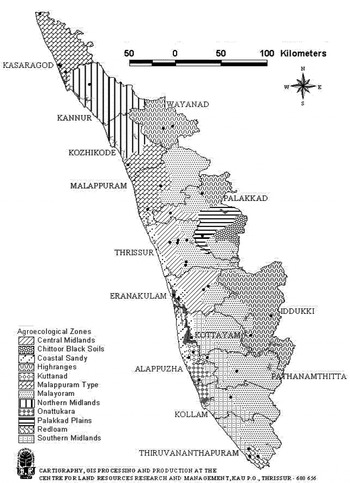
This survey was conducted in the northern midlands agro-ecological zone, one among 13 different agro-ecological zones of Kerala comprised of Kannur and Kozhikode districts as depicted in Figure 1. This zone is a low altitude region of Kerala, endowed with humid tropical climate and altitudinal variations up to 500 m above mean sea level. It receives southwest monsoon during June to August with July maximum and relatively weak northeast monsoon during October to November. Topographical features of less extensive valleys and hills with moderate gradients and tops with egg shaped humps are characteristic of this zone. The soil type is laterite.
Agro ecological zones of Kerala (Source:http://fcitr.kau.edu/pop/agro-ecologicalzonesofkerala.htm).

Sampling procedure
The panchayats (areas) randomly selected for the study were Chekkiad in the Kozhikode district and Thrippangottur in the Kannur district. In each panchayat, five wards were randomly selected for the study. A sample of 75 farmers in each district was randomly drawn from the list of families maintained in the official records of panchayats. Villages close to town and urban areas were not sampled as they tend to be influenced by urban farming. Although the intended number of households was 75 per district, some farmers were either unavailable during the survey, or uncooperative. Therefore data could be generated from an effective sample size of 65 and 63 families from the Kozhikode and Kannur districts respectively.
Participatory rural appraisals and data collection
Structured questionnaires were used to interview the member of the family who was directly responsible for the care of chickens. Additional data were collected by actual measurements and on-spot observations. The assistance of local veterinary surgeons and the ward members were obtained to establish good rapport with farmers for effective survey and post-visit follow-ups. Data collected mainly included rearing practices, housing, feeding and watering managements, diseases and their management, natural incubation, ethno-veterinary practices, income from chicken keeping and marketing. Focussed group discussions with the family members were arranged to analyse the pros and cons of village chicken farming, disease prevalence, adequacy of veterinary facility and to assess the social and cultural impact of village chicken farming.
Overview information
The system of management of village chicken rearing in the northern midlands agro-ecological zone of Kerala is extensive free range type with (98.4%) or without (1.6%) the provision for night shelter.
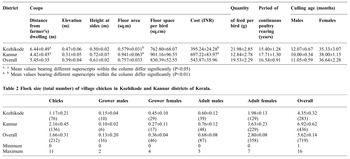
On average the farmers have been involved in village chicken rearing continuously for the past 16.5 years (Table 1). Most of the farmers (83.6%) reared pure indigenous chickens (local name: Naadan kozhi) and expressed satisfaction in keeping indigenous chickens rather than improved varieties of exotic hybrids.
Different parameters of village chicken rearing in the Kozhikode and Kannur districts of Kerala.

x, y Mean values bearing different superscripts within the column differ significantly (P<0.05)
a, b Mean values bearing different superscripts within the column differ significantly (P<0.01)
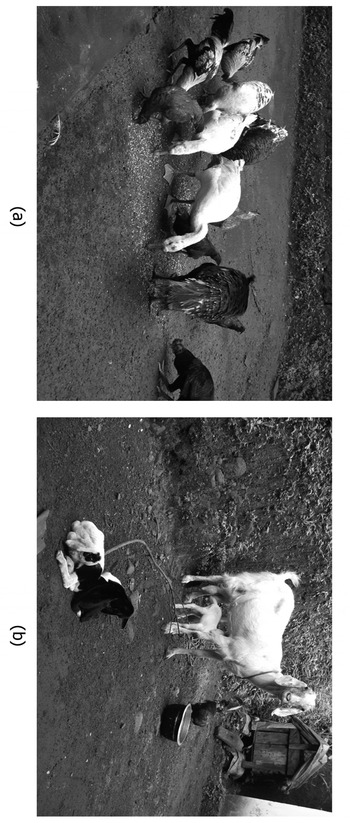
Family chickens are managed by women in most families (89.1%) when compared to men (3.1%) or all the family members together (7.8%). Other animal husbandry activities of chicken farming households are cattle rearing (23.4%), both cattle and goat rearing (17.2%) and goat rearing (12.5%). Interestingly, 43.8% of the households have no other animal husbandry activity except backyard chicken keeping. Few farmers (3.1%) rear geese, turkeys and chickens together (Figure 2). The main agricultural activity of chicken farming families is either coconut cultivation (25.0%) or mixed farming (20.3%) or plantain (3.1%) or vegetable (3.1%) cultivation; while, others (48.4%) have no agricultural activities.
Integrated chicken farming in Kerala; (a) with other poultry; (b) with other livestock.

Flock composition
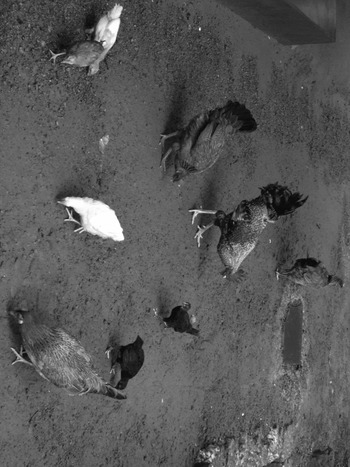
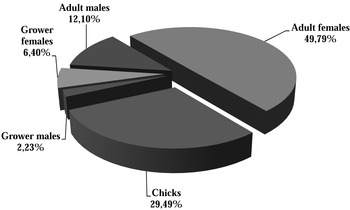
A typical flock of village chickens in the northern midlands agro-ecological zones of Kerala state is shown in Figure 3.
Composition of a typical flock of village chickens in Kerala.

Flock size (total number) of village chicken in Kozhikode and Kannur districts of Kerala.
| Chicks | Grower males | Grower females | Adult males | Adult females | Overall | |
|---|---|---|---|---|---|---|
| Kozhikode | 1.17±0.21 | 0.15±0.04 | 0.45±0.10 | 0.60±0.12 | 1.98±0.13 | 4.35±0.32 |
| (76) | (10) | (29) | (39) | (129) | (283) | |
| Kannur | 2.16±0.45 | 0.10±0.02 | 0.27±0.11 | 0.76±0.12 | 3.63±0.23 | 6.92±0.62 |
| (136) | (6) | (17) | (48) | (229) | (436) | |
| Overall | 1.66±0.31 | 0.13±0.20 | 0.36±0.04 | 0.68±0.08 | 2.80±0.08 | 5.62±0.14 |
| (212) | (16) | (46) | (87) | (358) | (719) | |
| Minimum | 0 | 0 | 0 | 0 | 0 | 1 |
| Maximum | 11 | 2 | 4 | 5 | 7 | 16 |
The flock composition and minimum and maximum number of birds observed under each category in the entire survey area is presented in Table 2. The mean number of birds per household in the Kozhikode district was only 4.4±0.32, while that of the Kannur district was 6.9±0.62; the mean values between districts differ significantly (P≤0.01). The overall mean number of birds per household was 5.6±0.14. As shown in Figure 4, among the 719 birds surveyed from 128 chicken farming households, 212 (29.5%) were chicks (0 – 8 weeks old), 16 (2.2%) were grower (9 - 20 weeks old) males, 46 (6.4%) were grower females, 87 (12.1%) were adult (above 20 weeks old) males and 358 (49.8%) were adult females.
Flock composition of village chickens in Kerala.

Breeding management
Most of the farmers (59.3%) had performed at least one natural incubation to produce replacement stock during the 12 months prior to the survey. Some farmers (12.1%) exchange eggs for chicks with their neighbours while others purchase grown chicks from neighbours (11.9%) or the market (8.4%).
Natural incubation
The nest box materials used in natural incubation include plastic cans (21.9%), rubber baskets (17.2%) and steel mortar pans used in construction works (14.1%), broken earthen pots (12.5%), wooden crates used in vegetable packing (9.4%), baskets made of spathes of areca palm (1.6%); while, 23.4% of the farmers set the eggs directly on the floor for incubation. No nesting material is used inside the nest box by 14.1% of the farmers, while others use either sand (51.6%), paddy husk (15.6%), straw (12.5%), clothes (3.1%), ash (1.6%) or coir fibre (1.6%). The average number of eggs set under a broody hen is 10.4. A break-open study of 78 un-hatched eggs from 217 incubated eggs showed a fertility rate of 76.0%.
Housing and housing management
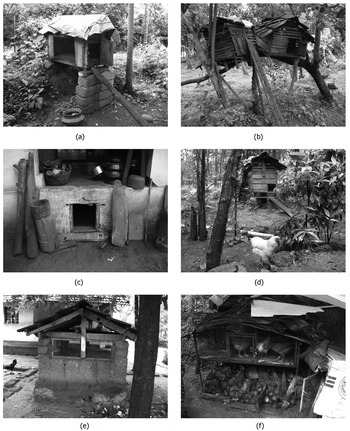
All the farmers were providing night shelter to their birds in coops except two, who allowed the birds to roost on the trees during night. The different types of coops used for providing night shelter are presented in Figure 5.
design and location
The measurements and the location of chicken coops used in the Kannur and Kozhikode districts are presented in Table 1. The majority of the coops were made up of a wooden floor (61.9%) and materials like mud (17.5%), cement (11.1%) and slats (9.5%) were found to be used minimally. The roofing materials used were tiles (33.3%), thatch (23.8%), plastic sheets (14.3%), stones with mud (14.3%), wood (7.9%), concrete (4.7%) and asbestos (1.6%). The walls were chiefly made of wood (69.8%); however materials like bricks (12.7%), stone with mud (9.5%), wire mesh (4.8%) and wire mesh mounted in wooden frames (3.2%) were less commonly seen. The coops were constructed either at the ground level (36.5%) or elevated at 0.39 m on pillars constructed with laterite stones. The average height of coops at eave was 0.61m. The floor area of the coops varied from 0.180 to 1.420 m2 with an overall mean of 0.757 m2, giving a floor space of 830.39 cm2 per bird. Very few coops were provided with perches (11.1%) or spread with sand as litter material (3.2%).
location of coops
Only a small proportion (12.7%) of farmers had the coops attached to their houses. The average distance between independent coops and farmers’ house was 5.45 m (Table 1).
Types of coops used by village chicken farmers of Kerala; (a) Elevated, wooden with wire mesh with plastic sheet on top, (b) Wooden with tiled roof, built on tree branch, (c) Attached to house, (d) Wooden with tiled roof, (e) Mud and stone with wire mesh, tiled roof, (f) Welded mesh with plastic sheet roof.

floor space allocation
The average floor space given as night shelter ranged from 278 cm2 to 1395 cm2 with overall mean of 830.39 cm2 per bird.
construction cost
The construction cost of coops ranged from INR 100 to 2500 with an average of INR 543.87.
Nesting management
The majority of the farmers (55.5%) do not provide nests for egg laying. Some farmers use wooden crates used in vegetable packing spread with paddy straw for this purpose. Birds usually lay their eggs in the cattle barns or inside the house. Some farmers confine the birds under bamboo baskets when they are in search of a nest for egg laying.
Feeding and water management
The prime purpose of supplemental feeding as perceived by the farmers is to provide adequate nutrition (29.7%) or to encourage some behavioural activities (18.8%) or for both (15.6%). The remaining households (35.9%) do not provide any supplemental feeding. Rice grain is the most common feed supplement (46.9%), followed by wheat grains (9.4%), finger millet (3.1%), rice flakes (3.1%) and compounded poultry feed (1.6%). The average quantity of supplemental feed given per adult bird per day is 19.5 g. Some farmers (41.5%) follow no specific timing in feeding, whereas others feed their birds either during morning before 11am (4.9%) or noon between 11am and 1pm (21.9%) or evening after 1pm (17.1%) or three times a day (9.8%) or immediately after laying (4.9%).
The majority of the farmers (57.8%) provide well water in containers while the rest do not have any provision for water. The containers used for this purpose are coconut shells (23.4%), stainless steel containers (17.2%), broken earthen pots (7.8%), plastic utensils (6.3%) and rubber containers (3.1%).
Diseases and their management
The systems of medicine adopted by farmers to treat diseases include indigenous (31.3%), allopathic (20.3%), a combination of both (15.6%) or none (32.8%). Only 25.0% of the farmers seek veterinary services from Government institutions for treating their birds.
A vast majority of the farming households (90.6%) do not practice any disease control measures, whereas 6.3% depend on herbals like holy basil, garlic, turmeric, coastal premna, thatch screw pine and other aromatic plants whenever an outbreak of disease has been encountered in the surroundings. Very few farmers follow antibiotic administration (1.6%) or practice disinfection of coops with bleaching powder (1.6%) as a measure of biosecurity. No farmer in the surveyed area practiced de-worming.
Culling of surplus stock
The mean culling age of surplus male birds was 11.1 months. Most of the farmers (59.4%) cull their cockerels between seven months and one year of age, 28.1% from 1 to 1.5 years and 12.5% above 1.5 years. Surplus males are removed by slaughter for self-use (50.0%), live sale (23.4%), by both self-use and live sale (21.9%) or for religious rites (4.7%). In the case of hens, the average culling age is 36.6 months. Surprisingly, most of the farmers (78.1%) do not practice culling excess females for meat purposes, but rather rear them till they meet a natural death due to senility or other means. Some farmers use females for meat (7.8%), while others sell them out (6.3%) or both sell and consume (7.8%).
Marketing and monetary benefit
The eggs are being consumed in home (52.2%) or sold (40.9%) in most situations, but less frequently, are given free of cost to neighbours and relatives (3.2%) or retained for hatching purpose (3.7%). The surplus adult birds are sold for meat to neighbours (21.3%) or sold in the nearby market (19.4%). The sale price of eggs ranges from INR 5.50 to 7.50 and adult birds are sold at INR 350 to 500. The proceeds of sales mostly (84.4%) go to the female member of the family who maintain the family flock.
Conclusions
Housing for village chickens in the northern midlands agro-ecological zone of Malabar India is being provided only at night in most cases (98%) while very few farmers (1.6%) allow the birds to roost on the trees during night as was reported from Nicobar Islands, India (Vijh et al., Reference VIJH, CHATTERJEE, VIJ, TANTIA and AHLAWAT2006). In Southern Nyanza of Kenya, most of the farmers (94%) provided night shelter in human dwellings and only 6% of the farms had separate shelters (Olwande et al., Reference OLWANDE, OGARA, OKUTHE, MUCHEMI, OKOTH, ODINDO and ADHIAMBO2010). The provision of coops for night shelter is considered essential by the farmers because of highly prevalent nocturnal predators in the nearby jungle.
The farmers rear chickens as a traditional farming activity which was evidenced by an average of 16.5 years of continuous chicken rearing. Breaks in chicken rearing happened mainly due to the outbreak of Ranikhet disease. The farmers are adept in managing native chickens in a manner similar to the farming practices reported by Selvam (Reference SELVAM2004) in Tamil Nadu, India.
It was observed in the present study that mostly the women (89%) are engaged in chicken rearing while the men are involved in agricultural work and other off farm activities. Similar findings were reported by Mengesha et al. (Reference MENGESHA, TAMIR and TADELLE2008) in Ethiopia (70%). Most of the women in the survey area are the members of a self-help group (SHG) called Kudumbasree supported by the Kerala state Government. They need to deposit a small fixed amount of money every week as their savings. Some of the women raise this money in full and others in part from chicken rearing.
The farmers rear chickens alone or in combination with other poultry and small and large ruminants. The kitchen wastes, leftover concentrates from dairy animals and agricultural by-products are found utilised effectively in the study area as reported earlier by Tantia et al. (Reference TANTIA, VIJH, VIJ and AHLAWAT2005b). There is a common belief in the survey area that birds’ droppings, if consumed accidentally, make the dairy animals sick, therefore some households having dairy animals stay away from keeping chickens.
The average flock size of chicks, grower males, grower females, adult males and adult females in the village chicken recorded in the study was 1.66, 0.13, 0.36, 0.68 and 2.80 respectively. In contrast to the high proportion of adult females (50%) and low proportion of chicks (30%) observed in the present study, many earlier reports (Tantia et al., Reference TANTIA, VIJH, VIJ and AHLAWAT2005b; Vijh et al., Reference VIJH, ROY, VIJ, TANTIA and AHLAWAT2005) recorded less than 30% of adult females but more than 50% chicks in the indigenous chicken populations of India. The practice of not culling the females and high level of depletion of chicks due to predation in this thickly vegetated region might be attributed to the shift in flock composition.
The farmers use locally available materials, including plastic cans, rubber baskets, steel mortar pans, earthen pots, wooden crates as nest boxes for incubation; whereas bamboo is the common building material reported in other parts of India (Vij et al., Reference VIJ, TANTIA, VIJH and AHLAWAT2005) and other countries (Das et al., Reference DAS, CHOWDHURY, KHATUN, NISHIBORI, ISOBE and YOSHIMURA2008). It is interesting to note that a good number of farmers (23%) directly set the eggs on the floor in a dark corner of their house. The nest material used by the majority of farmers (52%) is sand followed by paddy husk, straw, clothes, coir fibre and even ash. Perusal of literature provided no evidence of using sand as nesting material in any part of the world. As reported by Vijh et al. (Reference VIJH, ROY, VIJ, TANTIA and AHLAWAT2005) in indigenous Miri birds, paddy straw bedding is being provided; whereas, grass has been used in Zimbabwe (McAinsh et al., Reference MCAINSH, KUSINA, MADSEN and NYONJI2004) and wood shavings or paddy straw in Bangladesh (Das et al., Reference DAS, CHOWDHURY, KHATUN, NISHIBORI, ISOBE and YOSHIMURA2008). The mean number of eggs set under broody hen (10.4 eggs) is very close to the findings of McAinsh et al. (Reference MCAINSH, KUSINA, MADSEN and NYONJI2004) in local chickens of Zimbabwe (10.6 eggs).
The fertility of eggs observed in this study was low (76%) mainly because the majority of the farmers (58%) do not maintain a single cockerel in their homestead, despite the fact that they are well aware of the importance of them for producing fertile eggs. Interestingly, the farmers having no cockerel in their flock also incubate their eggs for hatching taking chance of their hens being mated by the cockerels from the neighbourhood. Moreover, poor fertility could be attributed to the practice of keeping cockerels for several years.
The most popular material used for making the floor (61.90%) and side walls (69.84%) of coops is wood as reported in other parts of India (Kumar and Kumar, Reference KUMAR and KUMAR2007) and Zimbawe (McAinsh et al., Reference MCAINSH, KUSINA, MADSEN and NYONJI2004). Wood is the cheapest and most easily available material in this thickly vegetated hilly region. The roofing of coops is mainly made of tiles (33.33%) or thatch (23.81%). Locally available materials like damaged tiles and abundantly available coconut leaves were found utilised efficiently in the construction of coops. Although the usage of tiles was scarcely reported, thatch is commonly used in India (Tantia et al., Reference TANTIA, GANAI, VIJ, VIJH and AHLAWAT2005a; Vij et al., Reference VIJ, TANTIA, VIJH and AHLAWAT2005) and other countries (McAinsh et al., Reference MCAINSH, KUSINA, MADSEN and NYONJI2004; Jansen et al., Reference JANSEN, GLATZ and and MIAO2009). Most chicken coops (63.5%) are elevated so as to avoid the nuisance from terrestrial predators like snake, rat, mongoose etc. This prevents termite-associated damage to the wooden parts or rusting and water seepage during rainy season, since Kerala, the only state of India receiving heavy rainfall from two monsoons. The elevation of shelter for the local chickens of Zimbabwe reported by McAinsh et al. (Reference MCAINSH, KUSINA, MADSEN and NYONJI2004) was one meter from the ground against the current findings of 0.39 m. Average floor space per bird (830 cm2) is much less when compared to 1900 cm2 given under an intensive, deep litter system (Panda and Mohapatra, Reference PANDA and MOHAPATRA1989). The reason given by most of the farmers (87%) for keeping the coops at a distance was to avoid the ectoparasites affecting chickens and to keep away from the off-odour of droppings. At the same time the coops are not kept too far away that the farmers can easily watch on the coop to minimise the incidences of predation. In addition, small landholdings allow the farmers to have only a short distance between their houses and chicken coops in many cases. The information regarding the distance of coop from the house is sparse in the literature. The low average construction cost of the coop (INR 543.87) is made possible only by utilizing the available household materials and workmanship. Considering the average floor area of coops (0.75 m2.) the construction cost per m2 works out to be INR 702.9 only.
The commonly used supplementary feed is rice (47%) since this is the food of the people of Kerala. Usage of compounded poultry feed is less prevalent (1.6%). In addition, the leftover feed and kitchen waste are fed to the birds. Farmers in other regions of India (Tantia et al., Reference TANTIA, KHANNA, VIJH, VIJ, SINGH and AHLAWAT2006) and other countries (McAinsh et al., Reference MCAINSH, KUSINA, MADSEN and NYONJI2004) also feed their chicken with the grains they cultivate, available in plenty locally or they commonly use as food. The quantity of supplemental feed per bird (19 g) in the present study was lower than that reported by Kumar and Kumar (Reference KUMAR and KUMAR2007) in Local Hill fowl of Uttarakhand, India. Some farmers have the practice of feeding the birds just after laying, so that the birds develop a habit of coming for feed after laying. This behaviour assists the owner to understand that the egg had been laid to collect them immediately without losing to crows, snakes etc. Some farmers feed the birds in the evening to develop the habit of returning from scavenging before dusk. A study on rural families in Bangladesh discussed the practice of feeding twice a day once in morning when birds leave the night shelter and again in the evening when they return (Das et al., Reference DAS, CHOWDHURY, KHATUN, NISHIBORI, ISOBE and YOSHIMURA2008). The farmers call the birds by making a peculiar sound to give feed or kitchen waste. The birds become conditioned to the call from a young age and assemble immediately. There is no rigid timing for feeding native chickens, unlike flocks reared under intensive system of rearing. This allows the households to attend to their birds at the leisure time between their household chores.
Apart from 58% of the farmers, others do not provide water to their birds similar to the findings of Jansen et al. (Reference JANSEN, GLATZ and and MIAO2009) in the Solomon Islands. This shows that the birds under extensive systems can thrive only from the water derived through scavenged feed of plant and animal origins which generally contain more than three-fourth water. Although chickens normally need double the quantity of water to that of dry matter intake, its ability to excrete the metabolic end products of protein in the form of uric acid comes handy in coping with the conditions of less available water. Farmers use coconut shells, stainless steel or plastic containers and earthen pots for watering similar to the usage of locally available materials like metallic pots in Uttarakhand, India (Kumar and Kumar, Reference KUMAR and KUMAR2007) and old tyres, plastic containers, cups and plates in Zimbabwe (McAinsh et al., Reference MCAINSH, KUSINA, MADSEN and NYONJI2004).
Herbs used for treatment are garlic juice and leaves of holy basil (Ocimum sanctum) (local name: Tulsi) for respiratory problems, turmeric for external application on wounds and orally for sick birds and an aromatic shrub coastal premna (Premna serratifolia) (local name: Narimunja) for ectoparasitism. Pungent fruits of a thorny plant thatch screwpine (Pandanus sp) (local Name: Kaitha) are kept inside the coops to control ectoparasites. Some farmers even give toddy (alcohol) when the birds become sick. In a similar study from Zimbabwe, farmers use a local plant called as ‘Gavakava’ of the aloe family for treating diarrhoea and swollen eyes (McAinsh et al., Reference MCAINSH, KUSINA, MADSEN and NYONJI2004). The primary reason attributed by the farmers for minimal usage (25%) of veterinary services from Government institutions was poor accessibility. For disease control also tulsi leaves, garlic and turmeric are being used. In a similar study, majority (60%) of the farmers of southern Nyanza, Kenya use herbs like Aloe vera, pepper and sisal leaves for treatment and control of the indigenous chicken diseases (Olwande et al., Reference OLWANDE, OGARA, OKUTHE, MUCHEMI, OKOTH, ODINDO and ADHIAMBO2010). The farmers of survey area were not impressed about vaccination when explained; but felt predation was the grave problem in causing more mortality than diseases. However, other indigenous chicken populations are being vaccinated against either one or more diseases like Ranikhet, fowl pox and fowl cholera (Tantia et al., Reference TANTIA, GANAI, VIJ, VIJH and AHLAWAT2005a; Reference TANTIA, VIJH, VIJ and AHLAWAT2005b; Vijh et al., Reference VIJH, ROY, VIJ, TANTIA and AHLAWAT2005; Tantia et al., Reference TANTIA, KHANNA, VIJH, VIJ, SINGH and AHLAWAT2006).
The majority of the farmers (88%) eliminate the surplus male birds between seven months and one-and-half years of age. The culling age of male cockerels was in agreement with that of Nicobari cockerels in Nicobar Islands of India (nine months) reported by Vijh et al. (Reference VIJH, CHATTERJEE, VIJ, TANTIA and AHLAWAT2006). The males in the study area are being slaughtered for meat at any time after seven months of age for occasions like festivals or feast. Most (50%) of the farmers use the males for home consumption, which is in sharp contrast with mere 3% home consumption in Solomon Islands (Jansen et al., Reference JANSEN, GLATZ and and MIAO2009). As per our knowledge, the practice of rare culling of female birds (21.87%) in the survey area has not been reported elsewhere in the world. If sacrificed, it is done only after their high rate of egg production as reported in Nicobari hens (Vijh et al., Reference VIJH, CHATTERJEE, VIJ, TANTIA and AHLAWAT2006). The market price of country chicken is driven mainly by festivals and availability of fish. However, both eggs and grownup males command 2 to 3 fold higher price compared to those from industrial origin. The decision on selling is mostly made by the housewives and the revenue goes to them only as was reported in Ethiopia (Mengesha et al., Reference MENGESHA, TAMIR and TADELLE2008). The farmers of different agro-ecological zones considered chickens as a source of food, income and manure as well as for cultural beliefs (Muchadeyi et al., Reference MUCHADEYI, WOLLNY, EDING, WEIGEND, MAKUZA and SIMIANER2007).
In conclusion, family chicken farming is a traditional activity in almost all households of Kerala. The present study revealed that indigenous chickens by virtue of their hardiness to diseases, capability to evade predation, broodiness for self-propagation, ability to thrive under scavenging and scrap feeding, ability to withstand harsh climates, products fetching a higher price are preferred by the farmers than exotic hybrids. This low input farming system involves minimal investment and expenditure in terms of housing, feeding and disease control. Nevertheless, village chickens serve as a subsidiary source of income to housewives, nutritious food for the family especially children, an effective way of recycling agricultural by-products and kitchen wastes and animals to perform religious rites. This study clearly indicated the need for the proactive involvement of state Government in terms of supply of inputs like grownup deshi chicks, doorstep veterinary services and the establishment of cooperative producer and marketing societies and above all educating farmers on scientific chicken rearing practices to augment the output delivery from this sector.