Introduction
The Internet has increasingly been used to discuss personal accounts of suicidality (Etzersdorfer et al. Reference Etzersdorfer, Fielder and Witte2003; Eichenberg, Reference Eichenberg2008). Only a small proportion of this communication occurs in professional settings. Non-professionally run suicide message boards provide ample opportunities for anonymous individuals to discuss suicidality with like-minded peers and their discussions are easily accessible to other Internet users, resulting in multiplicative effects of communicated contents (Eichenberg, Reference Eichenberg2008).
Non-professional suicide message boards are heterogeneous, with varying predominant attitudes towards suicide, as reflected in specific forum regulations (Etzersdorfer et al. Reference Etzersdorfer, Fielder and Witte2003). Some boards foster discussions about suicide methods and have been labeled ‘pro-suicide’; others prohibit suicide announcements and have been labeled ‘against-suicide’. It is, therefore, not surprising that non-professional suicide message boards have been at the forefront of controversial discussions among mental health professionals, policy makers and public media about their potential negative impact on vulnerable users. An increasing number of case studies highlight that message boards can serve as a tool for learning about suicide methods (Baume et al. Reference Baume, Cantor and Rolfe1997; Becker et al. Reference Becker, Mayer, Nagenborg, El-Faddagh and Schmidt2004; Alao et al. Reference Alao, Soderberg, Pohl and Alao2006; Naito, Reference Naito2007), and can be experienced as an inspiration for suicide (Becker & Schmidt, Reference Becker and Schmidt2004; Dunlop et al. Reference Dunlop, More and Romer2011; Tseng & Yang, Reference Tseng and Yang2015; Westerlund et al. Reference Westerlund, Hadlaczky and Wasserman2015). Concerns about the risks involved have resulted in the suggestion for mental health professionals to take a patient's Internet history (Cooney & Morris, Reference Cooney and Morris2009; Lehavot et al. Reference Lehavot, Ben-Zeev and Neville2012; Till & Niederkrotenthaler, Reference Till and Niederkrotenthaler2014). Policy regulations to ban ‘pro-suicide’ sites have been discussed, but are difficult to implement (Pirkis et al. Reference Pirkis, Neal, Dare, Blood and Studdert2009).
The impact of suicide message boards may not only be negative, and numerous potential positive effects of online communication have been reported: individuals at risk of suicide reported feeling less alienated and believed their online experience reduced their suicidality (Harris et al. Reference Harris, McLean and Sheffield2009). This finding seems even more relevant as suicidal individuals who go online for suicide-related purposes also reported higher suicidality as compared with suicidal individuals not using the Internet for such purposes (Harris et al. Reference Harris, McLean and Sheffield2009; Mok et al. Reference Mok, Jorm and Pirkis2016; Niederkrotenthaler et al. Reference Niederkrotenthaler, Haider, Till, Mok and Pirkisin press). Most postings in an electronic bulletin board devoted to suicide were supportive and respectful of other posters (Miller & Gergen, Reference Miller and Gergen1998). Communication patterns in online support groups depend upon the training of posters responding to messages of distress. Trained volunteers use a greater variety of strategies, and focus more on emotions as well as therapeutic-like focused strategies, whereas strategies such as self-disclosure are more common in untrained lay individuals (Gilat et al. Reference Gilat, Tobin and Shahar2012).
It is currently unclear how communication patterns vary across boards that support an ‘against-suicide’, ‘neutral’ and ‘pro-suicide’ attitude, and which communication styles may help users in these settings to psychologically improve (Collings & Niederkrotenthaler, Reference Collings and Niederkrotenthaler2012). Related information may inform preventive interventions in these settings.
We investigated the following research questions:
-
How does the content of postings from primary posters (i.e. posters opening a thread) and responding posters differ across boards that support an ‘against-suicide’, ‘neutral’ and ‘pro-suicide’ attitude?
-
How consistent are primary posters and respondents with regard to indicators of suicidality?
-
Which communication styles of respondents are associated with expressions of psychological improvement in the primary poster by the end of the thread?
Method
We searched the Internet (German search terms: Suizidforum, Selbstmordforum) for suicide message boards, using the Google and Bing search engines. Consistent with previous literature (Till & Niederkrotenthaler, Reference Till and Niederkrotenthaler2014), we screened the first three pages of the search results (12 pages total for two terms and two engines). Browser cache and history were cleared, and all filters were switched off. The following inclusion criteria applied: (1) non-professionally run message board; (2) at least a defined subgroup with main focus on suicide and ‘crisis’, but not on a specific mental disorder; (3) more than 25 threads archived; (4) site not down; (5) site not part of a commercial application (e.g. Facebook). In total, we identified 24 potential message boards. Of these, eight boards contained <25 archived threads. Five sites were down. Two sites were not message boards. One site had been inactive for >10 years. Two boards had suicide only as a side topic. The remaining six boards were included.
We screened the start pages of these boards for potential links to further boards, which yielded one additional board.
We screened these seven boards and categorized them into three categories: ‘pro-suicide’ board (n = 4), ‘neutral’ board (n = 1) and ‘against-suicide’ board (n = 2). Criteria for the categorization included the mottos stated on the website, graphic symbols used and specific forum regulations. To code as ‘against-suicide’, boards were required to prohibit method discussions, link to professional resources and encourage reaching out in the case of suicide announcements. Boards explicitly promoting uncensored and method discussions were coded as ‘pro-suicide’. Boards without any ‘pro-suicide’ features that did not link professional resources were coded ‘neutral’. See online Supplementary Table S1 for detailed board characteristics.
Sample selection of postings
For each message board, we randomly selected threads that were saved in February 2014 and included threads dating back until 2002. Postings with start dates in 2014 were only included if they seemed not to be ongoing. Two of the boards (selbstmordforum.at, suizidbase.com) contained very few threads overall. All available threads from these boards were included to ensure a sufficient representation in the sample. With regard to the other boards, we applied a two-step selection procedure using an online random number generator (random.org). The first step was the random selection of a page number of the respective archive to look up. The second step was the generation of several random numbers which determined the specific threads on the selected archival page to look up. A post-hoc Kolmogornov–Smirnoff goodness-of-fit test indicated that the number of selected threads was consistent with a uniform distribution across archived years (selbstmordforum.net, suizid-forum.com) or across archived pages (voy-boards).
Threads that contained fewer than four postings were excluded. The final sample included n = 401 threads from ‘against-suicide’ boards, n = 382 threads from ‘neutral’ boards, and n = 399 threads from ‘pro-suicide’ boards.
Content analysis
A total of 50 threads from all message boards were obtained for the development of the coding scheme. These threads were not part of the sample analysed subsequently. We defined each thread as a coding unit and read the threads in depth to get an overview of the material. For each of the thematic categories of interest, we defined coding categories based on theoretical considerations and previous related research. During the development process, the researchers frequently redefined codes, and amended code categories to tailor the analysis to the material at hand. In the following section we describe basic categories and provide selected definitions. Detailed code definitions and coding examples are provided in online Supplementary Table S2.
Demographics of primary poster
-
Demographic information obtained was reported gender and reported age group.
Basic descriptive information
-
Basic descriptive information obtained was: length of thread in terms of days and number of postings; number of postings by primary posters; and number of respondents.
Primary needs and main types of reactions to need
The primary posters’ stated primary need in terms of constructive or self-destructive intent was noted, and any responses to that need that were of particular relevance.
The subcodes developed were help-constructive (i.e. the primary poster raised a wish to get constructive help), help-destructive (i.e. a wish to get help for a suicidal act or self-destruction), general discussion (i.e. a wish to generally discuss an issue related to suicide or death without any self-reference), death announcement (i.e. announcing the death of some other person), and ‘other need’.
We captured the responses of posters in terms of their encouragement or discouragement of the primary need. Beside explicit forms of encouragement or discouragement, there were also implicit forms that typically did not directly address the primary poster, but rather included a general opinion on that type of wish, or a self-disclosure. For example, in reply to a destructive wish for hanging, the following statement would code as ‘implicit’ encouragement (parentheses indicate the respective text position in the material): ‘Hanging is pretty painless if done right’ (VOY2/23).
In contrast, an explicitly affirming response would directly address the primary poster's behavior: ‘I think it is good and brave that you are willing to take this step…’ (VOY3/91).
Specific response types
For the functional types of responses, we adapted codes from earlier literature on crisis intervention (Mishara et al. Reference Mishara, Chagnon, Daigle, Balan, Raymond, Marcoux, Bardon, Campbell and Berman2007; Gould et al. Reference Gould, Cross, Pisani, Munfakh and Kleinman2013):
-
Suicide risk assessment (i.e. respondent(s) assessed suicide risk);
-
Active listening with focus on problems/stressors;
-
Active listening with focus on self-destructive impulses only;
-
Collaborative problem solving;
-
Constructive advice;
-
Destructive advice;
-
Revealing own problems/experiences;
-
Psychoeducation (e.g. providing information on therapy settings);
-
Promotion of health services; promotion of life and highlighting reasons for living; and promotion of suicide/death; Sympathy; antipathy towards primary posters/others in thread
Indicators of suicidality
To assess indicators of suicidality, we created codes based on Erwin Ringel's concept of the pre-suicidal syndrome and Edwin Shneidman's concept of 10 commonalities of suicide (Ringel, Reference Ringel1976, Reference Ringel1997; Shneidman, Reference Shneidman1995; Sonneck et al. Reference Sonneck, Kapusta, Tomandl and Voracek2012) which both refer to constricted forms of cognition and emotion typically found in suicidal individuals. Several dimensions of ‘constriction’ were defined, in particular affective, situative and relationship-related constriction. The pre-suicidal syndrome also comprises symptoms of aggression and so-called suicidal ‘fantasies’ or imageries (Ringel, Reference Ringel1976; Shneidman, Reference Shneidman1995). Suicidal imagery has been shown to be prevalent in depression and bipolar disorders involving suicidality; and patients reported a stronger pre-occupation with these imageries as compared with verbal thoughts of suicide (Hales et al. Reference Hales, Deeprose, Goodwin and Holmes2011, Reference Hales, Blackwell, Simplicio, Iyadurai, Young, Holmes, Brown and Clark2015).
In addition, we coded the following risk factors of suicidality: current suicidal ideation; and method considered.
Because it was evident that both primary posters and responding posters showed indicators of suicidality, we coded these codes separately for the primary poster and responding posters. If any responding poster showed a specific indicator, the respective code was coded positive, irrespective of the amount across all responding posters.
Changes/outcomes by end of thread
Psychological improvement in terms of the primary poster indicating being less overwhelmed, less suicidal, more hopeful, or more confident/ in control was coded based on Gould et al. (Reference Gould, Cross, Pisani, Munfakh and Kleinman2013). Psychological improvement was coded positive if any of these indicators was positive and clearly related to a constructive development of the primary poster.
Selected harmful and protective media recommendations
Media recommendations for reporting on suicide list codes that may enhance or reduce harmful effects of reporting on suicide (World Health Organization, 2008). Examples of harmful item characteristics include detailed descriptions of suicide methods, or simplifications of suicide. Protective characteristics include the featuring of help services, and stories of lived experience. We coded selected media recommendations as they were relevant to the material at hand.
Procedure
The content of the threads retrieved for analysis (n = 1182) was coded by two coders (T.N. and B.T.) who each coded half of the threads selected. The coding took place from 2 February 2014 to 8 August 2014.
Intercoder reliability
After the coding, n = 60 threads (5.1% of all threads analysed) were randomly selected and coded by the other coder. Percentage agreement and Krippendorff α values were calculated for each code. For all variables, percentage agreement was >90%. Krippendorff α coefficients were >0.9 for most variables, which is considered very reliable, and generally >0.8, which is considered satisfactory (Krippendorff, Reference Krippendorff2004; see online Supplementary Table S2 for individual coefficients).
Sample size calculation
A sample size calculation indicated that, in order to be able to detect a difference of 10% in the prevalence of dichotomized item characteristics with low to high prevalence, a total sample size of n = 1182 was required. The sample size calculation was performed with GPower 3.1 (Faul et al. Reference Faul, Erdfelder, Lang and Buchner2007).
Statistical analysis
We compared frequencies of codes using χ2 tests, comparing ‘pro-suicide’ and ‘neutral’ threads with ‘against-suicide’ threads, respectively. For small cell counts (⩽5), we used Fisher's exact tests.
To test if primary posters and respondents were similar in terms of suicidality, we calculated phi (ϕ) correlation coefficients between the respective indicators in the primary poster and respondents within the same thread.
Associations of responses with potential psychological improvement of the primary poster were assessed with logistic regression analysis. Improvement on either of the categories less overwhelmed, less suicidal, more hopeful or more confident/in control was coded as positive (1). In the adjusted analyses, we generally controlled for the forum type and for the initially constructive or destructive intent as raised by the primary poster (see respective table for details). All analyses were performed with IBM SPSS Statistics 23 (USA).
Ethical statement
All procedures contributing to this work comply with the ethical standards of the relevant national and institutional committees on human experimentation and with the Helsinki Declaration of 1975, as revised in 2008. Ethical approval for this study was obtained from the Ethical Review Board at the Medical University of Vienna, Austria (review number 2010/353). Permission of site moderators to analyse postings was not sought. Potential personal identifiers, e.g. nicknames, are blinded in the coding examples provided.
Results
Differences in contents between board types
Demographics of primary posters and basic thread characteristics
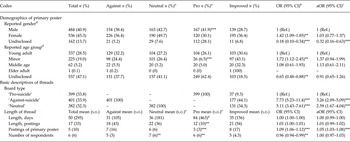
Posters in ‘pro-suicide’ threads were more frequently males, and less frequently minors than in ‘against-suicide’ boards. ‘Against-suicide’ threads were longer, with more postings stemming from the primary poster, whereas ‘pro-suicide’ threads spanned across a longer time period and included more respondents (Table 1).
Demographics of primary poster and basic thread characteristics by forum type and associations with primary posters’ improvement

OR, Odds ratio; CI, confidence interval; aOR, adjusted OR; Ref., reference; s.d., standard deviation.
a Compared with ‘against-suicide’ threads with Pearson's χ2 tests or Fisher's exact test (if cell numbers ⩽5).
b ORs are crude odds of improvement.
c aORs of psychological improvement are generally adjusted for board type (against-suicide, neutral and pro-suicide) and type of initial need (see Table 2) as brought up by primary poster. Exemption: aORs displayed for board types are only adjusted for type of initial need.
d χ2 Tests were based on known categories only (undisclosed category was excluded).
e Compared with ‘against-suicide’ threads with t tests.
* p < 0.05, ** p < 0.01, *** p < 0.001 (two-tailed).
Characteristics of primary initial needs and reaction to needs
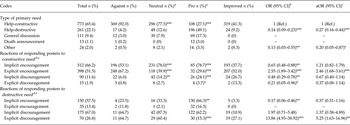
Primary posters in ‘against-suicide’ threads raised more constructive primary needs, whereas destructive primary needs were more common in ‘pro-suicide’ boards.
Responses explicitly supporting constructive help-seeking were most common in ‘against-suicide’ threads (67.2%), followed by ‘neutral’ (39.9%) and ‘pro-suicide’ threads (29.6%) (Table 2). Implicitly discouraging reactions to constructive help-seeking needs were least frequent in ‘against-suicide’ boards (6%), and increased to 14.2% and 24.1% in ‘neutral’ and ‘pro-suicide’ boards, respectively. Explicitly discouraging postings in reaction to constructive needs were rare across message boards (range: 0.8% in ‘against-suicide’ threads to 3.7% in ‘pro-suicide’ threads).
Characteristics of primary initial needs and reactions to that need by forum type and associations with primary posters’ improvement

OR, Odds ratio; CI, confidence interval; aOR, adjusted OR; Ref., reference.
a Compared with ‘against-suicide’ threads with Pearson's χ2 tests or Fisher's exact test (if cell numbers ⩽5).
b ORs are crude odds of improvement.
c aORs are adjusted for board type. Reactions to constructive and destructive need are additionally adjusted for all other reaction types present in thread.
d Multiple responses allowed, therefore responses do not add up to 100%. Coded positive as soon as type of response is present within responding postings in the thread. Reference (not shown) for each category is ‘respective reaction type absent in thread’.
e Includes only threads with primary poster initially indicating a constructive need (n = 773).
f Includes only threads with primary poster initially indicating a destructive need (n = 261).
* p < 0.05, ** p < 0.01, *** p < 0.001 (two-tailed).
Implicit support of destructive needs was present in 23.5% of ‘against-suicide’ threads, which increased to 66.3% in ‘pro-suicide’ threads. Explicit statements discouraging destructive intent were similarly frequent in ‘against-suicide’ and ‘neutral’ threads (64.7% and 60.4%, respectively), but significantly lower in ‘pro-suicide’ threads (15.3%).
Specific response types
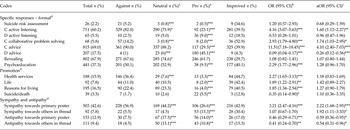
Response types that were more frequent in ‘against-suicide’ than in ‘pro-suicide’ threads included constructive active listening (82.0% v. 23.1%); collaborative problem solving (14.2% v. 2%) and constructive advice (90% v. 29.3%) (Table 3). Promotion of life-affirming aspects (e.g. of health services; 36.4% v. 3.3%), as well as statements indicating sympathy towards the primary poster (56.9% v. 26.6%), were more frequent in ‘against-suicide’ threads.
Specific response types by forum type and associations with primary posters’ improvement

OR, Odds ratio; CI, confidence interval; aOR, adjusted OR; C, constructive focus; D, destructive focus (e.g. active listening focuses on problems regarding how to conduct a suicide method, or advice regarding how to use a suicide method).
a Compared with ‘against-suicide’ threads with Pearson's χ2 tests or Fisher's exact test (if cell numbers ⩽5).
b ORs are crude odds of improvement.
c aORs are adjusted for board type and type of initial primary need as brought up by the primary poster.
d Multiple responses allowed, therefore responses do not add up to 100%. Positive as soon as type of response is present within responding postings in the thread. Reference (not shown) for each code is ‘respective code absent in thread’.
*p < 0.05, ** p < 0.01, *** p < 0.001 (two-tailed).
In contrast, ‘pro-suicide’ threads had more destructive advice (45.1% v. 1%) and included more antipathy towards the primary poster (14% v. 7.5%).
Promotion of suicide/death was infrequent across all board types, but more prevalent in ‘pro-suicide’ threads (5.5%) than in ‘against-suicide’ threads (1.7%).
Indicators of suicidality
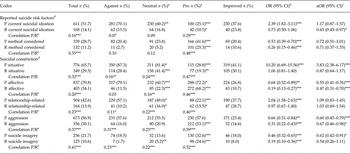
Codes that were more common in ‘against-suicide’ threads included direct reference to one's own current suicidal ideation (primary poster: 70.1% v. 25.1% in ‘pro-suicide’ threads), situative constriction of primary poster (87.3% v. 28.8%) and relationship-related constriction (57.1% v. 22.1%). Codes that were more frequent in ‘pro-suicide’ threads were suicidal imageries (32.6% v. 18.5% in ‘against-suicide’ threads); and several indicators of suicidal constriction in responding posters (e.g. affective constriction: 68.2% in ‘pro-suicide’ threads v. 11.5% in ‘against-suicide’ threads; aggression: 53.1% v.16.0%, and suicidal imageries: 24.6% v. 1.7%) (Table 4).
Indicators of suicidality by forum type, correlations between indicators in primary posters and respondents, and associations with primary posters’ improvement

OR, Odds ratio; CI, confidence interval; aOR, adjusted OR; P, primary poster; R, responding posters.
a Compared with ‘against-suicide’ threads with Pearson's χ2 tests or Fisher's exact test (if cell numbers ⩽5).
b ORs are crude odds of improvement.
c aORs are adjusted for board type and type of initial primary need as brought up by primary poster.
d Multiple responses for each variable allowed. Reference (not shown) for each category is ‘respective response absent’.
e Phi (ϕ) correlation coefficient for correlation between respective codes of primary poster and respondents.
* p < 0.05, ** p < 0.01, *** p < 0.001 (two-tailed).
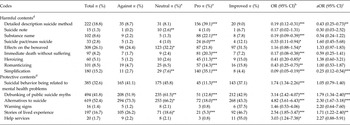
Selected harmful and protective media recommendations
Detailed descriptions of suicide methods (39.1% v. 8.7%), naming of substances that can be used (22.1% v. 2.2%), discussion of death without suffering (20.3% v. 1.7%) as well as heroizing (11.3% v. 1.2%), romanticizing (14.3% v. 4.7%) and simplifying suicidal behavior (35.1% v. 2.7%) were all more frequent in ‘pro-suicide’ threads as compared with ‘against-suicide’ threads (Table 5).
Selected harmful and protective media recommendations by forum type and associations with primary posters’ improvement

OR, Odds ratio; CI, confidence interval; aOR, adjusted OR.
a Compared with ‘against-suicide’ threads with Pearson's χ2 tests or Fisher's exact test (if cell numbers ⩽5).
b ORs are crude odds of improvement.
c aORs are adjusted for board type and type of initial need as brought up by primary poster.
d Multiple responses for each variable allowed, therefore responses do not add up to 100%. Reference (not shown) for each category is ‘respective code absent in thread’.
* p < 0.05, ** p < 0.01, *** p < 0.001 (two-tailed).
Protective codes were generally more prevalent in ‘against-suicide’ threads; e.g. highlighting suicidal behavior as a mental health problem (41.1% v. 11.3% in ‘pro-suicide’ threads), debunking suicide myths (51.9% v. 12.8%), highlighting alternatives to suicide (73.4% v. 18.0%) and stories of lived experience (26.2% v. 5.3%).
Consistency between primary posters' and responding posters' suicidality
In general, there was a moderate to strong consistency between primary posters’ and the respondents’ suicidality in ‘pro-suicide’ threads, which was not present in ‘against-suicide’ threads. ‘Neutral’ threads often had an intermediate position (Table 4).
Psychological improvement in the primary poster
Demographics of primary posters and basic thread characteristics
Undisclosed gender [adjusted odds ratio (aOR) 0.32, 95% confidence interval (CI) 0.16–0.63] was associated with lower odds of improvement as compared with male gender. ‘Neutral’ threads (aOR 2.59, 95% CI 1.67–4.04) and ‘against-suicide’ threads (aOR 3.26, 95% CI 2.09–5.09) had higher odds of improvement than ‘pro-suicide’ threads. A higher number of postings from the primary poster within the same thread was positively associated with improvement (aOR 1.05, 95% CI 1.03–1.08) (Table 1).
Primary needs and reactions to need
Destructive initial needs (aOR 0.27, 95% CI 0.16–0.44) of the primary poster were negatively associated with improvement. In cases of constructive needs, explicit encouragement by responding posters increased the odds of improvement (aOR 2.46, 95% CI 1.68–3.61). For destructive needs, explicit discouragement was positively associated with improvement (aOR 5.25, 95% CI 1.63–16.96) (Table 2).
Specific response types
Constructive active listening (aOR 1.60, 95% CI 1.12–2.27), collaborative problem solving (OR 1.74, 95% CI 1.03–2.95) and constructive advice (aOR 4.10, 95% CI 2.40–7.03) were positively associated with improvement, whereas destructive advice (aOR 0.26, 95% CI 0.12–0.56) was negatively associated with improvement.
Sympathy towards the primary poster (aOR 2.22, 95% CI 1.68–2.95) and towards others in the thread (aOR 1.92, 95% CI 1.11–3.33) were positively associated with improvement, whereas antipathy towards the primary poster (aOR 0.59, 95% CI 0.36–0.95) or others (aOR 0.54, 95% CI 0.31–0.96) were negatively associated with improvement (Table 3).
Indicators of suicidality
Explicit current suicidal ideation in respondents was negatively associated with improvement (aOR 0.65, 95% CI 0.43–0.97). Indicators of situative constriction of the primary poster were positively associated with improvement (aOR 3.83, 95% CI 2.38–6.17). In contrast, indicators of affective constriction in primary posters (aOR 0.55, 95% CI 0.41–0.76) and respondents (aOR 0.47, 95% CI 0.31–0.70) were negatively associated with improvement, as were aggression of primary posters (aOR 0.60, 95% CI 0.45–0.79) and respondents (aOR 0.67, 95% CI 0.46–0.98), and suicidal imageries among primary posters (aOR 0.62, 95% CI 0.42–0.91) (Table 4).
Selected harmful and protective media recommendations
Detailed descriptions of suicide methods (aOR 0.43, 95% CI 0.25–0.73) and simplifications of suicide (aOR 0.25, 95% CI 0.12–0.54) were negatively associated with improvement. In contrast, the debunking of public suicide myths (OR 1.79, 95% CI 1.34–2.40), portraying of alternatives to suicide (aOR 2.30, 95% CI 1.67–3.18) and stories of lived experience (aOR 1.71, 95% CI 1.22–2.40) were all positively associated with improvement of the primary poster (Table 5).
Discussion
Distinct differences exist between ‘against-suicide’ and ‘neutral’/‘pro-suicide’ message boards with regard to self-reported demographics, thread length, primary needs as raised by the primary posters, indicators of suicidality, and responses received from other posters. Primary posters and respondents resemble each other with regard to indicators of suicidality in ‘pro-suicide’ threads, less so in ‘neutral’ boards, and least in ‘against-suicide’ threads. Several communicative characteristics were associated with verbal expressions of psychological improvement in the primary poster by the end of the thread. In particular, strong participation of the primary poster, disclosure of his or her sociodemographic information and social circumstances, explicit affirmation of constructive needs and explicit discouragement of destructive needs increased the odds of improvement after controlling for board type and initial destructive or constructive need. Strategies that may help achieve positive outcomes are the provision of constructive advice, active listening and collaborative problem solving, as well as expression of sympathy, debunking of suicide myths, and provision of alternatives to suicidal behavior and positive stories of lived experience.
Comparison with other studies and study meaning
A German study showed that most users of a suicide message board were constructive help-seekers (Eichenberg, Reference Eichenberg2008). Constructive and destructive help-seeking were identified as the main motivations for posting in German and Japanese message boards (Sueki & Eichenberg, Reference Sueki and Eichenberg2012). This finding was clearly supported in the present analysis, and posters differed strongly with regard to their constructive v. destructive expressed motivation across board types. The identified differences in communicated needs, along with the self-reported differences in demographics, suggest a selection of different types of users into different types of message boards.
Some content-analytic studies have previously focused on the interaction in such boards. One study found that communicative strategies in an online support group primarily served to generate an emotionally supportive environment and to provide alternatives to the suicidal view (Gilat et al. Reference Gilat, Tobin and Shahar2011). Consistent with this view, anthropological work suggests that participation in Internet suicide forums results from a need for social connectedness and the fear of social rejection and isolation (Ozawa-de Silva, Reference Ozawa-de Silva2010). Another content analysis revealed that hostile entries were rare in a non-professional online board for individuals with mental health problems (Miller & Gergen, Reference Miller and Gergen1998), although subtle forms of potential encouragement of self-harm were discussed to potentially normalize or even minimize suicidal behavior (Rodham et al. Reference Rodham, Gavin and Miles2007).
Survey studies in message boards typically highlight that users perceive the interactions as supportive (Winkel et al. Reference Winkel, Groen and Petermann2005), see a value in the anonymity, and appreciate the low threshold for communication and self-disclosure (Jones et al. Reference Jones, Sharkey, Ford, Emmens, Hewis, Smithson, Sheaves and Owens2011).
It was hypothesized in previous research that conversations in message boards may be more suicidality-sustaining than transforming (Miller & Gergen, Reference Miller and Gergen1998). This finding was supported for ‘pro-suicide’ message boards in the present analysis, where expressions of psychological improvement over time were much less frequent as compared with posters in ‘neutral’ or ‘against-suicide’ boards. The similarity of posters and respondents with regard to suicidality in ‘pro-suicide’ boards may contribute to this consolidation, and may signal a stronger identification between primary posters and respondents in these boards. The findings support the notion of ‘birds of a feather that flock together’, i.e. that like-minded individuals tend to be selected into these boards. Based on knowledge about transference in counseling processes, it is unlikely that responding posters who show a similar degree of suicidal constriction as the primary poster can effectively help individuals transform their suicidality (Sonneck et al. Reference Sonneck, Kapusta, Tomandl and Voracek2012).
Interestingly, the communication of situative constriction (i.e. the poster's constricted life situation) was positively associated with psychological improvement. The apparent lack of indicators of situational issues discussed in ‘pro-suicide’ boards may reflect a further step in the suicidal process of posters on these boards (Wasserman et al. Reference Wasserman, Saraceno and Farberow2001; Sonneck et al. Reference Sonneck, Kapusta, Tomandl and Voracek2012), a reluctance of responding posters to ask about the current life situation, or a lower involvement of the poster in the conversation.
Strengths and limitations of the study
Strengths of the present study include the large sample size, and the detailed coding system. The differentiation of communicated contents of primary poster and respondents and of types of suicide message boards are further strengths. Most codes achieved very high intercoder reliability, indicating good measurement consistency across coders.
Limitations of the present study include the inability to assess underlying intentions that are not communicated. For example, a poster describing a need for help with regard to a suicide method may still be ambivalent and wish to get constructive help. Further, any indications of psychological improvement do not necessarily reflect an impact of the posting activity, and may be due to other co-occurring circumstances. The present analysis provides insight into the presence v. absence of specific communication content, but it does not provide details on the amount of related content. For example, a thread where most responding posters provided constructive advice, but some gave destructive advice, would screen positive for both characteristics. Further, because this study focused on a relatively small number of German-speaking message boards, the analysis needs to be replicated in other countries and cultures. There may be message boards which are more hostile regarding constructive needs as compared with those identified in the present analysis. Finally, this study focused on psychological improvement. Future analyses should also investigate potential deterioration. With regard to the present material, coding deterioration would have been difficult. Many primary posters communicated that they felt miserable at the beginning of the thread, often using similar statements in later postings. Different methodological approaches may be necessary to investigate potential psychological deterioration.
Implications for practice, policy and research
The present study confirms that potentially destructive primary needs are more accepted in ‘pro-suicide’ boards, and posters show fewer indicators of psychological improvement. Nevertheless, specific communicative strategies seem to be associated with potential psychological improvement. Individuals intervening in these settings can use the identified strategies. The odds of improvement increased with the level of participation of the primary poster in the conversation, which is consistent with previous findings on online communication (Barak & Bloch, Reference Barak and Bloch2006; Barak & Dolev-Cohen, Reference Barak and Dolev-Cohen2006). Also telephone helpline findings indicate that the length of the call is associated with callers’ positive behavioral changes (Gould et al. Reference Gould, Cross, Pisani, Munfakh and Kleinman2013). From the perspective of volunteers who want to provide help in ‘pro-suicide’ settings, these findings signal that the maintenance of a conversation and a person-centered focus on the primary poster are helpful.
Training of volunteers and professionals seems essential in efforts to improve communication in message boards. Training has been shown to result in a broader variety of communicative strategies used (Gilat et al. Reference Gilat, Tobin and Shahar2012). Both, strategies that are typically used in lay communication (e.g. self-disclosure as provided in stories of lived experience) and typical professional strategies (e.g. active listening) are culturally accepted and may be helpful in these settings.
With regard to policy implications, the present findings indicate that non-professional message boards should not be demonized. These boards seem to reach different priority populations for suicide prevention. Different from previous studies (Kemp & Collins, Reference Kemp and Collings2011; Till & Niederkrotenthaler, Reference Till and Niederkrotenthaler2014), both ‘pro-suicide’ and ‘against-suicide’ boards were relatively easy to find in the Austrian version of the Google and Bing search engines. Individuals running ‘against-suicide’ boards should further increase their ranking in search engines, e.g. by using meta-tags and increasing the number of links to their sites.
Further research is needed to compare the findings from these non-professional boards with professional settings. It has been noted that professional communicators rarely apply self-disclosure of lived experience (Gilat et al. Reference Gilat, Tobin and Shahar2012), which was associated with improvement in the present study. These self-disclosures may have a protective effect in certain individuals and situations. Also age and gender interactions should be explored in future research as the necessary data become available.
Conclusion
Several communicative strategies that are culturally accepted within the settings of non-professional suicide message boards may help suicidal posters to psychologically improve. The identified associations provide a rich basis for experimental intervention studies. Opportunities to intervene in ‘pro-suicide’ boards need to be taken and evaluated. The findings of this study can also help mental health professionals to better address suicidal posting activities with patients (Cooney & Morris, Reference Cooney and Morris2009; Lehavot et al. Reference Lehavot, Ben-Zeev and Neville2012). Talking through specific posting contents may strengthen the therapeutic alliance, assist in suicide risk assessment, and reduce possible negative effects of posting in these settings which have long been avoided in professional interventions.
Supplementary material
The supplementary material for this article can be found at http://dx.doi.org/10.1017/S003329171600221X
Acknowledgements
This study was supported by the Austrian Science Fund (grant number: P23659-B11, principal investigator T.N.).
Declaration of Interest
None.