The Language Experience and Proficiency Questionnaire (LEAP-Q) – a questionnaire tool for collecting self-reported background information on bilingual and multilingual speakers – was developed in the Northwestern Bilingualism and Psycholinguistics Research Lab over the course of several years and was introduced in a paper published in the Journal of Speech, Language, and Hearing Research (Marian, Blumenfeld & Kaushanskaya, Reference Marian, Blumenfeld and Kaushanskaya2007). The original version of the LEAP-Q, all its translations and adaptions, and information on how to export the data can be accessed online at https://bilingualism.northwestern.edu/leapq/ at no cost to the research community.
We designed the LEAP-Q because, at the time, there was little uniformity in how information about bilingual participants was presented in publications, and little agreement about which information was necessary to collect and present to enable replication (e.g., Li, Zhang, Tsai & Puls., Reference Li, Sepanski and Zhao2006). Although to this day there is debate about the aspects of bilingual experience that are necessary in defining bilingual populations (e.g., Bedore, Peña, Summers, Boerger, Resendiz, Greene, Bohman & Gillam, Reference Bedore, Peña, Summers, Boerger, Resendiz, Greene, Bohman and Gillam2012; Dunn & Tree, Reference Dunn and Tree2009; Gollan, Weissberger, Runnqvist, Montoya & Cera, Reference Gollan, Weissberger, Runnqvist, Montoya and Cera2012; Luk & Bialystok, Reference Luk and Bialystok2013; Robinson Anthony & Blumenfeld, Reference Robinson Anthony and Blumenfeld2018; Sheng, Lu & Gollan, Reference Sheng, Lu and Gollan2014), there is also considerable consensus across researchers on the fundamentals. At minimum, any work in bilingualism published today strives to include the following information: the ages at which the bilinguals’ two languages were acquired; the extent of exposure to the two languages currently and over a lifetime; and estimates of dominance and/or proficiency (subjective, objective, or both). The publication of the LEAP-Q played a significant role in engendering this change.
How does it work?
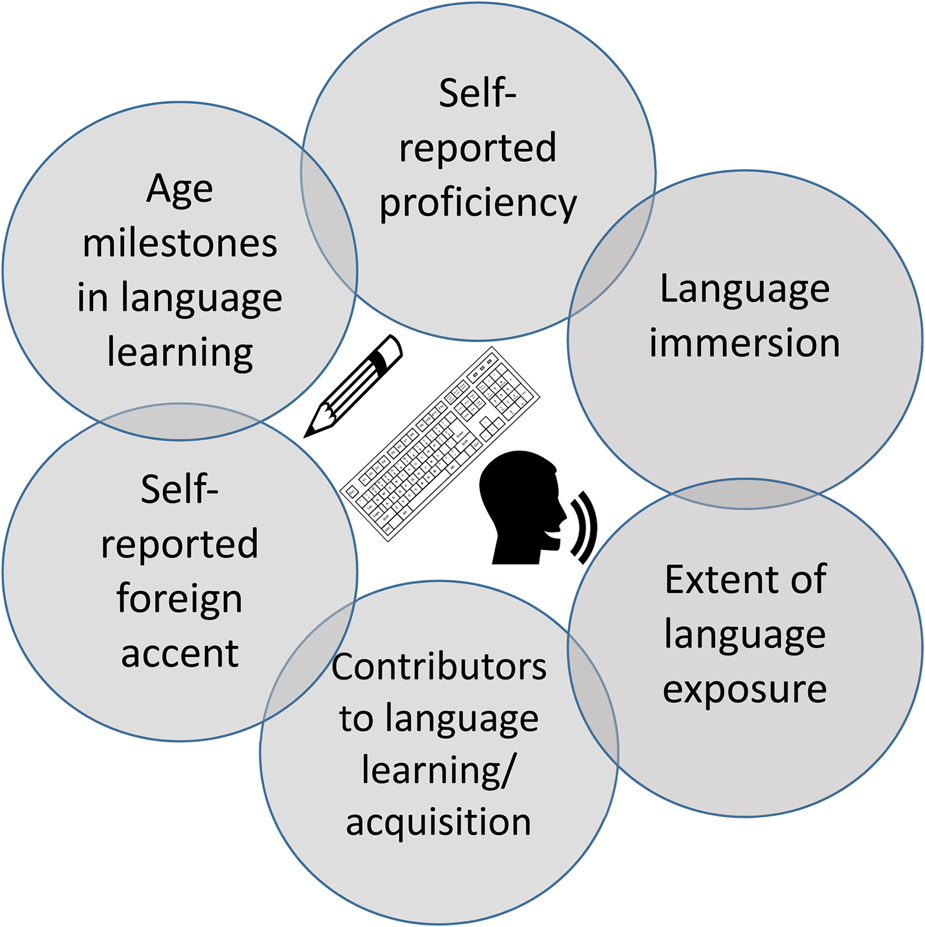
The LEAP-Q enables collection of self-reported language proficiency and experience data for any number of languages spoken by an individual. The LEAP-Q was designed to collect both broad measures of language dominance, language exposure, and language preference, and specific measures associated with each language (ages of acquisition and ages of attained fluency; length of immersion in different contexts; estimates of proficiency in speaking, reading, and understanding; ratings of how different contexts contribute to the acquisition of the language; extent of exposure to the language in different contexts; and degree of accent). See Figure 1 for a visual schematic. An 11-point (0–10) Likert scale is used for all the questions requiring estimates of degree and strength, with each point of the scale anchored to a descriptive label. The digital version of the LEAP-Q can be completed in 15 minutes by speakers of two languages. Knowledge of another language adds approximately 5 minutes to the completion of the questionnaire. The administration of the questionnaire as an oral interview extends administration time by 5–10 minutes.
The Language Experience and Proficiency questionnaire (LEAP-Q) is a self-report measure that can capture language profiles of multilingual speakers through self-reported proficiency, learning milestones, immersion duration, contributors to language learning/ acquisition, extent of exposure and self-reported foreign accent, and can be administered as a pencil-and-paper, electronic or interview measure.

The LEAP-Q was validated in two studies with two different samples of bilingual speakers. In Study 1, the LEAP-Q was administered to 52 multilingual speakers with diverse language backgrounds, representing 34 different languages. The internal validity of the questionnaire was established via a factor analysis that revealed logical clusters of questions reflecting fundamental bilingual dimensions (native language competence; second language competence; etc.). In Study 2, the LEAP-Q was administered to 50 bilingual speakers of English and Spanish. The internal validity of the questionnaire was replicated with this more homogenous sample of bilingual speakers. More importantly, criterion-based validity was established by confirming a relationship between self-reported data on the LEAP-Q and performance on objective, behavioral speech and language measures administered in the bilinguals’ two languages (Reading Fluency, Oral Comprehension, Passage Comprehension, Productive Vocabulary, and Sound Awareness subtests of the Woodcock-Johnson/Woodcock-Muñoz Tests of Achievement; Peabody Picture Vocabulary Test/ Test de Vocabulario en Imágenes Peabody; and grammaticality judgment tasks).
Correlation analyses linked self-ratings of proficiency in the L1 and the L2 to performance scores on speech and language measures. The general pattern of correlations indicated stronger relationships for the L2 than for the L1, most likely because of the wider range of values for the L2, both in the self-reported proficiency data and in the behavioral performance data. Broad measures of language ability (reading and oral comprehension) correlated more strongly with the self-ratings of proficiency than more specific measures of language ability (vocabulary; sound awareness; etc.). This indicates that bilinguals’ self-ratings of their proficiency reflect gestalt approximations of language skill. In the L1, self-ratings of reading proficiency were the strongest predictors of performance on speech and language measures. Conversely, in the L2, self-ratings of speaking proficiency were the strongest predictors of performance on speech and language measures.
Who is it for?
The original LEAP-Q was designed to be used in research settings, and to be administered to adult and adolescent bilingual and multilingual speakers representing a wide variety of language experiences and proficiency levels. In published studies, the youngest participants who successfully completed the LEAP-Q were 14 years of age (Krizman, Skoe, Marian & Kraus, Reference Krizman, Skoe, Marian and Kraus2014), and the oldest participants were 80 years of age (Ansaldo, Ghazi-Saidi & Adrover-Roig, Reference Ansaldo, Ghazi-Saidi and Adrover-Roig2015; Blumenfeld, Schroeder, Bobb, Freeman & Marian, Reference Blumenfeld, Schroeder, Bobb, Freeman and Marian2016; Schroeder & Marian, Reference Schroeder and Marian2012). The 11-point rating scales make the LEAP-Q exquisitely sensitive to fluctuations in bilingual experience, and as a result, it can be successfully completed by highly proficient bilingual speakers (e.g., Conrad, Recio & Jacobs, Reference Conrad, Recio and Jacobs2011; Mercier, Pivneva & Titone, Reference Mercier, Pivneva and Titone2014; Pelham & Abrams, Reference Pelham and Abrams2014), as well as by very inexperienced L2 learners (Ettlinger, Morgan-Short, Faretta-Studenberg & Wong, Reference Ettlinger, Morgan-Short, Faretta-Sudenberg and Wong2015; Nip & Blumenfeld, Reference Nip and Blumenfeld2015).
In the past 10 years, the LEAP-Q has become significantly more versatile. The LEAP-Q has been translated into 22 different languages (see Appendix A), and adapted for different dialects and socio-cultural contexts (e.g., English versions for the US, Australia, Singapore, and Canada). The LEAP-Q is now available in both an electronic and a paper-and-pencil format, and has been adapted as an oral interview to be used with older adult participants (e.g., Ansaldo et al., Reference Ansaldo, Ghazi-Saidi and Adrover-Roig2015), and with participants whose literacy levels are not strong enough (Blumenfeld, Quinzon, Alsol & Riera, Reference Blumenfeld, Quinzon, Alsol and Riera2017). Recently, the LEAP-Q was modified to enable collection of language background data from parents regarding their children (Rochanavibhata & Marian, Reference Rochanavibhata and Marianin preparation). All translations and adaptations of the LEAP-Q are available on https://bilingualism.northwestern.edu/leapq/. It is important to note that only the original LEAP-Q was validated against objective measures of speech and language ability.
How is it used?
Most frequently, the LEAP-Q is used by researchers to provide a comprehensive description of their bilingual participants (e.g., Ettlinger et al., Reference Ettlinger, Morgan-Short, Faretta-Sudenberg and Wong2015; Leonard, Torres, Travis, Brown, Hagler Jr, Dale, Elman & Halgren, Reference Leonard, Torres, Travis, Brown, Hagler, Dale, Elman and Halgren2011), and to substantiate a division of bilinguals into groups and subgroups. For example, LEAP-Q data often form the basis for assigning and/or confirming the assignment of bilinguals to early/simultaneous vs. late/sequential bilingual groups (e.g., Dimitropoulou, Duñabeitia & Carreiras, Reference Dimitropoulou, Duñabeitia and Carreiras2011; Pelham & Abrams, Reference Pelham and Abrams2014; Shi, Reference Shi2010). The LEAP-Q is also often used by researchers to screen their bilingual participants for adequate levels of language proficiency (e.g., Conrad et al., Reference Conrad, Recio and Jacobs2011), to confirm native-speaker status (e.g., Hespos & Piccin, Reference Hespos and Piccin2009), high levels of language proficiency (e.g., Lidji, Palmer, Peretz & Morningstar, Reference Lidji, Palmer, Peretz and Morningstar2011), or to document differences in L1 vs. L2 language skills (e.g., Mor, Yitzahki-Amslalem & Prior, Reference Mor, Yitzhaki-Amsalem and Prior2014). In some cases, it is required that threshold levels of proficiency be established for participating in a study. For instance, in studies requiring that only highly proficient bilinguals complete the experimental tasks, only participants who report proficiency levels of greater or equal to 7 (Stocco & Prat, Reference Stocco and Prat2014) or 8 (Krizman, Marian, Shook, Skoe & Kraus, Reference Krizman, Marian, Shook, Skoe and Kraus2012) may be recruited.
At the same time, in a world where monolingualism is becoming less common, the LEAP-Q is increasingly often used to institute threshold levels of knowledge in a second language in defining monolingual participants. As is the case with using threshold levels to document high language proficiency, the levels used to document low levels of language proficiency also fluctuate. Thus, in some studies, a proficiency rating of 3 or below qualifies participants as monolinguals (e.g., Pelham & Abrams, Reference Pelham and Abrams2014), and in other studies a score of 4 is used for the same purpose (e.g., Ansaldo et al., Reference Ansaldo, Ghazi-Saidi and Adrover-Roig2015).
Responses on the LEAP-Q tend to cluster together for particular types of bilinguals. For example, a beginner classroom L2 learner might be characterized by the following pattern of responses: a relatively small (less than 10%) proportion of overall exposure to an L2, a relatively low preference for the L2 in speaking and reading situations (less than 10%), a relatively late age of L2 acquisition (older than 12), an absence of a response for the questions regarding attained L2 fluency, lack of immersion in a country or a family where the L2 is spoken, relatively low levels of speaking L2 proficiency (less than 3, “fair”), and relatively low levels of naturalistic exposure to the L2 (less than 2). In contrast, a simultaneous bilingual who is also an active user of the two languages would be characterized by a very different pattern of responses: a relatively even (close to 50%) proportion of overall exposure to an L2, a relatively balanced preference for the L2 in speaking and reading situations (around 50%), an early age of L2 acquisition (birth to 3) as well as an early age of attained L2 fluency; immersion experiences in a country or a family where the L2 is spoken (at least 6 months), relatively high levels of L2 speaking proficiency (more than 7 “good”), and relatively high levels of naturalistic exposure to the L2 (more than 5). This holistic consideration of responses across the questionnaire is the best approach in identifying bilingual language profiles.
At the same time, answers on the LEAP-Q often do not fall neatly into a pattern. For instance, simultaneous bilinguals often report never attaining fluency, especially in reading, for the minority language. This is consistent with the literature suggesting partial attrition or incomplete acquisition in second-generation bilinguals (e.g., Montrul, Reference Montrul2016). It is also possible for bilinguals to report high levels of L2 proficiency despite relatively low levels of L2 preference, and a relative lack of current immersion experiences in one of their language. The LEAP-Q was not designed or validated to provide clusters of questions that would be informative with regard to bilingual sub-types. It then falls to each research team to make decisions about which answers of the LEAP-Q to take into account when characterizing their bilingual population, depending on the research question of interest.
Ultimately, each research team can identify the particular threshold proficiency levels and/or other aspects of language experience to define their participants, depending on the nature of the research question and the characteristics of the bilingual population under study. Further, the focus of the research question may dictate that one particular self-rating of proficiency be prioritized as the defining bilingual characteristic. For instance, a critical threshold in reading proficiency may be set by researchers testing reading-related processes, while a critical threshold in speaking proficiency may be set by researchers examining language production.
Researchers have also combined responses from multiple questions on the LEAP-Q to obtain global proficiency indexes. For example, self-ratings of speaking, understanding and reading proficiency have frequently been averaged to yield a single composite proficiency score for each language (e.g., Dimitropoulou et al., Reference Dimitropoulou, Duñabeitia and Carreiras2011; Krizman et al., Reference Krizman, Skoe, Marian and Kraus2014; Reichle & Birdsong, Reference Reichle and Birdsong2014; Marian, Chabal, Bartolotti, Bradley & Hernandez, Reference Marian, Chabal, Bartolotti, Bradley and Hernandez2014). The advantage of this approach is that it enables the researcher to avoid running multiple, and likely redundant, tests when proficiency is entered into analyses as a predictor or an outcome variable. At the same time, it is common for some bilingual populations (e.g., L2 classroom learners; heritage speakers) to report higher levels of proficiency understanding than speaking L2. Such discrepancies in proficiency ratings may pose challenges to aggregating across proficiency scores. While we ultimately leave the choice of a particular analytical strategy to each individual researcher, we recommend that researchers conduct factor or correlational analyses of their LEAP-Q data before combining responses obtained from the LEAP-Q into a single score. It is appropriate to combine variables into a single index only when they correlate with each other (e.g., Rubin, Reference Rubin2012). Across the two experiments in the initial validation study, we found that although general constructs captured by the LEAP-Q were stable, there was also variability in how the questions clustered together depending on the specific characteristics of the bilingual sample.
Can it be modified?
Because only the original LEAP-Q was validated against behavioral measures of speech and language ability, our recommendation is to administer the LEAP-Q in its entirety. We therefore discourage researchers from changing the wording of the questions, changing the question order, or inserting / deleting questions from the LEAP-Q. However, we encourage researchers to modify the LEAP-Q in ways that suit their purposes by adding questions at the end of the questionnaire. Several such modifications have been implemented. For example, Libben and Titone (Reference Libben and Titone2009) modeled their proficiency questions after the questions on the LEAP-Q, and used the 11-point proficiency scale to also collect bilinguals’ self-ratings of their translating ability, grammatical ability, and fluency. Reichle (Reference Reichle2010) adapted the LEAP-Q to probe for pronunciation ability, in addition to speaking, understanding, and reading proficiency. Prior (Reference Prior2012) added questions about parental education to the original LEAP-Q in order to obtain information about participants’ socioeconomic status. The LEAP-Q was also adapted to collect language proficiency and exposure data in a trilingual individual with aphasia before and after the stroke (Faroqi-Shah & Waked, Reference Faroqi-Shah and Waked2010).
Best practices for using the LEAP-Q
Because self-reported proficiency data collected via the LEAP-Q correlate with behavioral measures of speech and language performance (as reported in the original study), it is tempting to rely solely on bilinguals’ self-reported proficiency when describing a bilingual sample. Self-reported proficiency data alone can sometimes meet the needs of a particular study (e.g., Athanasopoulos, Damjanovic, Burnand & Bylund, Reference Athanasopoulos, Damjanovic, Burnand and Bylund2015; Garbin, Costa, Sanjuan, Forn, Rodriguez-Pujadas, Venura, Belloch, Hernandez & Avila, Reference Garbin, Costa, Sanjuan, Forn, Rodriguez-Pujadas, Venura, Belloch, Hernandez and Avila2011; Martin, Strijkers, Santestaban, Escera, Hartsuiker & Costa, Reference Martin, Strijers, Santesteban, Escera, Hartsuiker and Costa2013; Sullivan & Schatz, Reference Sullivan and Schatz2009). However, a comprehensive approach to assessing bilinguals is more likely to yield a reliable picture of bilinguals’ language profiles. In the case of the LEAP-Q, the correlations between self-reported proficiency levels and performance on behavioral speech and language measures were moderate-to-strong for the L2, and weak-to-moderate for the L1. In the regression models where the behavioral measures of speech and language were used to predict self-rated levels of proficiency, the R 2 values ranged from 0.70 to 0.23: that is, there was not a perfect alignment between self-ratings of proficiency and objective measures of speech and language ability. A study by Shi (Reference Shi2011) illustrates this point.
Shi (Reference Shi2011) tested the ability of LEAP-Q proficiency ratings to yield reliable estimates of bilinguals’ performance on an English listening task. Those bilinguals who self-rated their English proficiency as 7 or above (highly proficient) tended to perform most similarly to the monolinguals on the listening task. However, there was a large number of false-positive cases – i.e., many participants rated themselves as highly proficient while performing rather poorly on the listening task. Crucially, consideration of other aspects of history (language dominance and age of acquisition) improved upon the use of proficiency scores in assigning bilinguals into groups that would align with their behavioral performance.
In the original publication, we suggested that researchers use aspects of bilinguals’ language acquisition history (and not just self-ratings of proficiency) to characterize the bilingual participants. We continue to believe that this is the best practice. Furthermore, in our own work, we administer the LEAP-Q to characterize our bilingual participants, but whenever possible, we use objective metrics of language performance to confirm the proficiency or dominance profiles revealed by the LEAP-Q. We strongly encourage other researchers to do the same.
Looking to the future
It is now standard to include measures of proficiency and experience in any research protocol that involves bilingual participants. Over the past 10 years, the LEAP-Q has been employed as such a measure across a wide range of academic disciplines, ranging from psycholinguistic studies (e.g., Bartolotti & Marian, Reference Bartolotti and Marian2012; Blumenfeld, Bobb & Marian, Reference Blumenfeld, Bobb and Marian2016; Dimitropoulou et al., Reference Dimitropoulou, Duñabeitia and Carreiras2011; Mercier, Pivneva & Titone, Reference Mercier, Pivneva and Titone2014; Shook & Marian, Reference Shook and Marian2012; Van Engen, Reference Van Engen2010; Whitford & Titone, Reference Whitford and Titone2012) to neuroimaging (e.g., Conrad et al., Reference Conrad, Recio and Jacobs2011; Leonard et al., Reference Leonard, Torres, Travis, Brown, Hagler, Dale, Elman and Halgren2011; Marian et al., Reference Marian, Chabal, Bartolotti, Bradley and Hernandez2014; Reichle & Birdsong, Reference Reichle and Birdsong2014; Scherer, Fonseca, Amiri, Adrover-Roig, Marcotte, Giroux, Senhadji, Benali, Lesage & Ansaldo, Reference Scherer, Fonseca, Amiri, Adrover-Roig, Marcotte, Giroux, Senhadji, Benali, Lesage and Ansaldo2011; Yi, Maddox, Mumford & Chandrasekaran, Reference Yi, Maddox, Mumford and Chandrasekaran2014) and clinical research (e.g., Faroqi-Shah & Waked, Reference Faroqi-Shah and Waked2010; Mor et al., Reference Mor, Yitzhaki-Amsalem and Prior2014; Summers, Gonzales & Pechak, Reference Summers, Gonzalez and Pechak2015). Together with other questionnaire tools such as the Language History Questionnaire by Li and colleagues (Reference Li, Sepanski and Zhao2006; Reference Li, Zhang, Tsai and Puls2014), the Language and Social Background Questionnaire by Anderson, Mak, Chahi, and Bialystok (Reference Anderson, Mak, Chahi and Bialystok2018), and the Language Exposure Assessment Tool for children by DeAnda, Bosch, Poulin-Dubois, Zesiger, and Friend (Reference DeAnda, Bosch, Poulin-Dubois, Zesiger and Friend2016), the LEAP-Q has become part of the standard battery of background assessments in bilingualism research.
To date, the original LEAP-Q article has been cited over 800 times (see google scholar metrics at goo.gl/eDjxhn). As the field moves forward, we envision that the LEAP-Q will continue to play a central role in multifaceted examinations of the bilingual experience. It is likely that the use of LEAP-Q data will shift in step with the re-conceptualizations of bilingualism as a continuum (e.g., Luk & Bialystok, Reference Luk and Bialystok2013; Dunn & Tree, Reference Dunn and Tree2009), and with changing trends in the research questions posed within the broad realm of bilingualism research. For example, specific aspects of bilingual proficiency and experience obtained from the LEAP-Q are used increasingly in a graded manner, often serving as continuous predictors of bilinguals’ performance (e.g., Krizman et al., Reference Krizman, Skoe, Marian and Kraus2014; Mercier et al., Reference Mercier, Pivneva and Titone2014; Reichle & Birdsong, Reference Reichle and Birdsong2014). This approach, when appropriate, may ultimately yield more consistent findings across studies and populations.
Although the existing version of the LEAP-Q and its many translations and adaptations can continue to serve the needs of many researchers for some time, it is important to recognize the need to re-norm the questionnaire in the future, as well as to update it in relevant ways. For example, possible updates to the LEAP-Q that we are currently considering include: addition of questions regarding code-switching practices and exposure to code-switching; addition of questions regarding language exposure through internet and media; and a validation of empirically-derived thresholds in proficiency, exposure, and ages-of-acquisition that would reliably separate bilinguals into sub-groups. Any of these, or other changes, would require another validation of the questionnaire against objective measures of language ability, as was done for the original LEAP-Q.
In conclusion, together with other instruments, the LEAP-Q can be a helpful tool to bilingualism researchers in identifying profiles of language proficiency and exposure that influence linguistic and cognitive processes and their neural underpinnings. As the LEAP-Q continues to be used, translated, adapted, and modified by scientists to meet their research needs, we will continue to maintain a publicly available repository of all LEAP-Q versions so that we can contribute to validation and replicability efforts in the bilingualism research community.
Author ORCIDs
Henrike K. Blumenfeld, 0000-0002-0538-5339
Acknowledgements
The present project was supported by NIDCD Grant R01 DC011750 to Margarita Kaushanskaya, and Grant NICHD 2R01 HD059858 to Viorica Marian. The authors wish to express gratitude to all of the researchers who have adopted, adapted, and translated the LEAP-Q, and to the participants who provided the norming data. We would also like to thank everyone who has assisted with data coding, data analyses, data management, and email correspondence related to the LEAP-Q.
Appendix A. Translations of the LEAP-Q that are currently available. All versions can be accessed at https://bilingualism.northwestern.edu/leapq/