Introduction
Future space exploration may partly rely on the utilization of geological resources found on other planets and/or asteroids for the extraction of oxygen, metals and other elements for life support, propulsion and construction. The extraction of these elements from rock using traditional methods often requires high temperatures and a substantial investment in infrastructure. The possibility of finding more efficient extraction technologies for some elements, coupled with the promise of multiple and integrated uses (e.g., soil development, waste degradation and possible food sources), has driven speculation regarding the potential role of microorganisms in in-situ resource utilization for space exploration (Schwartzkopf Reference Schwartzkopf1992; James et al. Reference James, Chamitoff and Barker1998). The reality is, however, that few experimental studies have been conducted that directly test whether microbes can substantially accelerate the leaching of silicate- and oxide-based rocks and minerals that comprise nearby planets and satellites.
Bioleaching technologies for sulphide-rich rocks and ores are well established, and heap bioleaching and bioreactor systems are commonplace in the mining industry (e.g., Murr & Brierley Reference Murr, Brierley, Murr, Torma and Brierley1978; Van Aswegen et al. Reference Van Aswegen, Godfrey, Miller and Haines1991; Rawlings & Johnson Reference Rawlings and Johnson2007). In most of these systems bacterial consortia fix atmospheric carbon dioxide while gaining energy from the oxidation of reduced sulphur and iron. These oxidation reactions produce sulphuric acid, which additionally solubilizes the minerals and releases metals. Conversely, the bioleaching of non-sulphide minerals is rarely attempted for commercial purposes, because (1) redox gradients for reduced iron (Fe) and sulphur (S) are much lower in silicate and oxide minerals when compared with sulphide minerals and (2) these rocks have much smaller amounts of useful metals (e.g., Jain & Sharma Reference Jain and Sharma2004). Despite these hurdles, a handful of investigations have demonstrated that under ideal conditions, acidophilic, iron-oxidizing bacteria can grow using the chemical energy derived from the oxidation of elemental iron in meteorites (González-Toril et al. Reference González-Toril, Martínez-Frías, Gómez, Rull and Amils2005; Gronstal et al. Reference Gronstal, Pearson, Kappler, Dooris, Anand, Poitrasson, Kee and Cockell2009) and in silicate minerals such as fayalite (Fe2SiO4) (Santelli et al. Reference Santelli, Welch, Westrich and Banfield2001). These results have implications for understanding the bacteria and energy gradients that could potentially support life on other planets; however, they do not suggest that the bacteria increase the overall leaching rates of these minerals. In fact, the presence of Fe-oxidizing bacteria decreased the overall rate and extent of leaching of fayalite as compared with abiotic control experiments (Santelli et al. Reference Santelli, Welch, Westrich and Banfield2001). On the other hand, some neutrophilic, Fe-oxidizing bacteria present at hydrothermal vents on the seafloor have been shown to increase the leaching rates of ocean floor basalts (Edwards et al. Reference Edwards, Bach, McCollom and Rogers2004).
The leaching of silicate-rich rocks and oxides may also be accomplished using heterotrophic bacteria (or fungi) that release organic acids or siderophores to cause etching, pitting and dissolution of the rock near their cells (Hider Reference Hider1984; Jain & Sharma Reference Jain and Sharma2004). For example, Wu et al. (Reference Wu, Jacobson and Hausner2007) found that the Gram-negative bacterium, Burkholderia fungorum, was successful in accelerating the leaching of basalts by effectively lowering the pH of the system. Others have proposed that bioleaching of silicates and oxides can be accomplished by using photosynthesizing autotrophs such as cyanobacteria because they can often withstand extreme conditions (Brown et al. Reference Brown, Sarkisova, Garrison, Thomas-Keptra, Allen, Jones, Galindo and McKay2008; Olsson-Francis & Cockell Reference Olsson-Francis and Cockell2010). To date, however, there has been no rigorous demonstration that cyanobacteria accelerate silicate- or oxide-mineral leaching rates. In the few initial studies that have been performed, complexities fundamental to understanding leaching rates such as surface area, pH and precipitation of secondary mineral phases have not been considered.
In this study, we address the question of whether the presence of an acidophilic, Fe-oxidizing bacteria or an Fe-scavenging bacteria in circumneutral pH, can accelerate the leaching of Lunar (JSC Lunar-1A) and Martian (JSC Mars-1A) simulant rocks and the mineral ilmenite (FeTiO3). The experiments are designed as ‘best-case scenarios’ in that we do not initially consider growth requirements or the suitability of these bacterial strains for the extreme conditions of space. Instead, our goal is to determine whether the biomining of Lunar and Martian rocks for the purposes of extracting metals (i.e., Fe, aluminium (Al), titanium (Ti) etc.) is feasible under the best-case conditions of the laboratory. Moreover, the laboratory conditions we employ can be found in some terrestrial environments (e.g., acid rock drainage systems in the case of the iron-oxidizing bacteria experiments), and therefore may provide insights into the processes governing the microbial weathering of basalt in some settings on Earth. Finally, as part of our experimentation we will test whether Fe-oxidizing bacteria can gain enough energy to grow from the oxidation of small amounts of Fe(II) that can be derived from these substrates. This question has astrobiological implications for life on planets such as Mars where Fe redox gradients have been recognized as one of the possible energy sources for life (e.g., Jakosky & Shock Reference Jakosky and Shock1998; Fisk & Giovannoni Reference Fisk and Giovannoni1999).
Methods
Bacterial species
We chose Acidithiobacillus ferrooxidans and Pseudomonas mendocina as analogue Fe-oxidizing and Fe-scavenging bacterial strains, respectively. A. ferrooxidans is a Gram-negative, acidophilic, Fe-oxidizing chemolithoautotroph commonly found in acidic, metal-rich waters (Murr & Brierley Reference Murr, Brierley, Murr, Torma and Brierley1978; Schrenk et al. Reference Schrenk, Edwards, Goodman, Hamers and Banfield1998). A. ferrooxidans can grow aerobically under acidic conditions through the oxidation of Fe(II) or inorganic sulphur compounds, as well as anaerobically (over a wide range of pH) through the oxidation of reduced S or hydrogen sulphide compounds. The strain used in this investigation (Acidithiobacillus ferrooxidans ATCC no. 13598) was purchased from the American Type Culture Collection. P. mendocina is an aerobic Gram-negative, heterotrophic bacterium that grows under circumneutral pH conditions. This strain was a gift from L. Hersman and the Environmental Molecular Science Institute at the University of Notre Dame. It was originally isolated by Hersman and others (2001) from the Yucca Mountain Nevada Test Site. P. mendocina does not use Fe as an electron donor, but has been shown to scavenge Fe for growth from refractory minerals such as iron-oxides (Maurice et al. Reference Maurice, Lee and Hersman2000) and kaolinite (Hersman et al. Reference Hersman, Forsythe, Ticknor and Maurice2001). Under Fe-limited conditions, P. mendocina produces siderophores and exogenous reductants to obtain the metals necessary for metabolic function (Hersman et al. Reference Hersman, Forsythe, Ticknor and Maurice2001; Dhunaga et al. Reference Dhunaga, Anthony and Hersman2007; Dehner et al. Reference Dehner, Awaya, Maurice and DuBois2010).
Rocks and minerals
Commercial rock powders that simulated the compositions of lunar and Martian rocks were purchased from Orbital Technologies Corp. (http://www.orbitec.com/). JSC Lunar-1A was collected from a volcanic ash unit in the San Francisco volcanic field in Arizona and is similar in composition to lunar mare regolith. JSC Mars-1A is a palagonite tephra collected from a cinder cone on the Island of Hawaii that has a spectral signature similar to the bright regions on Mars. JSC Lunar-1A is characterized as having a major proportion of plagioclase feldspar and basaltic glass. JSC Mars-1A is similar in composition to the lunar simulant and is dominated by amorphous palagonite with the only mineral phases detected being plagioclase feldspar and minor magnetite. Characterization data, which includes chemical composition, mineralogy and grain size for these rocks have been included in the supplementary materials (available at http://journals.cambridge.org/IJA) and can also be found online through the Orbitec® data resource guide (http://www.orbitec.com/). The concentrations of Fe(II) (wt% FeO) for Lunar-1A and Mars-1A (X-ray fluorescence normalized data) were reported as 8.2 and 3.5%, respectively, while the concentrations of Fe(III) (wt% Fe2O3) are reported as 12.5 and 11.8% for Lunar-1A and Mars-1A, respectively. Ilmenite is a common Fe and Ti oxide (FeTiO3) accessory mineral on the moon and in some regions has been estimated to comprise 20% or more of the total surface minerals (e.g., Bokun et al. Reference Bokun, Runsheng, Fuping and Zhenchao2010). The Fe in ilmenite is present in the reduced, Fe(II), form. Bulk ilmenite was acquired through Wards Scientific® and prepared by crushing and sieving to less than 25 mesh (<0.71 mm). The specific surface areas of the samples used in our experiments (measured by Pacific Surface Science Incorporated using the 5 point BET method) were as follows: Lunar 1A = 0.96 m2 g−1, Mars-1A = 102.83 m2 g−1 and ilmenite = 0.08 m2 g−1. Samples were sterilized and prepared for experimentation by washing the rock/mineral powders three times with 90% ethanol prior to experimentation. Ethanol was used to limit water–rock interaction prior to experimentation.
Growth media and cell enumeration
The growth medium for Acidithiobacillus ferrooxidans was prepared by using the specified ingredients in recipe ATCC medium 2039 (Acidithiobacillus ferrooxidans medium, AFM), but eliminating Fe. These include the following per litre of 18 MΩ ultra-pure water: 0.8 g of (NH4)2SO4, 2.0 g of MgSO4·7H2O, 0.4 g of K2HPO4, 5.0 ml of Wolfe's Mineral Solution (available from ATCC as a sterile ready-to-use liquid). Prior to experimentation, the growth medium pH was adjusted to ∼2.4 using ultrapure H2SO4. Full medium recipe and instructions can be found online at http://www.bama.ua.edu/~kredding/CH564/resources/media/2039_Acidithiobacillus.pdf.
P. mendocina cells were grown in a minimal Fe-deficient medium at pH ∼ 6.8. This medium was previously formulated for growing P. mendocina in an iron-limiting environment (Hersman et al. Reference Hersman, Forsythe, Ticknor and Maurice2001). The medium recipe contained the following per litre of 18 MΩ ultra-pure water: 0.5 g of K2HPO4, 1.0 g of NH4Cl, 0.2 g of MgSO4·7H2O, 0.2 g of CaCl2·2H2O, 8.33 g of succinate disodium salt, 4.77 g of HEPES buffer and 0.125 ml of additional trace elements (5 mg of MnSO4·H2O, 6.5 mg of CoSO4·7H2O, 3.3 mg of ZnSO4 and 2.4 mg of MoO3 per 100 ml of water; Hersman et al. Reference Hersman, Forsythe, Ticknor and Maurice2001). The growth media for both bacterial species was analysed using an inductively coupled plasma-optical emission spectrometer (ICP-OES; see below) and was found to have less than 2 μg l−1 Fe.
The concentrations of live planktonic cells for both bacterial strains were measured in samples collected from experimental solutions using serial dilutions and colony forming unit (CFU) count procedures. Serial dilution and CFU methods gave us an estimate for viable planktonic cell counts, however, any cells associated with the rock substrate or biofilm, are not represented. In addition, the high number of cell counts on the plates made our estimates less accurate. P. mendocina and A. ferrooxidans were both plated on Trypticase™ soy agar (TSA) plates. It has been shown that both strains will grow readily on TSA plates despite the fact that experiments were done using an alternate medium (e.g., Johnson et al. Reference Johnson, Macvicar and Rolfe1987; Johnson Reference Johnson1995; Werner et al. Reference Werner, Roe, Bugnicourt, Franklin, Heydorn, Molin, Pitts and Stewart2004). Serial dilutions of 0.5 ml of experimental solution were performed and 0.5 ml of each dilution (typically dilutions ranging from 108- to 1014-fold) applied to the TSA plates. The CFU count was obtained after 48 hours of incubation at 25 °C. The number of CFUs counted was divided by the product of the dilution factor and the volume of plated diluted suspension to determine the number of bacteria per ml in the experimental solution. The average of three plates was calculated and these are the numbers reported here. Uncertainty for this enumeration method was calculated to be approximately ±15% (1σ).
For the P. mendocina experiments, cell density (in CFUs) was correlated to absorbance at 600 nm using a Hach 2300 UV-Vis photospectrometer. Uncertainty in the absorbance values was quantified through replicate analysis of samples and was found to be ±2%. A similar relationship was not obtainable for A. ferrooxidans because we could find no effective method for separating the viable bacterial cells from their closely associated Fe(III)-mineral precipitates, which were both suspended in solution.
Leaching experiments
Leaching experiments were conducted in 1 litre Erlenmeyer flasks filled with 500 ml of sterilized (autoclaved at 121 °C, 15 psi for 1.5 hours) growth medium and 3 g of pre-sterilized rocks or ilmenite (see above). Samples of the medium + rock mixture were collected prior to inoculation to provide a baseline analysis of bulk chemistry. Experimental batches were inoculated with either ∼200 μl of A. ferrooxidans in its growth medium (i.e., a liquid) or in the case of P. mendocina, using a sterile loop to transfer cells from an agar plate. Control experiments were similarly treated but not inoculated with bacteria. All experimental flasks were capped loosely with aluminium foil to allow air exchange and were gently agitated at 25 °C using an orbital incubator/shaker.
Samples were collected as a function of time, for each inoculated and control experiment by first homogenizing the mixture with more rigorous shaking and then using a sterile serological pipette to remove a ∼10 ml sample. By attempting to homogenize the mixture during sampling, we tried to maintain the initial water/rock ratio over the entire duration of the experiment. For this reason, we did not adjust our subsequent calculations (see results) to reflect volume loss. The pH of each sample was measured and 1 ml of the sample was used to measure Fe(II) concentrations using the Ferrozine (Gibbs Reference Gibbs1979) colorimetric method (see details below). The remaining fluid was filtered through a 0.45 μm nylon membrane and preserved with 200 μl of concentrated, ultra-pure HNO3. The preserved samples were later analysed for their dissolved ion concentrations using an ICP-OES technique (see below).
A. ferrooxidans
We conducted two types of leaching experiments with A. ferrooxidans, (1) short-term (about 3 weeks) experiments to determine leaching rates of major elements and (2) long-term (more than 10 weeks) experiments to determine the ‘final’ yield of elements leached. In the short-term experiments, before inoculation, we pre-leached the rocks or minerals for 48 hours at pH 2.5, using concentrated HNO3 delivered via a Radiometer TIM 856 autotitrator/pH-stat instrument. This pre-leaching treatment was designed to release Fe(II) into solution to provide a sufficient amount of Fe(II) for the A. ferrooxidans cells and to avoid an initial shock that might cause an extensive lag phase in growth. Cell counts were not conducted for the short-term experiments. Long-term experiments were not subjected to the pre-leaching step.
The long-term leaching experiments were sampled in a similar fashion to determine the bulk amount of Fe extracted from the rocks or minerals, including the amount of Fe sequestered in Fe(III)-precipitates. To minimize the effect of our sampling on the volume of the batches, a minimal amount of sample (1.5 ml) was collected for the Ferrozine and CFU procedures. At the conclusion of the experiments, bulk Fe was measured after dissolving Fe(III)-precipitates (and any adsorbed Fe) by adding a mixture of 30 ml of oxalic acid plus 20 ml of ultrapure concentrated HCl (OAA + HCl) to the experimental batches. This amount of acid, when added to the remaining experimental solution, appeared to be sufficient to completely dissolve the Fe(III)-precipitates within ∼15 minutes (i.e., all visible evidence of the precipitates was gone, including Fe(III)-mineral coatings that ringed the glass flasks. Samples were then collected, filtered (0.45 μm) and preserved for later analysis of their ion compositions. In order to confirm that our aggressive 15 minutes leaching with OAA + HCl did not in itself cause substantial Fe release from the rock/mineral substrates, we applied the OAA + HCl mixture to unaltered rocks/minerals. In the short 15 minutes time window, only limited leaching occurred; however, we still subtracted this baseline amount of Fe, Al and Ti from bulk concentration of the OAA + HCl-treated experimental systems as a correction (this correction was less than 15% of the total Fe in the long-term leaching experiments). By carefully tracking the volumes of liquid and Fe concentrations we were able to complete a rough Fe mass balance at the end of the long-term leaching experiments. The amount of Fe (and other elements) associated with the precipitates was determined by subtracting the masses of elements associated with the solution collected prior to the dissolution of Fe(III)-precipitates from the mass of elements found after dissolution of the precipitates with OAA + HCl. These masses could then be compared with the initial masses of Fe (and other elements) in the rocks/minerals added to the experimental solutions. Some rock, mineral and Fe(III)-precipitate samples were collected prior to treatment with OAA + HCl for morphological analysis using a High Resolution-Scanning Electron Microscope (HR-SEM).
P. mendocina
Similar sampling protocols were used for the P. mendocina experiments; however, in this case only short-term experiments were completed. Longer-term experiments were not feasible because the bacterial death phase was reached relatively quickly. In the P. mendocina experiments, large amounts of biofilm development complicated cell counts and likely acted as a sink for ions leached from the rock. To test this, at the end of the experiments we used centrifugation to separate bacterial cells and biofilm from the denser rock substrate and then digested the biological material using concentrated, ultra-pure nitric acid and hydrogen peroxide. The bacterial digests were analysed for Fe and other ion concentrations using an ICP-OES. In this manner, an Fe mass balance similar to that described above was done for the P. mendocina experiments.
ICP-OES analyses
Samples collected from the batch leaching experiments were analysed for their concentrations of Fe, Al, Ti, silica (Si), magnesium (Mg), calcium (Ca) and trace metals using a Perkin-Elmer® Optima 5300DV ICP-OES. Standards were diluted from a CertiSpex® multi-element ICP standard. Uncertainty was quantified through replicate analyses and was found to be less than ±5%. USGS standard reference water T-143 was used as an external check to verify accuracy for trace metal analyses. Concentrations obtained for Fe, Al, Zn, Cu, Cr, Ni and Zn fell within the reported ranges.
Colorimetric analyses
Quantification of Fe(II) was performed using a Hach DR2700 UV-vis spectrophotometer, after Fe(II) was reacted with FerroVer® Iron Reagent powder pillows of 1, 10 phenanthroline. The reagent chemical reacts with Fe(II) in the sample to form an orange colour and the intensity of this colour (as determined using the UV-vis instrument) is proportional to the Fe(II) concentration. In order to get our samples within the linear range recommended for measurement (0.02–3 mg l−1), we diluted 1 ml of sample with 24 ml of 18 MΩ water (25-fold). The contents of the reagent packet were immediately added to the sample and allowed to react for 3 minutes. The reacted liquid was analysed in the spectrophotometer at 510 nm and the intensity results were transformed into concentration values using a pre-calibrated formula. The Fe(II) concentration was then multiplied by a dilution factor of 25. We tested the accuracy of this method using a series of laboratory standards of Fe(II). The concentrations of the standards were in excellent agreement with those reported using the photospectrometer method. The uncertainty of these analyses was around ±5% based on replicate sampling and analysis. Fe(III) concentrations were determined by subtracting Fe(II) concentrations from the total Fe concentrations (measured using an ICP-OES).
HR-SEM analysis
Selected precipitates and rocks/minerals from the leaching experiments were analysed using a Hitachi® HR-SEM located in the Materials and Metallurgical Engineering Department. Operating conditions were: 20 kV beam energy, ∼0.7 mA beam current. Samples were prepared by air-drying precipitates/rock on glass microscope slides in covered Petri dishes. Scrapings of the air-dried samples were then fixed to aluminium tabs with double-coated carbon tape. High-resolution SEM images of these samples from control and bacterial experiments were collected and energy dispersive spectral (EDS) analysis was used to qualitatively identify mineral phases.
Results and discussion
A. ferrooxidans short-term leaching experiments
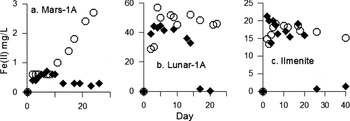
The dissolved (i.e., filtered) concentrations of major ions and trace metals were measured for short-term experiments with and without A. ferrooxidans. Selected data are presented in Figs 1 and 2, and the entire dataset is included in Table S1. The concentrations of Fe(II) for the control experiments with Mars-1A (Fig. 1(a)) remain constant and relatively low (<1 mg l−1) for the first 10 days, after which time a linear increase is observed with concentrations reaching ∼2.7 mg l−1 within 25 days. However, in bacterial experiments with Mars-1A, the concentrations of Fe(II) begin to decrease ∼10 days after inoculation and remain low until the end of the experiment (<0.3 mg l−1 at day 26). The removal of Fe(II) in the bacterial experiment is a reflection of the active metabolism of A. ferrooxidans. The bacteria actively oxidized Fe(II) to Fe(III) resulting in the formation of Fe(III)-precipitates. Similar results were seen for the concentrations of Fe(II) in the Lunar-1A (Fig. 1(b)) and ilmenite (Fig. 1(c)) experiments. In these experiments, however, the concentrations of Fe(II) in the control systems rapidly reached a steady state at about 50 and 17 mg l−1 in the Lunar-1A and ilmenite systems, respectively. After a substantial lag time, Fe(II) in the experiments inoculated with A. ferrooxidans dropped off to trace levels, indicating that the bacteria had oxidized all the reduced Fe in these systems. The lag times before substantial Fe(II) oxidation occurred ranged from 10 to 20 days, depending upon the experimental system. The lag time represents a delay in the exponential growth phase of A. ferrooxidans, as the bacterium acclimatizes to its environment, and is typical when it is introduced into a new system. The timing differences likely reflect small changes in the experimental systems and rock/mineral substrate.
Fe(II) concentration of filtrate for short-term bioleaching experiments with (diamonds) and without (circles) A. ferrooxidans.

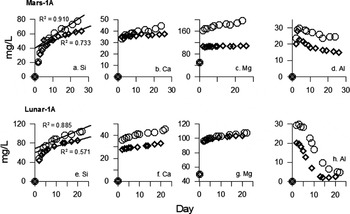
(a–h) Selected elemental concentrations of filtrate for short-term bioleaching experiments with (diamonds) and without (circles) A. ferrooxidans. Lines represent tangent of curve used to calculate release rates for Si in control and bacterial experiments, respectively.

The dissolved concentrations of Si, Ca and Mg in the bacterial and control experiments for the Mars-1A and Lunar-1A simulant are presented in Figs 2(a–c) and 2(e–g), respectively. In all cases, the concentrations of these elements increased with time. Note that baseline concentrations of these elements were elevated during the first sampling event, which occurred after the 48 hour pre-leaching step. Moreover, some of the variation in the concentrations of Mg in the Mars-1A experiments may have been due to small initial differences in the amounts of Mg in the prepared growth medium.
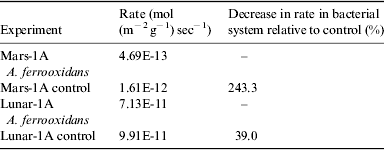
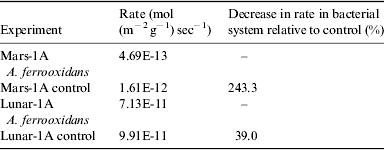
In these short-term experiments, the rates (and amounts) of leaching of Si, Ca and Mg for the bacteria systems were either similar or less than those for the control experiments. We calculated the release rates for silica (in mol m−2 s−1) in these experiments by using the slope of a best-fit linear regression of the data collected after 7 days. We neglected the initial data because the parabolic shape of the dissolution curve in the early days of the experiment was likely caused by the rapid leaching of the smallest grain sizes and was not representative of the longer-term rate (e.g., White & Brantley Reference White and Brantley1995; Lasaga et al. Reference Lasaga, Soler, Ganor, Burch and Nagy1994). BET data were not collected after experimentation to quantify possible surface area changes, so the initial BET numbers were used for rate calculations. The R 2 of the best-fit linear regressions (Fig. 2(a)) were 0.910 and 0.733 mol m−2 s−1 for the Mars-1A control and bacterial experiments, respectively. Results for the Lunar-1A linear regression yielded R 2 values of 0.885 and 0.571 mol m−2 s−1 for control and bacterial experiments, respectively. These Si leaching rates are similar to those found in the abiotic dissolution of fayalite (Santelli et al. Reference Santelli, Welch, Westrich and Banfield2001), mixed cation orthosilicates (Westrich et al. Reference Westrich, Cygan, Casey, Zemitis and Arnold1993) and olivine (Wogelius & Walther Reference Wogelius and Walther1992) with Si release rates of 1 × 10⁻¹¹, 6 × 10⁻¹¹ and 5 × 10⁻¹² mol m−2 s−1, respectively. The calculated Si leaching rates, presented in Table 1, indicate that the presence and/or activity of A. ferrooxidans caused a 243 and 39% decrease in the release rate of Si in the Mars-1A and Lunar-1A experiments, respectively. This finding is in agreement with Santelli et al. (Reference Santelli, Welch, Westrich and Banfield2001) in that the presence of A. ferrooxidans decreased the overall initial leaching rate of the mineral fayalite (Fe2SiO4) relative to control systems without bacteria. The authors suggested that adsorbed Fe(III) of mineral surfaces, and/or other surface phenomenon, acted to pacify the leaching process. A large body of previous work has described similar passivation caused by the formation of alteration layers or secondary minerals on the surfaces of silicate minerals (e.g., Stumm & Wieland Reference Stumm, Wieland and Stumm1990; Brantley et al. Reference Brantley, Guynn, Liermann, Anbar, Barling and Icopini2004; Harneit et al. Reference Harneit, Göksel, Kock, Klock, Gehrke and Sand2006).
Leaching rates of Si in short-term experiments with and without A. ferrooxidans. Rates calculated from tangent to latter part of curve in Figs 1(a) and (e)
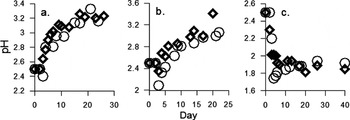
The dissolved concentrations of Al in the bacteria and control experiments using Mars-1A and Lunar-1A rocks are presented in Figs 2(d) and (h), respectively. Both experimental systems are characterized by an initial increase in the concentration of Al over the first few days followed by a gradual, but substantial, decrease at the end of the experiments. This pattern occurred both for the control and A. ferrooxidans experiments, although the concentrations of Al in the bacterial systems were always lower than those of the controls. The loss of Al over time coincided with a gradual increase in the pH of the experimental solutions (Fig. 3). For example, for both the control and bacterial experiments, the pH evolved from about 2.4 to 3.3 and 2.1 to 3.2 in the Mars-1A and Lunar-1A systems, respectively (Figs 3(a) and (b)). The loss of Al was most likely caused by the precipitation of secondary Al-rich mineral phases. Geochemical modelling with Visual Minteq 3.0 (Gustaffson 2011) confirmed that gibbsite, Al(OH)3 and several other Al-rich phases were close to saturation under these experimental conditions. The increase in pH (i.e., acid neutralization) is caused by hydroxylation reactions with silicate minerals in basaltic rocks (e.g., Sherlock et al. Reference Sherlock, Lawrence and Poulin1995). This process can be balanced in part by the reduction of acidity caused by the precipitation of secondary Fe(III)-mineral phases that scavenge hydroxyl groups. For example, in the ilmenite experimental system, pH actually decreased over time in the absence of silicate phases that could neutralize additional acidity caused by the precipitation reactions (Fig. 3(c)).
(a–c) pH of short-term experiments with (diamonds) and without (circles) A. ferrooxidans. Error bars of ±0.1 pH unit lie within the symbols.

Mineral precipitates
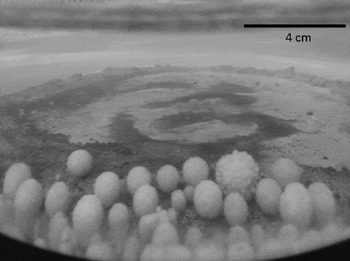
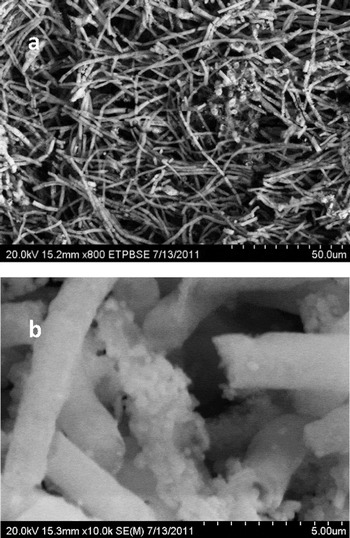
During these experiments, white secondary precipitates were observed in the systems with A. ferrooxidans, but not in the control experiments. These precipitates did not bind to the existing rock/mineral substrate, but tended to cluster together to form spherical nodules up to 1.5 cm in diameter (Fig. 4). The spheres formed not only in the original experiments but also in duplicate experiments we conducted where the reaction vessels were placed on a stationary bench top as opposed to an orbital shaker. We analysed these mineralized spheres using an HR-SEM and found that they were comprised of colonies of A. ferrooxidans coated and encrusted by Fe(III)-phosphate precipitates (Fig. 5(a)). Elongated, tubular structures which appear to be Fe(III)-phosphate enriched cells were abundant. The cells were attached end to end to give the appearance of segmented filaments, some up to 50 μm in length, and in some cases the cells appeared to be hollow (Fig. 5(b)). Semi-quantitative EDS analysis of the precipitates (including multiple samples from duplicate experiments) showed that Fe and P were dominant and were present in roughly similar proportions (Fig. S1). Only trace amounts of sulphur and other elements were detected, suggesting it is an Fe(III)-phosphate (probably hydrated) precipitate. XRD analysis of the precipitates did not reveal any peaks, suggesting they were largely amorphous. Geochemical modelling with Visual Minteq (Gustaffson, 2011) indicated that strengite, Fe(III)PO4·2H2O, was supersaturated under the experimental conditions. Finally, as a test to confirm that A. ferrooxidans cells were an important constituent of the spherical nodules, we removed some of the nodules from solution and soaked them briefly in 5 M HCl. The Fe(III)-phosphate coatings were immediately dissolved in this solution, turning it bright yellow. The Fe-rich solution was then decanted, revealing a substantial amount of amorphous biomass, from which individual cells could be identified using a light microscope.
Fe-phosphate-rich spherical nodules in Lunar-1A bacterial experiment with A. ferrooxidans.

SEM micrograph of A. ferrooxidans cells coated with Fe-phosphate minerals (a) and of concentric rings of Fe-phosphate minerals around cells (b).

Long-term experiments with A. ferrooxidans
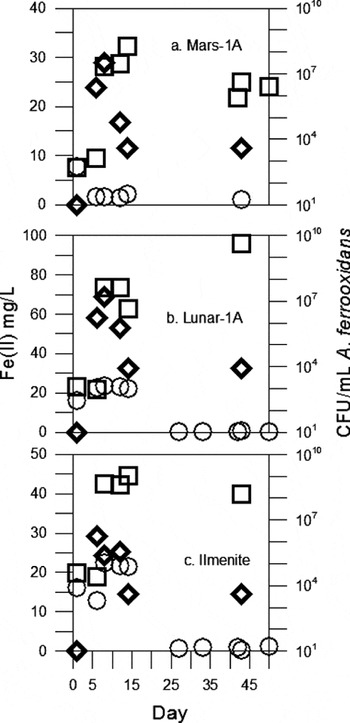
Long-term leaching experiments (∼50 days) with A. ferrooxidans were conducted in order to (1) determine whether the bacteria continued to metabolize for this extended time period and (2) evaluate how much Fe could be extracted from the rock (in the form of Fe(III)-mineral precipitates) relative to control experiments. The dissolved concentrations of Fe(II) and cell concentrations were evaluated over the duration of these experiments, and are presented in Fig. 6. In order for us to avoid removal of too much liquid over the long duration of these experiments, we collected only a limited number of samples and limited the collected volume to 1.5 ml (enough for Fe(II) measurements and cell enumeration).
(a–c) Fe(II) concentration (circles) and estimated CFU ml−1 (diamonds) for long-term experiments with A. ferrooxidans and Fe(II) concentration for abiotic control (squares). Cell numbers are estimations only. Error bars representing 15% error, lie within the symbols.

As observed for the short-term experiments with A. ferrooxidans, the concentrations of Fe(II) decreased over time in the presence of the bacteria, while Fe(II) in the control experiments increased over time, remaining elevated at the end of the experiments. The loss of dissolved Fe(II) is inversely correlated with an increase in A. ferrooxidans estimated cell counts (Fig. 6). The pH and concentrations of other elements in these systems can be found in the on-line supplemental data, Table S2.
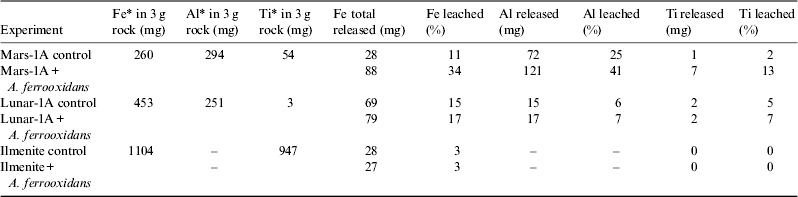
At the end of the experiments, we added a treatment of concentrated OAA + HCl (see methods section) to dissolve Fe(III)-mineral precipitates (and any other easily dissolved precipitates) and to solubilize any adsorbed species. Despite the fact that the controls did not show visible Fe(III)-precipitates, we treated them similarly. The treated fluids were then analysed for their total Fe and other elemental concentrations. These data were transformed to mass abundances and then compared with the masses of Fe, Al and Ti present in the initial rocks/minerals used for each experiment (Table 2). Information for other elements in these solutions is included in Table S2. The results indicate that substantially more Fe, Al and Ti were removed from the Mars-1A rock in the presence of A. ferrooxidans than in the control experiments (Table 2). For example, 11% of the total Fe was leached from the Mars-1A rock during abiotic leaching experiments, while 34% of the total Fe was leached (and ultimately precipitated as Fe(III) solid phases) in the presence of bacteria. There was almost no change in the amounts of these elements leached from the Lunar-1A rock and ilmenite in the presence of A. ferrooxidans as compared with the control experiments (Table 2). The reason that the Mars-1A rock was more susceptible to Fe leaching in the presence of A. ferrooxidans than Lunar-1A or ilmenite is not entirely clear. However, the particle sizes of the Mars-1A rock were much smaller than the other tested substrates, exhibiting more than two orders of magnitude more surface area. This surface area difference might influence elemental release patterns. Moreover, the mineralogy of Mars-1A is different from that of the Lunar-1A rock. For example, the major mineral phases in Lunar-1A are plagioclase feldspar and basaltic glass, whereas Mars-1A is dominated by amorphous palagonite of plagioclase feldspar composition (Morris et al. Reference Morris, Golden, Bell, Lauer and Adams1993).
Mass of major elements leached from basalt and mineral after long-term biotic and abiotic experiments at pH ∼ 2.4.
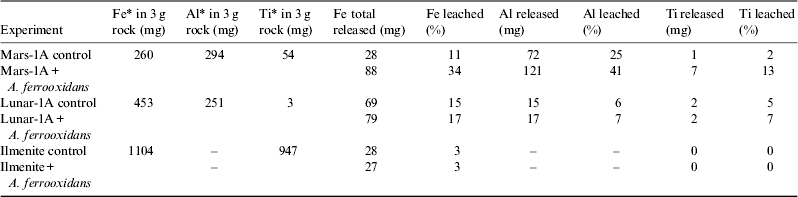
* Estimated from published values available online (http://www.orbitec.com/) for Lunar-1A and Mars-1A, or estimated by stoichiometry of ilmenite.
Finally, the fact that the OAA + HCl leach treatment did not solubilize any Ti in the ilmenite experiment was also curious. Qualitative HR-SEM EDS analysis of unaltered ilmenite compared with leached ilmenite indicated that Ti was enriched on the ilmenite surfaces that had been leached (both in the biotic and abiotic experimental systems). This can be explained by the removal of Fe from the surface layers of ilmenite during leaching, and/or the precipitation of TiO2 at the mineral surface.
The rates of Si leaching in the short-term A. ferrooxidans experiments tended to be slightly less than the rates of Si leaching in the control experiments (Figs 2(a) and (e)). However, the long-term experiments show that more Fe was ultimately removed from the Mars-1A rock by A. ferrooxidans than in the control experiment (Table 2). This apparent conflict can be explained by incongruent leaching of the rocks/minerals such that different elements leach more rapidly than others. For example, the formation of alteration layers on mineral surfaces has been observed to decrease the rate of Si release relative to other cations such as Fe (Brantley, 2008).
P. mendocina experiments
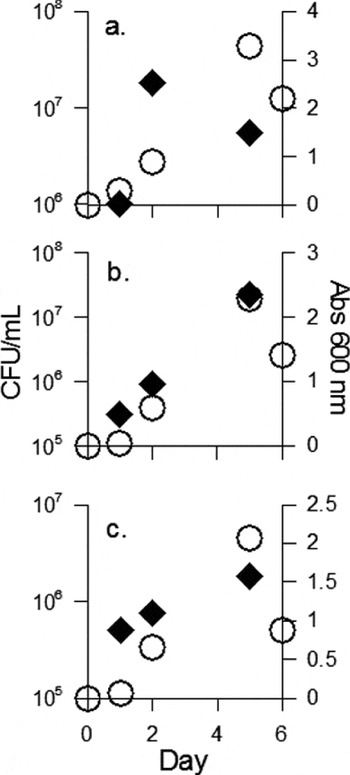
Cell counts and corresponding UV-Vis measurements from experiments with P. mendocina in the Lunar-1A, Mars-1A and ilmenite systems are presented in Figs 7(a)–(c), respectively. In all cases enough Fe was provided by the rock/mineral substrate to sustain a large population of cells. Owing to the closed nature of the batch system, this rapid cell growth was followed by an exhaustion of nutrients in the medium and a rapid death-phase. In addition to an abundance of planktonic cells, bacterial biofilms were observed growing on the rock/mineral substrate. This contrasts with the experiments with A. ferrooxidans, where biofilm was not observed on the rocks/minerals.
(a–c) Growth curve of P. mendocina in FeDM and basalt or ilmenite Fe source. CFU ml−1 (diamonds) and absorbance at 600 nm (circles).

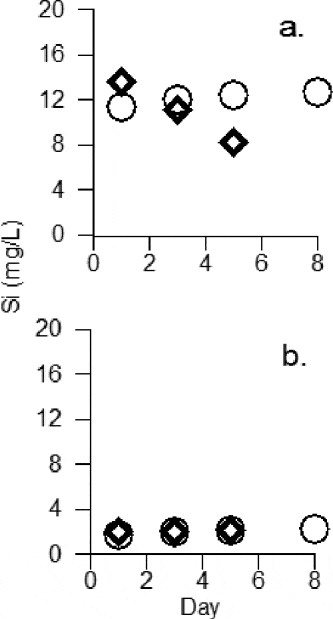
Samples for elemental analysis were collected from the bacterial experiments only until the 5th day due to the onset of the death phase. The dissolved concentrations of major ions and trace metals were measured for experiments with and without P. mendocina. Data for the concentrations of Si in the Mars-1A and Lunar-1A systems are presented in Fig. 8. The entire dataset is included in Table S1.
(a, b) Si concentration from filtrate in bioleaching experiments with (diamonds) and without (circles) Pseudomonas mendocina.

The results reveal that under circumneutral pH conditions, only small amounts of elemental release occurred compared with the low-pH experiments with A. ferrooxidans (Fig. 2). For example, when compared with the 5-day mark, the maximum amount of Si released from the Mars-1A system with P. mendocina was 6 times less than that in the low-pH experiments with A. ferrooxidans. The experiments with Lunar-1A released 50 times less dissolved silica as compared with the A. ferrooxidans experiments. In both cases, the experiments with P. mendocina contained similar or smaller amounts of dissolved Si as compared with the control experiments (also at neutral pH), suggesting that the presence of P. mendocina did not increase leaching rates. Since they are largely insoluble at neutral pH in oxygenated systems, the concentrations of Fe and Al remaining in solution were negligible (Table S2).
In order to determine how much Fe was removed from the rocks/minerals and sequestered by the bacteria, P. mendocina cells and associated biofilm were harvested from each experimental system (through centrifugation) after 5 days of growth. These cells were digested, using ultra-pure, concentrated HNO3 and H2O2, and analysed for their Fe concentrations. By multiplying the concentration of Fe in the digests by the volume of the digestion fluid, we determined the mass of Fe associated with the bacteria and bacterial exudates. This mass was then compared with the mass of Fe in the rocks/minerals used in each experiment. The results, presented in Table 3, indicate that ∼5 mg of Fe were sequestered by the bacteria in the experiment with Lunar-1A rock, while ∼2 mg of Fe were sequestered by P. mendocina in the experiments with Mars-1A and ilmenite. Less than 2% of the total Fe in the rocks/minerals was extracted in all the experimental systems (Table 3).
Mass of Fe in the original rock/mineral, in P. mendocina biomass digest and % Fe removed from rock/mineral.

Reaction pathways
In the low pH experiments, acid attack initially releases Fe(II) into solution (e.g., Figs 1(a)–(c)). This reaction can be described for silicate minerals such as fayalite according to equation (1), and for ilmenite according to equation (2).
 $$\hfill {\rm Fe}_{\rm 2} {\rm SiO}_{\rm 4} + {\rm 4H}^ + = {\rm 2Fe}^{{\rm 2} +} + {\rm 2H}_{\rm 2} {\rm O} + {\rm SiO}_{\rm 2},\hfill $$
 $$\hfill{\rm Fe}_{\rm 2} {\rm SiO}_{\rm 4} + {\rm 4H}^ + = {\rm 2Fe}^{{\rm 2} +} + {\rm 2H}_{\rm 2} {\rm O} + {\rm SiO}_{\rm 2}.\hfill $$
The Fe(II) generated during these reactions can then be converted to Fe(III) as oxygen gas is reduced through the reaction described by equation (3):
 $$\hfill{\rm 2Fe}^{{\rm 2} +} + {\rm 1}/{\rm 2O}_{\rm 2} + {\rm 2H}^ + = {\rm 2Fe}^{{\rm 3} +} + {\rm H}_{\rm 2} {\rm O}{\rm.}\hfill $$
Under acidic conditions, the abiotic pathway for Fe(II) oxidation is kinetically inhibited and most Fe will stay in the reduced state and remain in solution (Singer & Stumm Reference Singer and Stumm1970; Nordstrom & Southam 1997). A. ferrooxidans, however, is able to catalyse the oxidation of Fe(II) to Fe(III) as a means of gaining biologically useful energy in the form of electrons. This causes a change in the equilibrium of the system, i.e. Le Chatelier's Principle, and will lead to enhanced elemental release from the rock/mineral substrates. A. ferrooxidans has been shown to accelerate the rate of Fe(II) oxidation (in low pH conditions) by many orders of magnitude (e.g., Singer & Stumm Reference Singer and Stumm1970) thus enhancing this effect in a steady-state system.
Since Fe(III)aq is relatively insoluble under our experimental conditions, the biotic oxidation of Fe(II) to Fe(III) leads to the precipitation of Fe(III) phases. The Fe(III)-mineral that is thermodynamically predicted to form under our experimental conditions changes based on the relative amounts of sulphate and phosphate added to the solution as part of the growth medium. In our case, an Fe(III)-phosphate mineral was favoured because of the large amount of phosphate in the growth medium. In subsequent experiments, not described here, we were able to change the Fe(III)-precipitate phase to Fe(III)-sulphate, and Fe(III)-oxide simply by manipulating the growth medium of the experimental solutions.
In the experiments with P. mendocina the pH was near neutral. For this reason, leaching rates in the abiotic systems were negligible (Table 2). However, because P. mendocina generates organic acids and/or siderophores that scavenge Fe, measurable amounts of Fe were incorporated in the bacterial biomass. Although the reactions described by equations (1) and (2) probably still hold, they are likely localized reactions that occur only in close proximity to the microbial cells or in the biofilm. The Fe leached from these substrates is used by the cells for their metabolic function and no chemical energy is gained by the cells through oxidation of Fe. The reaction described in equation (3) may proceed abiotically under the circumneutral pH conditions here, which explain why minimal amounts of Fe were detected in the experimental solutions. The small amounts of dissolved Fe that were measured were likely in the form of organic acid complexes.
Conclusions and future directions
The results from our leaching experiments with A. ferrooxidans and P. mendocina indicate the following:
1 A. ferrooxidans was able to grow using Fe derived only from the tested basaltic rocks and ilmenite as its sole source of metabolic energy. A. ferrooxidans grew for extended periods of time (at least 50 days) in our batch experimental systems while maintaining some viable cells (103 CFU ml−1 after 40 days).
2 The presence of A. ferrooxidans slightly decreased the Si release rates of the tested basaltic lunar and Mars simulant rocks. However, inspite of not increasing the overall Si leaching rate, the presence of A. ferrooxidans did ultimately result in greater extraction of Fe, Al and Ti (and other elements) from the Mars-1A rock. The amount of Fe and other elements extracted from the Lunar-1A rock and ilmenite was not measurably increased by the presence of A. ferrooxidans. We suspect that the greater surface area and unique mineralogical composition of the Mars-1A rock made it more susceptible to leaching using A. ferrooxidans. The major element release rates in the Mars and lunar simulant experiments were also probably affected by small differences in mineralogy in addition to differences in the amount and form of available Fe.
3 The morphology of the bacterially mediated Fe(III)-precipitates in our experiments is a distinct and recognizable biosignature. Since the chemical energy associated with Fe(II) oxidation is thought to be one of several possible niches for chemolithotrophic life on planets such as Mars (e.g., Jakosky & Shock Reference Jakosky and Shock1998; Fisk & Giovannoni Reference Fisk and Giovannoni1999), developing an understanding of these biosignatures is important for astrobiological exploration.
Future experimental work with A. ferrooxidans will include optimization of the experimental conditions (including the growth medium) to determine (1) the minimum amount of nutrient input necessary to sustain growth and (2) what conditions maximize elemental release rates from the basaltic rocks.
Acknowledgements
The material is based upon work supported by NASA under award No. NNX09AV09A and the Center for Space Exploration Research at The University of Texas at El Paso. Graduate funding for J. Navarrete was provided through the National Science Foundation Graduate Research Fellowship Programme. In addition, we would like to thank Jose H. Garcia of the Department of Geological Sciences at the University of Texas at El Paso and Bonnie L. Cooper from the Astromaterials Research Group at NASA Johnson Space Center for their assistance with the analysis of our samples.
Supplementary materials
For supplementary material for this article, please visit http://dx.doi.org/10.1017/S1473550412000493.