In most dairy cows only 20 % or even less of the milk stored in the udder is located in the cisternal cavities before milking and thus immediately available for milk removal. In contrast, most of the milk is located in the mammary parenchyma and small milk ducts. This so-called alveolar milk is only available after active contraction of the alveoli which is caused by the neuropeptide hormone, oxytocin. Tactile stimuli of the teats induce the release of oxytocin from the anterior pituitary via a neuro-endocrine reflex arc (reviewed by Bruckmaier & Blum, Reference Bruckmaier and Blum1998).
During machine milking, continuous milk flow requires the availability of the alveolar milk shortly after the start of milking because the immediately available cisternal fraction is mostly removed within 1 min or less. Although the normal liner pulsation has a full stimulatory effect on oxytocin release and milk ejection, a stimulatory treatment before the application of the full milking vacuum (pre-stimulation) is required for fast, complete and simultaneously gentle milk removal. The early induction of milk ejection avoids milking on empty teats with all the consequences such as reduced milk flow and increased load on the teat tissue (Bruckmaier et al. Reference Bruckmaier, Rothenanger and Blum1995; Bruckmaier & Blum, Reference Bruckmaier and Blum1996; Bruckmaier & Hilger, Reference Bruckmaier and Hilger2001).
Research in European dairy cows has shown that the time from the start of pre-stimulation until the availability of the first alveolar milk in the cistern depends on the relative degree of udder filling, and is around 40 s in well-filled udders, 60 s in medium-filled and 90 s or even longer in little-filled udders (Bruckmaier & Hilger, Reference Bruckmaier and Hilger2001; Weiss & Bruckmaier, Reference Weiss and Bruckmaier2005).
Depending on the milking routine, i.e. complete individual milking or batch udder preparation, it is relevant whether the pre-stimulation must be continuous or whether a short induction of oxytocin release followed by a latency period until milk ejection is also suitable for management of machine milking. It has been shown that both oxytocin levels and milking characteristics show no difference whether pre-stimulation is performed continuously for 45 or 60 s or whether a short teat stimulation for 15 s is followed by a short latency period for 30–45 s before cluster attachment (Rasmussen et al. Reference Rasmussen, Frimer, Galton and Petersson1992; Bruckmaier et al. Reference Bruckmaier, Macuhova and Meyer2001; Kaskous & Bruckmaier, Reference Kaskous and Bruckmaier2011). However, effects of a latency period between pre-stimulation and start of milking on teat tissue condition after milking have to our knowledge not been investigated.
Machine milking in dairy cows should allow a fast and complete udder emptying with minimal stress for the teat tissue. Transient formation of blood congestion and tissue oedema mainly towards the end of machine milking are the obvious reasons for thickened teat walls immediately after teat cup detachment (Hamann & Mein, Reference Hamann and Mein1988). Hamann et al. (Reference Hamann, Mein and Wetzel1993) found through measurements with a spring-loaded caliper (cutimeter) that teat wall tissue thickness and recovery time increase with the intensity of the applied vacuum. It was shown that increased teat end tissue thickness increases the risk of teat canal contamination and hence the risk of intramammary infection (Zecconi et al. Reference Zecconi, Bronzo, Piccinini, Moroni and Ruffo1996). On the other hand, reducing the milking vacuum in order to prevent harm to the teat tissue leads to reduced milk flow and hence longer machine-on time (Rasmussen & Madsen, Reference Rasmussen and Madsen2000; Gleeson et al. Reference Gleeson, O'Callaghan and Rath2003). While a lower teat end vacuum reduced teat tissue damage, both too high and too low vacuum were shown to potentially increase the risk of intramammary infection (Langlois et al. Reference Langlois, Cox, Hemken and Nicolai1981). Besides an optimal milking routine including pre-stimulation to minimise machine-on time a possible approach to achieve the goal of minimum stress for the teat tissue is an interruption of the vacuum load on the teat within each pulsation cycle which mimics the way of milk removal by the sucking calf.
The goal of the present study was to investigate the effect of a short pre-stimulation (P) for 15 s followed by a latency period (L) of 30 s before cluster attachment, and of a periodic vacuum reduction (VR) as well as the interaction of these two treatments on milking characteristics and on teat tissue condition after milking. The experiment was based on a relatively small number of animals so that results obtained would be applicable to European family farms, but the results are of course relevant to larger herd sizes.
Materials and methods
Animals
Nine Holstein dairy cows from the Swiss Federal Research Station Agroscope Liebefeld-Posieux (ALP) in Posieux were used for the experiment. Experimental cows were in mid-lactation (185–212 d in milk) with an estimated degree of udder filling between 55 and 75 %. The estimation was performed as described previously (Bruckmaier & Hilger, Reference Bruckmaier and Hilger2001) i.e. based on the mean milk yield during the experimental period as a percentage of maximum storage capacity during the current lactation. Five cows were in the second, one in the third, two in the fourth and one in the seventh lactation. Milk production of the experimental animals in the preceding lactation was 8284±615 kg.
Experimental milkings
Experimental milkings were performed twice daily at 5·00 and 16·00 during the usual routine milking times of the experimental farm. One day before the experiment cows were moved from loose housing into a tie stall which was familiar to the cows. A bucket milking system was used for the experiments at a vacuum of 43 kPa. Milkings were performed at a pulsation rate of 60 cycles/min and a pulsation ratio of 60:40. At the end of milking a short machine stripping was applied manually when milk flow dropped below 0·2 kg/min. After teat cup removal teats were dipped with a disinfectant. In the case of post-milking ultrasound imaging teat dipping was postponed for 15 min until the ultrasound measurements were finished. During the experiment each animal was used in each of the four treatments which consisted of two different routines of udder preparation combined with two different milking systems. The sequence of treatments was individually and randomly determined for each individual cow. The experiment lasted for 12 d, and each treatment was used during six consecutive milkings (3 d). All experimental milkings were exclusively performed by the same person.
Pre-milking udder preparations
Pre-milking udder preparation lasted for 45 s before teat cups were attached. Udder preparation was either continuous for 45 s, consisting of forestripping (four squirts of milk per teat), udder cleaning with a wet single-use paper (together 15 s), followed by 30 s manual massaging of teats and udder (P45/L0), or was composed of a 15-s forestripping (four squirts per teat) and udder cleaning followed by a 30-s latency period (P15/L30).
Milking systems
Milkings were performed with two different milking units. Cluster weight was 2·2 kg and the volume of claw piece was 330 cm3.
Standard milking unit
The standard unit consisted of standard teat cups equipped with standard liners (diameter of mouthpiece: 22 mm, touch point pressure: 12 kPa).
VR milking unit
The VR milking unit had special liners (diameter of mouthpiece: 22 mm) that cause a transient reduction of the vacuum under at the teats to 12–15 kPa when the liner is closed. The vacuum-relief at the teats results by sealing the outlet bore of liner during massage phase (AktivPuls®, Happel Suisse S.A.R.L., 3421 Lyssach, Switzerland).
Measurements
Milk flow recording
During all experimental milkings, milk flow was recorded with a mobile milk flow recording unit (LactoCorder®, WMB AG, 9436 Balgach, Switzerland). The resulting data were analysed and computed into standard parameters with the LactoPro Software (Version 5.2.0 Beta 49 software, WMB AG, 9436 Balgach, Switzerland). Total milk yield (TMY) was measured in kg, and average milk flow (AMF) in kg/min was calculated from the milk yield obtained during the main milking time. Main milking time (MMT, min) was defined as the time when milk flow surmounted 0·5 kg/min at the start of milking until milk flow declined below 0·2 kg/min. Peak flow rate (PFR, kg/min) was measured as the maximal milk flow which was maintained for at least 22·4 s.
Ultrasound imaging
Longitudinal cross section images through the right front teat were performed by B-mode ultrasound at 0, 5, and 15 min after the sixth (last) milking of each treatment as described earlier (Bruckmaier & Blum, Reference Bruckmaier and Blum1992; Weiss et al. Reference Weiss, Weinfurtner and Bruckmaier2004). Measurements were always made from the same direction and by the same person by dipping the teat into a transparent cup filled with lukewarm water. A linear 5-MHz probe was applied from outside to the cup using a contact gel between cup wall and probe. Teat wall thickness (TWT, average of both measured teat walls), teat cistern diameter (CD), teat diameter (TD), and length of teat canal (CL) were measured. TWT, CD and TD were measured at the teat barrel 2 cm above the teat tip.
Statistical analysis
The obtained data were evaluated by using a MIXED procedure of SAS (2011). Preliminary data analysis included both the method of udder preparation (P45/L0 vs. P15/L30) and the milking system (Standard vs. VR) as fixed effects as well as the interaction between both factors. This analysis did not result in any significant differences. Therefore, effects of udder preparation and milking system were analysed separately for all presented data. For the ultrasonographic data (Table 2), time of measurement (0, 5, 15 min after milking) was additionally included, besides either udder preparation or milking system as fixed effect. In addition, for each time of measurement, effects of udder preparation and milking system were tested separately with the same procedure as described above. Cow was used as repeated subject, and time of measurement was used as a repeated measure with variance components (VC) as matrix structure. Multiple comparisons between the respective means were performed by the Bonferroni's t test, and differences between means were considered significant if P<0·05. Data are presented as means±se.
Results
Milking characteristics
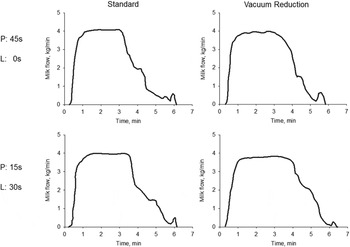
As illustrated in Table 1, TMY, MMT, PFR, and AMF did not differ between any of the treatments performed. The identical course of milk removal in all treatments is also confirmed by the milk flow curves of one exemplary cow representing the four treatments (Fig. 1). Neither the type of pre-stimulation nor the type of the milking unit with or without VR influenced the performance of milk removal and machine-on time.
Representative milk flow curves of cow no.1646 (with characteristics closest to the calculated means). Milkings were performed with different ways of udder preparation (P45/L0 vs. P15/L30) and different milking systems (standard vs. VR in massage phase).

Means±sem of milking characteristics. P-value of ANOVA testing different milking systems (Standard vs. Vacuum Reduction) and different udder preparations (P45/L0 vs. P15/L30)

† VR, Vacuum Reduction; P, Prestimulation; L, Latency period
However, milking characteristics differed between cows in different lactation numbers, and between morning and evening milkings. Total milk yield was higher (P<0·01) in cows with more than two lactations than in cows in their second lactation (14·4±0·3 vs. 13·0±0·2 kg) and TMY was higher (P<0·01) at morning than at evening milkings (14·8±0·3 vs. 12·6±0·2 kg). Main milking time was longer (P<0·05) in cows with more than two lactations as compared with cows in their second lactation (5·2±0·1 vs. 4·8±0·1 min) and tended to be longer (P<0·10) at morning milkings than at evening milkings (5·1±0·1 vs. 4·8±0·1 min). Peak flow rate was higher (P<0·01) in cows with more than two lactations than in cows in their second lactation (4·9±0·1 vs. 3·9±0·1 kg/min) but did not differ between morning and evening milkings. Average milk flow did not differ between parities but was higher (P<0·01) at morning than at evening milking (2·9±0·1 vs. 2·6±0·1 kg/min).
Teat tissue condition
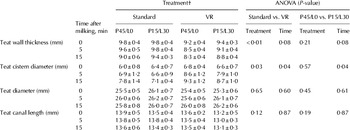
Results of teat ultrasound cross sections at 0, 5, and 15 min after the end of milking are shown in Table 2. TWT after milking was smaller (P<0·01) at milkings with the VR milking unit than at milkings with the standard milking unit (mean of all time points: 8·9±0·3 vs. 9·6±0·3 mm, respectively). However teat measures showed no significant difference if treatments were compared at the three measurement points individually. TWT tended to be smaller in VR vs. non-VR treatments at 5 min after milking (P=0·05). Teat wall thickness immediately after milking was higher (P<0·01) in cows with more than two lactations than in cows in their second lactation (10·2±0·2 vs. 9·2±0·2 mm). At 5 and 15 min after milking TWT no longer differed between parities (9·4±0·2 vs. 9·1±0·1 mm at 5 min and 9·2±0·2 vs. 8·6±0·1 mm at 15 min). Teat wall thickness tended to decrease within 15 min after the end of milking.
Means±sem of ultrasound measurements at 0, 5, and 15 min after milking. P-values displaying the effect of milking systems (Standard vs. Vacuum Reduction) and udder preparations (P45/L0 vs. P15/L30)

† VR, Vacuum Reduction; P, Prestimulation; L, Latency period
Teat cistern diameter after milking was larger at milkings with VR as compared with the standard milking system (mean of all time points: 8·0±0·04 vs. 6·8±0·4 mm, respectively) but was not affected by the type of pre-stimulation. In both milking systems and both types of pre-stimulation CD increased (P<0·05) within 15 min after the end of milking.
Both TD and CL did not differ between milking systems or type of pre-stimulation at any of the recorded time points nor did they change during 15 min after the end of milking.
Discussion
Numerous studies have shown the negative effect of insufficient pre-stimulation on milk flow. Most of the studies described effects on milk flow rates and machine-on time but not on milk yield (Sagi et al. Reference Sagi, Gorewit, Merril and Wilson1980; Gorewit & Gassman, Reference Gorewit and Gassman1985; Rothenanger et al. Reference Rothenanger, Bruckmaier and Blum1995; Bruckmaier & Blum, Reference Bruckmaier and Blum1996; Tančin et al. Reference Tančin, Uhrinčat', Mačuhová and Bruckmaier2007). The unchanged values of PFR, AMT and MMT indicate that the combination of a short teat stimulation followed by a short latency period represents a similarly efficient udder preparation as continuous stimulation and does not lead to a transient decrease of milk flow after removal of cisternal milk. Studies by Rasmussen et al. (Reference Rasmussen, Frimer, Galton and Petersson1992), Bruckmaier et al. (Reference Bruckmaier, Macuhova and Meyer2001) and Kaskous & Bruckmaier (Reference Kaskous and Bruckmaier2011) confirm the positive effects of udder preparation combined with a latency period. Kaskous & Bruckmaier (Reference Kaskous and Bruckmaier2011) found no differences of oxytocin release during milking with or without a short latency period after a short pre-stimulation. Based on the half-life time of oxytocin of 2–3 min (Belo & Bruckmaier, Reference Belo and Bruckmaier2010) a latency period of 30 s does not cause a decline of the hormone below the threshold required to maintain milk ejection until the teat cup attachment. On the other hand, a much longer latency period of more than 2 min could lead to a transient decline of oxytocin and a problematic re-establishment of milk ejection after delayed cluster attachment (Bruckmaier et al. Reference Bruckmaier, Macuhova and Meyer2001). In the present study where cows had an udder filling of 55–75 % the 45 s between first touch of the udder and attachment of the cluster was sufficient for the milk ejection to commence before teat cup attachment (Bruckmaier & Hilger, Reference Bruckmaier and Hilger2001; Weiss & Bruckmaier, Reference Weiss and Bruckmaier2005; Kaskous & Bruckmaier, Reference Kaskous and Bruckmaier2011). Thus, the applied combination of a short teat stimulation and a short latency period seems to be suitable under most conditions in practical dairy farms. Only if the degree of udder filling is very small a longer teat stimulation may be necessary.
The latency period between pre-stimulation and teat cup attachment did not affect teat tissue condition after milking. It can be assumed that 30 s less of manual stimulation is less stressful on the teat tissue and may possibly even exert a relaxing influence on the teat (Kaskous & Bruckmaier, Reference Kaskous and Bruckmaier2011). However, this potential effect could not be visualised by ultrasound after the end of milking. Thus it is also not surprising that interactions between the type of udder preparation and the milking system on teat measures could not be shown.
Lower TWT and larger CD after milking in VR as compared with the standard milking system indicates that milking-induced congestion and formation of oedema of the teat tissue are lower when the vacuum at the teat is reduced during the massage phase. Milking characteristics did not show any differences between the milking systems because vacuum and pulsation did not differ except for the short vacuum reduction during the massage phase in VR when milk flow is interrupted anyway. Thus, the transient vacuum reduction is not to be considered a disadvantage with respect to the efficiency of milk removal with simultaneous positive effects on teat condition.
Regardless of the milking system used, TWT tended to become thinner over the three time points, whereas no changes in CL could be found. While the milking system influenced the TWT after milking in general, the discovery from the milking-related changes during the recorded 15 min were not influenced by the milking system. The observed increase of CD with time after milking, and independent of type of pre-stimulation or milking system, could be expected because the teat cistern refills with milk within minutes.
Parity affected milking characteristics and teat tissue condition. Cows in the second lactation have not yet reached their maximum milk yield. That explains the higher TMY, MMT, and PFR of cows with more than two lactations as compared with the cows in their second lactation. TWT immediately after milking was higher in cows with more than two lactations than in cows in their second lactation. Growth of the teats including cisternal cavities with increasing number of lactations has been described (Klein et al. Reference Klein, Flöck, Khol, Franz, Stüger and Baumgartner2005). The load of vacuum and pulsation during each milking process is probably a main reason for this observed enlargement in older cows.
In conclusion pre-milking udder preparation consisting of a short manual pre-stimulation followed by a short latency period leads to similarly good milking characteristics as continuous pre-stimulation. However, a positive effect on teat condition after milking was not obvious if milking was performed after short pre-stimulation combined with a latency period. Milking with periodically reduced vacuum under the teat in the massage phase allows a similarly fast and complete milking as compared with a standard milking unit. The results of this study indicate slightly positive effects of the vacuum reduction with respect to the load on the teat tissue during milking, and the system is obviously suitable for the use in practical dairy farms.