Introduction
Throughout the ventennio, 1922–1943, the Fascist regime engaged in and financed a vast range of public projects in its efforts to make a new Italy. These projects included the construction of new infrastructure in order to connect a population bound by local rather than national traditions, grand public buildings to support government operations, capacious and ordered public spaces for rallies and other mass events, and a host of more modest buildings to accommodate the numerous para-state agencies established to transform communities. In recent decades, architectural historians, preservationists and others have demonstrated a growing interest in Fascist-era buildings. Many of the most high-profile examples are those associated with the monumental excesses of the regime, such as the Palazzo del Civiltà Italiana in the EUR district of Rome, which is now the headquarters for the Italian fashion brand Fendi. However, new attention is also focused on those buildings that are significant examples of interwar Italian modernism or Rationalism, including former Fascist Party headquarters or case del fascio.Footnote 1
As part of the National Fascist Party’s (Partito Nazionale Fascista, PNF) efforts to increase its presence and influence, party leaders encouraged the establishment of case del fascio, outposts that served as a base for party activities and as a physical reminder of its authority in population centres throughout Italy.Footnote 2 In the second half of the 1930s, young architects influenced by the work and writings of avant-garde practitioners like Le Corbusier participated in the design of these buildings, especially in northern Italy, where the party was most able to fund new construction and support for the organisation was generally strong. Following completion, these buildings were often featured in architectural and cultural periodicals as well as in commemorative publications and newspapers sponsored by the PNF.Footnote 3
At the end of the Second World War, former party headquarters were adapted to new purposes and those designed by the best architects affiliated with Rationalism were often understood in opposition to or in isolation from the political environment in which they were created.Footnote 4 Indeed, until the early 1980s, scholars glossed over or ignored the many connections between Italian modernism and Fascist politics.Footnote 5 Scholars interested in the relationship between architecture and politics instead identified equivalencies between Fascism and the exaggerated scale, classically inspired monumentality, and axial symmetry found in complexes like EUR, (originally intended and planned as the setting for the Esposizione Universale of 1942). The scholarly literature now widely acknowledges Fascism’s engagement with diverse modes of artistic expression and, moving away from questions of style, has begun to explore the ways in which the regime, through patronage, economic policies, education and so forth, shaped architectural practice (Ghirardo Reference Ghirardo2013, 65–103). At the same time, recent efforts to restore and repurpose buildings associated with the Fascist regime, including former party headquarters, some of which were designed by leading Italian modernists, have provoked new questions about how and to what extent these buildings should be understood as reminders of a discredited regime.
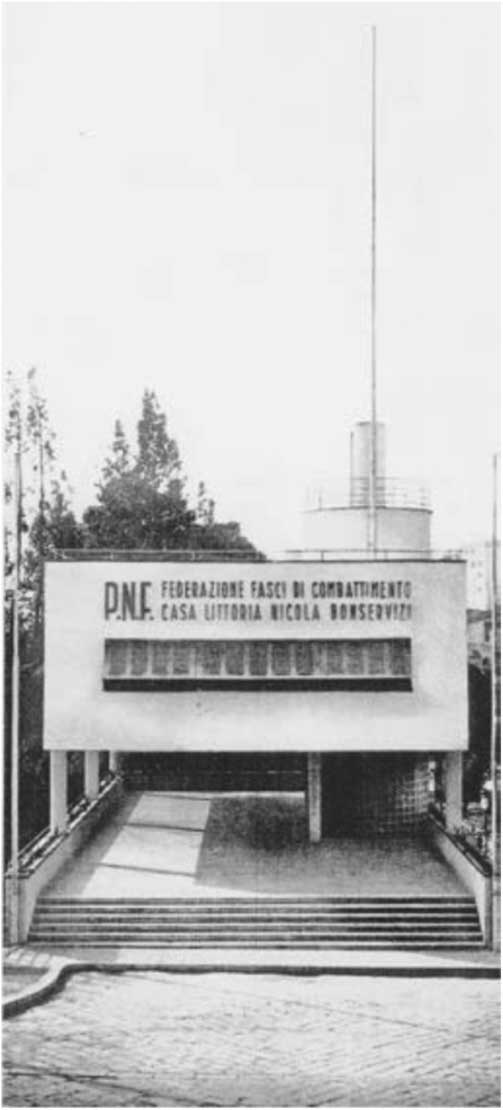
To explore this topic, this paper takes as its primary examples buildings designed for the PNF by three young northern Italian architects: Luigi Carlo Danieri (1900–1972), Giuseppe Terragni (1904–1943), and Luigi Vietti (1903–1998), each of whom sought to harness modernism in the service of Fascist politics and whose former party headquarters, to varying degrees, have been a focus of recent attention.Footnote 6 In the spring of 2017, the city of Genoa announced plans to make Danieri’s modest former Casa del Fascio (1936), in the coastal community of Sturla, part of an initiative to expand the city’s tourist economy through the restoration of and development of public programming (such as events and tours) for a number of buildings constructed during the Fascist era (Figure 1).Footnote 7 In 2001, Terragni’s former party headquarters in Lissone (with A. Carminati, 1937–1939) underwent its second restoration (Carminati Reference Carminati2006, 302–304). More controversially, in 2018, Matteo Salvini, head of the far-right La Lega and now Deputy Prime Minister and Minister of the Interior, proposed making Terragni’s ex-Casa del Fascio in Como (1936) – the work most often put forward by scholars as an example of the Italian interwar avant-garde – a museum of modern art.Footnote 8 In 2012, the municipal government in Verbania (formerly Intra) inaugurated Vietti’s former Casa del Fascio (1933) on Lake Maggiore as the new offices of the town council following a three-year restoration project.Footnote 9 The postwar history of these buildings provides an opportunity to consider how and to what extent the symbolic value of Fascist Party headquarters as well as Fascist-era architecture more broadly has changed over time and the consequences of this for the architectural landscape of contemporary Italy.Footnote 10
Casa Littorio Nicola Bonservizi, Sturla, designed by Luigi Carlo Danieri, 1936-1938. Po Reference Po.1939, p. 20.

The interwar years
The PNF’s network of case del fascio represented the regime’s most coherent and widespread attempt to translate its policies and beliefs into built form and was a key element of its effort to make new Italians. In the early 1930s the party launched a campaign to ensure that every village, town, and city on the Italian peninsula and in Italy’s colonies had an appropriate symbolic setting from which to direct its operations.Footnote 11 Although the National Party secretary oversaw this effort, local officials were largely responsible for selecting the project architect (who often worked free of charge), and determining the scale and scope of the project, according to the needs and financial resources of the community (Maulsby Reference Maulsby2014a, 47).
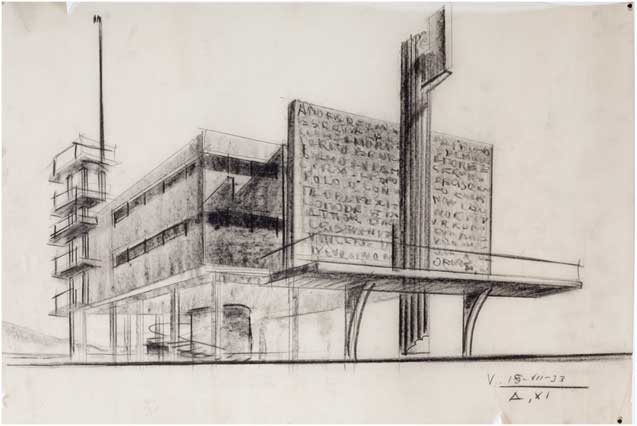
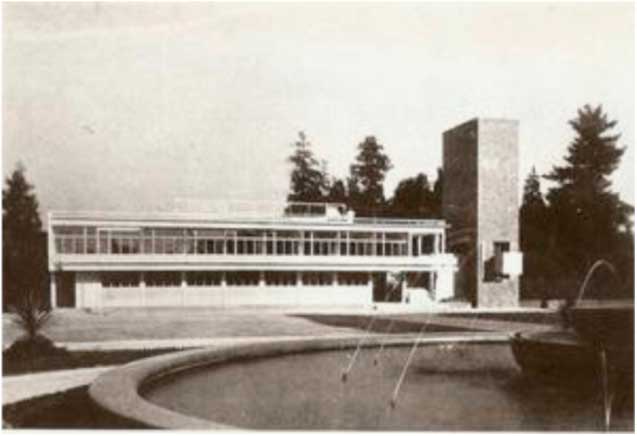
By the late 1930s PNF headquarters were a feature of cities and towns throughout the Italian peninsula and in Italian territories and colonies. These centres accommodated a wide range of functions: they held office and meeting spaces for party officials; operated as seats from which diverse (but always politically charged) programmes (such as lectures, films, rallies and workshops) were administered; functioned as a spiritual home for Fascist ritual activities and as a base for local control. Wherever possible, Fascist officials used their influence to obtain prominent buildings or sites (those at major intersections, facing public plazas, along major streets, and so forth) in order to ensure that these buildings were a characteristic element of cities and towns. For example, Danieri’s former party headquarters in Sturla faces the large and irregular Piazza Sturla, directly opposite a fifteenth-century church and, on its lower level, it is adjacent to a nursery and elementary school constructed in the nineteenth century. Prominent local families donated the land and funds for the building.Footnote 12 Party officials also encouraged the repetition of formal motifs such as towers, or the suggestion of towers, and speaking platforms or balconies (arengari). Vietti, for example, proposed a six-storey tower (open along its four sides and connected by an exposed staircase) to complete the main façade of his party headquarters in Verbania/Intra, which featured a broad podium in front of its solid double-height front and, in one version, an oversized fasces (Figure 2). More conventionally, a stone tower and balcony stood adjacent to Terragni’s Casa del Fascio in Lissone in a relationship that fostered associations with symbols of authority from Italy’s past, specifically northern Italian medieval town halls (Ghirardo Reference Ghirardo1996, 260) (Figure 3). The codification and then reproduction of visually distinctive formal elements reinforced connections between individual party-controlled centres within each community and those found all over the nation. The addition of fasces, quotes from Mussolini, and bold sculptural programmes (commissioned when groups had sufficient resources) made clear the political function of these buildings. Following Italy’s entry into the Second World War on 10 June 1940, as an ally of Nazi Germany, the Fascist Party concentrated its efforts on the creation of new headquarters in strategic locations, especially near railway stations and other centres from which personnel and equipment could be easily dispatched, as well as overseas, along the nation’s northern borders, and other areas remote from already established centres of command (Ghirardo Reference Ghirardo1982, 88; Mangione Reference Mangione2003, 77).
Sketch for the Casa del Fascio, Verbania (formerly Intra), by Luigi Vietti, 1933. Centro studi e archivio della comunicazione, University of Parma, Fondo Luigi Vietti, Archivio Vietti.

Casa del Fascio, Lissone, designed by Giuseppe Terragni and Antonio Carminati, 1937-1939. G.B. Reference G1941, p. 4.

Architects influenced by the modern movement were instrumental in giving visual form to Fascism’s ambitions. They participated in a range of projects, including the design of exhibition spaces, housing, and public buildings, although these were most often projects for schools, post offices, and train stations rather than prestigious government buildings, as well as those for para-state agencies and the PNF throughout the 1930s and into the early 1940s (Doordan Reference Doordan1988; Ciucci Reference Ciucci1989; Etlin Reference Etlin1991). Architects involved in this enterprise, in addition to Danieri, Terragni, and Vietti, included the Milan-based firm of BBPR, comprising G.L. Banfi, L. Belgiojoso, E. Peressutti and E.N. Rogers. This team of recent graduates from the Politecnico di Milano submitted the influential winning designs for a competition for prototypical case del fascio held by the Fascist newspaper L’Assalto in 1932, and put forward a proposal for a casa del fascio in Caravaggio (1934) (Maulsby Reference Maulsby2014a, 110–112; Banfi, Peressutti, and Rogers Reference Banfi, Peressutti and Rogers1934). Other architects were responsible for discrete elements of these buildings. Marco Zanuso (1916–2001), for example, worked with a group of his classmates from the Politecnico di Milano to design the mortuary chapel for an expansive new provincial headquarters designed by Piero Portaluppi (1888–1967) facing the venerable Piazza San Sepolcro in Milan (Maulsby Reference Maulsby2014a, 126–132). These buildings and spaces provided a generation of architects with an important professional opportunity and a means to show how architectural modernism could participate in the making of a new Fascist Italy.
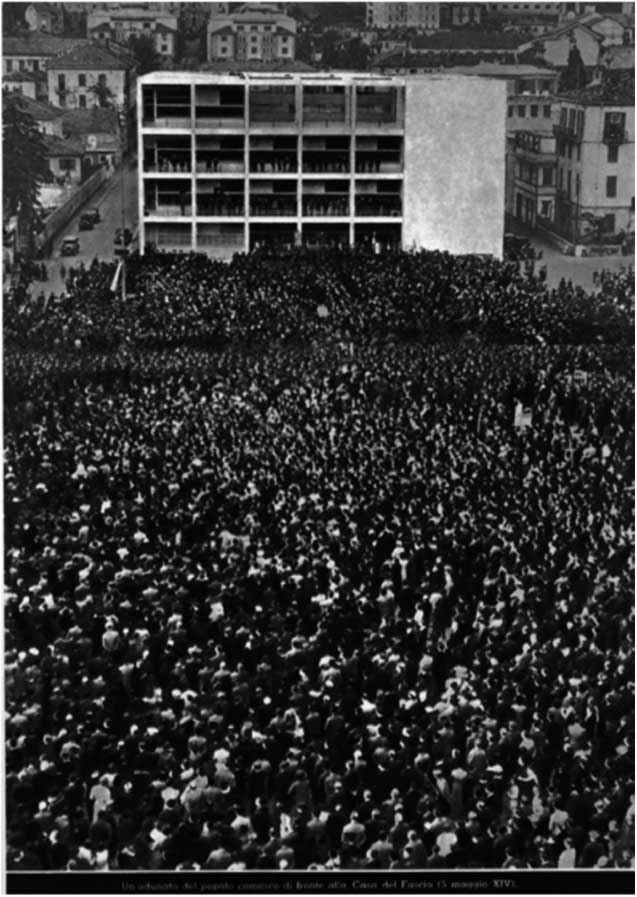
More so than many of his contemporaries, Terragni made explicit the connections between his lyrical modernism and Fascist politics. In 1936, in a special issue of Quadrante, the cultural journal directed by the author Massimo Bontempelli and the curator and writer P. M. Bardi, which Terragni had helped establish in 1933, dedicated to the Casa del Fascio in Como, the architect made effective use of text and image to draw attention to the symbolic intentions of his palatial building (Figure 4). For example, he argued that the transparency between interior and exterior, which was dramatically evident in the file of glass doors that permitted fluid movement from the facing piazza past a mortuary chapel (sacrario) and into a light-filled atrium, was intended to manifest Fascism’s call for personal sacrifice and collective action. Terragni similarly anticipated that the furniture he designed, the materials he selected, and works of art he commissioned for the building would reinforce Fascism’s myths. Photographs in the issue emphasised the building’s connections to the historical fabric of the city, especially the nearby Piazza del Duomo, with its fourteenth-century cathedral and medieval town hall, and drew attention to the building’s role as a centre for Fascist political activity. Terragni devoted a full page to a photograph of a mass gathering in the Piazza Impero (now del Popolo) on 5 May 1936 (the day Mussolini declared victory in Ethiopia) in front of the recently completed building (Quadrante October 1936, 19). In order to augment its visual impact, the image was edited to make the crowd seem larger and more coherent (Rifkind Reference Rifkind2012, 169–202). Critics, with some notable exceptions, were enthusiastic about Terragni’s building and party officials requested information in order to replicate some of the building’s aspects elsewhere (Ghirardo Reference Ghirardo1980b, 111).
5 May 1936: crowds gather outside the Casa del Fascio, Como, designed by Giuseppe Terragni, 1932-1936.

Although the PNF sought to invest these buildings with lasting meaning by commissioning architects to design spaces for the party’s ritual functions, mandating the inclusion of symbols of authority drawn from the past, commissioning works of art that reinforced Fascist narratives, and sponsoring events to engage its members and the public, the history of these buildings after the fall of Mussolini’s Fascist regime demonstrates some of the limits of that enterprise.
The collapse of Fascism and the end of the Second World War
The Allied landing in Sicily on July 9, 1943, and the subsequent arrest of Mussolini on 25 July,began the long process through which new meanings were ascribed to buildings originally intended to cultivate and control Fascist citizens. This process was not uniform throughout Italy. Indeed, it was shaped not only by longstanding historical and cultural regional differences, but also by the very different ways in which each region experienced the nearly twenty years of Fascism and the final years of the Second World War. In many southern towns, local authorities simply resumed control of property they had rented or lent to the PNF. The Fascist Party rarely owned its headquarters in the South, due to its limited financial resources and a general lack of enthusiasm for the party (Ghirardo Reference Ghirardo1982, 62). In the former Austrian territory of South Tyrol, which did not become part of Italy until after the First World War, the postwar history of Fascist-era buildings, including party headquarters, was shaped by ongoing tensions between the region and Rome (Mitterhofer Reference Mitterhofer2013; Steinacher 2013; Hökerberg Reference Hokerberg2017). Nevertheless, in much of northern Italy, former Fascist Party headquarters served first as outposts for Nazi-Fascist forces and then members of the Resistance during the final months of the war before absorbing new functions immediately after the war.
Following Mussolini’s arrest in July 1943, Italians took to the streets in celebration and made public their rejection of Fascism, marking the start of a period (known as the Forty-Five Days) that lasted until the Allies signed an armistice with Italy (3 September 1943) (Arthurs Reference Arthurs2015, 617–639). Ordinary citizens, ex-Fascists, and members of the Resistance participated in parades and demonstrations that, although modest in size, represented an initial effort to repossess the public spaces of Italian cities and towns (Luzzatto Reference Luzzatto1998, 37). The buildings and spaces most closely associated with Fascism, and the symbols that embellished them, served as a focus for anti-Fascist activities. Streets and squares that had names with explicit Fascist associations (Hitler, Mussolini) were given new ones drawn from a shared democratic past or from the Resistance (Antonio Gramsci, Alcide De Gasperi), while those that were nationalist or imperialist were often left unchanged, in a process that that only partially erased a difficult recent past in its effort to create a foundation for a new political understanding (von Henneberg Reference von Henneberg2004, 42–44). Crowds attacked the ‘Covo’ or Den, the offices from which Mussolini launched his journal Il Popolo d’Italia, and, according to one account, stripped the interior of its ‘furniture, portraits, a bust of Mussolini and other symbols’, all of which were set on fire by an enthusiastic mob in Milan (Afletra Reference Afletra1993, 20). The fasces adorning Portaluppi’s Montegani Group headquarters (1933) in Milan were pulled from its facade.Footnote 13 In Lissone, participants in an anti-Fascist parade that culminated at Terragni’s former Casa del Fascio removed Fascist slogans including the ritual call Credere, Obbedire, Combattere (Believe, Obey, Fight) from the exterior of the building.Footnote 14 Newspapers, diaries, and other accounts chronicle similar efforts to destroy or deface PNF symbols and property in cities and towns throughout Italy, a process that allowed communities to denounce nearly twenty years of Fascist rule (Dondi 1999, 13. Belco Reference Belco2010, 39; Caponi Reference Caponi1960, 36).
The occupation of northern and central Italy by German troops following the Italian armistice with the Allies left Italy temporarily divided. In the occupied north, reconstituted as the Italian Social Republic under Mussolini’s nominal control, a legislative decree (23 January 1944, n. 38, art. 9) officially transferred the ownership of all of the former assets of the PNF (including real estate) to the new Republican Fascist Party (Belco Reference Belco2010, 46). Former PNF headquarters, including Vietti’s building in Verbania/Intra, now became outposts for squads of the Republican National Guard (Guarda Nazionale Repubblicana), which maintained order locally and supported the military operations of Nazi-Fascist forces.Footnote 15
In the liberated South, the Italian government (under the watchful eye of Allied command) initiated a legislative process intended to cleanse the Italian nation of the discredited regime, even as government leadership and structure remained relatively unchanged. Prior to the armistice, on 2 August 1943, the prime minister Badoglio had ordered the liquidation of the PNF (Royal Legislative Decree 2 August 1943, n. 704) and its related organisations. The following July, Badoglio established the High Commission for Sanctions against Fascism (L’Alto Commissariato per le Sanzioni contro il Fascismo), a subcommittee of which oversaw the transfer of all party property (owned outright or confiscated) to the state. Government officials were to coordinate the process of inventorying the contents of and designating new functions for former PNF headquarters as well as other party buildings such as those for the party’s after-work and youth organisations. The same month, new legislation (Lieutenant Legislative Decree, 27 July 1944, n. 159), replaced all previous sanctions against Fascism. The legislation established a formal structure for the investigation and punishment of those associated with the regime and for the reallocation of its resources. Following the decree, the High Commission for Sanctions against Fascism oversaw the transfer of the party’s ex-headquarters to the state, which was to use them for ‘public services of general interest’.Footnote 16 At the close of the war, this legislation went into effect for all of Italy. Subsequent legislation (art. 1, Legislative Decree 31July 1945, n. 452) placed the administration of former Fascist Party headquarters under the jurisdiction of the Ministry of Finance (Domenico Reference Domenico1991; Pavone Reference Pavone1991). Nevertheless, in the wake of a war that left Italy, like much of the rest of Europe, physically and morally devastated, local forces rather than national policies often determined the ways in which these buildings were adapted and repurposed.
During the protracted end and in the immediate aftermath of the war, case del fascio served a variety of needs. As Nazi-Fascist forces retreated, partisans commandeered former party headquarters as bases for their activities. In cities damaged by aerial bombing and elsewhere, squatters took possession of custodians’ apartments or fashioned makeshift accommodation in abandoned case del fascio. One former party headquarters in Milan functioned as a centre from which to provide housing and meals for Jews liberated from concentration camps in central Europe.Footnote 17 As a semblance of order gradually returned, political organisations, particularly those of the left that had supported the Resistance, adapted many former party headquarters to serve as centres for their activities as well as those of their affiliated agencies. In northern Italy, the National Liberation Committee (Comitato Liberazione Nazionale, CLN), an anti-Fascist umbrella organisation that had been the primary representative of the Resistance to Allied forces after its formation in 1943, often occupied former case del fascio, taking advantage of an established network of strategically placed outposts.Footnote 18
Following this pattern, in April 1945 anti-Fascist groups allied with the CLN, of which the Italian Communist Party (PCI) was the largest and best organised, took charge of Giuseppe Terragni’s Casa del Fascio in Como.Footnote 19 In a similar fashion, Terragni’s Casa del Fascio in Lissone housed a variety of political associations, including the PCI as well as the Union of Italian Women (Unione Donne Italiane, UDI) and the National Association of Ex-Partisans (Associazione Nazionale Partigiani d’Italia, ANPI), the most important of the collateral organisations supported by both Communists and Socialists.Footnote 20 Further north, Vietti’s former party headquarters in Verbania/Intra was occupied illegally (abusivamente) by a local chapter of the ANPI.Footnote 21 The PCI, along with the Italian Socialist Party (PSI) and ANPI took possession of Danieri’s ex-Casa del Fascio in Sturla.Footnote 22 The building’s prominent location, like that of other former party headquarters, made it well suited to the needs of political organisations looking to secure a position in a period of insecurity and instability.
New occupants often removed or covered politically charged iconography, such as quotes from Mussolini, portraits of the dictator, and the fasces (the symbol of the PNF), but did little else to change the exterior appearance of Fascist party headquarters, a practically difficult undertaking. The elaborate decorative programme for Terragni’s Como building, which included a baked-enamel photographic portrait of Mussolini and was conceived by artist Marcello Nizzoli, was never installed. As a result, the neutral gridded façade of the building together with the blank travertine wall on its right side, evocative of a tower, remained as they had been under Fascism. Similarly, the proposed exterior decoration of Vietti’s Casa del Fascio in Verbania/Intra was never executed. In Lissone, the defaced façade of the former party headquarters suggested how iconoclasm could serve as a visual reminder of the regime’s collapse. In Sturla, the elimination of the Fascist group’s name from the façade of Danieri’s Casa del Fascio and the removal of the bell in the tower likewise signalled that destruction of imagery associated with the regime might serve as a means to erase a difficult past as well as to reinforce the building’s value as a work of art (Benton Reference Benton2010, 131). Nevertheless, the terrace, intended to establish a continuous spatial relationship between the piazza and building for large rallies (not unlike the glass doors in Como) and bell-tower, meant to signal the building’s prominence in the landscape and evoke established symbols of power and authority (as in Lissone), remained as iconic features of the building. Former Fascist Party headquarters thus preserved spatial and formal relationships designed to support Fascist rituals and myths even as they were stripped of some (but rarely all) Fascist iconography and assumed new functions, and, in that process, began to take on new identities.
In contrast to Germany, where occupying Allied armies systematically destroyed imagery related to the Nazi government and its particular brand of nationalism, Allied forces in Italy generally ignored the material remains of Fascist Italy and delegated the removal or alteration of Fascist monuments and works of art to Italian authorities, even in those buildings and complexes occupied by the Allies (Carter and Martin Reference Carter and Martin2017, 346). The Ministry of Education, following orders from the Allied Control Commission, established a commission to oversee the removal of ‘works of art that celebrate, through their content, the ideas and aims of Fascism’, and the prime minister’s office instructed local prefects to remove all imagery that made reference to the Fascist regime (Carter and Martin Reference Carter and Martin2017, 346–347). Indicative of the challenges this work entailed (the removal of stone bas-reliefs, mosaics and so forth from building façades was laborious and expensive) and the limited pressure placed on local authorities, Fascist era iconography and imagery remains a feature of public buildings and spaces throughout Italy, including former party headquarters, even though much (but certainly not all) of the most explicit iconography has been removed, covered, or disfigured.
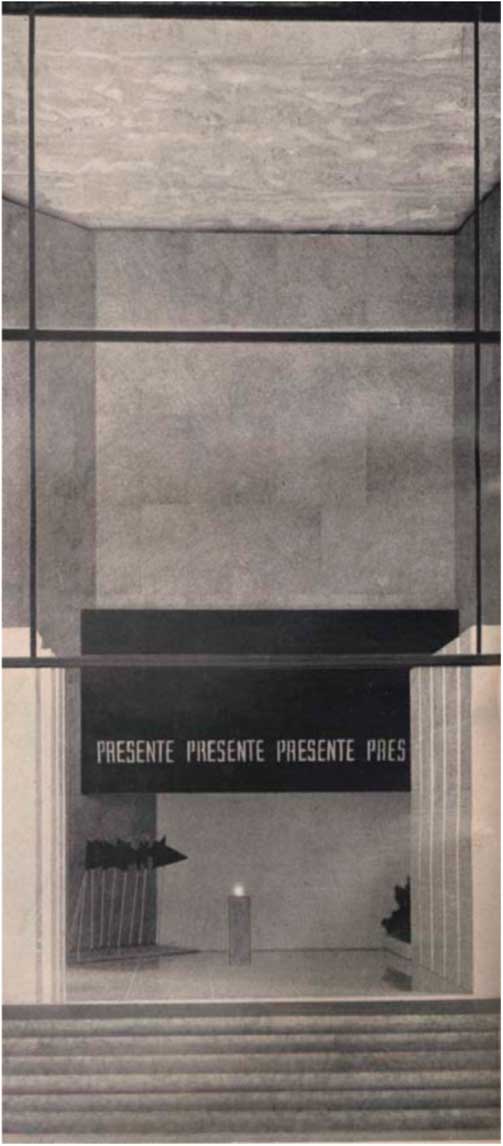
Former PNF headquarters, not unlike other public buildings, therefore continue to hold bas-reliefs, mosaics, frescoes, and other works of art that celebrate Fascist myths. For example, the mortuary chapel (sacrario) designed by Marco Zanuso (along with G. Albricci, M. Tevarotto, L. Mattoni and G. Salvedè) for Pietro Portaluppi’s former provincial Fascist Party headquarters (Sede Federale, 1936–1940) in Milan, was substantially reconfigured after the war (Figure 5). The tall freestanding white marble slabs originally positioned along the rectangular hall to focus the viewer’s attention on a votive flame, a crucifix, and a plaque commemorating Fascist martyrs at the end of the room, have all been removed. However, the former chapel, now an entrance vestibule to a military police (carabinieri) headquarters, still holds the bas-relief Flight of Victory (Volo di Vittorie, 1938–1939) by the artist Lucio Fontana, and four winged victories, each of which celebrates events significant to Italian Fascism, continue to frame the double-height glass entrance, suggesting that their value as works of art surpasses their potency as political symbols or, more problematically, the persistence of Fascist era national narratives.Footnote 23
Memorial chapel (sacrario), designed by G. Albricci, M. Tevarotto, M. Zanuso, L. Mattoni, G. Reggio and M. Salvedè, at Piero Portaluppi’s Sede Federale, Milan, 1938–1940. Costruzioni 1941, p. 44.

Initial attempts to obscure references to the Fascist regime as well as to make these former party buildings better suited to new purposes focused not only on Fascist iconography but also spaces, like mortuary chapels, that were most closely tied to the ritual operations of the Fascist Party. In Lissone, new occupants removed the original furnishings, blocked access to the mortuary chapel (located on the ground floor of the stone tower), destroyed the bridge linking the tower to the building, modified panels resembling fasces that lined the auditorium, and either removed or destroyed all decoration and inscriptions in a process that here, as elsewhere, was largely undocumented (Ugolini Reference Ugolini1994, 7; Ugolini and Zilioli Reference Ugolini and Zilioli1994, 108). In the immediate postwar period, much of the interior decoration for Terragni’s Casa del Fascio in Como was destroyed. By the early 1950s, when government agencies considered adapting the building for use as administrative offices, officials focussed on the functional aspects of the design, noting that the expansive windows on the front façade (which carried symbolic meaning for Terragni as a reminder of Fascism’s transparency) made it difficult to regulate internal temperatures. They proposed partitioning and lowering the ceiling of the large central courtyard (designed for large gatherings and Fascist ritual events) in order to create additional office space.Footnote 24
The renaming of buildings served as a means to signal new ownership, in some instances to strengthen associations with the political left, as well as a practical response to the dissolution of the PNF. In 1947, the ANPI, which occupied Vietti’s former Casa del Fascio in Verbania, renamed the building (now Palazzo Flaim) to honour Mario Flaim, a local hero of the Resistance, and a proposal was put forward to place a neon sign reading ‘Casa del Popolo’ on the façade of Terragni’s former Casa del Fascio in Como.Footnote 25
The occupation of former party buildings by the CLN as well as by political parties and organisations affiliated with the Resistance, not only made use of available real estate but also represented an opportunity for these organisations to re-establish their position in the political life of the nation. During Fascism’s rise, the PNF had commandeered or destroyed the buildings and spaces used by political parties of the left, especially the socialist House of the People (casa del popolo), to suppress opposition and as bases for its own operations. Indeed, case del popolo had served as a model for case del fascio (Biscossa Reference Biscossa1986). Socialist and communist groups, although officially banned after 1926, continued their activities, albeit in greatly reduced circumstances, throughout the interwar period. In the final years of the war, they provided critical organisational and logistical support as well as personnel for the Resistance and often operated under the direction of the CLN. The occupation of former Fascist Party headquarters thus represented the opportunity to reclaim past losses and assert authority over a vanquished enemy. Indeed, the CLN used these headquarters as centres from which they could ‘promote and supervise the purging (epurazione) of former Fascists and the diffusion of a democratic consciousness and respect for freedom’ as well as to provide access to services, including food, housing, and heating (Punzo Reference Punzo1979, 213–214, n. 25). As Italy struggled to recover from the devastating effects of war, these buildings could be understood by some Italians as material reminders of Fascism’s defeat and of the new political order in formation.
Immediately following the end of the Second World War, the repurposing of PNF headquarters, after an initial phase of destruction that focussed on the most politically charged elements of these buildings, represented a pragmatic response to the material needs of communities ravaged by war and the political aspirations of the political left. Their presence in buildings designed for the Fascist regime supported narratives encouraging the view that Fascism had been vanquished and that members of the Resistance were national heroes, but did little to address the violence and trauma either of the war or of the Fascist experience.
Cold War and after
The cultural and political dynamic between Italy and the United States during the Cold War helped to shape the history of former party headquarters as the immediate aftermath of war gave way to recovery and reconstruction. The polarised landscape of the Cold War created a climate in which the United States viewed left-wing political movements within Italy as a threat to American interests. Although the financial and technological support offered by America shared some aspects of earlier prewar exchanges, Italy’s near-total dependence on American assistance as the nation undertook the project of rebuilding (communications networks, transportation infrastructure, water supplies, housing, and so forth), combined with the intensity of American propaganda efforts created a dynamic in which cultural, economic, and political activities were closely intertwined (Castillo Reference Castillo2010; Scrivano Reference Scrivano2013, 11–24; Duran 2017).
In this context, the continued presence of the political left in government-owned buildings, often prominent structures in the historic centre of a city or town, could be understood as problematic evidence of the persistence of Communist and Socialist Party activity in a political environment increasingly divided along the ideological lines of the Cold War. In January 1947, in a move indicative of the changing political landscape, the Christian Democrat leader and prime minster of Italy, Alcide De Gasperi, following a trip to the United States, reshuffled his cabinet, in a process that began the steady removal of Communist and Socialist Party members from the government. This reorganisation extended to the Ministry of Finance, which since June 1945 had been overseen by the Communist senator Mauro Scoccimarro and was thereafter led for the following decade, with only a few exceptions, by a member of the Christian Democrats. Later that same year, the Truman Doctrine (12 March 1947) made clear that America understood their support of Italy as part of a larger strategy to limit the spread of Soviet influence. In anticipation of the elections of 1948, American officials warned that a Communist victory would end the steady stream of aid that had become central to Italy’s reconstruction, and Christian Democrat and American agencies cultivated narratives that presented communism as a hostile alien force in Italian society. In the end, Christian Democrats enjoyed a decisive victory. Among the consequences was the final collapse of the coalition between the parties of the left involved in the Resistance and the Italian government. By the early 1950s, the consensus achieved by the Christian Democrats in 1948 gave way to a more fractured political landscape: nevertheless, Cold War politics continued to define much of Italian cultural and political life (Ginsborg Reference Ginsborg2003).
In the early 1950s, the Ministry of Finance took steps to regularise its operations, demonstrate its authority, and reclaim lost revenue through the management of the properties placed under its control nearly a decade earlier. Many of these buildings, including Terragni’s former Casa del Fascio in Como, which was now known as the Casa del Popolo and disparagingly referred to in the local press as the ‘house of no one’, had fallen into disrepair.Footnote 26 Records from the Ministry of Finance emphasise that tenants, who included a number of political groups, a few government agencies, and private individuals, failed, with the exception of the Christian Democrats, to pay rent.Footnote 27 As a result, maintenance was inconsistent, and the press, to the embarrassment of local officials, provided vivid reports of the degraded state of the property.Footnote 28 Officials feared that their efforts to remove current tenants, among these the PCI, which occupied fifteen rooms and was the majority occupant, would be seen as politically-motivated and lead to protests. In correspondence with the Ministry of Finance, the head of the provincial financial office emphasised that all political parties and organisations would be treated equally and asked to vacate the building to make way for new uses by 31 July 1952.Footnote 29 Although presented as a political necessity, the head of the Como finance office also acknowledged that the building, which was of modern construction, generous in its proportions and size, and well-positioned in the city centre, could comfortably accommodate the local finance office.Footnote 30 Throughout Italy, the government ordered political parties and affiliated organisations, and others who had occupied former party headquarters since the end of the war, to vacate these buildings and assigned them new functions. This process was often complicated by the disputed legality of the transfer to the national government of these properties (many of which had been donated to the PNF under pressure) in a period of political upheaval, and by the ambiguity of the requirements surrounding the building’s use. Local authorities described the means through which the Ministry of Finance acquired property as ‘having only the appearance of legality’.Footnote 31
By 1956, the majority of former party headquarters had been given new designations by presidential degree. Indicative of national trends, a decree of that year established Terragni’s Como building as an outpost for the branch of the Italian armed forces responsible for combatting financial crime and smuggling (Guardia di Finanza). The building continues to function as their provincial headquarters. Although many former party centres became outposts for state and military police in this period (both were significantly expanded in the postwar era), an assignment that restored these buildings as centres of authority and control, even if under a substantially different political enterprise, others were used for very different purposes. Terragni’s former Casa del Fascio in Lissone continued to be occupied illegally throughout the 1950s by a number of political parties and agencies, including the PCI, Istituto Nazionale per l’Assicurazione contro le Malattie (INAM), Camera del Lavoro, and Unione Artigiana Mutilati e Invalidi di Lavoro, as well as by two private individuals, indicating the extent to which the effort to regulate was never uniform and often protracted.Footnote 32 In 1962 the architect Pietro Lingeri, who had frequently collaborated with Terragni in the interwar period, reconfigured the mortuary chapel to serve as a memorial to war veterans. In 1968 the municipal government purchased the building (now known as the Palazzo Terragni) for use as a conference centre, art gallery, offices, library, and venue for public events, and undertook the first of two renovations in this period (Ugolini and Zilioli Reference Ugolini and Zilioli1994, 108). In Genoa in the early 1950s, the Ministry of Defence transformed Danieri’s former party headquarters into a casa del soldato, from which it administered veterans’ assistance programmes until vacating the building in 2009.Footnote 33 In each instance, the designation of new functions contributed to the layered character of Italy’s urban form, but did little to acknowledge or address the historical circumstances surrounding the buildings’ construction or change in function over time.
In the case of buildings designed by architects associated with Rationalism, any effort to address the political complexities of the history of these buildings was further complicated by cultural narratives that equated modernism in architecture and design with democratic values and that portrayed Fascism as a rupture within a noble Italian cultural tradition (Duggan Reference Duggan1995, 7; Duran 2014, 2). In addition, the view that works of art and architecture should be understood in isolation from their economic, political and social context nurtured an environment in which scholarly accounts and preservation efforts often paid little attention to their role as instruments of the PNF or their history in the postwar period.Footnote 34
Conclusion
Recent projects to restore or designate new uses for former party headquarters designed by architects associated with Italian Rationalism have brought together unlikely allies, including scholars and preservationists who agree that these buildings, to varying degrees, are significant examples of Italian modernism worthy of preservation, as well as those who understand the buildings and spaces constructed by the Fascist regime as a reminder of past glories. This process, together with a renewed interest in the material legacy of the interwar period and the far-right’s growing traction in Italian politics, has brought to the fore a lingering uncertainty among scholars, especially outside of Italy, about how and to what extent the interwar history of these buildings shapes current understanding.Footnote 35
Long celebrated as a significant work of Italian modernism, Terragni’s Casa del Fascio in Como was recognised by the Ministry of Culture as a national monument (a designation given in 1986) and is a regular stop on architectural sightseeing tours (Artioli Reference Artioli1994, 104). In recent years, cultural leaders in Como have advocated making the building into a museum or cultural centre. The undertaking was initially opposed by Terragni’s nephew, Attilio Terragni, who remarked: ‘The Casa del Fascio is a centre for cultural and political associations and manifestations: it should never be a museum, at least if you don’t want to destroy it. If the city wants a museum, it should build one.’Footnote 36 In March 2017, Made in Maarc (Museo virtuale astrattismo e architettura razionalista Como), an association dedicated to the promotion of the region’s cultural importance in the modern period, with support from American architect and theorist Peter Eisenman, launched a petition to transform Terragni’s Casa del Fascio and the adjacent former Fascist Union of Industrial Workers (Unione Fascista dei Lavoratori dell’Industria, 1940) by the Rationalist architects C. Cattaneo and P. Lingeri, into a museum complex dedicated to the study and conservation of Rationalism and abstraction.Footnote 37 In an indication of the ways in which culture and politics continue to be intertwined, the head of La Lega Nord Matteo Salvini made a related proposal part of his 2018 election campaign. The desire to expand Italy’s vibrant tourist industry and to capture an audience interested in modern architecture and design provides a context for such an undertaking, but also obscures the ways in which buildings and spaces associated with Fascism, many of which remain substantially unchanged, can be reinvested with meaning, perhaps especially in the current political climate.
Many former party headquarters have been quietly reabsorbed into the fabric of cities and towns and architecture, more than many other art forms, has a limited capacity to carry meaning. However, the plan to establish a museum to Fascism in the former Casa del Fascio in Predappio draws attention to the degree to which buildings and spaces associated with the regime are, despite their postwar history, still capable of holding a political charge (Fuller Reference Fuller2018). In a related vein, architectural historian Paolo Nicoloso argues that Fascist-era imagery (spatial and iconographic) continues to inform Italian identity (Nicoloso Reference Nicoloso2009). The recently completed art installation, which projects in spare san serif text, ‘No one has the right to obey’ (Hanna Arendt, 1964) in German, Italian and Ladin (the three official languages of the region) on the façade of the monumental former Fascist party headquarters in Bolzano (G. Pellizzari, F. Rossi and L. Plattner, 1939–1942) suggests one possibility for a critical engagement with buildings tied to a difficult past.Footnote 38 Such examples suggest that even as Fascist-era buildings have assumed new meanings, this process, in at least some instances, is ongoing. As a result, those involved in constructing narratives about the significance of these buildings – including scholars of history and architecture, preservationists, and political leaders, as well as the public at large – have the opportunity to play a critical role in shaping the ways in which they are understood not only as historical objects but also in the context of the contemporary architectural landscape.
Acknowledgements
I would like to thank the anonymous reviewers who provided helpful suggestions and food for thought as I continue to carry this project forward. I would also like to offer an especially warm thank you to Nick Carter and Simon Martin for their work in bringing this collection of essays together. In addition, I am indebted to comments in response to earlier versions of some of the material in this paper presented at ‘Difficult Heritage’ at the EAHN annual conference in Dublin, Ireland (2016) and at the session ‘Instruments of Power in Modern Italian Architecture and Landscapes’ at the AAIS/CSIS conference in Columbus, Ohio (2017). Thank you as well to Francesca Gusella for translating the abstract into Italian.
Lucy Maulsby is an Associate Professor of Architectural History at the School of Architecture at Northeastern University in Boston, MA. Her research focuses on architectural responses to modernisation, with a special emphasis on the relationships between architecture, urbanism, and politics in Italy. She is the author of Fascism, Architecture and the Claiming of Modern Milan (University of Toronto Press, 2014).