1. The problem
Most theoretical syntactic studies recognize, in addition to the active Voice, a single non-active Voice, passive.Footnote 2 The term middle is not used to denote Voice; rather, it is usually restricted to a form of the verb denoting disposition, as in the bread cuts easily (see e.g. Fagan Reference Fagan1992).
In descriptive and typological studies, on the other hand, a distinction can be found between two different non-active Voices: the passive Voice and the middle Voice. Several typological studies discuss the middle Voice (Siewierska Reference Siewierska1984; Geniušienė Reference Geniušienė1987; Klaiman Reference Klaiman1991, Reference Klaiman1992; Kemmer Reference Kemmer1993, Reference Kemmer, Fox and Hopper1994; Croft Reference Croft, Fox and Hopper1994; Shibatani Reference Shibatani2006) and attempt to provide descriptions of its semantics. Though these descriptions have proven hard to sharpen and explicate in theoretical terms, it is nevertheless striking that the same traits repeat themselves in the descriptions of the middle Voice from various languages of different language families.
One factor complicating the issue is that in some languages, all non-active verbs share the same morphology. This is the case in (Modern) Greek, Latin, Akkadian, Syriac, and Amharic. In other languages, such as Classical Greek, Hebrew (both Modern and Classical), Standard Arabic, Fula, and Icelandic, however, there are two separate non-active forms of the verb.Footnote 3 Whereas in the latter type of languages we have morphological evidence for the passive vs. middle distinction, it is much less clear what can be concluded from the former type of languages. In the typological literature, one mostly finds the view that the passive Voice in these languages subsumes middle-like meanings (see e.g. Hopper & Thompson Reference Hopper and Thompson1980, Haspelmath Reference Haspelmath1990, Nichols, Peterson & Barnes Reference Nichols, Peterson and Barnes2004, and references therein).
A further complication is the following. In English, active Voice and dispositional middles share the same morphology, whereas the passive is morphologically (and syntactically) marked. Thus, we find that cross-linguistically, dispositional middles can sometimes be marked as non-active (as in Greek, for example) or as active (as in English). On the other hand, Haspelmath (Reference Haspelmath1990) has argued that no language marks passive and active alike. This would seem to indicate that the middle Voice is not demarcated cross-linguistically as well as the passive Voice is.
In this paper, we look for a theoretical characterization of the middle Voice as distinct from the passive Voice. We raise the question of whether it is possible to develop a syntactic analysis (independent of the morphological exponents) which might be equally relevant to the two types of languages, thus indicating the existence of the middle Voice. While morphology is a key ingredient in recognizing the number of Voices available in a language, we would like to offer a more formal characterization. We argue that there are indeed two non-active Voices, passive and middle, both preventing the insertion of an external argument as subject, but with different properties. Of these two Voices, it is actually the middle Voice rather than passive Voice which is found in the first type of languages (e.g. Greek).
Among the languages of the world, some do not have morphological Voice variation at all, and only have active morphology (Malayalam, Neo-Aramaic).Footnote 4 Other languages have morphological Voice contrasts in the verb system, the most famous being the two-way active–passive contrast of English. A different two-way contrast is active vs. middle (sometimes called non-active). This latter contrast was probably the one found in Proto-Indo-European and Proto-Semitic, and is now, we argue, found in Modern Greek (see also Klaiman Reference Klaiman1991, Manney Reference Manney2000, Kaufmann Reference Kaufmann2001, contra Zombolou Reference Zombolou2004). Such a system basically marks two Voices: active vs. middle, where the middle Voice appears with anticausative, reflexive, dispositional-middle, and medio-passive verbs. What characterizes the middle Voice is that it does not require, though it allows (depending on what we call here the root, see Section 3 below), the participation of an external argument. In some languages with the middle Voice, a more specialized Voice can develop – the passive Voice – which distinguishes itself from the middle Voice by always requiring the participation of an external argument, irrespectively of the specification of the root (Hebrew, Arabic). English too, which has lost its middle morphology altogether, so that middle-Voice verbs are now marked as active, has developed a passive Voice based on a passive auxiliary and a participle.
The paper is structured as follows: Section 2 introduces our terminology, describes the realization of non-active Voice in three different types of languages, represented by Modern Hebrew, Modern Greek and English, and motivates a distinction between two non-active Voices: the middle and the passive. In particular, we discuss verbs which we call medio-passive, which appear at first sight to be passive but are revealed under scrutiny to be different from passive verbs, and actually better classified as middle. Section 3 presents our theoretic background based on Doron (Reference Doron2003) and Alexiadou, Anagnostopoulou & Schäfer (Reference Alexiadou, Anagnostopoulou, Schäfer and Frascarelli2006), works which provide the framework for a Distributed-Morphology-style construction of verbs from roots. In this framework, middle and passive verbs are constructed from two different Voice heads μ and π respectively. Section 4 demonstrates the construction of non-active verbs representing the different types of non-active interpretations introduced in Section 2. Section 5 argues that the syntactic derivation of non-active verbs from their roots is preferable to lexicalist analyses where non-active verbs are derived from their active counterparts. Section 6 offers our conclusions.
2. The interpretation of non-active Voice
Cross-linguistically, (at least) the following types of intransitive verbs cluster together under non-active Voice morphology:Footnote 5
(i) anticausatives, denoting spontaneous events (break, open)
(ii) naturally reflexive verbs, e.g. verbs of body care (wash, comb) and naturally reciprocal verbs (meet, kiss)
(iii) dispositional middles (This book sells well)
(iv) medio-passives, typically underdetermined for passive/anticausative (not found in English)
(v) passives (The door was opened)
As shown by Kemmer (Reference Kemmer1993, Reference Kemmer, Fox and Hopper1994) for a variety of languages, types (i)–(iv) systematically share the same morphological marking: the middle Voice. In the present work, we will analyse this morphological identity as the reflection of a single syntactic structure underlying these various constructions, a structure containing the middle-Voice functional head (which we call μ). The difference in interpretation between the four different types results from the variety of interactions between μ and the verb's root, stemming from differences between roots. For example, roots of anticausative verbs typically do not allow the external argument in middle-Voice derivations, whereas roots of medio-passive verbs do.
According to our analysis, the syntactic structure underlying type (v), the passive, contains a different functional head, the passive Voice head π. The interpretation of passive structures always includes an understood external argument, since this is a property of π independent of the root. The event described by the passive verb involves the same external argument as the corresponding active verb; the thematic role of this argument is the one required by the root: agent/experiencer/location/cause. But the presence of the passive Voice head π triggers the existential binding of the external participant in the morphology, which results in it not occupying the syntactic subject position (see Baker, Johnson & Roberts (Reference Baker, Johnson and Roberts1989), who argue that -en is a true syntactic argument, the external one, which is generated under the Infl node and lowers to V). In particular, this argument is interpreted as non-coreferential with any of the other arguments of the verb. This is different from the middle Voice, where some roots which allow an external argument (e.g. reflexive verbs) require it to be coreferential with the internal argument.
Medio.passive is different from the passive in that it shares the morphology of the middle Voice. It is nevertheless similar to the passive in that it allows the participation of the external argument of the active Voice. Yet, unlike the passive, where the external argument is required, the medio-passive allows this argument but does not require it. Medio-passives thus also share properties with anticausatives, where the external argument is not included in the derivation. The medio-passive is compatible both with interpretations under which something happens on its own and with interpretations where it is brought about by an external argument. It is thus underdetermined for the passive/anticausative distinction (see Tsimpli Reference Tsimpli, Unsworth, Parodi, Sorace and Young-Scholten2006).
In cases where the root does not require an external argument, active Voice morphology describes an event without an external cause/agent. Accordingly, there is no reason for merging either middle or passive morphology to achieve the reduction of the external argument. If such morphology is nevertheless merged, then, for economy reasons, this is only appropriate if the active is less informative, i.e. if the described event has an external argument after all. This argument must be interpreted as agent, which is the default theta role assigned when the root is not the element which selects the external argument. Probably, it is the agent role which is the default, rather than cause, say, since a cause is always understood irrespective of argument structure.
We assume that the medio-passive interpretation of the middle Voice depends on the lack of a passive Voice, either in the language in general, or at least for particular verbs. Where both middle and passive structures are available (as is the case in the Modern Hebrew intensive template), the middle is typically interpreted as anticausative rather than medio-passive, since the passive is a better choice to indicate the presence of the external argument.
Across languages, we find a three-way morphological distinction, which is a factor in determining the number of Voices available in a language:
1. In some languages (Classical Greek, Classical Hebrew, (Modern) Hebrew, Arabic, Fula, Icelandic), there is morphological evidence for both the middle Voice and the passive Voice, distinguishing passive verbs (v) from middle verbs (i)–(iv).
2. In other languages, there is morphological evidence for the middle but no morphological evidence for the passive, and we only find middle verbs (i)–(iv), including reflexives, anticausatives, and medio-passives. This is the case in (Modern) Greek, Latin, Akkadian, Syriac, and Amharic (see Klaiman Reference Klaiman1991, Manney Reference Manney2000, Kaufmann Reference Kaufmann2001, among others).
3. In yet other languages, there is morphological evidence for the passive but no morphological evidence for the middle, hence there is no medio-passive, i.e. no type (iv) verbs. Yet, there is semantic evidence for middle-Voice derivations in (i)–(iii). In English, (i)–(iii) share the morphology with the active, and a passive form has developed, which marks (v).
In what follows, Hebrew, Greek, and English are discussed as representatives of each group.
2.1 Hebrew
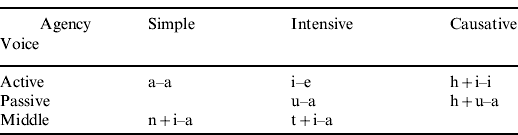
As traditionally assumed, the Semitic stem consists of a root and a template. Templates are discontinuous morphemes that are intertwined with the root in the derivation of the stem; templates consist of a vowel pattern, but some include consonantal prefixes as well. The seven verbal templates found in Hebrew are shown in Table 1, based on Doron (Reference Doron2003). The table spans two dimensions, Voice and Agency, each having three different values; of the nine potential patterns, only seven are attested in Hebrew, leaving two empty cells in Table 1.
The seven verbal templates of Hebrew

2.1.1 Two types of Agency
The Agency dimension expresses variation of the external argument's thematic role. The simple template is unmarked in that it does not determine a particular role. The intensive template determines the agent role, and the causative template – the cause role.Footnote 6 In example (1), the different active templates (a–a, i–e, h+i–i) are intertwined with the root (R) [R btx] ‘secure, confident’.
(1) [R btx] ‘secure, confident’

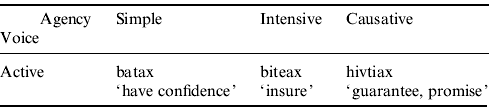
The external argument of the intensive verb is an agent, exemplified in (2a) below. One factor which distinguishes agents from causes is that only the latter can be abstract. The example in (2b) demonstrates that an abstract subject is unacceptable with the intensive verb, and (2c) demonstrates that an abstract cause can be found as the external argument of the causative template.
- (2)
(a) ha-soxen biteax et-ha-mexonit.the-agent insure.intnsacc-the-car‘The agent insured the car.’
(b) *ze še hu nahag bizehirut biteax et-ha-mexonitit that he drive carefully insure.intnsacc-the-car
(c) ze še hu nahag bizehirut hivtiax še hu yaxazor xay.it that he drive carefully promise.caus that he will-return alive‘His having driven carefully guaranteed that he would return alive.’
Another example is constructed with the root [R yšv] ‘sit, inhabit’:
(3) [R yšv] ‘sit, inhabit’
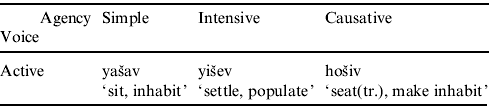
Again, the intensive template is compatible with an agent (4a) but not with an abstract cause (4b). The causative template is compatible with a cause subject (4c):
- (4)
(a) ha-šiltonot yišvu otam b-a-negev.the-authorities settle.intnsacc.them in-the-Negev‘The authorities settled them in the Negev.’
(b) *sibot kalkaliyot yišvu otam b-a-negev.reasons economic settle.intnsacc.them in-the-Negev
(c) sibot kalkaliyot hošivu otam b-a-negev.reasons economic seat.causacc.them in-the-Negev‘Economic reasons made them inhabit the Negev.’
2.1.2 Two types of non-active Voice
We now turn to the second dimension, the Voice dimension. Passive forms in Hebrew are derived with the vowel template u–a, and middle forms with the template i–a. Early on in the historical development of the language, the simple template lost its passive form, and the causative template lost its middle form (these are found in other Semitic languages):Footnote 7
(5) [R yšv] ‘sit, inhabit’

The middle templates are interpreted as anticausatives/reflexives/dispositional middles/medio-passives. In the passive template, the implicit argument is an agent; this is particularly striking in the causative template, where the active external argument is a cause. Thus, compare the active (4c) above, where the subject is a cause, with the passive (6c), where the argument in the ‘by’-phrase cannot be a cause:
- (1)
(a) hem yušvu b-a-negev al-yedey ha-šiltonot.they settle.intns.pass in-the-Negev by the-authorities‘They were settled in the Negev by the authorities.’
(b) hem hušvu b-a-negev al-yedey ha-šiltonot.they seat.caus.pass in-the-Negev by the-authorities‘They were seated in the Negev by the authorities.’
(c) *hem hušvu b-a-negev al-yedey sibot kalkaliyot.they seat.caus.pass in-the-Negev by reasons economic‘They were seated in the Negev by economic reasons.’
Yet, the ungrammaticality of a cause ‘by’-phrase is not due to a general ban on causes in ‘by’-phrases. As we show later, causes in ‘by’-phrases are possible in the middle Voice, i.e. in the medio-passive. It is in the passive that the argument of the ‘by’-phrase is restricted to the agent role. This is explained by the fact that in the active, the causative subject of these verbs is not selected by the root, but by the causative template, together with our proposal that ‘by’-phrases not selected by the root are assigned the default thematic role of agent.
Similarly to what we will show for Greek in the next section, middle forms can be interpreted as anticausative, see (8), reflexive/reciprocal, as in (10), dispositional, as in (12), and medio-passive, as in (14). We give examples in (a) with the simple template and examples in (b) with the intensive template, corresponding, respectively, to the (a) and (b) active forms in (7), (9), (11), (13):
(7) Active
(a) ha-more gamar et-ha-ši'ur.the-teacher end.smpl.actacc-the-lesson‘The teacher ended the lesson.’
(b) ha-more siyem et-ha-ši'ur.the-teacher end.intns.actacc-the lesson‘The teacher ended the lesson.’
(8) Anticausative
(a) ha-ši'ur nigmar.the lesson end.smpl.mid‘The lesson ended.’
(b) ha-ši'ur histayem.the-lesson end.intns.mid‘The lesson ended.’
(9) Active
(a) dani pagaš et-dina.Dani meet.smpl.actacc-Dina‘Dani met Dina.’
(b) dani nišeq et-dina.dani kiss.intns.actacc-Dina‘Dani kissed Dina.’
(10) Refexive/reciprocal
(a) dani ve-dina nifgešu.Dani and-Dina meet.smpl.mid‘Dani and Dina met.’
(b) dani ve-dina hitnašqu.Dani and-Dina kiss.intns.mid‘Dani and Dina kissed.’
(11) Active
(a) dani marax et-ha-xem'a. Dani spread.smpl.actacc-the-butter‘Dani spread the butter.’
(b) dani gihec et-ha-xulca.Dani iron.intns.actacc-the shirt‘Dani ironed the shirt.’
(12) Dispositional middle (see Borer & Grodzinsky Reference Borer, Grodzinsky and Borer1986)
(a) ha-xem'a lo nimrexa l-o.the-butter not spread.smpl.mid to-him‘The butter didn't spread for him.’
(b) ha-xulca lo hitgahaca l-o.the-shirt not iron.intns.mid to-him‘The shirt didn't iron for him.’
(13) Active
(a) ha-masa'it maxaca et-ha-mexonit.the-truck squash.smpl.actacc-the-car‘The truck squashed the car.’
(b) ha-xoqer bicea' et-ha-nisuythe researcher perform.intns.actacc-the-experiment‘The researcher performed the experiment.’
(14) Medio-passive
(a) ha-mexonit nimxaca (al-yedey ha-masa'it).the-car squash.smpl.mid by the-truck‘The car was squashed (by the truck).’
(b) ha-nisuy hitbacea' (al-yedey ha-xoqer).the-experiment perform.intns.mid by the-researcher‘The experiment was performed (by the researcher).’
Unlike Greek, which, as will be shown later in this section, has a single non-active Voice, Hebrew has dedicated passive templates in addition to the middle templates. The interpretation of the passive template differs from the medio-passive interpretation of the middle template. Several differences between medio-passives and passives can be observed. These are discussed in the remainder of this sub-section.
2.1.3 Distinguishing the medio-passive from the passive
Unlike the passive, middle Voice related to active transitive verbs can usually have an anticausative reading besides the medio-passive one (i.e. they can appear with me-acma ‘by itself’). This correlates with a difference in interpretation from the passive, and we accordingly sometimes translate Hebrew verbs in middle Voice into English as get-passives (and see Alexiadou (to appear) for arguments that get-passives realize middle Voice):
- (15)
(a) ktovet muzara nixteva al-yedey ha-mafginim.inscription strange write.smpl.mid by the-demonstrators‘A strange inscription was written by the demonstrators.’
(b) ktovet muzara nixteva me-acma b-a-šamayim.inscription strange write.smpl.mid from-itself in-the-sky‘A strange inscription got written in the sky by itself.’
In the intensive, there are two non-active templates. As already mentioned, the existence of the passive form normally blocks the medio-passive interpretation of the middle template. The passive template obligatorily introduces an external argument (see the contrast (16a–b)), whereas the corresponding middle template often has an anticaustive interpretation, i.e. it is interpreted as lacking an external argument (see the contrast in (17a–b)):Footnote 8
- (16)
(a) ha-gader porqa al-yedey ha-mafginim.the-wall dismantle.intns.pass by the-demonstrators‘The wall was dismantled by the demonstrators.’
(b) *ha-gader porqa me-acma.the-wall dismantle.intns.pass from-itself‘The wall was dismantled by itself.’
- (17)
(a) *ha-gader hitparqa al-yedey ha-mafginim.the-wall dismantle.intns.mid by the-demonstrators‘The wall fell apart by the demonstrators.’
(b) ha-gader hitparqa me-acmathe-wall dismantle.intns.mid from-itself‘The wall fell apart by itself.’
Typically, the medio-passive interpretation of intns.mid only exists for roots which do not derive intns.pass verbs: *qubal ‘receive.intns.pass’, *buqaš ‘request.intns.pass’, *busar ‘announce.intns.pass’, *gula ‘discover.intns.pass’. These roots allow intns.mid medio-passives, middle-Voice verbs which can be modified with ‘by’-phrases:Footnote 9
- (18)
(a) qibel receive.intns.acthitqabel al-yedey … receive.intns. mid by …
(b) biqeš request.intns.acthitbaqeš al-yedey … ask.intns. mid by …
(c) biser announce.intns.acthitbaser al-yedey … announce.intns. mid by …
(d) gila discover.intns.acthitgala al-yedey … discover.intns. mid by …
The possibility of interpreting a smpl.mid form as medio-passive is lexically determined, unlike the passive form, which is always interpreted as passive. The examples in (19) illustrate middle Voice forms of transitive verbs which cannot be interpreted as medio-passive:
- (19)
(a) ha-ši'ur nigmar (*al-yedey ha-more).the-lesson end.smpl.mid by the-teacher‘The lesson ended.’
(b) ha-tinoq nolad (*al-yedey imo).the-baby be-born.smpl.mid by mother.his‘The baby was born.’
(c) ha-pritim nixlelu (*al-yedey ha-rešima).the-items include.smp.mid by the-list‘The items were included.’
As will be shown also for Greek, some middle forms are interpreted as anticausative only; these allow ‘from’-phrases and disallow ‘by’-phrases, as is shown in (20). (All the examples in this paper citing Internet sources were checked or retrieved on 20 February 2011.)
- (20)
(a) ha-roman nigmar mi-/*al-yedey paxad šeli lihyot im adam maxur.the-romance end.simpl.mid from/by fear mine to.be with person addicted‘The relationship ended because of my fear of being with an addict.’
(b) ha-šemen nidlaq me-ha-xom/*al-yedey ha-po'alim.the-oil ignite.smpl.mid from-the-heat/by the-workers‘The oil ignited from the heat.’
Other forms allow both anticausative and medio-passive interpretations, and exhibit a variation in prepositions:
- (21)
(a) criax ha-knesiya nisraf mi/al-yedey baraq še paga bo.tower the-church burn.smpl.mid from/by lightning that hit it‘The tower of the church was burned by lightning that hit it.’
(b) ha-ro'e acmo nifga mi/al-yedey haxlata še-lo le-qabl-o ke-xaver bursa …the-sees himself hurt.smpl.mid from/by decision that-not to-accept-him as-member stock.exchange‘Whoever considers himself negatively affected by a decision not to accept him as a stock-exchange member …’
Medio-passives differ from passives in allowing cause ‘by’-phrases, whereas passives only allow agentive (or instrumental) ‘by’-phrases in Hebrew. The following two examples show causative active verbs, where the passive only allows agentive ‘by’-phrases (an additional example appears above, in (6)):
- (22)
(a) xavert-o/saqranut-o hevi'a oto l-a-mesiba.friend-his/curiosity-his bring.caus.actacc.him to-the-party‘His friend/his curiosity brought him to the party.’
(b) hu huva l-a-mesiba al-yedey xavert-o/*saqranut-o.he bring.caus.pass to-the-party by friend-his/curiosity-his‘He was brought to the party by his friend.’
- (23)
(a) ha-menahelet/ha-texnologya ha-xadaša horida et-ha-mexirim.the-director/the-technology the-new lower.caus.actacc-the-prices‘The director/the new technology lowered the prices.’
(b) ha-mexirim hurdu al-yedey ha-menahelet//*al-yedey ha-texnologya ha-xadaša.the-prices lower.caus.pass by the-director/by the-technology the-new‘The prices were lowered by the director.’
Medio-passives, on the other hand, allow cause ‘by’-phrases:
- (24)
(a) ha-be'ayot nigremu al-yedey mezeg-ha-avir.the-problems cause.smpl.mid by the-weather‘The problems were caused by the weather.’
(b) ha-be'ayot nocru al-yedey išiyut-o.the-problems create.smpl.mid by personality-his‘The problems were created by his personality.’
(c) hu ne'enaš al-yedey yisurey-ha-macpun šelo.he punish.smpl.mid by the-guilt-feelings of.his‘He was punished by his guilt feelings.’
(d) hu nitmax al-yedey emunato ha-xazaqa.he support.smpl.mid by faith.his the-strong‘He was supported by his strong faith.’
Only middle forms, not passives, give rise to dispositional readings. Moreover, middle forms, even when they have a medio-passive interpretation, can also be interpreted dispositionally:
- (25)
(a) Dispositional
ha-xulca lo hitgahaca.the-shirt not iron.intns.mid‘The shirt didn't iron.’ (i.e. it was impossible to iron the shirt)
(b) Passive
ha-xulca lo gohaca.the-shirt not iron.intns.pass‘The shirt wasn't ironed.’ ((verbal) passive only, not dispositional)
(c) Dispositional/medio-passive
migdal ayfel lo nir'a mi-šam.tower Eiffel not see.smpl.mid from-there‘The Eiffel tower was not visible/was not seen from there.’
2.2 Greek
As opposed to Classical Greek which had a three-way Voice morphological distinction, active, middle and passive, Modern Greek has a two-way distinction, active (Act) and non-active (Nact), illustrated in (26) for the 1st person singular of the verb grafo ‘write’.Footnote 10
(26) Active/non-active 1st person forms of grafo ‘write’

The distribution of non-active Voice in Greek can be summarized as follows:Footnote 11
First, non-active morphology appears with naturally reflexive verbs as in (27), see e.g. Kemmer's (Reference Kemmer1993) classification.Footnote 12
(27) i Maria htenizete.the Maria combs.nact‘Maria combs herself.’
Secondly, non-active morphology appears on the intransitive members of the causative alternation. These cannot be interpreted as (medio-)passive:
- (28)
(a) o Janis ekapse ti supa. Causativethe Janis burnt.act the soup.acc‘Janis burnt the soup.’
(b) i supa kaike. Anticausativethe soup.nom burnt.nact‘The soup burnt.’
Thirdly, as in Hebrew, non-active morphology appears in the dispositional middle (Condoravdi Reference Condoravdi1989, Tsimpli Reference Tsimpli1989, Sioupi Reference Sioupi1998, Lekakou Reference Lekakou2005):
- (29)
(a) o Janis diavase to vivlio.the Janis read.act the book.acc‘Janis read the book.’
(b) afto to vivlio diavazete efkola.this the book reads.nact easily‘This book reads easily.’
Fourthly, non-active morphology appears on a group of verbs that we call medio-passives, where the external argument, whether implicit, as in (30a), or explicit via a PP, as in (30b), has the thematic role determined by the root; it is not necessarily an agent, but could be an experiencer in (30a) or a causer in (30b):
- (30)
(a) to vivlio diavastike.the book read.nact‘The book was read.’
(b) to provlima proklithike apo tin ishirognomosini tu.the problem caused.nact by his stubbornness‘The probem was caused by his stubbornness.’
Finally, non-active morphology appears on verbs which have a reading compatible with both a (medio-)passive and an anticausative interpretation. These interpretations can be teased apart on the basis of the preposition introducing the external argument:Footnote 13
- (31)
(a) o diefthindis/i nees ekseliksis miose/an tis times.the director/the new developments lowered.act.3sg/3pl the prices‘The director/the new developments lowered the prices.’
(b) i times miothikan apo to diefthindi/me tis nees ekseliksis.the prices lowered.nact by the director/with the new developments‘The prices were lowered by the director/went down because of the new developments.’
This is like the situation described in the previous section for the Hebrew medio-passive in (21) (in contrast with the the passive (22)–(23)). Due to this syncretism, it is hard to tease the readings of the forms apart, especially the anticausative one from the medio-passive, see Philippaki-Warburton (Reference Philippaki-Warburton1975), Theophanopoulou-Kontou (Reference Theophanopoulou-Kontou1983). As Zombolou (Reference Zombolou2004), Alexiadou et al. (Reference Alexiadou, Anagnostopoulou, Schäfer and Frascarelli2006) and Alexiadou & Anagnostopoulou (Reference Alexiadou and Anagnostopoulou2009) have shown, however, there are systematic differences between these forms that relate to the licencing of PPs.Footnote 14
Very few verbs in Greek allow the agentive ‘by’-phrase, but crucially anticausative verbs do not:
(32) i supa kaike *apo to Jani.the soup burnt.nact by the Janis‘The soup got burnt by Janis.’
On the other hand, anticausatives can appear with apo mono tu ‘by itself’ and allow causer PPs, which is impossible for verbs that only have an agentive medio-passive interpretation (such as those in (36) below):Footnote 15
(33) i supa kaike apo moni tis.the soup burnt.nact by itself‘The soup got burnt by itself.’
(34) i supa kaike me ti dinati fotia.the soup burnt.nact with the strong fire‘The soup got burnt with the strong fire.’
Other non-active forms of a transitive verb are incompatible both with a ‘by’-phrase and also with ‘by itself’.
(35) to pedi genithike *apo ti mitera tu/*apo mono tu.the baby was.born.nact by his mother/by itself‘The baby was born by his mother/by itself.’
According to Zombolou (Reference Zombolou2004) and Alexiadou et al. (Reference Alexiadou, Anagnostopoulou, Schäfer and Frascarelli2006) only the following verb classes accept an agentive ‘by’-phrase in Greek but disallow a causer PP and ‘by itself’ (based on Levin Reference Levin1993):
(36) Verbs of change of possession (e.g. dino ‘give’), verbs of transfer of message (e.g. leo ‘tell’), ‘take’ verbs, verbs of instrument of communication (e.g. tragudo ‘sign’), remove verbs (e.g. diohno ‘expel’), and murder and poison verbs (e.g. dolofono ‘murder’).
We believe that for these verbs too, it is possible to say that the Nact form realizes middle Voice rather than passive. These verbs take an agent ‘by’-phrase as a requirement of the root. As they are agentive verbs to begin with, it is no surprise that they can only license an agent ‘by’-phrase. This is clearly the case with, for example, the English verbs murder and poison, which ‘lexicalize the purpose or manner or instrument of killing’. Such verbs necessarily make reference to properties that conceptually need to be in control of an agent (Levin Reference Levin1993: 231).Footnote 16
There is one class of verbs, however, that shows a different pattern, the class of de-adjectival verbs. With this class, medio-passives bear non-active morphology, while the anticausative bears active morphology. In the dispositional middle, Tsimpli (Reference Tsimpli1989), Sioupi (Reference Sioupi1998) and Lekakou (Reference Lekakou2005) suggest that only non-active morphology is present:Footnote 17,Footnote 18
- (37)
(a) to pukamiso stegnose me ton aera/apo mono tu/*apo to Jani.the shirt dried.act with the wind/by itself/by the Janis‘The shirt dried with the wind/by itself/*by Janis.’
(b) to pukamiso stegnothike apo to Jani/*me ton aera.the shirt dried.nact by the Janis/with the wind‘The shirt was dried by Janis/with the wind.’
(38) afto to pukamiso stegnonete efkola.this the shirt dries.nact easily‘This shirt dries easily.’
This class of verbs, and its parallels in Hebrew and English, will provide crucial evidence for our analysis deriving (medio-)passive verbs from roots rather than from transitive verb.
2.3 English
As is well known, in English the passive is expressed in an auxiliary+passive participle combination, whereas in the anticausative, reflexive/reciprocal, and dispositional middle formation the verb bears active morphology:
- (39)
(a) The window broke from the pressure/by itself.
(b) The children kissed.
(c) This book sells well.
(d) The window was broken (by John).
Unlike in Hebrew and Greek, in English it is impossible to tell from the morphology whether the verb in (39a) is an active-Voice unaccusative verb or a middle-Voice anticausative verb with active morphology (Hale & Keyser Reference Hale, Samuel, Hale and Keyser1993a). Since middle-Voice reflexives and dispositional middles are found in English with active morphology (39b–c), we will assume that at least some middle-Voice anticausatives with active morphology exist as well. On the other hand, the marked verb in (39d) is clearly passive rather than medio-passive, since (39d) is only true of an event which has not taken place by itself.
As in Hebrew and Greek, the passive form of verbs with roots that do not require an external argument in the active Voice is typically construed as agentive. Malka Rappaport Hovav (p.c.) notes that the passive form of unaccusative verbs in English typically appears in attested examples with agentive by-phrases only, unlike their active counterparts:
- (40)
(a) Man walks out of his car after it was crushed by a truck. (http://www.metacafe.com/watch/201989/miracle/)
(b) Most likely the can will crush from atmospheric pressure. (http://www.overclockers.com/forums/showthread.php?p=3975509)
(40) Thus, no examples are attested of a passive with a cause by-phrase parallel to the anticausative (40b), though the active is attested:
(41) The atmospheric pressure crushed the can. (http://www.newton.dep.anl.gov/askasci/chem00/chem00214.htm)
- (42)
(a) small piles of shell, which ignited from the heat
(http://www.newsinhistory.com/blog/fort-sumter-surrenders-ending-opening-battle-civil-war)
(b) tube that was closed on one side and ignited by the heat of an oven
(books.google.co.il/books?isbn=1588294153)
- (43)
(a) My heart was burnt by love.
(http://www.mp3rocket.com/mp3/-1_00/El-Tanbura-My-Heart-Was-Burnt-by-Love.htm)
(b) My heart which burnt from love.
The distribution described in Sections 2.1–2.3 raises the following two questions:
• What regulates this variation?
• Is there a core structural characterization of a middle Voice and a passive Voice despite the cross-linguistic morphological variation?
3. Theoretical assumptions
In this section, we present our theoretical assumptions. We assume a syntactic approach to word structure (following Hale & Keyser 1993a, Halle & Marantz Reference Halle, Marantz, Hale and Keyser1993, Marantz Reference Marantz1997, and subsequent work). In our view, the building blocks of verbal meaning consist of a root which combines with certain functional heads.Footnote 19 In the recent literature, several approaches have been developed which make similar general assumptions, but differ in the specifics. We briefly outline two such approaches here. While both seem to agree on the level at which the internal argument is introduced – it is introduced at the root level (but see Borer Reference Borer2005, Marantz Reference Marantz2005, and others) – they make different claims concerning external arguments.
Doron (Reference Doron2003) assumes that all active Voice forms of verbs are constructed in the syntax by combining the root with different agency heads, ι and γ. These heads play two roles: first they determine whether this will be a verb of action, a verb of causation or unclassified for these dimensions, and secondly, they introduce an external argument (see also Harley Reference Harley2007, Merchant Reference Merchant2008). Under default conditions described in Doron (Reference Doron2003), the ι and γ agency heads are spelled out as intensive and causative templates respectively. In addition, a derivation may contain a Voice head. Doron assumes two Voice-heads: the passive Voice head π, and the middle Voice head μ, spelled out as passive and middle morphology respectively. The lack of a Voice head in a derivation is interpreted by default as active Voice.
Alexiadou et al. (Reference Alexiadou, Anagnostopoulou, Schäfer and Frascarelli2006) assume a decomposition into a Voice and a v component (see Kratzer Reference Kratzer, Maienborn and Wöllstein2005). On this view, following Kratzer (Reference Kratzer1994), but see also Pylkkänen (Reference Pylkkänen2002) and Marantz (Reference Marantz2005), Voice is responsible for the introduction of the external argument and bears features relating to agency. The head v comes in a number of variants. In change-of-state contexts, it is a vCAUS and introduces a causal relation between a causing event (the implicit argument of CAUS) and the resultant state denoted by the verbal root+theme. In activity contexts, it is a vACT head.Footnote 20 These could be seen as similar to the agency heads discussed in Doron, the difference being that they are not responsible for the introduction of the external argument (although, as Schäfer Reference Schäfer2008 argues, v could introduce causer arguments).
In both approaches, although external arguments are introduced by a separate head, they are obligatory only if they are required by the semantics of the root. For instance, a so-called agentive verb such as murder or an externally caused verb such as kill will necessarily appear with an external argument, since it is part of its meaning that the change of state is brought about by an external cause/agent, rather than spontaneously (see Levin & Rappaport Hovav Reference Levin and Hovav1995).
Moreover, in both approaches, the treatment of non-active Voice is similar. There is a passive Voice head, and there is a Voice head, which in spite of being non-active has rather special properties, see Embick (Reference Embick1998), Alexiadou & Anagnostopoulou (Reference Alexiadou, Anagnostopoulou and Alexiadou2004), Schäfer (Reference Schäfer2008). On this view, Voice morphology does not always effect syntactic alternation, whenever it appears. In the passive, there is effectively valency reduction. However, in the anticausative, for example, this cannot be the case. If anticausative verbs are fundamentally intransitive, then there is simply no way the Voice morphology can be an instance of valency reduction.
In this paper, we follow the exposition advanced in Doron (Reference Doron2003), yet we adopt Alexiadou et al.'s (Reference Alexiadou, Anagnostopoulou, Schäfer and Frascarelli2006) view that there is special functional head, here called v, which actually introduces the external argument into the derivation, in addition to the agency heads ι and γ that determine the external argument's thematic role.Footnote 21
We propose the Voice classification shown in (44), according to which there are two separate non-active Voices, the passive and the middle.
(44)

Both non-active Voices prevent the realization of the external argument as subject. Both the middle Voice head μ and the passive Voice head π derive intransitive verbs, as they only allow the merge of the root's argument into the derivation. These two Voices receive a distinct realization. Specifically, the middle-Voice head μ modifies the root by reclassifying it with respect to its requirement for an external argument. The passive Voice head π, on the other hand, does not modify the root; rather it introduces an external argument, or rather requires the insertion of the head v while preventing the actual syntactic insertion of the argument. In the case of both Voice heads, the external argument is a default agent, unless required by the root.
This analysis draws evidence from de-adjectival verbs and other unaccusative verbs, where no external argument is required. It is clear that in both Hebrew and Greek, an intransitive verb can simply be derived without any Voice head, i.e. in the active Voice. We assume that this is true in English as well, for at least some unaccusative verbs. In all three languages, when a non-active Voice head is merged in the derivation of such verbs, an external argument is inserted (since, by economy, a derivation without an external argument does not require a Voice head; as the root does not select an external argument, a Voice head is superfluous if the root is to appear without an external argument). By default, this argument must be an agent in all three languages, since an argument not required by the root is an agent. As can be seen in (45)–(47), indeed only an agent is allowed.
(45) Greek
(a) ta ruha stegnosan apo ton ilio.the clothes dried.act from the sun
(b) ta ruha stegnothikan *apo ton ilio.the clothes dried.nact from the sun‘The clothes were dried (by an implicit agent).’
(46) Hebrew
(a) ha-kvisa hilbina me ha-šemeš.the-laundry whiten.caus.act from the-sun‘The laundry whitened from the sun.’
(b) ha-kvisa hulbena *me ha-šemeš.the-laundry whiten.caus.pass from the-sun‘The laundry was whitened (by an implicit agent).’
(47) English
(a) The nose (of the skateboard) chipped from kickflips. (http://www.skateboard-city.com/messageboard/archive/index.php/t-42795.html)
(b) The nose (of the skateboard) was chipped *by kickflips.
4. Deriving the patterns
We have identified the following derivations: (i) anticausative, (ii) reflexive (and reciprocal), (iii) dispositional middle, (iv) medio-passive, and (v) passive.
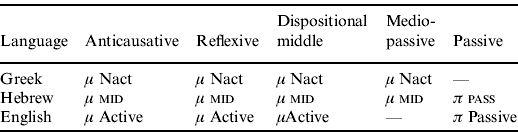
We propose that the Voice head in derivations (i)–(iv) is μ (middle), and π (passive) in (v). In particular, the Voice head in the medio-passive derivation (iv) is distinct from that in the passive derivation (v). All three languages morphologically distinguish the realization of μ from that of π. Accordingly, since there is no morphological distinction in Greek, but rather a unique Nact morphology for all the derivations, we conclude that Nact verbs modified by agentive ‘by’-phrases are medio-passives rather than passives. In other words, Greek lacks the passive Voice head π. As was shown above in Section 2.2, this conclusion is compatible with the distribution of Greek non-active verbs. In Hebrew, middle morphology marks (i)–(iv), and passive morphology marks (v). In English, (i)–(iii) is unmarked (active), (v) is marked as passive. This is shown in Table 2 below.
The morphological realization of the two non-active Voice heads
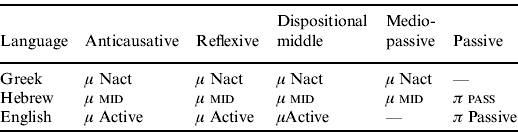
Let us now examine the derivations one by one.
4.1 Anticausatives
For some roots (R) which require an external argument, μ modifies (ι+)R such that μ+(ι+)R does not require an external argument:Footnote 22
- (48)
(a) o Janis ekapse ti supa. Greekthe Janis burnt.act the soup‘Janis burnt the soup.’
(b) i supa kaike.the soup burnt.nact‘The soup burnt.’
- (49)
(a) yon bišel et-ha-maraq. HebrewYon cook.intns.actacc-the-soup‘Yon cooked the soup.’
(b) ha-maraq hitbašel.the-soup cook.intns.mid‘The soup cooked.’
- (50)
(a) Active
(b) Anticausative
Some roots can only appear in an anti-causative structure and do not allow the insertion of the external argument by the middle Voice:
- (51)
(a) to pani skistike apo mono tu. Greekthe cloth tore.nact by alone its ‘The cloth tore by itself.’
(b) to pani skistike me ton aera.the cloth tore.nact with the wind‘The cloth got torn from the wind.’
(c) to pani skistike (*apo to Jani).the cloth tore.nact by the Janis*The cloth tore by Janis.'
(52) ha-zikaron ba-maxšev nigmar me-acmo/*'al-yedey ha-yacran. Hebrewthe-memory in-the computer run-out.simpl.mid from-itself/by the-manufacturer‘The computer has run out of memory.’
In derivations (ii)–(iv), μ+(ι+)R requires an external argument.
4.2 Reflexives
The head v introducing the external argument combines with μ+(ι+)R via an operation called ‘argument identification’ (Higginbotham Reference Higginbotham1985: 564), e.g. the combination of v and μ illustrated in (55) below by identifying x and y, which results in assigning the root's argument the external thematic role as well:
(53) i Maria htenizete. Greekthe Maria combs.nact‘Maria combs herself.’
(54) maria histarqa. HebrewMaria comb.intns.mid‘Maria combed herself.’
(55)
In derivations (iii)–(iv), μ+(ι+)R's argument is merged below v, thus cannot be assigned the external theta role. The external argument must therefore be eventually bound by contextual operators:
4.3 Dispositional middles
The external argument is eventually bound in the context of a possibility modal.
(56) to pukamiso sideronete efkola. Greekthe shirt iron.nact easily‘The shirt irons easily.’
(57) ha-xulca lo hitgahaca l-o. Hebrewthe-shirt not iron.intns.mid to-him‘The shirt didn't iron for him.’
(58)
4.4 Medio-passives
Since the external argument's thematic role depends on the root, it could be an agent, but also an experiencer, location or cause (the latter illustrated by the examples below). These medio-passives are verbs which can be modified by agentive or non-agentive ‘by’-phrases. Some of them, such as the examples below, and clearly also the Greek verbs listed in (36) above, cannot be modified by ‘by itself’, and thus can only appear in the medio-passive derivation, not in the anti-causative (but see Alexiadou et al. Reference Alexiadou, Anagnostopoulou, Schäfer and Frascarelli2006 for an alternative explanation).
(59) to paketo katastrafike (*apo mono tu). Greekthe parcel destroyed.nact by itself‘The parcel got destroyed (*by itself).’
(60) ha-mexonit nimxaca (*me-acma). Hebrewthe-car quash.smpl.mid from-itself‘The car got squashed.’
(61)
4.5 Passives
The passive π always introduces an external argument. The role of this argument is determined by the root, unless the root does not require an external argument, as is the case, for example, with de-adjectival verbs. In these verbs, the root derives, alongside an active transitive verb (as in (62)), an active intransitive verb (as in (63)). The external argument is thus a requirement of the causative head γ, not the root. It is therefore assigned the default thematic role of agent in the passive derivation (64) (and in the corresponding medio-passive derivation of Greek).Footnote 23
(62) Active causative Footnote 24
(a) ha-de'agot hilbinu et-se'ara. Hebrewthe-worries whitened.caus.actacc-hair.her‘The worries turned her hair white.’
(b)
(63) Active anticausative
(a) se'ara hilbin (me-ha-de'agot). Hebrewhair.her whiten.caus.act from-the-worries‘Her hair turned white (with worry).’
(b)
(64) Passive
(a) se'ara hulban (al-yedey ha-sapar/*ha-de'agot). Hebrewhair.her whiten.caus.pass by the-hairdresser/the-worries‘Her hair was whitened by the hairdresser.’
(b)
5. Challenges to lexicalist theories
The analysis presented here crucially differs from those in, for example, Chierchia (Reference Chierchia1989), Levin & Rappaport Hovav (Reference Levin and Hovav1995), Reinhart (Reference Reinhart2002), Zombolou (Reference Zombolou2004) and Reinhart & Siloni (Reference Reinhart and Siloni2005), where the different intransitive derivations involve processes of de-transitivization of the verb, see Kalluli (Reference Kallulli, Abraham and Leisiö2006). The distribution we have described challenges these lexicalist theories on several grounds:
A. The difference in thematic roles that we have found between the external argument of the active and the implicit external argument of the passive would be unexpected if the derivation were based on the active verb (see, for instance, the Hebrew examples (6), (22) and (23)).
B. It would also be unexpected that the same morphology which marks the processes of ‘reflexivization’ and ‘decausativization’ also marks some passives (e.g. medio-passives in Hebrew, such as (60) above) but not others (e.g. (64)).
C. Lexicalist analyses result in massive ambiguity of middle Voice forms. In Hebrew and Greek, many middle-Voice forms would be ambiguous between anticausative and passive interpretations. For example, consider nisraf ‘burn.smpl.mid’ in Hebrew (as in (21a) above). According to a lexicalist analysis, this verb undergoes both ‘decausativization’ and ‘passivization’. We have shown that medio-passive derivations are actually expected from the properties of the middle Voice, and are only blocked when a more specific passive form exists for the particular verb.
Could it be the case that verbs in the smpl.mid template in Hebrew and verbs bearing non-active morphology in Greek are actually ambiguous? Is it the case that e.g. nisraf in Hebrew is ambiguous between ‘burned’ (intransitive) and ‘was burned’? Similarly, is miothikan in Greek ambiguous between ‘lowered’ (intransitive) and ‘were lowered’? This does not seem to be the case, as demonstrated by the ellipsis test in examples (65) and (66) below. The missing verb in the (b) clauses is interpreted as passive, but as anticausative in the (c) clauses. Yet, both missing verbs in each example have a single antecedent, the medio-passive verb in the (a) clause. This is accounted for if the medio-passive verb is underdetermined for the passive/anticausative distinction. But if a passive verb and an anticausative verb are lexically different, their ellipsis is not expected to be licensed by a single antecedent.
(65) Hebrew
(a) ya'arot ha-karmel nisrefu, ve-gam ya'arot ša'ar-ha-gay.forests the-Carmel burn.smpl.mid and-also forests Shaar-Ha-Gay
(b) ya'arot ha-karmel al-yedey piroman.forests the-Carmel by pyromaniac
(c) ve-ya'arot ša'ar-ha-gay me-ha-xom.and-forests Shaar-Ha-Gay from-the-heat‘The Carmel forests burned, and also the Shaar-Hagay forests. The Carmel forests by a pyromaniac, and the Shaar-Hagay forests from the heat.’
(66) Greek
(a) i times ke i fori miothikan.the prices and the taxes lowered.nact
(b) i fori apo tin kivernisi.the taxes by the government
(c) ke i times me tin ikonomiki krisi.and the prices with the economic crisis‘The prices and the taxes got lowered. The taxes by the government and the prices from the economic crisis.’
D. Moreover, additional ambiguity would have to be postulated for verbs which have both medio-passive and reflexive interpretations, e.g. Hebrew nin'al and Greek klidothike ‘be locked’ can also mean ‘lock oneself up’, and anihtike ‘be opened’ also means ‘open oneself’:
(67) ha-baxur nin'al be xadro ve-yara be-acmo. Hebrewthe-young.man lock.simpl.mid in his.room and-shot at-himself‘The young man locked himself up in his room and shot himself.’
(68) o Janis klidothike sto domatio tu. Greekthe Janis locked up.nact in the.room his‘Janis locked himself up in his room.’
(69) i Maria mu anihtike. Greekthe Maria me opened.nact‘Maria opened herself to me.’
6. Conclusions
In this paper, we argued for a theoretical characterization of the middle Voice as distinct from the passive Voice, and shown that despite the cross-linguistic morphological variation in realizing these two non-active Voices, they systematically reflect two different non-active Voice heads, μ (middle) and π (passive). We argued that the syntactic construction of Voice allows for the flexibility in the distribution of the various PP adjuncts found with different roots, without postulating the ambiguity assumed in lexicalist theories. In particular, we have argued for the following main points:
1. Rather than using ‘passive’ as a cover term for the non-active Voice in English and Modern Greek alike, it is possible to determine which one of the non-active Voice heads generates the ‘passive’ forms of the language. We have argued that while in English it is the passive Voice head, in Modern Greek it is the middle Voice head. In other languages, such as another language, Hebrew, there is evidence for both non-active Voice heads.
2. Hebrew and English are distinct from Greek in having a passive Voice head. Derivations with the passive Voice head block the medio-passive interpretation of the corresponding derivations with the middle Voice head.
3. There exists a clear distinction between the medio-passive, which is one type of interpretation of the middle Voice, and the passive Voice. We have argued that the morphological identity of the medio-passive in both Greek and Hebrew with the anticausative, reflexive/reciprocal and dispositional middle is indeed reliable indication of its middle Voice rather than passive Voice nature.
4. The passive Voice head is clearly distinguished from the middle Voice head by introducing its own argument. This is an argument with independent reference, not anaphoric to any other argument of the verb. The middle Voice head does not have an argument, but, depending on the root, sometimes allows the verb's external argument to be included in the derivation, and moreover be sometimes identified with one of the internal arguments, giving rise to the reflexive (and reciprocal) derivation.
5. The agent thematic role is the default thematic role for external arguments. Accordingly, if the external thematic role is not assigned by the root but by a Voice head, then that role will be agent. This is the case in the derivation of (medio)-passive verbs whose roots do not assign the external role, such as Hebrew causative-template verbs, and Greek/Hebrew de-adjectival verbs.
6. The previous point can serve to detect the basic member of English causative/anticausative pairs. For some pairs, the anticausative verb is basic, e.g. in the case of crush. This verb has a root which does not require an external argument, as indicated by the fact that it is only compatible with an agentive ‘by’-phrase in the passive. For other pairs, the causative verb is basic, e.g. burn. Here the root requires an external argument, a cause, and is thus compatible with a causative ‘by’-phrase.