Hospitals impacted by disaster situations such as hurricanes and floods must act quickly and efficiently to protect their vulnerable populations. Reference Esfandyari, Vaghef-Mehrabany and Ebrahimi-Mameghani1,Reference Frey, Meaney-Delman and Bowen2 Patients in the Neonatal Intensive Care Unit (NICU) are amongst these vulnerable patients, particularly technology dependent infants, who require round the clock supervision and are at high risk of adverse outcomes during disasters. However, hospitals may not be sufficiently prepared to respond in such instances. Reference Barfield and Krug3–Reference Phillips, Niedergesaess, Powers and Brandt5 Adequate preparation of clinicians and their defined roles and responsibilities and efficient communication were deemed important factors necessary for quick and efficient execution of disaster plans. Reference Espiritu, Patil and Cruz6–Reference Powell, Hanfling and Gostin9 The NICU disaster preparedness literature describes the roles and responsibilities of nursing with very little mention of the role of physicians and even fewer studies address the role of pediatric residents during these situations. Reference Clancy and Kacica4,8,Reference Hayanga, Barnett and Shallow10–Reference Schultz, Pouletsos and Combs14
Teaching hospitals serve as major referral centers and provide most of the critical care in the nation. 15 Pediatric residents represent one of the largest clinician groups in academic and teaching hospitals. Reference Burke, Frakt and Khullar16 Furthermore, their role as residents affords them the opportunity to seamlessly transition across different disciplines, for example, from the pediatric emergency room to the ward to the intensive care units. 17 They are also aware of hospital culture, operating procedures, and policies of different areas of the hospital, which is of the utmost advantage during times of disaster. During Hurricane Katrina and Hurricane Harvey, residents actively managed patients, communicated with hospitals and other providers, and completed the necessary documentation. Reference Mani18–Reference Newman and Gallion20 Yet, their roles during disasters remain vague or overlooked. In addition, hospital disaster preparedness training often excludes pediatric residents Reference Espiritu, Patil and Cruz6,8,Reference Zell, Blake and Brittingham21 who are rarely prepared for these situations. Reference Martin, Bush and Lynch11,Reference Stroud, Trautman and Meyer22 This untapped and underutilized skilled resource could provide much needed personnel resources to help adjust the imbalances that occur during disaster responses, particularly in the NICU. Reference Tegtmeyer, Conway, Upperman and Kissoon23,Reference Christian, Toltzis and Kanter24 This study aimed to: (1) assess the level of NICU disaster preparedness among pediatric residents at Children’s National Hospital (CNH) in Washington, DC, prior to the coronavirus disease (COVID-19) pandemic; (2) characterize residents’ roles for both surge and evacuation events; and (3) determine whether and how residents would like to be trained for disaster responses. Our ultimate goal was to develop NICU disaster preparedness plans that are mindful and inclusive of pediatric residents and incorporate disaster preparedness education into the pediatric and neonatal residency curriculum.
Methods
A mixed-methods approach of an initial basic qualitative interview followed by a general survey of pediatric residents was performed Reference Passmore, Dobbie, Parchman and Tysinger25 ; interviews informed survey development.
Qualitative Methods
A comprehensive literature search evaluated prior published surveys that assessed resident disaster preparedness and served as a reference for this study. Search terms included disaster, emergency preparedness, pediatric, residents, evacuation, surge, and NICU. A survey of anesthesiology residents was used to formulate some questions, including addressing residents’ willingness to respond to disasters. Reference Hayanga, Barnett and Shallow10 An interview guide pertinent to disaster preparedness in the NICU was created by the research team, which included the medical director of the NICU and the medical director for disaster preparedness using the subsequent methodology (Supplemental Document 1).
An initial invitation was sent out to the pediatric chief residents who then identified other residents willing to be interviewed (purposive sampling). Reference Monzani and Ragazzoni26,Reference Streeton, Cooke and Campbell27 Ten pediatric residents (1 male and 9 female) who were representative of the CNH resident population in terms of their institutional and NICU experience in the main level IV NICU, postgraduate year (PGY)-3 and PGY-4, were interviewed. Single participant interviews were conducted over 2 months in a private office in the hospital at a time that was convenient to participants; mean duration was 30 minutes/interview. Interviews were recorded and transcribed, and the responses coded by 2 team members (NK, LS). Reference Merriam and Tisdell28 Responses were reviewed by participants (member check). Emerging themes were reviewed by all authors until thematic saturation was achieved. Interview responses along with literature review were used to create the survey questions and answer choices. Survey questions were iteratively revised for clarity and content. Cognitive pre-testing (an evidence-based method used to determine whether survey questions gather the intended information) Reference Simon, Atkins and Miller29 and pilot testing on a small group of 5 residents were performed to test for readability before the final draft was completed. Eligible interview participants were also asked to complete the survey. Five of the 10 residents who were interviewed were either not eligible to take the survey as they had graduated from the program or declined. The remaining 5 residents were involved very early on in interviews and the questions had changed for the final survey. Survey questions assessed residents’ background in disaster preparedness, knowledge of hospital disaster protocols, evaluation of NICU disaster preparedness, resident roles during a surge or evacuation, and views on disaster preparedness training.
Survey Administration
The anonymous, voluntary, 15-minute on-line survey was distributed to all pediatric residents (PGY-2, PGY-3, and Pediatric Chief Residents, n = 80) who rotated through the NICU at the main campus of CNH (Supplemental Document 2). These residents were familiar with the environment from their rotations within this particular NICU and were aware of the variation in culture and resources of other parts of the hospital. The final survey was sent out 3 times thereafter over 12 months. The survey response status was linked to each resident’s email, recording whether the resident had responded to at least 1 survey question and preventing multiple submissions by the same resident. Data were collected via REDCap (Research Electronic Data Capture), a browser-based data capture system. Reference Harris, Taylor and Thielke30,Reference Harris, Taylor and Minor31
Analysis of the Outcome
An a priori sample size calculation showed that 66 survey responses would provide a confidence level of 95% with a margin of error of 5%, based on a population size of 80 PGY-2 and PGY-3 pediatric residents. Statistical analyses were performed with JMP Pro®, Version 14, SAS Institute Inc. (Cary, NC, USA) 2018. Data were expressed as means and standard deviations or proportions; independent-sample t tests, chi-square, and analysis of variance were used where appropriate with P < 0.05 considered as significant.
IRB approval
The study (Study Number Pro00010678) received exempt status by the Children’s National Medical Center Institutional Review Board.
Results
Qualitative Interview Results
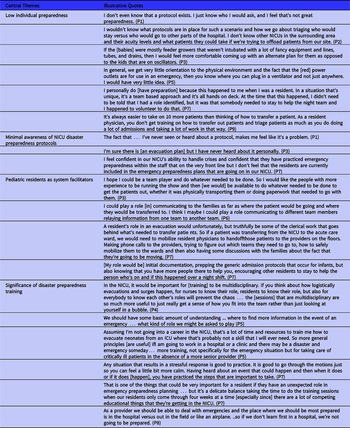
Four central themes emerged from 10 interviews (Table 1). Thematic saturation was achieved after 6 interviews. Themes included:
Illustrative quotes from interview participants

NICU, Neonatal Intensive Care Unit
-
1. Low individual preparedness for a NICU evacuation or surge. Participants expressed a lack of previous disaster training (general and NICU-specific) as only 4 had taken any disaster medicine orientation courses. Nine participants felt unprepared for a NICU evacuation or a surge situation. Nine out of 10 participants were comfortable in their abilities to triage and transport non-acute patients, but only 1 was prepared from a prior self-reported surge experience. Residents were reliant on others around them, for example, attending physician, nurse-in-charge, incident command center, or transport team, to define roles on their behalf, which in turn gave them confidence but not necessarily preparedness. Low individual preparedness stemmed from concern about deficits in their clinical decision-making skills, operation of equipment, role definition, and resource knowledge (eg, availability of beds in their own and outlying hospitals, quantity of specialized NICU equipment, eg, ventilators, incubators, medications, and trained personnel). High acuity of patients, possibility of staffing shortages, and lack of proper organization also contributed to their feeling of unpreparedness. Evacuations were deemed easier than surge situations since evacuations required triage skills rather than administrative skills such as resource allocation. Participants cited that our NICU normally runs close to full capacity making surge additionally stressful, but other residents noted that this was similar to other high-volume situations. Handling of surge situations could be better during the day compared to the night shift when there was less staffing. Drills specific to the NICU, having other experienced providers, developing an adequate system to call in extra providers, previous personal experience in disaster management, having a pre-prepared list of patients for evacuation or surge, role definition, clear communication, and a visible plan or protocol in place were thought to be helpful.
-
2. Minimal awareness of existing protocols. Almost all participants (9/10) did not know whether the NICU had disaster protocols, and none of them were aware of the details citing that they only spent 1 month at a time in each hospital location making it difficult to fully grasp each area’s protocols. Most participants noted that they would need to ask the nurse or physician-in-charge at the time of the event whether a surge or an evacuation occurred. One participant was worried that the actual team themselves may not be aware of the protocol, while another was reassured because of the frequent evacuation drills that occur in the unit.
-
3. Self-selection of role to be system facilitators. Participants believed that their primary role in a disaster would be system facilitators. The team leader (senior nurse or physician) would delegate tasks to residents who would then execute plans. Duties cited included triaging patients; writing notes; placing orders; coordination of placement or transfer of patients; physically moving patients; communication with parents, resuscitation, and stabilization; and recruiting other residents. None of the residents considered any leadership role.
-
4. Significance of disaster preparedness training. Disaster training should be an important part of resident education as expressed by all participants. Participants noted that pediatric residency training was a period of time where new skills are learned and that there is minimal opportunity thereafter to acquire these skills. The paucity of medical school disaster preparedness training, responsibility, and autonomy placed on residents after graduation as independent providers, being in a high-volume children’s hospital, a disaster-prone city, and the underutilization of a valuable personnel resource were cited as reasons that training is fundamental. Pediatric residents exposed to the topic through educational sessions were stimulated to learn more, had more confidence in their competence, were calmer under pressure, and could potentially serve as peer-mentors to other residents in the event of a disaster. Proposed training included developing an educational curriculum (lectures and interdisciplinary tabletop exercises), NICU-specific orientation, visible protocols (evacuation and surge), resident job action sheets, interdisciplinary in situ NICU simulations (1-2 times/year), and general hospital-wide simulations within the first 2-3 months of the academic year. The pediatric residency program could facilitate scheduling of training into the curriculum but unit level participation and resident involvement in planning would be needed. One participant noted that scheduling a drill at the beginning of every resident rotation may not be feasible due to the busy educational requirements and that more general teaching (eg, running a code without a senior provider, transport medicine electives) may be more useful, particularly for those who are not specializing in neonatology.
Survey Results
Fifty residents responded to the survey (63%), providing a margin of error of 8.4% (CI of 95%), which was acceptable with minimal risk of response bias and non-response error. Forty-one participants (51%) completed all questions. Most were female (64%), PGY-3 residents (PGY-2, 26%; PGY-3, 54%) between 25 and 30 years old (70%). None had previous training in NICU surge or evacuation, and only 8% had taken any disaster preparedness training course (50% Federal Emergency Management Agency online courses, 25% general or pediatric focused course through medical school or residency).
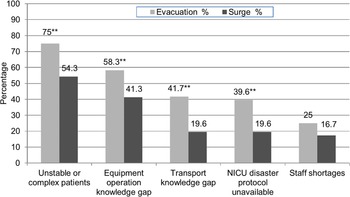
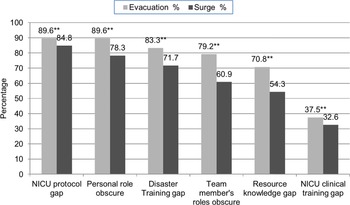
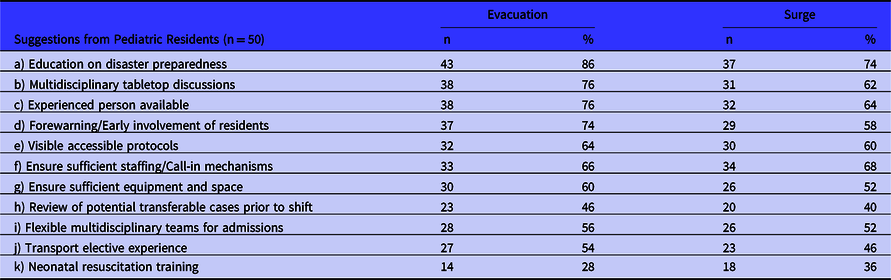
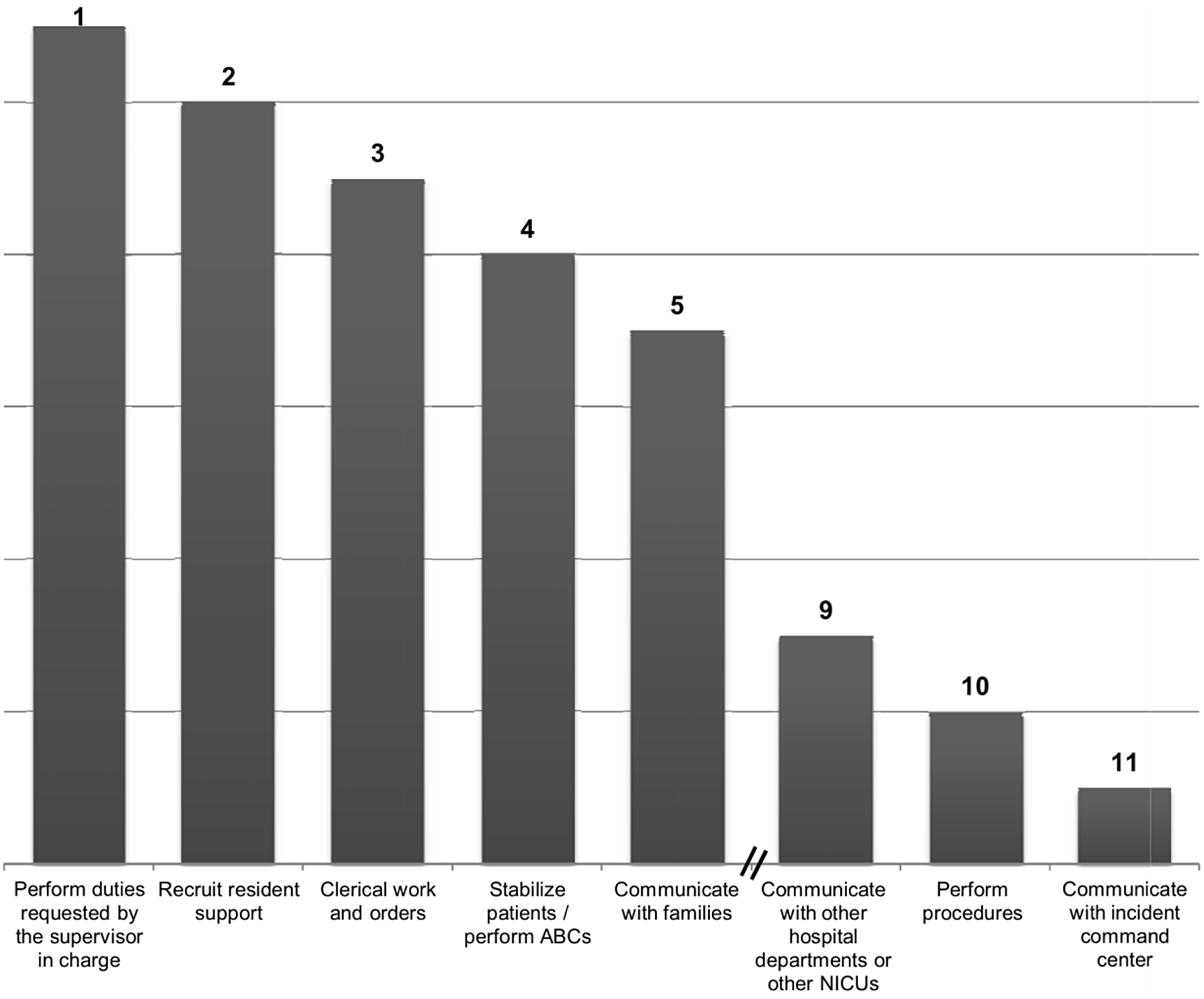
The survey results confirmed the interviews’ central themes. Eighty-six percent of residents (43/50) felt unprepared or poorly prepared for an evacuation, and 80% (40/50) felt unprepared for a surge. Thirty-six residents (72%) felt that they were neither prepared for an evacuation nor a surge compared to 7 participants (14%) who felt more comfortable in a surge rather than during evacuation situations due to their previous experience with high NICU volumes (86%) and their ability to use their day-to-day skills (86%). All participants were unfamiliar with the disaster plans. Patient acuity, ambiguity around protocols and roles, and knowledge and training deficits were major contributors to unpreparedness and were significantly worse for evacuations compared to surge situations (Figure 1a and 1b). Despite being unprepared, 84% of participants were still willing to respond to a hospital disaster. Suggestions for improving preparedness are listed in Table 2. Performance of duties requested by supervisors, recruiting other residents, and documentation were identified as the most important roles that residents could play during disasters (Figure 2).
NICU factors contributing to unpreparedness for disasters among pediatric residents (evacuation n = 48, surge n = 46 respondents).

Personal factors contributing to unpreparedness for NICU disasters among residents (evacuation n = 48, surge n = 46 respondents, **P < 0.05).

Suggestions for improving resident preparedness in NICU evacuation and surge situations

Top 5 roles proposed by pediatric residents during NICU evacuation or surge compared to the bottom 3 roles (ranked list).

Preparedness training and education were the top requests to enhance readiness (84%). Most residents suggested conducting training once every NICU rotation (48%) through multidisciplinary simulations (66%) focusing on role definition (56%) with written supplementary protocols (50%). Less favorable methods were discussions (42%), preparedness electives (40%), online training (32%), and mandatory courses (16%).
Discussion
Pediatric residents consistently felt ill-equipped to participate in a NICU disaster response. This mixed-methods study conducted prior to the novel coronavirus pandemic showed that pediatric residents were not prepared for a NICU disaster and lack the tools to feel ready and be effective responders. This situation has occurred before as role ambiguity and lack of disaster preparedness led to inefficient resident disaster response during the Boston Marathon bombing; however, these studies included all residents not just PGY-2 and PGY-3 residents. Reference Schlosser, Creedon and Michelson32
Residents are often not integrated in disaster plans, despite their experience across the different hospital departments and their exposure to the different services and systems. Reference Carbine, Cohen and Hopper7 For example, the evacuation plan from CNH did not include resident-specific roles in their protocol. Reference Zell, Blake and Brittingham21 Hospitals that did include residents in their mitigation plans oftentimes had residents performing basic work that did not utilize their clinical skill sets, for example, holding flashlights to illuminate an evacuation route. Reference Espiritu, Patil and Cruz6 In a few instances, residents were tasked with duties more akin to their routine responsibilities such as clerical work and transfer of patient records. Reference Mani18,Reference Barkemeyer19 Newman et al. noted that residents felt underutilized if they were asked to perform clerical work, such as documentation, but this was not largely seen in the literature and in our study where residents voiced their willingness to perform this job. Reference Newman and Gallion20 During Hurricane Harvey, attending physicians believed that too many interns (PGY-1) who needed direct supervision were involved in the disaster response, taking up valuable attending physician time. Reference Newman and Gallion20 This study was not able to determine the level of preparedness of interns as it was only distributed to PGY-2 and PGY-3 residents who rotate through our Level IV NICU. PGY-2 and PGY-3 residents have more patient care experience and require less supervision than interns. Moreover, the roles that residents felt most comfortable in, such as documentation and recruiting resident support, also require less supervision from attending physicians. It is also notable that, during the early part of the novel coronavirus pandemic, several medical schools graduated fourth-year medical students early to boost the surge response in their hospitals. Reference Murphy33 This enforces the need to not only allow residents (who are more experienced than students) to take on more responsibility during disaster situations, but also to train them for these roles beforehand. Pediatric residents can also take on more responsibility at the time of the event through “just-in-time” training to provide disaster standards of care. Reference Barfield and Krug3,Reference Tegtmeyer, Conway, Upperman and Kissoon23,Reference Ragazzoni, Barco and Echeverri34 Hospitals should keep residents informed and involved when developing disaster response plans, as they can be vital resources.
The survey results confirm that pediatric residents in the study population were enthusiastic about disaster training and willing to respond despite their inexperience. This willingness was similar to a survey of anesthesiology attendings and residents. Reference Hayanga, Barnett and Shallow10 Residents expressed that education should include NICU disaster protocols and multidisciplinary simulations delivered to every NICU rotation to allow them to contribute fully to a disaster response; moreover, this could be their last training opportunity in disaster management prior to graduation. Training sessions have been noted in the literature to improve provider readiness. Reference Barfield and Krug3,Reference Smith, Burkle, Aitken and Leggatt35 Disaster training requires an interprofessional team to develop a robust training program ensuring that nursing, transport, and NICU providers are all involved in the process. Reference Stroud, Trautman and Meyer22 The complexity of NICU infants and the unique nature of NICU operations highlight the need for local NICU leadership in disaster training versus relying on general or hospital run courses alone. Reference Cohen, Murphy, Ahern and Hackel36 Educational interventions should continue throughout other departments with highly vulnerable patients, such as the pediatric intensive care unit and emergency department. Hospital-wide disaster drills should include NICU scenarios given the unique resource needs of neonates such as appropriately sized equipment. Training in the NICU could provide a foundation for additional disaster preparedness education conducted throughout the hospital as many of the skills would be transferrable to the acute care ward and other intensive settings.
The strengths of this paper lie in the use of a mixed-methods design to elicit resident feedback (needs assessment) through both qualitative and quantitative means, which can be replicated again at different time points, in other departments, and in different institutions to gauge readiness and progress. The study differentiated between surge and evacuation situations where residents felt more able to handle surge situations.
Limitations
The study is limited in that it is a single-site study; therefore, conclusions drawn are specific to CNH and the region. The survey was distributed solely to PGY-2 and PGY-3 residents as interns do not rotate through the Level IV NICU. Survey respondents were demographically representative of the wider resident pool and would have been exposed to the same rotation as those who did not respond, and interviews did reach thematic saturation. However, it is possible that non-responders hold differing views either positive or negative from responders (non-response bias). The margin of error of 8.4% was higher than a priori calculations (5%), which denotes that repeat surveys could produce variable responses. The survey was sent out to all possible residents in the program, and non-responders were encouraged to take the survey through 3 reminders to mitigate these sources of bias, but this is still a limitation of the study. It is possible those residents who did not complete the survey in its entirety stopped because they lacked interest in the NICU or disaster preparedness or were adequately prepared and therefore did not want further training. It is also possible that the number of questions contributed to the lack of completion. To minimize response bias, questions were asked in different formats and agree/disagree questions were kept to a minimum.
Conclusion
Pediatric residents at a single children’s hospital provide frontline care in the intensive care units yet are not ready to respond to evacuation or surge events in the NICU. For these residents, preparedness for emergencies is essential and a crucial component of postgraduate residency training. Future research steps that may follow include assessing pediatric resident disaster preparedness at multiple centers, after the proposed training interventions, and during and after the COVID-19 pandemic.
Author contributions
Dr Kuppanda, Dr Simpson, and Dr Soghier participated in the project inception, data collection, data analysis, and writing and revision of the manuscript. This manuscript was finalized and approved by all authors, who maintain accountability for its submission.
Conflicts of interest
Dr Kuppanda, Dr Simpson, and Dr Soghier declare no conflicts of interest.
Supplementary material
To view supplementary material for this article, please visit https://doi.org/10.1017/dmp.2021.322