When interacting with the environment, appropriate behavior requires a strong relationship between visual perception and action. Gibson (Reference Gibson1979) introduced the concept of affordance, which refers to the fact that people not only visually perceive an object’s physical properties, but they also perceive its potential for carrying out action with the object. Consistent with this view, recent studies have demonstrated that the mere observation of an object automatically activates a series of actions relating to interaction with this object, such as reaching or grasping, even in the absence of explicit intentions to act. For example, Tucker and Ellis (Reference Tucker and Ellis1998) required that participants make a left or right response in reporting whether a household object was upright or inverted. Results showed that responses were faster when the responding hand shared the same orientation as the handle of the object, even if the orientation of the handle was irrelevant for the current task. A similar effect was obtained in later studies (Tucker & Ellis, Reference Tucker and Ellis2001, Reference Tucker and Ellis2004). Participants responded more quickly when the grasp type afforded by a (small or large) object was congruent with a type of grasp to be executed based on precision or strength.
Other studies have investigated the time course of response activation generated by the irrelevant object, and found that the affordance effects developed gradually and were long lasting. For example, Phillips and Ward (Reference Phillips and Ward2002) manipulated stimulus onset asynchrony (SOA) using primes (images of a frying pan), which were visible for 0, 400, 800, or 1,200 ms before presentation of the target stimulus. Participants were instructed to press a button with either the right hand or left hand. The researchers obtained a significant congruency effect that favored congruent over incongruent mappings between the responding hand and handle orientation of object. This congruency effect increased with SOA between prime and target. Vingerhoets, Vandamme, and Vercammen (2009) also found a gradually developing pattern of object affordance with same SOAs (with the exception of 0 ms).
Recent studies have provided evidence that individuals are sensitive to differences between ‘‘dangerous objects’’ i.e. ones that imply a potential risk and ‘‘neutral objects’’, namely, objects that can be manipulated without any risk (Anelli, Borghi, & Nicoletti, Reference Anelli, Borghi and Nicoletti2012; Anelli, Nicoletti, Bolzani, & Borghi, Reference Anelli, Nicoletti, Bolzani and Borghi2013; Anelli, Ranzini, Nicoletti, & Borghi, Reference Anelli, Nicoletti, Bolzani and Borghi2013; Morrison, Tipper, Fenton-Adams, & Bach, Reference Morrison, Tipper, Fenton-Adams and Bach2013; Zhao, Reference Zhao2017). For example, Anelli, Nicoletti, et al. (2013) presented participants with a video of either an approaching or receding object, and participants were asked to respond to objects depending on the object property. It was found that movement direction influenced the participants’ responses regarding the object. When neutral objects moved toward a participant, these objects were processed faster than when dangerous objects were moved away from a participant. Also, Zhao (Reference Zhao2017) simultaneously presented a neutral object and a dangerous object in a symbol identification task in order to assess congruency sequence effects (i.e., congruency effects following incongruent trials are smaller than those following congruent trials) occurred across the two types of affordance conflict. Such an effect is typically assumed to be observed between same conflict types (Egner, Delano, & Hirsch, Reference Egner, Delano and Hirsch2007; Zhao, Bai, Ma, & Wang, Reference Zhao, Bai, Ma and Wang2015). Zhao found that congruency sequence effects only occurred within the same types of affordance conflict (e.g., neutral object or dangerous object), but not between two different types of affordance conflict (e.g., neutral object and dangerous object); it was assumed two different pathways exist for the processing of the neutral and dangerous object.
For self-preservation, humans need to effectively identify objects that are potentially dangerous. Given the apparent difference between neutral and dangerous objects to potentiate actions, a question arises concerning the nature of the developing time course associated with dangerous object-related action activity. Specifically, the present study aims to clarify whether or not the response activation of the dangerous object happens earlier than that of neutral object and to investigate the length of response codes with dangerous object affordances.
The present study used the experimental designs of Phillips and Ward (Reference Phillips and Ward2002), which permit examination of the time course of response activation with a dangerous object. An image of a dangerous graspable object was presented as a prime display. The handle of each object was oriented to the left or the right. After a variable stimulus onset asynchrony (SOA), the prime was followed by a target that required a left or right hand key-press response. Four different SOAs (0, 400, 800, and 1,200 ms) between the onset of the object image and the target onset allowed investigation of the time course of response activation generated by the dangerous object.
Method
Participants
Thirty participants (14 males and 16 females; mean age ± SD, 25 ± 4 years) were recruited into the main experiment in exchange for course credit or £6. All self-reported as right-handed and had normal or corrected-to-normal vision. All were naïve as to the purpose of the experiment. Informed consent was obtained from all participants. This study was approved by the Baoji University of Arts and Sciences Ethical Committee in accordance with the ethical standards of the Declaration of Helsinki (1964).
Apparatus and Stimuli
The stimuli were presented on a 19-in. monitor (refresh rate 60 Hz). E-Prime software was used for stimulus presentation and data collection. Participants faced the computer monitor at a viewing distance of approximately 50 cm.
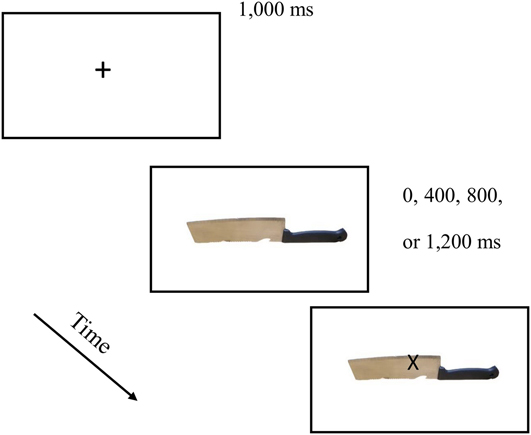
On each trial an image of a “prime” object was presented followed by that of a small visual target (Figure 1). The primes consisted of a series of photographs of neutral objects (e.g., cup, spoon, teapot, or toothbrush) and dangerous objects (e.g., knife, axe, dagger, or hacksaw) with a graspable handle (5.52° × 5.52°). All the objects could appear oriented to either the left or right. The orientation of the handle simulated an apparent affordance for grasping with either left or right hand. Following presentation of primes, the symbol of “x” or “#” (0.95° × 0.95°) was presented as a target at the center of the screen, which required a left or right hand response.
Example Sequence of Events for Experiment.
Actual figure shows an incongruent trial for participants where the prime object affords a right action and “X” denotes a left response. The key-response mapping was reversed for half of the participants.

Each object was evaluated in a pre-experimental phase. A separate group of 20 healthy participants (12 female, 8 male; age 20-23 years) evaluated the risk degree of each object. Each object was evaluated on a 7-point Likert scale from 1 (not at all dangerous) to 7 (extremely dangerous). The mean level of risk for the group of dangerous objects (M = 6.10) was significantly higher than for the group of neutral objects (M = 1.80), t(19) = 5.31, p < .001.
Procedure
At the beginning of each trial block, a fixation cross was presented in the center of the screen (0.5° × 0.5°) for 1,000 ms. Immediately following the offset of the fixation cross, a prime image (object picture) was presented. The target (a symbol) then occurred superimposed upon the prime image; it signaled either a left- or right-side response. Stimulus onset asynchrony (SOA) between the prime and the target was varied for each of the primes: A prime was visible for 0, 400, 800, or 1,200 ms until the participant gave a response. The participants were asked to judge the symbol of “x” or “#” a left or right hand response. Half of the participants were instructed to press the left key (“A”) with the index finger of the left hand if the symbol was “x” and the right key (“L”) with the index finger of the right hand if it was “#”; the other half of the participants received the opposite key-response instructions. They were instructed to respond to each symbol as quickly as possible and to avoid errors. Immediately after a response was given, the stimulus disappeared from the screen. Each stimulus was displayed for a maximum of 2,000 ms.
Design
The experiment comprised six blocks of 64 trials each in a within-participants three-factor design. The factors consisted of object type (neutral, dangerous); congruency between response hand and handle orientation (congruent, incongruent); SOA between the onset of the object image and the target (0, 400, 800, and 1,200 ms). The stimuli were arranged in randomized order. The participants performed 24 practice trials before beginning the experimental phase.
Results
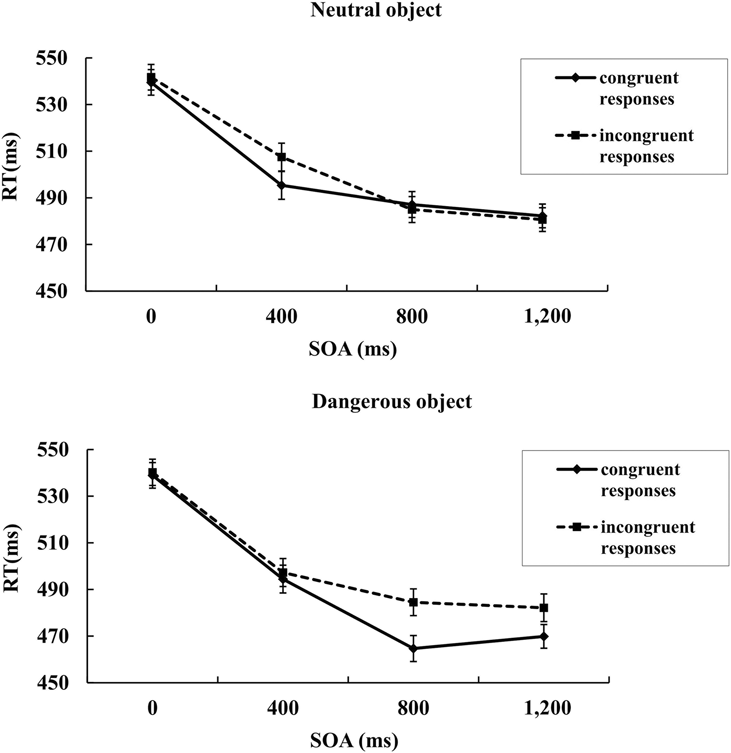
Figure 2 shows the reaction times in the present experiment. Mean reaction times (RTs) were calculated for each participant within each experimental condition. RTs were computed only for correct trials. RTs greater than 1,000 ms or less than 200 ms were removed from the data set. These exclusions represent 0.63% of all trials.
Mean Response Times for all the Experimental Conditions in Experiment.
Error bars denote standard errors.

Mean RTs from correct responses were submitted to a repeated measures analysis of variance with 2 (object type: Neutral, dangerous) × 2 (congruency between response hand and handle orientation: Congruent, incongruent) ×4 (SOA: 0, 400, 800, and 1,200 ms). Results appear in Figure 2.
The ANOVA revealed a main effect of object type, F(1, 29) = 4.66, p < .05, η2p = .14, reflecting significantly slower RTs for neutral (502 ms) compared with dangerous objects (496 ms). The main effect of congruency between response hand and handle orientation approached significance, F(1, 29) = 22.63, p < .001, η2p = .44, with faster responses for congruent (496 ms) than for incongruent trials (502 ms). A significant main effect of SOA was also obtained, F(3, 87) = 77.66, p < .001, η2p = .73. Post-hoc t-tests revealed that the RTs of SOAs of 0 ms (540 ms) were slower than SOAs of 400 ms (499 ms), t(29) = 9.19, p < .001, SOAs of 800 ms (480 ms), t(29) = 15.61, p < .001, and SOAs of 1,200 ms (478 ms), t(29) = 9.91, p < .001. Furthermore, the object type, congruency between response hand and handle orientation and SOA produced a significant three-way interaction, F(3, 87) = 7.16, p < .001. η2p = .20.
To explore these results further, a separate 2 (congruency between response hand and handle orientation: Congruent, incongruent) ×4 (SOA: 0, 400, 800, and 1,200 ms) analysis was conducted for each of the two object types. For the neutral object, the main effect of SOA approached significance, F(3, 87) = 33.29, p < .001, η2p = .53. Post-hoc t-tests revealed that the RTs of SOAs of 0 ms (541 ms) were slower than SOAs of 400 ms (501 ms) t(29) = 6.63, p < .001; SOAs of 800ms (486 ms), t(29) = 9.75, p < .001; and SOAs of 1,200 ms (481 ms), t(29) = 8.39, p < .001. The main effect of congruency between response hand and handle orientation was not significant, F(1, 29) = 2.20, p = .15, η2p = .07. However, a significant interaction emerged between these two factors, F(3, 87) = 3.98, p < .05, η2p = .12. Post-hoc t-tests revealed that congruent responses (495 ms) were significantly faster than incongruent responses (503 ms) only for the SOA of 400 ms, t(29) = 3.69, p < .001. This congruency effect was not found for other SOAs, ps > .10.
For the dangerous object, the main effect of SOA was significant, F(3, 87) = 39.57, p < 0.001, η2p = .58. Post-hoc t-tests revealed that the RTs of SOAs of 0 ms (540 ms) were slower than SOAs of 400ms (496 ms), t(29) = 5.70, p < .001, SOAs of 800 ms (475 ms), t(29) = 10.94, p < .001, and SOAs of 1,200 ms (476 ms), t(29) = 7.98, p < .001. The main effect of congruency between response hand and handle orientation approached significance, F(1, 29) = 18.77, p <.001, η2p = .39, with faster responses for congruent (492 ms) than for incongruent trials (501 ms). SOA significantly interacted with congruency between response hand and handle orientation, F(3, 87) = 4.12, p < .01, η2p = .12. Post-hoc t-tests revealed that congruent responses were significantly faster than incongruent responses for SOAs of 800 ms (congruent = 465 ms, incongruent = 485 ms; t(29) = 4.13, p< .001) and 1,200 ms (congruent = 470 ms, incongruent = 482 ms, t(29) =2.56, p < .05). This congruency effect was not found for SOAs of 0 and 400 ms, ps> .10.
The error rates were also entered into a 2 (object type: neutral, dangerous) ×2 (congruency between response hand and handle orientation: congruent, incongruent) ×4 (SOA: 0, 400, 800, and 1,200 ms) repeated measurements ANOVA. Only the main effect of SOA reached significance, F(3, 87) = 4.06, p < .05, η2p = .12. Post-hoc t-tests revealed that the errors with SOAs of 800 ms (8.2 %) were higher than SOAs of 400 ms (5.7 %, t(29) = 2.98, p < .01) and SOAs of 1,200 ms (6.1 %, t(29) = 2.31, p < .05). No other main effects or interactions approached significance (all ps > .10).
Discussion
This experiment investigated processing of dangerous objects to determine how a time course involving dangerous object-related action activity develops. The results revealed a strikingly different time course pattern of response activation for neutral versus dangerous objects. The affordances of dangerous objects were evident in conditions with SOAs of 800 and 1,200 ms, whereas the affordances of neutral objects were only present in the condition with an SOA of 400 ms.
Consistent with previous studies, the present study also finds unique characteristics of dangerous objects. Compared with the rapid activation for the affordance effect of neutral objects, dangerous objects seemed to generate a plan for slower action that is timed to occur over 400 ms after visual representation of graspable objects. Similarly, Anelli et al. (Reference Anelli, Borghi and Nicoletti2012) presented an image prime (hand) following by graspable objects (neutral or dangerous objects). Participants were asked to carry out a categorization task by pressing different keys. Anelli and colleagues found that neutral objects facilitated motor response, whereas dangerous objects generated an interference effect evident in the slower RTs associated with processing dangerous objects. They explained that responses to dangerous objects were slowed due to the presence of a late occurring blocking mechanism. The current data seem to support this view in that participants responded more slowly to dangerous objects than to neutral ones. On the other hand, some researchers argue that affordances are generated quickly. Previous studies have shown that object affordances have the potential to play a significant role in the early stages of an action plan (Ellis and Tucker, Reference Ellis and Tucker2000; Hauk & Pulvermüller, Reference Hauk and Pulvermüller2004; Pelli, Burns, Farell, & Moore-Page, Reference Pelli, Burns, Farell and Moore-Page2006; Proverbio, Adorni, & D’Aniello, Reference Proverbio, Adorni and D’Aniello2011). However, the current data suggests that the response activation generated by the object develops “relatively” quickly. There may be complex mental processes associated with action potentials of dangerous objects, as implied by the slower RTs when processing these items.
In fact, when individuals observed dangerous objects, it is possible they evaluated whether these objects posed a danger; such evaluation might consume a portion of attention resources. When SOAs was 0 or 400 ms, this could create a situation characterized by insufficient attention resources for dangerous objects to potentiate an action (Murphy, van Velzen, & de Fockert, Reference Murphy, van Velzen and de Fockert2012). In one previous study, the perceptual load was manipulated in a letter identification task (Zhao, Reference Zhao2016). Participants were required to identify a target letter with the right or left hand while ignoring a graspable object. The congruency effect between the affordance of the ignored dangerous object and the response to be executed was observed only when the perceptual load of concurrent letter identification task was low. There was no effect of a dangerous object if it received insufficient attention. This result fits well with the above explanation. When SOAs were 800 or 1,200 ms, attention resources was sufficient to potentiate an action for dangerous objects. The individuals also had sufficient time to evaluate irrelevant dangerous object information and respond to the target.
For the neutral objects, the time course of response activation develops quickly, within a 400 ms period following prime onset. It also dissipated quite rapidly, manifesting in SOAs of 800-1,200 ms. The influence of affordances was undetectable with 800-1,200 ms SOAs. Perhaps this outcome reflects a more persistent action intent that is not implemented yet it interferes with the system’s execution of a new action, which happens when an individual notices a different object (Makris, Hadar, & Yarrow, Reference Makris, Hadar and Yarrow2011). The results of the present study are in broad accord with findings concerning the rapid and relatively short-lived evolution activated by object priming. Using visual objects, Makris et al. (Reference Makris, Hadar and Yarrow2011) examined the temporal evolution of the potentiation of grasping behaviors. Both RTs and motor evoked potentials (MEPs) suggesting activity of a congruent motor plan generated immediately after object presentation (300-400 ms), which then decays rapidly (600 ms post stimulus). These authors argued that such a rapid evolution and decay might reflect the metabolic or computational costs during maintaining action plans. Indeed, the current findings support such a view.
However, such a result seems to contradict evidence (Phillips & Ward, Reference Phillips and Ward2002; Vingerhoets, et al, Reference Vingerhoets, Vandamme and Vercammen2009). They found that affordances develop gradually and are long lasting. There are two differences between the present study and the ones described in Phillips and Ward (Reference Phillips and Ward2002) and Vingerhoets et al. (Reference Vingerhoets, Vandamme and Vercammen2009) that might have influenced the time course of affordances. The first concerns the fact that dangerous as well as neutral objects were displayed randomly in our study, whereas in Phillips and Ward (Reference Phillips and Ward2002) and Vingerhoets et al. (Reference Vingerhoets, Vandamme and Vercammen2009) the prime objects were only neutral objects. In the present study, this difference presumably led to consumption of attention resources in evaluating dangerous information and maintaining plans for action when the SOA was 800 or 1,200 ms. The second difference was that the fixation cross was presented for 1,000 ms in the present study and Makris et al. (Reference Makris, Hadar and Yarrow2011), whereas it was displayed for 1,500 ms in Phillips and Ward (Reference Phillips and Ward2002) and Vingerhoets et al. (2011). Focusing on the screen center for an extended time might result in divergence of attention. Further research is necessary to verify these possibilities.
In conclusion, this paper sheds further light on the time course of response activation with object affordance. The present results suggest that response activation of neutral objects affordance decays very quickly, whereas this activation has a longer-lasting development for affordance of dangerous objects. Further investigation will be required in order to identify the neural network that implements these processes.