It is the aim of this study to investigate whether gender-marking regularities, that is, formal indicators of a noun's grammatical gender such as suffixes, have an impact on the process of gender assignment in German. Different models have made suggestions on the question of gender storage and assignment. On the one hand (Jescheniak & Levelt, 1994; Levelt, 1989; Levelt, Roelofs, & Meyer, 1999; Roelofs, 1992), it is assumed that gender is stored as part of the lemma entry in the mental lexicon. According to this model gender is not stored for each single noun, but all nouns of a common gender have links to one abstract gender node. All phonological information is stored at the lexeme level. Formal regularities that are indicators of the noun's gender belong to this level. Because of the operating principles of discreteness, seriality, and unidirectionality (for a review, compare Schriefers & Jescheniak, 1999), this model predicts that gender-marking regularities have no influence on the process of gender assignment in language production. Gender is retrieved together with lemma information, prior to all information that belongs to the lexeme level. In accordance with Gollan and Frost (2001), further on this will be called the lexical route of gender assignment. The assumption that grammatical gender is lexically stored is supported by a number of empirical findings. Vigliocco, Antonini, and Garrett (1997), Badecker, Miozzo, and Zanutti (1995), and also Miozzo and Caramazza (1997) demonstrated independence of gender assignment and phonological information in Italian. Despite being in a tip of the tongue state (being unable to retrieve the word form of a lexical item), healthy and aphasic participants were able to correctly report the grammatical gender for gender-marked nouns, which are nouns in Italian with endings that are a very reliable cue for grammatical gender, as well as for ambiguous nouns whose endings did not correlate with gender. Badecker et al. (1995) point out that there might be some impact of gender-marking regularities during the process of language acquisition, but once the link between a noun and its corresponding gender node is established, regularities of gender marking lose their impact on language processing.
Contrary to the approach of modeling gender retrieval as uninfluenced by formal gender-marking regularities, Desrochers and Paivio (1990), as well as Taft and Meunier (1998), present evidence that supports the impact of gender-marking suffixes on the process of gender assignment in French. It is suggested that grammatical gender is represented as a connection between gender-marking regularities and an abstract gender node. The reliability of gender-marking regularities has an impact on the process of gender assignment. Gollan and Frost (2001) call this approach the “reliable cue hypothesis” (p. 629), which predicts facilitation of gender retrieval whenever gender is marked by a reliable cue. Desrochers and Paivio (1990) demonstrate such benefits in a gender identification task. If participants were able to predict the gender of a noun on the basis of its suffix their answers were faster and more often correct.
A third way of modeling gender assignment is proposed by Bates, Devescovi, and Pizzaniglio (1995), as well as Bates, Devescovi, Hernandez, and Pizzaniglio (1996), and supported by the results from Gollan and Frost (2001). The latter call this approach the “postlexical checking hypothesis” (p. 630). In a gender identification task (Bates et al., 1995) as well as in a gender priming study (Bates et al., 1996) faster reactions and a larger number of correct answers were measured when Italian nouns were phonologically gender marked compared to unmarked nouns. Bates et al. (1995, 1996) assume a first stage during gender assignment at which gender is retrieved from the mental lexicon independently from any phonological gender-marking regularities (as suggested by Levelt, 1989; Levelt et al., 1999). In a second step, these phonological gender markers are compared to the selected gender (postlexical checking). If there is converging information from both sources in a gender decision task, faster reactions are predicted than in the case of incongruence between the two compared items. The postlexical checking hypothesis incorporates the assumption that access to gender is based on the lemma entry as well as on gender-marking regularities. The study of Gollan and Frost (2001) specifies the circumstances under which gender is assigned via the lexical or the form-based route in Hebrew. In a gender decision task robust effects of gender-marking regularities were found if the composition of the stimulus set encouraged a form-based strategy (90% of the cases were gender marked). In a grammaticality judgment task, however, which required participants to assess the acceptability of nouns paired with correctly or incorrectly gender-marked adjectives, evidence for the form-based route was only found for ungrammatical cases, not for grammatical ones. The results from the study of Gollan and Frost (2001) indicate that gender in Hebrew can be assigned via a lexical and a form-based route. However, task properties and idiosyncratic features of the language under investigation seem to determine whether gender is assigned via the one or the other route. These results are in conflict with a reliable cue hypothesis that forecasts facilitation of gender retrieval whenever gender is marked by a reliable cue.
To summarize, at first sight empirical evidence is very heterogeneous. However, heterogeneity might not be due to the phenomenon under investigation, instead being due to the fact that it is investigated within a variety of experimental settings. In tasks evoking a tip of the tongue state, no effects of gender-marking regularities have been found (Vigliocco et al., 1997). For the time being, positive evidence for a form-based route to gender has been revealed only by a restricted number of tasks such as gender assignment or gender priming, which allow to explore processes of conscious gender processing in the first, and of language perception in the latter, case. For language production similar effects have not been reported.
It is the first objective of this study to investigate whether an effect of gender-marking regularities can be shown during an on-line gender assignment task for German nouns. As discussed above (Gollan & Frost, 2001; Taft & Meunier, 1998), this effect has been demonstrated in other languages during gender assignment; for this reason this type of task is used in the study reported below. Will gender information be retrieved faster when visually presented German nouns are formally gender marked compared to unmarked nouns? It is a second aim of this study to determine under which conditions gender is assigned via a lexical or a form-based route. What happens if the access to the mental lexicon is blocked? In the present study, the accessibility of the mental lexicon was manipulated by adding nonwords to the set of experimental stimuli. It is assumed that they do not have an entry in the mental lexicon, and thus there should not be any lexically stored gender. According to theories that assume that gender assignment is exclusively based on entries in the mental lexicon, gender assignment should not be possible, apart from assignment based on pure guessing. On the contrary, the reliable cue hypothesis as well as the postlexical checking hypothesis predict correct gender assignment in case of gender-marked nouns.
There are three grammatical genders in German, masculine (masc.), feminine (fem.), and neuter (neut.), which have to be marked on determiners (e.g., articles, pronouns). As suggested by Bauch (1971), the majority of nouns is masculine (50%), 30% are feminine and 20% are of neuter gender. At first sight there is little gender-marking regularity in German. However, Köpcke and Zubin (Köpcke, 1982; Köpcke & Zubin, 1983, 1984) have formulated semantic, phonological, pseudosuffix, as well as suffix regularities on the basis of which gender can be assigned to monosyllabic and polysyllabic German nouns. These regularities allow us to predict the correct gender of 90% of the monosyllabic German nouns. A neuronal network (MacWhinney, Leinbach, Taraban, & McDonald, 1989), which was trained on the basis of Köpcke's and Zubin's regularities, assigned the correct definite article to 70% of the polysyllabic German nouns. However, the regularities proposed by Köpcke and Zubin differ with respect to their reliability; most of them are probabilistic, and only a small number of rules, such as suffix rules, is deterministic in nature. There remains a group of nouns that does not have any gender-marking regularities in the sense of the regularities proposed by Köpcke (1982). In this case, gender assignment cannot be based on gender-marking regularities; consequently, one has to assume that gender is part of the lexical entry. This group contains many loan words. In the experiments reported below two categories of nouns, transparent and nontransparent nouns, were included. The group of transparent nouns allows gender assignment on the basis of reliable pseudosuffixes, and suffixes (such as -heit [fem.], -ling [masc.], -chen [neut.]). Apart from some foreign words such as Feeling or Peeling, which take neuter instead of masculine gender, the reliability of these gender cues amounts up to a 100% (Eisenberg, 1994). There are also occurrences of less reliable cues in the stimulus list. The suffix -nis, as an indicator of neuter gender (das Hinder-nis), was not discarded from the material, although there are nouns, which end in -nis, and which are feminine, such as die [fem.] Finster-nis (darkness). The same holds true for the prefix Ge-, which is an indicator of neuter gender in the case of derived mass nouns such as Ge-bälk (timberwork), Ge-bäck (pastries). However, one cannot conclude that all nouns starting with Ge- are of neuter gender, there are nouns such as Gebrauch (use) or Gebärde (gesture), which take masculine or feminine gender, respectively. The pseudosuffix -e, however, was avoided, although it correctly indicates feminine gender in cases like die [fem.] Fläch-e (area), die [fem.] Scheib-e (screen, disc, slice). However, there are exceptions, such as der [masc.] Käs-e (cheese), der [masc.] Jung-e (boy), das [neut.] Aug-e (eye), as well as a whole group of neuter nouns beginning with Ge-, ending in -e, where -e is part of a circumfix, such as Ge-lach-e (laughter). The group of nontransparent nouns contains nouns that do not have formal indicators of gender, for example, das [neut.] Antlitz (countenance), der [masc.] Palast (palace), das [neut.] Paradies (paradise).
In German, the impact of gender-marking regularities on cognitive processes is supported by the fact that the gender of diminutive nouns is acquired early (Mills, 1986). As discussed by the author, this is due to the reliable diminutive suffixes that indicate neuter gender. Moreover, reliable gender cues have an impact on the assignment of gender to loan words (Gregor, 1983). In a study of DeBleser and Bayer (1988) the relevance of gender-marking regularities for gender assignment is demonstrated with German agrammatic patients. These patients were able to assign the correct definite article to nonwords that had reliable gender cues (e.g., Salm-ist [masc.], Lupp-ner [masc.], Rühler-in [fem.]). Furthermore, Köpcke and Zubin (1983) found evidence that their postulated gender assignment rules affect gender assignment by confronting healthy German adults with a set of 44 nonwords and two gender alternatives. Participants correctly assigned gender in 71% of the cases. Although these findings could also have emerged applying probabilistic rules based on the distribution of the three genders in German (50% masculin, 30% feminin, 20% neuter) and given only two choices, the authors suggest that gender-marking regularities have an impact on gender storage as well as assignment. In addition, the authors suggest that these findings support the idea of prototypical learning with respect to gender in German. Words can have characteristics that are prototypical of a specific gender. If gender has to be assigned to an unknown word such prototypical characteristics may guide speakers in making their decision. All these findings imply that gender-marking regularities belong to German speakers' language competence. However, they do not give evidence that there are processing differences between transparent and nontransparent nouns during gender assignment.
The experiments reported below are an attempt to reveal such differences during online and offline processing. The following factors were manipulated: in Experiment 1 the factor transparency was manipulated. Healthy speakers had to assign the definite article (der [masc.], die [fem.], das [neut.]) to transparent and nontransparent nouns in an on-line task. Reaction times and error rates were measured as dependent variables. To specify the circumstances under which a form-based route to gender can be induced, two within-subject factors were manipulated in an offline gender assignment task in Experiment 2, namely transparency as well as access to the mental lexicon. The second manipulation was achieved by adding nonwords to the list of stimuli. Because nonwords do not have entries in the mental lexicon, gender assignment on the basis of memorized gender should be impossible. Numbers of correct responses were measured as the dependent variable.
EXPERIMENT 1
Method
Participants
Sixteen students from different faculties (4 male, 12 female; one of them was a student of linguistics) took part in the experiment and were paid for participation. Their mean age was 26.2 years (range=21–34). All of them were native German speakers.
Material
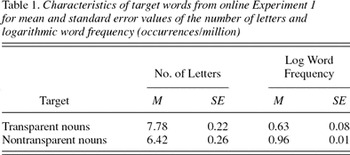
A list of 72 polysyllabic German nouns was collected, half of the nouns allowed gender assignment on the basis of a formal indicator (prefix or suffix). There were 12 nouns of each gender category in the transparent group. The following suffixes and prefixes, with four occurrences each, were used as indicators of gender: the suffixes -ling, -er, -eur as indicators of masculine gender; the suffixes -ung, -heit, -ei as indicators of feminine gender. In the case of neuter gender, four nouns with the closing suffix -chen, and four with the final suffix -nis were selected; moreover, four neuter nouns started with the prefix Ge-. A second list consisted of 36 nontransparent nouns: 13 masculine, 12 neuter, and 11 feminine gender. Compare Table 1 for logarithmic frequency of usage (Baayan, Piepenbrock, & van Rijn, 1995) and for number of letters. Appendix A gives the complete list of verbal material. All stimuli were presented in the center of a black computer screen in white letters, with a vertical size of 1 cm. The first letter of a noun was a capital one; all following ones were lowercase letters.

A control condition was added to the experimental gender assignment task. In the control condition participants were asked to read out all nouns from the experimental condition. In this way it was possible to detect effects of frequency on processing time of transparent and nontransparent nouns. Each participant performed both tasks; consequently, 144 stimuli were presented altogether.
Procedure
Participants were tested in a quiet room. In the experimental condition participants had to pronounce the noun as fast as possible, which was visually presented on the computer screen, assigning the correct definite singular article (der [masc.], die [fem.], das [neut.]) to it, which was not shown. Voice onset latencies were measured with a voice key. In the control condition the nouns from the experimental condition had to be read out without article assignment. The gender assignment task was always prior to the reading task. Experimental and reading task were preceded by a short training block of 24 items. Each task contained two blocks of 36 items, the sequence of blocks was balanced over participants. Stimuli were presented in a randomized order.
An experimental trial started with a clear screen; after 600 ms a fixation point was presented for 1000 ms in the center of the screen. This interval was succeeded by the stimulus, which was presented for 300 ms. The screen was positioned at eye level 0.5 m in front of the participants.
Reaction time measurement started as soon as the noun was presented. Reactions had to be given within an interval of 2000 ms. A new experimental trial began either directly after the reaction had been given or if the 2000 ms had passed. To be able to measure voice key trigger delays a tone of 600 Hz was sent for 500 ms as soon as the voice key triggered. Tone and answers given by the participants were tape-recorded. In case of a voice key trigger delay, response times were corrected. This was done with the help of a speech editing program. Every response was cross-checked with the 600-Hz tone. If voice onset and the onset of the acoustic signal did not overlap, the time from voice onset to the point in time when the voice key triggered (marked by the onset of the 600-Hz tone) was measured and subtracted from the recorded response time.
Results and discussion
Response time
In the gender assignment task responses to transparent words were not faster than responses to nontransparent words (M=431.48 vs. 430.06 ms, SE=12.15 vs. 12.10); the same holds true for the reading task (M=320.80 vs. 325.40 ms, SE=10.00 vs. 9.90). An analysis of variance based on correct responses confirmed that there was no significant effect of transparency, neither in the gender assignment task (F<1), nor in the reading task, F(1, 15)=1.87, p=.19. There was no significant interaction of transparency and task, F(1, 15)=1.02, p=.33.
Errors
Apart from 29 trigger failures of the voice key there were only 13 assignment errors. Six errors cannot clearly be classified as gender errors, because they could also be errors in task. Participants might have failed to assign the singular article, but assigned the plural article instead, for example, die [plural] Weber (weaver), die [plural] Glöckchen (bell). That leaves seven gender assignment errors, two in the transparent group, and five in the nontransparent group. Because of the small number of errors, we refrained from statistical analysis.
It was the aim of Experiment 1 to investigate whether there are differences in processing time between transparent and nontransparent German nouns in an online gender assignment task. Participants had to accomplish a gender assignment task first and then read the same nouns in a reading task. This sequence of tasks was kept stable across all participants, because it was expected that possible effects of transparency might be very small. Thus, balancing tasks across participants might have concealed effects of gender transparency. In contrast, one could argue that the effect of frequency on reading times, which was intended to be detected by the control condition, might also become obscured by the stable sequence, which necessarily leads to a repetition of the experimental stimuli in the control condition. However, as has been shown by previous research for language perception as well as production (cf. Jescheniak & Levelt, 1994; Marlsen-Wilson, 1990) effects of frequency are very persistent over repetitions. Moreover, note that frequency differences between transparent and nontransparent nouns were very small (see Table 1).
With respect to the question of whether transparent and nontransparent German nouns differ in processing time, the results clearly indicate that there is no difference. This suggests that in an online gender assignment task participants assign gender via the lexical route, which is equally fast for transparent and nontransparent nouns. This interpretation is in contrast to the findings of Desrocher and Pavio (1990), Taft and Meunier (1998), and Bates et al. (1995, 1996) in French and Italian. To explain these contrasting findings it can be argued that there are language-specific differences in accessing gender. Although there are numerous reliable cues that are correlated with a certain gender in French and Italian, there are only a few reliable cues in German. As mentioned before, most of the regularities suggested by Köpcke and Zubin (Köpcke, 1982; Köpcke & Zubin, 1983, 1984) are probabilistic in nature. In the case of monosyllabic nouns, Köpcke needs to postulate 24 phonological rules that explain gender assignment to only a small number of nouns. Consequently, German speakers might learn not to rely on cues during online processing to avoid mistakes. This does not exclude that German speakers do have knowledge of these regularities, as becomes evident during gender assignment to foreign words or during language acquisition. However, the circumstances under which speakers make use of gender-marking regularities needs to be defined more sharply. It was the aim of experiment two to contribute to this question.
Before turning to the second experiment of this study a comment has to be made concerning the fact that some participants were tempted to assign the plural instead of the singular article when nouns terminated in the dimunitive suffix -chen or -lein. Although the morphological forms of singular and plural articles differ in the case of diminutives, diminutive nouns themselves do not change their morphological form when they are pluralized ([singular] das Glöck-chen vs. [plural] die Glöck-chen). This might have lead some participants to assign the plural article instead of the singular article.
In sum, on the basis of the results from this experiment the following interpretation is suggested: during online processing German speakers assign gender per default on the basis of lexically stored information. However, one could also argue that the task had been too simple, and thus reaction time differences between transparent and nontransparent words could not be measured. To investigate effects of gender-marking regularities, which in German might be very subtle because of the probabilistic character of most rules, future research needs to establish new experimental paradigms and make use of other methods of measurement as has already been done by registering the electroencephalogram during pronoun processing (cf. Schmitt, Lamers, & Münte, 2002).
EXPERIMENT 2
It is the aim of Experiment 2 to investigate whether there are processing differences between transparent and nontransparent nouns in an offline task. As mentioned in the introduction, there are findings from gender assignment to loan words and nonwords as well as from language acquisition that support the effect of gender-marking regularities on gender assignment in German. Although previous research mainly aimed at showing that speakers of German can infer the correct gender from gender-marking regularities, the focus of this study is to reveal processing differences between transparent and nontransparent words as well as nonwords in an offline task. It was the aim to further specify under which conditions a form-based route can be induced in German. It is intuitively plausible that the importance of a form-based route increases when the access to lexically stored gender is impeded. To increase the likelihood of the form-based route, nonwords were added to the set of stimuli. Nonwords do not have an entry in the mental lexicon; consequently, their gender has to be derived by analogy to existing German nouns or on the basis of gender-marking regularities.
Method
Participants
Eight participants took part in the study (four female). Their age ranged from 57 to 74 years of age (M=67).1
The mean age of this group of participants was matched with a group of aphasic participants, who also took part in this experiment. However, the focus of the present manuscript lies on healthy language processing, and thus their results are not reported in the present context.
Materials
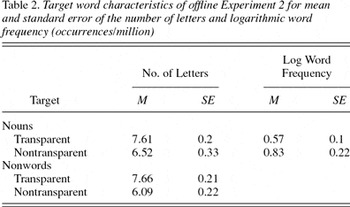
The list of stimuli consisted of 42 German nouns and 42 nonwords. Twenty-one of the nouns belonged to the group of transparent nouns, which allow gender assignment on the basis of suffixes and pseudosuffixes. Masculine gender is indicated by the suffixes -ling (five occurrences), including the noun Sperling (sparrow), which is pseudoderived. Because of the fact that other pseudosuffixes, such as -e, function as gender-marking regularities in German, Sperling was not discarded from the material. There are 9 feminine nouns, 4 ending in -ung, 3 in -in, and 2 in -keit. The diminutive suffixes -chen and -lein indicate neuter gender on 7 nouns. Reliability of cues was given priority over balancing the distribution of stimuli over the three genders. Furthermore, the uneven distribution is because many nouns in German, whose terminating suffix is -ung or -keit, refer to abstract entities. To make understanding easier, this type of reference was avoided and nouns referring to concrete entities were preferred. Moreover, frequency of occurrence had to be balanced, which lead to the exclusion of several possible candidates from the lists. The nontransparent group of nouns consisted of five masculine, nine feminine, and seven neuter nouns, respectively. In analogy to word stimuli, a list of 21 transparent and 21 nontransparent nonwords was constructed. All nonwords were pronounceable sequences. Nontransparent nonwords were devised in a way that they complied with prosodic wellformedness. They were read out with a German stress pattern, that is, main stress was on the first syllable. The gender-marking suffixes of transparent nonwords resembled those of transparent nouns in type and number of occurrence. The complete list is given in Appendix B. Words and nonwords were matched for number of letters. Transparent and nontransparent words were matched for frequency (see Table 2).

Procedure
Participants had to assign the German definite article (der [masc.], die [fem.], das [neut.]) to visually presented stimuli without time restriction. Definite articles were written on cards and placed in front of the participant during the whole experiment. In addition to the visual presentation, stimuli were read out by the investigator. Participants did not need to respond by speaking. They were encouraged to point to the card with the appropriate article. Participants could correct themselves once. Before starting the experiment it was emphasized that all stimuli were in their singular form, and that the singular article had to be assigned. To familiarize participants with the task, each session started with a practice block of six trials (three nouns, three nonwords). The 84 stimuli were presented in random order, with the only restriction that stimuli with the same suffix should not follow each other. Answers were scored on prepared answer sheets. The experiment took place in one session with the possibility of short breaks.
Data analysis
Because we are dealing with ordinal scaled data, several nonparametric tests were chosen for data analysis (cf. Siegel, 1997). The difference between gender assignment to transparent and nontransparent words was tested by means of the Wilcoxon test. The chi-square test was chosen to assess whether there is a random distribution across the three genders in case of transparent as well as nontransparent nonwords. To test whether there is a difference between the random probability of giving the correct answer, which is 33% because of the three genders in German, and the actual number of correct answers in the transparent nonword condition, results were submitted to a binomial test. The level of significance in all tests was .05.
Results
Words
The number of correct answers to transparent words was not higher than that to nontransparent words (M=20.8 vs. 20.6, SE=0.11 vs. 0.18, z=−1.41, p=.16; two-tailed Wilcoxon).
Transparent nonwords
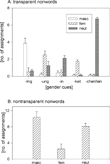
Participants assigned gender on the basis of gender cues in a large number of cases (see Figure 1A). Altogether participants assigned the gender according to the cue in 72.8% of the cases. Analysis revealed gender assignment as indicated by the suffix in case of the suffix -ung, χ2(2, 32)=15.25, p=.00; the suffix -keit, χ2(2, 16)=21.125, p=.00; the suffix -ling, χ2(2, 40)=35.15, p=.00; and in case of the suffixes -chen/lein, χ2(2, 56)=100.32, p=.00. However, the suffix -in did not induce the expected feminine gender; instead, there was a significant tendency toward neuter gender, χ2(2, 24)=15.25, p=.00, which was not expected.

(A) The gender assignment to transparent nonwords. The distribution of the assignments across the three genders (masculine, feminine, neuter) is shown for the five types of cues. (B) The distribution of gender assignments across the three possible genders (masculine, feminine, neuter) is shown for nontransparent nonwords. The standard errorsare shown in one direction.
To test whether there is a difference between the random probability of giving the correct answer, which is 33% because of the three genders in German, and the actual number of correct answers given, results were submitted to a binomial test. The test proved the difference to be significant (p=.00).
Nontransparent nonwords
Because of the absence of gender cues, either a random distribution of answers over the three genders was expected or a distribution reflecting the general proportion of masculine, feminine, and neutral gender in the German language. The general distribution of the three genders predicts a bias toward masculine and feminine gender; however, a strong bias toward masculine and neuter gender was observed (see Figure 1B). By applying the chi-square test the difference between a random distribution over the three genders and the actual distribution was proven to be significant, χ2(2, 168)=37.6, p=.00. With the one-tailed Wilcoxon test significant differences between the number of answers to feminine and masculine stimuli as well as to feminine and neuter stimuli were revealed. Participants assigned masculine (z=−2.05, p=.02) as well as neuter gender (z=−2.32, p=.01) significantly more often than feminine gender.2
Although there was a stable tendency to assign masculine or neuter gender, participants never completely agreed in their choice of gender. In the case of four items (Tapam, Riefol, Gumdul, Podun) seven out of the eight participants assigned the same gender. In all other cases there was even less agreement.
Discussion
This study aimed at specifying conditions under which a form-based route to gender can be induced in an offline task. When gender had to be assigned to words there was no effect of transparency; participants did not make use of gender cues. However, in the case of transparent nonwords, participants based gender assignment on reliable gender cues. This implies that in case of nonwords, which do not have entries in the mental lexicon, a form-based route was induced. There is instability of behavior in case of the suffix -in. Participants preferred neuter over feminine gender. These results are interpreted as an index of reduced reliability of this cue. In German, there are neuter nouns, such as Benzin (petrol), which also end in -in. For this group of nouns final stress is characteristic. Although the stimuli in this experiment were not only visually presented, but also read out by the investigator with main stress on the first syllable, participants might have generated their own stress patterns, causing ambiguity and reduced reliability of the cue -in. It has to be pointed out that the processes of gender assignment to novel words are not necessarily comparable to those underlying gender assignment to known words. Therefore, the findings related to transparent nonwords can be interpreted as a reflection of German speaker's ability, to make use of gender-marking regularities in case of unknown words. However, it cannot be inferred that these rules also guide gender assignment to known words. Once the appropriate gender of a novel word has been detected on the basis of a gender-marking cue, speakers may store this gender information lexically.
In the case of nontransparent nonwords, there was a strong bias to assign masculine or neuter gender. This behavior correlates with observations of Fries (1997). According to Fries, feminine gender in German underlies rules that are more specific than those of masculine and neuter gender. For illustration, Fries refers to so-called default cases in which masculine or neuter gender is assigned, but never feminine gender. If a gender other than neuter gender has to be assigned, it is masculine, not feminine; for example, Kann mir einer [masc.] sagen, wie spät es ist?(Can someone [masc.] tell me what time it is?). If no gender has to be specified, neuter gender is assigned (Früh übt sich, was [neut.] ein Meister werden will. (Early practice for those who [neut.] want to become professionals)). Moreover, gender can be unstable, and this is often an instability between neuter and masculine gender: der [masc.]/das [neut.] Filter (filter), Joghurt (yoghurt), Sims (sill), Zepter (scepter), but rarely between neuter and feminine or between masculine and feminine gender. The results from nontransparent nonwords illustrate what Gollan and Frost (2001) call heuristics, which do not necessarily reflect normal mechanisms of access to gender (Gollan & Frost, 2001, p. 627). However, as suggested by an anonymous reviewer, the findings from nontransparent nonwords might also imply that there are some more fine-grained regularities in the phonological or orthographic form that lead participants to assign a particular gender, which needs to be tested in future experiments. According to this reviewer, gender might have been assigned by associating parts of the nonwords (or stress patterns) to parts or patterns of real words. This explanation cannot be ruled out, although care was taken not to construct nontransparent stimuli by rhyming.
GENERAL DISCUSSION
It was the aim of this study to explore the impact of gender-marking regularities in German when gender has to be assigned to visually presented nouns. Furthermore, it was attempted to determine the conditions under which such an effect can be measured on the behavioral level. An effect of transparency could not be shown during online gender assignment. In an offline gender assignment task an effect of transparency was measured during assignment to nonwords. On the basis of these findings it is suggested here that there are two routes to grammatical gender in German: one lexical and one rule based. Per default, gender is assigned via the lexical route. If there is no or only limited access to the lexical entry, as in the case of nonwords, gender assignment might be guided by either gender-marking regularities alone or lexical information as well as gender cue information (postlexical checking). These results are in accordance with findings from Hebrew and Italian (Bates et al., 1995, 1996; Gollan & Frost, 2001). However, they are in contrast to the results from French (Desrochers & Paivio, 1990; Taft & Meunier, 1998), which are consistent with the reliable cue hypothesis (gender assignment on the basis of gender-marking regularities whenever they occur). Our results do not allow us to conclude that a form-based assignment of gender is the default case in German. Because of the probabilistic character of gender-marking regularities in German, speakers might learn to rely on the lexical entry rather than on gender cues with little reliability.
A gender assignment task, which was successful to reveal processing differences between transparent and nontransparent nouns in languages like Italian, French, and Hebrew, was also applied here. In contrast to the languages just mentioned in the present study, this task did not reveal online processing differences in healthy German speakers. Offline effects of gender-marking regularities were measured in the case of transparent nonwords. Possibly, effects of gender-marking regularities in German might be more subtle than in other languages. Consequently, results from this study underline the necessity of new methodological approaches toward the phenomenon of gender assignment in German. The use of electrophysiological measures, for instance, might help to get a better understanding of the mechanism underlying gender assignment in German.
In conclusion, the present study showed that there is no processing difference between transparent and nontransparent words in an online gender assignment task. However, during offline gender assignment participants made use of gender cues during gender assignment to nonwords. On the basis of these results it is suggested that there are two routes to gender in German: a form-based route and a lexical route. Per default, gender is assigned via the lexical route; however, there are cases when also the form-based route is applied, such as when there is no lemma entry in the mental lexicon.
APPENDIX A

APPENDIX B

ACKNOWLEDGMENTS
I thank Heike Wiese, Birgit Stürmer, Annekathrin Schacht, and Werner Sommer for their support and helpful discussion concerning the manuscript.