Implications
Growth, feed intake and non-specific immune response of channel catfish reared at a low temperature (15°C) were enhanced by the addition of flaxseed oil or a dairy/yeast prebiotic to the diet compared with a diet supplemented with soybean oil. The use of dietary n-3 fatty acids and a prebiotic to enhance growth and immune response at a suboptimal temperature could improve overall production efficiency of catfish in ponds by reducing the weight loss and mortality associated with the 3-month winter period.
Introduction
Channel catfish (Ictalurus punctatus) is the most widely cultured food fish in the United States. Production in ponds occurs primarily in the southeastern region, where water temperature varies seasonally (MacMillan and Santucci, Reference MacMillan and Santucci1990). Two growing seasons separated by a winter period (December, January and February) are required to reach market size (0.6 to 0.7 kg). Catfish feed inconsistently at lower water temperatures (<20°C), but feeding during the winter may help maintain weight and health (Robinson and Li, Reference Robinson and Li2002). Fish are visibly active during mild winter periods when temperatures are between 13°C and 20°C, thus daily or every-other-day feeding is recommended (Robinson and Li, Reference Robinson and Li2002). Economic analysis shows that this partial feeding regime is also profitable compared with not feeding in winter because it reduces mortality and mitigates weight loss (Hatch et al., Reference Hatch, Hanson, Kim and Lovell1998).
Few studies have focused on the potential of different dietary lipids to enhance feed intake, feed conversion efficiency and growth of channel catfish at low temperatures. However, there are demonstrated differences in the immune responses of catfish due both to dietary lipid source and water temperature. Channel catfish-fed diets rich in n-3 fatty acids had increased immune function at low temperatures, but at high temperatures a diet rich in n-6 fatty acids enhanced disease resistance (Lingenfelser et al., Reference Lingenfelser, Blazer and Gay1995). Sheldon and Blazer (Reference Sheldon and Blazer1991) also positively correlated dietary n-3 concentration (particularly long-chain polyunsaturated fatty acids, or LC-PUFA), with enhanced intracellular pronephros macrophage killing of Edwardsiella ictaluri in channel catfish at optimum (28°C) and suboptimal (19°C) temperatures for growth. Lysozyme activity was higher in channel catfish maintained at 22°C and fed diets high in n-3 fatty acids (with fish or flax oil) than those fed a diet with soybean oil (Suja et al., Reference Suja, Lochmann, Sink, Phillips and Chen2012). Because lipids are the easiest component of fish tissues to manipulate through the diet, their potential to improve general fish performance as well as fish health at low temperatures should be explored further.
Non-nutritive supplements such as prebiotics may also have potential to enhance growth, feed efficiency and overall health of fish at low temperatures. Prebiotics are non-digestible dietary compounds that can be metabolized by specific microflora in the gut (Gibson and Roberfroid, Reference Gibson and Roberfroid1995). Typical benefits include improved nutrient assimilation, growth and immune function (Vos et al., Reference Vos, M’Rabet, Stah, Boehm and Garssen2007). A dairy/yeast prebiotic had beneficial effects in golden shiners Notemigonus crysoleucas and goldfish Carassius auratus in our laboratory (Lochmann et al., Reference Lochmann, Sink and Phillips2009; Lochmann et al., Reference Lochmann, Sink and Phillips2011), but the same dairy/yeast prebiotic did not enhance growth or feed conversion of channel catfish at optimal temperatures (27°C to 28°C) (Thompson, Reference Thompson2009). The gut microflora of channel catfish varies seasonally (MacMillan and Santucci, Reference MacMillan and Santucci1990). Prebiotic effects may vary with temperature because different bacteria have different temperature optima for growth and survival (Panigrahi et al., Reference Panigrahi, Kiron, Satoh, Hirono, Kobayashi, Sugita, Puangkaew and Aoki2007). Furthermore, there is evidence that dietary lipid and prebiotics interact in fish, as they do in mammals. In humans, short-chain fatty acids produced by fermentation of dietary prebiotics by the gut microflora modulate blood lipids (Floch, Reference Floch2010). Interactions between dietary lipid concentration and prebiotic on survival of goldfish exposed to a pathogen were observed but not explained in Lochmann et al. (Reference Lochmann, Sink and Phillips2011). These findings raise the possibility that catfish performance at low temperatures could be manipulated with dietary lipid, prebiotic or both to improve fish performance.
The objective of this study was to determine the effects of supplementing diets with either soybean oil (control), flaxseed oil (a concentrated source of n-3 fatty acids), or soybean oil and a dairy/yeast prebiotic on the performance and body composition of channel catfish at a suboptimal temperature (15°C).
Material and methods
Experimental design and culture system
A 12-week feeding trial was conducted at the Aquaculture Research Station at the University of Arkansas at Pine Bluff in three independent recirculating systems. Each system consisted of four 1140-l tanks, a sump (528 l) and a biofilter (Ultima 2 filter, Aqua Ultraviolet, Westminster, CA, USA) to maintain water quality. The temperature in each system was maintained at 15°C by circulating water through thermistor-controlled heat pump and chiller units. The pH, total ammonia nitrogen (TAN, salicylate/cyanurate method), hardness, alkalinity and nitrite were measured every 4 weeks to ensure suitable conditions. The pH was measured with an electrode (Denver Instruments, Denver, CO, USA), and the other parameters with a HachTM DR/890 colorimeter test lab (Hach Company, Loveland, CO, USA). Un-ionized ammonia was calculated with the results of TAN and pH measurements (Emerson et al., Reference Emerson, Russo, Lund and Thurston1975). Mean water quality parameters did not differ among treatments throughout this study. Parameters were (mean±s.e.m.): temperature (°C), 15.1±0.1; pH, 6.96±0.52; total hardness (mg/l), 75.5±9.1, alkalinity (mg/l), 65.6±14.8, un-ionized ammonia (mg/l), 0.0043±0.0013 and nitrite (mg/l), 0.166±0.028.
Feeding and monitoring
Channel catfish fingerlings were obtained onsite from the Aquaculture Research Station. Due to the possibility of cross contamination of different lipids, independent recirculation systems with four tanks each were used for the three treatments. Each tank within each system was stocked with 100 fish (mean weight 61.4±0.43 g s.e.m.), and allowed to acclimate to experimental water conditions and a temperature of 26°C. Over a 2-week period, the temperature in each system was decreased 1°C daily to 15°C. This gradual acclimation was meant to simulate water conditions commonly found in commercial ponds in the fall, when temperatures gradually decrease toward winter temperatures. All fish in each tank were group-weighed every 3 weeks to monitor growth and adjust feeding rate.
The three experimental diets were prepared by modifying a commercially available diet that contained 280 g/kg protein (ARKAT, Dumas, Arkansas). The ingredient composition was proprietary, but the diet was formulated to meet or exceed all known nutrient requirements of channel catfish (Robinson and Li, Reference Robinson and Li2002). The modification consisted of grinding the commercial diet, then adding 20 g/kg cellulose and 20 g/kg soybean oil (SBO), 20 g/kg cellulose and 20 g/kg flaxseed oil (FLAX), or 20 g/kg of a dairy/yeast prebiotic (GroBiotic-A™; International Ingredient Corp., St. Louis, MO, USA) and 20 g/kg soybean oil (PREB), before being repelleted into sinking 6-mm pellets. The inclusion rate for the prebiotic was chosen based on manufacturer’s recommendations. Cellulose was included in the diets without prebiotic to produce diets with similar total energy content. The commercially available dairy/yeast prebiotic contained partially autolyzed brewer’s yeast, dairy ingredient components and dried fermentation products with ∼530 g/kg simple and complex carbohydrates. The analyzed total lipid of the prebiotic was 36 g/kg, and 16:0, 18:1n-9, and 18:2n-6 were the main fatty acids (comprising more than 800 g/kg of total fatty acids). Fish were offered feed up to a maximum of 1.5% total BW, until apparent satiation was achieved. After 45 min, the uneaten feed was collected with a siphon, and then dried to constant weight at 50°C and weighed.
Blood sample collection
At the end of 12 weeks, final group weights were taken, and all fish were held for 2 weeks to minimize the potential effects of handling stress on health parameters. Fish were maintained on their experimental diets during this time. At 14 weeks, 10 fish were randomly selected from each tank for hematological analyses. Fish were anesthetized with tricaine methanesulfonate (MS-222, Sigma, St. Louis, MO, USA) at a dose of 100 mg/l. Blood samples were drawn from anesthetized fish by severing the caudal peduncle and collecting blood in heparinized microhematocrit capillary tubes. Blood from five fish from each tank was used to analyze hematocrit (Ht) after centrifugation (3500×g for 10 min), and hemoglobin (Hb) following Houston (Reference Houston1990). Mean corpuscular hemoglobin content (MCHC) was calculated according to the formula: MCHC=Hb (g/dl)/ Hk. Plasma from these fresh blood samples was used to analyze alternative complement activity (ACH50) following Tort et al. (Reference Tort, Gomez, Montero and Sunyer1996). Plasma from the remaining five blood samples from each tank were used in the lysozyme analysis following the procedures of Hutchinson and Manning (Reference Hutchinson and Manning1996) and Magnadottir et al. (Reference Magnadottir, Jonsdottir, Helgason, Bjornsson, Jorgensen and Pilstrom1999).
Proximate and fatty acid analysis
Five randomly selected fish from each tank were euthanized with an overdose of tricaine methanesulfonate (200 mg/l). The liver of each fish was weighed for calculation of hepatosomatic index (HSI=liver weight/BW). Muscle samples were stored at −70°C and later analyzed for protein (ID 7.015) and ash content (ID 7.009) using standard methods (Association of Official Analytical Chemists, 1995). Dry matter was determined using AOAC procedure 7.007, except that the drying time was reduced to 2 h because samples had reached constant weight. Diets were analyzed using the same procedures. Total lipids from the three experimental diets, the basal diet, as well as muscle samples from three fish per tank were extracted and quantified using the chloroform/methanol procedure described by Folch et al. (Reference Folch, Lees and Sloane-Stanley1957). Lipid extract from the chloroform/methanol procedure was then used for fatty acid analysis. After methylation of the lipid extract, fatty acid methyl esters (FAMEs) were collected for analysis using a flame ionization gas chromatograph (Varian, Model CP-3800 with a CP-8200 autosampler, Walnut Creek, CA, USA) using helium as the carrier gas. The FAMEs were separated on a fused silica capillary column (15 m×0.25 mm ID; Varian CP select for Fame #CP8510). Injection volume was 1 μl, with an injector and detector temperature of 250°C and 315°C, respectively. The column temperature were held initially at 100°C for 10 min, increased to 160°C at a rate of 15°C/min and held for 4 min, then increased to 250°C at a rate of 2.5°C/min. Each sample had a total analysis time of 60 min. The FAMEs were identified and quantified by comparing the retention time and peak area to those of serially diluted mixtures of reference standards (GLC-96, GLC-473b, Nu-Check Prep, Elysian, MN, USA). Tridecanoate methyl ester (13:0) served as the internal standard. The results of the individual fatty acids were expressed as g/kg of total identified FAMEs.
Statistical analysis
Percentage data were arc-sin transformed before statistical analysis. Weight gain, survival, feed intake, FCR, hematocrit, Hb, lysozyme, complement and proximate and fatty acid composition data were analyzed by one-way ANOVA with a StatView program (SAS Institute Inc, version 5.0.1) to test for differences among experimental groups. When differences among treatment means were significant (P⩽0.05), Fisher’s least significance difference test was used to compare means.
Results
Proximate and fatty acid composition of experimental diets
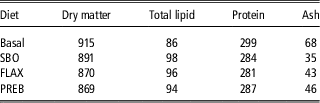
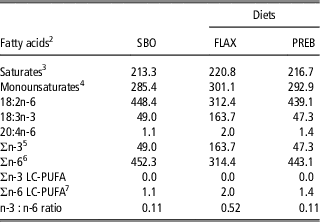
Ash and total lipid content did not differ among the three diets (Table 1). Dry matter was higher in the SBO diet than in the PREB diet (Table 1). CP was slightly higher (0.66%) in the PREB diet than in the FLAX diet (Table 1), but all diets contained at least 280 g/kg protein. Fatty acid composition for the experimental diets is summarized in Table 2. Saturated fatty acids did not differ among experimental diets. Monounsaturated fatty acids (MUFAs), arachidonic acid (20:4n-6) and total n-6 PUFAs were highest in the diet with FLAX and lowest in the diet with SBO. Linoleic acid (18:2n-6) and total n-6 fatty acids were highest in the diet with SBO and lowest in the diet with FLAX. Alpha-linolenic acid (18:3n-3) and total n-3 fatty acids were highest in the diet with FLAX and lowest in the diet with PREB. No n-3 PUFAs were detected in any of the diets. The ratio of n-3 : n-6 fatty acids was higher in the FLAX diet than in both the SBO and PREB diets.
Proximate composition (g/kg) of the basal diet and three experimental diets in a 12-week feeding trial with catfish fingerlings maintained at 15°CFootnote 1

SBO=soybean oil diet; FLAX=flaxseed oil diet; PREB=prebiotic diet.
1 All values are means of duplicate samples.
Selected fatty acid composition of the experimental diets (g/kg of total fatty acids by weight) used in a 12-week feeding trial with catfish fingerlings maintained at 15°CFootnote 1

SBO=soybean oil diet; FLAX=flaxseed oil diet; PREB=prebiotic diet; LC-PUFA=long-chain polyunsaturated fatty acids.
1 All values are means of duplicate samples.
2 Fatty acids detected at ⩽1.0 g/kg of total fatty acids by weight are not included.
3 Saturates included 14:0, 16:0, 17:18:0, 19:0, 21:0, 22:0 and 24:0.
4 Monounsaturates included 16:1, 16:1n-7, 18:1n-7, 18:1n-9 and 20:1.
5 Total n-3 fatty acids included 18:3n-3.
6 Total n-6 fatty acids included 18:2n-6, 18:3n-6, 20:4n-6 and 22:2n-6.
7 Total n-6 LC-PUFA included 20:4n-6.
Growth, survival, and feed consumption and conversion
Mean individual weight gain and mean individual feed consumption were higher in fish fed FLAX or PREB diets compared with the SBO diet (Table 3). The FCR and survival were similar among treatments (Table 3).
Effect of diets supplemented with SBO, FLAX or SBO and a dairy/yeast PREB on weight gain, survival, feed consumption and FCR of channel catfish fingerlings in a 12-week feeding trial at 15°CFootnote 1

SBO=soybean oil; FLAX=flaxseed oil; PREB=prebiotic; FCR=feed conversion ratio.
1 All values are means of four replicate tanks, each containing 100 fish initially. Means within rows with different letters are different (P⩽0.05) as determined by one-way ANOVA.
2 FCR is the mean value for the calculations from each replicate. FCR=mean individual consumption/mean individual weight gain.
Proximate and fatty acid composition of muscle
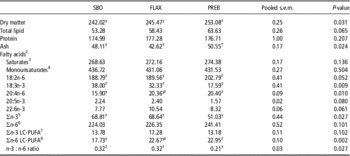
Muscle dry matter and ash were higher in fish fed the diet with PREB than those fed diets with SBO or FLAX (Table 4). CP and total lipid in muscle did not differ among treatments (Table 4). Muscle saturated fatty acids, MUFAs, 20:5n-3, 22:6n-3, total n-6 fatty acids, and n-3 LC PUFAs did not differ among treatments (Table 4). Muscle 18:2n-6 was higher in fish fed the diet with PREB than in fish fed diets with SBO or FLAX. Muscle 18:3n-3 and total n-3 fatty acids were higher in fish fed diets with SBO or FLAX than in those fed the diet with PREB. Muscle 20:4n-6 and total n-6 LC PUFAs were higher in fish fed the diet with PREB compared with those fed the diet with SBO. The ratio of n-3 to n-6 fatty acids was higher in muscle of fish fed the SBO or FLAX diets than those fed the PREB diet (Table 4).
Effect of diets supplemented with SBO, FLAX or SBO and a dairy/yeast PREB on muscle proximate composition (g/kg) and selected fatty acid composition (g/kg of total fatty acids by weight) of channel catfish fingerlings in a 12-week feeding trial at 15°CFootnote 1

SBO=soybean oil; FLAX=flaxseed oil; PREB=prebiotic; LC-PUFA=long-chain polyunsaturated fatty acids.
1 All values are means of duplicate samples of five individual fish from each of four replicate tanks per treatment. Means within rows with different letters are different (P⩽0.05) as determined by one-way ANOVA.
2 Fatty acids detected at ⩽1.0 g/kg of total fatty acids by weight are not included.
3 Saturates included 14:0, 16:0, 17:0, 18:0, 19:0, 20:0 and 21:0.
4 Monounsaturates included 16:1, 16:1n-7, 18:1(n-7+n-9), 20:1, 22:1 and 24:1.
5 Total n-3 fatty acids included 18:3n-3, 20:3n-3, 20:5n-3, 22:5n-3 and 22:6n-3.
6 Total n-6 fatty acids included 18:2n-6, 18:3n-6, 20:4n-6, 22:2n-6 and 22:4n-6.
7 Total n-3 LC-PUFA included 20:5n-3, 22:5n-3 and 22:6n-3.
8 Total n-6 LC-PUFA included 20:4n-6 and 22:4n-6.
Health indices
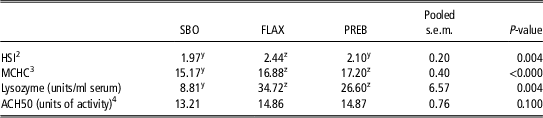
Fish fed the FLAX diet had a higher HSI than fish fed diets with SBO or PREB (Table 5). Fish fed diets with FLAX or PREB had higher MCHC and lysozyme activity compared with fish fed the SBO diet (Table 5). Complement activity did not differ among treatments (Table 5).
Effect of diets supplemented with SBO, FLAX, or SBO and a dairy/yeast PREB on HSI, MCHC, lysozyme, and alternative complement activity (ACH50) of channel catfish fingerlings in a 12-week feeding trial at 15°C Footnote 1

SBO=soybean oil; FLAX=flaxseed oil; PREB=prebiotic; HSI=hepatosomatic index; MCHC=mean corpuscular hemoglobin concentration.
1 All values are means of four replicate tanks. Five individual fish per tank (20 per diet) were used in the analysis of MCHC, ACH50, and an additional five individual fish per tank were used in the analysis of lysozyme activity. Means within rows with different letters are different (P⩽0.05) as determined by one-way ANOVA.
2 HSI is calculated by the following formula: HSI=fish liver weight (g)/BW (g)×100 from five individual fish from each of four replicate tanks per treatment.
3 MCHC is calculated by the formula: MCHC=Hb concentration/hematocrit fraction.
4 ACH50 is reported as the reciprocal of the serum dilution causing 50% lysis of rabbit red blood cells.
Discussion
Despite the suboptimal temperature limiting growth rates (35% to 44% increase from initial weights), fish fed either the FLAX or PREB diets had higher mean individual weight gain and mean individual feed consumption than fish fed the SBO diet. It is unlikely that dietary energy is the cause of these differences in growth and consumption, because total lipid concentrations did not differ among diets. In fish, lipids are the major source of energy used for growth, health and normal function (Sargent et al., Reference Sargent, Henderson and Tocher2002). Fish can also use protein as a source of energy, but the slight differences in dietary protein (<10 g/kg) would not explain the growth differences because all diets contained at least 280 g/kg, which meet catfish requirements (Robinson and Li, Reference Robinson and Li2002). At lower temperatures, the unsaturation of lipids in fish tissues increases as a means of maintaining normal cell membrane function (Hazel and Williams, Reference Hazel and Williams1990). Catfish have the ability to elongate and desaturate shorter-chain fatty acids found in plants into their longer-chain homologs; for instance, 18:3n-3→20:3n-3→20:5n-3. Satoh et al. (Reference Satoh, Poe and Wilson1989) showed that at 26.7ºC, catfish growth and feed efficiency were enhanced by dietary n-3 fatty acids. In particular, catfish fed diets with either cod liver oil (high in 20:5n-3 and 22:6n-3) or linseed oil (high in 18:3n-3) exhibited the highest growth rate and feed efficiency, while catfish fed diets with 18:2n-6 showed no improvements in growth or feed efficiency. Catfish fed diets with menhaden fish oil, or a mixture of oils including fish oil had better growth than catfish fed diets with beef tallow, corn oil or linseed oil at 28ºC (Fracalossi and Lovell, Reference Fracalossi and Lovell1995). However, at a lower temperature (17ºC), catfish fed diets with corn oil or linseed oil had similar growth to fish fed diets with menhaden oil or the mixed oil (Fracalossi and Lovell, Reference Fracalossi and Lovell1995). Corn oil is made up mostly of 18:2n-6, much like soybean oil, while linseed oil is similar to flaxseed oil (high in 18:3n-3). Yet, in the current study, catfish fed the FLAX or PREB diets had enhanced growth compared with catfish fed the SBO diet. Conflicting results between the study of Fracalossi and Lovell (Reference Fracalossi and Lovell1995) and this study are difficult to explain, because there were multiple differences in the proximate and ingredient composition of the purified diets in their study v. the practical diets used in the current study.
Mixed results regarding growth and feed efficiency of fish fed the dairy/yeast prebiotic used in this study have been obtained for hybrid striped bass (Li and Gatlin, Reference Li and Gatlin2004), red drum (Burr et al., Reference Burr, Gatlin and Hume2009; Buentello et al., Reference Buentello, Neill and Gatlin2010), rainbow trout (Sealey et al., Reference Sealey, Barrows, Johansen, Overturf, LaPatra and Hardy2007), golden shiner (Lochmann et al., Reference Lochmann, Sink and Phillips2011) and goldfish (Savolainen and Gatlin, Reference Savolainen and Gatlin2009). In channel catfish reared at an optimal temperature for growth (27°C), there were no differences in general performance of fry or fingerlings fed the dairy/yeast prebiotic (Thompson, Reference Thompson2009). Therefore, growth improvement in catfish fed the prebiotic in this trial at a suboptimal temperature was encouraging. Prebiotics are thought to alter the microbial community in the intestine, which in turn can enhance dietary nutrient utilization by the fish. Red drum (Sciaenops ocellatus) fed a dairy/yeast prebiotic had increased apparent protein and organic matter digestibility over fish fed the basal diet (Burr et al., Reference Burr, Hume, Neill and Gatlin2008). In cool months of the year, characterized by inconsistent feeding, poor growth and increased FCR, the use of a dietary prebiotic may enhance the ability of catfish to utilize the smaller amount of feed that they consume. However, nutrient digestibility was not measured in this trial and the mechanism of growth enhancement by prebiotics in catfish at a low temperature needs to be addressed with additional research.
Fish fed the diet with PREB had an increase in both fillet dry matter and ash content. Prebiotics can enhance calcium and magnesium uptake through several possible modes of action, such as decreasing gastrointestinal pH, bacterial community shifts and production of short-chain fatty acids such as acetate and propionate (Griffin and Abrams, Reference Griffin and Abrams2008).
The fatty acid composition of muscle differed among the three treatments in many ways. Fish have some ability to modify fatty acids consumed in the diet (Sargent et al., Reference Sargent, Henderson and Tocher2002), which is one mechanism used to facilitate physiological adaptation to different environmental temperatures (Bell et al., Reference Bell, Henderson and Stickney1986). The FLAX- and SBO-fed fish had increased proportions of total n-3 fatty acids in the muscle tissue compared with fish fed the PREB diet. However, the proportions of the individual n-3 fatty acids differed slightly. Fish fed the FLAX or SBO diet had higher concentrations of 18:3n-3 over those fed the PREB diet, but all three treatments resulted in similar muscle concentrations of 20:5n-3, 22:6n-3 and total n-3 LC-PUFA. This suggests that different rates of elongation and desaturation of the dietary n-3 fatty acids occurred among treatments. Suja et al. (Reference Suja, Lochmann, Sink, Phillips and Chen2012) found that catfish reared at 22°C fed diets supplemented with soybean oil, flaxseed oil or menhaden fish oil had similar fatty acid profiles (including longer-chain fatty acid homologs) to those of their respective diets. The concentration of total n-6 fatty acids in muscle tissue in this study did not differ among treatments. However, the concentration of 18:2n-6 in muscle of fish fed the PREB diet was higher than that of fish fed the FLAX or SBO diets. Concentrations of 20:4n-6 and total n-6 LC-PUFA were also higher in muscle of PREB-fed fish compared with those fed the SBO diet without prebiotic. The differences in fatty acid composition of the SBO and PREB diets were very minor, and do not explain the higher concentrations of n-6 fatty acids (18:2n-6 and 20:4n-6) found in muscle of fish fed the PREB diet compared with the SBO diet. These results indicate the dairy/yeast prebiotic altered the metabolism of dietary fatty acids in channel catfish at a low temperature. Prebiotics stimulate the gut microflora to produce short-chain fatty acids such as acetic and propionic acid that can affect serum cholesterol, triglycerides and phospholipids (Floch, Reference Floch2010). However, further research is needed to determine the effects of prebiotics on the metabolism of individual fatty acids, particularly at suboptimal temperatures.
The HSI was higher in fish fed the FLAX diet than in fish fed the SBO or PREB diet. Larger livers in fish fed the FLAX diet may be linked with higher concentrations of total hepatic enzymes, as production can increase in fish at a low temperature to compensate for a lower metabolic rate (Kent et al., Reference Kent, Koban and Prosser1988). The livers were smaller in fish fed either diet with soybean oil, indicating that the same adaptation did not occur in fish fed the SBO or PREB diets with more n-6 fatty acids. The FLAX- and PREB-fed fish had significant increases in both MCHC and lysozyme activity over the SBO treatment. Complement activity followed the same trend, but did not differ among treatments. The FLAX diet contained the highest proportion of n-3 fatty acids as 18:3n-3 relative to the other diets, which might have been a contributing factor to the increased lysozyme observed in FLAX-fed fish. In general, there is a correlation between the concentration of n-3 fatty acids in the diet, temperature and the immunocompetence of fish (Bowden, Reference Bowden2008). In Suja et al. (Reference Suja, Lochmann, Sink, Phillips and Chen2012), catfish reared at 22°C and fed diets with flaxseed oil or menhaden fish oil had increased lysozyme activity compared with fish fed the control diet with soybean oil. Catfish reared at 18°C fed a diet high in total n-3 fatty acids from menhaden fish oil had enhanced immune parameters compared with catfish fed diets with catfish oil and a low level of n-3 fatty acids (Lingenfelser et al., Reference Lingenfelser, Blazer and Gay1995). However, fish fed the PREB diet in the current study had lower concentrations of total n-3 fatty acids than fish fed diets with FLAX or SBO, yet fish fed the PREB diet also had increased lysozyme activity compared with those fed the SBO diet. Red drum fed a dairy/yeast prebiotic also had increased lysozyme activity (Buentello et al., Reference Buentello, Neill and Gatlin2010), but catfish fed the same prebiotic at optimal temperature for growth did not have increased lysozyme activity compared with the control (Thompson, Reference Thompson2009). Ambient temperature clearly affects many physiological conditions in fish, including gut microflora, health status and immunocompetence (MacMillan and Santucci, Reference MacMillan and Santucci1990; Bowden, Reference Bowden2008). Seasonal trends in intestinal microflora are found in many species, including channel catfish (MacMillan and Santucci, Reference MacMillan and Santucci1990; Hagi et al., Reference Hagi, Tanaka, Iwamura and Hoshino2004), hybrid tilapia Oreochromis niloticus×Oreochromis aureus (Al-Harbi and Uddin, Reference Al-Harbi and Uddin2004), silver carp Hypophthalmichthys molitrix, common carp Cyprinus carpio and crucian carp Carassius cuvieri (Hagi et al., Reference Hagi, Tanaka, Iwamura and Hoshino2004). At low temperatures when catfish feed intake is reduced significantly the gastrointestinal tract may even become devoid of all microbes (MacMillan and Santucci, Reference MacMillan and Santucci1990). However, as long as fish are feeding they should retain a microflora, which can be affected by dietary prebiotics or lipids, both of which can modulate the immune response (Gibson and Roberfroid, Reference Gibson and Roberfroid1995). Further studies are needed to characterize the microbial community in catfish gastrointestinal tracts at different temperatures, as well as the specific effects of prebiotics and dietary fatty acids on that community.
In summary, the growth, feed intake, lysozyme and MCHC of catfish reared at a low temperature were enhanced by the addition of flaxseed oil or a dairy/yeast prebiotic to the diet compared with a diet supplemented only with SBO. Lipids have a well-documented role in the maintenance of immunocompetence, especially at lower temperatures, and the inclusion of n-3 rich lipids should be considered for winter diets for catfish. In contrast, prebiotics have had mixed effects on the immune response and overall performance in fish, and their modes of action are poorly understood. In addition, the gut may be sparsely colonized by microbes at low temperatures. Therefore, the ability of prebiotics to enhance nutrient utilization and immune response of catfish during this vulnerable part of the production cycle should be explored further.
Acknowledgments
The authors thank the Arkansas Catfish Promotion Board for partial support of this study, International Ingredient Corporation for donating the GroBiotic®-A, and Bioriginal Food and Science Corporation for contributing flaxseed oil. Andrew Goodwin, David Heikes, and Alf Haukenes reviewed the manuscript.