The Ti-6Al-4V alloy is widely used for aerospace applications,Reference Boyer1, Reference Druz, Moxson, Chernenkoff, Jandeska and Lynn2 biomedical devices and implants because of its excellent strength-to-density ratio and corrosion resistance.Reference Geetha, Singh, Asokamani and Gogia3 However, the high cost of conventionally processed Ti-6Al-4V (casting followed by forging and/or machining) makes powder metallurgy (P/M) with prealloyed powdersReference Lutjering and Williams4 an interesting alternative. In this route, the prealloyed powders are cold-pressed, sintered, and then subjected to hot isostatic pressing (HIP)—typically carried out at high pressures of ~100 MPa at ~920 °C for ~4 h—to remove residual pores and achieve optimal mechanical properties, in particular fatigue resistance.Reference Atkinson and Davies5, Reference Zhang, Mei, Wain and Wu6 Recently, we showed that this HIP step can be replaced by uniaxial hot pressing at much lower pressure (~15 MPa) carried out under thermal cycling within the range of the α/β phase transformation of Ti-6Al-4V to activate transformation superplasticity as a deformation mechanism.Reference Ye, Matsen and Dunand7 To further reduce the processing costs, prealloyed Ti-6Al-4V powder can be replaced by blended elemental (BE) powders consisting of commercial purity titanium (CP-Ti, for which many low costs fabrication routes existReference Weil, Hovanski and Lavender8, Reference Imam and Froes9) with 10% addition Al-40 wt.% V (Al-40V) master alloy, which are homogenized to the Ti-6Al-4V composition during the sintering step.Reference Druz, Moxson, Chernenkoff, Jandeska and Lynn2, Reference Ivasishin, Eylon, Bondarchuk and Savvakin10 An Al-40V master alloy is used rather than elemental Al and V to avoid porosity or even swelling from low temperature eutectic formation during sintering.Reference Ivasishin, Eylon, Bondarchuk and Savvakin10, Reference Liu, Chen, Wei, Tang, Liu and Huang11 Furthermore, hydrogenated titanium powders rather than regular titanium powders can be used for better pore healing.Reference Ivasishin, Eylon, Bondarchuk and Savvakin10
A typical BE P/M process includes mixing of CP-Ti and Al-40V powders, cold pressing, vacuum sintering, and final-stage HIP.Reference Druz, Moxson, Chernenkoff, Jandeska and Lynn2, Reference Ivasishin, Eylon, Bondarchuk and Savvakin10, Reference Hagiwara and Emura12 Cold pressing at room temperature is usually conducted at 400–1000 MPa for a relative density above 95%.Reference Ivasishin, Eylon, Bondarchuk and Savvakin10, Reference Hagiwara and Emura12 Vacuum sintering is the critical step needed to achieve a homogeneous microstructure by solid state diffusion. Since CP-Ti and Al-40V have densities of 4.51 and 3.50 ± 0.18 g/cm3, respectively, the volume average density of Ti-6Al-4V is 4.38 ± 0.03 g/cm3 (calculated for a blend of 90 wt.% Ti and 10 wt.% Al-40V powders) so that a 1.1 ± 0.6% shrinkage is needed to reach the theoretical Ti-6Al-4V density of 4.43 g/cm3. Final stage porosity (relative density 98.9% before HIP) removal by the HIP process is often necessary,Reference Druz, Moxson, Chernenkoff, Jandeska and Lynn2, Reference Ivasishin, Eylon, Bondarchuk and Savvakin10, Reference Yang and Hwang13 which compromises the cost saving in the BE P/M process.
Other than densification at high stress levels (such as cold pressing, conventional isothermal hot pressing, and HIP), full densification can be achieved at low stresses for CP-Ti (1–3 MPaReference Schuh, Noel and Dunand14) and Ti-6Al-4V (15 MPaReference Ye, Matsen and Dunand7) with improved densification kinetics by repeated thermal cycling between their α and β phases. Internal mismatch stresses produced during the phase transformations are biased by the externally applied stress and lead to a reduction of flow stress and an average strain rate sensitivity near unity (Newtonian flow) associated with transformation superplasticity.Reference Ye, Matsen and Dunand7 Low-stress powder densification under thermal cycling could then be used to replace HIP for final stage porosity removal in the BE P/M process.
Here, we study the densification of BE powders (CP-Ti and Al-40V) into fully dense Ti-6Al-4V as a function of stress (1–10 MPa) under isothermal and thermal cycling conditions. Annealing for subsequent chemical homogenization is also studied. This single-step process route, without the additional steps of high-pressure cold compaction and final stage HIP, provides an affordable means for net shape processing of Ti-6Al-4V objects with complex shapes, when using shaped dies.
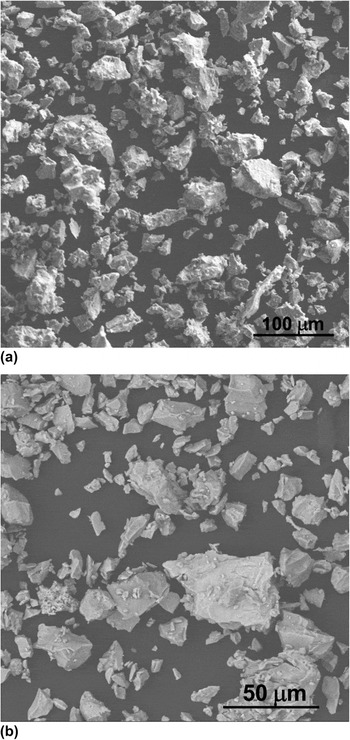
The powders used were Al-40V master alloy (with composition 57.8 wt.% Al and 41.7 wt.% V) powders supplied by Dynamet Technology (Burlington, MA), and CP-Ti powders produced by hydrogenation/dehydrogenation (HDH) from Phelly Materials (Bergenfield, NJ). The CP-Ti powders, with ~0.4 wt.% oxygen level, exhibited angular shape with ~44 μm (325 mesh) particle size [Fig. 1(a)]. The Al-40V powder had angular-shaped particle size below ~55 μm (−275 mesh) [Fig. 1(b)].
SEM images of powders: (a) commercial purity titanium (CP-Ti) and (b) Al-40 wt.% V master alloy.

CP-Ti and Al-40V powders with a mass ratio of 9:1 were blended for 20 min in a custom mixer outfitted with a single axially located baffleReference Ottino and Lueptow15 for enhanced mixing. The powder blend was then poured into a cylindrical graphite die coated with boron nitride, with inner and outer diameters of 12.7 and 63.5 mm, respectively.
Powder densification was conducted in a custom vacuum hot press apparatusReference Ye, Matsen and Dunand7 under isothermal conditions (1020 °C) at stress levels of 3, 5, and 10 MPa with a vacuum of 5 × 10⁻⁵ Torr. Furthermore, three thermal cycling densification experiments were conducted at 860–1020 °C with a 191-s period at the same stresses. After hot pressing, the samples were cooled under vacuum to room temperature. The sample density was measured by the Archimedes method with vacuum grease for pore sealing. Standard metallographic preparation method was used, as described in Ref. Reference Ye, Matsen and Dunand7.
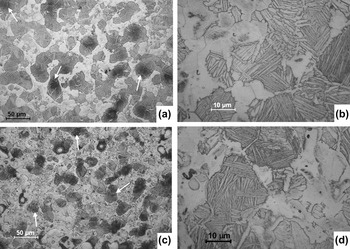
The etched microstructures of the densified samples are shown in Fig. 2 for thermal cycling and isothermal conditions (both for 108 min) at 10 MPa, respectively. Only a few pores are visible in the cross sections, and the final porosity is below 0.5%. Although isothermal densification at 1020 °C occurred at a higher average temperature than thermal cycling densification at 860–1020 °C, the microstructure appears more uniform for the latter condition, as illustrated by comparing Figs. 2(a) and 2(b) with Figs. 2(c) and 2(d). In both cases, Ti-6Al-4V regions show Widmanstätten or “basket weave” microstructure typical of a slow-cooled condition. Some dark regions visible in the etched cross section (marked by arrows in Fig. 2) are indicative of higher aluminum concentrations owing to incomplete Al-40V dissolution.Reference Ivasishin, Eylon, Bondarchuk and Savvakin10
Optical micrographs of etched cross-sections of Ti-6Al-4V densified from blended elemental (BE) powders at 10 MPa under (a, b) thermal cycling conditions (860–1020 °C) for 106 min and (c, d) isothermal conditions (1020 °C) for 110 min, respectively. Arrows indicate regions of incompletely dissolved Al-40V.

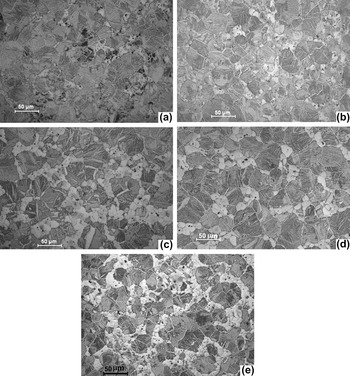
Samples consolidated by thermal cycling were subsequently annealed at 1020 °C for 2, 4, 16, or 64 h to further homogenize their composition. The corresponding etched microstructures are shown in Figs. 3(a)–3(d) and are representative of the entire 127 mm2 cross section of the sample observed both in the middle of the sample and at its top (in contact with the piston). The microstructure after 4 h annealing [Fig. 3(b)] appears to be better homogenized than a control sample of an isothermally consolidated sample annealed for the same time [Fig. 3(e)]. As shown in Figs. 3(b)–3(d), homogenization is achieved after about 4 h of annealing, and longer exposure in the β phase leads to grain growth [Figs. 3(c) and 3(d)]. As reported in Ref. Reference Ivasishin, Eylon, Bondarchuk and Savvakin10, homogenization for shorter time at higher temperatures (e.g., 2 h at 1100 °C) is also possible. Any porosity formed during this step, associated with the higher density of Ti-6Al-4V as compared to the volume average density of Ti and Al-40V, may be eliminated by hot pressing at low stress under thermal cycling conditions.Reference Ye, Matsen and Dunand7
Optical micrographs of etched cross sections of Ti-6Al-4V densified from BE powders at 10 MPa under thermal cycling conditions (860–1020 °C) for 106 min and subsequently homogenized at 1020 °C for (a) 2 h, (b) 4 h, (c) 16 h, (d), and 64 h (e). As previously described, but sample initially densified at 10 MPa under isothermal conditions (1020 °C) for 110 min and homogenized for 4 h.

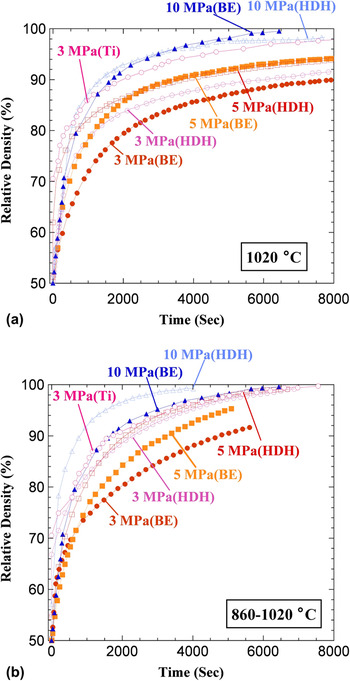
Densification curves (relative density versus time) under isothermal and thermal cycling conditions are shown in Figs. 4(a) and 4(b) for the present BE Ti-6Al-4V powders. Also shown for comparison are published densification curves for CP-TiReference Schuh, Noel and Dunand14 and prealloyed HDH Ti-6Al-4V.Reference Ye, Matsen and Dunand7 At a given applied stress, the densification kinetics of BE powders tend to be slower than those of prealloyed HDH Ti-6Al-4V and much slower than those of CP-Ti. Given that the composition of the BE preforms is both spatially inhomogenous and evolving with time during the densification, modeling is difficult without an extensive chemical mapping as a function of time. It is, however, clear that the densification behavior of the BE powders is closer to that of prealloyed Ti-6Al-4V than CP-Ti. The improvement in densification kinetics provided by transformation superplasticity (860–1020 °C) as compared to creep isothermal densification (1020 °C) for prealloyed Ti-6Al-4V and CP-Ti (Fig. 4) is nearly inexistent for BE powders. However, a benefit still exists, as the average temperature during cycling is lower than that during isothermal densification. It is possible that reaction between CP-Ti and Al-40V powders results in the transient formation of Ti-Al compounds with high transformation temperature,Reference Ivasishin, Eylon, Bondarchuk and Savvakin10 which do not transform over the 860–1020 °C range and also strengthen the matrix.
Densification curves for BE Ti-6Al-4V powders at 3, 5, and 10 MPa (a) isothermally at 1020 °C and (b) under thermal cycling (860–1020 °C). Published densification curves for prealloyed CP-TiReference Schuh, Noel and Dunand14 and for prealloyed hydrogenation/dehydrogenation Ti-6Al-4VReference Ye, Matsen and Dunand7 are also given for comparison.

In summary, the above experiments demonstrate a route for low-cost, single-step densification of Ti-6Al-4V by hot pressing of BE powders (CP-Ti and Al-40V), allowing the use of low-cost CP-Ti powdersReference Weil, Hovanski and Lavender8, Reference Imam and Froes9 and avoiding costly HIP densification. Figures 4(a) and 4(b) show that BE powders can be fully densified by hot pressing at a relatively low stress of 10 MPa for ~2 h, either isothermally at 1020 °C or under 860–1020 °C thermal cycling. The somewhat inhomogeneous alloy [Figs. 2(a) and 2(c)] can then be fully homogenized at 1020 °C for times as short as 4 h [Figs. 3(a)–3(d)]. If any residual porosity is still present, the homogenized Ti-6Al-4V sample can be further densified by thermal cycling (860–1020 °C) under a relatively low applied stress of ~15 MPa for ~1 h.Reference Ye, Matsen and Dunand7
ACKNOWLEDGMENTS
This project was supported by a grant from the Boeing Company. The authors thank Mr. Stan Abkowitz and Ms. Sue Abkowitz (Dynamet Technology) for providing the Al-40V master alloy powders.