Attention-deficit/hyperactivity disorder (ADHD) is a common, impairing syndrome characterized by age-inappropriate overactivity, impulsivity, inattention, and disorganization (American Psychiatric Association, 2013). Twin studies have estimated heritability for ADHD at approximately 70% (Chang, Lichtenstein, Asherson, & Larsson, Reference Chang, Lichtenstein, Asherson and Larsson2013; Larsson, Chang, D'Onofrio, & Lichtenstein, Reference Larsson, Chang, D'Onofrio and Lichtenstein2014; Nikolas & Burt, Reference Nikolas and Burt2010). However, the variance explained by genetic polymorphisms in genome-wide investigations of ADHD is substantially smaller than heritability estimates from family-based studies (Neale et al., Reference Neale, Medland, Ripke, Asherson, Franke and Lesch2010; van der Sluis, Verhage, Posthuma, & Dolan, Reference van der Sluis, Verhage, Posthuma and Dolan2010). This “missing heritability” has led to increased interest in contributions from rare genetic variants (Manolio et al., Reference Manolio, Collins, Cox, Goldstein, Hindorff and Hunter2009) and the role of gene–environment interplay in ADHD (Nigg, Reference Nigg2012; Nigg, Nikolas, & Burt, Reference Nigg, Nikolas and Burt2010), as well as renewed interest in clarifying etiological heterogeneity in the ADHD phenotype (Nigg, Reference Nigg2012).
Although multiple approaches for identifying susceptibility genes for ADHD are now available, candidate gene studies can continue to provide a useful approach, because they take advantage of previous empirical work examining the underlying neurobiological mechanisms of the disorder (Li, Chang, Zhang, Gao, & Wang, Reference Li, Chang, Zhang, Gao and Wang2014). In particular, while it is recognized that ADHD is genetically and neurobiologically heterogeneous (Faraone & Biederman, Reference Faraone and Biederman1998; Willcutt et al., Reference Willcutt, Nigg, Pennington, Solanto, Rohde and Tannock2012), the role of dopamine neurotransmission has been implicated in investigations of the effects of stimulant medications (Volkow et al., Reference Volkow, Ding, Fowler, Wang, Logan and Gatley1995) and of the ADHD-like behavior seen in mice lacking the dopamine receptor gene (Giros, Jaber, Jones, Wightman, & Caron, Reference Giros, Jaber, Jones, Wightman and Caron1996). Further, alterations in dopamine continue to be among the leading pathophysiological theories of ADHD (Kirley et al., Reference Kirley, Lowe, Mullins, McCarron, Daly and Waldman2002; Stark et al., Reference Stark, Bauer, Merz, Zimmermann, Reuter and Plichta2011; Volkow, Wang, Fowler, Tomasi, & Baler, Reference Volkow, Wang, Fowler, Tomasi and Baler2011). Because dopamine is expressed heavily in frontal–subcortical circuitry and in brain regions for which alterations in brain function have also been associated with ADHD, the principal hypothesis concerning pathophysiology is that dopamine alterations influence changes in brain systems that support key cognitive endophenotypes of ADHD.
However, it is important that this mediational hypothesis has not yet been directly tested in a multiple mediation framework that tests multiple neuropsychological variables simultaneously. A candidate gene approach also provides a useful strategy for examining such associations. Over the past 20 years, molecular genetic studies have identified several markers within candidate genes that result in functional changes of proteins involved in neurotransmission and also appear to account for some proportion of the variance in ADHD (Gizer, Ficks, & Waldman, Reference Gizer, Ficks and Waldman2009). Among these, are the dopamine active transporter 1 gene (DAT1) and the dopamine receptor D4 gene (DRD4).
DAT1 (SLC6A3): 3′ Untranslated Region Variable Number Tandem Repeat (VNTR)
Abnormalities or deficiencies in how the dopamine system responds to stimulation have been suggested to underlie the pathophysiology of ADHD (Solanto, Reference Solanto2002). DAT1, which codes for a protein responsible for the reuptake of dopamine from the synaptic cleft back to the presynaptic neuron (Vandenbergh et al., Reference Vandenbergh, Persico, Hawkins, Griffin, Li and Jabs1992), is a relevant candidate gene for ADHD for several reasons. The success of stimulant medications (i.e., methylphenidate), which are considered first-line treatments for ADHD symptoms (Wilens, Biederman, & Spencer, Reference Wilens, Biederman and Spencer2002), work by inhibiting the function of the dopamine transporter and thereby increasing the levels of available dopamine in the synapse (Volkow et al., Reference Volkow, Ding, Fowler, Wang, Logan and Gatley1995). In addition, DAT1 knockout mice display marked increases in motor activity, similar to behaviors observed in individuals with ADHD (i.e., substantially increased motor activity; see Giros et al., Reference Giros, Jaber, Jones, Wightman and Caron1996). Furthermore, associations with DAT1 and ADHD have been replicated, albeit with small effect sizes (Gizer et al., Reference Gizer, Ficks and Waldman2009).
One of the most commonly studied polymorphisms of the DAT1 gene is the 40 base pair (bp) VNTR in the 3′ untranslated region of the gene (Bruxel et al., Reference Bruxel, Akutagava-Martins, Salatino-Oliveira, Contini, Kieling and Hutz2014). Meta-analyses have documented small but significant associations between the 10-repeat polymorphism of DAT1 and ADHD (odds ratio [OR] = 1.12). The 10-repeat polymorphism has been implicated in problems with response control (see Gizer & Waldman, Reference Gizer and Waldman2012); and more recent research demonstrated that the DAT1 10-6 haplotype was associated with increased P3 amplitude in the brain, which may be related to less neuronal efficiency, and was found to be related to response inhibition (Albrecht et al., Reference Albrecht, Brandeis, von Sandersleben, Valko, Heinrich and Xu2014).
DRD4
DRD4 is heavily expressed in brain areas thought to underpin the cognitive deficits that are involved in many cases of ADHD (i.e., frontal lobe, orbitofrontal cortex, and anterior cingulate cortex; Gizer & Waldman, Reference Gizer and Waldman2012; Noaín et al., Reference Noaín, Avale, Wedemeyer, Calvo, Peper and Rubinstein2006). DRD4 has been associated with novelty seeking (Benjamin, Patterson, Greenberg, Murphy, & Hamer, Reference Benjamin, Li, Patterson, Greenberg, Murphy and Hamer1996; Ebstein et al., Reference Ebstein, Novick, Umansky, Priel, Osher and Blaine1996), which is proposed to contribute to the hyperactivity–impulsivity symptoms observed among individuals with ADHD (Faraone et al., Reference Faraone, Biederman, Weiffenbach, Keith, Chu and Weaver1999). Findings have also shown that DRD4 is involved in reward processing, such that knockout mice exhibit a heightened response to cocaine and methamphetamine (Rubinstein et al., Reference Rubinstein, Phillips, Bunzow, Falzone, Dziewczapolski and Zhang1997), which may be important for understanding the atypical reward processing that often underlies ADHD (Beauchaine & McNulty, Reference Beauchaine and McNulty2013).
Researchers have focused on the polymorphism of the 48-bp VNTR in exon III, and more specifically the seven-repeat allele (7R), of DRD4 because this variant mediates a blunted response to dopamine (Asghari et al., Reference Asghari, Sanyal, Buchwaldt, Paterson, Jovanovic and Van Tol1995; Faraone et al., Reference Faraone, Biederman, Weiffenbach, Keith, Chu and Weaver1999; Tol et al., Reference Tol, Wu, Guan, Ohara, Bunzow and Civelli1992) and has been associated with ADHD (Faraone & Mick, Reference Faraone and Mick2010; Li, Sham, Owen, & He, Reference Li, Sham, Owen and He2006). Studies have demonstrated that in addition to its association with ADHD (OR = 1.33), the 7R polymorphism has been related to sustained attention and performance on tasks of cognitive control (Gizer & Waldman, Reference Gizer and Waldman2012; Johnson et al., Reference Johnson, Kelly, Robertson, Barry, Mulligan and Daly2008; Kieling, Roman, Doyle, Hutz, & Rohde, Reference Kieling, Roman, Doyle, Hutz and Rohde2006). Another widely studied DRD4 polymorphism is the 120-bp duplication found in the promoter region of the gene (Gizer et al., Reference Gizer, Ficks and Waldman2009), which has been associated with ADHD in children (Kereszturi et al., Reference Kereszturi, Kiraly, Csapo, Tarnok, Gadoros and Sasvari-Szekely2007). In particular, the findings suggest that the homozygous one-repeat form of the 120 bp may be a risk factor for ADHD (Kereszturi et al., Reference Kereszturi, Kiraly, Csapo, Tarnok, Gadoros and Sasvari-Szekely2007).
Endophenotypes/Intermediate Phenotypes and ADHD
Meta-analyses have indicated associations between these candidate markers and ADHD (e.g., DAT1 3′ untranslated region VNTR 10 repeat, OR = 1.12, Q statistic = 92.97; DRD4 promoter insertion/deletion [120-bp], OR = 1.05, Q statistic χ2 = 15.16; Gizer et al., Reference Gizer, Ficks and Waldman2009); however, inconsistency of genetic effects across studies (as evidenced by significant Q statistics, a metric of heterogeneity of effects in meta-analysis) has led to questions regarding phenotype refinement. Similarly, review studies evaluating the relationship between ADHD candidate genes and neuropsychological performance have also indicated inconsistent results (Kebir, Tabbane, Sengupta, & Joober, Reference Kebir, Tabbane, Sengupta and Joober2009). For example, Swanson et al. (Reference Swanson, Oosterlaan, Murias, Schuck, Flodman and Spence2000) were the first to discover that contrary to expectation, individuals with ADHD with the 7R allele of the DRD4 gene did not display neuropsychological deficits on tests of attention (i.e., color–word, cued-detection, and go–change tasks), although those without the 7R allele did display abnormalities on these tasks (i.e., slow and variable reaction times). In line with this, additional studies have found children with ADHD with the 7R allele performed better on a task of variables of attention (i.e., fewer commission and omission errors and lower reaction time variability) compared to those without the 7R allele (Bellgrove, Hawi, Lowe, et al., Reference Bellgrove, Hawi, Lowe, Kirley, Robertson and Gill2005; Manor et al., Reference Manor, Tyano, Eisenberg, Bachner-Melman, Kotler and Ebstein2002). However, some work has indicated the opposite relationship, such that compared to those without the 7R allele, individuals with ADHD with the 7R allele demonstrated worse performance on neuropsychological tasks, including less accurate responses on a matched familiar figures test (Langley et al., Reference Langley, Marshall, van den Bree, Thomas, Dphil and O'Donovan2004), longer reaction times on the trail making task (Waldman, Reference Waldman2005), and more commission errors on the continuous performance task (Kieling et al., Reference Kieling, Roman, Doyle, Hutz and Rohde2006). These inconsistencies mirror those described in the candidate gene literature regarding associations with ADHD diagnosis. While it is possible that multiple methodological and theoretical factors may account for these inconsistencies (e.g., small sample size, artifact, and variation in neurocognitive performance due to age), a mediational approach may help clarify patterns of association that link variation in candidate genes to neuropsychological performance and ADHD symptomatology.
Several studies have proposed that genetic investigation may best proceed with the use of endophenotypes or intermediate phenotypes. Endophenotypes are conceptualized as markers of genetic susceptibility for psychopathology, and are presumed to be in the causal pathway of the disorder(s) they underlie, be more heritable and less genetically complex, and be present in unaffected relatives of affected individuals (Gottesman & Gould, Reference Gottesman and Gould2003). However, some work has favored the term intermediate phenotype because this does not presume higher heritability or a differing degree of genetic complexity, which is more consistent with past work examining endophenotypes for psychiatric disorders (Szatmari et al., Reference Szatmari, Maziade, Zwaigenbaum, Mérette, Roy and Joober2007). For the purposes of the present research, the terms endophenotype and intermediate phenotype will be used interchangeably; however, it is important to note this conceptual distinction.
Neuropsychological measures have been frequently proposed as endophenotypes for ADHD, because numerous studies have documented deficits among unaffected relatives of youth with ADHD relative to controls, including in response inhibition (Bidwell, Willcutt, DeFries, & Pennington, Reference Bidwell, Willcutt, DeFries and Pennington2007; Goos, Crosbie, Payne, & Schachar, Reference Goos, Crosbie, Psych, Payne and Schachar2009; Nigg, Blaskey, Stawicki, & Sachek, Reference Nigg, Blaskey, Stawicki and Sachek2004), response variability (Nigg et al., Reference Nigg, Blaskey, Stawicki and Sachek2004), temporal processing (Nikolas & Nigg, Reference Nikolas and Nigg2015), and verbal and nonverbal executive functions (Gau & Shang, Reference Gau and Shang2010). However, tests of mediational associations have been limited, with some work indicating that inhibitory control and delay aversion measures may account for the association between genetic risk (indexed via family history of ADHD) and ADHD symptoms (Pauli-Pott, Dalir, Mingebach, Roller, & Becker, Reference Pauli-Pott, Dalir, Mingebach, Roller and Becker2013). No prior studies to our knowledge have examined multiple neuropsychological measures simultaneously as mediators using candidate gene polymorphisms as predictors of ADHD.
Linking Candidate Genes and ADHD Phenotypes
Taken together, the literature suggests that combining theorized endophenotypes with relevant genotypes may lead to a clearer understanding of the association between these candidate genes and ADHD. Further, this approach allows for directly testing the simple, but powerful, proposal that alterations in functioning of key neural systems (as moderated by genotype) alters basic cognitive processes, in turn emanating in ADHD, in conjunction, of course, with other effects. Therefore, the present study aims to investigate how genes influence ADHD through their effect on neurocognition. We also included symptoms of oppositional defiant disorder (ODD) and conduct disorder (CD) as outcomes in order to evaluate this relationship in the context of externalizing psychopathology more broadly. While less research has linked variation within dopamine candidate genes to ODD and CD, past work has indicated these comorbid disorders share genes with ADHD (Comings et al., Reference Comings, Gade-Andavolu, Gonzalez, Wu, Muhleman and Blake2000). Further, ODD and CD have been associated with neuropsychological deficits independent of ADHD (Baving, Rellum, Laucht, & Schmidt, Reference Baving, Rellum, Laucht and Schmidt2006; Pajer et al., Reference Pajer, Chung, Leininger, Wang, Gardner and Yeates2008; Sergeant, Geurts, & Oosterlaan, Reference Sergeant, Geurts and Oosterlaan2002). Therefore, examining pathways from candidate genes to externalizing symptom dimensions (inattention, hyperactivity–impulsivity, oppositionality, and conduct problems) may help clarify whether these processes influence ADHD specifically or if they increase liability for externalizing problems more broadly. Specifically, we employed a mediational framework to statistically test for direct effects of DAT1 and DRD4 polymorphisms on ADHD and comorbid symptom dimensions as well as their indirect effects via neuropsychological functioning.
As hinted above, and although these neurotransmitter systems are known to be mutually cross-regulating, we hypothesized for heuristic purposes that given dopamine's role in motor activity and reward processing, and its expression in the frontal regions of the brain, dopamine genes would preferentially influence ADHD via effects on cognitive control such as in response inhibition.
Methods
Participants
Participants were 498 youth ages 6–17 years (mean M = 10.8 years, SD = 2.4 years, 55.0% male). These included 205 sibling pairs and 88 singleton children from a total of 293 families. Participants were recruited using mass mailings to parents in the local school districts, public advertisements, and community outreach to local clinics, in order to obtain as broad and representative sample as possible and also in order to avoid potential biases inherent in a purely clinic-referred sample. A multistage, multiple-informant assessment procedure was used to identify cases and noncases meeting research criteria among those who volunteered. Informed consent and informed assent were obtained from all participating parents and children. This study was approved by the local institutional review board.
Diagnostic procedures
At Stage 1, a parent completed a telephone screen to evaluate potential rule-outs, including physical handicap, nonnative English speaking, history of intellectual disability or autistic disorder, and prescription of long-acting psychoactive medications (e.g., atomoxetine or bupropion). A total of 902 individual children from 762 families completed the initial telephone screen. Of these, 724 individual children from 588 families were invited to the complete the Stage 2 diagnostic assessment. Informed consent was obtained from all participating parents, and children provided written assent. The Stage 2 diagnostic assessment included obtaining parent and teacher report on normative behavioral rating scales including (a) the DSM-IV ADHD Rating Scale (Du-Paul et al., 1998) and (b) the Conners (Reference Conners1997) Rating Scale—Revised Short Form. Whether to combine parent and teacher ratings or whether to treat them as internal replication is often debated. In the current study, our goal was to minimize statistical tests with a single best estimate of ADHD. Therefore, we adopted a recently successful model (Martel, Schimmack, Nikolas, & Nigg, Reference Martel, Schimmack, Nikolas and Nigg2015) to combine parent and teacher ratings by averaging. Martel et al. found that in this case, averaging across raters performed best when predicting ADHD diagnostic status as a single indicator.
During a laboratory visit, one parent completed the Kiddie Schedule for Affective Disorders and Schizophrenia—Epidemiological Version (KSADS-E; Puig-Antich & Ryan, Reference Puig-Antich and Ryan1986) with a trained master's-level clinical interviewer. Interviewers all viewed and scored a common set of 20 KSADS-E interviews to ensure reliability across interviewers. Agreement rates were moderate to high for ratings of ADHD symptoms of inattention (κ = 0.94) and hyperactivity–impulsivity (κ = 0.81) as well as for comorbid DSM-IV diagnoses with a base rate of 5% or greater (κ range = 0.74–0.92).
While parents completed the semistructured clinical interview, youth completed an abbreviated testing battery of IQ and academic achievement. A three-subtest version of the Wechsler Intelligence Scale for Children—Fourth Edition (Wechsler, Reference Wechsler2003; block design, vocabulary, and information) was used to estimate full-scale IQ. Reading abilities were assessed via the Wechsler Individual Achievement Test—Second Edition (Wechsler, Reference Wechsler2001; word reading subtest). Reading disorder was presented as a potential diagnosis to the diagnostic team (see below) if reading achievement was >15 points below IQ and below a standard score of 85 (1 SD below mean); 87/498 youth (17.5%) were coded as having a potential reading disorder based on these methods, and 68/498 (13.7%) of parents reported a history of reading disorder on the KSADS-E.
Final diagnostic assignment and eligibility were determined at Stage 3 by a best estimate procedure as follows. All diagnostic data, along with IQ and achievement scores, interviewer notes and observations, and history of treatment, were presented to a diagnostic team consisting of a board-certified child psychiatrist and a licensed child clinical psychologist. Both professionals arrived independently at a clinical decision regarding ADHD subtype and comorbid diagnoses. Agreement rates were acceptable for all ADHD subtype diagnoses as well as all diagnoses discussed in this report (all κs > 0.88). In all cases of disagreement, consensus was reached upon discussion. It is important that, when reviewing current and lifetime ADHD subtype diagnoses, youth were classified as combined type by the diagnostic team if they had ever previously been diagnosed with ADHD combined type in order to account for diagnostic history (see Lahey, Pelham, Loney, Lee, & Willcutt, Reference Lahey, Pelham, Loney, Lee and Willcutt2005).
Exclusion criteria
Youth were then invited to complete the Stage 4 neuropsychological testing visit, provided they were not excluded based upon the following criteria. After the diagnostic assessment, youth were excluded if the diagnostic team identified intellectual disability (based on having a full-scale IQ of <70), head injury with a loss of consciousness, history of seizures as ascertained by parent report, autism spectrum disorders, current major depressive episode, lifetime bipolar disorder, lifetime psychosis, or current substance abuse or dependence. The remaining sample of 498 youth was therefore selected by design to complete the neuropsychological testing battery. This group included 251 ADHD cases and 213 non-ADHD controls, as determined by our research clinical team described above. Of these 498 youth who completed the testing battery, 34 were classified as having subthreshold (five symptoms) or situational ADHD symptoms (lack of cross-informant convergence on parent and teacher symptom ratings; n = 16 with subthreshold symptoms, n = 18 with situational ADHD). These 34 were included for analyses of dimensional symptom scores but not for analysis of diagnostic group effects.
Medication status and washout
Of the 498 children, 98 were currently prescribed stimulant medication preparations (19.7% of the entire sample;, 36.2% of the ADHD group). The medications prescribed were Adderall 30.6% (n = 30), Concerta 36.7% (n = 36), Ritalin (pill or patch) 30.6% (n = 30), and Vyvanse 3.1% (n = 3). Although lower than many clinic-referred or treated samples, this medication rate (36.2% of ADHD cases) is consistent with estimated medication treatment rates of 11%–50% in community-identified samples of ADHD such as this one (Jensen et al., Reference Jensen, Kettle, Roper, Sloan, Dulcan and Hoven1999). Lifetime medication rates were similar to rates of current medication prescription (21.4%). All children completed the neuropsychological testing battery after a minimum washout period of 24 hr for short-acting preparations and 48 hr for long-acting preparations (washout range = 24–152 hr, M = 58 hr). Use of longer acting psychoactive prescription medications (including atomextine and guanfacine) was a rule-out.
Measures
Dopamine candidate gene polymorphisms
Overview
Buccal DNA samples were requested from all participating children and purified using a method described in Meulebelt, Droog, Trommelen, Boomsma, and Slagboom (1995). The following two polymorphisms were examined from two candidate genes: DRD4, promoter region insertion/deletion (Kustonavich et al., 2003), and the DAT1 3′ untranslated region VNTR (Barr et al., Reference Barr, Xu, Kroft, Feng, Wigg and Zai2001). Assay details are described next.
Polymerase chain reaction (PCR) conditions
Genomic DNA (40–60 ng) was amplified using 0.5 U of Taq polymerase (Invitrogen Corp., Carlsbad, CA) in standard PCR buffer consisting of 20 mM Tris HCl and 50 mM KCl, 1.5 mM MgCl2, 0.2 mM dNTPs, and 1 μM of each primer as described for each assay below. All reaction conditions consisted of an initial denaturing step at 94 °C for 3 min followed by 35 cycles of 94 °C denaturation for 30 s, the appropriate annealing temperature for 30 s, and an extension at 72 °C, followed by a final extension step for 7 min at 72 °C.
DRD4
The DRD4 120-bp tandem repeat polymorphism was assayed according to the method of McCracken et al. (Reference McCracken, Smalley, McGough, Crawford, Del'Homme and Cantor2000) with minor modification to the amplification parameters. The single primer set (5′-GTTGTCTGTCTTTTCTCATTGTTTCCATTG-3′ and 5′-GAAGGAGCAGGCACCGTGAGC-3') was used for amplification using a 61 °C annealing temperature and 1 min extension time. Expected product sizes of 429 bp for the short allele and 549 bp for the long allele were analyzed on a 1.5 agarose gel. For the purposes of the current analyses and based upon prior work (Martel et al., Reference Martel, Nikolas, Jernigan, Friderici, Waldman and Nigg2010), those homozygous for the 120-bp insertion were grouped together (n = 281), whereas those with one copy of the insertion (n = 132) and those homozygous for the deletion (n = 63) were grouped together.
DAT1
The DAT1 VNTR genotyping assay was adopted from the original report by Vandenbergh et al. (Reference Vandenbergh, Persico, Hawkins, Griffin, Li and Jabs1992) by developing new PCR primers (forward 5′-CCTTGAAACCAGCTCAG-3′ and reverse 5′-TATTGATGTGGCACGCACCT-3′). Standard amplification conditions were as described with the addition of a 1:5 dilution of Q solution (Qiagen Inc., Valencia, CA) due to the high GC content of the amplicon. The reactions were heated for 3 min at 94 °C, followed by 35 cycles of 94 °C for 30 s, 58 °C for 30 s, and 72 °C for 45 s, and a final extension step at 72 °C for 2 min. Genotyping calls were made on agarose gels. The changes in primer design resulted in allele size differences from those of previous reports. The allele calls were as follows: allele 1: 640 bp; allele 2: 581 bp; allele 3: 541 bp; allele 4: 520 bp; allele 5: 480 bp; allele 6: 400 bp; and allele 7: 320 bp. The common alleles (2 and 3) were analogous to the 10 and 9 repeats, respectively. In order to achieve similar genotype groups in regard to sample sized, coding of the genotypes was based on minor allele frequency. Based on prior research, youth homozygous for the 10-repeat allele (2 copies of the 10-repeat) were grouped together (n = 255). Those with 1 or 0 copies of the 10-repeat were grouped together, which included 9/10 heterozygotes and those homozygous for the 9-repeat allele (n = 228).
Symptoms
ADHD symptoms
Parents and teachers completed the DSM-IV ADHD Rating Scale (DuPaul et al., Reference DuPaul, Anastopoulos, Power, Reid, Ikeda and McGoey1998), which asks informants to rate children on the core characteristics of ADHD (i.e., inattention, hyperactivity, and impulsivity) on a Likert-type scale (0–3), indicating whether each symptom occurs never or rarely, sometimes, often, or very often for the child. The DSM-IV is in line with DSM-5 such that informants evaluate children on two dimensions of ADHD including nine symptoms of inattention and nine symptoms of hyperactivity–impulsivity. The final sum score for parent and teacher ratings of symptom dimensions were retained, and a mean composite was computed for all subsequent analyses, based on recent work suggesting enhanced validity of average ratings (Martel, Schimmack, Nikolas, & Nigg, Reference Martel, Schimmack, Nikolas and Nigg2015). In addition, internal consistencies for the inattention (α parent = 0.93, α teacher = 0.91) and hyperactivity (α parent = 0.90, α teacher = 0. 88) scales were adequate.
CD and ODD symptoms
Parent report on the KSADS-E, which asks parents to rate the presence or absence of the 8 DSM-IV ODD symptoms and 15 DSM-IV CD symptoms (Puig-Antich & Ryan, Reference Puig-Antich and Ryan1986), was used to assess symptoms of ODD and CD. In addition, teachers provided Likert ratings (never, sometimes, often, and very often) for 8 CD items and 8 ODD items from the Disruptive Behavior Disorders Rating Scale (Pelham, Gnagy, Greenslade, & Milich, Reference Pelham, Gnagy, Greenslade and Milich1992). A sum score was then computed and retained for subsequent analyses. Internal consistencies were adequate for teacher report of both CD (α = 0.81) and ODD (α = 0.94).
Neurocognitive Testing Battery
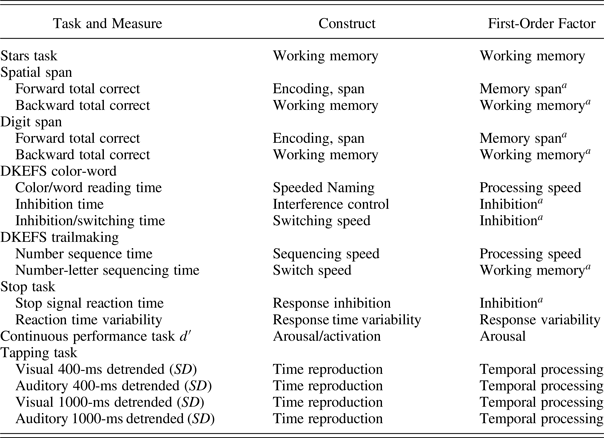
The testing battery included tasks chosen to assess a variety of neuropsychological domains deemed especially relevant to ADHD. They were administered in a fixed order as follows: stars task (Engle, Reference Engle2002), spatial span (see Martinussen & Tannock, 2007), digit span (Wechsler Intelligence Scale for Children—Fourth Edition), Delis–Kaplan Executive Function System color–word interference (Delis, Kaplan, & Kramer, Reference Delis, Kaplan and Kramer2001), stop task (Logan, Reference Logan, Dagenbach and Carr1994), continuous performance task (Cornblatt, Risch, Faris, Friedman, & Erlenmeyer–Kimling, Reference Cornblatt, Risch, Faris, Friedman and Erlenmeyer-Kimling1988), tapping task (Toplak & Tannock, Reference Toplak and Tannock2005), and Delis–Kaplan Executive Function System trailmaking task (Delis et al., Reference Delis, Kaplan and Kramer2001). Table 1 describes each measure and corresponding construct.
Neuropsychological tasks and measures, constructs, and factors
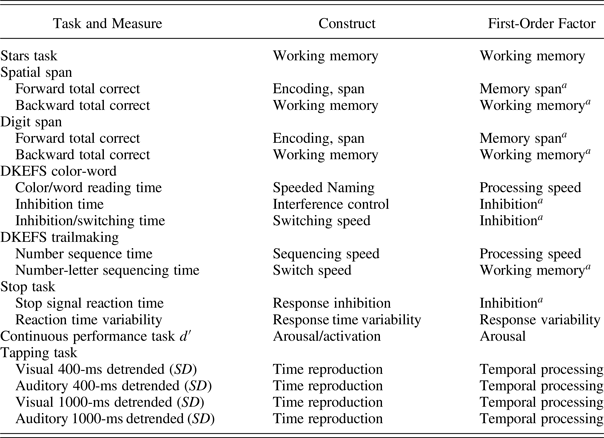
Note: DKEFS, Delis Kaplan Executive Function System.
a Factor significantly loaded on second-order cognitive control factor.
Data reduction
All scores were transformed such that higher scores were indicative of worse performance (i.e., slower reaction times, worse accuracy) and then standardized via z transformation on the mean and standard deviation of the entire sample, both to enable appropriate tests of statistical interactions and to simplify data presentation. One goal of the current study was to examine performance across a broad set of neurocognitive measures that have been hypothesized to be relevant to ADHD. To reduce the number of redundant indicators in the analyses, we used a model from prior confirmatory factor analysis (Nikolas & Nigg, Reference Nikolas and Nigg2013), which allowed us to use latent factors that captured variance common among measures that tapped into similar domains of neuropsychological functioning, while removing the error variance associated with each individual measure. This model included seven lower order factors labeled as response inhibition, working memory, memory span, speed, response variability, arousal, and temporal processing as well as one second-order factor termed cognitive control. This second-order factor was composed of the inhibition, working memory, and memory span factors. Factor scores were analyzed such that higher scores indicated worse performance in each domain. All analyses were conducted in MPlus version 6.0 (Muthén & Muthén, Reference Muthen and Muthen2011) with the cluster option to enable appropriate parameter estimation, while taking into account the nonindependence of sibling data.
Data analytic strategy
Missingness (i.e., children did not complete task combined with data ruled invalid) was minimal (range = 1%–11%) on tasks and was unrelated to demographic or diagnostic variables (all ps > .36). All models were estimated using a full-information maximum likelihood approach, which provides a more robust method for handling missing data compared to data imputation or listwise deletion.
Direct and indirect effects (the sum total and specific point estimates) were examined based on the methodology set forth by Preacher and Hayes (Reference Preacher and Hayes2008) and tested formally using MPlus. Given the clustered nature of the sibling data, delta method standard errors were computed (because bootstrapped confidence intervals could not be computed with clustered data). In total, eight models were tested: four for each candidate gene polymorphism with each outcome (symptom scores of inattention, hyperactivity–impulsivity, oppositionality, and conduct problems). Neuropsychological tasks were examined simultaneously as multiple mediators of the association between genotype and inattention, hyperactivity–impulsivity, oppositionality, and conduct problems. Using this procedure, the total indirect effects and point estimates for each neuropsychological task are estimated. Covariates included sex, age, ethnicity, and stimulant use. Ethnicity was coded using a series of three dummy codes (e.g., Caucasian vs. non-Caucasian; African American vs. non–African Americans; Latino vs. non-Latino) and all were included as covariates.
While not without controversy, several scholars have argued that mediation can occur in the absence of a simple association between X and Y (Cerin & MacKinnon, Reference Cerin and MacKinnon2009; Hayes, Reference Hayes2009; Rucker, Preacher, Tormala, & Petty, Reference Rucker, Preacher, Tormala and Petty2011; Shrout & Bolger, Reference Shrout and Bolger2002; Zhao, Lynch, & Chen, Reference Zhao, Lynch and Chen2010). It is suggested that, because mediation is proposed as a causal chain, there may be variables separated by multiple “links” in that chain that are causally related but not directly related to one another (Collins, Graham, & Flaherty, Reference Collins, Graham and Flaherty1998). That logic was adopted here, and a correspondingly appropriate model was adopted. Using a multiple mediation model is advantageous for several reasons (Preacher & Hayes, Reference Preacher and Hayes2008). First, similar to performing a regression analysis with several predictors, testing the total indirect effect of genotype on externalizing symptoms can determine if an overall effect exists. It is important that, if an effect is present, it can be assumed that the set of mediators (neuropsychological functioning) partially accounts for any effect of candidate gene polymorphism on the behavioral outcomes. Second, this method allows for determining the extent to which specific neuropsychological task variables account for the association between genotype and child symptom outcomes. Third, this method can estimate indirect effects while accounting for the shared association between mediators. Overall, seven potential mediators were included in each model, with moderate correlation with one another (rs = .28–.69). Thus, all of the pathways in each model are being estimated simultaneously, avoiding the potential limitations of running numerous linear regressions to test mediation. Fourth, including multiple mediators in a model allows for the examination of the relative magnitude of the specific indirect effects associated with all of the mediators.
Results
Demographic and descriptive statistics
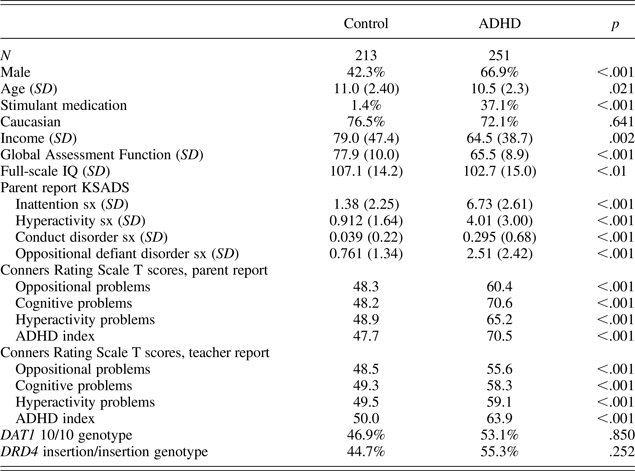
Demographic and descriptive statistics (Table 2) indicate that our diagnostic procedures were effective in discriminating the control group from the ADHD group. As expected, the ADHD group had significantly higher symptom counts for all symptom domain measures (p < .001). The ADHD group also had a significantly higher percentage of individuals on stimulant medications (p < .001). Although the two groups did not differ significantly in age and ethnicity, the ADHD group did differ significantly in gender (p < .001) and income (p < .01), such that there were more males in the ADHD group and that overall family income was lower among ADHD families compared to non-ADHD families.
Descriptive statistics for the control versus ADHD group for demographics
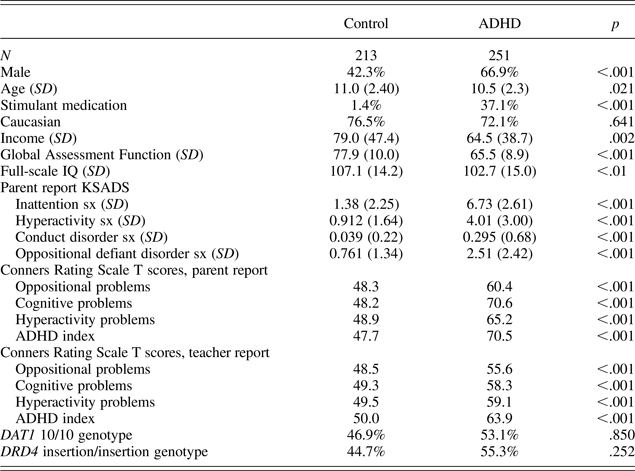
Note: ADHD, Attention-deficit/hyperactivity disorder; KSADS, Kiddie Schedule of Affective Disorders and Schizophrenia. Conner values are based on T scores.
Next, we examined differences between the control participants and the ADHD group in regard to dopamine genotype. No significant differences were found for DAT1 or for DRD4 (p = .252). Thus, neither candidate gene was significantly associated with the categorical diagnosis of ADHD in this sample.
In addition, we examined if gene allele frequencies varied across ethnic groups. DAT1 allele frequencies did not vary by ethnicity (all ps > .29). However, analyses revealed that Caucasians participants were significantly more likely to have the 120-bp insertion in the promoter of DRD4 than non-Caucasians (p = .006), whereas African Americans were marginally more likely to have a deletion of this polymorphism (p = .055). This was addressed with secondary analyses below.
Primary tests of direct and indirect effects
Neuropsychological functions as intermediate phenotypes
DAT1
Multiple mediation models were first conducted using the relevant neuropsychological domains as mediators of the association between genotype and symptom outcomes (mean parent and teacher ratings of inattention, hyperactivity–impulsivity, oppositionality, and conduct problems). The direct effect of DAT1 genotype was marginally significant for inattention, β = –0.076, 95% confidence interval (CI) = (–0.157, 0.006), p = .068, but did not statistically predict hyperactivity–impulsivity, β = –0.056, 95% CI = (–0.138, 0.025), p = .175; oppositionality, β = –0.029, 95% CI = (–0.114, 0.056), p = .506, or conduct problems, β = 0.036, 95% CI = (–0.167, 0.090), p = .429. However, significant indirect effects via neuropsychological functioning emerged between DAT1 and both inattention, β = 0.043, 95% CI = (0.006, 0.079), p = .023, and hyperactivity–impulsivity, β = 0.049, 95% CI = (0.013, 0.084), p = .007 (see Figure 1a,b, respectively). Examination of specific indirect effects revealed that DAT1 genotype (i.e., presence of the 10-repeat allele) was associated with poorer response inhibition, which, in turn, statistically predicted higher inattention, β = 0.029, 95% CI = (0.054, 0.201), p = .017, and higher hyperactivity–impulsivity, β = 0.030, 95% CI = (0.054, 0.201), p = .007. Similar indirect effects emerged when examining models predicting oppositionality, such that DAT1 genotype was associated with higher oppositionality scores via measures of neuropsychological functioning, β = 0.029, 95% CI = (0.001, 0.058), p = .046 (see Figure 1c). Examination of specific indirect effects again revealed that these indirect effects operated primarily via response inhibition, β = 0.023, 95% CI = (0.054, 0.201), p = .052, such that DAT1 genotype (10/10 homozygotes) had marginally worse response inhibition, which in turn statistically predicted higher ODD scores. Further, to ensure results for ODD were not secondary to ADHD, we reran models predicting ODD controlling for ADHD. The results indicated that when controlling for ADHD, the indirect effect of DAT1 on ODD via response inhibition remained significant, β = 0.049, 95% CI = (0.001, 0.048), p = .045. The direct and indirect effects of genotype were not statistically significant in predicting CD.
Mediational model depicting direct and indirect effects of dopamine active transporter 1 (DAT1) on child attention-deficit/hyperactivity disorder and externalizing symptoms. (a) Inattention: direct effect = –0.076, indirect effect = 0.043; (b) hyperactivity: direct effect = –0.056, indirect effect = 0.049; (c) oppositionality: direct effect = –0.029, indirect effect = 0.029. *p <.05, **p < .01, ***p < .001.

DRD4
Similar to DAT1, the direct effect of DRD4 on all four outcomes was not significant: inattention: β = –0.018, 95% CI = (–0.099, –0.063), p = .657; hyperactivity–impulsivity: β = –0.036, 95% CI = (–0.122, 0.051), p = .418; oppositionality: β = –0.017, 95% CI = (–0.105, 0.071), p = .700; and conduct problems: β = –0.044, 95% CI = (–0.113, 0.070), p = .645. No significant indirect pathways emerged in models predicting inattention, hyperactivity–impulsivity, ODD, or CD scores.
Follow-up analyses
Population substructure
Although primary analyses controlled for ethnicity, we cannot be assured that results are not due to population stratification due to the ancestrally mixed nature of our sample. To address this issue, additional analyses were conducted within a restricted sample of only Caucasians. Results showed similar pattern of the sum of indirect effects for hyperactivity, such that DAT1 genotype exerted significant indirect effects on hyperactivity, β = 0.048, 95% CI = (0.002, 0.180), p = .045, although the sum of indirect effects for inattention and oppositionality was no longer significant. Specific indirect effects via response inhibition remained when predicting hyperactivity–impulsivity, β = 0.035, 95% CI = (0.007, 0.124), p = .027; however, specific indirect pathways involving response inhibition were only marginally significant for both inattention, β = 0.025, 95% CI = (0.002, 0.052), p = .070, and oppositionality, β = 0.030, 95% CI = (–0.001, 0.061), p = .059. While this restricted sample likely decreased power to detect effects, particularly in regard to multiple mediation analyses, the pattern of results was notably consistent with the overall findings.
Role of IQ
In order to evaluate the specificity of the observed associations, secondary analyses were conducted. We originally did not control for IQ due to its high correlation with neuropsychological performance (rs = –.14 to –.38 in this sample). In addition, prior work has shown that the genetic effects on IQ appear to differ from those on other neurocognitive processes, such as executive functioning (Wood, Asherson, van der Meere, & Kuntsi, Reference Wood, Asherson, van der Meere and Kuntsi2010). However, we elected to also evaluate the impact of IQ in two ways. First, we included IQ as a covariate in a series of secondary analyses, which did not influence any of the results regarding significant indirect pathways from DAT1 to ADHD and ODD symptoms via response inhibition. Second, we also ran a series of models that included IQ as an additional mediator. The results again remained unchanged, and no specific indirect pathways involving IQ were significant in any of the models (βs = –0.001 to 0.000, all ps > .70). Therefore, IQ was found to be associated with all neuropsychological variables, but did not impact any of the original mediation results.
Impact of development
To evaluate the role of development in the observed associations, we reran analyses in two different age groups, determined by a median split on age, resulting in one group of 10 or younger, and another group of 11 or older. Restricting the sample to the group of 10 or younger resulted in no significant indirect pathways (all ps > .12), but rather it seems the significant pathways emerge when restricting the sample to 11 years of age or older (all ps < .05). Further examination of the models revealed that associations between DAT1 and neuropsychological variables were significant in older youth but not among younger children, such that for children 11 years of age or older, DAT1 had specific indirect effects through response inhibition on inattention, β = 0.089, 95% CI = (0.037, 0.142), p = .001; hyperactivity, β = 0.085, 95% CI = (0.033, 0.138), p = .001; and oppositionality, β = 0.082, 95% CI = (0.023, 0.142), p = .007.
Gender differences
Although gender was included as a covariate in the primary analyses, we undertook additional follow-up analyses in order to explore potential sex differences in effects. Thus, we reran all models separately for males and females. Among females, findings were similar to the primary analyses, and again revealed significant indirect pathways between DAT1 genotype and inattention, hyperactivity–impulsivity, and oppositionality via response inhibition. Among males, all findings remained similar; however, the specific indirect pathways involving response inhibition were marginally significant. Two-group models that constrain parameter estimates to be equal across sex provided superior fit compared to models that allowed all parameter estimates to vary across sex. Overall, results appear to be robust across sex.
Reverse mediation
While the use of a cross-sectional design may reduce our ability to interpret findings as causal, examination of reverse mediation can be helpful in evaluating whether or not the proposed pathways best capture the associations among the key variables of interest. It is important that, when examining DAT1 as a predictor of response inhibition via symptoms (inattention, hyperactivity, and oppositionality), no significant indirect pathways emerged (all ps > .50). The lack of significant indirect effects within a reverse mediation framework provides additional support for the proposed mediation pathways.
Discussion
The current study examined the presence of indirect effects of candidate gene polymorphisms on child inattention, hyperactivity–impulsivity, oppositionality, and conduct problems via neuropsychological performance. Using a multiple mediation framework, we simultaneously examined the direct effects of candidate gene polymorphisms on these four symptom dimensions, as well as indirect pathways involving performance on neuropsychological tasks as statistical mediators of these associations within the limitations of cross-sectional data. Again, given that mediation can occur in the absence of a significant direct association between genotype and childhood symptom outcomes (Cerin & MacKinnon, Reference Cerin and MacKinnon2009; Hayes Reference Hayes2009; Rucker et al., Reference Rucker, Preacher, Tormala and Petty2011; Shrout & Bolger, Reference Shrout and Bolger2002; Zhao et al., Reference Zhao, Lynch and Chen2010), no significant direct effects of genotype emerged. However, consistent with our hypotheses, indirect effects of candidate genes on ADHD and externalizing outcomes did emerge. These effects were only present regarding associations between DAT1 and symptoms of inattention, hyperactivity, and oppositionality, and were largely accounted for by the effects of variation in DAT1 on response inhibition. Findings were consistent across sex and remained when controlling for or including IQ as a mediator. These findings are consistent with past work indicating that response inhibition may serve as a familial marker for ADHD risk (Bidwell et al., Reference Bidwell, Willcutt, DeFries and Pennington2007; Crosbie & Schachar, 2014; Gau & Shang, Reference Gau and Shang2010; Goos et al., Reference Goos, Crosbie, Psych, Payne and Schachar2009; Nikolas & Nigg, Reference Nikolas and Nigg2015). Furthermore these findings are also consistent with dopamine theories of ADHD, which suggest that dopamine neurotransmission is dysfunctional in key brain networks underpinning cognitive processes, such as response inhibition (Ridderinkhof, van den Wildenberg, Segalowitz, & Carter, Reference Ridderinkhof, van den Wildenberg, Segalowitz and Carter2004), and that such dysfunction in dopamine neurotransmission may be associated with functional variation within dopamine genes (Cornish et al., Reference Cornish, Manly, Savage, Swanson, Morisano and Butler2005). While response inhibition has not been explicitly linked with or explored as an endophenotype for ODD in the past, it has been implicated in externalizing problems more broadly (Young et al., Reference Young, Friedman, Miyake, Willcutt, Corley and Haberstick2009). Similar patterns of results were found for ADHD symptoms and oppositionality (including for ODD with ADHD symptoms controlled), reflecting the possibility that a shared mechanism via response inhibition contributes to both disorders and/or to their co-occurrence. The present study therefore extends upon this past work by demonstrating indirect pathways linking a functional polymorphism in the DAT1 gene with ADHD and externalizing psychopathology via the effects of DAT1 genotype on response inhibition.
Implications
While candidate genes involved in dopaminergic neurotransmission (i.e., DAT1 and DRD4) have been implicated in ADHD (Gizer et al., Reference Gizer, Ficks and Waldman2009), inconsistency of findings has led to the notion that genetic investigation may best proceed with the use of intermediate phenotypes. The current findings add to a growing body of literature implicating response inhibition in particular as a viable candidate alternative phenotype for genetic study of ADHD. Further, these results are in line with recent work that has examined connections among neurocognitive processes, genetics, and behavior. For example, imaging genetics research has found that dopamine-related functional polymorphisms led to increased reward-related ventral striatum reactivity, which is associated with self-reported impulsivity and preference for immediate rewards (Forbes et al., 2009).
It is important that, when examining effects separately among younger and older youth, all indirect pathways were significant only in older but not in younger children. Past work utilizing sibling designs to identify relevant neurocognitive endophenotypes for ADHD has also found that age appears to moderate differences between unaffected siblings and controls (Nikolas & Nigg, Reference Nikolas and Nigg2015; Thissen et al., Reference Thissen, Rommelse, Hoekstra, Hartman, Heslenfeld and Luman2014). However, these findings seemed to suggest that endophenotype effects may be more difficult to identify during adolescence, whereas the current findings seemed to indicate that such indirect pathways may be particularly robust in older youth (ages 11–17 years) versus younger children (ages 6–10 years). Further, it appeared that associations between the DAT1 genotype and neuropsychological functioning (particularly response inhibition) were only present among older youth, suggesting that variation in the DAT1 genotype may exert differential effects on neurocognitive processes at different ages. Such variation in effects may help explain prior inconsistencies in findings regarding associations between DAT1 and DRD4 polymorphisms and neuropsychological performance (Kebir et al., Reference Kebir, Tabbane, Sengupta and Joober2009; Langley et al., Reference Langley, Marshall, van den Bree, Thomas, Dphil and O'Donovan2004; Swanson et al., Reference Swanson, Oosterlaan, Murias, Schuck, Flodman and Spence2000). Taken together, past work as well as the findings from this study suggest that careful consideration of age and development in regard to endophenotype effects will likely be crucial in future genetic investigations of ADHD.
Although genome-wide investigations may continue to advance our understanding of important candidate genes for psychopathology, it will be important for future research to focus on more than just the main effects of genes. It may be most useful to take a mechanistic approach to studying ADHD and externalizing psychopathology, by testing both direct and indirect effects in order to get a clearer understanding of the relationship between genetic and neurocognitive underpinnings of such symptoms and how they relate to the phenotype. Potential designs that might best test associations between these different levels of analyses include epigenetic approaches, neuroimaging, and gene–environment interplay. For example, an epigenetic approach might suggest that prenatal experiences impact gene expression in offspring, which causes alterations in behavioral and neural development, and could ultimately result in psychopathology. Neuroimaging techniques could also help clarify the role of dopamine polymorphisms in relation to neurocognition and externalizing symptoms, by examining activity in the reward pathway and the amygdala. Furthermore, studies of gene–environment interplay could help highlight how genetic differences in candidate genes affect an individual's vulnerability to developing externalizing psychopathology through environmental exposure.
Limitations
There are some limitations of the current research. Although this study used a comprehensive battery of neurocognitive tasks, there are additional neuropsychological domains that would be beneficial to include (i.e., delay aversion, temporal processing, and decision making) to understand the pathophysiology of ADHD and externalizing problems (Sonuga-Barke, Bitsakou, & Thompson, Reference Sonuga-Barke, Bitsakou and Thompson2010). Further, neuropsychological factors differed with respect to the number of indicators. For example, two factors (i.e., response variability and arousal) only had one indicator each. Therefore, a lack of association between these factors and genotype may be partially attributable to the need for additional indicators of that particular factor. Although the coding of genotypes was based on minor allele frequency as well as previous research with these markers, larger theoretical questions remain regarding the biological plausibility of various models of inheritance and the ways in which information across genetic markers can be aggregated in future studies (Burt, Reference Burt2009; Nikolas & Burt, Reference Nikolas and Burt2010).
In addition, only two candidate polymorphisms were analyzed, and emerging research has shown additional polymorphisms that should be included for future study. For example, a meta-analysis of genome-wide association studies describes the top 50 results from candidate gene single nucleotide polymorphisms, with the most strongly implicated region being on chromosome 7 (i.e., split hand/foot malformation (ectrodactyly) Type 1 [SHFM1] is the gene nearest to this region, which functions in embryonic development and is expressed in the brain, but its relevance to ADHD is still unknown; see Neale et al., Reference Neale, Medland, Ripke, Asherson, Franke and Lesch2010). Additional studies have found that the most studied polymorphism in the catechol-O-methyltransferase gene (COMT), the valine 158 methionine variant (Stergiakouli & Thapar, Reference Stergiakouli and Thapar2010), may be relevant for ADHD because it was associated with conduct symptoms (Thapar, Langley, & Fowler, Reference Thapar, Langley and Fowler2005) and antisocial behavior in those with ADHD (Caspi et al., Reference Caspi, Langley, Milne, Moffitt, O'Donovan and Owen2008). Furthermore, molecular genetics studies call for large sample sizes, so it may be important for future work to examine these relationships within a larger sample.
We did not apply additional corrections for multiple testing, because one of the benefits of multiple mediation analysis is that all of the pathways are being estimated simultaneously; however, this further highlights the need to replicate findings within larger samples. In addition, controlling for population stratification is challenging without access to more detailed ancestral information (i.e., without a biological test to control for population stratification). As previously mentioned, analyses indicated that Caucasians were significantly more likely to have the 120-bp insertion in the promoter of DRD4, whereas African Americans were marginally more likely to have a deletion of this polymorphism. However, our multiple mediation analyses indicated no significant pathways involving DRD4. Thus, while we did find variation in DRD4 allele frequency across ethnic groups, these differences did not appreciably change the interpretation of the overall findings (because all pathways involving DRD4 were not statistically significant). Finally, while it may be difficult to infer causality from these findings due to our use of a cross-sectional design, secondary analyses that included reversing the mediators and outcomes revealed no significant indirect pathways, providing additional support for the proposed association among our key variables. Despite these limitations, this study was strengthened by using a multiple mediation framework to investigate both direct and indirect effects of candidate gene polymorphism on symptoms of ADHD, oppositionality, and conduct problems via neurocognitive tasks.
Conclusions
In sum, the present study demonstrated that the DAT1 3′ VNTR was associated with increased inattention, hyperactivity–impulsivity, and oppositionality via effects on response inhibition. The present study extends past work by using a multiple mediational framework and provides converging evidence highlighting the utility of neuropsychological measures as alternative phenotypes in the genetic study of ADHD.