In January 1922, articles in several film trade journals announced that director Dudley Murphy and former general manager of Universal Pictures Claude Macgowan had formed an exciting new enterprise: Visual Symphony Productions.Footnote 1 The company was already at work producing films that would visually interpret well-known compositions to the accompaniment of a live performance of that composition. “Inspired by and synchronized with the theme of the composition,” Macgowan told Motion Picture News, “each production carries out, visually and in a dramatic manner, the rhythm and the story of the music.”Footnote 2 The mood of the films would be varied, Exhibitors Trade Review advised: “some are tragedies, others are artistic comedies, and still others are poetic fantasies.”Footnote 3 The first film of the series, to be released shortly, was an interpretation of Saint-Saëns's Danse Macabre, starring famed former Ballets Russes dancer Adolph Bolm and American ballerina Ruth Page as two dancing lovers who are threatened by “the dread spectre” of Death, embodied by performer Olin Howland.Footnote 4
In recent years, Dudley Murphy's films have garnered the interest of musicologists and film historians alike. Perhaps most notably, Murphy has come to be recognized as a central figure in the making of the celebrated 1924 avant-garde film Ballet mécanique. Building on the claims of scholars including William Moritz and David James, biographer Susan Delson asserts that of the esteemed artists involved in the project—Fernand Léger, George Antheil, Ezra Pound, and Man Ray—Murphy was the sole collaborator involved from “start to finish” and the “primary day-to-day sensibility on the project.”Footnote 5 Murphy's 1929 jazz films St. Louis Blues, featuring Bessie Smith, and Black and Tan, starring Duke Ellington, and his feature-length film starring Paul Robeson, The Emperor Jones (1933) also frequently figure in scholarship on jazz in Hollywood, the role of film in the careers of popular musicians, and African American cinema.Footnote 6
However, Murphy's filmmaking career hardly originates in 1924 with Ballet mécanique. In 1920, Murphy began shooting a series of four short films up and down the California coast. At least one more, Danse Macabre, was made after Murphy moved to New York City in mid-1921. Of these five, two remain extant: The Soul of the Cypress (1920) and Danse Macabre (1922).Footnote 7 Shrouded in misunderstanding, these shorts are rarely discussed at any length. Instead, scholars tend to invoke them primarily as evidence that Murphy was experimenting with filmic representations of music long before Ballet mécanique—and thus, of his centrality to that film's vision and execution.Footnote 8 Film scholar William Moritz and others have also frequently cited these shorts as early examples of a wave of abstract (and often unaccompanied) films that used rhythmic images and movements, careful editing, and geometric shapes to approximate the non-representative qualities that their makers associated with music: Charles Sheeler and Paul Strand's city symphony Manhatta (1921); Walter Ruttmann's Lichtspiel series (1921–25) and city symphony Berlin: Symphony of a Metropolis (1927); and the “visual music” films of Oskar Fischinger and the Whitney Brothers, among others.Footnote 9 To this list we might add Germaine Dulac's La Folie des vaillants (1925), in which she attempts to realize her vision of cinema as “visual symphony” defined by movement and rhythm, and André Sauvage's Études sur Paris (1928).Footnote 10
Underpinning these narratives is the assumption that Murphy's short films, usually referred to collectively as his “visual symphonies,” are a homogeneous series guided by a solo artist's distinct creative vision. Such a supposition is hardly unusual; the artistic genius or auteur toiling in isolation to express an aesthetic vision is a trope that looms large in histories of film, music, and beyond.Footnote 11 However, closer examination of the creation, marketing, and exhibition of Murphy's early films reveals that they were hardly homogeneous, nor all guided by the same vision. Made over the course of two years in at least two different contexts by a host of contributors, the films were aesthetically diverse, particularly in their approaches to music, visual representation, and synchronization. Moreover, they were the product of sustained collaboration. Indeed, the very concept of the Visual Symphony is likely attributable not to Murphy, but to collaborator Hugo Riesenfeld, a prominent New York film exhibitor and composer. In this article, I focus on these details in order to generate a more nuanced history of both Dudley Murphy's early career and the Visual Symphony Productions endeavor. This history, in turn, offers new insights into shifting discourses on the relationship between silent film and music and the centrality of live performance to film exhibition in the late ’teens and early 1920s, as well as the myriad of ways in which music and dance were regularly invoked in both the discourse surrounding moving pictures and actual film presentations in the United States in this period.
This article opens with an examination of the rhetoric that accompanied the formation of Visual Symphony Productions, situating both the company's mission and films in relation to contemporary film production and exhibition. I trace the origins of each of Murphy's early films individually, examining the specific conditions under which each was made, how each was presented to and received by the public, and precisely when and in what context each began to be presented as a Visual Symphony. In the second section, I recast the Visual Symphony project as a collaborative endeavor involving not only Dudley Murphy, but also the cast and crew of the films, and the exhibitor who made them available to the public, Hugo Riesenfeld. With this collaborative framework in mind, I turn to the extant films, offering an analysis of the visual and musical aesthetics at play in The Soul of the Cypress and Danse Macabre; here, I highlight the divergent approaches to (and prioritization of) sound–image synchronization in the two films. The history and works produced by Visual Symphony Productions, I argue, draws our attention to the spate of audiovisual and synchronization experiments during the silent era, and to the ever-evolving ways in which filmmakers, performers, and exhibitors in turn—and in tandem—conceptualized the relationships between music and image, art and entertainment, and the live and mediated in the early 1920s.
The “Twin Arts” of Music and Film
When Murphy's Visual Symphony Productions was founded in January of 1922, the concept of uniting film and musical compositions was hardly novel. As Rick Altman, Julie Brown, Annette Davison, and others have amply described, musical accompaniment was ubiquitous at film screenings throughout the silent era film, and by the late ’teens, many theaters—not only the immense movie palaces, but also large and even mid-sized venues around the country—were regularly staging film presentation programs.Footnote 12 These elaborate, often thematically oriented programs generally opened with an overture performed by the theater's resident ensemble or organist, followed by a series of film shorts—newsreels, scenic films, cartoons, and comedies—and the week's feature film, all accompanied by music composed or compiled by the theater's musical staff. Complementary live performances were interspersed: arias by local or touring singers, solo instrumental selections, dance divertissements, and variety acts. When The Red Lantern, a film based on a Chinese story, opened at the Rivoli Theater in May of 1919, for example, it was flanked by a scenic film of China, a performance of “Chinese Lullaby” from the musical East is West, an orchestral selection from the show The Chinese Honeymoon, and a ballet called “The Glow of the Lantern”; the theater itself was decorated with lanterns and temple banners and perfumed with burning incense.Footnote 13
Presentation programs, particularly the musical performances therein, were considered crucial to film exhibition. As trade journals reminded exhibitors, excellent musical performances and stage acts could more than make up for a disappointing feature film.Footnote 14 However, such programs exceeded the budgets and personnel of many theaters, particularly smaller ones outside of major urban centers. Where would one find and how would one pay for the fleet of well-trained theater musicians, compelling stage acts, scenic designers, and a visionary musical director who could churn out several hours worth of musical accompaniment each week? Just two weeks after Visual Symphony Productions was formed, Exhibitors Herald reported that theater chains in Chicago and California had abandoned their “extensive presentations” because of the cost.Footnote 15 Trade periodicals from the period are rife with suggestions about how to stage compelling programs on a budget and ads for products and services that would reduce costs, such as standardized film scores, rudimentary synchronization equipment, and performer circuits.Footnote 16
Murphy's Visual Symphonies were marketed in precisely this way. These films, trade press reported, were “ideal attraction substitutes”: a compelling surrogate for one of the live performances typically included in a film program, without any of the expense, advance planning and coordination, or rehearsal time.Footnote 17 Even as they relieved exhibitors of the burden of staging live performances, however, Visual Symphonies promised to retain a sense of the live: each film starred “one or more of the great stars of the operatic and kindred fields of the drama, music, and pantomime.”Footnote 18 Indeed, Visual Symphonies would bring to cinema audiences across the country the performers that even some large movie palaces could not afford—preeminent artists like Adolph Bolm, who Macgowan assured the press was “beyond all question the greatest dancer and pantomimist in the world.”Footnote 19 In short, the company proposed to package live performance for mass distribution.
Visual Symphonies were presented as a particular boon to theater music directors and musicians. Each Visual Symphony was shot and edited to synchronize “perfectly and practically” with a familiar existing musical work.Footnote 20 The films were then distributed with a score for that composition, available in a variety of arrangements: full orchestra, small ensembles, solo piano or organ, even player piano rolls.Footnote 21 Thus, the music director was relieved of any demand to compile, orchestrate, and master elaborate film scores overnight; they simply needed to select the correct arrangement and distribute the parts. In practice, of course, it was not quite so simple: before the premiere of Danse Macabre, Adolf Bolm's wife, Beatta, wrote that Hugo Riesenfeld, who was conducting, had to carefully mark synch points on his score in order to keep the ensemble's performance aligned with the film.Footnote 22 However, the oft-repeated guarantee that Visual Symphonies were “virtually fool-proof” suggests that the company may have planned to issue scores with notes and synch points to help facilitate the process.Footnote 23 Notably, too, Visual Symphony Productions was formed at precisely the same time that synchronizing devices like the visiophone were first advertised in the United States; these were small keyboards with sliding keys that attached to a projector and enabled a projectionist or recruited musician to easily speed or slow the film based on the conductor's (or accompanist's) tempo. While there is no evidence that Murphy imagined or advocated using such devices with the Visual Symphonies, it is clear that Murphy's films would have been an ideal choice for exhibitors with access to this technology.Footnote 24
Although economical, Murphy's Visual Symphonies were hardly cheap or gimmicky, the press assured exhibitors and patrons. It was the film industry's “incessant striving for novelty,” Murphy declared, that burdened exhibitors with the need to develop elaborate, expensive “pseudo vaudeville” film programs in the first place.Footnote 25 His Visual Symphonies were true artistic productions, a sort of cinematic Gesamtkunstwerk. As Macgowan told one trade periodical, Murphy was a well-educated artist who had for years sought a means of uniting the “twin arts” of motion pictures and music. “The phrase ‘twin arts,’” he clarified, “is Murphy's own, his contention being that music and pictures should be so bracketed because both are fluid forms, and because they alone of all the arts, make the most sympathetic blending possible. . . . as synchronized by Mr. Murphy, [they] are so intertwined and blended as to be true complements each of the other, interpreting each other, yet conveying but a single impression.”Footnote 26 That they would simultaneously “save the exhibitors hundreds of thousands of dollars” only added to their appeal.Footnote 27 The very involvement of renowned artists such as Adolph Bolm, who had “steadfastly refused to appear in pictures” until Visual Symphonies offered him “an opportunity to do his own work, and this in connection with great music,” was cited by Murphy as evidence of the films’ impeccable quality.Footnote 28 “Novelty,” Moving Picture World assured its readers, “is the least of the attraction value of ‘Visual Symphonies.’”Footnote 29
In addition to uniting music and moving pictures into an artistic whole, Visual Symphonies also promised to function as a site of music education.Footnote 30 The films were intended to expose audiences to what Moving Picture World declared the “works of the world's greatest composers.”Footnote 31 Yet they were also described as a means of teaching audiences how to listen to and appreciate art music. Initially, each film was to begin by introducing audiences not only to the composer and relevant musical work, but also to the myth of composer as inspired genius. Audiences would be treated to an “atmospheric and beautiful” vision of “the composer as he dreams and creates his compositions. He will be in his studio or at his piano, and as he starts to play, as his hands move on the keyboard, the music will start and the scene will dissolve into his vision, which is the interpretation of the composition, the action synchronizing with the tempo of the music. In the same manner the story of the composition is told, sometimes in realistic and sometimes in more illusionary and symbolic fashion until at the end[,] the scene will return to the composer as he sits playing or scoring the composition.”Footnote 32 The plan for images of the composer at the piano was eventually discarded. However, the films continued to be described by their creator and the trade press more broadly as visual “translations” of compositions for those without adequate musical training to otherwise fully appreciate them. As Murphy told Moving Picture World, few people had the capacity to listen to live or recorded performances of art music and “get from them any mental visions such as delight the soul of the true student of music. The ear is tickled but the intellect receives no impression.”Footnote 33 Films like Murphy's, however, were presented as a sort of listening aid, visually guiding listeners through a musical work and revealing to them its meaning and beauty. “Picture the stories of the masterpieces, let the eye convey to the intellect what the ear alone can only communicate as pleasing sound,” and there would be “nothing short . . . [of a] musical awakening.”Footnote 34 A writer for the journal Visual Education agreed, concluding, “Those cognizant of the possibilities of the motion picture can see in these ‘Visual Symphonies’ marked indication of what it can accomplish informationally and culturally.”Footnote 35
The list of musical compositions that Visual Symphony Productions planned to “picture” differs from one trade press article to the next, and there are no extant production files to offer clarity. Most of the announcements printed between December 1921 and February 1922 reported that a total of twelve films were planned, beginning with Danse Macabre, which was already in production and set to be released shortly.Footnote 36 All of the compositions mentioned were familiar, popular works with programs or extramusical associations: Beethoven's Moonlight and Pastoral sonatas, Debussy's Prelude to the Afternoon of a Faun, Rimsky-Korsakov's Scheherazade, Grieg's Peer Gynt Suite, Gilbert and Sullivan's Pirates of Penzance, and so on.Footnote 37 By April 1922, a Musical America article implied that the roster had been determined, reporting that “a staff of workers had been engaged in the preparation of material for twelve musical works to be illustrated”: Danse Macabre, Faun, the Pastoral Symphony, the Moonlight Sonata, Tchaikovsky's March Slav and his Chinese dance from The Nutcracker Suite, the Peer Gynt Suite, the overture from Fingal's Cave, excerpts from The Flying Dutchman, Pirates of Penzance, and eleven one-and-a-half minute shorts based on Schubert's Scenes from Childhood shorts.Footnote 38 Equally unclear was the company's production schedule: while many articles published in late 1921 and early 1922 implied that Danse Macabre was the only Visual Symphony in production, others claimed that the endeavor was much further along. In late December 1921, Wid's Daily reported that films to Danse Macabre and Tchaikovsky's March Slav were “destined for immediate making,” and that film versions of “a Beethoven composition and one by Debussy have already been completed.”Footnote 39 A few weeks later, a Film Daily article noted that both Danse Macabre and an unnamed second film were complete, and a Flying Dutchman film was in preparation.Footnote 40
In truth, at least one and likely more of these “already completed” films had been completed nearly two years earlier, under entirely different auspices. Around 1920, while living in Los Angeles and working in art departments at various Hollywood film studios, Murphy raised $2000, hired a young photographer named John Eyreman, borrowed equipment from a studio, and began shooting film shorts along the California coast.Footnote 41 The first, The Soul of the Cypress, was filmed near Carmel, and featured his wife Chase Herendeen as the “spirit of the cypress” lured from a cypress tree by a young musician. The second, Aphrodite, is now lost, but production photos and copyright records reveal that it featured dancer Katharine Hawley, a friend of Herendeen's who eventually became Murphy's second wife. Clad in a Grecian gown, Hawley, who had studied with Isadora Duncan's sister Elizabeth and at Denishawn with Ruth St. Denis and Ted Shawn, was “born” from the sea on a beach in Laguna, then performed improvised movement sequences in a series of picturesque locales including Elysian Park in Los Angeles and a Theosophy colony in Hollywood called Krotona.Footnote 42 Anywhere Out of the World, also now lost, starred Chase Herendeen as a “nude nymph” cavorting near Palm Springs.Footnote 43 The Way of Love, which Murphy refers to in letters as his “Japanese film,” depicted “the adventures of a Japanese girl and her lover and father.”Footnote 44
Existing scholarship has almost always grouped these four California films alongside Danse Macabre under the “Visual Symphony” moniker, assuming a consistency of both aesthetic approach and technique across the films.Footnote 45 It is a logical supposition: the repeated references in press releases to already-extant visual symphonies, and especially the inclusion of Debussy's Prelude to the Afternoon of a Faun in the list of compositions to be filmed implies that Murphy began his Visual Symphony project long before he arrived in New York and launched Visual Symphony Productions. However, close examination reveals that the first four shorts were actually quite different from Danse Macabre and the “Visual Symphony” vision articulated in the company's publicity.Footnote 46 Although The Soul of the Cypress may have been inspired by Debussy's Faun, it and the other California films are not experiments in sound–image synchronization or the unification of Murphy's “twin arts.” Rather, they are most accurately described as scenics, a genre of short film featuring views of picturesque or exotic locales. In his autobiography, Murphy himself characterizes the films as “scenic pictures of the beauty spots of California, with a story for each.”Footnote 47 His descriptions of each concentrate on the visual—the shots of “crystal waters and pools” in Anywhere Out of the World and the “fantastic eucalyptus trees” captured in Aphrodite—and make no mention of music or synchronized accompaniment.Footnote 48 Indeed, even The Soul of the Cypress is narrated in purely visual terms: a “lonely musician” entices the spirit of a cypress tree to emerge and dance. He falls in love, “but being immortal, he could not touch her and in trying to catch her, she disappears back into the tree.”Footnote 49 Murphy expresses no intention to accompany the film with Faun—nor any of the scenics with a specific musical work. In fact, Aphrodite and Anywhere Out of this World were inspired not by musical compositions, but by “the myth of Aphrodite” and a Baudelaire poem, respectively.Footnote 50
The four California shorts were slow to be shown in public, but when they finally premiered at the Boston Motion Picture Supply Company in late August 1920, they were presented and received as scenics.Footnote 51 William Howe Downes of the Boston Evening Transcript summarized the plot of each film only briefly before turning his attention to the films’ “most beautiful natural backgrounds.”Footnote 52 “The landscape part of the show was enough in itself to justify all the effort involved in Mr. Murphy's experiment . . . they are certainly very beautiful, many of them,” he wrote.Footnote 53 Downes was quick to position the shorts as an artistic endeavor, much as Murphy and Macgowan later would in their Visual Symphonies announcements.Footnote 54 Yet, it was not the perfect synchronization of music and motion picture that made these films artistic. In fact, reviews make no mention of musical accompaniment, musicians, or musical works, suggesting that the films may have been presented sans musical accompaniment.Footnote 55 Rather, it was the films’ photography, composition, and tinting that, as Boston Post critic Sidney Woodward wrote, marked a “distinct achievement . . . from a purely artistic standpoint.”Footnote 56
It was not until July 1921, when theater manager and conductor Hugo Riesenfeld programmed The Soul of the Cypress at the Rivoli Theater in New York, that music entered the picture. Edited to about half of its original length and accompanied by a performance of Debussy's Prelude to the Afternoon of a Faun, Cypress appeared on a program that opened with the orchestra's rendition of the first movement of Rimsky-Korsakov's Scheherazade, and also included a dance trio, “Danse de Nymphes,” arranged by Paul Oscard; a pictorial film; renditions of “I Hear a Thrush at Eve” by soprano Zila Simpson and tenor Carlo Enciso and “Printemps” by soprano Grace Hoffman; the feature film The Conquest of Canaan; a Pathé comedy called At The Ringside; and finally, an organ number, “Chant Seraphique.”Footnote 57 The following week, Cypress and the program's other films moved to the Rialto, another Riesenfeld movie palace, where they were screened alongside the overture from La Forza Del Destino, a solo version of “Danse De Nymphe” performed by Lillian Powell, a trumpet solo by Joseph Alessi, and an organ solo of Bach's Toccata and Fugue in D minor.
Though The Conquest of Canaan was an unqualified flop—the New York Times declared it devoid of any “cinematographic individuality” and panned the performance of leading actor Thomas Meighan—The Soul of the Cypress was warmly received.Footnote 58 Some critics found the film's plot lacking: a New York Times review deemed the story “too thin and broken to be effective,” and another warned that the copious titles “require a good deal of reading to get through.”Footnote 59 However, most appreciated the concept. The Times called the film an “unusually interesting scenic picture,” and a New York Tribune critic praised this “scenic fairy story” flavored with “a bit of the spirit of ancient Greece.”Footnote 60
Critics were particularly taken with the film's originality. “The biggest thing about this single reel production,” one trade periodical declared, “is that it breaks away completely from the stuff that has been repeated so often, and makes a decided step forward both in an artistic sense and in pictorial qualities.”Footnote 61 The New York Globe was equally hyperbolic, noting that Cypress “points the way to a new field of motion picture theater entertainment.”Footnote 62 As in Boston, however, it was the film's visual elements alone that constituted its artistry. Critics praised the film's photography as “striking . . . distinctively composed and expressive,” if not “some of the best work yet accomplished in this line.”Footnote 63 That the film was accompanied by a synchronized orchestral performance of the musical work that inspired its narrative went without remark. Even with the Faun accompaniment, it seems, audiences and critics understood the film as a scenic rather than an audiovisual experiment. As Murphy noted in his autobiography, “The pictures received glowing notices, as the first truly artistic scenic pictures.”Footnote 64
Six months later, another of Murphy's four shorts, The Way of Love, seems to have been screened at the Rialto under a new title: The Romance of the White Chrysanthemum.Footnote 65 Reviews do not mention the film's accompaniment, but it was likely Beethoven's Moonlight Sonata; this would explain both the remark in Wid's that the two completed Visual Symphonies were “a Beethoven composition and one by Debussy”—The Romance of the White Chrysanthemum and The Soul of the Cypress, respectively—and Macgowan's reference to both Danse Macabre and the Moonlight Sonata as examples of the “well-known composers and compositions” to be featured in Visual Symphonies.Footnote 66 Nonetheless, Romance joined Cypress in being received by critics as a standard scenic film. Both Exhibitors Trade Weekly and the Brooklyn Daily Eagle describe the short as a scenic, sandwiched between a performance of the prelude to Die Meistersinger and a mazurka from The Firebird danced by Victorina Krigher on a program that also included a newsreel, baritone and trumpet solos, the feature film Nancy from Nowhere, and a comedy.Footnote 67 Once again, there is no evidence that the film was presented, much less conceptualized of, as a revolutionary approach to film accompaniment and synchronization. Rather, it was a scenic that happened to be accompanied by a familiar musical work.
In Murphy's autobiography, he suggests that it was not until after his California shorts were screened at the Rialto and Rivoli that he “got the idea of synchronizing music to film and [. . .] formed a company called Visual Symphonies.”Footnote 68 And indeed, when Danse Macabre, the first short made under the auspices of Visual Symphony Productions, premiered at the Rialto Theater in late July 1922, it was both advertised and received as such. The program opened with an overture comprised of excerpts from Verdi's Rigoletto; followed by “Riesenfeld's Classical Jazz,” a new standing act in which the theater orchestra played string-heavy arrangements of popular tunes minus syncopation, improvisation, and “bleating or blurring”; and a newsreel.Footnote 69 Danse Macabre came next, accompanied by a carefully synchronized live performance of Saint-Saëns's composition.Footnote 70 “In rhythmic pantomime,” the New York Times reported, dancers Adolph Bolm and Ruth Page and actor Olin Howland “told the story of Youth and Love pursued by Death, and finally escaping him in the Dawn. Their dancing combined with imaginative settings and appreciative lighting to present a practically perfect illusion, with the music, of course, heightening the altogether pleasing effect.”Footnote 71 Following the Visual Symphony, audiences enjoyed baritone Ford Palmer's rendition of “The Temple Bells”; the feature film The Mysteries of India; an organ solo; and a cartoon, “What a Difference a Little Hair Will Make.”Footnote 72
Danse Macabre was well received. In his autobiography, Murphy writes that the film's synchronized score “created quite a sensation.”Footnote 73 In a letter to Ruth Page, the film's lighting designer, Francis Bruguière, reported that the short “went perfectly with the music” and “turned quite a little applause” at its premiere.Footnote 74 The New York Times concurred in an unusually lengthy discussion of a short film, noting, “Good things do come, advantageously, to the screen . . . and among such must now be listed that entertaining and encouraging little film, ‘Dance Macabre,’ [sic] which Dr. Riesenfeld, with an eye for true pictorial value, selected for his Rialto program week before last. The work is distinctive.”Footnote 75 While many critics praised the film's visual elements, they were also quick to highlight the film's use of music.Footnote 76 Referring to the film as a “pictorial synchronization of Saint-Saëns’ masterwork,” the Evening Telegram noted, “The film presents Bolm's visualization of the great French composer's tone picture of Death playing his violin at midnight, a dance in which Youth and Love join, a merry festival in which Death is the victor.”Footnote 77 While The Soul of the Cypress and The Romance of the White Chrysanthemum were praised primarily for their stunning visual qualities even when presented with musical accompaniment, critics experienced Danse Macabre’s visual pleasures as inseparable from the music that inspired and accompanied them. Danse Macabre, in short, fulfilled the vision of Visual Symphony Productions.
The Visual Symphony as Collaborative Work
That Murphy “got the idea of synchronizing music to film” after meeting Hugo Riesenfeld in New York City seems hardly a coincidence. Rather, Riesenfeld likely inspired and facilitated the entire Visual Symphony project. In his autobiography, Murphy implies that it was Riesenfeld's idea to accompanying Cypress with Prelude to the Afternoon of a Faun (and presumably, Chrysanthemum with Beethoven's sonata). After seeing the films, Murphy writes, Riesenfeld “booked the pictures at his theatre and played Debussy's Afternoon of a Faun on his beautiful orchestra as an accompaniment.”Footnote 78 Riesenfeld's responsibility for this innovation is also suggested by the fact that the version of Cypress shown in his theaters was not Murphy's original twenty-minute film, but a new ten-minute edit—just the length of Debussy's composition.Footnote 79 Riesenfeld looms large in Murphy's description of Danse Macabre’s premiere, as well: “Hugo Riesenfeld played the Danse Macabre at the Rialto Theatre,” he writes, “conducting St. Saen's [sic] music as an accompaniment to the picture, which was synchronized exactly bar for bar to the movements of the dancers.”Footnote 80
For Riesenfeld to collaborate with Murphy in reimagining his existing films and developing a new series was par for the course in the silent era. Indeed, exhibitors like Riesenfeld regularly exerted authorial control over the films they presented. Not only did the musical accompaniment developed for a film and the program into which it was inserted often flavor the film's narrative meaning, but exhibitors also frequently shortened films due to time constraints, recut them to better align with compiled film scores, edited them for content, and even added or removed intertitles.Footnote 81 Nor is it surprising that Murphy would have embraced Riesenfeld's suggestions. Indeed, Riesenfeld's influence extended far beyond the walls of his own theater: as the esteemed manager of several New York City movie palaces, he was a powerful figure within the film industry. His film programs, presentation practices, and theater initiatives, along with those of prominent exhibitors including Samuel “Roxy” Rothafel and Sid Grauman, were regularly detailed—and held up as the gold standard for film presentation—in film trade periodicals and the popular press. Riesenfeld's involvement with Murphy's Visual Symphony project was nothing short of a coup for the young filmmaker.
It is impossible to know precisely how Murphy and Riesenfeld collaborated in formulating the visual symphony concept and reshaping his scenics into this mold. However, it seems likely that Riesenfeld was the driving force behind the endeavor. The son of moneyed artists, Murphy was probably familiar with musical works like the Moonlight Sonata and Prelude to the Afternoon of a Faun, as well as Nijinsky's ballet. Murphy was not a musician, though, and showed no interest in film accompaniment until meeting Riesenfeld. Riesenfeld, by contrast, was an accomplished musician and composer who developed on a daily basis the musical accompaniment for the film programs screened at his theater. He was also an outspoken proponent for the use of art music in film presentation: Riesenfeld regularly argued that films would be enhanced and elevated when accompanied by “good” music, and envisioned American film theaters as ideal sites of music education. In a 1919 Motion Picture News article, he opined, “Added to the motion picture, in pleasing surroundings and carefully chosen to fit the story, music and pictures blend into one harmonious whole, and the audience scarcely realizes that it is getting as much good music as it would hear at an ordinary concert. . .We are not afraid to-day to play the most difficult and modern composers and the people like it.”Footnote 82
Most tellingly, Riesenfeld began experimenting with the very conceit that defined the Visual Symphony project years before meeting Dudley Murphy. In 1919, he assisted with the creation of Roxy Rothafel's first and only Unit Programme, a pre-assembled, fully scored film presentation package.Footnote 83 Among the shorts they included was The Last Hour, a “picturization” of Jules Massenet's composition Élégie in the form of a dying man lamenting life's wasted opportunities, shot and edited to synchronize with a performance of the composition.Footnote 84 Several months before the premiere of Danse Macabre, too, Riesenfeld joined forces with director J. F. Leventhal and choreographer Ted Shawn to film a series of dance solos and duets borrowed from Shawn and his dancers’ stage repertoire; each included within the frame conductor Louis Horst's arms as he led the specified musical work, ensuring a synchronized performance from theater musicians.Footnote 85 Indeed, contemporary trade and popular press writers tended to associate synchronization experiments with Riesenfeld, first and foremost. As an Ogden Standard-Examiner column noted in May 1922, citing the Leventhal films and Riesenfeld's scores for several film operas, “The ‘music film’ is an innovation by Hugo Riesenfeld.”Footnote 86 Peddling his picturesque scenics, including one that was inspired by a musical work and featured dance, Murphy likely struck Riesenfeld as an ideal collaborator with whom to continue experimenting.
If the Visual Symphony is as much Riesenfeld's as Murphy's, Danse Macabre bears the fingerprints of three artists: Murphy, Riesenfeld, and Adoph Bolm. Set in a castle atop a high hill, the film is dominated by a pas de deux performed by Bolm and Ruth Page as the menacing spectre of Death (Olin Howland) lurks. The dance, and most of the film's interior action, was borrowed wholesale from a Danse Macabre stage ballet Bolm choreographed to Saint-Saëns's tone poem for the 1919 Chicago season of his company, Ballet Intime. Originally performed by Bolm, prima ballerina Rita Zalmani, and dancer Marshall Hall as Death, the work was revived during the company's 1920 tour by Bolm, Ruth Page, and Olin Howland as Death. Though Murphy and his collaborators certainly utilized cinematographic techniques like animation and superimpositions to dramatize the Death character and generate visual interest, much of the film is essentially a filmed version of Bolm's stage ballet. Program notes for the ballet, which detail the two lovers journeying to a castle, where the woman delights in fans, laces, and other objects and the two dance until Death “stalks in, glaring confidently at his victims” and halting their duet, could just as easily be a description of the film's action.Footnote 87
In many ways, Danse Macabre was the outgrowth of a collaborative project that Bolm and Riesenfeld began long before Murphy arrived in New York. As early as 1918, Bolm was creating and performing short ballets as part of the Rialto and Rivoli's presentation programs.Footnote 88 Bolm's offerings, often performed by Ballet Intime dancers including Ruth Page and Olin Howland, were an eclectic mix of solo and ensemble works that resonated with the specific program's theme: a Christmas fantasy, comedy ballets, and a “Spanish Choreographic Episode” to an Albéniz composition, as well as excerpts drawn from Ballets Russes and Ballet Intime repertoire.Footnote 89 Like Riesenfeld, Bolm envisioned the movie theater as a site of arts education, exposing the public to “good” music and dance. “A great mass of Americans never frequent the opera and are timid about appearing in the concert hall,” Bolm wrote. “I wish to bring the ballet to this group. I wish to prove to them the intensity, the beauty, the dramatic power of the dance. I wish to tell them that it is not a dull intellectual form of entertainment but a glorious spectacle. There is no better meeting place for dancer and public than the motion picture theatre.”Footnote 90 It was this shared sensibility that initially prompted Bolm to create dances for Riesenfeld's programs. “I am doing a series of short ballets at the Rivoli Theater with Hugo Riesenfeld's co-operation,” he told Musical America in 1919. Riesenfeld had already introduced his audiences to “the finest type of music,” Bolm noted, and his series of “short and simple” ballets were “acquainting the audience with a new type of art.”Footnote 91
Danse Macabre, then, extends Riesenfeld and Bolm's collaborative efforts and Bolm's vision of the cinema as a site of arts education. In the film, Murphy's cinematic visual and narrative effects serve as a frame for—and at times, a superimposed layer upon—precisely the sort of performance that Bolm regularly staged at Riesenfeld's theater: a Ballet Intime ballet complete with live musical accompaniment. Here, the art music and ballet that were usually presented alongside the week's films became an integral part of the film itself. As a result, live performances once available only to a single theater during a single week were transformed into a self-contained media object—a film and its pre-existing, readily available score—that could be readily distributed to theaters across the country, if not around the world. Danse Macabre truly had the potential to reach the “great mass of Americans” with whom Bolm was eager to share the “glorious spectacle” of dance.
The Distant Genres of Symphony and Scenic
Hugo Riesenfeld and Adolph Bolm's central role in the creation of Danse Macabre is readily visible in the film's marked divergence from the aesthetics and techniques of Murphy's lone extant California film, The Soul of the Cypress. Certainly, it is difficult to know precisely how each of these films was screened in 1921 and 1922; while scholars and archivists are reasonably sure that extant prints are the same versions screened in New York, it is always possible that the prints Riesenfeld showed were slightly different. Additionally, it is impossible to recreate the exact timing of the live orchestra's performances of the accompanying musical works, which would have varied from presentation to presentation; my analysis is based on reconstructions made by curator Bruce Posner, which synchronize the films to period Victor audio recordings of Faun and Danse Macabre performed by Leopold Stokowski and the Philadelphia Orchestra.Footnote 92 Even assuming some amount of imprecision, though, the films employ strikingly divergent narrative structures, visual strategies, and approaches to music. While The Soul of the Cypress and Danse Macabre both gesture towards their respective musical works and to music more generally, Danse Macabre utilizes various techniques to render its musical accompaniment “visible” and highlight its synchronization.
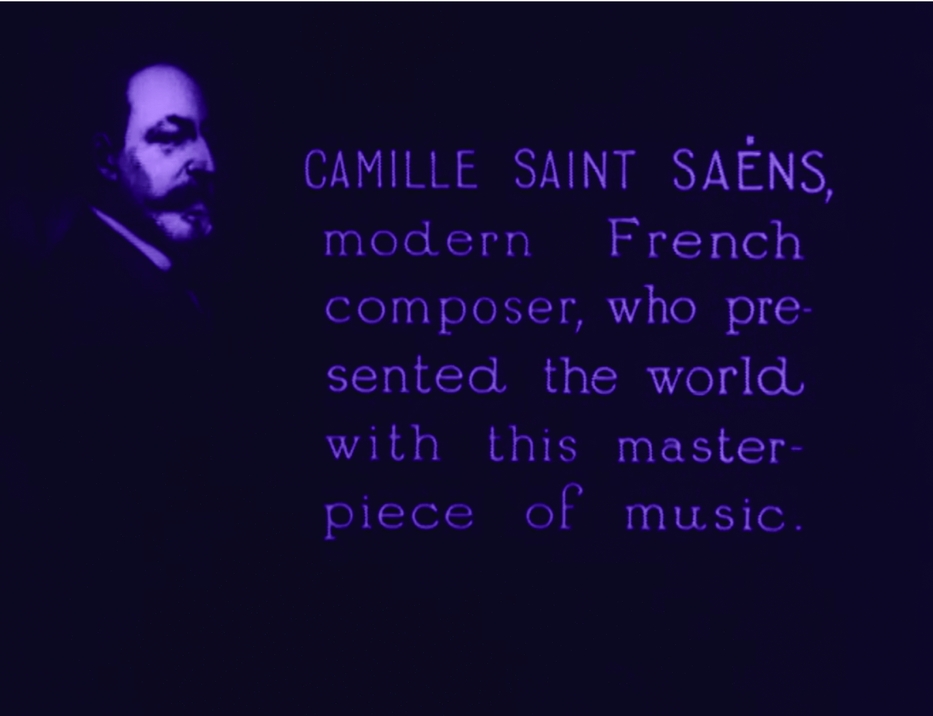
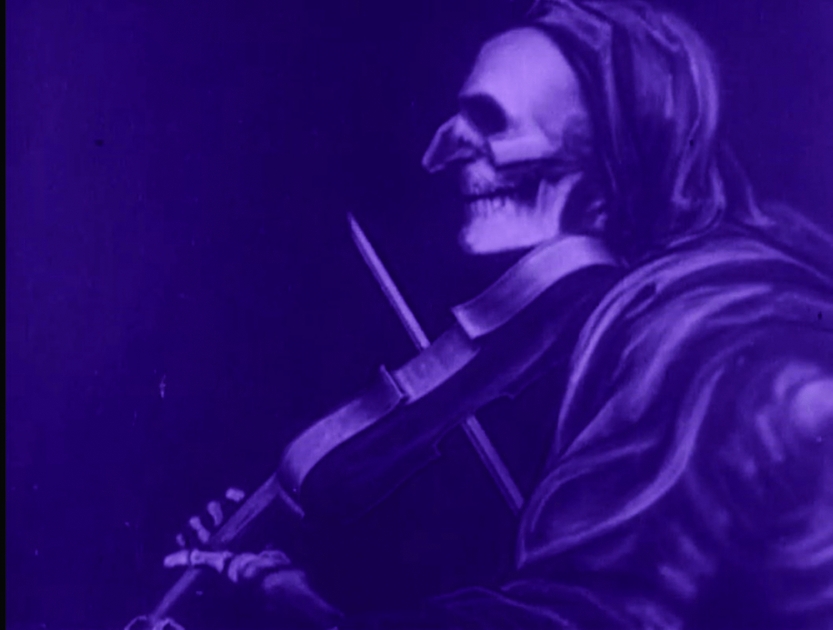
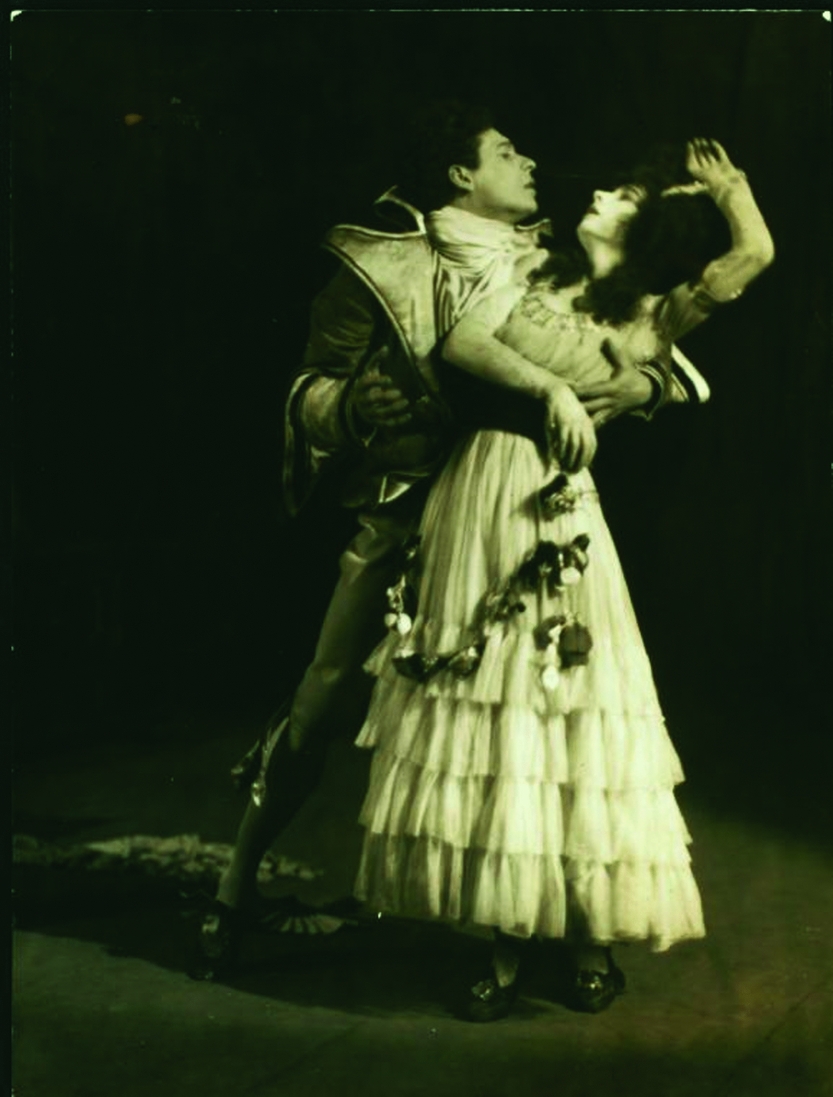
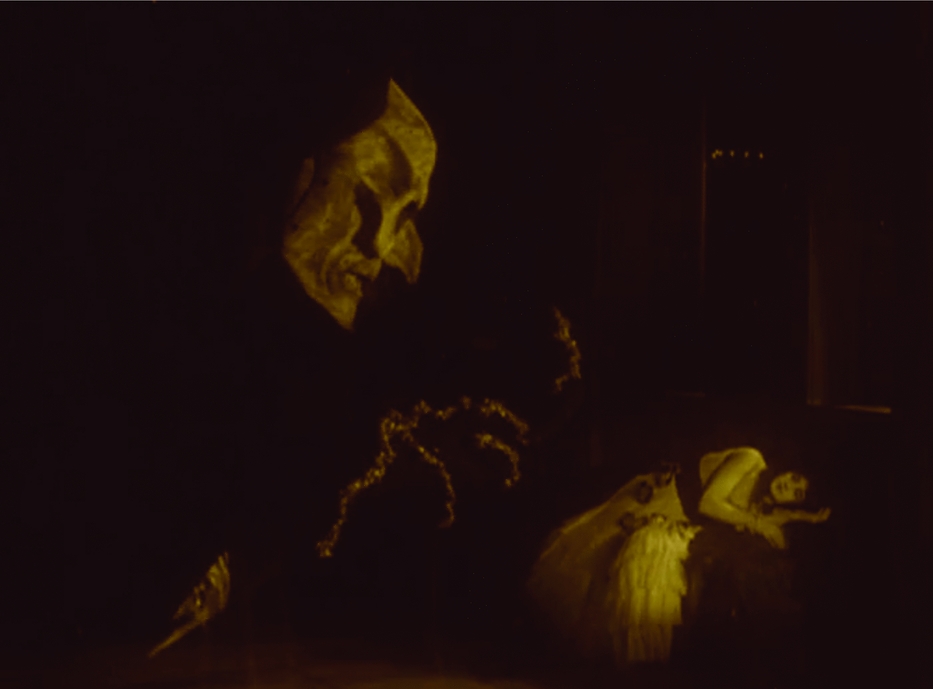
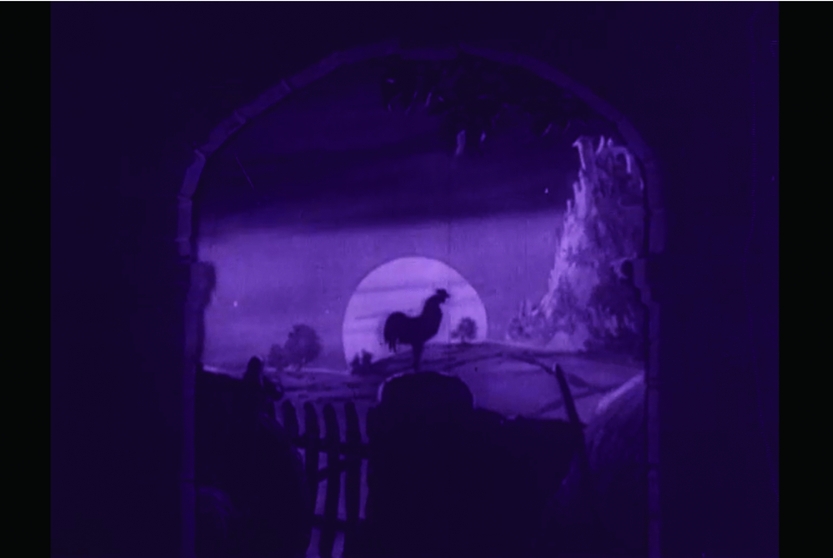
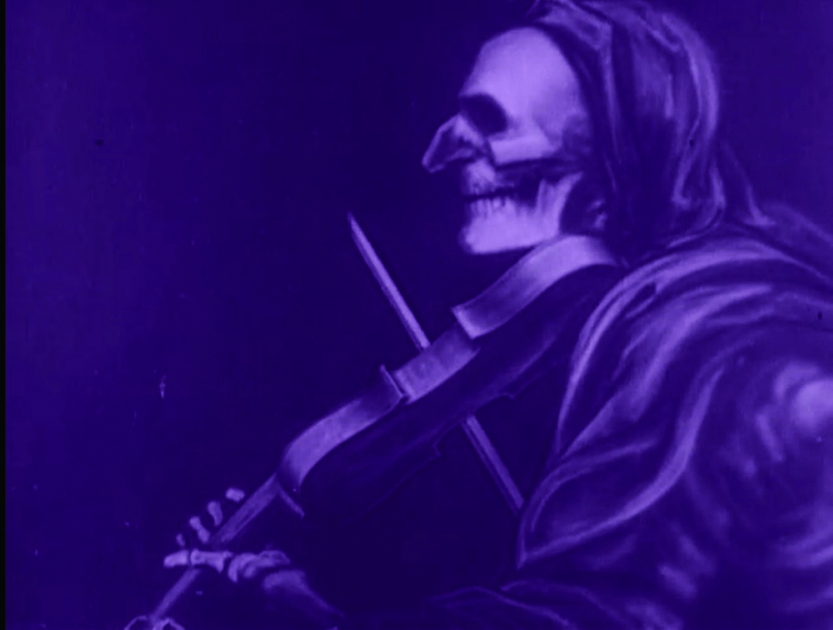
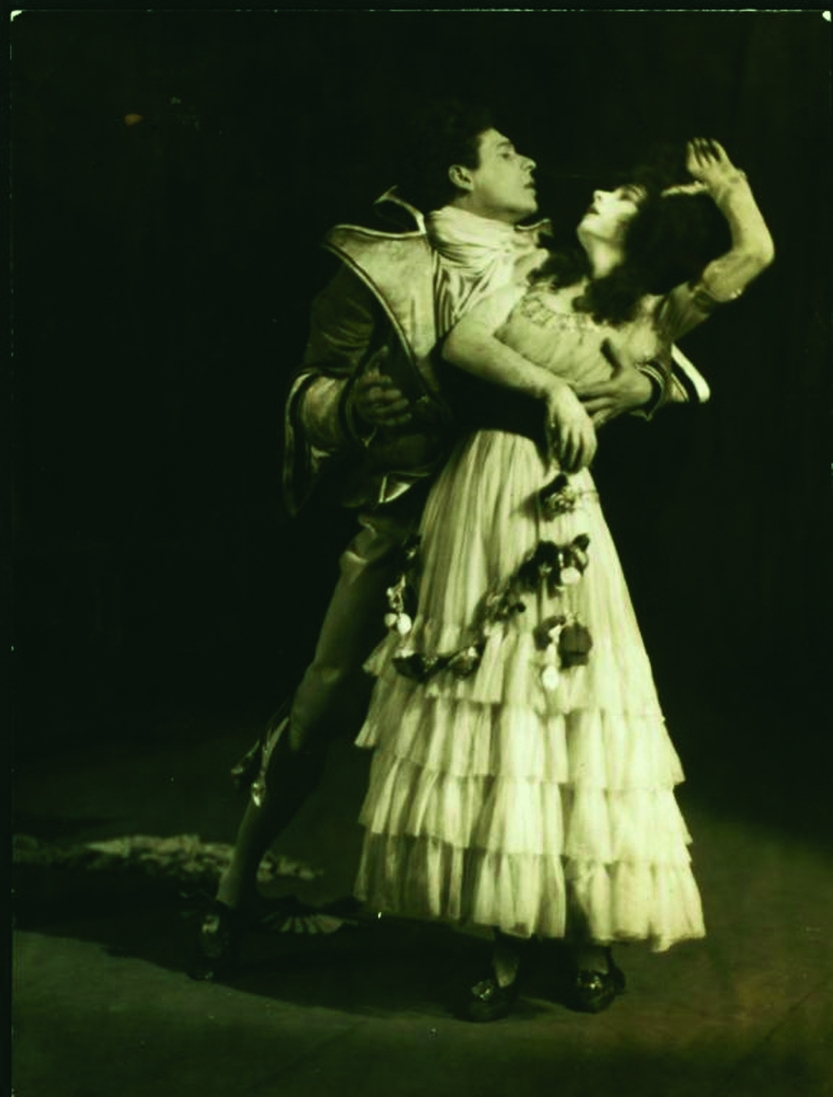
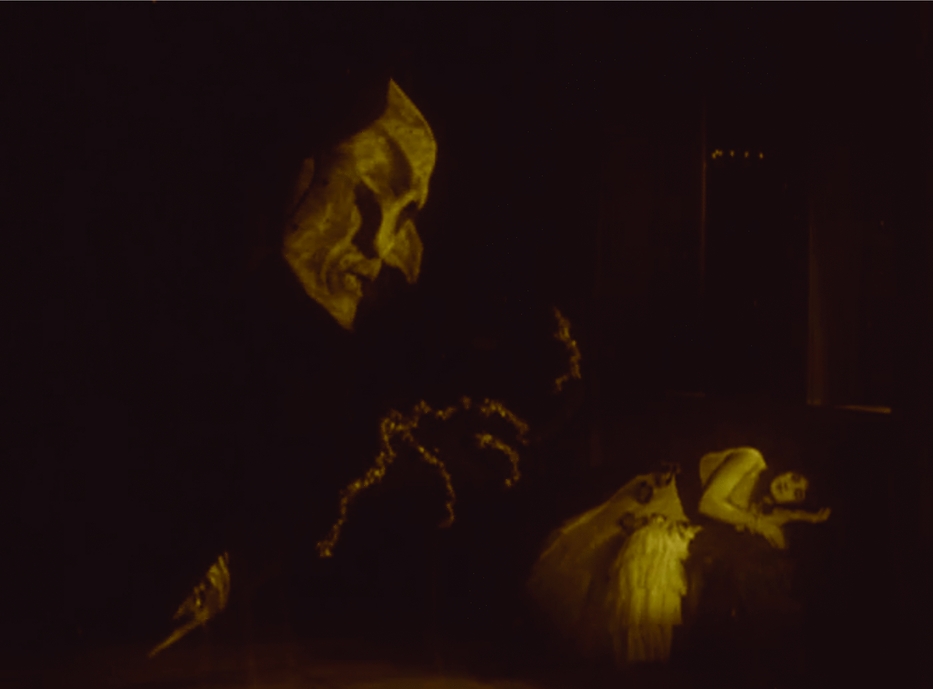
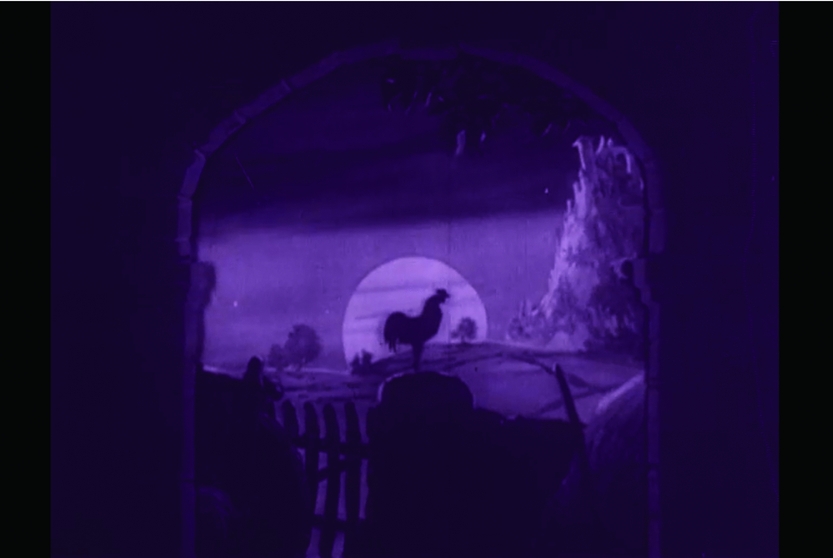
Music and image are synchronized on several levels in Danse Macabre. First, the film's narrative structure follows the structure of Saint-Saëns's composition. The film's opening credits appear as the harp repeats a single note (D) twelve times to represent a clock striking midnight, and continue through the work's first eerie series of violin tritones and the flute's introduction of the staccato first theme. As the strings take up the first theme, a title introduces Camille Saint-Saëns and his music, declaring, “Camille Saint-Saëns, modern French composer, who presented the world with this masterpiece of music” (see Figure 1). The second theme—a lyrical, descending melody with modal elements—begins as a new title situates the audience: it is midnight in “plague-ridden Spain,” and “Youth and Love flee from Death who follows their path.” As the violin tritones return (m. 82) and the first theme begins to circulate through the orchestra, a series of animations unfold: a bat flies near the clock tower, then a skeletal Death appears in a hooded cloak and begins to bow his violin (see Figure 2). We are introduced to our protagonists as the descending second theme returns (m. 102): a man and woman climb toward a turreted castle in blue-tinted animation, then the film cuts to a warmly-tinted live action shot of the man (Adolph Bolm) and woman (Ruth Page) indoors. They shed their outerwear, light a candle, and embrace, then Bolm presents Page with a variety of baubles. As a contrapuntal section based on the second theme begins, the two launch into a pas de deux (see Figure 3). Their pleasure is short-lived, however. The fugue transforms into a staccato, major-key parody of the Dies Irae played by the woodwinds and harp (m. 173), and Death (played by Olin Howland in an oversized mask) appears, superimposed atop the dancing couple. The figure is presumably visible only to us and quickly disappears, but Page senses that something is awry, and pulls away from Bolm while looking about wildly. The Dies Irae theme cedes to a variation on the descending second theme played the solo violin (m. 205), and Page relaxes and resumes the dance. But when a variation on the first theme begins moments later (m. 265), Howland's Death character reappears in superimposition, gesturing menacingly toward the couple as if casting the plague upon them. Page trembles in Bolm's arms, and then pulls away, cowering in fear. As Saint-Saëns's composition accelerates towards its climax, Death increasingly dominates the frame, fiddling like mad and dancing gleefully. Simultaneously, Page swoons and faints, her eyelids fluttering as Bolm lays her on a chaise and tries to revive her (see Figure 4). Death looms larger and larger as she weakens; by the time the orchestra crescendos toward a series of fortississimo G-minor triads (mm. 433–437), the Death figure dwarfs the actors onscreen. Suddenly, though, relief comes: as the coda begins with a solo oboe sounding the break of dawn (m. 440), the film cuts to an animated rooster silhouetted by the rising sun, head tilted back to crow (see Figure 5). Death vanishes and Page is revived. As she turns to kiss Bolm, the threat momentarily returns: accompanied by the low strings (m. 469), Death reappears in superimposition and reaches out, past Bolm and Page, toward the camera (and the film's audience), before slowly disappearing backwards into the darkness.
The animated sequence introducing Camille Saint-Saëns in the introduction to Danse Macabre (Murphy, Dudley, dir. Danse Macabre. 1922. Disc 7. Unseen Cinema: Early American Avant Garde Cinema, 1893-1941. New York: Image Entertainment in cooperation with Anthology Film Archive, 2005, DVD).

The animated Death fiddling in Danse Macabre (Murphy, Dudley, dir. Danse Macabre. 1922. Disc 7. Unseen Cinema: Early American Avant Garde Cinema, 1893-1941. New York: Image Entertainment in cooperation with Anthology Film Archive, 2005, DVD).
Publicity photo of Ruth Page and Adolph Bolm in Danse Macabre, 1922. Photo by Francis Bruguiére. ©Jerome Robbins Dance Division, New York Public Library for the Performing Arts.
Olin Howland as Death looming above Ruth Page in Danse Macabre (Murphy, Dudley, dir. Danse Macabre. 1922. Disc 7. Unseen Cinema: Early American Avant Garde Cinema, 1893-1941. New York: Image Entertainment in cooperation with Anthology Film Archive, 2005, DVD).
The animated rooster at the break of dawn in Danse Macabre (Murphy, Dudley, dir. Danse Macabre. 1922. Disc 7. Unseen Cinema: Early American Avant Garde Cinema, 1893-1941. New York: Image Entertainment in cooperation with Anthology Film Archive, 2005, DVD).
In addition to these structural resonances, much of the film's editing corresponds with the music's phrases and metrical structure. Cuts often coincide with the downbeats of Saint-Saëns's composition and occasionally match the phrase structure. For example, the first four bars of eight-bar phrases regularly accompany a single long shot of the couple, then the film cuts to a close-up of their interaction during the second half of the phrase. Similarly, the appearances and disappearances of Death frequently coincide with downbeats or other musical events. In one instance, Page lies unconscious as the woodwinds and strings play a four-bar ascending chromatic line culminating in a fortissimo G-minor triad (m. 370); as the triad sounds, Death appears in the center of the frame. He looms over Page with his violin as the low brass begin playing the second theme. On the downbeat of m. 375, as the melody begins to ascend, Bolm reappears with a glass of water and Death vanishes. Similarly, Death's first appearance is foreshadowed by the violin tritones (mm. 81–84) and synchronized with the full cadence that follows; his final appearance occurs just as the low strings enter with an eerie fragment of the first theme (m. 469).
Movement and gesture within the frame also regularly visualize elements of Saint-Saëns's score, offering film audiences moments of audiovisual synchresis.Footnote 93 In one instance, Page is drawn across the floor as the woodwinds play a descending chromatic line (m. 305), as if her body is drawn by the descent. Death's gestures are often matched to ascending or descending chromatic phrases as well, and the gleeful shuffling dance he performs over Page's unconscious body seems almost to be a physical manifestation of half-step oscillation simultaneously being played by the strings. Similarly, Death's final attempt to capture Page occurs as the orchestra performs the relentless series of tonic triads that are halted only by the arrival of the coda. Strikingly, Murphy and his collaborators largely avoided overt mickey-mousing: Death's onscreen fiddling never aligns with Saint-Säens's violin solos, nor moments when the string section is prominent; rather, he most often “fiddles” to woodwind or brass melodies. The obvious exception is the appearance of the crowing rooster at the moment the oboe signals the arrival of morning; it is perhaps telling that Bruguière criticized this decision, writing to Page, “I do not think the dawn is much good synchronized. . . .”Footnote 94 Though Death's onscreen fiddling doesn't align with the score's violin solos, making explicit to audiences that he was neither literally the source nor expected to be understood as the source of the audible sound, the sight of Death fiddling nonetheless draws viewers’ attention to the accompanying music—and thus remains fundamental to the film's visualization of music. For audiences attending the film's premiere at the Rialto, where musicians sat onstage in front of the screen rather than in a pit, this phenomenon was probably particularly striking: the animated violin flickered above the musicians, a shadow of their audible instruments cast onscreen.
Bolm and Page's onscreen dance performance also renders music visible—and perhaps audible. Choreographed to Saint-Saëns's tone poem and likely shot as a piano transcription of the work was performed in the film studio, Bolm and Page's precise, rhythmic dance aligns closely with the film's accompaniment.Footnote 95 Their movement phrases correspond with Saint-Saëns's musical phrases: as melodic material is traded between different instruments, for example, the two dancers often trade movement phrases. Similarly, their steps and gestures mark the music's pulse and rhythmic structures. As Death appears and vanishes during the Dies Irae section of the work, Page reacts to his presence in a series of movements that simultaneously mark the music's triple meter. She steps forward and lifts her arms over her head on the downbeat of m. 190; on the next downbeat, she steps back, extending her arms above and in front of her, and then pauses on the downbeat of m. 192, hands crossed over her heart. Frustrated, Bolm's character turns away, dismissing her with a flick of his wrist on the downbeat of m. 193; she rushes toward him, and gestures repeatedly toward the wall behind him, each arm movement aligning with a downbeat. He, in turn, stills her with his finger on the downbeat of m. 196, before turning to investigate. In Danse Macabre, then, it is not just the film's narrative structure and editing that align with the phrases and contours of its musical accompaniment. Saint-Saëns's work is also conjured by the film's diegetic music-making, its precise, balletic choreography—which makes it clear that Bolm and Page are dancing to something—and finally, through the close synchronization of the performers’ every movement and gesture with the composition's metrical and rhythmic contours.
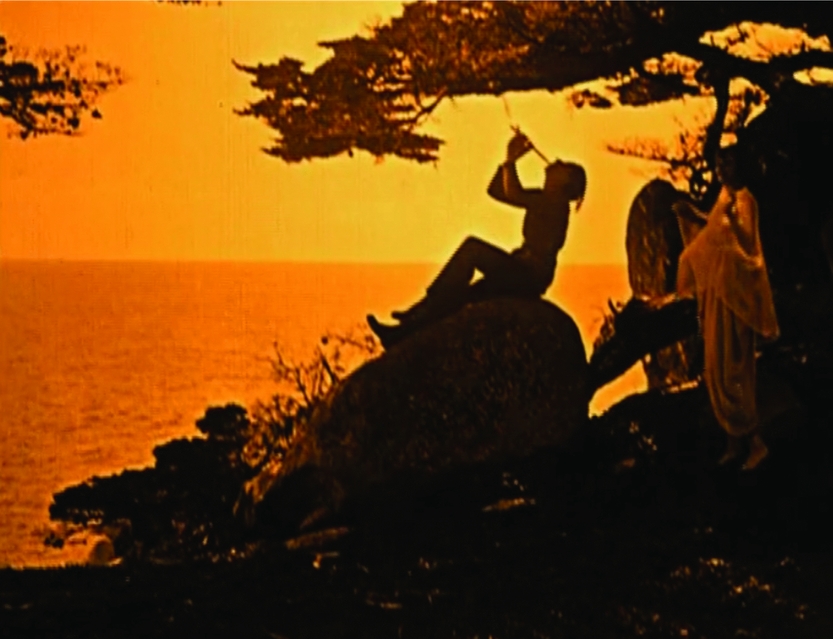
A different principle governs the relationship between image and music in The Soul of the Cypress. Cypress’s narrative structure—or more precisely, the narrative structure of the extant ten-minute version of the film—generally aligns with the loosely ternary structure of Debussy's Prelude to the Afternoon of a Faun. The flute solo that opens Debussy's work accompanies a series of intertitles outlining the film's narrative, alternating with shots of the California coast. The A section of Debussy's composition accompanies the film's introduction of its two protagonists in images and intertitles. We glimpse a “young Musician” settling atop a rock in a cypress grove to “compose his ‘Song of the Sea’” on his flute; his melody “melts the heart of one of the trees,” and a dryad (Chase Herendeen) clad in a gauzy, Grecian-style drapery, magically appears superimposed on its trunk. She stretches and begins to skip and cavort through the cypress grove. As the clarinet takes up the melody and the orchestra becomes increasingly dark (mm. 30–54), the dryad suddenly bends to put her ear to the ground, knocking repeatedly, then listening intently: she hears the musician's flute. A parallel montage unfolds as the film cuts between long shots of the musician playing and shots of the dryad dancing through the landscape. Their repeated juxtaposition strongly suggests that she is dancing to his music, an impression confirmed by an intertitle: “Lured by his Song, the dryad dances ever closer to the young musician's side.” As Debussy's composition begins its B section (mm. 55–78), the two characters finally meet. As the musician sits playing, the dryad creeps into the frame; he turns to look at her over his shoulder, and she dashes off, beginning a playful chase—rather, pas de deux. As Debussy's composition reaches the harp glissandi that begins its A’ section (mm. 79–106), however, the dryad suddenly vanishes back into the tree, leaving the musician alone. He freezes mid-stride, glancing about, then sinks to the ground in mourning. The two are eventually reunited during the coda (mm. 106–110): the musician leaps into the sea and the dryad is freed from the tree to sit oceanside.
Despite this broad structural alignment of music and narrative, it is clear that the synchronization of editing and onscreen action with specific musical events was not prioritized in the creation of Cypress. Certainly, there are moments in the film when music and image converge: the dryad's emergence from and disappearance into the cypress tree coincide with the harp glissandi in m. 26 and m. 79. After the dryad vanishes, the musician's movements also roughly align with Debussy's score: he stumbles up the hill as the flute and oboe perform a series of descending sixteenth notes (m. 85), drops to his knees as the descending line moves to clarinet and horns, and falls to the ground in a fetal position as the line returns to the oboe (m. 90).Footnote 96 However, these moments are the exception rather than the rule. Not only is there no attempt to synchronize the musician's appearances with Debussy's flute or oboe solos, but there are also no other discernable relationships between the film's characters or setting and musical events. In fact, it is the film's missed opportunities for synchronization that are most apparent. A particularly compelling moment in the film comes when the dryad first hears the musician's flute. It is a narrative turning point—the dryad is suddenly aware of the musician's presence and begins following his music—and also marks a visual shift: we are treated to the first medium shot of the dryad's face. Instead of aligning this moment of realization with the motive that is introduced on beat 4 of m. 30 and begins the transition to the composition's B section, however, the film cuts to this shot two beats earlier, interrupting a sustained B-major triad that closes the prior phrase, missing the opportunity to synchronize the dryad's repeated knocking gesture with a series of staccato notes in the cello (m. 31). Similarly, the dryad's first glimpse of the musician—and our first glimpse of both characters in the same frame—occurs not as the lyrical melody that opens the B section begins, as one might expect, but three beats earlier, in the midst of the syncopated oboe and flute figure that prefaces it.
As in Danse Macabre, Cypress’s diegetic flute playing and dancing likely drew the film audience's attention to the film's musical accompaniment. Many audience members would have immediately recognized Herendeen's movements as reminiscent of the barefoot “Greek” dances of Isadora Duncan, Ruth St. Denis, and scores of other professional and amateur dancers in the early twentieth century.Footnote 97 Certainly, critics readily received her dance as such. While a New York Tribune writer's description of the film as “a bit of the spirit of ancient Greece” likely referred in part to its parallels with the myth in which Daphne is transformed into a laurel tree to escape Apollo's attentions, it also echoed a turn of phrase regularly used in relation to the dances of Duncan and her contemporaries.Footnote 98 Moreover, the film's narrative may itself have conjured early modern dance to some: the trope of a dryad magically emerging from a tree was exploited by numerous dancers of the time, including ballerina Adeline Genée and even Adolph Bolm.Footnote 99
Herendeen's dance does not, however, visualize Debussy's composition—or conjure rhythm or metrical structure—in the way that Bolm and Page's performance does in Danse Macabre. Irregular and spontaneous, Herendeen's movements rarely coincide with the pulse or meter of Debussy's composition: her movements come in bursts rather than organized phrases. This is hardly surprising: because the film was shot on location, it is unlikely that Herendeen actually listened to Debussy's composition—or any music that might have provided a steady beat—during the shoot.
In fact, The Soul of the Cypress most strikingly conjures Debussy's Prelude to the Afternoon of a Faun through association rather than visualization. Cypress bears an uncanny resemblance to another work that is accompanied by Debussy's Faun: the Ballet Russes’s Afternoon of a Faun (1912). A staple of Diaghilev's Paris-based troupe's repertoire, and a controversial mainstay of their American tours in 1916–17, Afternoon of a Faun was choreographed by Vaslav Nijinsky, with costumes and sets by Léon Bakst. Although the film's plot diverges from that of the ballet, they begin similarly: a Faun (originally performed by Nijinsky himself, and danced by Rudolf Nureyev in the Joffrey Ballet's early 1980s reconstruction) is playing his flute in the countryside when a group of tunic-clad nymphs wander by. Like the Cypress musician, the Faun tries to approach, but they flee; eventually one nymph returns and lingers long enough to flirt with him before being frightened off. The Faun fondles the scarf she has left behind, before performing an autoerotic act atop it as the curtains close.
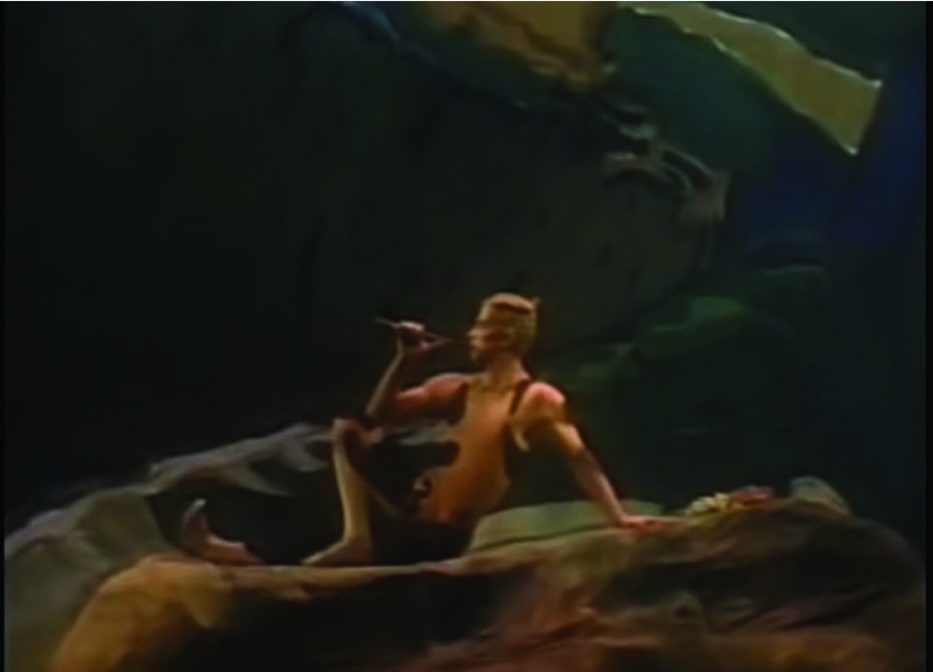
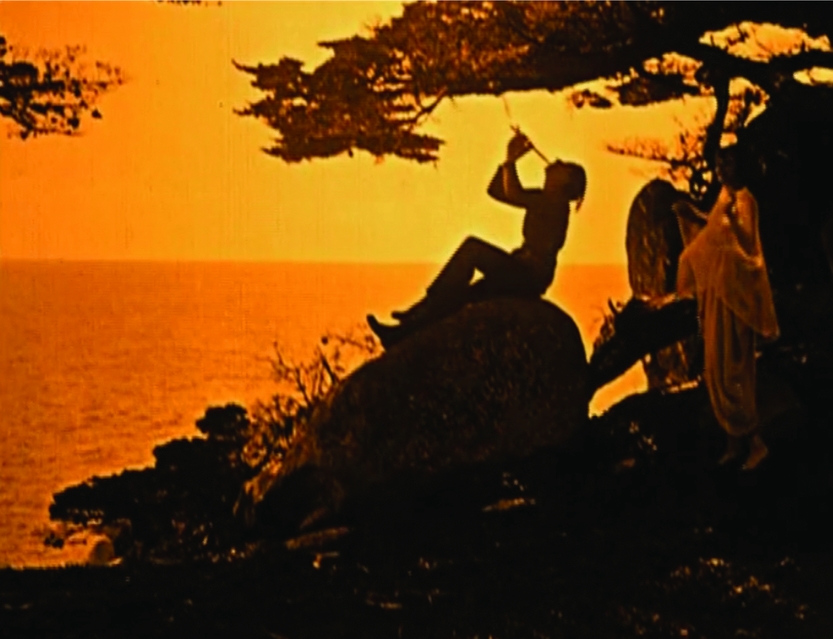
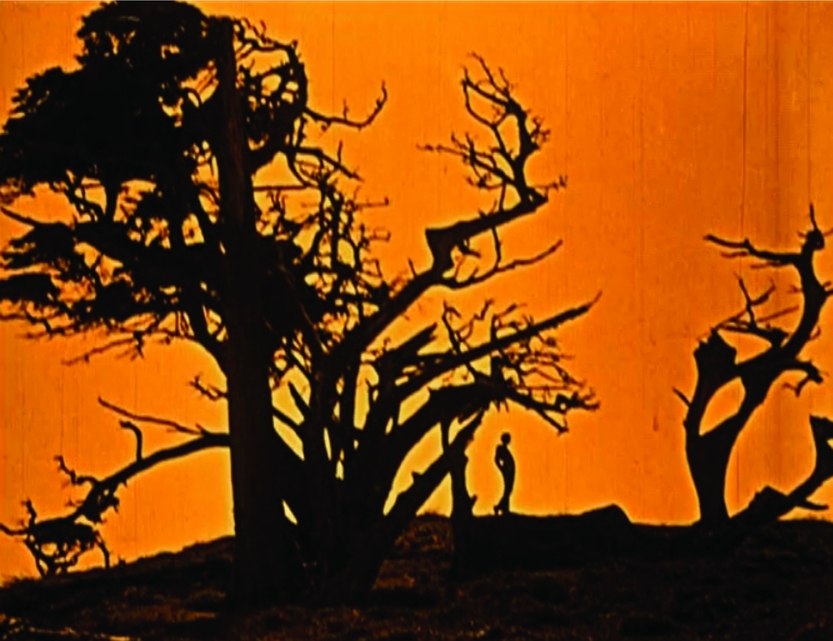
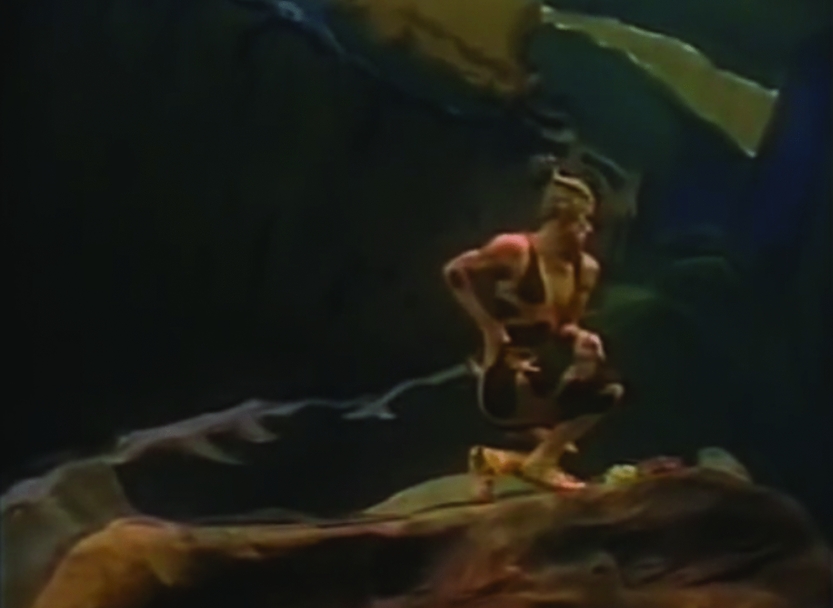
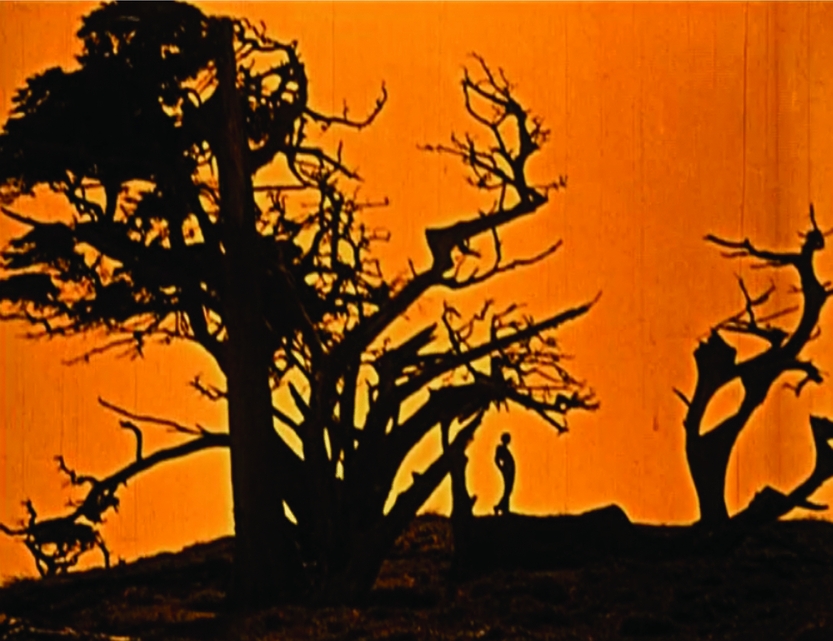
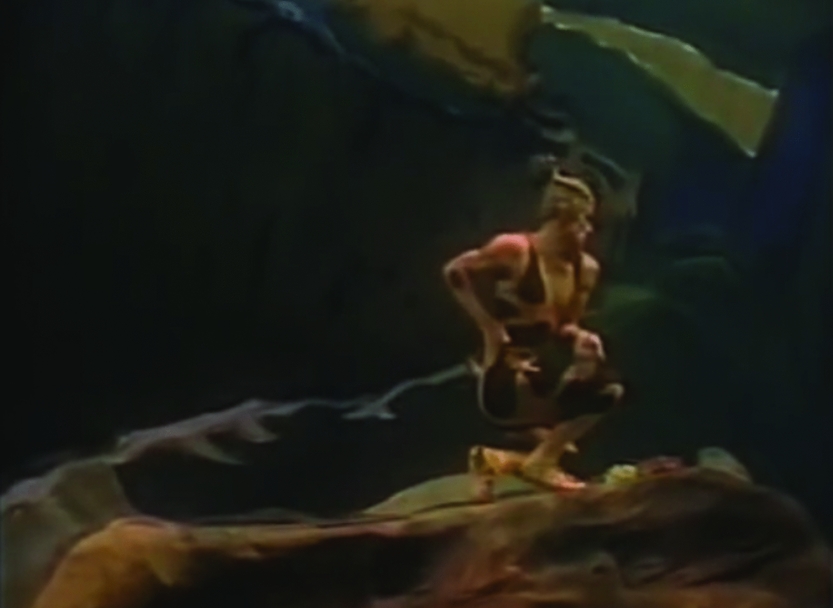
The film's choreographic similarities to the ballet are equally striking. The ballet's choreography imitates the attitudes portrayed on ancient Greek vases: the Faun and nymphs move across the stage haltingly in profile, their limbs at sharp angles, as if they are two-dimensional. While the nymph of the film utilizes far less stylized or angular movements, the film's musician approximates the Faun's movement vocabulary, moving across the screen in profile with a stiff, stylized gait, striking sharp, angular poses in silhouette against the bright sky.Footnote 100 The musician's posture in a series of shots about three minutes into the film, for example, are remarkably reminiscent of the Faun's choreography in the ballet's opening moments: both sit, one leg extended to the front and the other bent at the knee, their flutes raised to their lips (see Figures 6 and 7). Throughout the film, the musician frequently poses with elbows jutting upwards behind him at a right angle to create a window with his arched torso (see Figure 8). This attitude, too, evokes both Nijinsky's character and the ballet's movement vocabulary: in the ballet's opening moments, the Faun crouches atop a rock, repeatedly bending his nose toward a flower, his arm bent at a right angle behind him, creating a window with his torso (see Figure 9). Indeed, at one point in the film, the musician actually borrows both posture and gesture: the musician wanders through the cypress grove, occasionally bending into a tight, hunched squat with one elbow raised behind him at a right angle as he dips his head to smell a flower, just like the Faun.
Rudolf Nureyev as the Faun in the Joffrey Ballet's reconstruction of Nijinsky's Afternoon of a Faun, as performed in Nureyev and the Joffrey Ballet in Tribute to Nijinsky (Ardolino, Amile and Judy Kinberg, dir. Nureyev and the Joffrey Ballet in Tribute to Nijinsky. New York: Thirteen/WNET, 1981, VHS.).
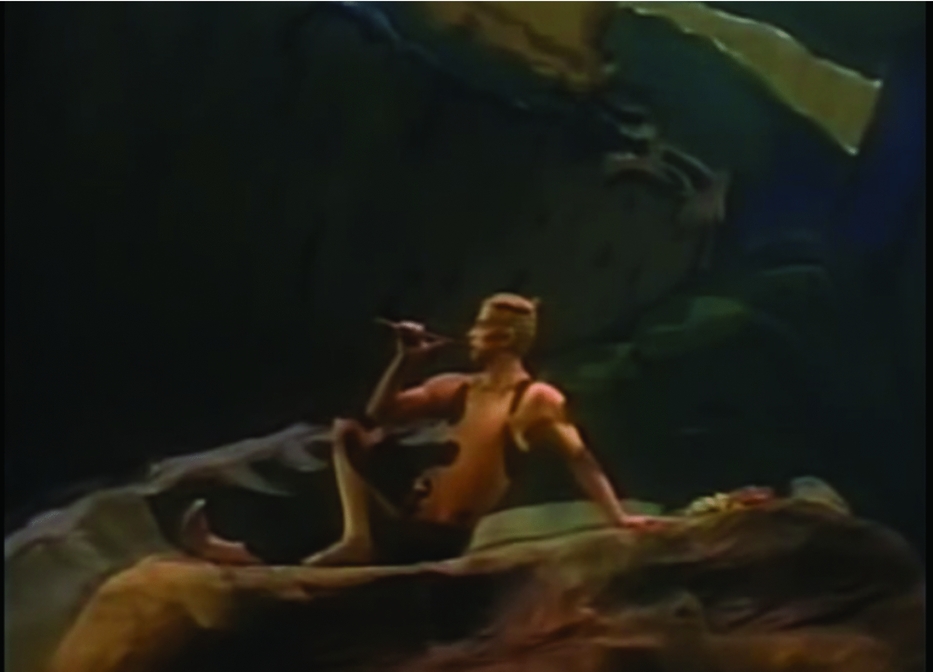
The musician playing his flute as the dryad approaches in The Soul of the Cypress (Murphy, Dudley, dir. The Soul of the Cypress. 1920. Disc 7. Unseen Cinema: Early American Avant Garde Cinema, 1893-1941. New York: Image Entertainment in cooperation with Anthology Film Archive, 2005, DVD.).
The musician standing atop a tree trunk in The Soul of the Cypress (Murphy, Dudley, dir. The Soul of the Cypress. 1920. Disc 7. Unseen Cinema: Early American Avant Garde Cinema, 1893-1941. New York: Image Entertainment in cooperation with Anthology Film Archive, 2005, DVD.).
Rudolf Nureyev as the Faun in the Joffrey Ballet's reconstruction of Afternoon of a Faun, as performed in Nureyev and the Joffrey Ballet in Tribute to Nijinsky (Ardolino, Amile and Judy Kinberg, dir. Nureyev and the Joffrey Ballet in Tribute to Nijinsky. New York: Thirteen/WNET, 1981, VHS.).
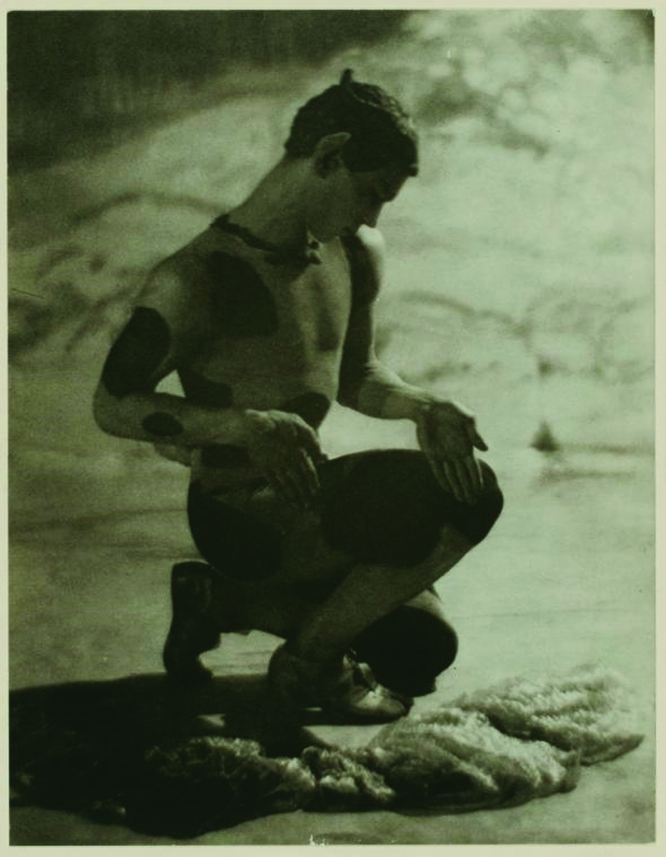
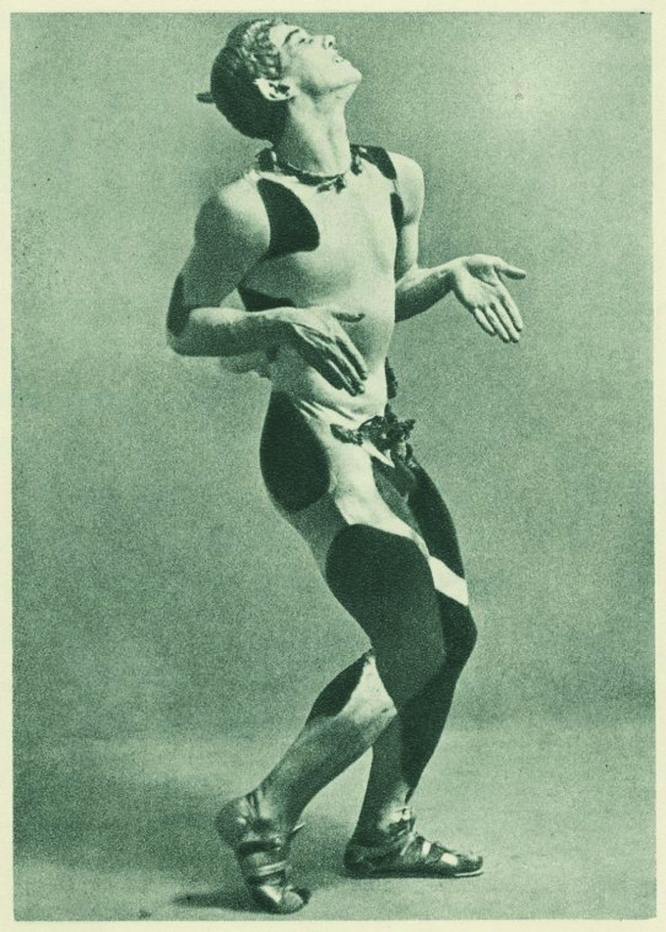
The gestures and poses of the Cypress musician, certainly, are less precise and refined than those of the Faun; at times, they seem more awkward than stylized. Nonetheless, these choreographic similarities, taken together with the film's use of the same musical accompaniment, narrative conceit, and two-dimensional aesthetic strongly suggest that The Soul of the Cypress was inspired by Nijinsky's Afternoon of a Faun. Murphy would surely have known the ballet. During the company's tours, the ballet was the subject of endless commentary within the American press and artistic community, and likely within Murphy's own family: his sister Carlene was a dancer who studied with Ruth St. Denis and Ted Shawn in the ’teens, then Adolph Bolm (a former Ballets Russes dancer) in the early 1920s. Indeed, it is fair to wager that Murphy and/or his collaborators saw the ballet performed: the Ballets Russes appeared in over forty cities across the United States, including Los Angeles, and included Afternoon of a Faun on the majority of their programs. If not, they likely encountered the many reviews, synopses, and publicity photos of the ballet. The Cypress musician's gestures could easily have been extrapolated from two photos that circulated widely in the press and company publications: Nijinsky squats before the nymph's scarf with his arms bent behind him, chin to chest in one, and stands with knees bent, feet separated, shoulders and elbows pulled back, and chin raised in the other—precisely the poses attempted by the Cypress musician that are most suggestive of Nijinsky's Faun (see Figures 10 and 11).
Vaslav Nijinsky as the Faun in Afternoon of a Faun, photographed by Baron Adolf de Meyer, 1912. Courtesy of the Jerome Robbins Dance Division, New York Public Library for the Performing Arts, Astor, Lenox, and Tilden Foundations.

Vaslav Nijinsky as the Faun in Afternoon of a Faun, photographed by Baron Adolf de Meyer, 1912. Courtesy of the Jerome Robbins Dance Division, New York Public Library for the Performing Arts, Astor, Lenox, and Tilden Foundations.

It makes sense that The Soul of the Cypress and Debussy's Prelude to the Afternoon of a Faun are “synchronized” by way of Nijinsky's Afternoon of a Faun as opposed to by the alignment of musical and filmic structures and events. The Soul of the Cypress was not conceptualized, shot, or edited with synchronization in mind; rather, it seems to have been created to convey the beauty of the California coast in a visual style inspired by Debussy's music—or perhaps Nijinsky's ballet. This approach remains visible even after the film was re-edited to synchronize with Prelude to the Afternoon of a Faun and marketed as a Visual Symphony. Transforming the twenty-minute scenic into the ten-minute version screened in New York, Murphy and his collaborators managed to introduce broad structural relationships and even occasional synch points between music and image. However, it would have been impossible to retroactively integrate the rich layers of synchronization that characterize Danse Macabre: the film's shape and form could only be manipulated so much. While The Soul of the Cypress may have passed as a Visual Symphony, the film's origin as a scenic that conjured rather than visualized Debussy's composition is all too visible and audible.
Cinema as Studio, Cinema as Stage
Visual Symphony Productions was short lived. It is unclear precisely when the company was dissolved, but mention of it disappeared from trade periodicals after the July release of Danse Macabre. By then, Murphy was already shooting a narrative feature in Long Island, and by September he was Europe bound.Footnote 101 Though Bolm continued to occasionally dance in presentation programs, he too left New York to become the ballet master of the Chicago Civic Opera and then the artistic director of the Chicago Allied Arts.Footnote 102 Riesenfeld, of course, had turned his attention to the Leventhal/Shawn music films in March; that series was premiered at the Rialto in May—nearly two full months before Danse Macabre finally appeared—and was screened at the Rivoli throughout July.
Despite the endeavor's brief life, the Visual Symphony project—as dreamed in publicity materials, approximated in Cypress, and embodied in Danse Macabre—offers numerous insights into the status and role of music and dance in 1920s American cinema. First, the very concept of the Visual Symphony—films designed to guarantee “perfect and practicable” synchronization—highlights the embrace of synchronization as an aspirational ideal and the ultimate mark of excellent film exhibition. The strategies of synchronization on display in Danse Macabre, as compared with Cypress’s more limited and approximate relationships, also clarify precisely what was meant by “perfect” synchronization. Riesenfeld, Murphy, and Bolm sought a particularly tight, multilayered temporal correspondence between the film's images and its musical accompaniment—a correspondence that is achieved not because theater musicians developed and executed a score that closely followed the film, as was typical practice in the silent era, but because the film itself was created to “follow” an existing musical work. In short, Murphy and Riesenfeld's Visual Symphony project flipped the accepted approach to film accompaniment on its head.
Indeed, the Visual Symphony project was driven as much by the exhibition practicalities and aesthetics as by the creative vision of an avant-garde filmmaker. That scholars have so frequently situated these films as the work of a visionary auteur is understandable: these early shorts offer a compelling foundation for a unified narrative of Murphy's disparate ideals and projects. Yet this project was as fully grounded in Riesenfeld's desire to expose audiences to “good” music and Bolm's interest in the cinema as a site of dance education as it was in Murphy's avant-garde visual sensibilities.Footnote 103 Moreover, this visual and musical integrity was valuable precisely because the films solved a host of exhibitor difficulties; likewise, they were a viable solution only because of their artistic integrity. Motivated as much by exhibitor and exhibition context as by the director, the Visual Symphony endeavor highlights the fluid boundaries between filmmaking and film exhibition in the silent era.
While narratives of early twentieth-century American culture have frequently described much hand-wringing over silent film's threat to live performance, the Visual Symphonies project—and the programs at the Rialto and Rivoli more broadly—make visible a far more complex reality.Footnote 104 Silent era film theaters were an important venue for live performance, regularly offering more and less modest programs that mixed music, dance, film, and theater. The visual symphony project went a step further, incorporating the hybridity of film presentation programs into the film text itself. In Danse Macabre, Saint-Saëns's composition combines with Bolm's ballet and Murphy's inventive visual experiments; in Cypress, Debussy's composition is sutured to Murphy's re-edited film, which in turn features Herendeen's dance improvisations and gestures toward Nijinsky's Faun choreography. Far from supplanting art music or dance, these films present music and dance in exciting new ways in an attempt to make both more accessible to the “great mass of Americans.” Conversely, the synchronized musical performances and diegetic dancing featured in each film are constitutive of the avant-garde visual strategies for which Murphy has received such praise: indeed, in Danse Macabre, the animated and superimposed Death figure literally fiddles and dances. The collaborative vision of the Visual Symphony, then, serves as compelling evidence of the close entwinement of film with music, dance, and other modes of live performance—the utter inseparability of the live from the mediated—in the final decade of the silent era, and a compelling model for contemporary artists.