Conflict-torn countries are at the receiving end of interventions from celebrity humanitarians who want to serve us hope in a coffee cup. In announcing Nespresso’s new line from South Sudan, the first coffee exports from the young country, brand ambassador George Clooney explained that “coffee farms have a great history of building peaceful pockets in very volatile areas. We drank our first cup this summer and it tasted just a little bit better knowing that it was from people who have worked so hard for normalcy and peace” (Smith Reference Smith2015). Two years later, in The New York Times, Ben Affleck explained the Starbucks Reserve Collection label for Kawa Kabuya, a coffee sourced from Eastern Congo: “Most people don’t know that Congo used to be one of the world’s greatest coffee producers, before war and disease wiped out nearly 90 percent of the crop” (2017). The simple messaging and earnest marketing of a coffee elixir by celebrities conceals extensive partnerships between NGOs, businesses, humanitarian agencies, and governments that are shaping politics.
The toolkit for advancing peace and development in conflict-affected countries now includes a partnership model linking celebrities, causes, and branded products in what Richey and Ponte (Reference Richey and Ponte2011) call Brand Aid initiatives. George Clooney encouraged the Swiss company Nespresso to source beans from South Sudan with the help of an NGO TechnoServe. Affleck’s own organization Eastern Congo Initiative persuaded Starbucks to export from Eastern DR Congo Lake Kivu. These Brand Aid initiatives suggest the acquisition of new terrain for celebrities in shaping politics. Their influence now extends to coordinating partnerships across business and NGOs while at the same time promoting market solutions to peace and development. What is further remarkable about both Clooney and Affleck’s initiatives is the official support they receive from the U.S. government.
The question I take up is how do celebrities exert power to influence elite and popular thinking and policy around peace and development. Drawing from research on neoliberalism, celebrities, and ethical consumption, I build an interpretive analysis of two case studies of Brand Aid initiatives to argue first, that celebrities mobilize financial and political capital to create partnerships across businesses, NGOs, and the government in ways that embody neoliberal politics by ushering in new private actors; and second, that celebrities reinforce these neoliberal politics by promoting these partnerships to popular and elite audiences. In the conclusion, I discuss how this contributes to unmasking neoliberal trends by showing how celebrities are deepening their engagement in ways that hold implications for democratic politics.
Brand Aid Initiatives: Neoliberal Politics, Celebrity Humanitarianism, and Ethical Consumption
Brand Aid initiatives are a recent practice fronted by celebrity humanitarians. The concept is built around three pillars—a branded product, celebrity and a cause. As “brands that provide aid,” Brand Aid initiatives follow the cause-related marketing (CRM) business model in linking a purchase to the support of a cause; in turn, they are also “aid to brands,” enabling businesses to fulfill corporate social responsibilities in a more public fashion than simply making donations (Richey and Ponte Reference Richey and Ponte2011, 10-11). Research finds that the CRM configuration brings short-term benefits to all parties: corporations increase sales and enhance their images while charities generate revenues and raise awareness (Eikenberry Reference Eikenberry2009). The Brand Aid initiatives identified by Richey and Ponte are directed towards overseas causes, in ways that complement and complicate traditional development and humanitarian financing.
The co-branding effects of a celebrity spokesperson for Brand Aid initiatives offer great appeal to business. The Western celebrity figure becomes “the lubricant for this political-economic formation, acting as emotional sovereigns, mitigating the threat to capitalist accumulation posed by the need to display corporate social responsibility” (Richey and Ponte Reference Richey and Ponte2011, 13). With the lure of a celebrity spokesperson, major companies like Amex, Apple, and Motorola signed on to the Brand Aid initiative (PRODUCT) RED to support the Global Fund to Fight Aids. PRODUCT RED has since been followed by other initiatives like TOMS One to One campaign, linking the TV actresses and fashion designers Mary-Kate and Ashley Olsen to children’s health and Johnson’s Baby Cares, linking actress Hilary Duff to Save the Children’s work (Ponte and Richey Reference Ponte and Ann Richey2014). Celebrities are significant for not only increasing media coverage but also the “credibility and believability of international development in the eyes of the public” (Richey and Ponte Reference Richey and Ponte2011, 179). Moreover, when A-list celebrities with access to policy-making spheres take the lead in creating their own partnerships, the Brand Aid model gains further purchase as a way to advance peace and development.
Neoliberalism
Brand Aid initiatives are considered part and parcel of broader neoliberal politics, with the presence of celebrities embodying and reinforcing certain trends. As a set of economic policy shifts enacted in the post-World War II era with intellectual roots in the work of Hayek, neoliberalism is understood as “the specific market-triumphalist manner in which capitalist globalization has been shaped and reproduced in recent decades” (Kingfisher and Maskovsky Reference Kingfisher and Maskovsky2008, 116). Many have come to consider neoliberalism a polyvalent term with little utility; for example, Ferguson see the “uses” of neoliberalism as reflecting a doctrine, a regime of practice, or even as a “shorthand for the world economy and its policies” (Reference Ferguson2009, 171). However, beyond economic practices, neoliberalism as a political rationality can be understood and studied for its suffusion into other areas of human life (Brown Reference Brown2016). I follow Wilson in considering Brand Aid initiatives a neoliberal artifact of our times that is “nothing necessary or natural” but rather reflects the “social constructedness of our worlds and identities” (2018, 7).Footnote 1 What becomes invested in coffee marketed as “a cup of hope” by celebrities is more than a simple charitable act.
The following elements of neoliberalism are the most germane here when considering Brand Aid initiatives. First, I underscore the reorganization of relations between state and society that favors privatization, specifically the entry of new agents. In the area of development and humanitarianism, the increasing role and influence of non-traditional actors has been considered a growing trend (see Fejerskov, Lundsgaarde, and Cold-Ravnkilde, Reference Fejerskov, Lundsgaarde and Cold-Ravnkilde2017; Brainard and Chollet Reference Brainard and Chollet2008). The expansion of Brand Aid initiatives invites corporations into a favorable environment for alliances linking traditional and new actors (Richey and Ponte Reference Richey and Ponte2014). The second neoliberal element I focus on here is the emphasis on “free-market fetishism” that holds the market to be “the most efficient and moral institution for the organization of human affairs” (Springer, Birch, and MacLeavy Reference Springer, Birch and MacLeavy2016, 3). How consumption practices become connected to peace and development shows the reach of this political rationality that emphasizes the place of the individual. Brand Aid initiatives that rely on a consumer public can be understood, following Brown, to constitute part of “neoliberal devolutions of decision-making, agency and responsibility to the individual” (2016, 3). Importantly, this way of being and thinking is being “sold” to us, through celebrity endorsement and clever marketing. I build on this research by tracking how and where celebrities enter politics as private actors and engage with neoliberal discourses to promote market solutions to peace and development.
Celebrity Humanitarianism
Scholars have begun to study how, through charity, activism, and humanitarianism, celebrities are taking on ever more public functions, deepening their engagement in ways that reinforce neoliberal politics (Kapoor Reference Kapoor2013, Daley Reference Daley2013, Majic Reference Majic2017). Coming from spheres related to culture, sports, and entertainment, celebrities may be distinguished by their path to fame, based on lineage, accomplishments, or notoriety (Rojek Reference Rojek2001) but what celebrities do share is the “public recognition and circulation” that makes them known to broad audiences (Drake and Miah Reference Drake and Miah2010, 52). Celebrities occupy an unusual status as the paradigms of “people we know so well” who are simultaneously “just like us” and “exemplary” (Marks and Fischer 2002). In taking up activities like activism and charity, Tsaliki Frangonikolopoulos, and Huliaras (Reference Tsaliki, Frangonikolopoulos and Huliaras2011) suggest that celebrity do-gooding operates as a way to continue to “collapse the distance between us and them” while also serving “an ideological function, articulating ideas about personhood and individual in a capitalist society” (2011, 10-11).
The term “celebrity humanitarianism” has come to be understood as encompassing the expanding field for celebritized forms of global humanitarian and charity work (Kapoor Reference Kapoor2013). A rich body of research on celebrity humanitarians tracks the scope of their activities, impact, and effect on global governance. This work has demonstrated the expansion of their celebrity activities both in and across North South relations (Richey Reference Richey2015) that often directs attention to new causes or under-represented groups (Brysk Reference Brysk2013); celebrity humanitarians have been considered to be important by governments, NGOs, and humanitarian agencies for their ability to link Western audiences to “distant sufferers” (Scott Reference Scott2015). Beginning in the 1950s, the U.S. State Department sent celebrities abroad in what was called “jazz diplomacy” to endorse U.S. democratic government in the Cold War period (Davenport Reference Davenport2009 as cited in Wheeler Reference Wheeler2013). Later, at the UN, celebrities were enlisted as “ambassadors” in order “to raise funds, affect diplomatic agendas and draw attention to development causes” (Wheeler Reference Wheeler2013, 144). Whereas past celebrity humanitarianism was seen as part of a counter-cultural activities as symbolized by Band Aid in the early 1980s, today’s involvement is aligned with more mainstream politics (Müller Reference Müller2013). While touted for their “ordinariness” and ability to appeal to the mass public, Brockington finds that celebrity advocacy is in fact an elite game that “enhances the distributions of power and inequality that it purports to change” (2014, 159). Recent work has shown the elite networks that undergird celebrity humanitarians as they gain access, create their own organizations, shape policy, and even lead to hierarchies among celebrities (Budabin, Mubanda Rasmussen, and Richey Reference Richey and Ponte2017; Budabin and Richey Reference Budabin and Richey2018).
Celebrity humanitarians have also been studied for how they communicate—raising awareness and promoting ideas as purported experts to both elite and mass audiences. Scholars have used the concept of norm entrepreneurs from the constructivist school of international relations to explore the ability of celebrities to promote “norms” or “sell ideas” that gain wide acceptance for issues such as human trafficking and genocide (Majic Reference Majic2017; Budabin Reference Budabin2015a). However, in the case of Clooney and Affleck studied here, the use of neoliberal style partnerships is not a new idea but an approach that gains further endorsement when convened by a celebrity humanitarian. Here, I focus on the elite foundations that enable celebrities to become experts, gain access to, and influence policy spheres. Compared to actual humanitarian workers, “the celebrity is a different kind of expert, whose knowledge is not derived from numbers, deduction, or semi-structured interviews, but from ‘feeling the pain’ of the poor and from offering an emotional connection to the subjects of development” (Abrahamsen Reference Abrahamsen2012, 141). This brand of expertise has appeal beyond celebrity fan bases; in settings such as Davos and the UN, officials appreciate celebrities who “have the power to frame issues in a manner that attracts visibility and new channels of communication at the mass as well as the elite levels” (Cooper Reference Cooper2008, 7). Their presence in high level forums has had mixed results: in her work on the media coverage of celebrity-led campaigns, Njoroge showed how Bono and Bob Geldorf mobilized the Make Poverty History campaign to counter prevailing discourses in the debates on African development, raising Africa’s profile in the international arena while posing challenges to “what was once a clear consensus on Africa” (Reference Njoroge, Tsaliki, Frangonikolopoulos and Huliaras2011, 245). Budabin and Richey (Reference Budabin and Richey2018) likewise show that celebrities may promote alternate narratives that challenge hegemonic thinking. Still other work has shown that celebrity discourses directed toward the public don’t necessarily move past stereotypes about the Global South or give specifics on political engagement (Kogen Reference Kogen, Enghel and Noske-Turner2018). As A-list celebrities embedded in elite networks, Affleck and Clooney exhibit the capacity to assemble partnerships involving new private actors and promote market solutions in high level fora, marking a new frontier for celebrity humanitarianism.
Ethical Consumption and the Coffee Elixir
The Brand Aid cases studied here elevate coffee, already a highly politicized commodity, and key symbol of ethical consumption as the “the ideal fair-trade product” (Jaffee Reference Jaffee2014, 14). Barnett et al. define ethical consumption “as a set of practices which mobilise a diverse range of motivations, incentives, and desires in developing large-scale forms of collective action that are able to induce meaningful change in the patterns of conduct of powerful economic and bureaucratic systems” (2005, 5).
The symbolic value of coffee has been deployed for its story-telling potency on behalf of an array of causes. In her monograph on coffee narratives, Lekakis refracted the politics of consumption and the ethics of consumerism in analyzing coffee activism as a large-scale effort “to balance trade injustice by setting and activating mechanisms which protect the ‘global South’ and raising awareness in the ‘global North’” (2013, 2). The original claims around coffee’s transformative properties are extensive and touch on multiple agendas: environmental, developmental and gender equality (Lekakis Reference Lekakis2013, 2). Previously, celebrities played a key role in promoting coffee as part of fair trade practices (Goodman Reference Goodman2010). Celebrity engagement in ethical consumption follows Tsaliki, Frangonikolopoulos, and Huliaras’ argument, drawn from Dyer’s work on the “compensatory” nature of celebrity’s ability to furnish elements absence in ordinary lives (Reference Dyer1998), that “celebrities perform a ‘compensatory’ role as they render the consumption of politics and activism an attractive imperative” (2011, 11). This reframing role for the symbolic value of coffee will fall to celebrity humanitarians.
Today, Clooney and Affleck are not alone in investing coffee with new transformative properties, ideas that fall in line with recent thinking about the relationship between coffee and conflict in both its negative consequences and possibilities in the area of conflict and development. A prime case has been Colombia, where analysts have gone so far as to describe coffee as part of a “resource curse” that may be responsible for conflict.Footnote 2 More recently, assertions around coffee’s power to solve economic and social issues have extended to the areas of conflict, security, and post-conflict sustainable development with dueling claims around both taste and impact.Footnote 3 The Financial Times recently reported that “the enthusiasm over gourmet coffees, and the potential returns from coffee production have attracted aid organizations, philanthropic foundations and corporations to try to lift the livelihoods of war-torn areas through coffee growing” (Terazono Reference Terazono2016). There are high expectations that coffee can advance development and sustain peace though the research suggests otherwise (see Daviron and Ponte Reference Daviron and Ponte2005; Gong and Sullivan Reference Gong and Sullivan2017). This has not stopped a vibrant marketplace with ventures located in South America, Africa, and Asia from emerging, where coffee is considered a potential change agent. Celebrity humanitarians hawking coffee as an elixir enter into a contested space with a branded product that has already been to shown to have mixed results.
Methods
To reveal the neoliberal politics embodied and reinforced by celebrities in convening and promoting Brand Aid initiatives, I adopt an interpretive research design, deriving insights from observed data. I follow work by Majic (Reference Majic2017) on celebrities as communicators of ideas and policies and Dunn (Reference Dunn, Klotz and Prakash2009) in studying the production of discourses and contestations in the socio-historic contexts that make Brand Aid initiatives possible. With this approach, I focus on celebrity capital and narratives to expose currents of neoliberal politics, “by learning what it does, how particular people use it, in particular contexts” (Schwartz-Shea and Yanow Reference Schwartz-Shea and Yanow2012). To organize my analysis, I use the conceptual model of Brand Aid formulated by Richey and Ponte (Reference Richey and Ponte2011), taking the cause, celebrity, and branded product of my two cases in turn.Footnote 4 The countries—South Sudan and Congo—are presented as “causes” based on scholarly texts, reports, and recent coverage. The sections on “celebrity” and “branded product” draw data from a wide range of popular and mainstream news as well as content from organization and company websites and videos. From Nexis Uni searches on media coverage from 2013 to 2017, I found fifty articles on the South Sudan-Clooney-Nespresso case and forty articles on the Congo-Affleck-Starbucks case. Specifically, I interpreted this collection of data in two ways: by tracking the various manifestations of celebrity capital, and then by identifying celebrity narratives as they engaged neoliberal discourses.
First, I adopt a political economy approach to detect the unique resources available to celebrities. To explain how celebrities exert the power to assemble Brand Aid initiatives, I follow Driessens who draws on Bourdieu’s field theory to argue that celebrities possess their own capital, based on “recurrent media representations or accumulated media visibility that can be converted into economic, social, symbolic, and political capital” (Reference Driessens2013, 550). Here, I detect how celebrities marshal two types of capital—both financial (through resources and merchandising, for example) and political (through access or gaining of political power)—to become celebrity humanitarians and assemble Brand Aid initiatives. I trace the presence and utility of celebrity capital through a material analysis of the alliances and actors involved in Brand Aid Initiatives: celebrities, companies, philanthropists, NGOs, states, humanitarian agencies, and international organizations. With this reading, I demonstrate how a select group of celebrities have become positioned not only to enter the policy field of peace and development but to shape thinking.
Second, I analyze celebrity narratives in mainstream news and policy spheres that feature Clooney and Affleck’s coffee partnerships. From literature theory around story-telling, narratives serve as a discursive strategy that is deployed to “interpret and understand the political realities around us” in ways that shape action (Patterson and Monroe Reference Patterson and Renwick Monroe1998, 316). Narrative analysis has been instrumental in detecting hegemonic and alternative discourses within contentious discursive spheres. It has been especially useful for tracking simplified solutions, obfuscations, and misrepresentations of development and humanitarianism in Africa, particularly the Congo (Dunn Reference Dunn2003; Autesserre Reference Autesserre2014; Seay Reference Seay and de Waal2015). In the case of celebrity narratives presented in mainstream news and policy circles, these discursive devices reflect the capital acquired by celebrities (Budabin and Richey Reference Budabin and Richey2018). Thus, it is also critical to study where and by whom celebrity narratives circulate; indeed, celebrative narratives that are echoed by state actors and other elite figures become endorsements.
Narrative analysis involves combing the data for certain elements that engage with ideological and political agendas. Here I read celebrity narratives related to Brand Aid initiatives for the ways in which they intersect with neoliberal discourses as they justify these partnerships as meaningful approaches to peace and development. Discursive elements such as the identification (and heralding) of private actors and funding (Marijnen and Verweijen Reference Marijnen and Verwijen2016) overlap with other dominant narratives such as “aid is bad because it is too little” and “aid is bad because it is too much”, reinforcing arguments that traditional aid and government interventions have failed (Richey and Ponte Reference Richey and Ponte2011, 93-94). In looking at the human agents embedded in narratives, in their Narrative Policy Framework, Shanahan, Jones, and McBeth (2018, 335) distinguish some of the populating characters—hero, villain, beneficiary, allies, and opponents. Thus, in celebrity narratives that promote Brand Aid initiatives, it is possible to see the identification and valorization of certain “heroic” actors and “allies” on behalf of distant “beneficiaries”. Other neoliberal discourses include a “multiple-win rhetoric” and the component of “marketization” that presents “market-based instruments and consumption as desirable and ‘adequate solutions’” (Marijnen and Verweijen Reference Marijnen and Verwijen2016). Even the term “partnership” (Lynch Reference Lynch, Smith and Verdeja2013, 58) has come to characterize transfers of knowledge and funds from North to South. With this interpretivist approach to detecting capital and narrative in two case studies of Brand Aid, I trace the entry of private actors and the “triumphalist” assumptions.
Selling Hope in a Cup: Cause, Celebrity, and Branded Product
Cause: Peace and Development in South Sudan and the Democratic Republic of Congo
As the causes, South Sudan and Congo occupy many of the same categories as conflict-affected countries characterized by political instability, crisis of governance, and fighting between security forces and armed militias. The international community has devoted extensive resources as part of diplomatic, humanitarian, and peacekeeping interventions. South Sudan and Congo are on the low end of human development, according to the most recent UN Human Development Report: South Sudan ranks at 181 on the index while Congo is only a bit higher at 176 (2016, 200). Another aspect that South Sudan and Congo share is a history as coffee producers in previous eras and they will find themselves on the receiving end of the same strategy for advancing peace and development. While sharing similar profiles as conflict-affected countries, it is doubtful that adopting Brand Aid will take into account “the specific needs of the countries [that] are a consequence of their particular histories and contemporary challenges” (Smith and Verdeja Reference Smith and Verdeja2013, 6).
South Sudan is the world’s newest country, having emerged from decades of conflict with the Sudanese regime based in Khartoum.Footnote 5 Described as the Second Sudanese War, the conflict between the North and South of Sudan led to the deaths of over two million civilians. Following the comprehensive peace agreement of 2005 and the country’s independence in 2011, South Sudan’s first years have been characterized by lingering tension and in-fighting among the elite leadership. The country continues to face high rates of upheaval and mass population displacements; a UN peacekeeping mission called UNMISS has maintained a heavy and active presence in the country. As of 2013, armed clashes rooted in political tension among the governing leadership in South Sudan have led to a new round of diplomatic, humanitarian, and peacekeeping interventions.
To the southwest of Sudan, the Democratic Republic of Congo and its Eastern region are struggling to rebuild after decades of war and conflict.Footnote 6 In the aftermath of the Rwandan genocide of 1994, two million refugees crossed the border into Congo, causing a destabilization that persists to this day. A first civil war (1996–1997) led to regime change in Kinshasa. In addition to the political fragility of DRC, major humanitarian crises have arisen, repeatedly. Internal mayhem led to a second civil war (1998–2002), which was characterized by extensive torture, mass rape, and cannibalism.Footnote 7 A peace agreement signed in July 1999 laid down a timetable for the withdrawal of foreign groups and created an interim Congolese government, comprised of representatives of Congolese rebel groups from the eastern part of the country. Congo wars of the late 1990s would see the provision of international aid and UN peacekeeping troops but without “much cooperation from the Congolese authorities” (Prunier Reference Prunier2009, 246). The International Red Cross estimates that the cycle of violence in the Great Lakes region killed an estimated 5.4 million people between 1998 and 2007.
A Global and Inclusive Peace Agreement was signed in 2002 but Eastern Congo continued to experience violence. The UN’s largest and most expensive peacekeeping operation has been in the country since 2003 and helped organize democratic elections in 2006 (Quick Reference Quick2015). However, analysts maintain that the extensive intervention has been unsuccessful in fully halting the cycles of violence, addressing the humanitarian crisis, and returning the rule of law (Autesserre Reference Autesserre2010, Reference Autesserre2014). In contrast to the rest of the country where a fragile peace had taken hold, Eastern Congo continues to have a precarious political and security situation, which is exacerbated by a thin government presence and dozens of armed groups that were never fully demobilized (Quick Reference Quick2015, 20-21).
As countries that have experienced mass atrocity, ongoing conflict, and poor governance, South Sudan and DRC have attracted attention from Western advocates, social movements, and celebrities. Congo has a longer history of humanitarianism: during the colonial period of Belgian rule, journalist E.D. Morel founded the Congo Reform Association (CRA), with chapters in Europe and the United States, and wrote a book called Red Rubber (Reference Morel1906) to decry major human rights abuses (Hochschild Reference Hochschild1998). However, Kabemba argues that this humanitarianism has “always been the mask for economic intervention” (2013, 14). For Sudan, beginning in the 1980s, evangelical Christians and anti-slavery groups lobbied in Washington, DC, around the North-South conflict and were successful in capturing attention from Congress (Hertzke Reference Hertzke2004). Divestment campaigns and sanctions led to the departure of major oil companies from Sudan over human rights (Patey Reference Patey2009) and the international community took steps to advance a peace process that would culminate in 2005.
Yet since 2000, DRC and South Sudan would not share the levels of attention and styles of advocacy given to situations in Darfur, Uganda, and South Africa. These situations became celebrated causes, with the formation of distinct advocacy organizations based in Washington, DC that mobilized millions of grassroots supporters, assembled broad coalitions, and drew celebrity supporters (Hamilton Reference Hamilton2011, Lanz Reference Lanz2011, Fadlalla Reference Fadlalla, Collins, DiLeonardo and Williams2008, Mamdani Reference Mamdani2009). However, the effectiveness and ethics of this new style of humanitarian advocacy are mixed (see de Waal Reference de Waal2015, Pruce Reference Pruce2019, Budabin and Pruce Reference Budabin and Pruce2018). Footnote 8 Coley (Reference Coley2013) explores the puzzle that Congo did not garner as much attention as Darfur, with some exceptions.Footnote 9 Meanwhile, Save Darfur activists were unable to fully transfer the attention of the mass public to the challenges plaguing Sudan in general and South Sudan specifically (Budabin Reference Budabin2014).Footnote 10 Some resources and celebrity visibility have come through the advocacy organization Project Enough, which launched a campaign Raise Hope for Congo in 2008 that underscored the link between sexual violence and conflict minerals.Footnote 11 Research on media coverage of Darfur and DRC suggests that celebrities have not been “able to increase or sustain media and public interest” in the long term (Hawkins Reference Hawkins, Tsaliki, Frangonikolopoulos and Huliaras2011, 101). Thus, in turning to Brand Aid initiatives, Clooney and Affleck will attempt to recapture and redirect elite and mass attention on South Sudan and DRC as “neglected causes” in need of new thinking.
Celebrity Humanitarians George Clooney and Ben Affleck
Clooney and Affleck achieved their status as celebrity humanitarians for South Sudan and Eastern Congo by slightly different paths. As A-list players in Hollywood, they have won their share of academy awards and Golden Globes for acting, directing, and producing. Their names were linked to a variety of causes and political campaigns: Clooney raised money for the South Asian Tsunami and Hurricane Katrina and participated in the Live 8 Concert while Affleck was mainly focused on domestic causes, appearing before Congress for an appeal to support stem-cell research as well as working Ted Kennedy to increase the federal minimum wage. After they honed in on the causes of Sudan and DRC, both would demonstrate long-term commitments to these conflict-affect countries. Marshaling financial and political capital, Clooney and Affleck would gain access to policy-making spheres related to peace and development.
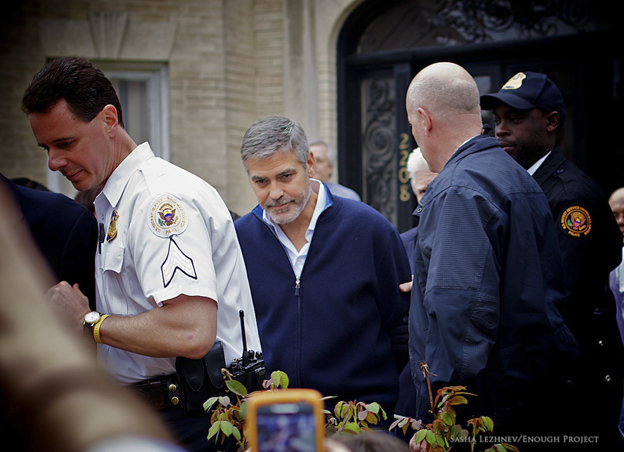
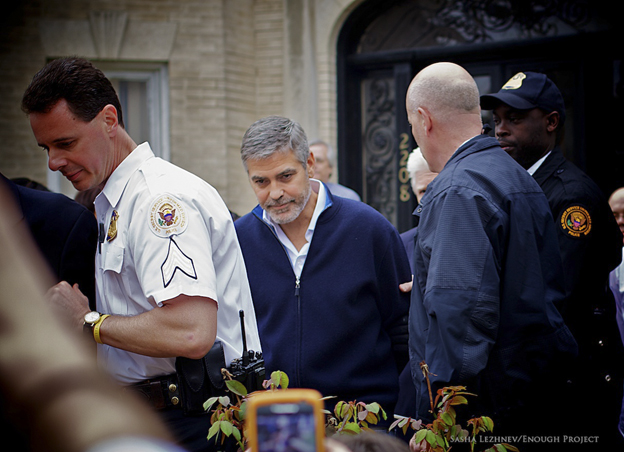
Clooney’s advocacy around Darfur started with a self-funded trip he took with his father, journalist Nick Clooney. As the news emerged in 2004 following the outbreak of conflict in Darfur, the Clooneys decided to visit the region and created a documentary A Journey to Darfur that was handed out to members of Congress, churches, and other community leaders (Orr Reference Orr2008: chap. 3). George Clooney then joined the Save Darfur Coalition and was one of the main speakers at a major April 2006 rally held at the National Mall in Washington, DC. His participation brought a vertiginous spike in awareness to Darfur, according to the Save Darfur president at the time.Footnote 12 Demonstrating a high degree of political capital, Clooney presented on the situation in Darfur to the UN Security Council; later that year, he met with the governments of Egypt and China, urging them to put pressure on the government of Sudan. In 2008, Clooney also aligned himself with the UN as a Messenger of Peace. He briefed the press at UN headquarters following a visit to the Darfur region. In a show of civil disobedience, Clooney was arrested for protesting outside the Sudanese Embassy in Washington, DC (Devereaux Reference Devereaux2012); refer to figure 1. For the most part, Clooney’s advocacy efforts sought to claim the spotlight for an issue as well as sustain coverage over long periods of time. But he would soon use his personal financial resources to expand his activism and use his celebrity in an attempt to “make the policies.”
George Clooney handcuffed at rally for peace in Sudan
Photo credit: Sasha Lezhnev, March 16, 2012. Some rights reserved. https://www.flickr.com/photos/enoughproject/6841795748/in/photolist-bqzZvE-99GYRP-S6m2ML-bqysTN-bDxYh4-pxQs2e-bDtoHR-8KWXEe-bqD45Q-bqD5ky-dbwHR-bwqzYy-bxduko-bL8cJK-bKkw5i-92sRAy-bDsCQM-bKkhFM-98WCK7-bDukDv-bqxJmQ-vGiRX9-98TxvF-dntKNr-bD1jFz-bKkydx-bKkmx8-98WJXJ-bKkxQR-bDsF3z-bqxJ7N-bDukyg-bqEF87-hNeiYt-bwqMJ9-bwqQCU-bqy4jo-ecSoH-os5p5-qexRJy-os5oX-bDvqyM-bDsEbg-bDth7v-aC5D2C-JuSCF-ecSnE-JuBHi-bqyn3b-pwto2E
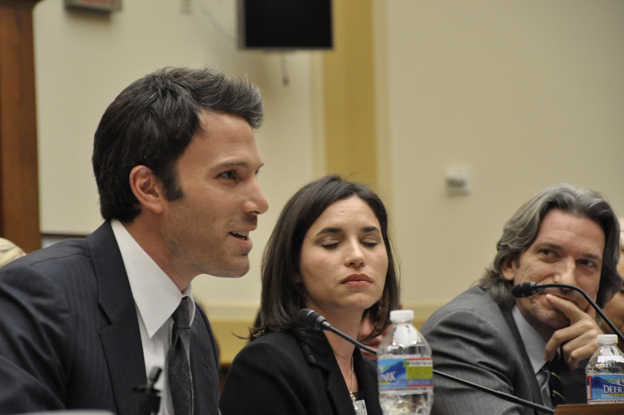
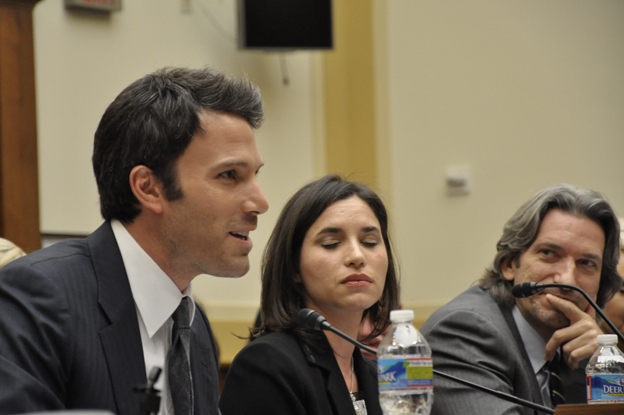
In contrast, Affleck hired a consulting firm and adopted a more methodical approach to his celebrity humanitarianism. In 2007, Affleck began thinking about becoming more intentional with his philanthropy “with both a renewed reputation and abiding political aspirations at stake” (Rapkin Reference Rapkin2013). On the advice of celebrity friends, Affleck hired williamsworks, a Seattle-based strategic advisory firm whose founder and CEO Whitney Williams has gained a reputation for advising high-profile donors such as Bill Gates and Hillary Clinton along with other celebrity-led organizations like Bono’s ONE and Water.org, co-founded by Affleck’s childhood friend Matt Damon (Rapkin Reference Rapkin2013). With the CEO of the firm, Affleck took a tour of conflict-affected countries in Africa and settled on Eastern Congo as the site of his efforts (Roth Reference Roth2016). To gain local knowledge, he has made field visits to Eastern Congo and has also met with numerous experts (Richey and Budabin forthcoming). In 2010, he launched his organization, the Eastern Congo Initiative (ECI), which had the goal of advancing economic and social development through advocacy and grant-making. In a show of his financial capital, the NGO’s donor list of “investors” includes Howard G. Buffett Foundation, Humanity United, the Bridgeway Foundation, Cindy Hensley McCain, and Google, among others.Footnote 13 ECI also chose to open an office in Goma and hire local staff, gathering evidence from the field in partnerships with other research and development institutions.Footnote 14 As a sign of his political capital and with the help of lobbying, Affleck was invited to testify in Congress multiple times on the security situation in Eastern Congo as well as to escort political officials to the country (Budabin Reference Budabin and Richey2015b); refer to figure 2). Affleck’s brand of advocacy was directed towards elite policy spheres rather than mass audiences; he didn’t attend rallies or get arrested to draw attention to Congo.
Ben Affleck testifying to Congress on the Democratic Republic of Congo
Photo credit: Amanda Bossard/Medill News Service, March 8, 2011. Some rights reserved.
Burnishing his own political and financial capital, Clooney has formed several organizations and initiatives to support his advocacy for conflict-affected countries. Focusing on Darfur, Burma, and Zimbabwe, Clooney established the NGO Not on Our Watch in 2008 with fellow celebrities to “develop projects and campaigns that bring global attention to forgotten international crises” by targeting “mass media and global policy-makers,” the elite and popular audiences that celebrities are able to reach simultaneously.Footnote 15 But most of the organization’s activities seem to be funneled through Project Enough, whose founding director John Prendergast has championed the use of “celebrity upstanders.”Footnote 16 Prendergast partnered with Clooney on his most controversial effort, an organization called the Satellite Sentinel Project that monitors conflict outbreaks in South Sudan using DigitalGlobe satellites. In 2012, he was invited to testify before Congress on violence in the border region between Sudan and South Sudan; he also met with President Obama.Footnote 17 In 2015, Clooney and Prendergast launched The Sentry, an initiative that tracks the personal revenue of politicians and military leaders who are implicated in African conflicts. These partnerships involved cooperation and support from partners such as the Center for Advanced Defense Studies (C4ADS), Carnegie Corporation, and Humanity United, among others. He would soon join Affleck in marshaling his celebrity capital towards a more ambitious intervention.
Branded Products: Nespresso and Starbucks Coffee
Business relationships were always entwined with the humanitarian work of Clooney and Affleck. Alongside his activism, Clooney became a brand ambassador for Nespresso coffee in 2006, though mainly in European and international markets rather than North America. His relationship with the company was not without controversy.Footnote 18 As Gulam (Reference Gulam and Farrellforthcoming) has argued, Clooney’s brand ambassadorship “draws upon the moral authority hat he has accrued through campaigning.” This good will was not without its limits; after facing challenges from media and activists on the sustainability practices of the company, he made efforts to learn more about the company by visiting coffee farmers in Costa Rica (Siegle Reference Siegle2013). In a philanthropic twist on his celebrity humanitarianism, Clooney claims to take the major part of his endorsement money from Nespresso to maintain a satellite as part of his Satellite Sentinel project (Makarechi Reference Makarechi2013). Affleck’s organization ECI received extensive support from corporate and philanthropic sources and there were two Brand Aid initiatives with partners Theo Chocolate and TOMS shoes (Richey and Budabin Reference Richey and Budabin2016). Affleck appeared as the spokesperson in discussing the initiatives, though he was mainly focused on addressing the security situation in Eastern Congo as part of his advocacy efforts (Budabin and Richey Reference Budabin and Richey2018). Both celebrities will use their convening power to bring corporate partners on board as pillars to similar Brand Aid initiatives on behalf of their causes.
Capitalizing on his status as ambassador and his value to the brand, Clooney directed Nespresso’s sights towards South Sudan as a coffee source. A partnership between the Swiss company Nespresso and the U.S. NGO TechnoServe launched in 2011 with the goal of working with local small-holder farmers. The NGO TechnoServe at the heart of the Clooney-Nespresso-Sudan partnership operates in 40 countries; the organization “provides business solutions to poverty by linking people to information, capital and markets” (TechnoServe, “Our History”). TechnoServe explained the objectives of the partnership: “these efforts are helping to diversify South Sudan’s economy and build a globally competitive agricultural export industry from the ground up” (TechnoServe, “Video”). The first stage involved a two-year investment from Nespresso to assess the possibilities for the country’s coffee production. In 2013, a collaboration was announced with another round of investment from Nespresso that amounted to $4.3 million. The prospect of foreign direct investment for this new sector was advantageous, according to a South Sudanese coffee manager, “With private investors it will do better and generate hard currency and improve livelihoods of the people and economy” (Africa News 2013). Another American coffee importer claimed that without markets and buyers, investment was risky (McConnell Reference McConnell2013).
The presence of Clooney likely reduced the risk of this investment for Nespresso while at the same time enriching the company’s CSR profile. As reported by the media, Clooney joined Nespresso’s first Sustainability Advisory Board, as one of the board’s “experts and thought leaders” (News Aktuell 2013). In a demonstration of the co-branding effects of Brand Aid initiatives, Clooney was quoted in the article as stating, “Nespresso and I have a shared commitment to sustainability, most recently helping to rebuild coffee farms in South Sudan.” As the celebrity spokesperson, Clooney extends the cloak of moral authority borne of his humanitarian work to the business he represents (see Gulam forthcoming). In a press release prepared by Nespresso, Clooney references his activism on behalf of South Sudan as the grounding for his expertise:
During the last decade, I traveled to South Sudan on a number of occasions in order to support the people’s aspirations for peace after suffering through a devastating war that cost over two million lives. Now a new war has begun, and I strongly support the peace process to end it. But work must also be done now to prepare for peace, and that includes creating economic opportunities for the people of South Sudan and diversifying the economy of the country away from an exclusive reliance on oil (Nespresso n.d.).
He describes the need to go beyond diplomatic solutions of “peace processes” to lay the groundwork for sustainable development in the post-conflict period. Clooney raises the notion of addressing South Sudan’s dependence on oil; here, he pitches coffee as the only other export besides oil and explains, “[the money from oil sales] doesn’t seem to trickle back down to the people” (Siegle Reference Siegle2013). With a more equitable distribution of resources, further conflict can be avoided. Moreover, with the support of a large company like Nespresso, Clooney implies that coffee might be “a real game-changing move” (Agence France Presse 2013), the presentation of a “marketization” that would be a “multiple-win”. The entry of a new player in the field of development is justified as an innovative approach that reflects a neoliberal solution to the problem of corruptive leadership, a recurring theme in the “bad aid” narrative.
The narrative around business as “ally” to Clooney’s “heroics” was echoed in the media and by industry leaders. One article cited Clooney as having “pitched South Sudan to help its economy” (Agence France Presse 2013). Another piece waxed lyrical on the a “win-win” story line presented by this partnership: “Nespresso is marketing its investment through brand ambassador George Clooney, as a unique chance to diversify South Sudan’s heavily oil-dependent economy, build peace and offer a glimmer of hope for war-torn South Sudan” (Foltyn Reference Foltyn2016). Indeed, the financial and humanitarian motivations of the project become inextricably linked through the “marketization”; as one reporter wrote, “George Clooney wants you to drink South Sudan’s coffee. And this isn’t about charity--it’s all business” (McConnell Reference McConnell2013). Even the director of Nespresso Daniel Weston was careful to point this out: “George Clooney opened the door to the opportunity, but we stayed for the coffee” (Global English 2015). Not all coverage was positive; one snide piece in a UK newspaper noted in a nod to Clooney’s humanitarian work and Nespresso’s controversies, how the 2013 Ambassador for Humanity “elevate[d] Nestle’s Nespresso into the world’s most redemptive coffee brand” (Bennett Reference Bennett2014). Clooney risks losing his moral authority by embedding himself too closely with business solutions.
After running a feasibility study on the prospects in the Congolese coffee sector, ECI and Affleck announced the Kivu Specialty Coffee project, which ran from October 2012-September 2016. Showing the mobilization of financial and political capital, ECI recounts how “we mobilized United States Agency for International Development (USAID), the Howard G. Buffett Foundation, and Catholic Relief Services to rally behind this mission, while also engaging private sector partners like Falcon Coffees, Westrock, and Starbucks to help bring Congolese coffee to the world” (2017).
The resulting project was part of the Global Development Alliance, a USAID model for public-private partnerships that reflects the neoliberal entry of new players into governing spheres, and received $4.19 million in financing. Note that in the ECI language, “partnerships” refers only to partners in the North; there is no mention of local collaborators. The Buffet Foundation gave $1.98 million and there were some private contributions from ECI and CRS. The aim was to elevate smallholder coffee farmers by expanding high-value market opportunities while also protecting farmers from hunger and environmental degradation; a priority was also placed on assisting women farmers. Catholic Relief Services had more experience in rural development projects and was thus the lead organization in a partnership with multiple stake-holders (see Richey and Ponte Reference Richey and Ponte2017). In 2014, Starbucks Reserve® Eastern D.R.Congo Lake Kivu was sold in more than 1,500 Starbucks® stores in the United States and Canada as well as online. It would fall to Affleck and ECI to promote the partnership.
As a spokesperson for an NGO, Affleck promoted the “marketization” narrative of business-as-solution to addressing the situation in Eastern Congo. On American Public Media’s Marketplace, he described the effects of traditional aid as “a mixed bag” due to reliance on Western development workers who ran only short-term projects (Brancaccio Reference Brancaccio2014). CEO Williams spoke to a reporter about bringing philanthropists and corporations to DRC to “increase investments in the region” as part of the promotion of DRC as “a place of massive opportunity” (Birkenbuel Reference Birkenbuel2014); the opportunity is presented as being for supporters in the Global North. Affleck and ECI drew on their local knowledge and in-country experience born of their Goma office and repeated field visits to offer a sanguine assessment of the coffee sector. These prospects were echoed when Starbucks CEO Dave Olsen became an ECI board member and endorsed the partnership in an essay submitted to the Seattle Times: “I’ve just returned from a trip to the region, with Eastern Congo Initiative, where I saw the incredible potential for sustainable agricultural production” (2015). He described the initiative and the role that Starbucks was playing in importing the coffee for sale in the United States as a “multiple-win”. He ended on the optimistic note that made all caffeine junkies “allies” working on behalf of a needy “beneficiary”: “And as we enjoy Congolese coffee, we help the Congolese people write a new, hopeful chapter in their country’s history. Through this seemingly simple act, we will make an incredible difference in the lives of farmers and their communities.”
It may be that Clooney’s status as a Nespresso’s brand ambassador limited his outreach, which was mainly to mainstream media, but as head of an NGO, Affleck possessed greater political capital to reinforce a neoliberal narrative. During his fourth testimony on Capitol Hill in March 2015, Affleck sat next to Bill Gates and presented the achievements of the Kivu project. He described it as “a case study of the difference our Nation’s foreign assistance and diplomacy is making where smart, targeted public and private investments are transforming communities in need, advancing our nation’s interests and creating opportunities, both in the countries we assist and here at home” (Affleck Reference Affleck2015). Affleck goes on to describe the project and its partners but underscored the role played by his “ally” Starbucks: “Involvement by the world’s largest coffee company is a clear testament to what’s possible for Congo. This isn’t charity or aid in the traditional sense, it’s good business.” Here Affleck toes the line that these types of partnerships build in returns for all—that “multiple-win” rhetoric. Starbuck’s own press release opened with the following statement on the “hero” at the heart of the partnership, “Actor and director Ben Affleck testified before the U.S. Senate last week, citing Starbucks as an example of how a private company can bring economic development to some of the world’s poorest regions” (Starbucks Newsroom 2015). From coverage in The New York Times, Glamour, US Weekly, and People to TEDx talks, Affleck and ECI’s business solution is disseminated to elite and mass audiences as a “marketization” approach to solving the complex challenges of DRC.
Rather than signal a retreat of the state, the participation of humanitarian agencies and government institutions signaled the embrace of such partnerships. USAID ran posts with headlines such as “The DRC’s Coffee Might Be Served at a Starbucks Near You” (Jhumra Smith, Reference Jhumra Smith2016). But, the humanitarian agency would also join the Nespresso project Suluja ti South Sudan as a partner in 2016. Bringing $3.18 in funding, USAID described how the investment would “strengthen efforts to rebuild the coffee industry in South Sudan and improve coffee farmer livelihoods” (USAID 2016). In a shout-out to the corporate partner, USAID stated, “We’re encouraged to see a company like Nespresso investing in long-term growth in South Sudan and look forward to working together to expand economic growth and opportunity in the country” (USAID 2016). In turn, Clooney championed USAID as a new “ally”: “This commitment by USAID is a strong signal of the relevance of the program that Nespresso and TechnoServe have built up with these communities, allowing it to reach even more farmers in more areas of the country” (Nestle 2016). Meanwhile, ECI extended its Kivu Coffee project in partnership with the U.S. Department of State (ECI 2018). The initiative was announced in a blog post entitled “Coffee, Conflict, and the Congo” that noted the many “beneficiaries,” bringing “peace, stability and better livelihoods to coffee farmers, their families and local communities” (Hadrick Reference Hadrick2018).
All of these heraldic statements made in media and Congress and endorsed by politicians and humanitarian agencies stand in sharp contrast to the promotional materials of the coffee itself. The coffee was distributed with muted packaging and no reference to the partnerships or the “causes” behind the sourcing from South Sudan and DRC. The business partner was the only “ally” listed on the branded product. The Nespresso Suluja ti South Sudan is sold in a green capsule with gold leaves draw on the bottom with the tag line “Renaissance of a great land.” The Starbucks packaging includes a bold graphic print and references to the coffee’s origin of Lake Kivu in Eastern Congo. Neither is labeled as fair trade nor is there reference to derivation of the beans as coming from conflict-afflicted areas. Thus, in contrast to media coverage, the narrative possibilities of the branded product are severely limited. It is interesting to note that coffees sourced from conflict-affected areas are marketed as higher quality (i.e., Reserve or Premier collections), perhaps to the gourmet coffee drinker. This suggests that the messages of promoting neoliberal partnerships were mainly directed towards elite audiences and not for public consumption, as we might expect from a partnership with a celebrity.
Meanwhile, the countries that formed the Brand Aid “cause” are marketed for their novelty rather than their status as being conflict-affected. But when the interventions are deemed ineffective, there is little information; this lack of transparency is common in Brand Aid initiatives (Richey and Ponte Reference Richey and Ponte2011). Due to instability in South Sudan, Nespresso was forced to suspend operations, according to The Wall Street Journal (Bariyo Reference Bariyo2016). The lofty expectations of income generation from access to foreign markets for coffee failed to reconcile with the larger problems facing these fragile states. In a sign of the entrenchment of coffee brands in the field of humanitarianism following the same playbook, Nestlé and Starbucks have recently formed a Global Coffee Alliance.Footnote 19 Yet in taking up the situations in South Sudan and Congo with the Brand Aid approach, we see little more than a star-studded reinforcement of neoliberal politics that plays little attention to context.
Discussion
The cases of Clooney’s South Sudan Nespresso capsules and Affleck’s DRC Starbucks beans show how Brand Aid initiatives are the result of social, economic, and political forces. These initiatives rely on and elevate select celebrities to reinforce neoliberal thinking in the fields of peace and development. Elite networks enable Clooney and Affleck to become experts who are invited to testify to official policy making spheres such as Congress; these invitations are based on their long-term commitments, organizational platforms, and field trips. Behind the scenes we find extensive financial resources and political endorsements that have been assembled by strategic management films, other development and advocacy NGOs, philanthropists, and officials. Marshaling their financial and political capital, these celebrity humanitarians assembled the funding and partners for complex Brand Aid arrangements to advance peace and development in conflict-affected countries that involved support for coffee farmers, exporting to global markets, and media promotion. Clooney’s ambassadorship for a global business gives him access to large amounts of investment capital and a wider scope of media coverage. In contrast, Affleck and ECI worked within development circles to establish their Brand Aid project with USAID and drew from elite circles for capital and partnerships with more established NGOs. Their celebrity capital is demonstrated by their ability to convene new partnerships with significant financial investment from philanthropists, companies, and the U.S. government. Celebrity humanitarians draw on their elite networks and use their visibility and appeal to popular audiences to absorb the risks of operating in insecure environments with high stakes.
In addition to bringing in large coffee brands to support causes, Clooney and Affleck as highly visible figures entered into a discursive field around the best way to help others. I have shown how the celebrity narratives offered justification for Brand Aid initiatives in ways that intersected with prevailing neoliberal discourses. First, the narratives justified the entry of new players such as businesses and consumers as “allies”, whose investments would reach “beneficiaries” in South Sudan and the DRC. The distribution of benefits beyond the “beneficiaries” in the conflict-affected countries is resonant of the “multiple-win rhetoric”; financial investment is not aid but rather contributes to the bottom line of businesses like Starbucks and Nespresso. Second, the advantages of “marketization” were presented forcefully as a response to “bad aid” and past charitable practices; here, the market-based instrument and consumption of coffee (by aficionados in the Global North) were presented as desirable and adequate solutions. The circulation of celebrity narratives was demonstrated in that these stories were not only echoed by other prominent actors in the Brand Aid initiatives but were also heard by elite policy-makers in the U.S. Congress. These endorsing statements paint the celebrities as “heroes” for bringing together the partnerships that bring in a consumer public to advance peace and development in conflict-affected countries.
The trajectories and variations in spheres do show some constraints on celebrity humanitarians. Both Clooney and Affleck occupy a rarified stratum of celebrity humanitarian, cutting their teeth as advocates with engagement over long periods. Not all well-intentioned celebrities will be able to gain legitimacy as development actors to amass capital to follow their own paths (Budabin, Mubanda Rasmussen, and Richey Reference Richey and Ponte2017). Meanwhile, Clooney’s status as a brand ambassador for Nespresso made his endorsement of the partnership a paid, and somewhat tainted, affair that reduced his moral authority. He was limited to promoting neoliberal practices from a business perspective, despite his extensive humanitarian background and expertise in South Sudan. In contrast, Affleck’s moral authority remained intact, as the head of an NGO focused on Eastern Congo. His organization, and its extensive political connections and financial support, elevated Affleck as a celebrity humanitarian able to speak with expertise and vision to the United States Congress.
Conclusion
I have explored how celebrities exert power to shape elite and popular thinking and policy around peace and development. I argued that celebrities mobilize financial and political capital to convene partnerships as well as promote them through the circulation of narratives that engage with neoliberal discourses. This work substantiates Biccum’s argument that celebrities “combine in a single personage the free market development actor and advocate” (2011, 1333). By promoting coffee partnerships to advance peace and development, celebrity humanitarians are not necessarily promoting new thinking around humanitarianism and development. As discussed earlier, business has been brought in by international organizations as a legitimate actor; meanwhile, market-based solutions are not especially innovative considering the legacy of fair trade. However, the figure of the celebrity humanitarian accelerates neoliberal trends by gaining higher visibility with both elite and mass audiences.
The case of Clooney and Affleck’s Brand Aid initiatives around coffee contributes to our understanding of celebrities’ role in embodying and reinforcing neoliberal politics by making legible the dynamics of power—its possibilities and limits—within and through which celebrity humanitarians operate. First, a celebrity’s ability to convene costly partnerships with the promises of lucrative co-branding potential ushers in the entry of private actors, like themselves, into policy fields alongside more traditional actors. While celebrities are heralded as public figures, their access and influence is mainly based on their membership in elite networks. Second, celebrities are well situated as visible figures to present narratives—concise and persuasive arguments—that justify market solutions. Moreover, the presentation of this solution to peace and development challenges receives airing in both official circles as well as mass-market settings such as coffee shops and supermarkets. This is an argument that also plays well with state actors like USAID and U.S. Department of State, official bodies that are supporting and expanding public-private partnerships. This institutional embrace of these practices and traction of these celebrity narratives in elite spheres is further evidence of their influence. Meanwhile, a lack of transparency persists: changes in partnerships are not due to ineffectiveness of approach but rather to in-country realities. These cases demonstrate the extension of celebrity capital into humanitarian spheres and the deeper entrenchment of celebrity-led market solutions as valid approaches.
These findings pose unsettling implications for the role of celebrities as popular figures in politics. In selecting causes and formulating development interventions that garner both public and private support, celebrities are skewing dynamics in democratic politics towards elite, not necessarily expert, control and management. The imbalance may preclude other issues from reaching the agenda, key stakeholders from entering the debate, and valid assessments. The championing of market solutions to both elite and mass audiences assures their appeal, at the expense of “aid as usual.” The ability for celebrities to build and promote a “one-size fits all” Brand Aid initiative reflects wider troubling trends within the fields of humanitarianism and development, where official support for private-public partnerships continues to strengthen along with dynamics of elite engagement. Ineffective strategies and poor results do not threaten a celebrity humanitarian’s ability to continue “do-gooding”; their ability to mobilize political and financial capital secures their platform for testing interventions. In circulating narratives of business solutions, celebrity humanitarians conceal the complex nature of peace and development and the hazards of faulty interventions. Further research could work to identify additional paths of celebrity influence in political areas beyond humanitarianism and development, to underscore, in particular, the deepening links between celebrities and companies with government support.