Introduction
Suicide is the 10th leading cause of death worldwide, with old age and depressive illness as the most important determinants at the population level (Hawton and van Heeringen, Reference Hawton and Van Heeringen2009). In later life, however, depression is often comorbid with anxiety disorders. Moreover, anxiety disorders on their own are among the most prevalent psychiatric disorders in later life (Beekman et al., Reference Beekman1998; Grenier et al., Reference Grenier2011). Although it is still debated whether the association between anxiety and suicidality is confounded by the presence of comorbid psychiatric disorders, especially depression, some recent and well-conducted epidemiological studies in mixed age groups have identified a unique contribution of anxiety disorders to the onset of suicide attempts (Nock et al., Reference Nock2009; Nepon et al., Reference Nepon, Belik, Bolton and Sareen2010; Thibodeau et al., Reference Thibodeau, Welch, Sareen and Asmundson2013). In one of these studies, the WHO World Mental Health Survey, it was found that while mental disorders did not accurately predict the transition from suicidal thoughts to attempts, disorders characterized by anxiety and poor impulse-control did (Nock et al., Reference Nock2009).
Data on suicide in late-life anxiety disorders, however, are scarce. Psychological autopsy studies have shown that about 90% of all suicides in later life are preceded by axis I psychiatric disorders, predominantly depression (Conwell et al., Reference Conwell, Duberstein, Cox, Herrmann, Forbes and Caine1996; Waern et al., Reference Waern, Rubenowitz, Runeson, Skoog, Wilhelmson and Allebeck2002; Chiu et al., Reference Chiu2004). Nonetheless, psychological autopsy studies in later life are generally small and rarely encompass patients that feature anxiety disorders. To our knowledge only one study found an association between suicide and anxiety disorders, which was non-significant after adjustment for other psychiatric disorders (Waern et al., Reference Waern, Rubenowitz, Runeson, Skoog, Wilhelmson and Allebeck2002).
A systematic review of 42 observational studies on the association between anxiety and different indices of suicidality showed that patients suffering from anxiety disorders had a higher risk of completed suicide (meta-analysis of 14 studies with completed suicide as outcome: odds ratios (OR) = 3.34 (2.13–5.25)) (Kanwar et al., Reference Kanwar2013). Only two studies were conducted exclusively in an older age group; one with completed suicide as the outcome (see above: Waern et al., Reference Waern, Rubenowitz, Runeson, Skoog, Wilhelmson and Allebeck2002), the other with suicide attempts as the outcome (Bolton et al., Reference Bolton, Cox, Afifi, Enns, Bienvenu and Sareen2008). Another five studies included a sample with a broad age range including patients aged 65 years and over of which only one was confined to completed suicide (Allgulander, Reference Allgulander1994). This latter study was based on a national psychiatric case register of psychiatric inpatients and included 9,910 patients who died by suicide. The odds of dying from suicide in patients with “anxiety neurosis” was 5.2 (95% confidence intervals (CI): 2.6–9.2) for males and 6.3 (95% CI: 3.5–10.3) for females aged 65 years and over, respectively (Allgulander, Reference Allgulander1994) and independent of depressive neurosis (Allgulander and Lavori, Reference Allgulander and Lavori1993).
Irrespective of the discussion of whether (late-life) anxiety disorders independently contribute to the risk of completed suicide, no data are available on the behavioral, clinical, and care characteristics of suicide among older people suffering from anxiety disorders. Such knowledge is a prerequisite to identifying this patient group in routine clinical care and providing appropriate interventions. The ongoing National Confidential Inquiry into Suicide and Homicide by People with Mental Illness, including detailed data on all cases of suicide from April 1996 to date (Appleby et al., Reference Appleby, Shaw, Sherrat, Amos, Robinson and McDonnell2001; Windfuhr and Kapur, Reference Windfuhr and Kapur2011) offer the unique opportunity to explore the characteristics of suicide in late-life anxiety disorders in more detail. Since it is still debated whether or not the association between anxiety disorders and suicide is confounded by comorbid psychiatric disorders, we will especially focus on comorbidity rates. Furthermore, to put the findings of this explorative study in context, a comparison will be made with younger patients with anxiety disorders who died by suicide.
Methods
The study was carried out as part of the National Confidential Inquiry into Suicide and Homicide by People with Mental Illness (Appleby et al., Reference Appleby, Shaw, Sherrat, Amos, Robinson and McDonnell2001), a complete national clinical sample of all people that had been in contact with mental health services in the 12 months prior to their death by suicide. The Inquiry has research ethics approval (South Manchester Research Ethics Committee ERP/96/2771) and approval under Section 60 of the Health and Social Care Act to process patient-identifiable data without consent. The data collection on suicides involved three stages: (1) collection of a comprehensive national sample, irrespective of mental health history; (2) identification of people in the sample who had been in contact with mental health services in the 12 months before death; and (3) collection of clinical data about these individuals. Data collection has been described in detail elsewhere (Hunt et al., Reference Hunt2006; Meehan et al., Reference Meehan2006), and is summarized below.
Comprehensive national sample
Information on all deaths in England, Wales, Scotland, and Northern Ireland receiving a suicide or an open verdict at coroner's inquest was obtained from the Office for National Statistics (ONS), the Northern Ireland Statistics and Research Agency (NISRA), and the National Records of Scotland (NRS). The cases presented here consist of those deaths, which occurred between January 1, 1997 and December 31, 2012. In the first 3 years of the study, this information was cross-checked against equivalent data from the health authorities in England and Wales; inconsistencies were rare. Open verdicts, recorded as deaths from undetermined external cause, are often reached in cases of suicide in the UK. Open verdicts are conventionally included in research on suicide and in official suicide statistics (Lindsley et al., Reference Lindsley, Schapira and Kelly2001). In this study, open verdicts were included unless it was clear that suicide was not considered at inquest – for example, in deaths from an unexplained medical cause.
Identification of mental health service contact and collection of clinical data
Identifying details on each individual who had died by suicide were submitted to the main hospital and community NHS trusts who provided mental health services to people living in the deceased's district of residence. When NHS records showed that contact had occurred in the 12 months before the suicide, the person became an “Inquiry case.” The main aim of the inquiry was to collect data on all suicide and homicide cases by people in contact with psychiatric services in order to be able to recommend changes to clinical practice and policy that might reduce the number of these incidents (Windfuhr and Kapur, Reference Windfuhr and Kapur2011). We were interested in comparatively recent rather that lifetime contact with services. We selected a cut-off of 12 months to minimize information bias and ensure ease of case ascertainment. For each inquiry case, the consultant psychiatrist was sent a questionnaire and asked to complete it based on their knowledge of the patient, psychiatry case-notes, and in discussion with other members of the mental health team. The questionnaire consisted of sections covering social/demographic characteristics, clinical history, details of suicide, aspects of care, details of final contact with mental health services, and clinicians’ views on suicide prevention. The questionnaire was developed in 1996 on the basis of established risk factors for completed suicide and aims to cover a wide range of clinical antecedents of suicide. It is periodically updated in order to reflect changes in service delivery and encompass any additional risk factors for suicide from literature reviews. Clinicians were also asked for the ICD-10 primary diagnosis and also a maximum of two other ICD-10 comorbid diagnoses (or previous versions) for which the patient was in contact with mental health services (World Health Organization, 2015). The social and clinical items reflected many of the most frequently reported risk factors for suicide. The majority of items were factual but some (for example, adherence to treatment) were based on the judgments of clinicians.
Case-ascertainment
Patients who died by suicide and suffered from a primary diagnosis of an anxiety disorder are defined as our population of interest. Since we were a priori interested in comorbidity rates, we also extracted patients with a comorbid diagnosis of an anxiety disorder in order to examine which primary (and other comorbid) diagnoses these patients had been given.
The age cut-off that is applied in studies on late-life anxiety disorders varies considerably, with the vast majority using a cut-off at 55 or 60 years, in order to be able to recruit sufficient numbers of patients (Oude Voshaar, Reference Oude Voshaar2013). Therefore, we classified people as old when they were aged 60 years or over to ensure comparability with previous studies on late-life anxiety.
Statistical analysis
All data are presented as absolute numbers and percentages within groups. If an item of information was not known for a patient, the patient was removed from the analysis of that item; the denominator in all estimates is therefore the number of valid patients for the item.
As the study was mainly explorative, differences between age groups are presented as OR with 95% CI based on logistic regression analyses. These analyses will be corrected for those demographic variables (except age) that differ significantly between both age groups. A p-value less than 0.05 was considered statistically significant. All analyses were conducted in SPSS version 20.
Results
Sample size
Over the 15-year study period, the inquiry received notifications of 94,922 deaths by suicide, including 67,747 (71%) patients in which the coroner's verdict was suicide and 27,175 (29%) open verdicts or deaths from undetermined cause. Of these, 25,740 (27%) were confirmed to have been in contact with mental health services in the year prior to death. Completed questionnaires were received on 25,128 patients, a response rate of 98%.
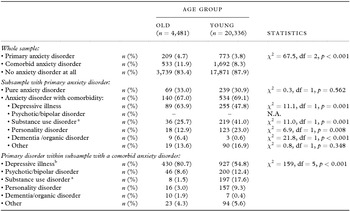
Of the 25,128, data on psychiatric diagnoses were complete for 24,817 patients. In the old age group, 209/4,481 (4.7%) patients suffered from a primary anxiety disorder and 533/4,481 (11.9%) had an anxiety disorder comorbid to another primary diagnosis. These proportions were significantly higher than those in the younger age group (see Table 1). Furthermore, comorbidity with depressive illness was much more frequent in older compared to younger patients; either among those with a primary anxiety disorder as well as among those with a comorbid anxiety disorder.
Proportion of patients who died by suicide by diagnosis, stratified by age (<≥ 60 years)

aIncluding alcohol dependence and/or misuse.
bWhen also patients with a tertiary diagnosis of depressive illness were taken into account, comorbidity with depressive illness rises to 87.4% (466/533) in the older age group and 67.4% (1,141/1,692) in the younger age group (χ 2 = 80.8, df = 1, p < 0.001).
Primary anxiety disorders and suicide
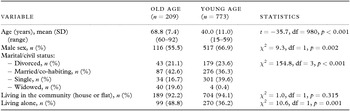
For further exploration of characteristics of suicide in late-life anxiety disorders, all analyses are restricted to those patients with a primary anxiety disorder. Older patients who died by suicide were significantly less often male and more often lived alone in comparison to younger patients (see Table 2). Both age groups further differed with respect to marital status, which was (as expected) driven by a higher proportion of widows in the old age group. Combining “widowed” and “single” patients into one category, both age groups did not differ any more (χ 2 = 2.7, df = 2, p = 0.253).
Socio-demographic characteristics of suicide patients who died by suicide with a primary anxiety disorder, stratified by age (<≥ 60 years)

Subsequent analyses on difference between age groups will be corrected for sex and living arrangement, but not marital status (to avoid collinearity with living arrangement).
Method of suicide
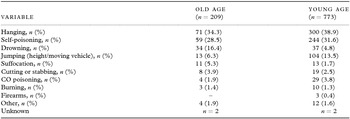
The method of suicide differed significantly between both age groups (χ 2 = 51.4, df = 9, p < 0.001): older patients died significantly more often from drowning and suffocation, and less often from jumping or CO-poisoning (see Table 3).
Method of suicide of patients who died by suicide with a primary anxiety disorder, stratified by age (<≥ 60 years)a

aOverall comparison of older with younger cases showed a significant difference (χ 2 = 51.4, df = 9, p < 0.001).
In case of self-poisoning, the substance taken did not differ between both age groups. Opiates (n = 70, 26.8%), either alone (n = 43, 16.5%) or combined with paracetamol (n = 27, 10.3%) were used most often, followed by antidepressants (n = 68, 26.0%).
Clinical and behavioral characteristics
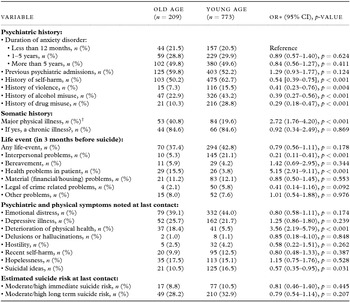
Table 4 presents the clinical and behavioral characteristics. Although, the duration of the anxiety disorder as well as the frequency of previous hospitalizations did not vary between the age groups, older patients had significantly less often a history of self-harm, violence, alcohol misuse and drug misuse compared to younger patients (see Table 4). On the other hand, older patients suffered significantly more often from a (chronic) physical illness.
Clinical and behavioral characteristics of patients who died by suicide with a primary anxiety disorder, stratified by age (<≥ 60 years)

*Adjusted for sex and living arrangements (alone vs. together with others).
†Only available for patients who died by suicide after 2005.
The presence of any life-events in the three months prior to suicide did not differ between both age groups, but there were some differences for specific events. Interpersonal problems were more frequent in the younger age group, whereas health related events were more frequent in the older age group. In line with this, deterioration in physical health status was more frequently noted during the last contact with older patients. The psychiatric symptoms noted within this last contact did not differ between both groups, except for the proportion of patients with documented suicidal ideas, which was significantly lower in the older age group (see Table 4).
Care characteristics
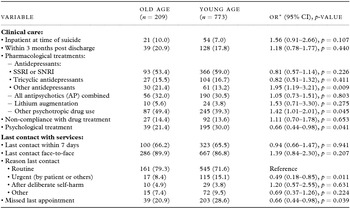
Care characteristics are presented in Table 5. Older patients were significantly more often prescribed psychotropic drugs other than antidepressants, lithium or antipsychotics compared to younger patients, whereas this age group had received psychotherapy significantly less often compared to younger patients.
Care characteristics of patients who died by suicide with a primary anxiety disorder, stratified by age (<≥ 60 years)

*Adjusted for sex and living arrangements (alone vs. together with others).
Discussion
Main findings
The prevalence of anxiety disorders among patients who died by suicide was significantly higher among older compared to younger patients, pointing to the importance of age-effects in mental health pathology in suicide. This age-effect is difficult to explain, but is most likely the result of a “survivor bias.” Among people who ultimately take their own life, those with a high level of impulsivity probably will do so at a relatively young age, whereas anxious people will probably act on any suicidal tendency much later in life when stressors have cumulated (often due to the chronic nature of their anxiety pathology). Nonetheless, other explanations may also hold true, like dissociation from the aging body during severe anxiety states, analogues to a dissociation of the developing body in adolescence described in younger suicidal patients (Orbach et al., Reference Orbach, Stein, Shani-Sela and Har-Even2001).
Although suicide in late-life anxiety should still be considered rare given the high prevalence of late-life anxiety disorders in the community (Beekman et al., Reference Beekman1998; Grenier et al., Reference Grenier2011), 16.6% (742/4,481) of all older patients who died by suicide suffered from an anxiety disorder at the time of death. Nonetheless, the anxiety disorder was considered the primary disorder in only 209 (4.7%) patients of which only 69 (1.5%) patients had “pure anxiety” without any psychiatric comorbidity. Finally, the age-related characteristics found in our study are in line with previous studies of determinants for suicide in old age, like a more prominent role for physical illness, depression, and loneliness. Below all characteristics we found will be discussed in detail.
Suicide characteristics in context
In line with studies on suicide attempts in later life, we found a predominance of male sex (Wiktorsson et al., Reference Wiktorsson, Runeson, Skoog, Ostling and Waern2010) and also that approximately half of the study population lived alone (Fässberg et al., Reference Fässberg2012). Nonetheless, the male-dominance we found in both age groups contrasts with population based findings, which show the prevalence of anxiety disorders in women to be almost double that in men (Grenier et al., Reference Grenier2011). This sex-effect, however, was less pronounced in later life, which may be explained by comorbidity. Compared with younger patients, older patients suffered more often from comorbid depressive illness (which is associated with female sex), whereas younger patients suffered significantly more often from comorbid personality disorders and substance use disorders (which is associated with male sex) (Kessler et al., Reference Kessler, Berglund, Demler, Jin, Merinkangas and Walters2005).
Older people who died by suicide used a variety of methods and hanging, self-poisoning and drowning were most frequent. The latter was more common in the older compared to younger patients. A lower level of impulsivity in later life might explain the relatively low frequency of jumping among older patients compared to younger patients. In our study, we perhaps found indirect evidence for lower impulsivity. Older patients compared to younger patients were less likely to have comorbid psychiatric disorders that are traditionally associated with increased impulsive behavior like substance use disorders and personality disorders (Tamam et al., Reference Tamam, Bican and Keskin2014).
The clinical characteristics of older patients further suggest that in the vast majority of patients the suicide came not completely out of the blue. Half of the patients suffered from anxiety for over five years, 60% had been treated previously as psychiatric inpatients during their lives and also half had a history of deliberate self-harm (including previous suicide attempts). Although these figures imply severe mental illness among older patients with anxiety disorders who died by suicide, compared to younger patients, physical and social characteristics in this cohort are also important. This is reflected in a significantly lower frequency of a history of self-harm, violence, alcohol and drug misuse in older patients compared to younger patients, as well as a significantly higher proportion of patients who lived alone as well as a higher frequency of physical health problems. Previously, it has been demonstrated that several chronic somatic diseases as well as social withdrawal increase the risk of suicide in older persons (Waern et al., Reference Waern, Rubenowitz, Runeson, Skoog, Wilhelmson and Allebeck2002; Fässberg et al., Reference Fässberg2012). In our study, the physical health problems were not simply restricted to major physical illnesses, but also to physical health events experienced as a life-event as well as a significant deterioration of physical health status prior to suicide, suggesting that both objective and subjective experiences of physical health are important (Benyamini et al., Reference Benyamini, Leventhal and Leventhal2004).
Finally, the proportion of older patients that received psychological treatment, often considered the first choice treatment for anxiety disorders, was low (21%) and significantly lower compared to younger patients. Furthermore, nearly all patients received some form of pharmacological treatment and with regards to age differences; older patients were more likely to have been prescribed psychotropic drugs. In light of an increase of adverse effects of psychotropic drugs in later life, as well as a preference of older patients themselves for psychotherapy, these findings are potentially concerning (Oude Voshaar, Reference Oude Voshaar2013). Although a higher level of treatment resistance among older patients might have caused a predominance of pharmacological treatment, this was not reflected by a longer duration of illness compared to the younger patients. It is possible that these findings reflect a form of age discrimination with regards to treatment selection and recommendations for older patients (Spinewine et al., Reference Spinewine2007).
Methodological considerations
Despite a large sample size and almost complete data collection, the findings of this study need to be interpreted in the context of certain methodological issues. First, data collection relies on clinical reports and respondents are not blind to outcome. However, most information is factual and previous studies have shown good reliability and validity of inquiry questionnaire data (Appleby et al., Reference Appleby1999). Second, we cannot make causal inferences, as this study is a survey of the clinical circumstances preceding suicide. An age-matched control group of patients with anxiety disorders who had not died by suicide is needed to study specific suicide risk factors. Finally, our data does not allow comparison of the individual anxiety disorders specified in the ICD or DSM classification systems. Although all anxiety disorders have been associated with suicidality indices (Nock et al., Reference Nock2009; Kanwar et al., Reference Kanwar2013; Thibodeau et al., Reference Thibodeau, Welch, Sareen and Asmundson2013), some studies found solely associations with panic disorder or post-traumatic stress disorder (Sareen et al., Reference Sareen, Houlohan, Cox and Asmundson2005; Nepon et al., Reference Nepon, Belik, Bolton and Sareen2010).
Final conclusion
The proportion of patients with anxiety disorders increases with age among patients who died by suicide. In older age, anxiety disorders are involved in one of six suicide deaths. Our data show that suicide in the presence of late-life anxiety may reflect the severity of underlying mental health problems with a prominent role for late-life depression. Nonetheless, comparison with younger patients shows that in late-life anxiety a deterioration of physical health and social isolation may become relatively more important. Completed suicide is only the tip of the iceberg, with suicidal behaviors and suicidal thoughts much more common in older and younger populations. Compared to younger patients, older patients less often missed their last appointment as well as less often had an urgent reason for their last contact, which stresses the difficulty of identifying older patients at high risk of suicide in daily care. Paying heed to both physical and mental health functioning in older people, as well as offering good access to pharmacological and psychological treatment to frail elderly are likely to be helpful from a preventative perspective. Such initiatives need to be evaluated in future studies of older people with late-life anxiety disorders.
Conflicts of interest
None.
Description of authors’ roles
R. C. Oude Voshaar, D. C. van der Veen, and N. A. Pachana designed the present study; N. Kapur supervised this process and was a principal investigator of the National Confidential Inquiry into Suicide and Homicide by People with Mental Illness. R. C. Oude Voshaar was responsible for the statistical design of the study, for carrying out the statistical analyses and writing the article, the latter in close collaboration with D. C. van der Veen and N. A. Pachana. I. M. Hunt and A. Williams collected the data and all authors assisted in critically revising the article.