1 Setting the scene
Over the last few decades, a growing number of linguists have investigated the role played by processing complexity in shaping grammatical variation and change. This article focuses on two relevant processing principles, the Domain Minimization Principle advanced by Hawkins (e.g. Reference Hawkins1999, Reference Hawkins2004) and the Complexity Principle invoked, for instance, in Rohdenburg (Reference Rohdenburg1996, Reference Rohdenburg2007b), Vosberg (Reference Vosberg2006), Mondorf (Reference Mondorf2009) and Berlage (Reference Berlage2014). The two principles profile entirely different perspectives and, so far, their application has generally involved complementary ranges of phenomena.
Three prominent areas in English analysed in terms of Domain Minimization include the variable placement of the particle with particle verbs (Lohse et al. Reference Lohse, Hawkins and Wasow2004), the spread of gerundives to preverbal position at the expense of infinitives (Fanego Reference Fanego and Hickey2010: 217–20), and the filler–gap domain in extractions, which is reviewed in this study. According to the Domain Minimization Principle, natural languages prefer their processing domains to be as simple as possible both morphosyntactically and semantically.
By contrast, the Complexity Principle represents a correlation between two dimensions, processing complexity and grammatical explicitness, and it has usually been described as follows:
In the case of more or less explicit constructional options, the more explicit one(s) tend to be preferred in cognitively more complex environments.
In other words, if the processing load goes up, so does the degree of grammatical explicitness. The principle covers a great variety of grammatical manifestations of cognitive complexity including those listed in (1).
-
(1)
-
(a) discontinuous structures involving various kinds of insertions (e.g. Fanego Reference Fanego1990: 144–7; Rissanen Reference Rissanen, Aijmer and Altenberg1991; Rohdenburg Reference Rohdenburg1995, Reference Rohdenburg1996, Reference Rohdenburg2003; Vosberg Reference Vosberg2006)
-
(b) voice contrasts (e.g. Rohdenburg Reference Rohdenburg1996, Reference Rohdenburg, Cuyckens and Radden2002)
-
(c) number contrasts (e.g. Rohdenburg Reference Rohdenburg2003)
-
(d) tense contrasts (e.g. Wasserman Reference Wasserman1976; Rohdenburg Reference Rohdenburg2003)
-
(e) subordinate clause negation (Horn Reference Horn and Greenberg1978; Rohdenburg Reference Rohdenburg, Höglund, Rickman, Rudanko and Havu2015)
-
(f) subject complexity (e.g. Quirk Reference Quirk1957; Wasserman Reference Wasserman1976; Rohdenburg Reference Rohdenburg2014)
-
(g) complex objects and other NPs (e.g. Rohdenburg & Schlüter Reference Rohdenburg and Schlüter2000: 446–52; Berlage Reference Berlage2014)
-
(h) the contrast between finite and infinitival interrogative complements (Rohdenburg Reference Rohdenburg2003)
-
(i) post-modification of relevant nouns (including other qualifying elements) (e.g. Rohdenburg Reference Rohdenburg, Cuyckens and Radden2002; Berlage Reference Berlage2014)
-
(j) the length of complement, relative and adverbial clauses (e.g. Quirk Reference Quirk1957: 108; Rohdenburg Reference Rohdenburg1996: 164, Reference Rohdenburg, Kürschner and Rapp2006a: 55)
-
(k) gapping (Postal Reference Postal1974: 129–31)
-
(l) right node raising (Postal Reference Postal1974: 125–9)
-
(m) the rivalry between synthetic and analytic comparatives (Mondorf Reference Mondorf2009)
-
Consider, for instance, the examples in (2), which illustrate constraint (1a). Compared with (2a), (2b) has been made more complex by inserting one of the four types of adverbs ending in -ably, -ally, -antly and -ously between the (intransitively used) verb help and the dependent infinitive.
-
(2)
-
(a) These events helped (to) change her outlook.
-
(b) These events helped dramatically (to) change her outlook.
-
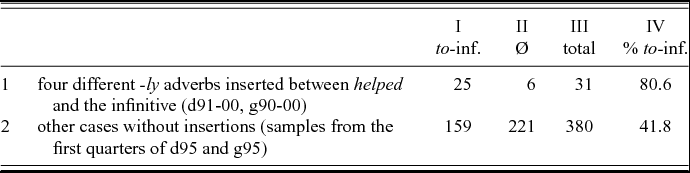
In keeping with the Complexity Principle, the structural discontinuity found in (2b) increases dramatically the proportion of the more explicit marked infinitive, as shown in table 1.
Marked and unmarked infinitives after the intransitively used active verb form helped in British newspapers

In this article, the two processing principles will be put to the test in examples like (3), which represent an infrequent and cognitively demanding kind of environment.
-
(3)
-
(a) They had promised (that) they would tackle/to tackle this problem.
-
(b) This is a problem (which/that) they had promised (that) they would tackle Ø.
-
(c) This is a problem (which/that) they had promised to tackle Ø.
-
Example (3a) illustrates a canonical structure, where the subordinate verb (in they would tackle/to tackle) is followed by its direct object. In (3b, c), however, the direct object has been extracted from its canonical position by means of relativization, thus creating a gap (here indicated by Ø). In the relevant literature, the distance between the relative marker (which, that or zero) and the (canonical) site of the relativized element is usually described as a filler–gap domain. Examples such as (3b, c), where a postverbal element of the subordinate clause has been moved across the superordinate clause, contain unusually lengthy filler–gap domains and there is a general consensus that they are extremely complex structures to process (see e.g. Hawkins Reference Hawkins1999, Reference Hawkins2004).
In line with Domain Minimization, Hawkins (Reference Hawkins1999) demonstrates that English and various other languages display similar tendencies to minimize the size and complexity of this particular domain, and he proposes the following implicational scale for gaps in clause embeddings for English and, in fact, for all natural languages:
It appears that infinitival phrases are most hospitable to gaps, that finite subordinate clauses are more resistant, while complex NP environments are most resistant of all. (Hawkins Reference Hawkins1999: 263; see also Hawkins Reference Hawkins2004: 193ff.)
In English, for instance, the contrast between complex NP environments and straightforward (finite) embedded clauses is evidenced in (4a, b) and that between finite and infinitival complements in examples like (5a, b).Footnote 1
-
(4)
-
(a) *Who did you hear the rumor [sic] that Mary saw? (Hawkins Reference Hawkins1999: 267)
-
(b) Who did you hear that Mary saw? (ibid.)
-
-
(5)
-
(a) *This is a task we do not know how we should deal with. (adapted from Hawkins Reference Hawkins1999: 269; Reference Hawkins2004: 198)
-
(b) This is a task we do not know how to deal with. (ibid.)
-
Note that the examples in (5) are even more complex than those in (3b–c): there are two gaps rather than just one. So (5a, b) certainly prove Hawkins’ point. By contrast, the Complexity Principle would have the extraction contexts favouring the more explicit finite option. To that extent, it makes the wrong prediction in cases like (5). Moreover, the Complexity Principle, which focuses on possible variants in a given language rather than strictly excluded ones, has so far not concerned itself with contrasts like (4a, b). At this point it may be appropriate to reformulate the fundamental question to be posed with respect to the grammatical variants associated with (cognitively complex) extraction contexts: which of the variants is favoured in such environments, the morphosyntactically less complex one(s) (as stipulated by Domain Minimization) or the more explicit and typically more bulky one(s) (as predicted by the Complexity Principle)?
The database used for this study consists of several years of British and American newspapers (including Time Magazine) from the 1990s and early 2000s, the BNC, and a sizeable collection of historical data sets provided by Chadwyck-Healey and the Gutenberg project (see the bibliography for further details). Concerning the corpus analyses conducted, a few methodological remarks may be in order: While the focus is on British English (BrE), explorations concerning American English have usually been included only to increase the database or to draw attention to additional insights. In the case of rival complement options involving second and successive conjuncts, all analyses have been confined to the first in a series of conjuncts. The category of extractions generally disregards any examples of the fronting of direct speech and quoted thought. For reasons of both economy and homogeneity, the search procedures adopted have been restricted in a wide variety of ways. In addition, in terms of size and text type, the data sets have generally been selected to suit the purpose in question as far as possible.
Throughout, any detected duplicates and quotations from earlier periods than the (presumed) year of publication of the source in question have been excluded from consideration. The asterisk is used not only to refer to expressions found to be unacceptable but also to indicate the time span during which the authors concerned were born. Three levels of statistical significance will be distinguished: significant (p < 0.05 or p < 0.025), highly significant (p < 0.01) and extremely significant (p < 0.001). In the majority of sufficiently large samples, the figures compared reach significance levels ranging from p < 0.01 to p < 0.001. Therefore, explicit mention of the significance levels in question will usually be made only for tables containing what might appear to be doubtful cases.
The remainder of this article is organized as follows. Following up on examples (3)–(5), section 2 provides a brief survey of further acceptability-based findings. Section 3 goes on to analyse a novel range of complement pairs. Here, the argumentation will be supported throughout by distributional differences discovered in large electronically available databases (see the bibliography). In keeping with the Performance-Grammar-Correspondence Hypothesis (see Hawkins Reference Hawkins2004: 3), the expectation is that the kinds of contrast predicted by the two processing principles should be reflected in text-distributional preferences. Section 4 provides a summary of major findings and some further discussion.
2 A survey of previous acceptability-based findings
2.1 Finite clauses
The literature refers to three additional complement pairs involving finite complement clauses whose behaviour clearly supports Domain Minimization. They will be presented in turn.
Let us begin by taking a brief look at verbs complemented by that-clauses. On the basis of examples like (6a, b), Culicover (Reference Culicover1999: 214–15) concludes that finite clauses with the complementizer that are more difficult to extract out of than those without.
-
(6)
-
(a) *What book did Lee remark that you were reading. (Culicover Reference Culicover1999: 214)
-
(b) What book does Lee believe you were reading? (ibid.)
-
The conclusion is based on the following observation: while verbs such as believe, which potentially omit the complementizer, invariably permit the objects of their complement clauses to be extracted in cases like (6b), only some of the verbs that cannot drop the complementizer allow this procedure to be applied.
Next we turn to the so-called phenomenon of subject-to-object raising (or AcI) in contrasting examples like (7a, b), which have been discussed by a succession of linguists since Postal (Reference Postal1974).Footnote 2
-
(7)
-
(a) *They alleged Melvin to be a fraud.
-
(b) This is the man (that) they alleged to be a fraud.
-
Such examples demonstrate that – unlike their finite rivals in (8a, b) – the status of infinitival subject-to-object raising structures may be improved substantially in extraction contexts like (7b).
-
(8)
-
(a) They alleged that Melvin was a fraud.
-
(b) This is the man (that) they alleged was a fraud.
-
Finally, this brings us to so-called tough-movement structures like (9a, b) and (10a, b) discussed amongst others by Berman (Reference Berman1973: 43), Ross (Reference Ross, Weimer and Palermo1974: 117) and Joseph (Reference Joseph1980: 361).
-
(9)
-
(a) *That ring is difficult to believe (that) Jack stole.
-
(b) That ring is difficult to believe Jack to have stolen.
-
-
(10)
-
(a) *The car would be tough for me to suggest (that) we should leave at home.
-
(b) The car would be tough for me to suggest leaving at home.
-
Let us assume, as is commonly done in the literature on tough-movement (see e.g. Ross Reference Ross, Weimer and Palermo1974: 17), that in cases like (9) and (10) the subject expressions the ring and the car have been extracted out of the complements of the verbs believe and suggest, respectively. On this assumption, these examples leave no doubt that – in line with Domain Minimization – non-finite complements, both infinitives and gerunds, are easier to extract out of than their finite counterparts.
2.2 Gerunds
It has occasionally been observed that – compared with contextually (near-)equivalent gerunds – specific infinitival complements may be strikingly improved in extraction contexts. Following Vosberg (e.g. Reference Vosberg2006) and Fanego (e.g. Reference Fanego, Pérez-Guerra, González-Alvarez, Bueno-Alonso and Rama-Martínez2007), I am assuming here that marked infinitives constitute more explicit grammatical structures than their gerundial counterparts. In addition, their morphosyntactic structure is, if anything, more complex than that of rivalling gerunds. The contrast between the two non-finite options will be discussed more fully in section 3.2 below.
In an article on comparatives, Pilch (Reference Pilch1965: 51) observed the acceptability contrasts shown in (11a–c).
-
(11)
-
(a) *I cannot stand him to be nasty.
-
(b) I cannot stand his being nasty.
-
(c) He is nastier than I can stand him to be.
-
It is evident that – unlike its gerundial counterpart – the acceptability of the object–infinitive construction, which may be treated as a manifestation of S-O Raising, is enhanced dramatically in extraction contexts like (11c). However, what Pilch failed to mention is the fact that the object–infinitive construction like many other examples of S-O Raising (see (7a, b), (8a, b) above or (14), (19), (20) and table 3 below), may also be improved by other kinds of extraction. Compare, for instance:
-
(12)
-
(a) (?)They cannot stand this chap to be in charge.
-
(b) They cannot stand this chap being in charge.
-
(c) This is the chap they cannot stand to be/being in charge.
-
Similar observations have been made concerning examples like (13), which may involve unspecified object control with one or two directive verbs such as advise (Rohdenburg Reference Rohdenburg2005).
-
(13)
-
(a) (?)We advise to bring lifebelts along.
-
(b) We advise bringing lifebelts along.
-
(c) Lifebelts are among the items we advise to bring along.
-
(d) Lifebelts are among the items we advise bringing along.
-
Given that – in the cases surveyed – the infinitival structures are more explicit (and presumably also more complex in terms of grammatical nodes) than their gerundial counterparts, neither phenomenon can be handled in terms of Domain Minimization. They are, however, captured by the Complexity Principle.
2.3 Infinitival clauses
There are two further constructional rivals of subject-to-object raising structures featuring the string to be. In the first case, the sequence object + infinitive contrasts with its corresponding object predicative, its counterpart lacking to be as in (14) (see Quirk et al. Reference Quirk, Greenbaum, Leech and Svartvik1972: 900).Footnote 3
-
(14)
-
(a) ? We thought the boy to be honest.
-
(b) We thought the boy honest.
-
(c) The boy (that) we thought (to be) honest.
-
Similar contrasts are found in English with several object predicatives introduced by as and corresponding raising structures as in regard x as y vs regard x to be y or represent x as y vs represent x to be y.
In the second case, the raising structure is contrasted with the for-to construction as in (15).
-
(15)
-
(a) He had asked for/*∅ the furniture to be removed. (Christian Mair p.c.; Rohdenburg Reference Rohdenburg2005)
-
(b) Is that the furniture he had asked (for) to be removed? (ibid.)
-
With both types of contrast, the acceptability of the string object + to be is definitely enhanced in extraction contexts. In (14), the raising construction is both more complex morphosyntactically and more explicit than the competing object predicative. While the situation is incompatible with Domain Minimization, it is captured by the Complexity Principle. In (15), by contrast, it is only the shorter alternative without for that has dramatically improved its acceptability status in the extraction context. This behaviour fully conforms to Domain Minimization. Concerning the Complexity Principle, however, it would not be reasonable to argue that the (shorter) raising structure was any more explicit than its corresponding for-to construction. If anything, we have to assume the reverse to be true. As is well known, the complementizer for in (15) still preserves a lingering semantic and syntactic relationship with its prepositional source as in (16).
-
(16) He had asked for the removal of the furniture.
To that extent, the variant including for could be regarded as a more explicit option than its simpler counterpart. This means that (15b) contradicts the Complexity Principle: Crucially, it is the shorter and less explicit option whose acceptability is enhanced in the extraction context.
3 Corpus data
3.1 Finite clauses
Let us begin by revisiting two constraints mentioned earlier on. In the first case, we are comparing finite and infinitival complements of the verb rejoice as in (17) and (18) in a Late Modern English database.Footnote 4
-
(17)
-
(a) My daughter rejoiced that she had passed her exam.
-
(b) My daughter rejoiced to have passed her exam.
-
-
(18)
-
(a) That is the exam my daughter rejoiced (that) she had passed.
-
(b) That is the exam my daughter rejoiced to have passed.
-
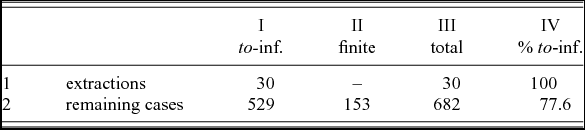
Since the implied subject of the infinitival complement is necessarily coreferential with the subject of the superordinate clause, the finite complements had to be similarly restricted. To be able to compare like with like, the analysis considers only those examples where the (explicit) subject of the finite that-clause complement also stands in a relation of coreference with the subject of the superordinate clause. The results of this comparison are found in table 2. Clearly, at p < 0.01, the corpus data corroborate the acceptability-based contrast seen in examples (5a, b) above: The marked infinitive is easier to extract out of than the finite clause.
Infinitival and finite that-clause complements after rejoice in Late Modern English corpora (ECF, NCF, EAF)

The second type of contrast features finite clauses and subject-to-object raising structures associated with verbs like believe as in examples (19) and (20).
-
(19)
-
(a) She still believes (that) the statement is true.
-
(b) She still believes the statement to be true.
-
-
(20)
-
(a) This is the statement (that) she still believes is true.
-
(b) This is the statement (that) she still believes to be true.
-
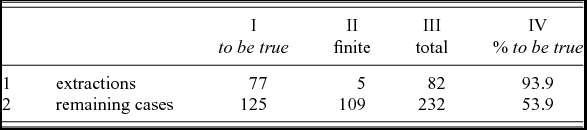
Here the contrast seen in examples (7) and (8) above, which favours the sequence object + to-infinitive in extractions, is clearly confirmed (at p < 0.001) in table 3.
S-O Raising (. . . to be true) and finite complements (. . . is/are/was/were true) after believes/believed in British newspapers (t90–04, g90–05, d91–00, d02, d04–05, i93–94, i02–05, m93–00)

This brings us to a novel type of contrast, which involves directive verbs like recommend associated with the subjunctive and the rivalling modal structure represented by should. In order to make sure that we retrieve unambiguous and relatively common subjunctive predicates, we are comparing examples containing be-passives as in (21a, b).
-
(21)
-
(a) We recommended (that) they (should) be selected for the job.
-
(b) They were the people (that) we recommended (should) be selected for the job.
-
I take it that for a number of reasons set out in Rohdenburg (Reference Rohdenburg, Höglund, Rickman, Rudanko and Havu2015: 113–15) the subjunctive provides a (morphosyntactically) less complex and less explicit structure than its modal alternative. These arguments include the following:
-
1. Unlike the subjunctive, which shares its form with the imperative, the infinitive and finite verbs, the should-structure unambiguously represents a finite form.
-
2. The subjunctive behaves syntactically like a reduced form of the should-structure in at least two respects: not-negation does not trigger do-support, and the negator occupies the position it has in the corresponding modal alternative (see also Kjellmer Reference Kjellmer, Rohdenburg and Schlüter2009).
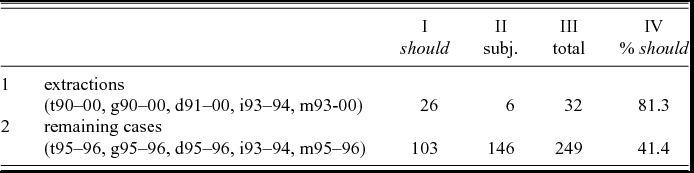
Turning now to the corpus analysis in table 4, we find that – contrary to Domain Minimization and in line with the Complexity Principle – it is the more complex and explicit modal variant that shows a special affinity for extraction contexts.
should + infinitive and the subjunctive in passive complements after recommend in British newspapers

Note: In order to compare like with like, any examples involving no/not-negation in the complement have been discarded, since they represent another complex environment (Rohdenburg Reference Rohdenburg, Höglund, Rickman, Rudanko and Havu2015).
3.2 Gerunds
This section begins by contrasting gerunds and marked infinitives. The gerunds may be directly linked to their governing predicates as in (22) or they may involve various prepositions as in (23).
-
(22)
-
(a) It was a scene which he had dreaded to see.
-
(b) It was a scene which he had dreaded seeing.
-
-
(23)
-
(a) The projects that they were committed to support . . .
-
(b) The projects that they were committed to supporting . . .
-
In terms of grammatical complexity, the competing options in cases like (23) may seem to defy any straightforward ranking. However, a number of arguments presented by Vosberg (Reference Vosberg2003a, Reference Vosberg2006) and Fanego (Reference Fanego, Pérez-Guerra, González-Alvarez, Bueno-Alonso and Rama-Martínez2007: 213–21) suggest that the marked infinitive represents a more explicit clausal complement than the gerund. The arguments in support of this assessment include the following:
-
1. Unlike infinitives, gerunds stand in a paradigmatic relationship with (not necessarily synonymous) noun phrases, which underlines their lingering nominal orientation. Note furthermore that, in general, the choice of the gerund rather than the infinitive tends to correlate with a given verb's affinity for nominal complements (see e.g. Kjellmer Reference Kjellmer, Allwood and Ljung1980; De Smet Reference De Smet2010, Reference De Smet2012: 219, 254ff.).
-
2. The cue validity of gerunds is comparatively low, in particular in extraction contexts where they occur in clause-final position (concerning the notion of cue validity, see e.g. MacWhinney et al. Reference MacWhinney, Pléh and Bates1985). Unlike the marked infinitive, which immediately signals its verbal function, the recognition of the gerund as a clausal complement is more highly dependent on (the adjacency of) a governing verb and its characteristic nominal complements and adjuncts.
-
3. Previous explorations have shown that – compared with all kinds of gerunds – the marked infinitive displays a special affinity for some of the complexity factors listed in (1) above, including the use of insertions (see, in particular, Vosberg Reference Vosberg2006) and complement negation (Rohdenburg Reference Rohdenburg, Höglund, Rickman, Rudanko and Havu2015). Crucially, these complications favour the choice of several clearly more explicit types of subordinate clause over less explicit ones, replacing, for instance, the marked infinitive by the that-clause or finite clauses involving the subjunctive by those containing should + infinitive (as shown in the preceding section).
Thus it is reasonable to assume that the marked infinitive represents a more explicit clausal structure than the gerund. In line with the Complexity Principle, Vosberg (Reference Vosberg2003a, Reference Vosbergb, Reference Vosberg2006) and Rohdenburg (Reference Rohdenburg, Dalton-Puffer, Kastovsky, Ritt and Schendl2006b: 153–5, Reference Rohdenburg, Hundt, Biewer and Nesselhauf2007a: 197–9, Reference Rohdenburg2007b: 228–31) have shown in various corpus analyses that all kinds of gerunds are more difficult to extract out of than corresponding marked infinitives. Additional evidence supporting these findings is presented in table 5, dealing with directly linked gerunds after the verb dread as in examples (22a, b) above and tables 6 and 7, which present a selection of cases involving a prepositional linkage. Let us now consider these analyses in some more detail.
Marked infinitives and directly linked gerunds after dread in British newspapers (t90–01, g90–00, d91–00, m93–00) and the BNC)Footnote 5

Marked infinitives and prepositional gerunds after two verb–object collocations and two adjectives (used non-attributively) in British databases

Note: Examples involving adjectives premodified by too as in too proud, which invariably select the infinitive, have been excluded from consideration.
Marked infinitives and prepositional gerunds after accustomed in British newspapers (d91–98, m93–00), the BNC, LOB and FLOB

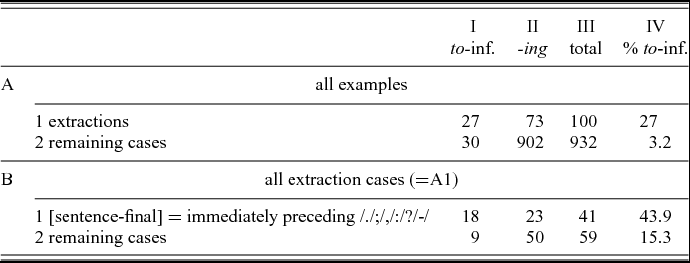
Like many other verbs, dread has generally replaced infinitival complements with gerunds. Table 5 shows that, in straightforward environments, the infinitive is used today in a measly 3 per cent of all cases. By contrast, in extraction contexts, it still accounts for over a quarter of all examples. At p < 0.001, the figures in rows A1 and A2 are extremely significant. Following a lead given by Bolinger (Reference Bolinger, Allerton, Carney and Holdcroft1979), the 100 extraction cases have been subjected to a closer analysis. Here, a distinction is drawn between non-finite verbs occurring in sentence-final position and elsewhere. We can see at a glance that the advance of the gerund has been delayed to a strikingly greater extent in sentence-final position than in all other environments. This confirms Bolinger's assumption that sentence-final position is least compatible with gerunds, but it also suggests that the distribution of the gerund and the infinitive in extractions might to some extent be motivated by other factors than processing complexity. Crucially, however, even the occurrence of extraction gaps in other than sentence-final position (=B2) provides an extremely significant contrast with the remaining canonical examples (=A2) (at p < 0.001).
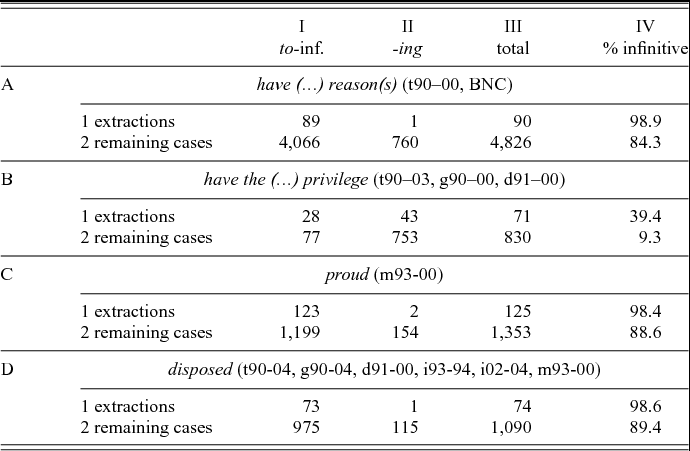
The rivalry between the marked infinitives and prepositional gerunds is presented in tables 6 and 7. The predicates dealt with in table 6 are illustrated in examples (24)–(27). They involve two verb–noun collocations and two adjectives.
-
(24)
-
(a) They have a very good reason to ignore/for ignoring that event.
-
(b) The event that we have a very good reason to ignore/for ignoring . . .
-
-
(25)
-
(a) Some of us had the privilege to experience/of experiencing that event.
-
(b) The event some of us had the privilege to experience/of experiencing . . .
-
-
(26)
-
(a) She was proud to have seen/of having seen that match.
-
(b) The match that she was proud to have seen/of having seen . . .
-
-
(27)
-
(a) He was disposed to support/to supporting the project.
-
(b) The project he was disposed to support/to supporting/toward(s) supporting.
-
Again, the analyses distinguish between two kinds of contrasting structures, extraction contexts and all remaining environments. Paralleling the findings of e.g. Vosberg (Reference Vosberg2003a, Reference Vosberg2006) and Rohdenburg (Reference Rohdenburg, Hundt, Biewer and Nesselhauf2007a, Reference Rohdenburgb), the results leave no doubt that in every single case the marked infinitive is proportionally more common in extractions than elsewhere. While the figures for the contrasting environments are extremely significant in A–C, those in D reach only the basic level of significance at p < 0.025.
This brings us to table 7, which deals only with the adjective accustomed as illustrated in (28).
-
(28)
-
(a) We are accustomed to make/making these distinctions.
-
(b) The distinctions we are accustomed to make/making . . .
-
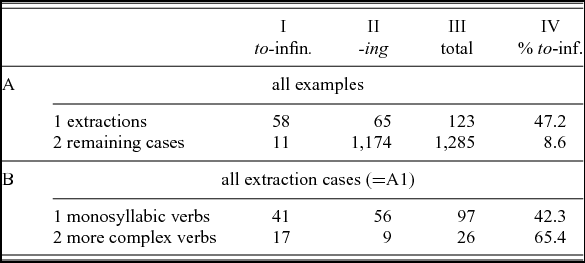
We know that after accustomed the infinitive has been largely replaced by the gerund (see e.g. Rudanko Reference Rudanko1999: 9–10, Reference Rudanko2000: 90–1, Reference Rudanko, Lenker, Huber and Mailhammer2010; Vosberg Reference Vosberg2006: 238–44; Rohdenburg Reference Rohdenburg, Dalton-Puffer, Kastovsky, Ritt and Schendl2006b: 153–5). Not surprisingly, the data in rows A1–2 of table 7 show that the replacement process is less far advanced in extraction contexts, thus confirming previous conclusions. Consider now in rows B1–2 the more detailed analysis carried out on the 123 extraction cases. According to Zipf (Reference Zipf1935), the length and complexity of a given expression is in general positively correlated with its semantic specificity and negatively correlated with its frequency of occurrence. In line with Zipf's prediction and Vosberg's in depth analysis, the data in rows B1–2 reveal that the replacement process has been delayed, in particular, with those subordinate verbs that are more complex phonologically and (most likely) also semantically and which can be assumed to be difficult to process. The figures in B1–2 are significant at p < 0.025.
We turn next to the contextually equivalent types of constructions in (29) and (30), which will be referred to as help -ing and help but.
-
(29)
-
(a) They could not help criticizing the project.
-
(b) They could not help but criticize the project.
-
-
(30)
-
(a) This is a project (that) they could not help criticizing.
-
(b) This is a project (that) they could not help but criticize.
-
I take it that – for a number of reasons put forward in Rohdenburg (Reference Rohdenburg, Hasselgård, Ebeling and Oksefjell Ebeling2013) – help but represents a more explicit structure than help -ing. In addition to those associated with the nominal character of gerunds mentioned above, they include the following:
-
1. Corpus analyses have shown that help but is attracted to several secondary, derived or more complex clause types including the use of inanimate subjects of the superordinate predicate and the use of the passive and/or perfect of the dependent verb phrase.
-
2. Unlike help -ing, help but is invariably associated with a verbal item, which selects the same range of complements or adjuncts as other verb forms. In addition, the verb stem after help but alternates occasionally with the marked infinitive, which confirms its status as a bare infinitive.
-
3. Moreover, the use of but in the sense of ‘except’ reinforces or clarifies the semantic orientation of the complex help + dependent clause. The situation is paralleled by that of prevent s.o. (from) -ing in British English, where the optional use of from helps to clarify the semantics of the overall construction.
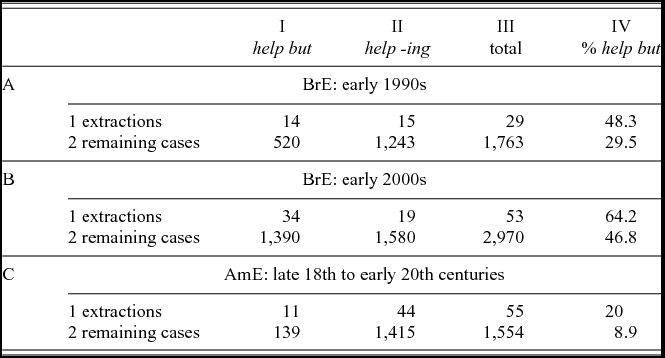
On the basis of the evidence in table 8, we can assume that help but, which we regard as more explicit than help -ing, has always been more strongly attracted to extraction contexts than its gerundial rival. The three analyses reach the following levels of statistical significance: p < 0.025 in A, p < 0.01 in B and p < 0.05 in C. In any case, since the filler–gap domain of help -ing is shorter than that of help but, both the historical and present-day data fail to accord with the prediction of Domain Minimization.
The rivalry between help but and help -ing in British newspapers of the early 1990s and early 2000s and a series of American fictional databases of the eighteenth and nineteenth centuries: t90–91, g90–91, d91–92, d94–95, m94–95; t03–04, g04–05, d04–05; AD (*1750–*1849), EAF (*1750–*1827), LNC/A (*1860–*1869), ETC/A (*1870–*1894)

The following pair of complements involves two different kinds of contextually equivalent gerunds: perfective and non-perfective gerunds after retrospective verbs. Here, simple (non-perfective) and complex perfective gerunds as in (31a, b) have ousted the earlier perfective infinitive as in (31c).
-
(31)
-
(a) I remember/recollect meeting her sister before.
-
(b) I remember/recollect having met her sister before.
-
(c) *I remember/recollect to have met her sister before.
-
Vosberg (Reference Vosberg2003a: 308–11, Reference Vosberg2006) has shown that – while it was current – the perfective infinitive used to be preferred in extraction contexts over both types of gerunds. Whereas this observation is incompatible with Domain Minimization, it is accounted for by the Complexity Principle. Concerning the two types of gerunds themselves, it is obvious that, with retrospective verbs and backward looking gerunds, the perfective gerund should be regarded as the more explicit of the two. Now Vosberg (Reference Vosberg2003a: 311–12, Reference Vosberg2006: 180, 201) finds that with both remember and recollect it is the perfective variant that seems to have always displayed a special affinity for extraction contexts as in (32). Again, Domain Minimization fails to account for the fact that the shorter variant is, relatively speaking, less common in such environments.
-
(32) This is the girl I remember/recollect having met before.
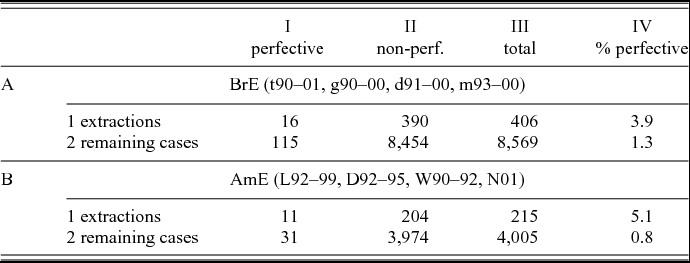
In the meantime, I have conducted several companion analyses involving admit, recall and remember in a large newspaper collection from the 1990s and the early 2000s. Even if the proportion of the perfective variant is very low, the contrast between the two rival options seen in Vosberg's (Reference Vosberg2006) mainly historical work still remains visible in large newspaper databases. Compare, for example, the evidence for recall in British English in table 9 and that for remember in table 10 for British and American English. With both verbs, and unlike Vosberg's more comprehensive analyses, the category of extractions has been confined to the relativization of direct objects as illustrated for the perfective gerund in example (32) above. Accordingly, the category of the remaining gerunds not involving extractions is also represented by verbs governing direct objects as shown in (31a, b). Furthermore, the totals for the non-perfective gerunds have been estimated on the basis of the attested examples in representative samples of the overall databases used. Due to the large number of examples involved, the figures in all three analyses are extremely significant at p < 0.001, thus supporting the earlier observations made by Vosberg (Reference Vosberg2003a, Reference Vosberg2006).
Perfective and non-perfective gerunds after recall in British newspapers (t90–00, g90–00, d91–00, m93–00)

Note: The database for the non-perfective gerunds in column II comprises the following samples: the first quarters from t93, g93, d03, m93, t98, g98, m98, and the first and second quarters from d98.
Perfective and non-perfective gerunds after remember in British and American newspapers

Note: The databases analysed for the non-perfective gerunds are as follows. BrE: first quarters of t95, g95, d95 and m95; AmE: L99, D95, W91 (excluding the supplement Insight on the News) and the first two quarters of N01.
3.3 Infinitival clauses
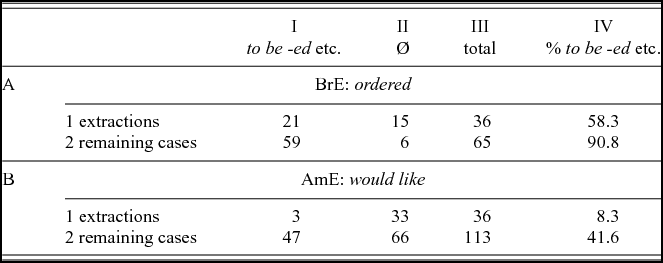
There are two remaining pairs of complements contrasting marked infinitives with related structures. The first pair contrasts passive raising structures after the directive predicates ordered and would like as in (33) with their counterparts lacking to be.
-
(33)
-
(a) We ordered/would like the horse (to be) dope tested.
-
(b) This is the horse we ordered/would like (to be) dope tested.
-
Intriguingly, examples like (33) behave very differently from those in (14) above. With both predicates in (33), the frequency of the shorter and less explicit variant involving to be-deletion is clearly increased in extraction contexts over its more complex and explicit counterpart. Compare the evidence in table 11, which – running counter to the Complexity Principle – conforms to the prediction of Domain Minimization.
Passive raising structures after ordered and would like and their reduced variants lacking to be in British and American newspapers (ordered in BrE: t90–00, g90–00, d91–00, i93–94; would like in AmE: L92–94, D92–95, W90–92, N01)

The second pair of complements compares marked and unmarked infinitives as illustrated in (34).
-
(34)
-
(a) He helped/had helped (to) establish the system.
-
(b) This is the system he helped/had helped (to) establish.
-
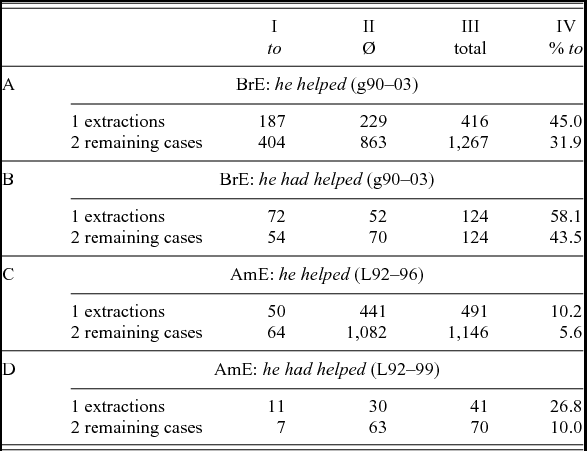
The more explicit type including the infinitive marker is at present being replaced by the less explicit variant, with American English spearheading the change. As has been shown in a number of studies, several of the complexity factors mentioned in list (1) above, such as object complexity or complement negation (see Berlage Reference Berlage2014: 196–230; Rohdenburg Reference Rohdenburg, Höglund, Rickman, Rudanko and Havu2015: 111), tend to slow down the erosion of the infinitive marker in both transitive and intransitive uses of help. However, for the sake of convenience, this article is exclusively concerned with intransitively used help governing transitive verbs like establish as shown in examples (34a–b). Concerning extractions as in (34b), Domain Minimization predicts that the unmarked infinitive should be favoured over the more complex marked infinitive.
Consider now the large-scale investigation summarized in table 12, which deals with two superordinate phrases, he helped and he had helped in the Los Angeles Times and the Guardian. Allowing for the fact that American English appears to be much further advanced in this area than British English, it is seen that both varieties display the same general tendency, which is diametrically opposed to Domain Minimization.Footnote 6 Throughout, and in line with the Complexity Principle, the more explicit marked infinitive is proportionally used more frequently in extraction contexts than elsewhere. While the figures in analyses A and C are extremely significant at p < 0.001, those for B and D only reach the basic level of significance at p < 0.025.
Marked and unmarked infinitives of transitive verbs after intransitive help in British and American newspapers

4 Conclusion
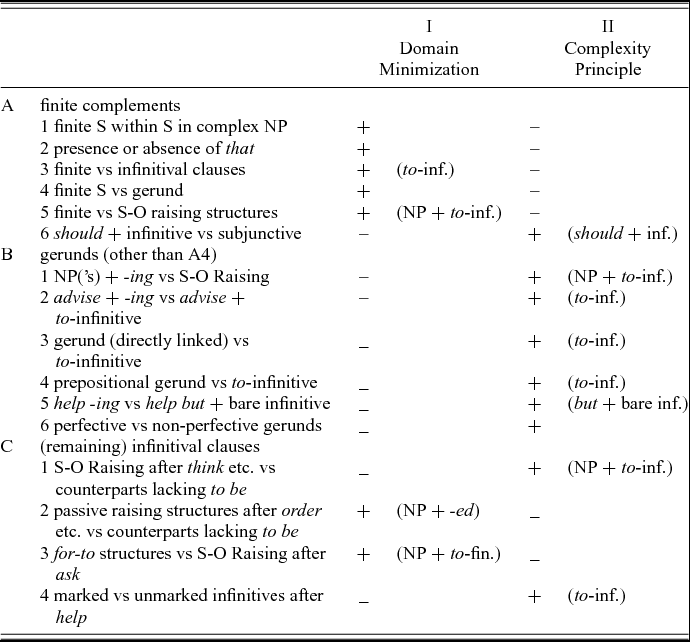
This article has surveyed – in both canonical environments and non-canonical extraction contexts – a total of sixteen complement pairs (including one or two variants). The overview in table 13 identifies seven cases that are handled only by the Domain Minimization Principle and nine others that are only accounted for by the Complexity Principle.
Overview of competing complement clauses in extraction contexts

Thus the visible effects of the two principles are found in virtually non-overlapping ranges of application. It would follow that we cannot dispense with the basic insights afforded by either principle.
For the sake of clarity, the sixteen contrasting pairs in table 13 have been subdivided into three groups, A, B, and C. Group A is confined to finite complements, which are paired with (a) three other finites (A1, A2, and A6) and (b) three non-finites (A3, A4 and A5). Group B contrasts the remaining gerunds with infinitival constructions. Group C contains the remaining infinitival constructions, which are paired with (a) other infinitival structures and (b) reduced structures involving to-be deletion.
Since, strictly speaking, A1 does not feature two constructional variants, it falls outside the domain dealt with by the Complexity Principle. This is why it will also be excluded from further consideration. Of the remaining five pairs of complements in group A, the first four run counter to the predictions of the Complexity Principle. They do, however, behave as predicted by Domain Minimization. Notice that in A2 one of these pairs features finite complements with or without the complementizer that. By contrast, A6, the only other pair consisting of two finite complements, shows a behaviour that is only captured by the Complexity Principle. This leaves us wondering what motivates the different behaviour of A2 and A6. Could it be that – apart from increasing the length of the filler–gap domain – the complementizer plays a decisive role in clearly separating the complement from the superordinate clause?
Concerning five of the gerunds in B paired with infinitival structures, we can say that the less explicit gerund is outranked in extraction contexts by two more explicit and morphosyntactically more complex types, (a) the marked infinitive (preceded by an NP in B1) and (b) the combination consisting of but + bare infinitive. Furthermore, in the pair opposing two different gerunds (B6), it is the more formally complex and explicit perfective gerund that is favoured over the much more common non-perfective type.
Turning now to group C, we find that, in each subgroup mentioned above, one of the contrasts is only accounted for by the Complexity Principle while the other conforms only to Domain Minimization. Again we are left to speculate as to what motivates the contrasting behaviour of C1–2 and C3–4. Could it be, for instance, that – in parallel with that in A2 – the demarcating function of the complementizer for is responsible for disfavouring the extraction context? While the reduced constructions with verbs like think in C1 are typically confined to stative and non-future predicates, those of verbs like order in C2 tend to involve non-stative and future predicates. Moreover, apart from the occasional use of adverbs like out, reduced structures after order are typically confined to passive uses of the perfect participle. Thus the clear-cut preference for to be-deletion in passive raising structures after directive predicates might be partially explained by their unusually high cue validity.
We have seen, then, that the marked infinitive, on its own or with an associated NP in raising structures, enjoys a privileged or target status in extraction contexts. Conforming, as it were, to Domain Minimization, it outranks finite clauses and for-to structures, but conforming, as it were, to the Complexity Principle, it also outranks all kinds of gerunds, the unmarked infinitive (after help) and object predicatives or reduced raising structures involving to be-deletion – in C1 – after verbs like think. The special role played by the marked infinitive may be due to the fact that it represents a good compromise in a hypothetical trade-off between Domain Minimization and the Complexity Principle: it is neither a very complex morphosyntactic structure nor an overly inexplicit one. For instance, with the prominent subject-to-object raising verbs, the verbs of knowing, thinking and saying, the marked infinitive in S-O raising structures is preferred over both the finite clause, which is structurally too complex, and the object predicative (produced by to be-deletion), which is less explicit.
Let us briefly return to those pairs of complements where – in extraction contexts – Domain Minimization wins out over the Complexity Principle. Here, it should be pointed out that with other complexities (such as discontinuities, complement negation, and passivization) we can expect the usual alignment of the more complex environment with the more explicit variant to reassert itself. This is the case, for instance, with the following pairs of complements:
-
– that-clauses with or without the complementizer (e.g. Wasserman Reference Wasserman1976; Fanego Reference Fanego1990: 144–7; Rissanen Reference Rissanen, Aijmer and Altenberg1991).
-
– that-clauses contrasting with marked infinitives or gerunds (e.g. Vosberg Reference Vosberg2006; Rohdenburg Reference Rohdenburg, Höglund, Rickman, Rudanko and Havu2015).
-
– for-to structures contrasting with subject-to-object raising ones (e.g. Postal Reference Postal1974).
Furthermore, as is suggested by the analysis of accustomed in section 3.2, the processing of the filler–gap domain is not just a syntactic issue. According to Hawkins (Reference Hawkins1999: 271ff), the human processor also prefers to minimize the semantic information that needs to be processed in a filler–gap domain. However, what still has to be explained is why this tendency should affect gerunds so much more strongly than marked infinitives. And we also need to account for the fact – shown in the case of the verb dread in section 3.2 – that gerunds are most strongly objected to in sentence-final position. Could it be, as suggested by Bolinger (Reference Bolinger, Allerton, Carney and Holdcroft1979), that prosodic prominence in final position has the effect of further weakening an already weak structural choice?
In addition, there are still a few contrasts left in the area of clausal complementation that have yet to be sorted out. They include prepositional vs directly linked gerunds as in (35) and marked infinitives vs pseudo-coordinated structures as in (36).
-
(35)
-
(a) They had difficulty (in) coming to grips with that problem.
-
(b) Lack of time prevented him (from) finishing the job.
-
-
(36) You should try to/and meet the deadline.
In (35), the prepositional gerunds clearly represent the more explicit grammatical alternatives. However, the situation in (36) is less straightforward. While the rival options appear to be equally complex in terms of grammatical nodes, the marked infinitive has been shown to constitute the more explicit structure (see Rohdenburg Reference Rohdenburg, Höglund, Rickman, Rudanko and Havu2015: 112–13). In both cases, then, it is the more explicit rivals that – according to the Complexity Principle – should be favoured in relevant extraction contexts. By contrast, Domain Minimization could be expected to favour extractions out of directly linked gerunds over prepositional ones in (35), while having to leave open the case of extractions out of the complements in (36). Finally, going beyond the area of complement clauses, we may encounter similar contrasts with extractions out of more or less complex and explicit purpose clauses such as (37a, b).
-
(37)
-
(a) ? He is the sort of player most clubs go out of their way in order/so as to attract.
-
(b) He is the sort of player most clubs go out of their way to attract.
-
The rivalry between cases like these would appear to be captured by Domain Minimization rather than the Complexity Principle.