When parents behave aggressively during family conflict, their children may develop a more aversive repertoire of conflict behaviors and ultimately form dysfunctional adult relationships (McNeal & Amato, Reference McNeal and Amato1998; Smith, Ireland, Park, Elwyn, & Thornberry, Reference Smith, Ireland, Park, Elwyn and Thornberry2011). However, many children raised in violent homes do not go on to perpetrate aggression (Cappell & Heiner, Reference Cappell and Heiner1990). What factors might lead children who have witnessed or experienced aversive family conflict to show more aggressive behavior in the future? Emotion regulation and social competence have been named as key pathways that may link “risky” family environments to future negative outcomes (Repetti, Taylor, & Seeman, Reference Repetti, Taylor and Seeman2002). In the case of family aggression, the development of the ability to read others’ emotions and to respond appropriately to them may be stunted in conflictual family environments where disagreements may escalate rapidly or be short circuited by highly aversive behavior (Patterson, Reference Patterson1982). Harsh parenting appears to compromise children's ability to recognize and regulate emotion (Chang, Schwartz, Dodge, & McBride-Chang, Reference Chang, Schwartz, Dodge and McBride-Chang2003), and children's emotion regulation has been linked to their developing social competence (Denham et al., Reference Denham, Blair, DeMulder, Levitas, Sawyer and Auerbach–Major2003). In sum, children of aggressive parents may interpret others’ emotional cues improperly, withdraw from social situations, and show perspective-taking difficulties that increase their likelihood of lashing out in anger toward others (Miller & Eisenberg, Reference Miller and Eisenberg1988).
The current study tests whether adolescents’ neural activation when rating their own parents’ emotions mediates the link between parents’ past aggression and youths’ subsequent parent-directed aggression. While the general association between family aggression and subsequent child aggression has been studied, relatively few researchers have focused on the aversive conflict behaviors that youth direct at parents. Child-to-parent aggression is dramatically under studied given its prevalence and the possibility that children who aggress against parents may go on to perpetuate more aggression (Margolin & Baucom, Reference Margolin and Baucom2014). In other words, youths’ parent-directed aggression may be an early indicator of social relationship dysfunction that could precede intimate partner aggression and difficulties in adult relationships. This study uses a community sample, and operationalizes family aggression broadly to include not only overt physical violence but also emotionally aggressive behaviors such as yelling or cursing at family members, storming out of the room, and making threats.
Processing Own and Others’ Emotions in the Brain
Processing one's own and others’ emotions recruits a broad array of structures in the brain. These systems include most prominently the insula and anterior cingulate cortex, involved in autonomic modulation, interoception, interoceptive awareness and emotional experience (Critchley, Wiens, Rotshtein, Ohman, & Dolan, Reference Critchley, Wiens, Rotshtein, Ohman and Dolan2004; Damasio & Carvalho, Reference Damasio and Carvalho2013; Singer, Critchley, & Preuschoff, Reference Singer, Critchley and Preuschoff2009), and subcortical structures such as the amygdala, ventral striatum, and thalamus (Adolphs, Reference Adolphs2010). At the most basic level, emotions serve homeostatic regulatory functions by adapting body and mind states to current situations (Barrett, Mesquita, Ochsner, & Gross, Reference Barrett, Mesquita, Ochsner and Gross2007; Damasio, Reference Damasio1994). In turn, emotional feelings, or conscious experiences of emotion, are mental representations that incorporate interoceptive cues (Barrett, Reference Barrett2006; Immordino-Yang, Yang, & Damasio, Reference Immordino-Yang, Yang and Damasio2014; Russell & Barrett, Reference Russell and Barrett1999; Seth, Reference Seth2013).
Given the complexity of these processes, numerous neural systems are engaged to induce and construct experiences of emotions, and many of the same systems also process socioemotional responses to others’ emotions (Adolphs, Reference Adolphs2010; Lindquist, Wager, Kober, Bliss-Moreau, & Barrett, Reference Lindquist, Wager, Kober, Bliss-Moreau and Barrett2012). One early test of this notion of “affective empathy” emerged in the pain-processing literature, with evidence that watching others experience physical or psychological pain activates regions such as the anterior insula and anterior cingulate cortex, which also respond to one's own pain (Immordino-Yang, McColl, Damasio, & Damasio, Reference Immordino-Yang, McColl, Damasio and Damasio2009; Jackson, Meltzoff, & Decety, Reference Jackson, Meltzoff and Decety2005; Singer et al., Reference Singer, Seymour, O'Doherty, Kaube, Dolan and Frith2004). Limbic system structures have also been shown to participate in empathetic recognition of others’ emotions (Hooker, Verosky, Germine, Knight, & D'Esposito, Reference Hooker, Verosky, Germine, Knight and D'Esposito2008; Nummenmaa, Hirvonen, Parkkola, & Hietanen, Reference Nummenmaa, Hirvonen, Parkkola and Hietanen2008; Preston & deWaal, Reference Preston and deWaal2002; Shirtcliff et al., Reference Shirtcliff, Vitacco, Graf, Gostisha, Merz and Zahn-Waxler2009; Sterzer, Stadler, Poustka, & Kleinschmidt, Reference Sterzer, Stadler, Poustka and Kleinschmidt2007).
Central to the study of emotional reactivity and social processing is the amygdala. While often associated with threat to the self, the amygdala's function has recently been more broadly defined to include processing of “biological value” to the self and others (e.g., salience, significance, ambiguity, unpredictability) as part of a network that also includes interconnected nuclei within the thalamus, ventral tegmental area, anterior insula, and prefrontal cortex (Pessoa & Adolphs, Reference Pessoa and Adolphs2010). As such, the amygdala is involved in socioemotional processing of facial expressions (e.g., Adolphs et al., Reference Adolphs, Tranel, Hamann, Young, Calder and Phelps1999) and, via its interconnectivity with the hippocampus, socioemotional memories (Immordino-Yang & Singh, 2011), and plays an important role in attachment to caregivers. For example, children and adolescents show stronger amygdala responses to their own mothers than to strangers (Tottenham, Shapiro, Telzer, & Humphreys, Reference Tottenham, Shapiro, Telzer and Humphreys2012). Adopted children with early-life maternal deprivation do not show this discrimination, suggesting that caregiver experiences may modulate the specificity of the amygdala response (Olsavsky et al., Reference Olsavsky, Telzer, Shapiro, Humphreys, Flannery and Goff2013). Converging evidence from studies of parents viewing their own children have found positive activation in the amygdala and, more broadly, in the circuits to which it is connected, including the thalamocingulate circuit, midbrain dopaminergic regions, and fronto-insular cortex, supporting the role of these circuits in attachment and social approach behavior (Rilling, 2012). The thalamic circuit in particular integrates sensory and motor information and so plays a key role, particularly through the centrally located thalamic pulvinar nucleus (Pessoa & Adolphs, Reference Pessoa and Adolphs2010). Conversely, early adversity and poor parenting adjustment have been associated with parents’ reduced activation in these circuits when viewing their own children (Kim, Fonagy, Allen, & Strathearn, Reference Kim, Fonagy, Allen and Strathearn2014; Moses-Kolko, Horner, Phillips, Hipwell, & Swain, Reference Moses-Kolko, Horner, Phillips, Hipwell and Swain2014).
Attenuation as a Marker of Neurodevelopmental Risk
The “attenuation hypothesis” (Susman, Reference Susman2006) has been proposed to explain a link between adverse and stressful early environments and subsequent antisocial and aggressive behavior. Although aggressive family conflict may lead to hypervigilance and sensitized patterns of stress responding in young children, adolescents in high-conflict family environments may be more likely to show avoidant, withdrawn, and disengaged coping strategies (Brown, Oudekerk, Szwedo, & Allen, Reference Brown, Oudekerk, Szwedo and Allen2013; Michael, Torres, & Seemann, Reference Michael, Torres and Seemann2007; Pine et al., Reference Pine, Mogg, Bradley, Montgomery, Monk and McClure2005). These behaviors may be mirrored by physiological responses to stress: Early, chronic stressful experience appears to downregulate the stress system of some children, an adaptive strategy that protects them from continued adrenocortical overload (Gunnar & Donzella, Reference Gunnar and Donzella2002; Susman, Reference Susman2006). Systems that have shown attenuation in youth exposed to adversity include the sympathetic nervous system, endocrine system (e.g., dampened patterns of cortisol reactivity), lower levels of neurotransmitters, such as serotonin, and hypoarousal of brain structures, including the amygdala (e.g., dampened amygdala activation to threatening faces in young adults from “risky families”; Taylor, Eisenberger, Saxbe, Lehman, & Lieberman, Reference Taylor, Eisenberger, Saxbe, Lehman and Lieberman2006). Underactivation of the above systems has also been linked with antisocial and aggressive behavior, perhaps because of disrupted fear conditioning and dysregulation of systems responding to novelty and threat (Gao, Raine, Venables, Dawson, & Mednick, Reference Gao, Raine, Venables, Dawson and Mednick2010; Susman, Reference Susman2006). Hypoarousal of the amygdala to fearful faces has been noted in children with conduct problems and callous–unemotional traits (Jones, Laurens, Herba, Barker, & Viding, Reference Jones, Laurens, Herba, Barker and Viding2009), and reduced activity to emotional cues within the insula, anterior cingulate, amygdala, and orbitofrontal cortex has been observed in studies of callous, antisocial, and psychopathic individuals (Shirtcliff et al., Reference Shirtcliff, Vitacco, Graf, Gostisha, Merz and Zahn-Waxler2009). In summary, converging evidence from both the neuroendocrine and neuroimaging literatures suggests that aversive family environments may result in attenuation of stress and emotion response systems. Moreover, this pattern of underarousal may lead youth to show more aggressive and antisocial behavior.
The current study asked adolescents to rate their own parents’ emotions and tests an attenuation hypothesis that underactivation of neural structures associated with emotion and social processing mediate the link between parents’ past aggression and youths’ subsequent parent-directed aggression. We expected that, when rating parents’ emotions, more aggression-exposed youth would show reduced activation in the insula and limbic system and that these patterns would, in turn, be associated with adolescents’ subsequent aggression toward parents. We will test whether signal change coefficients from neural regions associated with parents’ past aggression mediate the association between parents’ aggression and adolescents’ aggression toward parents. Finally, we expected that participants’ activity in mediating neural regions would be correlated with their scores on a measure of mentalizing ability used in the context of research on empathy (Reading the Mind in the Eyes; Baron-Cohen, Wheelwright, Hill, Raste, & Plumb, Reference Baron-Cohen, Wheelwright, Hill, Raste and Plumb2001).
Methods
Participants
Participants were drawn from the second cohort (n = 69) of a larger longitudinal study on the impact of family aggression on youth development, conducted in Los Angeles (Margolin, Vickerman, Oliver, & Gordis, Reference Margolin, Vickerman, Oliver and Gordis2010). Families were recruited from the community for this cohort via advertising and word of mouth. Eligibility criteria included that the family included a child in middle school (Grades 6–8), that the parents had lived together for the past 3 years, and all three family members could complete measures in English. Parent and youth ratings of parents’ aggressive conflict behavior (parents’ aggression) over the previous year were made Time 1 (T1) when youth were 15.51 years old (SD = 0.76, range = 13.69–17.02), and youth ratings of their aversive conflict behavior toward parents (youth aggression) over the previous year were made at Time 2 (T2), approximately 2 years later, when youth were on average 17.30 years (SD = 0.99, range = 14.93–19.52).
Fifty families from this cohort of the longitudinal study participated in at least some aspect of T1 data collection and, of these, 43 families participated in all protocols, including a videotaped discussion including both parents and the youth. At the beginning of T2 data collection, a letter was sent to these 43 families inviting youth to participate in the magnetic resonance imaging (MRI) substudy. (We could not invite the entire cohort because the MRI stimuli included video collected at T1, as described below.) Eligibility criteria included that youth be right-handed, not have metal in their body or conditions that would preclude scanning, and not be taking psychoactive medications. Of the 43 families we contacted, 7 youth were ineligible, 5 declined to participate, and 7 could not be reached or had scheduling difficulties. Ultimately, 24 youth participated in the procedures and, of these, 3 did not have useable data: 1 because of experimenter error, 1 had a brain abnormality flagged by the radiologist, and 1 lacked video clips of his father. The remaining 21 adolescents (11 males) averaged 16.9 years of age at the time of the scan (range = 15.47–18.67). The sample was diverse: 33% (7 youth) identified as Latino, 29% (6 youth) as Caucasian, 14% (3 youth) as African American, 14% (3 youth) as multiracial, and 10% (2 youth) as Asian American. Youth who participated in the scan visit did not differ from the larger longitudinal sample on age, race/ethnicity, gender, or parents’ aggressive conflict behavior at T1 (independent-samples t-test t values ranging from 0.07 to 1.68; all ps > .10). However, youth in the scan sample were more likely (at a marginal level of significance) to report aggressive behavior toward parents at T2: t (97, 19) = –1.92, p = .06). Of the 21 youth with scan data, 19 also participated in the main T2 data collection visit (scheduled an average of 8 days postscan, range = 9 months prescan to 18 months postscan, all but 1 participant did the visit within 9 months of the scan).
MRI procedure
MRI stimuli
Video stimuli came from a family discussion conducted at T1, involving the mother, father, and youth, and recorded using a split-screen system. The program Adobe Premiere Pro CS 5 was used to extract 5-s clips for each family member. Any clips in which another person was visible (e.g., a hand gesturing in front of the target person) were discarded so that only the target person could be seen in each clip. We removed sound for three reasons: to eliminate the potential distractions of incomplete sentences or partially completed thoughts, to reduce the risk that other people would be audible during the clip showing the target person, and to ensure that the task focused on nonverbal emotion rather than on the specific verbal content of the discussion. Thirty clips were initially produced for each family member and were then culled down to 15. Before selecting clips, each clip was scored by the first author for valence (positive/negative affect) and expression (whether the person in the clip was talking or listening), and clips were selected so as to balance both of these features, so that each participant viewed a mix of positively and negatively valenced clips in which the target person was both talking and listening.
An additional two sets of 15 5-s gender-matched peer clips were created by videotaping a male and female youth in the same setting as the family discussion task. The “peers” were unfamiliar to participants and of similar age. Given our diverse sample, we chose two multiracial youth whose ethnic identity would not appear obvious to participants. As with the family stimuli, the peer clips were only used if only one person was visible onscreen and were selected in order to balance positive and negative valence and talking and listening.
MRI protocol
Before scanning, participants watched a 1-min clip of their own family discussion to acclimate them to seeing images of themselves and their parents. They were told not to focus on memories of the specific content of the discussion, but “as you watch each clip, try to put yourself in that person's shoes and imagine how they are feeling.” Youth did a practice version of the task in which they rated mother, father, youth, and peer clips on a computer outside the scanner.
In the scanner, adolescents completed three 4-min runs of the video task, which used an event-related design. Each run consisted of five 12-s trials of each condition (self, mother, father, and peer) and five trials of a 12-s rest condition in which a fixation cross was shown. Condition order was optimized using a genetic algorithm (Wager & Nichols, Reference Wager and Nichols2003). This approach generates multiple designs and quantifies their efficiency at distinguishing among the modeled conditions in order to select a condition order that ensures optimal differential overlap among the hemodynamic responses to each condition. The trials contained a 2-s cue screen in which the word “You,” “Mother,” “Father” or “Her/Him” (depending on peer's gender) was presented, followed by the 5-s clip, followed by a 4-s rating screen in which participants rated the person's emotional valence on a 4-point scale (from very negative to very positive) using the button box, followed by a 1-s fixation cross.
Whole brain images were acquired with a Siemens 3 Tesla MAGNETON TIM Trio scanner, 12-channel matrix head coil. We used a T2* weighted echo planar sequence (repetition time = 2 s, echo time = 30 ms, flip angle = 90°) with a voxel resolution of 3 × 3 × 4.5 mm. Thirty-two transverse slices were continuously acquired to cover the whole brain and brain stem, with breaks between runs. Anatomical images were acquired using a magnetization prepared rapid acquisition gradient sequence (time to inversion = 900 ms, repetition time = 1950 ms, echo time = 2.26 ms, flip angle = 7°), isotropic voxel resolution of 1 mm.
Questionnaires
Parents’ T1 aggressive family conflict behavior (parents’ past aggression) was calculated in four domains: mother-to-father and father-to-mother (Domestic Conflict Index; Margolin, John, & Foo, Reference Margolin, John and Foo1998), and mother-to-child and father-to-child (Conflict Tactics Scale; Straus, Hamby, Finkelhor, Moore, & Runyan, Reference Straus, Hamby, Finkelhor, Moore and Runyan1998). Both parents and youth reported on marital aggression; fathers and children reported on father–child aggression and mothers and children on mother–child aggression. Questionnaires asked how many times, over the previous year, each of a number of aggressive behaviors (56 behaviors for the marital questionnaire, 22 for the parent–child questionnaire) had occurred; these included physical aggression (e.g., shaking or slapping a child or spouse) and emotional aggression (swearing at a child or spouse; threatening to kick a child or spouse out of the house). Frequencies were maximized across reporters, a strategy that helps adjust for underreporting biases in family conflict studies (Margolin et al., Reference Margolin, Vickerman, Oliver and Gordis2010), and then averaged. The Z scores for each domain were averaged to create a total score (mean = 0.07, range = –0.84 to 2.04, SD = 0.71).
Youths’ T2 aversive conflict behavior toward parents (youth-to-parent aggression) was assessed using a 22-item questionnaire adapted from Straus et al. (1998) asking how many times within the past year youth had shown each of a range of conflict behaviors toward each parent, including “screamed or yelled,” “stormed out of the house out of anger,” “slammed the door,” “pushed, grabbed, or shoved,” and “swore.” The Z scores for youth-to-mother and youth-to-father averages were averaged (mean = 0.03, range = –77 to 2.91, SD = 0.94). Since one participant was an outlier (score of 2.91 > 3 SD from the mean) we winsorized her score to equal 2 SD from the mean (1.91). (Winsorization is a statistical technique in which extreme values are converted in order to reduce the effect of outliers.)
During the MRI visit, adolescents completed the Reading the Mind in the Eyes test (Baron-Cohen et al., Reference Baron-Cohen, Wheelwright, Hill, Raste and Plumb2001). This measure asks participants to select the emotions that best describe a series of 36 faces with only eyes visible, and it has been widely used as a test of mentalizing ability in the context of research on empathic awareness of others’ emotions. Consistent with norms reported in other community studies, our sample mean was 25.81 (range = 15–34, SD = 4.15).
MRI analyses
Data were preprocessed in FSL (FMRIB, Oxford, UK). Prior to contrast modeling, we performed standard preprocessing: slice timing correction, motion correction, brain extraction, spatial smoothing (5 mm kernel), high-pass filtering, and prewhitening (correction for autocorrelation). Each of the four conditions was modeled with a separate regressor derived from a convolution of a task boxcar function and a Gamma hemodynamic response function. We modeled the whole 12-s trial including the video and video response. Six motion-correction parameters were also included in the model, as was the temporal derivative of each task regressor. FLIRT was used for registration to high resolution structural and to standard space images. After combining the three runs for each subject in a fixed-effects analysis, data were combined across subjects using FLAME mixed effects analysis with FSL's FEAT (cluster corrected threshold z = 2.3, p < .05). The cluster thresholding technique used by FSL uses Gaussian random field theory to estimate the probability of clusters of a given size in noise data, given the smoothness of our data. The p < .05 cluster threshold indicates that we only accept clusters which are large enough such that clusters that big occur less than 5% of the time by chance in data with comparable smoothness, after thresholding the images at Z = 2.3.
The contrasts originally tested for this paper were mother versus rest, father versus rest, and peer versus rest. However, youths’ responses to mother and father clips did not differ in hypothesized brain regions of interest, so they were combined into a single condition (parents) when analyzing contrasts. Associations between these contrasts and behavioral covariates were tested with a higher level analysis in which the demeaned behavioral score was included as a cross-subjects regressor.
Results
Consistent with strong positive associations between T1 parents’ aggression and T2 youth aggression that have been reported for the full sample (Margolin & Baucom, Reference Margolin and Baucom2014), T1 parents’ aggression and T2 youth aggression were positively correlated within our functional MRI (fMRI) subsample, r (18) = .68, p = .001.
Parents’ past aggressive behavior
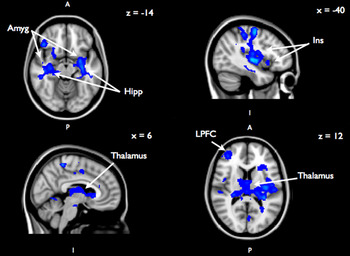
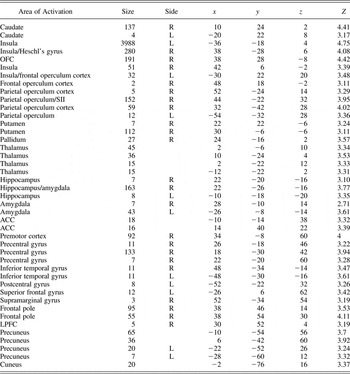
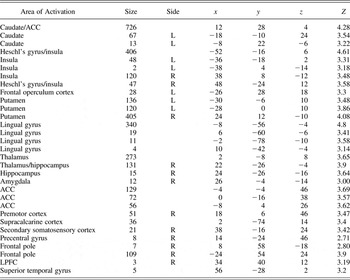
We regressed the T1 parents’ aggression variable on the contrast of parents > resting baseline. As shown in Figure 1 and Table 1, whole brain results indicated that youth whose parents had behaved more aggressively in the past showed decreased activation when rating the emotions of parents (relative to rest) in areas including the (bilateral) insula, thalamus, left putamen, right caudate, bilateral hippocampus, bilateral amygdala, frontal pole, primary somatosensory cortex, premotor cortex, and lingual gyrus.
(Color online) Activation to parent > rest as modulated by youths’ aggressive conflict behavior toward parents (Time 2), thresholded at z = 2.3, p < .05.

Clusters in which parents’ past aggression (Time 1) was associated with decreased signal in parents versus rest contrast

Note: Clusters were extracted using the FSL cluster tool thresholded at 3.1. OFC, Orbitofrontal cortex; ACC, Anterior cingulate cortex; LPFC, lateral prefrontal cortex.
In a test of whether the effects were specific to viewing parents, we also examined whole-brain associations using the T1 parents’ aggression variable as a regressor for the peer > rest condition, but no results emerged above statistical threshold.
Youths’ aggressive and aversive conflict behavior toward parents
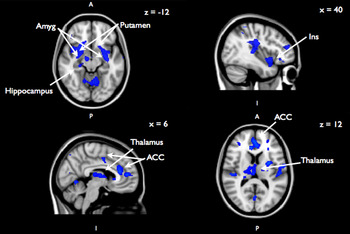
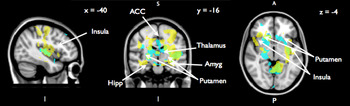
Next, we regressed youths’ T2 aggression variable on the parents > rest contrast. As shown in Figure 2 and Table 2, whole brain results suggested that youth who behaved more aggressively toward parents had decreased activation to parents’ emotions in the thalamus, putamen, caudate, bilateral insula, frontal pole, bilateral amygdala, and the anterior cingulate cortex. Figure 3 depicts the results from the T2 youth aggression-to-parents regressor masked by results from the T1 parental aggression regressor.
(Color online) Activation to parent > rest as modulated by youths’ aggressive conflict behavior toward parents (Time 2), thresholded at z = 2.3, p < .05.

(Color online) Activation to rating parents’ emotions versus resting baseline; conjunction of Time 1 parental aggression regressor (in yellow online) and Time 2 youth aggression to parents regressor (in blue online), thresholded at z = 2.3, p < .05. Both regressors were reverse coded (greater neural activation associated with less aggressive behavior).

Clusters in which youth aggression to parents (Time 2) was associated with decreased signal in parents versus rest contrast

Note: Clusters were extracted using the FSL cluster tool thresholded at 3.1. ACC, Anterior cingulate cortex; LPFC, lateral prefrontal cortex.
Mediation results
In order to test whether neural activation while rating parents’ emotions mediated the association between T1 parents’ aggression and T2 youth aggression, we used FeatQuery to extract percentage signal change coefficients for the parents > rest contrast from regions of interest that emerged from the above-reported analyses as statistically significant correlates of both the T1 parents’ aggression and T2 youth aggression measures: insula, left and right amygdala, thalamus, caudate, putamen and frontal pole; all regions of interest were defined by Harvard Cortical/Subcortical Atlas coordinates. We then performed bias-corrected bootstrapping tests of mediation to estimate confidence intervals (CIs) using the SPSS macro described by Preacher and Hayes (Reference Preacher and Hayes2004, 2008), with T1 parents’ aggression as our predictor and T2 youth aggression as the outcome variable. This approach uses bias-corrected bootstrapping techniques, a nonparametric method based on resampling with replacement, to estimate CIs, an approach that adjusts for uneven sampling distribution of the indirect effects (Preacher & Hayes, Reference Preacher and Hayes2008). Out of the seven regions of interest that we tested, four (insula, thalamus, putamen, and right amygdala) passed the full mediation test (yielding 95% bias-corrected and accelerated bootstrap CIs not containing zero), specifically 95% CI = 0.01, 1.64 (insula); 95% CI = 0.04, 1.73 (putamen); 95% CI = 0.02, 1.49 (thalamus); and 95% CI = 0.02, 0.78 (right amygdala).
Correlations with Reading the Mind in the Eyes score
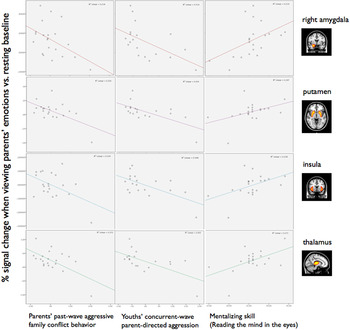
To further assess whether these mediating regions were associated with individual differences in mentalizing ability, we ran correlations between the signal change coefficients and the Reading the Mind in the Eyes score. All were positive: r (20) = .49, p = .03 (insula); r (20) = .52, p = .02 (thalamus); r (20) = .44, p = .04 (putamen); and r (20) = .46, p = .04 (right amygdala). Scatterplots of these and other signal change correlations are shown in Figure 4.
(Color online) Scatterplots of the correlations between the signal change coefficients and the Reading the Mind in the Eyes score and other signal change correlations.

Correlations with button-box ratings and reaction times
Finally, we tested whether youths’ ratings of the clips shown in the scanner could explain any of the above-described results, and ran correlations between button-box ratings of parents’ and peer emotions, the reaction times associated with these ratings, and the four signal change coefficients (insula, thalamus, putamen, right amygdala) as well as the T1 and T2 aggression measures. None of these correlations reached statistical significance (the 24 correlation coefficients range = –0.28 to 0.17, all ps > .10).
Discussion
When youth with more aggressive parents rated their parents’ emotions, they showed less activation in areas associated with emotion, salience, and interoceptive awareness. Many of these same areas were also less activated among adolescents who went on to behave more aggressively toward their parents in a subsequent wave of the study. Using a bootstrapping test of mediation, we found that reduced activation in the insula, putamen, thalamus, and right amygdala fully mediated the positive association between parents’ aggression in the prior wave and youths’ subsequent aggression toward parents. We interpret these findings to suggest that underrecruitment of the emotional brain to family members is one mechanism explaining the transmission of aggressive family conflict behavior between generations. Supporting our contention that these mediating brain regions reflected emotion recognition skills and sensitivity to others’ feelings, signal change in all four regions was significantly positively associated with youths’ scores on a widely used measure of mentalizing.
Our findings suggest that parents’ aggression reduces the degree to which their children both recruit their own emotion-responding systems and also use the “self as platform” to vicariously and viscerally experience the emotions of their parents. Adolescents may be less motivated to empathize with harsh parents, and their neural disengagement from parents’ emotional stimuli may mirror a pattern of avoidance that is potentially adaptive in conflictual family environments (Seiffge-Krenke, Reference Seiffge-Krenke2011). Another possibility is that aggressive parents pass on generalized emotion reading difficulties to their children through pathways such as genes and social learning. However, this possibility does not fully explain why our results emerged in the parents versus rest contrast and were nonsignificant when we tested family aggression history as a moderator of the peer versus rest contrast. Participants’ past experience with their parents may have particularly profound effects on their processing of parents’ emotions specifically. Another possibility is that exposure to family aggression, which occurs in intimate settings, affects the processing of emotions when targets are socially familiar. Either possibility suggests that these results have applications to understanding the transmission of family or intimate partner aggression from one generation to the next.
It is surprising that we did not find any brain regions to be more positively activated in response to more aggressive parents. One might expect aggressive parents to elicit more vigilant attention from children, leading to heightened neural activity. Several studies (e.g., Seo, Tsou, Ansell, Potenza, & Sinha, 2014) have found hyper- rather than hypoarousal of emotion-processing structures among participants raised in aversive family contexts. For example, Dannlowski et al. (Reference Dannlowski, Stuhrmann, Beutelmann, Zwanzger, Lenzen and Grotegerd2012) found exaggerated amygdala responses to faces among adults maltreated as children. However, that study presented strangers’ faces showing threat-related expressions, whereas our participants viewed their own parents displaying a range of positive and negative emotions. Moreover, our study used a community sample with a normative range of aggressive family conflict behavior, whereas many studies of early adversity have used clinical samples (Belsky & de Haan, 2011). Mild to moderate violence exposure, as assessed in our study, may have different effects than severe abuse or maltreatment, contributing to an avoidant/attenuated rather than sensitized response. In addition, developmental stage may play a role: sensitized responses to aggression in young children may be replaced by dampened responses in adolescence (Susman, Reference Susman2006). Consistent with this, a prior investigation of our same sample found that adolescents exposed to more aggressive family conflict behavior showed dampened hypothalamic–pituitary–adrenal axis activation when visiting the lab with their parents (Saxbe, Margolin, Shapiro, & Baucom, Reference Saxbe, Margolin, Spies Shapiro and Baucom2012). Our results also dovetail with findings linking reduced amygdala activation to aggressive behavior (Mathiak & Weber, Reference Mathiak and Weber2006) and with findings linking hyporesponsiveness of fear conditioning circuitry (insula, anterior cingulate cortex, and amygdala) to callous–unemotional traits, conduct disorder, and antisocial behavior (Gao et al., Reference Gao, Raine, Venables, Dawson and Mednick2010; Shirtcliff et al., Reference Shirtcliff, Vitacco, Graf, Gostisha, Merz and Zahn-Waxler2009). Consistent with this, Blair, Leibenluft, and Pine (2014) point to “deficient empathy” as one of the key neurocognitive dysfunctions appearing in youth with callous–unemotional traits, with reduced amygdala responding to facial emotions as one potential pathway. It is notable that our findings were not driven by activation within the cortical mentalizing network, which includes structures along the cortical midline and temporoparietal junction (Van Overwalle & Baetens, Reference Van Overwalle and Baetens2009), suggesting that our findings are best conceptualized as reflecting the visceral, emotion-driven constituents rather than the more cognitive and abstract components of theory of mind. This may be due to our task design, which prompted affectively oriented processing by asking participants to “put themselves in the shoes” of the target person in each clip.
Our study had a number of limitations. First, the measure of parent-directed aggression by adolescents was administered to adolescents only at T2, so we are not able to control for this measure at T1 or to combine scores from multiple raters. Moreover, we did not include siblings in our family aggression measures, meaning that these measures only reflect parent-to-youth, parent-to-parent, and youth-to-parent aggression. Although this increases the standardization and specificity of our measures, it means that our use of the term “family aggression” should include the caveat that the whole family was not assessed. In a similar vein, we did not measure or control for other contexts of youths’ aggression (e.g., toward peers or teachers), so we cannot definitively conclude whether our youth-to-parent aggression measure reflects an overall pattern of aggression or is specific to family conflict behavior. This study is also limited by its small sample size, with scan data from only 21 youth, only 19 of whom had aggression data from both assessments. This compromises our ability to test for potentially meaningful differences in gender, race, and age. Although the larger longitudinal study included over 100 families, we recruited from within a smaller cohort of 43 families and needed to screen out a number of youth ineligible for MRI scanning. These constraints placed a ceiling on our ability to recruit a larger sample. However, a tradeoff of this small sample is that this study reflects unusually rich individual differences data for an MRI investigation, with parents’ aggression assessed using multirater, multidomain measures at one timepoint and adolescents’ aggression assessed approximately 2 years later. We had previously demonstrated the longitudinal association between parents’ aggression and youths’ subsequent aggression toward parents in our full sample (Margolin & Baucom, Reference Margolin and Baucom2014). Therefore, this study leverages a larger dataset by exploring possible neural mediators within a subsample of participants, consistent with the field of developmental psychopathology's shift toward mechanisms (Pollak, Reference Pollak2005).
What appears to be this study's most serious limitation may also represent one of its strengths: The stimuli used in the parent condition are idiosyncratic, given that each participating adolescent came into the study with different parents who looked and acted differently in the video clips. This lack of standardization contributes to the ecological validity of the study but also makes it challenging to untangle the precise mechanisms underlying our results. For example, more aggressive parents may have appeared more negative in their video clips. Alternatively, more aggressive parents might be perceived by children as being more difficult to “read” and thus as more challenging targets for empathic understanding (Shackman et al., Reference Shackman, Fatani, Camras, Berkowitz, Bachorowski and Pollak2010). It is worth noting that these possibilities are belied by the lack of significant correlations between reaction time measures and in-scanner ratings of parents’ and peer emotions and either the T1 and T2 aggression measures or the signal change coefficients in the regions of interest. In other words, our results do not appear to be driven by the perceived positivity and negativity of parents’ emotions or by the difficulty of determining parents’ emotional state (which would presumably influence participants’ reaction times). Nonetheless, because the parent stimuli are different for each participant, and because they are taken from a discussion which might elicit specific memories in our participants, it is impossible for us to fully tease apart the extent to which adolescents’ neural responses are shaped by the vagaries of our stimuli or by their real-life past and future experiences with parents.
As mentioned above, despite its important limitations, our use of idiographic, self-relevant stimuli also gives our study an uncommon degree of ecological validity for an fMRI study. To our knowledge, this is the first study to connect parents’ past behavior with adolescents’ subsequent behavior toward their parents, using adolescents’ neural responses to those same parents as a mediator. While using “real world” stimuli creates confounds and measurement challenges, it also allows us to draw conclusions about how adolescents respond to the actual social contexts in which they are situated. Different children have different parents, and their responses to those different parents are multidetermined but meaningful. That no significant family aggression findings emerged for the standardized stimuli using unfamiliar peers underscores this point and indicates the potential value of using personally meaningful stimuli to capture individual differences in emotion responding. This is consistent with work by Whittle and colleagues (Reference Whittle, Yücel, Forbes, Davey, Harding and Sheeber2012), who found that adolescents’ depressive symptoms modulated their responses to their own mother more than to unfamiliar women. It also dovetails with studies of parents viewing their infants, which have reported blunted neural responses associated with adverse life events when parents view their own infants but not when they view unfamiliar infants (Kim et al., Reference Kim, Fonagy, Allen and Strathearn2014). Other strengths of this study include our ethnically diverse sample, longitudinal design, and use of a bootstrapping test of mediation, considered a statistical advance over traditional mediation approaches, such as the Sobel test (Preacher & Hayes, Reference Preacher and Hayes2004).
In conclusion, this study found that adolescents who showed less activity in emotion and salience regions of the brain when rating their parents’ emotions were also those most likely to have reported aggressing toward parents, suggesting that those youth are most at risk for perpetuating a cycle of family violence. Increasing evidence points to the importance of social context for neurodevelopment and for adolescence as a potentially sensitive period for the influence of social relationships on the mind and brain (Blakemore & Mills, Reference Blakemore and Mills2014). Our results point to hypoactivity of the emotional and empathetic brain as a potential mechanism linking parents’ past aggression with youths’ parent-directed aggression. Interventions focused on strengthening youths’ emotion-processing abilities and targeting youth at risk for antisocial behavior who show “attenuation” of stress response systems (both behaviorally, e.g., avoidant coping; and neurophysiologically, e.g., hypoarousal of stress response systems) may help to forestall the intergenerational transmission of family aggression.