



Decision points about terminating core psychotropic medications for patients with major depressive disorder (MDD) or bipolar disorders are not well established. After resolution of a first lifetime major depressive episode, most practice guidelines advise continuing antidepressants for 4–9 months Reference Bauer, Severus, Köhler, Whybrow, Angst and Möller1 or longer, Reference Liu, Momen, Molenaar, Rommel, Bergink and Munk-Olsen2 to prevent relapse. Potentially indefinite pharmacotherapy is often recommended when MDD involves multiple episodes, persistence/chronicity or high severity/disability. In bipolar disorders, Reference Fountoulakis, Grunze, Vieta, Young, Yatham and Blier3 antidepressants remain controversial because of low acute Reference McGirr, Vöhringer, Ghaemi, Lam and Yatham4 or prophylactic Reference McGirr, Vöhringer, Ghaemi, Lam and Yatham4,Reference Yatham, Arumugham, Kesavan, Ramachandran, Murthy and Saraf5 efficacy, and a risk for inducing mania/hypomania Reference Fornaro, Anastasia, Novell, Fusco, Solmi and Monaco6 or accelerating cycling frequency. Reference El-Mallakh, Vöhringer, Ostacher, Baldassano, Holtzman and Whitham7 By contrast, indefinite maintenance pharmacotherapy with mood stabilisers and/or second-generation antipsychotics (SGA) has become standard of care.
Deprescribing – the planned and supervised stopping of a medication where harms or detriments may outweigh benefits Reference Goldberg, Swartz, Mago, McIntyre, Malhi and Rosenblat8 – has become a focus of public health controversy. Some authors have expressed concerns about ‘overprescribing’ of antidepressants for mild forms of depression without anticipated end-points, particularly in older adults or other subgroups more vulnerable to adverse drug effects. Reference Pillinger, Arumuham, McCutcheon, D’Ambrosio, Basdanis and Branco9 Yet, because mood disorders remain underrecognised and undertreated worldwide, Reference Thornicroft, Chatterji, Evans-Lacko, Gruber, Sampson and Aguilar-Gaxiola10 decisions to discontinue medications must consider risks for worsening morbidity and mortality.
Patients, and the general public, may construe a medication as being ‘inappropriate’ based more on beliefs or attitudes about psychopharmacology than on pharmacodynamic risks and benefits. Deprescribing requests may reflect psychologically complex factors that drive nonadherence, including actual Reference Niarchou, Roberts and Naughton11 or expected Reference Scott and Pope12 adverse drug effects; potentially unfounded presumptions about physiological dependence or severe and persistent discontinuation symptoms upon cessation; Reference Kalfas, Tsapekos, Butler, McCutcheon, Pillinger and Strawbridge13 lack of insight about needing treatment; Reference Novick, Montgomery, Treuer, Aguado, Kraemer and Haro14,Reference Zewdu, Dagnu, Tarekegn, Yazie, Ayicheh and Dagnew15 internalised stigma Reference Zewdu, Dagnu, Tarekegn, Yazie, Ayicheh and Dagnew15 or discouragement to continue treatment by significant others; Reference Zewdu, Dagnu, Tarekegn, Yazie, Ayicheh and Dagnew15 sociocultural beliefs that discourage mental health treatment; Reference Gopalkrishnan16 medical mistrust and the fear of harm or exploitation; Reference Shukla, Schilt-Solberg and Gibson-Scipio17 or a sense of hopelessness about treatment that may simply reflect the negative expectancy biases of depression.
Given the above issues, the American Society of Clinical Psychopharmacology (ASCP) convened a Task Force of 45 international experts to undertake a multi-round Delphi survey and selective literature review, focusing on identifying when the deprescribing of particular psychotropic medications may be appropriate. We focused on the following questions:
-
(a) What clinical circumstances should inform decisions to continue an antidepressant beyond 6–12 months’ duration after successful treatment for a major depressive episode?
-
(b) When should adjunctive SGAs be deprescribed for patients with nonpsychotic mood disorders?
-
(c) When antidepressants are prescribed for patients with bipolar disorder, what clinical circumstances should signal their end-points for deprescription?
-
(d) Are there instances where pharmacotherapy for relapse prevention can be altogether discontinued in selected patients with bipolar disorder?
Method
Task force composition
Task Force panellists were invited by the ASCP leadership based on internationally recognised expertise (representing 12 countries) in clinical psychopharmacology, including academic and clinical reputation, peer-reviewed publications, and educational/teaching activities. None were employed by the pharmaceutical industry. A core working group (J.F.G., H.A.S., R.S.M., R.M.) identified experts in psychopharmacology based on having published extensively in peer-reviewed journals, although a specific number of publications was not set. We intentionally sought out individuals whose domains of expertise included all major topics assayed in the Delphi process. We also employed a snowballing technique for identification of experts wherein a domain expert could propose the addition of another qualified individual, although all final decisions about inclusion were made by the core work group. The core work group agreed unanimously in selecting the task force members.
Delphi survey composition and development
All Task Force members participated in the generation and initial vetting of Delphi statements, which were completed in electronic format, using SurveyMonkey. Following a standard Delphi survey format Reference Khodyakov, Grant, Kroger and Bauman18 that adhered to the Guidance on Conducting and Reporting Delphi Studies (CREDES) standards, Reference Jünger, Payne, Brine, Radbruch and Brearley19 participant anonymity was maintained to minimise undue influence from identifiable participants. Survey statements were rated by panellists on a scale ranging from 1 to 5 (1 = ‘strongly agree’; 2 = ‘moderately agree’; 3 = ‘neither agree or disagree’; 4 = ‘moderately disagree’ or 5 = ‘strongly disagree’), or abstaining from a response, accompanied by ratings of confidence for each response (low, medium or high), as well as the opportunity to provide narrative text comments. Task Force panellists were asked to respond to survey items based on their knowledge of the peer-reviewed literature combined with their own clinical experience.
‘Consensus’ was defined a priori as achieving at least 75% agreement (or disagreement) based on scores of ‘1’ or ‘2’ with each survey statement. This proportion was chosen a priori based on meta-analysis findings involving previous Delphi surveys in healthcare that empirically identified a cut-off of ≥75% agreement/disagreement as the median threshold to define consensus, which has become a widely accepted percentage that provides a degree of methodological consistency across studies. Reference Diamond, Grant, Feldman, Pencharz, Ling and Moore20
For items that nearly fell short of consensus (60–74% agreement), the core work group considered written text comments provided by respondents for each item and solicited additional feedback and clarifications as deemed necessary to rework, rephrase and re-ask items in subsequent Delphi rounds. No new panellists were added between rounds. Survey rounds were conducted online via SurveyMonkey (SurveyMonkey Inc, San Mateo, California, USA; www.surveymonkey.com) from January to May 2025. Denominators for calculating per cent agreements were adjusted for instances in which respondents abstained from responding to a given item. Total respondents from the Task Force across iterative Delphi survey rounds varied as noted in the Results section.
All co-authors reviewed initial and subsequent manuscript drafts and summary of Delphi survey findings prepared by the Task Force core work group, and provided their review and revisions regarding intellectual content.
Selective literature review
The Task Force core workgroup undertook a selective literature review via PubMed database searches of pertinent key terms (i.e. ‘deprescribing’ or ‘maintenance pharmacotherapy’ or ‘antidepressant use’ or ‘discontinuation trials’ AND ‘major depressive disorder’ or ‘bipolar disorder’), conducted with several updates from June to December 2025.
Statistical analyses
Data findings that summarise both the original and (when necessary) final reworked Delphi statement responses are presented as descriptive statistics. Survey responses are presented as proportions of respondents that agreed (or disagreed, as noted) with corresponding 95% confidence intervals. Spearman rank correlations were calculated to identify the strength of association between (ordinal) proportional ratings of Delphi statement agreements with high confidence ratings (reported when at least five pairwise comparisons existed), with Fisher-z transformations to calculate corresponding 95% confidence intervals.
Results
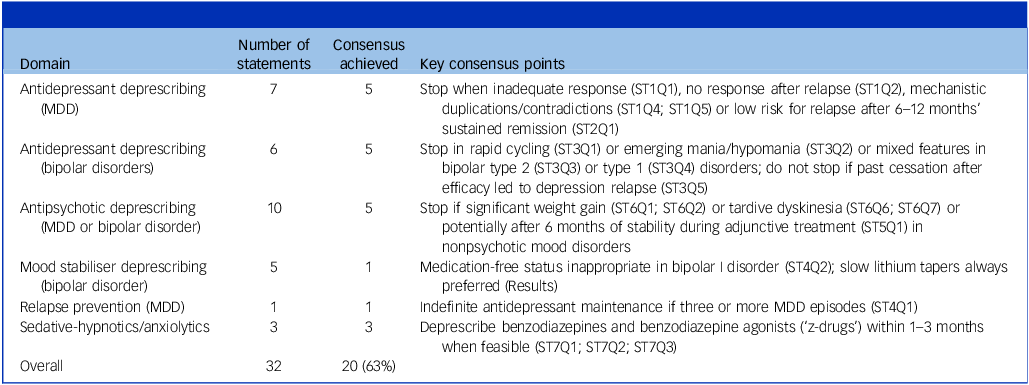
A total of 32 unique statements were finalised from three Delphi rounds, with consensus agreement reached on 20 (63%). Statements were divided into seven thematically linked areas, as described below. Those from initial rounds that failed to reach consensus but did so after modification of wording are presented in their final version. First and third round surveys were most extensive and each had nearly 100% Task Force participation. A brief second round, netting only three additional statements (see Supplementary Tables 1 and 3 available at https://doi.org/10.1192/bjp.2026.10580) was completed by 22 of the original 45 original panellists (49%). Statements from across all three rounds are merged with notation of round numbers alongside respondent numbers, abstentions, degree of agreement, degree of high confidence and whether consensus was achieved.
Table 1 provides a comprehensive summary of key points of consensus across all Delphi items across successive rounds, linked to corresponding Delphi statements presented in Supplementary Tables 1–7. Specific item wordings and proportions achieving consensus, as well as ratings of ‘high confidence’ among panellists, are presented in supplementary tables as indicated within the following sections. Examples of the evolution of wordings of initial Delphi statements across rounds are presented in Supplementary Table 8.
Summary of consensus outcomes

Table 1 Long description
The table has six rows and five columns. The columns are labeled Domain, Number of statements, Consensus achieved, and Key consensus points. The rows detail consensus points for antidepressant deprescribing in major depressive disorder (MDD) and bipolar disorders, antipsychotic deprescribing in MDD or bipolar disorder, mood stabilizer deprescribing in bipolar disorder, relapse prevention in MDD, and sedative-hypnotics/anxiolytics. Each row lists the number of statements, the number of consensus points achieved, and the key consensus points for each domain.
MDD, major depressive disorder.
Abbreviations in the ‘Key consensus points’ column refer to Supplementary Table (numbers) and Question (numbers).
Antidepressant deprescribing: basic concepts and pharmacokinetic/pharmacodynamic considerations
Supplementary Table 1 summarises findings for Delphi statements involving fundamental decisions and basic pharmacodynamic/pharmacokinetic considerations about deprescribing antidepressants. Consensus was reached favouring (a) decisions to deprescribe antidepressants when an adequate trial produces an inadequate response; (b) when loss of response cannot be recaptured after dosage increases; and (c) eliminating medications that duplicate mechanisms of action, such as serotonin reuptake inhibition. Two additional statements ultimately failed to reach consensus: the first asked whether an antidepressant should be discontinued soon after a patient with MDD achieves euthymia if they have characteristics that could potentially suggest a bipolar diathesis, i.e. early age at onset, atypical depressive symptoms, or a family history of bipolar disorder or highly recurrent depression (22/41 respondents; 54% agreement; 95% CI 0.37–0.69, 21% with high confidence). The second asked whether, by contrast, early age at onset and/or a family history of recurrent unipolar depression should discourage premature deprescribing of an antidepressant after an initial response in patient with MDD because of a greater risk for future depression recurrences (28/32 respondents; 67% agreement; 95% CI 0.50–0.80; 31% with high confidence). A strong correlation was observed between proportional agreements in Supplementary Table 1 and ‘high confidence’ rating levels (rho = 0.90, 95% CI 0.087–0.993).
Antidepressant deprescribing in nonpsychotic major depressive disorder and relapse prevention
Supplementary Table 2 summarises Delphi survey findings about antidepressant deprescribing relative to relapse risk. Respondents agreed that individualised circumstances should inform decisions about if and when to discontinue an antidepressant after an initial sustained response over 6–12 months (98% agreement), but did not achieve consensus on whether factors such as mild severity or rapid initial response (which might reflect placebo-responsivity) should influence decisions to shorten the duration of a continuation/maintenance phase antidepressant treatment (45% agreement).
Antidepressant deprescribing in bipolar disorders
Supplementary Table 3 summarises panellists’ responses to statements regarding the deprescribing of antidepressants for patients with bipolar disorder. Key findings included a strong consensus that efforts should be made to deprescribe antidepressants in the setting of rapid cycling and in the setting of bipolar depression with mixed features. Notably, panellists focused on the magnitude of observable signs of mania/hypomania: many preferred to discontinue an antidepressant altogether in the presence of syndromal mania during a major depressive episode, but instead reduce antidepressant doses during concomitant hypomania. Panellists also agreed that in both bipolar type 1 and 2 disorders, the emergence of manic or hypomanic symptoms should prompt either an antidepressant dosage reduction or cessation, rather than compensatory upward-dosing of co-administered antimanic pharmacotherapies instead. Some indicated that they would do both simultaneously. Panellists failed to reach consensus on whether efforts should be made routinely to deprescribe an antidepressant within 12 months of achieving euthymia, although there was consensus that deprescribing an antidepressant after an initial favourable response would be unwise if previously doing so led to depression relapse.
The Spearman rank correlation between proportional agreements and ‘high confidence’ levels as shown in Supplementary Table 3, involving only six pairwise comparisons, fell short of statistical significance (rho = 0.64, 95% CI –0.39 to 0.96).
Long-term relapse prevention across mood disorders
Supplementary Table 4 presents several points of consensus regarding deprescribing and the risk for longitudinal relapse in either MDD or bipolar disorder. A first statement strongly affirmed (95% agreement) that indefinite (possibly lifelong) antidepressant pharmacotherapy is often advisable in patients with MDD after three or more lifetime episodes because of high risk for further recurrences. A second was that it is seldom if ever appropriate to strive for a medication-free status in patients with bipolar type 1 disorder, but consensus fell short for this concept in bipolar type 2 disorder (64% agreement). A further question aimed to refine the issue of possible candidacy for a pharmacotherapy-free status asked if respondents would consider tapering off all prophylactic medications in a patient with bipolar disorder after at least 1–2 years of full and sustained remission, with excellent psychosocial functioning, following a single lifetime nonpsychotic manic or hypomanic episode; only 51% of respondents felt this was appropriate, with some noting that future recurrence was virtually inevitable, and could arise even many years after an index presentation episode.
Panellists were subsequently asked about the validity of concerns that stopping lithium, even gradually, could potentially lead to diminished responsivity upon possible future rechallenge. Strongly divergent opinions were voiced (only 55% agreed with this sentiment after several rewordings of the original Delphi statement), with some calling such concerns ‘debunked mythology’ and others expressing the view that deprescribing lithium after an initial robust response could jeopardise future efficacy if illness characteristics unpredictably evolved or worsened over time.
A further question asked about preferred time frames for tapering off lithium in patients with bipolar type 1 or 2 disorder, either in the context of discontinuing it with or without a replacement mood stabilising/antimanic agent. Here, 90% of respondents (38/42) favoured tapers lasting ≥6 weeks when no other mood stabilising agent was replacing lithium; and, when substituting a replacement agent, 27 out of 42 respondents (64%) again favoured lithium tapers of >6 weeks’ duration, whereas 13 (31%) advocated tapers of 4–5 weeks’ duration, and the remainder favoured 2-week tapers.
Finally, respondents were queried about whether lamotrigine was an appropriate prophylactic monotherapy against recurrent (hypo)manic recurrences in bipolar type 1 or 2 disorder. As shown in Supplementary Table 4, near-consensus was reached (70%) disagreeing with this proposition, with associated comments from panellists pointing to lamotrigine’s questionable antimanic prophylactic efficacy based on both the clinical trials literature and their firsthand experience.
A strong significant correlation was observed between proportional agreements in Supplementary Table 4 and ratings of ‘high confidence’ (rho = 0.83, 95% CI 0.06–0.98).
Deprescribing and duration of antipsychotics in bipolar disorder
Panellists addressed several questions about deprescribing antipsychotic medications after successful treatment of an acute bipolar disorder episode. As shown in Supplementary Table 5, consensus was reached (90%) favouring the deprescribing of an SGA after a period of sustained stability following successfully treated acute mania with the combination of an SGA plus antimanic mood stabiliser. Two other Delphi statements queried optimal SGA duration after successfully treating acute bipolar depression – particularly positive maintenance/relapse prevention data are lacking (e.g. lurasidone, cariprazine, lumateperone). Consensus was not reached either for bipolar type 1 (43% agreement) or type 2 depression (55%).
Deprescribing and medication adverse effect management
A next set of statements, summarised in Supplementary Table 6, focused on the occurrence and management of significant adverse effects that impact risk–benefit analyses for continuing versus deprescribing SGAs and lithium. When significant weight gain and/or glycaemic dysregulation occurs as a result of SGAs, panellists strongly favoured deprescribing and replacing the offending agent, and using alternative pharmacotherapies when feasible (98% agreement in nonpsychotic major depressive disorder, 83% in bipolar disorder). However, they also acknowledged the need for individualised risk–benefit analyses and circumstances where the potentially unique SGA efficacy may warrant retention despite side-effects, in turn prompting enthusiasm for antidote/weight mitigation strategies. In contrast, agreement fell short of consensus (62% agreement) for the same scenario during acute treatment for non-treatment resistant bipolar type 1 or 2 disorder. Rephrasing the concept by asking if, in non-treatment resistant bipolar disorder, panellists favoured adding pharmacological antidote strategies for significant weight gain or metabolic dysregulation (rather than deprescribing and replacing), there was non-consensus (49% agreement). Only 57% agreed that in nonpsychotic MDD or bipolar disorder, pharmacological countermeasures for antipsychotic-associated weight gain should routinely precede deprescribing metabolically offensive, but otherwise efficacious SGAs.
For emerging signs of tardive dyskinesia during antipsychotic treatment, panellists strongly favoured antipsychotic deprescribing over drug retention, regardless of decisions to treat tardive dyskinesia with a vesicular monoamine transporter-2 (VMAT-2), in both nonpsychotic MDD (95% agreement) and nonpsychotic bipolar disorder (93% agreement).
A strong significant correlation was observed between proportional agreements in Supplementary Table 6 and ratings of ‘high confidence’ (rho = 0.80, 95% CI 0.12–0.97).
Deprescribing of anxiolytics and sleep aids
Finally, panellists were asked about deprescribing anxiolytic agents (e.g. benzodiazepines) or sleep aids. As noted in Supplementary Table 7, panellists strongly favoured deprescribing nonbenzodiazepine receptor agonists (i.e. so-called ‘z-drugs’; zolpidem, eszopiclone or zaleplon) within 1–3 months of initiation for purposes of managing insomnia in euthymic patients, regardless of polarity. Similar preferences were expressed, with high consensus (93%), about deprescribing low-dose quetiapine primarily for promoting sleep. High consensus was achieved for deprescribing adjunctive benzodiazepines to avoid long-term (e.g. >1–3 months)/indefinite use whenever possible.
An overall Spearman’s rank coefficient across all 32 Delphi statements comparing proportions of agreement with ‘high confidence’ ratings was statistically significant (rho = 0.62, 95% CI 0.35–0.80).
Discussion
The findings and recommendations from this ASCP Task Force provide a framework for identifying when psychotropic medications for mood disorder patients may warrant deprescribing. Mood disorders are often chronic/recurrent in nature, requiring long-term active surveillance, regardless of pharmacotherapy status, to monitor for relapse. Also worth underscoring is the finding that consensus (defined as at least 75% ‘strongly’ or ‘moderately’ agreeing (or disagreeing) with survey statements) occurred in 63% of this large international task force, despite multiple Delphi rounds – suggesting that even among experts, unanimity was elusive, with about a third expressing divergence of opinions.
Previous groups have addressed logistical parameters for stopping medications, such as gradual dosage reductions, Reference Horowitz and Taylor21 linear versus hyperbolic tapering, Reference Cooper, Ashman, Lomani, Moncrieff, Guy and Davies22,Reference Horowitz, Jauhar, Natesan, Murray and Taylor23 dual administration (optimising the dose and establishing the efficacy of a new medication before tapering off an outgoing one) and managing discontinuation phenomena. We instead sought to focus on identifying clinical circumstances that best define when deprescribing may be indicated in patients with mood disorders, including when continued pharmacotherapy may be undesirable based on pharmacokinetic or pharmacodynamic grounds (e.g. drug–drug interactions, mechanistic conflicts or redundancies), lack of efficacy, or mismatches between presenting symptoms and the pharmacodynamic properties of a prescribed medication.
As this ASCP Task Force has discussed previously, Reference Goldberg, Swartz, Mago, McIntyre, Malhi and Rosenblat8 construing a psychotropic medication as ‘inappropriate’ can stir controversy when the term becomes distorted to insinuate that psychotropic medications inherently lack value or pose intrinsic harm. Such thinking places the term ‘deprescribing’ at variance with its wider adoption throughout other areas of medicine, Reference Goldberg, Swartz, Mago, McIntyre, Malhi and Rosenblat8 where it signifies that a once useful treatment can become obsolete. Deprescribing as an ‘anti-medication ideology’ reinforces stigma about mental illness and its treatment, undermines confidence in findings from evidence-based trials, encourages nonadherence and disavows the clinical and psychosocial ramifications of untreated psychiatric disorders. By contrast, thoughtful deprescribing means attentively curating a pharmacology regimen as a patient’s condition evolves, diagnostic formulations become revised, continued treatments intended to prevent relapse may be deemed unnecessary or non-evidence-based, harms of continued use may outweigh benefits or alternative treatments may become preferable.
Deprescribing antidepressants in bipolar disorder touches on an age-old debate. Randomised trials have failed to reveal a robust signal for their acute or prophylactic efficacy. Reference McGirr, Vöhringer, Ghaemi, Lam and Yatham4 Their potential risk for inducing mania or hypomania may be less than was once thought, occurring in a minority (about 10–15%) of patients in prospective trials. Reference Fornaro, Anastasia, Novell, Fusco, Solmi and Monaco6 The International Society for Bipolar Disorders Task Force on Antidepressant Use in Bipolar Disorder Reference Pacchiarotti, Bond, Baldessarini, Nolen, Grunze and Licht24 acknowledged that limited empirical data preclude broad recommendations for or against either their short- or long-term administration.
The magnitude of acute responsivity to any psychotropic agent may help forecast long-term efficacy, in turn impacting decisions about deprescribing. In the case of antidepressants, Altshuler et al Reference Altshuler, Post, Hellemann, Leverich, Nolen and Frye25 showed that in a bipolar depression group highly enriched for initial robust acute antidepressant response, randomised antidepressant discontinuation significantly increased the likelihood of depression relapse over one year. On the other hand, a more recent 1-year randomised discontinuation trial after initial remission from bipolar type 1 depression with adjunctive escitalopram or bupropion XL (added to an antimanic mood stabiliser or SGA) Reference Yatham, Arumugham, Kesavan, Ramachandran, Murthy and Saraf5 found no difference in relapse rates for any mood episode as compared with patients whose antidepressant was discontinued after 8 weeks, although 52-week treatment was better than 8-week treatment specifically for depression prevention.
The Task Force considered whether it is ever reasonable and appropriate to strive for an eventual ‘medication-free’ management state in patients with either bipolar disorder or recurrent MDD. There is little empirical literature to inform this proposition, and most of that which exists is limited by short-term randomised discontinuation designs or observational studies that fail to account for confounding by indication. As an example of the latter, Biel and colleagues Reference Biel, Peselow, Mulcare, Case and Fieve26 naturalistically studied 213 patients with bipolar disorder who, by preference, continued or discontinued lithium after 2 years of stability; after controlling for demographic differences, nearly a five-fold increased risk for relapse was observed in those who stopped lithium. Of note, that report was enriched for acute (and sustained) lithium responsivity. Similarly, a smaller naturalistic controlled lithium discontinuation protocol among 32 unequivocally lithium-responsive patients found only 19% relapse-free over 9 years. Reference Yazici, Kora, Polat and Saylan27 Seminal long-term follow-up studies by Angst and colleagues Reference Angst, Gamma, Sellaro, Lavori and Zhang28 of patients with a mood disorder suggest a linear risk for recurrence as much as 40 years after an initial index episode.
Pharmacotherapy deprescribing issues may differ for patients with bipolar type 1 versus type 2 disorder, as perhaps reflected by the greater degree of diversity and lesser consensus among Delphi panellists for statements related to bipolar type 2 disorder (e.g. regarding long-term maintenance treatment with an SGA, and whether a medication-free status might ever be considered appropriate in some patients with bipolar type 2 disorder). It is worth emphasising that the prospect of an eventual medication-free status in bipolar type 1 disorder was disputed with ‘high confidence’ by 71% of panellists, although in bipolar type 2 disorder, only 36% of respondents expressed high confidence about the inappropriateness of a medication-free status, and consensus was not reached. Issues related to deprescribing in bipolar type 1 versus type 2 disorder may also be especially relevant for antidepressants, where some studies suggest a low risk for mood destabilisation, Reference Angst, Gamma, Sellaro, Lavori and Zhang28,Reference Altshuler, Sugar, McElroy, Calimlim, Gitlin and Keck29 and comparable Reference Amsterdam and Shults30 or even higher Reference Amsterdam and Shults30 acute antidepressant efficacy, even as monotherapy, than seen with mood stabilisers such as lithium. Also pertinent to potential differences in pharmacodynamic efficacy between bipolar type 1 versus type 2 disorder is the strong consensus by the Task Force that lamotrigine is an inappropriate monotherapy in bipolar type 1 disorder, given its lack of demonstrated superiority to placebo to prevent manias in randomised trials. Reference Bowden, Calabrese, Sachs, Yathan, Asghar and Hompland31,Reference Calabrese, Bowden, Sachs, Latham, Behnke and Mehtonen32 In bipolar type 2 disorder, mostly retrospective studies suggest it may be a useful monotherapy, Reference Terao, Ishida, Kimura, Yarita and Hara33 although the Task Force expressed concern that some clinicians may favour its utility based more on its fairly benign tolerability profile than demonstrated efficacy against mood elevation.
Relevant to decisions about deprescribing, few comparative studies have directly compared long-term SGA versus mood stabiliser safety versus efficacy. After stabilisation from acute mania with an SGA plus antimanic mood stabiliser, short-term randomised discontinuation trials suggest limited benefits retaining SGAs beyond 24 weeks’ duration as compared with mood stabiliser monotherapy. Reference Yatham, Beaulieu, Schaffer, Kauer-Sant’Anna, Kapczinski and Lafer34 The increasing use of SGAs in long-term treatment of bipolar disorder, greater adoption of long acting injectable antipsychotics and adjunctive SGA use in nonpsychotic MDD, makes comparative longer-term data essential to determine optimal exposure duration.
Lack of consensus on certain topics – such as predicting lithium’s efficacy upon rechallenge after discontinuation, type of initial response and the benefits of deprescribing in MDD or bipolar disorder, or the optimal duration of antidepressant use in bipolar type 2 disorder – highlights critical evidence gaps that warrant empirical investigation through prospective deprescribing studies. A slim majority of Delphi survey respondents agreed with the proposition that lithium cessation, even when gradually undertaken, could lead to a failure of benefit upon future retrial. Past empirical literature on this issue has been mixed, with some reports suggesting that true discontinuation-induced refractoriness to lithium appears to be uncommon. Reference Kupka, Regeer, van Bergen, Tondo and Bauer35
Box 1 summarises key concepts regarding pharmacotherapy deprescribing for mood disorder patients where consensus was not reached, and outlines potential directions for future research.
Areas of non-consensus and avenues for future research and deprescribing randomised trials
-
(a) Can randomised discontinuation trials shed light on whether patients with MDD with milder severity or less chronic or nonrecurrent forms of illness are better candidates for antidepressant deprescribing after achieving stabilisation than those with more severe, recurrent or chronic forms of MDD?
-
(b) When does the risk–benefit analysis for a given patient with MDD or bipolar disorder favour treating antipsychotic-induced weight gain and retaining an offending agent rather than deprescribing an otherwise efficacious agent and considering less offensive (but potentially less efficacious) alternatives?
-
(c) Which patients with MDD are best candidates for antidepressant deprescribing within 12 months after achieving sustained response and stability?
-
(d) In addition to the need for randomised discontinuation trials to anticipate deprescribing outcomes, it is important to empirically identify moderating factors and other clinical features that best characterise optimal patient candidates for successful deprescribing.
-
(e) Under what circumstances, if any, is it appropriate to discontinue all prophylactic psychotropic medications after a prolonged period of stability following a single nonpsychotic bipolar type 1 manic episode?
-
(f) What factors should guide decisions to deprescribe versus continue, in long-term open-ended fashion, an SGA in patients with nonpsychotic MDD or bipolar disorder, relative to other prophylactic pharmacotherapy options?
Limitations
Limitations of the current study include the potential for selection bias among Task Force members; panellists were recruited based on breadth and depth of knowledge, but the findings may reflect perceptions and opinions of academic clinicians from tertiary care settings. Some participants were asked to offer views that may have fallen outside their specific expertise (all were chosen to participate based on general psychopharmacology expertise), although few abstained from responding to any particular Delphi statements. Panellists’ views also may not comprehensively reflect global practice settings or subspecialties within psychopharmacology (e.g. geriatrics, patients with comorbidities). This panel focused exclusively on major pharmacological classes for mood disorders and did not query respondents’ perspectives about deprescribing ketamine or device-based interventions (e.g. neuromodulation). The Task Force focused on expert-clinician consensus, and the perspective of people with lived experience or caregivers was not included, which could impact how these findings might be integrated within shared decision-making formats in real-world practice settings. Additionally, although the Delphi methodology reduces dominance bias, it cannot eliminate shared cultural or training-related assumptions about pharmacotherapy management.
In conclusion, the current findings underscore the complexity of deprescribing in mood disorders, where empirical guidance is sparse and clinical decision-making remains highly individualised. Consensus points suggests emerging principles for safe and rational discontinuation strategies, particularly in differentiating between pharmacologically redundant or contradictory agents, loss of efficacy and adverse effect-driven deprescribing. Deprescribing decisions are ideally undertaken with patients as partners; the findings may help clinicians facilitate such dialogues within a collaborative care model. They also underscore the need for future randomised discontinuation trial designs to better inform which patient subtypes may be best suited for safe, planned deprescribing of core psychotropic agents at specific time points, without exacerbating risk for relapse and clinical decompensation.
Supplementary material
The supplementary material is available online at https://doi.org/10.1192/bjp.2026.10580
Data availability
The data that support the findings of this study are available from the corresponding author (J.F.G.) upon reasonable request.
Acknowledgements
The authors wish to thank Snehal R. Bhatt, MD, George I. Papakostas, MD and Arthur Robin Williams, MD, who participated as expert panellists in the Delphi survey for this project but were not involved in the development and writing of the current publication; and the Parthenon Medical Group for their assistance with survey implementation and statistical summaries.
Author contributions
J.F.G., H.A.S., R.S.M., R.M., G.S.M., M.K.J., M.B., S.K., M.P.F., M.J.G., M.S., M.J.O., L.C., D.V.I., R.H.P., T.A.F., E.V., M.E.T., A.H.Y., M.T., A.A.N., M.M., R.C.S., C.U.C., S.T.A., J.D.R., P.G., A.K., R.K., L.J.C., P.B.M., M.A.F., G.S., J.M.K., J.M.R.-L., D.W.G., J.Z., L.D., S.G., S.S., C.A.Z. and A.H.C. formulated the research question. J.F.G., H.A.S., R.S.M., R.M., G.S.M., M.K.J., M.B., S.K., M.P.F., M.J.G., M.S., M.J.O., L.C., D.V.I., R.H.P., T.A.F., E.V., M.E.T., A.H.Y., M.T., A.A.N., M.M., R.C.S., C.U.C., S.T.A., J.D.R., P.G., A.K., R.K., L.J.C., P.B.M., M.A.F., G.S., J.M.K., J.M.R.-L., D.W.G., J.Z., L.D., S.G., S.S., C.A.Z. and A.H.C. designed and carried out the study. J.F.G., H.A.S., R.S.M., R.M. and T.A.F. analysed the study data. J.F.G., H.A.S., R.S.M. and R.M. drafted the manuscript. J.F.G., H.A.S., R.S.M., R.M., G.S.M., M.K.J., M.B., S.K., M.P.F., M.J.G., M.S., M.J.O., L.C., D.V.I., R.H.P., T.A.F., E.V., M.E.T., A.H.Y., M.T., A.A.N., M.M., R.C.S., C.U.C., S.T.A., J.D.R., P.G., A.K., R.K., L.J.C., P.B.M., M.A.F., G.S., J.M.K., J.M.R.-L., D.W.G., J.Z., L.D., S.G., S.S., C.A.Z. and A.H.C. critically reviewed the paper for intellectual content. J.F.G., H.A.S., R.S.M., R.M., G.S.M., M.K.J., M.B., S.K., M.P.F., M.J.G., M.S., M.J.O., L.C., D.V.I., R.H.P., T.A.F., E.V., M.E.T., A.H.Y., M.T., A.A.N., M.M., R.C.S., C.U.C., S.T.A., J.D.R., P.G., A.K., R.K., L.J.C., P.B.M., M.A.F., G.S., J.M.K., J.M.R.-L., D.W.G., J.Z., L.D., S.S., C.A.Z. and A.H.C. take accountability for the accuracy and integrity of the work.
Funding
M.B. is supported by an Australian National Health and Medical Research Council Leadership 3 Investigator grant (grant number GNT2017131). P.B.M. is supported by an Australian NHMRC Leadership 3 Investigator grant. A.A.N. is supported by the Dauten Family Center for Bipolar Treatment Innovation and the Thomas P. Hackett, MD, Endowed Chair in Psychiatry at Massachusetts General Hospital.
Declaration of interest
J.F.G. has been a consultant to Abbvie, Alvogen, Bristol Myers Squibb, Genomind, Luye Pharmaceuticals, Neumora, Otsuka; has served on the speakers bureau for Alkermes, Axsome, Bristol Myers Squibb, Johnson & Johnson, and Vanda Pharmaceuticals; and has received royalties from American Psychiatric Publishing and Cambridge University Press.
H.A.S. has received honoraria for continuing medical education (CME) activities Medscape/WebMD, Clinical Education Alliance and Intracellular Therapies, as well as royalty payments from Wolters Kluwer, American Psychiatric Association Press, New Harbinger Publications, Mediflix.
R.S.M. has received research grant support from Canadian Institutes of Health Research (CIHR)/Global Alliance for Chronic Diseases/National Natural Science Foundation of the People’s Republic of China and the Milken Institute; and speaker/consultation fees from Lundbeck, Janssen, Alkermes, Neumora Therapeutics, Boehringer Ingelheim, Sage, Biogen, Mitsubishi Tanabe, Purdue, Pfizer, Otsuka, Takeda, Neurocrine, Neurawell, Sunovion, Bausch Health, Axsome, Novo Nordisk, Kris, Sanofi, Eisai, Intra-Cellular, NewBridge Pharmaceuticals, Viatris, Abbvie, Bristol Myers Squibb (BMS) and Atai Life Sciences.
R.M. has no conflicts of interest to declare.
G.S.M. has received grant or research support from National Health and Medical Research Council, Australian Rotary Health, New South Wales Health, American Foundation for Suicide Prevention, Ramsay Research and Teaching Fund, Elsevier, AstraZeneca, Janssen-Cilag, Lundbeck, Otsuka and Servier; and has been a consultant for AstraZeneca, Janssen-Cilag, Lundbeck, Otsuka and Servier. He is the recipient of an investigator-initiated grant from Janssen-Cilag (PoET Study), joint grant funding from the University of Sydney and National Taiwan University (Ignition Grant) and grant funding from The North Foundation. G.S.M. is a member of the British Journal of Psychiatry Editorial Board but did not take part in the review process or decision-making process of this paper.
M.K.J. has received research contract grants from Neurocrine Bioscience, Navitor/Supernus and Janssen Research & Development; honorarium to serve as Section Editor of the Psychiatry & Behavioral Health Learning Network and as Guest Editor for Psychiatric Clinics of North America from Elsevier; consultant fees from Janssen Scientific Affairs and Boehringer Ingelheim; fees to serve on Data Safety and Monitoring Board for Worldwide Clinical Trials (Eliem, Skye and Inversargo), Vicore Pharma and IMS Health, Quintiles and VIA (IQVIA) (Click); and honoraria for educational presentations from North American Center for Continuing Medical Education, Medscape/WebMD, Clinical Care Options, Physicians’ Education Resource and H.C. Wainwright & Co.
M.B. has received grant/research support from National Health and Medical Research Council, Wellcome Trust, Medical Research Future Fund, Victorian Medical Research Acceleration Fund, Centre for Research Excellence (CRE), Victorian Government Department of Jobs, Precincts and Regions and Victorian COVID-19 Research Fund. He has received honoraria from Springer, Oxford University Press, Cambridge University Press, Allen and Unwin, Lundbeck, Controversias Barcelona, Servier, Medisquire, HealthEd, Australian and New Zealand Journal of Psychiatry, Environmental Protection Agency, Janssen, Medplan, Milken Institute, Royal Australian and New Zealand College of Psychiatrists, Abbott India, American Society of Clinical Psychopharmacology, Headspace and Sandoz.
S.K. has served as a consultant or on advisory boards for Angelini, Biogen, Boehringer, Esai, Janssen, IQVIA, Mylan, Otsuka Inc., Recordati, Rovi and Schwabe; and has served on speakers bureaus for Angelini, Aspen Farmaceutica S.A., Biogen, Janssen, Recordati, Schwabe, Servier and Sothema.
M.P.F. is an employee of Massachusetts General Hospital (MGH), and works with the MGH Clinical Trials Network and Institute (CTNI) and MGH Center for Women’s Mental Health, which has had research funding from multiple pharmaceutical companies and the National Institute on Aging (NIA). The MGH National Pregnancy Registry include the following current sponsors: Alkermes, Inc. (2016–present); Otsuka America Pharmaceutical, Inc. (2008–present); Supernus Pharmaceuticals (2021–present) and Teva Pharmaceutical Industries Ltd. (2018–present). Past sponsors of the MGH National Pregnancy Registry include Forest/Actavis/Allergan (2016–2018, declined to sponsor; 2018–present); Aurobindo Pharma (2020–2022, declined to sponsor; 2022–present); AstraZeneca Pharmaceuticals (2009–2014, declined to sponsor; 2022–present); Johnson & Johnson/Janssen Pharmaceuticals, Inc (2019–2023, declined to sponsor; 2024–present); Ortho-McNeil-Janssen Pharmaceuticals, Inc (2009–2014, declined to sponsor; 2015–present); Pfizer, Inc. (2009–2011, declined to sponsor; 2012–present); Sage Pharmaceuticals, Inc (2011–2023, declined to sponsor; 2024–present). Updated sponsors can be found at: https://womensmentalhealth.org/research/pregnancyregistry/. M.P.F. has received research support at MGH through the NIA (RO1-AG056426-01A1 (co-principal investigator)) and the National Institute of Mental Health (NIMH) (RO1-MH117251 (co-investigator). Consulting through CTNI through MGH (see below). She has served on advisory boards or been a consultant or member of Data Safety Committees/Independent Data Safety and Monitoring Committees for Janssen (Johnson & Johnson), Novartis, Neurocrine, Eliem, Sage, Brainify, Everly Health, Tibi Health, Relmada, Beckley Psytech, Brii Biotech, Reunion and Vistagen. She has been a consultant for MycoMedica. She has been part of compensated educational activities (speaking, planning) for MGH Psych Academy, WebMD, Medscape, Pri-Med, Postpartum Support International, PRIME, HMP Global and CME Institute.
M.J.G. has no conflicts of interest to declare.
M.S. has research grant funding from Neurocrine, Merck, Alkermes, Intra-Cellular Inc. and Otsuka; and reports a relationship with Alkermes, Otsuka, Lundbeck, Janssen and Teva, Springer Press, Johns Hopkins University Press, Oxford Press and UpToDate that includes consulting or advisory.
M.J.O. has received grant/research support from Otsuka and is a consultant to Neurocrine Inc.
L.C. is a consultant for AbbVie/Allergan, Acadia, Adamas, Adheretech, Alkermes, Alumis, Angelini, Astellas, Autobahn, Avanir, Axsome, Biogen, BioXcel, Bristol-Myers Squibb, Boehringer Ingelheim, Cadent Therapeutics, Cerevel, Clinilabs, COMPASS, Delpor, Draig Therapeutics, Eisai, Enteris BioPharma, HLS Therapeutics, Idorsia, INmune Bio, Impel, Intra-Cellular Therapies, Janssen, Karuna, Lundbeck, Luye, Lyndra, MapLight, Marvin, Medavante-ProPhase, Merck, Mitsubishi-Tanabe Pharma, Neumora, Neurocrine, Neurelis, Noema, Novartis, Noven, Otsuka, Ovid, Praxis, Recordati, Relmada, Reviva, Sage, Sumitomo/Sunovion, Supernus, Teva, University of Arizona, Vanda and Wells Fargo, and has done one-off ad hoc consulting for individuals/entities conducting marketing, commercial or scientific scoping research; has been a speaker for AbbVie/Allergan, Acadia, Alkermes, Angelini, Axsome, BioXcel, Bristol-Myers Squibb, Eisai, Idorsia, Intra-Cellular Therapies, Janssen, Lundbeck, Neurocrine, Neopharm, Noven, Otsuka, Recordati, Sage, Sunovion, Takeda, Teva, Vanda and CME activities organised by medical education companies such as Medscape, North American Center for Continuing Medical Education, LLC, Neuroscience Education Institute, Vindico, and universities and professional organisations/societies; owns stock (small number of shares of common stock) in Bristol-Myers Squibb, Eli Lilly, Johnson & Johnson, Merck and Pfizer purchased > 10 years ago, and has stock options in Reviva; has received royalties/publishing income from Taylor & Francis (Editor-in-Chief, Current Medical Research and Opinion, 2022–present), Wiley (Editor-in-Chief, International Journal of Clinical Practice, to end 2019), UpToDate (reviewer), Springer Healthcare (book) and Elsevier (Topic Editor, Psychiatry, Clinical Therapeutics, to Spring 2025).
D.V.I. is a consultant with Alkermes, Allergan, Autobahn, Axsome Therapeutics, Biogen, Boehringer Ingelheim, Centers for Psychiatric Excellence, Clexio, Delix, Jazz, Lundbeck, Neumora, Otsuka, Precision Neuroscience, Relmada, Sage and Sunovion; has received research funding (through his academic institutions) from Alkermes, Astra Zeneca, Brainsway, Litecure, Neosync, Otsuka, Roche and Shire.
R.H.P. is a scientific advisor to Genomind, Circular Genomics, Psy Therapeutics and Alkermes.
T.A.F. reports personal fees from Boehringer-Ingelheim, Daiichi Sankyo, DT Axis, Micron, Shionogi, SONY and UpToDate, and a grant from DT Axis and Shionogi, outside the submitted work. In addition, they have a patent (7448125) and a pending patent (2022-082495), and licensed intellectual properties for Kokoro-app to DT Axis.
E.V. has received grants and served as consultant, advisor or CME speaker for the following entities: AB-Biotics, Abbott, AbbVie, Adamed, Adium, Alcediag, Angelini, Biogen, Beckley-Psytech, Biohaven, Boehringer-Ingelheim, Casen-Recordati, Celon Pharma, Compass, Dainippon Sumitomo Pharma, Esteve, Ethypharm, Ferrer, Gedeon Richter, GH Research, Glaxo-Smith Kline, HMNC, Intra-Cellular therapies, Idorsia, Johnson & Johnson, Lundbeck, Luye Pharma, Medincell, Merck, Mitsubishi Tanabe Pharma, Newron, Novartis, Organon, Orion Corporation, Otsuka, Roche, Rovi, Sage, Sanofi-Aventis, Sunovion, Takeda, Teva and Viatris, outside the submitted work.
M.E.T. has served in advisory/consultant roles for Autobahn Therapeutics, Axsome Therapeutics Inc., Clexio Biosciences, Gerson Lehman, GH Therapeutics, H. Lundbeck A/S, Janssen Pharmaceuticals Inc., Johnson & Johnson, Luye Pharma Group Ltd., Merck & Company Inc., Object Pharma, Otsuka Pharmaceutical Company, Pfizer, Sage Pharmaceuticals, Seelos Pharmaceuticals and Takeda Pharmaceutical Company; has received grant support from Acadia, Alkermes, Axsome Therapeutics Inc., Intracellular, Janssen Pharmaceuticals, Myriad, National Institute of Mental Health, Otsuka Pharmaceutical Company, Patient-Centered Outcomes Research Institute (PCORI) and Takeda Pharmaceutical Company; has received royalties from American Psychiatric Foundation, Guilford Publications, Herald House, Kluwer-Wolters and W.W. Norton & Company; and reports spous al employment with Open Health, which does business with most major pharmaceutical companies.
A.H.Y. was the Principal Investigator on multiple studies and has received grants for these. He has received funding for participation in advisory boards and lectures from Allergan, AstraZeneca, Bionomics, Boehringer Ingelheim, Compass, Eli Lilly, Flow Neuroscience, Janssen, LivaNova, Lundbeck, Neurocentrx, Noema Pharma, Novartis, Roche, Sage, Servier, Sumitomo Dainippon Pharma, Sunovion and Takeda. A.H.Y.’s independent research is funded by the NIHR Maudsley Biomedical Research Centre at South London and Maudsley NHS Foundation Trust and King’s College London. A.H.Y. is a member of the British Journal of Psychiatry Editorial Board but did not take part in the review process or decision-making process of this paper.
M.T. has received honoraria or consulting fees from Abbvie, Alkermes, Atai, Biohaven Pharmaceuticals, Rapport Neurosciences, Johnson & Johnson, Otsuka, Merck, Intra-Cellular Therapies, NeuroRX, Rapport Therapeutics, Elan, Lundbeck, Neurocrine Biosciences and NoemaPharma. M.T. was an employee (industry scientist) at Lilly (1997–2008); his spouse was an employee at Lilly (1998–2013).
A.A.N. has received grant/research support from the Patient Centered Outcomes Research Institute, the Baszucki Foundation, the Harvard Brain Initiative, the Milken Center for Strategic Philanthropy, Myriad, the National Alliance for Mental Illness and FitBit. He received honoraria for consulting or advisory boards for Alkermes, Clexio, Eisai, Ginger/Headspace Health, Janssen, Merck, Myriad, Neuronetics, Novartis, Otsuka, Protagenics, Sage and Sunovion. He received honoraria or royalties from Belvior Publishing, Guilford Publications, Helio and Up-to-Date Wolters Kluwer Health Wiley. He holds stock options in Altimate, Flow Neuroscience, NeuroRx, Unravel Bioscience and 4M Therapeutics.
M.M. has received research grant support from Alto, Autobahn, Boehringer-Ingeleheim, Liva Nova, Johnson & Johnson/Janssen, Merck, Navitor/Supernus, Neurocrine, Otsuka, PCORI and NIH/NIMH. All clinical trial payments were made to the University of Alabama at Birmingham (UAB). They are a paid advisor (with UAB’s permission) for Alfasigma, edYOU, Embody XR, Intracellular, Liva Nova, NuSachi Labs, PharmaTher, Residents Medical, Tactical Mind Solutions and the University of Missouri; and have received royalties from American Psychiatric Association Publishing and Springer Nature.
R.C.S. is a consultant with Boehringer Ingelheim, Denovo Biopharma, Equulus Therapeutics, Evecxia Therapeutics, Johnson & Johnson, Neurocrine Biosciences, Novartis AG, Otsuka Pharmaceuticals and Seelos Therapeutics; has received royalties from Springer-Nature Group and Wolters-Kluwer NV; has received research grant support from the NIH, PCORI, Abbvie, Alkermes, Alto Pharmaceuticals, Boehringer Ingelheim, Denovo Biopharma, InMune Bio, Intra-cellular Therapies, Johnson & Johnson, LivaNova PLC, Navitor Pharmaceuticals, Neumora, Neurocrine Biosciences, Neurorx, Novartis AG, Otsuka Pharmaceuticals, Sumitomo Group, Supernus Pharmaceuticals and Syndeio Biosciences.
C.U.C. has been a consultant and/or advisor to or has received honoraria from AbbVie, Alkermes, Allergan, Angelini, Aristo, Autobahn, Boehringer-Ingelheim, Bristol-Meyers Squibb, Cardio Diagnostics, Cerevel, CNX Therapeutics, Compass Pathways, Darnitsa, Delpor, Denovo, Draig, Eli Lilly, Eumentis Therapeutics, Gedeon Richter, GH, Hikma, Holmusk, IntraCellular Therapies, Jamjoom Pharma, Janssen/J&J, Karuna, LB Pharma, Lundbeck, MedInCell, MedLink, Merck, Mindpax, Mitsubishi Tanabe Pharma, Maplight, Mylan, Neumora Therapeutics, Neuraxpharm, Neurocrine, Neurelis, NeuShen, Newron, Noven, Novo Nordisk, Orion Pharma, Otsuka, PPD Biotech, Recognify Life Science, Recordati, Relmada, Response Pharmaeutical, Reviva, Rovi, Saladax, Sanofi, Seqirus, Servier, Sumitomo Pharma America, Sunovion, Sun Pharma, Supernus, Tabuk, Takeda, Teva, Terran, Tolmar, Vertex, Viatris and Xenon Pharmaceuticals. He provided expert testimony for Janssen, Lundbeck, Neurocrine and Otsuka. He served on a Data Safety Monitoring Board for Compass Pathways, IntraCellular Therapies, Relmada, Reviva, Rovi. He has received grant support from Boehringer-Ingelheim, Janssen and Takeda. He received royalties from UpToDate and is also a stock option holder of Cardio Diagnostics, Kuleon Biosciences, LB Pharma, MedLink Global, Mindpax, Quantic and Terran.
S.T.A. is a consultant with LivaNova, Neuronetics, Genomind and Sage Therapeutics.
J.D.R. has received research grant support from the CIHR, Physician Services Inc (PSI) Foundation, Labatt Brain Health Network, Brain and Cognition Discovery Foundation (BCDF), Academic Scholars Award, American Psychiatric Association, University of Toronto and University Health Network Centre for Mental Health; and industry speaker/consultation/research fees from iGan, Boehringer Ingelheim, Abbvie, Braxia Health (Canadian Rapid Treatment Centre of Excellence), Braxia Scientific and Janssen.
P.G. received fees for presentations at congresses or participation in scientific boards from Biogen, Janssen, Lundbeck, Merck, MS Pharma, Newron, Otsuka, Richter and Viatris. He is employed by Université Paris Cité and GHU Paris.
A.K. reports no conflicts of interest.
R.K. reports no conflicts of interest.
L.J.C. has no conflicts of interest to declare.
P.B.M. has no conflicts of interest to declare.
M.A.F. reports a relationship with Assurex Health, Baszucki Group, Breakthrough Discoveries for Thriving with Bipolar Disorder (BD2), Carnot Laboratories and American Physician Institute as a consultant, investigator initiated researcher, or creator/presenter of continuing medical education, as well as financial interest in Cymia LLC.
G.S. has received grants/research contracts from Johnson & Johnson/Janssen, Michael J Foxx Foundation, Merck, National Institutes of Health, Patient Centered Outcomes Research Institute, and the Usona Institute. He also served as consultant to Actinogen Medical, Alto Neuroscience, Aptinyx, Atai, Axsome Therapeutics, Biogen, Biohaven Pharmaceuticals, Boehringer Ingelheim International GmbH, Bristol-Myers Squibb, Clexio, Daiichi Sankyo, Denovo Biopharma, Douglas Pharmaceuticals, EMA Wellness, Embark, Engrail Therapeutics, Freedom Biosciences, Gilgamesh, Holmusk, Intra-Cellular Therapies, Janssen, Levo therapeutics, Lilly, Lundbeck, Merck, MiCure, Navitor Pharmaceuticals, Neumora, Neurocrine, Newleos, Novartis, Noven Pharmaceuticals, Otsuka, Perception Neuroscience, Praxis Therapeutics, Relmada Therapeutics, Seaport Pharmaceuticals, Sage Pharmaceuticals, Seelos Pharmaceuticals, Supernus, Taisho Pharmaceuticals, Tetricus, Transcend Therapeutics, Usona Institute, Valeant, Vistagen Therapeutics and XW Labs. He also holds equity in Biohaven Pharmaceuticals, Freedom Biosciences, Gilead, Relmada and Tetricus. He is a co-inventor on USA patents (#8778979), (#11554117), (#10052318) (#11793794) and (#12090145). Yale University has a financial relationship with Janssen Pharmaceuticals and may receive financial benefits from this relationship. G.S. receives no benefit from this agreement and the University has put multiple measures in place to mitigate this institutional conflict of interest. Questions about the details of these measures should be directed to Yale University’s Conflict of Interest office.
J.M.K. has received honoraria for lectures or consulting fees from AbbVie, Alkermes, Boehringer-Ingelheim, Bristol Meyer-Squibb, Cerevel, Click Therapeutics, Dainippon Sumitomo, H. Lundbeck, HealthRhythms, HLS Therapeutics, Intracellular Therapies, Janssen Pharmaceutical, Johnson & Johnson, LB Pharmaceuticals, Mapi, Maplight, Merck, Minerva, Neurocrine, Newron, Novartis, NW PharmaTech, Otsuka, Roche, Saladax, Sunovion, Teva, Terran and UpToDate (Royalties). He is a shareholder or option holder in LB Pharma, Health Rhythms, NW Pharmatech, Medincell, North Shore Therapeutics, Saladax, Reviva and The Vanguard Research Group.
J.M.R.-L. has received consulting honoraria from TEVA and Bristol Myers-Squibb; research grants from Neurocrine, Bristol Myers-Squibb and Alkermes; and royalties from UpToDate.
D.W.G. serves as consultant/faculty to National Football League; World Anti-doping Agency; National Academies of Sciences, Engineering, and Medicine; Medscape and the Neuroscience Education Institute.
J.Z. has received grants/research support from Lundbeck, Servier, Brainsway, Pfizer, NIH and the DoD; honoraria or consultation fees from Servier, Pfizer, Abbott, Lilly, Actelion, AstraZeneca, SunPharma, Roche and Brainsway; reports participation in company sponsored events at Abbott, Lundbeck, Roche, Lilly, Servier and Pfizer; and has served on speakers bureaus for Abbott, SunPharma and Brainsway.
L.D. is a consultant with Otsuka/Lundbeck and Boehringer Ingelheim; has received honoraria from Clinical Care Options, MedScape and Novus Medical Education; and has received research grants from Alkermes, Relmada, US Department of Veterans Affairs, Department of Defense, PCORI and Social Finance.
S.G. reports no conflicts of interest.
S.S. reports no conflicts of interest.
C.A.Z. is listed as a co-inventor on a patent for the use of ketamine in major depression and suicidal ideation; as a co-inventor on a patent for the use of (2R,6R)-hydroxynorketamine, (S)-dehydronorketamine, and other stereoisomeric dehydroxylated and hydroxylated metabolites of (R,S)-ketamine metabolites in the treatment of depression and neuropathic pain; and as a co-inventor on a patent application for the use of (2R,6R)-hydroxynorketamine and (2S,6S)-hydroxynorketamine in the treatment of depression, anxiety, anhedonia, suicidal ideation and post-traumatic stress disorders. He has assigned his patent rights to the USA Government but will share a percentage of any royalties that may be received by the Government.
A.H.C. reports research and grant support from Dare Bioscience, Janssen,Neumora Therapeutics, Otsuka, Relmada Therapeutics and ReunionNeuroscience; consultant or advisory board fees from AbbVie, Biogen, Brii Biosciences, Fabre-Kramer, Initiator Pharma, Janssen Research & Development, LLC, MycoMedica Life Sciences, PBC, ReunionNeuroscience, S1 Biopharma, Sage Therapeutics, SeaportTherapeutics (formerly PureTech Health), Sertsei Pharmaceuticals and Vella Bioscience; shares/restricted stock units of Mediflix LLCand S1 Biopharma; and royalties or copyrights from BallantineBooks/Random House, Changes in Sexual Functioning Questionnaire and Guilford Publications.




eLetters
No eLetters have been published for this article.