Introduction
Progression has been conceptualized in a range of different ways, several of which can be applied in the context of music education. For instance, the Oxford Dictionary defines progress as ‘forward or onward movement towards a destination’; ‘advance or development towards completion, betterment, etc.’; or ‘improvement’. Progression is defined as ‘the act or an instance of making progress.’ Reflecting these definitions musical progression might include working towards meeting a short term learning goal, taking a particular examination, pursuing a specific career path, or developing or improving a range of musical skills. This paper focuses on the impact of the adoption of the Musical Futures approach in England on two aspects of progression, the development and enhancement of musical skills and the impact on take-up of music as an option at Key Stage 4 (KS4) (age range 14–16). While there has been considerable research on the assessment of the development of musical skills in the classroom and why young people do not continue with school music when it becomes optional (see for example Little, Reference LITTLE2009), there has been much less consideration of how more young people might enhance their musical skills and be encouraged to continue with school music in KS4. The Musical Futures approach was developed with a view to addressing these issues through practical music making, initially in popular music, a genre with which young people engage in their everyday lives.
Recently, concerns have been raised in England about the place of music in the secondary school curriculum. As students progress through school their interest in school music declines and in comparison with other subjects relatively few take the General Certificate of School Education (GCSE) music examination (Harland et al., Reference HARLAND, KINDER, LORD, STOTT, SCHAGEN, HAYNES, CUSWORTH, WHITE and PAOLA2000) at age 16. This has led to some suggesting that music should be removed from the school curriculum with a re-focusing on extra-curricular activity (Sloboda, Reference SLOBODA2001). These concerns are not new. In the early 20th Century music accounted for only 1 per cent of examination entries in 1926 and in the 1940s there was only one music examiner in the country for the School Certificate (Crabtree, Reference CRABTREE1947). In 1911 the Inspection of Music in Secondary Schools indicated that some schools did not see music as having relevance for future employment and did not include it in the curriculum offer while inspectors were critical of the quality of teaching between 1922 and 1929. In some ways little has changed. At the start of the 21st century Ofsted (2003) concluded that music lessons displayed some of the best and worst practice across all subjects, with too much variability in quality. Lessons were described as unimaginatively taught and out of touch with pupils’ interests. Schools had low expectations, with too great a focus on teaching examination content.
Since then a series of Ofsted reports have raised similar concerns. The 2009 report indicated that generally, lessons were practical and included a range of experiences but there was perceived to be a lack of challenge. A range of different activities were offered but insufficient links were made between them. Students were not given sufficient opportunities to increase their understanding and make progress. They performed and composed in a variety of styles without relating these to the wider musical context. While this ensured appropriate breadth in the curriculum it did not support deep understanding and progression (Ofsted, 2009). Subsequent reports (2011, 2012, 2013) indicated that while there was some exceptional work there was much provision that was inadequate or barely satisfactory. The 2011 report found that relatively few schools had a clear understanding about how all students should make good musical progress as they moved through the curriculum in Key Stages 1 to 3. Secondary school students’ musical achievement was weakest in KS3. The report identified that in about a quarter of Key Stage 3 lessons observed, students made inadequate progress. While schools often gave students a range of musical experiences learning was disjointed and superficial. Classical music was rarely introduced to pupils. At Key Stage 4 music was a specialized activity for a small minority. This high level of selectivity was reinforced by later reports. In the 2012 and 2013 reports Ofsted indicated that while there was much to celebrate about music education, there were concerns that the wide range of tuition and ensemble opportunities available in the newly established music hubs was only accessible for a minority of pupils. This reinforced the selective nature of music education.
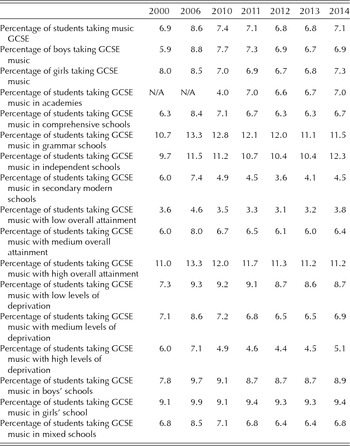
The issue of the continuation of music education when it becomes optional is not a solely English issue. For instance, in Canada on average only 10–12% of secondary school students continue with music once it is not compulsory at the age of 14 (Bolden, Reference BOLDEN, Beynon and Veblen2012). In the UK (excluding Scotland) relatively few students take GCSE music in comparison with other subjects. For instance, in 2014, the percentage of students taking GCSE music was 7.1% compared to 13.9% taking Art and Design, 17.1% taking Physical Education and Sports Studies, 11.8% taking Drama and Theatre studies and 8.9% taking Media/Film/TV studies (Gill, Reference GILL2015). Consideration of the data relating to the take-up of music over time shows that the percentage taking music at GCSE in the 21st century has remained remarkably stable (see Table 1). However, examination relating to take-up which considers school type, overall attainment and levels of deprivation shows that most students taking music at GCSE are amongst those with the highest levels of overall attainment, the lowest levels of deprivation, and attending schools with an academic focus (see Table 1). It is clear that the challenge is not only to increase the number of young people taking music at KS4 but to encourage a wider range of students, particularly those from lower socio-economic status groups to continue with music.
Percentage of students taking GCSE music between 2000 and 2014

*Data derived from reports by Cambridge Assessment
*Levels of overall attainment were assessed in relation to overall GCSE points
*Levels of deprivation were derived from national databases
Persuading more young people to continue with music beyond the age of 14 is particularly challenging as there is evidence of a widely-held perception that it is necessary to have high level instrumental skills in order to continue with music and take national examinations at age 16 and 18 (Lamont et al., Reference LAMONT, HARGREAVES, MARSHALL and TARRNAT2003; Wright, Reference WRIGHT2002). Lamont and Maton (Reference LAMONT, MATON and Wright2010) invoke the concept of legitimation codes to describe the understandings that students have of what is required for success. They argue that students perceive school music as an elite code which requires special knowledge, skills and ability. They refer to ‘knowledge codes’ that encode this legitimized and sanctioned (specialist) knowledge and ‘knower codes’ that refer to sensibilities and dispositions: ‘the kind of knower that you are’. (p 270). In school music knowledge codes focus on the processes, procedures and theoretical knowledge associated with Western classical music, while the knower codes are those of practitioners including composers, performers and listeners. Those without the knowledge codes and identities which match those of the school system are likely to disengage from school music.
Music teachers are almost always trained in the Western classical tradition and some music teachers have been found to discourage pupils with no instrumental skills from continuing with music as an option (Ofsted, 2009). This reinforces the perceptions of music as being an elite pursuit. In addition, young people with high-level instrumental or vocal skills may see no need to continue with music at KS4 unless they wish to pursue a career in music (Little, Reference LITTLE2009) particularly as music is perceived to have little value in career terms in the wider community (Lamont et al., Reference LAMONT, HARGREAVES, MARSHALL and TARRNAT2003; Hallam, Creech & McQueen, Reference HALLAM, CREECH and McQUEEN2009). Parents also sometimes dissuade their children from taking music (Button, Reference BUTTON2006; Hallam et al., Reference HALLAM, CREECH and McQUEEN2009). Overall, while young people in secondary schools in England have reported that they enjoy school music lessons (Lamont et al., Reference LAMONT, HARGREAVES, MARSHALL and TARRNAT2003), value the opportunities to work practically and indicate that music increases their self-esteem, particularly when they can perform to others (Ofsted, 2009; Hallam et al., Reference HALLAM, CREECH and McQUEEN2009) most do not take up opportunities to continue with it in KS4.
It was in this context that Musical Futures was developed by the Paul Hamlyn foundation to encourage more young people to continue with music. It is broadly based on the principles of ‘informal learning’, a much contested concept (Narita & Green, Reference NARITA, GREEN, Benedict, Schmidt, Spruce and Woodford2016). Folkestad (Reference FOLKESTAD2006) drawing on research undertaken in the Nordic countries on the way that popular musicians develop their skills (Fornas, Lindberg & Sernhede, 1995; Berkaak & Ruud, Reference BERKAAK and RUUD1994; Lilliestam, Reference LILLIESTAM1996, Johansson, Reference JOHANSON2002; Soderman & Folkestad, Reference SODERMAN and FOLKESTAD2004) and the work of Green (Reference GREEN2002) argues that formal learning occurs when the activity is sequenced beforehand by a teacher or other leader who leads and manages the activity. In contrast, informal learning is not planned in advance. The activity determines the way of working/ playing/ composing and the process evolves through the interaction of the participants in the activity. Other key features relate to participation as voluntary or self-chosen, the situation where the learning takes place; the learning style (nature of the learning process), ownership (who owns the decisions of the activity); and intentionality (what is the aim). In practice, in the classroom, the boundaries between formal and informal learning are not always clear and any lesson may include elements of each.
Within an informal learning approach, Musical Futures was introduced to devise new and imaginative ways of engaging young people, aged 11–19, in musical activities, providing all children with opportunities to engage with music that reflected their interests, generally popular music, while also empowering them in taking control of their musical learning (Green, Reference GREEN2008). It was hoped that the adoption of the Musical Futures approach would encourage more young people from a wider range of backgrounds to continue with music when it became optional, in part because the approach was informal in nature, and also because its starting point was popular music. Musical Futures was launched in 2003 and emerged from research which focused on how musicians working in popular genres learned through listening and playing by ear (Green, Reference GREEN2002; Reference GREEN2008). It was based on the development of student-centred pedagogies. Teachers facilitated learning rather than directing it with pupils participating in determining the nature of the curriculum. The original pilot work took place between 2004 and 2006 in three Local Authority Music Services in the UK with four key strands emerging:
-
— Informal learning at KS3;
-
— The whole curriculum approach;
-
— Personalising Extra-Curricular Music; and
-
— NUMU.
Musical Futures conceptualized each of these activities as below:
Informal Music Learning at Key Stage 3 was based on the real-life learning practices and processes of popular musicians, enabling students to learn alongside friends, through independent, self-directed learning with teachers acting as facilitators and musical models.
The Whole Curriculum Approach was described as a scheme of work for Year 8 students who had not previously experienced sustained musical engagement included extra support for the teacher, bringing informal learning processes into schools, making tangible connections with students’ musical lives outside school, and involving students in real musical activity, in genuine musical situations and environments.
Personalising Extra-Curricular Music provided guidance on the personalization of activities that students undertook outside of the school curriculum so that they complemented the curricular work in schools and enhanced students’ musical progression.
NUMU (www.numu.org.uk) was an interactive web space for creating music, publishing, marketing and promoting, allowing students to develop skills and apply them to a real life situation with a global audience.
Following this initial work Musical Futures published a toolkit of teacher resources which included a wide range of materials – lesson plans, National Curriculum mapping, video and audio material, case studies and quotes from participants, students and teachers (www.musicalfutures.org). A two-year Continuing Professional Development (CPD) programme was offered and in 2008 Musical Futures set up a national network of ‘Champion Schools’. Musical Futures described these as adapting and adopting Musical Futures independently (d'Amore, Reference D'AMORE2014).
Since its initial conceptualisation the programme has been developed further based on feedback which provided increasing knowledge of how teachers adapted and applied the pedagogy in a range of classroom situations. The programme now focuses on two key areas: informal learning and non-formal teaching. Informal learning, as defined by Musical Futures, is where students determine their own targets and learn through self-directed activities starting with familiar music, moving on to other genres and ultimately composition. When this approach is adopted the role of the teacher is to model, support, advise and guide. Non-formal teaching is described as based on community music practice. Inclusive group-based activities in performing, listening, composing and improvising are undertaken with teachers and students co-constructing content. As a result of these changes Musical Futures is now defined as ‘an approach to teaching and learning. . . a new way of thinking about music-making in schools that brings non-formal teaching and informal learning approaches into the more formal context of schools’ (Musical Futures, 2014, p. 9).
A number of evaluations of the implementation of the Musical Futures approach to teaching music have been undertaken. These have been broadly positive indicating enhanced motivation and enthusiasm for music and as a consequence improvement in learning and progression (see Benson, Reference BENSON2012; Evans, Beauchamp & John, Reference EVANS, BEAUCHAMP and JOHN2015; John & Evans, Reference JOHN and EVANS2013; Ofsted, 2006; O'Neill & Bespflug, Reference O'NEILL and BESPFLUG2011; Younker et al., Reference YOUNKER, WRIGHT, LINTON and BEYNON2012). In pilot work in Australia, some teachers reported an increase in students taking instrumental music and/or electing to participate in more classroom music, although others were cautious saying that it was too early to comment (Jeanneret, McLennan & Stevens-Ballenger, Reference JEANNERET, MCLENNAN and STEVENS–BALLENGER2011). In Wales, teachers reported an increase in national curriculum levels for many students, in some cases increased up-take at Key Stage 4 and increased take up of instrumental tuition. The students also reported enhanced and speedier learning (John & Evans, Reference JOHN and EVANS2013). Wright (Reference WRIGHT, Benedict, Schmidt, Spruce and Woodford2016), undertaking an analysis of the introduction of informal music pedagogy broadly based on the Musical Futures approach, tracked students’ perceptions of their pedagogical capital (skills, knowledge and understanding related to learning and teaching and ownership of pedagogical decision making) and musical capital (skills knowledge and understanding related to music, self-perceptions of musicality and musical potential), noting changes in both (Wright, Reference WRIGHT, Burnard, Soderman and Hofvander–Truleson2015).
In the Nordic countries informal, student centred learning in music lessons has been in place for many years (Karlsen & Vakeva, Reference KARSLEN and VAKEVA2012). In the 1960s when education became compulsory in Sweden the first music education national curriculum was based on music literacy, singing songs in harmony and the Western history of music (Georgii-Hemming & Westvall, Reference GEORGII–HEMMING and WESTVALL2010). This changed when policy documents advocated that each student was entitled to have his or her individual needs and interests recognized in school (Zackari & Modigh, Reference ZACKARI and MODIGH2000). As a result the national curriculum emphasized the students’ own world of musical experience and was based on singing, playing instruments and making music, described by Stålhammar (Reference STÅLHAMMAR1995) as a transition from school music to music in school. The content of lessons was developed jointly by teachers and students and focused on students’ development as human beings, musical craft and musical activities (Georgii-Hemming & Westvall, Reference GEORGII–HEMMING and WESTVALL2010). Popular music became part of the compulsory school music curricula in the 1970s. In response to the changes, in 1971 a music teacher education programme (SAMUS) was launched in Gothenburg embracing musical styles such as jazz, folk music, pop and rock. Other higher education institutions in the Nordic countries soon adopted this approach with the pedagogical approaches adopted frequently building on the learning strategies that popular musicians employ when acquiring their skills and knowledge in informal situations or practices which had been identified through a range of Nordic research (see Karlsen & Vakeva, Reference KARSLEN and VAKEVA2012). In practice this meant that there were greater links between students’ extra-curricular music activities and the activities that they undertook in the classroom. The longer time span of the implementation of informal learning of popular music in the classroom in the Nordic countries has made it possible to evaluate its impact over a longer period of time. What has emerged is that as the music that the students engage with out of school changes quickly, what is learned in school tends to not include many contemporary genres and styles (Skolverket, 2004; Georgii-Hemming, Reference GEORGII–HEMMING2006; Vakeva, Reference VAKEVA2010). As teachers design the curriculum to meet the needs of their students there is also large variability between schools (Georgii-Hemming & Westvall, Reference GEORGII–HEMMING and WESTVALL2010). Overall, there are still some groups of students whose needs are not met and who tend to become disengaged (Bergman, Reference BERGMAN2009). The most serious criticism is the lack of progression. Teaching tends to be short-term, unplanned and populist with many one-off activities which contribute to a lack of continuity (Georgii-Hemming & Westvall, Reference GEORGII–HEMMING and WESTVALL2010; Skolverket, 2004).
Taking account of the literature considered above, the aim of the research reported here was to explore the extent to which teachers and students perceived that Musical Futures had supported the development of musical skills, the take-up of music in Key Stage 4 and had influenced the musical qualifications that schools were offering.
The specific research questions were:
Does the implementation of the Musical Futures approach
-
− enhance the musical progression of participating students in terms of the development of musical skills?
-
− increase the take-up of music as an option at Key Stage 4?
-
− change the nature of the qualifications offered at Key Stage 4?
Methods
Research design
The research was based in a number of case study Musical Futures champion schools. It was carried out over a three-year period. During Phase 1, questionnaires were completed by music staff and students in each of the participating schools. During Phases 2 and 3, the questionnaires for students were repeated. In each of the case study schools, focus group interviews with students were carried out in Phases 1 and 2 and individual student interviews were undertaken in Phase 3. In-depth individual interviews with Heads of Music and members of the music teaching staff in each case study school were also carried out during Phases 1, 2 and 3.
The sample
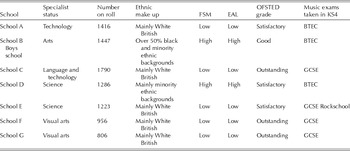
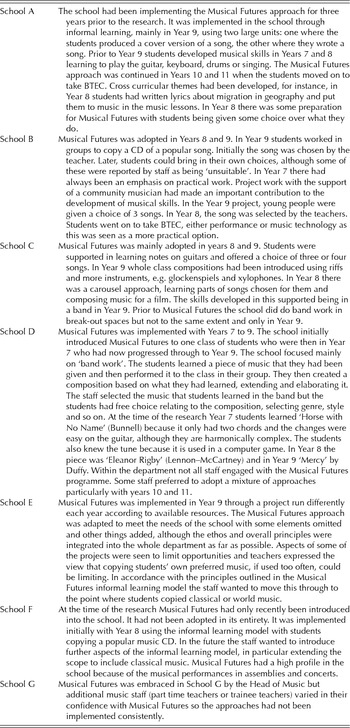
The case study schools: The six case study schools were selected in consultation with the Musical Futures team to represent different types of school and differences in experience with Musical Futures. One additional school was recruited to allow for attrition. Students and teachers in this school participated in some elements of the research. The schools had different characteristics. What they shared was a Head of Music who could see the value of Musical Futures and was committed to its implementation. Table 2 sets out the general characteristics of the case study schools at the time of the research, Table 3 the details of the implementation of the Musical Futures approach. While, there were differences in the year groups where Musical Futures was implemented typically, the element of the approach adopted was using informal learning in Key Stage 3 with popular music as the focus. Schools A, E and G used informal learning in Year 9, schools B and C in Years 8 and 9, and School D in Years 7–9. In School F, the students selected their option subjects in Year 8 so all students could only access Musical Futures for a maximum of two years before deciding if they wished to continue with music. (see Table 3). As Champion Schools for Musical Futures all of the schools were highly committed to the Musical Futures approach. This is likely to have influenced responses to the questionnaires and interview contributions positively, although teachers and students demonstrated that they could be critical of the approach where they felt this was relevant (see Hallam et al., Reference HALLAM, CREECH and McQUEEN2016a; forthcoming).
Case study schools

*FSM = free school meals; EAL = English as an additional language
*Ofsted gradings are set out as at the time of the research
The implementation of Musical Futures in the Schools

Music staff: During Phase 1, 28 music teachers, representing different levels of teaching experience and experience of Musical Futures, completed a questionnaire. During Phase 1, interviews were undertaken in six case study schools with the Head of Music and a music teacher. In Phases 2 (12) and 3 (18) in-depth interviews were carried out with Heads of Music and other music staff. In Phase three the seventh school that had participated in completing the questionnaires for Phases 1 and 2 was also visited; three in-depth staff interviews were carried out in that school.
Students: Overall, across the three Phases of data collection, 733 students completed questionnaires. 154 had completed it at all three Phases. In phase one focus group interviews were undertaken with 171 students representing a range of year groups and ability levels. The music teachers selected students to participate in the focus group interviews based on their assessment of their musical attainment, high, moderate, low. In subsequent phases, the student focus groups were revisited (Phase 2) with 117 students participating, Individual interviews were carried out with 37 students (Phase 3). In Phase 3 four in-depth student interviews were carried out in School G.
The questionnaires
Two questionnaires were designed, the first for teachers adopting the Musical Futures approach, the second for their students. The questionnaires were based on five point Likert scales where respondents indicated their level of agreement or disagreement with a range of statements.
The teacher questionnaire addressed issues relating to the impact of Musical Futures on students’ musical skills, progress, attainment, understanding of different genres, and the extent to which they had fulfilled their potential and had exceeded expectations.
Students were asked to rate themselves in terms of their expertise on their first instrument. They were also asked to respond to a series of Likert scale statements relating to whether Musical Futures had helped them to become a better musician and to listen to music differently and whether they believed that they could make music as well as others, were musical, were confident, had good musical skills, and had achieved a lot. They were also asked to respond to a series of statements as to whether they would choose music as one of their options at Key Stage 4 (age 14–16) or continue to engage with music but not for a school examination. They were also asked whether they engaged in musical activities outside school; whether music lessons in school encouraged them to continue with music outside school and whether school music supported out of school activities.
The interviews
The interviews with teachers asked them about the impact on students in terms of musical progression, take-up of GCSE music and whether adopting the Musical Futures approach had led to changes in the examinations on offer in Key Stage 4. Students were asked in the interviews if Musical Futures had had an impact on their learning and progress.
Procedure
A member of the research team visited the participant schools for the purposes of administering and collecting questionnaires, undertaking focus group interviews and interviews with staff. The ethical guidelines from the British Educational Research Association were followed. Consent was obtained from all participants prior to the research. They were ensured of confidentiality. Those being interviewed were told that they could withdraw from the process at any time.
Data analysis
The questionnaire data were analysed using SPSS. Interviews were transcribed in full and a thematic analysis undertaken (Patton, Reference PATTON1990; Braun & Clarke, Reference BRAUN and CLARKE2006). The evidence from the qualitative data is presented through a series of quotes from the interviews which enable the voices of the participants, pupils and teachers, to be heard. This is a well established approach in music education (Finney & Harrison, Reference FINNEY and HARRISON2010).
Findings
Teachers’ perceptions of students’ musical progression
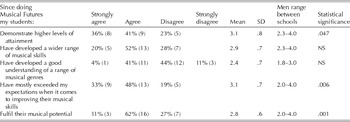
In the questionnaire completed in phase 1 of the research teachers responded positively to a number of statements relating to students’ progress. These are set out in Table 4. Overall, teachers were generally positive about the impact of Musical Futures on their students’ development of musical skills and progression. The exception to this was in relation to developing a good understanding of a range of musical genres. Statistical analysis revealed that there were school differences in relation to some of these responses (see Table 4) including demonstrating higher levels of attainment, exceeding expectations, and fulfilling musical potential.
Teachers’ perceptions of the impact on students’ musical progress

*NS means not statistically significant
These findings were supported in the interview data. Teachers described how the students were able to make progress in each lesson:
Just recently we've been doing a simple song in one lesson. We were doing ‘Use Somebody’, Kings of Leon, ukuleles, guitars, bass, drums, singers, and in the space of one lesson we managed to put that whole song together – Year 7s. They've all learnt those chords already . . . They can see progress if they're doing that from Year 7 right through to Year 9. We're noticing with this year's Year 8, they're much more musically adaptable and able, just having learnt those different instruments last year. (Head of Music)
These teachers clearly perceived that the students had increased their musical capital through engaging in practical informal learning. The independence that students were given and the opportunities that they had for working on projects of their own choosing were seen as important in supporting progress particularly for those who the teachers described as moderate and lower attaining students and boys:
I think it's probably more beneficial to middle end, lower end ability rather than the top end, because someone like a classical flute player will be good at music anyway and will be pushing herself in other ways. I think girls get quite a lot out of it as well but I think it works very well for the boys. (Head of Music)
I think that boys that were achieving low grades in music, because they've been allowed to do what they've wanted to do, it's really sparked their enthusiasm. Certainly at the lower end it's certainly lifted attainment I would say, particularly boys. (Head of Music)
These statements reflect teachers’ perceptions of changes in students’ musical and pedagogical capital (Wright, Reference WRIGHT, Burnard, Soderman and Hofvander–Truleson2015). Staff reported that the group work enabled them to assess progress more easily and spot those who were developing considerable musical skills. Teachers seemed to be concerned to identify those who might continue with music as an option choice. Their responses also suggest an underlying belief in the notion of ‘musical ability’.
You quite often find that you discover a real talent that you weren't quite aware of before. A couple of weeks ago there was a girl in Year 9, I didn't know she could sing and play at the same time. (Music Teacher)
We spotted X through the band project in Year 8, unbelievable singer. Anyway we did this lesson and I was blown away by this boy's voice and I thought ‘wow’. He's doing music now at key stage 4 and he just took the lead role in the musical, the Wizard of Oz, the Whizz King. (Music Teacher)
In phase 3 of the research some teachers expressed concern that Musical Futures was not meeting the needs of those pupils who they perceived had high level traditional musical skills. Some of the teachers held beliefs which continued to legitimize the elite nature of music education despite the implementation of the Musical Futures approach. For instance:
I must admit I think probably one weakness of Musical Futures is dealing to the higher end. You need to think quite a lot more what the best students can actually do. It depends what piece they choose. For example, when they choose their piece and try to recreate it and it's quite simple, that is going to limit a really good student, whereas if they pick something challenging, that's going to challenge them. (Music Teacher)
Other teachers described how pupils that they described as musically high and low attaining could benefit from participation in Musical Futures:
Take a notation-reading flute player, take away their notation and their flute and give them something else to do and it becomes much more challenging. If you have a very able musician in the group, taking a lead in organising other people and sharing their skills can be challenging as well. It's encouraging them off their preferred instrument to explore and do other things. So you can push the more able kids and we do see them thrive. (Head of Music)
The emphasis on performance and composition was seen as good preparation for examinations at Key Stage 4, although there were sometimes issues about the broader musical skills that students would need:
When they're doing their options I make it very clear to them that you are going to have to study other sorts of music as well, it's not just all about playing an instrument and getting bands in all the time, there is a listening paper and for the listening paper you have to study dance music, you have to study classical music. (Music Teacher)
Students’ perceptions of their musical progress
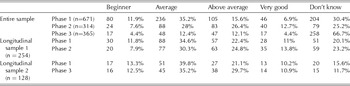
Level of attainment: One measure of progress was students’ perceptions of the level that they had attained on their instrument. In each phase of data collection the students indicated the level that they had attained on their first instrument. Table 5 indicates that the Phase 2 sample rated themselves most positively, with 73 (34%) students reporting their level as ‘above average’ and 37 (17.2%) rating themselves as ‘very good’. The increase in ‘don't know’ and the less positive self-ratings amongst the Phase 3 sample may be explained partially by the fact that this sample included 237 students who had by that time dropped music as a subject at school.
Students’ self-rating of their level on their first instruments

Comparisons were made between Phase 1 and Phase 2 (longitudinal sample 1) and between Phase 1 and Phase 3 (longitudinal sample 2). Over time students generally perceived themselves as having progressed on their first instrument. In Phase 1, 11.8% of students in longitudinal sample 1 rated themselves as ‘beginner’ and just 11% rated themselves as ‘very good’. In Phase 2, 7.9% of students rated themselves as beginner and 13.8% rated themselves as very good. Longitudinal sample 2 demonstrated a similar trend. Few students in Phase 3 indicated that they did not know how to rate their level of achievement, suggesting that they felt more confident in assessing their level. Their musical and pedagogical capital had been enhanced (Wright, Reference WRIGHT, Burnard, Soderman and Hofvander–Truleson2015).
Singing: Students’ perceptions of their progress in singing were assessed by asking them if they could sing. Analysis of longitudinal sample 1 (n = 254) revealed that in Phase 1, 47 students (18.1%) indicated that they could. This increased to 85 students (33.3%) in Phase 2. Analysis of longitudinal sample 2 (n = 128) supported this trend; in Phase 1, 29 students indicated that they could sing, rising to 42 (33%) in Phase 3. Statistically significantly more girls than boys said that they could sing in Phases 2 and 3 (p = .0001).
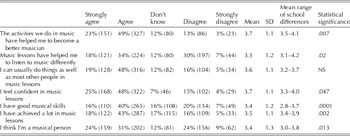
Development of musical skills: More general assessment of progress as perceived by the students were indicators of whether music lessons had benefitted them and whether they had acquired musical skills. Amongst the Phase 1 sample, there was considerable agreement that the music lessons in school had benefitted them and that they had acquired a range of musical skills (see Table 6) supporting the findings of Wright (Reference WRIGHT, Benedict, Schmidt, Spruce and Woodford2016). There were some statistically significant differences in responses between young people attending different schools (see Table 5).
Students’ perceptions of the development of their musical skills (Phase 1)

*NS indicates that there were no statistically significant differences
In the interviews students were able to identify areas where they had made progress and where they wanted to improve. Some focused on instrumental skills:
I've got better at organisation. I'd like to get better at playing the guitar because I forget the chords. I need more practice. (Year 8, boy, middle ability)
I've improved on the steel pan because I've played it for four years but what I could improve is violin because I've only just basically started. (Year 8, girl, high ability).
Students appeared to recognize that it took time and effort to develop musical capital.
For a number of students reading notation was a concern and a focus for improvement. While they felt that they had improved other musical skills including playing by ear and understanding of musical concepts their relatively poor reading of musical notation was perceived as a weakness.
I think my ear's got better, I can play music by ear quite easily and work it out quite fast. I think I could improve on the notation, not where the notes are but rhythms and things. (GCSE group, boys)
Well, my best improvement would be sight reading because I'm awful at it. But I can read music a lot faster now and play it as I go along a lot better. I used to be terrible at it, and I don't think my aural is very good, hearing things are in tune or sound good or not. (GCSE group, boy)
Progression to Key Stage 4
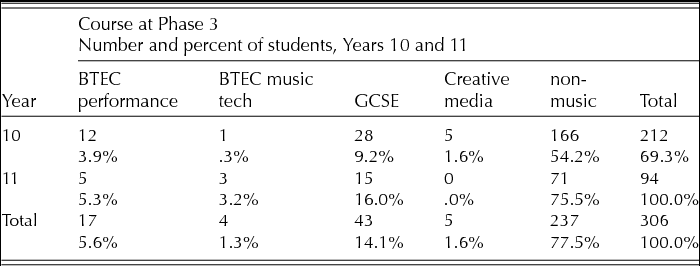
Uptake of music at Key Stage 4: A total of 365 students completed questionnaires at Phase 1 and again at Phase 3. Three hundred and six of these students had reached Years 10 or 11 at Phase 3, the stage at which music was an optional course at school. Two hundred and thirty-seven (77.5%) of the students had dropped music. Of the remaining students, 26 (8.5%) were enrolled on BTEC performance, music technology and creative media courses and 43 students (14.1%) were enrolled on GCSE music (see Table 7).
School data on progression to music diplomas and GCSE music

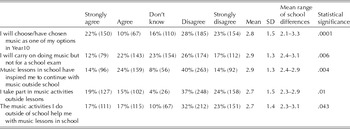
Pupil intentions to take music at Key Stage 4: 32% of respondents to the Phase 1 questionnaire indicated that they had chosen or would choose music as an option in Year 10. However, 34% indicated that they would carry on engaging with music but not as an option at KS4, although 38% indicated that music lessons in school had inspired them to continue with music. 34% reported taking part in music activities outside lessons and that the music activities outside school helped with music lessons in school (see Table 8).
Pupils’ reports of continuing with music at Key Stage 4 and the relationships with extra-curricular activity (Phase 1)

Teachers’ perceptions of take-up at Key Stage 4: The interviews with the teachers indicated that there had generally been an increase in take-up of music at Key Stage 4. In five of the participating schools the teachers commented favourably on the increase in the number of students continuing with music after Key Stage 3 as a result of Musical Futures for example:
This year in Year 10 we have 44 choosing to do GCSE music, compared with 23 two years ago. (Head of Music School C)
It's been steadily increasing. . . it's kind of upped since Musical Futures. . . For KS4 we have to turn kids away every year who want to study music to do our BTEC level 2. (Music Teacher School B)
One factor perceived to be important was the way that students, who were not having specialised instrumental lessons, had developed instrumental skills through their participation in Musical Futures:
It's people coming in doing GCSE music who are non-traditional musicians and whereas in the past we've always had some do that, it's now coming to the point where maybe half the class is like that. Whereas before you'd have a class who were grade 6 and upwards, now it's very different. It's taken away the elitism. (Music Teacher)
Musical Futures had supported inclusion.
Changes in choice of examinations on offer at Key Stage 4
In Phase 1 of the research, some schools were changing their formal examination arrangements in response to the increased motivation of the students, take up at Key Stage 4 and the requirements of GCSE which they felt that some students would not be able to meet:
We have introduced the start of the BTEC certificate in Year 10. That seems much better, much more appropriate for the kids than the GCSE which is more traditional. Nobody's dropped out of BTEC. Some drop out of GCSE, it's too much like hard work. (Head of Music)
Despite the early enthusiasm, the later interviews showed that offering BTEC in Key Stage 4 created some problems in some schools as it was a double option and perceived as reducing opportunities to take other subjects. In some cases staff wanted to maintain the GCSE option and run a BTEC option alongside it.
Discussion
There are of course limitations to this research. It was undertaken in Musical Futures champion schools where music staff and students were more likely to have favourable perceptions of the impact of Musical Futures. This may have influenced responses to the questionnaires and what emerged in the interviews and focus groups. The design of the Likert scale statements where statements were framed positively and asked for retrospective judgements about the impact of Musical Futures may have biased responses, although there was variability in the extent of agreement with different statements suggesting that respondents were responding thoughtfully. In the interviews participants may have had different understandings of the meaning of the term progression.
The findings provided evidence of progression in terms of musical skills from both teachers and students. This was particularly the case for those students who previously had not learned to play an instrument and whose engagement with making music had been limited. Participants had clearly enhanced their musical and pedagogical capital. Musical Futures had provided opportunities to address some of the challenges faced by secondary school teachers who find themselves facing greater diversity than in almost all other subjects, with some students at age 11 being highly competent advanced instrumentalists and others having few musical skills; the latter because of the wide variation in provision and its quality at primary school (Ofsted, 2003, 2009, 2011). Musical Futures enabled an inclusive approach to music education enabling all students in the schools to engage with music making in a way that was meaningful for them supporting their musical and pedagogical progression and enabling them to perceive themselves as capable of continuing with music when it became an optional subject. The barriers in terms of there being an elite code (Lamont & Maton, Reference LAMONT and MATON2008) seemed to be being challenged.
Despite this there was evidence that some of the teachers continued to identify a musical elite and were identifying talent, albeit in some cases of a different nature, in those who might progress to music at Key Stage 4. The nature of this elite appeared to have changed from one exclusively based on traditional classical musical skills to one which also embraced the skills required for learning popular music genres. As the implementations of Musical Futures had not moved beyond popular music into other genres the opportunities available to students were still limited albeit in a different way.
There had been an increase in uptake at Key Stage 4 as a result of the introduction of Musical Futures. Those who had previously considered themselves as lacking in musical skills now felt that they had sufficient musical capital to continue with music. These students might have been from lower socio-economic status families, although the available data did not allow an analysis of this.
Related to being more inclusive was the dilemma faced by some of the teachers regarding the examination opportunities that should be available, BTEC or GCSE. These different examination routes offered opportunities to students with very different musical aspirations and skills.
GCSEs were considered to be too demanding in terms of musical literacy and knowledge of different genres for many of the new participants. As an outcome of the implementation of the Musical Futures approach schools had changed to BTEC as it seemed to be a more appropriate progression route. However, it limited opportunities for those students who played classical instruments and needed GCSE for university entrance or the opportunity to take A-levels. Music Teachers felt that it was unlikely that they would be able to offer both options in the long term so they were faced with difficult choices. This situation is likely to be further exacerbated in the future by the pressure on schools in England to introduce a more rigorous academic curriculum; changes to the GCSE which have placed a greater emphasis on classical music; increasing pressures on school budgets; and the impact of the introduction of the English Baccalaureate and its use in assessing school performance. Overall, it seems extremely unlikely that schools will be able to offer BTEC and GCSE in the future.
The research highlighted the tensions between different conceptions of the purpose of music education and in particular the nature of the curriculum. The emphasis on popular music and an informal approach were key to many students continuing with music at KS4. However, music teachers were aware that this did not meet the needs of all students. The time allocated to music lessons in KS3 is limited. Acquiring musical skills in different genres is time-consuming and transfer of skills between genres can be difficult. This presents challenges for music education which are beyond the scope of this paper but which do need to be addressed.
There are other lessons to be learned from the implementation of the Musical Futures approach. Being given opportunities to learn informally, working with friends, having control of what is learned and how it is learned increases students’ pedagogical capital (Wright, Reference WRIGHT, Burnard, Soderman and Hofvander–Truleson2015; Hallam et al., Reference HALLAM, CREECH and McQUEEN2016b) and encourages then to take more responsibility for their learning. This suggests that the adoption of informal learning approaches might have benefits beyond the learning of popular music, not only for other musical genres but also across the school curriculum more widely.
There were school differences in relation to the questionnaire responses of students and teachers. This, in part, may reflect the different implementations of the Musical Futures approach but suggests that other factors are important in the extent to which students make progress in developing their musical skills. We know that this is the case in relation to continuing with music at KS4 (see Little, Reference LITTLE2009). Further research might focus on what factors influence the development of musical and pedagogical capital in the classroom.
To conclude, Musical Futures provides the means to engage a wider section of the school population in active music making increasing motivation and the opportunities for progression both musically and in terms of take up at Key Stage 4. However, challenges remain in terms of the kind of qualifications which are appropriate to offer to students with very different kinds of musical skills and knowledge. These will not easily be resolved particularly in the current educational context where schools are under pressure in terms of resources and the need to meet ever more demanding government standards in all subjects except the arts.