Introduction
Chronic fatigue syndrome (CFS), also known as myalgic encephalomyelitis (ME), is a condition characterized by profound fatigue and is associated with extreme disability (Sharpe et al. Reference Sharpe, Archard, Banatvala, Borysiewicz, Clare, David, Edwards, Hawton, Lambert, Lane, McDonald, Mowbray, Pearson, Peto, Preedy, Smith, Smith, Taylor, Tyrrell, Wessely and White1991). Adolescents are typically unable to attend school at a crucial stage of their development. Although earlier follow-up studies suggested that adolescents with fatigue have better outcomes than adults (Joyce et al. Reference Joyce, Hotopf and Wessely1997), the prognosis of CFS in adolescents is less impressive. In one long-term follow-up study, children with severe CFS took an average of 38 months to recover and a third remained ill (Rangel et al. Reference Rangel, Garralda, Levin and Roberts2000). In another study, many children with CFS experienced severe difficulties in returning to school and all reported that the illness had impacted on their education and career plans (Sankey et al. Reference Sankey, Hill, Brown, Quinn and Fletcher2006). Given the impact of symptoms and disability on adolescents' social and educational lives, it is imperative that they are enabled to return to school or college and ‘normal life’ as quickly as possible.
We have developed a model of understanding CFS that suggests that illness or stress can precipitate the symptoms, in predisposed individuals, but that cognitive, behavioural, physiological and social factors interact to perpetuate the illness. At the core of the model is the assumption that unhelpful cognitions and ‘all or nothing’ and/or an avoidance pattern of behaviour exacerbates symptoms and disability (Chalder, Reference Chalder1999). In families, the beliefs of parents may also be important in determining the beliefs and coping of the child.
Evidence suggests that cognitive behaviour therapy (CBT) reduces fatigue and improves physical functioning in adults with CFS (Sharpe et al. Reference Sharpe, Hawton, Simkin, Surawy, Hackmann, Klimas, Peto, Warrell and Seagrott1996; Deale et al. Reference Deale, Chalder, Marks and Wessely1997; Prins et al. Reference Prins, Bleijenberg, Bazelmans, Elving, de Boo, Severens, van der Wilt, Spinhoven and van der Meer2001). Based on the aforementioned model, we developed a family-focused approach for treating CFS in adolescents (Chalder, Reference Chalder1999) and conducted an initial pilot study that indicated that family-focused CBT may be helpful in reducing fatigue and improving school attendance in the majority of 11- to 18-year-olds (Chalder et al. Reference Chalder, Tong and Deary2002). There is now preliminary evidence from The Netherlands that CBT is more effective than remaining on a waiting list in improving school attendance and physical functioning and reducing fatigue at 5 months after assessment in children with CFS (Stulemeijer et al. Reference Stulemeijer, de Jong, Fiselier, Hoogveld and Bleijenberg2005). Given that CBT is usually provided by specialists and may be difficult to access, we decided to use a randomized controlled trial (RCT) to compare family-focused CBT with a briefer, easier to deliver intervention, psycho-education, in a proof-of-concept RCT. Psycho-education could potentially be delivered by a range of health professionals including paediatricians and may be more acceptable to patients. It contains much of the information provided in the context of CBT and we thought it would be more acceptable than usual medical care, which all the adolescents had already received. In addition, we wanted to extend previous findings by providing long-term follow-up after two pragmatic interventions and include additional assessments from mothers and an independent assessor.
Method
Hypotheses
Our a priori primary hypothesis was that CBT would result in higher levels of school return than psycho-education at 6 months after randomization. Our secondary hypothesis was that CBT would also result in improved fatigue, social adjustment, physical functioning and global improvement compared to psycho-education at 6 months follow-up. We subsequently went on to gather data at 12 months follow-up. We assumed that the results at 12 months would be similar to those at 6 months.
Nature of the participants
All adolescents between the ages of 11 and 18 years who were referred to King's College Hospital, London by their general practitioner or consultant paediatrician for an assessment of their CFS were screened for inclusion in the trial. Recruitment took place between February 2000 and December 2003. All were investigated by a paediatrician, prior to referral, to exclude alternative causes for their fatigue. Participants were eligible if they fulfilled either the Oxford or CDC (Centers for Disease Control and Prevention) criteria for CFS (Sharpe et al. Reference Sharpe, Archard, Banatvala, Borysiewicz, Clare, David, Edwards, Hawton, Lambert, Lane, McDonald, Mowbray, Pearson, Peto, Preedy, Smith, Smith, Taylor, Tyrrell, Wessely and White1991; Fukuda et al. Reference Fukuda, Straus, Hickie, Sharpe, Dobbins and Komaroff1994). We chose the more inclusive Oxford criteria to ensure that the findings were as generalizable as possible. Those with major depression, somatization disorder, conversion disorder, history of self-harm or an identifiable disease that could have contributed to their illness were excluded. This decision was made on the basis of a clinical assessment by an experienced therapist. Patients taking anti-depressants were not excluded. However, they had to be on a stable dose for 3 months before entering the trial.
Design and procedures
The study was an RCT in which 13 sessions of family-focused CBT were compared to four sessions of psycho-education over 6 months. The study was reviewed by the local ethical committee at the South London and Maudsley National Health Service (NHS) Trust. A clinical assessment involving all members of the family took place to establish whether the adolescent had CFS/ME according to either the CDC or Oxford criteria (Fukuda et al. Reference Fukuda, Straus, Hickie, Sharpe, Dobbins and Komaroff1994; Sharpe et al. Reference Sharpe, Hawton, Simkin, Surawy, Hackmann, Klimas, Peto, Warrell and Seagrott1996). Once the diagnosis was established, self-report measures were completed prior to eliciting consent and randomization. The adolescent with CFS and one parent who agreed to participate signed a consent form in the presence of a witness.
A list of consecutive random treatment assignments to either CBT or psycho-education was prepared in advance by a non-clinical research assistant using permuted block randomization with a fixed block size of 4 to ensure balance in the number of patients in each treatment group over time. The randomization list was transferred to a sequence of brown envelopes by writing the sequence of treatment names on the inside of the envelopes, which were then sealed. The sequence of envelopes was then ‘cut’ by taking approximately the first half of the envelopes and placing them at the end of the sequence so that no person involved in the trial would know the starting point of the randomization sequence and to preserve allocation concealment. The envelopes were then numbered. The therapist wrote the name of the participant on the randomization envelope when opened to prevent it being resealed or reused.
Intervention
Two trained and experienced cognitive behavioural psychotherapists (T.C. and V.D.) provided both interventions over 6 months. Live co-supervision of therapy took place using closed-circuit television to ensure adherence to protocol and that treatment was delivered to a high standard.
In both groups close liaison with relevant school teachers and home tutors was initiated from the start of treatment and maintained throughout. Key issues for discussion were: endorsement of the reality of the condition, negotiating a graded return to school and for some reducing the number of subjects taken. In some cases repeat years were negotiated. Anxieties about reintegrating with peer groups were addressed and some adolescents were supported in changing academic institutions altogether. In both groups the entire family was invited to the first session and the mother accompanied the child to every subsequent session. Other members of the family attended when they could.
CBT: 13 sessions
Thirteen 1-h sessions of CBT were offered every 2 weeks. The approach was based on our cognitive behavioural model of CFS/ME in adolescents (Chalder, Reference Chalder1999). The treatment protocol including the number of sessions was adapted from that used in a trial of CBT for CFS in adults (Deale et al. Reference Deale, Chalder, Marks and Wessely1997), taking into account the specific needs of this age group within the context of their family. There are numerous reasons as to why CBT for adolescents with CFS needs to be delivered within the context of the family. Previous research has shown that psychological distress or fatigue in the mother corresponds with CFS in the child (van de Putte, Reference van de Putte, van Doornen, Engelbert, Wietse Kuis, Kimpen and Uiterwaal2006). It is possible that the child with CFS is learning to respond to symptoms in a similar way to the mother. In addition, many parents state that they do not know how to advise their children on how to manage their illness and appreciate being advised about this. As with any cognitive behavioural approach, it is important that everyone is aware of the advantages and disadvantages of approaching things in a similar way and with children in particular that parents are working together to give a similar message.
Particular emphasis was placed on building a rapport with all members of the family and establishing a collaborative relationship. A rationale based on a multi-factorial model of CFS was given for the behavioural and cognitive interventions (Chalder, Reference Chalder and Graham2005). Typically, treatment involved (a) encouraging the participant to achieve a balance between activity and rest, (b) gradually increasing activities including home, social and school life, (c) establishing a sleep routine, (d) addressing beliefs such as fear regarding the relative benefits of activity and/or exercise, high self-expectations and all-or-nothing thinking, (e) encouraging individuals within the family to express their own views about the illness and agreeing a way forward and (f) paying attention to relapse prevention.
The parent providing the majority of the care (usually the mother) was supported during the transition period as the adolescents became more independent. Homework assignments were negotiated with participants at each session. A treatment guide, Self Help for Chronic Fatigue Syndrome: A Guide for Young People (Chalder & Husain, Reference Chalder and Husain2002), was given to the family.
Although the interventions were child centred, the specific concerns of the parents and siblings were elicited and addressed. In addition, as improvement often coincided with the adolescent maturing and differentiating from the family, these factors were addressed in treatment. Therapists sought to maintain neutrality and acted as brokers in the not infrequent adolescent/parent disputes.
Psycho-education
This consisted of four sessions over a 6-month period. Although the content was similar to CBT, the mode of delivery was didactic. It involved discussion, information giving and problem solving but specific homework assignments and cognitive restructuring were not included. Families were not given a manual. Therapists ensured adherence to protocol by working from a checklist that included the following. (a) Gave the message that untreated CFS in adolescents has a good prognosis. (b) Presented a model of CFS that distinguished predisposing, precipitating and maintaining factors. (c) Introduced the concept of symptom management – that the way we manage our physical symptoms can make a difference to the outcome. Physical illness analogies such as heart disease were used to increase likelihood of engagement. (d) Gave advice on pacing and consistency of activity and rest, in order to break the vicious circle of symptom lead behaviour. (e) Gave advice on sleep management. (f) Conveyed the message that hurt does not equal harm – increased symptoms do not mean more pathology. (g) Advised clients to gradually build up activity over a period of months.
Assessments
All the measures were selected to assess different aspects of the illness; that is, symptoms, physical functioning and associated strengths and difficulties. The questionnaires were given at baseline, discharge (6 months after baseline), and 3, 6 and 12 months post-treatment.
Primary outcome: school attendance
The primary outcome was attendance at school/college/work, over a 2-week period, as a percentage of what was expected at the 6-month follow-up (continuous outcome). This information was obtained from the parent. School attendance was also dichotomized with a good outcome set at ⩾70% because at this age many healthy adolescents are not attending school or college full time.
Secondary outcomes
Fatigue
We measured fatigue with the 11-item Chalder fatigue scale (Chalder et al. Reference Chalder, Berelowitz, Pawlikowska, Watts, Wessely, Wright and Wallace1993). It is reliable and valid, has been used in other treatment trials, and internal consistency in this sample was excellent with a Cronbach's α of 0.89. We have used the fatigue questionnaire in a previous pilot study of family-focused CBT for adolescents (Chalder et al. Reference Chalder, Tong and Deary2002). Using a Likert scoring system (0-1-2-3), items are summed to give a total fatigue score.
Physical functioning
We measured functional impairment with the physical functioning subscale of the SF-36 (range 0–100, higher scores denoting better health). This measure is valid and reliable and has been used in adolescents with CFS (Stewart et al. Reference Stewart, Hays and Ware1988; Bell et al. Reference Bell, Jordan and Robinson2001; Stulemeijer et al. Reference Stulemeijer, de Jong, Fiselier, Hoogveld and Bleijenberg2005).
Work and Social Adjustment Scale (Mundt et al. Reference Mundt, Marks, Shear and Griest2002)
This was used to examine the degree to which fatigue interfered with the adolescent's ability to participate in life. This five-item questionnaire measures impairment in school, social and private leisure activities, engagement in homework, and ability to make friends. Impairment in each area is measured on a Likert scale from 0 indicating ‘not at all impaired’ to 8 ‘very severely impaired’. The scale was adapted to suit the needs of adolescents and has been shown to be reliable (Cronbach's α=0.7–0.9) and valid (Mundt et al. Reference Mundt, Marks, Shear and Griest2002). In this study Cronbach's α was 0.91.
Strengths and difficulties
Adolescents and their mothers completed the Strengths and Difficulties Questionnaire (SDQ; Goodman, Reference Goodman1997), which was designed to give a balanced view of children's behaviours, emotions and relationships. The SDQ is a brief measure of adjustment and psychopathology of children and adolescents. It has been shown to be valid and reliable in many studies (Goodman, Reference Goodman1997). Each item is rated on a three-point scale: ‘not true’, ‘somewhat true’ or ‘certainly true’. A total difficulties score is obtained by summing the hyperactivity, emotional symptoms, conduct problems and peer problems to give a score of 0–40.
Global outcome and satisfaction
Global outcome scales were used by the adolescent and mother to rate global improvement and satisfaction. An assessor, blind to which group participants were randomized to, carried out a semi-structured interview with the adolescent and rated degree of improvement in fatigue and disability on a nine-point scale from ‘much better’ to ‘much worse’ at the 6-month follow-up.
Statistical analysis
No interim analyses of the data were planned or conducted. A priori power calculations were based on a continuous definition of school attendance and assumed a mean school attendance of 60% in the CBT group and 40% in the psycho-education group in the 2 weeks prior to the 6-month follow-up with a common standard deviation of 25%. This was based on the results of our pilot study (Chalder et al. Reference Chalder, Tong and Deary2002) and the assumption that only four sessions of psycho-education would not be as effective, even on number of sessions alone. Furthermore, assuming 10% loss to follow-up, a sample size of 58 participants was expected to provide 80% power to detect a statistically significant difference using a two-sample t test and a two-sided 5% significance level. Based on an a priori defined cut-off point, the clearly bimodal school attendance data were dichotomized into a good/bad outcome (⩾70%/<70%) and analysed using logistic regression. The primary analyses used all available follow-up data and compared participants in their randomized groups, irrespective of the intervention they received. The sensitivity of the primary analyses was assessed including baseline school attendance, using a per protocol analysis (excluding three participants in the psycho-education group, two of whom did not fulfil criteria for CFS and one who received 13 sessions of CBT) and multiple imputation as an alternative method for handling missing data.
Analyses of the secondary outcomes at the 6-month follow-up compared CBT with psycho-education using linear or logistic regression as appropriate, adjusting for baseline values. Dichotomized school attendance, Chalder fatigue, physical functioning and social adjustment scores were further modelled over time at discharge and 3, 6 and 12 months follow-up using population-averaged (generalized estimating equations, GEE) linear or logistic regressions, as appropriate, with unstructured covariance matrices to allow for correlation in outcomes across time within participants. Baseline values, group (CBT versus psycho-education), time (discharge, 3, 6 and 12 months follow-up) and a group-by-time interaction term were included as explanatory variables. Scale item missing data were pro-rated in line with the author's guidelines for the SDQ and where 75% or more items were available elsewhere. Data were manipulated in SPSS version 12.1 (SPSS Inc., USA). All analyses were conducted in Stata version 10.1 (Stata Corporation, USA).
Results
Seventy-six adolescents were referred between February 2000 and January 2003. Sixty-three participants were randomized (see Fig. 1). Thirteen adolescents were excluded from the trial, 10 because they were ineligible and three because they declined to be randomized and requested CBT. With two exceptions all fulfilled Oxford or CDC criteria for CFS. One male had only been fatigued for 4 months and a female reported being fatigued for less than 50% of the time. These minor protocol deviations were identified after randomization and were therefore included in the main intention-to-treat analysis. Eight (25.8%) participants in the psycho-education group and 11 (34.4%) in the CBT group had been seen by a doctor for an emotional reason. Ten (32.2%) and 12 (37.5%) respectively had been prescribed anti-depressants 3 months prior to being randomized. Baseline characteristics (see Table 1) were similar in the two groups with the exception of self-reported duration of fatigue symptoms, school attendance and physical functioning. This was inconsistent, however, in that physical functioning and school attendance were worse in the psycho-education group whereas the duration of fatigue symptoms was longer in the CBT group.
Trial profile.

Baseline characteristics

CBT, Cognitive behaviour therapy; IQR, interquartile range; CFS, chronic fatigue syndrome; CDC, Centers for Disease Control and Prevention; ME, myalgic encephalomyelitis; SDQ, Strengths and Difficulties Questionnaire.
Trial deviations and adverse events
Of the 63 participants who were randomized, only three discontinued the intervention. Two participants allocated to psycho-education received additional sessions by request; one participant received three additional sessions and the other received four additional sessions. One participant allocated to psycho-education received 13 sessions of family-focused CBT by request. Serious adverse events were monitored and one participant who received family-focused CBT was admitted to hospital with depression after discharge from treatment, during the follow-up phase.
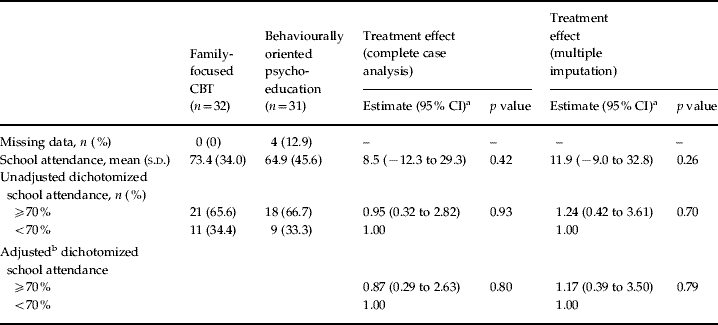
The CBT group did not differ significantly from the psycho-education group in any measure of school attendance, the primary outcome, at the 6-month follow-up (see Table 2). The distribution of school attendance rates was bimodal, violating the assumption of normality required for the primary analysis. School attendance was therefore dichotomized at an a priori defined cut-off. The conclusions were not altered in any of the sensitivity analyses, including the per protocol analyses (detailed analyses available from the authors on request).
School attendance at the 6-month follow-up

CBT, Cognitive behaviour therapy; CI, confidence interval; s.d., standard deviation.
a Where outcomes are binary, estimates are reported as odds ratios. Where outcomes are continuous, estimates are reported as mean differences.
b Estimates are adjusted for associated baseline values.
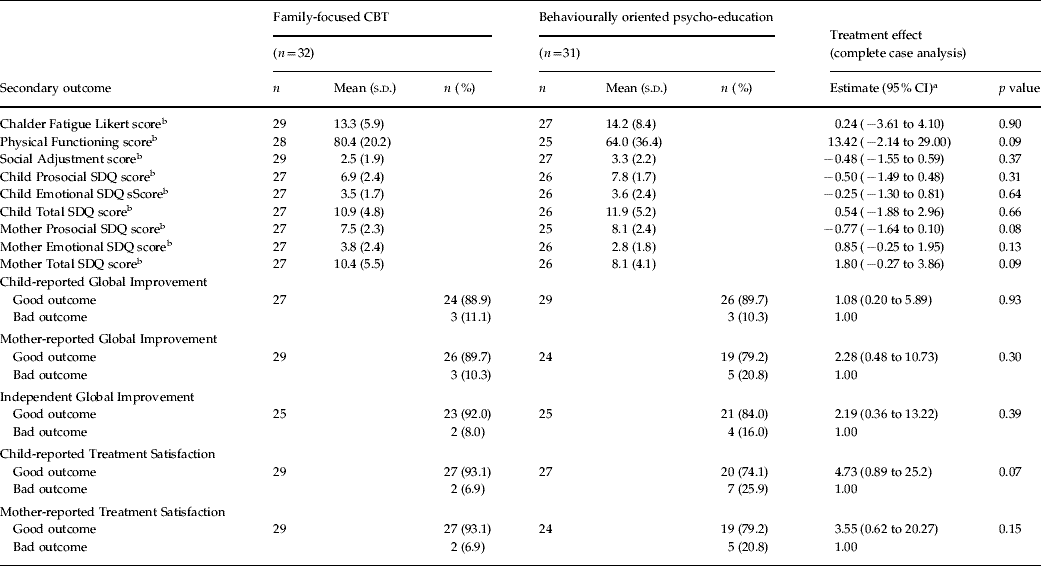
At the 6-month follow-up there were no statistical differences between the two groups on secondary outcomes (see Table 3). However there was a trend for participants in the family-focused CBT group to report greater levels of satisfaction than those in the psycho-education group.
Secondary outcomes at the 6-month follow-up

SDQ, Strengths and Difficulties Questionnaire; CBT, cognitive behaviour therapy; CI, confidence interval; s.d., standard deviation.
a Where outcomes are binary, estimates are reported as odds ratios. Where outcomes are continuous, estimates are reported as mean differences.
b Estimates are adjusted for associated baseline values.
Table 4 shows unadjusted frequencies and percentages, means and standard deviations for school attendance, fatigue, physical functioning and social adjustment at baseline, discharge from treatment and at 3, 6 and 12 months follow-up. The longitudinal analysis shows an interaction between group and time, indicating that the increased school attendance in those participants who received family-focused CBT at discharge decreased significantly over the follow-up period. Figure 2 shows the unadjusted pattern of change in school attendance from baseline to the 1-year follow-up.
School attendance (dichotomized) over time. Proportions on the y axis can be multiplied by 100 to give percentages (Table 4). The bars represent confidence intervals relating to an unadjusted analysis based on complete cases. –––, Family-focused CBT; - - -, behaviourally oriented psycho-education.

Outcomes over time

CBT, Cognitive behaviour therapy; GEE, generalized estimating equations; CI, confidence interval; s.d., standard deviation.
a Estimates are adjusted for associated baseline values and assume a linear effect over time.
b Where outcomes are binary, estimates are reported as odds ratios. Where outcomes are continuous, estimates are reported as mean differences.
Discussion
This study evaluated whether family-focused CBT was more effective than psycho-education in improving school attendance in adolescents with CFS.
We found that 13 sessions of family-focused CBT were no more effective than four sessions of psycho-education in improving school attendance, fatigue and social adjustment at the 6-month follow-up in adolescents with CFS. There was a non-significant trend, however, for the family-focused CBT group to report better satisfaction than the psycho-education group at the 6-month follow-up. However, the pattern of improvement in school attendance over time differed significantly between the treatment groups. During treatment, school attendance was higher for those who received family-focused CBT than for those who received psycho-education, indicating that adolescents initially improve more with the more intensive and more sophisticated treatment. This suggests that, during treatment, the odds of a good outcome are higher in the CBT group relative to the psycho-education group. However, post-treatment, school attendance increased more in those who received psycho-education, which suggests that the superiority of the CBT intervention over psycho-education decreases over time, with the psycho-education group catching up by the 12-month follow-up.
These results replicate and extend the findings of a previous study on the efficacy of CBT for adolescents with CFS that compared CBT to a waiting list control (Stulemeijer et al. Reference Stulemeijer, de Jong, Fiselier, Hoogveld and Bleijenberg2005). They showed improved outcomes, including school attendance and fatigue at 5 months, which was at the end of active treatment. They went on to find that, at 2 years, those who received CBT either during the RCT or after the waiting list period were significantly less fatigued, less functionally impaired and had higher school attendance than those in the no-treatment group (Knoop et al. Reference Knoop, Stulemeijer, de Jong, Fiselier and Bleijenberg2008). Our results replicate this, in that the improvements made after CBT are maintained up to 1 year after discharge from treatment, but we also show that those who received psycho-education went on to make additional improvements during the follow-up period.
It is important to note that there were more drop-outs from psycho-education, and adolescents and their mothers were more satisfied with family-focused CBT. Verbal reports from families confirmed that the face validity of the family-focused CBT group was higher. In the analysis of the primary outcome, multiple imputation reduced the effect of the control group, thereby increasing the treatment effect (i.e. difference between groups). This is consistent with the idea that the drop-outs, in the control group in particular, have poorer outcomes.
This study was a proof-of-concept trial and although the treatments were based on a cognitive behavioural model of understanding CFS, we did not test mechanisms and mediators of treatment. Psycho-education, which involves less time on the part of the health professional, seems to be as effective as family-focused CBT in the long term. This may have implications for health service delivery. Although families were less satisfied with psycho-education and positive outcomes were slower to emerge, it is worth considering this as a treatment option in settings where highly trained cognitive behaviour therapists are not available. In our study the main difference between family-focused CBT and psycho-education was the number of sessions. Conceptually, the two approaches have several similarities. In particular, both encourage behavioural activation and attention to sleep routines. Although CBT addressed unhelpful cognitions, it is possible that the initial improvement in the family-focused CBT was due to the number of sessions received and not because they were substantially different.
In treatment trials such as this it is important to carry out fidelity checks to ensure that the treatment is indeed carried out according to protocol. In this study, guidelines and manuals were written for both treatments. In vivo supervision took place using closed-circuit television to ensure adherence to protocol. However, sessions would ideally have been rated independently to check treatment fidelity.
This is the first study to examine follow-up rates to 12 months after discharge from two types of treatment. A future study should compare psycho-education with standard medical care. Given the positive outcomes associated with psycho-education, health professionals could potentially be trained in local centres. Specialized medical centres are few and far between and many families find long journeys impractical. Future studies need to control for the non-specific effects of therapists' time and attention.
Acknowledgements
We thank the NHS Executive London Region Office for funding this study (RFG 640) and are grateful to all the patients who took part. T. C. acknowledges support from the DoH via the National Institute for Health (NIHR) Specialist Biomedical Research Centre for Mental Health award to South London and Maudsley NHS Foundation Trust (SLAM) and the Institute of Psychiatry at King's College London.
Declaration of Interest
T. C. and K. H. have been authors/co-authors of books on chronic fatigue syndrome.