Surreal contexts
For me, their [the surrealist images’] greatest virtue, I must confess, is the one that is arbitrary to the highest degree, the one that takes the longest time to translate into practical language, either because it contains an immense amount of seeming contradiction or because one of its terms is strangely concealed; or because, presenting itself as something sensational, it seems to end weakly (because it suddenly closes the angle of its compass), or because it derives from itself a ridiculous formal justification, or because it is of a hallucinatory kind, or because it very naturally gives to the abstract the mask of the concrete, or the opposite, or because it implies the negation of some elementary physical property, or because it provokes laughter.
–André BretonFootnote 1For the Surrealist movement in inter-war Paris, music had an unfavourable status. ‘The most profoundly confusing’ of all arts, wrote the figurehead André Breton in 1928.Footnote 2 This despite the term ‘surreal’ originating from a description of the ballet Parade in Guillaume Apollinaire's preface to the programme of a performance in May 1917: ‘until now the scenery and the costumes, on the one hand, and the choreography on the other, had between them such artificial connections, resulting in Parade being a sort of sur-realism’.Footnote 3 The music was by Erik Satie, the plot by Jean Cocteau, with costumes by Picasso. Despite the association with Satie, Apollinaire was hardly describing the music, rather using the platform to introduce his new aesthetic term sur-réalisme, which within the month he would fully introduce through his play Les Mamelles de Tirésias. The concept gained significant momentum across artistic circles through Breton's adoption of the term in 1924. At this point, the term was far from a moniker of Parade, rather a new banner for his developing methods and aesthetic, distancing himself from the gradually self-imploding obsessive negation of the Dadaists. Within these artistic developments, however, music was almost systematically ignored.Footnote 4
This article explores how Poulenc's syntax can be understood through the various Surrealist aesthetic principles of André Breton and Guillaume Apollinaire. Developing Robert Hatten's systematizing of markedness in music, which describes when one side of a binary opposition is syntactically notable, I develop a model for understanding how music can partake in a Surreal aesthetic. Given the initial figures’ disdain for music yet wholehearted encompassment of other artistic mediums, the importance of specific embodiments of Surrealist principles in music is yet to be theorized. And given the movement's broader associations with the thoughts of Sigmund Freud, Jacques Lacan, and Jacques Derrida, even schools of structuralist and post-structuralist thought, reclaiming Surrealist aesthetics for music can shift the modernist narrative away from a tendency to centre upon more technical innovations.Footnote 5 Indeed, the art critic Hal Foster writes that, in the mediums of visual art, literature, theatre, and architecture, ‘much theory and practice of our postmodern present is partly, genealogically, a theory and practice of “Surrealism”’.Footnote 6
As the group challenged the conventional models of the sign/signifier and metaphor, I expand Robert Hatten's model of correlation to one that more closely reflects the Surrealist expressive model, as developed by Willard Bohn. Using William Caplin's theorizing of the cadence, I use Poulenc's various manipulations of the object of the authentic cadential progression as a musical case study for the Surrealists’ objet trouvé, a fundamental tenet of Surrealist aesthetics. I echo an element of Poulenc's neoclassical reception by using Caplin's definition of a strict classical cadence, though viewed through a Surrealist lens nuances the understanding of its role in his music.
I then explore Apollinaire's calligrams and his own earlier conceptions of Surrealism as related to form. For this article, I focus solely on the works written independently of settings of texts by Surrealist figures, as the layers of understanding quickly increase in complexity. The rather eclectic sample of works and genres is representative of the pervasive techniques across Poulenc's œuvre. Whilst underlining Surrealism as a persistent strain of modernist thought of early twentieth-century music, I also hope to temper our perceptions of neoclassical aspects in Poulenc's music; he adopted eighteenth-century principles critically, carefully manipulating them for his own aesthetic ends.
Several composers were associated with the early Surrealist movement. At the more extreme end, Edgard Varèse was associated with the Dadaists, a closely related, though distinctly more radical movement.Footnote 7 He signed the 1921 Dada manifesto, though later distanced himself. His works often drew upon literal found objects (e.g., sirens) or were inspired by dream sequences, such as Arcana.Footnote 8 Louise Varèse describes Varèse's experimentation with the concept of ‘simultaneism’ after meeting Apollinaire and Delaunay, echoing Surrealist principles: ‘While poets were juggling words on the page and painters were producing curious juxtapositions of noses, ears, eyes, and breasts in the name of simultaneism, Varèse was beginning to wonder how it might be obtained musically.’Footnote 9 Satie's works echo Surrealist conceptions, such as allusion to automatist techniques in his 1913 Descriptions automatiques and juxtaposing of a wide range of repertoire, from Wagner's overloaded language to popular songs, in a manner similar to the objet trouvé. And Les Six group centred around Satie's anti-Debussy stance.Footnote 10
Analytically, Daniel Albright more substantially situates Poulenc in the historical contexts of early Surrealism, focusing on Poulenc's ‘surrealizing misquotations’ of the world around him.Footnote 11 Jeremy Cox aligns the concept of ‘simplicity’ with automatism and broader Surrealist and Dada ideas in Poulenc's early songs.Footnote 12 More generally, several studies explore the later diaspora of Surrealist ideas in music, far beyond the initial group. Anne LeBaron argues that Surrealist concepts only took hold in music from the 1950s, specifically the methods of collage of Berio, automatism of John Cage, and free jazz.Footnote 13 Whilst she demonstrates the continued pervasiveness of Surrealist aesthetics throughout the twentieth century, she relies on quite radical examples more akin to Dadaists’ obsessive negation than the Surrealist's subtle manipulation of form; although the two movements shared many principles, the movement which became Surrealism is a negation of the extreme negation of Dadaism. Caroline Potter explores the trace of ‘objective chance’ and objet trouvé across Boulez's writings and works,Footnote 14 whilst Jonathan Goldman describes Boulez's setting of René Char's poetry in Le Marteau sans Maître as Surrealist due to the unconventional instrument combination.Footnote 15 Arfouilloux points out that, despite their disdain for music, the Surrealists’ discussion of the aural dimension of their poetry had much in common with music.Footnote 16 Although these studies demonstrate the influence of Surrealist ideas in music across the twentieth century, they tend to highlight the more extreme manifestations; in focusing on a single element of tonal syntax, this article seeks to nuance such angles, in the process highlighting the richness of Poulenc's language.
Surrealist principles
Motivated by a dissatisfaction with the Enlightenment's championing of reason, the Surrealist movement believed that the qualities of the irrational, unconscious mind had been suppressed. They aimed to liberate thought from the oppressive shackles of rationalism, striving for freedom. Apollinaire's initial concept in the Parade programme and Les Mamelles specifically reacted to the overt realism of Naturalist theatre. Later in 1924, Breton wrote in The First Manifesto that ‘the mere word “freedom” is the only one that still excites me … Imagination alone offers me some imitation of what can be’.Footnote 17 His criticism of positivism and realism was part of a wider critique, namely of ‘the fetishism of logical procedures, which were in fact incapable of solving the authentic problems of existence’.Footnote 18 For the Surrealists, reifying logical sequences of events stifles the reader's imagination. They aimed to systematically undermine the principles of reality, as Bohn writes: for them, ‘reality was at best an illusion and at its worst a cruel deception’.Footnote 19 Along with this questioning of rationalism, Breton's influential conception was inspired by Freud's recent writings on the unconscious.
In Breton's Manifestoes of Surrealism, the movement's principles and techniques were clearly laid out. Parodying other artistic and political manifestos, he gave dictionary definitions in the First Manifesto:
SURREALISM, n. Psychic automatism in its pure state, by which one proposes to express – verbally, by means of the written word, or in any other manner – the actual function of thought. Dictated by thought, in the absence of any control exercised by reason, exempt from any aesthetic or moral concern.
ENCYCLOPEDIA. Philosophy. Surrealism is based on the belief in the superior reality of certain forms of previously neglected associations, in the omnipotence of dream, in the disinterested play of thought.Footnote 20
Breton is careful not to lapse into a Dadaist chaos; rather, he writes that Surrealism was in touch with the irrationality of the unconscious, which had its own reality. Creating new associations was only possible through establishing tangible objects, rather than through constant negation. Unlike the more radical Dadaists who aimed to destroy familiar artistic experiences, the Surrealists strove to reconceive the experience itself through subverting form. Simply creating new forms without reference to the past was insufficient, however. Collage, for example, contains few familiar formal reference points in art, literature, or music, and thus was initially too extreme for the Surrealists. That is, they were committed to a cohesive lyrical subversion rather than a complete destruction.
Fundamental to these principles is the Surrealist object, the readymade or the objet trouvé. Although the term ‘readymade’ often describes the undisguised, factory-produced objects used in the plastic arts, in Breton's First Manifesto of Surrealism, he exemplifies the term in literature through referring to what he perceives to be an unnecessarily vivid description in Dostoevsky's Crime and Punishment. For Breton, the work's hero is a ‘readymade human type’,Footnote 21 and an unimaginative use of a cliché.Footnote 22 Later, in a 1931 edition of the journal Le Surréalisme au service de la révolution, Salvador Dalí defined the Surrealist object as something ‘which can be used following a minimum of mechanical functions and is based on fantasies and representations liable to be provoked by the realization of unconscious acts’, and that ‘objects with symbolic function leave no room for formal preoccupations’.Footnote 23 His focus on the basic mechanical functionality of the objet trouvé in contrast to objects with ‘symbolic function’ will become important in understanding the cadence as a musical Surrealist object.
Poulenc and the surreal
Poulenc regularly encountered the major figures and events of early Surrealism and they often left a strong impression on him.Footnote 24 For example, he first heard Satie's music as an 11-year-old, reminiscing that ‘suddenly music found a very real echo in me’.Footnote 25 Later his experience of the complete production of Parade as an 18-year-old left an equally powerful mark:
I was conquered! With all the injustice of youth, and although I idolized Debussy, I agreed to disown him a little because I was so eager for the new inspiration Satie and Picasso were bringing us.Footnote 26
With this effervescence, the young Poulenc began to frequent Adrienne Monnier's bookshop. The shop was a regular haunt for major figures of the movement, a place where the early practitioners met and would read their own poetry.Footnote 27 Poulenc recalls his initial encounter with three of the most significant figures of the Surrealist movement:
One afternoon in 1916 three young people I scarcely knew by name crossed the threshold of the shop: they were André Breton, Paul Éluard and Louis Aragon … Adrienne Monnier introduced us but I felt myself of very little account in front of these chaps who'd already published writings in the avant-garde magazines.Footnote 28
These senior figures had published poetry and articles in their own journals, such as Littérature, distributed by Adrienne Monnier herself.Footnote 29 Their status left an impression on the young Poulenc, yet he went on to lament that ‘none of them … was interested in music’:Footnote 30
I never belonged directly to the Surrealist group because there was no room for a musician. Anyway, they all detested music. For Breton, for example, music had no meaning, it was useless and cumbersome. At the end of his life Éluard became more accessible to it, and Aragon listens to it willingly, but without any great pleasure.Footnote 31
Breton was specific in whom he admitted to the movement, dismissing members whom he believed no longer followed his doctrine. For example, in the later 1930 Second Manifesto of Surrealism, written after a period of tension within the group, poet Robert Desnos was thrown out due to his unwillingness to support the group's political aims.Footnote 32 Considering Breton's firm stance on music, the lack of an official status for any composer, including Poulenc, is unsurprising. Whilst Breton does not specifically reject Poulenc, the composer's closer relation with the more temperate figures and settings of their works, rather than those at the centre, suggests he was aware of the ideas without any formal association.
Poulenc was evidently familiar with much of the group's work: most of his 152 songs written between 1919 and 1952 are settings of works by figures associated with the Surrealist movement, such as Apollinaire, Desnos, Aragon, Éluard, and Max Jacob, alongside the setting of Apollinaire's 1917 Les Mamelles des Tirésias (1945). Throughout his life, he was deeply concerned with composing a suitable setting of their poems, particularly those of Éluard.Footnote 33 The act of carefully setting Surrealist poetry to music with such concern for correct poetic representation demonstrates Poulenc's commitment to cross-medium aesthetic possibilities. He was unambiguous in his use of past materials as a means to innovation, rather than creating a new language:
I am well aware that I am not the kind of musician who makes harmonic innovations, like Igor, Ravel, or Debussy, but I do think there is a place for new music that is content with using other people's chords.Footnote 34
Although this may reflect Poulenc's modesty, his dismissal of ‘harmonic innovations’ and preference for ‘other people's chords’, whilst prioritizing the ‘new’ reflects a less radical version of modernism than composers who more strongly rejected the past.Footnote 35 And the continued use of past materials – though not itself evidence of an objet trouvé – overlaps with principles forwarded by Breton. Therefore, despite his slight distance from the core of the group, Poulenc's acquaintance with the members and his sometimes-shared principles suggests that the Surrealist movement and its aesthetic concepts had an impact on the young Poulenc. How, therefore, might his music echo Surrealist principles?
The cadence as a juxtaposed object
Litanies à la Vierge Noire, the brief work for female chorus and organ is an odd, yet perhaps provocative, place to start. Although not an obvious candidate for surreal music, elements demonstrate Poulenc's continual aesthetic concerns independent of Surrealist text-setting. Written within a week in August 1936, it was Poulenc's first work following the death of fellow composer Pierre-Octave Ferroud. Although he was not particularly close to Ferroud, having only met him two years prior, the death was a shock. Soon after, Poulenc travelled to Rocamadour, a major pilgrimage for Catholics. Following Louis XI and – allegedly – Charlemagne, he climbed the 216 steps to the top of the mount, where a striking statue of the Vierge Noire sits, said to have been brought by the early Christian hermit Zaccheus of Jericho. Following his return from Rocamadour, he soon began composing Litanies.
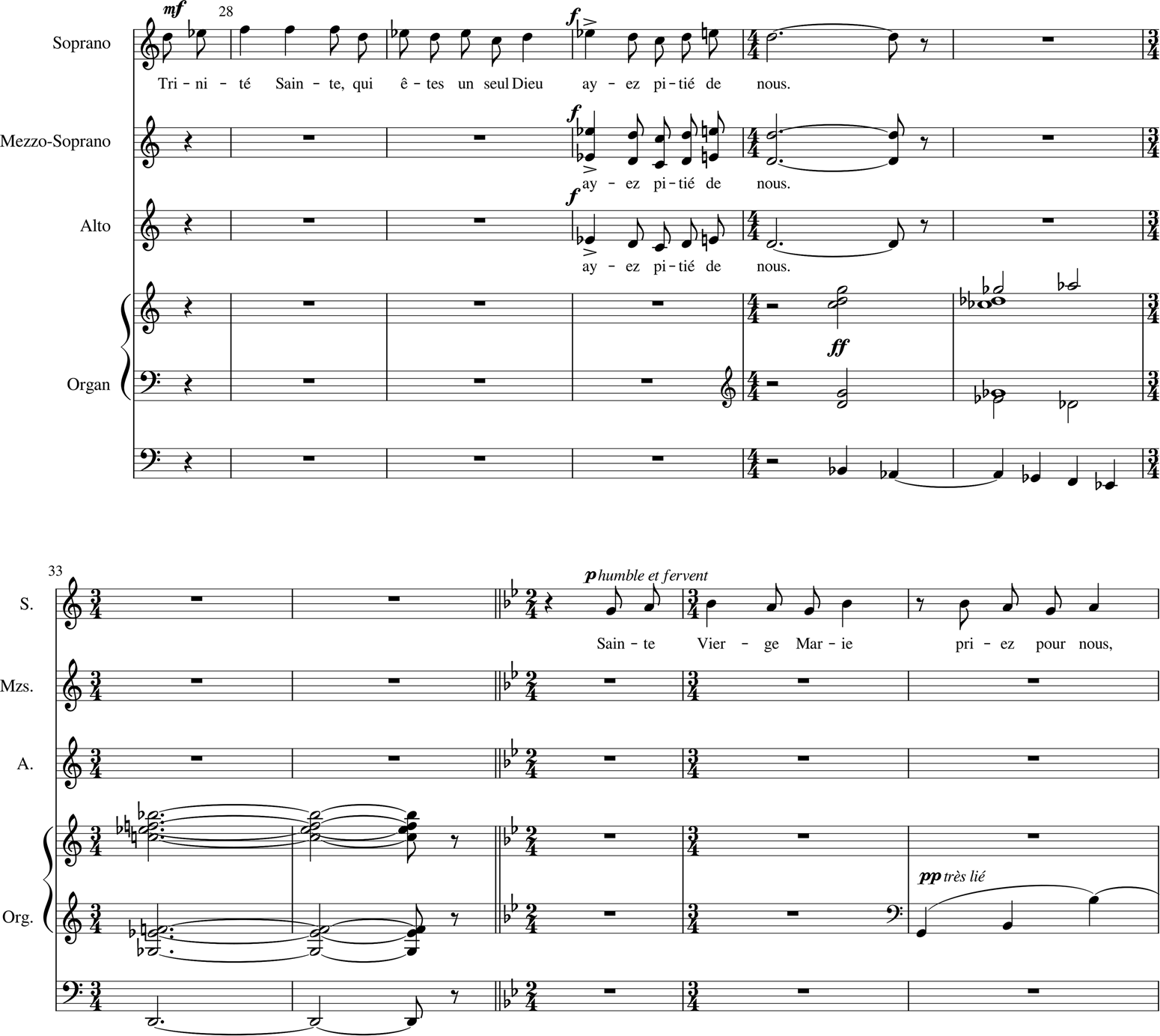
The opening of Litanies exemplifies two juxtaposed styles through a sudden appearance of a functional cadence, in the manner of Breton's ‘previously neglected association’. The work commences with strong references to a pre-tonal style, perhaps organum, as shown in Example 1: bare stacked fifths, stepwise motion, with false relations, and the occasional pp pedal reminiscent of the chant tone. No clear tonic emerges; sustained triads on D major and minor are undermined by the final chord containing overtones of C. Any suggestion of this function as an expanded dominant is rejected by the following chant-type material which centres on D. The allusions to chant of the introduction are realized in the monophonic texture. The expansion to triads – again circling on D – is further punctuated by dissonant chords which lack a functional direction. The opening thus sets up two ideas: the wandering, modal chant-type texture which lacks tonal function interspersed with non-functioning chords.
Opening of Litanies à la Vierge Noire. Copyright © by Éditions Durand. All Rights Reserved. International Copyright Secured. Reproduced by kind permission of Hal Leonard Europe S.r.l.

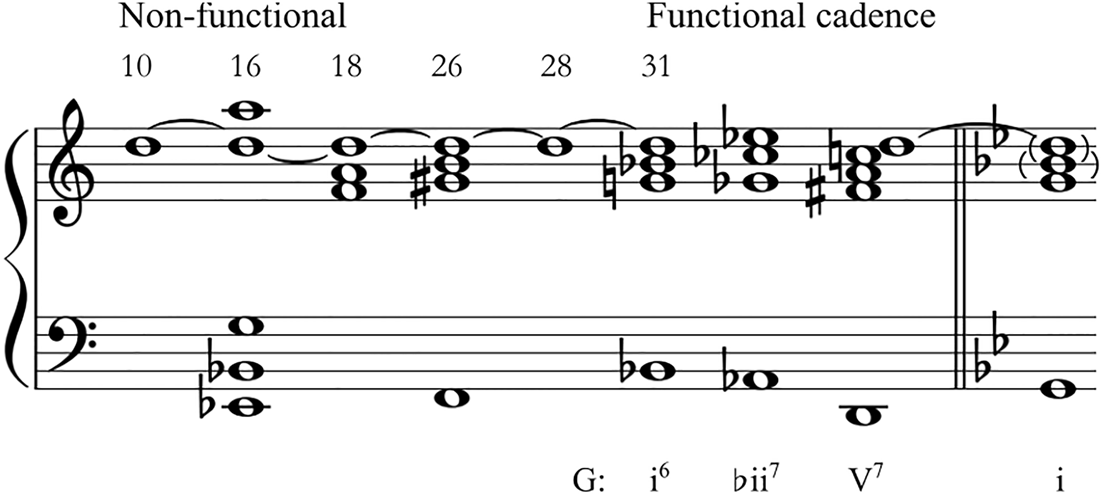
As Example 2 and its reduction Figure 1 show, the voices again settle on D, but the chords in this final statement of the introduction form a clear functional cadential progression, containing tonic–pre-dominant–dominant–tonic (T–PD–D–T), marked against the previous music. Although the extensions and alterations cloud the chord's clarity, it cements G minor as a tonic. Unlike the harmony thus far, the following section unambiguously starts in G minor. In introducing a tonally functioning cadence immediately after the chant's own cadence, both are highlighted as historical objects. As Saussure's conception, only through opposition can one establish meaning, but unlike Hatten's correlation to an imbalanced expressive binary, no immediate expressive correlation is present. Rather, the juxtaposition of the two ‘cultural units’ objectifies both, creating a ‘previously neglected association’, as per Breton. It becomes music about music, to echo the literal ‘on the real’ of Surrealism. Unlike collage or Dada, this excerpt reconceptualizes rather than destroys the form. Nevertheless, this reading creates a tension. Read through a Surrealist lens, this excerpt highlights an increased sense of plasticity of the cadence as a formal marker. But despite this subversion, it still functions to establish G minor for the next section.
Sudden appearance of functional cadence to establish G minor. Copyright © by Éditions Durand. All Rights Reserved. International Copyright Secured. Reproduced by kind permission of Hal Leonard Europe S.r.l.

Reduction of Litanies à la Vierge Noire, bb. 10–36. According to Caplin, the final four chords are an authentic cadence.

Modelling the surreal
Let us establish Surrealist mechanics in more detail. Surrealist principles can be traced to developments in science towards the end of the nineteenth century, particularly theorizing of a dimension beyond the three proposed by Euclidean geometry and Einstein's 1916 publication of General Theory of Relativity. The latter's proposal of time as relative and – essentially – subjective began to infiltrate avant-garde circles and these discoveries were consequently discussed as ways to move beyond previous aesthetic programmes, as Willard Bohn writes:
The cult of physical exactitude favored by the Realists, the Naturalists, and the Impressionists was barely able to scratch the surface. What was needed above all was a new way of looking at things. New tools (and new concepts) were required to explore these previously uncharted regions.Footnote 36
Inspired by such challenges to perception, Apollinaire and other early practitioners of nascent Surrealism began to experiment with methods through which to understand reality – a sur-reality – in new ways. As Linda Henderson remarks, ‘it was through the Surrealists that the fourth dimension and non-Euclidean geometry had their last broad impact on early modern art’.Footnote 37
Within this broader suspicion of previous understandings of reality, a closer underlying method of the Surrealist systematic juxtaposition of objects was the undermining of sign relations. Ferdinand de Saussure's contemporaneous publication of his lectures in the 1916 Cours de linguistique générale emphasized the arbitrary meaning of the linguistic sign, and that meaning – as language – is ultimately a product of social convention.Footnote 38 The Surrealists aimed to show that, as meaning is dependent on the reader's interpretation, relationships between a sequence of images has a degree of arbitrariness. Any ‘truth’ is not on the surface, but rather on a deep level that controls meaning. They aimed to probe, in Apollinaire's term, a ‘Fourth Dimension’, inspired by non-Euclidean geometry, as Breton described: ‘just as contemporary physics tends to be based on non-Euclidean systems, so the creation of ‘surrealist objects’ derives from the necessity to create, in Paul Éluard's terms, a genuine “physics of poetry”’.Footnote 39 The Surrealists suggested that the tapping into new dimensions through their methods would unearth new realities. The deep-level meaning of Apollinaire's ‘Fourth Dimension’ anticipated developments in structuralism and the concern for the audience became a focus for later pronouncements of the death of the author. By challenging the logocentric view of the world through establishing new binaries, the Surrealists foreshadowed Jacques Derrida's method of deconstruction and their awareness of the subjective perception of time and of slipping between the sign and the signified anticipated Jacques Lacan's work on the subject. Indeed, subjective generic expectations frame whether two objects are understood to be juxtaposed.
Rather than use a metaphor as a stock poetic device, the Surrealists aimed to structure images and objects around breaking the limits of the metaphor, such that a new connection might be created. Metaphor, as conceived by Aristotle, relies upon an understood correlation between two images: A/B = X/Y (or A′/B′). For example, old age is to life as sunset is to day.Footnote 40 But the Surrealists aimed to transcend this model, as Bohn writes: ‘one of Surrealism's greatest accomplishments was to expand the Aristotelian model until metaphoric distance exceeded the bounds of ordinary logic’.Footnote 41 That is, the concept which holds metaphor together is, under the Surrealist treatment, pushed to its limits. And this method was not merely at the thematic level as is common with metaphor, but at the fundamental structural level. As Breton explains in his description of ‘la méthode analogique’: ‘I have never experienced intellectual pleasure simply on the analogical plane.’Footnote 42 Breton refers to the ‘rapports justes’, which is that, ‘no matter how illogical it may appear, [the metaphor] is coherent at some level … to be effective the analogy must remain undetected on the surface but must trigger a response at a deeper level’.Footnote 43 In other words, juxtaposing two images does not mean that they are unrelated in every parameter. Rather, the discomfort one may experience on encountering a Surrealist image or text is because of the awkward new association one creates. For example, Dalí's Lobster Telephone relies on the common shape of a lobster and the telephone's headset, a ‘previous neglected association’, to refer again to Breton's definition. Associating two found objects is fundamentally formal and, after an initial alienation, the two objects are linked through an unexpected medium. As such, my characterization of a cadence as a Surrealist object plays on the friction between a cadence as both a distinct syntactical function and as a looser cultural understanding of the rhetoric of ending.
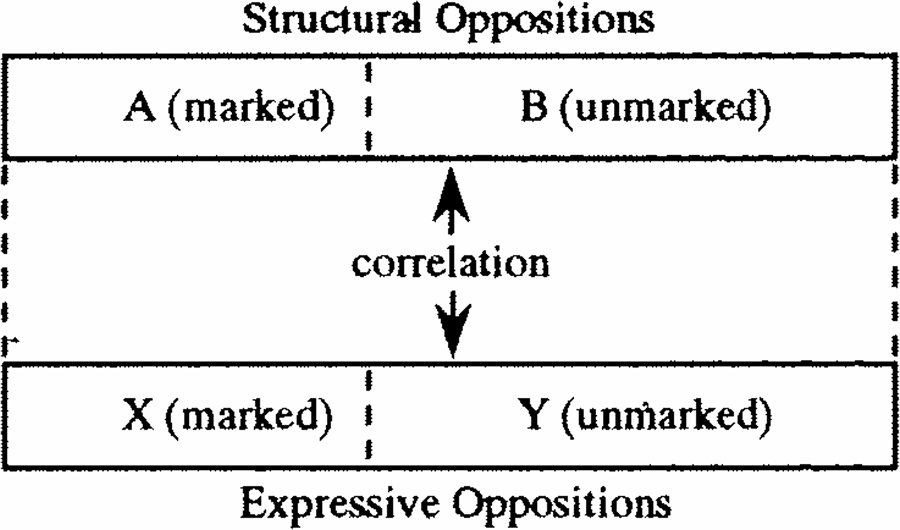
Robert Hatten's application of correlation to music systematizes an understanding of metaphor in music (Figure 2).Footnote 44 As musical objects are difficult to isolate, Hatten introduces the concept of markedness as a method to analyse binaries. This approach stems from Saussure's theory that the meaning of one word can only be understood through opposition; that is, meaning is related to difference. For example, although ‘up’ can only be understood with reference to ‘down’, they are conceptually equal. Many binaries are not, so a marked binary describes an opposition when one is syntactically notable. Only in a retrospective relationship with the marked term is phonological, grammatical, or wider conceptual information specified. For example, a bull is marked in relation to not being a cow. In this case, the gender is highlighted. In Hatten's musical application, a moment is marked if it is syntactically notable, a surprise within generic expectations, and this opposition can correlate to an equivalent expressive marked binary.Footnote 45 Regarding application to form, Naomi Cumming writes that ‘if any type of material is displaced to a location that is stylistically sensitized for another function, it is then marked by its incongruence’.Footnote 46 Accordingly, the disruption of formal expectations can correlate to expressive meaning.
From Robert S. Hatten: ‘Markedness as the asymmetrical organisational structure underlying correlations between structural and expressive oppositions’ (Musical Meaning in Beethoven: Markedness, Correlation, and Interpretation (Bloomington and Indianapolis: Indiana University Press, 1994), 37). Used by permission of Indiana University Press.
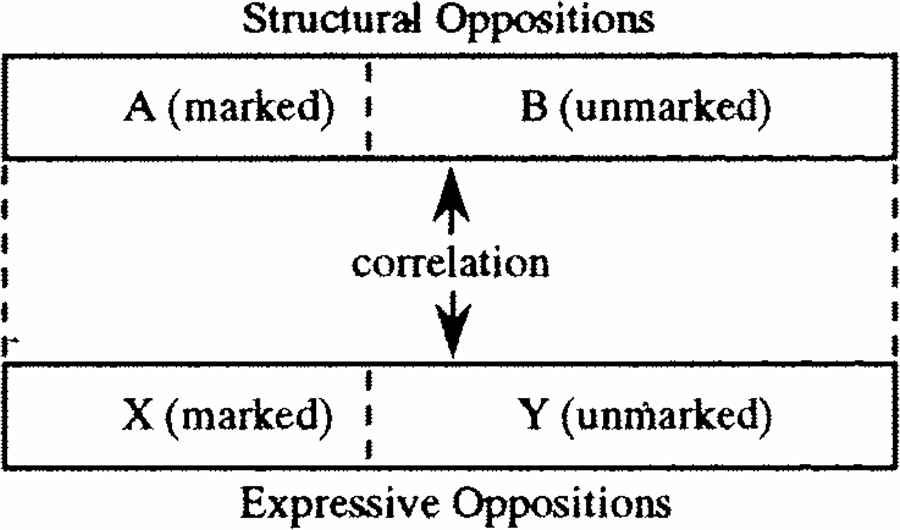
Markedness itself is fundamental to Surrealist structures, but central to the aesthetic was a level of relationships beyond the metaphor. The immediate experience of a juxtaposition is intentionally absurd and disorientating; only at a secondary structural level is a viable analogy understood – thus creating a new link, and in Breton's above definition, a ‘previously neglected association’ through the ‘disinterested play of thought’. From these principles, Willard Bohn develops a model of the function of Surrealist images. Fundamental is Pierre Reverdy's conception of the Surrealist image, which Breton quotes in his ‘First Manifesto’:
The image is a pure creation of the mind.
It cannot be born from a comparison but from a juxtaposition of two more or less distant realities.
The more the relationship between the two juxtaposed realities is distant and true, the stronger the image will be – the greater its emotional power and poetic reality.Footnote 47
At first glance, this may appear to describe an abstract conception of metaphor as two juxtaposed images compared. But it is the association between the two terms that Surrealism differs, as in the Reverdy-Breton definition the relationship is pushed to extremes.
A Surrealist juxtaposition therefore has two levels. The first step is effectively identical to the conception of metaphor: ‘to perceive the literal image and register its emotional impact’.Footnote 48 But in the second step the discrepancies inspire more distant imaginative responses. For example, J. H. Matthews describes a phrase from the ‘First Manifesto’ ‘la rosée à tête de chatte’ (‘the cat-headed dew’) as an
amalgamation of dew and the head of a cat [which] clearly lies outside the bounds of practical possibility and has no model in the world of physical reality … The reasoning mind declines to venture beyond the limits of the physical universe. Conversely, by luring us outside those very limits, [the phrase] stimulates imaginative responses.Footnote 49
For example, a reader, aware of a range of associations with a cat, might align the cat's eyes to the glistening of dew, though this step is beyond the initial image of the cat's head. This level activates the critical, historically and reality-sensitive consciousness, transforming the initial absurdity into a logical scenario. But, as the images are still juxtaposed, the association is an unfamiliar one, understood as beyond the familiar, beyond reality (once again, a sur-reality). The first step of appreciating the absurdity is often the popular understanding of Surrealism, but the less acknowledged second step differentiates it as an aesthetic.Footnote 50
This understanding of juxtaposed oppositions in music contrasts with other adaptions of Hatten's theory to twentieth-century music. Many oppositional conceptions conceive a marked moment as ironic. For example, in relation to the music of Shostakovich, Esti Sheinberg adapts Hatten's markedness model to encompass equipollent oppositions, which demonstrate the arbitrariness of an opposition.Footnote 51 Whilst this passive approach may apply well to Shostakovich's works, it does not map onto the Surrealist aims of having some deeper connection that is not completely arbitrary.Footnote 52 In contrast, Johanna Frymoyer conceives irony in the music of Schoenberg and Stravinsky as achieved through taking only ‘Idiomatic’ elements from a topic, such as a march or waltz.Footnote 53 This layered approach has more in common with mine, as Poulenc often takes only the content rather than the function of a cadence. Both these approaches are incompatible with the stance of the Surrealists though as, despite their play with signs, they were distinctly not ironic. The effect of their work may be satirical, but they were striving for a deeper ‘truth’. Bohn's model demonstrates this extension: by conceiving of another level of correlation, one demonstrates how, specifically, the Surrealists were transcending the semiotic plane where irony is perceived. Indeed, despite their often-humorous play with images, they took themselves deeply seriously, not least through the later political ambitions of the group.
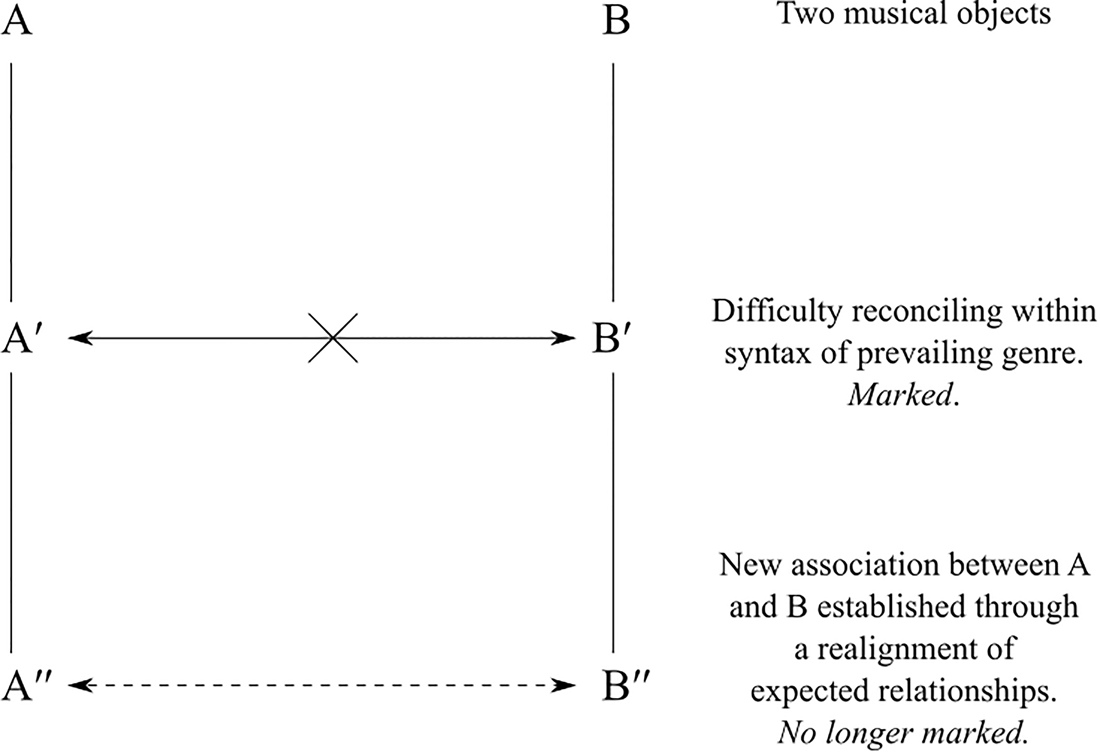
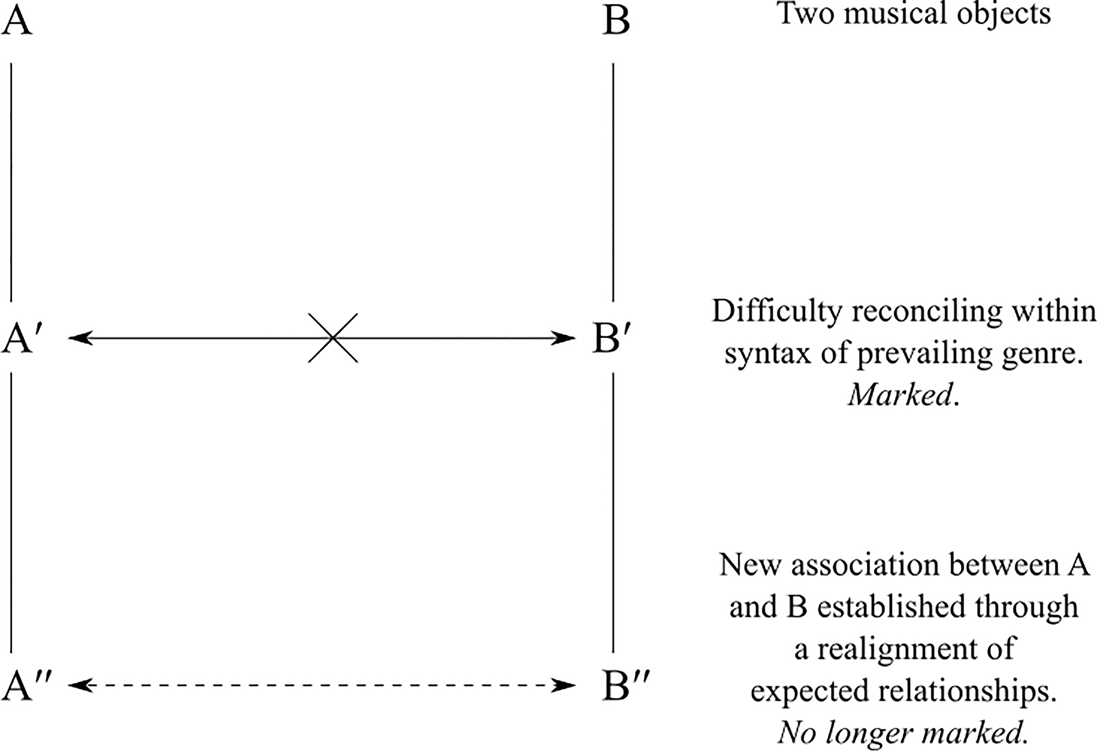
Thus, the Surrealist aesthetic relies on two elements: juxtaposed elements understood through an informed subject and an initially uncomfortable relationship between the two objects that is revealed to contain a hidden association. Expanding Hatten's model through Bohn's observations, Figure 3 abstracts my conception of Surrealism in music, relying on a realignment of generic expectations. An initially absurd juxtaposition alienates prevailing generic expectations.Footnote 54 Another relationship is established by the listener to comprehend, a ‘previously neglected association’. This model moves significantly beyond Hatten's as, through breaking the metaphor, something new is created. The excerpt from Litanies can be thus understood through this framework: the appearance of the tonal against pre-tonal cadences juxtaposes two generic expectations, thus marked. At Bohn's stage one metaphor, this opposition is difficult to reconcile in the syntax of pre-tonal repertoire. But once the listener's critical faculties are engaged at stage two, both elements are no longer understood through the lens of separate genres. Rather, they are associated as ending functions. Understanding both elements as ending the section allows the listener to understand the phrase as logical in a new realm.
Model of Musical Surrealism, building upon Hatten and Bohn.
Cadence as objet trouvé
Poulenc's varying treatments of the cadence is analogous to the Surrealists’ treatment of the object. Viewing its function as ending follows the Surrealists’ logocentric critique. The conception of the previously unaestheticized Surrealist ‘object’ overlaps with Hatten's type – or, to adopt Umberto Eco's term, ‘cultural unit’. Eco defines cultural unit, following David Schneider, as ‘simply anything that is culturally defined and distinguished as an entity. It may be a person, place, thing, feeling, state of affairs, sense of foreboding, fantasy, hallucination, hope, or idea.’Footnote 55 The concept of cultural unit is important in the development of topic theory,Footnote 56 but my cultural unit of a cadence does not refer to any extra-musical object, merely the idea of ending. As the cadential method of ending is so codified – enabling Caplin's strict definitions as a progression in opposition to prolongational and sequential – it is ripe for use as an objet trouvé.
Specifically, I adopt William Caplin's definition of cadence, as systematized through his study of a narrow stylistic repertoire. I refer exclusively to authentic cadential progressions, as they contain the maximum number of elements and are mechanisms of ending. They contain an initial tonic (often in first inversion), a pre-dominant (mostly ii6, but also IV), a penultimate dominant in root position, and a final tonic in root position.Footnote 57 Sometimes the cadence is incomplete and will omit the initial tonic or the pre-dominant (or both). When cadential arrival is not reached, the cadence is deceptive, evaded, or abandoned. Caplin distinguishes between cadential content and cadential function, a crucial distinction for Poulenc's cadences. Cadential function refers to the timespan of the cadential progression. Cadential content refers to the conventionalized harmonic, melodic, and rhythmic gestures, which can exist without cadential function (and thus do not function as cadences).
In order to establish marked instances, I shall briefly outline the norms of Poulenc's use of cadences. Caplin identifies seven stylistic characteristics of the use of cadences in the nineteenth-century, relative to the eighteenth, which affect the achievement of cadence and closure.Footnote 58 Across his oeuvre, Poulenc's syntactical cadences commonly draw upon three. First, the more extensive use of chromaticism and dissonance, specifically through extensions to the pre-dominant both vertically through sevenths and ninths and with an elaborating applied dominant.Footnote 59 In primarily elaborating the pre-dominant, the final two elements of the progression (dominant–tonic) are unambiguous. This clarity is strengthened by Poulenc's two other significant variants on the classical cadence: an emphasis on root-position harmonies within a regular harmonic rhythm. Daniel Salaun's discussion of Poulenc's elaboration of the dominant through appoggiaturas echoes Caplin's first category, but he suggests that Poulenc's goal was to mask the dominant.Footnote 60 Rather than obscure the dominant, an elaboration within root-position harmonies and a regular harmonic rhythm heightens the effect of the progression and subsequent resolution to the tonic; such overloading of cadential rhetoric allies with both Caplin's assessment and the later manifestation as a caricatured objet trouvé.
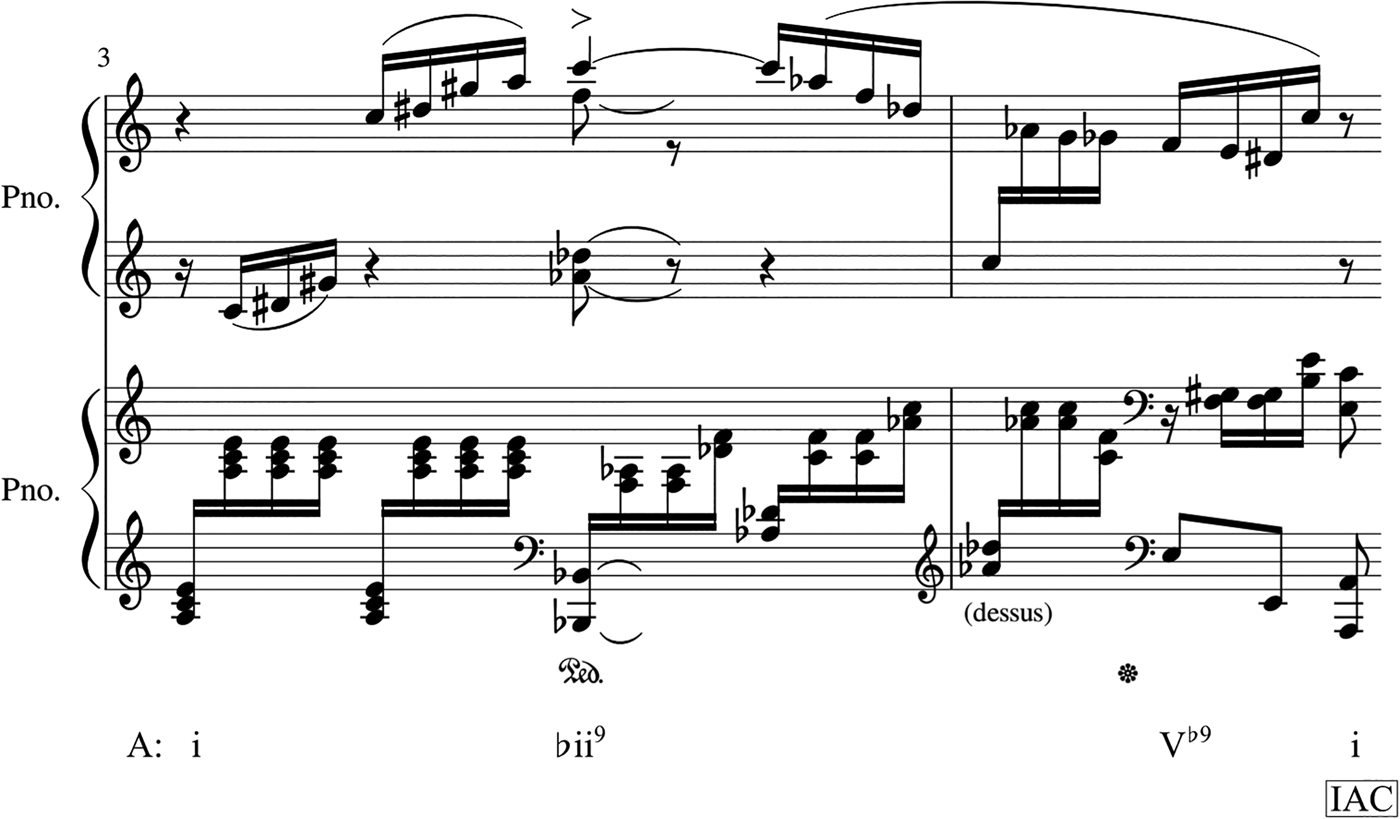
Example 3 is an instance of an idiomatic Poulenc cadence: each chord is in root position, the pre-dominant is expanded temporally, and a quick melodic descent to land on the tonic (albeit with a  ${\hat 3}$ in the melody). The pre-dominant expansion is a common device in Poulenc, whether through a metrical expansion as here, or elaborated through an applied dominant (see Example 5). Similarly, Poulenc often uses a root position Neapolitan as a pre-dominant, likely to strengthen the rhetorical gesture of the onset of the cadential progression (see Figure 1 and Example 6). That is, as a ♭II chord most often appears in a cadential progression, it establishes the chord progression as cadential, especially as the preceding initial tonic is often in root position.
A Poulencian cadential progression in Sonata for Two Pianos (1953), second movement, bb. 3–4. Copyright © by Éditions Max Eschig/Éditions Durand. All Rights Reserved. International Copyright Secured. Reproduced by kind permission of Hal Leonard Europe S.r.l.

For current purposes, cadences with familiar syntax, such as the idiomatic cadence in Example 3, are unmarked. Those which do not fulfil an authentic cadence are thus marked. Additionally, but more flexibly, I consider a familiar deceptive or evaded cadence also as unmarked, given their prolific appearances in Poulenc's output. This understanding contrasts with Hatten's conception of deceptive cadences as tending to be marked in Beethoven. Omitting the root-position tonic interrupts the expected harmony, though the set-up maintains the functional salience of the progression.Footnote 61 Markedness here, Hatten writes, relies on temporal location and tonal implications, thereby becoming limited in its potential. Given the plethora of deceptive cadences appearing in music between Beethoven and the early twentieth century, its degree of markedness is lessened. The following analyses show how Poulenc continues to mark a cadential progression through increasingly complex methods beyond the deceptive, evaded, and abandoned.
Ending without a cadence
It is a truism of music theory almost too trivial to mention that cadences were historically used to end pieces. For a Surrealist, though, this aesthetic expectation would be an ideal target; thus Caplin's codification of cadences would be a type of rationalist shackles that a Surrealist would eagerly seek to undermine. Accordingly, a common feature of Poulenc's music is the lack of final cadential arrival following an expectation through the commencement of a cadential progression; in Caplin's terms, a complete ending function is not always easily identifiable.
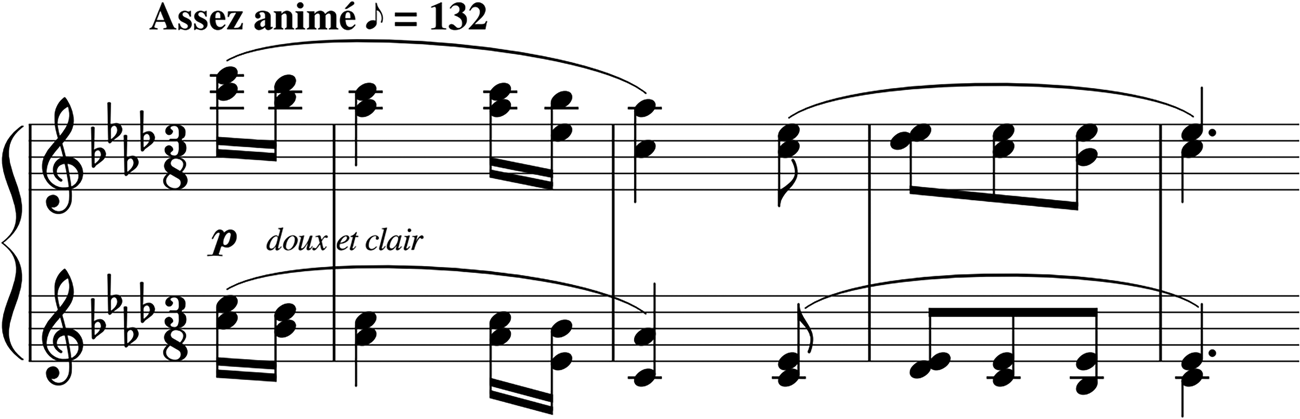
Poulenc's Deuxième Improvisation FP63/2 (1932) strikingly exemplifies omission of a clear cadence. Example 4 shows the opening of the piece and, although the key is not confirmed through a  ${\hat 5}$–
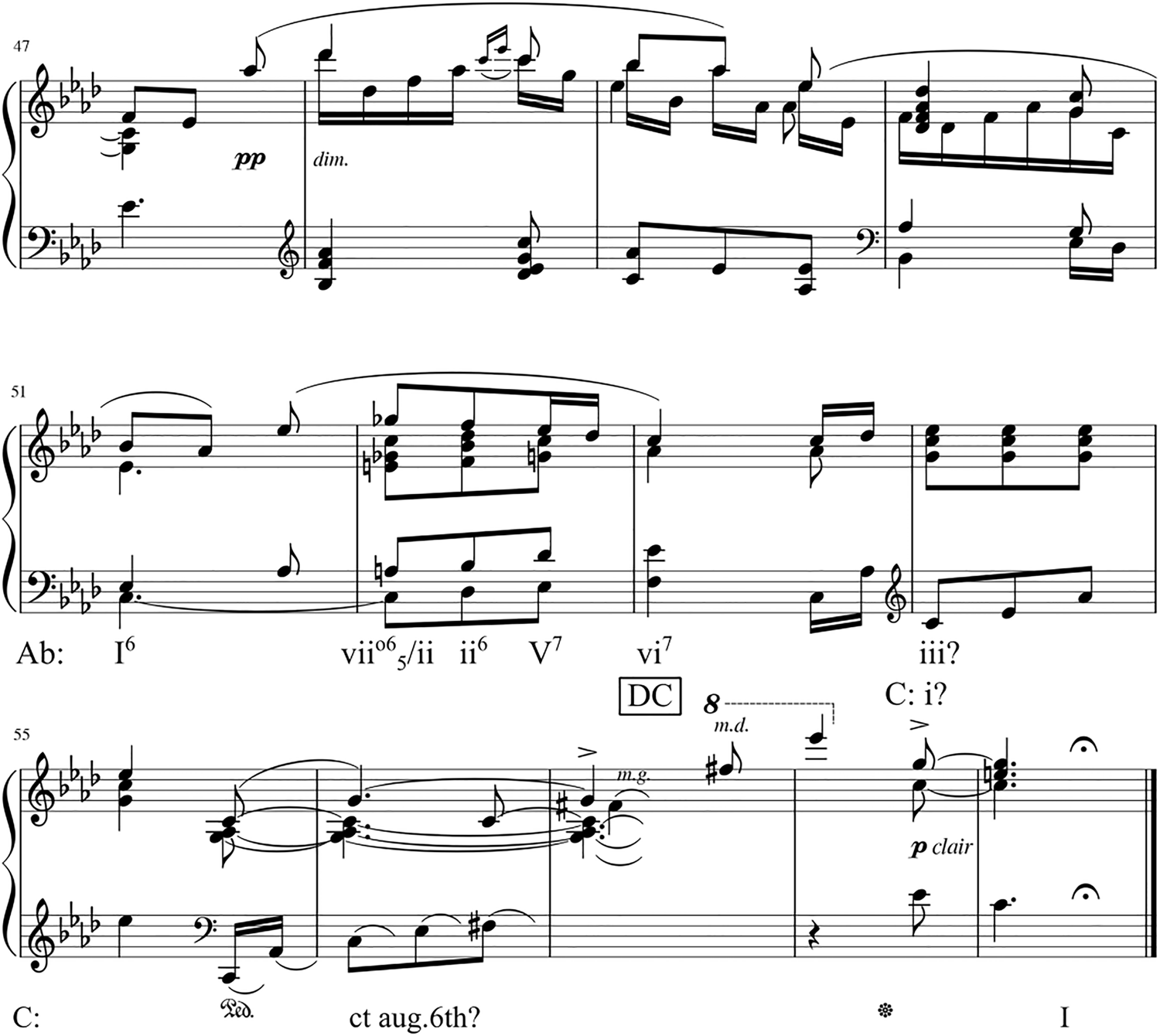
 ${\hat 1}$ motion in the bass, the horn call imitation leaves the A♭ major uncontested. Following tonicizations of E♭ major and C minor the piece returns to A♭. In the final moments, the piece does not satisfyingly cadence; far from it. As Example 5 shows, it arrives on an unrelated C major. In the penultimate phrase (bb. 51–3) a full T–PD–D is deceptively resolved to vi7. According to the familiar formal syntax of deceptive cadences, this appearance confirms A♭, anticipating a stronger cadential progression in the tonic. The first chord of the next phrase in bar 54 could be heard as commencing a new cadential progression with a
 $ \rm I_{\;5}^{6}$ in A♭, the possible initial tonic function undermined through an added major seventh. Alternatively, given the relative weakness of the A♭ pitch, this chord could be heard as iii in A♭, pivoting to the tonic of C minor. Even within the realm of C, a cadential progression is cryptic. If bar 54 is understood as a tonic in C, with bar 56 a German augmented sixth, a dominant as clear as the previous phrase is elusive. The dominant pitch G resonates until the final chords and could be considered a dominant substitute, but the surrounding chord muddies this function. Even if one accepts a common-tone augmented sixth can satisfactorily resolve to the tonic, the dissipating gesture and slide to settle on C major compromise this quite tenuous attempt at a cadence. Thus, the cadential progression within the prevailing harmonic syntax does not appear.
Clear A♭ major at the opening of Deuxième Improvisation, FP63/2. Copyright © by Éditions Salabert. All Rights Reserved. International Copyright Secured. Reproduced by kind permission of Hal Leonard Europe S.r.l.

Ending of Deuxième Improvisation. Copyright © by Éditions Salabert. All Rights Reserved. International Copyright Secured. Reproduced by kind permission of Hal Leonard Europe S.r.l.

In addition to the cadential function, the cadential content is undermined. The eighteenth-century cadence is often accompanied by a familiar descending melodic formula, as Caplin describes: ‘most cadential melodies of the classical style remain conventional (if not formulaic) by projecting a consistent descending stepwise motion within a series of uniform durational values’.Footnote 62 Both are subverted here: the always-rising arpeggio directly opposes cadential melodic expectation and the regular harmonic rhythm dissipating on the ambiguous sonority only to result in a C minor non-arrival triad, itself on a metrically weak beat (further emphasized by the only accent of the piece) that undermines any uniform duration. Again, whilst the other cadences of the piece fulfil the expectation of cadential progressions, the final, crucial cadence does not.
Despite the clear A♭ major throughout, many expectations for a final satisfactory cadence are undermined. In terms of the model of Surrealism in Figure 3, the music up until the final bars (A) is juxtaposed against the final bars themselves (B); within the prevailing generic tonal expectations, the marked opposition between tonal syntax (A′) is difficult to reconcile with an undermined final gesture (B′). Instead, a common-tone augmented sixth progression in the mediant major is a satisfactory ending in late-tonal syntax. The listener may realign the expected relationship, as B′ remains an ending gesture in a different harmonic syntax. The illogicity between A′ and B′ is now understood through the lens of two genres: Classical cadential syntax (A′′) and late-tonal cadential syntax (B′′). The tierce de Picardie in C in the final bar adds another layer of generic juxtaposition, alluding to sixteenth- and seventeenth-century endings. Within the cadence itself, late-tonal syntax (A′′) and sixteenth- and seventeenth-century syntax (B′′) are framed through a common cadential function. Despite their oppositions, all three co-exist and retain cadential elements within their respective genres. To echo Breton, this reconceives the role of the object in the artistic experience through the subtle subversion of form.
Cadences as calligrams and automatism
The examples thus far focus on cadences juxtaposed against the prevailing syntax. Whilst this technique mirrors Surrealist aesthetics in music through manipulating an object's function, it retains the ending location of the cadential subversion. In the following examples, cadential progressions are placed where an initiating or medial function might be expected.
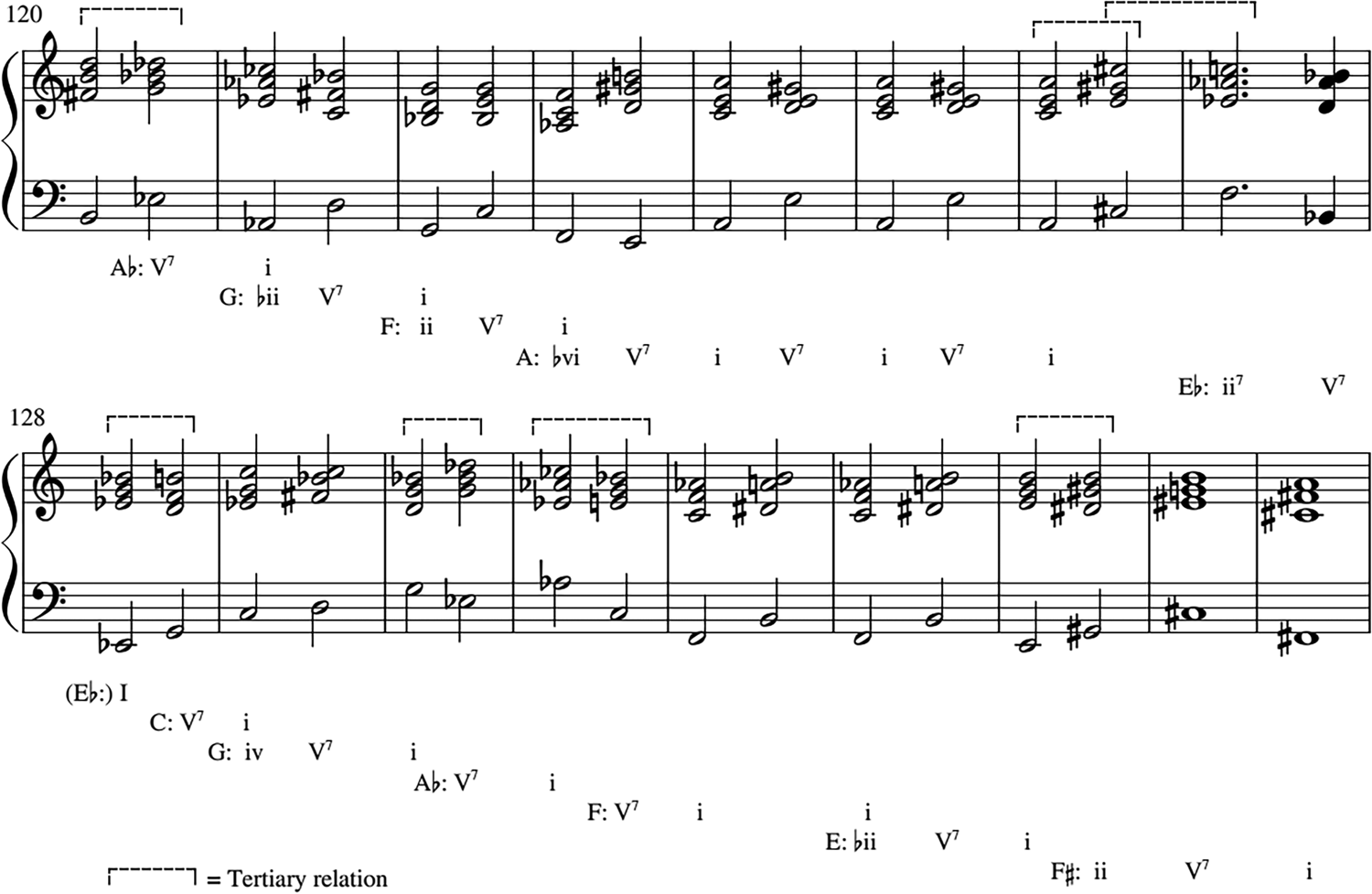
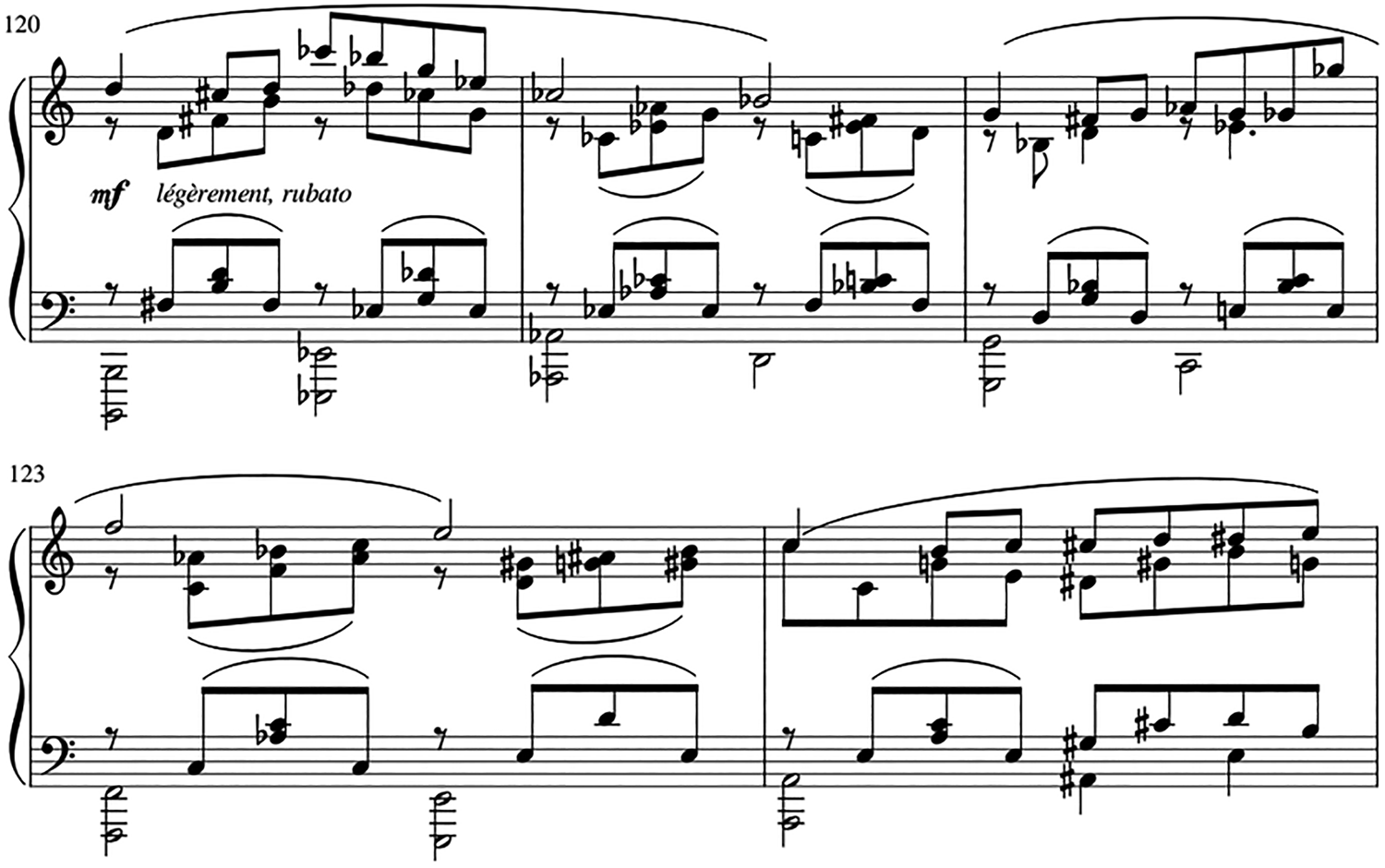
For example, Figure 4 reduces the subordinate theme (Example 6) of the Sextet for Piano and Winds, FP100 (1932). According to Caplin, a subordinate theme consists of an initiating, medial, and concluding function, including a perfect authentic cadence in the subordinate key, such that it ‘acquire[s] sufficient weight to vie for prominence with the home key (and thus to create the dramatic conflict of tonalities so central to the classical aesthetic)’.Footnote 63 Instead of confidently establishing a new key, the first movement's subordinate theme explodes with a beautiful Poulencian melody supported by a proliferation of authentic cadences. As this reduction shows, most iterations contain a pre-dominant, dominant, and tonic function. Rather than rigorously maintain fifths throughout – at risk of simply outlining the circle of fifths to create a model sequence, thereby losing the rhetorical impact of cadences – Poulenc intersperses slippages through tertiary relations, shown by brackets in Figure 4. The cadences appear random, tonicizing keys unrelated to any larger-scale tonic. The overload of cadences, gradually dissipating into increased chromaticism beyond those shown in Figure 4, results in none feeling satisfyingly final: the excessiveness fetishizes the object of the cadence and fifth relation, now removing it of all function within the broader musical language. In terms of the model above, the continued clear tonicizing of keys is juxtaposed against the expected syntax of the subordinate theme.
Repeated cadences in the Sextet for Piano and Winds, bb. 120–36.

Sextet, opening of subordinate theme, bb. 120–4. Copyright © by Edition Wilhelm Hansen, a division of Music Sales Group. All Rights Reserved. International Copyright Secured. Reproduced by kind permission of Hal Leonard Europe S.r.l.

But rather than be reconciled through a realignment of the marked relationship as the model, this effect parallels two broader Surrealist concepts. First, that of semantic satiation, the psychological phenomenon that occurs when a word is repeated and consequently temporarily loses meaning, becoming merely a meaningless repeated sound. Lewis Carroll, whose own works were influential on the Surrealist movement, describes this device:Footnote 64
The curious phenomenon … that if you repeat a word a great many times in succession, however suggestive it may have been when you began, you will end by divesting it of every shred of meaning, and almost wondering [if] you could have meant anything by it.Footnote 65
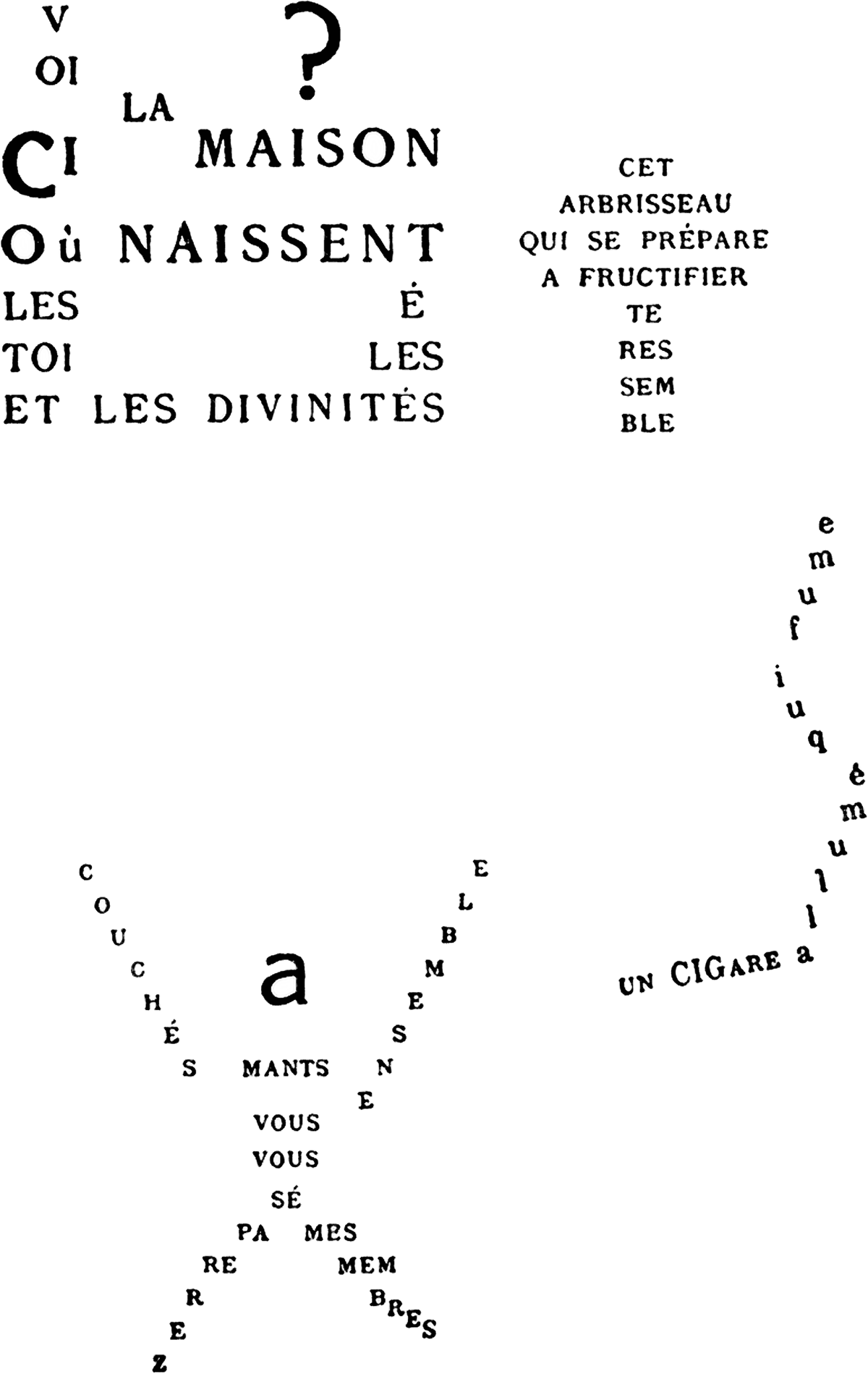
Repeating cadences of apparently random relations results in each isolated instance losing its rhetorical effect – and thus function – of ending. The object's function is overdetermined to the point of meaninglessness. This trope of Surrealist aesthetics is manifest in the calligram, such as Apollinaire's Paysage (1917) (Plate 1). In these short poems, the words of the poem mirror one aspect of the content, usually the first noun. Such spatialization of poetry is hardly original to the Surrealists, though Apollinaire's systematization is more extreme than previous examples. Through transcending the medium of words to the medium of the visual, each poem overdetermines an image, communicating through two mediums; the words could easily be reformed into another image, perhaps one which contradicts the content of the poem, reveals the arbitrariness of the words’ meaning. That is, demonstrating that the shape of the word ‘maison’ in no way evokes the image of a house. Whilst only rooted in a single medium of music, Poulenc's repeated cadences similarly overdetermine any meaning of the cadence – that is, its function – to the point that reveals its arbitrariness as a formal marker. After all, if the phrase consists only of endings, any semblance of ending function is neutralized. Similarly, in representing the poems as visual objects leads the reader to appreciate them as pleasing images in their own right in a manner analogous to Poulenc's treatment of the cadence as an object.
As before, though, there still lies a tension between objectification and musical function. Within the expectations of a subordinate theme, this wandering harmony and phrase structure is more loose-knit than the opening, with its near-obsessive foursquare phrases and constant affirmation of A minor. At the background formal level, this fulfilment of expectation is unmarked. This reading maps onto neoclassical aesthetics, if we characterize it primarily as reference to general rhetoric of formal plans of eighteenth-century music. At the level of the local harmony, though, this sequence of cadences is marked, thereby mirroring the Surrealist aesthetic standpoint of object juxtaposition.
On a closer foreground level, each chord follows syntactically from the previous. Usually a chord is reinterpreted as a new function in the next bar, but smooth voice-leading and tertiary motion create the illusion of local syntactical logic. As the longest progression contains three chords – always a pre-dominant, dominant, and tonic – before switching to a new distant key, the excerpt appears to suffer from a short-term memory, echoing a second Surrealist concept: automatism. Influenced by Freud's contemporaneous theories of the unconscious, Breton's and others’ use of the term ‘automatism’ refers to writing or painting without using conscious thought, rather distancing the work from the presumption of authorial control.Footnote 66 Central to Breton's initial definition (‘psychic automatism in its pure state’), the term was borrowed from physiology, where it refers to bodily movements that are autonomic, such as breathing or sleepwalking. Surrealist automatism adopted this unconscious aspect, particularly the associations with dreams. Dalí later clarified his own version of the concept, referring to the Surrealist object: ‘a spontaneous method of irrational knowledge based on the critical and systematic objectification of delirious associations and interpretations’.Footnote 67 As such, despite associations with irrationality, both automatism and dreams require a level of interpretation. The subconscious may create impossible experiences and appear arbitrary, but it maintains a degree of logic. For example, Buñuel and Dalí's 1929 film Un Chien Andalou contains a sequence through which a disembodied hand in different functions acts as a thread to several unrelated scenes.Footnote 68 Starting with a man's hand functioning as an ants’ nest, the shape of the hand within the frame briefly mirrors the form of an armpit, then appears disembodied on the street, appearing to function as a walked dog. Despite the dream-like free association between scenes, the object of the hand acts to unify, changing function within the scenes accordingly; the focus on the objects’ realism heightens the degree of discomfort.
Through their shared concern for stream-of-consciousness techniques, the closest to a musical automatism is perhaps improvisation.Footnote 69 Indeed, the title ‘Improvisation’ is common in Poulenc's output, but both automatism and improvisation require a similar degree of conscious involvement. Either way, this evocation of free key associations in this excerpt mirrors automatism. The technique of referring to multiple, often unrelated keys in quick succession is identifiable in other works of Poulenc, such as his brief Valse-Improvisation sur le nom de BACH (1932), which not only contains the word ‘improvisation’ in the title, but similarly proceeds through an array of seemingly unrelated keys. Each is confirmed through a PD–D–T cadential progression with pronounced $\;{\hat 2}$–
 ${\hat 5}$–
 ${\hat 1}$ in the bass, analogous to the continued thread of a hand in Un Chien Andalou.
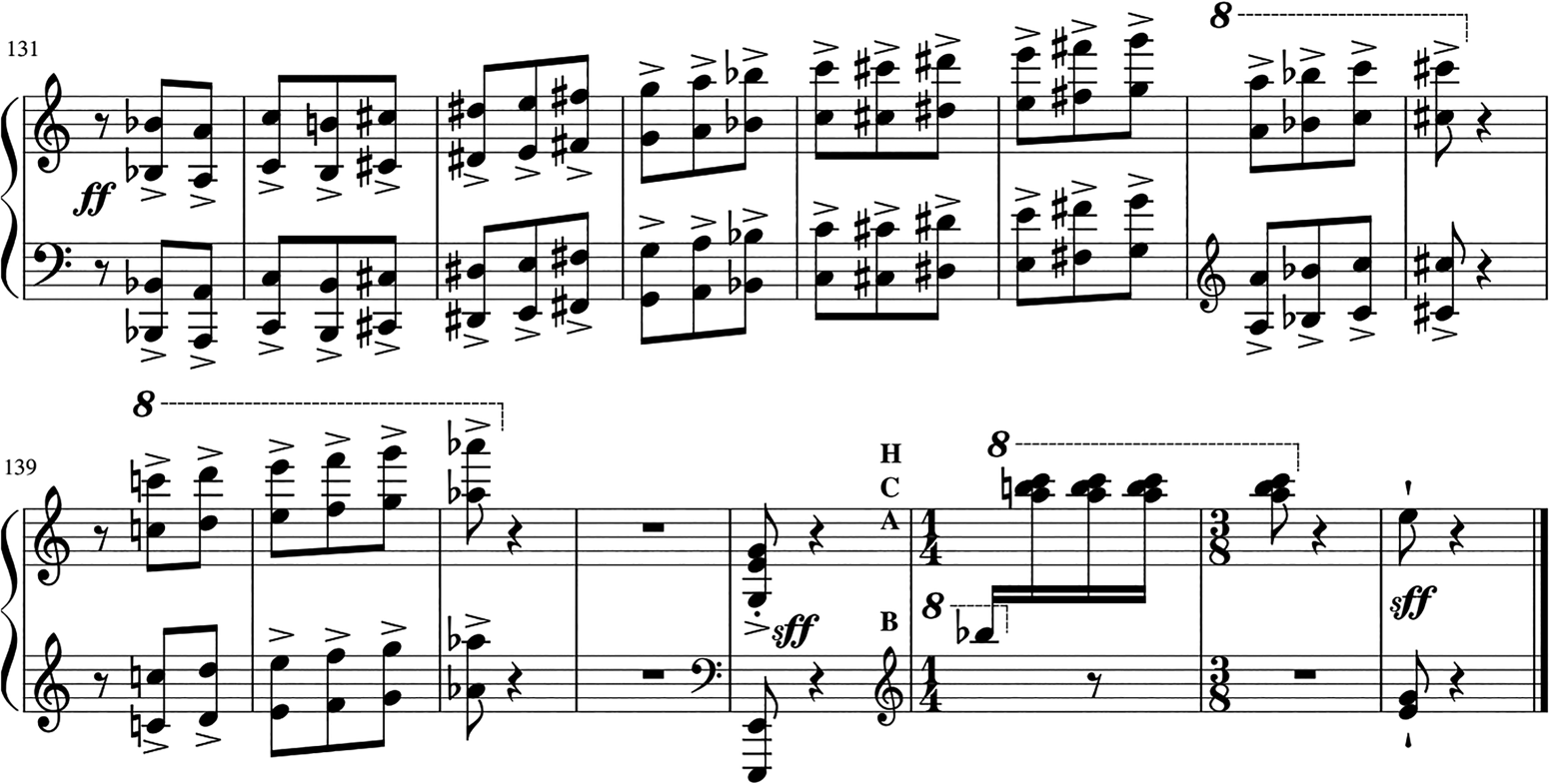
Figure 5 outlines the progression of tonal centres. The first half of the piece is dominated by these juxtaposed keys, never settling. The second half, marked by the retrograde of BACH to HCAB in the melody, settles on a dominant lock in D♭, strongly suggestive that this may be the key chosen to end. Suddenly, though, the material of the dominant lock is transposed to a new key, suggestive of V of E major; unlike D♭ major, the major mode on E is yet to appear. Instead of resolving to either of these keys, another sudden shift of key initiates a sequence from F minor. This sequence reaches an opposition of triads a tritone away, C-F♯ sharp, further muddying any overall sense of tonic, followed by a ff double octave ascending chromatic passage, which simply stops on first C♯ and then A♭. As Example 7 shows, a flourish of BACH notes, sandwiched by two sff dyads of E and G, abruptly ends the piece. Although E minor is the first confirmed key through PD–D–T, given the proliferation of keys and cadences unrelated to E minor interspersed and the ambiguity of the preceding harmony, this final gesture is hardly a grand return to a home key. Though the descending gesture and (nearly) uniform rhythm are familiar cadential content in Caplin's definition, the harmonic progression, and thus cadential function, is removed. Whilst the freely associating cadences with syntactical harmonic progressions in the body of the piece evoke an automatist aspect in a manner similar to the Sextet, ending with a gesture of cadential content without function dismantles and juxtaposes gestures of cadential content and function. The Valse, therefore, brings together Surrealist elements of the Deuxième Improvisation and the Sextet which, perhaps appropriately, draws upon not only the cadence but the familiar cipher BACH as another objet trouvé.
Key areas confirmed through cadences in Valse-Improvisation sur le nom de BACH. The final E and D♭ are expressed through standings-on-the-dominant.

Final bars and missing cadential progression of Valse-Improvisation sur le nom de BACH. Copyright © by Éditions Salabert. All Rights Reserved. International Copyright Secured. Reproduced by kind permission of Hal Leonard Europe S.r.l.

Formal issues and Apollinaire's ‘fantôme véritable’
The works discussed so far are either small-scale or isolated examples. But if juxtaposed binaries are fundamentally formal within a Surreal artwork and Poulenc uses the cadence as one side of this binary (itself a fundamentally formal device), how can we understand Poulenc's large-scale form within this paradigm of cadential subversion? The subversion of an essential formal element is unsustainable within the generic expectations of large-scale form.
If we take elements of Apollinaire's earlier writings on Surrealism as an opposition between form and content – that is, the broader structural use of paradox – we can establish a more nuanced approach. Apollinaire was less radical than Breton and, unlike Breton's striving for a truth beyond reality through the unconscious, Apollinaire's conception was an exaggeration of the real (a literal ‘sur-réel’), pushing the boundaries of reality rather than attempting to replace them.Footnote 70 As Bohn describes, in practice the Surrealists’ use of paradox as a structural device is unsustainable: ‘although surprise covered a multitude of attitudes, one form predominates over others. Time after time a situation or a statement that appears to be absurd turns out to be surprisingly valid.’Footnote 71 That is, for Apollinaire an initially absurd juxtaposition can be explained within the artwork. To describe this approach to form, he coined the terms ‘authentique fausseté’ (authentic falsehood) and ‘fantôme véritable’ (truthful illusion). As Figure 3 above, the initial association between the marked object and surrounding material is initially difficult to reconcile. But after a later explanation, the initially absurd object is revealed to function within the syntax, albeit one that was initially unidentifiable. Thus, whereas the analyses of cadences above paralleled Breton's localized approach, to conceive large-scale forms within Surrealist thinking, we must return to these earlier, less radical principles of Apollinaire. Transferring ‘fantôme véritable’ to music, we can explore how a Surrealist object can be treated richly in Poulenc's larger-scale forms. Often it is a smaller object whose syntactical function is less immediately clear, but in the process allows for a development of the established marked object.
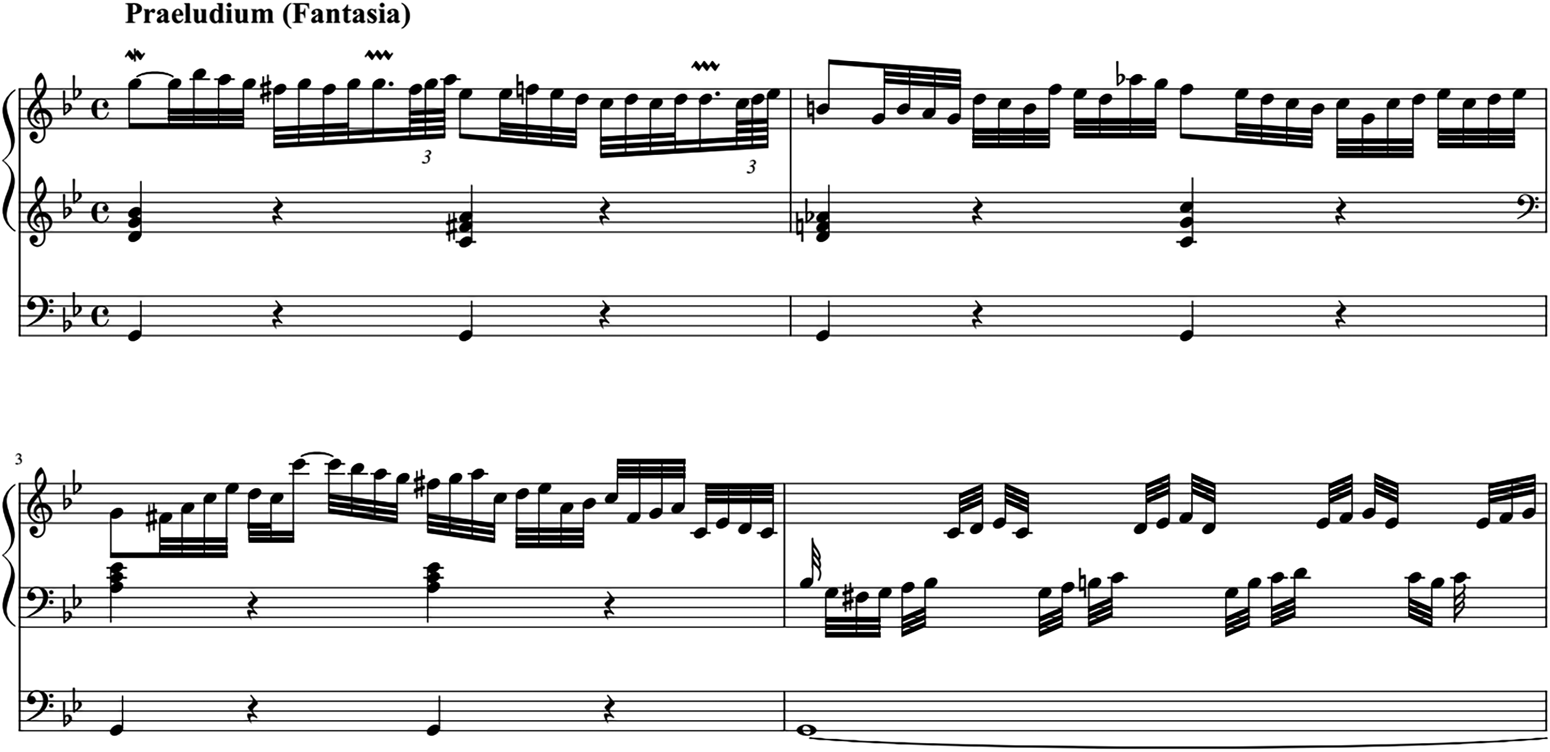
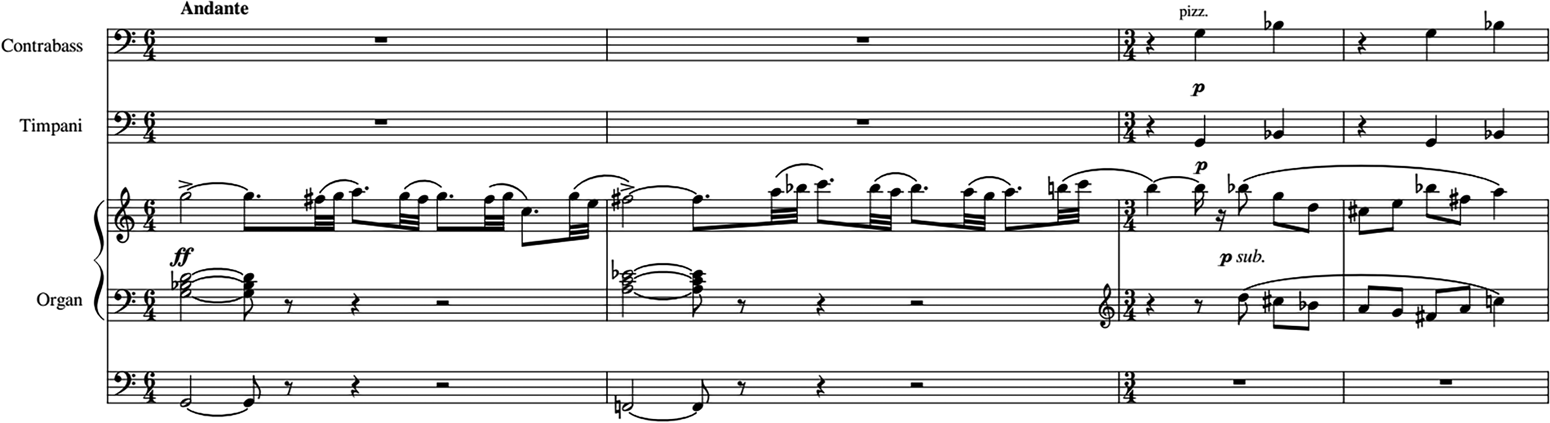
The Concerto for Organ, Strings, and Timpani (1938) exemplifies such a developing object. One specific gesture bookends the work, which contains a recurring chord with an ambiguous function that is initially juxtaposed, but gradually its syntactic logic within G minor is explained over the course of work. This recurring section evokes the opening of a baroque prelude, modelled on Bach's Fantasia and Fugue in G minor, BWV542 (Example 8) – another objet trouvé. As Example 9 shows, Poulenc's opening likewise clearly establishes G minor: a full fortissimo sustained G minor chord followed by a dramatic ornamental line. The soprano line weaves around G before landing on a dissonant sonority. An unambiguous return to G minor by the end of bar 3 is cemented by the timpani and contrabass entry. Unlike Bach's clear progression over a tonic pedal, as Figure 6 shows, the precise syntactical function of the second chord is somewhat ambiguous: in the manuals a familiar vii°7 in G minor is outlined, suggesting a dominant function within G minor. But the shift to F in the pedals forming an augmented octave with the soprano creates an ambiguity not captured in this analysis, marking this chord out within G minor. The return to the G minor triad is tentative compared to Bach's sustained pedal.
Bach, Fantasia and Fugue in G minor, BWV542, opening.

Concerto for Organ, Timpani, and Strings, bb.1–4. Copyright © by Éditions Salabert. All Rights Reserved. International Copyright Secured. Reproduced by kind permission of Hal Leonard Europe S.r.l.

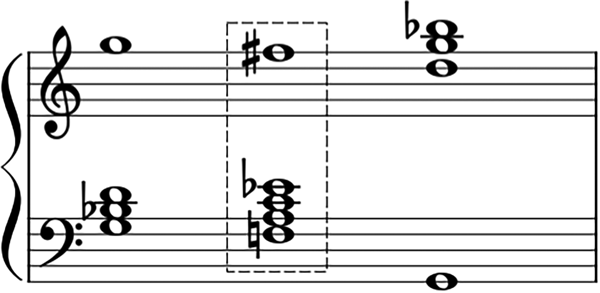
Concerto for Organ, Timpani, and Strings, bb. 1–3 reduction at middleground level showing non-syntactical marked chord, or ‘fantôme’ chord (boxed).

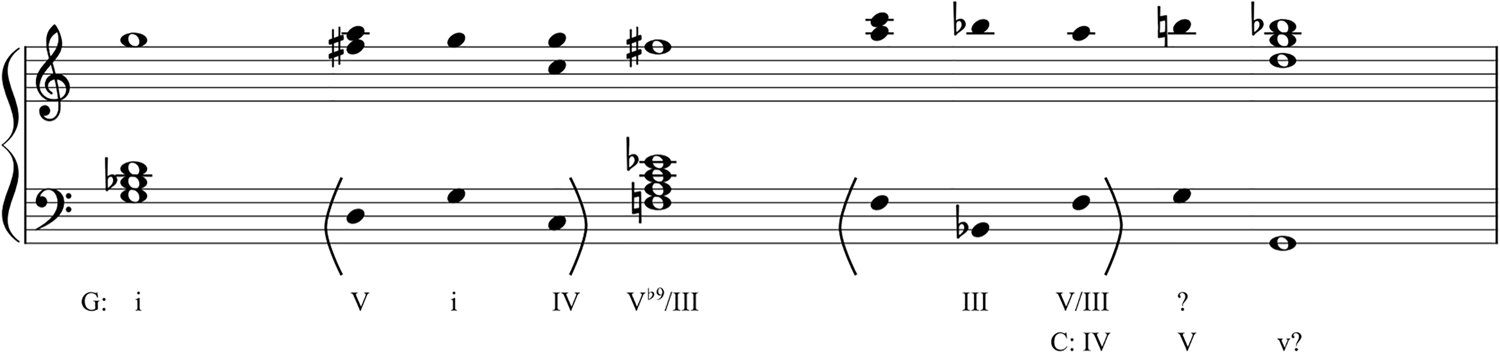
Despite embodying a tonic prolongational progression, one possible reading to understand this F is as a root for a dominant minor ninth in B♭. As Figure 7 shows, if we wanted to understand this within a functional progression, we could extrapolate the implied harmonies of the soprano line, situating the V♭9/III within a cycle of fifths.Footnote 72 Within this quite tenuous yet theoretically possible reading, the progression appears to head towards a cadential progression in the subdominant, C. The sudden interruption of a G minor triad within this progression (and alongside a sudden drop to piano) destroys this resolution, however, thus making the progression non-syntactical at both the middleground and foreground levels.Footnote 73 Therefore, the chord – which I shall call the ‘fantôme’ chord – is marked within the syntax. The isolated chord is a ninth chord – hardly rare in Poulenc's language – but it does not satisfactorily fit into either interpretation of the progression. Despite existing as a ‘real’ object (as opposed to a chord without potential function), the chord creates a paradoxical progression: given previous expectations of this style, one would expect a dominant function, but this is unfulfilled.
Concerto for Organ, Timpani, and Strings, bb. 1–3 reduction at foreground showing possible syntactical progression to ‘fantôme’ chord, but a non-syntactical cadence.

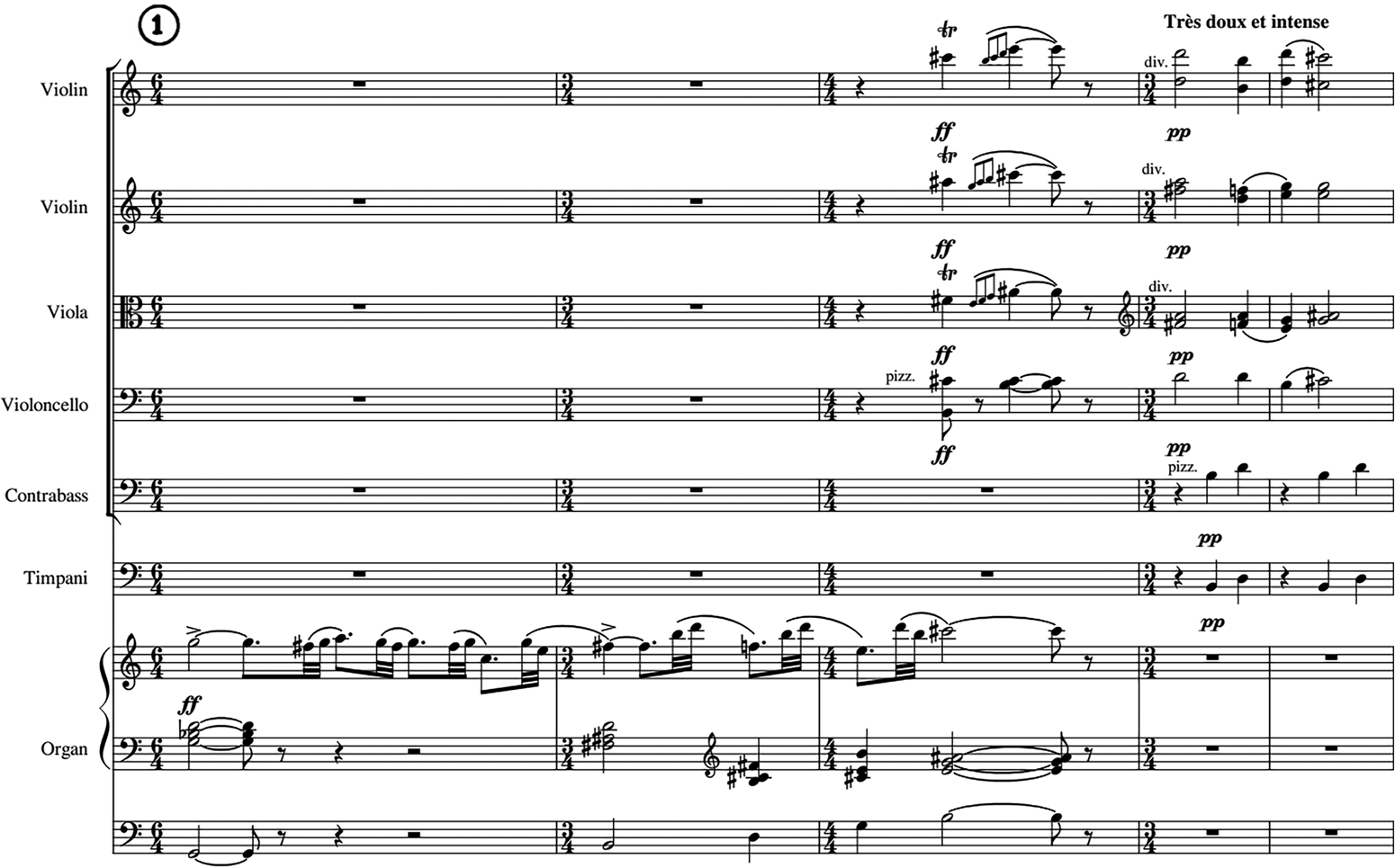
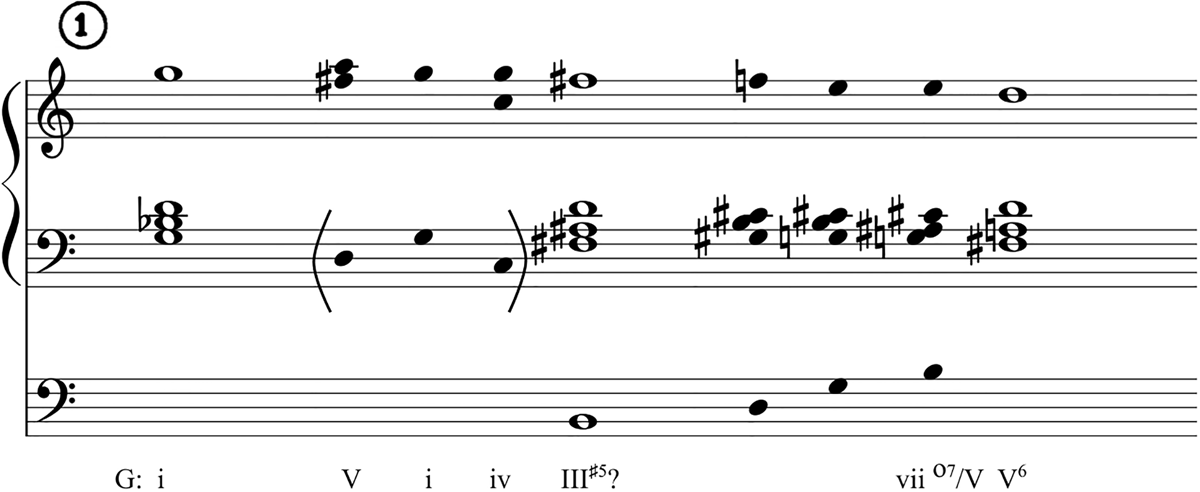
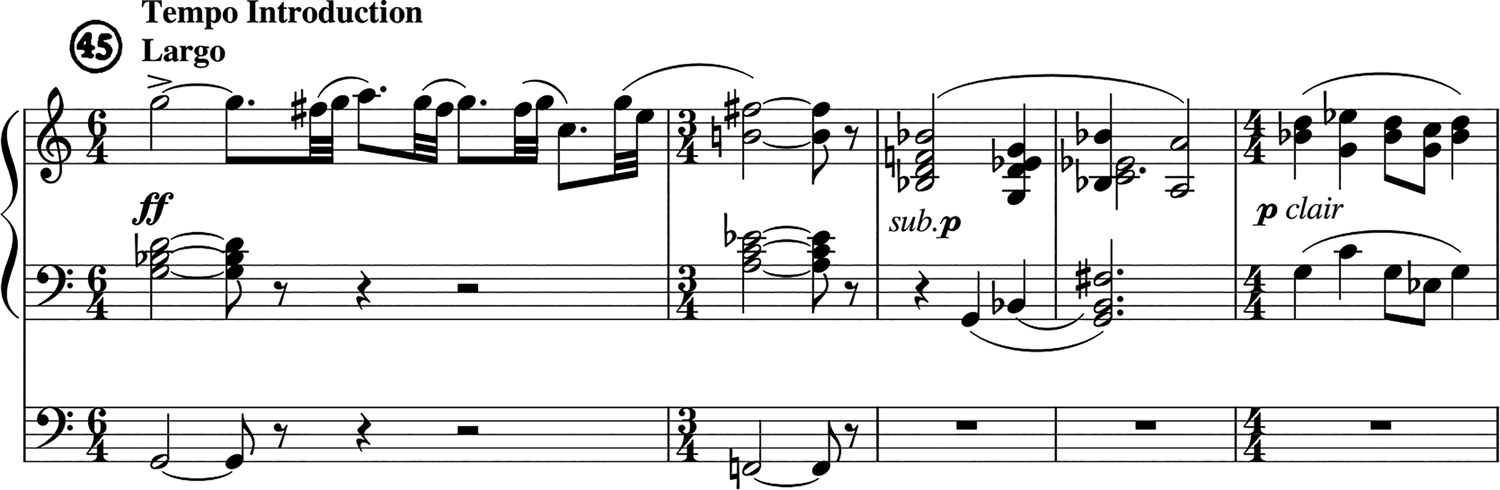
At fig.1 the opening gesture returns (see Example 10). The same rhetoric of a G minor triad followed by a dissonant chord returns. This chord is an augmented triad on B, though. But as the opening progression, this chord has little immediate function in tonal syntax besides a rather distant III♯5 and is therefore again marked as a ‘fantôme’ chord. Unlike previously, though, as shown in Figure 8 the chord moves through parsimonious voice-leading over a G major arpeggio to land on the dominant of G minor. Thus, although it is marked against the initial tonic, it retrospectively becomes an elaboration of V. Whereas the opening ‘fantôme’ chord was marked on both the foreground and middleground, the relative syntactical viability means the sonority is only marked on the foreground. In terms of Apollinaire's aesthetics, the relative illogicity of the second chord of the progression is now partially fulfilled as a dominant function, a step beyond the ‘fantôme’ chord at the opening.
Apollinaire, Paysage (1917).

Fig. 1: Return of a prolongational progression with a ‘fantôme’ chord in the second bar. Copyright © by Éditions Salabert. All Rights Reserved. International Copyright Secured. Reproduced by kind permission of Hal Leonard Europe S.r.l.

Reduction of the Concerto, fig. 1, showing the ‘fantôme’ chord's derivation from an elaborated dominant.

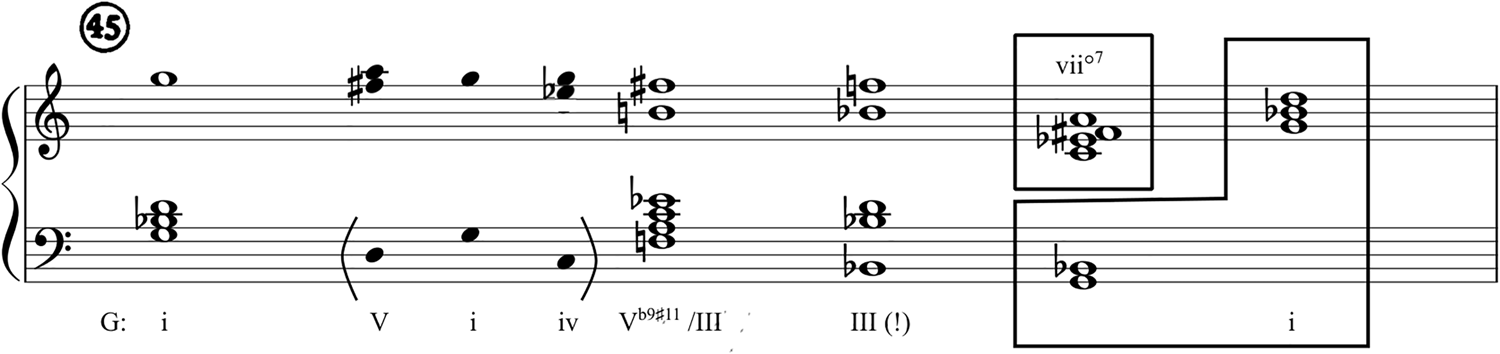
A similar gesture returns at the end (fig. 45), as shown in Example 11 and Figure 9. The first two chords are nearly identical to the opening harmony; the second's ambiguity is extended through adding a B♭. The enigmas of the opening are now given another perspective, however: the cycle of fifths to a V/III is fulfilled, resolving to B♭ in the next bar, albeit piano and soon interrupted by a return to the tonic. Now both the middleground and foreground analyses are fulfilled, as the chord can be comprehended in terms of both, so that the ‘fantôme’ chord's function has an explanation. As a dominant function in this recurring progression is now satisfied, the remainder of the work strongly confirms G minor, through a brief chorale and then a twenty-six-bar tonic pedal. Unlike the wandering harmony throughout the piece, the satisfactory dominant identity of the ‘fantôme’ chord allows for such extended stasis on the tonic.
Organ Concerto, fig. 45. Copyright © by Éditions Salabert. All Rights Reserved. International Copyright Secured. Reproduced by kind permission of Hal Leonard Europe S.r.l.

Reduction of Organ Concerto, fig. 45.

In the framework of the Surrealist model, this example is more dynamic. The appearance of the ‘fantôme’ chord initially creates a marked musical opposition against the expected prolongational progression. Rather than be reconciled immediately through different generic lenses as the examples above, the association between the two objects is reconciled across the work, mirroring Apollinaire's concept. The opening occurrence is a ‘truthful illusion’ or ‘fantôme véritable’: it creates the illusion of being marked, but is actually ‘truthful’ (i.e., tonally functional). The syntactical explanation of the ‘fantôme’ chord reinterprets its initial appearance at the opening as functional. The Organ Concerto potentially contains many elements which could be construed as analogous, but focusing on a single chord shows how Apollinaire's conception of Surrealism can inform the structure of Poulenc's music.
More broadly within Surrealist aesthetics, the different methods of undermining the status of the dominant in the Organ Concerto – that is, to objectify its function – whilst maintaining a necessary hold on the actual syntax reveals the challenges of marking out a chord for its function. Is this changing chord function still a musical Surrealism? Maybe not: the analogy with other arts becomes increasingly stretched, as the parsing of extended tonal syntax and critical referencing of the same syntax is far from a simple split, relying heavily on subtle generic expectations. And whilst the earlier juxtaposition of genres can be identified, exploring the larger-scale formal use of Surrealist principles applied to music risks diverting from the Surrealists’ striving for freedom through the irrational and unconscious. For example, a more organicist reading might set up the opening tension of the ‘fantôme’ chord as finally resolved in the final moments, a relatively conventional device.
Nevertheless, this play between conventional expectations and sudden undermining of them is the basis of much Surrealist art. Thus, to read Surrealism in music through Poulenc's fifth relations provides a familiar and thoroughly codified lens through which to analyse the Surrealists’ challenge to the fetishism of logical procedures. Perhaps through these analyses we can reach glimpses of Breton's ‘freedom’ in music.
The musical surreal in the twentieth century
Bohn writes that, of all the major poetic and artistic currents of the twentieth century, ‘Surrealism has proven to be the most durable and the most influential’.Footnote 74 The parallel with subsequent developments in linguistics and semiotics, embodied in influential strains of structuralist and post-structuralist thought, established its modes of thinking within familiar schools of thought. Indeed, the word ‘surreal’ has entered everyday parlance. Given the early practitioners’ major influence on many movements in twentieth-century art and literature, the movement's influence on music is under appreciated. Caplin's precise cadential terminology allows us to understand how his music engages with these aesthetic techniques, and Hatten's concept of markedness, alongside Bohn's conception of Surrealist communication, allows us to understand the significance of Poulenc's cadential and fifth-relations subversion. In effect, through creating forms that use the cadence outside their role as a form-functional device, Poulenc deconstructs the cadence.
The influence of Surrealist thinking pervades many aesthetics of music across the twentieth century.Footnote 75 Locally, Poulenc's colleagues in Les Six assembled around Satie. For example, Darius Milhaud's ballet Le Boeuf sur le toit (1920) which, like Satie's Parade, has a scenario by Jean Cocteau, cycles through keys in a manner similar to Poulenc's Sextet and Valse-Improvisation. More broadly, other strands of twentieth-century music demonstrate influence from Surrealist thinking, such as collage and objets trouvé (e.g., the third movement of Berio's Sinfonia), but also more subtle juxtaposed oppositions. For example, the close associations of Surrealist aesthetics with Cubist visual art has implications for situating Stravinsky's block aesthetic style.Footnote 76 Later in the century, composers set Surrealist texts, from Boulez's Marteau to Lutosławski's dream-like aleatoric settings in Trois Poèmes d'Henri Michaux and Jean-François Chabrun in Paroles Tissées. Messiaen evidenced an affinity to Surrealist aesthetics, writing in 1946 that ‘if you define surrealism as a mental vantage-point where visible, natural realities and invisible, supernatural realities are no longer in opposition to each other and where they cease to be perceived as contradictions, then I am a surrealist composer’.Footnote 77 His own surrealist-infused text in Harawi (1945) exemplifies another poetic strand.Footnote 78 Many of Kagel's works contain elements which could be considered Surrealist; indeed, his Szenario for Strings and Tape (1982) was conceived as a score for Buñuel and Dalí's Un Chien Andalou. Ligeti's alignment with broader Surrealist concepts, such as parodying found objects, is also well established,Footnote 79 and Thomas Adès's work has often been aligned with Surrealist concepts.Footnote 80 This continual and widely encompassing influence of Surrealist ideas across these often strikingly different works moves far beyond the original group and their antipathy towards music.
More broadly, the systematic opposition of objects is a familiar trope of twentieth-century music. If we take the legacy of Surrealist thinking earnestly, twentieth-century juxtapositions are far beyond mere irony. The systematic approach building upon Hatten's method of markedness outlined in this article demonstrates how one can interpret Surrealist-influenced musical works. Through highlighting the syntactical problem of the cadence, Poulenc echoes Surrealism's reconceptualizing of the expressive potential of form. If Schoenberg's atonality and twelve-tone method reimagined harmony within familiar forms in the early twentieth century, Poulenc reimagined form within familiar harmony. Placing Poulenc within these aesthetic principles resituates his modernist credentials, rather than his oft-characterized regressive neoclassicism. As such, despite the Surrealists’ disdain for music, taking their aesthetic principles in music seriously can revise our understandings of composers’ expressive intentions.