The duration of infectivity of severe acute respiratory syndrome coronavirus 2 (SARS-CoV-2) is a challenge among hospitalized critically ill or profoundly immunocompromised patients. Reference Rhee, Kanjilal, Baker and Klompas1 A subset of immunocompromised patients with coronavirus disease 2019 (COVID-19) maintain prolonged viral replication beyond 20 days. Reference Dioverti, Salto-Alejandre and Haidar2,Reference Niyonkuru, Pedersen and Assing3 SARS-CoV-2 is a single-stranded, positive-sense ribonucleic acid (RNA) virus that utilizes RNA-dependent RNA polymerase to generate genomic and subgenomic minus-strand RNA for viral replication. Reference Michalakis, Sofonea, Alizon and Bravo4 We used a strand-specific assay that detects minus-strand RNA as a surrogate for active viral replication, and we have described the characteristics associated with prolonged viral replication. Reference Hogan, Huang and Sahoo5
Methods
At Stanford Health Care, we use a real-time reverse transcriptase polymerase chain reaction (rRT-PCR) specific to the minus strand of the SARS-CoV-2 envelope gene to determine active viral replication. We identified patients hospitalized at Stanford Health Care from July 2020 to April 2022 who underwent at least 1 SARS-CoV-2 strand-specific assay. All patients with a minus-strand assay performed >20 days after illness onset or from the first detectable SARS-CoV-2 polymerase chain reaction (PCR) were reviewed for patient demographics, date of first positive SARS-CoV-2 PCR, symptom onset, comorbidities, and immunosuppression. The threshold was determined based on the absence of background amplification signal in control reactions (reverse transcription without forward or reverse primers) performed in a prospective set of clinical validation samples as described in 2021 by Hogan et al. Reference Hogan, Huang and Sahoo5 Symptom onset was defined as the day of the first COVID-19–related symptoms or the date of the first detectable SARS-CoV-2 PCR in asymptomatic patients. The time to the last detectable minus-strand assay was defined as days from symptom onset or first detectable SARS-CoV-2 PCR (in asymptomatic patients) to the last detectable minus-strand assay during hospitalization. The cycle threshold (Ct) value patterns for patients with 2 or more detectable minus-strand assays were defined as bimodal, a decrease in Ct value followed by an increase; prolonged, gradually increasing Ct values; and persistent, unchanged Ct values over time. Data are presented as counts, percentages, medians, and interquartile ranges (IQRs). Univariable logistic regression was used to calculate odds ratios (ORs) and 95% confidence intervals (CIs). The Stanford University Institutional Review Board approved this study.
Results
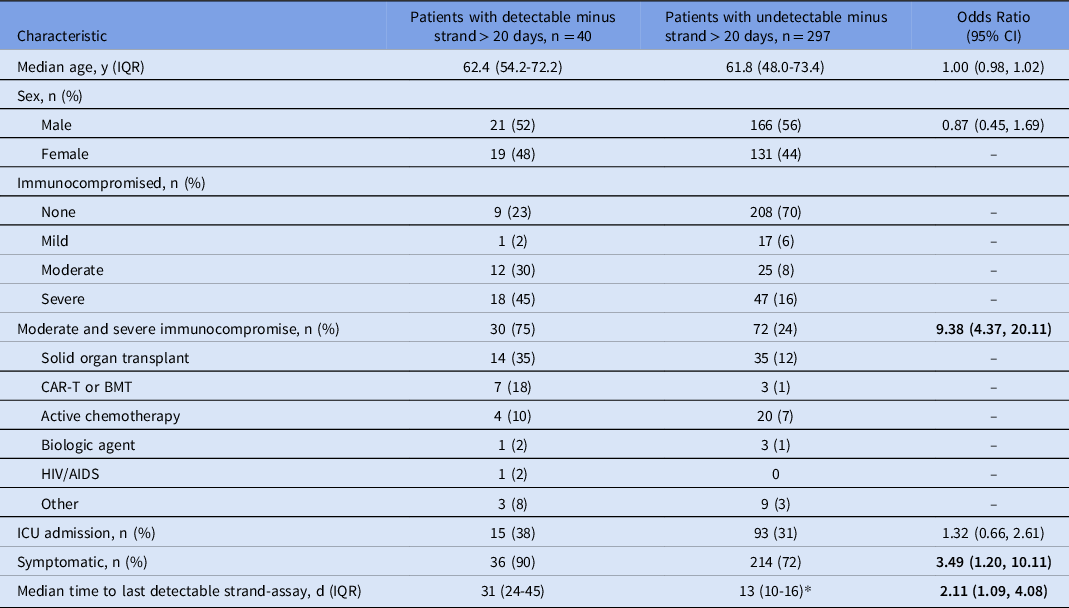
In total, 1,059 strand-specific assays were collected from 844 hospitalized patients between July 2020 and April 2022. Among them, 423 strand-specific assays (from 337 patients) were performed >20 days after COVID-19 illness onset and 64 had a detectable minus strand (from 40 patients). For these 40 patients, the median age was 62.4 years (IQR, 54.2–72.2), and 21 were male (52%). Also, 30 (75%) of these patients were classified as moderately or severely immunocompromised, including solid-organ transplant, bone-marrow transplant, chimeric antigen receptor T-cell (CAR-T) therapy, active chemotherapy or biologics, HIV/AIDS, or another form of immunosuppression (Table 1). The mean Ct value of the minus strand was 33.4 and mean Ct value of the plus strand was 18.7. The median time to last detectable minus-strand assay was 31 days (IQR, 24–45) and 15 (38%) patients required admission to the intensive care unit (ICU).
Clinical characteristics of patients identified to have a detectable minus strand assay more than 20 days from illness onset. Stanford Health Care, 2020–2022

* N = 13 patients with a detectable minus-strand assay after symptom onset, all other patients had an undetectable minus-strand assay and were not included
Abbreviations: AIDS, acquired immune deficiency syndrome; BMT, bone marrow transplant; CAR-T, chimeric antigen receptor T-cell; HIV, human immunodeficiency virus; ICU, intensive care unit; IQR, interquartile range.
Overall, 297 patients had an undetectable strand-specific assay performed >20 days after COVID-19 illness onset. Among them, 208 (70%) were not immunocompromised and only 72 (24%) were moderately or severely immunocompromised. Odds ratios for moderately or severely immunocompromised was significant between the detectable and undetectable strand-assay groups (OR, 9.38; 95% CI, 4.37–20.11). The median time to last detectable strand-assay was 13 days (IQR, 10–16) for 13 patients of the total 297, given the remainder had no detectable strand-assays upon testing.
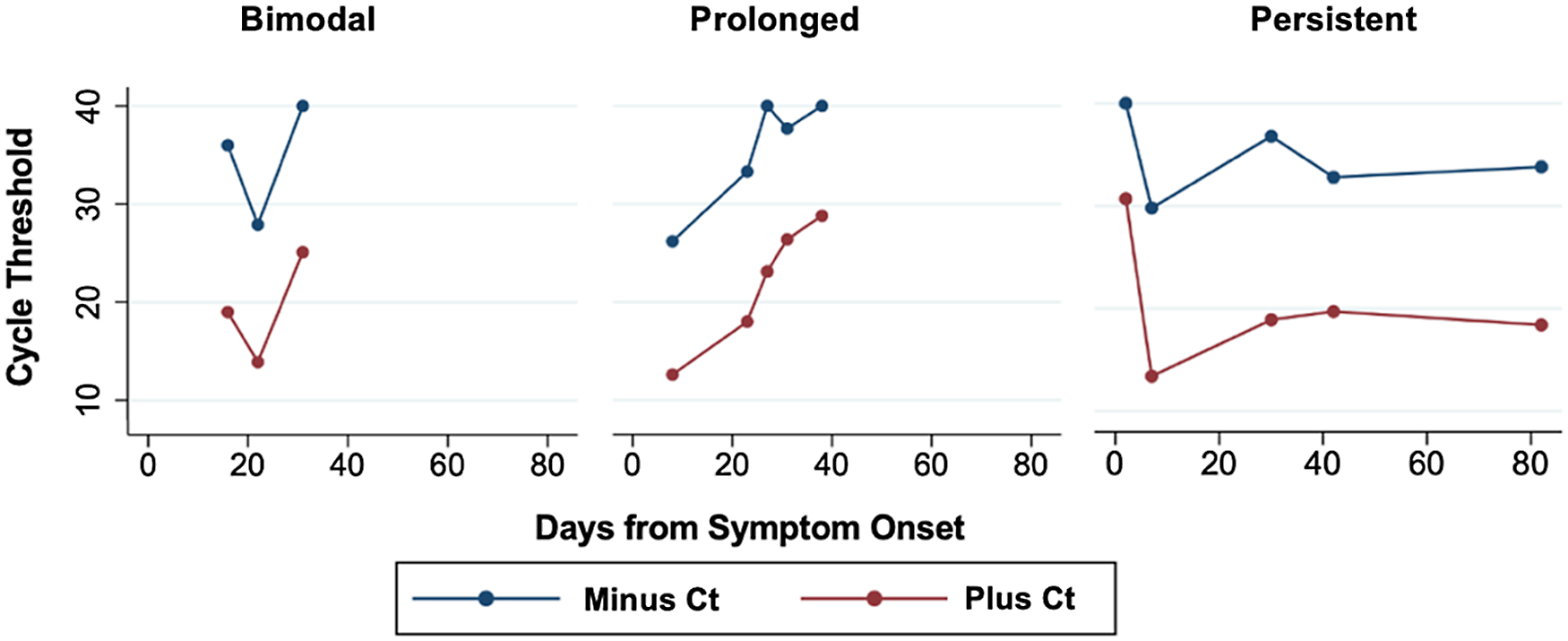
Moreover, 26 patients had 2 or more detectable strand-specific assays, with Ct values of the plus and minus strands displaying 1 of 3 patterns: bimodal (n = 4), prolonged (n = 12), or persistent (n = 10). Serial minus-strand assay Ct values of 3 representative patients are shown in Figure 1 to illustrate the 3 patterns. These patterns represent different types of persistent viral replication, with the most atypical being bimodal values demonstrating a decrease in Ct value after >20 days of viral replication.
Representative sample of three patients’ cycle threshold of plus and minus strands from days of illness onset – bimodal, prolonged, or persistent pattern of viral replication. Stanford Health Care, 2020–2022.
Abbreviations: Ct, cycle threshold.

Discussion
We present a novel tool that can be used in the assessment of ongoing viral replication in patients with profound immunosuppression who may be more likely to have a prolonged period of viral replication. Despite our current diagnostics, it remains difficult to ascertain whether ongoing low level viral replication is associated with a meaningful risk of transmission. The low mean Ct value of the plus strand (18.7) in those with detectable strand assays correlates with a higher rate of viral replication and transmission based on published data. Reference Alsuhaibani, Kobayashi and Trannel6,Reference Trannel, Kobayashi and Dains7 Use of plus-strand Ct values alone to determine viral replication can be considered at institutions without access to strand-specific testing. However, additional studies are needed to determine a standardized Ct value cutoff for SARS-CoV-2 viral replication. To better assess the optimal duration of isolation in specific patient populations, laboratory tests, including the strand-specific assay, clinical findings, and patient risk factors for persistent viral replication need to be considered. Reference Al Bayat, Mundodan and Hasnain8,Reference Basile, McPhie and Carter9 The presence of active viral replication has consequences beyond infection control precautions, as persistent viral replication can impact decisions for the need of additional SARS-CoV-2 treatment and timing of future immunosuppression (eg, administration of chemotherapy or proceeding with solid organ transplantation). Reference Kute, Meshram, Fleetwood, Chauhan and Lentine10
This analysis had several limitations. Not all patients underwent SARS-CoV-2 strand-specific assays; moreover, immunocompromised patients may have been more likely to have 1 or more assays performed. Immunocompromised patients’ longer hospital stays may also have contributed to an increased number of strand-specific assays in this group. Additionally, this was a single-center study, and the implementation and impacts of the strand-specific assay are limited to institutions where this test is available. Alternatives to the strand-specific assay, such as specific plus-strand Ct value cutoff values, should be evaluated as surrogates for viral replication.
In conclusion, most detectable strand-specific assays >20 days from COVID-19 illness onset occurred in immunocompromised or critically ill patients. The low Ct values of the plus strand in the strand-specific assay correlated with a detectable minus strand, consistent with ongoing active viral replication. Additional studies are needed to characterize whether this diagnostic tool can accurately identify those with persistent viral replication and risk of ongoing transmission to optimize patient-specific guidance for duration of transmission-based precautions.
Acknowledgments
The authors thank the laboratory staff and infection control practitioners at Stanford Health Care for their contributions to this study.
Financial support
This work was supported by the National Institues of Health grant no. 5R25AI147369-03 and grant no. R25 AI 147369.
Competing interests
All authors report no conflicts of interest relevant to this article.