1. Introduction
In past decades welfare state research has highlighted in lively debates the differences and developments in welfare state redistribution. Major scholars such as T.H. Marshall and Esping-Andersen have shown that welfare states differ not solely in terms of outcomes but first and foremost in their redistributive principles that are reflected in welfare state regulations. A major strand of this research has dealt with the question of how and how far welfare states redistribute financial resources based on work as one of the major redistributive principles (e.g. Korpi and Palme, Reference Korpi and Palme1998). The family though – another major principle of welfare state redistribution – has rarely been the object of such analyses. Family has mainly been addressed in redistribution debates as being simply affected by “higher-level” redistributive principles. This particular focus on welfare state spending and distributional outcomes and effects does not address family as a redistributive principle on its own, based on the respective regulations. Regulations that redistribute financial resources based on family have been established by welfare states, too. They, too, differ in the way they have been institutionalised and in the degree to which they redistribute, and they, too, are subject to particular conditions as a kind of societal negotiation of rights and obligations (Frericks, Reference Frericks2012). The latter twofold concept of redistribution might reduce differences in terms of financial resources but might also increase these differences. Family as a redistributive principle manifests itself in terms of rights by means of entitlements to additional benefits, derived rights, or tax deductions, and in terms of obligations by means of requested financial support of family members before these can be entitled to public support (for an overview on the full range of family in welfare regulations, see Frericks, Reference Frericks, Daly, Gilbert, Pfau-Effinger and Besharov2021), Against this background it is surprising that – as we will show in the following section – prominent theoretical concepts that have been developed to analyse welfare state redistribution often do not adequately take family as a redistributive principle into account, and when they do, they take a surprisingly little differentiated perspective on family. That is however essential to a better understanding of redistributive logics.
In this article we analyse the family as a principle of redistribution with its particular logics inscribed in welfare state regulations. We draw on the German case since it is known to be both redistributive and family-oriented. We analyse how and how far the German welfare state institutionalises family as a redistributive principle.
Aiming to better comprehend the redistributive logic of a welfare state (but not the factual differences in available resources), we carry out a pure regulation analysis. We calculate differences in the regulation of redistribution in terms of family by means of a clearly defined reference point, and to map the redistributive logic as comprehensively as possible, we consider the interplay of different redistributive instruments such as child benefits, family insurances, tax regulations and some maintenance law. We use the tax-benefit microsimulation model EUROMOD and its ‘Hypothetical Household Tool’ (HHoT) to map welfare state regulations in terms of family for a total of 54 family forms which are based on differences in marital status, whether inclusive or not of children or parents, and different forms of couples’ income distribution. The approach is necessarily innovative in theoretical, methodological, and empirical terms and contributes thereby to the corresponding debates in welfare state research.
The contribution is structured as follows: in the next section we present the state of the art in relation to welfare state redistribution and family. The third section introduces the methodology of our analysis, and the fourth presents the empirical results. After discussing the results in the fifth section, we close with a conclusion.
2. State of the Art
Welfare states are institutionalised forms of social order. Redistribution, in one form or another, is one of the fundamental characteristics of welfare states (Esping-Andersen and Myles, Reference Esping-Andersen, Myles, Nolan, Salverda and Smeeding2009). Resources from various taxes and contributions are used to support the societal participation of citizens and residents. Some of the most well-established research on welfare state redistribution is on the redistribution of resources between the currently working and currently not working population (such as pensioners and unemployed persons). This research focus became famous with the concept of de-commodification and particularly with Esping-Andersen’s 1990 study The Three Worlds of Welfare Capitalism that uses de-commodification as one of the major analytical components in explaining the international variation in redistributive logics. The other major analytical component of that study is stratification and the question of where welfare states draw the line between beneficiaries and those who do not qualify for benefits from welfare state redistribution. The welfare regimes that Esping-Andersen distinguishes differ in whether they aim to equalise the population, to conserve its differences, or to polarise it.
Most important about the above research strand is that it tries to identify the different aims and logics of welfare state redistribution. Welfare states, based on national or regime-typical perspectives on societal phenomena and social values, have been established differently; they are founded on different dominant principles. And we know at least since Esping-Andersen’s above study that family is a major principle in welfare state set-ups. Differently however from decommodification and stratification and related redistributive logics (and factual effects) of welfare states’ various vertical and horizontal redistributions, the redistributive logic of family as a principle of welfare state redistribution has hardly ever been the focus of welfare state research.
Indeed, all welfare states grant, to different degrees, benefits to families. Among these entitlements are the right to care for a family member without losing employment, compensation for being without income during care or parental leave, direct cash allowances (e.g. for children), indirect allowances in form of social security entitlements or tax deductions for families, and derived rights for children or partners with little or no wage (for an overview see Frericks, Reference Frericks, Daly, Gilbert, Pfau-Effinger and Besharov2021). Studies have analysed how families or individuals with family benefit from such measures (e.g. Van Lancker and Van Mechelen, Reference Van Lancker and Van Mechelen2015). At the same time though, welfare states oblige families or individuals with family to provide financial (and other forms of) resources to family members before the state is called upon to jump in. The most pronounced obligation is to maintain family members in the context of means-tested benefits. Research has paid rather little attention to the rights-and-obligations aspects of welfare state redistribution in terms of family (exceptions are Daly and Scheiwe, Reference Daly and Scheiwe2010; Millar, Reference Millar2004; Saraceno, Reference Saraceno, Knijn and Komter2004). Daly and Scheiwe (Reference Daly and Scheiwe2010), for instance, have investigated the relationship between individualisation and institutions regulating personal obligations to care for and maintain others. They identify two different individualisation processes that happen contemporaneously and interact. The degree to which regulations redistribute resources, though, is not part of their investigation.
For the study of welfare state differences regarding family, two major concepts have been developed that significantly contribute to understanding these differences: defamilialisation and individualisation. The concept of defamilialisation has been developed to study in how far paid work or social security systems reduce the financial dependence on family by enabling people to enjoy a ‘socially acceptable standard of living’ (Lister, Reference Lister, Baldwin and Falkingham1994) or ‘well-being’ (McLaughlin and Glendinning, Reference McLaughlin, Glendinning, Hantrais and Mangen1994). Defamilialisation studies focus either on redistributive mechanisms in relation to women’s relative independence from family resources also when caring for family (e.g. Bambra, Reference Bambra2004), or analyse ‘the degree to which social policy frees women from the burden of family obligations, [and] the extent to which motherhood is compatible with careers’ (Esping-Andersen, Reference Esping-Andersen1999: 88 and 178, also Korpi, Reference Korpi2000). Individualisation, again, can be conceptualised as a process of continuing separation of an individual from traditional and familial dependencies in which ‘personal dependencies come to be replaced by dependencies on the market’ (Daly and Scheiwe, Reference Daly and Scheiwe2010: 181). Individualisation refers to European welfare states’ general reconceptualisation of social citizenship as based on the male breadwinner, towards an individualised adult worker model (Lewis and Giullari, Reference Lewis and Giullari2005). While there has been indeed a political and cultural shift in European societies towards the primacy of the individual, redistributive regulations are far from being individualised, as studies have shown that family-related benefits have been extended or newly introduced, and that welfare state change has been rather ambiguous in this regard (Frericks Reference Frericks2012; Pfau-Effinger and Rostgaard, Reference Pfau-Effinger and Rostgaard2011).
For three main reasons, none of these key concepts of welfare state analysis in terms of family can be applied in the planned analysis, because, first, they are characterised by a one-dimensional perspective on family, while redistributive regulations in part strongly differ across family forms (Frericks et al., Reference Frericks, Höppner and Och2016); second, their prior focus has been on the question of a citizen’s making a living completely independent of the family, while we aim to understand the gradual differences in welfare state redistribution; and third, related to this, both concepts address societal effects and therefore usually mix the analysis of welfare state regulations with that of outcomes (e.g. Esping-Andersen, Reference Esping-Andersen1999; Leitner, Reference Leitner2003; Lohmann and Zagel, Reference Lohmann and Zagel2016). Factual outcomes though are affected by numerous other factors that include, in addition to welfare state regulations, preferences and structures in various ways (Pfau-Effinger, Reference Pfau-Effinger2004). The results, therefore, do not reflect so much the redistributive logics of welfare state regulations as factual societal differences.
Consequently, the empirical analysis of this contribution is based on three theoretical assumptions. These are: (1) redistributive logics differ across family forms, and in part markedly so; (2) these differences are not the result of one coherent set of regulations but of an interplay of in part contradictory regulations; and (3), family as a redistributive principle manifests itself not only in terms of additional benefits to families but also in terms of particular obligations of families to financially support family members before these can be entitled to public support. These three aspects have hardly been analysed together and doing so results in an innovative evaluation of how family is institutionalised as an essential redistributive principle of welfare states. To do this we conducted a case study to gain in-depth insights into institutional redistributive logics. For our empirical investigation we decided to study Germany as a welfare state because it has traditionally obliged families to financially support family members, and has financially supported ‘the family’, or at least particular family forms (Ostner, Reference Ostner2003; Frericks and Höppner, Reference Frericks and Höppner2019). By means of a regulation analysis we will answer the question how and how far the German welfare state institutionalises family as a redistributive principle.
3. Methodology
In order to analyse the redistributive logics of the German welfare state in terms of family, we needed to develop a particular methodological framework. Since we apply a purely institutional approach to welfare state regulations, outcome data are not considered. To study redistributive logics one needs to, first, identify the relevant regulations; second, define and delimit the family forms across which differences in redistribution are captured; and third, set a reference point for measuring these differences.
In the first step, we identified the regulations of the German welfare state that affect redistribution with regard to family. Striving for the most encompassing study possible in terms of welfare state areas, we identified the following regulations as relevant to our analysis: namely, those affecting: child benefits, social insurance contributions (with long-term care insurance and health insurance being particularly family related), financial obligations towards family members, and tax regulations (particularly on income tax with regard to ‘tax-splitting’ between spouses, and tax classes). The latter have often been neglected in welfare state analysis while highly determining redistribution, in particular in the German welfare state (see Dingeldey, Reference Dingeldey2001). The various family-related regulations are examined in two ways: with regard to the extent to which they grant additional financial resources to families and to the extent to which they oblige families to provide financial resources to family members before they can get public support.
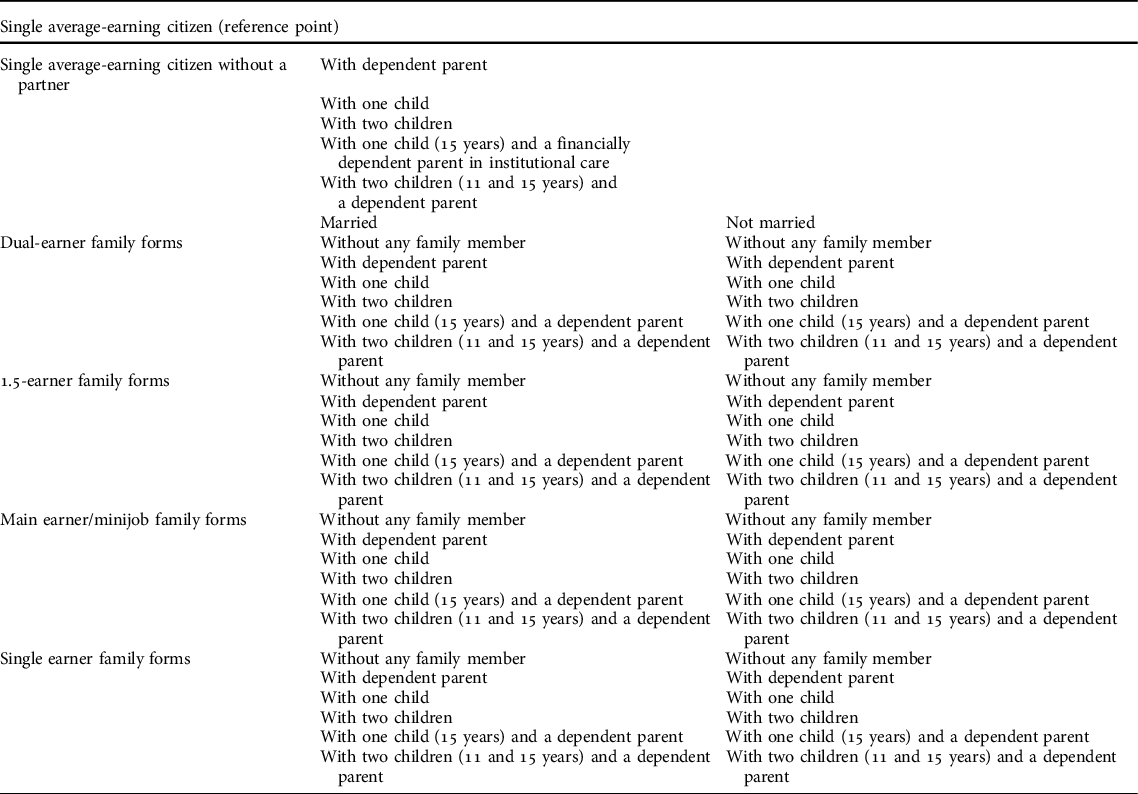
In a second step, we defined and delimited the family forms across which differences in redistribution are captured. German welfare regulations differ strongly across families of different status and composition (Frericks et al., Reference Frericks, Höppner and Och2016). Consequently, to study welfare state redistribution in terms of ‘the’ family, we need to distinguish between various family forms. We decided first to define the family forms that are most discussed in welfare state research (e.g. Korpi, Reference Korpi2000; Lewis et al., Reference Lewis, Campbell and Huerta2008). These are differentiated mainly by the shares of income earned by the partners. One is the ‘dual-earner’ family form that we interpret for our analysis as a couple in which both partners have the same income. Another is the ‘supplementary earner’ family form which has been identified as the dominant family model currently in Germany (Pfau-Effinger and Rostgaard, Reference Pfau-Effinger and Rostgaard2011). Since the supplementary earner family form manifests itself in different sub-forms depending on the earned income of the partner, we differentiate two major types: the first is where one of the partners earns half the income of the other (1.5-earner family form); the second is where one of the partners has a so-called ‘Mini-job’ of 450 euros/month (main-earner/minijob family form) which is subject to particular regulations in Germany (Beckmann, Reference Beckmann2020). The last family form that we consider is the ‘single-earner’ family (‘pure breadwinner’) in which one of the partners earns no income. We also consider the marital status of all these couples since it is highly relevant in German welfare regulations (Leitner, Reference Leitner, Obinger and Schmidt2019). Currently it is irrelevant in these regulations whether the couples are of the opposite or the same sex. In addition to these couple variations, we analyse welfare regulations with regard to having children by considering families (single or dual parents) with one or two children of age 11 and 15. We do not take smaller children into account, as a large number of specific regulations and exceptions apply to them, which on the one hand have already been widely investigated, and on the other hand tend to obscure our view of the general redistributive logic in terms of family. Moreover, we analyse regulations that refer to elderly parents in financial need and in institutional care because these are the most serious obligations regulated by the German maintenance law, § 1601 of the German Civil Code. We focus on those elderly in institutional care since, for care delivered in household economies, the maintenance law is impossible to model. In total, we analyse the German welfare state regulations on redistribution for 54 family forms (see Table 1).
Family forms matrix

Source: authors’ own compilation
In a third step of our methodological approach, we needed to set a reference point for measuring the degree of granted and requested financial resources in terms of family. This reference point needs to serve our research interest in redistributive logics in institutional terms. A reference point often used in welfare state research is the ‘average working citizen’, especially in the form of the average industrial/production worker, as in the pioneering study by Esping-Andersen (Reference Esping-Andersen1990), but also in more recent analyses (e.g. Kuitto, Reference Kuitto2018; Obinger and Starke, Reference Obinger, Starke, Leibfried, Huber, Lange, Levy and Stephens2015). In fact, the German welfare state is closely oriented to the construct of the average working citizen, or the average income earner, in its redistributive logic (Frericks, Reference Frericks2013; Lepperhoff and Scheele, Reference Lepperhoff and Scheele2017). We therefore take this construct as our reference point. More precisely, we use the average income earner without family as the point of departure (i.e. the zero point) because his/her financial resources are not affected by family-related welfare regulations. With this we have a theoretically based and commonly applied point of reference for our analysis. Using the average income earner as the common denominator for all the above-mentioned 54 family forms by including it as the first adult in each of them, we are systematically able to precisely identify differences in the allocation of resources due to family, and, consequently, the redistributive logics in terms of family. The monthly income of this German citizen corresponds to 3,994 euros – the average gross income of a full-time employee in 2019 (Destatis, 2020). Here, we use the gross income because it represents the income before the state’s granted and requested financial resources, and which is the same for the average income earner in all family forms.
Finally, in trying to avoid manual calculation we searched for a complex modelling tool to calculate redistributive differences that result from the various regulations and family forms. The tax-benefit microsimulation model for the European Union EUROMOD (version I2.0+) emerged as an excellent tool for this. It is often used as an instrument for comparative research on tax-benefit policies, but also includes most of the other regulative data needed to conduct our analysis. Its Hypothetical Household Tool (HHoT) allows us to study policy effects on the income of various hypothetical family forms (Hufkens et al., Reference Hufkens, Leventi, Rastrigina, Manios, Van Mechelen, Verbist, Sutherland and Goedemé2016). As we are interested in the current redistributive logics, we used policy data from 2019 as the last year available at the time of analysis. Since financial obligations towards financially dependent elderly parents in institutional care (Elternunterhalt) cannot be modelled in EUROMOD, we added the current (2019) laws manually. These financial obligations can to a certain degree be deducted from taxes; this, however, is not possible to adequately include into our modelling. Another limitation concerns regulations on long-term unemployment benefits (ALG II). They cannot be included since also their complexity would require a research design that draws on very concrete scenarios of family situations, not on hypothetical family forms.
Using the thus calculated data, we identified redistributive logics in terms of family. Granted resources, thereby, are identified as the amount that regulations add to the family’s resources in comparison to our reference point. In line with the logic of redistribution, we also consider to be granted resources those amounts which regulations may exempt a family from paying as contributions, as is the case in family insurances (healthcare insurance, long-term care insurance). Requested resources, in turn, are identified as the amount which a family is legally obliged (upon means-testing) to provide to other family members, or by which family resources are reduced as a consequence of higher income tax or social insurance contributions. To make these findings comparable across family forms, we related both the granted and requested resources in the various regulations to the gross income of the respective family. This income of the family is derived from the average income as defined above (double-earner family: 7,988 euros, 1.5-earner family: 5,991 euros, main earner/minijob family: 4,444 euros, single-earner family: 3,994 euros). Gradual differences in welfare state redistribution across different family forms are represented in terms of their shares of the respective gross income. This enabled us to identify aggregated redistributive logics of both additional and requested resources and to compare these aggregated values across family forms.
4. Findings
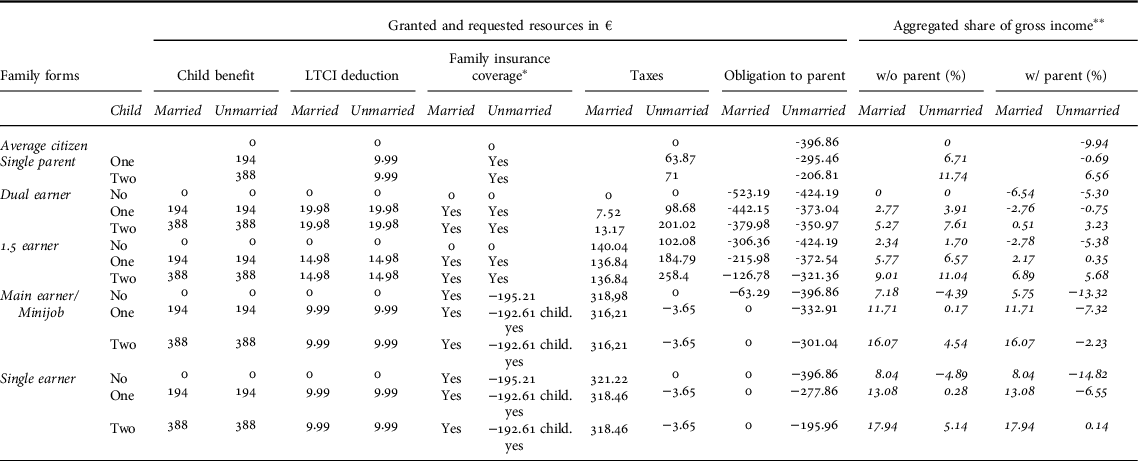
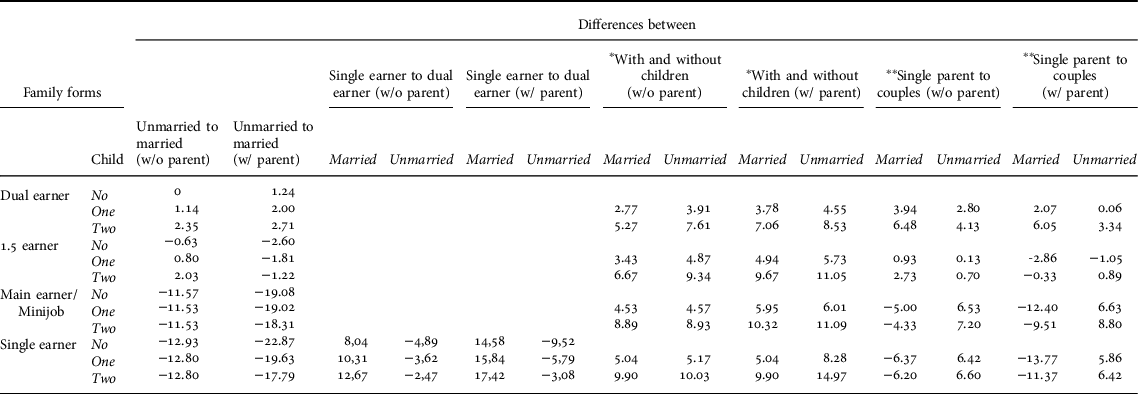
In this section we present our findings on family-related redistribution to show how and how far redistribution differs across the various family forms in Germany. The data is represented in Table 2 in two ways: first, as the amount in Euro by which the single regulations add to or reduce the resources of families in comparison to the reference point (these single values of the granted and requested resources resulting from the specific welfare regulations will not be explicitly discussed); and second, as the share of the gross income of the respective family form, in which both the granted and requested resources are included. Table 3 presents the differences in these aggregated values across family forms relative to their respective gross incomes. This table draws our attention to two major observations. First, married families of lower income are, relative to their respective gross income, financially more advantaged by the German welfare state than those of higher income; while this is reversed for unmarried families. Low-income family forms are therefore particularly worse off when the partners are unmarried, and even more so when they have to look after a financially and care-dependent parent. Second, the difference between a single parent (of average income) with or without a dependent parent, and couples of lower income is interesting since single parent family forms are particularly disadvantaged compared to married couples and advantaged compared to unmarried ones.
Resources (€) granted to and requested of (bold) family forms in comparison to the reference point and aggregated values of these resources as a share of family gross income (italics)

* Covered (not calculated in EUROMOD): ‘family-insured’ children and/or partner (exempt from paying contributions to health and long-term care insurance).
** Calculated as a difference between shares of granted and requested resources.
Source: Authors’ compilation based on data from EUROMOD.
Differences in aggregated values between family forms (unmarried/married relative to their respective gross income in %)

* Calculated as a difference in aggregated values between family forms with and without children of the same income constellation.
** Calculated as a difference in aggregated values between single-parent and couple family forms with a child/children of the respective income constellation.
Source: Authors’ compilation based on data from EUROMOD.
More in-depth analyses show the following. First, there are at times considerable differences between married and non-married couples. This counts for both families with and without a financially and care-dependent parent. Let us first look at families without a dependent parent. To both married and non-married dual-earner and 1.5-earner couples, resources are granted only; no resources are requested. And there are only marginal differences in the amount of resources granted to married and unmarried couples (up to 2%). Non-married family forms are granted slightly higher resources (3.91–7.61% of the share of gross income). This picture changes with lower family income – the differences between married and non-married couples greatly increase. Resources are granted to married family forms of single-earner and main earner/minijob couples for both children and partners (varying from 7.18–17.94% of the share of their income). In contrast, resources are granted to non-married family forms only when they have children, and resources are requested from them in the form of health and long-term care insurance contributions (varying from -4.89% to 5.14% of the share of their income). Thus, compared to the family forms of dual-earner and 1.5-earner couples, there are substantial differences between married and non-married family forms with lower incomes – varying from 11.53% to 12.93%.
Resource differences between married and non-married couples are greater when they also have financially and care-dependent parents. This is due to the requested resources; no family form is granted any additional resources because of a dependent parent. Significant resources, slightly higher for married couples, are requested from both married and non-married dual-earner family forms to financially support the parent in institutional care. While these financial obligations markedly decrease for 1.5-earner family forms, requested resources remain relatively high for identical non-married family forms due to a lower amount of deductibles (Selbstbehalt). Nevertheless, differences in the resources of married and non-married family forms with dependent parents are marginal (up to 3%). There are however substantial differences of up to 22.87% between married and non-married family forms with lower income (main earner/minijob, and single-earner family forms). This is caused by the fact that those in this income constellation who are married are exempt from financial obligations to elderly parents, while non-married are not. Higher amounts of resources are requested from non-married family forms in comparison to married ones, and the financial requests to non-married families even exceed the granted resources, i.e. they are net payers.Footnote 1
Redistributive logics, however, are not only different for married and non-married couples. There are also substantial differences within these groups. These differences are most visible in comparing the two opposite poles of income distribution – dual-earner and single-earner families. Married single-earner family forms are granted more resources than married dual-earner families (8.04-12.67% difference). This difference even increases to 14.58-17.42% with a financially dependent parent in institutional care, as single-earner families are exempt from financial obligations. Here, we observe redistribution towards poorer families. This picture is inverted, though, for non-married family forms. Due to the interplay of granted and requested resources, non-married, dual-earner family forms are better off than non-married, single-earner family forms when there is no parent who needs help (2.47-4.89%), and more so when a parent needs help (3.08-9.52%). Here, we observe a form of penalty imposed on those who aren’t married.
Different redistributive logics can also be observed that apply to childless families and families with children. Redistributive mechanisms applied to families with children are characterised by higher levels of additional resources and lower levels of requested resources in comparison to couples without children. Redistribution to families with children is however also strongly affected by marital status. This is particularly evident in dual-earner and 1.5-earner family forms in which non-married couples with children are granted higher amounts of additional resources than married ones, and the difference between them and childless families is higher than for their married counterparts (2.77-6.67% for married and 3.91-9.34% for non-married families; see Table 3). The redistributive logic, though, is the same for both married/non-married groups: the lower the family income, the more the differences across families with and without children. Most pronounced are the differences between childless non-married, single-earner family forms and those with one child (8.28%) or two children (14.97%). In other terms, lower-income families are most supported by the welfare state when they have children.
Lastly, the German welfare state is characterised by a particular redistributive logic implemented towards single parents. In comparison to married and non-married dual-earner and 1.5-earner family forms with children, single parents are granted more additional resources but, when they have a care-dependent parent, they are also requested to provide more from their resources. Single parents have higher aggregated values of family-related resources than do dual-earner family forms (e.g. 3.94-6.48% higher than married family forms without dependent parent). The differences in aggregated values are less when we compare single-parent family forms with 1.5-earner family forms. When a financially and care-dependent parent is included, single parents are disadvantaged in redistribution, as aggregated values of single earners are even lower than those of most 1.5-earner families. This is mainly caused by the request of higher amounts of resources from single parents to their dependent parent. Here, the comparison of single-parent and two-parent families (whether married or not) with lower income is particularly surprising. As unmarried family forms with lower income are requested to provide substantial financial resources, as explained above, and are granted lower resources than single parents, their aggregated values are considerably lower than those of single parents, and particularly so when dependent parents are included. But while single parents are advantaged in comparison to unmarried families of lower income, they are disadvantaged in comparison to married families of lower income whose aggregated values are substantially higher. Differences not only increase as the income of the married family is lower, they also increase with a dependent parent, as married family forms are, as explained, exempt from financial obligations towards parents.
5. Discussion
The findings show that the German welfare state is considerably more supportive of families with children than of those without. This is caused by two forms of regulation: those that grant higher resources to families with children, and those that request considerably lower financial resources from families with children. However, in the group of low-income family forms, the resources that are granted to families with children and requested from them strongly differ and this depends on the marital status. Married single-earner families are granted more resources without being requested to provide any. Single-parent families, instead, are granted fewer financial resources, and they are also requested to provide resources to financially and care-dependent parents, which is due to differences in the applied deductibles (Selbstbehalt). Research on redistribution focusses, in part, on the particular welfare state characteristics with regard to single parents. Our results show that particular attention should be paid to welfare state characteristics with regard to non-married low-income family forms, too. For them, unlike for married or single parents with low income, requested resources exceed the granted resources; they are, to put it very simply, losing income because of the welfare state. This might be interpreted, in welfare state terminology, as redistribution from the poor to the rich (Myles, Reference Myles, Esping-Andersen, Hemerijck, Myles and Gallie2002) which is based on particular disadvantages that result from marital status (Daly and Scheiwe, Reference Daly and Scheiwe2010).
This finding leads to a more general argument: although welfare state research and social policy debates deal definitely more with the question of how much welfare regulations add to a certain income (in this context, the income of families), our study shows that also the opposite tendency – to what extent welfare state regulations decrease income of families – needs to be considered to fully understand welfare state redistributive logics.
To provide a (more) comprehensive picture on granted and requested resources, we need to consider a variety of welfare regulations. To fully grasp the welfare state redistributive logics with regard to family would be to include all welfare regulations that affect family in one way or another; this is, for various reasons, practically impossible (see Frericks, Reference Frericks, Daly, Gilbert, Pfau-Effinger and Besharov2021). It is however possible, as we have shown, to study a substantial variety of welfare regulations that include regulations on benefits, taxes, social insurance contributions and, partly, the family’s financial obligations towards its members, and EUROMOD delivers a very suitable tool for doing so. Since its hypothetical household tool is, of course, household based, new challenges had to be solved such as manually adding a parent in institutional care. But helpful new tools are on the way and only need to be further developed to help us answer questions with regard to family more precisely.
As to redistributive logics, this paper shows that individualised social rights have not replaced marriage as a key redistributive principle (Lewis, Reference Lewis2001). On the contrary, for the German welfare state we show that marriage (and family) is still a major redistributive principle. This is particularly true of married family forms with unequal distribution of income, and there are fundamental differences in the redistribution of resources to married and non-married family forms of single-earner and main-earner/minijob couples. But our analysis has shown also that there are deviations from this redistributive logic in certain circumstances, as when family forms of unmarried couples benefit more from welfare state regulations than their married counterparts.
Lastly, there is a widely shared understanding of the German welfare state as strongly family-related. The redistributive logics of its regulations, though, have never been systematically analysed. Our analysis has revealed three major redistributive logics with regard to the family focussing on the aggregated data as the institutionalised redistributive logic for the particular family form. First, the ‘pure-receiver’ redistributive logic, in which families receive resources without being requested to provide any. This logic refers first and foremost to all married family forms that do not contain a financially dependent parent. Second, the ‘receiving-requesting’ redistributive logic, in which resources granted to families are accompanied by a certain amount of resources that is requested from them. This has been particularly true for family forms that include financially dependent parents (married dual-earner and 1.5-earner family forms and all single parent and non-married family forms), but also for non-married family forms of single-earner and main-earner/minijob couples that do not include dependent parents. Finally, also a ‘pure request’ redistributive logic has been identified that requests financial resources from families without granting any. This kind of redistribution appears particularly in childless unmarried family forms with lower income and family forms of couples with higher income, whether married or not, which do not have children but have a financially and care-dependent parent. These differences show that the German welfare state strongly varies in its redistributive logics in dependence on the family form.
6. Conclusion
Family is one of the major principles of welfare state redistribution. It has, however, rarely been a focus of welfare state research. The aim of this contribution was to help fill this gap in research on family-related redistribution by examining the German welfare state which is known to be both redistributive and family-oriented, in order to answer the question of how and how far the German welfare state institutionalises family as a redistributive principle. Using the tax-benefit microsimulation model EUROMOD and its Hypothetical Household Tool (HHoT), we examined welfare state regulations in terms of family. We differentiated 54 family forms referring to marital status, children, needy parents, and different forms of couples’ income distribution, and considered both the financial resources granted to families as well as the financial resources requested from them. That is, we considered the interplay of different redistributive regulations on benefits, taxes, social insurance contributions and, where possible, financial obligations towards family members that we, in part, manually added into HHoT.
The analysis verified the three theoretical assumptions that we derived from the relevant literature: (1) redistributive logics differ in part strongly across family forms; (2) these differences are not the result of one coherent set of regulations but of an interplay of partially contradictory regulations; and (3) family as a redistributive principle manifests itself not only in terms of additional benefits to families but also particular obligations of families to financially support family members before they can get public support. These aspects have hardly been analysed before and combining them allowed a clear evaluation of family-related redistribution.
The findings show that the German welfare state strongly inscribes family in its redistributive regulations and that, alongside work-related logics of redistribution, family is an important principle though which societal resources are redistributed. In fact, only three of our 54 family forms are not subject to family-related redistributive regulations, and we differentiate three major lines of conclusions.
First, the redistributive logic of the German welfare state is still characterised by a clear marriage-centricity and special financial support for family forms with an unequal income distribution. The latter is particularly true if one includes a financially dependent parent in need of care. This aspect has not been taken into account in previous research and underlines the marriage-centricity of the German welfare state. Thus, while married family forms are granted financial resources and are requested to provide resources only when they have higher income, non-married family forms with unequal income distribution are much more liable to provide resources. This difference is even more pronounced when they have a care-dependent parent. For non-married family forms with unequal income, requested resources in fact exceed the granted resources. In short, redistribution highly differs between married and non-married family forms, and in particular so for those of low income. There are, however, some deviations from this marriage-centred redistributive logic, since under certain conditions unmarried family forms are more advantaged than married ones. Yet, differences between them in this regard are rather marginal.
Second, family-related redistributive regulations do not follow one redistributive logic. On the one hand, the German welfare state is considerably more supportive of families with children than towards those without. This is caused by two forms of regulations: those that grant higher amounts of resources to families with children, and those that request considerably lower financial resources from families with children. Also, families with a financially and care-dependent parent are requested to provide substantial resources for them. On the other hand, regulations reduce the financial differences between family forms of high and low income (married dual-earner and single-earner family forms), as the latter are granted higher amounts of additional resources. This redistributive logic, however, is imposed only on married families; for non-married family forms, it is reversed, and regulations increase the material differences between families of high and low income.
Lastly, the greatest financial differences between family forms were not a result of one extreme regulation but are a cumulative result of the interplay of several regulations. This points to the importance of including in welfare state analysis more than just welfare benefits, and taking into consideration the greatest possible variety of regulations. Our study has thus provided new insights into the redistributive logics of the German welfare state as regards family. Consequently, social policy reforms that refer to equal treatment, as is increasingly the case in Germany, might reduce the differences in redistribution in various ways. One is to reduce the differences between married and unmarried family forms in both granting and requesting resources based on marital status. Also, redistribution from the poor to the rich should not be possible in a well-established welfare state, not even in a welfare state that is oriented towards status conservation. Another major issue is family obligations towards care-dependent parents, in particular when the obliged is a single parent. Here, Germany indeed reformed legislation so that, as of 2020, family is much less obliged to co-finance the care of financially and care-dependent parents in institutional care.
Acknowledgements
This paper is a result of the research project FaSo (‘The relevance of family for social rights in international comparison: between family allowances and legally obliged family solidarity’) which is generously financed by the German Research Foundation (DFG). The results presented here are based on EUROMOD version I2.0+. EUROMOD is maintained, developed and managed by the Institute for Social and Economic Research (ISER) at the University of Essex and the Joint Research Centre (JRC) of the European Commission, in collaboration with national teams from the EU member states. We are indebted to the many people who have contributed to the development of EUROMOD. The process of extending and updating EUROMOD is financially supported by the European Union Programme for Employment and Social Innovation “EaSI” (2014-2020). The paper’s results and their interpretation are solely the authors’ responsibility.
Competing interests
The authors declare none.