




No CrossRef data available.
Uncommon Ground: Indivisible Territory and the Politics of Legitimacy
Published online by Cambridge University Press: 04 January 2006
Abstract
In Jerusalem, Ireland, Kosovo, and Kashmir, indivisible territory underlies much of international conflict. I argue whether or not territory appears indivisible depends on how actors legitimate their claims to territory during negotiations. Although actors choose their legitimations strategically, in order to gain a political advantage at the bargaining table, legitimation strategies have unintended structural consequences: by resonating with some actors and not others, legitimations either build ties between coalitions and allow each side to recognize the legitimacy of each other's claims, or else lock actors into bargaining positions where they are unable to recognize the legitimacy of their opponent's demands. When the latter happens, actors come to negotiations with incompatible claims, constructing the territory as indivisible. I apply this legitimation theory to Ulster, arguing this territory's indivisibility was not inevitable, but a product of actors' legitimation strategies as they battled for support over the issue of Ireland's right to self-rule.For comments on this article, I thank Fiona Adamson, Tim Crawford, Consuelo Cruz, Ron Hassner, Jeff Herbst, Robert Jervis, Robert Keohane, Ron Krebs, Paul MacDonald, Daniel Nexon, John Padgett, Dan Reiter, Jack Snyder, Monica Toft, two anonymous reviewers, as well as participants in a seminar at the John M. Olin Institute at Harvard University. In addition, the John M. Olin Institute, the Belfer Center for Science and International Affairs, the Center for International Studies at Princeton University, and the Center for International Studies at the University of Southern California all provided support for this project.
Information
- Type
- Research Article
- Information
- Copyright
- © 2006 The IO Foundation and Cambridge University Press
Indivisible territory is all too frequent in international politics.1
On indivisibility and territory, see Walter 2000; Toft 2002 and 2003; and Hassner 2003. On indivisibility and war, see Fearon 1995, 389–90; Vasquez 1993; Newman, 1999, 16; and Pillar 1983. On indivisibility and negotiations, see Elster 1989, 67–78; Coleman 1990; Hirschman 1994; Kniss 1996.
Gerald Butt, “Jerusalem: Eternal, Intractable,” BBC News, 28 September 2000. Available at 〈http://news.bbc.co.uk/1/hi/in_depth/middle_east/2000/mideast_peace_process/626139.stm〉. Accessed 1 September 2005.
Indivisibility is thus a central element of international conflict. In many cases, the very presence of an indivisible issue leads to negotiation failure.3
See Hirschman 1994; Albin 1993, 8; Pillar 1983, 24.
This malleability raises the question of how territory becomes indivisible: under what conditions are actors unable to divide territory through partition, shared sovereignty, compensation, or other mechanisms of division? Given the significance of indivisible territory, the lack of attention devoted to this question is surprising. While economists theorize how indivisibility affects bargaining, their arguments address indivisibility primarily as a distribution problem, assuming the issue's indivisibility and addressing how equitable distribution might be achieved using mechanisms such as lottery, auction, and compensation. Although this is an important puzzle, it leaves unanswered why disputes that in theory have room for compromise—and in practice often do—become all-or-nothing games.
Explanations of indivisibility are also underdeveloped in international relations theory. Many models of conflict treat contested issues as comparable to currency—perfectly divisible, allowing for a broad range of settlements.4
See Fearon 1995; Sebenius 1983; Putnam 1988.
See Fearon 1998; Toft 2003; Walter 2000.
See Hall 1999; Toft 2003; Diehl 1999, xi.
I argue indivisibility is a constructed phenomenon. Unlike theorists who see indivisibility as a psychological attachment to territory or as an objective characteristic of an issue, indivisibility here is treated as a social fact, a product of actors' representations of the territory. Specifically, whether or not territory appears to be indivisible depends on how actors legitimate their claims to territory during the bargaining process. Although actors choose their legitimations strategically, in order to gain an advantage at the bargaining table, these legitimation strategies can have unintended consequences. By resonating with some actors and not others, legitimation strategies have what sociologists call “switching effects,” either building ties between coalitions, and allowing each side to recognize the legitimacy of each other's claims, or else locking actors into bargaining positions that leave them unable to recognize any other demand to an issue as legitimate. When the latter happens, actors come to negotiations with mutually incompatible claims, eliminating all possible mechanisms of division, and defining the territory as indivisible.
Viewed in this way, the construction of indivisibility is a deeply political process. So intractable are conflicts in Jerusalem, Kosovo, Kashmir, and Ulster that their indivisibility appears natural, an inevitable result of clashing identities and attachments to the land. The legitimation theory here questions this view, arguing that indivisibility is contingent and very much the product of human action. But although constructed, indivisibility is not easily malleable. As I argue in the conclusion, once actors are locked into an indivisible conflict, reconstructing the issue is difficult and requires dramatic changes in the political landscape.
This article proceeds as follows. The next section defines indivisibility, explaining why treating indivisibility as a social fact is particularly useful to explain territorial conflict. Next, I develop the legitimation theory of indivisibility. The theory rejects a strict dichotomy between legitimacy and interests and instead posits that legitimations are an integral part of strategic action. Drawing from structural theories of bargaining, I next contend that actors' legitimation strategies can have unanticipated structural consequences, creating a fundamentally different set of coalitions, actors, and strategies, and producing indivisibility as a result. Finally, to be useful, any theory of indivisibility must be applicable to significant cases of territorial conflict. I apply the legitimation theory to Ulster, from 1886 to 1916. The indivisibility of Ulster was not inevitable; it was constructed by actors' legitimation strategies as they battled for support over the issue of Ireland's right to self-rule. I conclude by exploring under what conditions indivisible territory might become divisible, and the implications of this for policy.
Our Money and Our Children: Defining Indivisible Issues
I define an issue as indivisible if actors represent the issue (such as territory) in ways that eliminate any possible division and thus reduce the bargaining range to “0.” In technical terms, indivisibility describes a situation in which actors represent the value of the issue as discontinuous, defined only for the values of (0,1). More informally, one can say an issue is indivisible when any division of the issue acceptable to one of the antagonists is unacceptable to the other. Under these conditions, actors are locked into single, incompatible claims, effectively constituting the issue as indivisible.
Although the definition here is not novel, it departs from other definitions of indivisibility in at least three ways. First, indivisibility is not limited to physical attributes of an issue. Some scholars describe “indivisible” issues as those that “cannot be split (physically) and/or allocated (easily, widely) among parties, at least not without losing much of [its] intrinsic value or utility.”7
Albin 1993, 43, emphasis in the original. See also Galvin and Lockhart 1990.
This definition of indivisibility may be intuitive, but it is deeply problematic—it conflates an issue's divisibility with its capacity to be physically partitioned. Often the physical indivisibility of an issue is beside the point. Territory is physically divisible—Kashmir, Ireland, and Kosovo can be infinitely divided—but this does not prevent actors from treating territory as indivisible in practice. Moreover, emphasizing physical partition obscures the ways one divides the most physically indivisible of issues in everyday life. One need not literally slice an object in half to divide it; one can also divide that issue by sharing ownership, or trading off possession. Similarly, economists argue that lotteries can effectively divide indivisible issues, and social scientists have long noted that monetary compensation or even leasing can give a “divisible” value to an otherwise “indivisible issue.”8
Elster 1989, 36–103. On leasing, see Boston Globe, 7 July 2000, A23.
Time is not always divisible. Elster 1989, 70.
Second, indivisibility is not equatable with bargaining failure or war.10
Walter and Toft equate indivisibility with intractable territorial conflict. See Walter 2000; Toft 2002.
See Fearon 1995; Jervis 1976.
Third, I define indivisibility as a social fact. Indivisibility is a construction; it is neither an objective, “inherent” property of territory, nor subjective and reducible to individual consciousness.12
See Durkheim 1982, 52; Searle 1995.
See Lustick 1993; Hassner 2003.
Beliefs are significant, however, when studying bargaining failure, it is more useful for us to define indivisibility as social, not perceptual. What one should be interested in, after all, is not whether one side viewed an issue as indivisible, but rather whether all actors reject mechanisms of division. A return to the child custody example is illustrative. It is quite likely that most divorcing parents view their children as indivisible beings, but this does not mean child custody disputes will necessarily become indivisible: the indivisibility of the child in the parents' minds and the indivisibility of the child during bargaining may be two different things. To capture the latter, one needs a concept that sees indivisibility as a “relational” value, captured here as a discontinuous bargaining set among actors. By this definition, an indivisible value is social—a product of relative claims by actors—and not a perception.
But indivisibility is not objective either; it is a constructed phenomenon, defined by actors' representations. As noted above, indivisibility is malleable: while Kosovo may have appeared indivisible in 1995, for instance, this was not the case in 1989. This malleability has led some to conclude that indivisibility is not a real characteristic: indivisible issues do not really exist; rather, other mechanisms within the bargaining process unrelated to divisibility prevent compromise.14
See Fearon 1995 and 1998; Walter 2000.
Fearon 1995, 381.
See Toft 2003, 70; Walter 2000, 4.
In a sense these theorists are correct: indivisibility is not “real” if by real one means objective or inherent. But just because an issue is objectively divisible in theory does not mean it is in practice. Yes, while children can be divided through the mechanism of time, not every parent sees that as an acceptable settlement. Territory, ideally, is divisible, but claims to Jerusalem, Kashmir, and Alsace-Lorraine appear irreconcilable both to observers and antagonists. Rather than dismiss the problem of indivisibility, one should ask how actors come to treat issues as if they are indivisible. The puzzle, in essence, is one of construction: how do actors come to represent territory in ways that its indivisibility becomes a social fact?
A Legitimation Theory of Indivisibility
I argue that indivisibility is constructed through the legitimation process. Actors' legitimation strategies can either expand the bargaining space among actors by convincing others of their legitimacy, or diminish room for compromise by appearing illegitimate to adversaries.17
Legitimation strategies are path-dependent: the use of legitimations at one point in time influence those used later on. See Tilly 1998a; Cruz 2000; Elster 1989, 128.
By legitimation strategies, I mean the use of public and recognized reasons to justify a claim to an issue.18
See Elster 1995; Jackson 2003.
Toft 2002 also argues legitimacy is integral to territorial bargaining, but she treats legitimacy as objective and constant.
Although legitimacy may seem intuitively important, what makes any particular claim legitimate is difficult to conceptualize. Empirically what is considered legitimate varies widely across time and space. Throughout history several violent acts have been legitimated in the name of God, for instance, and one cannot tell which was considered legitimate simply by noting the invocation of a divine being. It is not the substance of the claim, but rather context that determines legitimacy: whether or not an actor's claim is legitimate depends on that actor's position within a set of social and cultural institutions. First, whether or not a strategy—such as “in the name of God”—is legitimate depends on institutions in a society. In European international relations up to at least the seventeenth century, most if not all political violence was legitimated in the name of God—not surprising given that confessional institutions were the basis on which to conduct political affairs.20
But where most political institutions are relatively secular, as in the post-Enlightenment West, such legitimation strategies are less likely to succeed. Second, history and culture also restrict the range of legitimation strategies. Former Serbian President Slobodan Milosevic's choice of the Field of Blackbirds to expound Serbian nationalism was not coincidental: he used that historical battleground to reinforce the legitimacy of his claims.More important than the presence of sociocultural institutions is the position of the actor within them. Legitimacy is positional: whether or not actors can make a claim depends on how they are embedded in surrounding social and cultural institutions. Not every actor has the right to order a military mobilization or claim to defend Jerusalem. But there are individuals to whom institutions grant the legitimacy to engage in each of these actions.21
See Bourdieu 1991, 74; Cruz 2000.
In short, social and cultural institutions, and the actor's position within them, determine whether a claim is legitimate. Understanding legitimacy in this way has two implications for bargaining theory. First, in any bargaining situation, whose claims are actually legitimate is a matter of dispute. A claim's legitimacy, in particular, depends on the relative positions of the parties involved. Whether or not it is legitimate to fly the Confederate flag, for example is contingent and depends on the interpreter's position. In the debate over the appropriateness of displaying the Confederate flag lie two incommensurable interpretations of that symbol's meaning.22
New York Times, 28 January 2001, 4.
A second implication is that most actors have a choice of legitimation strategies: actors can be embedded in multiple social and cultural institutions, and as a result, have flexibility in their choice of legitimation strategies. Indeed, though there are risks to doing so, these actors often use several legitimating strategies.23
It might be argued that speaking to different sides undermines that speaker's credibility. However, network theory suggests that audiences are inclined to accept these strategies as long as the speaker occupies the appropriate position. Padgett and Ansell 1993.
See Echard 1983; Baguley 2000, 118–50.
When actors have a choice of legitimation strategies, they may also use ambiguous claims that “can be interpreted coherently from multiple perspectives simultaneously”25
Padgett and Ansell 1993, 1263.
Because actors may choose their strategies, it is not surprising that negotiations involve a contentious legitimation process. It is not enough for actors to state their preferences; behind every claim to an issue, every demand for a settlement, is a rationale explaining why an audience should accept a particular bargaining position as legitimate. It is also during this process that actors can become locked into incompatible claims: how actors choose to legitimate their interests can either create or destroy the possibility of division.
To explain how this happens, a legitimation theory of indivisibility must answer two questions. First, why do actors choose particular legitimation strategies? As argued above, most actors have access to a range of legitimation strategies, raising the question of why actors adopt some legitimation strategies and not others. Second, how do legitimation strategies lock actors into any particular position? Why is it that actors, who may choose legitimation strategies at one point in time, find themselves trapped into positions where compromise is impossible?
Legitimacy and Bargaining
In much of the social science literature, legitimation strategies are treated in one of two ways. Bargaining theories often view legitimacy as epiphenomenal: actors may “legitimate” their actions, but this is little more than window dressing; at most, this process reveals information about interests and type but has no autonomous causal effect.26
This argument is associated with work on “cheap talk.”
March and Olsen 1989. On legitimacy and constructivism, see Hall 1999; Bukovansky 2002.
Despite their obvious differences, these approaches share a strict dichotomy between interests and power on the one hand, and legitimacy on the other. I reject this dichotomy and see legitimacy as integral to strategic interaction. On the one hand, an actor's choice of legitimation strategies is a product of both ideas and interests. Following bargaining approaches, I argue that actors choose their legitimations strategically; they are, in Cruz's terms, effective “users” of legitimacy, deploying strategies likely to fulfill their political interests.28
On the other hand, this use of rhetoric is deeply constrained by social and cultural context: the legitimation strategy depends not only on interests, but on Cruz's set of social and cultural ties with surrounding coalitions and institutions.Although the approach here integrates ideas and interests, it also departs from rational choice studies. Legitimation strategies are more than cheap talk; they have structural effects—once used, they have causal effects not reducible to interests. Indeed, under some conditions legitimation strategies can have a “lock-in” effect that ultimately constrains actors from pursuing their interests.
The Strategy of Legitimacy
There are three ways legitimation strategies can give an advantage over an opponent. First, actors use legitimation strategies for coalitional outbidding. As Riker argues, actors may redefine “the political situation so that formerly unsympathetic competition wish to stand with the erstwhile disadvantaged.”29
Riker 1986, 35.
Second, individuals choose legitimations designed to undermine or delegitimate the demands of his opponent. After World War II, for example, colonies used arguments of self-determination against imperial powers, arguing that powerful states such as Great Britain and France were undermining their legitimacy as liberal nations.31
See Jackson 1990; Lustick 1993.
The legitimation process is thus deeply political. One implication of this is that changes in legitimation strategies are likely when actors believe they can gain an advantage over opponents. Most notably, actors losing a debate are likely to reframe the issue if they believe it will change the outcome of negotiations: losers have “an incentive to repackage the issues so that they come together in a way that turns the tables.”32
See McLean 2001, 10; Riker 1986, 1.
Each of these hypotheses is compatible with rational choice approaches. However, the theory goes beyond interest-based explanations in conceiving of an autonomous role for legitimacy in the bargaining process. First, as argued earlier, actors do not choose legitimations at will: their choice is not reducible to interests but depends on an actor's position in sociocultural institutions, which limit the range of legitimations and the flexibility of actors.
Yet despite these constraints, if the outcomes of bargaining remain consistent with rationalist explanations, legitimation strategies are still epiphenomenal, providing no additional explanatory power. In contrast, I argue that legitimation strategies have autonomous and unanticipated structural effects on bargaining, outcomes not adequately explained by rationalist approaches. Actors certainly try to foresee the long-term effects of their strategies and often produce reasonable calculations about outcomes. Ultimately, however, two factors hinder prediction and create unanticipated consequences. First, during the legitimation process actors often lack the necessary information needed to predict the long-term consequences of legitimation strategies. As argued by rationalists, there are cost-benefit tradeoffs to information searches; waiting to choose a strategy before gathering all possible information about long-term effects might simply be an irrational cost. These information problems are exacerbated in complex legitimation processes, where actors must gather information about multiple audiences.
Second, and more importantly, during bargaining actors may fail to predict the structural effects of their actions. Political agents use legitimation strategies in complex structures of coalitions, institutions, and culture. Within these complicated systems, legitimations resonate in ways that are structurally mediated, indirect, and often not understood by the actors themselves, creating “many paths to unanticipated consequences.”33
Jervis 1997, 18.
In fact, depending on how legitimation strategies resonate within this system of coalitions, they can fundamentally transform bargaining, and in the process the divisibility of the issue. Most importantly, legitimation strategies' structural consequences can create a lock-in effect, trapping actors into positions where they can no longer treat other claims to territory as legitimate, even if actors have an interest in finding a settlement to a dispute. When this happens, all mechanisms of division are removed, constituting territory as indivisible.
Legitimacy and Structural Effects
The idea that actors can become locked into their rhetoric is nothing new. Theorists have long hypothesized that actors' prior claims limit settlements in the future. Snyder, for instance, argues rationalizations have a blowback effect. Once groups rally around an issue, they are not easily demobilized. In fact, leaders may even come to believe their rhetoric.34
Similarly, Fearon and Elster contend strategic arguments can raise audience costs, punishing actors that defect from a position, particularly in democracies.35See Elster 1995; Fearon 1994.
While this blowback argument may be plausible, it misses the mechanisms that actually “lock” actors into claims: Why is it actors that have flexibility to choose strategies at one point in time become so constrained later on? Some mechanisms seem inconsistent: why is it, for instance, that a domestic audience easily manipulated in the past cannot be demobilized at a later time? Moreover, many blowback theories fail to explain variation in the effects of legitimations: how do some strategies trap actors, while others fail to exert any form of commitment? Constructivists recently have proposed some mechanisms that might explain blowback, such as norm-internalization or persuasion. While these mechanisms are plausible, none seem applicable to periods of short-term strategic interaction, where deep cognitive change is unlikely.36
See Wendt 1994, 1999; Risse 2000; Checkel 2001. See also Finnemore and Sikkink 1998.
Any theory of indivisibility thus needs to develop convincing mechanisms of lock-in. Within the social sciences, there is an increasingly large literature on the structural effects of rhetoric and legitimation. Symbolic interactionists argue that actors adopt frames strategically, based on their social environment, and that these frames in turn affect bargaining power.37
See Blumer 1969; and Goffman 1969, 1974. For symbolic interactionism in international relations, see Jervis 1989; Wendt 1999. For uses in negotiation theory, see McCombs 1981; Schön and Rein 1994; Snow et al. 1986.
Riker 1986. See also Schattschneider 1960; Jervis 1989; Schelling 1960.
Recently, it is within social network theory that the structural mechanisms driving the legitimation process have been most clearly elucidated.39
The literature on network theory is extensive and diverse. See Simmel 1968 and 1990; Abbott 1995; Bearman 1993; Burt 1992; Emirbayer and Goodwin 1994; Granovetter 1973; Jackson and Nexon 1999; McAdam and Paulsen 1993; Mische and White 1998; Padgett and Ansell 1993; Tilly 1998a and 1998b; White 1995.
Following network theory, I argue that legitimation strategies transform networks of coalitions during the bargaining process. Legitimation strategies, to be clear, are not the only cause of coalitional change during negotiations, nor are they the only source of switching effects: other bargaining strategies can change the structure of coalitions and outcomes. Rather, it is the combination of legitimation strategies and switching processes that creates indivisible conflict.
In particular, three switching mechanisms—coalition mobilization, polarization, and yoking—alter the structural landscape of bargaining, strengthening some ties, severing others, and even creating entirely new coalitions. In doing so, these switching mechanisms change the range of legitimate claims: as actors become increasingly dependent on fewer coalitions, they lose flexibility at the bargaining table. At the extremes, actors negotiate themselves into a single legitimate position, structurally forced to reject all other claims as illegitimate, and constructing the conflict as indivisible.
Coalition Mobilization
Under some conditions, legitimation strategies lead to coalition mobilization.41
See McAdam, Tarrow, and Tilly 2001, 43–45.
Coalition mobilization is likely under three conditions. First, there must be cultural harmony between the legitimation strategy and the targeted coalition. Networks of coalitions are not only material, they are also imbued with different understandings, symbols, and collective memories.42
As network theorists note, legitimation strategies are far more likely to mobilize when they incorporate the cultural content shared with a network of coalitions.43Second, coalition mobilization depends on network density: the more numerous and stronger the ties are between an actor and a coalition, the more likely the legitimation strategy will mobilize that coalition.44
Increased density, as argued by network theorists, creates social capital, trust, and generally increases actors' influence over their audience. Finally, an actor's centrality in the network affects mobilization. If an actor has exclusive influence over a coalition, it is more likely a legitimation strategy will transform the structure of the game; in contrast, if multiple actors can sway a coalition, then countervailing appeals can undermine the legitimation strategy.Coalition mobilization, therefore, depends on specific network conditions, a view that creates expectations that diverge from rational choice theories. For example, if legitimations lack cultural harmony, they will fail to mobilize a coalition even if it is in that coalition's interest to support the actor. Likewise, empirically one should find cases in which actors accept arguments as legitimate despite their interest to the contrary. Similarly, coalitions react not only to the argument, but also to the person making the claims—accordingly, a legitimation's success should vary depending on who is using it. From a network perspective, finally, coalition mobilization need not have been anyone's intention. For reasons described above, actors cannot fully predict when and where legitimation strategies will resonate. Because of this, mobilization depends not only on the intent of the actor, but on the complex interplay between claims and network structures.
Ultimately, these consequences have profound effects on indivisibility. By increasing an actor's dependence on a coalition, mobilization can decrease flexibility at the bargaining table. Previously embedded in multiple coalitions, an actor becomes restricted to a single claim, and any deviation will appear to undermine his legitimacy. For example, Milosevic's use of inflammatory rhetoric over Kosovo ultimately locked him into a coalition of extreme Serbian nationalists; as a result, he perceived that deviance from this strategy would lead to his delegitimation as a political actor. In sum, by locking actors into single and incompatible claims, coalition mobilization can construct conflict as indivisible.
Polarization
Legitimation strategies can also produce polarization, a switching effect that severs ties between coalitions.45
Legitimation strategies that fail to resonate with a coalition—when they appear illegitimate—destroy network ties, widening “the political and social space between claimants in a contentious episode.”46Ibid., 25.
See Larkin 1975, 1268; Laffan 1999.
Not surprisingly, the conditions that produce polarization are practically the opposite of those that cause mobilization. First, legitimation strategies polarize networks of coalitions if they are culturally dissonant. If actors legitimate their claims through limited sets of cultural symbols—through rhetoric and history not shared by the coalitions—the strategy is likely to appear illegitimate. Second, network sparseness makes polarization more likely. When ties between an actor and another coalition are few, sporadic, and informal, it is likely that legitimations can undercut these ties.
Finally, polarization is likely when there are peripheral coalitions—when actors have strong and central ties with one coalition, but weak and informal ties with another. Such structural imbalances are likely to induce “peripheral pulls,” where actors' legitimacy depends more on one coalition than another. Under these conditions, actors will appeal to the more closely tied actor, even if this comes at the expense of other coalitions in their network.
Each of these structural conditions produces unique hypotheses about legitimation strategies and polarization. For example, legitimations that are dissonant can sever ties with coalitions that would have otherwise supported the actor. Similarly, this structural view suggests why bargaining can become polarized around small extremist coalitions that seem to represent a minority interest. While lacking majority power, extremists often integrally bind themselves to ruling parties, forcing moderates to peripheral positions within a network of coalitions. In these cases, even if moderates constitute a majority, they may be marginalized—it is the weaker ties, and not the weaker actors, that are polarized in these disputes.
Indeed, at these extremes, polarization changes the range of legitimation strategies and leads to indivisible conflict. As argued above, actors' ability to make legitimate claims depends on their position—the number and type of coalitions in which they are embedded. When these ties are cut, actors have fewer options of legitimation strategies and less flexibility at the bargaining table. When actors become locked into a single coalition, their legitimation strategy is all but determined—actors cannot recognize the legitimacy of other positions without undermining their own claims.
Yoking
A third switching mechanism is actor creation, known in the sociological literature as yoking.48
With yoking, legitimation strategies go beyond resonating with existing coalitions. Rhetoric instead provides a focal point around which new identities can form and coalesce: actors themselves can be created and transformed during the course of strategic interaction. For example, Tilly argues that rhetoric can reconfigure social ties, demarcating new fault lines of ethnic identity and collective violence. Similarly, Nexon and Jackson propose that legitimation strategies both reproduce and change the boundaries of modern states.49Yoking is possible only under two conditions. First, the actor must be an identity bridge: the actor must have strong ties to otherwise disparate elements and thus be able to influence the identities of his audience. Without this bridging position, an actor will have little influence, and inventive legitimation strategies are likely to fall on deaf ears. However, this structural position, while necessary, is not sufficient to explain yoking—actors may occupy a structural bridge and speak to multiple coalitions without ever suggesting these groups share an identity. To achieve yoking, the legitimation strategy must also be culturally inventive, combining existing symbols, histories, and rhetoric into new legitimation strategies. In doing so, these legitimation strategies can appeal across traditional boundaries and invoke entirely new identities.
When both of these conditions hold legitimations can yoke together new actors. For example, before unification, nationalists and conservatives in Germany were deeply divided. After 1871, however, German Chancellor Otto von Bismarck's bridging position allowed him to strategically combine nationalist and conservative rhetoric, binding together a novel conception of nationhood that would shape the course of modern German history.50
See Breuilly 1996; Pflanze 1963.
Yoking processes most clearly diverge from conventional approaches to bargaining. In suggesting that the very actors involved in negotiations can change during strategic interaction, network theorists contend that it is not just that actors define the terms of the conflict; the conflict can transform the actors themselves. Moreover, as with the other mechanisms discussed here, these processes cannot be reduced to actor's intent. Bismarck could not have predicted that conservative nationalism would redefine the identity of the German people any more than the British believed “Ulster” would become a dominant actor in Anglo-Irish politics. Rather, it is the complex interplay between legitimation strategies and networks that produced these yoking effects.
Finally, by creating new actors at the bargaining table, yoking can have a lock-in effect. New actors change the balance of power and interests, creating different constraints on what can be considered legitimate. It is this process of building and severing ties that transforms the structure of the game and leads to indivisible conflict. At the extremes, actors come to depend on a single coalition for their legitimacy, and as a result they are restricted to a single claim. When this happens, actors are unable to recognize other claims to an issue as legitimate without undermining the validity of their position, creating indivisible conflict.
In sum, network theory provides a structural explanation of how legitimation strategies create indivisible conflict. Whether legitimation strategies polarize, mobilize coalitions, or create new actors altogether depends on the actors' position and the content of the legitimation strategy, not on interest or ideology. Empirically, one should see legitimation strategies polarize coalitions, even when their interests appear compatible. Similarly, there should be evidence that coalitions mobilize based on the legitimation strategy—that apart from the use of the strategy, the coalition would have failed to appear. Most importantly, lock-in should occur even when the material interests of the party are conducive to settlement. Whether or not the actors' bargaining sets overlap is inconsequential; what matters is which claims they can consider legitimate.
Testing the Legitimation Theory: The Case of Ulster's Indivisibility
To demonstrate these hypotheses, the next section explores one of the most intractable cases of territorial conflict. For some, it may seem the conflict over Ulster is inherently indivisible, a dispute that began more than 600 years ago and continues into the unrest in Northern Ireland today. But the fact is that Ireland, and Ulster in particular, was not always indivisible.51
The question of whether conflict over Ireland was indivisible differs from whether the empire as a unit was indivisible. Although the British consistently maintained the indivisibility of its empire, they were willing to share sovereignty with the Irish and allow an autonomous parliament for Ireland. On the indivisibility of the empire, see Lustick 1993.
Astoundingly, moreover, Ulster was not even considered a problematic issue for most of the Irish conflict. Throughout the nineteenth century, Orange (Protestant) societies had proliferated in Ulster, but before 1886 these groups had little effect on Anglo-Irish politics. True, there was a general resistance against Home Rule in Ulster, but speaking of an “Ulster problem” before 1886 engages in retrospective history. Far from being a cohesive unit, “Ulster” was fragmented among class and religious lines.52
See Boyce 1970, 112; Buckland 1973; Savage 1961; O'Day 1998, 262.
I argue that it was changes in legitimation strategies that produced Ulster's indivisibility. In 1886 British Conservatives, faced with the prospect of Home Rule, changed their legitimation strategy from one based on “imperial integrity” to rhetoric that used the Protestant minority in Ulster to justify resistance to Home Rule.53
As demonstrated below, this change was strategic: Conservatives were not seriously committed to the Orange societies, but hoped their rhetoric would delegitimate Irish demands for Home Rule. But once used, the Conservatives' “Orange Card” had utterly unanticipated switching effects, which ultimately locked all parties into positions where they could no longer recognize each other's claims as legitimate. By redefining the Irish question in terms of Ulster rights, the Conservative legitimation strategy removed possible mechanisms of division and created indivisible conflict.Ulster is a case of both historical and contemporary significance. In the nineteenth and early twentieth centuries, Ireland preoccupied the policy of a global power as the most discussed issue in the British parliament. Moreover, although a single case study is not enough to prove a theory, Ulster serves as a good plausibility probe, a “hard case” because the legitimation theory must compete with several other explanations of Ulster's indivisibility. For example, some argue that clashing ideologies of nationalism and imperialism caused Ulster's indivisibility.54
If this is correct, one should find evidence of actors motivated by nationalism, coalitions constructed on shared identity, and positions defined by nonnegotiable ideological claims. Yet, as argued below, while one cannot tell the story of Ulster without discussing identity, nationalism is not a sufficient explanation of the territory's indivisibility. In fact, until the twentieth century Irish nationalism was completely commensurable with imperial rule: nationalists saw themselves as both Irish and imperial subjects.55See Curtis 1988; Lyons 1977, 1985.
Other explanations emphasize interests as the foundation of Ulster's indivisibility. At the most basic level, one might argue that incompatible interests caused Ulster's indivisibility. Others might point to commitment problems and reputation as the cause of indivisibility—neither Ireland nor England could compromise for fear their opponent would renege on the commitment down the line. As argued below, however, the evidence supports neither of these explanations. Certainly there were concerns that Home Rule would lead to greater demands in the future, but this never kept even the most ardent imperialists from negotiating or developing plans to devolve power to Ireland. Furthermore, when viewed as a question of interest, the indivisibility of Ulster is puzzling. However polarized the British and Irish, this polarization was not one of interests; as demonstrated below, these parties agreed on the substance of a theoretical settlement. But whatever the congruence of interests, by 1913 Conservatives and Nationalists came to the bargaining table with mutually incompatible claims.
The theory here argues that Ulster's indivisibility was constructed through the legitimation process. To demonstrate this, I examine legitimation strategies and their effects in three periods of Anglo-Irish politics. The first section analyzes bargaining over Home Rule through 1886, showing that legitimation strategies ensured divisibility in this period, even as ideologies and interests clashed. Following this, I explain why British Conservatives adopted the rhetoric of “Ulster” Protestantism after 1886, showing that this decision to change legitimation strategies can neither be attributed to simple nationalism, nor as an intended commitment to an indivisible bargaining position. Finally, in the third period I trace the effects of the Conservatives' novel legitimation strategy. From 1886–1913 the map of Anglo-Irish politics changed dramatically—coalitions were mobilized, extant ties were shattered, and an entirely new actor, that of Ulster, appeared at the bargaining table. Each of these outcomes, I argue, were unintended structural effects, which ultimately locked all parties into an indivisible conflict.
Legitimacy Strategies and the First Home Rule Bill, 1886
In 1886 the first Home Rule bill was introduced to the House of Commons. Four coalitions drove the Home Rule debate.56
This is of course a simplification. Both agrarian movements and the Catholic Church were independent forces in Irish politics. On agrarian movements see Bew 1987. On the Catholic Church, see especially Larkin 1975.
This party also included Liberals who abandoned the party over Gladstone's support of Home Rule.
On the Irish side, two coalitions dominated the Home Rule debate: the Constitutional Nationalists and the Republicans. The Constitutional Nationalists formed the bulk of the Irish Parliamentary Party, Ireland's representative party at Westminster. From the party's formation in the 1870s to 1916, the party was the legitimate voice of the Irish nation. Most of the party's members supported Home Rule, believing England should accord Ireland its own parliament and some control over domestic affairs. However, both the goals and the methods of the parliamentary party upheld the legitimacy of Empire. Constitutional Nationalists had no desire to secede and in fact believed succession from British rule to be illegitimate. Moreover, their methods of obtaining Home Rule were strictly parliamentary, seeking independence through legislation and not revolution.
Operating outside of Westminster, the Republicans included groups such as the Irish Republican Brotherhood (the IRB or Fenians), their U.S. counterparts, various agrarian reform movements and, after 1917, Sinn Fein. While Republicans were the most radical nationalists in Ireland, there was a spectrum of preferences within the movement. Some, particularly the U.S. diaspora, wanted the Act of Union abolished and full Irish independence. Most Republicans, however, had goals much like the Constitutional Nationalists, namely the pursuit of self-government within the Empire. They differed with the Nationalists in their methods: legislation, they believed, would do little to solve the Irish question and was often considered blatant pandering to the British.59
See Lyons 1977, 86; O'Day 1998, 45.
Given this range of interests, it is hardly surprising that bargaining was contentious; indeed, earlier attempts to achieve Home Rule had failed miserably. But to political contemporaries and historians alike, the conflict over Home Rule in 1886 was decidedly divisible. As the legitimation theory suggests, both the Nationalists' position and the content of their legitimation strategy was necessary to create divisible conflict.
First, as Figure 1 illustrates, the Constitutional Nationalists occupied a structural bridge between critical parties in Anglo-Irish politics. Earlier actors pressing for Home Rule had been aligned with either the Republicans or with the British parties; as a result, these actors were dismissed as illegitimate by their opponents. In contrast, under Charles Stewart Parnell the Nationalists both maintained their extant ties with British parties as well as built strong ties with Republican groups in Ireland and the United States.60
See Moody 1967; Lyons 1985, 160–65.

Network structure of coalitions
Second, the content of the Nationalists strategies accomplished a politically adroit balancing act. To appeal to both British parties as well as republicans within Ireland, the Nationalists adopted rhetoric that would appear legitimate to both coalitions simultaneously. The party used language that seemed almost revolutionary to republicans, but was interpreted as constitutional and imperial by the British. For example, in a 1885 speech in Cork, Parnell stated, “I do not know whether England will be wise in time and concede to constitutional arguments and methods the restitution of that which was stolen from us towards the close of the last century…. We cannot, under the British Constitution, as for more than the restitution of Grattan's Parliament. But no man has the right to fix the boundary to the march of a nation.”61
Times, 22 January 1885, 10. Grattan's Parliament was the Irish legislature dissolved by the Act of Union.
Lyons 1977, 261.
Along with appeals to the British constitution, Nationalists also legitimated their claims in the language of British liberalism. Home Rule, in this framing, was justified by Britain's failure to act justly in Ireland. In an 1885 speech in Dublin, for example, Parnell explained he “had done [his] utmost … to direct the minds of the people to a constitutional issue, but if the constitution was forbidden to them it would not have been their fault if constitutional methods … failed.”63
The Nation, 5 September 1885.
Hammond 1964, 120.
Evidence suggests these legitimation strategies were critical in ensuring the divisibility of Home Rule in 1886. Republicans, for instance, had rejected earlier attempts to work with the Nationalists. Even though an alliance was in their interest, they viewed earlier Nationalists as wholly illegitimate representatives of Ireland's claims.65
See Lyons 1977, 86l; O'Day 1998, 45.
Nationalist legitimation strategies swayed Liberals as well. It may be tempting to explain the coalition between Nationalists and Liberals as a simple alignment of preferences: both parties, after all, believed Home Rule was in everyone's best interest. Despite this, Liberals rejected earlier appeals for Home Rule as illegitimate calls for absolute independence. As long as Home Rule appeared “republican” in its tone, it seemed a challenge to imperial rule.66
See Matthew 1990, cxi; Hammond 1964, 80.
In contrast, Nationalist appeals to imperial integrity and constitutional legitimacy resonated strongly with British Liberals, especially with the party's leader, W. E. Gladstone. So effective were Nationalist claims that many Liberals feared denying Home Rule would appear illegitimate, that “when full expression is given to Irish opinion there will be declared to the world … that we hold Ireland by force and by force alone.”67
Quoted in Loughlin 1986, 180.
Matthew 1990, cxi. See also O'Brien 1957, 159; Loughlin 1986, 55.
It is perhaps the Conservative reaction that provides the strongest evidence for the legitimation theory. In terms of both ideology and interest, Conservatives should have rejected the legitimacy of Nationalists' claims. Although Conservatives were not against compromise—as noted above, many believed a federal system was an appropriate middle-ground between imperial and self-rule—they remained deeply opposed to Home Rule, arguing that it would undermine British governance. Conservatives, as British member of Parliament Joseph Chamberlain argued, could “give assent to no measures that would tend to impair the unity and the integrity of the Empire.”69
Times, 18 December 1885, 7.
Legitimation strategies, however, resonate not because of shared interests, but because of the content of the strategy and the position of the speaker. On these grounds, Conservatives were forced to accept Nationalist claims as legitimate, even if this defied their own interest. On the one hand, Nationalist arguments undermined Conservative claims that Home Rule would place the Empire in jeopardy. Rather, as Gladstone argued, “Home Rule is … a source not of danger but of strength—the danger, if any, lies in refusing it.”70
Gladstone to the editor of the Daily Chronicle. Gladstone 1990, 539.
Quoted in Hammond 1964, 459.
Nationalist arguments, in sum, backed Conservatives into a rhetorical corner, where they were forced to accept the legitimacy of Nationalist claims even though they opposed Home Rule. So powerful were Nationalist strategies that by the mid-1880s, Home Rule appeared unavoidable.72
See Hammond 1964; O'Brien 1957.
Playing the “Orange Card”: The Conservative Change in Legitimation Strategies
During the 1886 debate over the Home Rule bill, Conservatives played the Orange Card, altering their legitimation strategy from one that justified opposition on the grounds of imperial integrity, to a strategy framing the policy as an attack on Protestant rights in Ulster. Although the alliance between Conservatives and Protestant nationals might appear ideological, historical evidence undercuts this view: while supporting the idea of a “Protestant Ascendancy,” Conservatives saw little ideological overlap with these Ulster Protestants, believing the nationalists of Ulster were too militant and extreme to be effective allies.
Legitimation theory provides a more convincing explanation of the change in legitimation strategies. As the theory suggests, when actors find themselves in a losing position, there are incentives to choose new legitimation strategies; if the actors' structural position allows, they will reframe an issue in ways that create an advantage in negotiations. Conservatives had both the position and interest in adopting a new legitimation strategy. On the one hand, Conservatives had well-defined cultural and social ties to the “Protestant Ascendancy,” a history of acting as the guardian of Protestant rights and principles within the United Kingdom.73
See Shipkey 1987; Boyce 1990.
Many Protestants lived in the south as part of the landlord class and opposed the partition of Ulster. On southern Unionism, see Lyons 1968; Savage 1961; Boyce 1970; Stubbs 1990.
Moreover, once backed into a rhetorical corner, Conservatives saw two strategic reasons for playing the Orange Card. First, Conservatives hoped a Protestant legitimation strategy would delegitimate the Nationalist and Liberal position on Home Rule. For one, a focus on Ulster would render the question of imperial integrity moot. Redefined as an attack on Protestant rights, the issue would now be not whether the Empire could survive, but whether England was abandoning its Protestant kin in Ulster. Moreover, by framing Home Rule as an attack on Ulster rights, Conservatives now charged it was the Nationalists and Liberals that were patently illiberal. As Lord Hugh Cecil argued, “What right have you to say to the people of Ulster, ‘We are going to create a nation, and, much as you dislike it, you shall belong to that nation?’ Has any Liberal statesman ever used language of that kind before today?”75
Similarly, in 191l an editorial in the Times derided Asquith's plans for Home Rule, arguing “How can Home Rule be the charter of an Irish nation if one-third of the Irish people decline to accept it…. How can it be a triumph for freedom, an act of liberation, if Ulster has to be coerced, whether morally or physically?”76Times, 25 September 1911, 7.
Second, Conservatives gambled a legitimation strategy of Protestant rights would resonate more strongly with the British public than had the rhetoric of imperial integrity. Through their liberal commitments, Liberals and Irish Nationalists had captured the British public's sympathy for Home Rule. Conservative leaders such as Randolph Churchill now called for British public support, telling Ulster's Protestants that “there will not be wanting to you those who on all hands in England are willing to case in their lot with you.77
Times, 23 February 1886, 10.
See Boyce 1970; Buckland 1973.
For these reasons, the Conservatives chose the “Orange Card” as their new legitimation strategy, not to reject compromise with the Liberals and Nationalists, but to force a settlement in keeping with Conservative concerns. Despite fierce language, Conservatives sought negotiation, not deadlock, and had no intention of abandoning a negotiated settlement to the Irish question.79
See Boyce 1970; Lyons 1985, 202.
The Conservative strategy, however, had little immediate effect. Indeed, Liberals and Nationalists secured a majority for Home Rule, and a successful Home Rule bill was perceived as inevitable.80
Although Liberals and Nationalists secured a majority for Home Rule, the House of Lords protected the Conservatives through their veto power over the House of Commons, which existed until 1911. Without the veto, historians argue Home Rule would have passed in 1890. See Hammond 1964, 601; Lyons 1977.
Ulster, Indivisible: Legitimation Strategies and Switching Effects
From 1886 to 1913, the map of Anglo-Irish politics changed dramatically. As seen in Figure 2, new coalitions were mobilized, alliances shattered, and perhaps most profoundly, an entirely new actor—that of a unified Ulster—appeared at the bargaining table.

Changes in networks of coalitions, 1886–1913
It was the unintended structural consequences of the Conservative strategy that transformed this network of coalitions and, in the process, constructed Ireland as indivisible. First, the Conservative legitimation strategy had a yoking effect: it actually created Ulster as a political identity. Now the British certainly did not invent Ulster's grievances or the demographic fact that Protestants were concentrated in Ulster. Yet while there was strong support for the Union among Protestants in Ireland, before 1886 “Ulster” itself was fragmented by religion and class. The “Ulster Unionists” for example, were largely composed of the landed elite; the party remained isolated from the Orange societies' professional and manufacturing class and was viewed with suspicion by tenant farmers and laborers.81
Jackson 2001, 118–19.
In the years after 1886, however, Ulster would emerge as a cohesive and powerful identity, a unity neither nationalism nor interests can explain. One could suggest that Ulster's appearance was a simple reaction to threat, for example, an attempt to preserve Protestant identity in the face of the Nationalists' challenge. Yet Protestants in Ulster had perceived such threats before and had failed to respond with any unity. Moreover, even during the Home Rule debate, not all Protestants unified against Home Rule; as argued below, many Protestants in southern Ireland continued to negotiate a devolution of power with Irish Nationalists.82
See Gailey 1984; Lyons 1948; O'Day 1998, 178–202.
Yoking, instead, was contingent on Conservative legitimation strategies—Ulster appeared only once Conservatives articulated its existence as a political identity. Two conditions in particular made yoking possible. First, the Conservative “Orange Card” was a cultural invention, merging historical appeals to Protestant rights and identity with the Unionist fight against Home Rule. Earlier Conservative strategies had reinforced these boundaries—appeals to imperial integrity, for example, resonated strongly with the landed elite but garnered little interest among tenant farmers and professionals.83
In contrast, framing opposition to Home Rule as Ulster's fight against Catholic tyranny obliterated those boundaries, portraying all Protestants within Ulster as a singular, threatened identity.Conservatives' position—and specifically, the position of Churchill—is also critical in explaining Ulster's yoking. Earlier appeals had been made to Ulster's unity, most notably by landed Ulster Unionists. This rhetoric, however, had little effect—with few connections to Orange factions and laborers, Ulster Unionist rhetoric had little legitimacy. In contrast, Churchill occupied an identity bridge. He had ties not only with landed elites, but had also built a network with professionals in Orange societies and church leaders of all denominations and thus occupied the position necessary for yoking.84
Foster 1980, 237–44.
These structural conditions, in short, allowed the Conservative legitimation strategy to unite fragmented units into the actor of Ulster, an outcome the British neither intended nor foresaw.85
See Boyce 1970, 112; O'Day 1998, 262.
Buckland 1973, 3.
Quoted in ibid., 13.
Second, the Conservative legitimations produced coalition mobilization. Now yoked into the single actor of Ulster, these elites further used Conservative rhetoric to gain influence in the British party and firmly tie the fate of these coalitions. This mobilization is puzzling from the perspective of either interests or ideology. On the one hand, Conservatives had little material interest in uniting with Ulster. As a coalition, Ulster was financially and politically weak; it was southern Unionists that “possessed exaggerated parliamentary and financial resources.”88
Jackson 2001, 123.
Jackson 1989, 303.
Quoted in Boyce 1970, 112. See also Smith 1993.
Coalition mobilization was rather an unintended structural effect of Conservative legitimation strategies. First, by using Ulster rhetoric, Conservatives created cultural harmony with the movements. Without this cultural harmony, earlier attempts to mobilize had failed: throughout the 1870s and early 1880s, for example, Orange factions in Ulster had appealed to the Conservative Party for support against Gladstone's policies with little result. But now, the “significance of Ulster in British Unionist rhetoric provided loyalist representatives with influence.”92
Jackson 1989, 193. See also Boyce 1970.
Moreover, while Ulster lacked material power, it now had strong and central ties with the Conservative Party. In the 1880s, for example, Ulster elites used extensive personal and professional ties to increase Ulster's influence in the Conservative Party, demanding powerful positions in governance be given to Ulstermen. By 1911 ties between Ulster and the Conservative Party were firmly secured when Andrew Bonar Law, an Ulsterman, was appointed as head of the Conservative Party. In short, Ulster cemented its ties with Conservatives based on legitimacy, despite Conservatives' reluctance to “be connected with … the extreme ‘Orange’ position.”93
Quoted in Jackson 1989, 303.
Third, the Conservative legitimation strategy polarized the network of coalitions: it severed Conservative ties with moderates—composed primarily of landed Protestants in Southern Ireland—and Irish Nationalists. Three conditions produced this polarization. First, the Conservative “Orange Card” was dissonant with British Liberals, moderate Conservatives, and Nationalists alike. Gladstone dismissed the notion of Ulster as a separate identity, arguing that “the great majority of the people who are opposed to Home Rule will, when Home Rule is granted, forget past differences…. Considerations of common interests will make them join with their fellow-countrymen in carrying on the government of Ireland.”94
Loughlin 1986, 235.
While causing momentous conflict, Conservative's dissonance did not entirely polarize relations with Liberals; networks between the British parties were too strong and institutionalized for the strategy to destroy these ties. But the legitimation strategy did polarize relations with both the moderates and Nationalists. On the one hand, the strengthening of Ulster moved moderates to a peripheral position in the Conservative network. Despite the fact that Conservatives shared the moderates' interests and ideology, they found themselves pulled toward Ulster's demands.
In the process, Conservative ties with moderates were literally severed. In the late nineteenth and early twentieth centuries, these moderates dominated the Conservative Party, and were integral in pursuing compromise over Home Rule, even presenting a plan for devolution that Nationalists declared “the most substantial victory gained for centuries by the Irish race for the reconquest of the soil of Ireland by the people.”95
Quoted in Gwynn 1932, 102.
See Jackson 1989, 193; Boyce 1970.
Lyons 1948, 22.
The Conservative legitimation strategy also polarized relations with Nationalists. Not only was the Orange Card dissonant to Nationalists, the ties between Nationalists and Conservatives had always been tenuous and informal, and with moderates marginalized, the strongest links between Nationalists and Conservatives were eliminated. In this structural context, the Conservative's legitimation strategy swiftly severed any link with the Nationalist party.
In short, the Conservative legitimation strategy had unanticipated switching effects. It created Ulster as a unified political actor, and at the same time shattered ties with moderates and Irish nationalists. Each of these switching effects ensured structural lock-in: when Nationalists and Conservatives negotiated the Third Home Rule bill in 1912, they came to the table trapped in strictly incompatible positions. On the one hand, Conservatives were now tied to a single coalition, that of Ulster, and they could not recognize any deal that would give Nationalists sovereignty over Ulster as legitimate. Shared sovereignty, in other words, was no longer an acceptable mechanism by which to divide the Irish question. Instead, the Conservatives now demanded the partition of Ireland, the exclusion of Ulster from the proposed Home Rule.
Neither interest nor ideology explains the Conservative bargaining position. Conservatives, simply put, were against partition. Conservatives believed the salient issue the integrity of the empire, not the protection of Ulster.98
Boyce 1970, 89.
Partition may have seemed an acceptable division for Conservatives and even some British Liberals.99
But the Irish Nationalists could not accept this division without undermining their legitimacy as representatives of the Irish nation. Indeed, the Nationalists' structural position was becoming increasingly intractable with the strengthening within Ireland of the Republicans, who warned that the Irish Parliamentary Party would betray the Irish nation by giving in to Ulster's demands.100See Garvin 1996; Laffan 1999.
Gwynn 1932, 220.
Ibid., 405–6.
Yet neither Nationalists nor Conservatives were driven by blind nationalism. As a final piece of evidence that this lock-in was one of legitimacy and not a clash of ideology or interests, it is astounding to note that Conservatives and Nationalists recognized the overlaps in their preferences. In negotiations over the Home Rule bill, Conservatives and Constitutional Nationalists suggested the same solution—that Ireland be given Home Rule, with the condition that Ulster have autonomy, known as “Home Rule within Home Rule.”103
Gwynn 1932, 232. See also O'Day 1998, 254.
But even with a substantive agreement on the table, rhetorically the two sides were trapped in what they could accept as legitimate. Conservatives, contrary to what commitment or reputation explanations would expect, were willing to devolve power to Ireland; however, they could not accept Ulster being treated symbolically as part of the Irish nation, no matter how much independence the region would have in practice. Nationalists could accept autonomy for Ulster, but not when it was legitimated as recognition of an “Ulster nation.” Here then were two parties with compatible interests now locked into incompatible positions, unable to accept each others' positions as legitimate. By 1913, far from being a matter of “politics as usual,” the politics of Ulster had become indivisible, a construction that haunts Anglo-Irish relations through the present day.
Conclusion
The Austrian diplomat Prince Klemens von Metternich once argued international relations is often less a matter of right versus wrong than of right versus right: legitimacy is not peripheral to strategic interaction, but an integral part of the bargaining process. In this article, I have argued that legitimation strategies are critical to explaining indivisibility. At its core, indivisibility is constructed from the mutually incompatible claims of actors. It is the legitimation process that locks actors into these claims, switching coalitions and trapping actors into positions where they can no longer recognize any other claim to the issue as legitimate. When this happens, the bargaining range is eliminated, and the territory becomes indivisible.
Far from begin an inherent property of territory, indivisibility is essentially political. But if indivisibility is a construct, why do conflicts in Ulster, Jerusalem, Kashmir, and Kosovo appear so intractable, their indivisibility inherent? To say that indivisibility is constructed does not mean it is infinitely or immediately malleable. As I have argued, indivisibility occurs under extreme structural constraints, suggesting that actors will have little room to change the indivisibility of territory, for three reasons.
First, once actors are locked into particular positions, they are likely to believe any change in their strategies will be perceived as illegitimate. In these circumstances, actors have staked their claims to territory on a single source of legitimacy. While a different legitimation strategy might open the door to compromise, it also undermines their political authority. Second, actors are structurally constrained in bargaining. Constraints are not just cognitive. Given the network structure, actors are likely to be punished if they deviate from their position. If actors have only one single basis to make a legitimate claim, new strategies will appear illegitimate to opponents and supporters alike and incur high political costs.
Finally, over time legitimation strategies reinforce the cultural boundaries of divisibility as well. Here indivisibility truly becomes a social fact, where the symbols and rhetoric associated with the territory come to frame the dispute as indivisible. The conventional wisdom surrounding Ulster, for instance, suggests an eternal immutable conflict, a narrative that forgets the Home Rule negotiations, the fragmentation of the north, all of the history that undermines the story of “Ulster, indivisible.” Indivisibility becomes a hegemonic discourse, where no alternative account of the dispute is given credence.104
Given these structural constraints, under what conditions, if any, can indivisible territorial conflicts become divisible? Though reconstructing such conflicts is difficult, the legitimation theory suggests it is not impossible. Two conditions, in particular, are necessary to alter an indivisible conflict. First, to make a conflict divisible, political structures must be changed to create room for settlement. Key to this is locating bridging actors—actors with network ties to each coalition involved in a conflict. As I have argued in this article, the more ties actors have in a network, the more flexibility they will have at the bargaining table. More specifically, actors with multiple ties have the ability to speak legitimately to otherwise opposed coalitions. In doing so, bridging actors create legitimate ground for negotiation and construct the conflict as divisible.
This argument has concrete implications for the type of actors that should be involved in negotiations over indivisible goods. Often policymakers stress the importance of bringing to the table moderates—those actors lacking ties to extremist groups and preferring compromise to violence. The theory here, however, suggests that if moderates lack ties with all relevant coalitions, their actions are likely to be dismissed as illegitimate. To negotiate successfully, actors must bridge all sides in the conflict—even the extremes—in order to build a legitimate settlement. For example, bringing Sinn Fein to the bargaining table was not easy for many within Unionist parties to accept, but it was a necessary step in ensuring negotiations would be legitimate not only to moderates, but to the extremes in the Republican Party. For all the major setbacks in the Northern Ireland peace process, incorporating Sinn Fein has ensured its general legitimacy.
Although bridging actors are necessary, they are not always available: if politics are completely polarized, all actors are locked into single positions, with no ties bridging the coalitions. In these cases, dramatic changes to the political landscape—specifically, transformations in the network structure of coalitions—are necessary to create bridging actors. Building bridging actors is not an easy proposition, often forcing network ties among groups that refuse to recognize the legitimacy not only of each other's claims, but of each other's existence. One way networks may change is through an “exogenous” shock to the political system. The downfall of Milosevic's regime have created space for new political parties able to speak for Kosovo's divisibility. Similarly, many hope the death of Yassar Arafat brings to the fore new Palestinian leadership with legitimacy among both moderates and extremists.
New networks, however, can also be built endogenously and institutionalized slowly over time. For example, the Good Friday peace process in Northern Ireland has left many crucial issues untouched—there is no settlement on the status of partition, for example. What the process has done is incorporate polarized coalitions into the shared networks of the Stormont. On the Republican end, the incorporation of Sinn Fein into a coalition government has reintroduced the legitimacy of constitutional reform over the status of Northern Ireland and helped even helped delegitimate the violent positions of groups such as the Real IRA.
Although these structural changes are necessary for divisibility, they are not sufficient. To construct divisibility, a second critical change is rhetorical—bridging actors must use legitimation strategies that resonate with multiple coalitions. In such a polarized society, it is unlikely that legitimation strategies can create shared identities or even shared interests among polarized coalitions. However bridging actors can use ambiguous strategies that appeal to multiple audiences simultaneously. Parnell, as argued above, used such strategies to facilitate negotiation between Nationalists, Liberals, and Conservatives. In contemporary Irish politics, politicians such as Gerry Adams and Martin McGuinness of Sinn Fein and David Trimble of the Ulster Unionist Party must use language that appears legitimate to each other while still satiating the extreme wings of their party.105
The Guardian, 5 February 1999, 21.
Such strategies may be frustratingly vague. Attempting to play all sides may also raise questions about actors' duplicity and commitment. But under conditions of indivisibility there is virtue to this ambiguity.106
See MacDonald 2002; Nexon 2004.
References
REFERENCES
Albin, Cecilia.
1993.
Resolving Conflicts over Indivisibles Through Negotiation: The Case
of Jerusalem.
Ph.D. diss.,
Johns Hopkins University,
Baltimore.
Baguley, David.
2000.
Napoleon III and His Regime: An Extravaganza.
Baton Rouge:
Louisiana State Press.
Bearman, Peter.
1993.
Relations into Rhetorics: Local Elite Social Structure in Norfolk,
England, 1540–1640.
New Brunswick, N.J.:
Rutgers University Press.
Bew, Paul.
1987.
Conflict and Conciliation in Ireland, 1890–1910.
Oxford:
Clarendon Press.
Blumer, Herbert.
1969.
Symbolic Interactionism: Perspective and Method.
Englewood Cliffs, N.J.:
Prentice-Hall.
Bourdieu, Pierre.
1991.
Language and Symbolic Power.
Cambridge, Mass.:
Harvard University Press.
Boyce, D. George.
1970.
British Conservative Opinion, the Ulster Question, and the Partition
of Ireland, 1912–21.
Irish Historical Studies
17 (65):89–112.Google Scholar
Boyce, D. George.
1990.
Nineteenth-Century Ireland: The Search for Stability.
Dublin:
Gill and Macmillan.
Breuilly, John.
1996.
The Formation of the First German Nation-State,
1800–1871.
London:
Macmillan.
Buckland, Patrick.
1973.
Ulster Unionism and the Origins of Northern Ireland,
1886–1922.
Dublin:
Gill and Macmillan.
Bukovansky, Mlada.
2002.
Legitimacy and Power Politics: The American and French Revolutions
in International Political Culture.
Princeton, N.J.:
Princeton University Press.
Burt, Ronald S.
1992.
Structural Holes: The Social Structure of Competition.
Cambridge, Mass.:
Harvard University Press.
Checkel, Jeffrey.
2001.
Why Comply? Social Learning and European Identity Change.
International Organization
55 (3):553–88.Google Scholar
Coleman, James.
1990.
Foundations of Social Theory.
Cambridge, Mass.:
Harvard University Press.
Cruz, Consuelo.
2000.
Identity and Persuasion: How Nations Remember Their Pasts and Make
Their Futures.
World Politics
52 (3):275–312.Google Scholar
Curtis, Lewis Perry.
1988.
Moral and Physical Force: The Language of Violence in Irish
Nationalism.
Journal of British Studies
27 (2):150–89.Google Scholar
Diehl, Paul, ed.
1999.
A Road Map to War: Territorial Dimensions of International
Conflict.
Nashville, Tenn.:
Vanderbilt University Press.
Durkheim, Emile.
1982.
The Rules of Sociological Method.
Edited by Steven Lukes. New York:
Free Press.
Echard, William E.
1983.
Napoleon III and the Concert of Europe.
Baton Rouge:
Louisiana State University.
Elster, Jon.
1989.
Solomonic Judgements.
Cambridge:
Cambridge University Press.
Elster, Jon.
1995.
Strategic Uses of Argument. In
Barriers to Conflict Resolution, edited by
Kenneth Arrow,
236–57.
New York:
W.W. Norton.
Emirbayer, Mustafa, and
Jeff Goodwin.
1994.
Network Analysis, Culture, and the Problem of Agency.
American Journal of Sociology
99 (6):1411–54.Google Scholar
Fearon, James D.
1994.
Domestic Political Audiences and the Escalation of International
Disputes.
American Political Science Review
88 (3):577–92.Google Scholar
Fearon, James D.
1995.
Rationalist Explanations for War.
International Organization
49 (3):379–414.Google Scholar
Fearon, James D.
1998.
Commitment Problems and the Spread of Ethnic Conflict. In
The International Spread of Ethnic Conflict: Fear, Diffusion, and
Escalation, edited by
David Lake and
Donald S. Rothchild,
107–26.
Princeton, N.J.:
Princeton University Press.
Finnemore, Martha, and
Katherine Sikkink.
1998.
International Norm Dynamics and Political Change.
International Organization
52 (4):887–917.Google Scholar
Foster, R. F.
1980.
To the Northern Counties: Lord Randolph Churchill and the Prelude
to the Orange Card. In
Ireland under the Union: Varieties of Tension, Essays in Honor of T.
W. Moody, edited by
F. S. L. Lyons and
R. A. J. Hawkins,
237–87.
Oxford:
Clarendon Press.
Gagnon, V. P.
1995.
Ethnic Nationalism and International Conflict.
International Security
19 (3):130–66.Google Scholar
Gailey, Andrew.
1984.
Unionist Rhetoric and Irish Local Government Reform,
1895–9.
Irish Historical Studies
24 (93):52–68.Google Scholar
Galvin, Richard F., and
Charles Lockhart.
1990.
Discrete Idiosyncratic Goods and Structural Principles of
Distributive Justice.
Journal of Politics
52 (4):1182–204.Google Scholar
Garvin, Tom.
1996.
1922: The Birth of Irish Democracy.
New York:
St. Martins Press.
Gladstone, William E.
1990.
The Gladstone Diaries.
Vol. 11, edited by
H. C. G. Matthew.
Oxford:
Clarendon Press.
Goffman, Erving.
1969.
Strategic Interaction.
Philadelphia:
University of Pennsylvania Press.
Goffman, Erving.
1974.
Frame Analysis: An Essay of the Organization of Experience.
Cambridge, Mass.:
Harvard University Press.
Gould, Roger V.
1991.
Multiple Networks and Mobilization in the Paris Commune,
1871.
American Sociological Review
56 (6):716–29.Google Scholar
Granovetter, Mark.
1973.
The Strength of Weak Ties.
American Journal of Sociology
78 (6):1360–79.Google Scholar
Gwynn, Denis.
1932.
The Life of John Redmond.
London:
Harrap.
Hall, Rodney Bruce.
1999.
National Collective Identity: Social Constructs and International
Systems.
New York:
Columbia University Press.
Hammond, J. L.
1964.
Gladstone and the Irish Nation.
Hamden, Conn.:
Archon.
Hansard's Parliamentary Debates.
Various years.
London:
Hansard.
Hassner, Ron.
2003.
To Halve and to Hold: Conflicts over Sacred Space and the Problem of
Indivisibility.
Security Studies
12 (4):1–33.Google Scholar
Hirschman, Albert O.
1994.
Social Conflicts as Pillars of Democratic Market Society.
Political Theory
22 (2):203–18.Google Scholar
Jackson, Alvin.
1989.
The Ulster Party: Irish Unionists in the House of Commons,
1884–1911.
Oxford:
Clarendon Press.
Jackson, Alvin.
2001.
Irish Unionism, 1870–1922. In
Defenders of the Union, edited by
D. George Boyce and
Alan O'Day,
115–36.
London:
Routledge.
Jackson, Patrick T.
2003.
Defending the West: Occidentalism and the Formation of NATO.
Journal of Political Philosophy
11 (3):223–52.Google Scholar
Jackson, Patrick T., and
Daniel H. Nexon.
1999.
Relations Before States: Substance, Process and the Study of World
Politics.
European Journal of International Relations
5 (3):291–332.Google Scholar
Jackson, Robert H.
1990.
Quasi-States: Sovereignty, International Relations, and the Third
World.
Cambridge:
Cambridge University Press.
Jalland, Patricia.
1980.
The Liberals and Ireland: The Ulster Question in British Politics to
1914.
Sussex:
Harvester Press.
Jervis, Robert.
1976.
Perception and Misperception in International Politics.
Princeton, N.J.:
Princeton University Press.
Jervis, Robert.
1989.
Logic of Images in International Relations.
New York:
Columbia University Press.
Jervis, Robert.
1997.
Systems Effects: Complexity in Political and Social Life.
Princeton, N.J.:
Princeton University Press.
Kendle, John.
1989.
Ireland and the Federal Solution: The Debate over the United Kingdom
Constitution, 1870–1921.
Montreal:
McGill-Queens University Press.
Kim, Hyojoung, and
Peter S. Bearman.
1997.
The Structure and Dynamics of Movement Participation.
American Sociological Review
62 (1):70–93.Google Scholar
Kniss, Fred.
1996.
Ideas and Symbols as Resources in Intrareligious Conflict: The Case
of American Mennonites.
Sociology of Religion
57 (1):7–23.Google Scholar
Laffan, Michael.
1999.
The Resurrection of Ireland: The Sinn Féin Party,
1916–1923.
Cambridge:
Cambridge University Press.
Larkin, Emmet.
1975.
Church, State, and Nation in Modern Ireland.
American Historical Review
80 (5):1244–1276.Google Scholar
Loughlin, James.
1986.
Gladstone, Home Rule and the Ulster Question 1882–93.
Dublin:
Gill and Macmillan.
Lustick, Ian S.
1993.
Unsettled States, Disputed Lands: Britain and Ireland, France and
Algeria, Israel and the West Bank-Gaza.
Ithaca, N.Y.:
Cornell University Press.
Lyons, F. S. L.
1948.
The Irish Unionist Party and the Devolution Crisis of
1904–5.
Irish Historical Studies
6 (21):1–22.Google Scholar
Lyons, F. S. L.
1968.
John Dillon.
London:
Routledge and Kegan Paul.
Lyons, F. S. L.
1977.
Charles Stewart Parnell.
New York:
Oxford University Press.
Lyons, F. S. L.
1985.
Ireland Since the Famine.
2d ed.
London:
Fontana.
MacDonald, Paul K.
2002.
The Virtues of Ambiguity.
Unpublished manuscript,
Columbia University,
New York.
March, James G., and
Johan Olsen.
1989.
Rediscovering Institutions: The Organizational Basis of
Politics.
New York:
Free Press.
Matthew, H. C. G.
1990.
Introduction. In
The Gladstone Diaries, Vol. 10, edited by
H. C. G. Matthew,
xxvii–cxcii.
Oxford:
Clarendon Press.
McAdam, Douglas.
1986.
Recruitment to High-Risk Activism: The Case of Freedom
Summer.
American Journal of Sociology
92 (1):64–90.Google Scholar
McAdam, Douglas, and
Ronnelle Paulsen.
1993.
Specifying the Relationship Between Social Ties and Activism.
American Journal of Sociology
99 (3):640–67.Google Scholar
McAdam, Douglas,
Sydney Tarrow, and
Charles Tilly.
2001.
Dynamics of Contention.
New York:
Cambridge University Press.
McCombs, Maxwell E.
1981.
The Agenda-Setting Approach. In
Handbook of Political Communication, edited by
D. D. Nimmo and
Keith R. Sanders,
121–40.
Beverly Hills, Calif.:
Sage Publications.
McLean, Iain.
2001.
Rational Choice and British Politics: An Analysis of Rhetoric and
Manipulation from Peel to Blair.
Oxford:
Oxford University Press.
McLean, Paul D.
1998.
A Frame Analysis of Favor Seeking in the Renaissance: Agency,
Networks, and Political Culture.
American Journal of Sociology
104 (1):51–91.Google Scholar
Mische, Ann, and
Harrison White.
1998.
Between Conversation and Situation: Public Switching Dynamics Across
Network Domains.
Social Research
65 (3):695–724.Google Scholar
Moody, T. W.
1967.
Irish-American Nationalism.
Irish Historical Studies
15 (60):438–45.Google Scholar
Newman, David.
1999.
Real Spaces, Symbolic Spaces: Interrelated Notions of Territory in
the Arab-Israeli Conflict. In
A Road Map to War: Territorial Dimensions of International
Conflict, edited by
Paul Diehl,
3–34.
Nashville, Tenn.:
Vanderbilt University Press.
Nexon, Daniel H.
2004.
Sovereignty, Religion, and the Fate of Empires in Early Modern
Europe.
Ph.D. diss.,
Columbia University,
New York.
O'Brien, Conor Cruise.
1957.
Parnell and His Party, 1880–90.
Oxford:
Clarendon Press.
O'Day, Alan.
1998.
Irish Home Rule, 1867–1921.
Manchester, England:
Manchester University Press.
Padgett, John, and
Christopher Ansell.
1993.
Robust Action and the Rise of the Medici, 1400–1434.
American Journal of Sociology
98 (6):1259–319.Google Scholar
Pflanze, Otto.
1963.
Bismarck and the Development of Germany.
Princeton, N.J.:
Princeton University Press.
Pillar, Paul R.
1983.
Negotiating Peace: War Termination as a Bargaining Process.
Princeton, N.J.:
Princeton University Press.
Putnam, Robert D.
1988.
Diplomacy and Domestic Politics: The Logic of Two-Level
Games.
International Organization
42 (3):427–60.Google Scholar
Riker, William.
1986.
The Art of Political Manipulation.
New Haven, Conn.:
Yale University Press.
Risse, Thomas.
2000.
“Lets Argue!”: Communicative Action in World
Politics.
International Organization
54 (1):1–39.Google Scholar
Savage, D. C.
1961.
The Origins of the Ulster Unionist Party, 1885–6.
Irish Historical Studies
12 (47):185–208.Google Scholar
Schattschneider, Elmer.
1960.
The Semi-Sovereign People: A Realist's View of Democracy in
America.
New York:
Holt, Rinehart and Winston.
Schelling, Thomas C.
1960.
The Strategy of Conflict.
Cambridge, Mass.:
Harvard University Press.
Schön, Donald A., and
Martin Rein.
1994.
Frame Reflection: Toward the Resolution of Intractable Policy
Controversies.
New York:
Basic Books.
Searle, John R.
1995.
The Construction of Social Reality.
New York:
Free Press.
Sebenius, James K.
1983.
Negotiation Arithmetic: Adding and Subtracting Issues and
Parties.
International Organization
37 (2):281–316.Google Scholar
Shipkey, Robert Carl.
1987.
Robert Peel's Irish Policy, 1812–1846.
New York:
Garland.
Simmel, Georg.
1968.
The Conflict in Modern Culture.
Translated by K. Peter Etzkorn.
New York:
Teachers College Press.
Simmel, Georg.
1990.
The Philosophy of Money.
New York:
Routledge.
Smith, Jeremy.
1993.
Bluff, Bluster, and Brinkmanship: Andrew Bonar Law and the Third
Home Rule Bill.
Historical Journal
36 (1):161–78.Google Scholar
Snow, David A.,
E. Burke Rochford Jr.,
Steven K. Worden, and
Robert D. Benford.
1986.
Frame Alignment Processes, Micromobilization, and Movement
Participation.
American Sociological Review
51 (4):464–81.Google Scholar
Snyder, Jack.
1991.
Myths of Empire: Domestic Politics and International
Ambition.
Ithaca, N.Y.:
Cornell University Press.
Stubbs, John O.
1990.
The Unionists and Ireland, 1914–1918.
The Historical Journal
33 (4):867–93.Google Scholar
Tilly, Charles.
1998b.
International Communities, Secure or Otherwise. In
Security Communities, edited by
Emanuel Adler and
Michael Barnett,
397–412.
Cambridge:
Cambridge University Press.
Tilly, Charles.
2003.
The Politics of Collective Violence.
New York:
Cambridge University Press.
Toft, Monica.
2002.
Indivisible Territory, Geographic Concentration, and Ethnic
War.
Security Studies
12 (2):82–119.Google Scholar
Toft, Monica.
2003.
The Geography of Ethnic Violence: Identity, Interests, and the
Indivisibility of Territory.
Princeton, N.J.:
Princeton University Press.
Vasquez, John A.
1993.
The War Puzzle.
Cambridge:
Cambridge University Press.
Walter, Barbara.
2000.
Explaining the Apparent Indivisibility of Territory.
Paper presented at the 96th Annual Meeting of the American
Political Science Association, September, Washington, D.C.
Wendt, Alexander.
1994.
Collective Identity Formation and the International State.
American Political Science Review
88 (2):384–96.Google Scholar
Wendt, Alexander.
1999.
Social Theory of International Politics.
Cambridge:
Cambridge University Press.
White, Harrison.
1995.
Network Switchings and Bayesian Forks: Reconstructing the Social and
Behavioral Sciences.
Social Research
62 (4):1035–63.Google Scholar
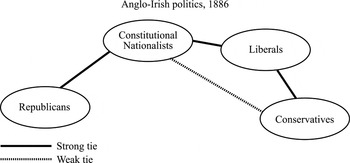
Network structure of coalitions
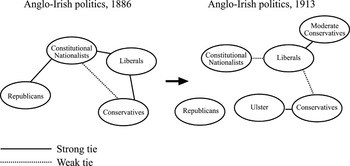
Changes in networks of coalitions, 1886–1913
 You have
Access
- 143
- Cited by