Introduction
A fracture of the nasal bones after trauma is suggested by external nasal deformity, crepitus or palpably mobile bony segments. Epistaxis and pain are common symptoms, and these may be accompanied by ecchymoses of the periorbital soft tissues (‘black eyes’) and nasal obstruction, especially if the septum has been displaced. Nasal fracture is the most common site-specific bone injury of the facial skeleton, and accounts for 39–45 per cent of all facial fractures.Reference Hussain, Wijetunge, Grubnic and Jackson1 The male-to-female ratio for nasal fractures is greater than 2:1. The incidence peaks bi-modally in patients aged 15–30 years and in the elderly, in whom a small increase is noted related to falls.Reference Muraoka, Nakai, Shimada and Nakaki2 The majority of nasal fractures in young adults are due to assault, sport and, less commonly, motor vehicle accidents. The incidence and the association with alcohol vary according to the study location.Reference Hussain, Wijetunge, Grubnic and Jackson1–Reference Logan, O'Driscoll and Masterson4
The nasal bones are flat, rectangular and thinner at the caudal end. They project from the frontal process of the maxilla and articulate with the upper lateral cartilages and nasion. Approximately 80 per cent of nasal fractures occur at the transition zone between the thicker proximal and thinner distal segments, which corresponds to the lower one-third to one-half of the nasal bones.Reference Murray, Maran, Mackenzie and Raab5 The goals of nasal fracture manipulation should be to achieve a cosmetic result similar to the pre-injury appearance, and to obtain good nasal airway patency. Reasonable candidates are patients who have a post-trauma nasal deformity thought to be due to nasal bony fracture or displacement.
Nasal fracture reduction and manipulation may be performed under local anaesthesia (LA) with or without sedation, or general anaesthesia (GA). Broadly speaking, manipulation of the nose (or ‘closed reduction’) involves repositioning of the nasal bones (with or without instrumentation) without making incisions. An ‘open reduction’ involves a formal operative procedure with incisions and open manipulation of the nasal bones and septum. Examples of commonly performed open procedures are rhinoplasty and septorhinoplasty.
Most nasal fractures requiring repositioning of the nasal bones are initially managed using a closed manipulation technique. Open surgery is reserved for residual cosmetic deformity, complex or comminuted fractures, and fracture dislocations. The manipulation techniques described for LA and GA are similar, with the exception of the administration of LA. Various methods of LA infiltration and/or application have been described in the literature on the manipulation of nasal fractures.
A number of studies have advocated the use of LA for closed manipulation of fractured noses. It is unclear whether the efficacy of manipulation procedures performed under LA is similar (or better) than that of those performed under GA, and which method of LA is best. The aim of this study was therefore to systematically review the literature on the use of LA in the manipulation of nasal fractures.
Methods
Search strategy
Original, published studies on manipulation of nasal fractures which compared general versus local anaesthesia were identified, using a comprehensive search strategy, in Medline (from 1966 to April 2007), Embase (from 1974 to April 2007) and the Cochrane Central Register of Controlled Trials (in Issue 4, 2007 of the Cochrane Library). The National Research Register and the metaRegister of Controlled Trials were also searched for ongoing and completed trials.
The search terms used for fractured noses included ‘fractured nose*’, ‘nasal fracture*’, ‘broken nose*’ and ‘nasal deformity’. The search terms used for the method of anaesthesia included ‘local anaesthe*’, ‘local anesthe*’ and ‘LA’. These terms were combined using Boolean operators. Searches were not restricted by language. Reference lists from relevant articles were searched and cross-referenced.
Inclusion and exclusion criteria
All relevant studies were obtained. The full text articles of retrieved studies were reviewed by the authors, and the below inclusion criteria were applied independently. Inclusion criteria were established a priori and followed throughout. Any differences in opinion on which studies to include in the review were resolved by discussion.
In order to be eligible for inclusion in the analysis, each study had to be a randomised, controlled trial (RCT) that included pain, cosmetic appearance and/or nasal airway patency as primary outcomes, and adverse events as secondary outcomes. These studies had to compare nasal fracture manipulation outcomes for two or more methods of local anaesthesia (e.g. topical, intranasal and external infiltration), or compare manipulation under LA with that under GA.
Exclusion criteria included lack of a control arm and duplicate publications of the same results.
Excluded studies and non-randomised studies were in addition reviewed narratively in order to identify any useful contribution to the body of evidence.
Quality assessment and analysis
The quality of all included trials was independently assessed by the authors. This included an assessment of the following categories: inclusion criteria, randomisation, allocation, interventions, outcome measures, blinding of assessors and follow up. All analysis was on an intention-to-treat basis. Where data were missing, the reviewers contacted the authors of the study requesting further information. Where data from studies were comparable and of sufficient quality, the intention was to perform a meta-analysis in order to obtain a summary measure of effect.
Results
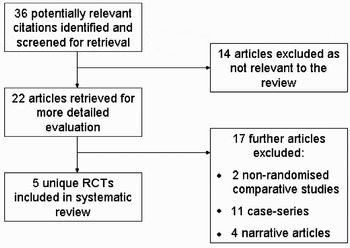
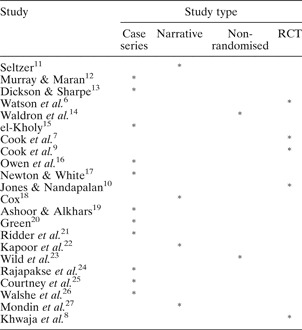
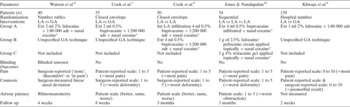
After searches, 22 studies on local anaesthesia for manipulation of nasal fractures were identified, comprising five RCTs, two non-randomised, comparative studies, 11 case series and four narrative articles (see Figure 1 for trial flow diagram). A summary of these studies is shown in Table I. The five identified RCTs meeting the inclusion criteria comprised three studies comparing LA with GA and two studies comparing different methods of LA with each other. Details of these RCT studies are shown in Table II, including the interventions used and outcome measurements employed.
Trial flow diagram. RCT = randomised, controlled trial

Identified relevant studies and type

Studies are shown in order of publication. RCT = randomised, controlled trial
Summary of included randomised, controlled trials

*2 ml 10% cocaine solution sprayed onto nasal mucosa. LA = local anaesthesia; GA = general anaesthesia; ext = external infiltration of LA around nasal root; int = internal; adr = adrenaline
Data were extracted from the included studies and where necessary reconfigured and statistically analysed, in order to allow comparison between study groups, as follows.
Local vs general anaesthesia
The study by Watson et al. did not compare pain between groups.Reference Watson, Parker, Slack and Griffiths6 It did however report a blinded, surgeon-reported ‘improved’ cosmetic outcome in 71 per cent (12/17) of the LA group and in 50 per cent (6/12) of the GA group (p = 0.438, Fisher's exact test), and a median nasal airflow resistance improvement from 0.25 to 0.20 kPa l−1 s in the LA group and from 0.21 to 0.20 kPa l−1 s in the GA group, at four weeks post-procedure. Simple external digital manipulation was used in all the LA patients.
The study by Cook et al. also did not compare pain between groups.Reference Cook, McRae, Irving and Dowie7 It showed a surgeon-reported median cosmesis score of 4/5 in the LA group and 4/5 in the GA group (p = 0.74, Mann–Whitney U test) eight weeks post-procedure, and a patient-reported nasal airway improvement in 72 per cent (18/25) of the LA group and 68 per cent (17/25) of the GA group (p = 0.764, Fisher's exact test) post-procedure. Both Asch's and Walsham's forceps were used during manipulation under LA.
The study by Khwaja et al. showed a patient-reported mean procedure pain score of 3/10 in the LA group and 2/10 in the GA group, and a patient-reported cosmesis score of at least 8/10 in 51 per cent (38/74) of LA patients and in 52 per cent (34/65) of GA patients, at two weeks post-procedure.Reference Khwaja, Pahade, Luff, Green and Green8 Instrumentation was used only for depressed nasal bones (eight patients in the GA group and only one in the LA group). Nasal airway patency was not compared between groups.
These three studies were too heterogeneous to allow meaningful meta-analysis.
Local vs local anaesthesia
The study by Cook et al. showed a patient-reported median pain score of 3/5 in the internal LA group and 2/5 in the external LA group (p < 0.001, Mann–Whitney U test).Reference Cook, Murrant, Evans and Lavelle9 A surgeon-determined median cosmesis score of 4/5 was allocated to both LA groups (p = 0.463, chi-square test for linear trend). Nasal airway improvement was reported by 78 per cent (18/23) of the internal LA group patients and 82 per cent (18/22) of the external LA group (p > 0.9999, Fisher's exact test).
The study by Jones and Nandapalan found a patient-reported median pain score of 4/5 in the infiltration LA group, 3/5 in the topical Emla® cream (lidocaine 2.5 per cent and prilocaine 2.5 per cent, AstraZeneca, London, UK) LA group and 2/5 in the topical Ametop® gel (tetracaine 4 per cent, Smith and Nephew, London, UK) LA group; the tetracaine group had significantly lower scores (p < 0.001, Kruskal–Wallis test).Reference Jones and Nandapalan10 A patient-reported median cosmesis score of 3/5 was obtained in all three LA groups (p = 0.605, Kruskal–Wallis test). The patient-reported median nasal airway score was 3/5 in all three LA groups (p = 0.844, Kruskal–Wallis test).
These two studies were too heterogeneous to allow meaningful meta-analysis.
Discussion
Evidence from included studies assessing local vs general anaesthesia
Local anaesthesia appears to be a well established method of pain relief for manipulation of nasal fractures, with numerous case series and comparative studies describing its successful use. There are methodological difficulties in comparing pain between subjects receiving local and general anaesthesia. A group of subjects receiving GA will be unconscious during the procedure, and therefore only post-procedure pain can truly be assessed. There may also be a tendency for patients to attribute surrogate outcomes to their GA, such as pain on insertion of intravenous cannulae, post-operative nausea or vomiting, or other post-operative symptoms.
The only study directly comparing pain between the two anaesthetic modalities used pain ‘post-procedure’, but did not specify the precise timing of this assessment in the GA group, who may have had their impression of discomfort influenced by analgesia or anaesthetic effects.Reference Khwaja, Pahade, Luff, Green and Green8 Despite this inherent weakness, this study reported no statistically significant difference in pain between the GA and LA groups, with pain scores averaging 3/10 and 2/10, respectively, on a visual analogue scale.
The other studies did not attempt to compare pain between patients receiving GA and LA. However, it is useful to note that 12 per cent (2/17) patients from Watson and colleagues' study suffered ‘pain’ after LA for manipulation and 41 per cent (7/17) reported ‘discomfort’.Reference Watson, Parker, Slack and Griffiths6 Despite this, 94 per cent (16/17) stated they would opt for LA in future. In Cook and colleagues' study, the median pain score was 3/5 (‘equivalent to having a dental filling’), and 96 per cent (24/25) of patients said they would opt for an LA again in future.Reference Cook, McRae, Irving and Dowie7
Cosmetic deformity with or without nasal obstruction are the primary indications for nasal fracture manipulation. In the studies assessed, there were no statistically significant differences in cosmetic appearance or nasal patency, comparing LA manipulation and GA manipulation of nasal fractures.Reference Cook, McRae, Irving and Dowie7–Reference Jones and Nandapalan10 This was independent of the outcome measures used, which included surgeon-reported cosmesis, patient-reported cosmesis, nasal rhinomanometry and patient-reported nasal patency. A lack of blinding was unfortunately present in many of the studies, and added to the potential for biased reporting.
The potential advantages of LA over GA include: shortened hospital stay; ability of patient to see cosmetic appearance post-manipulation while still anaesthetised, allowing further adjustment; minimal delay between diagnosis and treatment; cost savings; elimination of the risks of GA; and retention of the option of GA manipulation if the LA procedure is unsuccessful. The disadvantages of LA compared with GA include a degree of discomfort or pain, and a probable increased requirement of the surgeon's time. However, nasal fracture manipulation under LA appears to have been well tolerated by the vast majority of patients assessed, as they would opt for the same method in future.Reference Cook, McRae, Irving and Dowie7
Evidence from excluded studies assessing local vs general anaesthesia
Of the non-randomised studies examined following our comprehensive search, four were narrative descriptions of methods of nasal fracture management, two were non-randomised, controlled studies and eleven were case series (see Table I). These studies were appraised in order to seek additional useful evidence, and are summarised below in chronological order.
Waldron et al. prospectively examined 104 consecutive adult patients with nasal fractures.Reference Waldron, Mitchell and Ford14 The first 50 were manipulated under GA and the next 54 under LA (see Table III). The cosmetic results (assessed subjectively by the patient and the operating surgeon) revealed no statistically significant difference between the LA and GA groups (p < 0.05). The subjective, unblinded assessment makes comparison with other studies difficult.
Reported methods of LA administration

*Infiltrated unless specified. †See Table II. ‡Intravenous sedation also used (midazolam, maximum dose = 20 mg). LA = local anaesthesia; lido = lidocaine (lignocaine hydrochloride); adr = adrenaline
Newton and White prospectively studied a series of 35 patients who underwent nasal fracture manipulation under LA and intravenous sedation.Reference Newton and White17 Their outcomes were patient-reported pain scores, subjective cosmetic satisfaction and objective (i.e. independent surgeon assessed) cosmetic scores. They achieved 97 per cent approval by patients and over 90 per cent effectiveness (in terms of objective cosmetic outcome).
Green reported a prospective series of 45 patients willing to undergo LA manipulation. The most common pain score was one out of 10 (the lowest possible score), and 95.5 per cent stated they would undergo the same technique again if needed. Fifteen patients were subsequently listed for septorhinoplasty.Reference Green20
Ridder et al. conducted a retrospective review of 96 nasal fractures (68 manipulated under LA and 21 under GA; seven underwent manipulation and septoplasty).Reference Ridder, Boedeker, Fradis and Schipper21 Success and satisfaction were determined by retrospective review of the clinical notes at one-week follow up and then over one to two years. No difference in success was noted between the two groups, although the lack of objective outcome measures precludes direct comparison.
Rajapakse et al. retrospectively examined 197 patients over a 24-month period in two units, using a questionnaire.Reference Rajapakse, Courtney, Bialostocki, Duncan and Morrissey24 One hundred and seven patients underwent manipulation under GA (in a plastic surgery department) and 90 under LA (in an otolaryngology department). Assessment was by retrospective, subjective patient assessment of function and cosmesis, via a telephone survey. There were no statistically significant differences between the groups for any outcome; however, the methodology precludes direct comparison between the two groups or with other studies.
Wild et al. report a prospective, questionnaire-based assessment of 43 nasal fractures (37 of which were manipulated under LA).Reference Wild, El Alami and Conboy23 Eighty per cent of the LA group were satisfied with their functional and cosmetic results (as assessed with a visual analogue scale) and reported discomfort comparable to a dental procedure. No attempt at comparison between GA and LA groups was made.
Walshe et al. report a series of 10 patients who underwent LA manipulation successfully and who would opt to have this again in preference to admission for a GA.Reference Walshe, Harney, McConn Walsh and Walsh26
The narrative articles surveyed added no data to the evidence base regarding choice of anaesthetic for nasal fracture manipulation (see Table I), although Kapoor et al. usefully revealed the current practice of UK ENT surgeons.Reference Kapoor, Richards, Dhanasekar and Kumar22
Evidence from included studies exploring best local anaesthetic method
There was significant variation in the literature regarding the method of administration and type of LA agent used during nasal fracture manipulation (see Table III). This compounds the need for an established method with evidence-based efficacy.
Local anaesthetic pain control was found to be better with external infiltration through the skin of the nasal dorsum, compared with intranasal infiltration (when additionally using topical intranasal cocaine solution in both groups).Reference Cook, Murrant, Evans and Lavelle9 However, when comparing external infiltration of LA with topical LA ointment on the external nasal skin, it was demonstrated that both lidocaine plus prilocaine cream (used for one hour) and tetracaine gel (used for 45 minutes) resulted in better pain control (again, all three methods used in combination with topical intranasal cocaine solution). Tetracaine gel provided the best pain control, with 89 per cent (16/18) of subjects reporting pain as 2/5 and 11 per cent (2/18) reporting pain as 3/5, and therefore should be recommended to patients as the LA application of choice.Reference Jones and Nandapalan10 It should be noted that topical tetracaine requires 45 minutes to achieve effectiveness, compared with 15 minutes for external infiltration.
There was no evidence for a difference in cosmetic appearance (surgeon-reported and patient-reported) or nasal patency (patient-reported), comparing the various methods of administration or LA agents used.Reference Cook, Murrant, Evans and Lavelle9, Reference Jones and Nandapalan10 A lack of blinding in the studies unfortunately allowed the potential for bias in reporting.
Evidence from excluded studies exploring best local anaesthetic method
There were no additional excluded studies which provided further evidence for establishing the best method of LA.
Evidence for safety of local anaesthetic techniques
There was little reported evidence, in any of the identified studies, of major adverse effects from using LA for nasal fracture manipulation by any described method. Jones and Nandapalan reported two patients suffering epistaxis requiring nasal packing (one from group A and one from group C, see Table II), which was subsequently removed after four hours with no further sequelae; they also reported one patient suffering a vaso-vagal episode (group B).Reference Jones and Nandapalan10 Two of the 23 patients in the internal infiltration group of Cook and colleagues' study also suffered vaso-vagal episodes.Reference Cook, Murrant, Evans and Lavelle9 Of the excluded studies, Green et al. reported one LA patient (of 45) fainting and another suffering a vaso-vagal episode, with no serious sequelae.Reference Green20
Conclusion
Local anaesthesia for the manipulation of nasal fractures appears to be a safe and effective alternative to GA. There is no evidence of compromise in the nasal patency or cosmetic outcome after nasal fracture manipulation performed under LA.
Some discomfort and pain have been reported during LA for nasal fracture manipulation. Discomfort and pain were least after use of 3 g topical tetracaine gel applied for 45 minutes over the dorsum of the nose from the upper limits of the eyebrows and laterally to a vertical line passing through the infra-orbital foramen, together with 4 ml 5 per cent topical cocaine solution intranasally.
Patients should routinely be offered the option of a simple (i.e. without instrumentation) reduction of nasal fractures under LA, using this method. Informed consent should include an explanation that the expected level of discomfort has been reported as 2/5 on a scale of 1 (=‘no pain’) to 5 (=‘unbearable pain’), and that there is no evidence for LA resulting in inferior cosmetic appearance or airway patency.