INTRODUCTION
Despite the trend toward an overall increase in the number of forensic and medium secure beds nationally (Priebe et al., Reference Priebe, Badesconyi, Fioritti, Hansson, Kilian, Torres-Gonzales, Turner and Wiersma2005) little attention has been paid to trends in the characteristics of female patients admitted to medium secure facilities. The improvement of prison mental health care has led to more mental illness being ‘found’ in prison populations (Hill, Reference Hill2006). Bartlett (2006) noted that the absence of both longitudinal cohort studies and case register data for medium security made it hard to describe women in secure services ‘even in crude terms’.
A telephone survey of medium secure units in England and Wales found that 342 of 1836 beds were occupied by women (Hassell & Bartlett, Reference Hassell and Bartlett2001). In a subsequent study of a sample of 31 of the 342 women it was found that: most were mentally ill; arson was the most common index offence; one-third had offences involving violence to others; two-thirds had histories of deliberate self-harm and of child sexual or physical abuse; and one-third had been admitted without a conviction for an index offence (Bartlett, 2006). These findings echo those of a comprehensive survey of the characteristics of women in medium secure facilities reported by Coid et al. (2000a). In a subsequent cluster analysis of the diagnoses of 471 women admitted to 7 UK regional services, Coid et al. (2000b) found: three subgroups with personality disorder as their primary psychopathology; three subgroups with major mental illness; and one subgroup with organic brain syndrome. However, these studies reflect the characteristics of patients admitted to medium security between 1988 and 1994 and therefore may not be representative of current populations in the light of changing service provision and admission practice (Hill, Reference Hill2006). Ricketts et al. (2001) reported an analysis of 504 admissions to a regional secure unit between 1983 and 1999 which included 91 (18.1%) women. This figure represented a decline in the admission of women from 31% of the service user population to 8% over the duration of the study. Ricketts et al. (2001) speculated that the decline may be related to other trends, including the admission of more serious offenders and a reluctance to admit vulnerable women to male dominated environments.
In the London Medium Secure (MSU) Benchmarking Study, Bartlett et al. (2007) noted that 9.6% of the 781 inpatients in medium or low secure settings were women. Twenty-five per cent of these women were not offenders, mental illness led to their admission in 9 out of 10 cases, and women were more likely than men to be admitted with a diagnosis of personality disorder. One-third of the women had committed serious violence (homicide, attempted murder and grievous bodily harm) and 13% had committed arson. The MSU female population gave a profile similar to that of a high secure hospital sample. Bartlett et al. (2007) also noted a significant variation in the availability and quality of data available from the seven London forensic units included in their study.
Most studies of secure settings have not undertaken a separate gender analysis (e.g. Dolan & Lawson (Reference Dolan and Lawson2001); Coid & Dunn (Reference Coid and Dunn2004); Wheatley et al., (Reference Wheatley, Waine, Spence and Hollin2004); Chowdhury et al., (Reference Chowdhury, Whittle, McCarthy, Bailey and Harrington2005)). The need to map womens’ secure hospital services in terms of patient population and service needs is pressing, as knowledge of the characteristics of the population enables the adaptation of treatment to the precise needs of the patient group.
The responsivity principle, which refers to the responsivity of the care provider, has been relatively neglected despite the widespread adoption of the Risk and Needs principles in the criminal justice system (Ogloff & Davis Reference Ogloff and Davis2004). General responsivity refers to the delivery of a multi model treatment programme that is cognitive behavioural in nature and skills based. Such a programme for female psychiatric populations in medium secure settings has been described by Long et al. (2008). Specific responsivity, however, includes a variety of factors that match the patient’s attribution and motivation to engage in treatment to the content and pace of therapy (Gudjonsson & Young, Reference Gudjonsson and Young2007). It is this principle that necessitates regular monitoring of the characteristics of the treatment population in order to match interventions to the patients readiness to engage with therapy (Howells & Day, Reference Howells and Day2007). In this light, the current study provides a clinical profile of the patient group, admitted between 2002 and 2008, to an independent (charitable trust) provider of medium secure mental health care for women. This profile provides complementary data from the independent sector in order to chart change over time and inform the process of planning future gender specific treatment services. In this regard, the analysis follows the best practice model for a medium secure women's service previously described (Long et al., Reference Long, Fulton and Hollin2008), in which components of a psychosocial treatment programme were determined by analysis of the changing characteristics of the service user population.
METHOD
Sample
Sixty-five service users, consecutive admissions over a 6-year period to a women’s medium secure service (St Andrew’s Healthcare, Northampton UK), formed the sample. In this period only six referred patients were not admitted: four because of bed availability and two because of problems with ‘patient mix’. The admission criteria for the women’s unit are: 1) Age 19–60 years at the time of assessment; 2) Meeting criteria for detention under the Mental Health Act 1983; 3) Presenting disturbed and challenging behaviour that could be appropriately and safely managed in medium secure conditions.
Pre-admission assessment visits to referring organisations were by multidisciplinary teams, with either a consultant psychiatrist or psychologist and members of senior nursing staff. Information was gathered from care staff, the service user and care records. A structured assessment schedule was used to ensure consistent and detailed collation of relevant information. The assessment included sociodemographic details, with diagnosis, reason for referral, forensic history, risk behaviours, length of time in hospital/prison, legal status, current level of nursing observation, ground leave status, and degree of security of current placement. The Health of the Nation Outcome Scale: Secure (HoNOS Secure; Sugarman & Walker, Reference Sugarman and Walker2004) and the Camberwell Assessment of Need Forensic Version (CANFOR; Thomas et al., Reference Thomas, Harty, Parrott, McCrone, Slade and Thorneycroft2003) were also completed as baseline measures against which to assess progress.
Design
During the course of the study period (2002–2008) a single ward was replaced by two new units (in 2006), increasing capacity from 13 to 28 beds. Data relating to the medium secure population at three (26 month) time periods are reported in terms of: source of admission, Mental Health Act (1983) section, demographic and personal characteristics including age, ethnicity, marital status, children, intelligence quotient (IQ), past abuse, diagnosis, forensic histories, risk profiles and risk behaviours. IQ classifications were based on pre- or post-admission assessment using either the Weschler Adult Intelligence Scale (WAIS III; Weschler, Reference Weschler1999a) or the Weschler Abbreviated Scale of Intelligence (WASI; Weschler, Reference Weschler1999b). Diagnoses reported are those arrived at (or confirmed by) the unit consultant psychiatrist three months after admission. Although a minority of patients had more than two ICD-10 (World Health Organisation, 1992) diagnoses, the secondary diagnosis reported was as identified by the psychiatrist or was the most clinically significant secondary condition.
Risk categorisation (high = re-occurrence very likely; medium = re-occurrence possible; low = reoccurrence unlikely despite previous presence of risk indicators) for self-harm, aggression, suicide, aggression, fire setting, sexual assault, sexually inappropriate behaviour is that agreed at three-month post-admission by the multidisciplinary team, based on current behaviour and informed by routinely administered HoNOS secure ratings A–G and Historical, Clinical Risk 20 (HCR-20; Webster et al., Reference Webster, Douglas, Eaves and Hart1997) assessments. The Overt Aggression Scale (OAS; Yudofsky et al., Reference Yudofsky, Silver, Jackson, Endicott and Williams1986) categories of physical aggression were used to describe disturbed behaviour. Data has been analysed in terms of whole sample (N = 65) and in terms of their distribution over three (26 month) time periods, with 14 women overlapping two time periods. There were 19 patients admitted in time period 1, 17 patients admitted in time period 2, and a further 29 patients admitted in time period 3 which coincided with the expansion in bed provision. Given the numbers involved, selected descriptive statistics were favoured over other statistical analysis (Baer, Reference Baer1977).
RESULTS
Source of admission and section
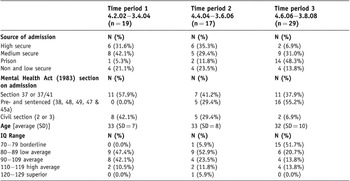
Between February 2002 and July 2008, there were 65 first admissions to the women’s medium secure service. Most patients were admitted under hospital orders (44.6%), followed by civil section (23.1%); 20% of patients were admitted as sentenced prisoners and 12.3% were admitted from court pre-sentence.
The majority of the cohort (93.8%) had had one or more previous psychiatric admissions. Approximately one-third (33.8%) were admitted from another medium secure unit, 26.1% came from prison, and 21.5% were transferred from a high secure hospital. The remaining patients came from non-secure and low secure NHS (10.8%) and independent (7.7%) facilities. Table 1 shows the source of admission and sections of the Mental Health Act (1983) under which service users were admitted across the three time periods together with age and level of cognitive functioning (IQ).
Pre-admission information over three time periods (2002–2008)

Demographic and personal characteristics of participants
The mean age of the women at admission was 31 years (SD = 8.55; range = 19–49). Of the 65 service users, 60 were white (92.3%), one was black african (1.5%) and four were of mixed heritage (6.2%). The majority of service users were single (78.5%) and 16 (24.6%) had children they were in contact with via phone, mail or visit. Most of the service users had a self-reported history of emotional, physical and/or sexual abuse (84.6%).
Length of stay
There were 27 (41.5%) of the cohort who remained as inpatients in July 2008. The mean duration of admission for those service users who had been discharged (N = 38) was 623.4 days (SD = 299.1; range = 45–1134).
Diagnoses
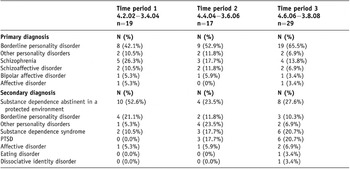
Of the 65 patients there were 58 (89.2%) diagnosed with a personality disorder as either a primary or secondary diagnosis using ICD-10 (World Health Organisation, 1992). Of the 45 primary or secondary diagnoses of personality disorder, the majority (41; 63.1%) were diagnosed with borderline disorder; 18 (27.7%) had a primary diagnosis of schizophrenia or schizoaffective disorder and 5 (7.7%) had a primary diagnosis of affective disorder. Post traumatic stress disorder was a secondary diagnosis in 9 cases (13.8%). Table 2 shows the primary and secondary diagnoses for patients admitted according to the three time periods.
Primary and secondary psychiatric diagnosis for patients admitted over three time periods (2002–2008)

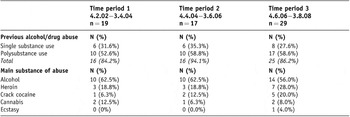
Although only ten women (15.4%) were given a formal diagnosis of alcohol or substance dependence or misuse, 57 patients (87.7%) had a documented history of alcohol and/substance misuse with substance/alcohol misuse identified as a current risk on their initial risk assessment. Table 3 shows the past history of substance abuse and main drug of choice (self-defined). Individuals were classified as either single substance users or polydrug users if they concurrently and regularly used three or more drugs of abuse (Wheatley, Reference Wheatley1998). While only three patients were formally diagnosed with an eating disorder, symptoms of an eating disorder were described in 17 (26.2%) patients’ case notes.
Pre-admission alcohol/drug abuse history over three time periods (2002–2008)

Forensic histories
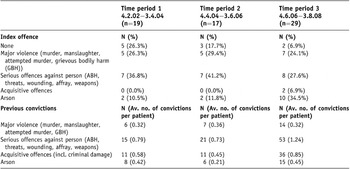
Most of the cohort (61; 93.8%) had a forensic history with one or more convictions, and all but ten women had an index offence that had led to their admission to St Andrew’s Healthcare. In terms of the type of index offence, over one-half were either charged with or convicted of a violent offence (39; 60%), ranging from threats to kill and affray, to murder and manslaughter. Of these violent index offences, 43.6% were classed as ‘major’ violence following the criteria of Coid et al. (2000b) and 56.4% as serious offences against the person. The most prevalent index offence after violence was arson with 14 (21.5%) of the cohort either being charged with or convicted of arson. A similar pattern to current offences can be seen with previous convictions. Almost two-thirds of the cohort had been previously convicted of a serious offence against the person (60%); 35.4% had been previously convicted of arson; 30.8% had been convicted of a ‘major’ violent offence. Fifteen members of the cohort (23.1%) had previously worked in the sex industry. Table 4 shows the index offences and average number of previous convictions of admissions over three time periods.
Index offences and prior conviction histories of patients admitted over three time periods (2002–2008)

Risk profiles
All but two members of the cohort had histories of deliberate self-harm in their case notes. Three months after their admission, 61 women (93.8%) had risk of self-harm rated as medium (‘recurrence possible’) or high (‘recurrence very likely’) by the multidisciplinary team; and 56 (86.2%) were rated as medium or high risk of suicide. The majority of women (62; 95.4%) were assessed as being of medium or high risk of committing physical assault. Although only 23 (35.4%) had a previous conviction for arson, 46 (70.8%) of the cohort were identified as being at medium or high risk of deliberate fire-setting. While only a small number, 5 (7.7%) were rated as being at risk of committing sexual assault, almost one-half of the cohort, (49.2%) were rated as being at risk of behaving in a sexually inappropriate manner.
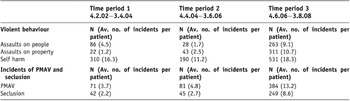
Table 5 shows the incidence of outward (assaults on people or property) and inward-directed aggression (self-harm) for all patients resident over the three time periods together with the use of prevention and management of aggression and violence (PMAV) procedures (including safe patient restraint) and seclusion.
Violent behaviour and use of PMAV and seclusion during three time periods (2002–2008)

DISCUSSION
Analysis of the first 65 admissions to an independent sector provider of a female pathway of care, beginning with a medium secure facility, reveals a population with personality disorder as a consistent diagnostic category in addition to mental illness, together with a significant past history of violence, self-harm, arson and substance misuse. The current sample resembles, in terms of presenting problems, the profile of female patients in a high secure hospital as described a decade ago by Bland et al. (1999). This similarity may in part reflect the migration of this population over the past decade from high to medium secure conditions (Dent, Reference Dent2006). The study population, however, most closely resembles the subgroup of women admitted to secure facilities that have borderline personality disorder as their primary psychopathology (Coid et al. Reference Coid, Kahtan, Gault and Jarman2000b). In Coid et al.’s (2000b) sample the largest personality disordered subgroup had a primary diagnosis of borderline personality disorder with a proportion having an additional diagnosis of schizophrenia or paranoid psychosis. Coid et al.’s (2000b) group was, as with the current sample, overwhelmingly Caucasian, UK-born and single; three-quarters had been admitted as a result of criminal behaviours, particularly arson, and there was a high prevalence of co-morbid alcohol/drug dependence or abuse. The borderline sub-group also had extensive criminal histories and were more likely than the other six clusters or sub-groups to have had a previous psychiatric admission (Coid et al., Reference Coid, Kahtan, Gault and Jarman2000b).
The current population shows some differences to the (mostly) NHS medium secure samples described by Bartlett (2006) and Bartlett et al. (2007). Specifically, although a similar percentage had a prior history of abuse, in contrast to Bartlett (2006) all but two service users had a forensic history. Further, a higher proportion of the current sample were classified as having committed serious violence than in the London medium secure benchmarking study (Bartlett et al., Reference Bartlett, Johns, Fiander and Jhawar2007). In contrast to Bartlett (2006), violence (49.2%) rather than arson (21.5%) was the most common index offence. In terms of legal status, this cohort is significantly different from a geographically similar, though mixed gender, regional secure unit (Ricketts et al., Reference Ricketts, Carnell, Davies, Kaul and Duggan2001), particularly in terms of a much higher rate of S37 and S37/41 admissions.
Findings from the current study chart a change in the referral and acceptance pattern of patients admitted over the last 2 years since the opening of two new purpose built medium secure wards. An expected decline in special hospital referrals (Dent, Reference Dent2006) and in Section 3 patients had been paralleled by an increase in prison transfers: the prison transfers are associated with drug-related offending (Councell, Reference Councell2003), with substance misuse being identified as the most pressing mental health problem in female inmates (Blitz et al., Reference Blitz, Wolff and Paap2006; Loughran & Seewoonerain, Reference Loughran and Seewoonarain2005). Of particular interest, however, is the association between prison transfers and a lower level of cognitive functioning. The association between low IQ and arson is evident (Dickens et al., Reference Dickens, Sugarman, Ahmad, Edgar, Hofberg and Tewari2008; Enayati et al., Reference Enayati, Grann, Lubbe and Fazel2008), with lifelong, temperamental problems being apparent in childhood that potentially may be related. The patient population in the most recent time period also displayed a higher average number of assaults on people, associated with a very high incidence of the use of PMAV and seclusion as a management strategy. While these factors may be aspects of the complex psychopathology of women admitted from prison to mental health facilities (Bartlett, Reference Bartlett2006), they have implications for medium secure services both in terms of assessment and treatment.
First, less attention and resources have been devoted to the assessment and treatment of prisoners’ mental health needs, so that their mental health needs have been under-estimated (Rutherford & Taylor, Reference Rutherford and Taylor2004), and few prisoners receive psychiatric treatment (Singleton et al., Reference Singleton, Meltzer, Gatward, Coid and Deasy1998). As Bartlett et al. (2007) noted, there is a need for a thorough review of the emerging demands on forensic services from the criminal justice system, particularly in the light of the Department of Health’s Offender Health Strategy (Department of Health, 2009).
Second, a changing psychopathology, risk and IQ profile will necessitate continual adjustments to psychosocial treatment programming. The relationship between a diagnosis of personality disorder and childhood physical and sexual abuse has been noted (Hassell & Bartlett, Reference Hassell and Bartlett2001). In the current sample the very high incidence of personality disorder, mostly of the borderline/emotionally unstable type, plus comorbidity highlights the therapeutic challenge presented by this population, one-third of whom were referred for specialist treatment from other medium secure facilities. Further, although a diagnosis of schizophrenia occurs in only a small subgroup of borderline patients, such women require special techniques of management (Coid et al., Reference Coid, Kahtan, Gault and Jarman2000b).
While multi-disciplinary team risk assessments of newly admitted patients are subjective and possibly conservative, the majority of the cohort were assessed as being concomitantly high-risk of both self-harm/suicide and physical assault, reinforcing the need for thorough risk assessment, and a treatment focus on the development of more effective coping skills, particularly emotional regulation (Linehan, Reference Linehan1993; Long et al., Reference Long, Fulton and Hollin2008). Although only four of this sample were in an ongoing marital relationship, almost one-quarter had children they were in contact with and elements of identity, such as being someone’s mother partner or sibling, need to be recognised and nurtured as appropriate (Hassell & Bartlett, Reference Hassell and Bartlett2001).
Low levels of treatment engagement are endemic in both offender treatment programmes and in patients with personality disorder (Howells & Day Reference Howells and Day2007). The likely lack of ‘preparedness’ for psychiatric intervention by patients admitted from prison to medium secure facilities highlights the need for greater emphasis, following stabilisation, on motivational and therapeutic alliance building work (to achieve a state of readiness to engage in treatment (Ward et al., Reference Ward, Day, Howells and Birgden2004)). The responsivity principle suggests the need to adapt treatment interventions to the characteristics of the forensic population being treated if treatment outcomes are to be optimised. Given that the causes of low engagement tend to be within the person rather than being related to situational or programme factors this point is particularly important (Howells & Day, Reference Howells and Day2007). In the current setting, this has led to ward-based psychoeducational/motivational/goal setting group sessions as a prelude to engagement in a manual-driven group treatment programme (Long et al., Reference Long, Fulton and Hollin2008). ‘Getting the most from your treatment’ sessions target key internal factors relevant to treatment engagement along with common obstacles and strategies for overcoming them. These internal treatment readiness conditions include cognitive, affective, behavioural readiness, volitional and identify factors (Howells & Day, Reference Howells and Day2007) and are of particular significance in personality disordered populations where the establishment of a therapeutic alliance is particularly problematic (Livesey, Reference Livesey2001). Central to this process is the instillation of hope (Hillbrand & Young, Reference Hillbrand and Young2008) along with validation of the patient’s struggle to help build a therapeutic alliance and the resilience to persist with treatment (Linehan, Reference Linehan1993).
In practical terms, a further consideration is the need to regularly adjust a gender specific treatment programme to meet the need of individuals with lower levels of intellectual functioning. This consideration has led to the review of all written group and handout material in terms of its comprehensibility (Flesch, Reference Flesch1948), and changes in the methods of group treatment delivery. An increased emphasis on interventions to ensure generalisation of the use of coping skills outside treatment situations has also been emphasised (Osnes & Lieblein, Reference Osnes and Lieblein2003).
In summary, the changing nature of the patient group admitted to medium secure facilities poses an evolving challenge in terms of both risk management and ‘preparedness’ for psychosocial treatment. A treatment programme based on these considerations is described in Long et al. (2008) and is currently under evaluation.