Nomenclature
- APP
-
approach control
- ATC
-
air traffic control
- ATFM
-
air traffic flow management
- ATCO
-
air traffic control officer
- BWM
-
Best-Worst Method
- CVM
-
Content Validity Method
- CVR
-
Content Validity Ratio
- DM
-
decision-maker
- LTFM
-
Istanbul Airport
- LTFJ
-
Istanbul Sabiha Gökçen Airport
- LTAI
-
Antalya Airport
- MTMA
-
military terminal areas
- PMS
-
point merge system
- RT
-
radio telephony
- TMA
-
terminal control area
- VL
-
validity levels
1.0 Introduction
The critical role of air traffic control (ATC) services in ensuring the safety and efficiency of air traffic cannot be overstated. These services, which encompass aerodrome control, approach control and area control, are fundamental to managing the intricate dynamics of aircraft movements. Among these services, the approach control units within terminal control areas (TMAs) present unique challenges due to their responsibility for managing the critical phases of climb after take-off and descent before landing. In particular, the coordination of multiple airports within a single TMA significantly increases the complexity of airspace management.
Approach control units, acting as intermediaries between aerodrome and area control, confront a unique set of challenges. These include managing variability in flight altitudes, handling the convergence of flight paths, dealing with various speed regulations and coping with high traffic volumes. Such complexities are further amplified by the diverse procedures and operational constraints of metroplex airspaces, which, including different airports, demand a high level of adaptability from air traffic control officers (ATCOs). In these dynamic conditions, the relationship between ATCO workload and airspace complexity directly shapes decision-making processes. Increased complexity often leads to greater workload, raising the likelihood of errors and making airspace complexity a significant risk factor [Reference Radišić, Andraši, Novak, Juričić and Antulov-Fantulin1].
Current studies often rely on subjective assessments, such as interviews and surveys, but there is a pressing need for comprehensive analyses that integrate ATCOs’ insights into structured frameworks [Reference Antulov-Fantulin, Juričić, Radišić and Çetek2]. This gap is particularly pronounced in metroplex airspaces like Istanbul TMA, where the coexistence of multiple civil and military airports, diverse approach procedures, and high traffic volumes creates an exceptionally complex operational environment. Such airspaces demand tailored analyses to capture the unique challenges faced by ATCOs and the intricate dynamics of managing high-density, multi-airport traffic. This study seeks to address this gap by offering an in-depth exploration of airspace complexity within approach control units in TMAs, focusing on the perspectives of experienced ATCOs. The objectives are twofold: first, to identify the factors contributing to complexity, and second, to assign weights to these factors based on their perceived impact on ATC operations.
The methodology adopted in this study is a blend of qualitative and quantitative approaches. Structured interviews are employed to explore ATCOs’ tacit knowledge and experiential insights, while a detailed questionnaire survey systematically captures their perceptions. This comprehensive approach ensures that both subjective experiences and objective measurements are considered. The data from interviews were analysed to identify key factors influencing airspace complexity. In addition, a multi-criteria decision-making (MCDM) approach was utilised for analysing the quantitative data gathered from the questionnaire survey. This dual approach not only identifies the critical factors but also prioritises them, providing a deeper understanding of their impact on ATCO decision-making. By focusing on ATCOs’ perspectives, this study aims to bridge the existing gaps in understanding airspace complexity and contribute to the development of more effective air traffic management strategies tailored to diverse operational challenges.
2.0 Literature review
Airspace complexity has long been a critical focus in air traffic management research. Laudeman et al. [Reference Laudeman, Shelden, Branstrom and Brasil3] introduced the concept of ‘dynamic density’, which combines aircraft count with the intricacies of traffic complexity. This pioneering concept shaped the development of ATC workload metrics and laid the groundwork for enhanced automation in air traffic management. Earlier, Pawlak et al. [Reference Pawlak, Brinton, Crouch and Lancaster4] emphasised the importance of evaluating both the cognitive and physical workloads of ATCOs, paving the way for a broader understanding of ATC operations.
Furthering this research, Histon et al. [Reference Histon, Hansman, Gottlieb, Kleinwaks, Yenson, Delahaye and Puechmorel5] investigated how airspace structure and procedural factors contribute to ATC cognitive complexity. They suggested that addressing these factors could help reduce overall complexity and ease the cognitive burden on ATCOs. Similarly, Riley et al. [Reference Riley, Chatterji, Johnson, Mogford, Kopardekar, Sieira, Landing and Lawton6] explored airspace complexity factors from the pilot’s perspective, focusing on variables such as the number of aircraft, climbing and descending trajectories, and speed variations. These findings underscore how such factors complicate conflict detection and resolution, significantly impacting operational decisions.
The study by Gianazza and Guittet [Reference Gianazza and Guittet7] marked a shift by prioritising specific complexity factors such as speed variations, aircraft count and potential conflicts, deeming these more critical than a broader set of factors. This focus on speed variations is particularly relevant in TMAs, where the continuous climb and descent of aircraft create additional challenges for ATCOs.
Kopardekar et al. [Reference Kopardekar, Bilimoria and Sridhar8] contributed substantially to this field with a real-time simulation study that quantified 52 different complexity factors, offering a scalable and nuanced metric for airspace complexity. While their work significantly advanced the understanding of these factors, achieving a universally accepted definition of airspace complexity – particularly from the perspective of ATCOs – remains an ongoing challenge. In another study, Kopardekar et al. [Reference Kopardekar, Prevot and Jastrzebski9] utilised factors such as the number of aircraft, the number of conflicts, aircraft density and vertical and horizontal convergence. They proposed conflict resolution using automation to reduce ATCOs’ efforts but left it to ATCOs to decide whether to implement it. These studies highlight the multifaceted nature of airspace complexity and the importance of ATCO judgement in managing complexity, which aligns with our focus on ATCO perceptions.
Brázdilová et al. [Reference Brázdilová, Cásek and Kubalčík10] approached complexity management by proposing changes in aircraft routes to distribute complexity more evenly across the airspace, aiming to create a more manageable environment. Prandini et al. [Reference Prandini, Putta and Hu11] focused on conflict and route optimisation in a four-dimensional context, highlighting the potential of strategic route adjustments in managing complex air traffic scenarios. Xiao et al. [Reference Xiao, Zhang, Cai and Cao12] emphasised the importance of identifying and analysing critical factors for complexity measurement, suggesting that not all factors contribute equally to complexity. By employing a genetic algorithm, they streamlined the complexity assessment process, focusing on key influencing factors.
Netjasov et al. [Reference Netjasov, Janić and Tošić13] introduced a comprehensive metric for terminal airspace complexity, incorporating static and dynamic factors for arrivals and departures. Their metric, validated using London Heathrow data, emphasised strategic planning rather than immediate workload management. More recently, Jurinić et al. [Reference Jurinić, Juričić, Antulov-Fantulin and Samardžić14] introduced new complexity indicators tailored to approach ATCO tasks, integrating operational challenges with airspace parameters to refine complexity management. An in-depth analysis of these studies reveals a wide array of factors contributing to airspace complexity. Table 1 summarises these factors alongside their references, providing a comprehensive overview of their role in previous research.
Complexity factors identified in the literature

Note: Table 1 summarises key complexity factors identified in previous studies, which are also considered in this research.
These factors are critical in understanding the challenges ATCOs face, particularly in TMAs like Istanbul, where traffic dynamics are highly complex. For instance, the ‘Number of Aircraft’ and ‘Possible Conflicts’ are particularly relevant in TMAs with heavy traffic, while ‘Performance Differences of Traffic’ and ‘Climbing/Descending Aircraft’ are significant in approach control due to varied aircraft types and flight phases.
While these studies provide a strong foundation for understanding airspace complexity, it is crucial to consider specific TMAs with unique operational challenges, such as Istanbul TMA. Istanbul TMA stands out due to its metroplex structure including multiple civil and military airports, diverse approach procedures and high traffic density, creating an exceptionally complex airspace environment. The need to manage varied procedures across multiple airports amplifies the workload and decision-making challenges faced by ATCOs. Understanding airspace complexity in such environments necessitates a deeper focus on ATCO perspectives, as their decisions are pivotal in ensuring safety and efficiency under these demanding conditions.
This study seeks to address this gap by focusing on the ATCO’s viewpoint, exploring their perceptions and the weighting they assign to various factors contributing to airspace complexity in a multi-airport-served TMA. This perspective aims to enrich the existing body of knowledge by integrating insights into the human factors that influence airspace management.
By synthesising the literature and incorporating ATCO perceptions, this research contributes to a more nuanced understanding of airspace complexity in approach control units. Through the application of a MCDM approach, this study not only identifies key complexity factors but also quantifies their relative importance as perceived by those directly managing the airspace.
3.0 Methodology
To comprehensively analyse the factors affecting airspace complexity within approach control units in the Istanbul TMA, this study adopts a mixed-method approach. By integrating qualitative and quantitative methodologies, we aim to capture a holistic understanding of complexity as perceived by experienced ATCOs. The methodology involves a case study of the Istanbul TMA, a critical and complex space managing both civil and military flights. The methodology is divided into two primary phases: the first phase employs the Content Validity Method (CVM) to identify relevant complexity factors, while the second phase uses the Best-Worst Method (BWM) to quantify the impact of these factors.
3.1 Case study: Istanbul TMA
The flight activity within Turkiye airspace from 2018 to 2023 exhibited a fluctuating trend. In 2018, the airspace saw 2.017.220 flights, with a marginal increase to 2.034.430 flights in 2019. The year 2020 witnessed a sharp decline to 1.055.168 flights due to the COVID-19 pandemic. A recovery was observed in 2021 with 1.466.860 flights. This upward trajectory continued in 2022, with the number of flights rising to 1.885.525. The year 2023 marked a significant rebound, reaching a total of 2.167.019 flights, indicating a return to pre-2020 levels and suggesting a resurgence in air travel within the region [21]. Providing ATC services with 75.245km of controlled flight routes and 982.286 square kilometers of controlled airspace, Turkiye has an important and large airspace where west-east and north-south air traffic flows between Europe, Asia, and the Middle East are carried out [22].
In terms of average daily movements, Istanbul Airport (LTFM) was the second busiest and Istanbul Sabiha Gökçen Airport (LTFJ) was the seventh busiest airport in Europe. In addition, these two airports are among the 30th busiest airports in European airspace with air traffic flow management (ATFM) delays for arrival traffic [21]. In 2022, LTFM and LTFJ had the highest amount of traffic in Turkiye [23].
LTFM and LTFJ, which are among the busiest airports in Europe, and Turkiye, and the approach control service for these airports is provided by Istanbul TMA. Istanbul TMA provides ATC services to seven civil airports (LTFM, LTFJ, LTBA, LTBW, LTBU, LTBR and LTBQ) and three military airports (LTBX, LTBG, and LTBP) as seen in Fig. 1. In addition, there are 24 training areas, 2 military terminal areas (MTMAs), and many restricted/prohibited airspaces. Although the point merge system (PMS) is implemented at both LTFM and LTFJ, other airports within service areas of the same approach unit utilise traditional procedures, highlighting the coexistence of different operational methods within a single airspace.

Figure 2 illustrates the yearly air traffic trends for airports in the Istanbul TMA from 2018 to 2023. A significant event occurred in 2018 with the opening of LTFM. This resulted in a sharp decline in traffic at Atatürk Airport (LTBA) as operations gradually shifted to the new airport. This trend is visible as traffic increased at LTFM while simultaneously decreasing at LTBA.
Total aircraft movements in Istanbul TMA from 2018 to 2023 (take-off and land).

Between 2019 and 2020, a notable drop in traffic can be attributed to the global COVID-19 pandemic, which severely impacted air travel worldwide. Post-pandemic recovery is evident in subsequent years, with LTFM and LTFJ emerging as the two busiest airports in the region. As of 2023, these two airports handle the majority of the air traffic within the Istanbul TMA. These key transitions and trends highlight the dynamic nature of air traffic management in one of the world’s most strategically located aviation hubs.
Approximately 45% of the traffic taking off from or landing in Turkish airspace operates from one of the airports within the Istanbul TMA. Around 94% of traffic landing or departing from airports in the Istanbul TMA did so at one of Istanbul’s airports. Given that nearly 42% of landings and departures in Turkiye’s airspace are to Istanbul city, the Istanbul TMA is the busiest TMA in the country [23] (Fig. 3).
Total aircraft movements in Turkiye and Istanbul TMA from 2018 to 2023 (take-off and land).

3.2 Data analysis
This study adopts a mixed-method approach to comprehensively analyse factors affecting airspace complexity, particularly in a TMA within approach control units. After a thorough literature review, a pool of complexity metrics was generated, from which 50 metrics were selected for initial assessment by combining and eliminating similar or overlapping factors. Then the methodology is structured into two primary phases: first, identifying the factors influencing TMA complexity through a qualitative approach, and second, quantifying the impact of these factors using quantitative methods.
3.2.1 Qualitative analysis using CVM
The CVM process begins with creating an initial draft of an assessment tool and relies on a group of experts to evaluate and rate its features based on how well they represent and are relevant to the content area [Reference Lynn25]. A total of 40 ATCOs, all with at least three years of experience in managing approach control operations, were selected as the first working group to provide insights on various factors contributing to airspace complexity. The CVM was employed to ensure the identified factors were relevant and significant from the ATCOs’ perspective. The ATCOs were presented with 50 complexity factors derived from the literature and asked to classify each as “essential,” “useful but not essential” or “not necessary.”
The content validity ratio (CVR) for each factor was calculated using Lawshe’s formula:
 \begin{align}CVR = \frac{{{N_E} - \left( {N/2} \right)}}{{N/2}}\end{align}
Where:
-
•
 ${N_E}$
is the number of ATCOs rating the factor as essential.
-
•
$N$
is the total number of ATCOs.


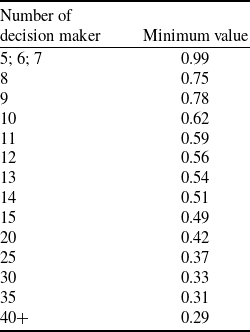
These CVR values were then compared against Lawshe’s minimum values given in Table 2 to determine the essentiality of each factor [Reference Lawshe26].
Minimum values of CVR

According to Lawshe’s table, for 40 participants, the minimum CVR value required for a factor to be considered essential is 0.29. Factors with CVR values above this threshold were included in the subsequent analysis. For example, a complexity factor that was deemed essential by only 25 out of 40 ATCOs resulted in a CVR of 0.25. This value indicates that the factor fails to meet Lawshe’s minimum threshold of 0.29 for essentiality; therefore, these values have not been included in our assessment.
3.2.2 Quantitative analysis using Best-Worst Method (BWM)
When dealing with multiple factors, it’s necessary to use MCDM methods to compare these factors and determine their relative importance. In this study, the BWM developed by Rezaei [Reference Rezaei27] is preferred for its efficiency in using fewer pairwise comparisons than other MCDM methods and for providing more accurate data on the structure of the pairwise comparison system [Reference Salimi and Rezaei28].
The second phase of the study involves analysing the factors identified in the first phase with the BWM to determine the extent of their impact on airspace complexity. Given the number of factors to be evaluated, the BWM was structured in two stages. Due to the complexity of comparing more than nine criteria, it is recommended to divide the criteria into main and sub-groupings [Reference Rezaei27]. The main and sub-grouping of the criteria were carried out with ATCOs, who are specialists in the field of air traffic control.
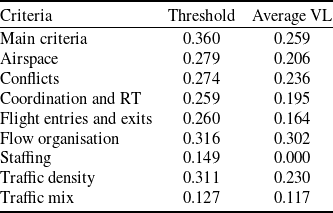
In this context, the BWM questionnaire was administered to 20 ATCOs with a minimum of ten years of experience working at İstanbul Atatürk Airport approach control unit (which serves all of Istanbul TMA). The extensive presence of all sub-criteria in Istanbul airspace allowed for precise evaluation. Participants with pairwise comparison validity levels (VL) above the acceptable threshold were asked to review their comparisons, ensuring that all pairwise comparison validity levels were acceptable. The average validity level of each pairwise comparison for each criterion is shown in Table 3.
CVR average validity levels for criteria in best-worst method analysis

Description: Table 3 presents the average validity levels for each criterion as assessed through the BWM. Validity levels reflect the consistency of pairwise comparisons, where a lower validity level indicates higher consistency.
Following the BWM, an arithmetic mean approach was used to evaluate the values received from each ATCO’s viewpoint, determining the weights of the criteria and sub-criteria.
The process of comparing criteria with BWM involves several steps:
-
1. Identification of Criteria: Determine the criteria to be used in BWM.
 \begin{align} Criteria:\left\{ {{C_1},{C_2}, \ldots, {C_n}} \right\} \end{align}
Here,
 ${C_1}$
represents the first criterion,
 ${C_2}$
the second, and
 ${C_n}$
the
 $n$
-th criterion.
-
2. Identifying the Best and Worst Criteria: The decision-maker (DM) selects the best and the worst criteria among the set.
-
3. Comparison of the Best Criterion Against All Others: The DM compares the best criterion with all others based on an importance scale of 1-9, resulting in vector
${A_B}$
:

 \begin{align}{A_B} = \left\{ {{a_{B1}},{a_{B2}}, \ldots, {a_{Bn}}} \right\}\end{align}
Here,
 ${a_{Bj}}$
indicates the importance of the best criterion relative to the
 $j$
-th criterion.
-
4. Comparison of All Criteria Against the Worst Criterion: The DM compares all criteria against the worst criterion based on the importance scale, resulting in vector
${A_W}$
:

 \begin{align}{A_W} = \left\{ {{a_{1W}},{a_{2W}}, \ldots, {a_{nW}}} \right\}\end{align}
-
5. Calculation of Criterion Weights: The optimal weight for each criterion is calculated. The ideal situation is where
$\frac{{{w_B}}}{{{w_j}}} = {a_{Bj}}$
and
$\frac{{{w_j}}}{{{w_W}}} = {a_{jW}}$
for each pair. The problem is formulated as a linear programming problem to minimise the maximum deviation among these ratios:


 \begin{align}\min {\xi _L}\end{align}
Subject to:
 \begin{align}\left| {{w_{B}} - {a_{Bj}}{w_j}} \right| \le {\xi _L},\quad \forall j\end{align}
 \begin{align}\left| {{w_j} - {a_{jW}}{w_W}} \right| \le {\xi _L},{\rm{\;\;\;\;}}\forall j\end{align}
 \begin{align}\mathop \sum \nolimits_{j = 1}^n {w_j} = 1\end{align}
 \begin{align}{w_j} \geqslant 0,\quad \forall j\end{align}
The optimal weights
 $\left( {w_1^{\rm{*}},w_2^{\rm{*}}, \ldots, w_n^{\rm{*}}} \right)$
and
 $\xi _L^{\rm{*}}$
are obtained after solving this problem, with
 $\xi _L^{\rm{*}}$
indicating the consistency of the comparison method. A lower value of
 $\xi _L^{\rm{*}}$
signifies better consistency and more reliable comparisons.
Integrating the results of CVM and BWM provides a comprehensive understanding of complexity factors in TMAs. The qualitative insights from CVM assist in selecting factors for BWM analysis, ensuring that only relevant complexity factors are considered based on expert judgement. Additionally, BWM’s quantitative outcomes assign weights to these factors, reflecting their significance as perceived by experienced ATCOs. This dual approach not only enhances the rigor of the analysis but also incorporates both qualitative insights and quantitative data related to airspace complexity, allowing for a more comprehensive evaluation. Furthermore, the gap between theoretical frameworks and practical applications is bridged by combining qualitative insights with quantitative data, facilitating better decision-making in air traffic management.
4.0 Results
4.1 CVM results
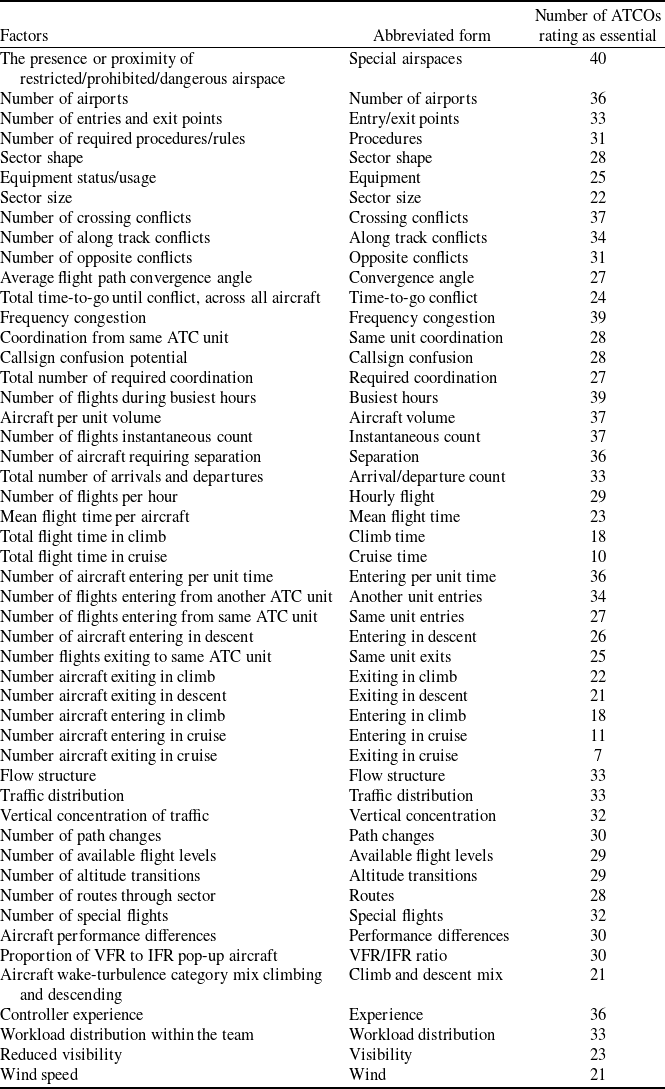
The initial phase of the study, employing the CVM, involved a comprehensive evaluation of various factors influencing airspace complexity by ATCOs. From this analysis, it was determined that out of the 50 complexity factors assessed, 15 were considered insignificant by ATCOs, whereas 35 factors were deemed essential in contributing to airspace complexity. These essential factors were categorised into eight main criteria: Airspace, Conflicts, Coordination and Radio Telephony (RT), Flight Entries and Exits, Flow Organisation, Staffing (representing human factors), Traffic Density, and Traffic Mix based on insights from the literature. These criteria and their sub-criteria, instrumental in measuring airspace complexity, are visualised in Fig. 4 with abbreviated names for clarity. For the full names and detailed CVM results, refer to Appendix A.
Airspace complexity factors and grouping after CVM.
(Note: Figure 4 illustrates the categorisation of the 35 essential factors into the eight main criteria.)

4.2 BWM results
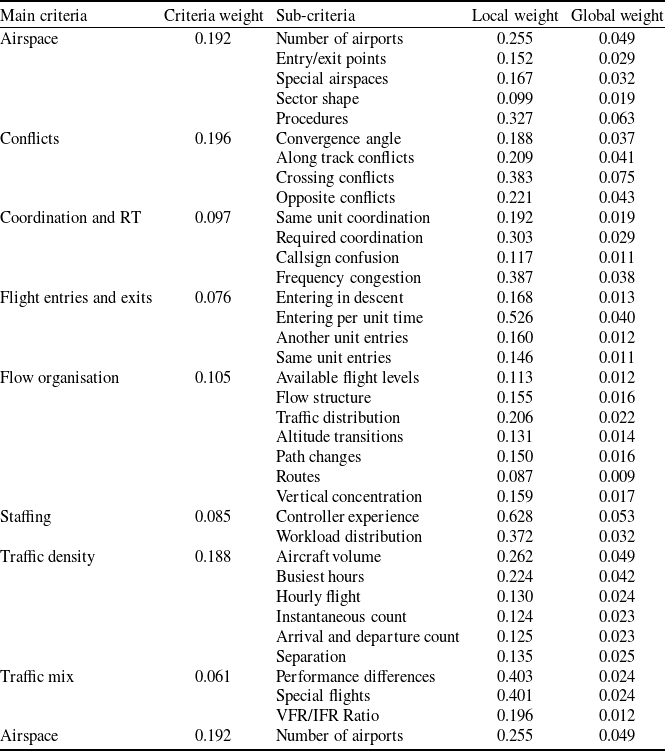
In the subsequent phase, the study utilised the BWM to analyse the impact of the 35 factors identified as essential in the CVM phase. Table 4 presents the weights determined for the main criteria and their respective sub-criteria, clearly showing which sub-criteria belong to which main criteria, reflecting their relative importance in contributing to airspace complexity.
Airspace complexity factors and weights

Description: Table 4 displays the weights assigned to the main and sub-criteria identified in the study, reflecting their relative importance in airspace complexity. Higher-weighted criteria are the most impactful on airspace complexity.
Table 4 shows that the most important main criterion affecting airspace complexity, as identified by respondents, is ‘Conflicts’ (weight: 0.196). This criterion is followed by ‘Airspace’ (weight: 0.192), ‘Traffic Density’ (weight: 0.188), ‘Flow Organisation’ (weight: 0.105), ‘Coordination and RT’ (weight: 0.097), ‘Staffing’ (weight: 0.085), ‘Flight Entries and Exits’ (weight: 0.076) and ‘Traffic Mix’ (weight: 0.061), respectively. Over half of the main criteria affecting airspace complexity are ‘Conflicts,’ ‘Airspace’ and ‘Traffic Density,’ while the weights of the remaining main criteria are relatively close to each other (Fig. 5).
Most important main criteria affecting airspace complexity.

In the analysis of sub-criteria that constitute the main criteria, an initial focus was placed on their comparisons to clearly understand the complexity factors. Within the most important main criterion, ‘Conflicts’ (weight = 0.196), the most significant sub-criterion is ‘Crossing Conflicts’ (local weight = 0.383), followed by ‘Opposite Conflicts’ (local weight = 0.221), ‘Along Track Conflicts’ (local weight = 0.209) and ‘Convergence Angle’ (local weight = 0.188). This emphasises that conflict resolution, a fundamental aspect of the air traffic controller profession, is a primary factor due to the nature of the job.
Regarding the second most important main criterion, ‘Airspace’ (weight = 0.192), the most crucial sub-criterion is ‘Procedures’ (local weight = 0.327), while ‘Sector Shape’ is the least significant (local weight = 0.099). For the third main criterion, ‘Traffic Density’ (weight = 0.188), ‘Aircraft Volume’ (local weight = 0.262) emerges as the most important sub-criterion, with ‘Instantaneous Count’ being the least (local weight = 0.124). These results confirm the study of Laudeman et al. (1998), which attempted to equalise workload and reduce individual complexity by evenly distributing traffic density.
In ‘Flow Organisation’, the fourth main criterion (weight = 0.105), the ‘Traffic Distribution’ (local weight = 0.206) is identified as the most important sub-criterion, whereas the ‘Number of Routes within the Sector’ is deemed least important (local weight = 0.087).
In ‘Coordination and RT’, the fifth main criterion (weight = 0.097), ‘Frequency Congestion’ is the most critical sub-criterion (local weight = 0.387), with ‘Callsign Confusion’ being the least (local weight = 0.117).
Under ‘Staffing’, the sixth main criterion (weight = 0.085), ‘Controller Experience’ is the most significant factor (local weight = 0.628), and ‘Workload Distribution’ the least (local weight = 0.372). Staffing is included as an airspace complexity indicator based on ATCO perspectives, as they emphasise that human factors, such as controller experience and workload distribution, play a crucial role in effectively managing complex airspace.
In the category of ‘Flight Entries and Exits’, the seventh main criterion (weight = 0.076), ‘Entering per Unit Time’ stands out as the most important (local weight = 0.526), while ‘Number of Flights from the Same Unit Entries’ is the least (local weight = 0.146).
Lastly, within ‘Traffic Mix’ (weight = 0.061), the most impactful sub-criteria are ‘Performance Differences Between Traffic’ (local weight = 0.403) and ‘Special Flights’ (local weight = 0.401), with the least being the ‘VFR/IFR Ratio’ (local weight = 0.196). The relatively low weight of ‘Traffic Mix’ as a main criterion may be due to the standardised procedures that ATCOs use to handle different types of aircraft, thereby mitigating its impact on perceived complexity. Additionally, the proportion of VFR to IFR aircraft is typically low in high-density TMAs like Istanbul, further diminishing its influence.
The effect of the top 10 most important complexity factors on the global weights is shown in Fig. 6. According to ATCOs, ‘Crossing Conflicts’ was identified as the most significant factor contributing to complexity in the airspace. It was also observed that factors under the main criterion of conflicts are among the most important. Possible conflicts, whether considered in terms of dynamic density or in other studies, have been separately analysed and are already recognised as important factors in the literature. ‘Procedures,’ ranking as the second most important factor, relates to the rules that ATCOs must follow in decision-making. From the ATCOs’ perspective, when rules and procedures are strict and numerous, decision flexibility decreases, and airspace complexity increases. Other sub-criteria were found to be either the most important or the second most important within their main criterion. Although ‘Flow Organisation’ is among the top four main factors, its most significant sub-factor ranked 23rd in global weight, which may suggest that when flow factors are considered together, they become more significant. ‘Experience,’ which appears as the third most significant sub-criterion, is given high global weight, highlighting the importance of ATCO expertise in managing complexity.
Top 10 most important complexity factors and weights.

The results indicate that conflict resolution, a fundamental aspect of the ATC profession, is a primary factor due to the nature of the job. The number of aircraft, airspace applications, and airspace design are also significant contributors to airspace complexity. Coordination, radio communication, intra-team planning, entry and exit of flights and traffic differences each affect airspace complexity with their sub-criteria.
4.3 Correlation analysis
The correlation heatmaps for sub-criteria and main criteria weights offer a window into the collective mindset of decision-makers. Where strong positive correlations exist, there is a tendency for decision-makers to concurrently attribute importance to pairs of criteria, suggesting a related or compounded effect on the perceived complexity within the sector. Conversely, strong negative correlations may denote a compensatory or trade-off relationship, where emphasis on one criterion diminishes focus on another. Sub-criteria or main criteria with weak or negligible correlations are often regarded as distinct factors, independently contributing to the overall assessment of complexity or importance, without significant interdependence. The correlation matrix of sub-criteria is presented in Fig. 7.
Correlation matrix for sub-criteria weights.
(Note: The sub-criteria abbreviations used in this figure are detailed in full form in Appendix A.)

As seen in Fig. 7, there are several pairs of sub-criteria with moderate to strong positive correlations, indicating these factors are often perceived to increase in complexity together. For example, sub-criteria such as ‘Crossing Conflicts’ and ‘Opposite Conflicts’ may show a strong positive correlation, suggesting that areas with complex route intersections are overall considered more challenging (note: correlations above 0.6 and below -0.6 are highlighted in the figure for emphasis).
Some sub-criteria show negative correlations, though the strength of these correlations seems less pronounced. This could mean that as the complexity or importance of one factor increases, the perceived complexity or importance of another decreases, but not as strongly as the positive relationships.
There are many sub-criteria with weak correlations, implying that decision-makers do not consistently link these factors. This could indicate that these factors are considered more independently when assessing complexity or importance. The correlation matrix of the main criteria is also visualised in Fig. 8.
Correlation matrix for main criteria weights.

As presented in Fig. 8, the main criteria ‘Airspace’ and ‘Conflicts’ show a moderate negative correlation, suggesting that decision-makers who rate the complexity of airspace management higher may not necessarily consider conflict management as complex, or vice versa.
‘Coordination and RT’ seems to have low to negligible correlations with other criteria, which may suggest that the complexity of coordination and radio telephony is perceived as independent of other factors such as ‘Airspace’ or ‘Conflicts’.
‘Flow Organisation’ has a strong negative correlation with ‘Conflicts’, indicating a perception that well-organised flows may lead to fewer conflicts or that sectors perceived to have many conflicts may be seen as less organised.
‘Staffing’ shows positive correlations with ‘Coordination and RT’ and ‘Flow Organisation’ but negative correlations with ‘Conflicts’ and ‘Traffic Density’. This could mean that decision-makers associate adequate staffing with better coordination and flow management but also perceive staffing challenges to be less relevant in areas with high traffic density or potential conflicts.
These specific interpretations are based on the provided correlation values and suggest how different factors are viewed in relation to each other by decision-makers. It’s important to note that these interpretations should be contextualised within the operational environment they relate to. Variations in operational and organisational contexts, such as traffic density, airspace design and coordination practices, can significantly influence these relationships. Furthermore, while the correlations provide valuable insights, they do not imply causation. Therefore, further investigations are necessary to explore the causal links and validate these findings across diverse operational scenarios.
5.0 Discussion and conclusion
This study has demonstrated a comprehensive approach to analysing airspace complexity in approach control units, particularly in metroplex airspaces, using the Istanbul TMA as a case study. By employing the CVM and BWM methods, the research identified and quantified the critical factors influencing airspace complexity as perceived by ATCOs. The findings emphasise the pivotal role of ‘Conflicts,’ ‘Airspace’ and ‘Traffic Density,’ highlighting the importance of conflict resolution, efficient airspace design and traffic management in ATC operations. Moreover, detailed sub-criteria weights reveal operational challenges such as crossing conflicts, procedural constraints and workload distribution.
The practical applications of these findings within the ATM system are significant. Airspace planners can use the criteria and sub-criteria weights to prioritise improvements, focusing resources on the most impactful factors. For example, decision-support tools can be developed to assist ATCOs in managing complexity more effectively. Weighted factors can also guide the redesign of air routes to minimise crossing conflicts or the revision of procedures to increase operational flexibility.
This research underscores the need to contextualise airspace complexity within specific operational environments, such as Istanbul TMA. The correlation values presented offer valuable insights into how different factors interact, aiding decision-makers in identifying key areas for intervention. However, it is essential to recognise that these interactions are not universally fixed but vary across traffic characteristics, organisational practices and airspace configurations. Future research should explore these variations to develop more adaptable and widely applicable complexity indicators.
In the context of capacity improvement and workload reduction in Istanbul TMA, the study highlights the need to focus on conflict management, procedural streamlining and airspace optimisation. By addressing these key areas, ATCOs can enhance efficiency, potentially increasing airspace capacity while reducing workload. For instance, redesigning air routes to alleviate crossing conflicts or adapting procedures for greater flexibility can significantly improve operations. This study provides airspace planners, policymakers and ATCOs with actionable insights to better manage the complexities of modern air traffic systems.
6.0 Limitations and future work
This study primarily draws upon data from the Istanbul Atatürk Airport approach control unit, reflecting specific operational and environmental conditions. These include the presence of multiple civil and military airports, the use of advanced systems like PMS and high traffic volumes. While these factors enrich the study as a detailed case, they also limit the generalisability of the findings to other airports with differing traffic patterns, airspace structures or operational constraints. Airports in diverse regions with varying sizes, traffic compositions or procedural standards may exhibit distinct complexities and ATCO experiences. Therefore, caution is necessary when applying these findings to other airspace environments.
Airspace complexity is inherently dynamic, shaped by evolving traffic patterns, technological advancements, and changing air traffic management practices. This study captures ATCO perceptions at a specific point in time; however, these perceptions may shift with the introduction of new technologies, changes in operational practices, or as controllers gain additional experience. Consequently, the findings may not fully reflect the long-term evolution of airspace complexity.
Certain factors, such as military traffic, environmental protection (noise abatement) and runway configurations, were excluded from the final analysis. While relevant, these factors are either managed through separate procedures or are encapsulated within broader criteria like ‘Airspace’ and ‘Procedures.’ For instance, noise abatement is considered a sub-component of procedural constraints, while runway configurations are factored into flow organisation.
Future research can expand upon these findings by exploring broader geographical regions, incorporating objective complexity measures, and examining the temporal dynamics of complexity. Advanced technologies, such as AI-based conflict detection and resolution tools, dynamic sectorisation models, and decision-support systems, could further enhance air traffic management. For example, real-time monitoring tools for workload distribution and adaptive coordination mechanisms for multi airport TMAs could improve operational efficiency and safety.
In conclusion, this study lays a foundation for understanding airspace complexity and offers actionable insights for future air traffic management strategies. By addressing key complexity factors, such as conflict management, traffic density and procedural constraints, future initiatives can create safer, more efficient and adaptable airspace environments.
Acknowledgements
During the preparation of this work, the author(s) used ChatGPT in order to improve language and readability, with caution. After using this tool/service, the author(s) reviewed and edited the content as needed and take(s) full responsibility for the content of the publication.
Appendix A
All factors and content validity method results