His skill is unappreciated, his zeal unrewarded, the strong and intelligent Labourer sinks to the lowest point in his class . . . at last he is degraded to a Parish slave, and passes his days in the cheerless endurance of the present, and in sullen recklessness of the future.
D.O.P. OkedenFootnote 2I
In December 1830 at the height of the Swing Riots, the Dorset Magistrate David Okeden Parry Okeden wrote a letter to the Houses of Parliament detailing the ‘problem’ of poverty in his district. The ‘evils of the Poor Laws’, so claimed Okeden, had reduced the labourer to a ‘Parish slave’. If change did not occur soon, the outlook for rural society was bleak. Labourers would be ‘starved to death’ and every community would ‘encounter the violence of man reduced by hunger and want to desperation’.Footnote 3 His observations were far from unusual. Many rate-payers wanted urgent reform of the poor laws. Nor were the conditions of Okeden's Dorset poor unique. Indeed, the ‘labouring class’ of Dorset were, just like many labouring families elsewhere in southern England, suffering from both under- and unemployment. Consequently, Okeden's assumptions about ‘the poor’ were not atypical either. By the turn of the nineteenth-century, the ‘poor’ were, in the eyes of rate-payers, a group dependent on the parish.
This article attempts to unpack the assertions of Okeden and will explore the representations of the poor in contemporary research which engage with the concept of life-cycle poverty. The aims are thus twofold. Firstly, this paper argues that by (re)constructing the lives of individuals who were supposedly dependent on the parish, we can uncover the actual patterns of need and relief. Secondly, the article attempts to increase understanding of the ways in which parishes responded to the differing, and even similar, needs of individuals, through the creation of eight detailed biographies that link relief histories to demographic data. From these biographies it will then be shown that, even within a single parish, not only did individuals' relief change in nature over time, but also individuals in similar situations were given relief in different ways. Before such an analysis, it is necessary to consider, firstly, the current understandings both of relief regimes and of the current engagement with the concept of the life-course and, secondly, the economic and social context of the area from which the biographies have been created.
II
It is now well known that under the Old Poor Law, different parishes utilised different relief strategies and that the vast majority of parishes also varied the type(s) of relief they provided over time.Footnote 4 This was especially evident during the early decades of the nineteenth century, when industrial and agricultural revolutions combined with the dislocating effects of the Revolutionary and Napoleonic Wars provoked profound social change.Footnote 5 Employment in agriculture, forestry and fishing fell from 35.9% of the workforce in 1700 to 21.7% by 1851, while those employed in manufacturing, mining and industry increased from 29.7% to 42.9%.Footnote 6 Due to mechanisation and cheaper costs of production in large scale factories, cottage industries declined, something which had a dramatic impact upon many rural communities.Footnote 7 In the countryside, the quickening of the capitalist imperative essentially divided rural societies into three main groups: landlords, tenant farmers and agricultural labourers.Footnote 8 The latter sector in the rural south, according to K.D.M. Snell, suffered a particular deterioration of both their standard of living and quality of life after circa 1780 due to their vulnerability to structural changes and continued population growth.Footnote 9 The widespread enclosure of commons and open fields allowed landlords to make efficiency savings as well as to capitalise on a long-term rise in rents. The labouring poor, conversely, almost invariably lost out, as the increased employment which proponents of enclosure claimed rarely made up for the loss of any common and wasteland access.Footnote 10
The economic effects of the Napoleonic Wars further exacerbated these problems, causing a further decline in real wages and acted to intensify structural unemployment. Indeed, Snell demonstrates that whilst labour shortages between 1793 and 1815 reduced unemployment rates, unemployment dramatically increased post 1815. Footnote 11 This, combined with a decline of live-in service which tended to reduce marriage ages, created an ever increasing but underemployed population.Footnote 12 By the nineteenth century, as Roger Wells has stated, ‘the vast bulk of the inhabitants of the English countryside . . . were landless agricultural labourers’, their families unable to subsist on male wages alone.Footnote 13 According to J.P.D. Dunbabin, this combination of factors created ‘the only real Marxian proletariat that England ever had’.Footnote 14 It is little wonder therefore that we have tended, as James Huzel has asserted, to assume that the ‘Poor Law loomed large in the daily life of the agricultural labourer’.Footnote 15
While it is evident that statutory welfare provision became an elemental part of labouring life in this period, it is also apparent there was not one straightforward model of parish poor law administration but instead an almost infinite variety of constantly changing and overlapping parish schemes. Indeed, although the early Elizabethan poor laws stipulated, for the first time, the responsibilities of the parish and family members for the maintenance of the poor, many of the acts which followed only gave suggestions as to how parishes could relieve their charges. For instance, the iconic workhouse-based Knatchbull's Act (1722) and Gilbert's Act (1782) were ‘enabling’ rather than compulsory Acts. Consequently, even between neighbouring parishes the chances were that the statute was interpreted and implemented in very different ways. Moreover, it is evident that parishes, whether under these enabling Acts or not, also devised their own non-statutory strategies for dealing with the poor. Such innovations went well beyond giving relief in money or in kind, for example in the form of shoes, blankets and bread. Many parishes also provided ‘wage’, ‘child’ and ‘pension’ allowances and negotiated employment deals, often in the form of working for the parish (by working upon the roads, in a quarry, nursing the elderly and unwell, and doing the parish laundry). Ratepayers would also employ out of work field labourers, usually based on a contract between the overseer and a farmer.Footnote 16
The rising demand for poor relief, and hence the rising cost of the poor rates, caused a nationwide consensus amongst relief administrators that it was necessary to ‘tighten-up’ parish provision by the early nineteenth century.Footnote 17 Parochial ingenuity in devising policies to reduce relief expenditure often predated formal parliamentary provisions. For instance, the Sturges-Bourne Acts (1818 and 1819), which enabled parishes legally to adopt Select Vestries and employ Assistant Overseers, post-dated similar parochially-instigated schemes.Footnote 18 Other strategies, whilst never formally inscribed in the statute, gained widespread support and, in the case of Speenhamland-style allowances, even ubiquity.Footnote 19 As such, in the early decades of the nineteenth-century the combination of policy innovation by both central government and the parish or the local bench of magistrates, combined with the developing discourse of a crisis in the poor relief system, had given, the impression that rural vestries were constantly besieged by individuals demanding relief.
The way in which the historiography of the poor laws has developed has not helped to curtail this perception. Most research has hitherto tended to focus on the institutional development of the laws rather than on how poverty itself was manifest and thus how the poor laws were actually experienced. As Lynn Hollen Lees has argued, ‘we know relatively little about how such institutions operated, how their practices changed over time, and how they were regarded by ordinary people.’Footnote 20 The legacy of poor law historiography has, therefore, tended to shadow the complex social and cultural dimensions of welfare provision towards the poor.
Running counter to the aforementioned tradition, there has been a perceptible, though as yet not hegemonic, shift to explore and analyse a wide variety of neglected sources that document the non-poor law strategies available to the poor. A decade ago Chronicling Poverty highlighted the importance of ‘pauper’ agency in forging alternative strategies in ‘getting by’ day to day.Footnote 21 A landmark collection of essays linked these strategies to the idea of the ‘economy of makeshifts’, a concept which sums up the ‘the patchy, desperate and sometimes failing strategies of the poor for material survival’.Footnote 22 Those supposedly dependent on the parish were shown to be exploring alternative means of managing the household economy, including the use of credit and pawning.Footnote 23 Subsequent work has also uncovered how the poor used the services of voluntary organisations, whether large institutions, such as the London Foundling Hospital, or small parochial institutions, such as Penny Clothing Clubs.Footnote 24 Furthermore, well-received recent collections of archival documents have not only brought a wide variety of hitherto obscure sources to a wider audience but have also advanced our understanding of the different lives led by the poor.Footnote 25 Not only do such collections suggest the ways in which the narratives of the poor can be teased out of the archive, but they also point towards an increasing awareness of the complexity and multiplicity of conditions which were lived-out at a time when parish policies were becoming, threateningly, residualist. By engaging with such everyday strategies of the poor, Tim Hitchcock believes we are on the verge of a more democratically-informed social history. This new welfare ‘history from below’ would no longer leave the poor, in the words of Hitchcock, with ‘the smallest of walk-on parts’ in our accounts of poverty and its relief.Footnote 26
Whilst such alternative strategies are now better understood, understanding the ways in which statutory welfare was manipulated has gained less attention. Indeed, when we think of individuals and families using a pawnbroker, receiving bread or clothes from a charity, or even leaving a child at a Foundling Hospital, we are aware that these options were utilised at particular moments in their lives. Was parish poor relief similarly used at specific points in the life-cycle? In some senses the content of Thomas Sokoll's Essex Pauper Letters suggests some answers. Indeed, Sokoll's book has been welcomed by poor law historians because it points towards the multiple conditions and events which induced individuals to claim parish relief. As Hitchcock has suggested, it is from such documents that ‘the lives, the suffering, the authority and the emotions of some of Britain's poorest inhabitants’ can be brought to light.Footnote 27 The majority of such correspondence was, however, written by or for paupers outside their parish of settlement and therefore invokes different experiences of relief from those claimants who requested relief face-to-face. In addition, although series of letters may be found from one individual over a period of time, each pauper letter is a window into the life of a claimant at a specific moment in time, usually during heightened distress and need. To glean understanding about the nature of parish welfare provision throughout the lives of the majority of relief claimants we must explore the patterns of provision from overseers' account books. Although, as Hitchcock suggests, on first sight such records seem ‘particularly discouraging’, ‘Six pence for a bit of medicine, a shilling for a pair of shoes’, such lists are the most frequent way that the majority of those who came into contact with the poor law system left their trace in the archive.Footnote 28 It is therefore possible by linking overseers' accounts to other ‘documents of life’ to argue that poor relief was also a strategy rather than a state of being. Individuals experienced periods of both receiving and not receiving relief, moments of reliance and independence.
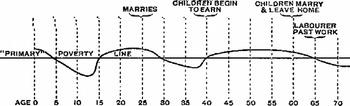
Rowntree's diagram of labourers' life-cycle poverty

III
One of the very first social investigators to posit the theory that poverty varied over the life-course was Seebohm Rowntree. According to Rowntree's analysis of labouring life in York during the late nineteenth century, labourers typically experienced poverty at certain points in their life-cycle. As a child, again after marriage when children were being raised, after children who had hitherto contributed to the household economy had married and left the household, and finally in old age when the labourer was ‘past work’. As such, Rowntree suggested that the ‘life of the labourer is marked by five alternating periods of want and comparative plenty’.Footnote 29 This pattern, as depicted in figure one, has since been referred to as either the ‘poverty cycle’ or ‘life-cycle (or -course) poverty’.
Barry Reay has recently brought Rowntree's findings back to the attention of rural poor law historians by, figuratively, adding some flesh to the bones of the pattern above. But whilst Reay pays some homage to Rowntree's model, he is anxious to tell us that individuals' own experiences were ‘not quite as tidy as this graph implied’.Footnote 30 For instance, working children and young infants often coexisted in the same household. Having an ‘empty nest’ was likely to occur much later in the life-course. Notwithstanding Reay's assertion, the idea of linking the poverty-cycle to the receipt of poor relief by the rural labouring class in the nineteenth century has not been systematically undertaken. Indeed, as Steven King has noted, ‘welfare historians have been slow to engage with the concept of the life cycle.’Footnote 31 The lack of engagement is not, according to King, related to ‘a lack of raw material’, for, as Hitchcock contends, the ‘county archives of England and Wales are stuffed to overflowing with records of the Old Poor Law’.Footnote 32 Rather, so King argues, it is down to the simple ‘[f]ailure to develop more sophisticated perspectives on life-cycles of poverty’.Footnote 33
The only research which has hitherto acknowledged the benefits of following individuals' poor relief receipts over the life-course is Tim Wales' 1984 examination of seventeenth-century Norfolk.Footnote 34 In his attempt to explore ‘the critical points in the life-cycle where parish relief was likely to become necessary for the poor’, Wales charted the relief provided to thirty-nine different individuals from the parish of Hedenham between 1662 and 1702.Footnote 35 Wales' research has subsequently been acknowledged by King to be ‘path-breaking methodological work’.Footnote 36 Yet, because the project was based on tracing such a large number of individuals' poor relief patterns, deeper insights into their situations over the life-course and during key demographic events were not possible. Since Wales' examination of Norfolk a few further studies have understood poor relief dynamics throughout the life-course. The only notable exceptions are Barry Stapleton's examination of poverty in the Hampshire parish of Odiham between 1650 and 1850, which innovatively combined both charity and poor relief provision, and King's study of welfare provision Calverly (Yorkshire) between 1650 and the 1820s and subsequent analysis which compares four communities between 1680 and 1799, namely Calverley and Idle (both within the parish of Calverley) and the parishes of Aynho and Farthinghoe (Northamptonshire).Footnote 37 Although such examinations are important in highlighting the long-run dynamics of poor law relief within the individual parish, these studies have adopted a somewhat socially reductionist strategy. Relief claimants have typically been categorised in large cohorts: the occupations of those claiming relief; the age of first relief receipt; and the frequency of relief receipt. In the latter case, Stapleton calculated the proportion of heads of pauper families in Odiham in ‘continuous poverty’ and ‘non-continuous poverty’ in fifty year intervals. This suggests ‘there would have been periods of shallower and deeper poverty throughout a pauper's life-cycle’, but it indicates the pauper was never ‘out’ of poverty and never existed independently from parish redistribution.Footnote 38 King divided the population of four communities into ‘Always Poor’, ‘Often Poor’, ‘Sometimes Poor’ and ‘Never Poor’ in twenty and twenty-five year intervals.Footnote 39 Such categories do not allow for an exploration of how individuals' situations could change and thus have complex experiences of poverty throughout their life-course. This approach is further problematised by not displaying key demographic events next to individuals' relief provision, thus making it hard to identify the times, reasons and types of relief provided. One exception to this is Snell's research which examines the average number of children within a family at the point of a settlement examination from the period between 1700 and 1800.Footnote 40 Whilst comparison could be made between these examinations and the biographical evidence displayed here, being viewed as ‘chargeable’ by a parish officials is often, although not always, linked to a claim for and the receipt of relief.
Tracing the relief provision of several individuals is not just an exploration of the poor relief dynamics of these individuals per se, but an attempt to explore the multiplicity of experience and parish provision. This research, therefore, is driven by the belief that what happens at the site of the local can challenge and add to our understandings of past societies, a concept which derives from Barry Reay's development of the Italian concept of ‘microhistory’.Footnote 41 This approach is particularly resonant here for the reason that microhistory is concerned with exposing the lives of ‘lost peoples’, the ‘obscure’ and ‘marginal’ groups in society, within clearly defined small areas ‘to [help] clarify the nature of authority’.Footnote 42 A microhistorical approach can therefore be applied to better understand the everyday lives of people based upon close readings of locally created documents. The approach is both practical and ‘political’. It allows us to move beyond ‘vague abstractions’ about past societies uprooted from real lives and experiences.Footnote 43 Or, as Reay in his pioneering study of labouring culture in the Blean area of Kent put it: ‘[t]he local is the site for exploring significant social change and for teasing out important historiographical issues’.Footnote 44 Since Reay's Microhistories was published the concept has been widely appropriated.Footnote 45 These studies have, however, tended to focus on scrutinising one place or event rather than examining individuals' lives.
This research therefore combines both microhistorical and biographical approaches rather than a more conventional approach to researching biography. There are different purposes for each type of biography and therefore different, or even contradictory, final results. As Jill Lepore states, traditional biographies are written with ‘a belief in the singularity and significance of an individual's contribution to history’.Footnote 46 As such, these writings include as many details about a specific individual as can be found, from birth through to death. Microhistory-influenced biographies are not always concerned with reconstructing the entire life of the individual since it is not the actual person who is the specific focus of study. Rather, the main concern is how their beliefs, words and actions at specific moments in time, no matter how extraordinary or ordinary history may deem them to be, ‘serve as an allegory for the culture as a whole’.Footnote 47 Thus far only Samantha Williams has used such an approach to construct biographies of welfare recipients during the operation of the poor laws. Williams constructed what she entitled ‘pauper biographies’, several of which detail the lives of nurses during the old poor law in Bedfordshire.Footnote 48 The creation of such biographical writings is particularly important to poor law historians because whilst some published autobiographies and autobiographical poems claim to be the true voice of their experiences, these rarely relate to the administration of much earlier welfare policies. Footnote 49 Very few biographies were written by the labouring class.Footnote 50 As such, how typical such writings are, when most labouring families were probably illiterate, is also open to question.Footnote 51
IV
The chosen geographical focus for this paper is north Dorset, specifically the Blackmore Vale parish of Motcombe. In part the area was chosen as a direct reaction to the disproportionate number of examinations of the operation of the poor law in the south-east,Footnote 52 but also because of the notoriously severe labouring conditions within the county and its below average agricultural wages during the eighteenth and nineteenth century.Footnote 53 Indeed, Snell places Dorset on a par with Norfolk. Both counties were ‘notorious for low wages, high poor law dependency, and associated problems of surplus labour’.Footnote 54 In the Blackmore Vale it was particularly difficult for agricultural labourers to gain remunerative employment. Here dairying dominated with only about a tenth of the land given over to arable production. It had changed little by the time Thomas Hardy called it the ‘Vale of the Little Dairies’, where fields were ‘mere paddocks’ and crops were ‘few and limited’.Footnote 55 Only during hay-making and harvest time were employment opportunities, for women and children as well as men, plentiful and wages relatively generous. It is not surprising therefore that the Blackmore Vale was the only major centre of machine-breaking in Dorset during the Swing Riots, since the popularly-loathed threshing machines displaced a precious source of winter employment.Footnote 56 Only those who lived on the remaining commons or waste, pockets of land which were few and far between, were able to take advantage of the Vale's fertile soils.Footnote 57 Enclosure had always been bitterly resisted in the Vale and in 1810 men from Motcombe and Gillingham (Dorset) as well as nearby Mere (Wiltshire) rioted against the creation of new enclosures.Footnote 58
The disafforestation of Gillingham Forest in the seventeenth century had, however, resulted in the establishment of a charity called the ‘Allotment Lands’. By 1837, Lord Grosvenor held this land, received money for its rent and his steward distributed it annually on St. Thomas Day ‘to the most deserving of the second poor, having regard for their characters and circumstances’. The ‘second poor’ were those parishioners who were thought to be poor but were not in regular receipt of parish relief.Footnote 59 Two further land-based charities were established and the distribution of their funds were just as discriminatory. By 1834 the pasture land called ‘Feoffees' Lands’, initially established by a decree of 1598 and under the control of the feoffees of the Gillingham Lands, had been divided into nine parcels. Eight of these were rented out to parishioners; the remainder was rented by the parish officers at a low rate for the purpose of building a workhouse. In 1738 Frances Wyke left land to be let out to ‘poor persons’ at ten shillings a year, but such individuals were not to ‘pay nor receive any parochial relief’. A section of this land was also managed in a similar way to the aforementioned allotments with the funds distributed mainly to ‘the aged and infirm’. It is important to note that those who benefited from this charity were ‘usually the same persons who receive[d] the income of the allotment lands’.Footnote 60 Evidently, those regularly ‘on the parish’ in Motcombe were not eligible to receive assistance through formal charity arrangements. Whilst elsewhere in Dorset, most notably in those towns where silk throwing and glove and rope making provided employment for many when trade was good, friendly societies offered another mechanism of support in times of sickness and occasionally unemployment. Whilst the market town of Blandford had established a friendly society with sixty members by 1795, such organisations did not appear in the rural parishes of the Vale until the mid 1830s.Footnote 61
Women and children contributed to the household economy not only through labouring in the fields but also by undertaking piecework in the form of laundering, spinning, sewing and weaving.Footnote 62 The decline of the cottage industries, however, had reduced their earning potential. For instance, by 1834 in the Vale parish of Fontmell Magna, it was reported that the work ‘hardly pays anything at all beyond the value of the materials’.Footnote 63 One opportunity that did develop for women and children in the early nineteenth century in the triangle between the Dorset towns of Blandford, Sturminster Newton and Shaftesbury was the household production of ‘Dorset buttons’. By the 1840s however even this option was threatened by the industrial manufacture of the pearl button.Footnote 64 Larger industries only operated in the towns in the area. Glove and coarse linen manufacture were predominantly concentrated in and around Yeovil (Somerset), although some smaller Vale towns had similar establishments.Footnote 65 Gillingham made gloves and in Shaftesbury the weaving of linsey was thought to be the ‘the old staple manufacture’ of the town.Footnote 66 Gloving manufactories were also concentrated in the larger market towns, including Milborne Port (Somerset) and neighbouring Sherborne (Dorset). Throughout much of the 1820s one silk manufactory employed approximately 600 people in Sherborne alone.Footnote 67 Such prospects did not stretch into the rural villages of the Blackmore Vale however.
Whilst the labouring conditions in many Dorset parishes were notoriously harsh, the chosen parish of Motcombe represented a somewhat more typical rural western parish, neither definitely ‘open’ nor clearly ‘closed’.Footnote 68 The major landowning families of Wyke and Whitaker resided in the parish. After the demise of the latter family in 1825, the Lords of Westminster, the Grosvenor family, bought North End Farm and became major landowners in the Vale. Although the Grosvenors funded the rebuilding of the church and later built the adjacent school and school house, relief administration was not under their control. Despite the presence of these major landowners, many other individuals owned and farmed land in the parish and many individuals owned several cottages. There was, moreover, no clear evidence of the population control methods practised by ‘closed’ parishes. Unsurprisingly therefore, labouring families made up a significant proportion of the population. Between 1790 and 1840 seventy per cent of the 491 grooms married in Motcombe were described as ‘labourers’ whilst only ten per cent were trades or craftsmen and four per cent were regarded as farmers.Footnote 69
V
Relatively harsh economic conditions and a fairly ‘typical’ parish management structure were not the only determinants for choosing Motcombe. The poor law records for Motcombe are more or less complete. Both the parish registers and overseers' account books of Motcombe are intact for the period between 1800 and 1832 with few damaged pages. Such records do not, however, necessarily lend themselves to meaningful reconstructions. As King has suggested, the layering of historical documents with basic demographics is ‘not an uncontested process’.Footnote 70 This research attempts to (re)construct the demographic events of eight individuals and their relief, rather than reconstitute the overall demographic trends of a larger population. The methodological challenges encountered were in some ways similar to those expressed by scholars who have used family reconstitution and population reconstruction techniques.Footnote 71 For instance, some individuals could not be traced accurately because two or more different people had the same or similar names which made deciphering the exact recipient of welfare impossible and the linking of demographic events problematic.Footnote 72 Individuals were linked with their demographic events and welfare receipt, by hand rather than with the use of computers.Footnote 73 Even though a parish may have some records, the quality of their content depends on various factors, such as the ability of the parish officers to record names and relief accurately and the researcher's ability to extract and record such relief amounts correctly. It is also important to consider why such administrative documents were created in the first place and the ways this impacted on the information recorded.Footnote 74
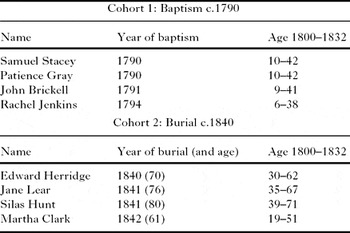
While Motcombe's overseers' account books contain the most complete overseers' accounts of the Vale parishes, these only cover a thirty-two year period. Motcombe's records, therefore, are not excellent or unusually complete but rather reflect the typical state of the majority of parish records in England and Wales. Recognising that these accounts will not cover an entire life time, an appropriate methodology was developed. Two cohorts of four people, those baptised c.1790 and those buried c.1840, were traced in order to examine moments/periods of relief (and non-relief) throughout both the early and late stages of the life-course (see Table 1). The individuals traced from the c.1790 baptisms ranged in age cohorts from 6–10 to 38–42 years during the existence of the records, whilst those who were traced in the c.1840 burial cohort ranged in age from 19–30 to 51–71 years. Initially more than eight individuals' were traced within each cohort, but they did not appear as welfare recipients in the overseers' account books. This was either because they did not claim parish relief, they died at an early age and it was not recorded in the Motcombe burial register or they moved from the parish.
The Cohorts

The very early and very late stages (the short period up until death) of peoples' lives are not covered by this cohort selection. Whilst this could be viewed as a potentially critical omission, it is important to state that children and the elderly were more likely to be held as deserving recipients of both relief and charity compared to those of a ‘middling age’. Besides, it would be extraordinarily unusual if anyone younger than ten years of age would be allowed to make an individual claim for relief, that is to say independent of their parent(s) or guardian(s).Footnote 75 The elderly also had complex pension and workhouse arrangements. In Eaton Socon (Bedfordshire), for instance, within six months of establishing a workhouse in May 1719 the number of people relieved with pensions fell from thirty-eight to just three, showing that the elderly either entered the workhouse or found alternative subsistence.Footnote 76 In Tavistock (Devon), however, just fourteen of the thirty-one parish pensioners entered the Knatchbull's Act (1722) workhouse, with the others continuing to receive a pension from out-relief.Footnote 77 Also, even if the elderly poor were admitted to a parish workhouse their provisions could vary from those outside the parish and over time.Footnote 78 Motcombe decided to establish a workhouse in 1805, for which, unfortunately, separate and clear accounts and admission records either were not created or have not survived.Footnote 79 Understanding the dynamics and use of poor relief in old age, therefore, requires an even more detailed set of parochial records that include exceptionally rare detailed old poor law workhouse registers and accounts.
The events which marked the very end of a life-course, death and burial, remain a much neglected area of research. Hurren and King have stressed the need to reconsider ‘accounts of the economic, social and emotional crises of death and burial’, both by and of the poor, to examine ‘feelings, experiences and motivations’ surrounding these events.Footnote 80 Whilst the individual's own burial payments have not been traced, during the thirty-two year period four individuals endured the death of one child. Although this research does not focus on the very end of life, therefore, it is able to demonstrate when the parish was willing to contribute towards the cost of a child's burial.
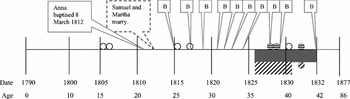
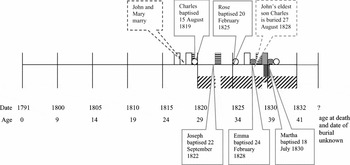
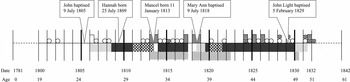
The next section reconstructs the microhistorical biographies of the eight individuals from Motcombe from cohorts one and two. Relief-time-age charts have been created in order to visualise individual relief dynamics over the thirty-two year period.Footnote 81 The charts detail their age, and illustrate monthly pay, extra pay, parish employment-linked pay and contain annotations of key demographic events, such as the baptism or burial of a child.Footnote 82
Key

VI
Cohort 1
Samuel Stacey
Samuel Stacey was born in 1790. When individuals were young their relief was usually claimed by their parents as the householders. Samuel, a son of labouring parents, claimed relief at a very early age independently from his parents. At fifteen years old he he requested a pair of ‘shoes’ and a set of clothes.Footnote 83 A year later he claimed for ‘canvas’. This strategy may illustrate his parents' fear of being rejected in making such a claim on top of their pre-existing relief requirements as a large labouring family. At the age of twenty-two Samuel had one child out of wedlock with Mary Willis. Their child was baptised Anna Maria and within one month and two days Samuel was ordered to pay for her maintenance. Samuel still paid maintenance for the child when he married Martha Mead in 1814. They did not have their first child until eleven months into their marriage.Footnote 84 They had a further nine children of whom only one, a boy named Charles baptised in 1819, died before reaching adulthood.
Although Samuel was a labourer, he was able to provide for his family through his wages. When Samuel and Martha had their sixth child however Samuel's wages were no longer able to meet the full demand of the family budget. At this point, at the depth of the 1820s agricultural depression, Samuel appears to have lost his job and instead fell upon the parish as a ‘stem’ man. This system, also known as the ‘roundsmen’ system, regulated the employment of those out of work by ‘placing’ them with parish farmers, with the vestry paying part or all of their wages. Such a stem arrangement had been in operation for at least eight years before Samuel entered upon the list.Footnote 85 A monthly allowance was also provided to the family. After 1831 his employment on the parish became less frequent and with the birth of their last child in 1834 Samuel may have continued this pattern of relief until all their remaining children had reached an employable age.
Samuel Stacey's relief-time-age chart
Patience Gray (later Miles)
Richard and Frances Gray baptised Patience on May 16th 1790. On the 24th October 1814 a pregnant Patience, then aged twenty-four, married James Miles, a labourer from Motcombe. Within five months of marriage, Patience gave birth to their first child, James. He died, however, at just one month old and was buried in Motcombe churchyard. The funeral was paid for by the parish. One year later Patience gave birth to a second child who was baptised Stephen. In 1817 the parish allowed Patience two shillings to ‘make up her pay’, whilst James also needed relief to ‘make up his pay’. Whilst caring for their child and working where possible, James and Patience were in a relatively stable position until the spring of 1818 when Charles, their third child, was born. This also triggered the start of the family's monthly allowance and her husband became a ‘stem’ man. During this period his body started to deteriorate from labouring. In the December of 1822 he was provided five shillings on one occasion and three shillings on a second to make up the money they lost because of his ‘lame hand’. After 1830 employment opportunities increased, yet there were also times when Patience's husband worked for the parish. The majority of relief provided just in Patience's name throughout this period was for illness, however, not least that afflicting her children, and for occasional items of clothing. Patience herself did not work on the parish due to the unrelenting unpaid domestic work she undertook for her family.
Patience Gray's relief-time-age chart

John Brickell
John, baptised on 30th October 1791, was born into a large Motcombe labouring family. He married unusually late at the age of twenty-eight to a slightly older woman called Mary Gray.Footnote 86 Within four months of their marriage Mary had given birth to a boy, subsequently baptised as Charles. Although John did not claim much relief in money or in kind during this period of family expansion, from 1820 onwards he continuously worked for the parish. There was only one period of time, just before 1830, that John's family was given an allowance. Mary also claimed relief between May 1826 and January 1827 when the family budget was particularly tight, the reason for which is unknown. John had three extended periods of illness throughout the records, for which relief was provided. Relief was also given to assist the family when their eldest son, Charles, was ill. In 1828, at the age of nine, Charles died. The parish provided five shillings to help purchase a shroud and to have him buried. Charles' labour would have contributed to the household purse, so after his death the family appear to have been struggling. They were provided with a large increase in their relief: two occasions of one pound as well as the provision of a temporary family allowance in 1830 of fifteen shillings and four pence for four months and seven shillings and eight pence for a further month. John was forty-one when Mary gave birth to their last child, which they named Charles. His parish employment probably continued until his wife and children could contribute more towards the family income.
John Brickell's relief-time-age chart
Rachel Jenkins (later Alford)
Rachel was born an illegitimate child to Mary Jenkins, a widow, in the Spring of 1794. Rachel's father was Thomas Stacey, a Motcombe labourer. In October 1794 the parish placed a bastardy order upon Thomas for the maintenance of Rachel at one shilling per week. Her parents never married and so she was likely to be brought up on a combination of her mother's wages, bastardy maintenance and parish relief. Mary, her mother, died when Rachel was twenty years old in 1814. Seven months later Rachel married John Alford, a labourer. Within four months of her marriage she gave birth to her first child Mary Ann. In 1816, after giving birth to her second child, Elizabeth, her husband received a family allowance, mostly varying between two shillings and eight pence to twelve shillings per month. During and after her next pregnancies Rachel also required relief due to both illness and absence from work during childbirth. For instance, in March 1821 five shillings was provided to ‘John Alford's wife for lying in’, money which kept the household economy afloat whilst Rachel gave birth to Celina who was baptised later the same month. During times of pregnancy the parish was obliged to help and further relief was provided. After the birth of their third child, Rachel's husband was regularly employed by the parish, working in the quarry and upon the roads. In 1830–1 a period of illness afflicted both Rachel and her youngest daughter Susanna, who died in 1831. On the day before the burial, the parish provided two shillings and six pence ‘to help bury John Alford's child’. Rachel had one further child in 1836 at the age of forty-two, the same age at which her mother had given birth to her.
Rachel Jenkins' relief-time-age chart

Cohort 2
Edward Herridge
In 1770 Edward Herridge was born into a labouring family. He married Sarah Crouch in 1790. Unusually for the late eighteenth century, Edward was able to sign his name on the marriage register. Sarah only ‘marked’.Footnote 87 Within four months of their marriage Sarah had given birth to Robert, baptised on 16th January 1791. John, their second child, was baptised on 16th December 1792 and within the next eight years they had two other children, Edward (1797) and Martha (1800). Edward was claiming relief at the beginning of the poor book in 1800 and may have claimed relief before that date. In 1800 he received various items of clothing, some of which were for his children, including shoes, shirts and a frock. In 1804 he received a spade presumably to enable him to work in husbandry on a farm or to help him subsist from a potato plot. Edward then worked for the parish a few times throughout the next fifteen years upon the parish roads and in the quarry and also received occasional relief. This employment was for shorter periods and was less frequent than for his fellow Motcombe labourers. When his last child, Henry, was born in 1808 the family managed without any relief from the parish as Edward was able to hold down a well-paid job. He only occasionally worked as a stem man. At the end of 1817, however, Edward suffered from under-employment and worked continuously on the stem. His employment opportunities then improved until 1831 when the parish started to provide him and Sarah a monthly relief of twelve shillings. As he was now in his early sixties and in all likelihood enfeebled from a life labouring in the fields, it is possible that this was the start of a parish pension.Footnote 88
Edward Herridge's relief-time-age chart

Jane Lear
Jane Lear was born in 1765. At the age of twenty-nine she had an illegitimate child, Sarah, who was baptised in 1792 alongside Mary Broadway's bastard child. It is likely that the women were forced to have the baptisms held on the same day. Indeed, between 1790 and 1840 a total of six pairs of women had their bastard children baptised on the same day. The pairing of women in this way may have been a deliberate act on the part of the parish officers to invoke wider attention and create a spectacle of the women, in the hope that no further cases of bastardy would occur. There was no indication of who the father was or any record of maintenance payments to Jane, for the support of her child. Nor is there any record of her receiving monthly pay at the start of 1800. Indeed, initially she made few claims for relief, suggesting that either work was available or that members of her family were supporting her and her child. From 1813 Jane received a fixed monthly allowance, although over the winter of 1819 this stopped. Whilst it is unlikely she would have gained outside work, she may have been employed by parishioners washing or looking after children, or alternatively her family may have supported her. During this time the parish provided relief only as and when it was needed. This period was, however, short-lived and Jane was again provided with a regular allowance in 1820. Now in her fifties, it is likely that this was a parish pension, ranging from six shillings to seven shillings and four pence per month, although it was often more generous during winter. On some occasions Jane claimed relief for extra items she could not afford from her allowance. In 1823, for instance, she was provided with some straw and a blanket for bedding. The parish, however, did not provide expensive items to Jane, but made only a small contribution towards their cost. Indeed, in the winter of 1827–8 the parish provided just six pence on two occasions for ‘Jane Lear to buy coats’. In March 1829 Jane became seriously ill. Whilst claiming small amounts of money throughout her illness (up to one shilling a time), the parish continued to provide her with an allowance of eight shillings per month. The parish also paid for someone to ‘attend’ or nurse Jane for between two and three visits a month (costing the parish one shilling per visit). It is likely such allowances and caring continued in this way unless she entered the Shaftesbury Union workhouse in 1837. She died in 1841.Footnote 89
Jane Lear's relief-time-age chart

Silas Hunt
Silas Hunt was born in Motcombe in 1761. On 21st March 1787 he married Mary Tuffin, then aged twenty-five, who was also from Motcombe. By the turn of the century they had four children Faith (baptised in 1795), Stephen (1797), Christian (1798) and Meriah (1800). When the overseers' accounts begin, Silas obtained relief on a non-regular basis of between two shillings and four shillings at a time and was provided with occasional pieces of clothing, such as shoes and a pair of breeches for one of his sons.Footnote 90 Silas claimed for relief on many occasions between 1804 and 1806, at which point he was placed on parish employment for four of the next six months. The wage and the nature of the work he undertook is not clear, but it is highly probable that he was either set to work in the quarry or upon the roads. The two months for which he was not so employed fell during the harvest season when work was relatively abundant for both himself and his family. Even when there were still infant members of the family present in the household, the Hunts did not once receive a ‘family’ allowance. Silas and his family appear to have obtained regular work. The family were, however, frequently afflicted by poor health. One of his daughters, Christian aged eleven, died in 1809 and one of Silas' sons became ill in 1813. The family required relief whilst he was unable to work. Silas only claimed relief over a significant period in the summer of 1818 before he was placed on the ‘stem’ between November 1818 and April 1819. He found employment independently of the parish in the period to March 1821, at which point he started to labour, intermittently, on the roads, something he continued to do for the last eleven years of the relief records. As such Silas continued working for the parish well into his seventies.
Silas Hunt's' relief-time-age chart

Martha Clark
Martha Clark was born in 1781. She claimed relief only infrequently in her twenties, one shilling and six pence in January 1801 and one shilling over a year later in February 1802, perhaps due to winter under-employment. Martha next obtained relief immediately after she gave birth to her first bastard child, baptised John, in 1805. The provision became more frequent thereafter and Martha started receiving bastardy maintenance from John's father, Martin Bunt.Footnote 91 Martha had her second child in 1809, Hannah, and on the same day as the birth (25th July 1809) the father, William Dodge, a Shaftesbury labourer, was ordered to pay maintenance costs. Martha also received an allowance, although it is not clear that Dodge paid any maintenance until 1811. In 1813, Martha gave birth to Mancel, and Robert Herridge, a Motcombe labourer, was ordered to pay towards her maintenance, a sum which appears to have been added to her overall parish allowance. From May 1813 Martha started to work for the parish nursing and caring, something recorded as ‘washing and attending’, for two elderly men, John and Burt Broadway. It was common for only women to be employed as a ‘poor law nurse’, a job which involved attending, washing and doing the laundry of the elderly and ill in the parish. Indeed, there was a gendered division of care-related work in Dorset.Footnote 92 Martha also started to receive relief with her mother in 1814, suggesting either that Martha had never moved out of the familial home or that her mother had now moved in with her. Martha gave birth to her last daughter, Mary Ann, in 1818, whose father was John King, a yeoman from Motcombe. King paid bastardy maintenance and Martha continued to work for the parish nursing as well as receiving relief for items which the allowance and maintenance could not cover. In 1824, for instance, she received amounts of one shilling for illness plus eight pence ‘to mend her [daughter's] shoes’.
In the meantime, two of her ‘patients’ died, John Broadway aged fifty-six (1821) and Ann Hannan who lived to the unusually old age of ninety-two (1823). There were, however, other people to attend to and sometimes Martha was employed alongside Jane Read, another younger single woman who had one bastard child supported by the parish. It is possible that Martha, due to her previous experience, tutored and advised Jane on the demands of the employment. For the majority of the time between 1813 and 1823 she worked for the parish and was also relieved during ‘lying-in’ periods, something which was not common in other southern parishes.Footnote 93 Martha received monthly pay although she stopped working for the parish until the birth of her last child, John Light, in 1829. Bastardy relief was provided whilst Martha returned to nursing in the parish on a temporary basis. Martha died aged sixty-one in 1842 when her youngest child was just thirteen years old.
Martha Clark's relief-time-age chart
VII
The microhistory influenced biographies of these eight individuals demonstrate that the labouring poor went through periods of both dependency on, and independence of, poor relief. There were certainly periods when relief was not received by individuals, highlighting that the Dorset magistrate's view of the dependent labourer constantly claiming for parish relief was an exaggeration. The Motcombe claimants were far from ‘parish slaves’. As such, it is now imperative to understand the complexity of both relief and non-relief occasions of these individuals and the parish officials' policy responses.
There is a complex association between individuals receiving relief and the expansion of their families. Patience Gray, Rachel Jenkins, Martha Clark, John Brickell and Edward Herridge were all either provided with one or a mixture of the following: a monthly allowance, ‘extras’ (some money in cash or kind) and parish employment (Martha Clark and males within the household) during the growth of their families. This broadly conforms to Rowntree's findings, which stressed that after childhood the next period for the family to live below the ‘primary poverty line’ was after marriage, when there were children to maintain with only the income of the parents to meet the needs of the family. A major complexity that Reay has highlighted, however, was that some families at particular stages in their lifetimes had both older children, who were capable of working, and infants. This extra income meant that some individuals did not always end up at the vestry door whilst their families were expanding.Footnote 94 Stapleton, who has noticed this dynamic, states that many labouring parents in their forties and fifties ‘still had young children at home who were economically dependent’.Footnote 95 Adding further evidence to this claim, here all but one individual from the Motcombe cohorts had their last child after their thirty-eighth birthday. One of them, Patience Gray, was in her forties when her husband stopped bringing home a monthly family allowance. At the time she had five children at home (aged fourteen, twelve, seven, six and two) and so it was likely that at least two children were able to contribute to the family economy.
Stapleton's examination of relief in Odiham also suggested that poverty was exacerbated when labouring families had three or more children.Footnote 96 Snell, on the other hand, demonstrates that families (comprised of both a man and woman) in the western counties became chargeable in this period when they had between 2.64 and 2.78 children.Footnote 97 Evidence from cohort one, however, suggests that this dynamic was neither universal nor clear cut. For instance Samuel Stacey started to receive both a family allowance and worked on the parish only after he and his wife had seven children to maintain. Patience Gray's family, conversely, received an allowance and her husband worked for the parish after the birth of their second child. Similarly, it was after the birth of their second child that Rachel Jenkins' family received an allowance. The implications of expanding families for the household economy could, and often did, provoke individuals to claim relief, but it is clear from these biographies that these needs occurred at different points in the growth of their different families. Moreover, the poor also expanded their families outside the typical nuclear family structure. Whilst the relief provided to Jane Lear just after the birth of her child is not captured in this analysis, the relief provided to Martha Clark after the birth of her children is. Notably, she obtained both bastardy support payments and a monthly allowance after her very first bastard child, and continued to receive a varying combination of bastardy maintenance and family allowance payments beyond the birth of her fifth and final child (chequered pattern of light and dark grey on the charts). Such generalisations about the points in the life-course when relief was needed do not, therefore, always hold. In the Vale, poverty came to its biting point at different times for different families.
Statistical analyses of the experiences of southern labouring communities have left us with a rather pessimistic view of the ability of the rural poor to get by on their own. The focus of the aforementioned enquiries has been to highlight how once an individual started to receive relief they became dependent on the parish. As Stapleton suggests, in Odiham ‘[n]early seven out of ten paupers, once they commenced receiving relief, became dependent for the rest of their lives’.Footnote 98 A similar conclusion could be made about many of the relief patterns of the individuals displayed here, especially the single women. Martha Clark is an obvious example, since after the baptism of her first child the parish afforded her relief every year thereafter. Jane Lear also received an allowance in 1813 and continued to obtain this allowance in all but one year until the end of the series due to an illness (horizontal stripes). Thus, as a consequence of their individual circumstances, Martha and Jane were both ‘dependent’ on the parish for a substantial amount of time. Individuals in labouring families also experienced prolonged periods of welfare receipt. Samuel Stacey, Patience Gray, John Brickell and Rachel Jenkins all received relief for eight consecutive years or more. What is important to understand, however, is that some individuals, such as Patience Gray, did not continue to be so dependent on such relief. There are, therefore, notable absences of the poor law in adults' lives, absences which complicate the idea of a blanket dependency.
Receiving a monthly Speenhamland-style allowance (dark grey) among the typical labouring families was not a common experience. Samuel Stacey did not start receiving his family's monthly allowance until he was thirty-six (1826). By this point in his life he had already fathered eight children, seven of whom survived infancy of which six were still living at home. Most startling is the lack of sustained monthly allowances to John Brickell, and the complete absence of an allowance in the biographies of both Edward Herridge and Silas Hunt, three labourers we would otherwise have expected to be dependent on the parish. The pattern of receiving ‘extras’, receipts of money in cash or kind (white or grey with a black outline), was also sporadic, indicating the ability of these individuals frequently to manage without such assistance. Both Samuel Stacey and Patience Gray, for instance, who may not have claimed for extras, received an increased amount of ‘extra’ pay on only five occasions. Whilst all the other individuals had a more pronounced need for such additional pay, either over a long time span (white with a black edge) or more regularly within a given amount of time (grey with a black edge), they were in no way dependent on relief throughout the whole course of their adult lives.
These eight biographies not only identify the fluctuating relief patterns of the poor, they also uncover the ways in which the parish dealt with the needs of individuals. Most strikingly, single women with children were offered relief in a different manner compared to married women with children. Married women were offered both ‘odd’ amounts of relief and an allowance which was not tied to any form of employment. The well-documented life of the persistent bastard bearer Martha Clark, combined with the detail we know about her trainee Jane Read, reveals that the Motcombe parish officers decided to tie their relief, in the form of allowances and bastardy maintenance payments, to parish employ (wavy pattern). Both cared, cleaned and completed the laundry for fellow parishioners, some of whom, such as Jane Lear, received regular relief themselves. Whilst the relief allocated to married and single women was distinctive, even those in very similar situations were treated in different ways. In addition, based upon what information we have about the experiences of the elderly, it is clear that whilst some individuals, including Edward Herridge and Jane Lear, were provided with a parish pension, others, such as Silas Hunt, continued to receive a parish wage for road or quarry work into their seventies (diagonal stripes).
Understanding that individuals from one parish with similar situations were provided with relief in such divergent ways begs the question of why parishes would adopt such complex relief regimes when a general policy would be far easier to administer. John Broad has consistently stressed that parish officials managed to maintain the independence of single labourers and labouring families throughout most of the eighteenth century through the pooling of parochial resources. Charitable and rate-based sources of welfare provision were sometimes placed in the same pot and then strategically allocated to maximise the potential benefit.Footnote 99 This purportedly ‘humane’ consolidation of both charity and poor-rate funded relief exposes just one way in which the parish economised their resources. These biographies demonstrate, however, how parish officials adopted similar strategies solely within the boundaries of the poor law. While Motcombe had a workhouse in operation and does not appear to have adopted any further enabling legislation (such as Gilbert's or the Sturges-Bourne Acts), they implemented a variety of policies which originated at the parish level. By employing those out of work in the quarries and upon the roads, the farmers on the vestry potentially saved money, and time, in not having to repair the roads themselves. Similarly, by appointing pauper nurses the parish did not have to pay relatively expensive specially trained nurses. In Motcombe even the children of relief-receiving families were given small amounts of money in return for collecting stones and filling potholes in roads. Whilst it could be argued that such a response maximised parish resources and hence enabled the parish to throw its welfare net a bit more widely than it could otherwise have done, it may also be conceived as a mechanism by which parishes curtailed further potential increases in the poor rate.
Employment was not just tied to relief as a way of managing the parish economy but also as a mechanism for managing the morals of specific parishioners. As Brundage suggests, the second concern of parish authorities, after minimising the cost of poor relief, was to try to ‘enforce communal moral standards’.Footnote 100 The fact that single women with children, rather than their married counterparts, worked as carers and launderers suggests that nursing was used intentionally as a stigmatising form of parish employment. Unlike the Bedfordshire parishes examined by Samantha Williams, where most old poor law nurses were married, Motcombe was intent on making only single childbearing women work for their relief. This was because such women, including Martha Clark and Jane Read, did not conform to the vestry's moral pronouncements.Footnote 101 And yet, this intentionally stigmatising practice actually helped Martha gain extra money and allowed her to continue bearing illegitimate children. How complicit Martha was in such a course is, however, unclear.Footnote 102 By placing their moral ideals into their decision-making processes, parish officers were allocating a wide variety of combinations of both money and employment in the parish. Relief in such ways was highly tailored to suit each individual.
The bespoke nature of relief provision was not, however, just for the supposedly immoral. The vestry's knowledge of each claimant, their families and collective resources, also guided the personalisation of relief. Edward Herridge received a spade in 1804 because the overseers knew it would either help him to gain employment or, in greater probability, help him cultivate a potato plot and thus reduce his future demands upon the parish. Martha Clark received a joint allowance with her mother between 1814 and 1817 of one pound and fourteen shillings. Martha's previous allowances, between 1808 and 1811, varied between only eight and sixteen shillings. The parish especially adapted Martha's allowances to take into consideration that she and her mother were living together and supporting each other by consolidating their resources. In the winter of 1827–8 Jane Lear was only offered two trifling amounts towards a new coat, perhaps because the parish knew that other sources of provision, such as family or friends, a charity or even credit from a shopkeeper, would make up the shortfall. The knowledge of each individual's circumstances might have allowed the parish officers to economise, but it also led to an infinite complexity in poor relief administration.
VIII
We have been warned by Hitchcock, amongst others, that ‘[t]oo frequently we allow middle-class and elite perceptions to stand in for the complex lives and views of the poor themselves’.Footnote 103 Okeden's views, as well as those of other rulers of rural England, have resonated throughout several analyses of labouring class poverty. Stapleton's analysis of Odiham represents the most extreme position: ‘[p]overty arrived before, or at the birth of the first child and frequently remained until death’.Footnote 104 More recently, the growth in the examination of pauper narratives has revealed that people's lives were immensely varied and they deployed numerous strategies to get by. There has, however, been little explicit discussion of how we can (re)construct, examine and communicate past lives and their complex relationship with statutory welfare provision. This article demonstrates that a micro-level biographical approach can equip us with the tools to disseminate this complexity and challenge such discourses about ‘the poor’. By looking at the above charts, we may tend to notice what is there over and above what is not there. Yet it is these absences which demonstrate that although parish relief was an important source of everyday subsistence, the poor often lived without it and could always return to it. The labouring class in the rural south went through periods of both dependence on, and independence from, statutory welfare provision. A new methodology was required to reveal these dynamics because Motcombe's parish records are in no way exceptional, representing the average set and state of parish records left in the archive. This method can be, therefore, applied to illuminate individuals' relief provision and parish policies in a multitude of other parishes. This will undoubtedly further question and add to our current knowledge of the lives of the poor.
Tomkins and King have suggested that our understanding of eighteenth- and nineteenth-century welfare has long been overshadowed by histories of poverty which can be characterised as ‘repeated, detailed studies of the parish poor relief’.Footnote 105 They contend that the ‘[a]lternative sources of assistance for the poor were addressed largely as free standing exercises’.Footnote 106 Whilst this latter point cannot be disputed, parish relief has had to be treated differently due to the nature in which it was invariably recorded – in rambling and often disorganised lists and payment charts. Yet, it does not mean it should be viewed differently from other resources or strategies mobilised by the poor. Regardless of the fact that parish relief was grounded in legislation and in some instances carried a degree of moral stigma, those in need utilised parish relief in ways similar to how they utilised non-poor rate-funded sources: at particular times of need and, for most, intermittently. Parish relief was also a ‘strategy’, and one that was often vital to the broader household economy. Indeed, whilst the charts and biographies detail statutory welfare provision, where records permit, charitable, mutual aid and self-help provision could be added to the picture. It would be illuminating, for instance, to examine an individual's relationship with parish relief and, say, a church charity, the local friendly society, a pawn shop and even criminal activity.
Research on the lives of the individual, as extracted from the massed group of ‘the poor’, highlights that there was no solitary, universal experience of poverty within the context of the parish. This also exposes the innovative and semi-autonomous character of the parish in implementing the poor laws. Social policies were not abstract legislations which were applied with precision and blanket uniformity, but rather they are instead lived out, negotiated, spatially and temporally varied experiences. In his pioneering Rural Englands, Reay strongly argued that ‘England was a nation of incredible local variation. So much so, that there is justification for seriously thinking in terms of plurality rather than the singular’.Footnote 107 Similarly, we could argue that there were many welfares under the provisions of the old poor law, not just one, and an infinite number of different experiences.