In 2014, international human rights non-governmental organizations reported vividly about continued Israeli human rights abuses,Footnote 1 leading to global calls for action against Israel. Threats of economic boycotts against Israel led both the British prime minister and the German Chancellor to make speeches before the Knesset renouncing any proposed restrictions against Israel.Footnote 2 Similarly, US Secretary of State John Kerry highlighted the security threat associated with growing efforts to isolate Israel economically.Footnote 3 Yet, despite the security interests of several major powers in safeguarding Israel’s economy, individuals in many rights-respecting countries have a growing awareness of the human rights situation in Israel. These individuals often decide to boycott Israeli goods, sharing pictures of Israeli-made products over social media and even relying on cell-phone applications to help them avoid Israeli exports.Footnote 4 A large number of individuals boycotting these goods could be detrimental to Israel’s economic interests. A successful boycott of Israel would be likely to lead to a reduction in exports by Israeli firms, which in turn could lead to higher unemployment and greater dissatisfaction with the Israeli government. In the 1990s, for example, efforts to boycott the repressive regime of Burma led to many multinational-firms pulling out of the country altogether, including such diverse companies as Texaco, Levi Strauss, and Eddie Bauer.Footnote 5
As the world economy has globalized, so has human rights activism.Footnote 6 Israel’s situation illustrates an important tradeoff that has emerged in the modern, globalized economy. Whereas abuse could be seen as serving a leader’s domestic security or economic interests,Footnote 7 globalized attention to abuse might be a liability if third parties then punish violations of human rights.Footnote 8 The discovery of this tradeoff is one among many contributions from a growing literature that has developed on the determinants of human rights abuse and the ability of third parties to pressure improvement in these practices. One of the most important findings in recent studies is that ‘naming and shaming’ by non-governmental human rights organizations (HROs) can precipitate reactions among states and individuals around the world intended to improve the conditions of those afflicted with abuse, or to punish the perpetrators of such abuse.Footnote 9 As such, in this globalized world the question now arises: should states fear economic costs associated with the transnational ‘naming and shaming’ of abusive human rights practices?
In this article, building from previous work,Footnote 10 we examine how naming and shaming by human rights organizations conditions the influence of human rights abuse on exports. We argue that human rights abuse alone is insufficient to damage a state’s exports. However, as global attention to abuse via HRO shaming increases, abuse has an increasingly negative impact on export flows to states that respect human rights. We find strong support for this expectation in empirical tests utilizing gravity models of trade incorporating data on physical integrity rights abuse and HRO shaming, spanning 1990–2008.Footnote 11
This study highlights the conditional, multi-actor process inherent in the relationship between human rights abuse and trade. While one might assume that the best empirical test of this relationship would utilize the country–year level of analysis, we demonstrate that the dyadic process of trade (typically modeled using the gravity equation) can be adapted to incorporate each trade partner’s respect for human rights, as well as the attention to human rights abuse focused by non-state actors. Accordingly, we account for the fact that the influence on trade of human rights abuse and of its shaming depends on the characteristics of the importer as much as on those of the exporter. Global human rights attention by HROs creates a transnational advocacy network, connecting the plight of citizens in repressed countries to the purchasing decisions of those in rights-respecting countries, ultimately influencing trade patterns – and potentially helping to reduce human rights abuses in the long run.
Trade and Human Rights
A growing body of literature examines the link between trade and human rights, focusing primarily on how states that respect human rights could pressure abusive governments to improve their human rights practices.Footnote 12 For example, Hafner-Burton shows that human rights clauses in preferential trade agreements can be effective, although only if an enforcement mechanism is included in order to create a material disincentive to violate human rights.Footnote 13 Cao, Greenhill and Prakash argue that the California Effect operates for human rights; activists and consumers in importing states will put pressure on political leaders and multinational firms to do less business with abusive states, leading exporters to improve their human rights practices.Footnote 14 The use of economic sanctions in the presence of repression appears to have a counter-productive impact, leading to worsened human rights practices in the target state.Footnote 15 However, recent research suggests that the imposition of such sanctions could have a reputation effect, informing other states that the sanctioning state is serious about preventing proscribed behavior, even leading to proactive improvement in human rights among similar third parties who wish to prevent trade restrictions.Footnote 16 A common theme in these studies is that respect for human rights is itself a commodity to be traded; some leaders are willing to improve human rights practices in exchange for access to lucrative foreign markets. However, we are only beginning to understand the means through which leaders and citizens in states that respect human rights become aware of human rights abuse by potential trade partners.Footnote 17 We suggest that human rights organizations are one of the means bringing a spotlight to bear on human rights violations, leading to reduced exports for states that continue to engage in abusive practices.
Human Rights Organizations
HROs employ a variety of tactics to improve the wellbeing of citizens in repressive states. Some organizations work behind the scenes, providing legal aid or educating individuals about their protections under human rights law.Footnote 18 Within a given location, organizations may be ‘field-building’ or otherwise trying to increase domestic pressure on a repressive government.Footnote 19
At the same time, other organizations often work more publicly, gathering information and disseminating it in the popular media. This set of public informational tactics is often referred to as ‘naming and shaming’ or ‘shaming and blaming.’Footnote 20 The idea here is to get international attention focused on the abuses, hopefully bringing powerful third party actors into the fight to improve human rights.
In much of the theoretical literature, the local ‘field-building’ and the international ‘shaming’ tactics are thought to work in tandem to pressure a state to change their repressive practices from both ‘below,’ or within the state, and ‘above,’ or outside the state.Footnote 21 As Keck and Sikkink contended, advocacy for human rights improvements operates in a ‘boomerang’ pattern.Footnote 22 First, countries unable to stop repressive practices on their own send calls for help to HROs. HROs respond, focusing on ways both to aid domestic advocates in their local movement and to draw attention to the abuses in the international media. Through shaming, HROs are able to involve additional advocates, such as third party states and parts of intergovernmental organizations, into the overall support network. These advocates can help to put formal and informal pressure on the repressive state. Risse, Ropp and Sikkink later added that this ‘boomerang’ pattern of domestic and international pressure may start a process of human rights improvement.Footnote 23 In the beginning, the repressive regime makes ‘tactical concessions’ in order to avoid being in the spotlight.Footnote 24 These concessions, such as signing human rights treaties and setting up domestic human rights commissions, can provide further openings of which HROs can later take advantage. If advocacy continues, however, the regime may eventually internalize human rights norms, leading to ‘rule consistent behavior.’Footnote 25
Much of the recent cross-national empirical literature backs up the contentions of Keck and SikkinkFootnote 26 and Risse, Ropp and Sikkink.Footnote 27 Domestically, HROs can help increase anti-state protest.Footnote 28 They can also change public opinion about human rights conditions.Footnote 29 Internationally, HRO shaming has been linked to reductions in direct foreign investment,Footnote 30 as well as various changes in state foreign policies.Footnote 31 The combination of domestic and international pressure has also been linked to eventual human rights improvement.Footnote 32
To our knowledge, no existing cross-national study has examined whether shaming also influences international trade. Anecdotally, the goal of many HRO shaming campaigns has been to change the purchasing behavior of individuals and the policies of governments toward an abusive state, which we could expect to have an aggregate influence on internal trade. Some of these shaming campaigns, like campaigns against Nike or GAP, have focused specifically on workers’ rights and lax regulations in exporting countries.Footnote 33 Others have focused on how exports could be linked to state and non-state repression, like the global campaign to end the trade in conflict diamonds.Footnote 34
Advocacy carried out against human rights abuses in China and Chinese-occupied Tibet is a useful illustration of these dynamics. Based on information about Chinese human rights abuses, most of it produced by HROs, a campaign was launched in the United States, India, and Canada to boycott goods that had been made in China. This effort started in 2001 and then intensified in late 2002.Footnote 35 A campaign flyer for the boycott in 2002 reviewed the myriad of abuses occurring in China, including torture and political imprisonment, and stated that ‘the only remaining way for concerned people to exert some positive influence on China seems to be through the power of the individual consumer. In short a boycott of Made in China products’.Footnote 36 Although overall levels of exports still increased to the United States and Canada from China in each year from 2002 to 2004, the change in this increase from the previous year was well below the global mean yearly change for Chinese exports for these years.Footnote 37 In other words, if the goal of the boycott was to slow down the rate of exports from China, then it was at least somewhat successful in Canada and the United States.
The Conditioning Impact of Hro Shaming on Exports
Does human rights abuse – and the shaming thereof – affect a state’s commerce? There is a great deal of evidence that trade (conditionally) affects human rights,Footnote 38 but less research on how trade is affected by human rights. Research in related areas suggests there is a relationship between human rights and FDI (foreign direct investment).Footnote 39 In one study that looks specifically at trade, Blanton and Blanton find that more repressive countries have on average lower exports.Footnote 40 Given that repression tends to correlate with lower levels of development and a more autocratic regime type, it is difficult to uncover whether this correlation reflects a causal relationship.
There are reasons to expect that repression could lead to lower exports. For example, the link from abuse to decreased exports could follow from the way in which abuse affects the productivity of firms. Although a threatened political leader may view abuse as an advantageous move, it is also possible that repression leads to inefficiency and lack of human capital; the potential for forced labor suggests a lack of technical sophistication, competence, and skill. Even in the absence of direct forced labor, fear of repression could reduce worker productivity, the consequence of which is lower exports. Blanton and Blanton argue that one possible explanation for the relationship between human rights and exports is that respect for human rights has a positive impact on competitiveness.Footnote 41 Seeing respect for human rights as a competitive edge fits with a general argument that states approach treatment of their populations from a strategic perspective, balancing the potential benefits of human rights competitiveness with the potential necessity of abuse when it is in their interest in order to maintain order and control.Footnote 42
However, the link between abuse and exports might not be entirely clear. Although human rights abuse might not lead to higher export volume overall, it could be used as a means to reduce production costs in some cases.Footnote 43 For example, critics of China’s treatment of workers have claimed that prices of highly demanded technology products are reduced a result of harsh conditions for workers.Footnote 44 Indeed, prior research could provide clues that abuse is, at times, a cost-saving measure. For example, a recent study finds that interest groups representing organized labor in the United States and other developed countries tend to reduce their resistance to trade agreements when enforceable human rights standards are stipulated in the agreement.Footnote 45 The author acknowledges that material interests rather than concern for human rights may motivate these labor organizations; requirements for improved human rights practices would reduce the production cost advantage from which their competitors benefit.
The discussion above omits an important factor that could condition the relationship between human rights abuse and export levels: international consumer knowledge of abuse. If a country is abusing its citizens, but there is little or no global attention being attracted to the abuse through shaming, we contend that the costs leaders face as a consequence of their abusive practices will be limited.Footnote 46 Specifically, in the absence of international attention to human rights abuse, leaders benefiting from export rents could engage in abuse without fearing a backlash among consumers in importing states. Consumers who learn about abuse might reduce their demand for products from abusive states, and might pressure their governments to discourage purchases from the abusing state.Footnote 47 Yet, in the absence of international attention, consumers are less likely to be aware of any abuse, preventing this punitive reaction. Indeed, abuse is likely to foster reduced exports only under the condition that citizens in importing states pay attention to repression. Thus, HRO shaming could play an important conditioning role on the link between abuse and export levels by informing citizens within importing states of the abuses occurring in exporting states.
Importantly, we contend that HRO shaming of human rights abuse can influence international markets even when consumers are unable to pressure their governments to enact sanctions; individuals can boycott certain exports, pressure firms, and change their purchasing behavior without formal sanctions. In the ‘Made in China’ boycott in 2002, for example, the boycott organizers justified individual involvement in the boycott because of the international community’s unwillingness to formally sanction or otherwise punish China.Footnote 48
The point of shaming is to put pressure on abusive leaders to change their behavior. To be successful, shaming would have to impose costs on leaders who maintain abuse. Even with shaming, leaders might still see abuse as more valuable than the gain that would accompany a cessation of shaming behavior. However, we argue that, in the absence of shaming, there are fewer incentives for leaders to change their behavior. Without including shaming in the equation we do not know how important actual abuse is relative to the cost of attention to that abuse.
There are two final requirements for shaming of abuse to lead to lower exports for abusive states: domestic groups in importing states (1) must prefer not to import from abusive states, and (2) must be able to influence other citizens, political leaders, or firms. We contend that better human rights practices in the importing state are associated with both the willingness and opportunity among consumers and activists to engage in activities (such as boycotts, further information campaigns, and lobbying of elected leaders) that are likely to reduce imports from abusive states. Indeed, previous research finds evidence that very respectful importer human rights practices are necessary for human rights practices to diffuse to exporters;Footnote 49 we contend that similarly respectful practices are necessary for HROs to be influential in causing material harm to abusive exporters. This requirement could explain why the boycott against China discussed above was more successful in the United States and Canada than in India, where human rights abuses were extremely widespread in the early 2000s. This point highlights the importance of looking beyond the country level of analysis when examining the impact of abuse – and shaming thereof – on trade.
When HRO shaming of exporters provokes among citizens of importing states both recognition of, and opposition to, abuse, we expect that demand for goods produced in abusive states will be lower. This logic can be restated as the following hypotheses:
HYPOTHESIS 1: In the absence of HRO shaming, human rights abuse is not associated with diminished exports; as HRO shaming increases, higher levels of human rights abuse become increasingly associated with lower levels of exports.
HYPOTHESIS 2: The (conditional) association between exporter human rights abuse and trade is strongest when importers are most respectful of human rights; as importers become more abusive of human rights, the association between exporter human rights abuse and export level diminishes towards 0 irrespective of HRO shaming levels.
Research DesignFootnote 50
We test our hypotheses using data on trade, human rights, and HRO shaming in the years from 1990 to 2008. Our theory suggests that the impact of exporter abuse is conditional both on the degree of shaming the exporter receives from human rights organizations and the human rights practices of the importing state. Accordingly, we contend that the country level of analysis is insufficient to test our hypotheses. Instead, we model the direction of trade flow from exporter to importer, using the directed dyad year as the unit of analysis. This unit of analysis is also appropriate given that trade typically is modeled using the dyadic gravity model,Footnote 51 providing us with a useful baseline model from which to build. Our dependent variable is the export value from state i (henceforth, the exporter) to state j (henceforth, the importer) in dyad ij . Specifically, we take the natural log of (one plus) exports ij measured in constant (2005) US dollars.Footnote 52 This dependent variable is measured in year t+1, while all explanatory variables are measured in year t, to mitigate bias due to reversed causation.Footnote 53 We use export data from the Correlates of War Trade Data version 3.0 to code this variable.Footnote 54
Models
The gravity model of trade posits that exports from one state to another are directly proportional to each state’s wealth and inversely proportional to the distance between these states.Footnote 55 Although modeled multiplicatively as (GDP i *GDP j )/distance ij , a linear model can be employed using logs of these variables because ln(GDP i )+ln(GDP j )−ln(distance ij ) is mathematically equivalent to ln([GDP i *GDP j ]/distance ij ). Adapting the standard gravity model of trade, we begin with a linear model, incorporating techniques to account for heterogeneity by unit and time. In our first set of models, we use dyad fixed effects to account for unmodeled heterogeneity by country pair, and year fixed effects to account for temporal heterogeneity and serial correlation. Further adjusting the model, we cluster standard errors on the dyad to produce estimates that are consistent in the presence of any remaining heteroskedasticity and serial correlation.Footnote 56
In our second set of models, we use dyad random effects along with year fixed effects, such that we can examine between-dyad variation, albeit at the cost of assuming that unit heterogeneity is randomly distributed throughout the international system. These models are useful to supplement fixed effects models because they allow the inclusion of additional variables that are time-invariant, but which vary by country or dyad.
Primary Explanatory Variables
Our primary explanatory variables are a three-way interaction between (1) the exporter’s human rights practices, (2) efforts by human rights organizations to shame abuse in a potential exporter, and (3) the importer’s human rights practices. By interacting these three variables, we can examine how the association between exporter abuse and export value varies at different levels of NGO shaming and importer abuse, thereby properly specifying a model of the conditional, multi-actor process about which we theorize.Footnote 57
We use the Cingranelli and Richards (CIRI) physical integrity index to capture the exporter’s and importer’s respect for human rights.Footnote 58 The physical integrity index captures the practice by government (or private actors, if carried out on behalf of a government) of torture, political imprisonment, extra-judicial killing, and disappearance. Each of the four categories is scored from 0 to 2, with a larger number meaning the country performs better on this practice. The combined, additive physical integrity index varies between 0 and 8, where 8 indicates complete respect for physical integrity rights.Footnote 59 However, we reverse this scale (such that 8 is the most abusive) so that our coefficients for exporter abuse and importer abuse represent the (conditional) associations between greater abuse and export levels, reflecting the directionality of our theory.Footnote 60
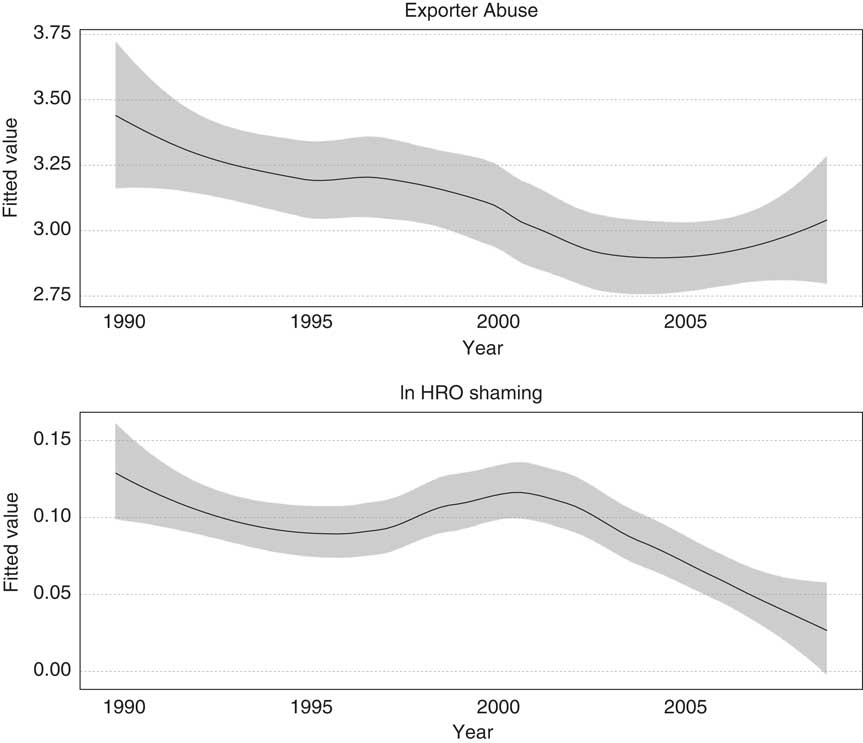
To capture shaming of exporters, we use the updated Murdie and Davis HRO shaming dataset,Footnote 61 as described in detail by Murdie and Peksen.Footnote 62 As such, our shaming measures capture the yearly count of all instances of shaming by 1,166 human rights organizations directed at a particular government or government agent, as identified in Reuters using the Integrated Data for Event Analysis (IDEA) framework by Virtual Research Associates, LLC.Footnote 63 We take the natural log of the raw count variable plus 1, given that counts are skewed, with many instances of zero shaming events.Footnote 64 Figure 1 illustrates trends in exporters’ human rights practices and NGO shaming behavior of exporters over time. Specifically, it presents a local polynomial smooth plot of the (inverted) physical integrity index and (logged) frequency of NGO shaming.Footnote 65 It illustrates that both abuse levels and NGO shaming have declined slightly on average over the span between 1990 and 2009.Footnote 66 However, abuse appears to decline consistently, while shaming at first holds steady, and then decreases more rapidly.
Local polynomial smooth plot of exporter abuse (8-physint) and (logged) exporter shaming over time

Given our interactive specification, the coefficient for exporter abuse captures the marginal effect of increasing abuse under two specific conditions: (1) in the absence of shaming – that is, when there are no HRO shaming events against the exporter, and (2) in the absence of importer abuse – that is, when importer abuse is equal to 0. Similarly, the coefficient for HRO shaming events represents the association between shaming and exports in the absence of abuse by either state – that is, when the exporter’s and importer’s inverted physical integrity indices are equal to 0. In order to capture the influence of exporter abuse at higher levels of NGO shaming and importer abuse, we must interpret each coefficient along with the interaction terms.Footnote 67
Three-way interactions require careful interpretation. Given the complexity of our design, we also present models in which we include a two-way interaction between exporter abuse and shaming, sub-setting the data to examine respectful and abusive importers separately, otherwise replicating the dyad fixed effects and dyad random effects specifications.Footnote 68
Other Explanatory Variables
We control for the overall frequency of events regarding the exporting state as reported in the IDEA data. Specifically, we take the (logged) value of total events less shaming events plus 1. The inclusion of this variable is intended to overcome possible bias in our estimates of shaming events that could follow if our shaming event counts were actually capturing overall attention to the exporting state. Remaining explanatory variables capture typical gravity model variables, particularly those that could correlate with human rights practices. In accordance with the gravity model, we include variables for the importer’s and exporter’s gross domestic product (GDP). We take the natural log of each state’s GDP in constant 2005 US dollars, using Gleditsch’s Expanded GDP and Population Data version 6.0.Footnote 69 On average, wealthier states tend to have lower levels of abuse and higher levels of trade. Similarly, we include measures of each state’s (logged) population, taking population values from Gleditsch.
In our random effects models, we include a measure of (logged) distance between capitals, as well as a dichotomous indicator of shared borders and a dichotomous indicator of a common spoken language. However, in the dyad fixed effects models, these time-invariant variables would drop from the analysis. Notably, the dyad-specific residual incorporates the influence of these and other unmodeled, dyad-specific phenomena on exports. Accordingly, the fixed effects models should not be biased by the exclusion of a distance variable. All of these variables are taken from the Centre d’Études Prospectives et d’Informations Internationales (CEPII) ‘GeoDist’ database.Footnote 70
Additionally, given that human rights correlate with democracy, we include variables for the importer’s and exporter’s twenty-one-point Polity combined score, as well as a multiplicative interaction of these variables.Footnote 71 We take the natural log of the raw score plus 11, such that the logged minimum value is equal to 0. More democratic states (and dyads) could trade more,Footnote 72 while they are likely to abuse less, with some exceptions.Footnote 73 Furthermore, leaders in less democratic importing states might be less attentive to HRO shaming, given that the shaming often achieves its objectives via informing mass publics – whose preferences are often ignored by dictators.Footnote 74 Given relative stability in Polity scores between 1990 and 2009 for most (but not all) dyads, we include these variables only in the dyad random effects models. However, the supplementary appendix presents dyad fixed effects models including Polity scores and the interaction thereof.
Finally, we address the potential for our results to reflect the fact that attention to human rights abuse could correlate with sanctions – either dyadic or by third parties – that reduce trade volumes. First, we present models that include variables for dyadic and third-party sanctions. However, given potential for dyadic sanctions to be a mediating variable leading from our explanatory variables and to our dependent variable, it might be inappropriate simply to control for the variable. Accordingly, we also present models that exclude all observations in which dyadic sanctions against the exporter are in force.
Analysis
We find strong evidence in favor of our hypotheses. Our main finding is that association between exporter human rights abuse and export volume becomes increasingly negative as HRO shaming against the exporter increases – but only under the condition that the importing state has (relatively) respectful human rights practices. In the absence of shaming, the association between exporter human rights abuse and export volume either is not statistically significant, or is negative and statistically significant, but substantively minimal.
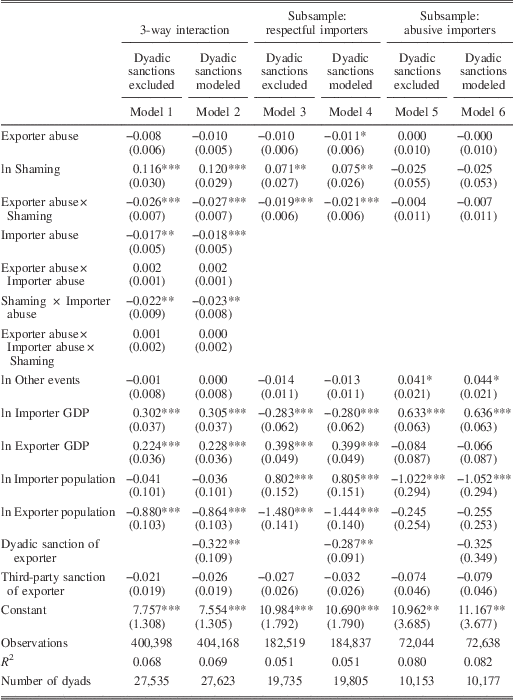
Table 1 presents coefficients and robust standard errors for two-way (dyad and year) fixed effects models examining both the exporter’s and importer’s abuse of physical integrity rights (using the inverted CIRI physical integrity index), the number of HRO shaming events, and exports. We present six models in Table 1. Model 1 is the baseline, including most explanatory variables and excluding all observations where the importer is actively sanctioning the exporter. Model 2 includes all observations where dyadic sanctions against exporter are active, adding a variable capturing the presence of these sanctions.
Fixed Effects Coefficients and Robust Standard Errors

Notes: All models include dyad and year fixed effects. Robust standard errors in parentheses.
***p<0.001, **p<0.01, *p<0.05.
The results of Models 1 and 2 are nearly identical. First, we find that the coefficient for physical integrity abuse is not significant. Accordingly, we find support for our expectation that human rights abuse is not detrimental to exports in the absence of HRO shaming – even when importers are completely respectful of human rights (that is, when HRO shaming and importer abuse are both held at 0). The coefficient for HRO shaming is positive and significant in both Models 1 and 2, suggesting – surprisingly – that, in the absence of abuse by the exporter or importer, shaming could actually be beneficial for exports. It is possible that this result reflects a situation in which human rights practices improved following shaming, leading to an increase in trade. However, we doubt that this optimistic outcome occurs; this finding could also be a statistical artefact given that HRO shaming events should be few in number in the absence of physical integrity rights abuse. Indeed, this coefficient illustrates an extrapolation about which we should be skeptical. Alternatively, it is possible that shaming occurring under this condition is focused on abuse of economic, political, or civil rights, rather than physical integrity rights.
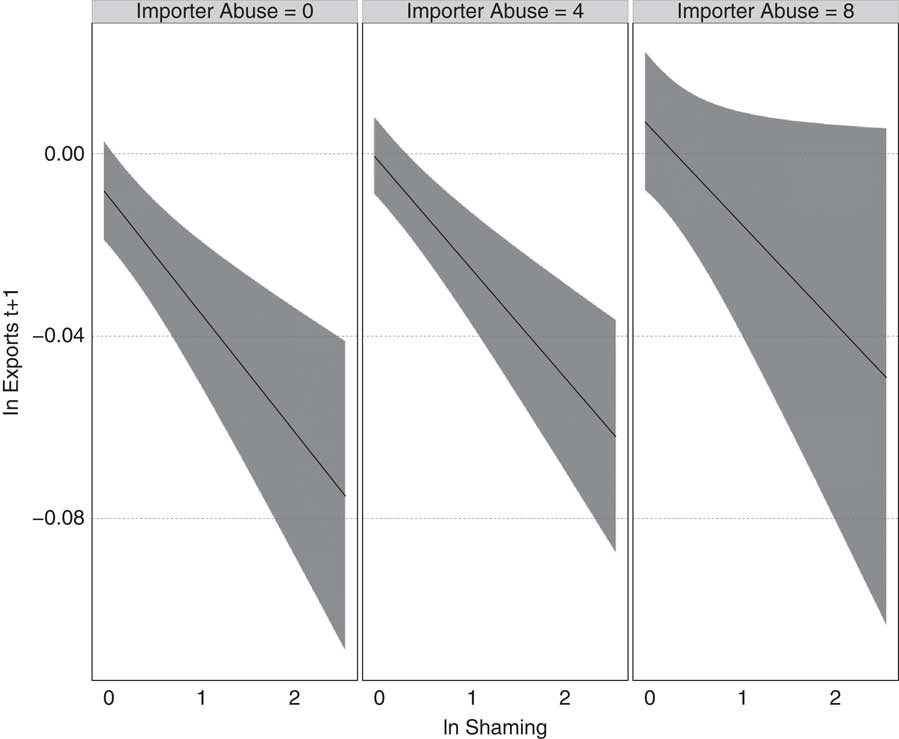
Most importantly for our hypotheses, we find that there is a negative and significant interaction term for abuse X shaming in Models 1 and 2. This result suggests that the influence of physical integrity rights abuse by the exporter is conditional on HRO shaming (and vice versa). Specifically, this interaction term suggests that the marginal effect of abuse becomes increasingly negative as HRO shaming increases. However, because we specify a three-way interaction, this conditional relationship between exporter abuse and exports applies only in the specific case that the importer engages in no abuse (that is, when importer abuse equals 0). Given that constituent terms and interaction variables do not fully convey the nature of interactions, we illustrate the conditional marginal effects of our key variables in Figure 2, following from the results of Model 1.
Conditional marginal effects for exporter abuse, with 95 percent confidence intervals

Although a three-way interaction can be cumbersome to interpret even in figures, we can illustrate our hypothesized relationships with three graphs. First, the left-hand graph of Figure 2 illustrates the marginal effect of exporter human rights abuse over the range of HRO shaming events in the specific case that the importer engages in no abuse. When there are zero HRO shaming events, a one-point higher value for abuse is associated with 0.8 percent lower exports from state i to state j , but this value is not statistically significant (p<0.138).Footnote 75 When there is one HRO shaming event, a one-point higher score for abuse is associated with 2.6 percent lower exports, a value that is statistically significant (p<0.001). At the maximum of twelve HRO shaming events, we predict that exports will be 7.2 percent lower for each additional point of physical integrity abuse (p<0.001).
The middle graph of Figure 2 replicates the left-hand graph, examining the marginal effect of exporter human rights abuse conditional on HRO shaming when holding importer abuse at its mid-point (4 on the 0–8 scale). Results for this graph look quite similar to those when importers are most respectful of human rights. However, estimates for reduction in trade appear slightly smaller at any given level of HRO shaming – although not (statistically) significantly so.
The right-hand graph of Figure 2 replicates the left-hand and middle graphs, examining the marginal effect of exporter human rights abuse conditional on HRO shaming. The values in this graph are taken holding importer abuse at the maximum (equal to 8). Notably, the slope of the line for exporter abuse looks similar to those in the left-hand and middle graphs. Most importantly, however, is that the 95 percent confidence bounds are considerably larger in the right-hand graph, such that the marginal effect of exporter abuse is not statistically significant at any level of HRO shaming. This result highlights the importance of accounting for the three way interaction despite the fact that the three-way interaction term is not significant in our models; the presence of increasingly abusive importers does not lead to a statistically significant change in the point estimate of the association between exporter abuse and export level, instead introducing higher uncertainty for this estimate. Accordingly, we find support for both of our hypotheses. Exporter abuse is associated with lower exports when it is shamed more; however, this effect is strongest when the importer is respectful of physical integrity rights, losing significance as the importer becomes more abusive.
Models 2 through 6 in Table 1 present alternative specification in which we omit the three-way interaction, instead including a two-way interaction for exporter abuse and HRO shaming and then sub-setting our observations by importer abuse level. Results from these models demonstrate patterns identical to that in Models 1 and 2. In Models 3 and 4, which include observations only for ‘respectful’ importers (with abuse less than 3 on the 0–8 scale), we find results similar to those in Models 1 and 2. Specifically, we find a negative and significant interaction term for Exporter Abuse x ln Shaming. Examinations of the interaction effect (omitted due to space considerations) suggest a conditional association very similar to that illustrated in Figure 2. Conversely, in Models 5 and 6, which include all observations in which importers are relatively abusive (with abuse greater than 5 on the 0–8 scale), none of the coefficients for Exporter Abuse, ln Shaming, or the interaction thereof, is statistically significant at conventional levels. An examination of conditional marginal effects confirms that there is no statistically significant association between exporter abuse and export volume at any level of HRO shaming.
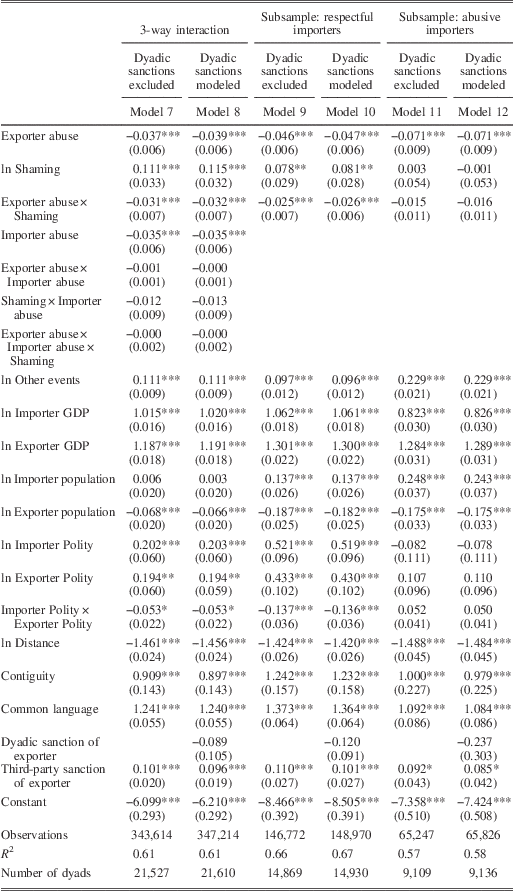
Table 2 replicates Table 1 with a few important alterations. First, we include dyad random effects rather than dyad fixed effects (while retaining year fixed effects). Second, we include a number of additional control variables that capture dyad-specific, but time-invariant factors, such as distance, common language, and democracy level.Footnote 76 Results of these models look nearly identical to those reported in Table 1; accordingly, we omit a detailed discussion. However, one important difference emerges. Specifically, in the random effects models, we find that human rights abuse by the exporter is associated with lower exports even in the absence of shaming, and even when the importer is also abusive. As discussed above, this finding could stem from the fact that human rights abuse harms productivity. Notably, however, in the case where importers respect human rights, the impact of exporter abuse is relatively small when shaming is absent, becoming larger as shaming increases – consistent with our expectations. When importers are abusive, the association between exporter abuse and export volume remains small even when HRO shaming is frequent.Footnote 77
Random Effects Coefficients and Robust Standard Errors

Notes: All models include dyad random effects and year fixed effects. Robust standard errors in parentheses.
***p<0.001, **p<0.01, *p<0.05.
Control variables look as expected. In all models, both importer and exporter GDP are positively associated with trade levels. Population has a more varied association with export volume across models – a result that is likely to occur due to gravity model conventions. The inclusion of ln GDP and ln Population implies that we also control for GDP per capita, given that ln(GDP/population) is mathematically equivalent to ln GDP – ln Population. A negative coefficient therefore could indicate that exports decrease as GDP per capita decreases (given that more population for a given level of GDP implies lower GDP per capita). From the random effects models in Table 2, we find, as expected, that a greater distance is associated with lower trade, while common borders and shared languages are associated with higher trade. In Models 7–10, we find that higher levels of democracy for either state are associated with greater export volumes. An examination into the negative and significant interaction term suggests diminishing returns to democracy: the positive impact of importer or exporter democracy is strongest when the other state is less democratic, and becomes relatively smaller when the other state is more democratic. In our fixed effects models (except in the restricted sample examining only abusive importers), we find that dyadic sanctions against the exporter are associated with lower export volume, as expected. The third-party sanction variables are significant only in random effects models, wherein their sign is positive, suggesting that a third party sanction against the exporter could be associated with higher dyadic exports. This association could exist if exporters redirect trade when they are restricted from doing business in some markets.
Conclusion
Does human rights abuse ‘pay’? In other words, when does human rights abuse harm a country’s bottom-line? In this article, we outline a mechanism through which international markets respond to human rights abuses. Our theoretical argument connects the global negative attention for human rights abuses by HROs – i.e., shaming – to lower exports among abusive states. We argue that shaming is critical to getting third-party countries, importers, and consumers aware of abuses happening in exporter countries. Without this global attention, abuse could have little or no negative repercussions. Yet, when the ‘spotlight’ of HRO attention shines on a country, international markets react. The exports of abusive states – to respectful states – suffer when HRO shaming occurs. We find widespread evidence for the implications of our argument in the post-Cold War time period.
These results reiterate the powerful role of non-state actors in world politics and draw attention to the process by which states could be pressured to improve their human rights practices.Footnote 78 Decreasing exports could make local power brokers upset at a regime’s repression, leading the regime to rethink the utility of the abuse. This evidence reinforces our current theoretical understanding of the process by which human rights improve.Footnote 79 Further, it outlines how international firms, in responding to boycotters, can become part of the advocacy network pressuring a state to improve their human rights practices. For example, by leaving Burma as a result of the boycott, multinational firms like Texaco and Eddie Bauer were joining in with Amnesty International and Human Rights Watch in demanding that Burma stop its repressive practices.Footnote 80 Although firms have been classified as potentially part of advocacy networks, this paper addresses a potential mechanism for their involvement in human rights issues.
Our results complement those of studies identifying how trade could lead to a diffusion of respectful human rights practices.Footnote 81 Whereas domestic individuals and groups in human rights-respecting importing states could pressure leaders to demand better practices, we find that these actors can also work largely independent of governments to pressure firms and limit their purchasing of products from exporters in abusive states. Furthermore, we point out the important caveat that this process does not occur unless global attention is focused on abusive exporters. Future research can benefit from examining the potentially competing motives by domestic interests to restrict trade or facilitate improved practices among continuing trade partners, as well as the potentially varying effectiveness and consequences of each of these goals.
Supplementary Material
To view supplementary material for this article, please visit http://dx.doi.org/10.1017/S0007123416000065