Introduction
A cochlear implant is a small, complex electronic device which can help to provide hearing to people with severe to profound hearing loss. The implant consists of an external component that sits behind the ear and an internal component that is surgically implanted under the skin. Although no problems are encountered with the majority of these implants, a small number do become infected. In such cases, if the device is to be salvaged, immediate intervention is required.Reference Trinidade, Rowlands, Obholzer and Lavy1
Following device implantation, reported five-year failure rates range from as low as 1.5 per cent up to 5.7 per cent.Reference Balkany, Hodges and Goodman2, Reference Roland, Huang and Cohen3 However, if the surgically implanted, internal component of the device becomes infected, the chances of salvage are minimal. Despite prolonged courses of high dose antibiotics and treatment with other antimicrobial agents such as hydrogen peroxide, such infected devices will almost invariably have to be removed, primarily due to the fact that the infecting bacteria grow in a biofilm, conferring increased resistance to antibiotics. The increased antibiotic resistance of bacteria growing in a biofilm has been attributed to a number of factors, including decreased antibiotic penetration, altered metabolism of bacteria growing in biofilm and expression of biofilm-specific antibiotic resistance genes.Reference Lewis4 Therefore, alternative approaches are required to treat cochlear implant biofilm mediated infections at the time of implant removal.
Previous studies have shown that many of the pathogens responsible for ear infections, such as meticillin-sensitive Staphylococcus aureus and Pseudomonas aeruginosa, are sensitive to tea tree oil, the essential oil of Melaleuca alternifolia.Reference Farnan, McCallum, Awa, Khan and Hall5, Reference Brady, Loughlin, Gilpin, Kearney and Tunney6 In addition, further studies have demonstrated that biofilms formed by meticillin-sensitive S aureus are particularly sensitive to this essential oil.Reference Brady, Loughlin, Gilpin, Kearney and Tunney6
In this study, we cultured a meticillin-sensitive S aureus isolate from a biofilm growing on a retrieved cochlear implant. We determined this bacterial isolate's susceptibility, growing planktonically and in biofilm, to a range of conventional antibacterial agents and also to tea tree oil and its active component terpinen-4-ol. Furthermore, as previous studies have demonstrated that biofilm development can be mediated by differing adhesion mechanisms, the mechanism of biofilm formation utilised by this bacterial isolate was also investigated.Reference Mack, Haeder, Siemssen and Laufs7, Reference Wang, Preston and Romeo8
Materials and methods
Case study
A cochlear implant, which was known to be infected, was explanted from a 75-year-old woman at the Department of Otolaryngology, Belfast City Hospital, Belfast Health and Social Care Trust, Northern Ireland.
The patient had undergone an uneventful initial cochlear implant insertion, and had been discharged with a five-day course of 375 mg oral co-amoxiclav thrice daily, as per standard treatment.
However, one week following her operation the patient was readmitted with pain, erythema and discharge from her post-auricular wound. Five millilitres of thick, brown fluid were aspirated and a saline wick inserted. A sample was sent for culture and sensitivity; on the advice of the microbiology department, the patient was commenced on intravenous piperacillin–tazobactam 4.5 g thrice daily. The patient's white cell count was slightly elevated, at 14.7 × 10⁹ /l, although she was apyrexial throughout the admission. The bacteriology report confirmed the presence of meticillin-sensitive S aureus, and her antibiotic regime was changed to intravenous flucloxacillin 2 g four times daily. This was continued for seven days then changed to oral flucloxacillin 500 mg four times daily, to be maintained for a further four weeks. During this admission, the patient's erythema and discharge gradually settled, and she was discharged home on day 13. A swab was taken prior to discharge, which revealed no bacterial growth.
At review five days post-discharge, while the patient was still taking oral flucloxacillin, a fluctuant area in the central part of the post-auricular wound was noted and serous fluid aspirated. Unfortunately, this area developed into a discharging sinus which failed to heal, and the decision was taken to formally explore the wound, almost seven weeks after initial implantation.
During this procedure, samples of mucoid fluid from around the implant were sent for microbiological analysis, and the implant was temporarily bathed in 6 per cent hydrogen peroxide soaked gauze. A superiorly based muscle flap was placed over the implant to aid wound healing. Microbiology results again indicated no bacterial growth, but a 10-day course of 500 mg oral flucloxacillin four times daily was still prescribed.
Initially, the wound appeared to be healing well. However, at review 25 days after exploration, an area of necrosis around the central part of the wound was noted, together with purple discolouration of the surrounding skin. There was also a thick, mucopurulent discharge, from which meticillin-sensitive S aureus isolate was cultured.
At this stage, it was decided that the only option was to remove the implant. Following explantation, mucopurulent material was dislodged from the implant surface by sonication and cultured. Briefly, after gentle washing the explanted device was further sonicated in 20 ml of sterile phosphate-buffered saline for 5 minutes to dislodge any remaining adherent bacteria. This phosphate-buffered saline solution was then plated onto Müeller–Hinton agar and incubated overnight at 37°C. The isolate was then transferred to preserver beads, stored at −70 °C and subcultured to Müeller–Hinton agar slopes before testing. Identification of the isolate was confirmed using a multiplex polymerase chain reaction, based on a previously described method with primers directed against the 16S ribosomal RNA and the nuc and mecA genes.Reference Strommenger, Kettlitz, Werner and Witte9
In addition to the test isolate, the RP62A (ATCC 35984) S aureus isolate (known to form biofilms) was used as a reference biofilm-forming organism.
Reagents
European pharmacopoeia grade tea tree oil was obtained from G R Lane Health Products (Gloucester, UK). Terpinen-4-ol was obtained from Acros Organics (Loughborough, UK). The following antimicrobial agents were used: amikacin sulphate (as Amikin®; Bristol Myers Squibb, Uxbridge, UK); cefuroxime sodium (as Zinacef®); ceftazidime pentahydrate (as Fortum®) and chlorhexidine (as Corsodyl®; GlaxoSmithKline, Uxbridge, UK); gentamicin sulphate, tobramycin sulphate and ofloxacin (Sigma Chemical, Poole, UK); meropenem (as Meronem®; Astra-Zeneca, Luton, UK); rifampicin (as Rifadin®; Aventis Pharma, Guilford, UK); and vancomycin hydrochloride (Alpharma, Barnstaple, UK). In addition, E-tests® (Bio-Stat, Stockport, UK) containing the following antimicrobial agents were used: pipericillin–tazobactam, clindamycin, linezolid, ampicillin, fusidic acid and mupirocin.
Crystal violet powder, hydrogen peroxide, Tween® 80, 3-(4,5-dimethylthiazol-2-yl)-2,5-diphenyltetrazoliumbromide, sodium metaperiodate and proteinase-K were all obtained from Sigma-Aldrich (Gillingham, UK).
Polymer formation
In order to accurately replicate the surface on which the cochlear implant meticillin-sensitive S aureus isolate had been growing in biofilm in vivo, the polymer liquid silicone rubber 30 (Polymer Systems Technology, High Wycombe, UK), which is identical to that used to encase cochlear implants, was prepared according to instructions and used. Briefly, a 1:1 mixture of liquid silicone rubber 30 part A and liquid silicone rubber 30 part B were mixed in a rapid speed mixer (DAC 150 FVZ-K Speed Mixer; Flacktec Inc, Landrum, USA) at 3000 rpm for 15 seconds. The resultant mixture was then centrifuged for 15 minutes at 3700 rpm to remove air bubbles. The centrifuged polymer was then cured at 100 ± 5°C for 1 hour. Upon curing, the polymer was cut into 1 cm2 sections and autoclaved prior to use, to ensure a sterile test surface.
Planktonic bacteria susceptibility testing
The minimum inhibitory concentrations of a range of antibacterials (amikacin, cefuroxime, ceftazidime, chlorhexidine, gentamicin, meropenem, ofloxacin, rifampicin, tobramycin and vancomycin) were determined for the isolate using the broth microdilution method, according to the British Society for Antimicrobial Chemotherapy guidelines.Reference Andrews10 Serial twofold dilutions of each antimicrobial were prepared in Iso-Sensitest broth (Oxoid, Basingstoke England), and final test volumes of 75 µl were dispensed into microdilution wells. The inoculum to be tested was prepared by adjusting the turbidity of an actively growing broth culture, in Iso-Sensitest broth, to an optical density at 550 nm, equivalent to 1 × 10⁸ colony-forming units/ml. The suspension was further diluted to provide a final inoculum density of 2 × 10⁵ colony-forming units/ml, in Iso-Sensitest broth, which was verified by total viable count. The final inoculum (75 µl) was then added to each well of the microdilution trays, which were incubated aerobically for 24 hours at 37°C. Positive and negative growth controls were included in every assay.
After incubation, the minimum inhibitory concentration was read as the lowest concentration of antibacterial which inhibited visible growth of the isolate. Determination of the minimum inhibitory concentration was carried out in triplicate, and results were recorded where there was agreement in at least two out of three minimum inhibitory concentration results. After determination of minimum inhibitory concentrations, minimum bactericidal concentrations were determined by spreading 10 µl of suspension from wells showing no growth onto Iso-Sensitest agar plates, which were then incubated as described previously and examined for 99.9 per cent killing.
In addition, the susceptibility of the cochlear implant meticillin-sensitive S aureus isolate to ampicillin, clindamycin, fusidic acid, linezolid, mupirocin and piperacillin–tazobactam was determined using E-Test strips, according to the manufacturer's instructions.
In order to determine the susceptibility of the cochlear implant meticillin-sensitive S aureus isolate to tea tree oil and terpinen-4-ol, serial twofold dilutions of tea tree oil and terpinen-4-ol in Iso-Sensitest broth were prepared in 96-well microtitre trays over the range 0.125 to 8 per cent (volume for volume). To enhance oil solubility, Tween 80 was included in all assays at a final concentration after inoculation of 0.25 per cent (volume for volume). To overcome the problem of turbidity due to the solubilised oil, 3-(4,5-dimethylthiazol-2-yl)-2,5-diphenyltetrazoliumbromide, a tetrazolium salt which is reduced by metabolically active cells to a coloured, water-soluble formazan derivative, was added to the Iso-Sensitest broth to allow visual identification of metabolic activity. The final concentration of 3-(4,5-dimethylthiazol-2-yl)-2,5-diphenyltetrazoliumbromide after inoculation was 0.005 per cent (volume for volume). For tea tree oil and terpinen-4-ol, bacterial growth after incubation was indicated by the development of a red colour; therefore, the minimum inhibitory concentration was recorded as the lowest concentration of tea tree oil and terpinen-4-ol at which no colour change occurred.
Quantification of biofilm formation
Bacterial biofilms were grown in 96-well trays as described previously, with the following modifications.Reference Stepanovic, Vukovic, Dakic, Savic and Svabic-Vlahovic11 Briefly, the cochlear implant meticillin-sensitive S aureus isolate was grown overnight at 37°C in Tryptone Soya Broth, Oxoid, Basingstoke England. The inoculum for use in biofilm studies was then prepared by adjusting the turbidity of an actively growing broth culture in Tryptone Soya broth, Oxoid, Basingstoke England to an optical density at 550 nm, equivalent to 1 × 10⁸ colony-forming units/ml. The suspension was further diluted to provide a final inoculum density of 2 × 10⁵ colony-forming units/ml in Tryptone Soya broth, which was verified by total viable count. Eight wells of the 96-well tray were filled with 200 µl of this bacterial suspension, while eight negative control wells were filled with Tryptone Soya broth only. The plates were then covered and incubated for 24 hours at 37°C. To establish biofilm adherence over a longer time period (i.e. 48 hours), the initial process was repeated and, instead of 24 hours, the plates were covered and incubated at 37°C for 48 hours before treatment.
To assess the level of biofilm formation, bacterial biomass was assessed using crystal violet staining. Following biofilm formation, media was removed and the biofilms were rinsed with 100 µl sterile phosphate-buffered saline, prior to being fixed in the wells of the microtitre plate by adding 150µl methanol and incubating at room temperature for 20 minutes. The methanol was then discarded and the wells allowed to air-dry for 5 minutes, prior to the addition of 150 µl of a 2 per cent (weight for volume) solution of crystal violet in ethanol. Biofilms were stained for 5 minutes with crystal violet at room temperature. The crystal violet solution was then discarded and the wells thoroughly rinsed with tap water. After air-drying for 20 minutes at room temperature, crystal violet adherent to the wells was solubilised with 150 µl of 33 per cent (volume for volume) glacial acetic acid. The absorbance of each well at 590 nm was then measured using a Tecan Sunrise® plate reader (Tecan UK, Reading, United Kingdom).
For the purposes of comparative analysis, this study used a classification of biofilm adherence based on a 2000 study by Stepanovic et al. Reference Stepanovic, Vukovic, Dakic, Savic and Svabic-Vlahovic11 Bacterial isolates were classified as non-adherent (scored 0), weakly adherent (+), moderately adherent (+ +) or strongly adherent (+ + +) based on the optical density of bacterial biofilms. The cut-off optical density for the study was defined as three standard deviations above the mean optical density of the negative control.
Detection of biofilm formation
Bacterial biofilms were grown in three 96-well trays as described previously. Following overnight incubation, the supernatant was discarded and the plates washed twice with 150 µl sterile phosphate-buffered saline. Plates were then treated as follows.
Plate one
Following supernatant removal and washing, each well was filled with 200 µl 40 mM sodium metaperiodate solution and incubated for a further 24 hours at 4°C. After incubation, the sodium metaperiodate solution was discarded and the wells washed thoroughly with phosphate-buffered saline. The plate was then allowed to air-dry, stained with crystal violet and the absorbance measured as described above.
Plate two
Following supernatant removal and washing, each well was filled with 200 µl of a proteinase-K solution (1 mg/ml in 100 mM Tris) and incubated for 4 hours at 37°C. After incubation, the proteinase-K solution was discarded and the wells washed thoroughly with phosphate-buffered saline. The plate was then allowed to air-dry, stained with crystal violet and the absorbance measured as described above.
Plate three
In addition to the above, an untreated control was created. Following supernatant removal and washing with phosphate-buffered saline, the plate was allowed to air-dry, stained with crystal violet and the absorbance measured as described above.
Biofilm susceptibility testing
An initial inoculum of 5 × 10⁹ colony-forming units/ml was prepared for use in biofilm susceptibility studies by diluting an actively growing culture in Iso-Sensitest broth as described previously. Samples of the initial inoculum (50 µl) were inoculated onto the surface of liquid silicone rubber polymer squares. These were then dried at 37°C in an incubator for 1 hour. After the squares were gently washed with sterile phosphate-buffered saline to remove any non-adherent bacteria, they were placed in sterile Petri dishes (3 squares per dish) containing 20 ml Iso-Sensitest broth and incubated at 37°C for 24 hours. After gently washing with sterile phosphate-buffered saline to remove any non-adherent bacteria, the squares were then transferred to McCartney bottles containing a range of concentrations of cefuroxime, gentamicin, rifampicin and vancomycin in Müeller–Hinton broth.
In addition, to replicate the activity of the disinfection practice currently used in our otolaryngology department after removal of an implant and prior to replacement, further squares were transferred to McCartney bottles containing 3 and 6 per cent hydrogen peroxide.
Similarly, further squares were transferred to McCartney bottles containing a range of concentrations of tea tree oil and terpinen-4-ol in both sterile distilled water and Müeller–Hinton broth.
Finally, two controls (0.5 per cent Tween 80 in sterile distilled water and 0.5 per cent Tween 80 in Müeller–Hinton broth) were used. McCartney bottles containing cefuroxime, gentamicin, rifampicin and vancomycin in Müeller–Hinton broth were incubated at 37°C overnight. Similarly, McCartney bottles containing tea tree oil and terpinen-4-ol in Müeller–Hinton broth were incubated at 37°C overnight. McCartney bottles containing tea tree oil, terpinen-4-ol and hydrogen peroxide in aqueous solution were shaken (100 rpm) at 37°C in an orbital incubator for 1 hour.
Following treatment, all squares were washed and placed in 5 ml phosphate-buffered saline in sterile McCartney bottles, and any bacteria retained on the surface were dislodged by mild ultrasonication (5 minutes) in a 150 W ultrasonic bath operating at a nominal frequency of 50 Hz, followed by rapid vortex mixing (30 seconds). Serial 10-fold dilutions were performed and total viable counts determined after overnight incubation at 37°C. All experiments were performed in triplicate.
Results
Planktonic bacteria susceptibility testing
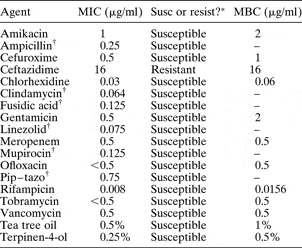
The minimum inhibitory concentration and minimum bactericidal concentration data for all antimicrobial agents tested are shown in Table I. When grown planktonically, the cochlear implant meticillin-sensitive S aureus isolate was susceptible to 17 of 18 antibacterial agents, based on the British Society for Antimicrobial Chemotherapy breakpoint susceptibility guidelines and commonly accepted susceptibility breakpoints for tea tree oil, terpinen-4-ol and chlorhexidine gluconate. Ceftazidime, with a minimum inhibitory concentration of 16 µg/ml, was the only antibiotic to which this isolate was resistant. Of the 15 antibiotics to which the isolate was sensitive, eight (amikacin, ampicillin, clindamycin, linezolid, meropenem, piperacillin–tazobactam, rifampicin and vancomycin) demonstrated a minimum inhibitory concentration value of at least three twofold dilutions below the British Society for Antimicrobial Chemotherapy susceptibility breakpoint. Minimum bactericidal concentrations were similar to minimum inhibitory concentrations; no minimum bactericidal concentration was greater than two twofold dilutions above the respective minimum inhibitory concentration.
MIC and MBC data for cochlear implant MSSA isolate, for 18 antimicrobial agents

*According to British Society for Antimicrobial Chemotherapy, and conventionally accepted breakpoints. †Determined by E-Test. MIC = minimum inhibitory concentration; MBC = minimum bactericidal concentration; MSSA = meticillin-sensitive Staphylococcus aureus; susc = susceptible; resist = resistant; – = not available as MIC determined by E-Test; pip–tazo = piperacillin–tazobactam
Biofilm formation: quantification and mechanism
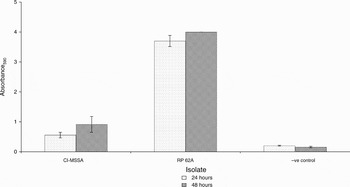
The ability of the cochlear implant meticillin-sensitive S aureus isolate to form a biofilm in microtitre plates was determined by measuring biomass, using crystal violet staining (Figure 1). Using the previously described classification system, the cochlear implant isolate proved to be moderately adherent (i.e. + +) at both the 24-hour and 48-hour time points.Reference Stepanovic, Vukovic, Dakic, Savic and Svabic-Vlahovic11 As expected, the known biofilm-forming S aureus isolate RP62A demonstrated strong adherence (i.e. + + +) at both time points.
Biofilm formation (indicated by absorbance at 590 nm) for cochlear implant meticillin-sensitive Staphylococcus aureus (CI-MSSA) isolate, RP62A (a known biofilm-forming S aureus isolate) and negative (–ve) control.

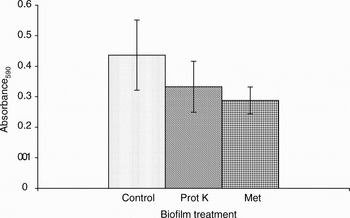
Figure 2 shows results for cochlear implant isolate biofilm growth after treatment with proteinase-K and metaperiodate. After crystal violet staining, similar absorbance readings were recorded for the proteinase-K- and metaperiodate-treated biofilms, with readings of 0.333 and 0.288, respectively.
Effect on cochlear implant meticillin-sensitive Staphylococcus aureus (CI-MSSA) biofilm formation (indicated by absorbance at 590 nm) of treatment with proteinase-K (Prot K), metaperiodate (Met) or nothing (control).

Biofilm susceptibility testing
Due to its previous effectiveness against clinical isolates of S aureus in biofilm, the effectiveness of tea tree oil and of its active component terpinen-4-ol were assessed.Reference Brady, Loughlin, Gilpin, Kearney and Tunney6 We also studied the effect of hydrogen peroxide, currently used as an antiseptic agent in our department. Finally, to gain an indication of the effectiveness of a range of conventional antibiotics against the isolate in biofilm, the effect of increasing concentrations of cefuroxime, gentamicin, rifampicin and vancomycin were also investigated.
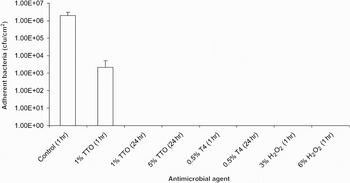
As shown in Figure 3, exposure of the bacteria in biofilm to 0.5 per cent terpinen-4-ol and to 3 and 6 per cent hydrogen peroxide resulted in complete eradication of the biofilm after 1 hour. Similarly, no adherent bacteria were detected after 24 hours' exposure to tea tree oil (at 1 and 5 per cent) and to 0.5 per cent terpinen-4-ol. In contrast, although exposure of the biofilm to 1 per cent tea tree oil for 1 hour reduced the number of adherent bacteria by approximately 103 colony-forming units/cm2, compared with the control, complete eradication of biofilm growth did not occur. However, when the concentration of tea tree oil was increased to 5 per cent, biofilm growth was completely eradicated after 1 hour.
Effect of various antibacterial agents on the viability of cochlear implant meticillin-sensitive Staphylococcus aureus in biofilm. TTO = tea tree oil; T4 = terpinen-4-ol; cfu = colony-forming units

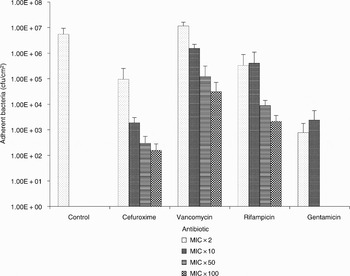
When treated with conventional antibiotics (Figure 4) which had previously demonstrated effectiveness against the isolate in a planktonic suspension, the biofilm isolate was resistant to cefuroxime, rifampicin and vancomycin at even the highest tested concentration (minimum inhibitory concentration × 100). In contrast, although gentamicin concentrations of minimum inhibitory concentration × 2 and minimum inhibitory concentration × 10 reduced biofilm viability without eradicating growth, concentrations of minimum inhibitory concentration × 50 and minimum inhibitory concentration × 100 resulted in complete biofilm eradication after 24-hour exposure.
Effect of various antibiotics on the viability of cochlear implant meticillin-sensitive Staphylococcus aureus in biofilm, after 24-hour exposure. MIC = minimum inhibitory concentration; cfu = colony-forming unit

Discussion
Cochlear implants are rarely complicated by microbial infection. However, when such infections do occur, they can be difficult to treat with conventional antibiotic therapy, and may consequently require surgical removal of the implant.Reference Cunningham, Slattery and Luxford12–Reference Tambyraja, Gutman and Megerian14 To date, several studies have demonstrated that infection of cochlear implants is due to biofilm formation.Reference Antonelli, Lee and Burne15, Reference Pawlowski, Wawro and Roland16 Biofilm-related infection is difficult to treat, as biofilm formation results in increased bacterial resistance both to the body's immune response and to antibiotic therapy.Reference Hoyle, Jass and Costerton17, Reference Buret, Ward, Olson and Costerton18 Furthermore, biofilms act as reservoirs, capable of releasing individual bacteria into the surrounding tissue, thereby causing recurrent episodes of infection which may persist, despite intensive antimicrobial therapy, until the device is removed. In addition, it has been acknowledged that, as the role of biofilm formation in human infection becomes more clearly defined, ENT surgeons should be prepared to deal with the unique demands of biofilm-related infection.Reference Vlastarakos, Nikolopoulos, Maragoudakis, Tzagaroulakis and Ferekidis19
To the best of our knowledge, this is the first study to assess the antimicrobial susceptibility of a bacterial isolate cultured from a cochlear implant. The retrieved cochlear implant isolate, when grown planktonically, demonstrated susceptibility to all but one of the antimicrobial agents tested. The only agent that proved ineffective was ceftazidime, a third generation cephalosporin. This result is not altogether unexpected as ceftazidime is mainly effective against Gram-negative organisms, possessing limited Gram-positive action. In addition to the conventional antibiotics tested, we also assessed the effectiveness of tea tree oil, the essential oil of Melaleuca alternifolia, and of its principal active component, terpinen-4-ol, both of which have previously demonstrated potential in killing clinical pathogens.Reference Brady, Loughlin, Gilpin, Kearney and Tunney6, Reference Ferrini, Mannoni, Aureli, Salvatore, Piccirilli and Ceddia20, Reference Loughlin, Gilmore, McCarron and Tunney21 The susceptibility of our study's cochlear implant meticillin-sensitive S aureus isolate to tea tree oil was similar to the minimum inhibitory concentration values reported in previous studies (i.e. the minimum concentration required to inhibit the growth of 90 per cent of organisms was 0.25 per cent).Reference Carson, Cookson, Farrelly and Riley22, Reference Nelson23 Similarly, the tea tree oil minimum inhibitory concentration of 0.5 per cent observed in our study was within the minimum inhibitory concentration range reported by Brady et al. (i.e. 0.5–2 per cent).Reference Brady, Loughlin, Gilpin, Kearney and Tunney6 Furthermore, the excellent antibacterial activity of tea tree oil and terpinen-4-ol observed in our study confirms the results reported by Ferrini et al., who found that the anti-staphylococcal activity of tea tree oil and terpinen-4-ol was superior to that of antibiotics belonging to the major classes.Reference Ferrini, Mannoni, Aureli, Salvatore, Piccirilli and Ceddia20 The minimum bactericidal concentration for tea tree oil observed in our study was also similar to those of previous studies using similar methods.Reference Carson, Cookson, Farrelly and Riley22, Reference Chan and Loudon24, Reference Elsom and Hide25 However, it was much lower than the minimum bactericidal concentrations reported by other studies, indicating the possibility of considerable isolate-to-isolate variation in meticillin-sensitive Staphylococcus aureus susceptibility to tea tree oil and, by assumption, to its principal active component terpinen-4-ol.Reference Brady, Loughlin, Gilpin, Kearney and Tunney6, Reference Banes-Marshall, Cawley and Phillips26
Our cochlear implant meticillin-sensitive S aureus isolate showed susceptibility to a wide selection of antimicrobial agents. However, it is widely recognised that the failure of implanted devices, such as cochlear implants, is predominantly mediated by biofilms.Reference Antonelli, Lee and Burne15 Furthermore, numerous studies have demonstrated that antimicrobial resistance is considerably increased when bacteria grow in biofilm mode.Reference Lewis4, Reference Anderson and O'Toole27 As a consequence, minimum inhibitory concentration data based on broth microdilution assays, such as the British Society for Antimicrobial Chemotherapy method, may provide antimicrobial concentrations which considerably underestimate the amount of antibacterial agent required to eradicate persistent bacterial biofilm infections. In order to further investigate our retrieved cochlear implant meticillin-sensitive S aureus isolate, its ability to form a biofilm was examined. Unsurprisingly, the isolate formed moderately adherent biofilm at both 24 and 48 hours. These results are comparable to those obtained by Stepanovic et al.; using a similar method, these authors reported that eight of 14 clinical S aureus isolates tested were moderately adherent.Reference Stepanovic, Vukovic, Dakic, Savic and Svabic-Vlahovic11 However, it was not clear whether these isolates were cultured from implants. Accordingly, it seems reasonable to assume that the ability of our isolate to form a biofilm in vivo would be a major contributing factor to its resistance to commonly prescribed antibiotics normally used to treat implant infection. This was demonstrated by the resistance of the isolate, in biofilm, to a range of antibiotics which had a mechanism of action similar to that of the antibiotic initially used, flucloxacillin (i.e. inhibition of cell wall synthesis).
Despite an increasing body of evidence implicating biofilm formation as the principle factor in cochlear implant rejection, no studies have investigated the mechanism of biofilm formation by bacteria isolated from retrieved cochlear implant devices. As demonstrated by Wang et al., if the polysaccharide β-1, 6-N-acetyl-D-glucosamine mediates biofilm formation, treatment with metaperiodate will result in biofilm dispersal.Reference Wang, Preston and Romeo8 In contrast, if biofilm formation is protein-mediated, treatment with metaperiodate will have no effect, whereas treatment with proteinase-K will result in biofilm disruption and dispersal. In addition, little is known about the factors contributing to biofilm formation in different clinical settings. It has recently been suggested that knowledge of these different factors could have major implications for the treatment of biofilm-mediated infections.Reference Rohde, Burandt, Siemssen, Frommelt, Burdelski and Wurster28 In our study, the cochlear implant meticillin-sensitive S aureus isolate appeared to utilise both polysaccharide and protein-mediated mechanisms of biofilm formation. These findings are similar to those of Rohde et al., who concluded that, in S aureus biofilm formation, polysaccharide intercellular adhesin and proteins acted cooperatively regardless of the infection site.Reference Rohde, Burandt, Siemssen, Frommelt, Burdelski and Wurster28 Similarly, while numerous studies have emphasised the importance of polysaccharide intercellular adhesin in staphylococcal-related biofilm infections, others have reported the prevalence of a proteinaceous mechanism of biofilm formation, notably in staphylococcal isolates which are polysaccharide intercellular adhesin negative.Reference Rohde, Burandt, Siemssen, Frommelt, Burdelski and Wurster28–Reference Rohde, Burdelski, Bartscht, Hussain, Buck and Horstkotte31 Prior to recent findings, it was thought that polysaccharide intercellular adhesin was the main factor affecting biofilm accumulation. However, Rohde et al. found that biofilms formed by all the S aureus isolates tested were disintegrated by trypsin, demonstrating that proteins are integral to S aureus biofilm accumulation, in addition to polysaccharide intercellular adhesin.Reference Rohde, Burandt, Siemssen, Frommelt, Burdelski and Wurster28
It is apparent that the S aureus isolate cultured from the retrieved cochlear implant in the present study is similar to S aureus isolates observed in other studies, in its ability to form a biofilm.Reference Stepanovic, Vukovic, Dakic, Savic and Svabic-Vlahovic11, Reference Rohde, Burandt, Siemssen, Frommelt, Burdelski and Wurster28 Therefore, it may be difficult to focus any potential future therapeutic treatment on one single mechanism of biofilm formation. Interestingly, it has been suggested that further work should be directed not at polysaccharide intercellular adhesin but rather at proteinaceous structures.Reference Rohde, Burandt, Siemssen, Frommelt, Burdelski and Wurster28 This suggestion is based on reports that the expression of the icaABCD operon, which codes for intercellular adhesion and subsequent polysaccharide intercellular adhesin synthesis, occurs in the later stages of S. aureus foreign-body infection. This suggests that other factors are active in the initial stages of biofilm formation.Reference Fluckiger, Ulrich, Steinhuber, Doring, Mack and Landmann32
Although bacteria in biofilm display increased resistance to antimicrobial therapy, often necessitating the removal of implanted devices, it would be of considerable therapeutic benefit if a treatment were available which negated the need for device explantation. Numerous studies have demonstrated that device infection and removal are associated with considerable patient morbidity. In addition, Antonelli et al. reported that replacement of a cochlear implant device costs in excess of £10 000, excluding surgical, anaesthetic and hospital fees.Reference Antonelli, Lee and Burne15 Although minimum inhibitory concentration data are a commonly used indication of susceptibility, by definition they test bacteria growing in suspension. Therefore, they may not be indicative of the presentation in vivo, where, as previously discussed, infection is more likely to present as a biofilm. Therefore, to more accurately replicate in vivo conditions we examined the bactericidal activity of tea tree oil, terpinen-4-ol and hydrogen peroxide, and of a range of conventional antibiotics, against a cochlear implant meticillin-sensitive S aureus isolate growing in biofilm.
The most effective agents against our isolate were 0.5 per cent terpinen-4-ol and 3 and 6 per cent hydrogen peroxide. The relevance of our inclusion of hydrogen peroxide as a test agent was based on its current use in treating infected implants. Briefly, due to the cost of implant replacement it may occasionally be decided to attempt salvage of the infected implant. In these cases, the patient will have the infected implant temporarily removed in the operating theatre and bathed in a 3 or 6 per cent hydrogen peroxide solution for approximately 30–60 minutes, in an attempt to eradicate the bacterial biofilm. After this period of disinfection, the implant is replaced as before and the patient is discharged on a high dose course of appropriate antibiotics, e.g. flucloxacillin. Unfortunately, this is often not successful, and the patient will often present days or weeks later requiring removal of the re-infected device.
Our study demonstrated that treatment with terpinen-4-ol or hydrogen peroxide for even as little as 1 hour was sufficient to eradicate all bacterial biofilm. Conversely, it also demonstrated how ineffective commonly used antibiotics were, even at high concentrations, in eradicating bacterial biofilm. Of the four antibiotics tested, only gentamicin was capable of eradicating the bacterial isolate when grown in biofilm. However, although effective, the gentamicin concentration required to eradicate infection could prove prohibitive in clinical practice, due to associated nephrotoxicity and ototoxicity, and may therefore only be effective if applied directly to the infected implant. Although 1 per cent tea tree oil failed to eradicate biofilm growth at 1 hour, 5 per cent tea tree oil (i.e. minimum inhibitory concentration × 10) proved sufficient to completely eradicate the biofilm formed by the cochlear implant meticillin-sensitive S aureus isolate. Similar studies have also reported complete biofilm eradication after 1-hour exposure to 5 per cent tea tree oil.Reference Brady, Loughlin, Gilpin, Kearney and Tunney6
• This study investigated antimicrobial treatment of an infected cochlear implant, with a view to salvaging the device
• The study assessed the susceptibility of a meticillin-sensitive Staphylococcus aureus isolate, cultured from the infected implant, to common antimicrobial agents as well as novel agents such as tea tree oil
• Treatment of infected cochlear implants with novel agents such as tea tree oil could significantly improve salvage outcome
Further to the current practice of peri-operative disinfection with hydrogen peroxide, it would be reasonable to assume that 30–60 minute exposure to hydrogen peroxide solution would be sufficient to eradicate biofilm growth from an infected implant. However, it is probable that after disinfection the implant, being reintroduced to the same site, would simply become recolonised with planktonic bacteria from the surrounding tissue, and as a result would ultimately require explantation. One potential solution to this problem would be to adopt a two-stage approach similar to that sometimes employed in revision hip surgery. The first stage would involve removal of the infected cochlear implant and disinfection of the device, e.g. using terpinen-4-ol or hydrogen peroxide. Following implant removal, the patient would then be prescribed a course of high dose intravenous antibiotics, such as gentamicin and flucloxacillin, for a prolonged period of time. Following such antibiotic therapy, and provided that bacteriology reports are negative for the presence of the infecting bacteria at the previous implantation site, the device could then be reimplanted to this site, which would now be free of infection.
Conclusion
The results of this study demonstrate that an isolate retrieved from an explanted cochlear implant was capable of forming a bacterial biofilm, mediated by both proteinaceous and polysaccharide intercellular adhesin mechanisms. In addition, as demonstrated by susceptibility data, the isolate was susceptible to conventional antibiotics when grown planktonically but highly resistant when grown in biofilm. Furthermore, the results demonstrate that, although resistant to conventional antibiotics, the cochlear implant meticillin-sensitive S aureus isolate, when grown in biofilm, was susceptible to tea tree oil, terpinen-4-ol and hydrogen peroxide after even a short exposure.
Therefore, the use of these agents, in conjunction with a two-stage treatment approach, could form the basis of a successful regime for the salvage of infected cochlear implants.