

Introduction
The genus Kalicephalus is a strongylid nematode of the family Diaphanocephalidae, with the adult worms living in the intestine of reptiles and lizards (Goldberg et al., Reference Goldberg, Bursey and Holycross2002). A total of 50 species of Kalicephalus have been reported in many countries and regions around the world. Infection with these parasites in animals can cause mild enteritis and raise a secondary bacterial infection, which can result in death of the hosts. Although there is no report on Kalicephalus infection in humans (Kavitha et al., Reference Kavitha, Latha, Bino Sundar, Jayathangaraj, Senthil Kumar, Sridhar and Abdul Basith2013), their prevalence in snakes is supposed to be underestimated or neglected (González-Fuentes et al., Reference González-Fuentes, Riehn, Koethe, von Borell, Luecker and Hamedy2014). For instance, a recent investigation showed a 25.0% prevalence of Kalicephalus in snakes in Brazil (Souza et al., Reference Souza, Barbosa, Vazon, Uchôa, Nunes, Cortez and Bastos2014). In spite of this, Kalicephalus species in snakes have been surveyed only in limited countries or regions (González-Fuentes et al., Reference González-Fuentes, Riehn, Koethe, von Borell, Luecker and Hamedy2014), and no survey of Kalicephalus prevalence has been reported in snakes in China.
In the past decade, Hunan Province in China has undergone major socio-economic development, resulting in a rapid increase in living standards and a change of life styles. This has led to more and more snakes being raised intensively. However, nothing is known about the infection of parasitic nematodes in snakes. Therefore, the aim of the present study was to determine the prevalence of infection of Kalicephalus species in snakes from farms in Hunan Province and to lay the foundation for improving control of these nematode species in snakes from China.
Materials and methods
Hunan Province is situated in the central eastern part of mainland China, between the northern latitudes of 25–30° and eastern longitudes of 109–114°. The climate is humid, subtropical monsoon with an average annual temperature of 16–18°C. The average annual rainfall ranges from 1200 to 1700 mm. Hunan Province is divided into 14 administrative regions, with the city of Changsha as its capital.
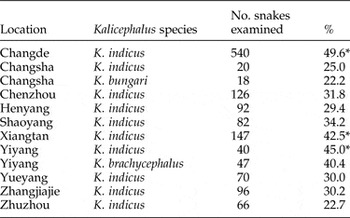
The survey took place between June 2012 and October 2013. Up to six snake species were examined from slaughterhouses in ten administrative regions within Hunan Province, China (see table 1). All snakes originated from farms where they were intensively reared and then offered for sale. Worm counts were performed on all washings or a proportion of total washings, depending on the total number of worms present. All worm specimens were identified to species according to previous reports based on morphology (Santoro et al., Reference Santoro, Aznar, Mattiucci, Kinsella, Pellegrino, Cipriani and Nascetti2013). The prevalence of infection (%) was examined and the intensity of infection was calculated by dividing the worm burden by the number of infected snakes of each species.
The prevalence (%) of snake infection with Kalicephalus indicus, K. bungari and K. brachycephalus in ten locations in Hunan Province, China.

* Level of significant difference with P < 0.05 between Changde, Xiangtan and Yiyang compared with other locations.
Differences in the prevalence of Kalicephalus infection in snakes from different geographical localities in Hunan Province were analysed by chi-square test, using SAS version 9.3 (SAS Institute Inc., Cary, North Carolina, USA), with P < 0.05 being considered statistically significant.
Results and discussion
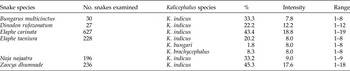
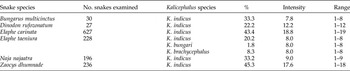
In the present study, three species of Kalicephalus spp., including K. indicus, K. bungari and K. brachycephalus, were found from a total of 1344 adult snakes of six species, including Bungarus multicinctus, Dinodon rufozonatum, Elaphe carinata, Elaphe taeniura, Naja najaatra and Zaocys dhumnade. The total prevalence of Kalicephalus in snakes in Hunan Province was 39.7%. The highest prevalence (49.6%) was found in Changde and the lowest prevalence (22.7%) occurred in Zhuzhou (table 1). The most common species was K. indicus, with the highest prevalence of 72.8%, followed by K. bungari (24.0%). The prevalence of K. brachycephalus was 0.9%. Three Kalicephalus species were found from all ten studied representative administrative regions in Hunan Province. The K. indicus prevalence in snakes in Changde (49.6%), Yiyang (45%) and Xiangtan (42.5%) were significantly higher than that in all other examined locations (P < 0.05) (table 1). Kalicephalus indicus and K. bungari were identified in Changsha, and K. indicus and K. brachycephalus in Yiyang; but in the rest of regions, only K. indicus was found. In the present study, six species of snakes were examined, with Z. dhumnade showing a higher prevalence of 45.3%, followed by E. carinata (43.4%) (table 2). Six host species – B. multicinctus, D. rufozonatum, E. carinata, E. taeniura, N. najaatra and Z. dhumnade – were infected with K. indicus, with an overall prevalence of 37.7%. Kalicephalus bungari was found in E. taeniura with a prevalence of 1.8%. Kalicephalus brachycephalus was found in E. taeniura with a prevalence of 8.3%. This result was not consistent with that of a previous study (Purwaningsih, Reference Purwaningsih and Mumpuni2011). Apart from climatic factors, such variations in Kalicephalus prevalences are likely to be due to differences in animal welfare and husbandry practices.
The prevalence (%) and intensity of infection of Kalicephalus in six snake species in Hunan Province, China.
The present results indicate that Kalicephalus infections are widespread in snakes in Hunan Province, China. Kalicephalus species have also been reported from other domestic animals, causing a significant economic impact (Grego et al., Reference Grego, Gardiner and Catão-Dias2004). Thus, integrated control strategies and measures should be implemented to prevent and control the infection of snakes with Kalicephalus species in this province and elsewhere in China.
In conclusion, the results of the present survey indicated that Kalicephalus infections of snakes are high in Hunan Province, China. However, this severe situation has received little attention in the past. Therefore, it is imperative to take integrated control strategies and measures to prevent and control Kalicephalus infections in snakes in this province and elsewhere in China.
Financial support
Project support was provided in part by grants from the Bureau of Animal Science and Aquaculture, Human Province, and the Department of Science and Technology, Hunan Province (grant no. 2014NK3049).
Conflict of interest
None.
Ethical standards
The performance of this study was strictly according to the recommendations of the Guide for the Care and Use of Laboratory Animals of the Ministry of Health, China, and our protocol was reviewed and approved by the Research Ethics Committee of Hunan Agricultural University.