

Kinship care is defined as “family-based care within the child's extended family or with close friends of the family known to the child, whether formal or informal in nature” (United Nations General Assembly, 2010). In Victoria, 8564 children are placed in formal kinship care, with kinship care placements (54.9%) currently exceeding foster placements (49.1%) (AIHW, 2016). These prevalence rates continue to rise.
The contention that children are safer and it is in their best interests to live with relatives (Berrick, Reference Berrick1997) is embedded in policy and legislation, particularly in regard to Indigenous and CALD children (Boetto, Reference Boetto2010; Cuddeback, Reference Cuddeback2004; Zhou, Paxman, Chen, & Chilvers, Reference Zhou, Paxman, Chen and Chilvers2010). Children are more likely to remain in contact and have a more regular and natural connection with their parents in a kinship care setting (Brown & Sen, Reference Brown and Sen2014; O'Brien, Reference O'Brien2012). However, there are concerns that continued contact with parents may perpetuate the problems that led the child to being placed in care in the first place (Brown & Sen, Reference Brown and Sen2014). Font (Reference Font2015) identifies a higher risk of maltreatment by biological parents of children whilst in kinship care, whilst Messing (Reference Messing2006) states that contact with birth parents and lack of monitoring may allow for abuse. Given that only a small number of kinship care placements are arranged by statutory authorities (Brown & Sen, Reference Brown and Sen2014), kinship carers are often unsupported in making access and contact arrangements for the child and the parents. The onus of responsibility for placing boundaries around parental contact lies with the carer and there is little support around access and supervised contact of children in kinship care. Irregular and unauthorised contact with parents can undermine placement stability, and children and carer's safety (Brown & Sen, Reference Brown and Sen2014).
The voices of kinship carers are largely unrepresented in the literature, however, a few sources identify the needs of carers with regard to support with family conflict. The need for more support around parental contact with the child in care when relationships with family are strained is strongly identified (Argent, Reference Argent2009; Brown & Sen, Reference Brown and Sen2014; O'Brien, Reference O'Brien2012). Kin carers report the need for more support to deal with parental contact and hostile parents (Brown & Sen, Reference Brown and Sen2014).
There are multiple reasons cited in the literature for the lack of reporting of violence in kinship care. These include a fear of negative responses to the report, such as the child being removed from the placement, and carers receiving both judgement and punitive responses from statutory authorities (Briggs & Broadhurst, Reference Briggs and Broadhurst2005; Uliando & Mellor, Reference Uliando and Mellor2012). Argent (Reference Argent2009) acknowledges the difficulties in carers taking legal action against family members. Kin carers also tolerate problems longer than foster carers and underreport difficulties, which can lead to unacceptable placements and/or placement breakdown (Farmer, Reference Farmer2009). This is often due to a conflict between keeping children safe versus maintaining family connection with the biological parent (Cooper, Reference Cooper2012).
Baptcare is a non-government community organisation operating in Victoria, South Australia and Tasmania. Baptcare provides a range of services to vulnerable adults, families and children, including kinship carers. In September 2017, Baptcare released its research on family violence in kinship care in Victoria. Family violence and abuse thrives on secrecy and a lack of visibility (Cooper & Vetere, Reference Cooper and Vetere2005). This study is the first step in understanding and exposing this multifaceted issue in Victoria.
The aims of this research were to explore the (1) types, (2) frequency and (3) impact of family violence perpetrated by a close family member of the child in care, directed towards the kinship care placement (i.e. the carers and child in care).
The focus of this paper is to explore the onset of family violence, the frequency of violence and the number of incidents of violence the kinship carers and children experienced since placement commencement. Further, this paper highlights the usefulness of the support mechanisms kinship carers access when seeking assistance for dealing with the violence and abuse – and the reasons why carers feel reluctant to file a report to police in an attempt to end the violence.
Research Methods
This study used a mixed methods approach which included an on-line survey and qualitative semi-structured interviews. Recruitment of participants was specifically targeted towards kinship carers who had direct experience of family violence since the placement started. In total, 101 kinship carers from Victoria responded to the survey. It is unknown how many surveys were sent due to the online nature of the survey. The survey link was distributed to both formal and informal kinship carers. Semi-structured qualitative interviews were conducted with carers who wished to share their story in greater detail. Consent for interviews was obtained by the carer's willingness to indicate their interest at the end of the survey. Twenty-three carers provided consent and 22 carers were interviewed. Data collection occurred from November 2016 to June 2017.
Findings
Carers were asked a series of questions relating to when the violence started, how often incidents of family violence occurred and the number of incidents of family violence they experienced that had been perpetrated by a close family member of the child being cared for since the placement started. Analysis of the survey findings revealed that carer households experienced family violence early in the placement. For a quarter of households, violent incidents started within days (27%), 14% started within a week and a further 36% experienced violence within a month to 6 months. Only a small proportion of households first experienced acts of violence more than 6 months after the child was placed with the carers (12%).
The survey findings also revealed that acts of family violence occurred frequently. 40% of carer households experienced violence (on average) daily, if not weekly. 14% of households experienced family violence monthly, with a further 26% every few months. Few carers experienced family violence infrequently (defined as once a year or less).
Incidents of family violence did not occur in isolation. Over two thirds of the carer households experienced more than five incidents of family violence since the placement commenced (68%).
Support in Relation to Family Violence
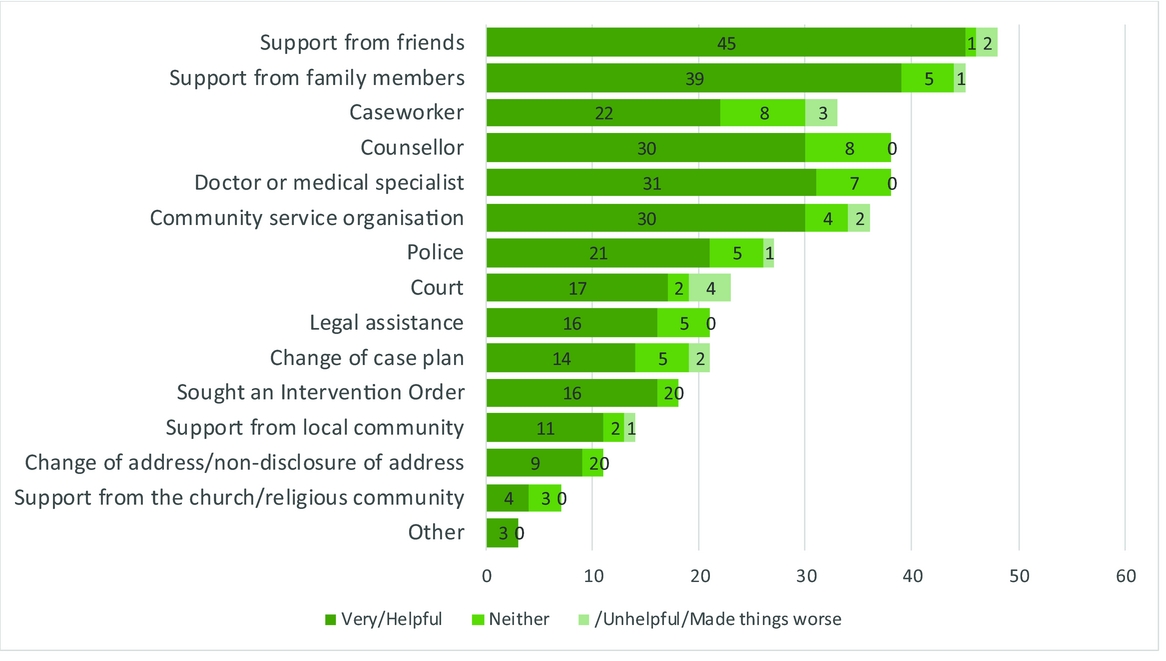
Most carers had sought support and assistance to help deal with their experience of family violence (79%). Figure 1 outlines the types of supports received and the extent to which carers thought they were helpful. As demonstrated by the number of responses (425 responses obtained from 80 carers), carers had clearly sought multiple types of assistance. The main kinds of assistance carers reported as being helpful included: support from friends (n = 45), support from family members (n = 39), assistance from a doctor or medical specialist (n = 31), help from a counsellor and community service organisation (n = 30 responses, respectively). Seeking assistance from statutory bodies was deemed less helpful for these carers compared to using informal supports.
Support and assistance received for family violence (n) Sample: Carers who sought assistance for family violence n = 80/101. Multi-response question, n = 425 responses.

The data obtained from the qualitative interviews support these findings. Peer support, both through online groups, formal groups, family, friends and other kinship carer connections were identified as the most common and most beneficial supports for kinship carers. Many carers identified as being part of an online “closed” group on Facebook for kinship carers. This Facebook group was cited by many carers as being a vital support. The group allowed carers to vent to others in similar situations, share information and lessons learned along the way, and give and receive advice. This group was the most commonly cited and the most valuable resource identified by kinship carers in the interviews.
Join a support group. If you don't like the one you've found, find another one, keep looking until you find one that's right for you.
Several carers reported seeking additional support from their General Practitioner (GP) to access a Mental Health Care Plan for psychological and counselling support related to the impact of caring for the children. Whereas other carers reported having to pay the full cost of accessing mental health support and counselling services to receive this support.
It was strongly noted throughout the interviews that many instances of children being placed with kinship carers were a result of, or following Child Protection (DHHS) intervention. However, upon placement, if no statutory orders were made, then no follow up support was provided, and the children and carers were not eligible for access to support services which are typically available to foster carers and formal kinship carers.
If they're going to be putting kids with family members they need to be able to access [services]. . . . I can't access a lot of the things that people that have taken on kids through child protection can access. You know I've saved them from like putting a kid in foster care and I'm taking on that role as his parent, but I can't access anything because he didn't come through child protection.
Some carers reported that their help seeking support with services including protective services (Child Protection, police and the legal system) were frequently met with responses which were not appropriate for the difficulties encountered and, in some instances, responses that could be considered punitive.
Even you know to get the department saying to us you know he needs the counselling or he's lashing out at us or whatever, they're just like yeah nup, can't help you sorry, we'll look into it. You never hear back from them.
They said if I couldn't keep them safe then I wasn't capable of looking after them, that was DHHS.
Some carers cited a lack of responsiveness from police to threats, stating that threats could not be acted on, resulting in fear, anxiety and in some instances relocation to ensure the safety of the carer and the child.
My life was in absolute turmoil because I didn't know where to turn, what to do or anything like that. I moved from Victoria to New South Wales to wherever I could find a safe place for the, for these children to stay.
Overall, the kinship carers who were interviewed demonstrated exceptional resourcefulness in accessing varied supports through their own research, networks and reading.
Reporting Family Violence
Carers were asked whether they felt afraid or reluctant to report the family violence caused by the close family member of the child being cared for. Just under one third of respondents (32%) indicated they had felt reluctant or afraid to make a report, with a further 4% unsure.
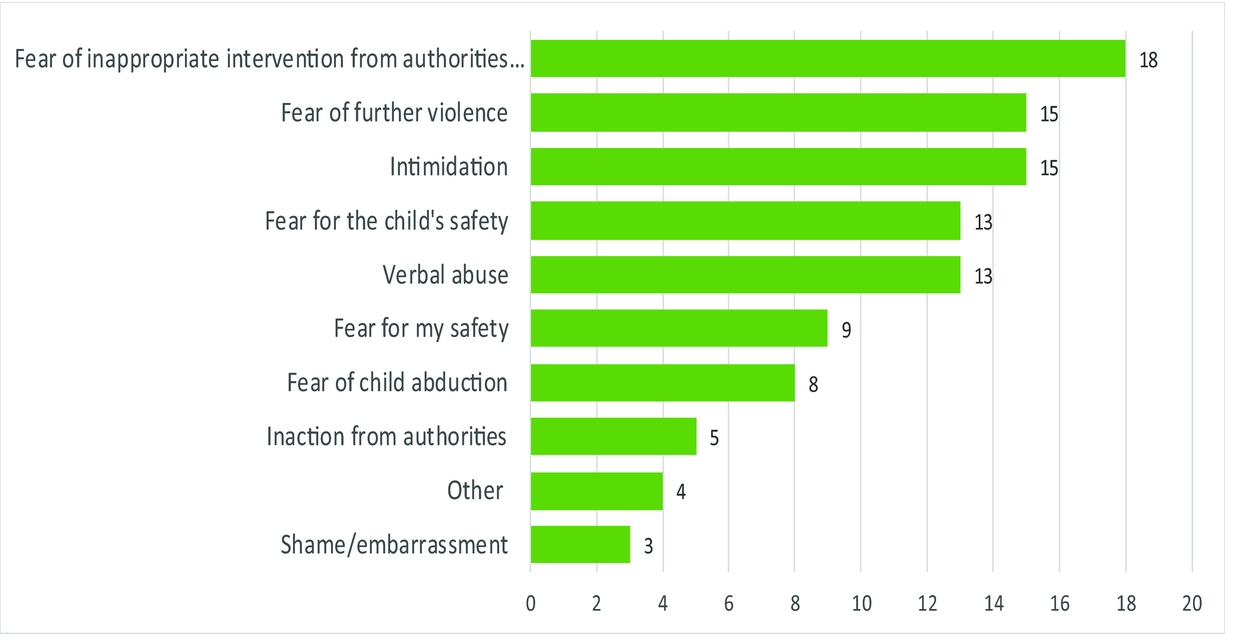
Carers provided multiple reasons for their reluctance to make a report (see Figure 2). The main barriers were the fear of inappropriate intervention from authorities (including the removal of the children from their care, n = 18), fear of further violence from the family perpetrator (n = 15) and intimidation (n = 15), fear for the child's safety and further verbal abuse (n = 13, respectively).
Barriers to reporting family violence (n) Sample: Carers who were afraid or reluctant to report the family violence n = 32. Multi-response question, n = 103 responses.

The data from the qualitative interviews support these findings. For example, there were instances where the child's parent had come to the carers home (uninvited) and instigated violence. When reported to DHHS, these carers were told that if they could not protect the child then the child would be removed from their care. They were not offered any support or strategies to ensure the child's safety from these situations that were primarily outside of their control. This punitive approach to reporting incidents has led some carers to be hesitant in reporting the violence following subsequent occurrences.
And she (my sister) would always come and remove (the child) from the house, that was one thing DHS were very thingo about. That they would take him off me if they thought he was in the house when she (the mother) came and carried on - they call that violence or whatever they call it. And so I made sure that after the first time they warned me I always made sure he was removed because I don't think that's quite a fair solution if she came round and was abusive and you don't know she's there, but if (the child) sees it that they then turn around and take him away from me. I didn't think that was very fair, but they made that very clear.
Discussion
The analysis of the frequency and onset rates of the abuse and violence indicate some interesting patterns. The first incident of violence usually occurred within the first six months of placement, which might suggest a relationship between parental distress upon separation and an increase in conflict during this period. Of most concern is the frequency in which the carers household are subject to violence, indicating that the exposure to family violence for these carers and children occurred regularly and not in isolation. Hence, some children are not necessarily safer when they are removed from their parents care, unless greater safety and protection measures are implemented.
Most kinship carers who reported receiving some support had done so through social connections such as family and friends. Some carers had utilised mainstream services such as GP's, private counsellors or psychologists; but sometimes this involved costs they could ill-afford.
Perhaps the most concerning issue identified by kinship carers in terms of accessing support around family violence was the clear message that formal protective services, including police, legal services and the courts, were found to be less helpful compared to accessing informal supports.
Family violence is often cited as being under-reported in the general population (Campo, Reference Campo2015; Richards, Reference Richards2011). This study demonstrated that one third of carers were reluctant to report incidents of violence. However, the reasons given for the failure to report violence in this group were specific to their circumstances. Studies of family violence in the general population suggest the failure to report family violence often has a link with stigma, shame, embarrassment and a fear of not being believed (ALRC, 2010; Overstreet & Quinn, Reference Overstreet and Quinn2013). For this cohort of kinship carers, reasons such as shame or embarrassment were the least of their concerns. Carer's decisions not to report violence were directly linked with repeated experiences of negative repercussions from protective services (including the fear of the child being removed), the fear of further violence and intimidation, and fear that the child's safety might be put at further risk. These results are consistent with the literature (Briggs & Broadhurst, Reference Briggs and Broadhurst2005; Uliando & Mellor, Reference Uliando and Mellor2012) and suggest a profound failure to protect by the services whose mandate it is to do so.
The cohort of carers from this study (who are mainly female, older, and the grandparent of the child in care) find themselves in a precarious position of doing their best to maintain the safety and stability of the placement, whilst experiencing abuse and violence from their own child. This in turn leaves many of these carers in a powerless position of having limited supports and effective reporting mechanisms to stop the violence and abuse. These kinship carer experiences of formal and protective services, legal and other administrative service systems indicate that there is a lack of scaffolding support for kinship carers and the children in their care.
Baptcare's Response
This study used a purposive sampling approach. Given the nature of the sample, no prevalence data was obtained. To address this study shortfall, Baptcare will be repeating this study in New South Wales using a random sample of both non-mandated and mandated kinship carers. Additionally, this study will be repeated in Tasmania through Baptcare's Grandparents and other Relative Carers program which supports informal kinship carers of children not subject to Child Protection orders. Both studies will continue to strengthen the evidence base around the issues raised in the research.
Baptcare is actively working with kinship carers, government and the not for profit sector to find solutions to issues identified in this research. In response to the recommendations outlined in the report (https://www.baptcare.org.au/why-baptcare/advocacy), Baptcare is providing access to specialised trauma support counselling through its “Reaching Children through Universal Service” demonstration program for children in kinship care who are affected by family violence and specialist support groups for kinship carers. Baptcare staff are also developing an online training package for kinship carers that has a focus on caring for traumatised children and the impact of family violence. Education is being provided to the biological parents of the child in relation to the long-term impacts of their perpetration of family violence on both the carers and the child in care via the Circle of Security groups facilitated by Baptcare. Baptcare run kinship carer support groups in both western metropolitan Melbourne and for the Grandparent carers in Tasmania. Further, Baptcare delivers targeted therapeutic support to address trauma in children in kinship care using equine and other therapeutic modalities. Staff, carers and children have access to therapeutic practice consultants for additional training and support. A specialised trauma training package, designed to meet the needs of kinship carers, is under development and will be implemented in late 2018. Baptcare is implementing an evidence-based program in the western metropolitan Melbourne that aims to improve health outcomes of children and their carers in kinship care. Baptcare is advocating for kinship carers in several ways including: disseminating the research findings at state and international conferences, briefing government on the key findings obtained from a workshop recently conducted at the International Foster Care Organisation conference in Malta, and undertaking policy development to see improvements for kinship carers.
Acknowledgements
The authors of this paper would like to thank Baptcare for funding the project and the wonderful carers who took part in the survey and interviews. Our thanks and appreciation also extend to Dr Meredith Kiraly and Professor Cathy Humphreys from the University of Melbourne, Elizabeth McCrea and Ruth Chattey from the Mirabel Foundation, Anne McLeish from Grandparents Victoria, and The Centre for Excellence in Child and Family Welfare.