Introduction
The Getting it Right Framework (Bessarab et al., Reference Bessarab, Green, Jones, Stratton, Young and Zubrzycki2014) planted the seed for change when in 2013 a roundtable discussion at Curtin University, Western Australia, prompted the social work department to explore ways to embed Aboriginal ways in the curriculum within the School of Occupational Therapy, Social Work and Speech Pathology. Staff and students had previously indicated their desire for more Aboriginal and Torres Strait Islander content in the curriculum and the Getting it Right Framework consultation provided the impetus to get started. A framework to guide non-Aboriginal people through culturally appropriate practice with Aboriginal people, the Minditj Kaart-Moorditj Kaart Framework, being developed by a local Nyoongar social work academic Dr Michael Wright (Wright et al., Reference Wright, O'Connell, Jones, Walley and Roarty2015), offered a guide for such change to occur. What followed was a set of activities that led to the RAD project.
National, state and local drivers
Several national, state, institutional and professional frameworks have guidelines for developing students' cultural responsiveness (see e.g. AASW, 2013; Department of Health, 2014; Curtin University, 2018a, 2018b; Universities Australia, n.d.). The National Aboriginal and Torres Strait Islander Health Framework published by the Department of Health (DoH) (2014) incorporates principles and strategies identified by Aboriginal peoples, communities and academics as essential for Higher Education Providers (HEP) when embedding Indigenous knowledges in the curriculum. The Framework (2014) identifies teaching and learning strategies that: privileges Aboriginal and Torres Strait Islander voices; works in partnership at the cultural interface using critical thinking to explore the complexity and diversity of Aboriginal experiences; and uses Yunkaporta's (Department of Health, 2014) eight ways of learning through relationships with local Aboriginal people and communities (Department of Health, 2014). The combination of pedagogies provides considerable guidance for HEPs in fulfilling their long overdue mandate of delivering on recognition, reconciliation and restoration of sovereignty (Hendrick and Young, Reference Hendrick and Young2019) for Aboriginal and Torres Strait Islander peoples.
Universities Australia (Universities Australia, n.d.) has similarly committed Australian universities to the historic recognition and reconciliation agenda through successive Indigenous Strategies. The 2011 Strategy (Universities Australia, 2011) identified five guiding principles for Indigenous cultural competency for governance and management and graduates. The 2017–2020 Strategy (Universities Australia, n.d.) broadens the agenda acknowledging the pivotal role universities play in informing the world views of their graduates who will go on to implement policies and services for the Australian community. To this end, the strategy commits to ensuring all students are exposed to Indigenous knowledges through embedding Indigenous-led content and pedagogies across all courses (Universities Australia, n.d., p. 30–32). While institutions across the country are taking up the challenge (Williamson and Dalal, Reference Williamson and Dalal2007; Al-Natour et al., Reference Al-Natour, Fredericks, Bargallie, Marrie and Bond2016) they express considerable uncertainty about how this might be achieved.
Curtin University's long-standing commitment to Indigenous reconciliation (see Curtin's Strategic plan (Curtin University, 2018b), Elevate RAP (Curtin University, 2018a)) recognises a need to ‘Indigenise’ curriculum to develop student capacity (Curtin University, 2018a). One embedded example is a compulsory Indigenous unit in the Health Sciences Faculty, which is coordinated and taught by Aboriginal and non-Aboriginal staff with significant results in improving cultural responsiveness of staff and students (Hendrick et al., Reference Hendrick, Britton, Hoffman and Kickett2014; Kickett et al., Reference Kickett, Hoffman and Flavell2014).
Professional membership organisations similarly reflect such commitments, as seen in the guidelines for the disciplines involved in the RAD project, Occupational Therapy Australia (OTA) and the Australian Association of Social Workers (AASW). The first refers to the Aboriginal and Torres Strait Islander Health Framework (Department of Health, 2014, p. 16) and the latter lists graduate capabilities to work with Aboriginal and Torres Strait Islander peoples as one of four core requirements (Australian Association of Social Workers, 2013) (AASW). This latter requirement was the impetus for the development of the Getting it Right Framework (GIR) (Bessarab et al., Reference Bessarab, Green, Jones, Stratton, Young and Zubrzycki2014) which outlines four key concepts as foundational to the development of Aboriginal and Torres Strait Islander-centred social work; epistemological equality, 3rd cultural space (3rd space), Aboriginal and Torres Strait Islander pedagogies and cultural responsiveness (Bessarab et al., Reference Bessarab, Green, Jones, Stratton, Young and Zubrzycki2014, p. 46). Professor Wright's Minditj Kaart-Moorditj Kaart Framework, an Elder led means of service engagement with the local Nyoongar community, met all of the pedagogical requirements outlined in the broader Health and professional Frameworks. Born out of his earlier Looking Forward project (LFP), a guide for Wadjellas to work in culturally safe ways with Nyoongar people and written about elsewhere (Wright et al., Reference Wright, O'Connell and Jones2013, Reference Wright, O'Connell, Jones, Walley and Roarty2015; Hendrick, Reference Hendrick2015), both frameworks were foundational to the work of RAD.
The Minditj Karrt-Moorditj Kaart Framework is based on principles of inclusivity, trustworthiness, reciprocity and adaptability and introduces a Nyoongar pedagogy of Debakarn Koorliny Wangkiny (Steady Walking and Talking) that outlines conditions for authentic engagement and mutual sharing of stories through yarning (Wright et al., Reference Wright, O'Connell, Jones, Walley and Roarty2015, p. 63). The four key principles, co-developed with Nyoongar Elders, are designed to equalise power differentials and enable respectful and authentic communication and relationship building. The Indigenous pedagogy focused on taking time to build mutually trusting and respectful relationships through sharing personal stories lays the groundwork for profound cross-cultural learning and is a radical departure from conventional didactic tertiary education pedagogies.
RAD project evaluation methodology
Applying the Minditj Kaart-Moorditj Kaart Framework
The Elders' desire to involve students led to the co-design of RAD in late 2016, and included staff who had earlier worked with the Elders. Fieldwork staff, from Occupational Therapy (OT) and Social Work (SW), allocated student placements, liaised with field supervisors and provided flexibility for students attending yarning sessions. Three yarning sessions (Hansen, Reference Hansen2017; Hansen and Corbett, Reference Hansen and Corbett2017) with project staff commenced prior to student engagement as part of building trusting relationships with Elders, as outlined in the Minditj Kaart-Moorditj Kaart Framework (Bessarab and Ng'andu, Reference Bessarab and Ng'andu2010; Lin et al., Reference Lin, Green and Bessarab2016).
Expressions of interest were sought from all final year undergraduate OT/SW students with a briefing day held for successful applicants. The On Country day, arranged by Elders, authored here, and their families, marked the first meeting between Elders and Students.
Elders, staff and students subsequently engaged in six yarning sessions with a total of four whole group and two smaller group sessions (see Table 1). One discipline-specific reflection group followed the second yarning session. Yarning sessions occurred before, during and following student placements with earlier yarning sessions aiming to develop student and Elder rapport and begin working at the cultural interface (Nakata, Reference Nakata2007). Following sessions aimed for a comfortable space for the student to raise questions or concerns arising from placement. Staff met with the Elders prior to each yarning session to discuss business before meeting with students, which was always prefaced with a discussion about family, health and wellbeing.
Staff and student Yarning sessions 2017

(Bunuru-Djeran, Feb–Apr) (Djeran, May) (Makuru-Kambarang, June–November).
Staff Yarning Sessions on Country Staff and student yarning sessions pre and post fieldwork placements.
Evaluation aim
The ethics approved (No. HRE2017) research aimed to:
1. report on whether the RAD project increased students' knowledge, skills and confidence in preparation for working with Aboriginal and Torres Strait Islander peoples;
2. identify elements of the RAD project that contribute to student preparedness to work with Aboriginal and Torres Strait Islander peoples; and
3. report on the effectiveness of the Minditj Kaart-Moorditj Kaart Framework as an interdisciplinary teaching and learning pedagogy for improving student capacities for working with Aboriginal and Torres Strait Islander people in higher education.
Evaluation method
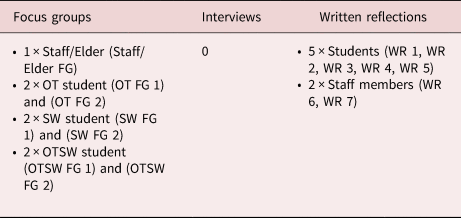
Consistent with co-produced research, all participants were invited to provide feedback on the key elements of the Minditj Kaart-Moorditj Kaart Framework: relationships, trust, respect and reciprocity in the yarning (Wright et al., Reference Wright, O'Connell and Jones2013). Semi-structured questionnaires from focus groups, interviews and/or written reflections were sought. The data set included seven focus groups, zero interviews and seven written reflections, as represented below. Participants were provided with information sheets and signed consent forms. Participants opting to provide written reflections were sent questions. Focus groups were recorded and transcribed.

Analysis
The research team followed Braun and Clarke's (Reference Braun and Clarke2006) thematic analysis to identify themes within the data set. Team members coded transcripts taken from the focus groups and written reflections. This was conducted individually before coming together to identify common themes. This process was repeated between the Principle Investigator (PI) and Research Assistant to draw out all themes, review them and then develop overarching themes developed from named codes. Participants were identified by their role and a number as seen above.
Limitations
RAD was not a compulsory program. As such, it could be considered that RAD was preaching to the converted. Elders unanimously agreed that it was preferable to work with willing participants, although one Elder acknowledged the importance for less willing students to develop cultural responsiveness. As a lecturer, participants may have felt an obligation to the PI to participate in the research. To mitigate this, the PI was not involved in the recruitment of participants.
RAD project findings
One student's experience exemplifies the transformative properties of RAD.
One student was assigned her placement in a remote location; where Aboriginal families were the majority with strong traditional cultural connections. The placement serviced the educational needs of children and families in both the Aboriginal and wider community and was staffed by a team of Wadjellas. During the placement the student became distressed at the blatant individual and institutional racism displayed by staff towards Aboriginal clients and their families. Prior to the placement the student had had three yarning sessions with the Elders during which she had difficulty believing Elders personal accounts of racism. On her return however, she apologised for disbelieving their accounts, she had not thought that what they experienced could actually happen, until she observed similar attitudes and behaviours herself. She was upset at her failure to credit the truth of the Elders experiences and apologised sincerely to them a number of times.
Indigenous pedagogy of yarning
The vignette above illustrates the power and transformational properties of yarning. Yarning, the building of relationships and cultural knowledge through sharing personal stories, was the process and vehicle for change and offered a way for students and staff to engage meaningfully with each other.
Yarning was echoed by students as a way of ‘real humanness together’ (OTSW FG 1). Students also described yarning as a journey, rather than a program, with transformative properties profoundly impacting upon them as people and as professionals. Yarning, positively experienced by all participants, offered a key to learning cultural responsiveness. Other reflections included yarning experienced as a catalyst to greater knowledge, skills and confidence, and igniting a passion and ambition to work with Aboriginal and Torres Strait Islander peoples.
Transformative properties
Students regularly spoke of transformation; about how they will now practice, and how they position themselves as people alongside others: ‘this experience has really shaped me as a person and as a practitioner’ (OTSW FG 1). With another student saying,
This was an experience that changes you, not only for your practice and for working with your peers and working with Indigenous people, but I think it also has potential to make a difference with you as a person (OTSW FG 1).
It was a change felt irrespective of discipline:
We'll take away things personally from the experience… something completely different… regardless of what profession you are (OTSW FG 1).
Learnings were not altogether identifiable or easily articulated yet were clearly felt: ‘learning is not altogether tangible – but [I] know it's there’ (SWFG 2). And this student stated:
It's hard to express the learnings I have received from this project as they have been internalised transformations rather than specific facts (WR 5).
And for this student, there was confidence that the learnings were attained just not explicit:
I can't say what I've learned because it's in there and it'll come to me when in practice, when I'm working with Aboriginal people (OTSW FG 1).
The student in the above vignette recognised the significant and sustained change in her own positionality and whiteness given her experiences.
Being human together
Yarning presented students with learning about ways of ‘real humanness together’ (OTSW FG 1). Connecting to one another through shared storying and engagement with Aboriginal Elders provided the opportunity to hear first-hand their experiences and share stories of their own. Through shared storying, students connect self/ves with the ‘other’:
Sitting with the Elders, naturally listening to them tell their stories and their experiences and tell us about some of the things their family was going through, that connected with me (SW FG 2).
Yarning enabled students to contextualise and review their previous learning, and their previously uncontested assumptions, biases and values, adding a unique transformational learning experience:
Meeting and yarning with Aboriginal people face to face transformed my knowledge about them. Things I learned in classrooms came to life (WR 5).
Being human together was expressed in different ways. Staff and students believed that it was their direct contact with the Elders that deepened their understanding about the relational nature of working in the third space.
For one staff member, it was the first direct interaction with Aboriginal people. She described this experience as moving her from ‘fence-sitter’ and observer to witnessing how things could be done differently: ‘I was always an observer, and an acknowledger of what needed to be done’ (Staff/Elder FG). Subsequently, this experience and personal connection has ignited this staff member's conviction to act and find ways to achieve change. As one Elder shared, ‘The primary things that I tried to impart is the fact that we're more similar than dissimilar’ (Staff/Elder FG).
Some students who had lived or grown up in remote locations doubted they would learn anything new about Aboriginal people. They spoke of their assumption that their familiarity with Aboriginal culture was sufficient for culturally responsive practice. To their surprise, involvement in RAD had significantly deepened their knowledge of Aboriginal culture and highlighted how much more there is to learn.
A noticeable point in our ‘real humanness together’ was when Elders invited students and staff to address them as ‘Aunty’ or ‘Uncle’. In closing the project, one Elder stated,
I've now got about 20 Wadjella nieces, which I never had before (Staff/Elder FG).
It was in the yarning together that the student from the vignette deeply reflected on being human together. This student opened her heart and mind and offered warmth and empathy in a powerful exchange with the Elders who listened deeply, with patience, gentle care and support.
Yarning as a journey of learning and learning of the importance of journeying
The Indigenous pedagogy of yarning was new to all students and some staff. Its effects were deeply felt and were considered by participants as central to learnings:
We've learned in a different way to what western structure would be. It's different learning so it's a different way of storing it - it's deep in our brain - it's a different way of learning. It's really profound (WR 1).
Yarning was described variously as a journey, contrasting starkly to traditional Western teaching and learning pedagogy. One Elder reflected on the vitality of yarning as a process and method of teaching and learning:
From a learning perspective [yarning] was a good method; a way of getting everyone involved. It was interactive and not one or two people monopolised the sessions. [In teaching,] talking and promoting Aboriginal culture [has] always been a one-way stream: we're giving our knowledge and our experience and the students have just had to listen and take it all [in]. But this interactive way, where we share, they share, I think that's a really good method (Staff/Elder FG).
Students agreed that:
Hearing first hand someone's story is completely different from learning about it through a textbook or the media (OTSW FG 2).
It required of staff a letting go of traditional Western didactic teaching methods and structures: set agendas, teacher–student dichotomies, hierarchical teaching formats and formal assessments.
Staff and students were required to be present, flexible and available to the group. The yarning was a group owned process, for the most part managed by the Elders. To the Elders, the success of the project was considered largely due to staff flexibility, support and, most of all, respect that was consistently modelled and then seen to be embraced by students. While students agreed that staff respect towards Elders influenced their own behaviour and that they found the staff to be flexible in their facilitation, one student would have liked to see: ‘the Elders have more freedom or autonomy to facilitate the groups. At times I felt the Curtin academics taking the lead role which I felt to diminish the power of the Elders’ (WR 4). Students too recognised that yarning required a different approach, as ‘RAD has helped me develop active listening skills that are patient and flexible rather than rigid or focussed’ (WR 4).
Learning from each other
Students felt that yarning with Elders enabled them to learn from each other's insights, particularly across professions. One student shared how listening to other students was the impetus for her own actions in challenging racism. Previous to RAD she had not challenged shop attendants checking the bags of Aboriginal people at her workplace, but after listening to other students' stories, she felt empowered to challenge the attendant during a subsequent incident, by querying if she would have subjected white shoppers to the same actions.
The learning exchange and reciprocity was not at all lost to the Elders: ‘it was lovely to hear about their [students’] lives too. Gave us an insight into the whole group, and how diverse we are’ (Staff/Elder FG).
Learning to yarn
Yarning for students did not occur naturally or easily in the first instance. It was the flexible format of yarning that students suggested had helped develop their confidence and sharing over time. The space was considered a safe space with shared power. As one Elder said, ‘it's a reciprocal thing, yarning. That's what yarning is all about. You telling your story, they telling theirs’ (Staff/Elder FG).
Students considered yarning to be a new learning experience. One student said,
… you can learn what you learn in a textbook and from a PowerPoint but being able to actually connect with the Elders in person and actually experience it for real made it a lot better (OTSW FG 1).
Yarning facilitated trust and respect
Staff and students spoke of yarning as an open, honest and genuine experience that required time. The Elders' own sharing and modelling in the yarning sessions assisted in how to engage with this process. Students described the first two or three yarning sessions as a period for listening to the Elders. There were times to share when going around the circle yet these were, in the first instance, brief musings. Elders observed students feeling at ease as the yarning sessions went on:
I feel for some of them younger ones who were hesitant, but I've actually noticed that they've come out, and they want to talk, and they will say something now, which, from my point of view, can only help their practice (Staff/Elder FG).
A staff member reflected on the learning environment and how students responded with greater attention with each session.
I remember some of the earlier meetings. The level of engagement was quite different to the end, and I was amazed at how connected and how for two hours [students could] sit in such a large group (Staff/Elder FG).
The vignette demonstrates how that student listened to the shared storying at the beginning, even though warily, but had developed a sense of safety in order to engage with and reflect on her distrust.
The ice breaker
All participants reflected on the On Country day as a significant entry point into the worldview of the Elders. Various participants spoke about this day in similar ways to: ‘[a] fabulous education and icebreaker at the same time’ (Staff/Elder FG). All students reiterated this day as thoroughly enjoyable.
At the On Country day, seeing the Elders with their families, and getting to be a part of that, and just kind of being accepted and embraced by the Elders as being a positive [experience] (OTSW FG 1).
The On Country gave students valuable insight into the importance of family and kinship. A staff member reflected on the care for the baby in the family. Whenever the baby would cry female and male members tuned in, looked to see why the baby was crying and different people would respond, demonstrating that caring for this child was a collective concern and everyone's business. This staff member reflected the differences this highlighted, where in most Western families childcare is most often ascribed to the mother.
Knowledge and skill development – ‘I think the Elders know what they want to teach us’ (OTSW FG 1).
All students identified RAD as helping them to develop knowledges and skills.
The Elders have described the diversity that is held within Aboriginal communities and culture. This was different to how Aboriginal culture has been taught to us during the rest of our university degrees. I have felt that previous teaching at Curtin has erroneously and superficially attempted to homogenise a richly diverse group (WR 4).
Elders spoke of the impact of the Stolen Generations on their own families; of police brutality with family members, of substance use and traumatic challenges faced throughout their lives.
We've been yarning with people for quite a while now, and everybody needs the good and bad, male and female [perspectives]…hopefully its benefitted people (Staff/Elder FG).
The effect of yarning is evident in student and staff reflections. It is evident also in the uncensored nature of the sharing which initiated reflective questioning:
Is this true? Can this possibly happen? Or might this be an over exaggeration, as surely people don't behave this badly towards Aboriginal people? (WR 5).
This too connects with the experiences of the student in the vignette when disbelief in the first instance soon turned to disbelief not in the Elders' storying but that racism was so pervasive.
Many students identified that RAD had enabled them to better understand the extent of intergenerational trauma and the barriers that families face in accessing government services:
what was most profound for me…was the recognition of what structural racism looks like …which enabled me to learn how racism can be eradicated…and [gave me] the confidence to challenge racism (WR 2).
Students on placement in regional or remote Aboriginal communities reported that RAD provided them with relevant knowledge, skills and confidence for engaging with Aboriginal clients in these settings:
…having the opportunity to discuss [racism and other topics] with the Elders provided me personally with the practical information and different ways of working that are relevant to Aboriginal culture (OTSW FG 2).
These students recommended that all students undertaking rural and remote placements be provided learning as offered by RAD. Some students felt the knowledge and engagement skills developed were generalisable to practice with all clients.
Students talked also of the calmness, the humility and the lack of anger and blame when listening to the Elders addressing racism when it arose within the group. This, students reflected, was a powerful example of addressing and disarming potentially racist attitudes in the wider community.
Overall, yarning provided a process and a tool to apply in practice. To one student, the yarning process offered a way to equalise power imbalances as identified in her reflective piece:
I have utilised this modelling [yarning] in how I work with Aboriginal clients and I feel that it grounds me as a reminder to leave the academic space and enter into an authentic and open interaction (WR 1).
Yarning offered this student a way to equalise power and develop relationships:
There's things that I learned in this program that I can use. When I get into a room, the client might be Aboriginal. I need to just sort of put the formal assessment aside, sit and talk to them, get to know their Elders, or ask who their Elders are, or ask who I can talk to. I wouldn't have learned that stuff without this program (OTSW FG 1).
Applying yarning, as a tool of engagement, enabled students to feel confident when working with Aboriginal people:
I'm a lot more confident in communicating with Aboriginal people and just in general; just being around them in the same space with them. I feel like I'm a lot more comfortable. I also feel like I can engage a lot better with them… and I'm striving to learn a lot more about their culture as well (OTSW FG 1).
With greater confidence, students spoke of the ability to listen to their clients when on placement, work with their agenda, and develop culturally informed assessments and treatment plans.
I'd go through the OT [assessment] process, and we'd do everything, and then I'd probably get nowhere and then give up, whereas with this [learning from RAD], I know now where to start and just find the little windows. I feel like I have the confidence now to do that, whereas before, I probably would have just given up and gone, I don't know what to do (OTSW FG 1).
This student summed up what many participants echoed:
I think the Elders know what they want to teach us. They know what is important for us to know and to walk away with to be culturally safe practitioners (OTSW FG 1).
Despite the learning reported on, there was also recognition that, ‘I only feel like I've scratched the surface of what I need to learn and understand’ (Staff/Elder FG).
Reflection
Some students reflected on the idea that Aboriginal people know a lot more about non-Aboriginal culture than non-Aboriginal people know about Aboriginal culture, and that non-Aboriginal professionals had a responsibility to educate themselves about Aboriginal culture rather than expect Aboriginal people to assume responsibility for this learning.
We kind of talked about how we expect the Elders to know everything, and I feel there's a learning opportunity for me. We shouldn't expect them to tell us what to do all the time. We should do our own research. I learned a lot from that; not expecting the Aboriginal workers to know everything about Aboriginal people (OTSW FG 1).
For the staff member, for whom it was the first time she had interacted with Aboriginal Elders, yarning provided the how to effect change and be more than a ‘fence-sitter’ and observer:
I didn't know the how, and so this process gave me some insight into the how… I certainly supported and understood the need for cultural competence, but I actually didn't have that skillset (Staff/Elder FG).
To staff involved in fieldwork placements, RAD helped provide them with skills and knowledge to support students: ‘I was able to help her, because I'd done this [RAD]’ and ‘it also helped to identify where the deficits in student skills are, and my own’ (Staff/Elder FG).
Discussion
RAD, as a set of actions, not merely statements (Boudreau Morris, Reference Boudreau Morris2017, p. 456), offers a unique model (the how) that draws together national, state and professional imperatives that aim to prepare students for working with Aboriginal and Torres Strait Islander peoples. Debakarn Koorliny Wangkiny (Steady Walking and Talking) which sets out conditions for authentic engagement (Wright et al., Reference Wright, O'Connell, Jones, Walley and Roarty2015) requires time and necessitates relationship building as a beginning point. Fidelity to the Minditj Kaart-Moorditj Kaart Framework principles and conditions created for yarning appear to deliver both the transformational learning and equitable power relations reported by participants.
Indigenous frameworks for practice
The Minditj Kaart-Moorditj Kaart Framework was guided by practice principles earlier identified by Chino and De Bryne in their engagement model for working with First Nations peoples ((2006) as cited by Wright et al. (Reference Wright, O'Connell and Jones2013). This framework guided Elder-staff engagement through its various stages from 2014 to include students in 2017 in the RAD project (Hendrick, Reference Hendrick2015). Principles of securing trust, creating relationships, sustaining commitment and working together (Wright et al., Reference Wright, O'Connell and Jones2013, p. 30) underpinned this developmental work which is about ‘shared intention’. As a tool, this framework helped Wadjella staff to ‘understand the cultural aspects fundamental to working with Nyoongar people’ and further assisted with creating third spaces of shared intention (Wright et al., Reference Wright, O'Connell and Jones2013, p. 5). The Getting it Right Framework (Bessarab et al., Reference Bessarab, Green, Jones, Stratton, Young and Zubrzycki2014) posits that ‘trust building’ (p. 42), taking ‘time to develop’ trust (p. 78) and ‘building connections of trust’ (p. 103) is essential in any aim for creating ‘reciprocal relationships’ (p. 42). The Framework further speaks of sustainable commitments: ‘commitment to epistemological equality’, ‘commitment to working collaboratively with Aboriginal and Torres Strait Islander knowledge holders’ and ‘commitment to use Whiteness theorising’ (Bessarab et al., Reference Bessarab, Green, Jones, Stratton, Young and Zubrzycki2014, p. 40) in any attempt at working towards and practising in the 3rd space. RAD was centred on epistemological equality and collaborative work. Yarning created a space for the development of meaningful relationships that offered trust and security supporting participant engagement in courageous conversations (Singleton, Reference Singleton2014) and admissions that could only be made where trusting relationships were established, as seen with the student in the vignette.
Indigenous pedagogy: yarning
Yarning, described as a process of ‘spending time grounding a conversation in topics of mutual human interest’ (Lin et al., Reference Lin, Green and Bessarab2016), is about the ‘production of knowledge’ creation as ‘once received and processed can lead to different understandings of the subject matter’ (Bessarab and Ng'andu, Reference Bessarab and Ng'andu2010, p. 38). Evidently, the process of yarning offered the students space to listen, question, engage and form a ‘different understanding’; a reflection on practice and further practice on reflection (Fook, Reference Fook2012). With its emphasis on mutual exchange of storying, with participants as both ‘knowers and learners’ (Bessarab and Ng'andu, Reference Bessarab and Ng'andu2010, p. 47), and ‘creating a space of mutual reciprocity, cultural safety and respect’ (Leeson et al., Reference Leeson, Smith and Rynne2016, p. 5), there remains a need to consider yarning as a way of working in the third space as potential sites of struggle and power. This is touched on below and the topic for a following paper. As a privileged white person, for instance, the student in the vignette could choose to do nothing (Tatum cited in Halley et al., Reference Halley, Eshleman and Vijaya2011, p. 56) about witnessing racism or disbelieving the Elders. It is through this dialogical exchange that individuals can conceive of themselves with deeper insight and understanding of their place in the world (Sammel and Waters, Reference Sammel and Waters2014, p. 1236) and in relation to ‘other’ (Fine, Reference Fine, Denzin and Lincoln1994). This was demonstrated in the realisation that this work is as much about ‘being human together’ (Fanon, 1967) as an authentic means of bridging across the divide between cultural differences, as the title suggests.
Developing trust and respect through yarning
The number and length of the yarning sessions allowed students to deepen and consolidate their learning, develop trust and respect for Elders, and enabled them to open up and share in the spirit of reciprocity. Trust and respect was evident with the student who felt safe enough to apologise to the Elders for disbelieving them. Yarning empowered students to better understand and tackle racism, as demonstrated with the student who was moved to question staff checking bags of Aboriginal shoppers. Yarning offered students a tool for engagement with people, not only Aboriginal people. It offered, perhaps, ‘the habits of mind that will continue their journey of reflection, research, inquiry and dialogue’ (Sammel and Waters, Reference Sammel and Waters2014, p. 1236). This could be true, for instance, of the student who was disbelieving. Building trust through deep listening in the first few yarning sessions meant this student was moved to act when witnessing racism through new eyes and understanding. Honouring the Elders' storying, she returned to share her experiences and apologise when she did not need to act, or proclaim her disbelief. There was the ‘trust that the Elders will guide you safely’ (Wright et al., Reference Wright, O'Connell and Jones2013, p. 26) even when proclaiming one's own vulnerabilities.
Transformative properties of yarning
RAD processes and the transformative properties of the Indigenous pedagogy (Bullen and Roberts, Reference Bullen and Roberts2018a, Reference Bullen and Roberts2018b) ignited student interest and passion to work with Aboriginal and Torres Strait Islander peoples. The process of transformational learning is theorised by a shift in the way we understand and make sense of our world which starts with a process or experience that ignites new ways of sense making and then ‘subsequent understanding, appreciation and action’ (Mezirow, Reference Mezirow and Mezirow1990, p. 1). Transformation learning theory is about the stimulation of critical reflection (Fook, Reference Fook, Davies and Leonard2004; Closs and Antonello, Reference Closs and Antonello2011). It is through reframing or examining previous knowledges and experiences (frame of reference) ‘in concert with reflection on experience that is addressed by the theory of perspective transformation – a paradigmatic shift’ (Taylor, Reference Taylor2008, p. 5). Students described this as shaping themselves as a person not only as a professional, suggesting RAD facilitated a new understanding—‘paradigmatic shift’—to reframe themselves in their work and in the world. Their actions, evident in their practice stories, indicate an imperative to act where previously, for many, either they lacked confidence or the knowledge.
The Third Space
The Third Space developed by Bhabha (Reference Bhabha and Rutherford1990) describes two cultures coming together and negotiating new ways of knowing, being and doing; a process compounded by the differences between Indigenous and Western scientific knowledge systems being so ‘disparate as to be incommensurable or reconcilable on cosmological, epistemological and ontological grounds’ (Nakata, Reference Nakata2007, p. 8). Reaching across this divide is no easy feat yet has been seen with RAD and elsewhere (see for instance the work of Robertson et al., Reference Robertson, Nannup, Stasiuk and Hopper2017). The focus on process is critical as ‘cultural knowledge and awareness cannot be imposed, for the process of attitude change is delicate, piecemeal and formative’ (Dudgeon & Fielder as cited in Zubrzycki and Crawford, Reference Zubrzycki, Crawford, Bennett, Green, Gilbert and Bessarab2013, p. 194–195). Where educators co-create curriculum with Aboriginal and Torres Strait Islander peoples using pedagogies that ensure safety and trust ‘3rd spaces will emerge, and managing the inherent uncertainties and tensions creates powerful learning opportunities for students’ and staff alike (Zubrzycki et al., Reference Zubrzycki, Green, Jones, Stratton, Young and Bessarab2014, p. 19).
Ways of working: Wadjella work
The success of RAD was due to the Indigenous pedagogy of the Elders (Hansen, Reference Hansen2017; Hansen and Corbett, Reference Hansen and Corbett2017), including their commitment and leadership, and involvement of dedicated staff who were part of the earlier iterations leading to RAD. But RAD had to be delivered within the Academy and this brought challenges. Payment to Elders for time and provisions for the On Country day needed to be negotiated. University systems had to be (and were eventually) changed to acknowledge the primacy of Aboriginal leadership and manage a crowded student curriculum to include the significant number of yarning sessions required by the pedagogy. To dilute, or scale up, or roll out a program like RAD would reduce its effect, yet as Ellenbogen (Reference Ellenbogen2017, p. 326) points out the threat to such practices is likely when ‘institutions that view large class sizes as an economic necessity are liable to view such teaching strategies as unwieldy’. University managers had to be educated to provide appropriate cultural responses.
It was apparent the rigid university structures needed to be managed and that this was Wadjella work (Land, Reference Land2015). The Elders were clear what constituted Elder work. The staff made all arrangements for yarning sessions with students once dates and times were agreed with Elders and travel to and from the university was met with ease given staff willingness to welcome Elders when they arrived on campus and escort them out when they were to leave.
Being human together: epistemic equity
Learning through open, honest and respectful dialogue offered an emotional engagement, connection and response not often apparent in standard didactic learning environments. Students felt these skills and increased confidence was a direct result of the openness, authenticity, acceptance, trust and respect shown by the Elders in the yarning space which enabled mutually respectful relationships and rapport building, facilitated by deep listening and learning.
The prescription of Indigenous pedagogies to achieve student cultural responsiveness and capabilities as identified in national and tertiary frameworks is supported by the outcomes achieved here by the RAD program. In contrast to the rigid organisational structures and didactic pedagogy of Western tertiary education, RAD demonstrates that indeed Indigenous pedagogies achieve the aims identified in the frameworks. As suggested by Bullen et al. (2018) and identified in the frameworks, the challenge for universities is to ensure that the institutional infrastructure supports authentic delivery of the pedagogy with fidelity to the principles and guidelines outlined here in order to achieve the transformational student outcomes required.
Conclusion
RAD provides a process for developing culturally responsive students and staff, as well as a process for decolonising the curriculum. This paper offers insight into ways of working in partnership with Aboriginal Elders towards healing and restoration. RADs implementation of Indigenous pedagogy within a tertiary institution demonstrates ways of working in the 3rd space with significant transformative learning outcomes for staff and students. Elders too spoke of their learnings about trust in the colonial ‘other’ with new confidence in initiating dialogue with people they have feared growing up, those they have been reminded to keep away from at risk of being removed or incarcerated. RAD presented both a reminder of the importance of ‘being human together’ and a means for achieving it. The challenge remains how to retain such a profound and effective pedagogy on a sustainable basis within increasingly crowded curriculums and tighter budgets. While the project does not aim to address wider curriculum deficiencies, its evaluation can inform future progress within the Academy. It is important for those of us who are Wadjellas to consider ways to make this work and actually deliver on our commitment to recognition, reconciliation and restoration.
Acknowledgements
We acknowledge the Wadjuk peoples of the Nyoongar nations on whose lands we worked and wrote this paper. We pay our respects to Elders past, present and emerging. The 16 student participants generously, keenly, openly and warmly gave their time to see that this project be considered by other tertiary institutions aiming at decolonising teaching and learning towards closing the gap on Aboriginal and Torres Strait Islander oppression and disadvantage. We would like to acknowledge their participation and ongoing commitment to the journey of decolonisation. This project was funded by a Curtin University Learning and Teaching Innovation Grant 2017 and further supported by the School of Occupational Therapy, Social Work and Speech Pathology.
Financial support
Above.
Conflict of interest
No conflicts of interest to declare.
Declaration
This manuscript is an original work that has not been submitted to nor published anywhere else.
Louise Hansen is a Binjareb Nyoongar woman born in Pinjarra, Western Australia. On her mother's side, she is a traditional owner of the Binjareb. On her father's side, she is a Palyku person from the Pilbara. Louise was educated at Pinjarra Senior High School and later, after having her four children she resumed her education at tertiary level completing units in Education, Law and Indigenous Australian Studies. Louise also has a Diploma in Welfare and is a fully qualified Counsellor. Louise was the first Aboriginal person to be appointed to the Federal Family Law Counsel. As a female Elder, she has experienced many of the issues faced by Aboriginal people in the past and also what is affecting Aboriginal people today. By being part of this project, she hopes to provide a better understanding of what families have had to go through to survive since white settlement.
Percy Hansen is of Balladong/Wilmen descent. Percy was educated at Quairading District High School, Broomehill Primary School, Katanning Senior High School and Leederville Technical College. Through his studies, He was able to graduate as a fully Qualified Plumber in 1975. Also during his education, Percy became a nationally recognised trainer in construction. In working with Curtin University, Percy hopes to assist non-Indigenous people in understanding how to work with his people. In partnership with his wife Louise, Percy wrote, put the music to and co-produced two albums of original music.
Joanna Corbett is a Binjareb Nyoongar of the South West of Western Australia on her mother's side and Palyku from the East Pilbara on her Father's. Born in Pinjarra, Joanna attended local schools before completing schooling at Mount Lawley Senior High and later gained a Diploma of Teaching and worked with the (now) Department of Education. Later Joanna returned and graduated from Curtin University with a Bachelor of Arts in Education. Joanna's involvement in the RAD project was fuelled by a desire to break down the dichotomy between Aboriginal and wider Australian views and to engender a deeper understanding and respect for each other in the process.
Antonia Hendrick is a Wadjella (white person) with English and Spanish ancestry. Her parents secured employment and shelter on arrival to Western Australia at a time when many Aboriginal people were denied these rights. Antonia's family began as a traditional white nuclear family, changing over time to include three Aboriginal sisters and their families since Antonia was four. Antonia is a lecturer in social work at Curtin University.
Trudi Marchant is a social worker with national and international experience including post graduate qualifications in social policy and migration. Trudi is of Anglo Irish descent with five generations of families from predominantly Australian settler communities clearing country and farming in Victoria and Western Australia.