Introduction
Over the last two decades, research into the attitudes of the general population has become a thriving field of psychiatric research. Indisputably, attitudes of the general public towards persons with mental illness, beliefs about help-seeking and perceptions of causes and consequences of mental disorders have immediate impact on the lives and well-being of those who experience mental illness. Despite this ‘boom’ in attitude research (Angermeyer & Holzinger, Reference Angermeyer and Holzinger2005) it is unclear to what extent growing quantity has been met by advances in methodological quality. While several recent reviews of population-based studies have summarised findings on specific topics, a summary and critical appraisal of the methodological developments in the field is missing.
Topics that have been subject to systematic reviews include the perception of dangerousness of persons with mental illness (Jorm et al. Reference Jorm, Reavley and Ross2012), desire for social distance (Jorm & Oh, Reference Jorm and Oh2009), gender differences in public beliefs and attitudes (Holzinger et al. Reference Holzinger, Floris, Schomerus, Carta and Angermeyer2012), attitudes towards people with alcohol dependence (Schomerus et al. Reference Schomerus, Lucht, Holzinger, Matschinger, Carta and Angermeyer2011), the association between biogenetic explanations and attitudes towards people with mental illness (Angermeyer et al. Reference Angermeyer, Holzinger, Carta and Schomerus2011; Kvaale et al. Reference Kvaale, Gottdiener and Haslam2013), and time trends of beliefs and attitudes (Schomerus et al. Reference Schomerus, Schwahn, Holzinger, Corrigan, Grabe, Carta and Angermeyer2012). In 2006, a comprehensive review of population-based attitude research between 1990 and 2004 pointed out a number of methodological limitations which, at that time, the authors considered urgent to overcome (Angermeyer & Dietrich, Reference Angermeyer and Dietrich2006). For example, the majority of studies had been conducted in western countries, very few studies originated from other parts of the world and there were only few cross-cultural comparisons of beliefs and attitudes; most studies were purely descriptive in nature and lacked any theoretical foundation; attitude research had mainly taken an interest in schizophrenia and depression and only few studies had looked into other mental disorders; there was a scarcity of studies on the development of public attitudes over time. Beyond the points raised in that earlier review, we do not know to what extent attitude research is based on reliable and valid instruments, and which instruments have proven most useful. Furthermore, we do not know how the evolution of interview modalities (from face-to-face to online surveys) has affected attitude research, and how far the use of quasi-experimental study designs on a population level has advanced. To further expand our knowledge on mental health related attitudes and how they might change, it is crucial to establish a state of the art of population-based research methodology. In this paper, we take on this task and look at how attitude research has developed in recent years. Based on a systematic review of the literature published between 2005 and 2014, we will summarise achievements that have been made and point out areas where further methodological progress is still needed.
Material and methods
We systematically reviewed all papers reporting results of representative population-based studies on beliefs and attitudes about mental disorders published in peer-reviewed journals between January 2005 and December 2014. To search for relevant papers we took a stepwise approach according to the systematic literature review guidelines of the Centre for Reviews and Dissemination (2009) and the Cochrane Collaboration (Higgins & Green, Reference Higgins and Green2011). As a starting point we conducted a literature search in PubMed, Web of Science and PsychINFO using the terms (population OR representative) AND (depression OR schizophrenia OR ‘mental disorder’ OR alcohol OR ‘bipolar disorder’ OR ‘obsessive compulsive disorder’ OR suicide OR ‘anxiety disorder’ OR ‘dementia’ OR ‘eating disorder’ OR ‘attention deficit hyperactive disorder’ OR ‘post traumatic stress disorder’) AND (knowledge OR attitude OR stigma OR stereotype OR discrimination OR ‘mental health literacy’). We used mesh-terms and truncations according to the properties of each database, for detailed syntax see the online supplement. We included all papers written in any of the European languages. Our search on January 8, 2015, resulted in 3275 articles from PubMed, 8252 articles from PsycINFO, and 11 915 articles from Web of Science. After manually removing all duplicates, this resulted in 11 447 references. Two independent researchers screened titles, abstracts and (where appropriate) the full text of all identified papers. All reports on studies meeting the following inclusion criteria were retained: first, the focus of the study was on the general public; studies investigating beliefs and attitudes of particular subgroups such as consumers, health professionals or students were excluded. Second, samples were obtained by either random or quota sampling methods. Third, while we included studies focusing on attitudes about substance-related disorders, those merely dealing with attitudes toward substance use and not referring to any disorder were excluded. After exclusion of papers not meeting our inclusion criteria we ended up with 310 papers. We then hand-searched the identified literature for relevant citations and searched electronically for other relevant publications by authors of papers thus far identified. By this method we identified another 168 papers that met our inclusion criteria. Our search strategy yielded in total 478 papers (see PRISMA flowchart in online supplement), 37 of which were written in languages other than English (7.7%).
With these papers a full-text analysis was carried out independently by the two authors. The following data were extracted from each paper:
-
– Publication details (year of publication, research group, theory-driven v. descriptive);
-
– Study characteristics (country, study year, sample size, national v. regional/local, special sample, subgroup analysis, age group, mental illness unspecified v. specific diagnosis);
-
– Study method (study design, interview mode, vignette, instruments);
-
– Research topics (mental health literacy, public stigma, perceived stigma, structural stigma, self-stigma, experienced stigma, courtesy stigma; attitudes towards mental health services, psychotropic medication, psychotherapy; help-seeking attitudes, attitudes towards prevention; comparison between attitudes of the public and professionals; time trends; cross-cultural comparison between countries, cross-cultural comparison within a country; attitudes towards mentally ill youth, attitudes towards mentally ill elderly; evaluation of anti-stigma or awareness raising interventions; relationship between causal attributions and attitudes towards people with mental illness; survey methodology, evaluation of instruments; miscellaneous).
If necessary, native speakers were contacted to provide translations. Disagreement about inclusion of individual papers into the review or about the allocation to the various analytic categories was resolved by discussion.
In order to assess the frequency of publications over a longer time span, an additional search was conducted covering the time period between 1945 and 2004, using the same procedure. This time, only the date of publication was registered and no full-text analysis was carried out.
Results
Time trend
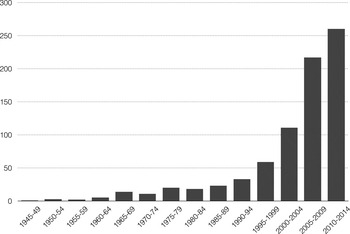
As shown in Fig. 1, since the beginning of population-based psychiatric attitude research in the late 1940s the number of papers increased slowly and steadily until the time period 1985–1994. Since then publication activity increased exponentially, resulting in an output of 478 papers during the years 2005–2014. Obviously there has been a real boom in population-based attitude research over the past 10 years with considerably more papers having been published in that time than over the whole time period before.
Publication activity since the beginning of population-based psychiatric attitude research (number of papers).

Geographical distribution
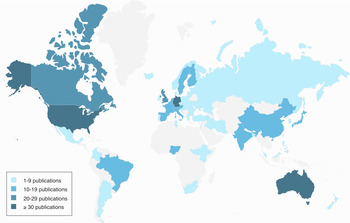
Figure 2 shows the geographical distribution of psychiatric attitude research by countries in absolute numbers of papers published. Most papers originated from Europe (36.2%), primarily from Germany (15.5%), France (4.6%) and UK (4.2%). Oceania comes next (23.4%), where Australia has contributed the lion share (22.6%). North America ranks third (23.2%) with the USA accounting for 20.9% and Canada for 5.2% of all papers. In contrast to western countries a relatively small proportion of papers reported research conducted in Asia (10.9%; mainly China (3.3%), Japan (2.9%) and India (1.9%)), Africa (4.8%; mainly Nigeria (2.5%)) and Latin America (4.6%; mainly Brazil (3.6%)).
Geographical distribution of psychiatric attitude research by countries (number of papers).

The distribution of papers over the various research centres involved in psychiatric attitude research turns out being highly skewed: The two most prolific research groups (one in Australia and one in Germany) accounted for three in ten papers published (28.7%). Almost half of all papers (44.4%) originated from the 10 most productive research centres worldwide.
Study characteristics
Slightly more papers were based on national surveys (54.8%) than on surveys conducted on a regional or local level. Regarding the age of participants, adults were the target in most cases (85.1%). In 9.2% research had been carried out among youth, in 2.7% among elderly. 1.9% focused specifically on attitudes towards mentally ill youth.
As concerns study design, the overwhelming majority of papers reported correlational cross-sectional studies (80.1%). Only a few were experimental (n = 9) or quasi-experimental (n = 10) in nature, of which seven studies evaluated campaigns aiming at reducing stigma or raising awareness. 11.7% of all papers presented results of trend analyses, comparing data obtained from at least two samples independently drawn at different times.
The most commonly chosen interview mode was face-to-face (45.9%). In 34.5% of papers the findings were based on telephone interviews. In 7.3% data had been obtained by mail, in 4.0% online.
In almost half of instances (44.6%) case-vignettes served as stimulus for eliciting responses from interviewees, most of them fulfilling criteria of commonly used diagnostic systems (DSM-III-R, DSM-IV, ICD-10).
The majority of papers presented data collected with instruments that had been developed ad hoc and had not been validated. In only 20.7% results were obtained using scales meeting established psychometric criteria. Among the five most frequently used scales for the measurement of stigma were Link's Social Distance Scale (Link et al. Reference Link, Cullen, Frank and Wozniak1987) (7-item version: 21 times, 5-item version 11 times), Link's Devaluation-Discrimination Scale (Link et al. Reference Link, Cullen, Struenung, Shrout and Dohrenwend1989) (22 times), the Depression Stigma Scale developed by Griffiths (Griffiths et al. Reference Griffiths, Christensen and Jorm2008) (21 times), the Community Attitudes towards the Mentally Ill Scale (CAMI) (Taylor & Dear, Reference Taylor and Dear1981) (11 times), and the Emotional Reactions Scale (ERMIS) (Angermeyer & Matschinger, Reference Angermeyer and Matschinger2003) (10 times).
As concerns mental health literacy, an instrument devised by Jorm et al. (Reference Jorm, Korten, Rodgers, Pollitt, Jacomb, Christensen and Jiao1997) for the assessment of the likely helpfulness and harmfulness of various professional and non-professional interventions for mental disorders has most widely been used (44 times, including modified versions). In its original form, the inventory represents the three factor-analytically derived dimensions ‘Medical’, ‘Psychological’ and ‘Lifestyle’. A more recent enlarged version includes a fourth factor named ‘Information-seeking’ (Jorm et al. Reference Jorm, Mackinnon, Christensen and Griffiths2005c ).
Conceptual framework
Most papers were descriptive in nature, only 12.1% were theory-driven. Most frequently they relied on attribution theory (Weiner, Reference Weiner1995) (14 papers), followed by cultural theories, such as the concept of ‘what matters most’ (Yang et al. Reference Yang, Kleinman, Link, Phelan, Lee and Good2007) (n = 10), the theory of social representations (Moscovici, Reference Moscovici2001) (n = 7), Link and Phelan's conceptualization of stigma (Link & Phelan, Reference Link and Phelan2001) (n = 5), the concept of medicalization (Conrad, Reference Conrad2007) (n = 4), the concepts of genetic essentialism (Nelkin & Lindee, Reference Nelkin and Lindee1995) (n = 4), and the theory of planned behaviour (Ajzen, Reference Ajzen1991) (n = 3).
Type of mental health problem
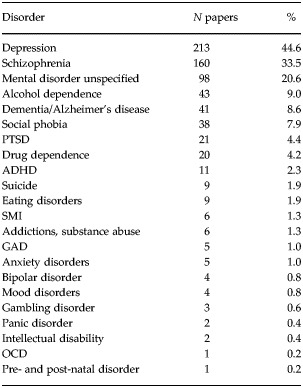
Almost half of attitude studies focused, exclusively or in combination with other disorders, on depression (44.6%). Schizophrenia comes next with 33.5% of all papers. 20.6% dealt with mental disorders in general without focusing on a specific illness. Less frequently researched were alcohol dependence, dementia, social phobia, PTSD and drug dependence (4.2–9.0%) and only few papers addressed the remaining disorders (Table 1).
Disorders addressed by population-based attitude research

Topics
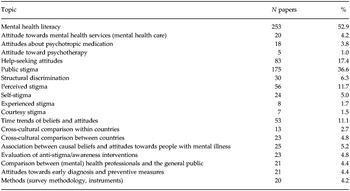
As shown in Table 2, the most common focus of research was on mental health literacy and related topics (in total 63.4% of all papers). This was followed by research focusing on various forms of stigma (in total 48.3%), with public stigma receiving by far the greatest attention (36.6%). 11.1% of papers investigated time trends of beliefs and attitudes about mental illness. The studies covering the longest time period were conducted in a rural community in the North of Sweden (27 years) (Ineland et al. Reference Ineland, Jacobsson, Renberg and Sjolander2008) and, on a national level, in Germany (21 years) (Angermeyer et al. Reference Angermeyer, Matschinger and Schomerus2013) and in Australia (16 years) (Reavley & Jorm, Reference Reavley and Jorm2012). 7.5% of papers reported on cross-cultural comparisons between countries or within countries. Most studies comparing different countries were conducted in the western hemisphere, only three included both western and non-western countries (Jorm et al. Reference Jorm, Nakane, Christensen, Yoshioka, Griffiths and Wata 2005b ; Nakane et al. Reference Nakane, Jorm, Yoshioka, Christensen, Nakane and Griffiths2005; Griffiths et al. Reference Griffiths, Nakane, Christensen, Yoshioka, Jorm and Nakane2006; Alonso et al. Reference Alonso, Buron, Bruffaerts, He, Posada-Villa, Lepine, Angermeyer, Levinson, de Girolamo, Tachimori, Mneimneh, Medina-Mora, Ormel, Scott, Gureje, Haro, Gluzman, Lee, Vilagut, Kessler and Von Korff2008; Pescosolido et al. Reference Pescosolido, Medina, Martin and Long2013). Comparisons between different ethnic groups within the same country originated almost all from the USA. 4.8% of papers are devoted to the evaluation of anti-stigma or awareness campaigns. Apart from these topics, which had already been included in the previous review new research topics have emerged. Fuelled by the ongoing debate whether biological illness explanations improve tolerance towards people with mental illness a number of papers examined the relationship between causal beliefs on the one hand and stereotypes, emotional reactions or desire for social distance on the other (5.2%). In several papers (4.4%) beliefs and attitudes of (mental) health professionals were contrasted with those of the general public. There has also been an increasing interest in public attitudes towards early diagnosis and preventive measures, mainly in the context of depression and dementia (4.4%).
Topics of population-based attitude research

Discussion
Limitations
Before discussing the results of our review some limitations should be addressed. First, our review only included papers written in English or other European languages, which may have resulted in an under-representation of countries where also other languages are in use for disseminating research results. Second, in order to guarantee a minimum of quality we only included peer-reviewed papers and excluded grey literature, research reports available on the Internet and doctoral theses, which also may have biased the sources on which our review is based.
Geographical distribution
Although attitude research has expanded in recent years into other parts of the world studies originating from western countries still predominate. Looking at economic indicators, only 14.6% of all studies included data from at least one low or middle income (LAMI) country (according to World Bank criteria), among them only 0.8% from low income economies, although these countries account for 80% of the world population. Here, psychiatric attitude research mirrors a general problem, the heavy bias of medical and psychiatric research towards high-income countries. It has been pointed out that on the one hand, in LAMI countries with low funding for research in general and few mental health researchers in particular, these restricted resources translate into lower research output (Sharan et al. Reference Sharan, Gallo, Gureje, Lamberte, Mari, Mazzotti, Patel, Swartz, Olifson, Levav, de Francisco and Saxena2009), while on the other hand medical journals could be biased against research from poorer countries (Patel & Kim, Reference Patel and Kim2007). Beyond, attitude research in particular is much more challenging in less affluent than in wealthier countries. Absence of professional market research companies, unequal distribution of landline or mobile telephones and stark differences in urban and rural infrastructure make accomplishing representative population samples highly difficult. These methodological challenges contrast with the high public health relevance of attitude research in countries where barriers to help-seeking are even higher because of lower availability of mental health care (Sharan et al. Reference Sharan, Gallo, Gureje, Lamberte, Mari, Mazzotti, Patel, Swartz, Olifson, Levav, de Francisco and Saxena2009; Becker & Kleinman, Reference Becker and Kleinman2013).
Cross-cultural comparison
Studies comparing public beliefs and attitudes about mental illness across different cultures still are scarce. This applies particularly to the comparison between western and non-western cultures. Typically, in stigma research instruments have been developed and validated in a western culture (mostly in the USA) with people of western European descent and then translated with little or no modification into another cultural context. The strength of this ‘universal’ approach is the generalisability and comparability of results across contexts. However, one inadvertent consequence is the elimination of stigma's culture-specific aspects (Yang et al. Reference Yang, Thornicroft, Alvarado, Vega and Link2014). Only recently, Yang et al. (Reference Yang, Kleinman, Link, Phelan, Lee and Good2007) have proposed a new theory, which allows accounting for how cultural influences impact upon stigma specifically. The concept of ‘moral experience’ or ‘what is most at stake for actors in a local social world’ provides a new interpretative framework for the behaviours of both the stigmatiser and the stigmatised person. The authors maintain that culture affects stigma by threatening a person's capacity to participate in the activities that determine ‘what matters most’ within a cultural context. For example, because the perpetuation of one's lineage is something, which is valued most within Chinese cultures, stigma is seen to most powerfully attack one's ability to extend one's lineage. So far, there exists one single population-based study where this new conceptual approach has been used (Yang et al. Reference Yang, Purdie-Vaughns, Kotabe, Link, Saw, Wong and Phelan2013).
Instruments
Apart from cultural validity, a major problem of population-based stigma research is that most studies use ad hoc developed instruments that have not been psychometrically validated. Moreover, among those instruments with proven psychometric properties, there are some, which have been developed years ago and may therefore not fully reflect the current situation. Just to give an example: In several items of Link's frequently used Devaluation-Discrimination Scale the perception of the stigma experienced by someone who had been in a ‘mental hospital’ is assessed – an institution, which in many western countries nowadays plays a rather marginal role in psychiatric care. The assessment of implicit stigma, a novel approach to measure stigmatising reactions, which is becoming increasingly popular in social-psychological experiments (for example, Rüsch et al. Reference Rüsch, Todd, Bodenhausen and Corrigan2010), has so far not been introduced into population-based research.
Type of mental health problem studied
Despite the spectrum of disorders under study having increased, the main focus of research is still on schizophrenia and depression. Reviews on differences in attitudes towards different disorders show that, for example, alcoholism seems to be stigmatised for very different reasons than schizophrenia (Schomerus et al. Reference Schomerus, Lucht, Holzinger, Matschinger, Carta and Angermeyer2011). This leads to another conceptual problem that should be addressed in future attitude research: Other stigmatised conditions like obesity or poverty often co-occur with mental disorder in individuals who then experience multiple stigmata. The concept of ‘layered stigma’ has been used in studies describing the multiple stigma experiences of persons with HIV (Henkel et al. Reference Henkel, Brown and Kalchman2008). Layered stigma could also be a useful concept when investigating mental illness stigma, but so far, attempts to bring together research on attitudes related to different medical and social conditions is only beginning (for example, Corrigan, Reference Corrigan2014).
Studies of time trends in attitudes and beliefs
The number of studies investigating time trends in attitudes and beliefs has significantly increased. Practically all of them are based on repeated cross-sectional assessment of attitudes with independent samples from the same population. This approach is best suited to detect variations of cultural conceptions of mental illness over time. While also providing insights into changes of people's attitudes on an individual level, panel studies would have to struggle with lack of representativeness of the follow-up assessment due to the huge attrition rate to be expected over time periods of 10 or more years, and, therefore, be less suitable for studying changes at the collective level. Using the same sampling procedure, interview mode and instruments within the same population at different time points has to be considered the gold-standard of time trend analysis. Data from identical surveys at three or more time-points will enable novel statistical approaches such as age-period-cohort (APC) analyses. APC analyses distinguish time-period effects from cohort and age effects and help thus explain whether any change in population attitudes is due to demographic transformation or a general shift of attitudes irrespective of age or cohort effects (Schomerus et al. Reference Schomerus, Van der Auwera, Matschinger, Baumeister and Angermeyer2015).
Influence of societal context on individual attitudes
Research has so far almost exclusively focused on individual beliefs and attitudes. The societal context that may influence individual perceptions and behavioural intentions has rarely attracted attention. Mojtabai (Reference Mojtabai2010) was the first examining the interplay between both individual and collective stigmatizing attitudes and how they are associated with willingness to seek professional help. Using multi-level analysis, Jang et al. (Reference Jang, Lim, Oh, Lee, Kim and Lee2012) were able to show that the desire for social distance from people with mental illness is not only determined by individual factors but also influenced by contextual factors. Adjusting for the individual's perceptions and characteristics, Richardson et al. (Reference Richardson, Morgenstern, Crider and Gonzalez2013), also using multi-level modelling, found collective perception of treatment effectiveness to be positively associated with the use of mental health services while collective perceptions of mental-illness stigma were not. Evans-Lacko et al. (Reference Evans-Lacko, Brohan, Mojtabai and Thornicroft2012) used multi-level analysis to show that self-stigma of individual patients is related to the degree of public stigma in a country. In view of potential implications for anti-stigma and awareness-raising interventions further research efforts in this direction are needed.
Attitudes v. behaviour
The overwhelming focus on attitudes may be looked upon as a limitation of the research reviewed, since attitudes allow predicting behaviour with only less than ideal accuracy. However, rather than using them as proxy for individual behaviours, public attitudes should also be regarded as a relevant phenomenon on their own. At a collective level, they reflect cultural conceptions of mental illness, forming a cultural context that influences the way we think about mental illness and the people who have them. As Link et al. (Reference Link, Angermeyer, Phelan, Thornicroft, Szmukler, Mueser and Drake2011) have pointed out ‘as a context this cultural conception becomes an external reality, something that individuals must take into account when they make decisions and enact behaviour’ (p. 255). Studies on individual stigma experiences yield manifold subtle forms of behaviour that are expressions of stigmatising attitudes but pose sincere problems to measurement (Angermeyer et al. Reference Angermeyer, Beck, Dietrich and Holzinger2004). Altered everyday interactions like not being completely trusted at work or receiving less phone calls by friends, for example, defy scientific evaluation. Moreover, the most frequently reported effect of stigma in a study among persons with schizophrenia was anticipation of discrimination and subsequent avoidance of critical situations (Thornicroft et al. Reference Thornicroft, Brohan, Rose, Sartorius and Leese2009). Social withdrawal because of fear of discrimination is discrimination without discriminatory behaviour, solely based on public attitudes and their perception. So attitudes remain a highly relevant topic of population-based studies. To measure and explain relevant discriminatory behaviour, studies in specific environments (work, school, health care, social media) or studies examining structural discrimination seem more useful than population studies.
Conceptual framework
Papers presenting descriptive results still predominate and only a minority of studies is theory driven. This is deplorable because pure description of reality does little to aid our understanding of attitudes and does not explore possibilities to change them. A good example is how testing specific theories has advanced research into the role of causal attributions for stigma. The dominant biological presentation of mental illness in science and media raised the question whether this shift in illness conceptualisation would help to reduce stigma. Here, conflicting theories predicted different effects: while attribution theory stressed the importance of blame and the potential of biogenetic causal models of mental illness to relieve it (Corrigan, Reference Corrigan2000), genetic essentialism predicted a deepening divide between persons with and without mental illness, should mental illness be explained in biogenetic terms (Phelan, Reference Phelan2005). Comparative testing of both theories revealed that in severe mental illness, essentialist thinking is much more relevant for stigma than attribution of blame (Schomerus et al. Reference Schomerus, Matschinger and Angermeyer2014).
Study design
Most studies are correlational studies not allowing causal inferences. Only a small number of studies used quasi-experimental designs, mainly for examining the influence of the presence of a community mental health facility on the attitudes of those living in the neighbourhood (Veltro et al. Reference Veltro, Raimondo, Porzio, Nugnes and Ciampone2005; Stadler, Reference Stadler2010) or for the evaluation of anti-stigma or awareness campaigns at a population level (Jorm et al. Reference Jorm, Christensen and Griffiths2005a , Reference Jorm, Christensen and Griffiths2006; Wright et al. Reference Wright, McGorry, Harris, Jorm and Pennell2006; Baumann et al. Reference Baumann, Zäske, Decker, Klosterkotter, Maier, Möller and Gaebel2007; Gaebel et al. Reference Gaebel, Zäske, Baumann, Klosterkötter, Maier, Decker and Möller2008; Dietrich et al. Reference Dietrich, Mergl, Freudenberg, Althaus and Hegerl2010). Although a population-based randomised controlled trial (RCT) to examine the effect of an information program on mental health literacy and help-seeking (Jorm et al. Reference Jorm, Griffiths, Christensen, Korten, Parslow and Rodgers2003) had already been conducted prior to the time covered by this review, no such RCT has been conducted since 2005.
As early as in 1963 Phillips (Reference Phillips1963) carried out a first survey experiment, but experimental studies sensu stricto only started again with Link's seminal study on the importance of labelling for mental illness stigma (Link et al. Reference Link, Cullen, Frank and Wozniak1987). Recent experimental studies manipulated for example causal explanations (Phelan, Reference Phelan2005), contextual factors of a disorder (Holzinger et al. Reference Holzinger, Matschinger, Schomerus, Carta and Angermeyer2011), or tested potentially adverse effects of different news media messages (McGinty et al. Reference McGinty, Webster and Barry2013). The thematic diversity among these few experimental studies demonstrates how widely experimental study designs may be used. Conducting online surveys has become increasingly convenient, facilitating complex experimental designs in large samples. The share of population-based experimental online surveys in the literature will thus likely grow.
Interview mode
The diversity of interview modes found in this review reflects the fact that each method carries specific advantages and disadvantages. Face-to-face interviews offer the opportunity that the interviewer can give direct support to the task performance of the respondent. They are therefore particularly suitable for longer interviews with more complex tasks (Holbrook et al. Reference Holbrook, Green and Krosnick2003). On the other hand, the presence of an interviewer may systematically influence the answers of the respondent resulting in interviewer bias, with social desirability bias being the best known example. In addition, as differences between interviewers in the way they do their job are not easy to control interviewer variance may pose a problem (Loosveldt, Reference Loosveldt, de Leeuw, Hox and Dillman2008). Face-to-face interviews are also the most expensive option.
Although face-to-face has remained the most frequently used interview mode, its share has decreased compared to the previous review, while that of telephone interviews has increased. An explanation for this change may be that telephone surveys, particularly those using Random Digit Dial samples, offer a more cost-efficient method for gaining access to the general population. Another advantage is that due to the centralised administration of Computer Assisted Telephone Interview (CATI) systems, complete control over all aspects of the interviewing process is possible (Steeh, Reference Steeh, de Leeuw, Hox and Dillman2008). However, the growing use of mobile phones (and declining availability of landline phones) makes it increasingly difficult to achieve representative samples in telephone surveys (Holborn et al. Reference Holborn, Reavley and Jorm2012). To overcome this problem, in some recent surveys the sample was contacted by random-digit dialling of both landlines and mobile telephones (for example, Reavley & Jorm, Reference Reavley and Jorm2012). However, this mixed design raises new methodological problems, since households are the sample unit for a landline telephone frame, whereas the individual subscriber is the sample unit for a mobile number frame (Steeh, Reference Steeh, de Leeuw, Hox and Dillman2008). Apart from the coverage problem, the principal difficulty has been maintaining adequate response rates as participants tend to object to long telephone interviews and feel more annoyed and disturbed by this approach (Holbrook et al. Reference Holbrook, Green and Krosnick2003). Systematic trend studies show response rates dropping significantly when the interview mode changes from face-to-face to random-digit dialling (Steeh, Reference Steeh1981). Like face-to face interviews, telephone surveys are considered vulnerable to social desirability bias (Henderson et al. Reference Henderson, Evans-Lacko, Flach and Thornicroft2012).
Online surveys are a recent development and their share will likely increase due to the growing availability of online access and low costs of surveys. They have the advantage of eliminating unwanted interviewer effects and providing more privacy when answering sensitive questions (Henderson et al. Reference Henderson, Evans-Lacko, Flach and Thornicroft2012). However, recruiting a sample representative of the general population for online studies is methodologically challenging. Of 14 online studies included in this review, seven used a ‘gold standard’ sampling method, drawing randomised samples from a large nationally representative panel that was recruited offline. Other studies relied on online panels that were not representative of the general population. Methods to approximate a representative sample were quota sampling or weighing data according to socio-demographic variables. Nonresponse is another serious problem for Internet surveys, which is higher than in comparable telephone surveys (de Leeuw & Hox, Reference de Leeuw, Hox, de Leeuw, Hox and Dillman2008).
In sum, the various interview modes carry specific benefits and risks, which, in consequence, may lead to differences in effective study samples and/or responses to survey questions. Direct comparison between surveys using different interview modes appears therefore highly problematic as differences may be the result of mode change rather than any actual difference in attitudes of interest (Dillman & Christian, Reference Dillman and Christian2003).
Use of case-vignettes
Case-vignettes were first used in 1955 by Reference StarStar in a national survey on attitudes of the American public towards mental illness. They have been in use for many years until, in 1990, Angermeyer & Matschinger (Reference Angermeyer and Matschinger1995) introduced for the first time into population studies vignettes utilising explicit criteria for diagnosing mental disorders derived from DSM-III-R (and subsequently DSM-IV). Since then, case-vignettes have enjoyed growing popularity. Over the last 10 years, in about half of all articles on public attitudes the vignette technique has been employed. According to Yang et al. (Reference Yang, Link, Phelan, Arboleda-Florez and Sartorius2008) there are two major reasons why vignettes have gained such a prominent position: first, vignettes present a more elaborate stimulus to respondents than simply asking about ‘mental illness’ or ‘mentally ill people’. Second, they can also be administered via random assignment, which brings the power of the experimental method to hypothesis testing – a possibility which, as indicated above, so far has only rarely been used in population-based studies (for example, Phelan, Reference Phelan2005; Holzinger et al. Reference Holzinger, Matschinger, Schomerus, Carta and Angermeyer2011).
Besides these strengths also some limitations of the vignette methodology have to be mentioned: supposedly equivalent vignettes illustrating the same disorder may yield different responses because of variation in number and type of symptoms described (Sai & Furnham, Reference Sai and Furnham2013; Schlier et al. Reference Schlier, Schmick and Lincoln2014). By their very nature vignettes tend to be highly specific and situated, questioning whether responses are transferable to different persons or situations. Moreover, the focus on paradigmatic cases does not represent the true diagnostic and demographic heterogeneity of a particular mental illness. The utilisation of paradigmatic cases may in fact be assessing the possession of stereotypical information among respondents, as much as their mental health ‘knowledge’ (Aldersey et al. Reference Aldersey, Huynh and Whitley2016). With rare exceptions (for example, Phelan, Reference Phelan2005; von dem Knesebeck et al. Reference von dem Knesebeck, Mnich, Daubmann, Wegscheider, Angermeyer, Lambert, Karow, Härter and Kofahl2013), population-based studies used unlabelled vignettes depicting symptoms of the disorder of interest. This may have clouded potential differences between reactions to unusual behaviour and reactions to psychiatric illness (Angermeyer et al. Reference Angermeyer, Daubmann, Wegscheider, Mnich, Schomerus and Knesebeck2015). In view of these problems there is a pressing need for more systematic research on this methodology.
Future directions of population-based attitude research in psychiatry
Our review shows that there is an avant-garde in attitude research using both well-founded and innovative survey methods to explore the depth of population attitudes towards mental illness, enabling us to exemplify the current gold-standard of population-based attitude research. However, dissemination of these methods is by far incomplete, and many of the shortcomings observed in 2006 persist until today. Additionally, there are challenges ahead: the outlined difficulties to achieve representative population samples particularly with telephone surveys will likely increase and it remains to be seen to what extent carefully selected representative online-panels can be used as a methodologically sound replacement. With regard to its methodology, attitude research needs to show both more rigor and sustain a pioneering spirit.
Supplementary material
The supplementary material for this article can be found at http://dx.doi.org/10.1017/S2045796016000627
Acknowledgements
None.
Financial support
This research has received no specific grant from any funding agency, commercial or not-for-profit sectors.
Conflict of Interest
None.
Availability of data and materials
The complete list of articles analysed in this review is provided in the online supplement.