THE SUCCESSIVE METAMORPHOSES OF A “SCIENTIFIC DISCOVERY”
In the 1970s, Ancel Keys shared the knowledge of the Mediterranean diet (MD) with a large audience, within the framework of the crusade against cholesterol, which has made this American epidemiologist famous in the baby boom era.Footnote 1 What was initially a simple scientific idea later turned into a nutritional model, known globally since the 1990s as the Mediterranean diet pyramid.Footnote 2 More recently, in 2010, the MD was one of the first food-related nominations on the Representative List of the Intangible Cultural Heritage of HumanityFootnote 3 (Representative List). This healthy diet is now understood in a more holistic manner, being assimilated to the diaita, an ancient Greek word meaning “way of life.”Footnote 4 Recently, Francisco Xavier Medina and Lluís Serra-Majem, who had the idea to propose the nomination, described the journey to the newest list of the United Nations Educational, Scientific, and Cultural Organization (UNESCO) in the following terms:
This process, was conceived and have been germinating in civil society; had the privilege of counting on the involvement of national, regional, and local institutions; and received the unconditional support of the scientific community … there was a genuine explosion of enthusiasm and support from institutions and all types of associations, thus consolidating the transversal nature of the project. This elation demonstrated that a close bond and genuine identification persisted between Mediterranean societies and their cultural and food heritage.Footnote 5
This article proposes a critical analysis that evaluates the involvement of the local communities and the belief in a common Mediterranean identity based in a shared food tradition. I will argue that the diaita is the last mutation of the Keys creation, resulting from a complex auto-organized process that is incomprehensible without adopting a diachronic approach as undertaken in the following pages. My goal is to demonstrate that the inscription’s proposal of being included on the Representative List was motivated first by a long-term strategy aimed at promoting an “umbrella brand” of agro-food products that was extended to the whole Mediterranean region, which will be referred to in the subsequent pages as the Med label.Footnote 6 I will first reveal why I have elected a theoretical groundwork based on the concepts of “governmentality” and “epistemic community” instead of “heritage entrepreneurship,” as Richard Pfeilstetter recently did to address the same case study.Footnote 7 I will also explain why this theoretical twist permits new advances in the comprehension of the issue. I will assume, contrary to Pfeilstetter,Footnote 8 that the MD is a scientific creation later turned into a “multi-tasks” governmentality instrument and not a pre-existent cultural element like other inscriptions on the Representative List.Footnote 9 Next, I will explore how the members of what I call “the pro-Mediterranean community” started to use this “scientific discovery” to promote the Med label. Next, I will explain how Barcelona became the epicenter of the global movement for safeguarding the MD and how its inclusion on the Representative List has been used since then as a new way to promote the Med label. I will emphasize the attempt to design a protective model of property rights that is adequate for this food label, which was later presented within the UNESCO arena as a measure for safeguarding the diaita as an item of intangible cultural heritage. Finally, I will argue that this claim completely ignores the rights of the numerous expatriates living outside this region.
EPISTEMIC COMMUNITY AND GOVERNMENTALITY
As Amin Maalouf openly argues, most Mediterraneans have no conscience about having a common identity, based on a shared food heritage that they value.Footnote 10 Today, solid evidence indicates to the contrary that more and more individuals are rejecting their traditional foodways, which have been characterized in the past by a limited consumption of meat and animal fat.Footnote 11 Serra-Majem, and Medina themselves give the governmental and the academic institutions, instead of the local communities, the credit for the UNESCO recognition.Footnote 12 I will argue further that this heritage turn is primarily the work of an epistemic community whose members have co-operated to include the MD in the Representative List and who, thereafter, have quite naturally assumed the mission to defend this legacy and, by extension, the identity of “the Mediterranean people” from the threat of cultural globalization. It is important to note that the whole pro-Mediterranean community, and not only the Mediterranean Diet Foundation (MDF),Footnote 13 has made the translation of the MD into the diaita possible. As usually happens with epistemic communities, the members belong to a very heterogeneous and dynamic set of national and international, governmental and non-governmental, academic and non-academic organizations, which are identified in the following discussion.
A theoretical framework based on the concept of an epistemic community, recently introduced in cultural heritage studies,Footnote 14 is applied in this case study to understand its particular nature instead of the agency-driven outlook adopted by Pfeilstetter.Footnote 15 The first advantage of this method is to avoid concentrating on a single organization—in this case, the MDF—even if I entirely agree that this foundation very quickly assumed the leadership of this motley collective, as we will see further. The alternative theoretical framework explored here also allows the valuation, in a more constructivist perspective, of the actions of single individuals belonging to both the MDF and other institutions, who have contributed significantly with their personal effort to the success of the application. On the other hand, we will see that the pro-Mediterranean community was assembled several years before the constitution of the MDF and the MD’s heritagization process. This single fact limits substantially the explanatory value of an approach based on a “heritage entrepreneurship,” being focused exclusively on the conversion of the cultural elements into heritage. Indeed, in this particular case, the heritagization is not the main purpose but, rather, only a new stage of a long-term strategy involving not only the MDF but also other stakeholders, each one with his own agenda.
Thus, instead of focusing on the leading position and the objectives of a single institution, the “epistemic community” defines itself by a common episteme. Footnote 16 This notion addresses the set of shared beliefs that assures the cohesion of the heterogeneous group that use the MD for multiple purposes, one of them being the promotion of the Med label since the beginning. The latter had gradually been constituted through successive feedback that articulated very closely with the factory of scientific knowledge by the researchers, the praxis, and the political agenda of the other stakeholders who integrate the pro-Mediterranean community.Footnote 17 The unifying episteme is primarily constructed of an aetiology of the MD’s origins based on a cold temporality inherited from Ancel Keys, who assimilated this nutritional model to a food tradition that has remained unchanged since the beginnings of Western civilization.Footnote 18 The existence of a transnational collective—“the Mediterranean people,” whose identity is cemented by a common culinary heritage—is also very consensual today within this group. Finally, the recognition of the MD’s potential as an instrument of governmentality brings together its members and, beyond the ancestral origin of this legacy, legitimizes the need for safeguarding it.
Adopting a governmentality-based approach avoids another weakness of the “cultural entrepreneurship” model; in this particular case, the heritagization process itself has turned the MD into a cultural element. In other words, the MD’s existence as an intangible legacy began when it was translated into the diaita, which is a UNESCO entity. Indeed, as I explained earlier, the MD is not an “emic” conception of “the Mediterranean people” at all but, simply, a scientific concept, turned into an instrument of governmentality during the 1990s. As the “cultural entrepreneurship” inspired by Pierre Bourdieu’s conception of the symbolic capital,Footnote 19 the Foucauldian notion of “governmentality” addresses the relation between power and culture in modern societies. However, instead of extending the intrinsic logic of the economy to other dimensions of social life, as Pfeilstetter openly does, a governmentality-based approach focuses the use of ideas, techniques, and organizations to inspire voluntary changes in individual behavior.Footnote 20 It allows the conception of the diaita’s nomination, not per se but, rather, just as a new step of the MD’s existence as an instrument of governmentality for multiple purposes. This change of paradigm permits the embrace of the plurality of agendas, including the promotion of the Med label addressed here, of a heterogeneous pool of individual stakeholders that belong to the pro-Mediterranean community. On the other hand, identifying the key agents and establishing the timeline of its existence demonstrates that the elevation of the MD to the Representative List was originally projected among this collective as a new strategy to promote the agro-food industry in the Mediterranean region. As we will see further, the connection between the MDF and this sector of activity has been very strong since the beginning.
Concerning the methodology adopted, my analysis will focus on both the official sources and the writings of individual stakeholders, as Pfeilstetter did earlier.Footnote 21 The public statements and also the comments shared in private by some of these individuals at scientific meetings and debates related to the MD will be used to contrast these two different kinds of evidence. However, I choose not to follow the way of formal interviews because previous inquiries have demonstrated that this kind of approach tends to be redundant. Indeed, during fieldwork undertaken in 2010 and 2011, Consuelo Álvares Plaza noted that her interlocutors often echoed the official narrative about this heritagization process,Footnote 22 which, by rule, totally omits the economical motivations of the nomination proposal. As Chiara Bortolotto has argued recently, the overlapping of commercial and heritage values is a source of embarrassment in this arena, which explains the difficulty in getting sincere feedback about this issue, at least in public.Footnote 23
Next, we will see how the original community of practice, exclusively made up of actors from the field of medical sciences inspired by Key’s work, turned into the very diverse group that started to use the MD to promote the Med label, 20 years before being translated into a heritage of humanity. As we will see, this process involves a changing set of heteroclite governmental and non-governmental entities that includes the International Olive Council (IOC), the Asociación para el desarollo de la dieta mediterránea (ADDM), the Spanish Ministry of Agriculture, Food and Environment, the International Centre for Advanced Mediterranean Agronomic Studies, and, more recently, the Abril Group. The final objective of these organizations has been consistently the same: to promote the agro-food industry and, particularly, the selling of olive oil.
USING THE MD TO PROMOTE THE MED LABEL
An American non-governmental organization (NGO), the Oldways Preservation and Exchange Trust (OPET), had an important role in associating the MD with the Med label. However, the original idea to take advantage of epidemiologists’ research related to cholesterol came from another institution: the IOC. The IOC was founded in Madrid in 1959, under the auspices of the United Nations, to bring together representatives of the producing countries of olive oil and table olives. The members realized that the American public was increasingly concerned about the healthiness of what they were eating daily. The consumer interest for this kind of issue was fully revealed in 1991 by the impact on the media of the controversies surrounding the presentation of the first US Department of Agriculture (USDA) pyramid, which was strongly contested by the national meat lobby.Footnote 24 The IOC expected that the ascending demand for healthy food could open up new doors of opportunity for the olive oil industry. In fact, this organization was the pioneer in exploring the commercial potential of the MD, later allowing other segments of the agro-food sector to expand into the market for products representative of the Mediterranean basin on a global scale and particularly in America. It is well known that cultural barriers are generally an obstacle to the export of foodstuffs out of their original context. Identifying products such as olive oil, which until then had been underrated, as being part of the MD would now permit them to reach a greater number of people, regardless of their culinary background or where they lived.Footnote 25 One of the IOC’s missions was precisely to work closely with the private sector to stimulate the expansion of international trade and the consumption of olive oil and table olives “through innovative campaigns and action plans.”Footnote 26 It was with this agenda in mind that the IOC president, Fausto Luchetti, charged the OPET with organizing a gastronomic “expedition” in Barcelona, Madrid, and Seville in 1992.Footnote 27 The aim was to present the Spanish cuisine and, more generally, the Mediterranean food legacies to a group of influential journalists and opinion makers. The OPET, based in Boston, was founded just two years earlier, and the goal of its charismatic leader, K. Dun Gifford, was to promote healthy habits inspired by the traditional dietary patterns from different regions of the planet.Footnote 28
In January 1993, a group of experts met at the Harvard School of Public Health in Boston for the first of a series of international conferences entitled Public Health Implications of Traditional Diets, which was organized by the World Health Organization, the Food and Agriculture Organization, and the OPET, with financial support from the IOC,Footnote 29 probably in the hope that researchers would recognize the nutritional virtues of olive oil. Gifford invited Lluís Serra-Majem, then professor of preventive medicine and public health at the University of Barcelona, to join the conference’s scientific commission. The two men met for the first time shortly before, on the occasion of the Spanish “tour.”Footnote 30 The objective announced by the organizers of this conference cycle was to design pyramids similar to those recently adopted by the USDA to represent traditional foodways, which they considered beneficial from a medical perspective.Footnote 31 The first session focused precisely on the Mediterranean case study. The participants in the conference agreed to define the MD as being predominant in this geographical area, where olive cultivation has been practiced for a very long time, being the principal source of fat used by the inhabitants.Footnote 32 The Boston meeting was also an opportunity to present a new graphic that was inspired by the last USDA’s food guide, which had aroused a great deal of controversy. The MD pyramid would in future be synonymous with virtuous nutritional standards, quickly conquering the rest of the world. Following the American example, health organizations in other Anglo-Saxon countries like England and Australia would soon be encouraging their citizens to adopt the Mediterranean way that was assimilated to the pyramid and other versions.Footnote 33
The immediate enthusiasm of scholars and the media for the Mediterranean food tradition in general, and, for olive oil, in particular, led Serra-Majem to join the OPET in 1995 to organize a new scientific encounter within the framework of the International Food and Beverages Exhibition (Alimentaria 1996), which was to be held in Barcelona. The same year, the Catalan capital also hosted an international summit that set the conditions for the unprecedented deployment of the MD as an instrument of governmentality a decade later. This conference laid the foundations for a Euro-Mediterranean security community.Footnote 34 The aim was to create a common space of peace and stability through political, economic, and financial co-operation, also considering social, cultural, and human factors.Footnote 35 The support of the Euro-Mediterranean partnership to the MD’s cause would contribute to greatly increasing the visibility of the pro-Mediterranean community in the next stage of its existence.
According to Serra-Majem, the preparation of the Alimentaria 1996 would be the origin of the ADDM. This institution, founded in August 1996, brought together several companies operating in Catalonia to promote the consumption of not only olive oil but also other Mediterranean foodstuffs.Footnote 36 In reality, this group of entrepreneurs had begun to develop the idea of lobbying on the occasion of the Alimentaria 1994, being inspired by the media buzz around the new pyramid.Footnote 37 From that moment on, the MD was seen as an effective way to promote the Med label, which now included the entire agro-food sector. It is clear today that the olive oil lobby, deeply rooted in the emerging epistemic community, made a visionary move with a durable effect. Indeed, the notoriety of food labels is currently undeniable. The key to their popularity is the ability to meet the expectations of consumers, allowing differentiation in export markets, even if they are increasingly exposed to competitors.Footnote 38
The next step was the creation of the MDF the same year. Serra-Majem was appointed to lead the Scientific Committee and was promoted to president a few months later,Footnote 39 being in charge until 2012. The ADDM was the backdrop to the MDF since the beginning. This association sponsored the organization alongside the Spanish Ministry of Agriculture, Food and Environment, the government of Catalonia, the municipality of Barcelona, and several public–private institutions and food enterprises operating in Catalonia, including members of the ADDM.Footnote 40 We must remember that the agro-food industry is the second most important sector of activity in Catalonia. Moreover, the products usually associated with the Med label alone account for nearly 60 percent of the cultivable area of the whole Spanish territory. The support of the central and provincial authorities was guaranteed for these two reasons.Footnote 41 However, the official narrative about the purpose of the MDF is quite different. Its mission was supposed to be “strictly cultural and scientific,” if we believe the information provided by this organization in 2010 to integrate the list of NGOs, non-profit-making institutions, and experts credited as advisors by UNESCO.Footnote 42 Thus, officially, the main goal of the MDF was not to promote the Med label but, instead, to safeguard the MD as a healthy nutritional model.
THE DIAITA: A NEW WAY TO PROMOTE THE MED LABEL
In the following years, the MDF assumed the informal leadership of the pro-Mediterranean community, turning Barcelona into the epicenter of the global MD’s safeguarding movement. Serra-Majem officially announced to the scientific arena his intention to present the nomination’s proposal for the first time at the third Euro-Mediterranean Forum, which was held in 2005 at the University La Sapienza of Rome.Footnote 43 This symposium, organized precisely on the tenth anniversary of the Euro-Mediterranean Partnership, brought together specialists from various disciplinary areas.Footnote 44 The final declaration (Rome Call for a Common Action) synthesized the basic ideas of the proposal approved by the Intergovernmental Committee in 2010.Footnote 45 All of the Mediterranean countries were invited to collaborate in order to prepare an application for the inclusion of the MD on the recently created Representative List, and it officially became known for the first time as the diaita.Footnote 46 The Rome Call also decided that the transnational initiative should be overseen from Barcelona, where the Euro-Mediterranean Partnership was founded in 1995. This choice was justified at the same time by the fact that the MDF’s headquarters had also been located there from the beginning. In the Mediterranean 2012 report, Joan Reguant-Aleix, the coordinator of the application-drafting team, and Francisco Sensat Alemany, summarized the main stages of the process:
• March 2006 (Barcelona, Spain): sixth International Congress on the Mediterranean Diet
The participants in this meeting, responding to the 2005 Rome Call, renewed their commitment. They also appealed to all the Mediterranean governmental and non-governmental stakeholders to join the initiative.
• February 2007 (Ibiza, Spain): Spanish-Italian Summit
The Spanish and Italian ministers of agriculture announced their support for the MD’s nomination proposal.
• October 2007 (Barcelona, Spain): meeting of the MDF International Scientific Committee
Declaration of Barcelona on the MD as intangible cultural heritage.
• December 2007 (Madrid, Spain): first trans-Mediterranean meeting hosted by the Spanish Ministry of Agriculture, Fisheries and Food
Spain, Greece, Italy, and Morocco constituted their respective national teams to start drafting the application, based on a strategic document previously prepared by the MDF.
• April 2008 (Rome, Italy): meeting hosted by the Italian Ministry of Agricultural, Food and Forestry Policies
Declaration of Rome, wherein the four states parties agreed to designate the MDF as the technical transnational coordinator of the proposal’s drafting.
• February 2008 (Zaragoza, Spain): first meeting of the ministers of food, agriculture and fisheries of the International Centre for Advanced Mediterranean Agronomic Studies (CIHEAM) member countries
The Final Declaration officially expresses the support of the CIHEAM to the initiative.
• June 2008 (Athens, Greece): international summit hosted by the Greek Ministries of Agriculture and Culture
The representatives of both ministries from each state party agree with the general contents of the nomination’s proposal.
• July 2009 (Rabat, Morocco): international summit hosted by the Moroccan Ministry of Culture
The states parties agree to present a final version of the nomination file with additional elements derived from the preliminary UNESCO evaluation.
• April 2009 (Chefchaouen, Morocco): first meeting of the emblematic communities
A declaration of support is given by the four emblematic communities of Cilento, Soria, Koroni, and Chefchaouen respectively, chosen by the governments of Italy, Spain, Greece, and Morocco to represent “the Mediterranean people.”
• August 2009 (Paris, France)
The submission of the nomination file at the UNESCO headquarters.
• March 2010 (Istanbul, Turkey): second meeting of the ministers of food, agriculture, and fisheries of the CIHEAM member countries
All of the countries that are members of this organization renewed their commitment to supporting the initiative.
• 16 November 2010 (Nairobi, Kenya): fifth session of the Intergovernmental Committee of the Safeguarding of Intangible Cultural Heritage
The Mediterranean Diet is inscribed on the Representative List.
• April 2011 (Cilento, Italy): second meeting of the emblematic communities.
• June 2011 (Koroni, Greece): third meeting of the emblematic communities.
• January 2012 (Soria, Spain): fourth meeting of the emblematic communities.Footnote 47
The analysis of this timeline first confirms the leading position of the MDF throughout the entire process. It also reveals that the ministers of agriculture of the four states parties responded to the 2005 Rome call, at least one year before the respective ministers of culture. According to Serra-Majem and Medina, the Spanish minister of agriculture, fisheries, and food was the first leader to endorse the project, later convincing other governmental institutions both at a national and international level to join the initiative.Footnote 48 His strong support confirms that the promotion of the agro-food products was indeed the major motivation of the whole operation. Finally, the representatives of the local communities chosen by the national governments to represent the diaita only met each other for the first time four months before the application’s submission. It is highly questionable, given this fact, whether their contribution to the definition of the MD as intangible heritage was really important. Indeed, even the Spanish town of Soria, which was the first to be elected as an emblematic community, only proclaimed its adherence at the occasion of a public ceremony in October 2008.Footnote 49 The fact that most of the actors involved in this heritagization process had, at this time, a very limited knowledge about the 2003 convention and the main objectives of the new UNESCO list can explain why they viewed the participation of the local people as a simple formality.Footnote 50
It is well known that, to be successful, an application to the Representative List must be based on a convincing narrative establishing a solid connection between the cultural element of the nomination’s proposal—a well-defined homogeneous collective (“community, group, or, if applicable, individuals”)—and a cultural identity shared by all of the members.Footnote 51 They must also express their consent (“free, prior and informed”) and participate (“the widest possible”) in the process of the proposal’s preparation.Footnote 52 However, the initiative to present a nomination file must always be assumed by the state(s) party(ies) where the cultural element is found—that is to say, never directly by the group to which this element belongs. For these two reasons, the proposal’s preparation is supposed to be a “from the bottom-up” process. It means that the initiative should be taken by the civil society at a local level, later being submitted by the national governments, to which the Convention for Safeguarding of the Intangible Cultural Heritage (CSICH) gives the power and legitimacy to endorse (or not) the nomination proposal according to the members’ own political and cultural agendas.Footnote 53
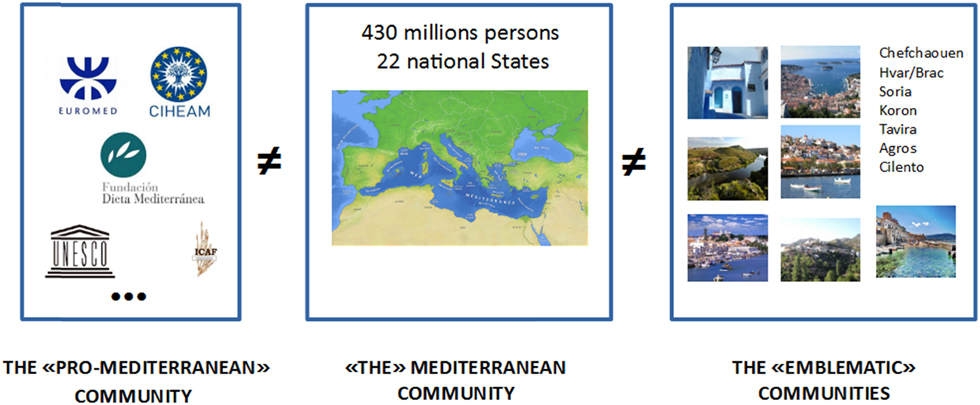
In this particular case, the collective is “the Mediterranean people” (Figure 1). It is comprised of nearly 430 million individuals, with well-known differences in what concerns culture, religion, and also food traditions,Footnote 54 living in the 22 national states bordering the land-locked sea. In theory, all of them are formally invited to join the nomination proposal submitted in 2010 by only four of these countries (Spain, Greece, Italy, and Morocco).Footnote 55 In fact, Portugal, Cyprus, and Croatia had already formalized their adhesion in 2013,Footnote 56 while several others had recently declared their intention to follow this example.Footnote 57 Thus, the seven countries that already claimed the MD are supposed to represent all of the nations of the Mediterranean region. At the local level, the same happens with the so-called emblematic communities,Footnote 58 whose members are supposed to represent all of the inhabitants of this large geographical area (Figure 1). This ingenuous formula, which was at that moment unique in the universe of nominations approved by the Representative List, was favored by the definition of the community’s meaning in the heritage arena,Footnote 59 which contributed to the crucial issue of participation and consent being avoided.
Collectives involved in the heritagization of the MD

According to Pfeilstetter, the leaders of 53 local governmental and non-governmental entities agreed to sign the consent declarations attached to the nomination file.Footnote 60 The number of individuals involved in these organizations, of course, was totally insignificant when we consider the 430 million individuals they were supposed to represent. However, the strategy of reducing “the Mediterranean people” to the members of the four emblematic communitiesFootnote 61 artificially improved the ratio between the represented and the representatives that gave a “free, prior and informed” consent, creating the illusion of achieving “the widest possible” level of participation. It was, however, enough for the proposal to be approved by the Intergovernmental Committee, which only had to consider the representative of the “Mediterranean people” indicated by the states parties. In the end, the community participation is mostly a state-sponsored activity, which gave the national governments exclusive control of how and by whom it is represented within the framework of the heritage narrative staged by the nomination files.Footnote 62 In theory, the CSICH gives to all the members of the “Mediterranean people” the last word in what concerns the safeguarding of the MD. However, in practice, as usually happens in heritagization processes, the preparation of the 2010 nomination’s proposal did not preview any previous public consultation to allow them to express (or not) their attachment to the MD and the Mediterranean identity.
We will now see how some newcomers of the expanding pro-Mediterranean community have tried to design, at the same time, a protection model of property rights related to this food label, presented later within the UNESCO arena as a measure for safeguarding the diaita as intangible cultural heritage.
PROTECTING THE MEDITERRANEAN TERROIRS
During this period, a new member of the growing epistemic community was responsible for a first step in legally protecting the Med label. As we saw before, the CIHEAM, which was already represented by the Istituto agronomico mediterraneo di Bari within the Italian delegation, officially joined the diaita project in February 2008.Footnote 63 Since that time, this organization had promoted several scientific studies to explore the possibility of using the MD as a governmentality instrument in new arenas. The results were later published in the Mediterra2012 report. This work was explicitly presented as a trans-Mediterranean effort towards a safeguarding measure in the second nomination file approved by the Intergovernmental Committee in 2013.Footnote 64 One of the tasks assumed by the CIHEAM was precisely to design a juridical framework to protect the Med label, which should reflect the future conversion of the MD into intangible cultural heritage. As Annarita Antonelli (CIHEAM-Bari) and Hélène Ilbert (CIHEAM-Montpellier) explained in their contribution to the Mediterra2012 report, they had regarded this brand since the beginning as a sign of quality directly related to the origin of the food products.Footnote 65
The idea of creating a trans-Mediterranean brand had been suggested earlier by Jean-Louis Rastoin, a researcher of the Montpellier Supagro, in a 2009 paper published in the proceedings of a scientific meeting on geographical denominations, which was organized by the CIHEAM.Footnote 66 The Novagrimed project would give the group an opportunity to evaluate its feasibility. This program assembled local authorities, research units, and other public entities within the framework of the 2007–13 European structural policy in the Mediterranean region. The main goal was to implement concrete, innovative, and collective actions to highlight the specificities of local agriculture in harmony with the sustainable philosophy expressed a few years earlier by the World Commission on Culture and Development in the report Our Creative Diversity.Footnote 67 Considering the support of the Euro-Mediterranean Partnership, it may be surprising to learn that the project only involved countries of the Latin arc: France, Greece, Italy, and Spain. However, this choice reflects the original geographical spectrum of the application to the Representative List. According to the testimony of the MDF’s vice-president, Francisco Sensat Alemany, the Spanish candidacy was inconceivable without the participation of Greece and Italy.Footnote 68 France, the fourth country of the “Mediterranean universe,” as defined by Keys in the 1970s,Footnote 69 was invited to join the project and it eventually supported the initiative officially at the beginning.Footnote 70 However, later, France would decline the offer because an application to inscribe the gastronomic meal of the French on the Representative List was already being prepared.Footnote 71 The French proposal would be approved in the same year as the diaita.Footnote 72 Morocco was then chosen to fill the gap because, according to the testimony of the general director of the Food Department of the Spanish Ministry of Agriculture,Footnote 73 all of the parties involved agreed to include a partner from the Maghreb, representing the whole southern shore. The participation of a non-European state, even if they were totally in harmony with the spirit and the strategic agenda of the Euro-Mediterranean Partnership, was in fact at that moment only a sort of plan B.
Turning again to Antonelli and Ilbert, the main objective was to create an “umbrella brand,” grouping the geographical indications from the Mediterranean countries to protect their emblematic products. The inspiration was, since the beginning, the appellation of origin based on the idea of “terroir.” This French word, lacking an exact translation in English, expresses a strong nexus between foodstuffs, the land where they are produced, and the local know-how. The same word also refers to the juridical category created to support the national wine industry during the viniculture crisis that affected France at the beginning of the twentieth century.Footnote 74 In the 1990s, its legal use evolved to deal with the semantic and practical shifts that had occurred between protection according to intellectual property rights and quality control procedures.Footnote 75 The definition by Jean-Louis Rastoin of the Med label as a sort of a constellation of affiliated terroirs—the so-called “Mediterranean terroirs”—reflects this evolution.Footnote 76
Like trademarks, geographical indications are now subject to the juridical status of intellectual property.Footnote 77 The fact that the product’s name is linked to a specific territory, distinguished by unique natural and human factors, makes its transmission outside this space impossible. It is passed with ownership or with the right to exploit the soil, turning it into an inalienable collective property. The purpose is to guarantee that the food products presented to the consumers as being Mediterranean are really from this geographical area. In this particular case, the implementation of protection measures was, according to Antonelli and Ilbert, justified by a predictable greater exposition to unfair promotion practices. In short, these two scholars believed that the Med label would, in the future, be the victim of its own success. The fact is that the earlier association to the MD rapidly turned this brand into a very effective method for increasing sales. For this reason, it was only to be expected that, after the diaita became integrated on the Representative List, the producers of lesser-known regions would take advantage of the UNESCO recognition, as they had unfairly used the notoriety of the brand mark “Italy” in the past.Footnote 78
Over the next years, despite the efforts of the CIHEAM, this “umbrella mark” seems not to have been endorsed by the producers of agri-food from the Mediterranean region. The reasons for this failure are not clear and still need to be studied. However, today, the olive oil lobby could once again be a major player in a new stage of the Med label’s history. The recent support of the Avril Group to the cause provides the opportunity to put into practice the juridical framework defined earlier, now formed into an effective protection system including, this time, the southern Mediterranean. The fact of having interests in this industry not only in France and Italy but also in Morocco and Tunisia has motivated the French company to extend the safeguarding model developed by the Novagrimed team to the non-European shores of the land-locked sea. The reason for the strong commitment openly announced in May 2015 during an interview by the chief executive officer of the group, Xavier Belin, is to improve the exports not only of olive oil but also of tomatoes and strawberries grown on the Mediterranean shores.Footnote 79 The point is, once more, to avoid the abusive use of the Med label by other producers such as South Africa, Australia, and California, claiming the UNESCO recognition as a factor of differentiation. The future of the Med label, then, is once again in the hands of the segment of the pro-Mediterranean community with connections to the olive oil industry.
THERE IS AN ELEPHANT IN THE ROOM
To conclude, it is true to say that not all fair causes can necessarily be harmoniously placated. By “fair causes,” I mean both the politically correct agenda beyond the Med label promotion and the humanistic values inherent in the safeguarding of the diaita as a cultural legacy. Like many other stakeholders involved in the heritage arena, the epistemic cluster that has taken on the task of defending the food tradition and the identity of the Mediterranean does not stand out from the methodological nationalismFootnote 80 inherited from the nineteenth century.Footnote 81 Indeed, the imagined community—the nation—idealized by the thinkers of the counter-Enlightenment movement,Footnote 82 continues to serve as a model for the creation of new collectives that transcend political boundaries, as is the case with “the Mediterranean people.”Footnote 83 One of the elementary principles that govern this outlook is that a nation’s social life is structured foremost by the territory to which each nation is intimately linked. The legal safeguarding of the Med label, as idealized by this epistemic community, is no exception, being based on the notion of “terroir,” created, as we saw earlier, one century ago within the framework of the first French attempts to protect the national wine industry against competitors. But, in some way, it reflects at the same time the “original sin” of the diaita as intangible cultural heritage.
In fact, in what concerns the MDF and the whole epistemic community led by this organization, this cultural element is above all envisaged as a stable relationship with a unique landscape that makes the specificity of the Mediterranean basin (expressed by the formula, “from the landscape to the table”Footnote 84) a premise inherited from the first scientific conceptions of this geographical area.Footnote 85 The idea that the particularities of a territory influence the character—that is, the culture of its inhabitants—has a long tradition in Western thinking.Footnote 86 It is relevant to note here that this deeply rooted belief has been, since the beginning, one of the base stones of methodological nationalism and that it continues to align the cultural policies of the modern states. It includes the nations that signed the CSICH in 2003.Footnote 87 In fact, the chiasmus of the CSICH seems not to have reduced the tension between the humanistic universalism inherited from the Enlightenment and the intellectual legacy of the ambivalent counter-Enlightenment in the UNESCO arena, exposed by Alain Finkielkraut 30 years ago.Footnote 88
However, if we believe Bortolotto, the CSICH marks a real change of paradigm.Footnote 89 In fact, it is not only because it represents an anthropological turn in what concerns the UNESCO doctrine, as she has claimed, but that it is also a necessary step for a desirable denationalization of the cultural heritage as an instrument of governmentality: first, by giving an active role to the local communities, at least theoretically, letting them define by themselves what legacies are relevant to their collective identity, and, second, by the possibility of linking individuals separated by national borders.Footnote 90 From this perspective, as the title of this final part indicates, there is an elephant in the room: what about the diasporic communities with roots in the Mediterranean countries who are living outside this geographical area? Even if not taken into consideration by the drafters of the diaita application, the experience of economical immigration nevertheless molds, directly and indirectly, the culture of the guardians of this food heritage. In fact, despite some brief allusions in the nomination file to the beneficent melting pot due to the circulation of peoples within this space in the “longue durée,”Footnote 91 not a word has been said in support of the constitutive importance of the migration fluxes that have connected this area with the rest of the world since several millennia ago and their decisive contribution to food globalization.Footnote 92
On the other hand, the peripheral states are particularly subject to the ongoing escalade of the “social apartheid”Footnote 93 between those who belong to the few elected, who have social protection guaranteed by their national constitutions, and a growing number of those left beyond.Footnote 94 In fact, we witness today not just an increasing fragmentation of state territories, as Boaventura de Sousa Santos argues.Footnote 95 The vicinity of rich northern Europe adds a new layer to this global phenomenon in the particular case of the Mediterranean societies. There, he who does not belong to the fortunate minority has the choice of facing impoverishment in his own country or trying his chance outside the national borders,Footnote 96 accepting the exchange of a greater salary for the loss of his citizenship rights. Thus, the concentration of “lumpen citizens” in internal ghettos and the dispersion of economical emigrants in diasporic communities of the First World countries are two complementary faces of the same growing social exclusion debunked by the Portuguese sociologist. From this point of view, the attempt to protect legally the Med label is nothing less than a new development of this social dystopia at a juridical level.
The definition as a brand mark, strictly linked to a limited set of terroirs, denies the right of the diasporic communities, located outside the Mediterranean area, to appropriate this business opportunity for their own good.Footnote 97 Paradoxically, they have been for a long time, and still are, the principal consumers of the products from this region, feeding their nostalgia from the homeland.Footnote 98 In addition, any scholar involved in food studies is well aware that these diasporic communities are responsible for the introduction to the new worlds of much know-how and many ingredients from the Mediterranean shores.Footnote 99 As Antonelli and Ilbert note, the usurpers often mention the name of the emigrant that founded their business to promote the products they sell as being authentic.Footnote 100 We can, of course, question, as these two scholars do, the fact that these companies generally belong to multinational groups. However, could we not say the same for most of the food corporations today? Taking, for example, the case of the Avril Group, it is true that this organization has branch offices in different areas of the Mediterranean basin, but, at the same time, it runs operations in other parts of the world such as Malaysia and Senegal.Footnote 101
Finally, I would like to suggest three future lines of enquiry. The first one consists of evaluating the following hypothesis—namely, that the indifference of the diasporic communities to the Mediterranean identity and the lack of interest from the producers for the Med label are related. Indeed, after 2010, the Mediterranean countries continued to refer the origin of their food production to their own national and regional territories and not to this area as a whole.Footnote 102 On the other hand, immigrants from this geographical area seem not to have embraced the common identity based on a shared food legacy. In general terms, they tend to be “dual nationalist” rather than truly trans-nationalist.Footnote 103 Yet, as has happened in the past with the brand marks “Italy,” “Greece,” “Basilicata,” and “Emilia-Romagna,” it seems to be in the first instance the fear of falsification by the diasporic communities that determines the success of a food label.Footnote 104 From this standpoint, including them in the construction process of a common Mediterranean identity should ironically help to convince the agro-food industry to adopt the Med label.
My second proposal involves ethnological fieldwork within the emblematic communities that supported the diaita’s inscription on the Representative List. The objective would be to evaluate the members’ perception of their own food culture in order to challenge the assumption that they have a conscious sense of belonging to a greater Mediterranean collective unified by shared food traditions, instead of taking it for granted.Footnote 105 The last, but not least, line of research should consist of trying to answer a simple question: as stakeholders of the heritage’s arena, why should we support the interests of economical groups?
I would like to thank Chiara Bortolotto, Benedetta Ubertazzi, and the anonymous reviewer for reading the manuscript and making valuable suggestions.