INTRODUCTION
Schistosomiasis represents a significant public health problem in tropical and sub-tropical areas. A recent analysis suggests that 779 million people are at risk of schistosomiasis, and 207 million people were infected in mid-2003 (Steinmann et al. Reference Steinmann, Keiser, Bos, Tanner and Utzinger2006). Africa is the continent that is suffering the most with an estimated 85% of those currently exposed living on this continent (WHO, 1999; Chitsulo et al. Reference Chitsulo, Engels, Montresor and Savioli2000; Steinmann et al. Reference Steinmann, Keiser, Bos, Tanner and Utzinger2006).
Apart from the known long-term complications of a chronic schistosome infection (e.g. portal hypertension, kidney failure, bladder cancer and sterility), schistosomiasis is a debilitating disease leading to anaemia, malnutrition, chronic abdominal and pelvic pain, and diarrhoea; all which are underestimated with regards to schistosomiasis-related morbidity (King et al. Reference King, Sturrocck, Kariuiki and Hamburger2006). A recent meta-analysis (King, Dickman and Tisch, Reference King, Dickman and Tisch2005) suggests that the disability weight due to schistosomiasis on a scale from 0 to 1 might be between 0·02 and 0·15, contrary to the former estimates of the World Health Organization (WHO) based on expert opinion which quantified the disability due to schistosomiasis at only 0·005−0·006 (WHO, 2002).
Following World Health Assembly (WHA) resolution 54·19, several African countries established national programmes to control morbidity due to schistosomiasis and soil-transmitted helminthiasis (STH). Burkina Faso, Mali and Niger, in West Africa, were selected to benefit from financial and technical support from the Schistosomiasis Control Initiative (SCI; http://www.sci-ntds.org) and large-scale schistosomiasis and STH control programmes were established (Fenwick, Rollinson and Southgate, Reference Fenwick, Rollinson and Southgate2006). The main strategies employed by these national control programmes are the organization of mass treatment campaigns and targeted health education in areas where prevalence rates justified the intervention according to WHO criteria (WHO, 2002).
This review article summarizes some of the key results obtained in the three years since the establishment of these large-scale schistosomiasis and STH control programmes in 2004 in the three West African countries supported by SCI. Finally, the challenges the countries now face in ensuring sustainability and thus consolidating the achievements made will be discussed, including a proposal for integrating multiple neglected tropical disease control programmes.
NATIONAL SCHISTOSOMIASIS CONTROL PROGRAMMES IN BURKINA FASO, MALI AND NIGER
Distribution of the disease
Schistosoma haematobium is the most widespread species in all three West African countries (Garba et al. Reference Garba, Touré, Dembelé, Bosque-Oliva and Fenwick2006). The transmission areas are primarily irrigation schemes, along rivers and near both temporary and permanent water ponds. Schistosoma mansoni is less prevalent compared to S. haematobium, and is limited to certain irrigated areas such as the Office of Niger, Bandiagara, Selingué and Baguinéda-Koulikoro in Mali (Koukounari et al. Reference Koukounari, Sacko, Keita, Gabrielli, Landouré, Dembelé, Clements, Whawell, Donnelly, Fenwick, Traoré and Webster2006). In Mali, the prevalence of S. mansoni exceeds 50% in the Office of Niger. In Burkina Faso, S. mansoni is restricted to the south-western part of the country; while in Niger transmission sites are primarily in the Niger River valley, but prevalence is increasing along the river where an emergent foci has been reported recently (Garba et al. Reference Garba, Labbo, Tohon, Sidiki and Djibrilla2004).
Objectives, targets and strategies of control programmes
In line with WHA resolution 54·19, the goal of the national control programmes is to reduce schistosomiasis morbidity to a level at which it will not constitute a public health problem. Hence, the three programmes have endorsed the WHO objective of reaching at least 75% of the school-aged children, and have added the objective of targeting high-risk communities with the drug of choice, praziquantel (Doenhoff et al. Reference Doenhoff, Hagan, Cioli, Southgate, Pica-Mattoccia, Botros, Coles, Tchuem Tchuenté, Mbaye and Engels2009 – see in this special issue). Two drug distribution strategies have been used by the programmes. The first distribution strategy is through the schools where trained teachers or health workers distribute the drugs to school-aged children. The second strategy used is community-based, where trained drug distributors selected by the community, trained teachers or health workers administer drugs to community members.
MASS TREATMENT AND ITS IMPACT
In the three countries, nearly 13·5 million doses of praziquantel have been administered in a 3-year period starting in 2004. The coverage rates of the mass treatment in the different study areas varied between 67·0% and 93·9% (Table 1). The lack of accurate population statistics due to a high rate of migration in certain areas of Niger might explain the somewhat lower coverage rate observed in Niger. Difficulties with the mass treatment campaigns were experienced mainly in large urban areas where populations were reluctant to comply with the treatment despite the significant number of people at risk in towns such as the capital cities of Bamako and Niamey (Dabo et al. Reference Dabo, Sow, Sangare, Maiga, Keita, Bagayoko, Kouriba and Doumbo2003; Labbo et al. Reference Labbo, Ernould, Djibrilla, Sidiki and Chippaux2003). Interestingly, this was observed particularly among more educated population strata. The regions were gradually integrated in the mass treatment campaigns. In both Burkina Faso and Niger, the mass treatment campaigns have been scaled up to target all regions; however, in Mali, the endemic areas of the centre and eastern part of the country still remain to be covered by mass treatment.
Reported number of people administered praziquantel and average coverage rates in the study regions during the first three years of schistosomiasis control activities implemented in Burkina Faso, Mali and Niger

For monitoring and evaluation purposes, cohorts of school-aged children in all three countries, and adolescent and adult cohorts in Niger were recruited and followed to monitor the impact of mass drug distribution campaigns. In Mali, repeated cross-sectional surveys of adolescent and adults were also carried out. In addition, rapid prevalence assessment surveys using questionnaires have been conducted in Niger. The cohorts were examined before treatment each year. They were treated after baseline data collection and were re-treated once a year in their respective localities at the time of the mass treatment campaigns to ensure the effect of the mass drug administration could be measured.
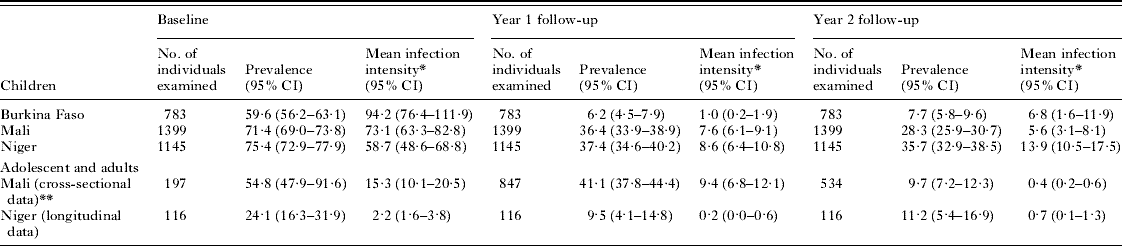
Table 2 shows the results of the cohort that completed the 3 years surveys as well as the cross-sectional surveys at the three times during the study. Following two distribution campaigns, a decline in both prevalence and most importantly intensity of schistosome infections was observed in all three countries (Table 2). The initial prevalence of schistosomes was higher in the school-aged group than in either the adolescent or the adult groups. In Burkina Faso, the most dramatic reduction in prevalence of infection was observed among the school-aged population group, i.e. the baseline infection prevalence of 59·6% in 2004 dropped to 6·2% in 2005 and increased only slightly to 7·7% in 2006. In Mali, the decrease of observed prevalence was satisfactory; from 71·4% at baseline to 36·4% and 28·3% after the first and second treatment rounds, respectively. However, in high transmission areas where the initial prevalence of infection was high, the prevalence after two treatment rounds was still close to 50%. The effect of the treatment on intensity of S. haematobium infection in Mali was a reduction from 73·1 eggs/10 ml of urine to 7·6 eggs/10 ml of urine and 5·6 eggs/10 ml of urine one and two years after baseline screening, respectively. We believe that in addition to the immediate health improvements of those treated, the benefit of the two treatments in the school-aged population will continue into adulthood (Ouma et al. Reference Ouma, King, Muchiri, Mungai, Koech, Ireri, Magak and Kadzo2005; King, Reference King2006).
Prevalence (in %) and intensity of infection (expressed in eggs per 10 ml of urine), including 95% confidence intervals (CIs) in children cohorts, adolescent and adult longitudinal and cross-sectional data pre- and post-treatment
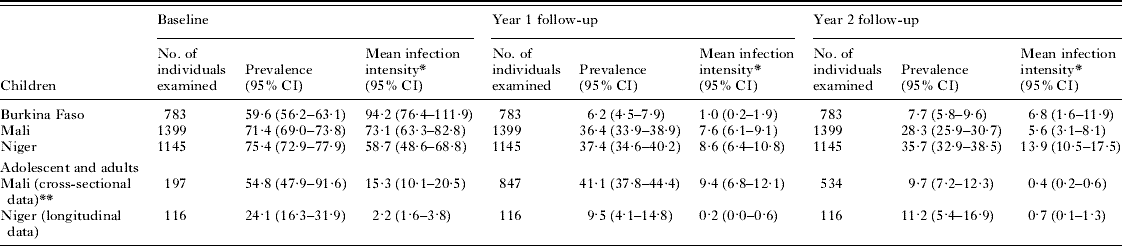
* Arithmetic mean of eggs/10 ml of urine; ** At baseline adolescents and adults have contributed data from 7 communities in Segou while at follow-up visits different people from 10 communities in Segou were recruited in these studies.
MAINTAINING THE BENEFITS OF MASS TREATMENT
The continuation of the treatment campaigns
Two mass treatment campaigns do not fully resolve the health problems due to schistosomiasis. Several areas in the three West African countries still remain to be covered by mass treatment campaigns. This is due to the significant resources necessary to scale up control activities. Moreover, re-treatment is essential to keep morbidity at low levels. The treatment of the target populations is of primary importance and must continue.
The continuation of the mass treatment campaigns relies heavily on the need for free and/or donated drugs. SCI provided the drugs for free mass drug administration. However, apart from the mass treatment campaigns the delivery of praziquantel is achieved through the cost recovery system in each of the three countries. In addition, SCI supported registration of several praziquantel manufacturers in these countries in order to encourage a competitive bidding process, which would obtain best prices during the in-country procurement process (Garba et al. Reference Garba, Touré, Dembelé, Bosque-Oliva and Fenwick2006). Even with the reduction of the price of praziquantel (Savioli et al. Reference Savioli, Engels, Roungou, Fenwick and Endo2004), its cost still remains high for the budget of these three national governments and for the current cost recovery system. International initiatives with pharmaceutical companies, such as the ivermectin, albendazole and the azithromycin donation programmes, are essential. There is a fear of donor fatigue if a praziquantel donation programme is not established and if national governments are unable to contribute to the costs of distribution. Gabrielli et al. (Reference Gabrielli, Toure, Sellin, Sellin, Ky, Ouedraogo, Wilson, Thompson, Sanou and Fenwick2006) showed that mass drug distribution campaigns only cost US$ 0·32 per person treated (including cost of the drug, management, planning, training, social mobilization and remuneration of distributor).
There is also a need to reinforce the capacities of the district health staff to ensure all the control activities at their level are successfully programmed and conducted with co-ordinated workshops in planning, surveillance and evaluation. In addition, it is necessary to increase the manpower of the district health staff with qualified personnel. This option may be difficult for these three West African countries in the context of World Bank structural adjustment policies, which require a reduction of the number of government agents.
One suggestion is for community structures or associations made up of the high-risk groups (e.g. gardening associations, fishermen groups, rice growers and women co-operations) to take the responsibility of the treatment under the supervision of the health workers. Drugs must be available at all levels of the health structure in order to treat individual cases free of charge. These both assume a general motivation of the target populations and a reinforcement of the existing community structures like the health committees, the irrigation scheme management committees, and other local non-governmental organizations (NGOs) and associations. In particular, the village communities need to be responsible for the management of their health centres. Enhancing school health programmes is another way to regularly distribute drugs and such programmes could possibly permit more periodic treatment campaigns (every two to three years). Integration with other health activities could also reduce the costs and therefore encourage governments and partners to contribute to the financing of mass treatment campaigns.
Villages targeted for control
Due to the fact that schistosomiasis is focal (Ernould et al. Reference Ernould, Garba, Labbo, Kaman, Sidiki, Djibrilla and Chippaux2004; Labbo et al. Reference Labbo, Ernould, Djibrilla, Garba and Chippaux2008), monitoring of control activities requires more precise annual evaluations, primarily at the village level. Such precise evaluations permit the monitoring of the long-term impact and effectiveness of the mass treatment campaigns and a possible reduction in the transmission. A reinforcement of local capacities in monitoring and evaluation is essential at all levels. It is misleading to think that a national co-ordination team alone can carry out all necessary surveys. This would take too much time and would require a very high data management capacity to ensure rapid analysis in order to formulate and adjust treatment strategies in a timely manner. Moreover, the district health staff do not have the capacity or the autonomy to undertake the control programmes and to conduct the surveillance activities. Even when district level capacities exist, health agents have additional work and therefore the activities required for schistosomiasis control are difficult to achieve.
Analysis of results indicates that the risk of reinfection is associated with the location of the village, the age of the individual and history of haematuria, but is not associated with gender or the frequency of water contact (King, Reference King2006; Satayathum et al. Reference Satayathum, Muchiri, Ouma, Whalen and King2006). Thus a schistosomiasis control strategy targeted at the village level seems the most logical and the establishment and use of a geographical information system (GIS) platform can assist the national programmes in targeting villages that require control interventions and defining overall treatment strategies (Clements et al. Reference Clements, Garba, Sacko, Touré, Dembelé, Landouré, Bosque-Oliva, Gabrielli and Fenwick2008; Simoonga et al. Reference Simoonga, Utzinger, Brooker, Vounatsou, Appleton, Stensgaard, Olsen and Kristensen2009 – see in this special issue), but its role may be limited in resource-poor countries.
Additional control strategies
The transmission of schistosomiasis is linked with human behaviour. Long-term information, education and communication (IEC) campaigns could increase the knowledge of the populations, and thus contribute to behavioural changes (Poggensee et al. Reference Poggensee, Krantz, Nordin, Mtweve, Ahlberg, Mosha and Freudenthal2005). Safe water supplies, and the construction and use of latrines, must be provided or improved (Asaolu and Ofoezie, Reference Asaolu and Ofoezie2003; Singer and de Castro, Reference Singer and de Castro2007). It is important to remember that schistosomiasis is primarily found in poor communities and in countries with very limited resources. In addition, preventing children from bathing in infested water when temperatures reach 40°C and above will always be difficult. Therefore, it would be deceptive to think of obtaining a good coverage of both safe water supplies and latrines in a short period. Thus, an increase in education and poverty reduction efforts are necessary for the control of schistosomiasis.
Can we consider transmission control?
Molluscicides were not used by any of the control programmes in West Africa probably due to cost and the fear of ecological consequences (Sturrock, Reference Sturrock2001). Considering the weak impact of the mass treatment campaigns on parasite transmission (King, Reference King2006), the use of molluscicides in small temporary ponds where fishing activities are not practised can be considered on a local scale (Sturrock, Reference Sturrock2001) to contribute to transmission control. This will ensure the reduction of transmission and therefore will enable the control programmes to adopt a more periodic treatment schedule. Using molluscicides in these small and temporary ponds where fishing activities are absent can therefore be advantageous to national control programmes. A study in northern Cameroon (Takougang, Meli and Angwafo, Reference Takougang, Meli and Angwafo2006) showed that in the sahelian zone where temporary ponds represent the main transmission system for schistosomiasis, a reduction in snail population without causing ecological damage to fish and frogs could be obtained with 4 fold less the recommended dose (0·25 mg/m3) of molluscicides applied twice within 24 h. This reduction in the numbers of snails with reduced doses of molluscicide can make affordable the cost of the use of a molluscicide but cost-effectiveness studies to examine this issue further are still necessary.
FUTURE: INTEGRATION OF THE PROGRAMMES AND THE CONTROL OF NEGLECTED TROPICAL DISEASES
The integration of vertical control programmes is considered as a cost-effective way to deliver a health package (Brady, Hooper and Ottesen, Reference Brady, Hooper and Ottesen2006; Lammie, Fenwick and Utzinger, Reference Lammie, Fenwick and Utzinger2006). The American government (United States Agency for International Development) awarded a US$ 100 million grant for the integrated control of neglected tropical diseases to the company Research Triangle International (RTI). Burkina Faso, Mali and Niger are among the fast-track countries selected for implementation of this neglected tropical disease control project. The integration will concentrate on delivery of appropriate treatments against schistosomiasis, STH, trachoma, lymphatic filariasis and onchocerciasis. The main strategies of the integration plan are mass drug distribution, IEC and training. The grant offers these three countries an opportunity to have continued support to their national control programmes, but for how long is currently not known.
Integration with other existing health activities is another way to ensure the continued distribution of the drugs. In Niger, an integrated distribution of the polio vaccination and mebendazole for children under 5 years of age successfully completed in December 2006 when 3 million children were treated against intestinal worms. Though under 5 year-old children are not considered in the WHO recommendations for schistosomiasis control (Stothard and Gabrielli, Reference Stothard and Gabrielli2007), they represent a significant proportion of those affected (Bosompem et al. Reference Bosompem, Bentum, Otchere, Anyan, Brown, Osada, Takeo, Kojima and Otha2004), and therefore integration of schistosomiasis control with existing health activities, such as national immunisation days could be a channel to reach this target.
CONCLUSION
The long-term treatment of target populations in an integrated and decentralized way, and a progressive introduction of transmission control, are essential for the successful fight against schistosomiasis in Africa. The poverty reduction policy of increasing school attendance and providing safe water and improving sanitation would ensure populations to become more aware of the disease and therefore reduce reinfection rates.
ACKNOWLEDGEMENTS
We would like to thank all the people involved in the control programmes in Burkina Faso, Mali and Niger, the SCI team, RISEAL, the researchers of CERMES in Niger, INRSP in Mali, IRSS/CNRST in Burkina Faso. In particular we would like to thank Dr. Bertrand Sellin, Professor Jean Roux, Dr. Albis Gabrielli and Dr. Russell Stothard for their advice and contributions to the disease control programmes. We would also like to acknowledge all the health workers, the teachers and the community members who made these programmes successful.