Introduction
The ‘going public’ of religious actors is taking central stage both in religious studies and political philosophy. As Casanova (Reference Casanova1994) has observed, there is a ‘deprivatisation’ of religion in Western societies, with religious actors going public and becoming normal civic actors advocating their cause. But this ‘going public’ among religious actors is controversial. The debate in political philosophy revolves around the question of whether religious actors must frame their religious convictions in terms of secular reason, the classical liberal view, or whether they should be allowed to introduce religiously grounded beliefs into public political argument without any constraints, the communitarian and post-classical liberal view (see Rawls, Reference Rawls1993; Weithman, 1997, Reference Weithman2002; Wolterstorff, Reference Wolterstorff1997a, Reference Wolterstorffb; Audi, Reference Audi2000; Habermas, Reference Habermas2006; Boettcher and Harmon, Reference Boettcher and Harmon2009; McGraw, Reference McGraw2010). In recent years, the direction of the post-classical liberal and communitarian view has shifted towards advocating a politics of non-restriction and even promotion of religious reasons in the public sphere.
Despite vigorous and ongoing debate, systematic and empirical research on this question has lagged behind. Our article seeks to change this. We focus on public statements of religious actors in the context of Swiss direct democratic votes on abortion and immigration. Our article has a dual focus: on the one hand, we analyse how often religious actors refer to religious or secular reasons when making public statements in the public sphere (in selected daily newspapers as well as in the religious press). This enables us to test whether a classical liberal frame prevails, with religious actors predominantly using secular reasons in public debate, or whether a post-classical liberal and communitarian frame prevails, with religious actors predominantly using religious reasons. On the other hand, we want to go beyond a simple inventory and also study the antecedents driving the public use of religious vs. secular reasons among religious actors. We focus on five factors that may affect the argumentative patterns of religious actors in the public sphere: different issues (abortion vs. immigration), different communication channels (religious vs. secular press and different media genres such as interviews or letters to the editor), different religious groups (with different theological traditions), different actors within religious groups (internal diversity of religious denominations), and different times (changes in argumentative patterns between the 1970s and 2000s). We intend to provide a more nuanced understanding of how religious actors argue in the public sphere. In order to distinguish between religious and secular arguments, we created an indicator that measures whether a statement contains an explicit ‘religious marker’ such as a reference to God, Jesus, or the Bible. In addition, we also created an indicator that measures the degree of explicit religiosity. We analysed about 800 public statements of religious actors in 15 direct democratic votes in Switzerland in the period from 1970 to 2007.
Our empirical results reveal an interesting gap: while many political philosophers and religious thinkers have moved to a post-classical liberal position where religious actors can – and even should – openly employ religious arguments, the practice of religious actors in Switzerland is different. Catholics and Protestants use a large amount of secular arguments in direct democratic votes, a trend that has even slightly accelerated in the 2000s. We think that this gap between philosophical aspirations and real-world practice must spur reflection both in the camp of philosophers and in the camp of religious actors (and religious campaigners). Both camps may need to re-think how the argumentation modes of religious actors should look – and how they can look under the constraints of real-world politics.
The remainder of the article is organized as follows. Section ‘The “going public” of religious group’ gives more background on the debate between classic liberals vs. post-classic liberals and communitarians regarding the proper use of religious and secular reasons in the public sphere. Section ‘Empirical translations’ translates these theoretical ideas into empirical research and describes our theoretical approach regarding the differential use of religious and secular reasons among religious actors. Section ‘Empirical analysis’ operationalizes the dependent variable (religious vs. secular reasons) and the predictor variables, discusses the statistical method, and presents the empirical findings. Section ‘Conclusion’ concludes and discusses the normative and practical implications of our findings.
The ‘going public’ of religious groups
Contemporary Western societies confront two parallel trends in religion. On the one hand, there is a trend towards secularization in the Western world (with the exception of the United States; see e.g. Bruce, Reference Bruce2002; Dobbelaere, Reference Dobbelaere2002; Pollack, Reference Pollack2003, Reference Pollack2009). Some authors also emphasize religious individualization and privatization (see Luckmann, Reference Luckmann1967; Davie, Reference Davie1994, Reference Davie2000; Gabriel, Reference Gabriel1996; Hervieu-Léger, Reference Hervieu-Léger1999). Religion retreats to the private sphere, leading to a diffuse and partly non-Christian religiosity. On the other hand, there is a parallel trend of a religious ‘recurrence’. José Casanova (Reference Casanova1994) depicts this as the ‘de-privatization’ of religion, coupled with the ‘going public’ of established religious communities.
Although religious sociologists have been taken aback by the self-confidence of religious actors in the public sphere, religious actors going public has also sparked a controversial debate in political philosophy [for a recent overview, see the special issue of Philosophy and Social Criticism (2009: Vol. 35, Nos 1–2)]. The contentious point is whether and how religious communities should bring their religious convictions into the public sphere. The starting point of the debate is John Rawls's (Reference Rawls1993) conception of political liberalism with its two core principles of ‘public reason’ and ‘duty of civility’. According to Rawls, the two principles require that democratic citizens owe each other justifications based on reasons that everyone can understand and reasonably accept. This implies a translation proviso for religious convictions. In Rawls's words: ‘The first is that reasonable comprehensive doctrines, religious or non-religious, may be introduced in public political discussion at any time, provided that in due course proper political reasons – and not reasons given solely by comprehensive doctrines – are presented that are sufficient to support whatever the comprehensive doctrines are said to support’ (Rawls, Reference Rawls1993: 217). As Lafont (Reference Lafont2007: 241) points out, there is some ambiguity in Rawls's writings about the exact status of comprehensive doctrines and political reasons in the public sphere. Rawls seems to be open to using reasons related to comprehensive doctrines in the public sphere, especially when it comes to argumentations by citizens. But, as Lafont (Reference Lafont2007: 242) notes, even in his latest discussions of the issue, Rawls eventually gives priority to the principle of public reason: ‘when a stand-off occurs, citizens simply invoke grounding reasons of their comprehensive views, the principle of reciprocity is violated’. A number of other prominent liberal philosophers have aired similar thoughts. Robert Audi (Reference Audi2000) for instance, argues that religious reasons in the public sphere are legitimate only if they combine with convincing secular reasons: ‘one has a prima facie obligation not to advocate or support any law or public policy unless one has, and is willing to offer, adequate secular reasons for this advocacy or support’ (p. 86).Footnote 1 According to McGraw (Reference McGraw2010), Audi's stress on secular reasons has a strong epistemological dimension as well: secular reasons are deemed more reliable than religious ones.
Banning religious arguments from the public sphere has met with resistance from several prominent religious thinkers. As Wolterstorff (Reference Wolterstorff1997b: 170) argues, religious actors should be free to present their religious arguments in public discussion: ‘[T]he ethic of the citizen in a liberal democracy imposes no restrictions on the reasons people offer in their discussion of political issues in the public square’. Similarly, Weithman (Reference Weithman2002: 121) holds: ‘Citizens of a liberal democracy may offer arguments in public political debate which depend upon reasons drawn from their comprehensive moral views, including their religious views, without making them good by appeal to other arguments’. If they find majorities for their religious arguments, this must be considered democratic. Finally, McGraw (Reference McGraw2010) argues that modern democracies do best when they ‘foster open toleration and robust engagement of all forms of faith and non-faith that can test and contest each others’ policies’.
According to advocates of no restriction, there are several reasons why religious arguments should be given unconstrained access to public discourse. First, religious arguments may not be more divisive than secular arguments. According to Lawrence Solum (Reference Solum1990: 1083), ‘[c]onditions in modern democracies may be so far from the conditions that gave rise to the religious wars of the sixteenth century that we no longer need to worry about religious divisiveness as a source of substantial social conflict’. Second, there is no reason to believe that religious reasons cannot contribute to a reasonable public discourse. For Stephen Carter (Reference Carter1993), the opposite is actually true: ‘our political culture cannot be truly deliberative unless we let ourselves be tested by religiously grounded moral beliefs’ (p. 240). Third, religion still plays an influential role in the life of many citizens see Perry (Reference Perry2001). Thus, religious arguments may exert a persuasive force for a significant number of citizens in a democracy. Fourth, the role of (abstract) philosophical arguments in public discourse is questionable. As Wolterstorff (Reference Wolterstorff1997a, Reference Wolterstorffb: 177) puts it: ‘What has been rushed in to fill the void is not noble discussions about principles of justice which have been extracted in Rawlsian fashion from the consensus populi. For nobody cares about principles of justice thus obtained. What has been rushed in to fill the void is mainly considerations of economic self-interest, of privatism, and of nationalism’. Fifth, religion can provide public conversation with much needed resources. It can point to elements of the secular worldview, which have undisclosed and unrecognized metaphysical backgrounds; moreover, religious actors may tap into important themes of religiously based social criticism (Perry, Reference Perry2001). Sixth, McGraw (Reference McGraw2010) argues that secular reasons ‘need not to be more reliable than religious ones, especially when we are dealing with moral questions as opposed to strictly scientific or empirical ones’ (p. 101). What count as superior secular reasons are often culturally bounded premises that we find plausible and persuasive simply because we have been socialized in that particular culture (McGraw, Reference McGraw2010). In this regard, McGraw (Reference McGraw2010: 162) also argues that it is difficult to uphold the Rawlsian ‘duty of civility’ since what citizens exactly understand by the notion of civility will remain controversial. Finally, religious institutions fulfil crucial functions for society. With an eye on the United States, Coleman (Reference Coleman2001) argues that religious institutions generate more social capital than any other institution. Consequently, ‘[e]ven a ‘secularist’ … might plausibly desire a more public role of churches in our civic society, precisely because of the ‘secular’ spin-off churches provide: greater volunteering; greater contributions to public civic organisations and charities; greater voting behavior’ (Coleman, Reference Coleman2001: 284–285).
In a recent essay, Jürgen Habermas (Reference Habermas2006) has proposed a ‘friendly amendment’ to a politics of restriction. Like other commentators, Habermas points out that Rawls's conception of public reason is too restrictive. In his view, the liberal state cannot expect that all citizens justify their positions independent of their religious convictions. In particular, since the liberal state institutionally privileges secular reasons the translation proviso puts an asymmetric burden on religious citizens and religious actors. At the same time, Rawls's translation proviso can force religious citizens to misrepresent their cause: by publicly stating reasons that do not conform to their true religious convictions. In order to preserve the integrity of the religious existence, Habermas allows – and even calls on – religious citizens to use religious vocabulary reasons instead of translating their claims into a philosophical pseudo-language. Finally, Habermas thinks that secular citizens can also learn from religious convictions if the latter contain normative claims and truths that also relate to the secular sphere. Religion can act as a source of inspiration for secular philosophy, especially within the Judaeo-Christian tradition. Moreover, religion can convey moral insights in a way that philosophy cannot. This reiterates Wolterstorff's (Reference Wolterstorff1997a, Reference Wolterstorffb) claim that religious reasoning is frequently more accessible to citizens than the deployment of (abstract) philosophical principles.
However, Habermas’ ‘friendly amendment’ has clear limits. Habermas strongly opposes proposals that promote using religious arguments in processes of democratic legislation and decision-making on the grounds that this violates the discursive character of such deliberations. As such, it is unclear whether Habermas would permit the massive use of religious reasons by organized religious actors (such as the Catholic Church) in campaigns prior to a direct democratic vote. According to McGraw's (Reference McGraw2010) interpretation of Habermas’ ‘friendly amendment’, ‘[r]eligion can make claims about the morality or immorality of any particular law and it can urge political changes to meet its particular moral vision. But it cannot … seek to flex it muscle politically and coerce others, even if that ‘coercion’ is purely psychological or spiritual’ (p. 122). Direct democratic campaigns are somewhat in-between advocacy and political decision-making. But as long as advocacy does not entail coercion, Habermas may not be in strict opposition to the more frequent use of religious reasons in the context of direct democratic campaigns.
In sum, the current trend in political philosophy clearly goes in direction of allowing religious reasons in public discourse (with more or less restrictions on political decision-making). Our overall conclusion drawn from this review of arguments in favour and against the translation requirement is that the scholarly debate might be improved were the philosophical models submitted to systematic and wide-ranging empirical investigations. So far, few scholars have taken an in-depth look at actual patterns of argumentation among religious actors (exceptions are Kettell, Reference Kettell2009; Klemp, Reference Klemp2010). We think that matters cannot be resolved at the level of theoretical stipulation alone, with little recourse to empirical evidence beyond illustrative anecdotes.
Empirical translations
We will now engage in a systematic analysis of religious and secular arguments in the context of selected Swiss direct democratic votes. One may wonder why we focus on a largely secular society such as Switzerland where the topic of religious vs. secular reasons is not a very salient one [compared with a less secular society such as the United States (see Norris and Inglehart, Reference Norris and Inglehart2004) where this topic is salient and controversial]. First, we think that it may also be interesting to study this topic under largely secular conditions. In such a context, religious actors may be confronted with a dilemma: on the one hand, they may have a natural inclination to present their religious convictions in an unfiltered and authentic way. This also corresponds to the current trend in political philosophy, which allows – and even advocates – a stronger use of religious reasons in the public sphere. On the other hand, they may feel pressured to translate their religious convictions into secular vocabulary in order to conform to the secular norms of the society (see McGraw, Reference McGraw2010: 104). Therefore, it will be interesting to explore how religious actors manage this tension in the context of strong secularity. Second, direct democratic institutions in Switzerland represent an excellent locus to study religious argumentation in the public sphere. Direct democratic votes enable citizens to decide upon specific issues. This, in turn, creates incentives for religious groups to ‘go public’ when their interests and beliefs are affected, to try to influence the voting behaviour of their own members as well as that of the wider public. Third, Switzerland also involves a great variety of religious groups and actors, ranging from Catholics, Protestants, Christ-Catholics to Free Churches (including evangelical groups), Jewish groups, and Muslims. This religious plurality will not only give us a broad picture of how religious actors argue in the public sphere, it will also enable us to explore differences in the argumentative modes of different religious groups. Finally, studying the argumentation modes of religious actors in Swiss direct democratic votes has two methodological advantages: on the one hand, direct democratic votes entail highly institutionalized political campaigns with a clear time frame (start and end of the campaign); on the other hand, since democratic votes are issue specific, one can study the deployment of religious and secular reasons in the context of clearly delineated issues. Conversely, if we were to analyse different issues in the context of elections and election campaigns, we would confront the methodological problem of much more blurred issue specificity (since most elections have multi-issue agendas).
A first focus of our study will be to explore whether, and how often, religious actors refer to religious or secular reasons when making public statements. In this vein, we evaluate whether religious actors adopt the classical liberal position and predominantly use secular reasons in the public sphere, or whether a post-classical liberal and communitarian view prevails in that religious actors predominantly use religious reasons in the public sphere.
A second focus of our study is the analysis of the antecedents of religious and secular reasons in the public sphere. In so doing, we go beyond a simple inventory of different argumentation modes. We seek to better understand the mechanisms underlying the use of religious vs. secular reasons of religious actors. Of course, if all religious actors argued in a uniform way in the public sphere (e.g. if religious actors only used religious reasons), then there would be no need to study the mechanisms of differential modes of argumentation. But a glimpse at our data reveals that there is considerable variation to be explored.
We start from the assumption that political discourse is largely strategic. We expect that religious actors are strategic campaigners in direct democratic votes and try to influence the voting choices of their members as well as those of the wider public. This is also in line with the ‘framing’ literature (see Sniderman and Theriault, Reference Sniderman and Theriault2004: 158; for an excellent overview see Hänggli, Reference Hänggli2010). This literature assumes that by appropriately framing an issue, actors in the public sphere attempt to construct the meaning of the reality in order to enhance support for their own point of view. Frames selectively draw attention to certain aspects of the topic under discussion and ‘promote a particular problem definition, causal interpretation, moral evaluation, and/or treatment recommendation for the item described’ (Entman, Reference Entman1993: 52). Strategic framers adapt their framing choices to specific circumstances and calculate respective costs and benefits. With regard to religious vs. secular argumentation, we expect that different contexts (such as different communication channels; see below) affect whether and how often religious actors use religious or secular reasons. Besides strategic framing choices, we also expect that ideological and organizational factors affect the way in which religious groups argue in the public sphere.
Let us now turn to the concrete contextual, actor-related, and time-specific factors that help us understand under which conditions religious actors use more religious or secular vocabulary.
Context: issues
Different issues may affect the way in which religious actors argue. We expect that topics that touch upon the core values of religious groups (such as abortion and related questions of life and death) lead to more religious argumentation than other less value-laden issues (such as immigration). Not only are value-laden topics highly salient for religious actors, they also strongly affect the self-understanding of religious groups as value protectors and value generators in society. Thus, in the context of highly value-laden topics religious actors will put a strong prime on their religiosity and their religious traditions, leading to a more frequent use of religious reasons.
Context: media channels and media genres
Different media channels and media genres may affect the argumentation mode of religious actors. According to the framing literature, campaigners vary their framing choices according to whom they address as well as according to whether the communication channel is mediated or unmediated (see Hänggli, Reference Hänggli2010). In mediated communication channels, campaigners promote messages, which have to pass selection by journalists. Campaigners must then cater to the needs and values of journalists. By contrast, unmediated communication channels guarantee a campaign's control over the content and form of the message. They allow campaigners to get their ‘ideal’ message to the public unfiltered by media gatekeepers (see Norris et al., Reference Norris, Curtice, Sanders, Scammell and Semetko1999). Thus, we expect differences between religious and secular media. In the former, religious groups can present their ‘ideal’ message to like-minded followers, whereas in the latter they have an incentive to abide by the (secular) norms of journalists as well as the wider public sphere. Moreover, religious groups (and particularly their leadership organizations; see below) may have an incentive to explain how the group's specific positioning on an issue relates to the basic tenets of the group's theology to their followers; this is generally accomplished in the context of internal media. Consequently, we expect religious groups to use religious reasons more frequently in their internal media than in the general media. Moreover, the distinction between mediated and unmediated channels also refers to different media genres. We expect that in less-mediated channels such as political ads and letters to the editor, religious actors can present their unfiltered – or less filtered – messages. Conversely, when religious actors present their position using mediated channels (e.g. in the context of press releases or in interviews), they need to abide by the secular values of journalists. Again, we expect religious actors to use religious reasons more frequently in less-mediated media genres and secular reasons more frequently in the fully mediated media genres.
Actors: religious traditions
Arguing in the public sphere entails an ideological dimension as well. When going public, religious actors draw from their own religious traditions. We expect that different theological and religious traditions matter to how religious groups argue in the public sphere. In this regard, some religious groups have theological backgrounds that ease the translation of their religious claims into a secular vocabulary, whereas other religious groups have theological backgrounds that hinder such translation efforts. In the Swiss context, the religious groups that regularly participate in the public discourse are Catholics, Protestants, the Old Catholic Church, Free Churches,Footnote 2 and, to a lesser degree, Jewish groups, and Muslims. First, the Catholic Church has a strong tradition of ‘natural’ theology. At an ethical level, this traditionally implies a linkage to a natural rights discourse, leading to an identification of divine and natural law. This identification of divine and natural law might make it easier for the Catholic Church to translate its positions and arguments into secular arguments, while simultaneously retaining its Catholic religiosity (see Schockenhoff, Reference Schockenhoff1996). Conversely, the Protestant Church makes strong reference to its own religious tradition, which is strongly geared to using biblical arguments. This might make it more difficult for Protestant groups to translate their positions and arguments into secular arguments.Footnote 3 With regard to their theological tradition, the Old Catholic Church is somewhere in between the Catholic and the Protestant Church. Evangelical groups, in turn, take biblical texts in a literal sense as well as an authority over any political judgment. This is combined with missionary instruction. Thus, evangelical groups may have a strong tendency to use religious (biblical) arguments in their public statements. Jews and Muslims are religious groups that place a strong prime on their theological traditions, leading them to use religious reasons rather than secular reasons in arguments. Finally, we expect less religious argumentation when different religious groups act together with secular groups. When religious actors act together with other religious actors, however, it is more difficult to formulate clear expectations: one strategy to bridge different theological backgrounds and bring them together in a common organization or statement is to use a secular frame of argumentation. Conversely, religious groups acting together may also have an incentive to identify themselves as a religious actor and hence use religious markers.
Actors: internal diversity
It is misleading to speak of religious groups such as ‘Catholics’ or ‘Protestants’ as unified religious actors. Rather, we need to take the internal diversity of religious groups into account. Therefore, we focus on the diverse actors within religious communities, running from leadership organizations to grassroots organizations and associations. In this regard, we expect leadership organizations to use more religious arguments than associations and grassroots organizations. Leadership organizations have a strong incentive to reinforce and promote the group's religious values, whereas associations and grassroots organizations (such as charity organizations) are much more closely aligned with the secular sphere and will therefore utilize a more secular vocabulary.
Time
As mentioned before, most Western societies are witnessing a secularization trend. Thus, society has changed in the past decades, and these societal changes may leave their imprint on the way in which religious groups argue. As strategic actors in direct democratic campaigns, religious actors will recognize that in a largely secular society (such as Switzerland), messages that resonate with the broader public should be framed in secular rather than purely religious terms. Thus, we expect that in the course of past decades, religious campaigners in direct democratic votes will use religious arguments less frequently. To be sure, this expectation – based on the strategic framing approach – runs counter to the current trend in political philosophy, which advocates a more open use of religious reasons in the public sphere.
Empirical analysis
Our empirical analysis focuses on two issues in the context of Swiss direct democratic votes, namely abortion and immigration. Both issues have strongly mobilized religious actors. Although abortion touches upon a vital concern for religious groups, immigration touches upon religious groups’ concerns with humanity and solidarity.
With regard to abortion debates, we selected all direct democratic votes at the federal level in the time period from the 1970s to the 2000s: ‘Popular initiative for abortions during the first term’Footnote 4 (1977), ‘Federal Law on the Protection of Pregnancy’Footnote 5 (1978); ‘Popular Initiative on the Right to Live’Footnote 6 (1985), and ‘Popular Initiative for Mother and Child’/‘Federal Law on Abortion’ (2002).Footnote 7
With regard to immigration, there were a fairly large number of direct democratic votes at the federal level in the period from 1970 to 2007. In order to keep the project manageable, we had to make a selection of direct democratic votes. The criteria for selection were the importance of the vote as well as the different political constellations surrounding these votes, namely a divide between left- and right-wing political parties or a divide between radical right movements and all other political parties. Our goal was to obtain a sample that reflects both the importance of the vote and the diversity of political constellations before and after 1990. We selected the following direct democratic votes: ‘Popular Initiative against Immigration (Schwarzenbach-Initiative)’Footnote 8 (1970), ‘Initiative for a new immigration policy’Footnote 9 (1981), ‘Asylum and Immigration Law’Footnote 10 (1987), ‘Popular Initiative for the Regulation of Immigration (18% Initiative)’Footnote 11 (2000), and ‘Federal Law on Foreigners’/‘Asylum Law Revision’Footnote 12 (2 issues) (2006).
To collect the claims and argumentations of religious groups we used political claims analysis (PCA). Although PCA was developed in the context of new social movements, it is ideally suited to capture the claim-making of religious groups as well. ‘PCA uses newspapers as a systematic source for identifying the claims of groups (Koopmans and Statham, Reference Koopmans and Statham1999). It has two distinct strengths (see Giugni and Passy, Reference Giugni and Passy2002): first, it allows us to collect a wide variety of claims in the public sphere, including established and marginal groups (such as Muslims). Second, it allows us to analyse the content of claims and arguments in a detailed fashion and extract religious vs. secular frames (see below). In our study, we focused on all interventions made by religious actors in the public sphere in a pre-defined time frame, namely the 3 months prior to a vote as well as 2 weeks after the vote. The interventions comprise press releases, interviews, letters to the editor, and political advertisements. With regard to the secular media, we focused on three Swiss quality newspapers – ‘Neue Zürcher Zeitung’, ‘Tagesanzeiger’, and ‘Tribune de Genève’. With regard to the internal press of the religious groups, we focused on a wide variety of newspapers comprising all religious communities (Catholics, Protestants, Christ-Catholics, Free Churches, Jews, and Muslims). In addition, we also conducted a wide-ranging internet search and archival research to complement our data set.
Measuring explicit religiosity
Measuring religious reasons is no easy task. Audi (Reference Audi2000) argues that there are two criteria for capturing the essence of secular and religious reasons. First, a secular reason is ‘roughly one whose normative force, that is, its status as a prima facie justificatory element, does not evidentially depend on the existence of God (or on denying it) or on theological considerations, or on the pronouncement of a person or institution qua religious authority’ (p. 89). Second, and less importantly, a secular reason must be complemented by a secular motivation, that is, religious actors must be sincere or truthful when they refer to secular reasons.
Although Audi's first criterion provides a useful way of empirically distinguishing between religious and secular reasons (see below), we think that in the context of PCA it is very difficult to conceive of religiosity in motivational terms as well. First, to judge whether actors have a religious or secular motivation is to make a judgment about a person's true preferences vs. their stated preferences. This is exceedingly difficult, since true preferences are not directly observable. The speculative nature of such a judgment is bound to introduce large amounts of (possibly systematic) measurement error. Second, as mentioned before, arguing in the public sphere and in the context of direct democratic votes creates strong incentives for strategic arguing (also for religious actors). The strategic nature of the context reinforces the problem of making a clear-cut empirical distinction between strategic and true preferences.
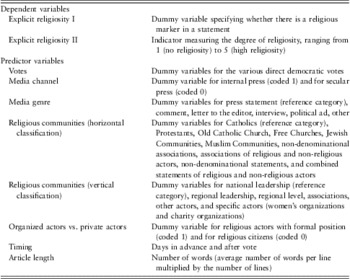
Thus, in order to operationalize explicit religiosity we used Audi's first criterion only, dropping his second. In concrete terms, we focused on ‘religious markers’, which secular persons (or atheists) would immediately recognize as religious argumentation. Religious markers involve words like ‘Jesus’, ‘God’, ‘Bible’, Bible quotes (such as the ‘Ten Commandments’), and references to religious authorities. We created a first indicator of explicit religiosity to measure whether a text contains a religious marker (coded as 1) or not (coded as 0). This is based on the assumption that a single religious marker creates a religious framing for the whole text. Note, further, that we only coded instances where a religious argument with a ‘positive’ connotation to religiosity was offered. Statements such as ‘some people rely heavily on what the Bible commands, and that's wrong’ were not coded under this rubric.Footnote 13
However, this operationalization does not take into account the fact that a statement might be framed in a more or less religious fashion. To capture this, we created an additional indicator measuring the degree of explicit religiosity, ranging from 1 (no religiosity) to 5 (high religiosity). A value of 1 indicates ‘no religiosity’ (and represents the value of 0 of our first indicator of explicit religiosity; see aboveFootnote 14); a value of 2 indicates ‘low religiosity’; a value of 3 indicates ‘medium religiosity’; a value of 4 indicates ‘high religiosity’; and a value of 5 indicates ‘very high religiosity’. We use this second indicator of religiosity mainly as a control (results for the statistical analyses are reported in the Appendix).
Let us give two examples to clarify our coding procedures. A first example is indicative of a high degree of explicit religiosity (coded 1 for the first indicator of explicit religiosity and 5 for the second indicator). In the 1984 abortion debate, the ‘Association of Pentecostal Free Churches of Switzerland’ (Bund Pfingstlicher Freikirchen der Schweiz) made the following statement: ‘Both in the Old and the New Testament, life is under God's protection. Man is predestined to restore community with the creator again, via redemption through Jesus Christ. Man is assigned to serve God with his life. Thus, any measure to shorten or end human life is not only a violation of the biological order, but also of God's will’.Footnote 15
A second example is indicative of a purely secular argumentation of a religious actor (coded 0 for our first indicator of explicit religiosity and 1 for the second indicator). In the abortion debate of 2002, the Swiss Catholic Women's Association (Schweizerischer Katholischer Frauenbund) made the following statement: ‘The decision of a woman/couple in favour or against the child is always a question of ethics. … As a morally responsible actor, the woman/couple are responsible to her/their conscience’.Footnote 16
We analysed about 800 public statements of religious actors in 15 direct democratic votes in Switzerland in the period from 1970 to 2007. We found very respectable reliability scores for the two measures of religiosity: the ratios of coder agreement are 0.74 for the first (and binary) indicator of explicit religiosity and 0.68 for the second indicator.
Predictor variables
For predictor variables, we focus on different issues (abortion vs. immigration), different media channels (religious vs. secular press), different media genres (statements, comments, letters to the editor, interviews, political advertisements), different religious groups [Catholics, Protestants, Christ-Catholics, Free Churches, Jewish and Muslim communities, non-denominational associations, associations of religious and non-religious actors, common statements of different religious actors (non-denominational statements), and common statements of religious and non-religious actors], internal diversity of religious groups [national leadership organizations, regional leadership organizations, regional and local level associations and movements, specific actors according to issue (women's organizations in the case of abortion and charity organizations in the case of immigration, as well as other actors including associations of foreigners or actors from the education and university spheres), organized vs. private actors, and time period (where we focus on the different direct democratic votes)]. In addition, we also control for the timing of the newspaper article [i.e. how many days before or after the vote the text was published, the length of the article (measured in words)]. Table 1 gives an overview of the specific codes we used for the predictor as well as for the outcome variables (explicit religiosity).
Overview of the dependent and predictor variables

Statistical analysis
The statistical analysis is conducted in a Bayesian framework (see e.g. Gelman et al., Reference Gelman, Carlin, Stern and Rubin2003; Gill, Reference Gill2007). For our data, Bayesian inference has several advantages compared with the more widely used frequentist methods (i.e. the so-called Neyman–Pearson framework). First, Bayesian analysis makes inferences that are conditional on the actual sample. This is in contrast to frequentist statistics, where inference is made according to some hypothetical super-population from which repeated samples akin to the researchers may be drawn. Given the non-random selection of the units of analysis – the direct democratic votes – we think that Bayesian inference is more consistent with our data collection process. Second, several independent variables predict our binary outcome variable (religious vs. secular argumentation) perfectly, a problem known as perfect separation. In a frequentist framework, the use of binary choice models such as logit or probit regression poses severe problems under such conditions: the independent variables that perfectly predict the outcome are dropped from the statistical analysis.Footnote 17 This is problematic since these are, by definition, the strongest predictors, and often the most interesting phenomena from a theoretical perspective, and should not thus be excluded simply for technical reasons. By contrast, in a Bayesian framework, perfect separation poses no problem for binary choice models (such as logistic regression) since the priors bound the parameters just far enough away from infinity for them to be identified and estimated.
Although a Bayesian framework encourages the incorporation of substantive prior knowledge, we refrain from such an undertaking. Since there is very little knowledge from prior studies available for the subject in hand, we use fairly conservative and only weakly informative priors on the unknown parameters of the regression model. More specifically, we follow Gelman et al.'s (Reference Gelman, Jakulin, Pittau and Su2008) advice and use heavy-tailed Gauchy priors with a centre 0 and 2.5 scale and rescale all non-binary variables to obtain a mean of 0 and a standard deviation of 0.5. The Gauchy prior has good shrinkage properties, which make the estimates slightly conservative, and allows estimation even under perfect separation. All models are estimated using the ‘bayesglm’ procedure from the arm (Gelman and Hill, Reference Gelman and Hill2007) package for the R statistical language. An advantage of ‘bayesglm’ is that it does not rely on Monte Carlo Markov Chain (MCMC) approximations for the posterior distribution, using an approximate Expectation Maximization algorithm instead. Hence, ‘bayesglm’ is a very fast, easy-to-use, and tuning-free algorithm that frees the user from running the convergence diagnostics required for any MCMC-based analysis.
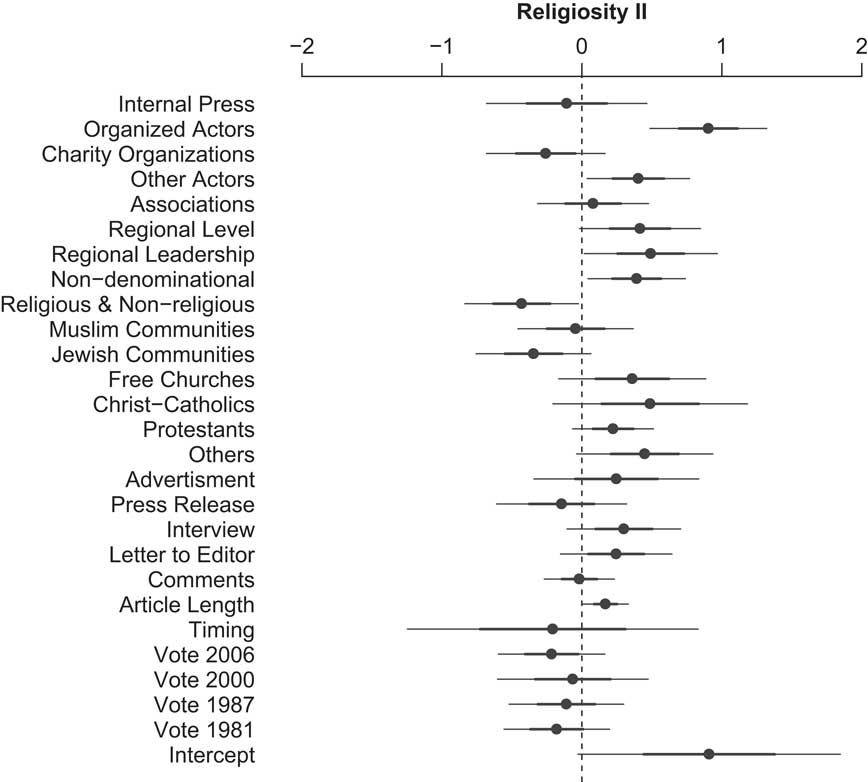
To model our binary indicator of explicit religiosity, we use a logistic model; to model our categorical indicator of explicit religiosity, we use a linear model. The results presented in the following section are the posterior distributions for the estimated coefficients for each covariate. Although the dots represent the mean of the posterior distribution, the short thick lines correspond to the 50% credible intervals, while the long thin lines correspond to the 95% credible intervals. Credible intervals are the Bayesian equivalent of confidence intervals in frequentist statistics, but have a simple and intuitive interpretation: the 95% credible intervals contain the underlying parameter with a posterior probability of 0.95. To facilitate substantive interpretation, all results are presented in a graphical manner (numerical estimates are available upon request).Footnote 18
Results
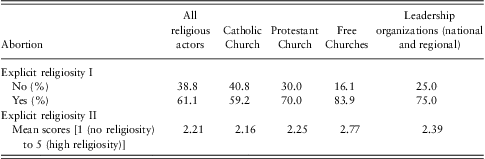
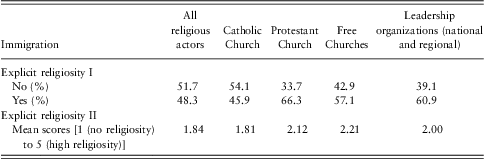
Tables 2 and 3 present the descriptive analyses for our first question, namely how often religious actors in Switzerland use religious or secular reasons. In addition, we also take a first stab at addressing issue- and actor-specific differences in the argumentation modes of religious actors. Table 2 shows that in the abortion debate, 61% of all statements of religious groups contain a reference to religious markers, while 39% do not. In the immigration debates, the amount of explicit religious vocabulary is even lower, hovering at 48%. With regard to the degree of explicit religiosity, the figures in both abortion and immigration debates indicate a low degree of religiosity, with mean scores hovering around 2.2 (abortion debates) and 1.8 (immigration debates). These results are indicative of a predominantly secular pattern of argumentation, which corresponds to the classic liberal approach. However, the picture becomes more nuanced when distinguishing between religious leadership organizations and grassroots organizations. National and regional leadership organizations (such as the Swiss Conference of Catholic Bishops) – publicly the most visible religious actors – clearly use more religious vocabulary than grassroots organizations: in the abortion debates, leadership organizations use a religious marker in 75% of the cases, whereas the respective amount in the immigration debates is about 61%. Yet when we focus on the degree of explicit religiosity, our data show that even religious leadership organizations (national and regional leadership combined) only very rarely employ a high degree of explicit religiosity: in the abortion debates, categories 4 and 5 (indicating a high degree of explicit religiosity) are only used in about 11% of the cases; in the immigration debates, category 4 (high religiosity) is only used in about 3% of the cases (while we find no instances of category 5 (very high religiosity). Thus, the strong secular frame of argumentation does not wither away when taking religious leadership into account. Besides, we find that there are also differences in argumentative patterns among religious groups. In the abortion debates, Catholics have the lowest score of religiosity while Free Churches have the highest score. In the immigration debates, there are similar differences among the different religious groups, albeit less pronounced than in the abortion debates. Let us now turn to the multivariate analyses, exploring the effects of the various context-specific, actor-centric, and time-specific antecedents of religious actors’ public discourses.
Explicit religiosity in abortion debates
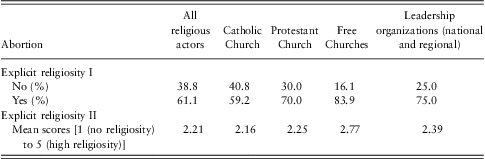
N = 284 (all religious actors).
Explicit religiosity in immigration debates
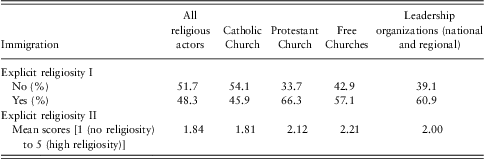
N = 373 (all religious actors).
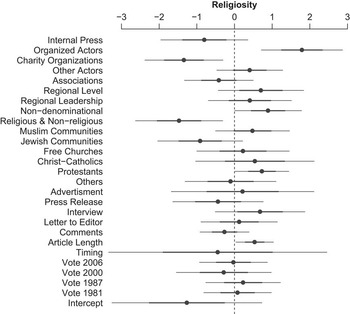
The statistical analyses controlling for covariates largely corroborate the above findings. The first model (see Figure 1) compares the different issues, namely abortion vs. immigration for our first (binary) indicator of explicit religiosity. In accordance with our theoretical expectation, abortion debates entail a higher level of religious argumentation than immigration debates. This effect is statistically significant (i.e. the 95% credible interval does not include zero). In this statistical model, however, we do not interpret the effects of the other context and actor-related variables, since these may play out differently according to the different issues (see analyses below).
Predicting explicit religiosity in abortion and immigration debates (N = 657).

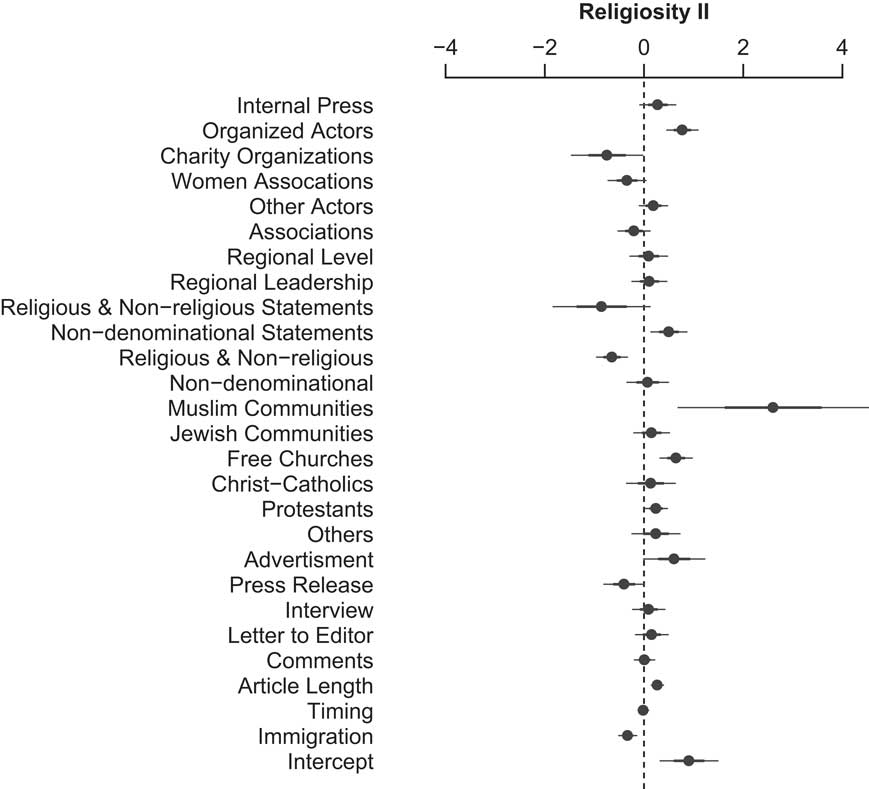
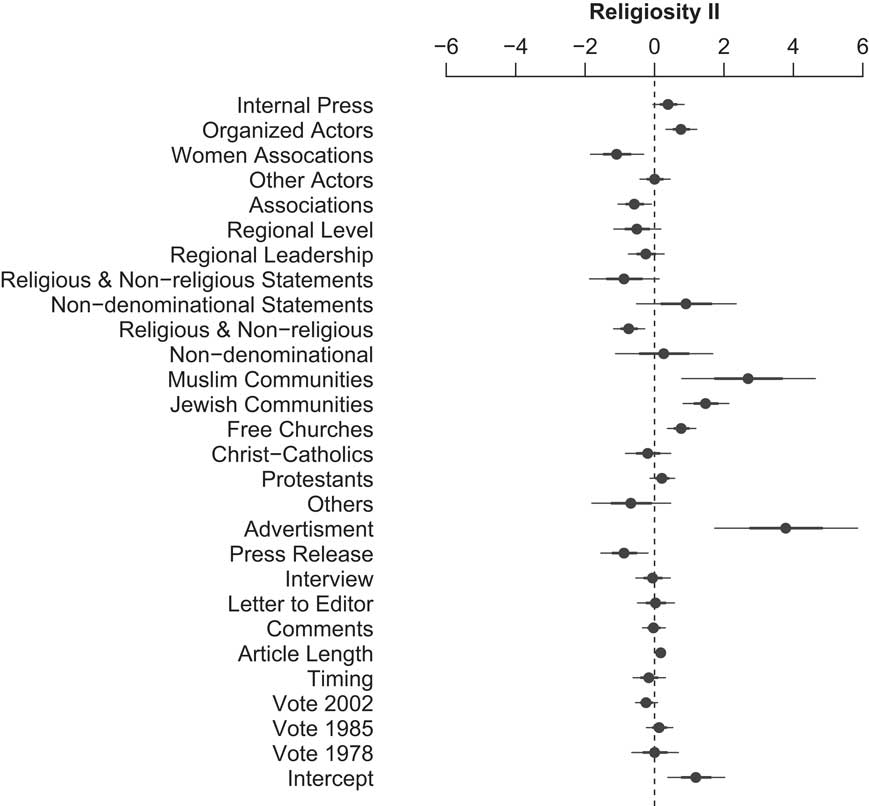
Focusing on the separate analysis for abortion (see Figure 2), we see that both context and actor characteristics matter for explicit religiosity. First, different media channels and media genres matter: as expected, explicit religiosity is higher in the religious press than in the secular press. Second, religious groups use less religious argumentation in the mediated channel of press statements (serving as the reference category) than in unmediated channels such as political advertisements; however, there is no statistically discernable effect for letters to editors (which also represent a less-mediated communication channel). Third, religious traditions matter. As expected, the Catholic Church (forming the reference category in the analysisFootnote 19) uses religious vocabulary less frequently than Protestants, Free Churches, and Jewish and Muslim communities. As we argued before, the Catholic Church has a natural rights discourse, which eases the secular translation of religious arguments. Conversely, other religious groups – Protestants, Jews, Muslims, and especially Free Churches are strongly anchored in their theological traditions, leading them to use religious reasons more frequently. However, our two indicators of explicit religiosity do not yield the same results here. Although the first indicator of religiosity displays a statistically discernible difference between Catholics and Protestants, the second indicator does not (see Figure A2 in the Appendix). Yet, both indicators of explicit religiosity show that there is a clear difference between the Catholic Church and Free Churches. In addition, when religious actors align with secular actors, explicit religiosity decreases; conversely, when religious actors act together (in a common organization or common statement), there is a slight tendency for explicit religiosity to increase (however, the 95% credible interval does not fully exclude zeroFootnote 20). Third, the internal diversity of religious groups matters as well: in line with our expectations, more secular-oriented associations, movements and women's associations use less religious vocabulary than the national leadership organizations of religious groups. This effect is statistically significant (i.e. the 95% credible interval does not include zero). Moreover, we find a higher amount of religious argumentation for organized religious actors compared with private ones. Fourth, when focusing on the effects of the different votes from 1970 to 2002, we detect a slight trend in the direction of more secular argumentation. This effect is not, however, fully within the 95% credible interval. Finally, the two control variables yield mixed results: while article length is positively associated with explicit religiosity, there is no discernible effect for the timing of the newspaper article [i.e. how many days the text was published before (or after) the vote].
Predicting explicit religiosity in abortion debates (N = 284).

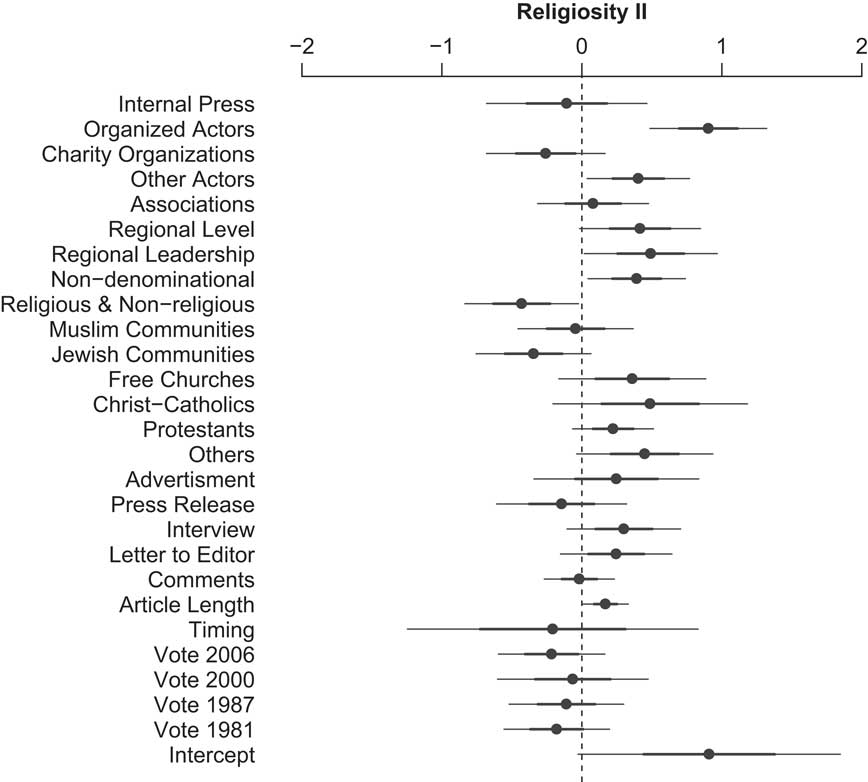
The immigration debates display a slightly different pattern of religious argumentation (see Figure 3). First, a number of contextual and actor-centric factors yield different effects compared with the abortion debates. First, different media channels (religious vs. secular press) do not really matter in the context of immigration debates: compared with the abortion debates there is even a slight reverse trend with explicit religiosity scoring higher in the secular press as compared with the internal press. Since the credible interval does not exclude zero, we do not strongly interpret this finding. Furthermore, different media genres do not matter: there are no statistically significant differences between press statements (serving as the reference category) and other media genres (note that there are no political advertisements by religious actors in the immigration debates). Second, when focusing on our first indicator of explicit religiosity (see Figure 3) religious traditions barely matter. There are few differences among the different religious groups; an exception here are the Protestants who use more religious vocabulary than the Catholics (forming the reference category in the analysis). However, when focusing on our second indicator of explicit religiosity (see Figure A3 in the Appendix), there are no discernible differences among the various religious groups. Furthermore, when religious actors align with secular actors, there is a slight tendency for explicit religiosity to decrease; conversely, when religious actors act together (in a common organization or statement), there is a slight tendency for explicit religiosity to increase for the second indicator of explicit religiosity. This conforms to the pattern that we found in the abortion debates. Third, the internal diversity of religious groups matters as well: more secular-oriented associations, movements and charity associations use less religious vocabulary than the national leadership organizations of religious groups. This effect is statistically significant (i.e. the 95% credible interval does not include zero). Moreover – and in line with the results on abortion – we find a higher amount of religious argumentation for organized religious actors as compared with private ones. Fifth, time does not matter for variation in religious argumentation. There is no discernible trend for the different votes from 1970 to 2006. This is surprising since the different votes also entail different political constellations (left-wing vs. right-wing actors and radical right vs. all other actors). We may interpret this result as an effect of routinized behaviour. Regular campaigners in direct democracy (including religious actors) learn how to use a well-defined set of communication routines that have been established over the course of time. Kriesi et al. (Reference Kriesi, Bernard and Hänggli2009) call this the ‘communication repertoire’ of actors. Thus, argumentative variation can be constrained. Finally, the two control variables yield mixed results: while article length is positively associated with explicit religiosity, the timing of the newspaper article does not yield any discernible effect.
Predicting explicit religiosity in immigration debates (N = 373).

Overall, our findings reveal an interesting gap: on the one hand, many political philosophers and religious thinkers have moved to a post-classical liberal position where religious actors can – and even should – openly employ religious arguments and do not have to translate their deepest beliefs and motivations into some putatively universal neutral secular language. On the other hand, as the Swiss case reveals, the practice of religious groups and actors is different. As our descriptive analyses document, the larger denominations of Catholics and Protestants especially have a tendency to use a large amount of secular vocabulary. We think that this documents their adaptation to the generally secular society in Switzerland. Furthermore, the results of our multivariate analyses also reveal that the use of religious or secular reasons varies considerably according to different issues, different arenas (religious vs. secular press), different religious traditions, different alliance structures, and different media genres, while there is no clear time trend. As such, it is wrong to see religious vs. secular argumentation as a uniform phenomenon.
Conclusion
Although the use of religious and secular reason represents a major topic in political philosophy, no systematic empirical analyses have been conducted on this topic. Focusing on direct democratic votes in Switzerland on abortion and immigration (1970–2006), we detect some intriguing patterns of argumentation. First, religious actors in the Swiss context use far less religious arguments than one might commonly surmise. When going public, religious actors largely abide by the secular norms of public discourse. From a classic liberal perspective, these results are highly satisfying: most religious groups – especially the larger denominations of Catholics and Protestants – make a serious translation effort. In the case of immigration debates, the majority of religious groups’ statements are made in purely secular terms. Even though our empirical approach does not address the issue of secular motivation, we may still say that from the perspective of rhetorics and framing, the larger denominations speak with a fairly liberal voice. From a post-liberal and communitarian perspective, these results are more problematic: by abiding by the secular norms of public discourse, religious actors may partly miss their deliberative role in the public sphere (see Carter, Reference Carter1993). According to this perspective, religious groups should not only be allowed to bring their religiosity into the public discourse but even make a dedicated effort to do so. To be sure, one can argue that by ‘going public’, religious actors (and especially their leadership organizations) almost automatically bring their religiosity into public discourse. From a communitarian perspective, however, the fact that religious actors frequently abstain from using any religious vocabulary mutilates this role and turns religious actors into just another civic or political actor. Second, our study also shows that there is considerable variation in the argumentative strategies of religious groups. Specific context and actor characteristics affect the way in which religious actors argue in public sphere. Issue type, religious traditions, alliance structures, and internal diversity in particular turn out to be strong drivers of different argumentation patterns (religious vs. secular reasoning). Third, a surprising result of this study is that time matters little: while we detected a slight trend towards more secular argumentation in the context of the abortion debates, there is no general time trend towards a more secular discourse. In other words, even though society has changed, the public discourse of religious groups has not changed (much).
Of course, our study is not without limitations. First, future research will need to look beyond the specifics of the Swiss case and engage in comparative analysis. A comparison with a less secular society such as the United States in particular might yield interesting results. Second, we also need to shed light on the question of how citizens – religious as well as secular – evaluate the going public of religious groups. Do they accept it when religious groups follow the current trend in political philosophy and use more religious vocabulary in the public sphere? Or do they oppose this trend and expect religious groups to act like any other civic actor when going public? Survey results from the European Values Study (2005–2007) show that about two-thirds of citizens interviewed in Europe are opposed to a strong influence of religious leaders in public affairs. Thus, religious actors going public might be well advised to retain their fairly liberal mode of argumentation in the public sphere. Put differently, one may even argue that the use of secular reasons may be a smart strategy employed by religious actors to advance their causes under largely secular conditions. Third, future research will also need to look beyond religious vs. secular argumentation. Cristina Lafont (Reference Lafont2007), for instance, proposes a deliberative approach to religion in the public sphere whereby the key is ‘inclusive accountability’. In this conception, religious citizens must not abstain from using religious arguments. Their only obligation is to present persuasive reasons as to why secular counter-arguments are wrong. At the same time, Lafont's deliberative approach also requires that religious citizens must grapple with secular arguments in order to identify generally acceptable reasons for political decisions with which all citizens must comply (Lafont, Reference Lafont2007). These limitations notwithstanding, our empirical study on the argumentation modes of religious actors in the context of Swiss direct democratic votes breaks new ground on a topic that has been primarily studied from a normative angle. It shows that a systematic engagement between empirical and normative studies can yield results that raise further questions for philosophers and religious actors (and campaigners) alike. We think that our findings should induce reflection both among philosophers and religious actors about how the argumentation modes of religious actors should look – and how they can look like under the constraints of real-world politics such as direct democratic campaigns. Both camps may need to re-think how a deliberative role of religious groups in the communitarian sense can be aligned with the necessities of strategic framing in political campaigning. Such thinking becomes even more important when we consider the growing numbers of contentious religious issues in current politics. In Switzerland, the much talked of vote on minarets in 2009 might provide a prominent example in this regard. Such contentious religious issues press religious actors to define appropriate political roles as well as appropriate rhetorical strategies.
Acknowledgement
We would like to thank Regula Hänggli, Christine Reh, Adrian Holderegger and three anonymous reviewers for excellent comments. We also thank the Swiss National Science Foundation for support (National Research Programm NRP 58, Religion, the State, and Society).
Predicting explicit religiosity II (degree of religiosity) in abortion and immigration debates (N = 657).
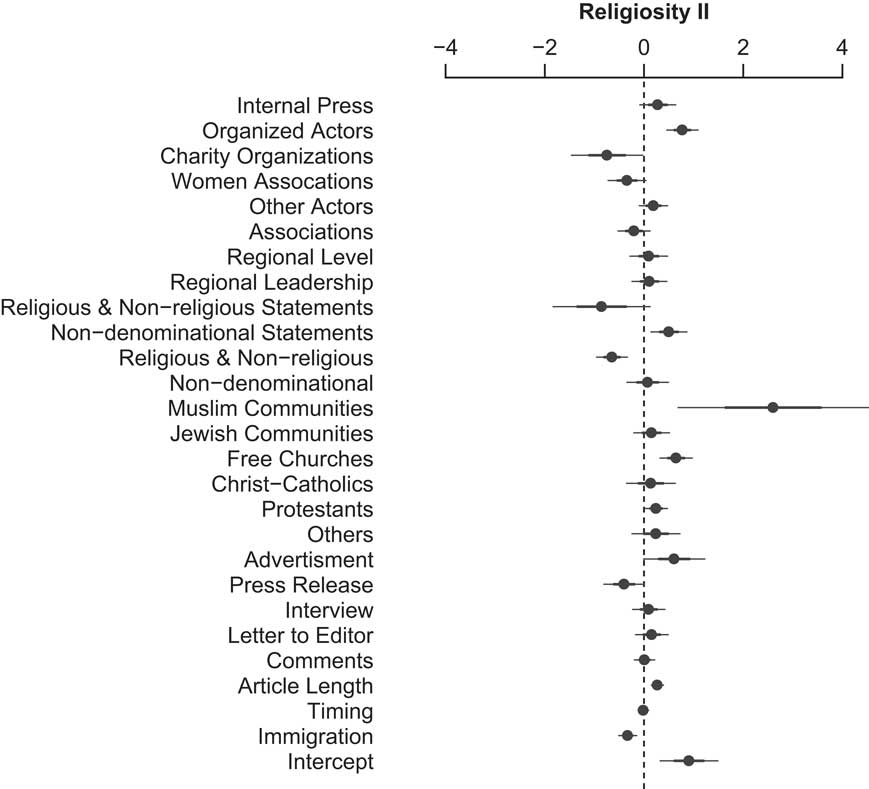
Predicting explicit religiosity II (degree of religiosity) in abortion debates (N = 284).
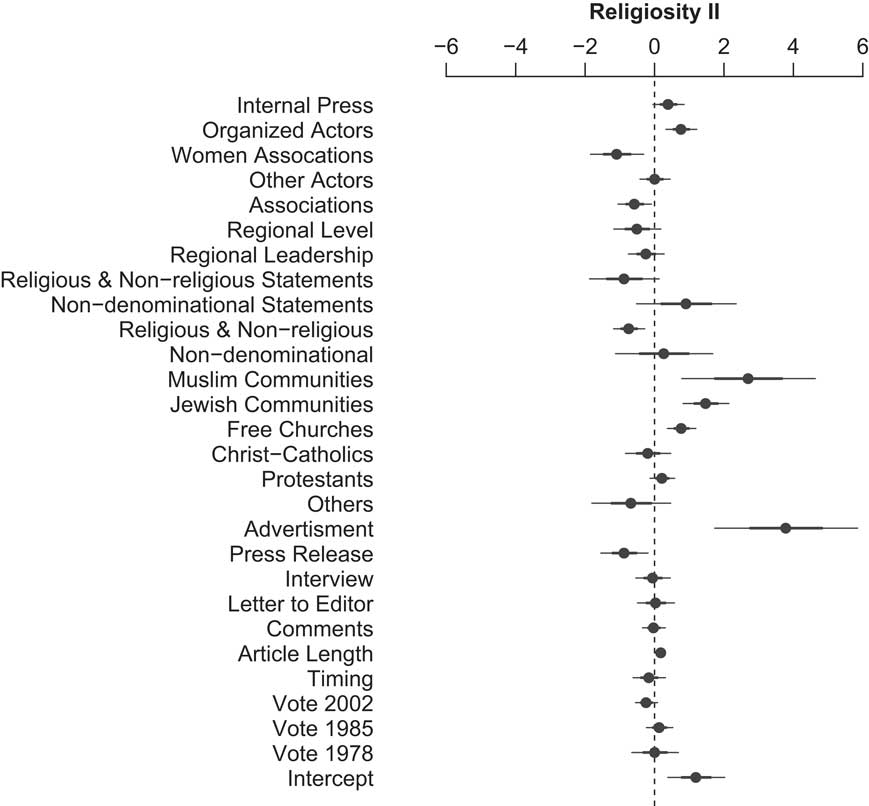
Predicting explicit religiosity II (degree of religiosity) in immigration debates (N = 373).