INTRODUCTION
Older adults account for half of the intensive care unit (ICU) admissions in the United States (Halpern et al., Reference Halpern and Pastores2010). Older patients in the ICU admissions have an increased risk for the development of complicated and prolonged hospital courses (Nagappan & Parkin, Reference Nagappan and Parkin2003; Wood & Ely, Reference Wood and Ely2003; Pisani, Reference Pisani2009).
In the era of the Patient Protection and Affordable Care Act (PPACA), hospitals have been under financial pressure more than ever before; therefore, attempts to cut current hospital margin deficits by limiting hospital length of stay have been suggested by the diagnosis-related group (American Hospital Association, 2010; Medicare Payment Advisory Commission, 2011). The hospital margin deficits have often been incurred by medically futile, prolonged length of stays for critically ill older adults (Cher & Lenert, Reference Cher and Lenert1997; Milbrandt et al., Reference Milbrandt, Kersten and Rahim2008; Weissman & Spragens, Reference Weissman and Spragens2010). Therefore, several studies identified that older adults admitted to the ICU were at high risk of becoming medically futile as a result of a bout of severely acute illness, and that cost-saving effects were achieved by reducing the hospital stay when medical care is futile and a patient is near death (Morrison et al., Reference Morrison, Penrod and Cassel2008; Hanks et al., Reference Hanks, Cherny and Christakis2009; Weissman & Spragens, Reference Weissman and Spragens2010). These studies investigated how to reduce hospital length of stay when a patient is near death; how to narrow communication gaps between healthcare providers and patients or families. These studies suggested the following ways to achieve the above goals: (1) incorporating palliative care into critical care; (2) foregoing treatments that did not meet their goals or prolong life in a meaningful fashion; (3) helping discharge planners to navigate medically futile patients to appropriate destinations such as hospice care. (The SUPPORT Principal investigators, 1995; Morrison et al., Reference Morrison, Penrod and Cassel2008).
In earlier literature, the ICU survivors with advance directives reported higher satisfaction, and their caregivers reported better overall physical and mental health, than those without advance directives (The SUPPORT Principal investigators, 1995; Teno et al., Reference Teno, Licks and Lynn1997). Although advance directives have received widespread public attentions since the implementation of Patient Self-Determination Act in 1991, the rates of documenting advance directives still remain fewer than half in acute care settings including critical care (Teno et al., Reference Teno, Gruneir and Schwartz2007; Auerbach et al., Reference Auerbach, Katz and Pantilat2008; Morrell et al., Reference Morrell, Brown and Qi2008).
Previous studies examining the relationships between discharge outcomes and advance directives in acute care settings had found that those with advance directives were less likely to die in hospital and more likely to die at home (Kutner et al., Reference Kutner, Blake and Meyer2002, Reference Kutner, Meyer and Beaty2004; Teno et al., Reference Teno, Gruneir and Schwartz2007; Kelly et al., Reference Kelly, Ettner and Wenger2011).
Controversial situations often occur when the courses of critically ill older adults resulting from circulatory or respiratory distress must be predicted and decisions made whether life-sustaining management of these situations should be adhered to (The SUPPORT Principal investigators, 1995; Fox et al., Reference Fox, Landrum–McNiff and Zhong1999; Hanks et al., Reference Hanks, Cherny and Christakis2009; Curtis & Rubenfeld, Reference Curtis and Rubenfeld2001). Clinicians are often challenged to decide when to forego or withdraw life-sustaining management in critically ill older adults mainly influenced by circulatory or respiratory distress (Fox et al., Reference Fox, Landrum–McNiff and Zhong1999; Curtis & Rubenfeld, Reference Curtis and Rubenfeld2001; Zier et al., Reference Zier, Burack and Micco2009; American Medical Association, 2010). In addition to diseases with characteristics of difficult prognostication, prior studies raised doubt about physicians' ability to predict medical futility among surrogate decision makers (The SUPPORT Principal investigators, 1995; Zier et al., Reference Zier, Burack and Micco2009). Based on the core of medical ethics, infectious diseases have been recognized as medically reversible conditions; therefore, life-sustaining aggressive approaches have been applied for patients with infectious diseases for decades (Curtis & Rubenfeld, Reference Curtis and Rubenfeld2001; American Medical Association, 2010). Several studies reported that episodes of severe infectious disease resulted in higher in-hospital deaths than did any other diseases, and even when survived, represented a sentinel event in the lives of patients and families, resulting in new and often persistent disability (Angus et al., Reference Angus, Linde-Zwirble and Lidicker2001; Teres et al., Reference Teres, Rapoport and Lemeshow2002; Kaufmann et al., Reference Kaufmann, Smolle and Krejs2009; Iwashyna et al., Reference Iwashyna, Ely and Smith2010; Khouli et al., Reference Khouli, Astua and Dombrowski2011). Given the disease characteristics of difficult prognostication (circulatory or respiratory diseases) and potential for reversibility (infectious diseases), we may ask whether the discharge outcomes with circulatory, respiratory, and infectious diseases may be more vulnerable to the presence of advance directives than are those for other diseases. Therefore, the research of examining the effects of advance directives on discharge outcomes by principal diagnoses in critically ill older adults may enhance our understanding of how advance directives influence community-dwelling patients' flow across diverse healthcare settings, thereby helping to contrive how to optimize the utilization of ICU beds and reduce hospital costs. Moreover, research on the relationships among advance directive status, principal diagnoses, and discharge outcomes in critical care settings may result in reducing communication gaps between healthcare professionals and patients or families by providing more information about the prognosis and discharge outcomes of critically ill older adults.
Using administrative and clinical data of community-dwelling, critically ill older adults, the present study sought to 1) measure their discharge outcomes (in-hospital deaths, hospice discharges, and transition to institutions) by their advance directive status, and 2) determine the relationships among advance directive status, principal diagnoses, and the discharge outcomes.
METHOD
Site, Setting, and Sample Selection
The study site was a 40 ICU bed, nonprofit, urban hospital. Inclusion criteria were the following: 1) admission to ICU, 2) ≥age 65, 3) Medicare beneficiaries, and 4) community-dwellers prior to admission to ICU. Exclusion criteria were the following: 1) residing at the institutions including long-term acute care hospitals, skilled nursing facilities, adult foster homes, and assisted living facilities prior to the admission to ICU, 2) referrals from other hospitals including psychiatric and inpatient rehabilitation hospitals, 3) discharges against medical advice and referrals to other hospitals, and 4) enrolled in hospice care prior to study enrollment. If a patient had more than one distinct ICU admission, each admission was included. Study enrollment period was from January 2006 to December 2008. Administrative claim data and electronic medical records were matched by name and date of birth and were reviewed regularly by this study's authors. We collected 1962 eligible admissions meeting the abovementioned criteria. Because of the relatively small numbers (n = 55, <3% of total participants) of Hispanic, Native American, and Asian patients, we restricted our analyses to African Americans and whites only. The All Patient Refined Diagnostic Related Group (APR-DRG) severity of illness classification system was used to estimate the severity of illness. The validity of APR-DRG severity of illness in acute palliative care settings has been discussed elsewhere (Lagman et al., Reference Lagman, Walsh and Davis2007). Given a relatively small number with low severity of illness (n = 96, <5%) and difficulty in interpreting the statistical analysis, individuals with low severity of illness were excluded. Multiple imputations were used to account for missing data. Missing data accounted for 7% (n = 138) of data values and were most frequent for education (5%) and marital status (6%). The number of the sample meeting the abovementioned eligibilities was 1673. This study was approved by the Institutional Review Board of the Cleveland Clinic Health System.
Discharge Outcomes
The discharge outcomes were “in-hospital deaths,” “hospice discharges,” “transitions to institutions,” and “return to communities.” Hospice discharges included both home hospice and hospice general inpatient (GIP) care. Institutions included long-term acute care hospitals, skilled nursing facilities, inpatient rehabilitation hospitals, adult foster homes, and assisted living facilities.
Predictors
Predictors were age, gender, ethnicity, advance directive status, severity of illness, education, marital status, private health insurance, and principal diagnoses at time of hospital admission. Social workers interviewed patients or families at time of hospital admission and documented advance directive status, education, and marital status in the medical records. “Advance directive” was defined as either a written living will or a designated durable power of attorney (DPOA) (Silveira et al., Reference Silveira, Kim and Langa2010; Hirschman et al., Reference Hirschman, Abbott and Hanlon2012). A living will was defined as a statement that allowed persons to state the kind of healthcare they did or did not want under certain circumstances if they were unable to make the medical decision for themselves. The designation of DPOA was defined as a statement that identified someone who could make healthcare decisions. The same definition of “advance directive” was used across several care settings. The APR-DRG data were gathered based on the 3M Health Information System (Wallingford, CT). The APR-DRG data were collected from the Department of Medical Operations, which was unaware of the study objectives, and were abstracted by the authors. Private health insurance was meant the additional “out of pocket” health insurance coverage beyond Medicare or Medicaid. Principal diagnoses were classified into the following eight groups by the International Classification of Diseases, Ninth Revision, Clinical Modification (ICD-9-CM): 1) cardiovascular diseases, 2) respiratory diseases, 3) infectious diseases, 4) cancer and blood diseases, 5) endocrine and metabolic diseases, 6) digestive and urogenital diseases, 7) neurologic diseases, and 8) others. Afterward, principal diagnoses were reclassified into two groups; Group A diseases included circulatory, respiratory, and infectious diseases and group B included other remaining diseases.
Categorizing the Predictors
For ease of interpretation, the predictors were categorized as follows: age (65–79 and ≥80), gender (male and female), ethnicity (African Americans and whites), severity of illness (moderate, major, and extreme), education (high school education or less and high school graduation or more), marital status (married and never married/widowed/divorced), private health insurance (yes and no), any advance directives (yes and no), and principal diagnoses (group A and B diseases). Sensitivity analyses were used to explore alternative category of age: 65–74 versus 75–84 versus ≥85. Results for this alternative category were similar to those of the original category (age: 65–79 vs. ≥80), and therefore were not included in the results.
Statistical Analyses
Bivariate comparisons of sample characteristics and discharge outcomes by advance directive status were examined using χ2 tests to compare categorical data and Wilcoxon sum tests to compare ordinal data. All reported p-values were two-sided, and p < 0.05 was considered statistically significant. We used the multinomial logit regressions of the discharge outcomes controlling for age, gender, ethnicity, severity of illness, education, marital status, and private health insurance to test their relationships between advance directive status and principal diagnoses. Multinomial logit regressions have been used for analyzing the effects of multiple predictors on a nominal categorical variable with more than two categories (Hosmer & Lemeshow, Reference Hosmer and Lemeshow2001; Stokes et al., Reference Stokes, Davis and Koch2009; Brody et al., Reference Brody, Ciemins and Newman2010). Predicted probabilities, odds ratios (ORs), in addition to corresponding 95% confidence intervals (CIs) were computed. OR > 1 indicated that the predicted probabilities of the discharge outcomes with any advance directives were higher than those without advance directives. Significant interactions between predictors and discharge outcomes were tested. None of interaction terms was statistically significant; therefore, they were not included in the regressions. Backward elimination was used to ensure that regressions were not changed. All regressions were assessed with goodness-of-fit testing procedures, which confirmed that these were not violated (Hosmer & Lemeshow, Reference Hosmer and Lemeshow2001). All data procedures and analyses were performed using SAS statistical software version 9.2 (SAS Institute, Inc., Cary, NC).
RESULTS
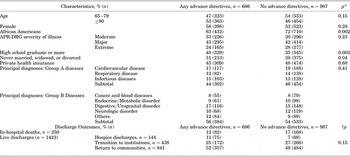
Our sample included 1673 admissions: 686 admissions with any advance directive and 987 admissions without advance directives. Compared with those without advance directives, those with advance directives were less likely to be African Americans (63%, p = 0.002), more likely to have graduated from high school (48%, p = 0.003), and less likely to be never married, widowed, or divorced (31%, p = 0.04). Other sample characteristics by advance directive status were not significantly different. Discharge outcomes for those with advance directives were as follows: 12% died in hospital, 11% were discharged to hospice, 25% were transitioned to institutions, and 52% returned to their communities. Discharge outcomes for those without advance directives were as follows: 17% died in hospital, 7% were discharged to hospice, 27% were transitioned to institutions, and 49% returned to their communities. Discharge outcomes by advance directive status were not significantly different. Table 1 presents sample characteristics and discharge outcomes by advance directive status.
Sample characteristics and discharge outcomes by advance directive status

APR-DRG, all patient refined-diagnostic related group.
*p values were derived from bivariate comparisons of sample characteristics and discharge outcomes by advance directive status.
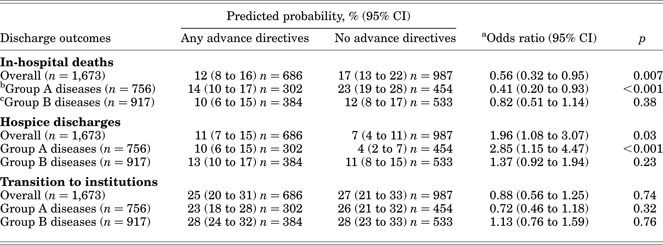
Table 2 presents predicted probability of discharge outcomes controlling the sample characteristics. In the overall sample (n = 1673), the adjusted probability of in-hospital deaths with advance directives (12%; 95% CI, 8–16%) was lower than that without advance directives (17%; 95% CI, 13–22%; OR = 0.56; 95% CI, 0.32–0.95; p = 0.007). In the sample of group A diseases (n = 756), the adjusted probability of in-hospital deaths with advance directives (14%; 95% CI, 10–17%) was lower than that without advance directives (23%; 95% CI, 19–28%; OR = 0.41; 95% CI, 0.20–0.93; p < 0.001). In the sample of group B diseases (n = 917), there was no significant difference in in-hospital deaths between those with and without advance directives (p = 0.38). In the overall sample, the adjusted probability of hospice discharges with advance directives (11%; 95% CI, 7–15%) was higher than that without advance directives (7%; 95% CI, 4–11%; OR = 1.96; 95% CI, 1.08–3.07; p = 0.03). In the sample of group A diseases, the adjusted probability of hospice discharges with advance directives (10%; 95% CI, 6–15%) was higher than that without advance directives (4%; 95% CI, 2–7%; OR = 2.85; 95% CI, 1.15–4.47; p < 0.001). In the sample of group B diseases, there was no statistically significant difference in hospice discharges between those with and without advance directives (p = 0.23). In the overall sample, there was no statistically significant difference in transitions to institutions between those with and without advance directives (p = 0.74). The above findings were not changed after subgroup analysis by the principal diagnosis groups.
Predicted probability of discharge outcomes: Adjusted relationships between advance directive status and principal diagnoses
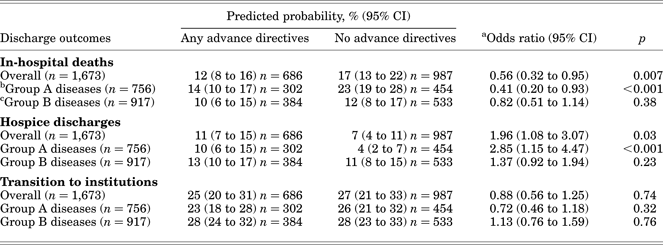
CI, confidence intervals.
aOdds ratios were derived from multivariate logistic regressions controlling sample characteristics (age, gender, ethnicity, severity of illness, education, marital status, and private health insurance). Odds ratio >1 indicated the predicted probabilities of discharge outcomes with any advance directives were higher than those with no advance directives.
bGroup A diseases included cardiovascular, respiratory, and infectious diseases.
cGroup B diseases included other remaining diseases.
DISCUSSION
At first, the present study measured the discharge outcomes (in-hospital deaths, hospice discharges, and transition to institutions) of community-dwelling, critically ill older adults by their advance directive status. Second, it examined the relationships among advance directive status, principal diagnoses, and the discharge outcomes.
Previous studies including the 1980s landmark Study to Understand Prognoses and Preferences for Outcomes and Risks of Treatment (SUPPORT) found that critically ill and later medically futile older adults with advance directives were less likely to utilize critical care and more likely to utilize hospice care than were those without advance directives (The SUPPORT Principal investigators, 1995; Teno et al., Reference Teno, Licks and Lynn1997; Silveira et al., Reference Silveira, Kim and Langa2010). Also, the presence of advance directives and their reinforcing role for both healthcare providers and patients or families in facilitating better communications about care plans, made transitions from critical care to hospice care easier (Teno et al., Reference Teno, Licks and Lynn1997; Curtis & Rubenfeld, Reference Curtis and Rubenfeld2001; Smith et al., Reference Smith, Coyne and Cassel2003; Kutner et al., Reference Kutner, Meyer and Beaty2004). Our findings may reflect the effects of advance directives for critically ill patients as did previous literature, which found that those with advance directives were less likely to die in hospital and more likely to be discharged to hospice than those without advance directives (Kutner et al., Reference Kutner, Blake and Meyer2002, Reference Kutner, Meyer and Beaty2004; Teno et al., Reference Teno, Gruneir and Schwartz2007; Kelly et al., Reference Kelly, Ettner and Wenger2011). The presence of advance directives may have reduced hospital length of stay for medically futile patients and resulted in decreases in in-hospital deaths in addition to reciprocal increases in hospice discharges (Smith et al., Reference Smith, Coyne and Cassel2003; Digwood et al., Reference Digwood, Lustbader and Pekmezaris2011; Lustbader et al., Reference Lustbader, Pekmezaris and Frankenthaler2011). On the other hand, the presence of advance directives did not make a contribution to transition from communities to institutions as presented at the previous study (Hirschman et al., Reference Hirschman, Abbott and Hanlon2012). Subgroup analysis confirmed that these findings were not changed by the principal diagnoses.
One interesting interpretation of these data was that the effects of advance directives on in-hospital deaths and hospice discharges varied by principal diagnoses. Subgroup analysis showed that the magnitude of the abovementioned reciprocal changes between in-hospital deaths and hospice discharges by the presence of advance directives was aggregated when their principal diagnoses were circulatory, respiratory, and infectious diseases, defined as group A diseases, a group of diseases with more difficult prognostication (circulatory and respiratory diseases) and more potential for reversibility (infectious diseases) than group B diseases. By contrast, the above reciprocal changes between in-hospital deaths and hospice discharges by the presence of advance directives were diminished with group B diseases. These findings may answer our question whether the discharge outcomes with circulatory, respiratory, and infectious diseases may be more vulnerable to the presence of advance directives compared with other diseases.
Our findings have implications that the applied approaches for patients with group A diseases (more difficult prognostication and more potential for reversibility) were more likely to remain life-sustaining treatments compared with other principal diseases when advance directives were absent. When advance directives are not documented in critical care settings, healthcare professionals are prone to choose and maintain aggressive approaches even for medically futile patients (The SUPPORT Principal investigators, 1995; Teno et al., Reference Teno, Licks and Lynn1997; Curtis et al., Reference Curtis and Rubenfeld2001). These healthcare professionals' preferences toward medically futile patients without advance directives may explain, at least partly, the prolongation of hospital stay and high rate of in-hospital deaths in this group.
Our findings should be interpreted in light of several limitations. A major limitation of the present study is lack of generalizability. Because the data were collected from an urban area and limited to African Americans and whites, critically ill older adults at rural hospitals or among other ethnic groups were not represented. Furthermore, our analyses were limited to cross-sectional data, and the longitudinal outcomes are unknown; therefore, our results cannot be interpreted as the cause and effect. Also, we used a claim-based definition of principal diagnoses; because principal diagnoses were not collected as complying with the objectives of the study, it is plausible that there was observer variation. Additionally, because the present Medicare claims lacked information on physical functioning, the present study could not adjust the physical functioning factor. Because 7% of data were missed and physician characteristics were not included in the analysis, selection bias may have occurred. Therefore, our findings should be interpreted with caution and considered preliminary until they are confirmed in future studies with more representative data.
ACKNOWLEDGMENTS
Drs. Yoo, Nakagawa, and Kim participated in study concept and design, acquisition of subjects and data, and manuscript preparation. Drs. Yoo and Kim participated in data analysis and interpretation. The authors are indebted to Dr. Pil Park for reviewing data analysis and interpretation as well as to the Department of Medical Operations of Cleveland Clinic Health System for providing information. The American Geriatrics Society (Seed Grant Research Program) financially supported this study. The sponsor was not involved in the design, methods, participants' recruitment, data collection, or analysis, or in manuscript preparation.