Introduction
The Caloplaca holocarpa group is one of several well-known groups of lichens. It is widespread, probably worldwide, common, and most lichenologists know of its existence even if they might not know the group in detail. However, its taxonomy or even which species belong to the group is far from well known. It is characterized by having a poorly developed, grey, yellow or orange thallus without soredia or isidia, abundant yellow to orange apothecia, and medium sized spores with a distinct septum, measuring 25–50% of the spore length. In Europe there are approximately ten species that have been thought to belong to the group. Caloplaca holocarpa (Hoffm. ex Ach.) A. E. Wade is the oldest name in the group and was described by Acharius (Reference Acharius1798) on wood. Caloplaca pyracea (Ach.) Th. Fr. is also an old name and was described by Acharius (Reference Acharius1803), but it grows on bark, while C. lithophila H. Magn. was described much later on stone (Magnusson Reference Magnusson1946). These taxa have been treated either as two or three species (Hansen et al. Reference Hansen, Poelt and Søchting1987; Clauzade & Roux Reference Clauzade and Roux1990; Nimis Reference Nimis1993; Arup Reference Arup1994) or as one (Wade Reference Wade1965; Purvis et al. Reference Purvis, Coppins, Hawksworth, James and Moore1992; Santesson Reference Santesson1993; Wirth Reference Wirth1995; Santesson et al. Reference Santesson, Moberg, Nordin, Tønsberg and Vitikainen2004). Caloplaca vitellinula (Nyl.) H. Olivier is closely related to these species, but the identity and circumscription of it has been very uncertain, partly because of uncertainties regarding the identity of the type material. Caloplaca cerinella (Nyl.) Flagey is also morphologically similar to these species, but has always been easily distinguished by its 8–16-spored asci. Caloplaca cerinelloides (Erichsen) Poelt is morphologically indistinguishable from C. cerinella, but has only 8 spores in the asci. Caloplaca saxifragarum Poelt has not yet been found in the Nordic countries but is known from Greenland (Hansen et al. Reference Hansen, Poelt and Søchting1987). Caloplaca thuringiaca was described rather recently (Søchting & Stordeur Reference Søchting and Stordeur2001) and was claimed to belong to the C. holocarpa group, but there was no molecular evidence presented to support this opinion. Caloplaca approximata (Lynge) H. Magn. is also morphologically similar to C. holocarpa, but easily separated by its smaller spores with a short septum. Caloplaca oasis (A. Massal.) Szat. has not been treated as belonging to the C. holocarpa group, but some of its variation has been confused with that of C. holocarpa, and therefore it is included in this study. In addition, C. polycarpa (A. Massal.) Zahlbr. is included because it has been confused with C. oasis. Caloplaca ahtii Søchting, C. borealis (Vain.) Poelt, C. luteoalba (Turner) Th. Fr., C tiroliensis Zahlbr. and C. ulcerosa Coppins & P. James were tested also genetically to evaluate their relationships to the C. holocarpa group.
Material and Methods
This study is based on material from BG, C, H, LD, O, S, and UPS. Material for DNA studies was mostly freshly collected specimens that are deposited in LD or in my private herbarium. The distribution maps are based only on material seen by the author and borrowed from the herbaria listed above.
The specimens were examined by interference contrast and light microscopy. Anatomical features were measured on hand-cut sections or squash preparations mounted in water. Morphological characters were measured on dry material using a dissecting microscope (×40). Spore dimensions are average values from ten measurements per specimen. Data on spore dimensions are presented as follows: (c. 7·5 % of the variation–)85 % of the variarion(−7·5 % of the variation). The chemistry was examined using HPTLC according to Arup et al. (1993).
DNA extraction, PCR amplification and sequencing
PCR amplification of the ITS regions including the 5.8S gene of the nuclear rDNA was made without an extraction step, but using Direct PCR as described by Arup (Reference Arup2006). Primers for amplification were ITS1F (Gardes and Bruns Reference Gardes and Bruns1993) and ITS4 (White et al. Reference White, Bruns, Lee, Taylor, Innis, Gelfand, Sninsky and White1990). The PCR settings used followed the manufacturer's recommendations.
Products were cleaned using EZNA cycle pure kit (Omega Bio-Tek, Inc.). PCR cycling parameters included an initial hold at 94 °C for 5 min, then denaturation at 94 °C for 1 min, annealing at 56 °C for 1 min., decreasing 1 °C per cycle for the first 6 of the 39 cycles (touchdown), and extension at 72 °C for 3 min. Both complementary strands were sequenced using the BigDye Terminator Cycle Sequencing kit (Applied Biosystem) using the primers mentioned above, and run on an ABI PRISM 3100 Genetic Analyzer.
Sequence alignment and phylogenetic analyses
A total of 31 sequences of the ingroup and two sequences of the outgroup were aligned by hand. The alignment included the ITS1, 5·8S, and ITS2 regions for a total of 592 bases. Indels and ambiguously aligned parts were excluded. Two specimens of C. phlogina (Ach.) Flag. were used as outgroup.
A phylogenetic analysis was carried out using PAUP*4·0bl0 (Swofford Reference Swofford2002) under the maximum parsimony optimality criterion. The characters were given equal weight and gaps were treated as missing data. A heuristic search was performed with 1000 random addition sequence replicates, using tree bisection-reconnection (TBR) branch swapping. Bootstrap proportions were estimated using 1000 bootstrap replicates, each with 10 random addition sequence replicates.
Results
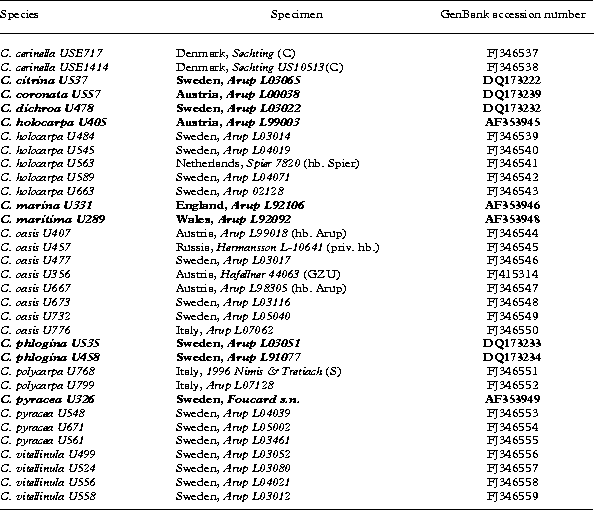
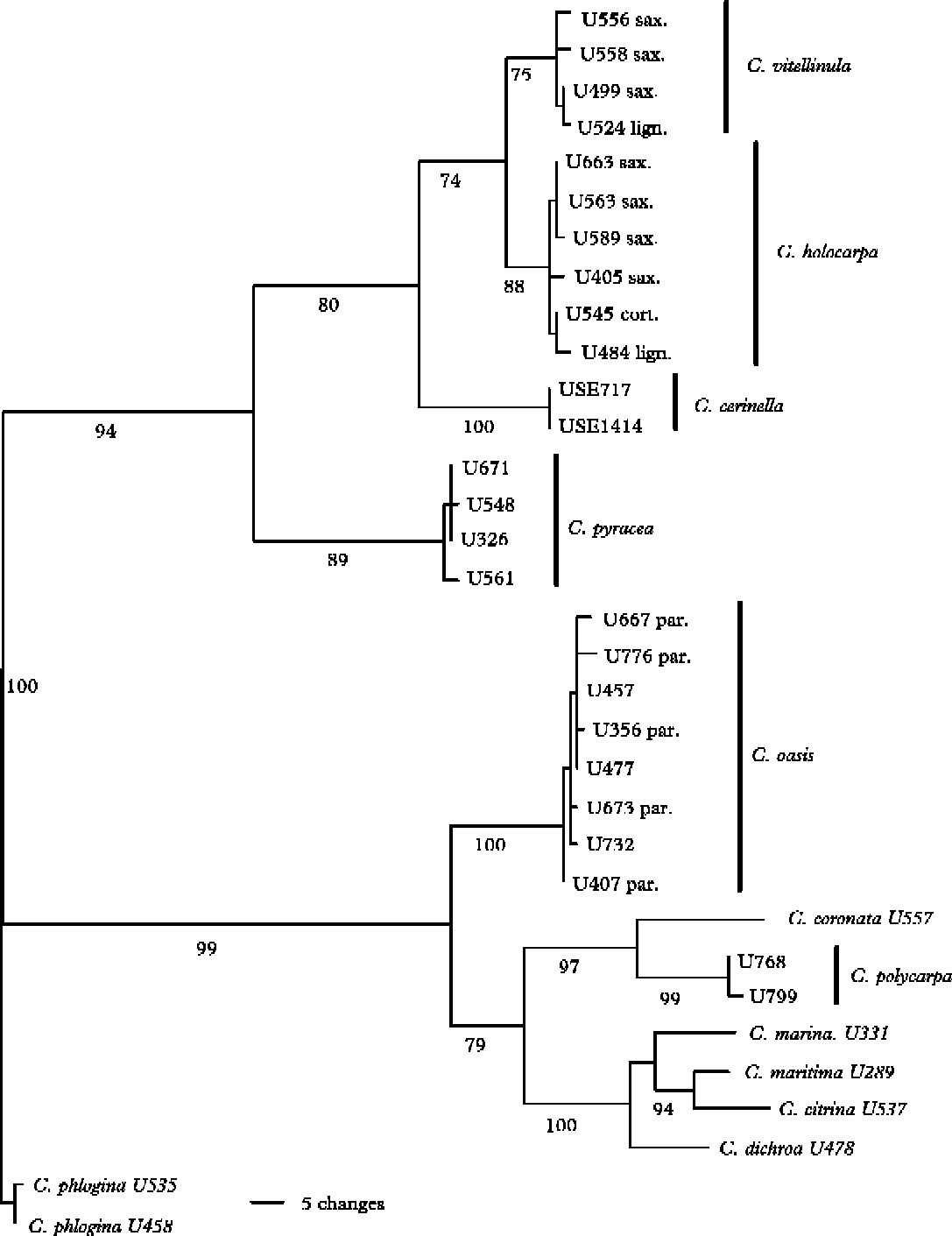
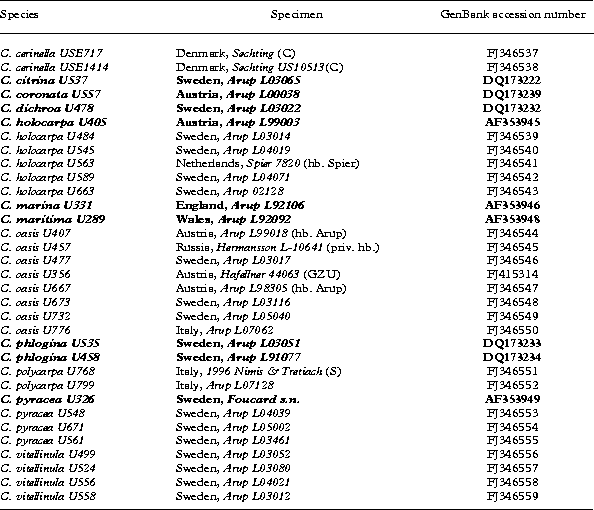
For the analysis 24 new nrDNA ITS sequences were produced, and nine were already available from previous studies (Table 1). A total of 140 parsimony-informative characters were used in the final phylogenetic analysis. The analysis resulted in three shortest trees of 301 steps, CI = 0·752, Rl = 0·918, HI = 0·249. One of these trees is shown in Figure 1.
Sequences used in the phylogenetic analyses, with location, collector, and GenBank accession numbers. Specimens in bold were already to hand and the rest are newly produced. All specimens are deposited in Lund (LD) unless stated otherwise
Phylogenetic analysis of the Caloplaca holocarpa group. One of the three shortest trees from the parsimonious analysis based on nrDNA ITS data. Numbers below the branches are bootstrap values >75. Cort. = corticolous; lig. = lignicolous; par. = parasitic; sax. = saxicolous.

The C. holocarpa group seems to be a rather small group of species made up of C holocarpa, C. vitellinula, C. cerinella and C. pyracea. Caloplaca oasis, on the other hand, seems to be related to the C. citrina group, to which it branches as a sister species. Caloplaca polycarpa seems to be closely related to C. coronata, both also belonging to the C. citrina group. All other species mentioned in the introduction belong outside of the C. holocarpa group (results not shown in the tree). It is, however, still unclear where C. saxifragarum belongs. The group itself is well supported (BS = 94) and distinct from other groups.
Caloplaca holocarpa and C. vitellinula are closely related sister species with fairly strong support for being monophyletic species. The two sequences of C. cerinella received best possible support as monophyletic with C. pyracea receiving slightly lower, but still strong support. The support for C. oasis as monophyletic is also the best possible, even if this group includes both parasitic and non-parasitic specimens.
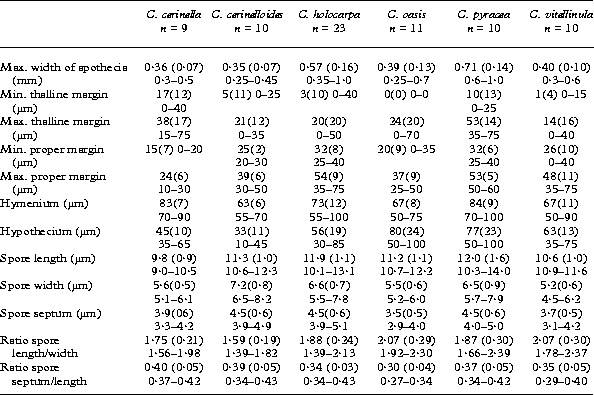
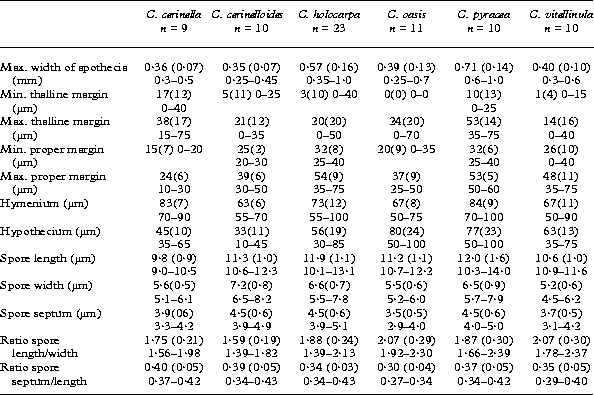
Morphological and anatomical differences are presented in Table 2.
Mean, standard deviation, and range from lowest to highest mean value for species of the C. holocarpa group. (n = number of specimens studied)
Discussion
It has not been clear for a long time whether C. holocarpa is one variable species with modifications induced by environmental conditions and substratum properties. However, it is now clear that C. holocarpa is mainly a saxicolous species and that it is distinct from C. pyracea that is mainly a corticolous species. It is also clear that C. holocarpa and C. vitellinula are closely related, but are separated genetically as well as by their morphology and can be treated as distinct species. An alternative could be to treat them as subspecies, but the phylogenetic analysis shows two distinct and monophyletic groups with fairly strong support and a vast majority of the collections can rather easily be determined. I therefore prefer to keep them at the species level. It is interesting to see that the two species, C. cerinella and C. cerinelloides, which are indistinguishable in the field, are not even closely related. It is also important to recognize that C. cerinella, that has 8–16 spores per ascus is closely related to species with only eight spores per ascus. This result is similar to that presented for Candelariella (Westberg et al. Reference Westberg, Arup and Kärnefelt2007), where there are examples of 8-spored species that are closely related to species with 32 spores per ascus. Both C. oasis and C. polycarpa belong to, or are very close to, the C. citrina clade. They have often been reported to belong near the C. velana group, but this group is very distant genetically from the C. citrina group. The two species have been confused with each other but are shown here to be distinct and separate from each other.
Several other species that are more or less similar to C. holocarpa were also analysed (the results are not included in Fig. 1, but will be presented elsewhere). Among these are C. ahtii, C. approximata, C. borealis, C. luteoalba, C. thuringiaca, C. tiroliensis and C. ulcerosa. They all clearly belong outside of the C. holocarpa group and show only morphological similarities to the group. It is still unclear where C. saxifragarum belongs, and further analyses are required to resolve its position.
Key to species morphologically similar to Caloplaca holocarpa in northern Europe
1. Terricolous, or on bryophytes and plant debris 2
Saxicolous, corticolous, lignicolous or on bryophytes over these substrata 4
2(1) Growing mainly on leaves of Saxifraga and Dryas C. saxifragarum
Terricolous, on mosses and plant debris on the ground 3
3(2) Apothecia orange, initially immersed in a grey thin thallus C. thuringiaca
Apothecia yellow, yellow-orange, olive-green, olive-black, dirty orange, not immersed in thallus; thallus usually not evident C. tiroliensis
4(1) Thallus with scattered ulcerose, small soralia, corticolous, poorly developed 5
Thallus without soralia, poorly developed or not; corticolous, lignicolous or saxicolous 6
5(4) Soredia dark blue-grey, often scarce; apothecia yellow to orange, common; northernC. ahtii
Soredia greenish grey, scattered to contiguous; apothecia rather rare, orange; southern C. ulcerosa
6(4) Mainly saxicolous 7
Mainly lignicolous or corticolous 11
7(6) Spore septum narrow, < 1/4 of spore length 8
Spore septum wide, > 1/4 of spore length 9
8(7) Mainly on slate, siliceous stone, or slightly calciferous rocks; northern; spores 8–13 × 3–6 μm C. approximata
On limestone, mortar, concrete; southern; spores 15–20 × 6–10 μm C. crenulatella
9(7) Thallus inconspicous, occurring around the apothecia only; apothecia 0·3–0·7(−1–0) mm; mean of spore septum (10 spores) > 4 μm C. holocarpa
Thallus yellow, usually visible but thin, continuous or of scattered areoles; apothecia 0·2–0·5 mm; mean of spore septum (10 spores) < 4 μm 10
10(9) Apothecia orange to dark orange, usually abundant and crowded; on limestone, mortar, concrete; sometimes parasitic on Verrucaria s. lat C. oasis
Apothecia yellow to orange, usually scattered; on siliceous rocks or sometimes calciferous rocks, wood or bark, never parasitic C. vitellinula
11(6) Spore septum narrow, < 1/4 of spore length C. luteoalba
Spore septum wider, > 1/4 of spore length 12
12(11) Thallus thin, pale yellow; apothecia −1·5 mm, orange; spores 12–18 × 6–12 μm, septum 5–9 μm wide; lower part of hymenium and hypothecium with numerous oil-droplets C. flavorubescens
Thallus grey to pale yellow; apothecia –1·0 μm, yellow to orange, olive-green, olive-black or dirty orange; spores usually smaller with narrower septa; no or only few oil-droplets in the hymenium 13
13(12) Apothecia yellow to orange, olive-green, olive-black or dirty orange, usually many but not crowded; mainly on mosses and plant debris but also on wood and bark; northern C. tiroliensis
Apothecia yellow reddish orange, but not with any olive tinge, sometimes with greyish or blackish outer portion of margin 14
14(13) Spores (8–)12–16 per ascus; apothecia yellow, 0·2–0·4 mm, in small groups C. cerinella
Spores 8 per ascus 15
15(14) Spore septum 2·5–4·0 μm; apothecia yellow, scattered; thallus sometimes sorediate with small dark blue- grey, ulcerose soralia C. ahtii
Spore septum wider; thallus not sorediate; apothecia crowded to scattered 16
16(15) Apothecia yellow to orange to reddish; margin without algae, concolorous or more often greyish to blackish, at least the outer part; often with black hypothallus C. borealis
Apothecia yellow to orange, sometimes with visible greyish thalline margin; margin always with algae; not with black hypothallus 17
17(16) Thallus usually visible as low, slightly convex areoles; areoles greyish to pale orange; apothecia yellow-orange to orange, 0·5–1 mm, usually with thin thalline margin; mainly on Populus, sometimes on bark of other trees and wood C. pyracea
Thallus usually inconspicuous, greyish to yellow; apothecia yellow to orange-yellow, 0·2–0·6(−1·0) mm; thalline margin not conspicuous; sometimes on Populus, but often on other trees and bushes 18
18(17) Apothecia 0·2–0·4 mm, pale yellow; hypothecium −45 μm thick C. cerinelloides
Apothecia 0·3–0·6(−1·0) mm, orange-yellow; hypothecium 50–80 μm C. holocarpa
Caloplaca cerinella (Nyl.) Flagey
Cat. Lich. Algérie, 31 (1896).—Lecanora cerinella Nyl., Bull. Soc. Bot. France 13: 370 (1866); type: Lecanora cerinella, France, Paris, Bois de Boulogne, 1866 Nylander (H-NYL 29739—holotypus!).
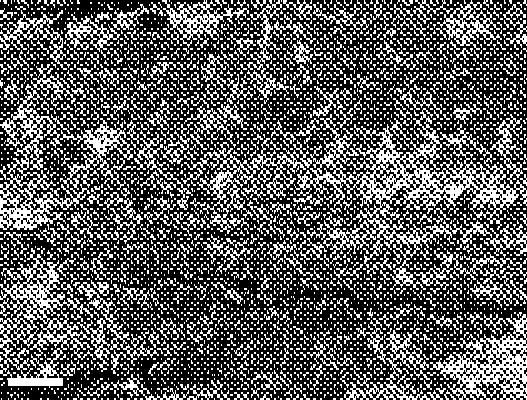
Caloplaca cerinella, a rather typical habitus (1941, Ahlner) Scale = 0·5 mm.
(Figs 2 & 3)
Thallus discontinuous to continuous, usually present but inconspicuous, up to 5 mm wide, up to 0·1 mm thick; areoles 0·1–0·2 mm wide, slightly convex, greyish to greyish yellow to yellow. Margin usually indistinct. Prothallus absent. Cortex usually poorly developed, composed of an amorphous layer or indistinctly paraplectenchymatous.
Apothecia normally present, and crowded in small groups but sometimes more scattered, often contiguous, usually adnate, round to somewhat irregular, zeorine, 0·1–0·4(−0·5) mm wide; disc ± flat or sometimes somewhat convex, normally of some shade of dark yellow, sometimes with orange tinge; proper margin 15–30 μm, slightly raised or level with disc, concolorous with or brighter yellow than disc, consisting of radiating, thick-walled hyphae with long and narrow to short ellipsoid cells, 4–15 × 1–4 μm; thalline margin often rather conspicuous, but sometimes suppressed, (0–)15–40(−60) μm, even to uneven, pale grey to yellow; epihymenium orange, granular inspersed; hymenium 70–90 μm thick, hyaline; hypothecium 40–65 μm thick, hyaline; paraphyses simple to branched above, 2–2·5 μm broad with upper cells slightly wider, 4–5 μm; asci cylindrical, 51–66 × 13–17 μm, (8–) 12–16–spored; spores polaribilocular, broadly ellipsoid, (8·0–)8·3–11·0(–12·0) × (4·5–)5·0–6·3(–7·0) μm, septum (2·5–)3·0–4·8(–5·0) μm wide, ratio of septum/spore length (0·29–)0·33–0·45(–0·50).
Pycnidia rarely observed, only found without conidia.
Chemistry. The thallus and apothecia contain parietin as a major compound, and small amounts of fallacinal, emodin, teloschistin and parietinic acid, which corresponds to chemosyndrome A of Søchting (Reference Søchting1997).
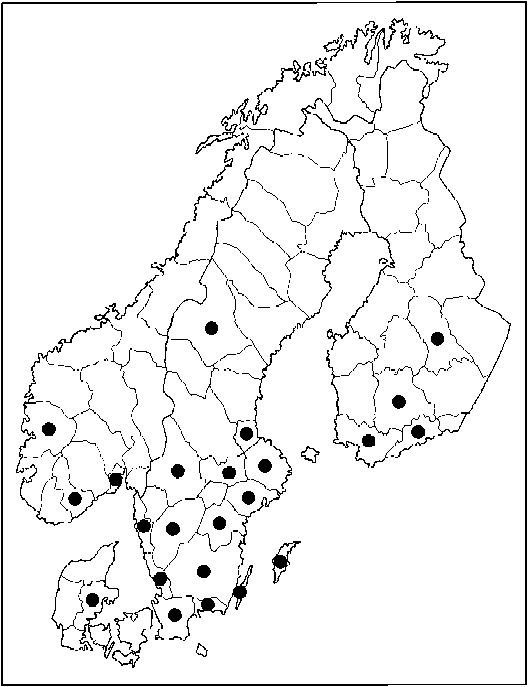
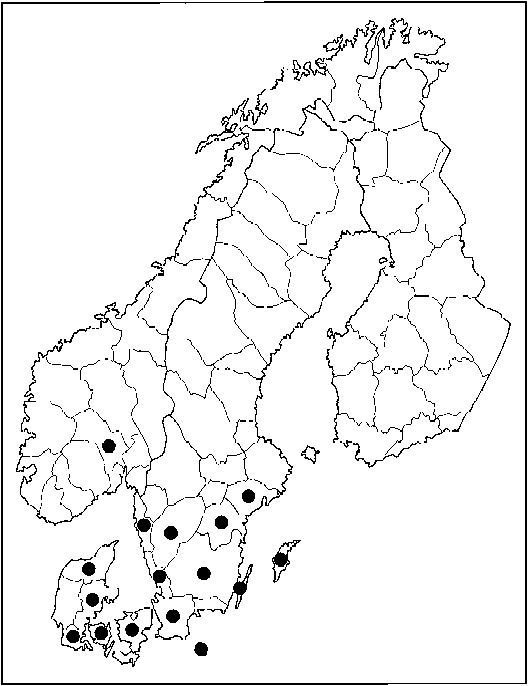
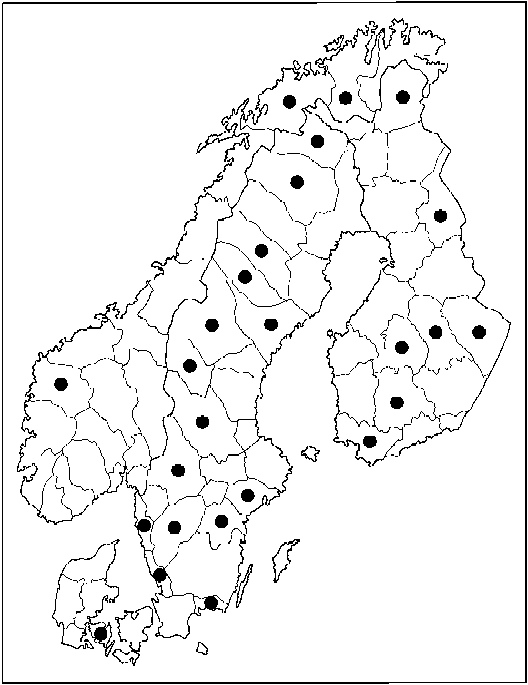
Habitat and distribution. Caloplaca cerinella usually grows on deciduous trees of various kinds, most often on Fraxinus, Populus and Sambucus. It is found more often on branches than on the trunk and it prefers open to semi-open situations: forest edges, small groves, gardens and on trees in open forests. Very often it is accompanied by C. pyracea, Lecania cyrtella and Lecidella elaeochroma. Caloplaca cerinella has a rather clear southern distribution in the Nordic countries and seems to be restricted to the hemiboreal and nemoral zones (Fig. 3). There is also one record from Jämtland in Sweden, which is exceptionally far north for this species. Another northern record, from Åsele Lappmark (Santesson et al. Reference Santesson, Moberg, Nordin, Tønsberg and Vitikainen2004), turned out to be C. cerinelloides. In Sweden and Denmark C. cerinella seems to be fairly scarce and in Norway and Finland it is rare.
The distribution of Caloplaca cerinella in the Nordic countries, except Iceland, based on studied material.
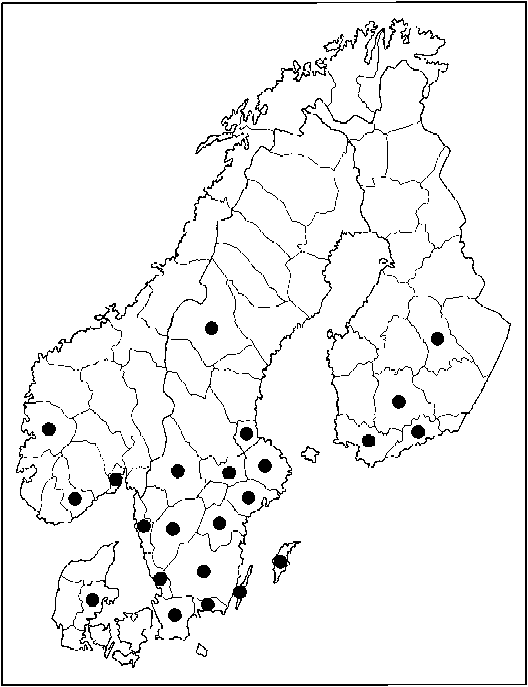
Remarks. This species is characterized by the inconspicuous thallus with small, dark yellow, crowded apothecia growing mainly on branches. However, it is morphologically indistinguishable from C. cerinelloides and the number of spores in the asci must be checked for certain determination.
Selected specimens examined. Denmark: Jylland: Mols Bjerge, Skytte-Christiansen 12711 (LD).—Finland: Etelä-Häme: Hollola, Pyhäniemi, Haikonen 14995 (H). Pohjois-Savo (Savonia-borealis): Kuipo, 1906, Lönnbohm (H). Varsinais-Suomi: Lohja, Pykälä 21087 (H).—Norway: Aust-Agder: Vestre Moland kyrkogard, 1926, Degelius (UPS). Hordaland: Ölen par., Ölen, 1968, Degelius (UPS), Vestfold: Larvik, Ihlen 874 (BG).—Sweden: Blekinge: Karlshamn par., Karlshamn, Arup L05101 (hb. Arup); Kyrkhult, Angölsmåla, Frödén 1874 (LD). Bohuslän: Bro par, Näverkärr, Arup L88195 (hb. Arup). Gotland: Västerhejde par., Ygne fiskeläge, 1946, Degelius (UPS). Gästrikland: Hille par., Iggön, 1939, Ahlner (UPS). Skåne: Kristanstad par., Näsby, Arup LS074 (hb. Arup). Småland: Furuby par., 700 m W of Furuby church, Arup L96010 (LD). Södermanland: Trosa par., Thoreholm, 1940, Degelius (UPS). Uppland: Börje par., III, prästgården, 1940, Degelius (UPS); Vänge par., Fiby urskog, Arup L91096 (bh. Arup). Värmland: Rudskoga, Gren, Sundell 6426 (UPS). Västergötland: Ålleberg, Saleby, Magnusson 15266 (UPS). Västmanland: Kila par., Grällsta, 1942, Degelius (UPS), Sala par., nära Sala gruva, 1941, Degelius (UPS). Öland. Resmo par., Resmo church yard, Arup L01531 (hb. Arup).
Caloplaca cerinelloides (Erichsen) Poelt
Bibl. Lich. 99: 50 (1993).—Caloplaca pyracea var. cerinelloides Erichsen, Verh. Bot. Ver. Prov. Brandenburg 72: 35 (1930); type: Caloplaca pyracea var. cerinelloides, Germany, Schleswig-Holstein, Kreis Flensburg, an Sambucus zwischen Tarp und Süder Schmedeby, 1924 Erichsen (HBG!—lectotype selected here).
(Fig 4)
Thallus absent or inconspicuous, consisting of small, scattered or contiguous areoles or granules, up to c. 1·5 cm wide, up to 0·1 mm thick; areoles 0·05–0·2 mm wide, weakly convex or as granules, greyish to greyish yellow. Margin indistinct. Prothallus absent. Cortex usually poorly developed, composed of an amorphous layer or indistinctly paraplectenchymatous.
Apothecia normally present and crowded in small groups, but usually not contiguous, slightly immersed in the substratum to sessile, round to somewhat irregular, zeorine, 0·1–0·4(−0·7) mm wide; disc ± flat or sometimes somewhat convex, yellow to orange-yellow; proper margin 20–40(−50) μm, ± level with disc, concolorous with or brighter yellow than the disc, consisting of radiating, thick-walled hyphae with long and narrow cells to short ellipsoid cells, 4–12 × 1–4 μm, thalline margin often inconspicuous and suppressed, up to 35 μm thick, even to uneven, grey-yellow to yellow; epihymenium orange, granular inspersed; hymenium 55–70 μm thick, hyaline; hypothecium 10–45 μm thick, hyaline; paraphyses simple to branched above, 2–2·5 μm broad with upper cells slightly wider, 4–6 μm, sometimes oil-inspersed; asci cylindrical, 43–54 × 11–15 μm, 8-spored; spores polaribilocular, broadly ellipsoid, (8·5–)10·0–12·5(–15·0) × (5·0–)6·0–8·0(–9·0) μm, septum (2·5–)3·8–5·0(–5·7) μm wide, ratio of septum/spore length (0·29–)0·33–0·48(–0·52).
Pycnidia not seen.
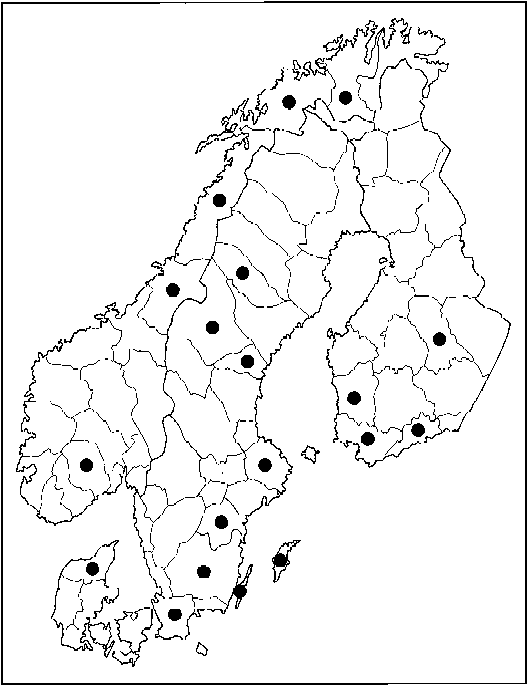
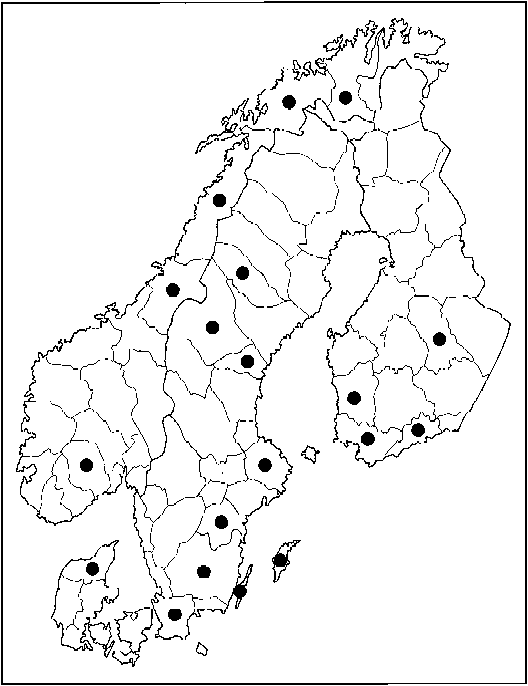
The distribution of Caloplaca cerinelloides in the Nordic countries, except Iceland, based on studied material.
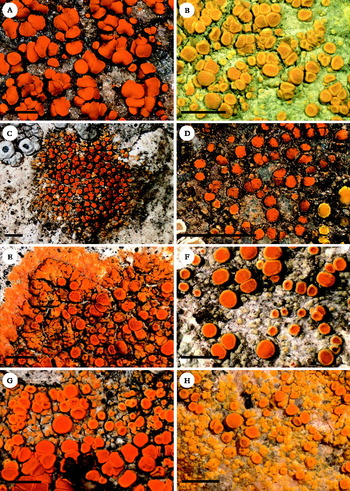
Species of Caloplaca. A, C. holocarpa, typical specimen from mountains with intensely orange apothecia (Sundell 5931); B, C. holocarpa, typical form from lowlands with more yellowish apothecia (1852, Fries); C, C. oasis, rather typical parasitic form growing on Verrucaria sp. (Arup L05070); D, C. oasis, typical non-parasitic form growing on concrete (Arup 05040); E, C. polycarpa, fairly typical specimen with well-developed, orange thallus and unusually well-defined prothallus (1996, Nimis & Tretiach); F, C. pyracea, typical specimen with scattered apothecia on a greyish thallus (Arup 05084); G, C. pyracea, less common habitus with more crowded apothecia and orange thallus (1948, Ahlner); H, C. vitellinula, very typical form with thin yellow thallus and scattered yellow apothecia (Hermansson 1577). Scales = 1 mm.

Chemistry. The thallus and apothecia contain parietin as a major compound, and small amounts of fallacinal, emodin, teloschistin and parietinic acid, which corresponds to chemosyndrome A of Søchting (Reference Søchting1997).
Habitat and distribution. This species seems to grow on many different bushes and trees and there is also one record from Norway on serpentine. The most common host tree seems to be Populus tremula, but there are records from, for example, Ribes, Picea, Sambucus, Betula, Juniperus, Potentilla fruticosa and wood. However, it is likely that C. cerinelloides requires dust rich in either lime or nutrients when it is growing on substrata with a low pH. It often occurs together with C. pyracea, especially when growing on Populus. The distribution in the Nordic countries is wide, but scattered, with records in all countries except Iceland (Fig. 4). It is not common anywhere but probably overlooked in many regions and is expected to be found in more provinces even if it actually is rather scarce in the Nordic countries.
Remarks. This species is very similar to C. cerinella and sometimes confused with that species, especially in the northern part of its distribution range. They are easily separated by their asci with eight spores. However, small, yellow forms of C. holocarpa growing on wood and bark may be very difficult to separate from C. cerinelloides. The best way to separate them is by the hypothecium which is 10–45 μm thick in C. cerinelloides and normally 50–80 μm thick in C. holocarpa.
Nomenclatural note. The material mentioned in the protologue consists of four specimens, but only one of these is C. cerinelloides and it is selected here as lectotype. Two of the other collections belong to C. cerinella and one belongs to C. phlogina.
Selected specimens examined. Austria: Steiermark: Teichalpe, Arup L98007, L98012 (hb. Arup); Hochlandtsch Mnt., Arup L97188, L97209 (hb. Arup).—Denmark: Nordøstjylland: Klim Bjerg, 1998, Alstrup (C).—Finland: Pohjois-Savo: Kangaslampi, Joutenlahti, Haikonen 9952b (H). Uusima: Lohja, Lieviö. Pykälä 21038 (H). Varsinais-Suomi: Kimito, Rugnola, Wikström 1303j (H).—Norway: Finnmark: Karasjok Co., Ettemasav'zi, Søchting 4192b (C); Kautokeino Co., N-end of Lake Ladnetjav'ri, Søchting 4285 (C). Nord-Trøndelag: Ön Leka, 2005, Bjelland (BG). Nordland: Saltdal par., Salten, Junkerdalen, 1937, Degelius (UPS). Telemark: Lifjell, 5 km NW of Bø, Søchting 4640 (C).—Sweden: Gotland: Hemse par., Mästermyr V om Dopparve, 1932, Degelius (UPS). Jämtland: Frosteviken, Gäddede, Magnusson 14548 (UPS). Medelpad: Njurunda sn., Ortsjö 1933, Eriksson (S). Skåne: Genarp, Häckeberga, 1953, Almborn (LD). Småland: Misterhult par., Blå jungfrun, Arup L96011 (LD). Uppland: Järfälla, Kallhäll, Arup L93O25 (hb. Arup). Åsele Lappmark: Risbäck par., Kalvberget, Santesson 33052 (UPS). Öland: Hulterstad par., Gösslunda alvar, 1912, Du Rietz (UPS).
Caloplaca holocarpa (Ach.) A. E. Wade
Lichenologist 3: 11 (1965).—Lichen holocarpus Ach., Lich. Suec. Prod: 73 (1798); type: Lichen holocarpus, Germany, Herrenhausi. Ehrhart, Plantae Cryptogamae no. 284 (GOET!—lectotype selected here).
(Figs 5A & B, 6)
Thallus discontinuous, inconspicuous or absent, up to 1·5 cm wide, to 0·1 mm thick, often developed only around apothecia, sometimes continuous, slightly cracked and verruculose; areoles when present 0·05–0·2 mm wide, flat or weakly convex, greyish to greyish yellow to orange. Margin usually indistinct, sometimes flat and thin. Prothallus normally absent. Cortex usually poorly developed, composed of an amorphous layer or indistinctly paraplectenchymatous.
Apothecia abundant, scattered to crowded, often contiguous, adnate to sessile, round to somewhat irregular, zeorine, 0·3–0·7(–l·0) mm wide; disc ± flat to convex, yellow, orange-yellow to orange, sometimes beige-yellow; proper margin 25–60(–75) μm, slightly raised or level with disc, concolorous with or slightly paler than the disc, consisting of irregularly radiating, thick-walled hyphae with rather long and narrow cells, 5–15 × 1–3·5 μm; thalline margin often inconspicuous, suppressed or absent 0–50 μm, sometimes more developed, even to uneven, yellow, cortex not expanding at base; epihymenium orange, granular inspersed; hymenium (55–)65–80(–100) μm thick, hyaline; hypothecium (25–)50–80(–100) μm thick, hyaline, sometimes oil-inspersed; paraphyses simple to branched once to twice above, 2–2·5 μm broad with upper cells wider, 4–6 μm, sometimes oil-inspersed; asci cylindrical, 42–60 × 11–15 μm, 8-spored; spores polaribilocular, ellipsoid to broadly ellipsoid, (9·5–)10·0–13·5(–15·5) × (4·8–)5·5–7·5(–8·4) μm, septum (3·0–)3·6–5·4(–5·8) μm wide, ratio of septum/spore length (0·27–)0·31–0·45 (–0·50).
Pycnidia not seen.
Chemistry. The thallus and apothecia contain parietin as a major compound, and small amounts of fallacinal, emodin, teloschistin and parietinic acid, which corresponds to chemosyndrome A of Søchting (Reference Søchting1997).
Habitat and distribution. Caloplaca holocarpa grows mainly on various enriched siliceous rocks, boulders and pebbles, but occurs also on lime-rich stone, slate, mortar and concrete. There are also several records on wood, but as for many of the sites with siliceous stone it is often eutrophicated by dust. Other substrata include roof tiles, bricks, asbestos, serpentine, dolomite, flint, sandstone and a number of deciduous trees. It is, however, rare on bark and here it normally grows close to the ground in more or less eutrophicated situations.
Usually, C. holocarpa occurs in well-lit places, but it may also occur in more shaded situations, for example, under overhangs. The environment varies considerably, from pebbles on the ground along roads, walls, seashore rocks in the lowland to rocks and boulders in alpine heaths. The highest altitude recorded for the specimens studied is 1600 m, but this is probably not the upper limit for the species.
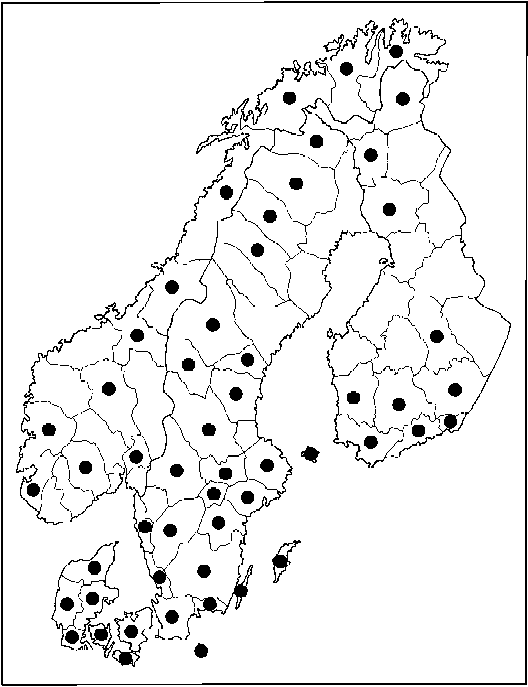
Caloplaca holocarpa is widely distributed in the Nordic countries and even if there are records lacking in some provinces, this is certainly due to missed records or incomplete collecting activity (Fig. 6). It occurs all over Europe, in North America and in near Asia, but records from other parts of the world need confirmation.
The distribution of Caloplaca holocarpa in the Nordic countries, except Iceland, based on the material studied.

Remarks. Caloplaca holocarpa is characterized by the near absence of thallus and the crowded yellow to orange apothecia with concolorous margin growing mainly on eutrophicated siliceous stone. However, this variable species has been widely misinterpreted and has included at least three species. It is now clear that the species grows mainly on siliceous rocks, even if the type material grows on wood, and should be called C. holocarpa. Material on wood, similar to the type, as well as bark has been proven to belong to this species by molecular data. Most of the material growing on bark is C. pyracea and it is morphologically as well as genetically well separated from C. holocarpa. Material growing on limestone and concrete named C. holocarpa belongs mainly to C. oasis. Caloplaca oasis differs from C. holocarpa in the small, evenly sized apothecia with a very thin margin. The thalli are usually better delimited by the yellow thallus at the margin. Finally, C. oasis has a spore septum that is shorter (average value of 10 spores 2·9–4·0 μm) than that in C. holocarpa (3·9–5·1 μm). Caloplaca pyracea differs from C. holocarpa in the better developed thallus, usually with slightly convex, grey to orange areoles, and the usually less crowded, orange apothecia with a more prominent, greyish to yellowish thalline margin (Fig. 7). In the lowlands C. holocarpa often has yellow to orange-yellow apothecia that clearly differ from the orange disc of C. pyracea, but in the mountains C. holocarpa usually becomes bright orange, a form that has been named var. norrlandica H. Magn. This is merely a result of the stronger light conditions and merits no taxonomic recognition. These three species have their favourite substrata, but they sometimes occur together on the same substratum, for example, C. holocarpa with C. oasis on concrete or with C. pyracea on wood, but in these cases there are rarely any problems in distinguishing the species. For differences between C. holocarpa and C. cerinelloides and C. vitellinula see these species, respectively.
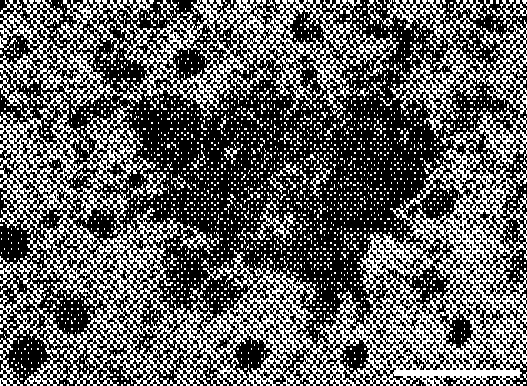
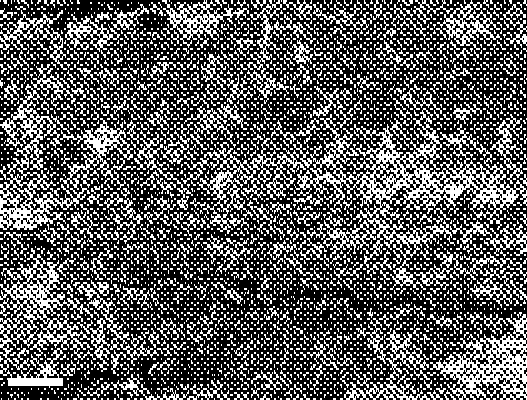
Caloplaca pyracea (bottom) and C. holocarpa (top)growing together on wood (1923, Eriksson). Even in a black and white photograph it is possible to separate the two species by the slightly larger apothecia with better developed thalline margin in C. pyracea. Scale = 1 mm.
Nomenclatural notes. Due to the uncertain taxonomy of the C. holocarpa group, the saxicolous specimens have often been treated under the name Caloplaca lithophila H. Magn. (e.g. Arup Reference Arup1994; Hansen et al. Reference Hansen, Poelt and Søchting1987; Nimis Reference Nimis1993). It is now clear that this name cannot be used for the saxicolous species, where the epithet holocarpa has priority. However, it is not clear whether the type of C. lithophila really should be considered a synonym of C. holocarpa. See C. vitellinula for further information.
Two samples of C. vitellinaria Szat. were also analysed genetically as well as morphologically. No differences were found between these specimens and those of C. holocarpa. However, since the type of C. vitellinaria was not available for study by me it is too soon to draw final conclusions regarding the status of this species.
Selected specimens examined, Austria: Steiermark. Grazer Bergland, N of St. Radegund, Arup L99003 (hb. Arup).—Denmark: Bornholm: Østermarie sn., Rankløve, 1936, Gelting (C). Jylland: N f. Grenaa Havn, Skytte-Christiansen 5046 (C). Østjylland: D. 15., MønstedW of Viborg, Svane 2704 (C); Anholt Stenrevle, Skytte-Christiansen 6576 (C). Sjælland: Gundsø, Bolund, Alstrup878 (C); Herslev sn., Bognæs, Skytte-Christiansen 9669 (C); Holbæk, Skytte-Christiansen 7657a (C).—Finland: Perä-Pohjanmaa: Simo, 1915, Räsänen (H). Pohjois-Savo: Kuopio, l909, Linkola (H). Uusimaa: Helsinki, Ahti & Seaward 31682 (H).—Norway: Akershus: Oslo. Rosenhof, 1869, Moe (O). Finnmark, Kautokeino Co., Vir'dneguol'ka, Søchting 4386 (C). Hordaland: Voss, 1915, Lynge (O). Nord-Trøndelag: Nordli hd., Eidet, 1939, Ahlner (S). Nordland: Bodø, 1823, Sommerfelt (O).: Saltdal kommune, Graddis, Arup L03561 (hb. Arup). Oppland, Vågå N of Vågåvatn, Søchting 5246 (C); Nordherad, Berge, Vitikainen 11496 (H). Sör-Trøndelag: Meråker par., Stenfjeld, Magnusson 22154 (UPS). Troms: Storfjord kommune, 1·5 km N of Skibotn, Arup L03562 (hb. Arup).—Sweden: Gotland: Fårö par., Gotska Sandön, Tibell 1250 (UPS); Gotska Sandön, Tibell 1177 (UPS). Holland: Lindome, Ekered, Magnusson 14776 (UPS). Jämtland: Undersåker par., Mt. Välliste, Arup L02081 (LD); Åre par., Mt. Saxvallklumpen, Arup L02128 (LD); Handöl, Arup L02222 (LD), Lule Lappmark: Jokkmokk par., Padjelanta National Park, Arup L04071 (LD). Skåne: Degeberga par., Saxamöllan, Arup L03014 (LD); Gödelöv par., Björnstorp, Arup L04019 (LD); Ivö, Ivö klack, Arup L91060 (hb. Arup); Sireköpinge, Kläsinge, 1894, Alvthin (LD); V. Vram par., on the churchyard wall, Arup L06189 (hb. Arup). Södermanland: Västermo: Vrakholmen, 1882, Blomberg (LD). Västergötland: Floby, 1893, Stenholm (LD); Torsö par., Djurö archipelago, Owe-Larsson 1555 (UPS). Västmanland: Arboga. Marieborg, 1950 Kjellmert (LD).
Exsiccata: Finland: Etelä-Savo: Längelmäki, l946, Räsänen (C).
Caloplaca oasis (A. Massal.) Szat
Magy, Bat Lapok 31: 120 (1932).—Callopisma aurantiacum (Lightf.) A. Massal. var. oasis, A. Massal. Sched. Crit. Lich. Exs. Ital. VII: 134 (1856); type: Callopisma aurantiacum var. oasis, A. Massal.: Lich. Ital. Exs. no. 240, ad saxa oolitica in oppido Grezzana et Chiesanuova Prov. Veron. plerumque in thallo spermatofore Hymeneliae hyascentis, A. Massal. (VER!—lectotype selected here, LD–isotype!, UPS—isotype!).
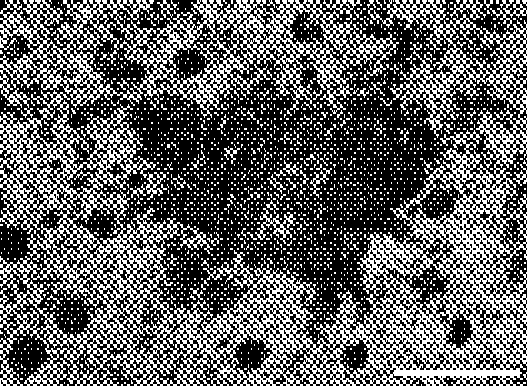
Caloplaca oasis, close up showing a small parasitic thallus on Verrucaria sp. (Arup L07008). Scale = 1 mm.
(Figs 5C & D, 8, 9)
Thallus discontinuous to continuous, 0·2–2(–2·5) cm wide, very thin and sometimes almost absent, up to 0·20(–0·3) mm thick, composed of scattered to contiguous areoles to cracked areolate; areoles 0·1–1·0 mm wide; pale yellow to yellow, sometimes greyish yellow. Margin indistinct of scattered areoles or more distinct with contiguous areoles. Prothallus usually absent but sometimes present, thin yellow and film-like. Cortex usually poorly developed, composed of an amorphous layer or indistinctly paraplectenchymatous.
Apothecia normally present and abundant, scattered to crowded, sometimes contiguous, ± immersed to adnate, round to somewhat irregular or angular, zeorine, 0·2–0·4(–0·7) mm wide; disc flat to slightly convex, orange to brownish orange, often overgrown by cyanobacteria; proper margin (0–)15–40(–50) μm, slightly raised or level with disc, concolorous with or slightly paler than disc, consisting of irregularly radiating, thick-walled hyphae with cells short and wide to long and narrow 3–10 × 1·5–6 μm; thalline margin often inconspicuous, suppressed or absent, 0–25(−70) μm, yellow; epihymenium orange, granular inspersed; hymenium (50–)65–75 μm thick, hyaline; hypothecium (35–)50–100(–125) μm thick, hyaline; paraphyses usually simple, sometimes branched above, 1·5–2·5 μm broad with upper cells wider, 4–6 μm; asci cylindrical, 40–52 × 11–13 μm, 8-spored; spores polaribilocular, ellipsoid, (8·0–)9·5–13·0(–14·0) × (4·0–)4·5–6·5(–7·0) μm, septum (2·5–)2·8–4·0(–4·6) μm wide, ratio of septum/spore length (0·21–)0·24–0·37(–0·41).
Pycnidia rarely observed, immersed, orange. Conidia broadly ellipsoid, 2·0–3·5 × l·3–1·7 μm.
Chemistry. The thallus and apothecia contain parietin as a major compound, and small amounts of fallacinal, emodin, teloschistin and parietinic acid, which corresponds to chemosyndrome A of Søchting (Reference Søchting1997).
Habitat and distribution. Caloplaca oasis has a rather restricted choice of substrata and occurs mainly on pure limestone, concrete and mortar. There are also some records on asbestos, calciferous pebbles and flint. In Sweden this species is most common on Öland and Gotland, where it occurs mainly on limestone in Alvar habitats, on rocks, stonewalls and on pebbles. On the mainland it is more common on concrete, mortar and to some degree on walls of limestone. In Denmark the most common substrata seem to be calciferous pebbles and concrete, but it also occurs on pure limestone rocks.
Caloplaca oasis has a distinctly southern distribution in the Nordic countries (Fig. 9). It is known from most provinces in Denmark and in Sweden up to just south of Stockholm. There is also one record from Buskerud in Norway, but so far no records from Finland. This picture of the distribution is probably more or less correct, but the limit may be pushed a bit further north and there may be occurrences in Finland as well as more occurrences in southern Norway. This species is widespread in Europe and probably occurs in all countries south of Scandinavia. There are also records from the Færoe Islands, Britain and Russia.
The distribution of C. oasis in the Nordic countries, except Iceland, based on the material studied.

Remarks. This species has been partly misunderstood in most parts of Europe. It has usually been referred to as a parasite on Verrucaria spp. (Clauzade & Roux Reference Clauzade and Roux1985, Nimis Reference Nimis1993, Wirth Reference Wirth1995) and as such it is usually a small lichen growing as islands on the host lichen. However, the species is probably much more common as a non-parasite. In some cases it starts out as a parasite, but the mature thallus is an autonomous lichen. When growing on concrete and mortar it is rarely parasitic and rather functions as a colonizer. The morphological variation is rather large, but the best developed thalli are usually parasitic or semi-parasitic. In parasitic specimens the thallus is usually conspicuous (Fig. 5F, 8), especially at thallus margin with crowded apothecia in the centre. In non-parasitic thalli, and especially on mortar and concrete, the thallus is usually less well developed and occurs as scattered yellow areoles with apothecia that are often more scattered (Fig. 5D). The best developed forms have often been misidentified as C. polycarpa (A. Massal.) Zahlbr., another parasitic species. In Sweden, for example, records of C. polycarpa (Santesson et al. Reference Santesson, Moberg, Nordin, Tønsberg and Vitikainen2004) refer to C. oasis. However, C. polycarpa differs in having a thicker, areolate, orange thallus with larger apothecia with thicker margins. Sometimes, a prominent thalline margin also develops in this species (Fig. 5E). Even if these two species may be somewhat similar and sometimes grow in similar habitats they are well separated. Molecular analyses of material collected at, or near the type locality, of both these species in the vicinity of Verona, show that the species are not even sister species. I have also studied the type material of C. tenuatula (Nyl.) Zahlbr. and C. fiumana Zahlbr. and I agree with Nimis (Reference Gardes and Bruns1993) that these names are synonyms of C. polycarpa. The distribution of C. polycarpa s. str. is not quite clear, but it seems to occur as far north as Hungary.
Even if C. oasis has been confused with C. polycarpa it has much more commonly been determined as C. holocarpa. For example, the photo in Wirth (Reference Wirth1995) shows C. oasis growing on concrete, under the name C. holocarpa. When C. oasis grows on this substratum the thallus is a rather poor character to separate the species, even if C. oasis normally has more prominent yellow areoles or even a thin, cracked areolate thallus. The best way to separate them is by the normally smaller, 0·2–0·4 mm wide apothecia with a narrower margin in C. oasis. In addition, the spore septa are narrower (average of ten spores normally below 4·0 μm).
Selected specimens examined. Austria: Steiermark: Grazer Bergland, S of Semriach, Arup L99018 (hb. Arup); Raabklamm, Arup L98305 (hb. Arup).— Denmark: Bornholm: Hammershus, Svane 7228–7 (C). Østjylland: Djursland, Søchting 9595 (C); Funen Romsø, Søchting 7190 (C). Jylland: (D. 1). Hirshholm Island, Vitikainen 9756 (H). Langeland: Kellsnor light, Svane 8491–1 (C). Sjælland: Sejerø, Alstrup 1672 (C); Jungshoved, Christiansen (C).—Norway: Buskerud: Ringrike, Søchting 5447 (C).—Sweden: Bohuslän: Kungshamn par., Kungshamn, Arup L05017 (LD); Valla par., small island between L. Askerö and Säckebäck, Arup L05007 (LD). Gotland: Fårö sn., Gotska Sandön, Tibell 145 (UPS); Västerhejde par., Högklint, Arup L03064 (LD); Östergarn par., Östergarnsberget, Arup L03116 (LD). Skåne: Gislövs hammar. Malme (S); Munka-Ljungby par., Munka-Ljungby, Arup L05040 (LD). Södermanland: Julita par., Gimmersta, Malme (S). Västergötland: Dala par., Djupadalen nature reserve, Arup L06185 (LD). Öland. Mörbylånga par., 1·5 km NW of Gösslunda, Arup L03017 (LD); Resmo par., W of Möckelmossen, Arup & Kustvall 45 (LD); Tveta ås, Zetterstsedt (UPS). Östergötland: S:t Anna, Ladudden, Arup L07068 (LD).
Caloplaca pyracea (Ach.) Th. Fr
Kgl. Svensk. Vetensk.-Akad. Handl. 7: no. 2, 25 (1867).—Parmelia cerina var. pyracea Ach., Method. Lich.: 176 (1803); type: Parmelia cerina var. pyracea (as Verrucaria aurantiacum), Germania, Persoon (H-ACH!—lectotype selected here).
(Figs 5F & G, 10)
Thallus usually ± continuous, 0·5–2 cm wide, very thin and sometimes almost endophloeic, up to 0·15(–0·25) mm thick, flat to weakly verruculose, often rimose, rarely strongly verruculose (Fig. 2G); areoles usually not discernable, but sometimes distinct and 0·05–0·2 mm wide; colour pale greyish to greyish yellow, orange-yellow to orange, rather often with greyish base colour and yellow to orange scattered spots. Margin flat and thin. Prothallus sometimes present, thin and grey. Cortex usually poorly developed, composed of an amorphous layer or indistinctly paraplectenchymatous.
Apothecia normally present and abundant, scattered to crowded, but rarely contiguous, adnate to sessile, round to somewhat irregular, zeorine, 0·3–1·0 mm wide; disc flat to slightly convex, orange, often rather intense, sometimes yellow-orange; proper margin (25–)35–50(–60) μm, slightly raised or level with disc, concolorous with the disc, consisting of irregularly radiating, thick-walled hyphae with cells rather short and wide to long and narrow, 4–10 × 1·5–5 μm; thalline margin mostly present, but sometimes excluded, often difficult to separate from the proper margin (0–)25–50(–75) μm, ± even, normally grey or greyish with some yellow or orange tone; epihymenium orange, granular inspersed; hymenium 70–90(–100) μm thick, hyaline; hypothecium (50–)70–100 μm thick, hyaline, sometimes oil-inspersed; paraphyses simple to branched once or twice above, 2–2·5 μm broad with upper cells wider, sometimes with oil-droplets, 4–7 μm; asci cylindrical, 45–55 × 12–15 μm, 8-spored; spores polaribilocular, ellipsoid to broadly ellipsoid, (8·5–)10·0–15·0(–15·5) × (4·5–)5·5–8·0(–9·0) μm, septum (3·3–)3·8–5·5(–6·5) μm wide, ratio of septum/spore length (0·26–)0·30–0·45(–0·50).
Pycnidia not seen.
Chemistry. The thallus and apothecia contain parietin as a major compound, and small amounts of fallacinal, emodin, teloschistin and parietinic acid, which corresponds to chemosyndrome A of Søchting (Reference Hansen, Poelt and Søchting1997).
Habitat and distribution. In the Nordic countries the majority of the records of C. pyracea are from Populus tremula. There are also some records from other deciduous trees, mainly Fraxinus, but also for example, Acer, Ulmus, Sorbus and Alnus. A small portion of the finds is also made on eutrophicated wood, where it on some occasions has grown together with C. holocarpa. Very rarely it has even been collected on strongly eutrophicated siliceous rocks or concrete and lime-impregnated Pinus and Juniperus. When growing on trees it prefers well-lit branches and exposed trunks. The environment varies from solitary roadside trees in the south to open forests with Populus or groups of trees in the mountains. In Norway it has been found up to at least 960 m altitude, but this is possibly not the upper limit for the species.
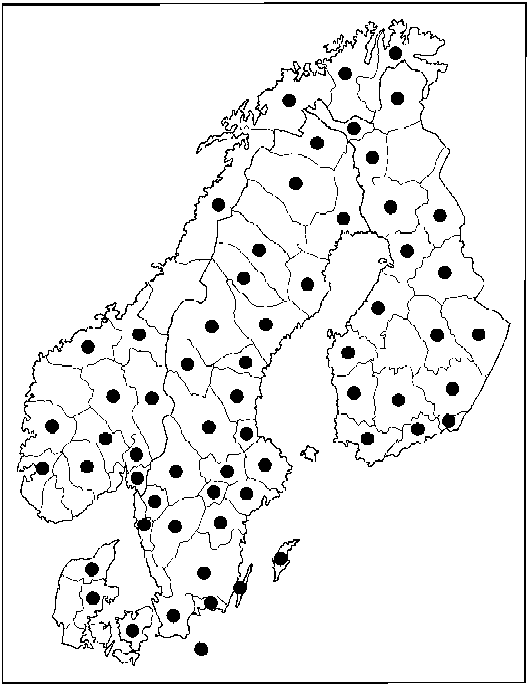
This species is found in most provinces in the Nordic countries and is a very common species (Fig. 10). It is also widespread in Europe, parts of North America and in Asia. Records from other continents however, need confirmation.
The distribution of C. pyracea in the Nordic countries, except Iceland, based on the material studied.

Remarks. This species is characterized by the often numerous, but usually not crowded, yellow-orange to orange apothecia with a narrow but often visible thalline margin outside the more prominent proper margin. This is normally more or less concolorous with the disk but the thalline margin can usually be seen as a greyish or yellowish outer part of the margin. When the margin is greyish the species has sometimes been confused with C. cerina, but this species has lecanorine apothecia with a thicker grey thalline margin and lacks the proper margin. Caloplaca borealis (Vain.) Poelt is another species that often has a thin greyish portion in the margin. However, in this case the apothecia are usually clearly smaller than in C. pyracea, up to 0·4 mm, and in this case the greyish portion is a part of the proper margin and lacks the alga completely.
In the Nordic countries C. pyracea has very often been confused with C. ahtii Søchting. This species normally produces dark, bluish grey crater-like soralia, but these may be very few or even absent. However, the apothecia are normally smaller, more delicate and scattered with a paler proper margin without any visible thalline margin, except in the very young apothecia. In addition, the spore septum is shorter, 2·5–4 μm, in C. ahtii than in C. pyracea. In southern Sweden and in Denmark C. ulcerosa may cause confusion. It has greenish grey, crater-like soralia and is often sterile, but sometimes the orange apothecia may be similar to C. pyracea. The soralia are, however, rather easy to find when looked for.
There are other species that resemble C. pyracea, for example, C. thuringiaca and C. saxifragarum. Caloplaca thuringiaca is a recently described species (Søchting & Stordeur Reference Søchting and Stordeur2001) that grows mainly on plant debris, detritus and bryophytes, but there are also records on wood of snags (U. Arup, unpublished data), a substratum where C. pyracea may grow. The former differs from C. pyracea mainly in the more immersed, less crowded apothecia, in substratum ecology and in preferring warmer and drier sites. Caloplaca saxifragarum Poelt is not yet known from the Nordic countries, but it occurs in Greenland and the Alps. It differs ecologically from C. pyracea growing mainly on plant debris, in Greenland mainly on Saxifraga oppositifolia or Dryas integrifolia (Hansen et al. Reference Hansen, Poelt and Søchting1987). Morphologically, it is very similar to C. pyracea and this species should be studied further.
Selected specimens examined. Denmark: Bornholm: Ibsker sn., Paradisbakker, 1945, Gelting (C). Nordjylland: D. 2., Rubjerg knude W of Hjørring, Svane 3547–4 (C). Sjœlland: Herslev sn. Bogends, Skytte-Christiansen 9730 (LD); Magleby sn., Boreby, Branth (C); Faxe kalkbrud, Alstrup 8250 (C). Østjylland: D. 14, Højbjerg by Ans, SE of Viborg, 1969, Svane 58 (C). —Finland: Etelä-Häme: Hattula, Tenhola, 1969, Vitikainen & Uotila (H). Etelä-Pohjanmaa: Korsnäs, Töjby 3 km S, Vitikainen 4076 (H). Kollismaa: Salla, Saija, Vitikainen 6245a (H). Pohjois-Häme: Savonranta, Pirttimäki, Haikonen 13120 (H). Uusimaa: Elimäki, Haikonen 24095 (H). Varsinais-Suomi: Kimito, Rugola, Wikström 1139 (H). — Norway: Akershus: Oslo, Rosenhof, 1869, Moe (O). Finnmark, Karasjok Co., Ettemasav'zi, Søchting 4192b (C); Kautokeino Co., N-end of Lake Ladnetjav'ri, Søchting 4285 (C). Hedmark: Hanestad, syd for stationen, 1918, Lynge (O); Stange, Tange, Haugan 7058 (O). Nordland: Saltdal par., Salten, 1937, Degelius (UPS); 10 km W of Rognan in Saltdal, Søchting 4122 (C). Opland: Böverdalen, Offigsbö, 1948, Ahlner (S); Vågå, Nordherad, Vitikainen 11496 (H). Rogaland: Rennesøy, Mosterøy, Kindt (BG). Telemark: Lifjell, Rui & Timdal 9367 (O). Troms: Storfjord kommune, 700–800 m W of top of Brennfjellet/Buollánvárri, Arup L03460 (hb. Arup). —Sweden: Gotland: Hemse par., Mästermyr, 1932, Degelius (UPS). Gästrikland: Hedesunda par., Spjutholmen, Arup L04039 (LD). Jämtland: Undersåker, Rista, 1917 Malme (S), Medelpad: Njurunda sn., Ortsjö, 1933, Eriksson (S). Småland: Hemmesjö par., Risinge, Arup L05002 (LD); Moheda par., Skog, Arup L05081 (hb. Arup); Åby par., 830 m E of Årtebäck, Arup L03033 (hb. Arup). Värmland: Forshaga par., NW of Krogen, Arup L05084 (LD). Västergötland: Skövde, Våmb, 1914, Hülphers (S). Västmanland: Vittinge par., 400 m SW of the church, 1995, Foucard (LD).
Caloplaca vitellinula (Nyl.) H. Olivier
Expos. Lich. Quest Fr. 1: 232 (1897).—Lecanora vitellinula Nyl. Flora 46: 305 (1863); type: Lecanora vitellinula, Russia, Murmansk Region, Lapponia tulomensis: “ad alnos in Lapponia orientali”, N.-I. Fellman (H-NYL 29940!—lectotype selected here, as “holotype”, Wade Lichenologist 3: 9 (1965); H(2)!, H-NYL 29943!—isolectotypes).
?Caloplaca lithophila H. Magn., Ark. Bot 33A(1): 132 (1946).
(Figs 5H & 11)
Thallus discontinuous with scattered to continuous convex areoles or weakly cracked areolate, up to several cm wide, 0·05–0·15 mm thick (Fig, 5H); areoles 0·1–0·5 mm wide, flat to slightly convex or uneven; pale greyish to greyish yellow to yellow. Margin normally thin and indistinct. Prothallus sometimes present, usually thin, white or pale yellow, film-like, occurring at the margin of the thallus or between areoles. Cortex usually poorly developed or indistinctly paraplectenchymatous.
Apothecia normally present, sometimes abundant but usually scattered, adnate to sessile, round to irregular, zeorine, 0·3–0·5(–0·6) mm wide; disc plane to convex, yellow to orange, and often dark orange in old apothecia; proper margin (0–)25–50(–75) μm, slightly raised or level with disc, concolorous with or paler than the disc, consisting of irregularly radiating, thick-walled hyphae with cells rather short and wide to long and narrow, 5–15 × 1·5–6 μm; thalline margin usually very inconspicuous and sometimes ± excluded, up to 25 μm thick, suppressed; epihymenium orange, granular inspersed; hymenium 50–80 μm thick, hyaline; hypothecium 35–80 μm thick, hyaline; paraphyses simple to branched above, 2–2·5 μm broad with upper cells wider, up to 6 μm, rarely if ever with oil-droplets; asci cylindrical, 45–55 × 10–14 μm, 8-spored; spores polaribilocular, ellipsoid, (8·0–)9·0–12·0(–14·0) × (4·0–)4·2–6·0(–7·0) μm, septum (2·5–)3·0–4·5(–5·0) μm wide, ratio of septum/spore length (0·24–)0·27–0·43(–0·45).
Pycnidia rarely observed, immersed, orange. Conidia broadly ellipsoid 3·0–3·2 × c. 1–5 μm.
Chemistry. The thallus and apothecia contain parietin as a major compound, and small amounts of fallacinal, emodin, teloschistin and parietinic acid, which corresponds to chemosyndrome A of Søchting (Reference Søchting1997).
Habitat and distribution. The majority of all the collections of C. vitellinula have been made from siliceous perpendicular rock, often under overhangs, but it grows also on the side of siliceous stonewalls and large boulders. There are also some collections from other substrata, for example, wood (east coast of Sweden, confirmed by molecular data), calcareous stone (Denmark), greenstone (Norway), and the type of the species was collected from Alnus (Kola). The situations are normally shady, often in forests, but there are records from more exposed environments. In these cases C. vitellinula is usually found on the shady side of the wall, boulder, or rock.
The distribution in the Nordic countries is currently somewhat scattered (Fig. 11). However, in Sweden there is an almost continuous distribution from the south to the very north of the country. In Norway there are records in the north and one isolated record far south. Also, in Finland the records are scattered from the south to the north. Iexpect that C. vitellinula is more frequent than the map indicates, especially in Norway and Finland, but it is probably rather rare, especially in the south. However, in Denmark it may be truly rare due to lack of suitable localities.
The distribution of C. vitellinula in the Nordic countries, except Iceland, based on the material studied.

Remarks. Caloplaca vitellinula is sometimes extremely hard to distinguish from C. holocarpa, but it is characterized by the pale yellow to greyish, thin thallus with scattered apothecia, rather often with mixed colours, from yellow to orange. The main difference from C. holocarpa is the better developed thallus and the normally scattered apothecia instead of the crowded ones in C. holocarpa. However, thalli of C. holocarpa that have been grazed by snails and then regenerated are more similar to C. vitellinula and can be very hard to determine. Statistically, there is also a clear difference in the spore size, smaller in C. vitellinula, and especially the spore septum is shorter (Table 2).
Caloplaca tegularis (Ehrh.) Sandst. is another morphologically similar species occurring in the same habitats as C. vitellinula. It belongs to the C. saxicola group, but the taxonomy of this species has not yet been clarified (Gaya Reference Westberg, Arup and Kärnefelt2007), Its morphology varies, but some forms resemble C. vitellinula in the rather thin yellowish thallus and scattered apothecia. They are distinguished from each other mainly in the areoles that often become more lobe-like in C. tegularis, a prothallus that is often present, larger apothecia and a spore septum that is on average slightly shorter, 2·5–4·0 (Gaya Reference Gaya2005).
Caloplaca vitellinula is a rather poorly understood species in Europe as well as in other parts of the world. The distribution in other European countries is yet not clear, but many specimens determined as C. vitellinula in European herbaria are in fact other species, for example, C. oasis and C. tegularis. My impression is that the species is very rare south of Scandinavia and probably absent from many countries.
Nomenclatural notes. This species has often been referred to as C. vitellinula auct. non (Nyl.) H. Olivier (e.g. Clauzade & Roux Reference Clauzade and Roux1985; Santesson Reference Santesson1984; Santesson et al. Reference Santesson, Moberg, Nordin, Tønsberg and Vitikainen2004; Wirth Reference Wirth1995). This is because the type specimen was collected from Alnus, but the epithet has often been applied to a saxicolous species. I have studied the type material (four specimens) and it corresponds well with what is found on siliceous rocks; it is only the substratum that is different. The type was collected in Kola and at these latitudes it is very common that Caloplaca species are less restricted to a specific substratum (Søchting Reference Søchting1989; Søchting et al. Reference Søchting, Lorentsen and Arup2008) and often grow on plant debris, bark and rocks. In addition, there is molecular proof of C. vitellinula growing on wood in southern Sweden. It is therefore my opinion that the epithet vitellinula should be used for this mainly saxicolous lichen. The type material consists of four specimens of which one was designated as ‘holotype' by Wade (Reference Wade1965), but it is not clear from the publication which specimen was designated. Here, the same specimen designated by Wade has been selected as the lectotype.
Caloplaca lithophila H. Magn. has normally been treated either as a taxon on its own or as a synonym of C. holocarpa (Arup Reference Arup1994). However, according to the results here it is not a species of its own and thus probably a synonym of another species. The type material consists of a poorly developed thallus with scattered small apothecia and, for C. holocarpa, unusually small spores that fit better with C. vitellinula. Also, the habitat where the specimen was collected, under an overhanging rock, agrees better with this species. Unfortunately, its is very difficult to determine whether the type is a very poorly developed C. holocarpa or a more normally developed C. vitellinula, but the name is here tentatively synonymized with the latter species. Future molecular analysis of fresh material very similar to the type may resolve the case.
Selected specimens examined. Denmark: Fyn: Fynshoved, Søchting 3993 (C).—Finland: Etelä-Häme; Padasjoki, Haikonen 4167 (H). Kollismaa: Kuusamo par., Paanajärvi, 1938, Laurila(H). Pohjois-Häme: Korpilahti Rutalahti, Lang 381 (H). Pohjois-Savo: Suonenjoki, Kutumäki, Takala 3480a (H). Satakunta: Lavia par., Laviankylä, 1936, Laurila (H). Varsinais-Suomi: Lohjan kunta, Jantoniemi, Pykalti 16696 (H).—Norway: Finnmark: Kautokeino co., Avzzi 7 km E of Kautokeino, Søchting 4157 (C). Troms: Storfjord kommune. 400 m WNW of Kavelnes, Arup L03479 (hb. Arup).—Sweden: Bohuslän: Bro par., Näverkärr nat. res., Arup L01837 (hb. Arup). Dalarna: Idre par., Blocktjärnåsen, Gethammaren, Arup L02332 (LD), Mt Hamrarna, Arup L02320 (LD). Halland: Enslöv par., Virsehatt, Arup L03209 (LD); Värö par., Vendelsö, Arup L03209 (LD). Härjedalen: Tännäs par., Mt. Frostsjöberget, Arup L02328 (LD). Jämtland: Åre par., Handölsfallen, DuRietz (UPS). Torne Lappmark: Abisko, Santesson 23828 (UPS). Värmland: Nedre Ullrud par., Torsberget, Sundell 184–54 (C). Åsele Lappmark: Vilhelmina par., Röberget, Søchting 6296 (C). Östergötland: Täby par., Nybble, 1911, DuRietz (UPS).
The author expresses his gratitude to all curators who have sent him large numbers of specimens on loan. Prof. U. Søchting is acknowledged for his comments on previous versions of the key and also for letting me use two sequences of C. cerinella in the DNA analysis. This work was made possible through a grant from the Swedish Threatened Species Unit and Stiftelsen Ove Almborns donationsfond.