Introduction
Rice (Oryza sativa), the primary staple food crop of Asia, is grown on soil subjected to different regimes of water (GRiSP, 2013), with different effects on soil acidity. Irrigated wetland rice grows on waterlogged soil that is submerged under a few centimetres of water throughout most of the growing season. Rainfed rice, which accounted for 41% of the global rice area by 2010, grows on aerated soil for part of or the whole of the growing season. Rainfed lowland rice, although grown in fields that are levelled and bound to hold water, is often subjected to the aerobic condition when there is insufficient rain to keep the soil flooded (Zeigler and Puckridge, Reference Zeigler and Puckridge1995). In contrast, rainfed upland rice is grown on aerobic soil on the unlevelled land, often on slopes. Traditional upland rice, the main subsistence crop for small farmers in many parts of tropical Asia, is usually grown on acidic infertile soils without the application of fertilizers (George et al., Reference George, Magbanua, Roder, Van Keer, Trébuil and Reom2001). As part of an effort to increase the efficiency of water use in rice production, modern upland rice is grown on aerobic soil but with full complements of irrigation, fertilizers, and pest and weed control, and is called aerobic rice to differentiate it from the low-input and low-yielding traditional upland rice (Kato and Katsura, Reference Kato and Katsura2014). Neutralization of soil acidity is a common consequence of the chemical process of reduction by flooding (Ponnamperuma, Reference Ponnamperuma1972; Sahrawat, Reference Sahrawat2005); therefore, adaptation to soil acidity is generally much more critical for upland and rainfed rice than for wetland rice.
Local rice germplasm, which is genetically diverse within as well as between varieties (e.g. see Pintasen et al., Reference Pintasen, Prom-u-thai, Jamjod, Yimyam and Rerkasem2007; Pusadee et al., Reference Pusadee, Jamjod, Chiang, Rerkasem and Schaal2009), continues to play a key role in rice farming in many parts of Asia. In Thailand, local rice varieties or land races are usually found in areas plagued by biotic and abiotic stresses. Upland rice planted under shifting cultivation in the highlands is invariably of local varieties (Sirabanchongkran et al., Reference Sirabanchongkran, Rerkasem, Yimyam, Boonma, Coffey, Pinedo-Vasquez and Padoch2004; Unthong, Reference Unthong2006). However, the farmers' yield of upland rice grown on acidic soil is not always as low as might be expected. The grain yield of 2.5–4.5 tonnes/ha measured for farmers' upland rice crop growing in rotational slash-and-burn cultivation on a soil with pH 4.8 at 0–30 cm and pH 4.6 at 30–60 cm (in 1:1 water) and 2–4 mg phosphorus (P)/kg (by Bray II) in the highlands of northern Thailand (Yimyam et al., Reference Yimyam, Rerkasem and Rerkasem2003) compared favourably with the national average yield of 2.3 tonnes/ha from the rainfed area in the lowlands (OAE, Reference OAE2013). Among the many factors contributing to acid soil infertility, toxicity of aluminium (Al) has been suggested as the primary cause of low productivity in upland rice (Fageria and Carvalho, Reference Fageria and Carvalho1982; Fageria and Breseghello, Reference Fageria and Breseghello2004). However, it has also been suggested that adaptation to Al and hydrogen (H) toxicity can be controlled by different mechanisms (Lazof and Holland, Reference Lazof and Holland1999; Kidd and Proctor, Reference Kidd and Proctor2001). Therefore, the aim of the study was to evaluate the tolerance to Al and H toxicity in popular local rice varieties grown on acidic soil in northern Thailand.
Materials and methods
Comparison of responses to H and Al toxicity in upland and wetland rice varieties (experiment 1)
Three of the most common local upland rice varieties (Bue Bang, BB; Bue Mue Tabong, BM; Pa Ai Khupe, PA) from Teecha, a mountain village in northern Thailand (17°53′ N and 97°54′ E; elevation 700–900 m), grown on acidic soil (pH 4.7–5.5, 1:1 water; 70–170 mg exchangeable Al/kg) and three common wetland rice varieties (KDML105, SPR1 and CNT1) were evaluated for their response to H and Al toxicity in solution culture with three treatments of nil Al (0 mg/l) at pH 7 (pH7Al0) and pH 4 (pH4Al0), and 30 mg Al/l at pH 4 (pH4Al30:Al2(SO4)3.18H2O). Upland rice seeds were obtained from farmers, and wetland rice seeds were breeder seeds obtained from Chiang Mai Rice Research Center. One experimental unit consisted of 100 5-d-old seedlings planted in the nutrient solution, modified from Kimura B solution (Yoshida et al., Reference Yoshida, Forno, Cock and Gomez1976) containing 48.2 mg (NH4)2SO4/l, 24.8 mg KH2PO4/l, 18.5 mg KNO3/l, 15.9 mg K2SO4/l, 59.9 mg Ca(NO3)2/l, 65.9 mg MgSO4/l and 46.0 mg Fe-EDTA/l, aerated by convection (Wiengweera et al., Reference Wiengweera, Greenway and Thomson1997). The experiment was conducted in duplicate. Differential effects of Al tolerance on different rice genotypes have been shown to be unaffected with or without air bubbling through the nutrient solution (Phattarakul, Reference Phattarakul2008). The nutrient solution was renewed weekly and pH adjusted daily to 4.00 ± 0.05 or 7.00 ± 0.05 with 1 N HCl or 1 N NaOH. The length of the shoot and the longest root of each plant were measured after 25 d.
Variation in response to Al tolerance within and between accessions of three upland rice varieties (experiments 2 and 3)
The variation in response to Al tolerance was evaluated in two accessions each from the three local upland rice varieties in experiment 1 (BB1, BB2, BM1, BM2, PA1 and PA2), compared with Al-tolerant Koshihikari (Ma et al., Reference Ma, Shen, Zhao, Wissuwa, Takeuchi, Ebitani and Yano2002) and Al-sensitive KDML105 (experiment 2). Twenty pure-line genotypes derived from each accession were grown in solution culture with Al (Al30) and without Al (Al0) as in experiment 1, in three replicated pots, with five plants per pot. Differential effects of Al tolerance on rice genotypes have been shown to be unaffected with or without air bubbling through the nutrient solution (Phattarakul, Reference Phattarakul2008). The nutrient solution was renewed weekly and pH adjusted daily to 4.00 ± 0.05 with 1 N HCl or 1 N NaOH. The length of the longest roots was measured after 21 d. The response to Al tolerance was determined by measuring the relative root length and the length of the longest root at Al30 as a percentage of the length at Al0. The genotypes were evaluated for the characteristics of the plant and seed including pigmentation of the leaf blade, leaf sheath, auricle, ligule, node, internode, apiculus, hull and pericarp, shape of the ligule, plant type and awning (IRRI, 1980). The size and shape of unhusked seeds were measured in width, length and thickness with a digital caliper.
Experiment 3 evaluated the shoot and root growth and root function of the most Al-tolerant pure-line genotypes of upland rice varieties in experiment 2 (BB01, BM01 and PA01), with KDML105 being the check, at pH 4 with the supplementation of four levels of Al (0, 10, 20 and 30 mg Al/l, designated Al0, Al10, Al20 and Al30), using separate sets of pots for each harvest at 30 and 45 d after the treatment. Plant culture and basal nutrient solution were the same as in experiments 1 and 2. At each harvest, growth was determined by measuring the length of the longest roots and the dry weight of roots and shoots after oven drying for 48 h at 75°C. Subsamples were dry-ashed for calorimetric analysis of P (Murphy and Riley, Reference Murphy and Riley1962). P uptake efficiency was calculated by measuring plant P content per unit root dry weight. The effects of Al were assessed by measuring the relative root dry weight and relative P content of the whole plant, with performance at each Al level being expressed as a percentage of performance at Al0.
Statistical analysis
The analysis of variance was used to determine the effects of acidity treatments on variety using Statistix 7.0 (Analytical Software, Tallahassee, Florida, USA), after log10 or arcsine transformation where appropriate. Means were compared by least significant difference (LSD) at P≤ 0.05. Significance of linear regressions was evaluated using the analysis of variance (Snedecor and Cochran, Reference Snedecor and Cochran1968). The variation in morphological characteristics within genotypes was determined by the Shannon–Weaver index (H′) (Powers and McSorley, Reference Powers and McSorley2000), which is calculated as follow:
 $$\begin{eqnarray} H\prime = - { \sum _{ i = 1}^{ s } }\, p i \,\,ln\,\, p i , \end{eqnarray}$$
where s is the total number of types found and p i is the proportion of individuals with type i.
Results
Variation in response to H and Al tolerance (experiment 1)
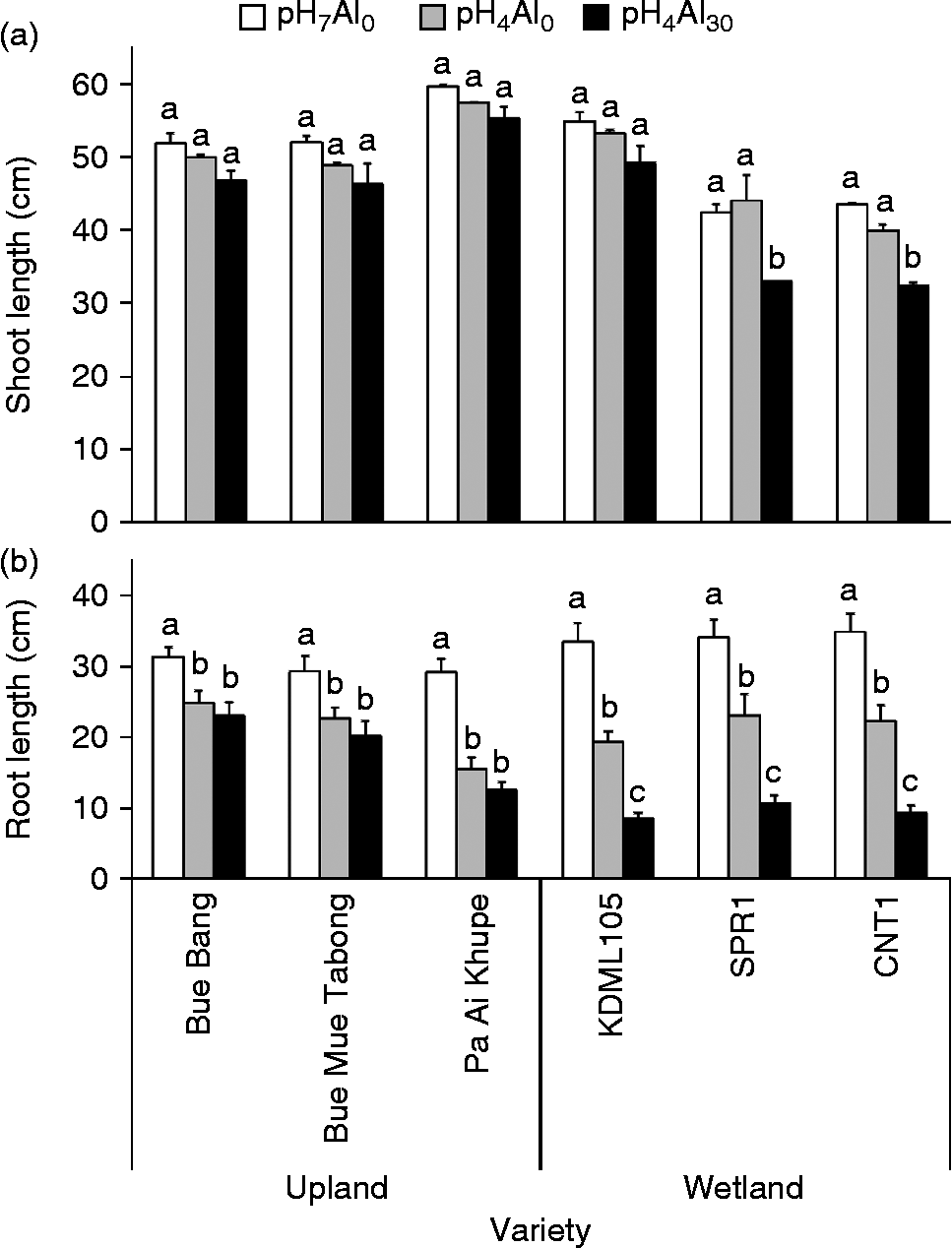
The differential effects of responses to H and Al tolerance between the upland and wetland rice varieties were clearly observed on their root length, and milder effects on their shoot growth (Fig. 1). The root length of all rice varieties was depressed when the pH decreased from 7 to 4 in the absence of Al. The presence of Al at pH 4 depressed the root length of the wetland rice varieties further and to a greater extent, with much less to no effect on the upland varieties. The shoot length was less sensitive to H and Al toxicity than the root length, although the shoot length was significantly depressed by Al in the wetland rice varieties SPR1 and CNT1.
Effects of H and Al (pH7Al0, pH4Al0, pH4Al30) toxicity on the shoot (a) and root (b) length (means with their standard errors) of three local upland rice and three commercial wetland rice varieties grown for 25 d in aerated solution culture (experiment 1). The unlike letters above the bars indicate significant differences between the treatments in each variety within each harvest (P≤ 0.05; LSD test). Significant effects by f-test after log10 transformation: for shoot length – acidity, P< 0.001; variety, P< 0.001; acidity × variety, P< 0.05; for root length: acidity, P< 0.001; variety, P< 0.001; acidity × variety, P< 0.05.

Variation in response to Al tolerance within and between the accessions of upland rice varieties (experiment 2)
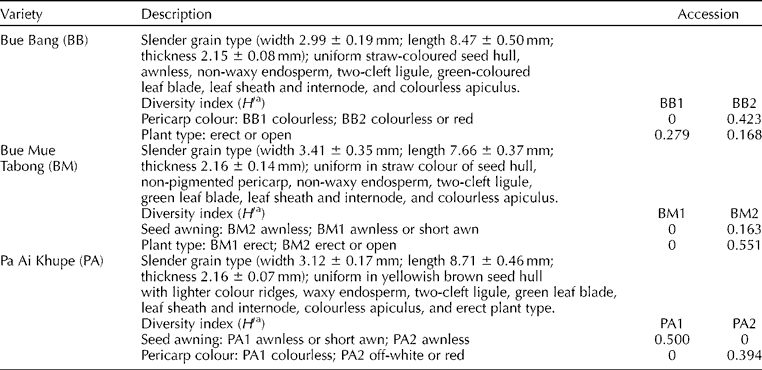
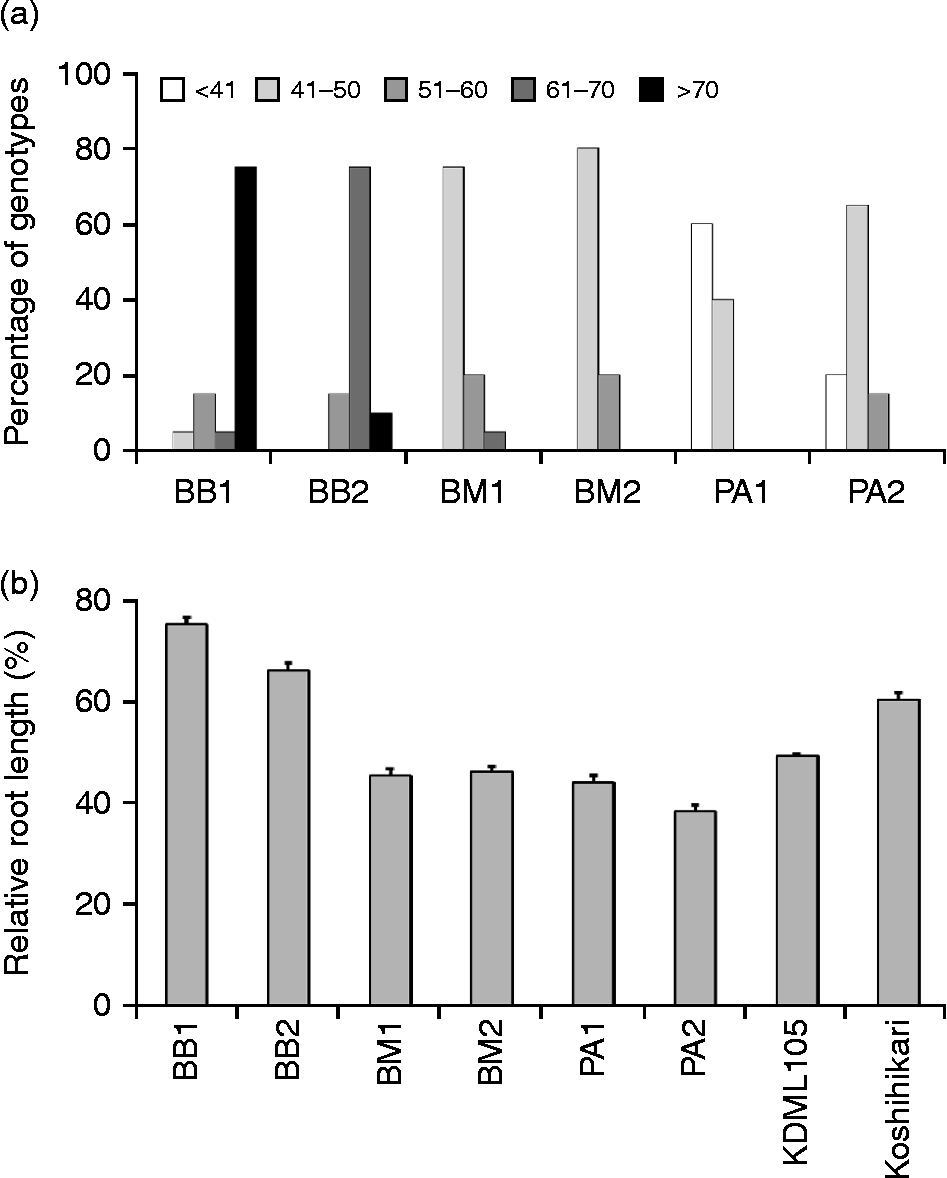
Each of the three common local upland rice varieties from this upland area was generally uniform in appearance, with minor variation between pure-line genotypes derived from the same accession and different accessions of the same variety (Table 1). However, the varieties were clearly differentiated in their tolerance to Al toxicity, and variation was also found among the individuals of the same accession and among the accessions of the same variety (Fig. 2). Each accession was dominated by individuals belonging to one class of Al tolerance, with different dominant classes in different accessions of BB and PA. Of the individuals in BB1 accessions, 75% were regarded as highly tolerant to Al toxicity, with an average relative root length of 75.0 ± 1.6%, whereas of those in BB2 accessions, 75% were tolerant, with an average relative root length of 66.0 ± 1.7%. In contrast, 60% of the PA1 accessions were very sensitive to Al toxicity, with an average relative root length of 38.3 ± 1.2%, while 65% of the PA2 accessions were sensitive, with an average relative root length of 44.0 ± 1.6%. Both BM1 and BM2 accessions were dominated by Al-sensitive individuals, although 20% of BM1 accessions were moderately tolerant and 5% tolerant. Among the accessions, BB1 and BB2 were more tolerant to Al toxicity than the tolerant check Koshihikari, BM1 and BM2 were in the same range as the Al-sensitive check KDML105, while both PA1 and PA2 were significantly less tolerant than KDML105.
Variation in the morphology of 20 single-seed-descent genotypes from two accessions each of the three most common local upland rice varieties in a village in northern Thailand

a Shannon–Weaver diversity index (Powers and McSorley, 1994).
Frequency distribution of the genotypes in five classes of Al tolerance by relative root length (root length in Al30 as a percentage of root length in Al0:  , highly tolerant;
 , tolerant;
 , moderately tolerant;
 , sensitive;
 , very sensitive) of 20 single-seed-descent genotypes from two accessions each of the common local upland rice varieties (a) and average relative root length (with their standard errors) of the dominant class of Al tolerance in each accession and the Al-sensitive (KDML105) and Al-tolerant (Koshihikari) check (b) (experiment 2).

Variation in response to Al tolerance in upland rice genotypes (experiment 3)
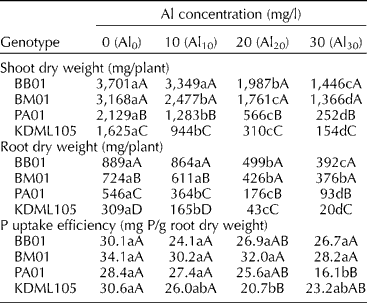
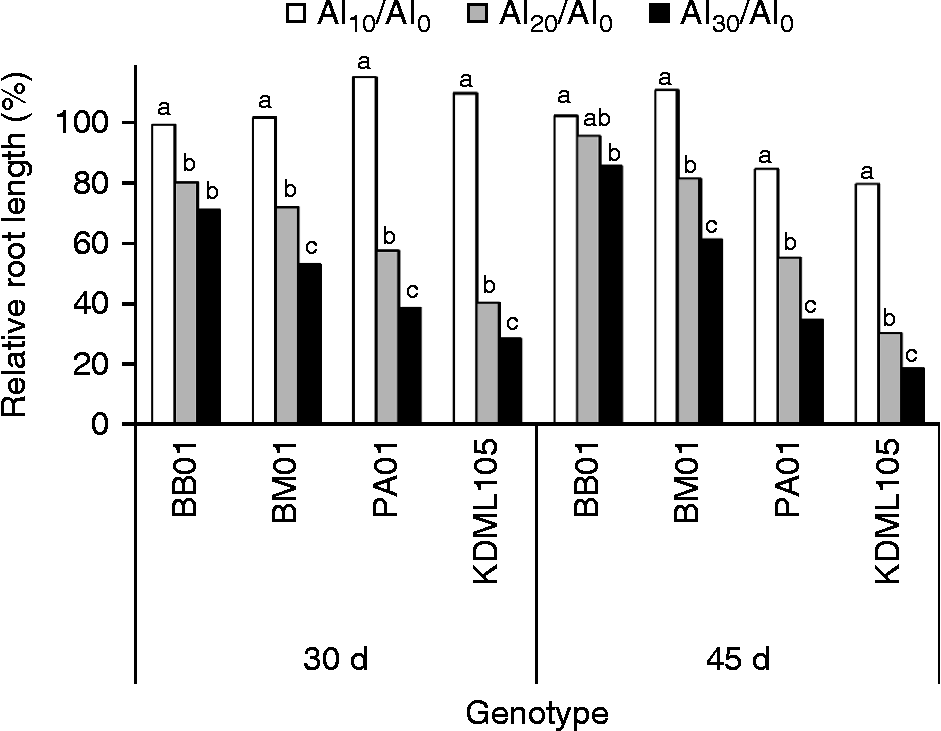
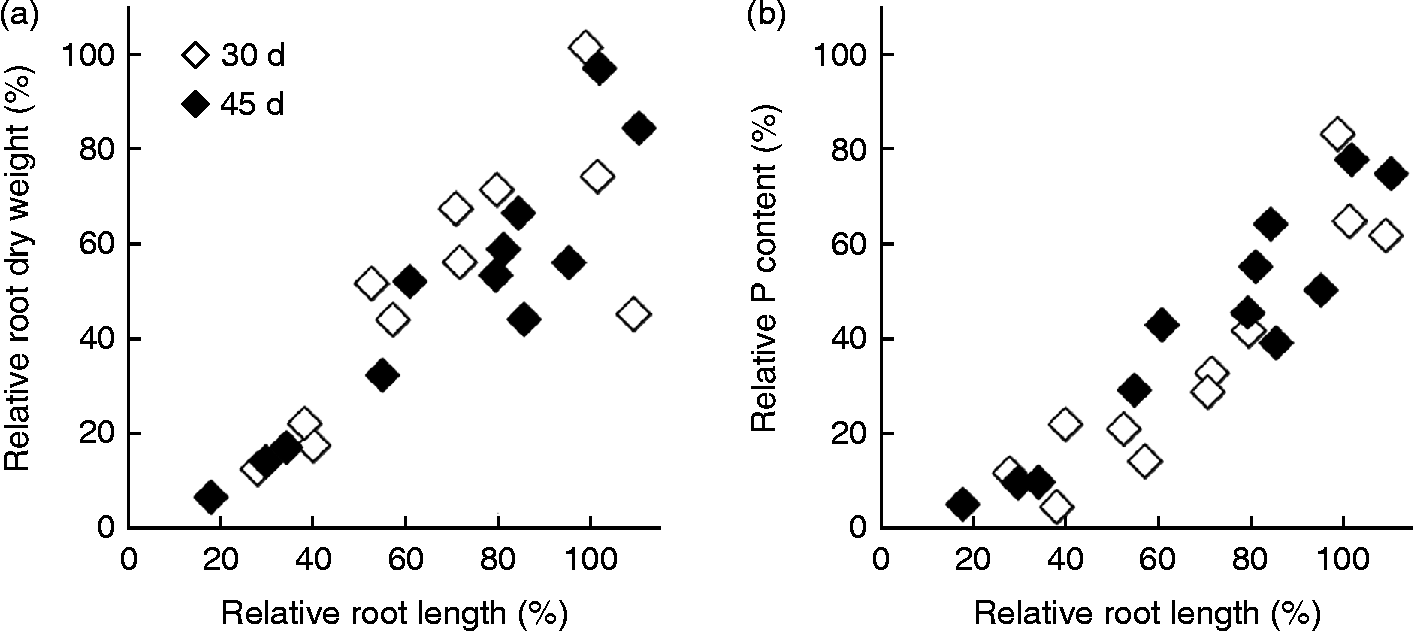
Among the selected upland rice genotypes, the variation in response to Al tolerance already observed at the concentration of 30 mg/l was clearly established at 45 d, during which their shoot and root growth and P uptake efficiency began to be depressed (Table 2; Fig. 3). The depression in the shoot and root growth of BB01 accessions did not start until at Al20, with BM01 accessions showing a mild effect at Al10, whereas the adverse effects of Al toxicity on PA01 and KDML105 were already significant at Al10. The variation could also be observed at Al30, at which the shoot and root dry weight of BB01 and BM01 accessions were about 40–50% of those at Al0, compared with only about one-quarter in PA01 and KDML105. In addition to root growth, root function, the amount of P accumulated per unit root dry weight, was also depressed more strongly by Al in PA01 and KDML105 but not significantly in BB01 and BM01. These effects of responses to Al tolerance on the depression of root dry weight and whole-plant P content were closely associated with the effect of Al on relative root length (Fig. 4). At both harvests, increasing relative root length was accompanied by significant reduction in the depression of both root dry weight (30 d: R 2= 0.61, P< 0.01; 45 d: R 2= 0.86, P< 0.001) and whole-plant P content (30 d: R 2= 0.79, P< 0.001; 45 d: R 2= 0.89, P< 0.001) (Fig. 4).
Effects of the level of Al toxicity in the nutrient solution on shoot and root growth and P uptake efficiency of three upland rice genotypes (G) compared with a commercial wetland rice variety at 45 d (experiment 3)a

Values within a row followed by unlike lower-case letters and within a column followed by unlike upper-case letters are significantly different (P≤ 0.05; LSD test).
a Significant effects by f-test after log10 transformation: G, P< 0.05; Al, P< 0.05; G × Al, P< 0.05.
Relative root length (root length at each Al level as a percentage of root length at Al0) of four rice genotypes at three levels of Al at 30 and 45 d (experiment 3). The unlike letters above the bars indicate significant differences between the treatments in each variety within each harvest (P≤ 0.05; LSD test).

Linear relationship between the relative root length and the relative root dry weight (a) and the relative P content of the whole plant (b) (experiment 3).

Discussion
Many studies have successfully used the relative root length to phenotype Al tolerance in rice varieties (e.g. Wu et al., Reference Wu, Liao, Hu, Yi, Jin, Ni and He2000; Nguyen et al., Reference Nguyen, Burow, Nguyen, Le, Le and Paterson2001; Xue et al., Reference Xue, Wan, Jiang, Wang, Liu, Zhang and Zhai2006). Although it has been reported that this relative root length based on the longest roots was only weakly correlated with the relative growth of the whole root system (Famoso et al., Reference Famoso, Clark, Shaff, Craft, McCouch and Kochian2010), variations observed in Al tolerance among the selected rice genotypes were confirmed herein by their relative root length, which (1) were consistent with the differential effects of responses to Al tolerance on plant dry weight, the length of the longest roots and P uptake efficiency, and (2) showed a close relationship with the effect of Al tolerance on root dry weight and plant P content. Therefore, the relative root length could be used with confidence to phenotype Al tolerance in upland rice germplasm.
Local crop varieties or landraces are characterized by their unique morphology and well-established local names, with genetic variation within as well as between populations (Brown, Reference Brown1978; Harlan, Reference Harlan1992). In this study, local upland rice varieties were generally uniform in the appearance of their plant and seed, among individuals of the same accessions and between accessions of the same varieties. BB and BM, the most common non-waxy varieties identified as such in this and other ethnic Karen villages by the prefix ‘Bue’ to their name, are grown to meet the household's staple rice requirement for the whole year. In contrast, the prefix ‘Pa Ai’ denotes rice with waxy endosperm grown for ceremonial and other special usages. The variety PA was produced specially for the brewing of rice wine and spirit. Adaptation in plants is defined as the evolutionary response that results from genetic changes in populations (Lambers et al., Reference Lambers, Chapins and Pons1998). Crop genetic systems, described by genetic variation among individuals growing in the same fields and among accessions of the same variety maintained by different farmers, can be highly dynamic in basically a self-fertilizing species such as rice (Pusadee et al., Reference Pusadee, Jamjod, Chiang, Rerkasem and Schaal2009) or wheat (Thomas et al., Reference Thomas, Demeulenaere, Dawson, Khan, Galic, Jouanne-Pin, Remoue, Bonneuil and Goldringer2012). The factors contributing to genetic variation and selection are frequent seed renewal and exchanges between farmers who practice seed saving from one season to the next (Coffey, Reference Coffey2008; Sirabanchongkran et al., Reference Sirabanchongkran, Rerkasem, Yimyam, Boonma, Coffey, Pinedo-Vasquez and Padoch2004; Thomas et al., Reference Thomas, Dawson, Goldringer and Bonneuil2011).
Variations in Al tolerance within and between accessions of the same varieties and between varieties shown herein illustrate how such adaptation to key environment stresses might be possible or limited. BB1 accessions have become well adapted to Al toxicity stress, and BB2 to a lesser degree. BM1, BM2, PA1 and PA2 accessions could become more tolerant over time to the highly acidic soil of villages; however, adaptation to soil acidity is limited by the most tolerant individuals within each accession. For example, PA1 accessions could not become more tolerant to Al without genetic interventions such as gene flow.
Greater sensitivity to Al tolerance found herein in PA accessions is in agreement with grain yield obtained from the variety grown on soil in farmers' field with pH 4–5, which was only a fraction of that from BB and BM accessions grown nearby (Phattarakul, Reference Phattarakul2008). In spite of its sensitivity to soil acidity, PA was the most common variety in the village on highly acidic soil, reportedly being grown by two-thirds of the farmers (Sirabanchongkran et al., Reference Sirabanchongkran, Rerkasem, Yimyam, Boonma, Coffey, Pinedo-Vasquez and Padoch2004). This waxy rice variety is produced in very small amounts for home brewing of rice wine and spirit, so its low productivity on very acidic soil might be of little consequence. In contrast, tolerance to soil acidity would be of primary concern for those non-waxy rice varieties that are crucial to the household's food security. Unlike natural species that survive or perish on their tolerance or sensitivity to the limiting stress factor, persistence of agricultural crop varieties could also be determined by their value, dictated by social or economic considerations.
Local crop varieties are known for their potential to adapt to local conditions and changing farming practices and environments (McCouch, Reference McCouch2004). The present study has confirmed that farmers growing local upland rice varieties on acidic soils in areas unreached by modern varieties may indeed benefit from their tolerance to Al toxicity. Accessions with greater tolerance than the standard Al-tolerant variety Koshihikari could be exploited to improve adaptation to acidic soils. However, it is crucial that evaluation should take into account the fact that tolerance may vary within and among the seed lots of the same varieties maintained by different farmers as well as among varieties.
Acknowledgements
The first author is a recipient of a Royal Golden Jubilee PhD Scholarship. The authors thank the farmers of Huai Teecha for generously sharing the seed of the rice varieties. They also gratefully acknowledge the financial support from the Thailand Research Fund and the National Research University Program of Thailand's Commission on Higher Education.