INTRODUCTION
The tertiary sulphonium compound dimethylsulphoniopropionate (DMSP) is commonly found in temperate green macroalgae (phylum Chlorophyta) and in the red algal (phylum Rhodophyta) genus Polysiphonia (Karsten et al., Reference Karsten, Wiencke and Kirst1990, Reference Karsten, Wiencke and Kirst1992; Kirst et al., Reference Kirst, Thiel, Wolff, Nothnagel, Wanzek and Ulmke1991; Van Alstyne et al., Reference Van Alstyne, Wolfe, Freidenburg, Neill and Hicken2001b; Van Alstyne, Reference Van Alstyne and Amsler2008). It is also found in numerous phytoplankton (Kiene et al., Reference Kiene, Visscher, Keller and Kirst1996) and zooxanthellate invertebrates, such as scleractinian corals, soft corals, anemones, corallimorphs (phylum Cnidaria) and in Tridacna spp. (phylum Mollusca) (Van Alstyne et al., Reference Van Alstyne, Schupp and Slattery2006 and references therein).
The reported functions of DMSP in macroalgae are diverse and vary by geographical region. For example, DMSP has been reported to be a cryoprotectant in Antarctic macroalgae (Kirst et al., Reference Kirst, Thiel, Wolff, Nothnagel, Wanzek and Ulmke1991; Karsten et al., Reference Karsten, Wiencke and Kirst1992), a compatible solute in north-eastern Atlantic macroalgae (Reed, Reference Reed1983a, Reference Reedb; Edwards et al., Reference Edwards, Reed, Chudek, Foster and Stewart1987, Reference Edwards, Reed and Stewart1988), an antioxidant in south-western Atlantic algae (Ross & Van Alstyne, Reference Ross and Van Alstyne2007), and as a precursor to an antiherbivore activated defence in north-eastern Pacific species (Van Alstyne et al., Reference Van Alstyne, Wolfe, Freidenburg, Neill and Hicken2001b; Van Alstyne & Houser, Reference Van Alstyne and Houser2003). Although these functions are reported for different regions, it is likely that DMSP serves multiple functions in some, if not all, areas. It is also possible that the current geographical patterns are a result of there only being a handful of studies conducted by researchers with different interests or expertise. The reported patterns may also be confounded by differences in the production of DMSP among algal taxa and by geographical variation in its production within taxa.
Patterns of spatial variation in algal natural products at scales of cms to 1000s of km have been described, both within species and across taxonomic groups (reviewed by Steinberg, Reference Steinberg and Paul1992; Van Alstyne et al., Reference Van Alstyne, Dethier, Duggins, McClintock and Baker2001a; Van Alstyne & Puglisi, Reference Van Alstyne and Puglisi2007). When natural product concentrations are phenotypically plastic, these patterns can be generated by a variety of factors including responses to local environmental conditions (Karban & Baldwin, Reference Karban and Baldwin1997; Tollrian & Harvell, Reference Tollrian and Harvell1999; Pigliucci, Reference Pigluicci2001). When they are produced at constitutive levels and dispersal is limited, local conditions can select for specific but different natural product levels at different sites. Alternatively, if dispersal is limited, natural product concentrations may become fixed at different levels at different sites by genetic drift.
Understanding the geographical and taxonomic patterns in the distribution of macroalgal DMSP concentrations at a range of scales could provide additional insights into the range of functions of the compound. For example, if DMSP plays an important role in protecting algae from reactive oxygen species (ROS) that are generated in response to physiological stresses (Sunda et al., Reference Sunda, Kieber, Kiene and Huntsman2002; Ross & Van Alstyne, Reference Ross and Van Alstyne2007), then algae in relatively stressful environments would be expected to produce higher concentrations of DMSP. Species growing higher in the intertidal zone would be expected to have higher concentrations of DMSP than algae growing in the lower intertidal or subtidal zone. Likewise, algae growing at lower latitudes would be expected to produce higher concentrations of DMSP than species in more temperate areas because of the higher levels of ultraviolet (UV) radiation at lower latitudes.
The purpose of this study was to survey DMSP concentrations in green macroalgae in temperate Australasian waters to assess both taxonomic and local and regional-scale geographical patterns in the compound's distribution. Algae were collected from 14 sites in Australia and New Zealand and DMSP was measured in them. It was also measured in the herbivorous ascoglossan sea slug Elysia maoria Powell, 1937, which lives on and consumes siphonaceous green algae.
MATERIALS AND METHODS
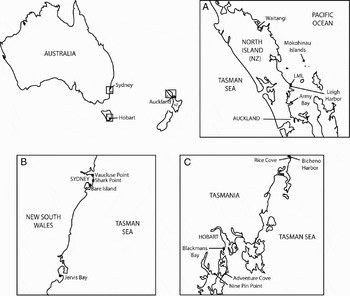
Marine green algae were collected by hand from intertidal or shallow subtidal habitats at five sites in northern New Zealand (Figure 1). These included: (1) the Goat Island Marine Reserve (36o 16′ S, 174o 47′E) near the University of Auckland's Leigh Marine Laboratory (LML) in Leigh, NZ; (2) Leigh Harbor (36o 17′ S 174o 48′E), located approximately 2 km from the LML site; (3) Army Bay (36o 36′ S 174o 48′E) on the south side of Whangaparoa Bay, approximately 35 km south of the LML site; and (4) Waitangi (35o 15′ S 174o 04′E), located approximately 75 km north of the LML site. A collection of Ulva lactuca L. was also made from the Mokohinau Islands (36o 16′ S 174o 47′E). The herbivorous sea slug Elysia maoria was noted to be occurring abundantly on Codium fragile ssp. tomentosoides (Van Goor) Silva at Army Bay so several individuals were collected in order to compare DMSP concentrations in the slugs and their host alga.
Collection sites in Australia and New Zealand. (A) North Island of New Zealand (NZ), LML, Leigh Marine Laboratory, Goat Island Reserve, Leigh; (B) eastern Australia; (C) Tasmania, Australia.

In Australia, algae were collected by hand or with SCUBA from the high intertidal zone to 15 m depth from four sites in eastern Australia and five sites in Tasmania (Figure 1). Three of the eastern Australia sites were located within 16 km of one another in Sydney, New South Wales (NSW). The northernmost site was at Vaucluse Point (33o 51′ S 151o 16′E) in Jackson Harbor, the middle site was at Shark Point (33o 55′ S 151o 16′E), and the southernmost site was at Bare Island (34o 00′ S 151o 14′E) in Botany Bay. A fourth site was located at Jervis Bay, NSW (35o 08′ S 150o 44′E), approximately 125 km south of the Sydney sites. Sites in Tasmania included Bicheno Harbor (41o 55′ S 148o 19′E) and Rice Cove (41o 55′ S 148o 19′E) on the east side of the island, and on the south-eastern side, the blowhole at Blackman's Bay (43o 01′ S 147o 20′E), Adventure Bay (43o 16′S 147o 21′E) on Bruny Island, and a location 1 km east of the Nine Pin Point marine reserve (43o 17′ S 147o 11′E) near Verona Sands. The three southernmost sites were located within 35 km of one another and approximately 150 to 180 km from the two southern sites, which were approximately 2 km apart.
The algae were transported to either the Leigh Marine Laboratory in Leigh, New Zealand or the University of New South Wales in Sydney, Australia and processed within about 2 days of collection. They were identified to species or subspecies whenever possible using Womersley (Reference Womersley1984), Adams (Reference Adams1994) and Huisman (Reference Huisman2000). Approximately 0.1 g pieces of each alga were dried in a drying oven at 60oC overnight. The dried algae were then shipped to the Shannon Point Marine Center (SPMC) in Anacortes, WA, USA for measurement of DMSP. Previous studies have shown that drying green algae prior to measuring tissue DMSP concentrations is preferable to measuring DMSP in fresh tissues (Karsten et al., Reference Karsten, Kuck, Daniel, Wiencke and Kirst1994; Van Alstyne et al., Reference Van Alstyne, Pelletreau and Rosario2003).
At SPMC, the dried algae and opisthobranchs were weighed to the nearest 0.1 mg and placed in 4 ml of 4 N NaOH in 30 ml gas-tight containers. Known amounts of commercially-obtained DMSP (Center for Analysis, Spectroscopy and Synthesis, University of Groningen; purity > 98%) were added to 4 N NaOH in gas-tight containers to generate standard curves. All containers were incubated in the dark at 4oC overnight to allow for the conversion of DMSP to DMS. DMSP was measured as DMS by directly injecting 10–20 µl of headspace gas into an SRI gas chromatograph (Chromasil 330 column, flame photometric detector; oven temperature 90oC; lower detection limit: 5 µg DMS).
Analyses at the ordinal level for the green algae were based on the classification of these organisms given on the AlgaeBase website (http://www.algaebase.org/) on 1 November 2007. A two-way analysis of variance was conducted to examine the effects of region (New Zealand, eastern Australia and Tasmania) and genus on DMSP concentrations in Ulva ssp. and Codium ssp. that contained detectable amounts of DMSP after ascertaining that the data met the assumption of normality. A Student's t-test was used to compare DMSP concentrations in E. maoria and its host alga C. fragile ssp. tomentosoides.
RESULTS
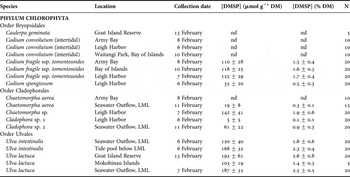
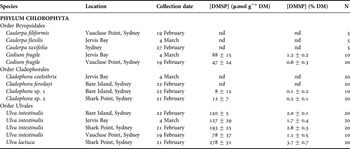
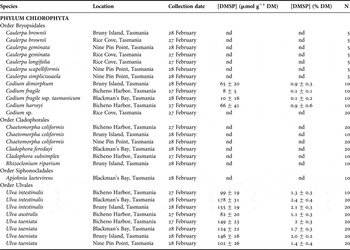
Concentrations of DMSP ranged from being undetectable in many algae in the orders Bryopsidales and Cladophorales to 3.7% of the alga's dry mass (DM) or 278 µmol g−1 DM (Tables 1–3). The presence of DMSP tended to follow taxonomic affinities rather than varying by geographical location. A two-way analysis of variance with region (eastern Australia, Tasmania and New Zealand) and genus (Codium and Ulva) as factors indicated that the effects of region were not significant (F = 1.05, P = 0.405), but the effects of genus were (F = 8.11, P = 0.029). There was no significant interaction effect (F = 0.42, P = 0.672).
DMSP concentrations in New Zealand macroalgae. Values are given in µmol g−1 tissue dry mass (DM) and as the per cent of the tissue DM to facilitate comparisons with the literature. All collections were made in 2002. LML, Leigh Marine Laboratory; nd, not detected.

DMSP concentrations of algae collected from eastern Australia. Values are given in µmol g−1 tissue dry mass (DM) and as the per cent of the tissue DM to facilitate comparisons with the literature. All collections were made in 2002. nd, not detected.

DMSP concentrations of algae collected from Tasmania, Australia. Values are given in µmol g−1 tissue dry mass (DM) and as the per cent of the tissue DM to facilitate comparisons with the literature. All collections were made in 2002. nd, not detected.

In the Bryopsidales, DMSP was absent in all species of Caulerpa, but was present in detectable quantities in two-thirds of the species of Codium examined. It was uniformly absent in Codium convolutum (Dellow) Silva, which was collected in the intertidal zone (Table 1). In Codium fragile (Suringar) Hariot, DMSP was present in significantly higher amounts in the invasive subspecies C. fragile ssp. tomentosoides, which was collected in low intertidal to shallow subtidal waters in New Zealand, than the non-invasive C. fragile, which was collected in Tasmania and eastern Australia (Student's t = 2.98, P = 0.041, N = 5 species).
In the order Cladophorales, concentrations of DMSP varied among species, even within genera (Tables 1–3). DMSP occurred in high concentrations in an unidentified species of Chaetomorpha from Leigh Harbor, New Zealand, in low concentrations in Chaetomorpha aerea (Dillwyn) Kuetzing from the seawater outflow at the Leigh Marine Laboratory, and was not detected in a population of C. aerea from Army Bay (Table 1). It was also not detected in Chaetomorpha coliformis (Montagne) Kuetzing from three sites on Tasmania (Table 3). In Cladophora, DMSP was not detected in four out of the eight species collected. It occurred in low concentrations in three of the remaining species and in high concentrations in a single species collected from the seawater outflow at the Leigh Marine Laboratory (Table 1). DMSP occurred in relatively high concentrations in all members of the order Ulvales.
Whole animal concentrations of DMSP in Elysia maoria were 95±22 µmol g−1 DM or 1.3±0.3% DM (N = 10). These values were not significantly different from the DMSP concentrations of 110±28 µmol g−1 DM or 1.5±0.4% DM in the Codium fragile ssp. tomentosoides from which they were collected (Student's t-test: t = 1.72, P = 0.10).
DISCUSSION
The patterns of DMSP concentrations of Australian and New Zealand marine macroalgae are similar to those seen in other regional geographical comparisons. The general pattern is that DMSP is present in high concentrations in members of the order Ulvales, in some members of the Bryopsidales and Ulotrichales, and in the red algal genus Polysiphonia. It is absent or in very low concentration in red algae except Polysiphonia spp., brown algae, siphonaceous green algae except most species of Codium and Acrosiphonia and cyanobacteria (Van Alstyne & Puglisi, Reference Van Alstyne and Puglisi2007). A few of the algae within these groups have low concentrations of DMSP but it is not known whether the source of the DMSP is the algae themselves or epiphytic microalgae growing on them.
The concentrations of DMSP in Ulva reported in this survey were comparable to values reported in Ulva from the northern hemisphere. In this study, DMSP in Ulva spp. ranged from 78 to 278 µmol g−1 DM, which is similar to concentrations of DMSP in Ulva spp. from northern hemisphere warm and cold temperate sites (Van Alstyne & Puglisi, Reference Van Alstyne and Puglisi2007). In Ulva intestinalis, local differences in DMSP concentrations among sites were as great as the differences in concentrations between sites from New Zealand, eastern Australia and Tasmania. This suggests that DMSP concentrations in these algae may be responding to localized environmental conditions, such as differences in salinity or grazer densities, rather than large scale environmental gradients.
Although DMSP concentrations in marine macroalgae tend to increase with increasing latitude in the northern hemisphere over a range of geographical and taxonomic scales (Van Alstyne et al., Reference Van Alstyne, Koellermaier and Nelson2007; Van Alstyne & Puglisi, Reference Van Alstyne and Puglisi2007), I saw no evidence that similar patterns of DMSP concentrations occurred in the algae examined here. In the northern hemisphere, DMSP concentrations in Ulva spp. increase from the tropics to polar regions (Van Alstyne & Puglisi, Reference Van Alstyne and Puglisi2007) and within Ulva lactuca over a 70 km change in latitude (Van Alstyne et al., Reference Van Alstyne, Koellermaier and Nelson2007). Here, we found no tendency for DMSP to differ among the three regions examined, even though the sampling sites from Tasmania were about 1000 km south of the eastern Australia and New Zealand sites. At this point, there are insufficient data available to determine whether geographical clines in macroalgal DMSP concentration that are seen in the northern hemisphere are absent in the southern hemisphere.
Members of the genus Codium spanned a range of tidal heights making it possible to test the hypothesis that DMSP is used to counter environmental stresses. If this hypothesis were true, then DMSP should be higher in species growing higher in the intertidal zone. In this study, I found that Codium convolutum, which I collected from the intertidal zone, did not contain detectable amounts of DMSP, whereas Codium fragile, which I collected from lower in the intertidal zone and in the subtidal zone, consistently contained DMSP, usually in relatively high quantities. With the exception of an unidentified species of Codium from Tasmania (Table 3), the several other species of Codium that were collected from the low intertidal zone to the subtidal zone also contained measurable amounts of DMSP; however, for these species, only single collections were made so it is not known how much inter-population variability exists in their DMSP concentrations. These data suggest that DMSP, at least in Codium spp., is not functioning to protect the algae from stresses such as desiccation and extreme temperatures that are found in the upper intertidal zone.
The presence of higher DMSP concentrations in the invasive subspecies of Codium fragile, C. fragile ssp. tomentosoides, may in part be responsible for the success of the invasive alga. DMSP has been shown to be the precursor to an activated anti-herbivore defence that can deter feeding by some sea urchins (Van Alstyne et al., Reference Van Alstyne, Wolfe, Freidenburg, Neill and Hicken2001b; Van Alstyne & Houser, Reference Van Alstyne and Houser2003; Lyons et al., Reference Lyons, Van Alstyne and Scheibling2007). In Nova Scotia, Canada, DMSP in C. fragile ssp. tomentosoides occurs in high enough concentrations to deter feeding by green sea urchins and is thought to contribute to the alga's ability to become established and persist in former kelp beds that are heavily grazed (Lyons et al., Reference Lyons, Van Alstyne and Scheibling2007).
Indirect evidence suggests that DMSP may also protect C. fragile ssp. tomentosoides from grazing in New Zealand. Although many species of herbivorous invertebrates inhabit the shores of the North Island of New Zealand, they are generally uncommon on C. fragile ssp. tomentosoides (Trowbridge, Reference Trowbridge1995). When local grazers were offered choices between fresh tissues of C. fragile ssp. tomentosoides and other sympatric species, they usually exhibited distinct preferences, although whether they preferred or avoided C. fragile ssp. tomentosoides was herbivore-specific (Trowbridge, Reference Trowbridge1995). However, when the algae were freeze-dried, ground, and incorporated into an agar-based food, almost all the preferences disappeared. Trowbridge (Reference Trowbridge1995) attributed the loss of preference to a loss of morphology or volatile chemicals in the artificial foods and noted that the C. fragile ssp. tomentosoides used in these assays had a strong pungent odour, which is consistent with the smell of DMS, one of the cleavage products of DMSP. Because DMSP is lost during freeze-drying, it is very likely that the artificial foods in Trowbridge's (1995) experiments contained little or none of the DMSP that was present in the fresh algae. If DMSP or its cleavage products were causing the preferences exhibited for the fresh algae, then a loss of DMSP due to freeze-drying in the ground C. fragile ssp. tomentosoides would explain the loss of preferences when herbivores were offered the agar-based diets.
The relatively high concentrations of DMSP found in the herbivorous sea slug Elysia maoria suggest that the animal is taking up DMSP from its host alga C. fragile ssp. tomentosoides. Many fish and shellfish species are reported to have high tissue concentrations of DMSP that are suspected to be derived from their diets (e.g. Ackman & Hingley, Reference Ackman and Hingley1968; Brooke et al., Reference Brooke, Mendelsohn and King1968; Ackman et al., Reference Ackman, Hingley and MacKay1972; Iida & Tokunaga, Reference Iida and Tokunaga1986; White et al., Reference White, Hill and Dacey1995). Ascoglossan opisthobranchs, including other species in the family Elysiidae, are known to take up algal components from their foods, including chloroplasts and secondary metabolites (e.g. Paul & Van Alstyne, Reference Paul and Van Alstyne1988; Williams & Walker, Reference Williams and Walker1999; Trowbridge & Todd, Reference Trowbridge and Todd2001). Therefore, it is not surprising that E. maoria contains DMSP in concentrations that are comparable to those in its host alga. An ascoglossan in the family Elysiidae from Guam has been shown to take up compounds from the host algae, which are then modified, stored, and emitted when the animal is perturbed (Paul & Van Alstyne, Reference Paul and Van Alstyne1988). The compound produced by the sea slug is a deterrent towards both herbivorous and carnivorous fish and is presumably being used as an anti-predator defence. Whether E. maoria uses sequestered DMSP as a defence is not currently known.
In summary, DMSP is found in many species of macroalgae and in an herbivorous sea slug in Australia and New Zealand. The taxonomic distribution of DMSP is comparable to that seen in other areas of the world; however, there was no evidence that the latitudinal clines that have been described in the northern hemisphere are present in this region. This may reflect the fact that there are currently fewer data available on the geographical distribution of DMSP in the southern hemisphere than the northern hemisphere. There is some support for DMSP functioning as an anti-herbivore defence in Australasia; however, further experimental work is needed to conclusively demonstrate this.
ACKNOWLEDGEMENTS
I would like to thank P. Steinberg and R. Taylor for hosting my visits to Australia and New Zealand, respectively. I thank the members of the Steinberg Laboratory and the faculty and staff at the Leigh Marine Laboratory for their invaluable assistance with many of the logistical aspects of this project. I would particularly like to acknowledge N. Paul for his assistance with fieldwork in Tasmania. This work was funded by a grant from the National Science Foundation (IOB-0090825).