Introduction
Effective weed management programs are essential in corn production, as weed interference is generally the most important factor affecting grain yield (Rajcan and Swanton Reference Rajcan and Swanton2001). The critical weed-free period (CWFP) is broadly defined as the period of time in crop development when interference from weeds will cause crop yield loss (Zimdahl Reference Zimdahl and Zimdahl2004); however, the CWFP can be divided into the length of time weeds can remain in the crop before yield loss occurs, and the length of time the crop must be kept weed-free to avert yield loss (Weaver and Tan Reference Weaver and Tan1983). Corn is particularly vulnerable to weed interference during early vegetative growth stages, highlighting the benefit of effective soil-applied herbicide programs that prevent early-season weed emergence (Green Reference Green2012; Page et al. Reference Page, Cerrudo, Westra, Loux, Smith, Foresman, Wright and Swanton2012); however, factors related to management or environment can affect the onset and duration of the CWFP (Gower et al. Reference Gower, Loux, Cardina and Harrison2002; Kropff and Spitters Reference Kropff and Spitters1991). The efficacy of several POST contact and systemic herbicides has been demonstrated to be affected by weed size or growth stage at the time of herbicide application (Johnson and Norsworthy Reference Johnson and Norsworthy2014; Kegode and Fronning Reference Kegode and Fronning2005; Soltani et al. Reference Soltani, Nurse and Sikkema2016; Steckel et al. Reference Steckel, Wax, Simmons and Phillips1997).
Contact herbicides such as glufosinate (a glutamine synthetase inhibitor) and bentazon [a photosystem II (PSII) inhibitor] are not widely translocated within treated plants (Rojano-Delgado et al. Reference Rojano-Delgado, Menendez, De, rado, Myung, Satchivi and Kingston2014; Stoller et al. Reference Stoller, Wax and Matthiesen1975). Therefore, an inverse relationship between glufosinate and bentazon efficacy and weed size at time of herbicide application is widely reported in the literature, as a result of insufficient control of plant foliage not contacted by the herbicide during topical application (Blackshaw Reference Blackshaw1989; Coetzer et al. Reference Coetzer, Al-Khatib and Peterson2002; Steckel et al. Reference Steckel, Wax, Simmons and Phillips1997; Stoller et al. Reference Stoller, Wax and Matthiesen1975). A similar relationship has been found with some systemic herbicides. Johnson and Norsworthy (Reference Johnson and Norsworthy2014) reported a decrease in control of johnsongrass [Sorghum halepense (L.) Pers.] with nicosulfuron, an acetolactate synthase (ALS)-inhibiting herbicide, when herbicide application was delayed from 15-cm until 30- to 45-cm or 60-cm timing. Similarly, a decline in the efficacy of clethodim [an acetyl coenzyme-A carboxylase (ACCase) inhibitor], glyphosate (an enoylpyruvyl-shikimate 3-phosphate synthase inhibitor), and synthetic auxin herbicides (including 2,4-D amine, dicamba, and triclopyr + fluroxypyr) has been reported in several weed species as weed size at the time of herbicide application increases (Johnson and Norsworthy Reference Johnson and Norsworthy2014; Sellers et al. Reference Sellers, Ferrell, MacDonald and Kline2009; Soltani et al. Reference Soltani, Nurse and Sikkema2016). In contrast, Obrigawitch et al. (Reference Obrigawitch, Kenyon and Kuratle1990) reported that the efficacy of nicosulfuron on johnsongrass improved when applied at 30- or 60-cm size compared to 10 cm. Similarly, several studies including Corbett et al. (Reference Corbett, Askew, Thomas and Wilcut2004) and Johnson and Norsworthy (Reference Johnson and Norsworthy2014) have found weed size to have little effect on glyphosate efficacy, contributing to inconsistencies in this relationship across weed species, environments, and herbicide active ingredients.
Tolpyralate is a Group 27 pyrazolone herbicide that inhibits the 4-hydroxyphenyl pyruvate dioxygenase (HPPD) enzyme, impeding the biosynthesis of intermediates involved in the carotenoid biosynthetic pathway and subsequently leading to light-induced photodegradation of the photosynthetic complex and chlorophyll, manifesting as stark white bleaching of plant tissues and eventual plant death (Ahrens et al. Reference Ahrens, Lange, Mueller, Rosinger, Willms and Almsick2013; Hawkes Reference Hawkes, Krämer, Schirmer, Jeschke and Witschel2012). Tolpyralate, applied early POST (EPOST) to 10-cm weeds, exhibits efficacy on several annual monocot and dicot weed species, particularly when co-applied with atrazine at a 1:33.3 ratio (Metzger et al. Reference Metzger, Soltani, Raeder, Hooker, Robinson and Sikkema2018a). The efficacy of tolpyralate + atrazine relative to weed size at the time of herbicide application has not been studied. Additionally, the efficacy of tolpyralate + atrazine applied PRE is largely unknown. Previous research with glufosinate, glyphosate, 2,4-D + dicamba, and bentazon has found that declining control of some weed species with increasing size can be overcome by increasing herbicide rate at later POST herbicide application timings (Johnson and Norsworthy Reference Johnson and Norsworthy2014; King and Oliver Reference King and Oliver1992; Sellers et al. Reference Sellers, Ferrell, MacDonald and Kline2009; Steckel et al. Reference Steckel, Wax, Simmons and Phillips1997; Soltani et al. Reference Soltani, Nurse and Sikkema2016); however, it is unclear whether this relationship also exists with tolpyralate + atrazine. Therefore, the objective of this research was to determine the effect of herbicide application timing/weed size and herbicide rate on the efficacy of tolpyralate + atrazine tank mixtures. An understanding of the relationship of tolpyralate + atrazine rate with herbicide application timing, and the effect of these factors on herbicide efficacy, will aid in optimization of the herbicide application window for tolpyralate + atrazine in corn.
Materials and Methods
Experimental methods
Six experiments were conducted on field sites near Ridgetown (42.454°N, 81.883°W) and Exeter (43.317°N, 81.507°W), ON, Canada, during the 2017 and 2018 growing seasons. Each experiment was organized as a two-factor randomized complete block, with herbicide application timing designated as Factor A, and herbicide rate as Factor B. Nontreated control (NTC) and weed-free control (WFC) plots were included within each level of Factor A. Weeds were controlled in WFC plots with the application of S-metolachlor/atrazine (2,880 g ai ha−1) + mesotrione (140 g ai ha−1) PRE, glyphosate (900 g ae ha−1) POST, and hand-hoeing as required. Field preparation at each experimental site consisted of fall moldboard plowing plus spring tillage with an s-tine field cultivator equipped with rolling-basket harrows prior to planting. Sites were fertilized each spring according to provincially accredited soil test results and crop requirements. Plots were 3 m wide (four corn rows 76 cm apart), and 8 and 10 m long at Ridgetown and Exeter, respectively. Two glyphosate-resistant corn hybrids were selected based on length of the growing season at each location: DKC53-56RIB at Ridgetown and DKC42-60RIB at Exeter (Monsanto Co., St. Louis, MO). Corn was seeded at a 4- to 5-cm depth at a population of 78,000 seeds ha−1 using a four-row conventional planter.
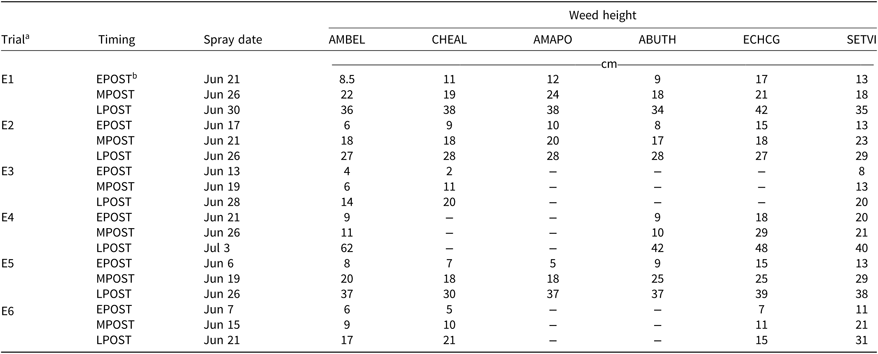
Treatments were applied using a CO2-pressurized backpack sprayer and a 1.5-m hand boom equipped with four ULD12002 nozzles (Pentair, New Brighton, MN, USA) spaced 50 cm apart, producing a spray width of 2 m. Treatments were applied at a spray volume of 187 L ha−1, at 255 kPa pressure. Herbicide treatments consisted of tolpyralate + atrazine applied at 15 + 500, 30 + 1,000, and 40 + 1,000 g ai ha−1, representing 0.5×, low, and high label rates; hereafter, these rates are referred to as low, medium, and high, respectively. Adjuvants included with POST tolpyralate treatments were methylated seed oil (MSO Concentrate®; Loveland Products, Loveland, CO, USA) at 0.50% (v/v) and urea ammonium nitrate (2.50% v/v). Each rate of tolpyralate + atrazine was applied prior to crop and weed emergence (PRE), early POST (EPOST), mid-POST (MPOST), and late POST (LPOST). Each POST herbicide application (EPOST, MPOST, and LPOST) corresponded to average weed heights of 10, 20, and 30 cm, respectively, within NTC plots. Corn stage ranged from V3 to V5 at EPOST, V5 to V8 at MPOST, and V6 to V9 at LPOST, depending on experiment. Further details regarding the size of individual weed species at the time of each POST herbicide application timing is presented in Table 1. Where a species was absent from an individual experiment or was present in insufficient density to provide meaningful data (<1 to 2 plants m−2), it was excluded and indicated by a dash (–) in Table 1.
POST application dates and average size of common ragweed (AMBEL), common lambsquarters (CHEAL), Powell amaranth (AMAPO), velvetleaf (ABUTH), barnyardgrass (ECHCG), and green foxtail (SETVI) within experiments at time of each POST herbicide application.

a E1, E2 designates Ridgetown 2017; E4, E5 designates Ridgetown 2018; E3, E6 designates Exeter 2017, 2018, respectively.
b Abbreviations: EPOST, early POST; MPOST, mid-POST; LPOST, late POST.
c A dash (–) indicates that the species was absent from a particular trial location in a given year.
Crop injury and weed control were assessed on a percent scale relative to the control plots, where 0 represents no control or injury and 100 indicates complete death of the crop or weed. Crop injury was assessed 1, 2, and 4 wk after emergence (WAE) for PRE herbicide applications, or 1, 2, and 4 wk after herbicide application (WAA) for each POST herbicide application. Weed control of each species was visually assessed 2 and 4 WAE for PRE treatments, or 2 and 4 WAA for POST herbicide applications. At 8 wk after LPOST herbicide applications, a final visible control assessment was conducted on all treatments. Density and aboveground biomass 4 wk after LPOST herbicide applications were determined by species within a 0.5-m2 quadrat placed at two arbitrary locations within each plot. Samples were kiln-dried at 60 C to constant mass, and dry weight was recorded. Grain yield and harvest moisture was measured by harvesting the center two rows of each plot with a small-plot combine. Grain yields were corrected to 15.5% moisture prior to analysis.
Statistical analysis
A mixed-model variance analysis was conducted on all response parameters for each weed species using the GLIMMIX procedure in SAS v. 9.4 (SAS Institute, Cary, NC). Variance was partitioned into fixed effects of herbicide application timing (Factor A), herbicide rate (Factor B), and interactions, whereas environment (experiment), replication within environment, and the interaction of environment with Factor A and Factor B, were each designated as random effects. Significance of the fixed effects was determined using an F-test, and significance of random effects was determined using a restricted log-likelihood test. A significance level of α = 0.05 was declared for all tests.
An appropriate distribution and link function was selected for each response parameter that best met assumptions that residuals were homogeneous, normally distributed, and had a mean equal to zero, as determined by scatter plots of studentized residuals and normality plots paired with a Shapiro-Wilk test of normality. Non-Gaussian data were analyzed using the Laplace method of integral approximation, which provides unbiased parameter estimation when the number of observations is small compared to default pseudo-likelihood models, and also facilitates direct comparison of various non-Gaussian models (Schabenburger Reference Schabenburger2007).
Least-square means of each response parameter for individual weed species were back-transformed by specifying the ilink option within the GLIMMIX procedure. Where a lognormal distribution was specified, data were back-transformed from the analysis scale using the omega procedure (M. Edwards, Ontario Agricultural College Statistician, University of Guelph, personal communication). Least-square means of Factor A, Factor B, and the interaction effect therein were separated using Tukey-Kramer’s multiple-range test, with Type I error set to α = 0.05. Letter codes were assigned for presentation in Tables 2 through 14 using the pdmix800 macro (Bowley Reference Bowley and Bowley2015) and slicediff commands. Where there was no statistically significant interaction between factors for a given weed species and assessment parameter, only the main effects are presented.
Results and Discussion
Common ragweed
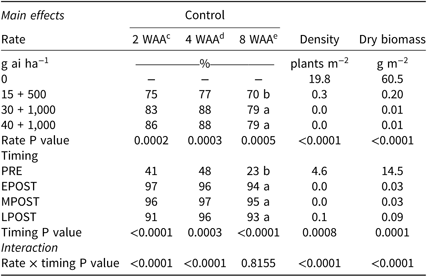
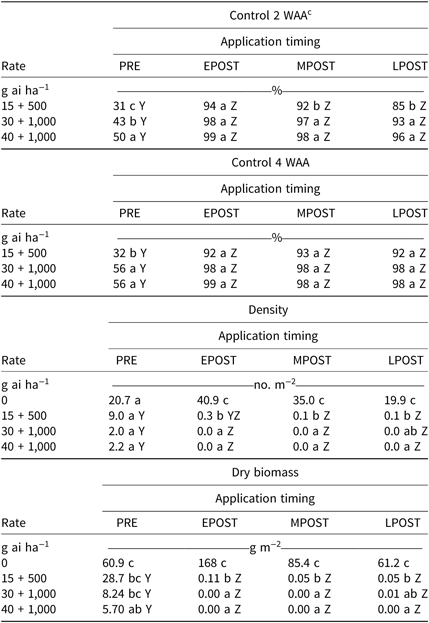
Common ragweed was not controlled PRE by tolpyralate + atrazine at any rate but was controlled by all rates at POST herbicide applications (Table 2). Atrazine applied PRE controls several dicot weed species, including common ragweed (Ontario Ministry of Agriculture, Food and Rural Affairs [OMAFRA], Reference Cowbrough2018); however, the increase in control observed 2 WAA with tolpyralate rate in this study indicates that tolpyralate applied PRE has residual activity on this species. As common ragweed control 4 WAA was equal (56%) with medium and high rates of tolpyralate applied PRE––which each included 1,000 g ha−1 atrazine, any residual control provided by tolpyralate in this study appeared to be relatively short-lived. The results of this study are similar to other studies from Ontario, where control of common ragweed was variable (<80%) with atrazine (1,000 g ha−1) applied with S-metolachlor (Swanton et al. Reference Swanton, Gulden and Chandler2007). At 2 and 4 WAA, tolpyralate + atrazine applied EPOST, MPOST, or LPOST had ≥85% common ragweed control, whereas PRE herbicide applications had ≤56% control; no differences were observed across POST herbicide application timings (Table 3). At 2 WAA, all three rates of tolpyralate + atrazine applied EPOST had equivalent control, whereas medium and high rates provided superior control compared to the low rate at MPOST and LPOST timings, when common ragweed was 6 to 22 and 14 to 62 cm tall, respectively. These results are consistent with other studies, where tolpyralate and tolpyralate + atrazine controlled common ragweed >90% (Sprague and Powell Reference Sprague and Powell2014; Tonks et al. Reference Tonks, Grove, Kikugawa, Parks, Nagayama and Tsukamoto2015), and tolpyralate + atrazine (30 + 1,000 g ha−1) applied EPOST controlled common ragweed 99% at 2 WAA (Metzger et al. Reference Metzger, Soltani, Raeder, Hooker, Robinson and Sikkema2018b).
Effect of rate and application timing on common ragweed control 2, 4, and 8 WAE/WAA, and density and dry biomass reduction with tolpyralate + atrazine in field experiments conducted in Ontario, Canada, in 2017–2018. a,b

a Means within a column followed by the same letter are not significantly different according to Tukey’s multiple means comparison (α = 0.05).
b Abbreviations: EPOST, early POST; MPOST, mid-POST; LPOST, late POST; WAE/WAA, weeks after emergence/weeks after herbicide application.
c Control with PRE herbicide applications was assessed 2 wk after crop emergence.
d Assessed 4 and 8 wk after the LPOST herbicide application.
Interaction of herbicide rate and herbicide application timing on control of common ragweed 2 and 4 WAE/WAA, and density and dry-biomass reduction with three rates of tolpyralate + atrazine applied PRE, EPOST, MPOST, or LPOST in field experiments conducted in Ontario, Canada in 2017–2018. a,b

a Means followed by the same lowercase letter within a column (a–c), or uppercase letter within a row (Y–Z) for each assessment parameter are not significantly different according to Tukey’s multiple means comparison test (α = 0.05).
b Abbreviations: PRE, preemergence; EPOST, early POST; MPOST, mid-POST; LPOST, late POST; WAE/WAA, weeks after emergence/weeks after herbicide application.
c Control with PRE herbicide applications was assessed 2 wk after crop emergence.
At 8 WAA, common ragweed control was improved by 9% with the medium or high rate of tolpyralate + atrazine compared to the low rate when averaged across herbicide application timings; the rate-by-timing interaction was not significant (P = 0.8155; Table 2). Common ragweed control with EPOST, MPOST, or LPOST herbicide applications was ≥93%, whereas control with the PRE herbicide application was 23%, less than with any POST timing.
There was a statistically significant interaction between rate and timing for common ragweed density and biomass (P < 0.0001; Table 2). All POST timings were superior to PRE within each rate, with the exception of the low rate applied EPOST for common ragweed density (Table 3). Tolpyralate + atrazine PRE did not reduce common ragweed density, although the high rate of tolpyralate + atrazine PRE reduced common ragweed biomass compared to the NTC. All POST herbicide treatments reduced density and dry biomass by >99% compared to the NTC (Table 3). With EPOST and MPOST herbicide applications, the medium and high rates of tolpyralate + atrazine reduced density and dry biomass similarly and were superior to the low rate. Applied LPOST, however, the high rate of tolpyralate + atrazine reduced density and dry biomass more than the low rate. Previous studies have reported improved control of larger, more mature weeds with higher herbicide rates (Blackshaw Reference Blackshaw1989; Lee and Oliver Reference Lee and Oliver1982; Steckel et al. Reference Steckel, Wax, Simmons and Phillips1997).
Common lambsquarters
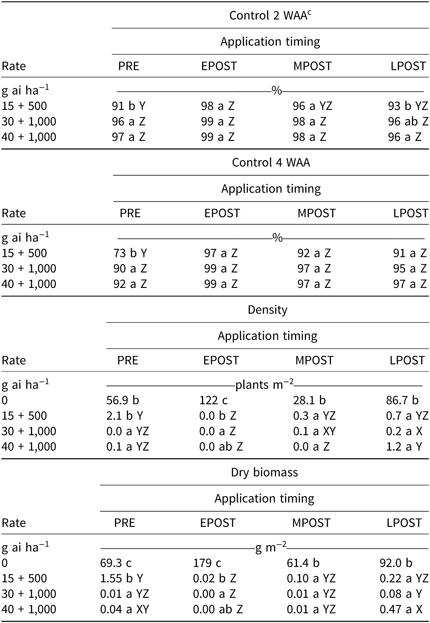
Common lambsquarters was controlled PRE with tolpyralate + atrazine; however, control was affected by rate, causing a significant rate-by-herbicide application timing interaction for each assessment parameter with the exception of control 8 WAA (P = 0.1600; Table 4). Common lambsquarters control was >90% with all treatment combinations evaluated 2 WAA in this study, although a rate response was observed at both the PRE and LPOST herbicide application timings (Table 5). These results are similar to those of a previous study (Metzger et al. Reference Metzger, Soltani, Raeder, Hooker, Robinson and Sikkema2018a), which determined that the biologically effective dose of tolpyralate + atrazine for 90% control of common lambsquarters is low (3.6 + 121 g ha−1) 2 WAA. Applied PRE, the low rate of tolpyralate + atrazine controlled common lambsquarters 91% 2 WAA but declined to 73% 4 WAA. At both 2 and 4 WAA, tolpyralate + atrazine applied PRE at the medium or high rate controlled common lambsquarters similarly; each provided better control than the low rate. Given the similarity of the medium- and high-rate treatments, which both included atrazine at 1,000 g ha−1, compared to the low rate, which included atrazine at 500 g ha−1, it is probable that lambsquarters control PRE is correlated with the rate of atrazine. Previous research has demonstrated atrazine to be highly efficacious on common lambsquarters applied PRE at 1,120 g ha−1, and less effective when applied at 280 or 560 g ha−1 (Bollman et al. Reference Bollman, Kells and Penner2006). Because tolpyralate was not applied alone in this study, it was not possible to determine the relative contribution of each herbicide for PRE applied control assessment. The high rate of tolpyralate + atrazine applied LPOST provided superior control to the low rate 2 WAA; no differences in rate were observed 4 WAA. Similarly, each rate of tolpyralate + atrazine controlled common lambsquarters ≥92% 2 and 4 WAA when applied EPOST or MPOST, and there was no improvement in control with the higher rates. Applied at the low rate, the EPOST herbicide application was superior to a PRE herbicide application at both 2 and 4 WAA. In contrast, tolpyralate + atrazine at the medium or high rate provided equivalent common lambsquarters control whether applied PRE, EPOST, MPOST, or LPOST. In general, these results corroborate previous findings reported in Metzger et al. (Reference Metzger, Soltani, Raeder, Hooker, Robinson and Sikkema2018a), that tolpyralate + atrazine applied POST exhibits high herbicidal activity in common lambsquarters.
Effect of rate and herbicide application timing on common lambsquarters control 2, 4, and 8 WAE/WAA, and density and dry-biomass reduction with tolpyralate + atrazine in field experiments conducted in Ontario, Canada in 2017–2018. a,b

a Means within a column followed by the same letter are not significantly different according to Tukey’s multiple means comparison (α = 0.05).
b Abbreviations: PRE, preemergence; EPOST, early POST; MPOST, mid-POST; LPOST, late POST; WAE/WAA, weeks after emergence/weeks after herbicide application.
c Control with PRE herbicide applications was assessed 2 wk after crop emergence.
d Assessed 4 and 8 wk after the LPOST herbicide application.
Interaction of herbicide rate and herbicide application timing on control of common lambsquarters 2 and 4 WAE/WAA, and density and dry-biomass reduction with three rates of tolpyralate + atrazine applied PRE, EPOST, MPOST, or LPOST in field experiments conducted in Ontario, Canada in 2017–2018. a,b

a Means followed by the same lowercase letter within a column (a–c), or uppercase letter within a row (X–Z) for each assessment parameter are not significantly different according to Tukey’s multiple means comparison test (α = 0.05).
b Abbreviations: PRE, preemergence; EPOST, EPOST, early POST; MPOST, mid-POST; LPOST, late POST; WAE/WAA, weeks after emergence/weeks after herbicide application.
c Control with PRE herbicide applications was assessed 2 weeks after crop emergence.
Common lambsquarters density was reduced with both medium and high rates of tolpyralate + atrazine applied PRE; however, the low rate was not statistically different from the NTC, presumably due to natural variation in common lambsquarters density within experiments (Table 5). In contrast, all rates applied PRE reduced common lambsquarters biomass compared to the NTC. The greatest reduction in biomass was observed where the medium and high rates were applied; however, all POST rate and herbicide application timing combinations reduced common lambsquarters density and biomass ≥99% compared to the NTC. Applied EPOST, tolpyralate + atrazine applied at the medium and high rates reduced common lambsquarters density and dry biomass to near zero, which was statistically superior to the low rate. Consistent with the current findings, tolpyralate + atrazine applied EPOST at 30 + 1,000 g ha−1 in a previous experiment was found to reduce common lambsquarters biomass to near zero (Metzger et al. Reference Metzger, Soltani, Raeder, Hooker, Robinson and Sikkema2018b). At both the MPOST and LPOST timings, tolpyralate + atrazine provided a similar reduction in density and dry biomass regardless of rate. At the low rate, an EPOST herbicide application resulted in a greater density and dry-biomass reduction than a PRE herbicide application, whereas MPOST and LPOST timings were similar to the earlier timings. With the medium or high rates of tolpyralate + atrazine, density and dry biomass were slightly lower when applied EPOST compared to LPOST; however, a greater response to common lambsquarters size has been reported with other herbicides. Soltani et al. (Reference Soltani, Nurse and Sikkema2016), reported that a higher dose of glyphosate was required to reduce common lambsquarters biomass when applied to 30-cm-tall plants compared to 10-cm-tall plants. The small numerical differences observed between EPOST and LPOST timings in the current study probably repudiate the biological significance of the statistical difference. Accordingly, control data collected 8 WAA showed no difference in herbicide application timings when averaged across rates, whereas the medium and high rates of tolpyralate + atrazine provided superior control to the low rate when averaged across herbicide application timings (Table 4).
Powell amaranth
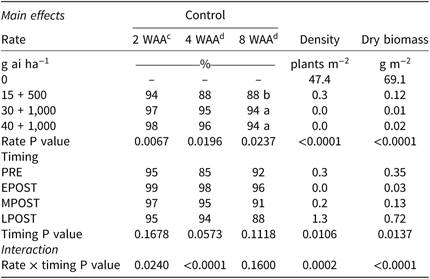
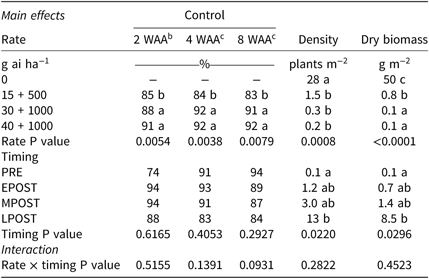
Powell amaranth was susceptible to tolpyralate + atrazine irrespective of herbicide application rate or timing; the interaction was not significant for any assessment parameter (P ≥ 0.0931; Table 6). At 2, 4, and 8 WAA, control with PRE, EPOST, MPOST, and LPOST herbicide applications was similar. When averaged across herbicide application timings, tolpyralate + atrazine applied at the medium and high rates provided equivalent Powell amaranth control (88% to 92%), and were consistently superior to control with the low rate. Interestingly, the biologically effective dose of tolpyralate + atrazine for 90% control of a mixed population of Powell amaranth and redroot pigweed [Amaranthus retroflexus (L.)] was determined to be less than 15 + 500 g ha−1 at 2, 4, and 8 WAA, although herbicide applications were only made EPOST in that study (Metzger et al Reference Metzger, Soltani, Raeder, Hooker, Robinson and Sikkema2018a); it is likely that the low rate was not sufficient for 90% control when averaged across PRE, EPOST, MPOST, and LPOST timings as it was in the current study. Both herbicide rate and herbicide application timing were found to have significant effects on Powell amaranth density and dry biomass. Averaged across timings, there were no differences in density where low, medium, or high rates of tolpyralate + atrazine were applied, whereas dry biomass was lower with the medium or high rate compared to the low rate. Averaged across rates, tolpyralate + atrazine applied PRE resulted in a greater reduction in Powell amaranth density and dry biomass than the LPOST herbicide application, whereas EPOST and MPOST herbicide applications were similar to either PRE or LPOST herbicide application timings. As with common lambsquarters, it is difficult to ascertain the relative contributions of tolpyralate and atrazine to residual Powell amaranth control with PRE herbicide applications. Atrazine typically controls Powell amaranth (OMAFRA, Reference Cowbrough2018), although biotypes resistant to triazine herbicides are well documented in Ontario (Diebold et al. Reference Diebold, McNaughton, Lee and Tardif2003). Consequently, it is possible that tolpyralate did contribute to residual control of Powell amaranth in this study.
Effect of rate and herbicide application timing on Powell amaranth control 2, 4, and 8 WAE/WAA, and density and dry-biomass reduction with tolpyralate + atrazine in field experiments conducted in Ontario, Canada in 2017–2018. a

a Means within a column followed by the same letter are not significantly different according to Tukey’s multiple means comparison (α = 0.05).
b Abbreviations: PRE, preemergence; EPOST, early POST; MPOST, mid-POST; LPOST, late POST; WAE/WAA, weeks after emergence/weeks after herbicide application
c Control with PRE herbicide applications was assessed 2 wk after crop emergence.
d Assessed 4 and 8 wk after the LPOST herbicide application.
Velvetleaf
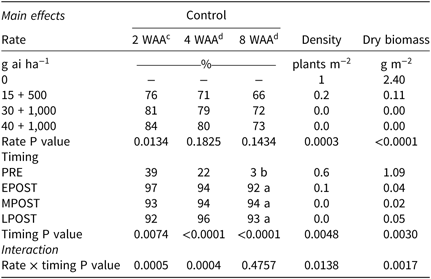
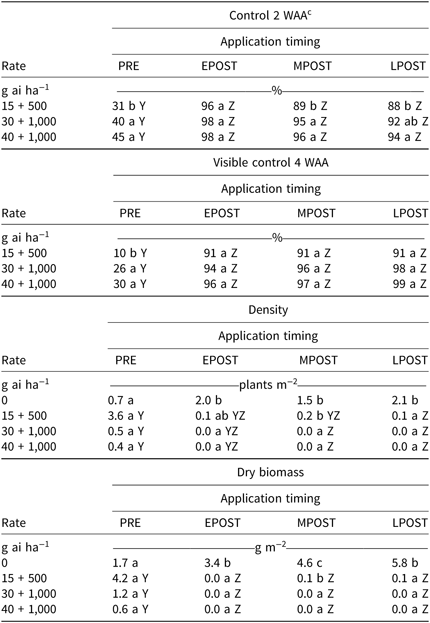
Velvetleaf control 2 and 4 WAA and reduction of density and biomass varied with rate depending on the herbicide application timing; the interaction was significant (P < 0.0138; Table 7). At 8 WAA, however, only the herbicide application timing had a significant effect on control, and the interaction with rate was not significant (P = 0.4757; Table 7). At 2 and 4 WAA, tolpyralate + atrazine applied at any POST timing provided better velvetleaf control than when applied at the PRE timing (Table 8). At 2 and 4 WAA, the medium and high rates of tolpyralate + atrazine controlled velvetleaf better than the low rate when applied PRE; however, control with all rates applied PRE was ≤45%. Consistent with these results, poor velvetleaf control with atrazine applied PRE alone has been reported previously (Bollman et al. Reference Bollman, Kells and Penner2006). Tolpyralate + atrazine applied EPOST controlled velvetleaf equally 2 and 4 WAA regardless of rate. Delaying herbicide application to MPOST resulted in a rate response from low to medium or high 2 WAA, whereas only the high rate of tolpyralate + atrazine improved control when herbicide application was delayed to LPOST. By 4 WAA, all three rates of tolpyralate + atrazine controlled velvetleaf equally when applied POST; delaying herbicide application from EPOST to MPOST or LPOST did not affect control. The excellent velvetleaf control observed with tolpyralate + atrazine applied LPOST may have been partially due to the extended emergence pattern of velvetleaf (Mitich Reference Mitich1991), which meant more late-emerging seedlings were present at the late herbicide application timing. However, velvetleaf plants were 28 to 42 cm tall at LPOST timing (Table 1). These results provide corroborating evidence that velvetleaf is highly sensitive to tolpyralate + atrazine applied POST, as was reported in Metzger et al. (Reference Metzger, Soltani, Raeder, Hooker, Robinson and Sikkema2018a).
Effect of rate and herbicide application timing on velvetleaf control 2, 4, and 8 WAE/WAA, and density and dry-biomass reduction with tolpyralate + atrazine in field experiments conducted in Ontario, Canada in 2017–2018. a,b

a Means within a column followed by the same letter are not significantly different according to Tukey’s multiple means comparison (α = 0.05).
b Abbreviations: EPOST, early POST; MPOST, mid-POST; LPOST, late POST; WAE/WAA, weeks after emergence/weeks after herbicide application.
c Control with PRE herbicide applications was assessed 2 wk after crop emergence.
d Assessed 4 and 8 wk after the LPOST herbicide application.
Interaction of herbicide rate and herbicide application timing on control of velvetleaf 2 and 4 WAE/WAA, and density and dry-biomass reduction with three rates of tolpyralate + atrazine applied PRE, EPOST, MPOST, or LPOST in field experiments conducted in Ontario, Canada in 2017–2018. a,b

a Means followed by the same lowercase letter within a column (a–c), or uppercase letter within a row (X–Z) for each assessment parameter are not significantly different according to Tukey’s multiple means comparison test (α = 0.05).
b Abbreviations: EPOST, early POST; MPOST, mid-POST; LPOST, late POST; WAE/WAA, weeks after emergence/weeks after herbicide application.
c Control with PRE herbicide applications was assessed 2 wk after crop emergence.
At 8 WAA, tolpyralate + atrazine applied EPOST, MPOST, or LPOST controlled velvetleaf >90% irrespective of rate; in contrast, PRE herbicide applications resulted in near zero control of this species when averaged across rates (Table 7). Similarly, tolpyralate + atrazine applied PRE at the low, medium, or high rate did not reduce velvetleaf density or dry biomass compared with the NTC (Table 8). Applied EPOST, only the medium and high rates of tolpyralate + atrazine reduced density compared to the NTC; similar densities were observed with the low rate and the NTC, probably because of the natural variation in velvetleaf density within experiments. Conversely, biomass was reduced to zero regardless of rate when applied EPOST. Similar trends were observed with MPOST herbicide applications; only medium and high rates reduced velvetleaf density, whereas all three rates reduced biomass. Applied LPOST, all three rates of tolpyralate + atrazine provided a similar reduction in both density and biomass; each was lower than in the NTC. Overall, the results presented here are consistent with those of Metzger et al. (Reference Metzger, Soltani, Raeder, Hooker, Robinson and Sikkema2018b) and Tonks et al. (Reference Tonks, Grove, Kikugawa, Parks, Nagayama and Tsukamoto2015), which observed excellent velvetleaf control with tolpyralate + atrazine mixtures applied EPOST; however, the current study demonstrates that velvetleaf control is maintained regardless of the POST herbicide application timings evaluated in this study.
Barnyardgrass
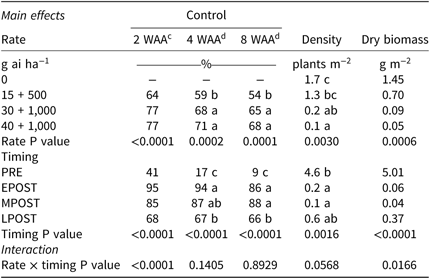
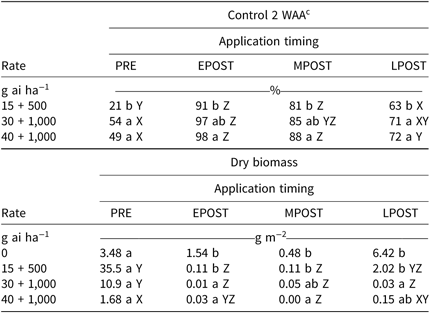
Control of barnyardgrass was poor with PRE herbicide applications at all rates; however, PRE control was improved with increasing rate at 2 WAA, leading to a significant rate-by-timing interaction (P < 0.0001; Table 9). Though tolpyralate efficacy PRE has not previously been reported in the literature for any weed species, atrazine generally does not control barnyardgrass (Janak and Grichar Reference Janak and Grichar2016; OMAFRA Reference Cowbrough2018). At 2 WAA, PRE herbicide applications of the medium or high rate of tolpyralate + atrazine controlled barnyardgrass only 49% to 54%, compared to 21% with the low rate (Table 10). Generally, control of barnyardgrass 2 WAA was highest with EPOST and MPOST herbicide application timings. With both EPOST and MPOST herbicide application timings, the high rate of tolpyralate + atrazine controlled barnyardgrass better than the low rate. Barnyardgrass control generally declined when herbicide application was delayed from EPOST to LPOST, regardless of rate; however, no difference in control was observed when herbicide application was delayed from EPOST to MPOST. All three POST timings were superior to the PRE timing, except with the medium rate. At the medium rate, EPOST herbicide applications provided 97% control, which was similar to the MPOST timing and superior to the LPOST timing. A similar trend was reported by King and Oliver (Reference King and Oliver1992) when the herbicide application of imazaquin, an ALS-inhibiting herbicide, was delayed for barnyardgrass from the 2- to 14-cm stage to the 30-cm stage.
Effect of rate and herbicide application timing on barnyardgrass control 2, 4, and 8 WAE/WAA and density and dry-biomass reduction with tolpyralate + atrazine in field experiments conducted in Ontario, Canada in 2017–2018.a,b

a Means within a column followed by the same letter are not significantly different according to Tukey’s multiple means comparison (α = 0.05).
a Abbreviations: EPOST, early POST; MPOST, mid-POST; LPOST, late POST; WAE/WAA, weeks after emergence/weeks after herbicide application.
b Control with PRE herbicide applications was assessed 2 wk after crop emergence.
c Assessed 4 and 8 wk after the LPOST herbicide application.
Interaction of herbicide rate and herbicide application timing on control of barnyardgrass 2 WAE/WAA and dry-biomass reduction with three rates of tolpyralate + atrazine applied PRE, EPOST, MPOST or LPOST in field experiments conducted in Ontario, Canada in 2017–2018.a, b

a Means followed by the same lowercase letter within a column (a–b), or uppercase letter within a row (X–Z) for each assessment parameter are not significantly different according to Tukey’s multiple means comparison test (α = 0.05).
b Abbreviations: EPOST, early POST; MPOST, mid-POST; LPOST, late POST; WAE/WAA, weeks after emergence/weeks after application.
c Control with PRE herbicide applications was assessed 2 wk after crop emergence.
At 4 and 8 WAA, tolpyralate + atrazine applied at the medium and high rates controlled barnyardgrass similarly when averaged across timings; control was consistently poorer with the low rate, leading to no significant rate-by-timing interaction (P = 0.1405, 4 WAA; P = 0.8929, 8 WAA; Table 9). Each POST herbicide application timing controlled barnyardgrass better than the PRE timing at both 4 and 8 WAA. The EPOST herbicide application resulted in 94% and 86% control on average 4 and 8 WAA, which was superior to the LPOST timing, and equal to the MPOST timing. Kikugawa et al. (Reference Kikugawa, Satake, Tonks, Grove, Nagayama and Tsukamoto2015) also reported better control of barnyardgrass with tolpyralate alone (30 g ha−1) when applied to plants with five to six leaves, compared to those at the eight-leaf stage. Similarly, Soltani et al. (Reference Soltani, Nurse and Sikkema2016) reported a higher biologically effective dose of glyphosate for control of barnyardgrass when herbicide application was delayed from 10-cm to 30-cm timing.
In agreement with control data, a greater reduction in density occurred where tolpyralate + atrazine was applied EPOST or MPOST compared to PRE, whereas the LPOST timing was similar to all other herbicide application timings regardless of rate. No rate-by-timing interaction occurred for barnyardgrass density (P = 0.0568; Table 9). Across timings, the low rate of tolpyralate + atrazine did not reduce barnyardgrass density compared with the NTC, whereas the high rate provided a greater density reduction than the low rate. In contrast to density, barnyardgrass dry biomass was affected by rate at POST timings but not at the PRE timing; biomass was similar to the NTC with all rates applied PRE, leading to a significant interaction between rate and herbicide application timing (P = 0.0166; Tables 9 and 10). The low rate of tolpyralate + atrazine did not reduce barnyardgrass dry biomass relative to the NTC, regardless of timing; however, the medium and high rate each reduced dry biomass more than the low rate when applied EPOST. Within rates, EPOST and MPOST herbicide applications consistently reduced barnyardgrass dry biomass more than a PRE herbicide application. Similarly, a greater biomass reduction occurred where the high rate was applied MPOST compared to LPOST. Overall, the results for barnyardgrass control obtained in this study are similar to those reported previously where tolpyralate was applied with atrazine EPOST at 30 + 1,000 g ha−1 (Metzger et al. Reference Metzger, Soltani, Raeder, Hooker, Robinson and Sikkema2018b; Tonks et al. Reference Tonks, Grove, Kikugawa, Parks, Nagayama and Tsukamoto2015). Tonks et al. (Reference Tonks, Grove, Kikugawa, Parks, Nagayama and Tsukamoto2015) reported 90% control of barnyardgrass 30 d after herbicide application of tolpyralate + atrazine, whereas 97% control was observed with the same treatment by Metzger et al. (Reference Metzger, Soltani, Raeder, Hooker, Robinson and Sikkema2018b). The results of the present study indicate that control of barnyardgrass can be maintained when herbicide application is delayed to MPOST timing, despite barnyardgrass plants being up to 29 cm in height at this timing. However, control of barnyardgrass generally declines when herbicide applications are delayed to the LPOST timing, when plants were up to 48 cm in height, highlighting the importance of timely herbicide application for control of this species.
Green foxtail
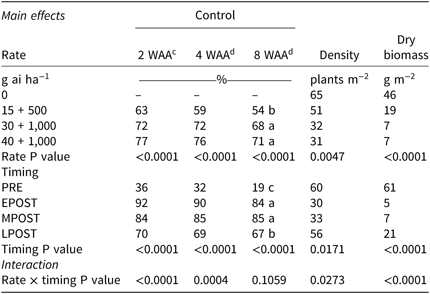
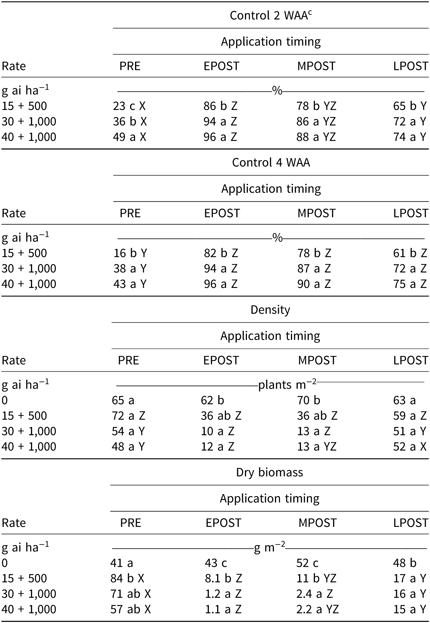
Green foxtail was among the most common weed species across sites; it was present at each trial location in both years of study (Table 1). Green foxtail responded differently to tolpyralate + atrazine rate depending on herbicide application timing at both 2 and 4 WAA; these differences were also present in density and biomass assessments, which contributed to a significant main-effect interaction for these parameters (P < 0.0273; Table 11). Similar to barnyardgrass, control of green foxtail with PRE herbicide applications of all rates of tolpyralate + atrazine was poor (<50%). Despite this result, a rate response secondary to the rate of atrazine was present 2 WAA with PRE herbicide applications (Table 12); control improved with tolpyralate rate even though the atrazine rate was held constant. In contrast, medium and high rates applied PRE suppressed green foxtail equally (38% to 43%) by 4 WAA. At both 2 and 4 WAA, within all POST herbicide application timings, the medium and high rate of tolpyralate + atrazine controlled green foxtail similarly; both rates were superior to the low rate. Similar to the 94% control observed in this study 2 and 4 WAA, tolpyralate + atrazine applied EPOST at 30 + 1,000 g ha−1 was previously found to control green foxtail 96% at the same timings (Metzger et al. Reference Metzger, Soltani, Raeder, Hooker, Robinson and Sikkema2018b). In contrast, a significant response to herbicide application timing was observed within each tolpyralate + atrazine rate 2 and 4 WAA. At each respective rate, EPOST, MPOST, and LPOST herbicide application timings were superior to the PRE timing. At 2 WAA, control with the EPOST timing was better than with the LPOST timing. Similar results have been reported in Setaria spp. with other herbicides. Soltani et al. (Reference Soltani, Nurse and Sikkema2016) observed better control of green foxtail with glyphosate applied to 10- or 20-cm plants, compared to herbicide applications made to 30-cm plants. Likewise, Steckel et al. (Reference Steckel, Wax, Simmons and Phillips1997) observed erratic control of 15-cm giant foxtail (Setaria faberi R.A.W. Herrm.) with glufosinate, compared to when herbicide applications were made to 10-cm plants. In contrast, Corbett et al. (Reference Corbett, Askew, Thomas and Wilcut2004) reported ≥97% control of green foxtail with glyphosate and glufosinate regardless of whether herbicide applications were made at 2- to 5-cm or 8- to 10-cm timing.
Green foxtail control 8 WAA was influenced by rate and herbicide application timing; however, the main effects acted independently of one another at this evaluation timing (P = 0.1059; Table 11). Similar to control assessments taken 2 and 4 WAA, the medium and high rates of tolpyralate + atrazine provided equivalent control; each was superior to the low rate when averaged across herbicide application timings. Green foxtail control with PRE herbicide applications of any rate was poor (19%). Conversely, control was similar (84% to 85%) with either an EPOST or MPOST herbicide application when averaged across rates, whereas control declined to 67% when herbicide application was delayed to the LPOST timing, a similar trend to that observed in barnyardgrass (Table 9). The results of this study indicate that control of these annual grasses with tolpyralate + atrazine generally declines when herbicide applications are delayed beyond a MPOST timing. At LPOST herbicide application timing, barnyardgrass and green foxtail were from the four-tiller to second-node growth stage (Zadoks growth scale 24 to 32), whereas at the MPOST timing no grasses were beyond the four-tiller stage (Zadoks growth scale 24) (data not presented). Consequently, growth stage in addition to size could have affected control of barnyardgrass and green foxtail. Similarly, Johnson and Norsworthy (Reference Johnson and Norsworthy2014) observed a decline in control of johnsongrass with nicosulfuron when herbicide application was delayed from 15-cm to 60-cm-tall plants, and with clethodim when herbicide application was delayed from the boot to panicle stage. Green foxtail density and dry biomass were not reduced with any rate of tolpyralate + atrazine applied PRE; low rates resulted in an increase in dry biomass compared with the NTC (Table 12). This increase in biomass with the low rate could be attributed to control or suppression of certain species with tolpyralate + atrazine applied PRE. Tolpyralate + atrazine controlled Powell amaranth and common lambsquarters PRE (Tables 5 and 6), allowing greater light penetration through the weed canopy and reducing interspecific competition. Furthermore, the low rate of tolpyralate + atrazine provided no appreciable suppression of green foxtail (Table 12). At both the EPOST and MPOST timing, green foxtail density was only reduced with the medium and high rate of tolpyralate + atrazine; all three rates reduced dry biomass. At both EPOST and MPOST herbicide application timings, medium and high rates of tolpyralate + atrazine reduced dry biomass more than the low rate, whereas no differences in biomass were observed across rates within the LPOST timing. In contrast, density was not reduced with any rate of tolpyralate + atrazine applied LPOST. These divergent results indicate that green foxtail was only partially controlled with LPOST herbicide applications; stunted or injured plants remained in treated plots and were therefore included in density assessments. A similar discrepancy was acknowledged in Metzger et al. (Reference Metzger, Soltani, Raeder, Hooker, Robinson and Sikkema2018a) for certain weed species, including common ragweed and barnyardgrass. Applied at the low rate, tolpyralate + atrazine reduced green foxtail biomass most effectively when applied EPOST, though this timing was not significantly different from MPOST. Each POST herbicide application of the low rate reduced green foxtail dry biomass more effectively than the PRE timing; however, no differences were observed in green foxtail density across timings at this rate. Consistent with control assessments, the medium rate of tolpyralate + atrazine reduced green foxtail density and dry biomass more effectively when applied EPOST or MPOST compared to when it was applied PRE or LPOST. In contrast, densities with PRE and MPOST herbicide applications were similar when the high rate of tolpyralate + atrazine was applied; each was lower than when herbicide application was delayed to the LPOST timing. Despite the slight reduction in green foxtail density with the high herbicide rate applied PRE, biomass was highest in PRE-treated plots across all three rates. All POST herbicide applications reduced green foxtail dry biomass compared with the control, irrespective of timing; however, the EPOST timing provided a greater biomass reduction than the LPOST timing. Overall, dry-biomass evaluations demonstrate that green foxtail control with tolpyralate + atrazine is generally highest with medium- or high-rate herbicide applications made at either an EPOST or an MPOST timing. Similarly, control of green foxtail typically declines when herbicide applications are delayed to LPOST (Table 11), a response similar to that observed in barnyardgrass (Table 9).
Effect of rate and herbicide application timing on green foxtail control 2, 4, and 8 WAE/WAA, and density and dry-biomass reduction with tolpyralate + atrazine in field experiments conducted in Ontario, Canada in 2017–2018. a,b

a Means within a column followed by the same letter are not significantly different according to Tukey’s multiple means comparison (α = 0.05).
b Abbreviations: EPOST, early POST; MPOST, mid-POST; LPOST, late POST; WAE/WAA, weeks after emergence/weeks after herbicide application.
c Control with PRE herbicide applications was assessed 2 wk after crop emergence.
d Assessed 4 and 8 wk after the LPOST herbicide application.
Interaction of herbicide rate and herbicide application timing on control of green foxtail 2 and 4 WAE/WAA, and density and dry-biomass reduction with three rates of tolpyralate + atrazine applied PRE, EPOST, MPOST, or LPOST in field experiments conducted in Ontario, Canada in 2017–2018. a,b

a Means followed by the same lowercase letter within a column (a–c), or uppercase letter within a row (X–Z) for each assessment parameter are not significantly different according to Tukey’s multiple means comparison test (α = 0.05).
b Abbreviations: EPOST, early POST; MPOST, mid-POST; LPOST, late POST; WAE/WAA, weeks after emergence/weeks after herbicide application.
c Control with PRE herbicide applications was assessed 2 wk after crop emergence.
Phytotoxicity and grain yield
On average, crop injury was minor (<10%) with all herbicide rate and application timings combinations 1, 2, and 4 WAA. No injury was observed with the PRE herbicide application timings regardless of rate, and by 4 WAA, injury was <5% on average with all rate-by-herbicide application timing combinations.
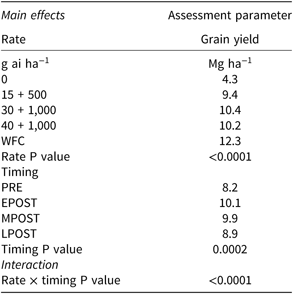
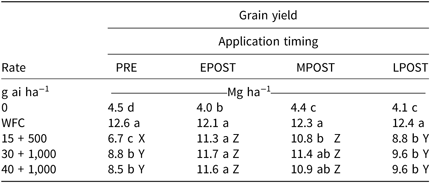
Weed interference reduced corn grain yield an average of 66% in this study. Grain yield varied by site and was reflective of overall weed control; yield ranged from 4.0 to 4.5 Mg ha−1 in NTC plots, to 12.1–12.6 Mg ha−1 in WFC plots (Table 13). Corn grain yields were greater than the NTC regardless of application rate or timing (P < 0.0001; Table 13). The medium or high rate of tolpyralate + atrazine applied PRE resulted in higher yields than the low rate; however, grain yields were lower for all rates of tolpyralate + atrazine applied PRE compared to the WFC. These results were expected for PRE treatments; tolpyralate + atrazine failed to adequately control four of the six weed species evaluated when applied PRE. In contrast, grain yields were not different among the WFC, and low, medium, and high rates of tolpyralate + atrazine when applied EPOST. When herbicide application occurred at the MPOST timing, there were no grain yield differences across the three rates of tolpyralate + atrazine; however, yields with the low herbicide rate were less than yield in the WFC plots. When herbicide application was further delayed to LPOST, no rate response was present; none of the applied rates of tolpyralate + atrazine reduced weed interference sufficiently to achieve yields similar to that of the WFC, probably because of the longer period of weed interference prior to herbicide application. Applied at the low rate, each of the POST herbicide application timings resulted in higher grain yield than the PRE timing; in contrast, PRE and LPOST herbicide applications resulted in similar corn grain yields when either the medium or high rate of tolpyralate + atrazine was applied. Several other studies have demonstrated the importance of early-season weed control in corn (Hall et al. Reference Hall, Swanton and Anderson1992; Norsworthy and Oliveira Reference Norsworthy and Oliveira2004; Page et al. Reference Page, Cerrudo, Westra, Loux, Smith, Foresman, Wright and Swanton2012; Swanton and Weise Reference Swanton and Weise1991; Tursun et al. Reference Tursun, Datta, Sakinmaz, Kantarci, Knezevic and Chauhan2016). In these and other studies, authors have investigated the critical period of weed control (CPWC): the time period during crop growth where weeds must be controlled to avoid yield loss (Knezevic et al. Reference Knezevic, Evans, Blankenship, Van Acker and Lindquist2002). Although this time period is subject to influence by a number of factors, Norsworthy and Oliveira (Reference Norsworthy and Oliveira2004) reported the CPWC to begin as early as the one- to two-leaf stage of corn, whereas Page et al. (Reference Page, Cerrudo, Westra, Loux, Smith, Foresman, Wright and Swanton2012) found the CPWC to begin between the third and fifth leaf stages of corn, generally corresponding to when EPOST treatments were applied in the current study. Averaged across rates, there was a 4% decrease in corn yield incurred by delaying herbicide application from EPOST to MPOST, and a 13% decrease incurred by delaying from EPOST to LPOST. These results give further supporting evidence for the importance of timely application of POST herbicides in corn to minimize yield loss, regardless of specific herbicide efficacy on larger weeds.
Corn grain yield with three rates of tolpyralate + atrazine applied PRE, EPOST, MPOST, and LPOST in field studies conducted in Ontario, Canada in 2017–2018. a,b

a Means within a column followed by the same letter are not significantly different according to Tukey’s multiple means comparison (α = 0.05).
b Abbreviations: PRE, preemergence; EPOST, early POST; MPOST, mid-POST; LPOST, late POST; WFC, weed-free control.
Weed control with tolpyralate + atrazine depends on herbicide application timing, though the magnitude of this effect depends on weed species. For control of each species in this study except Powell amaranth, the effect of tolpyralate + atrazine rate depends on time of herbicide application at 2 WAA (Tables 2, 4, 7, 9, 11). Despite its current registration as a POST-only herbicide, tolpyralate controlled common lambsquarters and Powell amaranth similarly (≥89%) 2, 4, and 8 WAA when applied PRE or EPOST at current label rates with atrazine (Tables 4–6). PRE herbicide applications at either the medium or high rate preserved corn grain yields similarly to the same rates applied LPOST. Ultimately, the results presented here warrant future research examining the efficacy of tolpyralate applied PRE alone, without the confounding effect of atrazine.
Common ragweed, common lambsquarters, velvetleaf, and Powell amaranth could be controlled equally regardless of POST herbicide application timing, substantiating the results presented in Metzger et al. (Reference Metzger, Soltani, Raeder, Hooker, Robinson and Sikkema2018a), which lists these among the species most sensitive to tolpyralate. In contrast, control of green foxtail and barnyardgrass 2, 4, and 8 WAA declined with all three rates of tolpyralate + atrazine when herbicide application was delayed from EPOST to LPOST (Tables 9–12). Grain yield declined when herbicide application of each rate of tolpyralate + atrazine was delayed to LPOST (Table 14), and this decline in control and crop yield could not be overcome by increasing the herbicide rate. The high rate of tolpyralate + atrazine generally provided no improvement in control or corn yield relative to the medium rate applied POST, and yield was equivalent across rates within each POST herbicide application timing. Overall, this study provides further insight into the interspecific sensitivities of weeds to tolpyralate, and facilitates the development of an appropriate herbicide application window for this herbicide when co-applied with atrazine to target the CPWC.
Interaction of herbicide rate and herbicide application timing on corn grain yield with three rates of tolpyralate + atrazine applied PRE, EPOST, MPOST, or LPOST in field experiments conducted in Ontario, Canada in 2017–2018. a,b

a Means followed by the same lowercase letter within a column (a–d), or uppercase letter within a row (X–Z) for each assessment parameter are not significantly different according to Tukey’s multiple means comparison test (α = 0.05).
b Abbreviations: EPOST, early POST; MPOST, mid-POST; LPOST, late POST; WFC, weed-free control.
Author ORCIDs
Nader Soltani, https://orcid.org/0000-0001-8687-4371
Acknowledgments
The authors gratefully acknowledge Christy Shropshire and Todd Cowan for their technical contributions to this project. Funding for this project was provided in part by the Grain Farmers of Ontario and through the Growing Forward (GF 2) program administered by the Agricultural Adaptation Council (AAC) and by ISK Biosciences Inc. No conflicts of interest have been declared.