Introduction
Public–Private Partnerships (PPPs) is a rapidly spreading idea in the current debate about public governance (Greve and Hodge, Reference Greve2005; Osborne, Reference Osborne2000; Savas, Reference Savas2000; Ghobadian, Reference Ghobadian2004). Like many other fashionable policy ideas, it is also an ambiguous concept. The next section of this article presents different conceptual approaches for analyzing PPP in health care. This presentation of conceptual approaches leads to a general definition, which is applied in the following section to undertake a survey of PPP in the Danish health sector. The transformation of the PPP idea into actual organizational practice is likely to be influenced by the broader societal context, as well as sector-specific conditions. Section 3 therefore investigates the regulatory context in the Danish health sector as a possible explanation for the emerging pattern of PPP. PPP is not only ambiguous, it is also a contested policy idea. Proponents argue that PPP is a remedy for financing shortages and a way to bring private sector expertise and civil society enthusiasm into the delivery of public services. Sceptics, on the other hand, point to transaction costs, unclear accountability structures, risk of service failure, vested interests, and the potential for eroding public sector knowledge as some of the potential problems (Joumard et al., Reference Joumard, Kongsrud, Nam and Price2005). The final sections discuss a number of general issues and concerns regarding the use of PPP in health care, and links these to the international literature on risk.
The Danish health sector is rooted in the Nordic welfare state tradition and can been characterized as a public integrated model with decentralized ownership and responsibility for hospital services. The system is financed by proportional income taxation at the national level, which is redistributed to the regions as block grants and some activity based financing. The integrated public sector context with strong normative roots in the welfare state may provide particular barriers for PPP projects. It thus seems that analysis of PPP in the health sector is particularly illustrative of some of the potentials, barriers, and concerns related to the practical application of this idea. The Danish case can thus supplement the emerging lessons from ‘first-mover’ PPP countries in health care such as England and Australia (McKee, Edwards, and Atun, Reference McKee, Nige and Rifat2006; Nikolic and Maikisch, Reference Irina A. and Harald2006). This paper can also extend the current discussion on PPPs in health care by presenting a risk-based framework for evaluating PPP projects.
Different approaches to analyzing PPPs in the health sector
It seems that at least five separate analytical traditions for the study of PPP can be identified (Weihe, Reference Weihe2005): a policy perspective focusing on the public–private mix in particular national policy sectors; a local regeneration perspective focusing on the collaboration between civil society organizations and the state; a governance perspective analyzing a broad range of network-based collaborative structures; a financial approach focusing more narrowly on financing arrangements in regards to establishing and running large infrastructure facilities – examples include the Private Finance Initiative (PFI) and the various combinations of BOOT arrangements (Build, Own, Operate, Transfer) – and, finally, a development approach applied by international organizations in regards to various development aid projects (Weihe, Reference Weihe2005). Each perspective may have internal variation in the understanding of PPP, but is generally held together by similarities in focus and orientation. The policy perspective is mainly driven by political scientists and policy analysts applying a broad understanding of PPP as various types of public–private mix in particular national policy sectors. The implicit purpose is to facilitate policy learning and search for optimality (Rosenau, Reference Rosenau2000). The development approach and the local regeneration perspective share this normative and constructivist starting point, as they tend to promote PPP arrangements in terms of civil society, private enterprise, and public sector partnerships at various levels (World Bank Web Site; Barnekov et al., Reference Barnekov, Boyle and Rich1989; Boyer, Reference Boyer1983). The financial perspective focuses more narrowly on the various instruments for financing large infrastructure projects, the consequences thereof and the issues of regulating such arrangements (Savas, Reference Savas2000). PPP is thus understood in a relatively narrow sense as the ‘alphabet soup’ of innovative arrangements for bringing in private investors to build, own, operate and finally transfer the infrastructure items (schools, hospitals, roads, prisons etc.). The governance perspective on the other hand is represented by a broad collection of writers interested in various network-based arrangements in a hybrid governance era that is claimed to have succeeded the previous focus on New Public Management (NPM) ideas (Klijn and Theisman, Reference Klijn, Geert R. and Osborne2000; Rhodes, Reference Rhodes1996; Kettl, Reference Kettl1993). This tradition operates with a rather inclusive understanding of PPP as various types of collaborative structures that cut across the public–private sectors. Interestingly some writers within this tradition do not include financial/infrastructure projects, as they are considered a variation on traditional and NPM-based contracting mechanisms without ongoing and mutual development dimensions (Klijn and Theisman, forthcoming). This seems problematic, as the definition of mutual development is at best unclear. It can therefore not a priori be concluded that such arrangements do not include joint development and mutual risk taking. Some of the governance literature tends to have normative undertones in regarding PPP as ‘a third way’ forward that facilitates (and requires) new types of civil society involvement (Sørensen, Reference Boyer2003). Other governance writers have more neutral ambitions of understanding current developments by using a new vocabulary. Finally, a degree of scepticism in regards to accountability structures is often voiced from the more traditional public administration members of this tradition.
This analysis uses a combination of policy, governance, and financial PPP perspectives. At the core is the following definition, which is an adjusted version of Van Ham and Koppenjahn's often-cited definition (Van Ham and Koppenjahn, 2001: 598):
Co-operation of some sort of durability between specific public and private actors in which they jointly develop infrastructure, products and services (including knowledge and dissemination of information) and share risks (financial and/or prestige), cost and resources, which are applied in the development and delivery process.
The term ‘specific public and private actors’ is included to distinguish PPPs from general corporatist arrangements, e.g. between all (private) general practitioners and all regional authorities on general tariffs and working conditions. Such corporatist agreements have both steering and development potential, but are too broad to be considered true PPP arrangements. The definition includes both ‘infrastructure’ projects such as PFI and partnerships in delivering service and goods. Research and knowledge creation is considered to be important in the health sector and is thus specifically mentioned. There must be some sharing of risks in terms of financial input and/or prestige. A high degree of joint development in one or more of the project phases (planning, design, construction, implementation/delivery) distinguishes PPPs from regular contracting out, which generally have a more clear division of responsibilities between public principals and private contract holders.
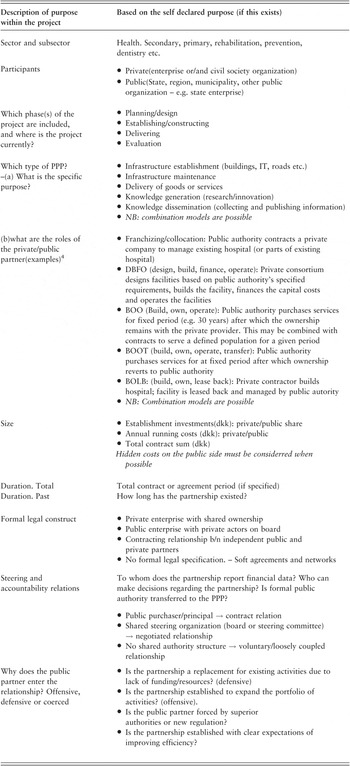
This definition is used as a starting point for identifying PPPs. They can be further classified according to their placement on the dimensions listed in Table 1, e.g. in terms of size, scope, and patterns in the use of PPPs in the health sector.
The following section will present an overview of data material collected using this framework in addition to other available supplementary data on PPP-like arrangements.
Dimensions for characterizing PPP projects in health care

4See also McKee, Edwards, and Atun (Reference McKee, Nige and Rifat2006) and Nikolic and Maikisch (2006).
Investigating the role of PPP in Danish health care
Using the PPP definition presented above on the available data on PPP in Danish health care, the following general picture emerges. At first sight, it is obvious that Denmark has not experienced the same growth in PPP infrastructure projects as we have seen primarily in Britain where 90+ hospital facilities to date have been established within the PFI initiative. There are currently no large-scale PFI projects for hospital building in Danish health care, which reflects the general PPP situation in Denmark. In fact, there are only two clear examples of large-scale infrastructure PPPs in the entire Danish public sector: a school in Jutland and the building of a new national archive. Besides that, the Road Directorate has partnering agreements for maintenance along roads and is planning a new motorway in southern Denmark.Footnote 1 There is also a plan for a prison in the future to be built as a PPP. This is somewhat paradoxical as the current government is actively promoting PPP and other forms of public–private collaboration as discussed below.
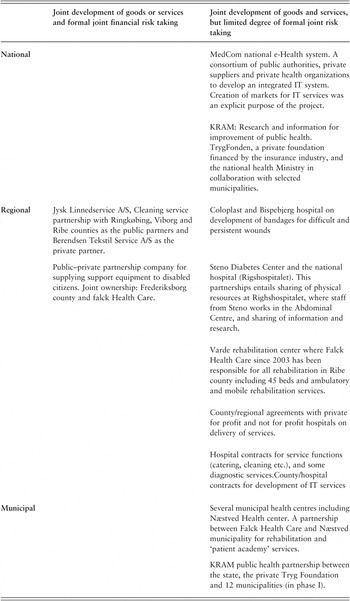
While there are few large-scale PPPs in Denmark, it is also clear that there is a long and ongoing tradition for various other types of public–private collaboration in the health sector. The arrangements vary in regards to the degree of co-development and joint risk taking. Table 2 illustrates the types of projects along two of the dimensions from Table 1.
An overview of PPPs in the Danish health sector

Projects are found at national, regional, and municipal levels. At the national level we find large-scale projects like MedCom and KRAM. MedCom is an example of a partnership between private suppliers, state, regional, and municipal authorities, and private organizations. The main purpose of the project is to develop standards for a national e-Health portal for electronic communication within the health sector and between patients and providers. It is thus an example of a complex IT PPP (see also Nikolic and Maikisch, 2006). MedCom is a co-operative venture between authorities, organizations, and private firms linked to the Danish healthcare sector. The project was initially financed one-third by private suppliers, one-third by the state, and one third by the counties. It is now financed by the state, Danish Regions, the Association of Municipalities in Denmark, and the (private) Danish Pharmaceutical Association. Private suppliers are still very much involved in the development of standards and projects, and via contracts for delivery of infrastructure and services. It has been an explicit aim of the project to develop markets where suppliers based on common standards can compete for contracts on the various parts of the project.
Another example of a national PPP is the partnership between the private TrygFonden, a foundation based on financial input from the insurance industry, and the Danish Ministry for the Interior and Health to undertake research and information activities in public health (KRAM). The partners collaborate with selected municipalities for the development and implementation of the programme.
At the regional level, we find several types of PPP arrangements. Many are based on contractual agreements for support functions (cleaning, catering, logistics etc.). Others deal with IT development and information dissemination, e.g. via collaboration between pharmaceutical companies, patient organizations, and publicly employed medical specialists. The first specific example concerns development of medical equipment, where an agreement has been made between the public Bispebjerg hospital and the private medical equipment supplier Coloplast on development of new bandages for difficult and persistent wounds. The collaboration takes the form of research projects, where Coloplast gains access to patients in return for providing personnel resources and making new treatment equipment available. Joint research papers are published, but patents are taken out by Coloplast alone. An example of joint ownership for delivering service to hospitals is Jysk Linnedservice A/S, which is established according to the rules for PPPs, with Ringkøbing, Viborg, and Ribe counties as the public partners and Berendsen Tekstil Service A/S as the private partner. Another example of joint public–private ownership was found in the previous county of Frederiksborg (North Zealand), where Falck and the county council in 1996 established a public–private partnership company for supplying support equipment to disabled citizens. Frederiksborg county owned 49% of the shares and Falck 51% initially. A restructuring in 2005 meant that the distribution is now 25%/75%. The company offers services in regards to logistics and distribution, general consultancy and advice, and temporary personnel services within the area of aiding handicapped. Services were offered in Frederiksborg County and to some extent in other counties according to specific contracts.
A slightly different group of regional PPPs concerns joint provision of services. Steno Diabetes Center, a private clinic owned by the pharmaceutical company Novo Nordisk, has entered a partnership with the national hospital (Rigshospitalet). This partnership entails sharing of physical resources at Righshospitalet, where staff from Steno works in the Abdominal Centre, and sharing of information and research. Another example is Varde rehabilitation center, where since 2003 the private company ‘Falck Health Care’ has been responsible for all rehabilitation in Ribe county, including 45 beds and ambulatory and mobile rehabilitation services. Falck is renting physical space in the county owned ‘Health Center Varde’, which houses other public and private health functions, such as a private clinic for heart diseases ‘Hjertecenter Varde’.
The relationship between public regional health systems and private (not-for-profit) hospital providers also include elements of the idea of PPP presented above. A distinction should be made between private not-for-profit hospitals and clinics that have been an integrated part of the system for many decades, and the relatively recent contracts with for-profit hospitals and clinics. Not-for-profit hospitals include specialty hospitals owned by patient organizations within rheumatology, epilepsy, sclerosis, as well as rehabilitation centres and hospices. These organizations are included in the regional planning of capacity and there is ongoing interaction between public authorities and these institutions in regards to development of services. Risk sharing is not financial, but tied to legitimacy issues, as there is a mutual interest in maintaining high standards etc.
Private-for-profit hospitals have emerged over the past decade, although they still account for less than 1% of all hospital beds in Denmark. For-profit hospitals and clinics have benefited from the establishment of an extended waiting time guarantee of two months in 2002 (one month as of October 2007). The regional authorities must pay for access to other public or private facilities if the expected waiting time for planned procedures exceeds the limit of one month. Patients can select among a list of private hospitals that have entered an agreement with the association of county councils. The contract negotiations entail some adjustment of services, but generally not real joint development.
At the municipal level, we find several service delivery PPP constructions that have already been established, or are currently planned. This is a response to the structural reform, which gave the municipalities a larger role as they are assuming a larger role in the health services provision. A partnership construction is currently being established in Næstved, which was one of the municipalities that received funding from the state in a recent round of project applications to develop health facilities at the municipal level. The health center in Næstved is established as a partnership with Falck Healthcare, which has been a partner since 2003 in the development process. Falck Healthcare will be responsible for running the so-called ‘patient academy’, while the municipality will be responsible for coordination of all other activities, and for supplying the physical facilities for the ‘patient academy’. Similar constructs are found in Skanderborg and on Østerbro.
We can conclude that there are few large-scale projects based on a clear PPP model. The national models include joint efforts to develop IT infrastructure and standards to facilitate market development, and a large-scale public health initiative. A number of local and regional projects were identified. Some projects take the form of business partnerships (e.g. Falck and Frederiksborg County); others are extensions or reformulations of network configurations involving public, civil society, and business actors. Co-location and private operators in public facilities is another emerging model (e.g. Steno and the National Hospital). Several PPPs involve IT and collection and dissemination of information.
Some would argue that PPP is simply a re-articulation of long-standing practices in the Scandinavian health sector, a re-articulation that fits the current public management climate and presents actor relationships in the administrative lingo of the day. The survey of PPPs presented in the above indicates that current PPP developments should be understood against the background of historical public–private collaboration, but that the current types of post NPM partnerships also have distinctive features. Notably, the emphasis on risk sharing and mutual commitment to development of infrastructure, products, or services is stronger than in traditional public–private collaborative arrangements. There is also an emphasis on private businesses as opposed to associations, unions, or voluntary organizations as the private partner. Current PPP trends thus downplay the role of corporatist and civil society arrangements and emphasize more business or market-based actors. In any case, important questions arise about regulation of hybrid organizational forms that are neither fully private nor fully public.
Regulating PPPFootnote 2
How can the observed pattern be explained? Are there barriers in the PPP regulation or policy for the health sector? The current government is a strong proponent of increased collaboration between the private and the public sectors. It is endorsing the use of outsourcing, and has developed programme statements and general policy documents to encourage PPP. Denmark's Ministry of Economics and Commerce took charge of the PPP policy from 2002. The task was in effect delegated to a government agency within the ministry, The National Agency for Enterprise and Construction. The agency has published material on PPPs, held conferences, supported reports on PPPs, and produced guidance material for organizations that want to go ahead with PPPs. The agency has also started a network of participants that work within the PPP field, including government people, potential private sector contractors, researchers, consultants, and other actors that give advice on PPPs. The network has had guests from outside (Ireland, England) to talk about PPP practices elsewhere. A recent initiative from the agency was the funding of a KPMG-report on the potential PPP market for Denmark for the period 2005–2010 (KPMG, 2005). The report estimated that the market for PPPs is worth around 22 billion DKK (US $3.6 billon) (KPMG, 2005). The report mentioned roads, railway infrastructure, local government sewage infrastructure, housing for elderly people, primary schools, and defence.
The official Danish PPP policy was first issued in January 2004 (Danish Government, 2004). The policy paper was called ‘Action plan for Public–Private Partnerships’. Remarkably, the policy was issued two and a half years after the government was formed. The slowness with which the PPP policy was formed was surprising, given the government's overall emphasis on bringing market actors closer to public service delivery. The Danish ‘Action plan’ consisted of suggestions of how to proceed with PPPs together with descriptions of ‘pilot projects’ that were going to be initiated in Denmark. The document lists ten further initiatives, including issue of guideline materials on PPPs, a site on the internet on PPP policy, forming a competence unit on PPPs concerning the construction industry, providing money for pilot projects in the transport sector, description of state PPP projects, and forming a framed contract agreement with advisers on PPP issues.
Four ministries were involved in developing the action plan: the Ministry of Economics and Commerce, the Ministry of Finance, the Ministry for the Interior and Health, and the Ministry of Transport. In the foreword to the publication, the government claims that it wants to encourage the use of market forces in the provision of public services, and that the government wants to use PPPs when it is appropriate – and only when it is appropriate. PPPs should not be used for ideological reasons according the government. The policy paper is more a description of intention, rather than a comprehensive document that examines the different legal, political, economical, communication, governance, and management challenges that PPPs pose. The bulk of the document consists of descriptions of various pilot projects that the government is intending to introduce here. The lessons learned in Britain are mentioned briefly. The level of ambition is ambiguous. From reading the policy paper, it is not certain whether the government really wants to pursue the PPP policy, or the document is just a necessary showcase to demonstrate that the government has considered the issue, while proceeding in a hesitant and cautious manner.
The government was re-elected in February 2005, but did not use the occasion to boost its PPP policy. The policy paper from January 2004 still stands as the primary declaration of intent. The Minister for Economics and Commerce, Mr Bendt Bendtsen, regularly mentions PPPs in his speeches, but does not follow up with action. The influential Minister for the Interior and Health, in contrast, has long been an advocate of marketization, but he seems to prefer traditional contracting out, consumer choice, and real privatization to PPPs. In his speeches, he emphasizes ‘putting citizens first’, and giving citizens choice among different providers, and he does not appear to take a particular interest in the murkier ground of PPPs.
A number of other actors and initiatives have been taken to promote PPPs. The Local Government Association has held conferences, encouraging local governments to engage more in PPPs. A network of private sector companies and some local governments was steered by a Danish think tank (Mandag Morgen = Monday Morning) that produced a report recommending PPPs. Industry organizations such as Danish Industry and the Danish Construction Association have also issued reports recommending the government to be more active on the PPP front. Various consultancy companies have written reports on behalf of government, such as the KPMG report mentioned earlier, and the guidelines for PPPs, the standard PPP contract (National Agency for Enterprise and Construction). Experiences with partnering-like contractual arrangements have been collected and published on the internet homepage devoted to public–private co-operation that the Local Government Denmark is running with the National Agency for Enterprise and Construction.
An internal government committee made up of civil servants follows the area. The committee was previously chaired by the Danish Ministry of Transport, but is now chaired by civil servants in the Ministry of Finance. The purpose of the group is to coordinate policies. So far, no policy document besides the 2004 action plan has emerged from the committee.
Summing up, the key policy paper is still the action plan from early 2004, but that paper was sketchy and not a coherent policy document. Since then a few projects have been launched, but we are far from seeing an explosion in the number of PPPs that are established in Denmark.
This is somewhat paradoxical given the governments ideological commitment to market solutions. Several possible explanations can be offered. The policy pressure is mostly by encouragement and promotion rather than coercion. The state institutions, counties, and municipalities are free to decide their own course, and, given a rather tight fiscal climate, they appear reluctant to experiment with solutions that may entail more risk than in-house production.
A supplementary explanation for the reluctance to experiment with PPPs may be that public authorities generally are able to finance projects with public sector funds, or by private loans with lower interest rates than private partners. This means that there are limited immediate financial benefits for the public in bringing in private funding, and indeed that the total societal costs (public and private) may be higher than in purely public projects. Many public sector spokespersons are therefore arguing that bringing in private partners is likely to increase costs and risks rather than provide more cost-efficient solutions. The Danish Ministry of Finance's view seems to be that PPP is less attractive than in other countries as illustrated in an interview with a Danish Ministry of Finance official (Kjær, Reference Kjær2004). This view is somewhat supported in a recent OECD evaluation of the Danish economy (OECD, 2005:110). On the positive side, it states that:
Interactive models, such as Public–Private Partnerships (PPPs), can be effective ways of cooperation for a number of complex tasks, for instance infrastructure, health and defence, where large-scale investments are often required and where emphasis may rather be on higher quality through innovation than on price competition. PPPs include models with more private involvement in development and management of public facilities and services, for instance by letting private investors design, build, own and operate facilities under contracts that are typically longer than under normal tenders. By transferring investment risks to the private investors (arising from, for instance, delays in construction projects) and ensuring a life-cycle perspective on costs, better cost-containment and greater efficiency may be achieved.
On a more cautionary note, it is stated that:
international experience with PPP models has been mixed so far, suggesting that the government needs to proceed carefully (Joumard et al., Reference Joumard, Kongsrud, Nam and Price2004). While some projects have turned out to be cost-effective ways of delivering public services, others have failed because of cost overruns – and subsequent bail-outs by the government – and discussions over the interpretation of contracts. Thus, the government may ultimately be held responsible for outcomes, thereby making the supposed transfer of risks to private contractors an illusion. Furthermore, the inherent long-term character and complexity of PPP contracts risk distorting competition, as the private partner will have revenue from the co-operation without being exposed to competition for a long period.
The report illustrates the ambiguity of both the PPP concept and the experiences. This ambiguity and particularly the financial risk taking involved have led the leading policy makers, including the Ministry of Finance, to take a cautious position. As the Ministry of Finance normally is a leading coordinator of policy initiatives, it becomes unclear who should now be the bearer of the policy.
Legally, there is some confusion as to how far partnership agreements can go before they clash with European Union tender rules. In EU law, contact between purchasers and providers are prohibited normally. A new tool – competitive dialogue – is supposed to enable at least some form of negotiation. But the insecurity about the application of rules may have held many back from trying to establish PPPs. Private sector companies are pressing the government to take on a more active role, and to implement PPP projects. A recent controversy between the private companies and the government has been about value added tax. The rules have been unclear about the juridical status of a PPP, and private sector companies do not know if they can discount the value-added tax from tax forms. This created a temporary stop for new projects (‘Fiasco threatens the Public–Private Partnerships’ as one headline read in the business paper Boersen, 12 September 2005). The Minister for Taxation is looking into the problem, but a clear resolution has not yet been found. This indicates an underlying conflict between the Ministry for Economics and Commerce, which is promoting PPP, and the Ministry for Taxation, which takes a more sceptical stance. So far, the influential Ministry for Finance has tended to support the sceptical view.
A few highly publicized scandals related to public–private collaboration at the municipal level have probably dampened the decentralized public authorities' willingness to experiment with PPPs. The municipality of Farum was for long promoted by the major liberal government party as en exemplary case of exploring the potential of public–private collaboration. The case backfired when the liberal mayor was accused of gross mismanagement. A current court trial is investigating charges of favouring business partners, neglecting to inform the municipal council of various financial transactions, and extensive use of municipal funds for luxury wines and dinners.
Another problematic case was the management of employee payments in Copenhagen Municipality by Accenture. The outsourcing of this task ended in continuous errors in payment of salaries, as the task was apparently more complex in terms of IT architecture than Accenture had initially assessed. Ultimately, the municipality had to release Accenture of the contract while suffering additional expenditures to develop alternative solutions.
It is likely that such cases have contributed to the somewhat cautious attitude in many regions and municipalities. Other reasons for hesitancy at the decentralized level could be fear of loosing direct control with activities, limitations in ability to change policies, and uncertainty in regards to ‘practical’ matters related to contracting arrangements. Some of these concerns may be shared among politicians and civil servants. Yet, there might also be diverging viewpoints between the two groups. Some politicians favour PPP on ideological grounds, while others are opposed for the same reason. Bureaucrats tend to be more concerned with accountability and loss of control than politicians that can be expected to focus on service improvements and high profile projects. On the other hand, politicians have a dual responsibility for securing financing through taxes and providing services. They will thus have incentives to maintain control of economic matters as well as flexibility in terms of service delivery levels.
Another part of the story is that private sector actors must be able and willing to take on the costs of developing suitable activities and entering partnerships. In some areas, there are active players such as the private company Falck Healthcare on patient transport and various other support functions and ISS on cleaning and other logistical tasks. But in many other areas, private actors have been reluctant to use their formal right of ‘challenging’ public services. As one representative of the industry recently stated ‘it may be difficult to develop close partnerships if you start out by kicking the door in’. In general it is clear that the development of new ‘markets’ takes time and requires commitment. There must also be obvious benefits and trust on both sides of the table. Benefits are harder to assess and trust more difficult to establish if the legal situation is somewhat uncertain as described above.
Issues and concerns
A number of general issues emerge from the above. First, it is evident that PPP is an ambiguous concept both in terms of scope and content and in terms of regulatory practices. A long-standing historical tradition for public–private collaboration has been extended by new forms involving closer integration in terms of joint development and risk taking. At the national level, there has only been a few flagship PPP infrastructure investment projects to date, but at the regional and municipal levels there are more examples of joint investment and ownership. Yet, the different organizational forms represent a sliding scale rather than clear divisions between PPP and all other forms. The organizational field is thus still developing, and new combinations being tried out. This obviously creates uncertainty in terms of regulation as illustrated by the debate regarding the VAT rules.
A number of additional points can be seen from the empirical material. First, it is clear that development of new markets (and collaborative arrangements) takes time and resources. The institutional infrastructure in terms of legal framework and in terms of normative understanding is established gradually. If the legal framework is somewhat uncertain, e.g. in regards to taxation and financial reporting rules, it will be more difficult to develop trust. Both the public and the private partners must see benefits that exceed the uncertainties and potential risks, before they enter into PPPs. At the aggregate level, the costs of developing the market must be outweighed by the potential societal benefits. In some cases, the partnership involves a joint commitment to develop the basic conditions for markets. An example is the MedCom project for integrated IT solutions, where public and private partners are collaborating in the development of standards that subsequently become the basis for competitive bidding among the participating private suppliers and other potential suppliers. This is a necessary, but very time-consuming and costly prerequisite for competition, which also involves a risk of lock-in to solutions that favour the participating private partners.
A second issue is the risk of cream skimming. Private partners will only enter activity areas where they can foresee a potential for profits. This is legitimate, yet it may mean that the public sector is thinned out, as the most interesting and lucrative activities disappear. The public sector will thus end up as the ‘sweeper’ in regards to problematic business areas. Moreover, competencies and innovation may be drained away from the public sector rather than being reinforced by the collaboration with the private partner. This is a particularly relevant concern, as there is a tendency for reorganizing the successful PPPs with greater private ownership when additional capital investments are needed. Private firms may thus see PPPs as a way to develop a new activity area while sharing the risk with public actors. In the event of successful expansion, they seek to gain larger ownership, while less successful PPPs may be discarded. The partnership for handicap aid equipment in Northern Zealand is an example, where the private partner has chosen to gradually take over more of the ownership, as the business area has proven to be profitable.
An opposing view on this issue is that the emergence of successful business activities out of PPPs may lead to the development of competitive markets, if other suppliers are gradually attracted to the area. In this sense, the risk of cream skimming may be acceptable, as long as it leads to the attraction of other competitors, and thus opening of the market in the long run.
A third issue of how to secure that PPP-based services are sufficiently robust to continuously deliver services even in difficult times. The underlying issue is what happens if the PPP construct or the private partner goes bankrupt during the PPP period, or less dramatically runs over budget and/or fails to deliver at the promised level. Will the public partner have to supply additional funding to secure mandatory service delivery? There have not been examples of this in Denmark, but the issue of public bail out is a general discussion in the international literature, as illustrated in the second part of the OECD quotation above. An opposing view is that PPPs may actually prove to be more robust than public delivery, as the latter is subject to political volatility, while PPPs represent long-term contractual commitments. This is true, but only to the extent that the PPP constructs and the private partners are able to live up to the commitment. This is more likely if the PPP involves large, well-established firms that are eager to maintain a reputation and where there are values to cover potential losses. Yet, this line of thinking may lead to limited competition and barriers for entry of new competitors.
A fourth and broader concern relates to the maintenance of public sector values. Public sector organizations are typically infused with a broader set of demands and values than private organizations (Jørgensen and Vrangbæk, Reference Jørgensen and Vrangbæk2004; Hood, Reference Hood1991). Concerns for democratic participation, social responsibility, openness, equity, and robustness typically matter more for public service organizations than private. The issue with PPPs is whether such values can be maintained or gradually will be eroded due to the concerns for the private business partner and the different legal construct. An opposing view could be that public sector organizations are not necessarily only characterized by such positive values. Public choice theory points to institutional self-interest and public monopolies leading to poor service, red tape, and lack of flexibility as just some of the more negative aspects of the public sector. The positive values may thus mostly be for promotion purposes, while the values in the actual interaction with citizens are very different. This a valid concern, and the essence is probably that it will be an empirical issue in each case, whether PPPs leads to erosion of positive public sector values or to a much-needed challenge of negative public sector values in practice.
In a practical sense, the issue of value differences can be illustrated by the differences in legal status of employees in public and private employment. In the Steno case described above, one of the major problems has been the unequal working conditions and salaries for the public and private employees working together on the project. This led to dissatisfaction and lack of real integration of work flows (Interview with Bente Hansen, Head Nurse of the Abdominal Center at Rigshospitalet). A specific set of values relate to openness and access to information for public actors. Depending on the regulatory structure, PPPs may be subject to other rules regarding transparency than pure public organizations. This can be problematic if the PPP is operating in an area with strong and clear importance for the public at large and more generally due to the fact that public money and shared risk taking is involved. An opposing view is that this concern can be handled via institutionalized contractual obligations to disclose relevant information.
A fifth concern is that PPPs represent a de facto restriction on the scope for decision making by future democratic assemblies as they create long-term contractual obligations. This may be acceptable in terms of investments, but less acceptable in terms of service delivery decisions, which are usually a prerogative of the public politicians. One counterargument is that investment decisions always represent restrictions on future decisions. It is therefore not unusual for present democratic assemblies to make economic decisions with long-term implications. Another counterargument is that PPPs, because of their inflexibility, provide security against short-term political volatility. PPPs may thus be a way to ensure that a particular activity is maintained, regardless of the shifting political majority. The general issue is thus, how much flexibility you want for your elected politicians representing the voting population at any given point in time. If you prefer much flexibility, PPPs might not be the best option. If, on the other hand, you have limited trust in politicians, you may like to see their hands tied by long-term commitments. A practical argument for maintaining some degree of flexibility is that the contextual conditions for service delivery change over time, e.g. as technology evolves and demographic patterns change. Using long-term PPP contracts might involve the risk of being to inflexible to meet the rapid changes in health technology (McKee, Edwards, and Atun, Reference McKee, Nige and Rifat2006). An example is the massive shift to ambulatory care in the past decade. This change might have been more difficult, if the sector had been tied to long-term PPP contract relationships guaranteeing a certain amount of in-patient activity for the private PPP partner. A counterargument is that such issues can perhaps be handled within the PPP setting, by creating more flexible PPP contracts.
A sixth concern is the cost of delivering services via PPPs. McKee, Edwards, and Atun (2006) investigate the available evidence on the performance of PPPs in the health sector, primarily in England and Australia. They conclude that costs have often been underestimated in PPP projects. There are a number of reasons for this. First, the interest rates for private investors are usually higher than for public borrowing as discussed above. Second, there are significant ‘transaction’ costs for both the public and the private partner in entering a bidding process. Private partners will have to find ways to recover losses of unsuccessful bids by adding to the price of new projects. One way of doing this could be to add to the cost of the service delivery part of partnership contracts. Whereas the construction part typically holds high risks for private partners, a service delivery element is more secure, as the public demand is guaranteed. The arguments by McKee et al. seem plausible, but it is perhaps worthwhile to distinguish clearly between the initial phase, where transaction and investment costs may be high for PPPs, and a life-time perspective, where the benefits of mutual learning may result in better and more cost effective practices, than would otherwise be the case. Again, this discussion can only be resolved empirically, and even so with considerable difficulty as the potential alternative development paths will always be difficult to establish.
The issue of complexity reinforces the risks and potential costs. Hospitals are extremely complex infrastructure projects in rapidly changing environments. The experience of Farum municipality in Denmark illustrates that the combination of complex projects and a very innovative leadership threatens the normal control mechanisms as both local politicians and national oversight authorities had difficulties controlling all details. This led to massive debts and an ongoing trial against the mayor and leading civil servants for misconduct. The Farum example also points to the potential for moral erosion in partnership arrangements, where politicians work closely with private partners in matters of huge economic interests. Complexity may also lead to increasing costs, as there will be few potential private actors large enough to handle big hospital projects. You may thus in essence end up with a monopoly or near monopoly situation. The question is then whether a private monopoly operating in a partnership with the public sector is inherently worse than a public monopoly. The inherent need to generate profits could point in that direction. On the other hand, the private partner will be under scrutiny by the public part, and if performance is very poor, the public part may take back the activity. If profits are extraordinarily large, other operators might also be attracted to the area, and the monopoly situation might disappear. There are some signs of this in the emerging European market for hospital services.
Quality is mentioned by McKee, Edwards, and Atun as a specific risk in health sector PPPs. The argument being that there will be strong focus on timeliness and cost, while quality may be harder to specify and control. The empirical evidence from England suggests that PPP projects tend to be on time more often than traditional public projects. Whereas the evidence on costs is ambiguous, quality on the other hand is found to be flawed in a number of cases (McKee, Edwards, and Atun, Reference McKee, Nige and Rifat2006). Yet, it is difficult to assess whether this is more often the case than in traditional projects, or indeed in traditional public sector delivery. There is limited evidence from Danish PPPs so far.
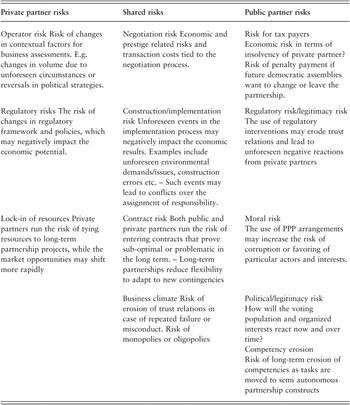
One way to operationalize the issues and concerns for analysis of PPP projects could be to utilize the concept of risk related to different actors and phases in PPP projects (Hardcastle and Boothroyd, Reference Hardcastle, Boothroyd, Akintoye, Beck and Hardcastle2003).Footnote 3 Matrix Table 3 illustrates the point. Some of the risk factors in the matrix are shared among public and private partners (illustrated by grey background colour). Others are predominantly related to one or the other part.
Potential risk factors in PPP projects

The matrix illustrates some of the potential risk factors involved in PPP projects. This can be used to feed into game theoretical models for assessment of the potential success or failure of particular PPP projects. Risk factors would obviously have to be assessed against the potential benefits for both private and public partners. Such a framework may also be used as a platform for developing policies to address the various risk factors.
Potential for future use of PPP in the health sector in Denmark
Although there are few PPP infrastructure projects currently, this may not be the case in the future. The Danish structural reform is currently being implemented as the new and larger regional authorities have assumed responsibility for health care as of January 2007. This may impact the PPP situation in several ways. All regions are currently looking at existing activities and contracting arrangements in order to determine the future setup. This represents an opening of the policy window for new institutional choices in the regional health services, and PPP may be considered as one of the options. A few regions have already signalled a need for new infrastructure and, given government promotion of PPPs, it is not unlikely that some PFI initiatives will be favoured. Skejby hospital is one example of this process. Other examples come from the municipalities that are assuming more responsibility for prevention, health promotion, and rehabilitation. In all three areas, this means expanding the activity area for the municipalities, and since the manpower resources and the expertise are limited, the option of collaboration with private partners may seem attractive. Many municipalities are therefore currently setting up health centres for rehabilitation and health promotion, and many are considering the use of PPP constructs following the experiences from Varde and Næstved municipalities described above. It can further be expected that the creation of larger units in itself will facilitate the creation of new markets. For private entrepreneurs it is more attractive to enter larger regions as the volume increases. Larger regions are also more likely to be affected by EU rules on tenders as discussed above.
Concluding remarks
This article set out by asking three related questions for the exploratory analysis of PPP in health care in Denmark: To what extent has PPP been used in the Danish health sector? Can the emerging pattern of PPP usage be explained by the general policy and politics of PPP? What are some of the general challenges and issues related to PPP in this sector?
It has been illustrated that PPP has been used very sparsely in the Danish health sector if a narrow infrastructural PPP definition is used. There are few examples of large-scale partnership projects with joint investment and risk taking, but a number of smaller partnerships such as jointly owned companies at the regional level. When defining PPP more broadly we can identify a long tradition for various types of collaboration between public and private actors in health care in Denmark. The degree of joint development and shared risk taking varies in the collaborative arrangements.
However, it is also clear that the government's PPP policy has been somewhat ambiguous. A significant amount of lip service has been paid to the concept of PPP, but the regulatory framework is still somewhat unclear. This is partly explained by the fact that major political and institutional actors at the central level differ in their enthusiasm for the PPP concept. The lack of clear policies for PPP provides an impediment to market creation. Private actors are reluctant to enter business areas with relatively large initial investments in terms of negotiations and bids have, if the regulatory structure and thus the risks are uncertain. Another explanation for the limited use of PPPs at the regional/municipal levels appears to be that decentralized authorities are influenced by a few highly publicized scandals of collaborative projects. Finally, it appears that central policy makers are reluctant to promote PPPs based on the fact that total societal investment costs (public and private) may be higher for PPPs than pure public projects, as these can be financed with lower interest rates.
The final sections of the paper discussed a number of issues and concerns related to PPPs. It is suggested that a risk-based framework may be useful for mapping the potential and challenges for both private and public partners. Such a framework can be used to feed into game theoretical models of the pros and cons for PPP projects. Generally, it can be concluded, that more empirical research is needed for the assessment of the various risk factors involved in using PPPs in health care. Most PPPs are still very young, and the evidence on performance and broader governance issues is only just emerging. Ideally, such assessments should include comparisons with a pure public alternative.