Does the language that people speak influence the way they think? Since ancient times, the relation between language and thought has intrigued philosophers, anthropologists, linguists and other researchers. The classical standpoint with regard to this issue is that thought precedes language. According to Aristotle, “Spoken words are the symbols of mental experience” (n.d.). An alternative view was proposed by Edward Sapir (1884–1939) and his disciple Benjamin Lee Whorf (1897–1941). Sapir believed that “[h]uman beings . . . are very much at the mercy of the particular language which has become the medium of expression for their society” (Reference Sapir1929, p. 209). Sapir laid the groundwork for the Linguistic Relativity Hypothesis, also known as the Sapir–Whorf hypothesis. Early evidence from color perception in the early 1970s appeared to contradict the hypothesis, which was labeled as circular, non-testable and probably false by several prominent scholars (e.g., Fodor, Bever & Garret, Reference Fodor, Bever and Garrett1974; Pinker, Reference Pinker, Gleitman and Liberman1995; Reddy, Reference Reddy and Ortony1979).
However, in recent decades, interest in Sapir–Whorf ideas has revived and numerous studies across a variety of linguistic domains and using a variety of methods suggest that language affects cognition. Evidence suggests that language affects conceptual development (e.g., de Villiers & de Villiers, Reference de Villiers, de Villiers, Gentner and Goldin-Meadow2003; Lohman & Tomasello, Reference Lohmann and Tomasello2003; Sera, Bales & Del Castillo Pintado, Reference Sera, Bales and Del Castillo Pintado1997; Sera, Reittinger & Del Castillo Pintado, Reference Sera, Reittinger and Del Castillo Pintado1991; Waxman, Reference Waxman1990), categorization (e.g., Athanasopoulos, Reference Athanasopoulos2007; Bassetti, Reference Bassetti2007; Boroditsky, Schmidt & Phillips, Reference Boroditsky, Schmidt, Phillips, Gentner and Goldin-Meadow2003; Flaherty, Reference Flaherty2001; Kuo & Sera, Reference Kuo and Sera2009; Lucy, Reference Lucy1992; Lucy & Gaskins, Reference Lucy, Gaskins, Gentner and Goldin-Meadow2003; Sera, Berge & Del Castillo Pintado, Reference Sera, Berge and Del Castillo Pintado1994; Sera, Leieff, Forbes, Clark-Burch, Rodriguez & Poulin-Dubois, Reference Sera, Leieff, Forbes, Clark-Burch, Rodriguez and Poulin-Dubois2002; Sera, Gathje & Del Castillo Pintado, Reference Sera, Gathje and Del Castillo Pintado1999), spatial representations (Choi & Bowerman, Reference Choi and Bowerman1991; Flaherty, Reference Flaherty1998; Hermer-Vasquez, Spelke & Katsnelson, Reference Hermer-Vasquez, Spelke and Katsnelson1999; Hill, Reference Hill1974; Levinson, Reference Levinson, Bloom, Peterson, Nadel and Garrett1996), event memory (Naigles, Eisenberg, Kako, Highter & McGraw, Reference Naigles, Eisenberg, Kako, Highter and McGraw1998; West & Bauer, Reference West and Bauer1999) and number concepts (Pica, Lemer, Izard & Dehaene, Reference Pica, Lemer, Izard and Dehaene2004). Even the classic evidence on color perception has been challenged (see e.g., Athanasopoulos, Reference Athanasopoulos2009; Davidoff, Davies & Roberson, Reference Davidoff, Davies and Roberson1999; Özgen, Reference Özgen2004; Özgen & Davies, Reference Özgen and Davies1998, Reference Özgen and Davies2002; Roberson, Davidoff, Davies & Shapiro, Reference Roberson, Davidoff, Davies and Shapiro2004). So questions today do not revolve around whether or not language effects on cognition exist. Clearly, they do. Questions today revolve around understanding the circumstances under which they occur and under which they do not, because while many empirical studies provide evidence to support the hypothesis of Linguistic Relativity, others do not (Chen, Reference Chen2007; Hofstätter, Reference Hofstätter1963; January and Kako, Reference January and Kako2006; Mazuka & Friedman, Reference Mazuka and Friedman2000; Papafragou, Hulbert & Trueswell, Reference Papafragou, Hulbert and Trueswell2008; Papafragou, Li, Choi & Han, Reference Papafragou, Li, Choi and Han2007; Papafragou, Massey & Gleitman, Reference Papafragou, Massey and Gleitman2002), and yet others suggest that these effects are limited (Slobin, Reference Slobin, Gumperz and Levinson1996; Vigliocco, Vinson, Paganelli & Dworzynski, Reference Vigliocco, Vinson, Paganelli and Dworzynski2005).
One question that has received little attention from researchers studying language–thought relations is whether the effects of language on cognition are limited to the learning of a language in early childhood. All of the evidence that we know of in favor of language effects on cognition comes from studies of monolingual children and adults, or of adult bilinguals who have learned the language in question at an early age (e.g., Gordon, Reference Gordon2004; Roberson et al., Reference Roberson, Davidoff, Davies and Shapiro2004; Sera et al., Reference Sera, Berge and Del Castillo Pintado1994, Reference Sera, Gathje and Del Castillo Pintado2002). In this study, we ask whether the effects of language on cognition can be observed in adults learning a second language. We focus on the potential effects of grammatical gender on categorization because categorization figures strongly in many cognitive processes (see e.g., Rogers & McClelland, Reference Rogers and McClelland2004) and because a relatively large body of systematic work suggests that grammatical gender affects categorization (e.g., Forbes, Poulin-Dubois, Rivero & Sera, Reference Forbes, Poulin-Dubois, Rivero and Sera2008; Jakobson, Reference Jakobson and Brower1966; Konishi, Reference Konishi1993; Martínez & Shatz, Reference Martínez and Shatz1996; Phillips & Boroditsky, Reference Phillips and Boroditsky2003; Sera et al., Reference Sera, Berge and Del Castillo Pintado1994, Reference Sera, Leieff, Forbes, Clark-Burch, Rodriguez and Poulin-Dubois2002). If grammatical gender affects categorization, and categorization is involved in a large number of cognitive processes, then grammatical gender would be implied in these processes. Moreover, because we focus on the role of grammatical gender on categorization, we limit our review of past findings to that realm.
Natural, grammatical and conceptual gender
The assignment of grammatical gender has traditionally been viewed as arbitrary, i.e., without any semantic basis. As Boroditsky et al. (Reference Boroditsky, Schmidt, Phillips, Gentner and Goldin-Meadow2003) indicate, one of the reasons for this assumption is that many languages assign different grammatical genders to what seem to be the same entities: e.g., the word “village” is feminine in Spanish (aldea), masculine in Hebrew (kfar) and neuter in Russian “selo”. This cross-linguistic disagreement with regard to grammatical gender assignment is evident in numerous languages. Also, although in some languages grammatical genders of animates correspond to their biological sex, this is not the case in others.
Natural gender is a biological marker that is consistent with either male or female referents. In short, natural gender indicates the biological gender of the referent (Jarvis & Pavlenko, Reference Jarvis and Pavlenko2008). In English, for instance, natural gender is primarily expressed by pronouns and lexical entries (human females and males, some mythical characters, etc.) whereas in some other languages natural gender is conveyed by noun and adjective endings, articles and pronouns. In Spanish, natural and grammatical genders almost always coincide, that is to say that nouns referring to males usually have masculine grammatical gender while nouns referring to females have feminine grammatical gender. For example, a woman = una mujer (feminine); a man = un hombre (masculine).
Grammatical gender, on the other hand, classifies all nouns (animate and inanimate) in two or more grammatical gender classes. According to Corbett (Reference Corbett1991), grammatical gender divides nouns into two or more mutually exclusive syntactic categories. French, Italian, Portuguese, Hebrew and many other languages have two grammatical genders, feminine and masculine, while German and Russian among many others have three grammatical genders, feminine, masculine and neuter. For example, in Russian, the grammatical gender of the noun “doll” ( ) is feminine while it is masculine for “tooth” (
 ) and neuter for “apple” (
 ). English, for instance, does not have a grammatical gender system (with the exception of third person singular pronouns), while a number of the world's languages have some categories of grammatical gender in addition to the three mentioned above (e.g., Czech). The grammatical gender of animate beings does not always correspond to their natural gender (in German, for example). Generally, the assignment of grammatical gender is thought to be arbitrary. However, recent evidence regarding Spanish grammatical gender assignment suggests that it may not be as arbitrary as previously thought because certain features (e.g., naturally occurring versus artificial objects) may be correlated with feminine and masculine gender assignment (Forbes et al., Reference Forbes, Poulin-Dubois, Rivero and Sera2008; Sera et al., Reference Sera, Berge and Del Castillo Pintado1994, Reference Sera, Leieff, Forbes, Clark-Burch, Rodriguez and Poulin-Dubois2002).
Conceptual gender is believed to be the gender that people tend to associate with inanimate objects and concepts. For example, death is often portrayed as female in Russian and Ukrainian cultures while it is portrayed as male in American culture. According to Agnoli and Forer (Reference Agnoli and Forer2004), conceptual gender is based on speakers' perception of these entities – that is, on the association of inanimate objects with male- or female-like characteristics. Sera et al. (Reference Sera, Berge and Del Castillo Pintado1994) suggested that “conceptual gender classifications are those that cannot be directly traced to linguistic or natural gender categories” (p. 262). Numerous empirical studies described below provide evidence showing that grammatical gender impacts speakers' conceptual gender assignments. According to Rakusan (Reference Rakusan and Nemeth2001) and Romaine (Reference Romaine1999), grammatical gender has been shown to influence metaphoric extensions and mental imagery associated with particular notions and objects (Jarvis & Pavlenko, Reference Jarvis and Pavlenko2008).
The Spanish system of grammatical gender
In modern Spanish, all nouns are categorized into two classes, masculine and feminine. Spanish determiners and many adjectives have feminine and masculine forms that are generally concordant with their corresponding nouns in both singular and plural forms. It should be noted that a relatively small group of adjectives that end with /e/, /l/ and /z/ have only one form, which is used with feminine and masculine nouns, e.g., inteligente “intelligent”, eficaz “effective”, central “central”. Typically, nouns that refer to animate entities (humans and animals) have feminine and masculine forms whereas nouns for inanimate entities (objects, concepts, places, etc.) are either feminine or masculine. Some exceptions exist: persona “person”, víctima “victim”, mamarracho “buffoon”, etc. Even though these nouns identify living beings, there is only one form for each of them regardless of the referent's gender. In addition, there are some nouns that designate both feminine and masculine referents, but their form remains the same: el/la guía “the guide”, el/la pianista “the pianist”, el/la testigo “the witness”. Definite and indefinite articles serve to identify a referent's gender in these cases. Gender assignment is usually fixed for Spanish nouns, i.e., it cannot be changed. In rare instances changes occur due to social and historical circumstances. For example, until recently professions such as doctors (los médicos) and lawyers (los abogados) only took the masculine form because men dominated these jobs. Today, feminine referents have emerged in addition to the masculine ones: la médico / la médica “female doctor”, la abogado / la abogada “female lawyer”. The following endings are typical for feminine nouns: /a/, /ion/, /d/ and /is/, while /o/, /e/ and some consonants are common endings for masculine nouns. If a grammatically feminine noun starts with a stressed a (e.g. agua), a masculine singular article el is used despite the fact that the noun's gender is feminine. Even though Spanish was derived from Latin, the Latin neuter gender was predominantly replaced in Spanish by masculine gender for nouns. Traces of the Latin neuter gender still exist in the pronoun system (Green, Reference Green and Comrie1990). For example, ello “it” is employed for generic reference. In addition, the Latin neuter is also preserved “when adjectives are used nominally . . . with the neuter article, e.g. lo bueno ‘the good one’” (Pérez-Pereira, Reference Pérez-Pereira1991, p. 575). To summarize, Spanish is a “gender-loaded” language because gender is marked morphologically across many grammatical categories: pronouns, determiners, nouns and adjectives.
Previous research on the effects of grammatical gender on categorization
As previously stated, a number of empirical studies have investigated the possible correlation between grammatical gender and conceptual gender. Some early studies on the effect of grammatical gender on cognition suggested that grammatical gender infiltrates speakers' cognition and influences their perception of inanimate entities (Clarke, Losoff, McCracken & Still, Reference Clarke, Losoff, McCracken and Still1981; Ervin-Tripp, Reference Ervin-Tripp1962; Jakobson, Reference Jakobson and Brower1966). However, while some early studies on gender described below suggested effects of language on cognition, others did not, such as Hofstätter (Reference Hofstätter1963). Since different grammatical genders are often attributed to the same objects across the world's languages, Hofstätter assumed that speakers might assign certain characteristics to a given inanimate object according to its grammatical gender in their language. This means that some of the object's qualities (male-like or female-like) may seem more obvious than others to speakers of different languages. The idea is that grammatical gender is associated with nouns, nouns are associated with objects and so grammatical gender may come to be associated with objects. In his experiment, Hofstätter focused on two words, “moon” and “sun”. Even though the nouns referring to moon and sun have opposite grammatical genders in German and Italian, the study participants (German and Italian speakers) chose similar descriptions for them. As a null finding, Hofstätter's study fails to suggest any effects of language on cognition.
In a larger similar study, Konishi's (Reference Konishi1993) findings contradict those of Hofstätter (Reference Hofstätter1963). In this study, native Spanish and German speakers evaluated 54 nouns whose referents were inanimate entities on three dimensions: evaluation, potency and activity. The test items consisted of two types: nouns that are grammatically feminine in German and masculine in Spanish, and nouns that are grammatically masculine in German and feminine in Spanish. The findings showed that both Spanish and German speakers considered inanimate entities that were represented by grammatically masculine nouns in their language more powerful or stronger, which are male-like attributes, than the ones represented by grammatically feminine nouns. Konishi concluded that grammatical gender affects meaning because the respondents' perception of the characteristics of the said inanimate entities correlates with the grammatical gender of the nouns representing these entities.
Along the same lines, Sera et al. (Reference Sera, Berge and Del Castillo Pintado1994) reported additional supporting evidence for the correlation between grammatical and conceptual gender. This cross-linguistic study explored the role of grammatical gender in the categorization of inanimate objects by monolingual English and Spanish children and adults. The respondents categorized a series of pictured objects as male- or female-like by using a voice-assigning technique, which consisted of attributing men's and women's voices to pictured items. The results show that the judgments of the Spanish-speaking respondents were consistent with Spanish grammatical gender, i.e., they classified the depicted objects according to their grammatical gender in Spanish, whereas the English-speaking participants' classifications did not follow the same pattern. Moreover, this study demonstrates that the effect of grammatical gender on the conceptual gender classification of inanimate objects in Spanish-speaking children occurs much later than their acquisition of grammatical gender. Spanish-speaking children generally acquire grammatical gender by the age of four (Pérez-Pereira, Reference Pérez-Pereira1991), but the effects of grammatical gender on categorization do not begin to emerge until the age of seven (Sera et al., Reference Sera, Berge and Del Castillo Pintado1994). Sera et al. (Reference Sera, Berge and Del Castillo Pintado1994) also found that monolingual native English speakers had a tendency to categorize artificial objects as masculine and natural objects as feminine. Native Spanish speakers demonstrated some susceptibility to this classification too, but by the age of seven Spanish speakers started showing stronger effects of grammatical gender on conceptual gender.
Sera et al. (Reference Sera, Leieff, Forbes, Clark-Burch, Rodriguez and Poulin-Dubois2002) similarly investigated the correlation between grammatical and conceptual gender. Monolingual native speakers of Spanish, French, German and English, both children and adults, participated in a series of experiments that were designed to analyze whether and how grammatical gender affects the categorization of inanimate objects. The data were elicited through the same voice-assignment task. The results revealed that Spanish and French speakers' responses were correlated with each language's grammatical gender. However, such a correlation was not found for the German speakers.
Flaherty (Reference Flaherty2001) also maintains that once grammatical gender is acquired, it affects speakers' perception. Native English speakers from Ireland and native Spanish speakers from Ecuador (children and adults) participated in this study, which consisted of three parts. In the first experiment, adult English speakers were asked to assign subject pronouns to animate (animals) and inanimate referents. The pronoun it was used almost exclusively with inanimate nouns. He was the most frequent pronoun for animate referents. In the second experiment, the respondents gave typical male or female names to 20 objects to show whether the objects were perceived as males or females. For the most part there was a strong correlation between grammatical and perceived gender for Spanish speakers who were older children and adults. Because Flaherty suspected that the referents' attributes might have affected the participants' choices, she decided to examine this hypothesis by asking the respondents to attribute some masculine and feminine characteristics to the same objects. She found that grammatical gender influenced the Spanish adults and older children in their choice of gender assignment while perceived attributes affected the younger Spanish children and native English speakers.
More recently, Phillips and Boroditsky (Reference Phillips and Boroditsky2003) extended the body of existing evidence on the effects of grammatical gender of artifacts on speakers' conceptual representations of these entities. The researchers conducted a series of studies in English (with respondents fluent in English, which was not their native language) to show that the effects of grammatical gender are not specific to the language being tested. In one experiment, Spanish and German speakers were asked to provide three descriptions for 24 objects, which had opposite grammatical genders in these two languages. Then a group of native English speakers evaluated all the elicited adjectives as describing feminine- or masculine-like features. Phillips and Boroditsky found that both the Spanish and the German speakers characterized grammatically masculine nouns in their respective languages with masculine adjectives and grammatically feminine nouns with feminine adjectives. This finding indicates that certain traits of inanimate objects are more salient than others for speakers of different languages and such diverse perception could be activated by one single mechanism – grammatical gender.
Bassetti (Reference Bassetti2007) conducted a study on the effects of grammatical gender on object categorization in Italian–German bilingual children in comparison to monolingual Italian children. Nouns that represented the stimuli objects have opposite grammatical gender in Italian and German. The results of the voice-attribution task demonstrated that Italian–German bilingual children were not influenced by Italian grammatical gender as opposed to monolingual Italian children, whose voice assignments were consistent with Italian grammatical gender. The author concludes: “[W]hen the two languages of a bilingual represent a specific aspect of reality differently, the bilingual may develop different concepts from a monolingual” (p. 251).
To summarize, an abundant body of evidence suggests a correlation between grammatical and conceptual gender and thus supports the idea that language affects cognition. However, most of this support comes from comparisons between monolingual speakers of two languages, and there may be reasons other than the language differences for the differences reported. The importance of culture in gender attribution should not be ignored, because there might be differences between the cultures in the objects that speakers associate with males and females, which may affect gender assignment by speakers of different languages. For example, in the United States, cars and boats are referred to as female as opposed to helicopters and airplanes. As Bassetti (Reference Bassetti2007) points out, it is important not to confuse the effects of culture and the effects of language in studies on the effects of language on thought. Consequently, it is crucial to control for potential effects of culture by testing participants from a single culture. In the current study, the experimental group that was tested over time belonged to one culture, thus some possible confounding non-linguistic cultural differences in previous studies, which included diverse cultural groups who spoke different languages, can be ruled out.
Past studies have also focused on the effects of language for speakers who learned the language at an early age. What about the possible impact of learning a foreign language with grammatical gender as an adult on one's perceptions of conceptual gender? To our knowledge, no studies have investigated this topic. The gender concepts of the same language learners have never been examined before and after their exposure to a language with a grammatical gender system over a substantial period of time during their acquisition of the target nouns' grammatical gender. The original contribution of the current study lies precisely in that we carry out this type of examination. So we asked: Does a newly acquired Spanish grammatical gender system by native English speakers affect their originally established conceptual gender of inanimate objects? Ours is the first longitudinal study of the gradual acquisition of Spanish grammatical gender and its possible influence on categorization. As learners advanced in their acquisition of Spanish grammatical gender over the course of a year, the correlation of grammatical gender knowledge of some nouns whose referents are inanimate objects and conceptual gender attribution to these objects by Spanish-language learners was analyzed. We also examined whether the effect of learning grammatical gender on conceptual gender was stronger for certain categories (e.g., feminine artificial, feminine natural, masculine artificial, masculine natural) as past work has shown that people associate natural objects with females and artificial objects with males (Mullen, Reference Mullen1990; Ortner, Reference Ortner, Rosaldo and Lamphere1974; Sera et al., Reference Sera, Berge and Del Castillo Pintado1994). It is possible that the effects of learning a grammatical gender system might be limited to pre-existing associations that people have about objects. So, we included items that should have matched their past associations (grammatically feminine nouns whose referents are natural or are not man-made; and grammatically masculine nouns whose referents are artificial or man-made) and items that should not have matched their past associations (grammatically feminine artificial items and grammatically masculine natural items). Alternatively, it is possible that the effects of grammatical gender are not limited and affect all categories equally. In short, the reason for including different kinds of categories was to see whether grammatical gender effects (if they exist) affect concepts by moving them further in the same direction of original biases or whether they can change the direction of original biases.
Accordingly, we addressed two main questions. The first was whether learning the grammatical gender of a foreign language shapes adult learners' perception of the conceptual gender of inanimate objects. The second was whether advanced Spanish learners achieve the same conceptual gender attribution of inanimate objects as native Spanish speakers. In order to answer these questions we tested three groups. One was a group of native English speakers who were enrolled in beginning Spanish courses throughout one academic year (the beginners). The second group consisted of advanced Spanish learners who had studied Spanish for several years. The third was a group of native Spanish speakers. The beginners participated in two pencil and paper tasks. One task, a determiner and lexical knowledge test, examined their acquisition of Spanish grammatical gender. The other task, a voice-assignment task, examined their conceptual gender attribution to animate and inanimate objects. In this categorization task, participants had to attribute male and female voices to pictures of objects. The beginners participated in the language task of determiner and lexical knowledge three times, and the categorization task four times, approximately ten weeks apart. We also tested the group of native Spanish speakers and native English speakers who had advanced knowledge of Spanish in the categorization task. A primary advantage of the data elicitation through pictures in studies on language–thought correlation is that this method enables investigators to implement a task in which the linguistic contrast under investigation is not explicitly presented. Some have criticized the voice-assignment task on the basis that it may lead the participants to explicitly think about grammatical gender (e.g., Kousta, Vinson & Vigliocco, Reference Kousta, Vinson and Vigliocco2008; Phillips & Boroditsky, Reference Phillips and Boroditsky2003). However, this criticism does not explain why such effects are not always found (e.g., they are found in Spanish, French and Italian but not German) and why they are not equally strong across all grammatical categories (e.g., stronger effects are often found for masculine than feminine items). In addition, the results from the voice-assignment task have been replicated by researchers using different tasks (Boroditsky et al., Reference Boroditsky, Schmidt, Phillips, Gentner and Goldin-Meadow2003; Kousta et al., Reference Kousta, Vinson and Vigliocco2008; Martínez & Shatz, Reference Martínez and Shatz1996).
Method
Participants
Three groups of participants were tested: (1) beginning Spanish learners; (2) advanced Spanish learners; and (3) native Spanish speakers. The group of beginners consisted of 50 native speakers of English who enrolled in beginning level Spanish courses during the first and second semesters at a large Midwestern university (the data from one beginner was excluded from the analyses as described below). All these students were true beginners. Some of them did not know any foreign language; others had had formal studies and/or informal experiences with other languages in the past. The beginners provided baseline data for the categorization task, which was crucial for this study because the first set of data for the categorization task (voice assignment) was collected when they did not know any Spanish. Given that at the university where the experiment took place only true beginners were allowed to take the first beginning course (their high school and any transfer transcripts were checked prior to registration), there was no need to use an independent measure of proficiency level. The advanced group consisted of 26 native speakers of English who had advanced knowledge of Spanish. Most of them were graduate students and instructors in the Department of Spanish. Therefore, it was unnecessary to use an independent measure of their proficiency level. These participants were selected because they were fluent speakers of Spanish, whose first language was English. It was important to see if their profound knowledge of Spanish grammatical gender had affected their categorization of inanimate objects. The native Spanish speakers were 26 graduate and undergraduate students. They were from various Hispanic countries, born and raised by Spanish-speaking parents in their native countries. Their length of stay in the United States varied. Some of them were newly arrived while others had been in the United States for a few years. Their length of stay ranged between one month and ten years, and because previous studies (Athanasopoulos, Reference Athanasopoulos2009; Cook, Bassetti, Kasai, Sasaki & Takahashi, Reference Cook, Bassetti, Kasai, Sasaki and Takahashi2006) have shown that length of stay is an important factor in restructuring speakers' cognition, any differences that we find between the native Spanish group and the other two groups of Spanish learners may underestimate the actual differences that might exist. The advanced Spanish learners and the native Spanish speakers were recruited through the personal contacts of the first author. The beginning learners were tested in their Spanish classes and during group data-collection sessions offered at different times of the day to accommodate the respondents. The advanced and native participants were tested individually and in small groups either on campus or at their university housing facility.
Experimental tasks
The beginners participated in two tasks longitudinally throughout the academic year. One task, the language task, tested the English speakers' acquisition of Spanish grammatical gender by examining their knowledge of Spanish determiners and nouns (the language task of determiner and lexical knowledge). The other task tested how their categorization of inanimate objects changed over one academic year. This was a task in which they assigned either a man's or a woman's voice to a pictured object. The categorization task always preceded the language task. Participants completed the categorization task before completing the language task in each session in order to minimize the potential effect of priming by language.
Language task of determiner and lexical knowledge
The determiner and lexical knowledge test was aimed at assessing the learners' development of grammatical gender knowledge of the given nouns and was thus intended to enable the researchers to examine in detail the relationship between grammatical gender acquisition and conceptual gender attribution.
Materials
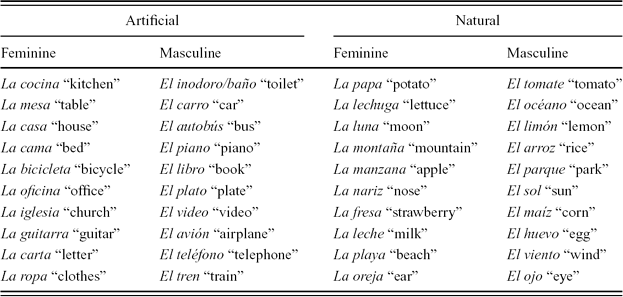
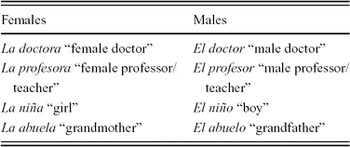
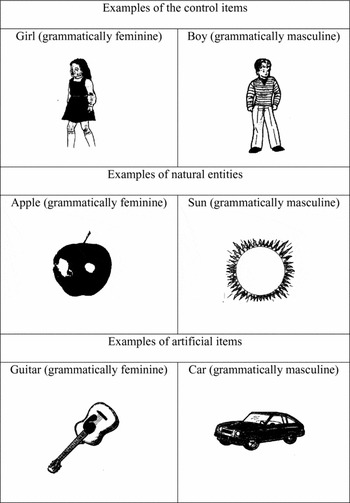
Forty-eight pictured items were used as stimuli in both tasks. In order to ensure the participants' exposure to the nouns representing the stimuli items, all nouns were chosen from the Spanish textbook that was being used in the courses taken by the beginners. We also ensured that the pictures elicited the nouns intended by the researchers by presenting the pictured stimuli to Spanish learners who labeled them in English. These students did not participate in the actual study. In the determiner and lexical knowledge test the respondents were shown the same pictures as in the voice-assignment task. Forty of the items were test items and eight were control items. Table 1 lists the nouns referring to the test items used, and Table 2 lists the nouns referring to the control items used. Figure 1 shows examples of the pictures.
List of the test items.

List of control items.

Black and white copies of sample pictures.

Procedure
The participants were asked to label pictures in Spanish, i.e., to provide Spanish words for them, including the Spanish definite article, because in Spanish articles indicate the noun's gender (with a few exceptions). The instructions were:
Please label each picture in Spanish. For example, if you see a picture of ice-cream, you will write “el helado” or if you see a picture of a hamburger, you will write “la hamburguesa” in the spaces provided for these items. Please make sure that picture numbers correspond to the numbers on your answer sheet. Do not worry about the spelling.
It should be noted that the instructions did not ask students explicitly to provide a definite article; rather, this request was made through examples. The main reason for this strategy was to not draw attention to one of the focal elements of the study – grammatical gender. It is important to stress that in order to examine the relationship between grammatical gender acquisition and categorization, the words were to be acquired by the study participants for the purpose of this experiment since in this study we were not looking at the perceived grammatical gender of the unfamiliar words' appearance, but rather at knowledge of the grammatical gender of the target nouns. For this reason, we ensured that respondents were exposed to the test items during class activities throughout the entire project.
Categorization task: assigning men's and women's voices to pictures
The categorization task was a voice-assignment task that was designed to provide evidence on the conceptual gender perception of inanimate objects by all of the participants.
Materials
In this task, participants were presented with the same 48 pictures as in the language task of determiner and lexical knowledge described above. The 48 pictures included two kinds of items, eight control and 40 test items. The eight control items consisted of four pictures of males and four of females (female/male doctor, female/male instructor, elderly woman/man, and girl/boy). The control items were used to ensure that participants fully understood the task, i.e., that they assigned voices according to the referents' natural genders (i.e., biological sex). Data collected from those who did not provide correct voices for the control pictures were excluded from the data analyses (the data from one participant was excluded as such). Of the 40 test items that illustrated inanimate objects, 10 depicted artificial objects that were feminine in Spanish, 10 artificial objects that were masculine in Spanish, 10 naturally occurring objects that were feminine in Spanish and 10 naturally occurring objects that were masculine in Spanish (see Table 1). Most of the pictures were found on various clipart websites, a few of them were actual photographs taken by the researchers for the purpose of this study and some of them were taken from the English and Spanish versions of the Peabody Picture Vocabulary test (Dunn & Dunn, Reference Dunn and Dunn1981, Reference Dunn and Dunn1986). Eight control items for the voice-assignment task, which were also used as test items in the people category for the determiner and lexical knowledge test, are listed in Table 2. Each participant received the 48 pictures on an individual handout. Each picture was approximately 5 cm by 5 cm in size. Six handouts containing the pictures in six different random orders were used to eliminate the possible effect of order on the participants' responses.
Procedure
The study participants were asked to assign men's and women's voices to the pictures. The instructions were always given in English to ensure that the respondents comprehended the task. It is important to highlight that the words gender, feminine and masculine were not used in the instructions in an attempt to keep the participants' attention away from explicitly thinking about grammatical gender. The exact instructions were:
We are thinking about making a new movie in which some everyday objects come to life and sing and dance. You will see a series of pictures of these objects and will need to determine whether each pictured object should have a man's/boy's voice or a woman's/girl's voice. If you decide that an object should have a woman's voice, please write “woman's” in a space provided for this object on your answer sheet. Similarly, if you decide that an object should have a man's voice, please write “man's” in a space provided for this object on your answer sheet. Please make sure that picture numbers correspond to the numbers on your answer sheet.
Design
The beginners participated in the voice-assignment task four times throughout one academic year, and in the determiner and lexical knowledge task three times. The first task that they participated in was the voice-assignment task, which took place in the first week of the semester before they were exposed to Spanish. The data from this session did not test for knowledge of Spanish and provided baseline data from the beginners on their categorization of inanimate objects. In the second and subsequent rounds of data collection the beginners participated in both tasks. The gap between each round of data collection was about ten weeks of instruction. The respondents saw the same pictures every time to enable the investigators to examine any possible changes in the learners' perception of these objects as they were acquiring the grammatical gender of the nouns whose referents were illustrated in the pictures. By testing the same participants several times throughout an academic year, changes in grammatical gender knowledge and its possible correlation with conceptual gender were observed. The advanced Spanish learners and native Spanish speakers participated only in the voice-assignment task and provided their data once. The data collection for these two groups followed the same protocol as the one for the beginners.
Results
We start by reporting the longitudinal results from the beginners on the language task to examine the process of grammatical gender acquisition in Spanish. We then report the longitudinal results from the beginners on the categorization task to see whether and how learning grammatical gender influences categorization. Then we directly examined the relationship between knowledge of grammatical gender and categorization among the beginners by analyzing their performance on a categorization task by those who showed high versus low knowledge of Spanish grammatical gender. Finally, we compared categorization by the beginners at the end of the year, advanced Spanish learners and native Spanish speakers.
Results for the beginners: language task of determiner and lexical knowledge
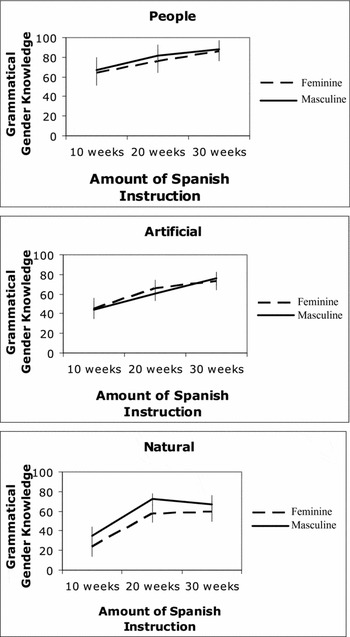
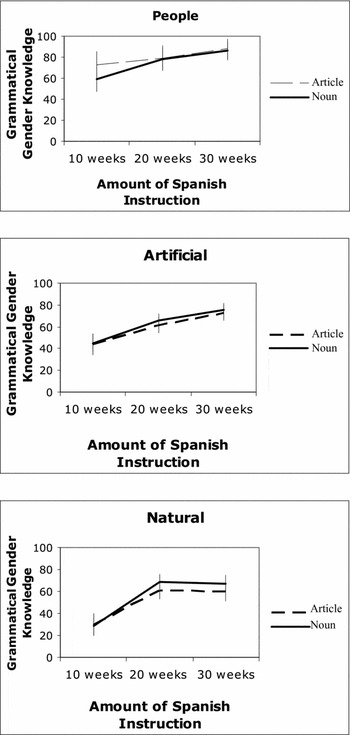
The first analysis focused on the beginners’ acquisition of the test items’ names and their grammatical genders as expressed by determiners over time. The percentage of times each article and noun, measured independently of each other, were provided correctly by each subject was calculated. These percentages were the dependent variables. They were submitted to an ANOVA, which had the following factors: time (2, 3, 4), category (people, natural, artificial), Spanish grammatical gender (feminine, masculine) and part of speech (article, noun). A number of significant effects and interactions emerged. Figures 2 and 3 show the relevant means.
The mean percentage of correct responses by the beginners in the language task over time for each category and gender. The vertical bars represent the standard deviation of each mean.

The mean percentage of correct responses in the language task by the beginners over time in each category for each part of speech. The vertical bars represent the standard deviation of each mean.

We found three main effects. A main effect of time was found (F(2,98) = 182.525, p < .0001) that showed gradual progress in knowledge of Spanish grammatical gender. The overall mean percentages correct for each time period are: time 2 = 46.4%, time 3 = 68.99% and time 4 = 74.95%. Post-hoc analyses (Tukey's HSD, p < .05) showed that the overall participants’ performance at time 4 was significantly better than at time 3; at time 3 it was significantly better than at time 2. As one can observe, most improvement took place between times 2 and 3. A main effect of category (F(2,98) = 80.48, p < .0001) also emerged: beginners performed correctly 77.08% of the time for people, 60.75% correct for artificial objects and 52.57% correct for natural ones. All of these differences in performance on each object category were statistically reliable (Tukey's HSD, p < .05). The best performance was observed for items in the people category, while the worst performance was observed for items in the natural category. A main effect of gender (F(1,49) = 21.13, p < .0001) suggested that overall the respondents performed better on grammatically masculine than on feminine entities: they provided 65.64% correct answers for masculine and 61.29% correct answers for feminine items. However, subsequent interactions (described below) qualify the main effect of grammatical gender.
Four significant 2-way interactions also emerged. We will interpret these interactions only briefly, because most of them are qualified by the 3-way interactions in which they participated. An interaction between time and category (F(4,196) = 19.42, p < .0001) showed that students performed significantly better on the category people than on the natural and artificial categories (Tukey's HSD, p < .05) after ten weeks of Spanish instruction. This interaction further suggests that improvement for the other categories was observed between ten and 30 weeks of classroom instruction (see Figure 2). Another significant 2-way interaction was observed between category and gender (F(2,98) = 11.33, p < .0001), suggesting that students knew masculine gender better than feminine gender primarily for the people and natural categories (Tukey's HSD, p < .05). A 2-way interaction between time and part of speech (F(2,98) = 18.29, p < .0001) was reliable, but not meaningful (see the 2-way interaction below). Finally, the last 2-way interaction found was between category and part of speech (F(2,98) = 23.04, p < .0001). It showed that the beginners’ performance on nouns was significantly better than their performance on articles for the natural and artificial categories. Participants performed significantly better on articles than on nouns in the category people, which may be due to an association between biological and grammatical gender. Although the beginners had not yet acquired all of the nouns that referred to people, they showed knowledge of these nouns’ gender, by using the correct articles (see Figure 3).
We now turn to the 3-way interactions. A 3-way significant interaction among time, category and gender was found (F(4,196) = 3.70, p < .01). What this 3-way interaction reveals is that the effect of gender was primarily due to a difference within the category of natural items. The largest difference between masculine and feminine items was within the naturally occurring objects.
A 3-way interaction among time, category and part of speech (F(4,196) = 4.25, p < .01) revealed a different pattern of the acquisition of articles and nouns for the category of people as opposed to the other two categories. For people, participants performed significantly better on articles than on nouns at time 2. For the other two categories, the performance on articles and nouns was equivalent (Tukey's HSD, p < .05). This suggests that there may be a natural link between biological sex and grammatical gender expressed by articles for English speakers. For the category of people, English speakers can accurately guess which article to use even if they do not know the Spanish noun. We tended to find the opposite pattern for the other two categories. For natural and artificial objects, as participants acquired knowledge of the nouns at times 3 and 4, they were not able to guess accurately which article to use. For example, we observed many answers like *El mesa and *El manzana. So it appears that English speakers often ignore phonological gender cues. These findings also suggest that native English speakers learn Spanish nouns that refer to objects earlier and separately from the corresponding articles, which carry their grammatical gender.
A 3-way interaction among category, gender and part of speech (F(2,98) = 7.63, p < .001) was also found to be significant. This 3-way interaction revealed that for the category of people the advantage of articles over nouns was primarily due to an advantage of the masculine article el. This may reflect a tendency for English speakers to use el as a default article. For artificial and natural object categories the advantage of nouns over articles was mostly due to an advantage in learning grammatically masculine nouns. The reason for this is unclear.
Categorization task: results for the beginners
We first examined the grammatically consistent conceptual gender attribution in the voice assignments by the beginners. The respondents’ performance on the control items (those with biological gender) was analyzed first, and the data of one participant who did not provide correct answers for 75% of the control items were excluded from further analysis because it appears that this person did not comprehend the task.
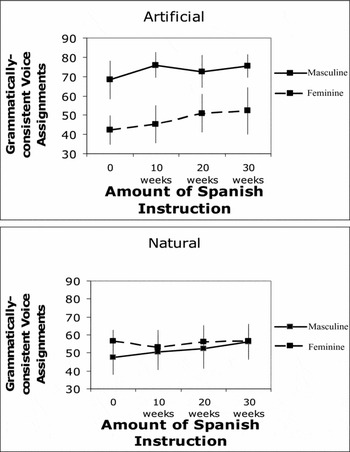
We analyzed the pattern of voice assignments with an ANOVA. This analysis included the following factors: time (1, 2, 3, 4), gender (feminine, masculine) and category (natural, artificial). All these factors were within-subjects. The dependent variable in the voice-assignment ANOVA was the percentage of gender-consistent voice assignments that corresponded to Spanish grammatical gender. Figure 4 shows the percentage of grammatically consistent items for each category and gender over time. Three main effects were found. There was an effect of time (F(3,147) = 6.217, p = .0005). Post-hoc Tukey's HSD, p < .05 indicated that judgments at times 3 and 4 were significantly different from voice assignments at time 1. Thus, after 20 weeks of Spanish classroom instruction, students’ categorization of the objects was significantly different from their judgments at the very beginning of their exposure to Spanish. A main effect of category also emerged (F(1,49) = 25.855, p < .0001). Across all four times, voice assignments for artificial entities were more consistent with Spanish grammatical gender than for natural ones, 60.375% versus 53.57%, respectively (Tukey's HSD, p < .05). In addition, a main effect of gender was also found (F(1,49) = 14.855, p = .0003). Across all four times, voice assignments for grammatically masculine entities were more consistent with Spanish grammatical gender than for grammatically feminine ones, 62.35% versus 51.6%, respectively.
The mean percentage of grammatically consistent voice assignments for the artificial and natural categories for feminine and masculine grammatical genders over time in the categorization task. The vertical bars represent the standard deviation of each mean.

A 2-way interaction between category and gender (F(1,49) = 70.950, p < .0001) was also found. According to a post-hoc analysis (Tukey's HSD, p < .01), beginners’ judgments of the artificial masculine items were significantly more consistent with Spanish grammatical gender than their judgments in all other categories. Also, voice assignments for the natural feminine category were significantly more consistent with Spanish grammatical gender than voice assignments for the artificial feminine category (Tukey's HSD, p < .05). In sum, these results suggest that learning Spanish grammatical gender as an adult affects categorization. However, the effects of language were not observed uniformly across all categories. Artificial items were most likely to be affected by learning grammatical gender – effects of both genders were observed for these items. Natural items were less affected by the acquisition of grammatical gender – only the items that took Spanish masculine genders were affected in this category. Thus, greater effects of grammatical gender were observed for Spanish masculine items, the items for which grammatical gender was also easier to learn.
Grammatical gender knowledge and categorization (beginners)
We found that the acquisition of gender was related to changes in the categorization of objects during the first year of Spanish learning as follows. The beginning Spanish learners steadily increased their knowledge of grammatical gender during the year, with the major gain in acquisition of the target nouns and their corresponding articles occurring between 10 and 20 weeks of classroom Spanish instruction; significantly different judgments in the categorization task were initially observed after 20 weeks of instruction. Importantly, improved knowledge of grammatical gender preceded the significant change in grammatically consistent judgments in the voice-assignment task. The fact that both the gender acquisition and the categorization changes occurred between 10 and 30 weeks of classroom Spanish instruction suggests that these two phenomena are related. Moreover, the fact that the changes in the language task of determiner and lexical knowledge preceded the changes in the categorization task suggests that the conceptual changes were triggered by the acquisition of Spanish grammatical gender.
Two additional strategies were used to further examine the relationship between knowledge of Spanish grammatical gender and categorization. One focused on the beginning learners who had different degrees of proficiency with Spanish grammatical gender. We asked whether the beginners who were more proficient in grammatical gender produced more gender-consistent attributions than beginners who were less proficient. The second strategy compared the grammatically consistent gender attributions by three groups of participants who were presumed to have different levels of knowledge of grammatical gender – the beginners, the advanced and the group of native Spanish speakers.
To directly examine the relationship between the acquisition of grammatical gender and voice assignments within the beginners, we looked at the voice attributions made by students who demonstrated high versus low knowledge of the test items’ grammatical gender on the determiner and lexical knowledge test at time 4. We specifically looked at individuals who scored very well (at least 75% correct) in the determiner and lexical knowledge test at time 4 versus those whose scores were classified as low (between 32% and 50%). Then we examined their voice assignments at time 4. The data from 15 high performers and 10 low performers were used in this analysis. The data from 25 other beginners did not meet the criteria for being called a high or a low performer. This ANOVA included the following three factors: group (high-performing students, low-performing students), category (natural, artificial) and gender (feminine, masculine). The dependent variable in this test was the percentage of gender-consistent voice assignments. The main finding that emerged from this ANOVA was that we failed to find any reliable effects involving group. Thus, degree of proficiency was not found to be correlated with the amount of gender-consistent voice assignments. Taken together with our findings from the ANOVA on voice assignments over time for the beginners, which showed an effect of gender over time, the findings from this analysis suggest that the impact of grammatical gender may be limited for adult native English speakers learning Spanish. In other words, the similar categorization patterns that we observed in both the high and low language learners suggests that some knowledge of Spanish grammatical gender is necessary for conceptual change, but more knowledge of Spanish grammatical gender in adult learners may not lead to more conceptual change. We further examined the limits of language effects in native English-speaking adults in the next analysis.
Categorization task results for the three groups – beginners at time 4, advanced and native speakers
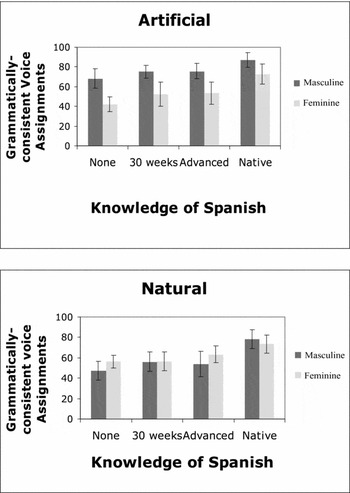
The final ANOVA compared conceptual gender attribution to inanimate objects by beginning learners at time 4, advanced Spanish learners whose first language is English and native Spanish speakers. The data from 102 participants were used in this ANOVA. This ANOVA included the following three factors: group (beginners at time 4, advanced, native), category (natural, artificial) and gender (feminine, masculine). Figure 5 shows the means for each group. Group was a between-subject factor whereas category and gender were within-subject factors. The dependent variable was the same as in the previously described ANOVA, i.e., the percentage of gender-consistent voice assignments. A main effect of group was found (F(2,99) = 16.874, p < .0001). The results of the beginners and advanced groups did not differ significantly from each other overall (60.05% versus 61.63%, respectively), while the outcome of the native group on the voice-assignment task was statistically different from the results of these two groups and is much more concordant with Spanish grammatical gender (77.78%). A main effect of category (F(1,99) = 18.067, p < .0001) also emerged. Overall, all of the groups assigned voices to artificial entities more consistently with Spanish grammatical gender than they did to natural entities: 69.40% versus 63.57%, respectively. A main effect of gender (F(1,99) = 19.177, p < .0001) revealed that the participants produced more gender-consistent judgments for items that were grammatically masculine than for those that were grammatically feminine: 71.03% versus 61.94%, respectively. This pattern mirrors the previously reported findings only among beginners. This ANOVA also yielded a 2-way significant interaction between category and gender (F(1,99) = 54.926, p < .0001) that mirrored the interaction previously described within the beginners. Participants provided the most gender-consistent voice assignments for the artificial masculine items, but within the feminine items more grammatically consistent judgments were found for the natural items (Tukey's HSD, p < .05). A 3-way interaction among group, category and gender (F(2,99) = 4.951, p = .0089) also emerged. This 3-way interaction qualified the effects of the 2-way interaction between gender and category as follows: only the advanced group showed more consistent voice assignments within the feminine items for natural entities (t(26) = 2.80, p < .01). Thus, more advanced knowledge of Spanish leads to an effect of grammatical gender that was not observed among the beginners – an effect of feminine grammatical gender for natural items. The native Spanish speakers’ results on natural feminine and natural masculine items did not differ significantly (t(26) = –1.212). Another way of viewing these findings is that for the native Spanish speakers, the effects of masculine grammatical gender are much more pronounced and uniform than they are in the native English speakers, as they are uniformly strong within all categories. It further suggests that the effects of grammatical gender in adults learning a second language – both those after 30 weeks, and those with more advanced knowledge – are largely in the same direction as the original biases. Early effects (those observed after 30 weeks of Spanish instruction) are strongest for artificial masculine items. Later effects – the effects observed in the advanced group – are strongest for natural feminine items.
The mean percentage of grammatically consistent voice assignments for artificial and natural object categories by the beginners (in the first round of data collection and after 30 weeks of Spanish instruction), the advanced Spanish learners and the native Spanish speakers in the categorization task. The vertical bars represent the standard deviation of each mean.

Participants' justifications
In order to better understand what the participants were thinking during the voice-assignment task, the advanced Spanish learners and native Spanish speakers were asked about their answers. After providing their responses on the voice-assignment task, all of the advanced Spanish learners were asked to state how they assigned voices to the pictures. Seven native English speakers said that they assigned voices according to the stereotypical gender roles in the society: e.g., kitchen – woman, phone – woman, church – man, etc. Some advanced learners commented that they associated certain objects with personified characters from children's cartoons and books. For example, a potato was given male voices because of Mr Potato Head. Six people said that they correlated red/pink colored pictures with femininity and green/blue/black colored pictures with masculinity. Eight respondents indicated that they employed personal experiences as they were assigning voices. For instance, one person's mother had traveled a lot, therefore he associated an airplane with her and consequently assigned a feminine voice to an airplane; his father used to like to ride a bike and that is why he assigned a masculine voice to it. One respondent made an interesting comment: rough and tough = men, warm and cozy = women. Another person said that she was consciously trying not to go by Spanish grammatical gender. One participant indicated that she wanted to go against the gender stereotypes established in our society.
The native Spanish speakers were similarly asked to explain their answers. Nineteen of the 26 native Spanish speakers stated that it was hard for them to determine what made them make certain choices. However, the other seven native speakers said that they always associate inanimate objects with Spanish grammatical gender, thus they assigned voices to them according to Spanish grammatical gender. Therefore, even though all the native Spanish speakers attributed voices consistently with Spanish grammatical gender, only a small number of them were explicitly aware of the basis for their judgments. The native speakers’ explicit knowledge of the reasons for their answers often did not match their answers.
Discussion
We began this research by asking whether the acquisition of Spanish grammatical gender by adult English speakers shapes their categorization of inanimate objects. In order to answer this question, we examined Spanish learners’ assignment of men's and women's voices to inanimate objects before they learned Spanish grammatical gender and as their knowledge of grammatical gender increased. In short, we found that beginning learners began acquiring grammatical gender after ten weeks of instruction and that the acquisition of grammatical gender affected their categorization of inanimate objects most strongly after 20 weeks of instruction. Thus, our findings indicate that learning a second language in adulthood can affect categorization. However, we also found that these effects were different from the effects found in native speakers. This discussion is organized into two parts. In the first part, we focus on the particular pattern of grammatical gender acquisition by the beginning Spanish learners and how this pattern may be related to categorization. In the second part, we discuss the possible reasons for the differences between how language affects categorization in native speakers and in adult second language learners.
Grammatical gender acquisition and categorization
Several notable findings about the acquisition of Spanish grammatical gender by English-speaking adults emerged. One was that all of the significant differences in performance between articles and nouns were found only for the masculine entities across all three categories. A similar advantage for the acquisition of masculine grammatical gender has been reported in a recent study on the acquisition of French grammatical gender by children (Seigneuric, Meunier, Zagar & Spinelli, Reference Seigneuric, Meunier, Zagar and Spinelli2007), which found that French children over the age of nine had a tendency to assign masculine gender to all unfamiliar nouns. Overall, masculine gender seems to be acquired better than feminine gender, which may be explained by a predisposition for learners to use the masculine grammatical gender by default because of its unmarked status. According to the Markedness Differential Hypothesis, “[s]tructures that are simple and/or especially common in human language are said to be unmarked, while structures that are complex or less common are said to be marked” (Archibald, Reference Archibald1998, p.53). Marked forms (e.g., feminine or neuter grammatical gender) are usually harder to learn and therefore they are acquired later by both children and adults. Gass and Selinker (Reference Gass and Selinker2001) provide a clear explanation of this notion:
If we consider words denoting professions, avocations, or societal roles, we see that male terms are the basic ones (e.g., actor, poet, host, hero), whereas the female counterparts have suffixes added on to the male term (actress, poetess, hostess, heroine). The male term is taken to be the basic one (unmarked) and the female term is the marked derivative. (p. 160)
Although Jarvis and Pavlenko (Reference Jarvis and Pavlenko2008, p. 135) have pointed out that Spanish learners may assign masculine (unmarked) grammatical gender as a meaningless default probably because of its simplicity and somewhat greater frequency,Footnote 1 our results suggest that masculine gender was used by the beginners with meaning. We found that early in acquisition, masculine gender was used correctly for people; later it was used correctly for inanimate objects. If it were used as a meaningless default, it would not be used correctly for people earlier and to a greater degree than it was used correctly for inanimate objects. Yet despite the tendency of second language learners to use masculine grammatical gender as a default, their attribution of men's voices to inanimate objects was still not as concordant with Spanish masculine grammatical gender as the native speakers’ attributions.
A related finding was the interaction between the acquisition of nouns and determiners and the semantic categories to which they referred (people versus inanimate entities). The adult English speakers tended to learn determiners for people faster than they learned determiners for inanimate objects. The opposite was found for inanimate entities: nouns were learned faster than determiners. Thus, it appears that even if the learners have not yet acquired a Spanish word identifying a human being, they naturally attribute a biological gender to this person, which in Spanish is expressed by a determiner and usually corresponds to the person's biological sex. In other words, the respondents clearly associated the grammatical gender of the individuals from the category people with their biological sex, and the results across all three times showed that even if learners did not know the noun that referred to certain items, they frequently managed to use correct articles, which indicates that they intuitively sensed the grammatical gender of many animate stimuli by linking it to their biological sex. It is possible that English speakers demonstrated a better knowledge of the grammatical gender of the experimental nouns referring to people because the English language has the pronouns she and he for people, but not for inanimate entities. So they may have transferred this notion from English into Spanish. It may be somewhat surprising that for the inanimate objects beginners performed correctly more often on the nouns than on the articles. This is surprising because according to the general rule, if a noun ends in -a, most likely it has feminine grammatical gender, while the -o ending often indicates masculine gender. Thus, one should be able to guess the article correctly if one knows the noun. So it appears that adult native English speakers are not sensitive to some of the phonological clues that often mark agreement across different parts of speech such as nouns, adjectives, pronouns and determiners. It appears that some beginning learners first acquire vocabulary items that identify inanimate entities without gender, which is encoded in the corresponding articles. These findings may explain some difficulties related to grammatical gender acquisition that adult English speakers experience as they learn other languages.
Our findings also suggest that the category into which the inanimate object falls – artificial or natural – also matters. Within inanimate objects, we found that knowledge of determiners and nouns was acquired faster for the artifacts than for the natural items. We found the same pattern in the categorization task – more grammatically consistent voice assignments for artifacts than for natural kinds. A similar pattern across the two tasks also indicates a link between gender acquisition and conceptual gender. Perhaps because English speakers initially viewed artifacts as male-like, they found it easier to acquire the grammatical (masculine) gender for these items, which in turn influenced their gender concepts. Future work is needed to better understand the timing and causal direction of these effects.
Possible reasons for the limits of language effect in second language learners
Our findings that high and low language learning beginners, and advanced learners, all show similar patterns of categorization indicate that the effects of second language learning on categorization are limited. For neither the beginners nor the advanced learners of Spanish who had been learning Spanish for at least four years did grammatical gender have the same impact as for native speakers. This last finding was unexpected because if proficiency in a language were to determine its impact on categorization, the advanced learners should have shown a significantly greater effect of grammatical gender on categorization than those who had studied Spanish for only two semesters. Moreover, the performance of native Spanish speakers in the categorization task was considerably more concordant with Spanish grammatical gender than the performance of the other two groups. Thus, it appears that for second language learners of Spanish, proficiency level is not as highly correlated with conceptual gender as it is for native speakers.
The impact of grammatical gender was also qualitatively different for second language learners. As previously stated, language effects on categorization among the beginners were primarily observed within artificial entities. The effects of grammatical gender on categorization were stronger for the advanced learners than for the beginners only on naturally occurring feminine items. Though clearly suggesting that effects of language on cognition in second language learning are limited, this particular result, however, rules out the possibility that participants were merely guessing that the task was about grammatical gender, and trying to satisfy the experimenter. If they had made the link between the voice assignment and the determiner and lexical knowledge task due to repeated testing, the outcome should not have been gender-consistent only for certain entities, but rather for all categories. Future work may empirically attempt to rule out the possibility of rote learning of specific items, however. If different object stimuli had been used each time, we would not have been able to infer whether the changes observed over time were due to learning or to the fact that different items were used. Now, given the results of the present study, which suggest that the changes in categorization are due to the learning of Spanish grammatical gender, future work may examine whether the effects of learning are extended to different examples of a particular object by using different pictures of the same objects at each round.
There may be several reasons why the conceptual changes are not the same in adult foreign language learners as in native speakers. This phenomenon may be related to the overall process of second language acquisition in adults: generally adult language learners understand and learn many aspects of language faster than children, but usually they do not acquire their second language as completely as native children do. Some researchers believe that a native language may inhibit a native-like acquisition of a target language (e.g., Bley-Vroman, Reference Bley-Vroman, Gass and Schachter1989). Perhaps conceptual development undergoes an analogous process. Thus, the effects of grammatical gender may be limited in adult foreign language learners because their cognitive concepts have already been formed. Consistent with this explanation is the fact that we found larger effects of gender in the adult learners for categories in which their pre-existing concepts matched Spanish grammatical gender assignment. The beginners made more grammatically consistent judgments in the baseline measure for artificial masculine items; the advanced learners performed the same as the beginners on the artificial items but made more grammatically consistent judgments for the natural feminine items. So it appears that original conceptual biases that English speakers had, which might have resulted in faster acquisition of the genders within certain object categories, also promoted the impact of Spanish grammatical gender on these same categories.
A related reason why gender effects may be limited could be due to the role of cultural factors. The impact of the foreign language's grammatical gender may be constrained by some factors such as cultural biases. For example, Mr Potato Head is a man for many English speakers from the United States, but the noun “potato” has feminine grammatical gender in Spanish. Another relevant finding is that the two groups of beginners, high and low performers on the determiner and lexical knowledge test, performed equivalently on the gender attribution task. Thus, the similarity of culture may be a stronger factor for gender attribution than differences within the beginning Spanish learners in their knowledge of Spanish gender. A final source of evidence that points to the role of culture is the participants’ justifications for their answers. The advanced Spanish learners almost always talked about their cultural experiences when asked to explain their answers, while the native Spanish speakers rarely did so. For the native speakers of English, personal experiences and cultural stereotypes may have suppressed the impact of Spanish grammatical gender on their perceptions of certain objects/categories. Native children may not have the cultural biases that prevent a deeper impact of grammar for adult learners.
A final difference between the language effects in native speakers and those in adult second language learners is the time lag between the language learning process and the effects of that language learning on categorization. Past literature (Seigneuric et al., Reference Seigneuric, Meunier, Zagar and Spinelli2007; Sera et al., Reference Sera, Berge and Del Castillo Pintado1994, Reference Sera, Leieff, Forbes, Clark-Burch, Rodriguez and Poulin-Dubois2002) suggests that for children, grammatical gender effects on categorization do not occur immediately after they acquire grammatical gender in their native language. Children who are native speakers of Spanish do not show these effects until second grade, which is approximately three years after they acquire Spanish grammatical gender (Pérez-Pereira, Reference Pérez-Pereira1991; Sera et al., Reference Sera, Berge and Del Castillo Pintado1994, Reference Sera, Leieff, Forbes, Clark-Burch, Rodriguez and Poulin-Dubois2002). French-speaking children demonstrate a somewhat similar sequence according to Seigneuric et al. (Reference Seigneuric, Meunier, Zagar and Spinelli2007), who found that native French children as young as three years old are quite accurate at grammatical gender markings yet require at least one year before grammatical gender affects their cognition. We found a time lag of up to ten weeks between gender acquisition and the subsequent effects of language on categorization among the beginners, and a significantly shorter time lag between the acquisition of grammatical gender and the impact of grammatical gender on categorization. While overall for the adult beginners the impact occurred within 10 to 30 weeks of them acquiring Spanish grammatical gender, they demonstrated significant progress in the acquisition of the target nouns’ grammatical gender between 10 and 20 weeks of classroom instruction. Nevertheless, most changes in their categorization of inanimate entities in comparison with the baseline data occurred later, between 20 and 30 weeks of Spanish instruction. Yet despite the fact that adult Spanish learners show grammatical gender effects sooner than native children, the correlation between grammatical gender and categorization is much stronger in native speakers than in adult language learners. Thus, the time taken for the development of changes in categorization may affect the amount and the kind of impact that language has on cognition.
The present study on the effects of grammatical gender on cognition contributes empirical data to our knowledge of language effects in bilinguals. As Pavlenko (Reference Pavlenko1999, p. 217) underlines, the relationship between bilingualism and thought may be the best testing ground for the Sapir–Whorf hypothesis. According to Athanasopoulos (Reference Athanasopoulos2009, p. 93), a bilingual context “offers a genuine methodological advantage in that we are able to correlate a range of linguistic and non-linguistic variables with cognitive behavior”. This study was carried out in an effort to investigate further the relationship between language and thought in bilinguals by examining the effects of a grammatical category – gender – on learners’ categorization of inanimate objects. The results of the current study are consistent with the results of several recent studies in adults that have focused on domains of color (Athanasopoulos, Reference Athanasopoulos2009), emotion vocabulary (Pavlenko & Driagina, Reference Pavlenko and Driagina2007), grammatical number and object categorization (Athanasopoulos, Reference Athanasopoulos2007; Cook et al., Reference Cook, Bassetti, Kasai, Sasaki and Takahashi2006) in that they suggest that second language learning “leads to cognitive restructuring in the bilingual mind” (Athanasopoulos, Reference Athanasopoulos2007, p. 689). While the said studies in different bilingual domains (grammatical categories, color, object categorization, emotion vocabulary, etc.) report corroborative evidence, more research is needed to more completely understand the range and limits of the effects of language on cognition in a broad context.
Conclusion
In conclusion, our findings replicate and extend the evidence on the relation between language and cognition. We found that learning a second language as an adult can affect one's categorization of objects. We found that native Spanish speakers demonstrated an effect of grammatical gender on categorization, thus corroborating previous findings (e.g., Flaherty, Reference Flaherty2001; Phillips & Boroditsky, Reference Phillips and Boroditsky2003; Sera et al., Reference Sera, Leieff, Forbes, Clark-Burch, Rodriguez and Poulin-Dubois2002), and that these effects can also be shown in native adult English speakers learning Spanish. These results demonstrate that language (not only native, but also foreign) can influence human cognition. An important implication is that learning a language changes the way one thinks regardless of whether one is a first or a second language learner, or whether the language is learned in early childhood or adulthood. However, our results also indicate that the effects of second language learning on cognition are limited. They differ from the effects in native speakers both qualitatively and quantitatively. The effects differ qualitatively because they were observed only in certain categories (e.g., masculine artificial, feminine natural items). The effects differ quantitatively because even the advanced Spanish learners did not show as much of an effect of language as the native speakers.
In future work it would not be surprising to find that gender effects differ according to the grammatical gender systems of the first and second languages involved. For example, speakers whose native language has grammatical gender categories (e.g., French or German) may show a different pattern than the native English speakers, whose gender category is empty. Likewise, it would be interesting to examine any potential gender effects on categorization in native Spanish speakers learning French, Russian, German, etc. While this is an empirical question, our prediction is that if a learner's first language has a grammatical gender category, they would be less prone to be affected by the second language's grammatical gender pattern. Speaking in Whorfian terms, the “binding power” of one's native language might have been minimized in this case due to the fact that English nouns do not have grammatical gender. Therefore, the respondents were not “bound” to a different cognitive representation of the target nouns. Thus, it would be interesting to examine the binding power of one's first language in the context of the proposed experiment when learners’ native language does have the category of grammatical gender. Clearly, studies in the field of second language acquisition have great potential for the further exploration of how language influences cognition. As proposed by Odlin (Reference Odlin2005), the notion of conceptual transfer is a key point for research in language–thought relations and the field of second language acquisition may contribute a great deal to the study of these issues.