Introduction
Borderline personality disorder (BPD) is one of the most prevalent mental disorders in psychiatric populations (Leichsenring et al. Reference Leichsenring, Leibing, Kruse, New and Leweke2011) and is associated with low quality of life (QoL) (Laurenssen et al. Reference Laurenssen, Eeren, Kikkert, Peen, Westra and Dekker2016), high psychiatric comorbidity (Zanarini et al. Reference Zanarini, Frankenburg, Dubo, Sickel, Trikha and Levin1998), and high socioeconomic burden (Laurenssen et al. Reference Laurenssen, Eeren, Kikkert, Peen, Westra and Dekker2016). Treatment guidelines and meta-analyses (National Institute for Health and Clinical Excellence, 2009; Stoffers et al. Reference Stoffers, Vollm, Rucker, Timmer, Huband and Lieb2012) suggest that day hospital mentalization-based treatment (MBT-DH) (Bateman & Fonagy, Reference Bateman and Fonagy1999, Reference Bateman and Fonagy2004) is a promising treatment for BPD. The goal of MBT-DH is to enhance patients’ mentalizing capacity, particularly in high arousal contexts. The term m entalizing refers to ‘the mental process by which an individual implicitly and explicitly interprets the actions of himself and others as meaningful on the basis of intentional mental states such as personal desires, needs, feelings, beliefs, and reasons’ (Bateman & Fonagy, Reference Bateman and Fonagy2004, p. xxi). Studies suggest that impairments in mentalizing are a core feature of patients with BPD, and are related to problems with affect regulation and attentional control. Hence, improving mentalizing capacity is thought to be associated with a decreased need to rely on maladaptive coping strategies to deal with feelings of inner emptiness, impulsivity, and conflicts in interpersonal relationships, thereby decreasing symptoms and enhancing interpersonal functioning (Bateman & Fonagy, Reference Bateman and Fonagy2004).
Research on the effectiveness of MBT-DH is still relatively scarce. In a sample of 38 BPD patients, Bateman & Fonagy (Reference Bateman and Fonagy1999) compared the effectiveness of MBT-DH with that of treatment as usual (TAU; standard psychiatric care). After 18 months of treatment, MBT-DH was superior to TAU on all major outcome variables, including depressive symptoms, suicide attempts and self-harm, number of inpatient days, and social and interpersonal functioning (Bateman & Fonagy, Reference Bateman and Fonagy1999). These results were maintained during the 18-month follow-up period (Bateman & Fonagy, Reference Bateman and Fonagy2001) up to 5 years after discharge (Bateman & Fonagy, Reference Bateman and Fonagy2008). Two other non-randomized studies, independent from the developers of MBT-DH, have provided further support for MBT-DH. Bales et al. (Reference Bales, van Beek, Smits, Willemsen, Busschbach and Verheul2012) investigated the effectiveness of MBT-DH in a naturalistic study in The Netherlands. They found significant improvements at 18 months treatment on all outcome variables, including a reduction in healthcare consumption. In another study, Bales et al. (Reference Bales, van Beek, Smits, Willemsen, Busschbach and Verheul2012) matched 29 BPD patients receiving MBT-DH to 29 BPD patients receiving other evidence-based psychotherapeutic treatments (OPT) in a non-randomized study. Patients in both MBT-DH and OPT improved on all outcome measures, including psychiatric symptoms and personality functioning at 36-month follow-up. However, at 36-month follow-up, the MBT-DH condition was superior to OPT on all outcome measures except for relational functioning (Bales et al. Reference Bales, van Beek, Smits, Willemsen, Busschbach and Verheul2012).
Existing research concerning the effectiveness of MBT-DH shows limitations beyond its scarcity. These include potential researcher allegiance problems with the generalizability of results to other countries given the large differences in healthcare systems between countries (Bateman & Fonagy, Reference Bateman and Fonagy1999), the lack of a control group, and the use of a non-randomized design (Bales et al. Reference Bales, van Beek, Smits, Willemsen, Busschbach and Verheul2012) in some studies. In addition, Bateman & Fonagy (Reference Bateman and Fonagy1999) compared MBT-DH with general psychiatric care, which does not involve formal psychotherapy. However, formal psychotherapy is the treatment of choice according to treatment guidelines (National Institute for Health and Clinical Excellence, 2009; Stoffers et al. Reference Stoffers, Vollm, Rucker, Timmer, Huband and Lieb2012). Therefore, the present study compared the efficacy of MBT-DH with specialist TAU (S-TAU) involving evidence-based psychotherapy, thus comparing an evidence-based treatment program to another effective treatment (Committee on Comparative Effectiveness Research Prioritization, 2009). Furthermore, recent studies suggest that implementing specialist treatments such as MBT in routine care may be more difficult than initially thought, as implementation problems have shown to negatively influence the outcome of MBT-DH in BPD patients, with effect sizes being two to three times smaller compared with well-implemented MBT-DH (Bales et al. Reference Bales, Timman, Luyten, Busschbach, Verheul and Hutsebaut2017).
The present study thus aimed to further investigate the efficacy of MBT-DH offered by a newly set up service that was trained to deliver MBT-DH, as compared with manualized S-TAU in BPD patients (Laurenssen et al. Reference Laurenssen, Westra, Kikkert, Noom, Eeren and van Broekhuyzen2014b) that was offered by a well-established specialized treatment center and consisted of evidence-based interventions such as dialectical behavior therapy (DBT) and emotion regulation therapy, tailored to the individual needs of patients. The primary hypothesis was that MBT-DH and S-TAU were both associated with significant improvements in primary and secondary outcomes. The primary outcome of this study was the borderline personality disorder severity index (BPDSI). The secondary hypothesis was that MBT-DH would be associated with at least 20% more improvement than S-TAU on the BPDSI at 18 months after the start of the intervention (Laurenssen et al. Reference Laurenssen, Westra, Kikkert, Noom, Eeren and van Broekhuyzen2014b). When this trial was initiated in 2006, TAU for these patients was still quite variable. Hence, we expected MBT-DH to be superior to S-TAU.
Method
Procedures
This study was approved by the Medical Ethics Review Committee of the University of Rotterdam, The Netherlands. For a detailed description of the study protocol, see Laurenssen et al. (Reference Laurenssen, Westra, Kikkert, Noom, Eeren and van Broekhuyzen2014b). Briefly, two mental healthcare centers, both located in Amsterdam, agreed to participate in this study. The City Crisis Service agreed to run the S-TAU condition (see below). From March 2009 to July 2012, patients were referred to one of the two mental healthcare centers in Amsterdam. Patients meeting inclusion criteria were provided with a complete description of the study, after which written informed consent to participate was obtained. Patients agreeing to participate were randomly assigned to either MBT-DH or S-TAU using block randomization taking into account the availability of treatment programs. For this reason, the randomization was slightly skewed in favor of MBT-DH, because the new MBT-DH groups needed to be filled. Randomization was done by an independent researcher, away from the site, using a computer algorithm.
Participants
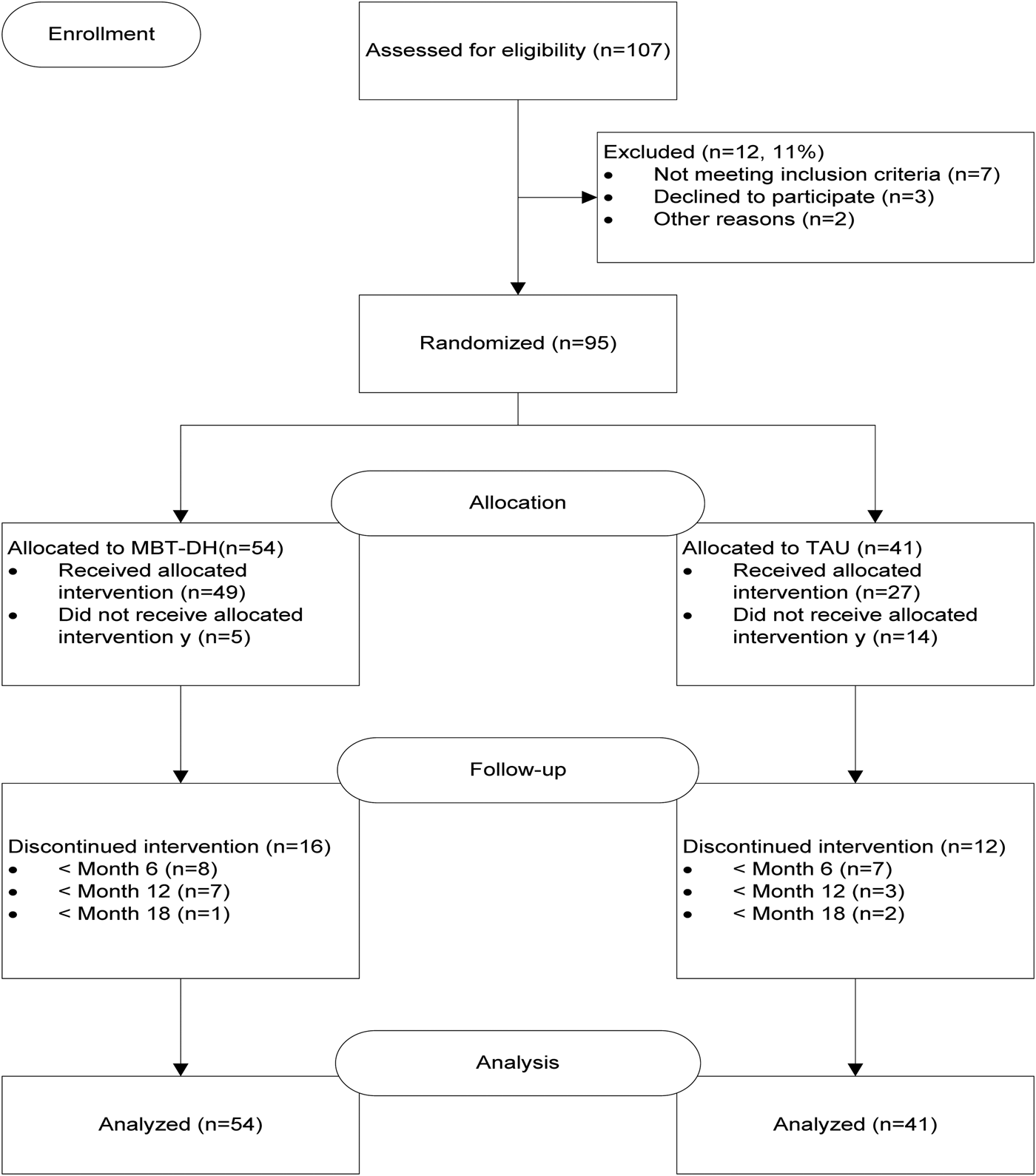
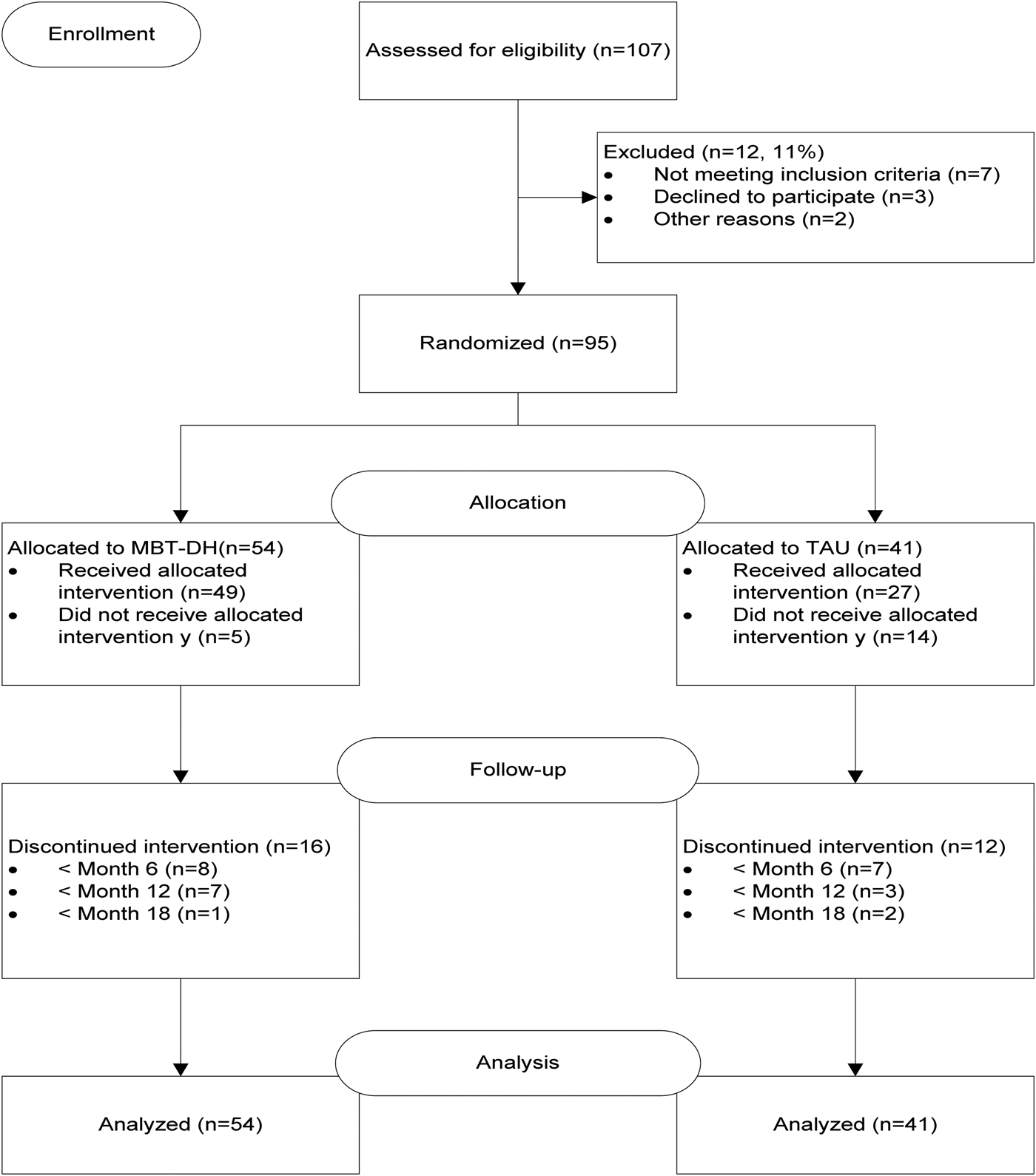
Participants were 95 patients with a BPD diagnosis as assessed with the Structured Clinical Interview for DSM-IV Axis II Personality Disorders (SCID-II) (Weertman et al. Reference Weertman, Arntz and Kerkhofs2000) and a total score on the BPDSI (Arntz et al. Reference Arntz, van den Hoorn, Cornelis, Verheul, van den Bosch and de Bie2003) of at least 20, reflecting severe BPD. Exclusion criteria were the presence of schizophrenia or bipolar disorder, as determined by the Structured Clinical Interview for DSM-IV Axis I Personality Disorders (SCID-I) (Van Groenestijn et al. Reference Van Groenestijn, Akkerhuis, Kupka, Schneider and Nolen1999), substance abuse requiring specialist treatment, organic brain disorder, IQ below 80, and inadequate mastery of the Dutch language. Figure 1 shows the flow of participants through the study.
Flow chart of patient enrollment in the current study.
Assessments
Patients completed the BPDSI, SCID-I and SCID-II before randomization. Other baseline assessments were completed after randomization. Follow-up interviews and assessments were conducted every 6 months until 36-month follow-up. Research assistants were psychologists with an MSc degree, and were blind for treatment condition. The primary outcome measure was the frequency and severity of BPD features as measured by the total score on the BPDSI (Arntz et al. Reference Arntz, van den Hoorn, Cornelis, Verheul, van den Bosch and de Bie2003). The BPDSI is a semi-structured interview, developed to assess BPD features as defined by DSM-IV criteria (American Psychiatric Association, 1994), and consists of the following nine subscales: (a) abandonment, (b) relationships, (c) identity, (d) impulsivity, (e) parasuicidal behavior, (f) affective instability, (g) emptiness, (h) anger-control, and (i) dissociation and paranoid ideation. The BPDSI has been shown to be sensitive to change (Arntz et al. Reference Arntz, van den Hoorn, Cornelis, Verheul, van den Bosch and de Bie2003). In a study of BPD patients, patients with other personality disorders, and patients with only Axis I disorders, the BPDSI was highly reliable [intraclass correlation coefficient (ICC) = 0.93] and internally consistent (Cronbach's α = .85).
Secondary outcome measures were suicide and self-harm, assessed with the Suicide and Self-Harm Inventory (SSHI) (Bateman & Fonagy, Reference Bateman and Fonagy2004), general psychopathological symptoms were measured with the Global Severity Index (GSI), which is part of the Brief Symptom Inventory (BSI) (De Beurs, Reference De Beurs2006), severity of depression was assessed by the Beck Depression Inventory (BDI-I) (Beck et al. Reference Beck, Ward, Mendelson, Mock and Erbaugh1961), interpersonal problems were measured with the Inventory of Interpersonal Problems (IIP-64) (Horowitz et al. Reference Horowitz, Alden, Wiggins and Pincus2000), BPD characteristics were assessed by the Dutch version of the Personality Assessment Inventory-Borderline (PAI-BOR) (Distel et al. Reference Distel, De Moor and Boomsma2009), and QoL was measured using the EuroQol EQ-5D-3L (Busschbach et al. Reference Busschbach, McDonnell, Essink-Bot and van Hout1999). Preliminary screening of the data showed substantial differences in the administration of the SSHI between research assistants, and therefore we decided not to report data using this measure.
Treatment conditions
MBT-DH
MBT-DH consists of a highly structured day hospitalization program with a maximum duration of 18 months, covering 5 days/week, approximately 6 h/day. The treatment consists of the following components: daily group psychotherapy, weekly individual psychotherapy, individual crisis planning, art therapy twice a week, mentalizing cognitive group therapy, and writing therapy. Each week's program ends with a social hour and a community meeting. Patients can also consult a psychiatrist upon request and medication is prescribed following American Psychiatric Association guidelines (American Psychiatric Association, 2000). MBT-DH has been described in more detail elsewhere (Bateman & Fonagy, Reference Bateman and Fonagy2004).
As noted, therapists offering MBT-DH were specifically trained for this study. Team members were certified and registered psychologists, psychotherapists, a psychiatrist, sociotherapists, and a creative therapist, who volunteered to be trained in MBT-DH, and followed a 2-day MBT training program led by a certified MBT trainer. Although therapists trained in MBT were not already familiar with MBT, they were highly experienced in delivering treatment to patients with BPD. In addition, a certified MBT psychotherapist, a sociotherapist, and creative therapist supervised the team for the first week. Adherence to MBT was monitored in several ways: by daily group reflections after group therapy, fortnightly team supervisions, 2-monthly individual supervision for the team leader and psychotherapist, and 2-monthly group supervision for the sociotherapists and creative therapist. Supervisions were based on principles outlined in the MBT quality manual that was being developed at the time of the study (Karterud et al. Reference Karterud, Pedersen, Engen, Johansen, Johansson and Schluter2013). The mean number of days in MBT-DH was 176 (range 5–402, median = 149). The mean number of hours in MBT-DH was 1056 (range 30–2412, median = 894).
S-TAU
The S-TAU was offered by a well-established treatment service that has been involved in the treatment of BPD patients since the 1980s. The treatment consists of a manualized, integrative approach in which both psychiatric treatment and a systemic therapy approach play a central role (for a detailed description, see Van Oenen et al. Reference Van Oenen, Bernardt and Van der Post2007). Its main aim is to deliver optimal care based on an extensive psychiatric examination by offering ‘system-oriented tailored care’, meaning that the optimal combination and intensity of interventions for each client is determined during an extensive assessment phase, which also focused on offering emotional and practical support and structure. Patients were subsequently referred to evidence-based treatments that have no explicit focus on fostering mentalizing, such as emotion regulation therapy, DBT, outpatient treatment for eating disorders, individual cognitive therapy, aggression regulation group treatment and/or inpatient treatment, depending on the needs of the patient. Inpatient treatment is offered in a hospital ward and involves individual and group therapy. Patients may also be referred to other centers for treatment targeting specific problem areas (e.g. drug addiction). Similarly, outreaching interventions are often used to facilitate change in the patient's environment. If patients preferred to be treated nearer to the area where they lived, they were referred to a specialist treatment provider nearer to their homes. The core team offering S-TAU consisted of five psychiatrists, two psychologists, five mental health nurses, and one systemic therapist, with between 5 and 10 years’ experience in offering this treatment. Team members were able to consult a psychiatrist on a daily basis. No systematic assessment of adherence was available because of the wide variety of treatments offered. The mean number of hours in S-TAU was 1473 (range 5–13099, median = 131). Three patients in the S-TAU condition had inpatient treatment.
Statistical analysis
All analyses were carried out using Stata Statistical Software Release 12 (StataCorp, 2011) and R (Amelia-2 for R version 3.2.1 + ) (Honaker et al. Reference Honaker, King and Blackwell2011). The primary data analysis was done based on intention-to-treat principles. The XTMIXED procedure was used to analyze treatment differences and changes over time. The four-time points were coded as −3, −2, −1, and 0 in all models for which 6-monthly data were available, thereby implying that regression coefficients involving time measured the rate of change from baseline to 18-month follow-up and that regression intercepts referenced group differences at the last follow-up point. As non-linear change effects over time were found in preliminary analyses, a quadratic time variable was added to all models to accommodate the non-linear change over time. In case the quadratic model was significant as well, a cubic time variable was added to the model. However, quadratic and cubic time variables were removed if the likelihood ratio test showed non-significant improvement in fit. Model parameters presented in this paper are (a) the overall significance of the model (Wald χ2 statistic); (b) the rate of change from baseline to 18 months for both groups combined; (c) the differential rate of change for the MBT-DH group, compared with the S-TAU group; and (d) group differences at 6-, 12-, and 18-month follow-up. Effect sizes were calculated in terms of Cohen's d. Differences at baseline were explored using univariate statistics. The sample size was determined based on a power analysis. With 54 patients per group, an effect size of at least 0.65 on the BPDSI could be detected with a power of 92% (α = 0.05, β = 0.083), which reflects a reasonable, realistic, and clinically relevant effect (Laurenssen et al. Reference Laurenssen, Westra, Kikkert, Noom, Eeren and van Broekhuyzen2014b). Because of the randomization procedure, 54 patients were referred to MBT-DH and 41 patients to S-TAU, resulting in a power of 88.2%.
As in most treatment studies with BPD patients, missing data were considerable in this study (approximately 45% across both conditions and all measurement times); we, therefore, decided to rerun all analyses on an imputed dataset. The multiple imputation software Amelia-2 (for R version 3.2.1+) was used to deal with missing data (Honaker et al. Reference Honaker, King and Blackwell2011). Simulation studies have indicated that this software package can yield valid estimates of missingness at random in longitudinal data, even if outcome data are skewed or dichotomous (Blankers et al. Reference Blankers, Koeter and Schippers2010). Five instances of missing data in the original dataset were imputed. In order to impute with non-linear trends over time, time was added as a second-degree polynomial variable. After the imputation process, analyses were performed on each of the five datasets separately. In a final step, results from these five analyses were combined using Rubin's rules for combining estimates obtained from multiple imputed datasets (Rubin, Reference Rubin1987). Estimated trajectories of change and effect sizes were highly similar based on the imputed and non-imputed data. In this paper, we, therefore, report only results based on the non-imputed dataset. Results for the imputed dataset are available upon request from the first author.
Results
Descriptive features and dropout
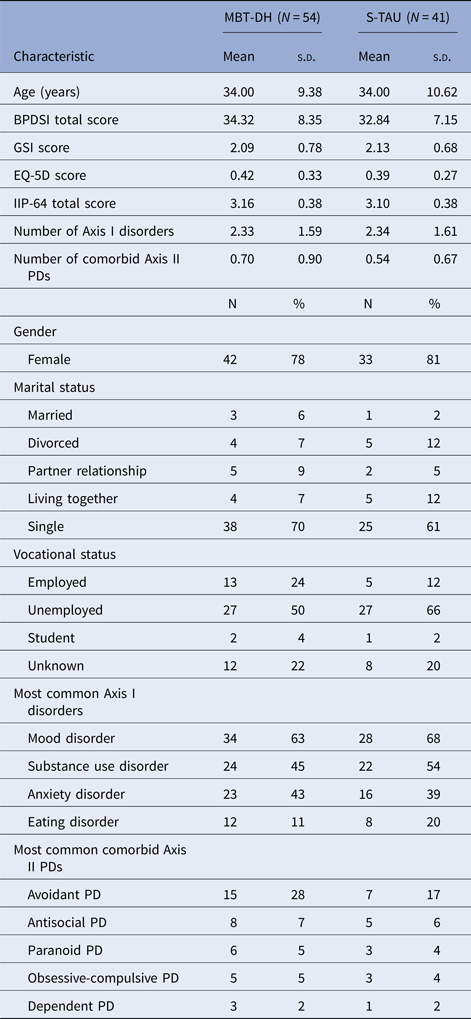
The treatment groups did not significantly differ from each other on any of the baseline variables (see Table 1). Five patients (9%) in the MBT-DH group v. 14 patients (34%) in the S-TAU group never started treatment or refused to participate in the study after randomization; this difference between both groups was significant: χ2(1) = 9.02, p = .003. Of the patients who started treatment, 39% (n = 16) in the MBT-DH group and 44% (n = 12) the S-TAU group dropped out; this difference was not significant: χ2(1) = 1.04, p = 0.31. No serious adverse events occurred during the trial.
Baseline demographic and clinical characteristics

MBT-DH, day hospital mentalization-based treatment; S-TAU, specialist treatment as usual; s.d., standard deviation; BPDSI, borderline personality disorder severity index; GSI, global severity index; IIP-64, inventory of interpersonal problems; PD, personality disorder.
Primary outcome
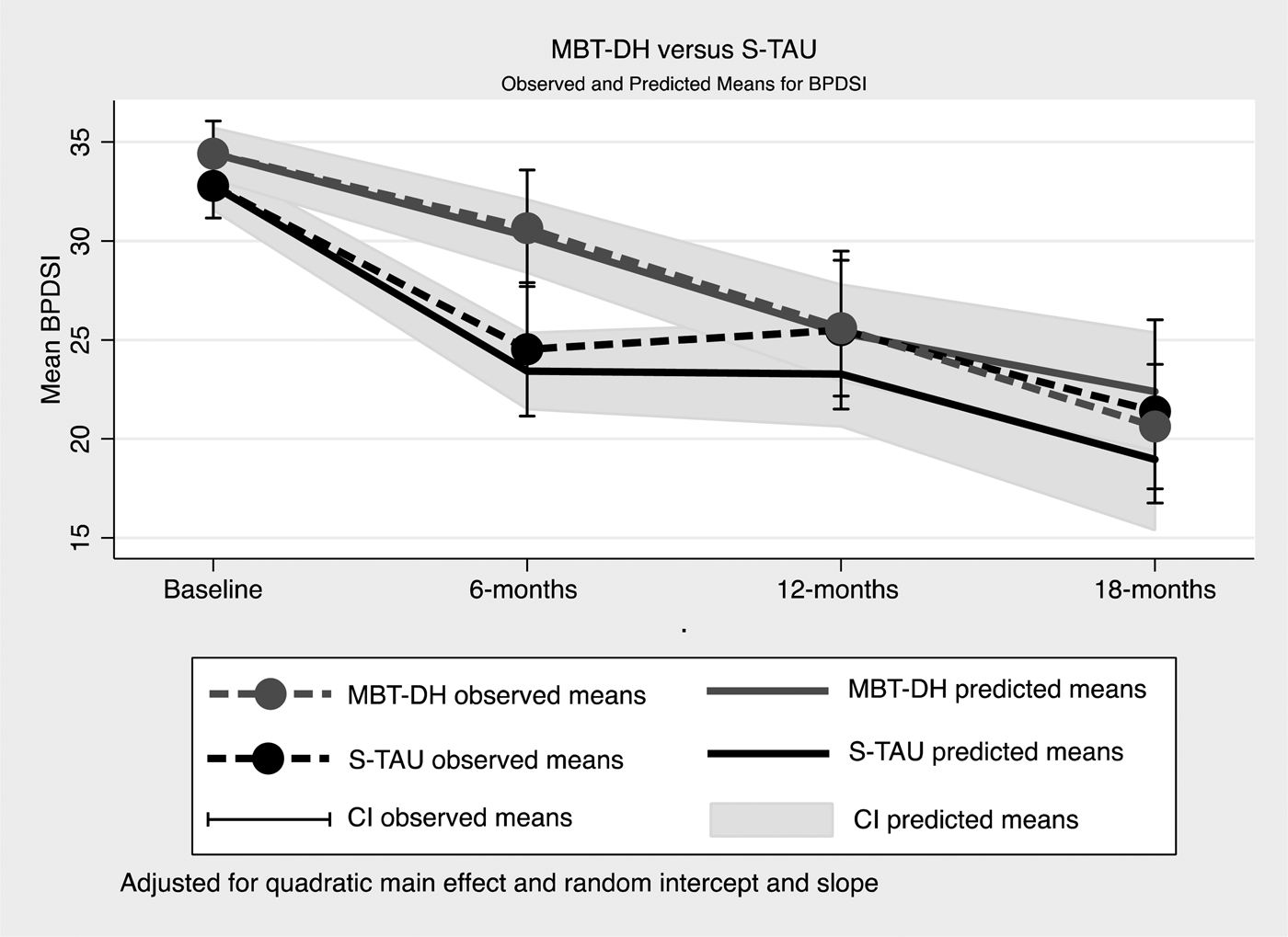
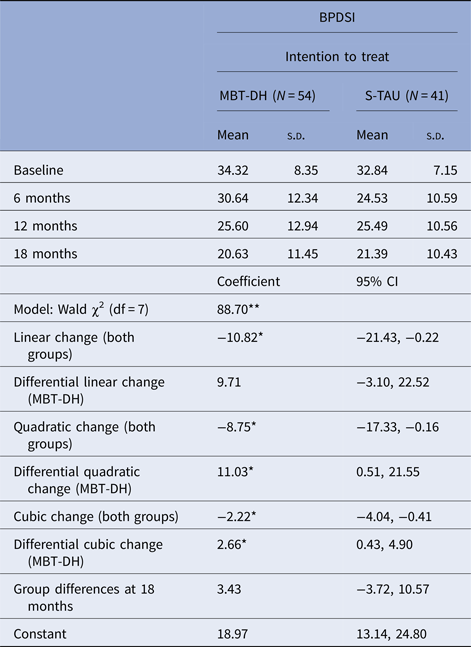
A cubic random intercepts and slopes model best fitted the change in the BPDSI (see Table 2 and Fig. 2). Both groups showed significant reductions on the BPDSI. The within-group effect sizes were large for both MBT-DH (d = 1.33) and S-TAU (d = 1.28). However, MT-DH and S-TAU showed a very different pattern of change over time. MBT-DH followed a linear pattern from baseline to 18-month follow-up, whereas S-TAU initially showed a steeper decrease in BPDSI scores; this was also apparent from the finding that at 6-month follow-up, scores on the BPDSI were significantly lower in S-TAU than in MBT. However, this steeper linear decrease for S-TAU was modified by a cubic and quadratic trend after 6 months, and at 12- and 18-month follow-up, there were no longer any differences between the two groups.
Scores on the BPDSI for both groups over time.

Results from mixed-effects random regression models for the primary outcome, BPDSI

MBT-DH, day hospital mentalization-based treatment; S-TAU, specialist treatment as usual; s.d., standard deviation; BPDSI, borderline personality disorder severity index; CI, confidence interval.
*p < 0.05, **p < 0.01, ***p < 0.001.
Secondary outcomes
A linear random intercepts and slopes model best fitted the trajectories of change in the BDI, GSI, EQ-5D, PAI-BOR, and IIP-64. Both MBT-DH and S-TAU showed a significant improvement on all secondary outcome measures at 18-month follow-up. There were no significant differences between the two groups on any of the secondary outcome measures at 18-month follow-up, nor was evidence found for differential rates of change between conditions. All within-group pretreatment–posttreatment effect sizes were moderate to large, with the exception of changes in the EQ-5D, which were small to moderate in MBT-DH (online Supplementary Table S3; see data supplement).
Discussion
The non-superiority of MBT-DH over S-TAU as found in this study is consistent with increasing evidence that well-specified treatments for BPD that are delivered in a consistent, coherent, and continuous way tend to be equally effective, irrespective of their theoretical orientation. This has been shown in recent trials comparing outpatient MBT (Bateman & Fonagy, Reference Bateman and Fonagy2009), DBT (McMain et al. Reference McMain, Guimond, Streiner, Cardish and Links2012), transference-focused psychotherapy (Clarkin et al. Reference Clarkin, Levy, Lenzenweger and Kernberg2007), and cognitive analytic therapy (Chanen et al. Reference Chanen, Jackson, McCutcheon, Jovev, Dudgeon and Yuen2008), with other treatments that meet the criteria of consistent, coherent, and continuous treatment delivery. Several studies have suggested that impairments in mentalizing are a core feature of patients with BPD, and are related to problems with affect regulation and attentional control. One of the main key ingredients of MBT is its focus on improving patients’ mentalizing. This explicit focus on mentalizing was not a core component of treatments in the S-TAU condition. Yet, as mentalizing has been proposed to be a common mechanism of change in all effective treatments for BPD (Cristea et al. Reference Cristea, Gentili, Cotet, Palomba, Barbui and Cuijpers2017; Fonagy et al. Reference Fonagy, Luyten, Allison and Campbell2017a, Reference Fonagy, Luyten, Allison and Campbellb, Reference Fonagy, Luyten and Batemanc), it cannot be excluded that mentalizing were related to changes in both conditions. This will be the focus of a separate paper.
A major finding of this study, in this context, was the significantly higher dropout immediately after randomization in the S-TAU condition (34%) than in MBT-DH (9%). This could be the result of differences in the way that patients perceived the two interventions. Patients allocated to S-TAU were told that they would receive treatment that was specifically tailored to their needs, meaning that the frequency, duration, and even treatment location was not clear from the outset. In MBT-DH, by contrast, a clear treatment plan, including the frequency and length of treatment, was presented from the start of the treatment. This may have had a greater appeal for the participants; because of BPD patients’ need for consistency and coherence (Fonagy et al. Reference Fonagy, Luyten and Allison2015).
Taken together, these findings stress the need for further research on the role of treatment-specific factors and techniques v. whether these treatment-specific techniques are delivered in a consistent, coherent, and continuous way (Fonagy et al. Reference Fonagy, Luyten and Allison2015). Consistent with the latter assumption, a number of integrative treatment approaches for BPD have recently been proposed that primarily focus on common effective principles and coherence of the treatment approach (Livesley, Reference Livesley2012; Bateman & Krawitz, Reference Bateman and Krawitz2013).
Given that MBT-DH was provided by a newly set-up service, implementation issues may have mitigated the treatment effects of MBT-DH. Although therapists trained in MBT were highly experienced clinicians, they had almost no prior experience with MBT. Therapists were, however, trained and supervised by a certified MBT trainer, and their adherence to the MBT model was rated as acceptable. However, we cannot exclude the possibility that this lack of experience with MBT may have had an impact on the outcome of MBT-DH when compared with S-TAU, particularly as the S-TAU was well-established and administered by professionals with years of experience with their approach. In addition, one of the sites (Arkin) that offered MBT-DH went through an intensive internal reorganization during the trial, which led to uncertainty whether MBT-DH could continue to be offered. A recent study in this context showed that effect sizes of MBT offered in a service undergoing reorganization may be half or even only a third of those observed in well-implemented MBT (Bales et al. Reference Bales, Timman, Luyten, Busschbach, Verheul and Hutsebaut2017). Although secondary analyses yielded no significant differences in outcome between the two MBT-DH sites in this trial, this analysis was underpowered for such a comparison, and therefore we cannot rule out the possibility that the outcome of MBT-DH, when compared with S-TAU, was mitigated because of these organization issues. In the current study, although the effect size obtained on the primary outcome measure was comparable with those reported in earlier research on MBT-DH, effect sizes on several secondary outcomes were substantially lower than in other trials of MBT-DH (Bateman & Fonagy, Reference Bateman and Fonagy1999; Bales et al. Reference Bales, van Beek, Smits, Willemsen, Busschbach and Verheul2012, Reference Bales, Timman, Andrea, Busschbach, Verheul and Kamphuis2015), which may indeed point to implementation and adherence problems in the MBT condition. This was particularly the case for interpersonal functioning and quality of life. Although this may reflect a chance finding, one additional possible explanation is that because MBT-DH involves patients attending treatment on 5 days a week, it may limit these patients’ ability to experiment with new ways of thinking, feeling, and behaving in the outside world. This interpretation is consistent with the recent emphasis on step-down programs in the treatment of BPD and the focus on fostering recovery of the capacity for social learning and salutogenesis (the capacity to benefit from positive features in the environment) in these patients (Fonagy et al. Reference Fonagy, Luyten and Allison2015). Future research is needed to investigate these assumptions. Results from an on-going trial comparing MBT-DH with an intensive outpatient MBT treatment (MBT-IOP), promise to shed more light on the effects of hospitalization in MBT (Laurenssen et al. Reference Laurenssen, Smits, Bales, Feenstra, Eeren and Noom2014a). With regard to identifying future training needs and the cost-effective provision of services for BPD patients, it should be noted that MBT was associated with equivalent outcomes with therapists receiving only 2 days of training and subsequent supervision, compared with a well-organized service with considerable experience in treating these patients.
A major strength of the study is that it is the first independent study to compare MBT-DH with a well-established specialist TAU. However, the study also has several limitations. First, the randomization was slightly skewed in favor of MBT-DH, because the new MBT-DH groups needed to be filled. Nevertheless, there were no baseline differences between patients in MBT-DH and S-TAU. Second, the baseline assessment of secondary outcome measures was performed after randomization. The outcome of the randomization may, therefore, have had some effects on this baseline assessment. Third, there was no quantitative assessment of treatment adherence. Although the team was supervised by a certified MBT therapist following principles outlined in a quality manual in order to obtain adherence to the MBT protocol (Bateman et al. Reference Bateman, Bales and Hutsebaut2012), there was no formal assessment of treatment adherence. Given that adherence to the MBT model has been positively associated with treatment outcome (Bales et al. Reference Bales, Timman, Luyten, Busschbach, Verheul and Hutsebaut2017), this is an important limitation of this study. In combination with the implementation problems of MBT in the current study, if anything, this study may have underestimated the effects of MBT. Fourth, dropout during treatment was relatively high, although comparable with other studies in the field (Giesen-Bloo et al. Reference Giesen-Bloo, van Dyck, Spinhoven, van Tilburg, Dirksen and van Asselt2006; Blum et al. Reference Blum, St John, Pfohl, Stuart, McCormick and Allen2008). To address this issue, we conducted post-hoc analyses comparing effect sizes based on imputed and non-imputed data, and on both the intention-to-treat and completer samples. Results were highly comparable. Fifth, the effects of both treatments may differ at longer follow-ups. This will be the focus of a future report. In this context, issues concerning cost-effectiveness may also be important. Sixth, in hindsight, given that meta-analyses carried out since this study was designed to have shown that there are very few, if any, differences in the effectiveness of well-organized treatments such as those investigated in this paper (Cristea et al. Reference Cristea, Gentili, Cotet, Palomba, Barbui and Cuijpers2017), the current study may have been underpowered to detect meaningful differences between the two treatments investigated in this study. Yet, at the same time, it may be questionable whether such small differences would be clinically meaningful. Seventh, the TAU comparison in this study is likely not to be representative of TAU for patients with BPD in many countries, where the quality of TAU for BPD patients may be much more variable. On the one hand, this limits the generalizability of the results of this study. On the other hand, this further emphasizes the need to implement well-organized treatments for these patients, such as MBT and the S-TAU treatment used in this study. Finally, future studies should address similarities and potential differences in the mechanisms of change of both treatments.
In conclusion, the current study suggests that MBT-DH is equally effective compared with a well-specified S-TAU in the treatment of BPD at 18-month follow-up. In addition, although presenting BPD patients with the option that their treatment will be tailored to their specific needs may be appealing, the lack of a clear treatment plan including frequency and length may have a negative impact on the engagement and motivation of patients with BPD. Yet, at the same time, the implementation of MBT-DH in a new setting may be challenging, as it may threaten the coherence and consistency of the treatment approach, which may in turn also mitigate treatment effects. Indeed, a recent study showed that effect sizes associated with MBT delivered during an organizational reorganization were only one-third of those observed under more optimal organizational conditions (Bales et al. Reference Bales, Timman, Luyten, Busschbach, Verheul and Hutsebaut2017). In this respect, this study may have underestimated the effectiveness of MBT. More positively formulated, however, this study suggests that MBT, as delivered by therapists who are new to the model and who receive a 2-day training and regular supervision, is associated with effects similar to a well-established treatment service offering other evidence-based interventions for BPD patients. This finding may have important implications in terms of cost-effectiveness of training and service delivery in this area. Further research into these issues is needed, as well as studies of the cost-effectiveness and longer-term outcome of both treatments. This will be the focus of a future report.
Supplementary material
The supplementary material for this article can be found at https://doi.org/10.1017/S0033291718000132
Acknowledgements
We would like to thank Laura Bakker, Carolien Christ, and Isabel Alvarez Perez for their hard work in collecting the data. We are also most grateful to all the patients who participated in this study. This study is in part funded by ZonMW, the Netherlands Organization for Health Research and Development (grant no. 171002402).
Declaration of Interest
Patrick Luyten has been involved in the training and dissemination of mentalization-based treatments. The other authors declare no competing interests.