Implications
In the West-Mediterranean grazing systems, terpenes and terpenoids, the primary constituents of essential oils in plants of the class Magnolopsida, are ingested by small ruminants kept on rangelands, and they are partly transferred to milk and cheese. They have been associated with changes in the sensorial profile of cheeses. Quantifying their metabolism by rumen microbiota in relation with their structural properties can contribute to a better understanding of the mechanisms of their transfer from plant to animal products.
Introduction
The dairy goat livestock system in Basilicata (southern Appennine range, Italy) is typical of West-Mediterranean grazing systems, as it relies on the use of rangelands of wide botanical diversity associated with a marked seasonality in plant resources (Fedele et al., Reference Fedele, Claps, Rubino, Sepe and Cifuni2005). Grazing plants of the class Magnolopsida, with high contents of essential oils, supply goats with mono- and sesquiterpenes, as well as monoterpenoids. Once ingested, the terpenes (TERP) or their derivatives are partly transferred from plant to milk and cheese (Fedele et al., Reference Fedele, Claps, Rubino, Sepe and Cifuni2004; Chion et al., Reference Chion, Tabacco, Giaccone, Peiretti, Battelli and Borreani2010). Once in milk, some, such as α-campholenal, are susceptible to biotransformation by lactic acid bacteria (Belviso et al., Reference Belviso, Giordano, Dolci and Zeppa2011) and are associated with changes in the sensorial profile of cheeses (Addis et al., Reference Addis, Pinna, Molle, Fiori, Spada, Decandia, Scintu, Piredda and Pirisi2006). Terpenes and terpenoids transfer rates vary with grazing conditions, in possible relation with the nutritional value of grazed herbage (Fedele et al., Reference Fedele, Claps, Rubino, Sepe and Cifuni2004), but the factors controlling these transfers are not fully identified, and information is required on the metabolic fate of these molecules in the rumen, in particular on their individual degradation rates.
In this study, nine monoterpene hydrocarbons (δ-3-carene, p-cymene, β-myrcene, (E)- and (Z)-β-ocimene, α-phellandrene, α-terpinene, γ-terpinene and α-terpinolene), one sesquiterpene hydrocarbon (β-cedrene) and four terpenoids ((E)- and (Z)-linalool oxide, 4-terpinenol, α + γ terpineol) were examined for their susceptibility to degradation by the rumen microflora of goats in vitro. These molecules were identified as major terpenes and terpenoids in the plants grazed by lactating goats during winter and spring in Basilicata (Fedele et al., Reference Fedele, Claps, Rubino, Sepe and Cifuni2005). In order to evaluate the terpene degradation capacity of rumen microflora, the molecules were tested at a high input concentration.
Material and methods
Incubation procedure
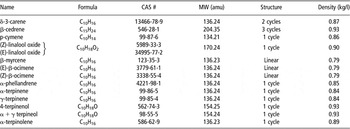
Goat care and use procedures were approved by the French Ministry of Agriculture in agreement with the French regulations for animal experimentation (guideline 19/04/1988). All terpenes and terpenoids, which were oxygenated monoterpenes, were of chromatographic grade (Roth-Sochiel Sarl, Lauterbourg, France and Extrasynthèse SA, Genay, France). Their characteristics are given in Table 1. In order to facilitate reading of this paper, the term ‘terpene’ will designate in the remaining text both terpenes and terpenoids. The TERP were individually tested at the concentration of 0.5 ml/l of incubation medium in 24-h incubations with mixed rumen bacteria during 3 consecutive days. On each incubation day, five culture tubes were also inoculated without the addition of terpene and used as controls (CTRL). Initial molar concentrations were similar among monoterpenes, from 2.64 to 3.27 mmol/l. The lowest value was 2.28 mmol/l for β-cedrene. Culture tubes of 70 ml, sealed with rubber/polytetrafluoroethylene (PTFE)-lined screw caps ,were used for batch incubations. The culture tubes assigned to the two treatments, CTRL and TERP, were inoculated with defaunated dual-flow fermenter contents.
Characteristics of the terpenes and terpenoids tested

CAS = chemical number; MW = molecular weight.
Ten days before batch incubations, 1.5 l of rumen contents were taken from four goats of Saanen and French-Alpine breeds fitted with a ruminal cannula. The goats were housed in the laboratory animal facilities at Grignon (France) and fed ad libitum a total mixed ration composed of 340 g/kg dehydrated grinded alfalfa, 140 g/kg grass hay, 310 g/kg beet pulp silage and 210 g/kg commercial concentrate. The rumen contents were immediately pooled and stored air-tight at −20°C for 3 days in order to eliminate ciliate protozoa (Jouany et al., Reference Jouany, Demeyer and Grain1988), and thus increase bacterial numbers before terpene incubations. The study was focused on mixed bacteria associated with rumen contents because most terpenes and terpenoids are poorly soluble in water (Weidenhamer et al., Reference Weidenhamer, Macias, Fischer and Williamson1993) and are supposed to adsorb onto particulate matter, that is, beyond the reach of ciliate protozoa. Further, plant terpene degradation by anaerobic protozoa has never been reported to our knowledge. The defaunating method used appeared to be the most appropriate to meet our experimental needs as it does not alter rumen microflora in a permanent way, as shown by the lack of difference between untreated and refaunated animals (Jouany et al., Reference Jouany, Demeyer and Grain1988). Rumen contents were then thawed and warmed at 39°C under anaerobic conditions before being introduced into four dual-flow continuous culture fermenters (working volume of 1.1 l). The dual-flow continuous culture fermenters were run for 9 days at 39°C. At 1100 and 2300 h each day they received 15 g of a pelleted diet (orchardgrass hay 650 g/kg, maize grains 200 g/kg, soyabean meal 150 g/kg). They were continuously infused with a mineral buffer (artificial saliva) solution, whose mineral composition is detailed in Broudiscou et al. (Reference Broudiscou, Papon and Broudiscou1999). The artificial saliva contained 0.15 g/l HCl-Cysteine as a reducing agent. The dilution rates of particle and liquid phases were set at 0.03 and 0.06/h. The absence of protozoa in fermentation media was regularly checked by microscopic observation (Broudiscou et al., Reference Broudiscou, Papon, Fabre and Broudiscou1997).
All compounds were batch incubated on each of 3 consecutive days (n = 3 replicates). On every day of incubation, cellobiose (0.15 mol/l), maltose (0.15 mol/l), tryptone (6.25 g/l), (NH4)2SO4 (2.36 g/l) and (NH4)H2PO4 (8.216 g/l) were solubilised in artificial saliva (Broudiscou et al., Reference Broudiscou, Papon and Broudiscou1999) at pH 6.8. The resulting nutrient solution met the nutritional requirements of rumen micro-organisms (Broudiscou and Jouany, Reference Broudiscou and Jouany1995) by providing 0.6 mmol hexoses, 5 mg N and 1.14 mg S per tube. Contents (300 g per fermenter) were anaerobically taken at 11 : 30 from the four dual-flow continuous culture fermenters, pooled and filtered through a 250 μm mesh nylon gauze. Each culture tube was then inoculated under CO2 atmosphere with 2 ml of nutrient solution and 8 ml of microbial inoculum. The terpenes were immediately added and the tubes were tightly sealed with rubber/PTFE-lined screw caps and were kept in a stirring water bath (100 r.p.m., 39°C ± 0.5). After 24 h of incubation, they were cooled at +4°C for 1 h in order to condense the terpenes before opening.
Chemical analyses
The tube contents were processed through a three-step liquid–liquid extraction procedure derived from Rutledge (Reference Rutledge1981). Immediately before extraction, individual terpenes were added to the CTRL culture tubes in identical amounts as in terpenes culture tubes. The extraction of known amounts of terpenes from similar matrices was necessary in order for comparisons to be made without bias. The fermentation broths resulting from CTRL culture tubes were thus used as matrices in the determination of initial terpene contents in culture tubes, allowing correction of terpene disappearance rates for the actual recovery rates during liquid–liquid extraction. Each tube content was thoroughly mixed with 4 ml dichloromethane/methanol 2/1 (v/v), centrifuged at 2000×g for 7 min and the organic phase was collected. The extraction step was repeated once with 4 ml dichloromethane/methanol 2/1 (v/v), then with 2 ml dichloromethane. The organic extracts were pooled, washed with 4 ml NaCl-saturated water, dried by filtration through a phase-separation filter paper and the volume was adjusted to 10 ml with dichloromethane. The extracts were stored air-tight at −20°C until analysis.
We separated the terpenes using a gas chromatograph Varian GC 3400 CX equipped with a flame ionisation detector, and CP-Sil 5 CB column (25 m length, 0.25 mm internal diameter, 0.25 μm film thickness, Varian SA, Les Ulis, France) with helium N55 as the carrier gas. The oven temperature, initially at 60°C for 1 min, was raised at the rate of 10°C/min up to 160°C, then at the rate of 40°C/min up to 200°C and finally held at 200°C for 1 min. The injector and detector temperatures were set at 200°C and 300°C, respectively. The peaks were identified by their retention times, which were determined by injection of individual terpenes of chromatographic grade in dichloromethane solution. The absence of interfering peaks at the retention times of the tested compounds was checked by the analysis of blanks extracted from fermenter broths.
Statistical analyses
Chromatographic results were subjected to ANOVA using a GLM procedure (Minitab, 1998). The response variables were peak area values, expressed in arbitrary units. The fixed factors were treatment (TERP v. CRTL) and day. We performed mean comparisons using Fisher's least-significance-difference test.
Results
The supply of terpenes in culture tubes at levels as high as 3.27 μmol/ml was required to screen these molecules on their degradabilities by mixed rumen bacteria from dairy goats, and approximate the maximal disappearance rates possible in the rumen ecosystem. Our supply rates were within the limits of published in vitro assays on rumen microbial fermentation in the presence of TERP (Rutledge, Reference Rutledge1981; Castillejos et al., Reference Castillejos, Calsamiglia and Ferret2006), and matched the highest experimental conditions reported in vivo 3 g per day in goats and sheep (Narjisse, Reference Narjisse1982), 0.5 g per day in lambs (Estell et al., Reference Estell, Fredrickson, Anderson, Havstad and Remmenga2002).
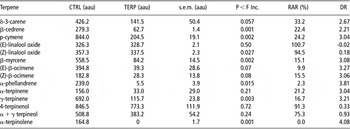
Incubation data are presented in Table 2. The amounts of individual terpene recovered after 24-h incubations varied from 0% to 100% of the initial amounts. Oxygen-containing compounds were the least degraded; that is, (E)-linalool oxide remained intact, whereas 91%, 95% and 75% of the initial amounts of 4-terpinenol, (Z)-linalool oxide and α + γ terpineol were recovered at the end of the incubation. In contrast, α-terpinolene concentration in fermentation broth extracts was below quantification limit, thus indicating an extensive, if not complete, degradation by rumen bacteria. Only 2% of the initial amounts of α-phellandrene were recovered. The other monoterpenes and β-cedrene were partly degraded, with losses ranging from 67% for δ-3-carene to 90% for (E)-β-ocimene. The corresponding rates of disappearance were comprised between 2.67 and 4.08 μmol/ml inoculum per day.
ANOVA of chromatographic results in TERP and CTRL incubations, RAR after 24-h incubations and DR of individual terpenes (μmol/ml inoculum per day)

TERP = terpenes; CTRL = controls; RAR = relative amounts recovery; DR = disappearance rates; aau = arbitrary peak area units; s.e.m. = standard error of the mean.
P < F Inc.: significance level of the differences for the treatment (TERP v. CTRL).
Discussion
In Basilicata, the plant species mostly grazed by dairy goats during spring are Lolium perenne L., Poa pratensis L., Medicago polymorpha L., Medicago lupulina L., Asperula odorata L. and Geranium molle L., which contribute approximately 10%, 6%, 13%, 8%, 12% and 8% of the diet, respectively (Fedele et al., Reference Fedele, Claps, Rubino, Sepe and Cifuni2005). These authors reported that the plants belonging to the class Magnolopsida (formerly dicotyledons) accounted for 36.5% of the biomass ingested. The winter diet was dominated by Graminacea, mostly L. perenne L. and Dactylis glomerata L., whereas Magnolopsida accounted for only 8% of the ingested plants. Among the compounds tested, p-cymene and α-phellandrene were detected in large amounts in both diets as well as, to a lesser extent, 4-terpinenol and α-terpinolene. Linalool oxides, β-cedrene and α + γ terpineol were at their highest concentrations in the spring diet, whereas δ-3-carene, β-ocimene and α-terpinene were only found in the winter diet. The monoterpene hydrocarbons and oxygenated monoterpenes tested had various structures, from linear to bicyclic molecules, whereas the sole sesquiterpene, β-cedrene, was a tricyclic molecule.
Little research has been done on ruminal degradation of terpenes. In majority of the cases, only indirect evidence of ruminal degradation of terpenes can be deduced from pharmacokinetic analyses of 1,8-cineole plasma concentration after rumen dosing (Dziba et al., Reference Dziba, Hall and Provenza2006) or from poor correlations between ocimene and myrcene contents in pasture samples and in the corresponding milk (Bugaud et al., Reference Bugaud, Buchin, Coulon, Hauwuy and Dupont2001). Our incubation results are consistent with a previous in vitro experiment, where 10 terpenes were incubated at 2 ml/l, a concentration four times higher than in this present series (Broudiscou et al., Reference Broudiscou, Cornu and Rouzeau2007). We measured similar rates of disappearance, from 1.42 to 5.24 μmol/ml inoculum per day, for six readily degradable terpenes. β-myrcene, in particular, was degraded at a rate of 4.46 μmol/ml inoculum per day. This supports our hypothesis that the terpene input concentrations in this study were high enough to support maximum terpene disappearance rates, which are therefore acceptable estimates of potential degradation of terpenes in the rumen. In addition, ranking the 14 terpenes by their relative amounts recovered was highly consistent with the results of a trial conducted under both experimentally and analytically dissimilar conditions (Malecky et al., Reference Malecky, Fedele and Broudiscou2009), in that terpenes were incubated with mixed rumen bacteria at a concentration 167-fold lower than in this study, and they were, then, extracted from fermentation broths using a head-space solid phase micro-extraction procedure. The relative amounts recovery ranged from 0.3% for α-phellandrene to 93% for (Z)-linalool oxide and correlated well with the data of this study (Y) according to the following regression equation: Y = X × 0.962 (±0.084) + 6.9 (±4.0; s.d. in parentheses, n = 14, adjusted R 2 = 0.91), in spite of completely different terpene test concentrations and extraction methods.
At present, the incubation was run with protozoa-free inocula because ciliate protoza prey on bacteria, thereby lowering their total number (Jouany et al., Reference Jouany, Demeyer and Grain1988). From our observations, we attempted to estimate the maximum capacity of the goat rumen bacteria to degrade individual terpenes. From the feed input per unit of volume (three times lower in dual outflow fermenters than in the rumen) and the feed constituent degradabilities and biomass synthesis efficiencies that are comparable in both cases, one can approximate that biomass contents in our inoculums were three times lower than in the original rumen fluid. As the inoculum accounted for 0.75 of the total incubation volume, we can thus extrapolate the maximum disappearance rates of the most degradable terpenes in a 10-l goat rumen that is 11, 14, 12, 13, 13 and 17 g per day for δ-3-carene, β-cedrene, p-cymene, β-myrcene, γ-terpinene and α-terpinolene, respectively. The values calculated for (E)-β-ocimene, (Z)-β-ocimene, α-phellandrene and α-terpinene were 13, 12, 16 and 12 g per day. However, the impact of repeated exposure of rumen micro-organisms to terpenes on the bioconversion of the latter remains to be assessed. Properly addressing this issue will require comparing unexposed animals with those kept on Mediterranean rangelands, and therefore to carefully adapt the experimental protocol to the local agrometeorological variability and to the subsequent terpene availabilities from the plants consumed.
In conclusion, our observations clearly differentiated the terpenes in terms of rumen microbial degradation rates in vitro in relation with terpene structural characteristics. Monocyclic α-terpinolene and α-phellandrene were extensively degraded, followed by linear and other monocyclic monoterpenes, then by compounds with a higher number of rings. At the opposite end of the scale, oxygen-containing compounds were poorly degraded. Consequently, dietary terpene profiles are subject to significant changes following rumen digestion.
Acknowledgements
We are grateful to J. Tessier and his team for the animal care.