In 1888 Rudyard Kipling published a collection of short-stories entitled The Phantom Rickshaw and Other Eerie Tales. Perhaps the most famous of these stories, ‘The Man Who Would Be King’, recounted the adventures of two British military veterans, Peachy Carnahan and Daniel Dravot Esq., played by Michael Caine and Sean Connery in John Huston's 1975 film of the same name. Both men have seen India's cities and jungles, jails and palaces, and have decided that she is too small for the likes of they. So, they set out to become kings of Kafiristan, a mountainous, isolated, and unstudied country beyond the Hindu Kush in north-eastern Afghanistan. They confide their plan to their recent acquaintance Rudyard Kipling (Christopher Plummer), then editor of the Northern Star, who calls them mad. No man, he says, has made it to Kafiristan since Alexander the Great, to which Peachy replies ‘If a Greek can do it, we can do it.’ What they find in north-eastern Afghanistan are the last remnants of Alexander the Great's empire, a local culture and religion part-Greek and part-Kafiri. The story is fiction, but aspects of its historical context are true. Alexander spent most of the years 330–325 campaigning in Afghanistan, Pakistan, and India, and he left behind Greek kingdoms and culture that flourished throughout the Hellenistic period and even later. Traces of these Greek kingdoms are continually coming to light and the archaeological, artistic, and epigraphic evidence coming out of Afghanistan, Pakistan, and India reveals a prosperous and culturally diverse kingdom.
In this article, I will explore questions of identity and cultural interaction in the Greco-Bactrian and Indo-Greek kingdoms by examining five inscriptions, or groups of inscriptions.Footnote 1 Some are old finds, some are recent discoveries. First, a Greek religious dedication from Tajikistan in honour of Euthydemos I and his son Demetrios, published in 2004 but dating from c.200–195. Second, a Greek transcription of the Delphic Maxims found in 1966 in Ai Khanoum in northern Afghanistan and dating, though not without debate, from the mid-third century. Third, a second century Greek funerary epigram for Sophytos, son of Naratos, found in Kandahar and also published in 2004. Fourth, an inscription by Heliodora, son of Diya (Heliodoros, son of Dion), on a dedicatory pillar first identified in 1909. Written in the Prakrit language but in Brahmi script, the inscription dates from the late second century and the pillar on which it is inscribed still stands in Besnagar in India. Fifth, a series of texts from Ai Khanoum and Sangcharak in Afghanistan and Takht-i Sangin in Tajikistan that bear witness to the administrative organization of the Greco-Bactrian kingdom in the second century. I want to use these very different documents to explore the interaction of different cultures, languages, and identities in the Hellenistic east. What these individual, isolated documents can tell us is, of course, limited, but they offer intriguing insights into the processes of cultural interaction at play in the Greek east, in particular the ways in which identities could be represented and expressed in highly mixed cultural environments.
Our sources for the Greco-Bactrian and Indo-Greek kingdoms are limited. Isolated references in authors such as Strabo, Pliny the Elder and Athenaeus provide the majority of literary references,Footnote 2 while new epigraphic, numismatic, and archaeological finds sporadically come to light. However, because so few literary sources exist, so few archaeological sites have been excavated, and so much material is illegally excavated and only appears on the black market, we have little to no historical context for much of the ancient evidence that comes out of modern Afghanistan and Pakistan. This means that new finds, such as some of the inscriptions that I will discuss below, often exist in a historical vacuum. We can say that they provide evidence for cultural interaction, but we have no context for that cultural interaction as a process developing over time. Without their archaeological context all we have is the epigraphic ‘moment’ depicted by the inscription and text itself.
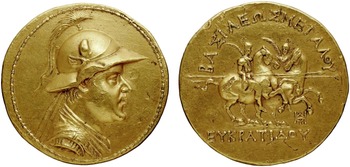
Despite these many deficiencies, however, much has been written about Hellenistic Bactria. William Tarn, Awadh Narain, and Omar Coloru have all produced general histories of the Greeks in Bactria and India, while cultural interaction between Greeks and non-Greeks has been the subject of a series of works by François Widemann, Rachel Mairs, and, in a forthcoming publication, Michael Iliakis.Footnote 3 Bactria and the Indus valley remained part of the Seleucid empire after Alexander the Great's death and Paul Kosmin has recently explored the importance of these regions in the late fourth and third centuries.Footnote 4 Getzl Cohen has also recently examined the evidence for new or re-founded settlements in the Hellenistic East.Footnote 5 The study of Hellenistic Bactria has long been based on its coins, which Philip Grierson described as ‘the finest sustained artistic achievement in the whole history of coinage’.Footnote 6 The region has produced not only the largest ancient coin hoard ever found – Mir Zakah II, consisting of over half a million gold, silver, and bronze coinsFootnote 7 – but also the largest gold and silver coins surviving from antiquity: the 169.2 g gold 20-stater of Eukratides I (diameter 58 mm), the Eukratidion (figure 1), and the 85 g silver double-decadrachms of Amyntas I (diameter c.62–67 mm).
The Eukratidion, now in the Cabinet des Médailles, Paris. © Gallica Digital Library.

Hellenistic Bactria has become synonymous with such numismatic anomalies. Over the years Frank Holt has produced a number of excellent works that bring to light Hellenistic Bactria through close study of its surviving coins.Footnote 8 A not inconsiderable number of short inscriptions, as well as a few long and high-quality texts, have survived from Bactria and Sogdiana, most of which have been collected by Filippo Canali de Rossi in Iscrizioni dello estremo oriente greco.Footnote 9 A series of fourth-century Bactrian administrative texts, the Khalili Collection, has recently been published by Joseph Naveh and Shaul Shaked.Footnote 10 Rachel Mairs's ongoing Archaeology of the Hellenistic Far East series provides a useful overview of recent developments in the archaeology of Hellenistic Bactria, while Frank Holt's Lost World of the Golden King offers a stimulating introduction to the history and study of ancient Bactria.Footnote 11
Historical outline
Alexander's conquests in Arachosia, Bactria, Sogdiana, and the Indus valley occupied most of the years 330–325. Numerous new cities, such as Alexandria-in-Arachosia (perhaps modern Kandahar, in Afghanistan) and Alexandria-Eschate (modern Khojend, previously Leninabad, in Tajikistan),Footnote 12 were founded as a means of stabilizing a difficult frontier region. For Plutarch (De Alex. fort. 328c–329d), these cities implanted Greek culture throughout the East. Alexander's settlers, however, felt different and revolted en masse in 326/5 and 323/2. Both revolts were brutally suppressed.Footnote 13
Bactria and Sogdiana remained important parts of the Seleucid Empire, the dynasty which came to rule much of western and central Asia under Alexander's general Seleukos, into the late fourth century, when numerous cities were founded or re-founded and the first mints in the region came into operation.Footnote 14 In the late fourth century Seleukos I ceded control of the far eastern satrapies of Gedrosia, Arachosia, Paropamisadai, and the Indus valley to King Chandragupta Maurya (Sandrokottos).Footnote 15 The population of these regions was ethnically mixed. A bilingual Greek–Aramaic inscription survives from Kandahar from c.258 detailing King Asoka Maurya's promotion of Buddhism, vegetarianism, and piety (Dhamma). Asoka's thirteenth Rock Edict (c.256/5) also survives and records that he sent embassies to lands as far distant as modern Albania and Sri Lanka, mentioning by name the Hellenistic kings Antiochos Theos, Ptolemy Philadelphos, Antigonos Gonatas, Magas of Cyrene, and Alexandros of Epirus.Footnote 16
The Seleucids maintained diplomatic, trade, and military interest in the eastern satrapies throughout the fourth and third centuries.Footnote 17 The Seleucid ambassador Megasthenes led numerous embassies to the court of Chandragupta in the late fourth and early third centuries. His Indika does not survive, but it seems to have treated of Indian history and ethnography.Footnote 18 Demodamas of Miletos campaigned with Antiochos I in central Asia in the early third century. He crossed the Oxos (Amu Darya) river and wrote a semi-autobiographical account of his military campaigns, which does not survive today.Footnote 19 Patrokles, a Seleucid military official of the late fourth and early third centuries, undertook a voyage of exploration (periplous) around the Caspian Sea, the first Greek to do so. His work is also lost.Footnote 20
Bactria, however, remained part of the Seleucid empire until the late 240s, when the Seleucid satrap Diodotos revolted and established an independent kingdom; Parthia revolted around the same time, or perhaps slightly earlier.Footnote 21 The power of this Greco-Bactrian kingdom reached its zenith in the early to mid-second century. Under Demetrios I (c.195–180) and Eukratides (c.170–145) Greco-Bactrian power extended into India, perhaps as far as Pataliputra (modern Patna).Footnote 22 In the late second century, however, the Greco-Bactrian kingdom was overrun by nomadic invaders from the north, leaving behind an isolated Indo-Greek kingdom south of the Hindu Kush, in the northern Indus valley, north-western India, and Gandhara. The most famous of the Indo-Greek kings, Menander I, is remembered for his conversion to Buddhism (Plut. Prae. ger. reip. 821d–e) and appears in the Buddhist dialogue The Questions of Milinda (c.100). This Indo-Greek kingdom fragmented into smaller units and died out by the late first century, though some nuclei may have remained until the second century ad at the latest.Footnote 23
At its second-century peak the Greco-Bactrian kingdom was particularly rich. It was ideally located for trade east and west, and the Jaxartes (Syr Darya) and Oxos (Amu Darya) rivers provided a fertile hinterland. Bactria was described by Apollodoros of Artemita, writing perhaps in the late second or early first century, as ‘the ornament of all Ariane’ (FGrH 779 F 7a = Strabo 11.11.1 [C516–17]) and it is recorded as having had 1,000 cities at its peak (Just. Epit. 41.1.8; Strabo 15.1.3 [C686]), though only a handful are known today. The empire was culturally diverse. Its rulers expressed power in Greek terms and used the Greek language,Footnote 24 but Buddhist iconography and terminology frequently appear on the coins of the Indo-Greek kings, which are sometimes bilingual, with both Greek and Prakrit inscriptions; the king is described as both Macedonian basileus and Indian maharajah. Artistic styles became highly mixed by the first centuries ad. Gandharan art reveals a pronounced synthesis of both Greek and Buddhist stylesFootnote 25 and Greek script remained in use well into the Kushan Empire of the second and third centuries ad.Footnote 26
Dedication to Hestia in honour of Euthydemos and Demetrios, Tajikistan
This fragrant altar to you, August Hestia, most honoured among the gods, Heliodotos established in the grove of Zeus with its fair trees, furnishing it with libations and burnt-offerings, so that you may graciously preserve free from care, together with divine good fortune, Euthydemos, greatest of all kings, and his outstanding son Demetrios, renowned for fine victories.
(SEG liv.1569)Footnote 27This inscription appeared on the antiquities market in 2004 and has only been available for study through one published photograph, so we know neither its dimensions nor its archaeological context.Footnote 28 It was allegedly found in the Kuliab district of Tajikistan, in what was eastern Bactria. Written in trochaic tetrameters,Footnote 29 the inscription would have been attached to an altar dedicated to Hestia in the sacred grove of Zeus on which sacrifices and libations were performed. In spite of the lack of archaeological context, we have a historical context. In 209/8 the Seleucid king Antiochos III invaded Bactria and India. He defeated the local ruler Euthydemos at the Battle of the Arios and besieged him in Bactra (modern Balkh) for three years. Terms were reached, by which Antiochos recognized Euthydemos' claim to kingship, formed an alliance with him, and promised one of his daughters to Euthydemos' son Demetrios (Polyb. 11.34).Footnote 30
Our text dates from shortly after Antiochos' campaign, c.200–195. Euthydemos is not only called king but ‘the greatest of all kings', a subtle jab at Antiochos' assumption of the epithet megas c.204, after his eastern campaign against Euthydemos, and the title basileus megas c.200, after his conquest of Koile Syria.Footnote 31 Demetrios, famous for his later campaigns in India in the 190s and 180s (Strabo 11.11.1), is termed kallinikos, perhaps suggesting that these campaigns had already begun. Heliodotos, the dedicator, was probably an officer of Euthydemos or Demetrios. He must have been well known, as no patronymic is given. His dedication of an altar to Hestia in honour of the king and his son might suggest a close relationship with one or both of them.
The monument is quintessentially Greek and appears to be culturally monolingual.Footnote 32 It is a dedication to a Greek goddess in honour of a Greco-Macedonian king and his son by a Greek man. It is erected in a Greek religious site, the ‘grove of Zeus’, which implies the presence of a local Greek community. The rituals of worship – altar, libations, and burnt offerings – are also Greek. Nothing about this text is exceptional, bar its appearance in Tajikistan. The context of the find, however, demands that we exercise caution. The community of Greeks present in the region had been there for almost 130 years and must have been in their fourth or fifth generation. Considerable ethnic and cultural diversity must therefore be assumed, with individuals perhaps exercising situational identities. For instance, in Ptolemaic Egypt an individual could use a Greek name and Greek language and customs in one situation, but an Egyptian name with Egyptian language and customs in another.Footnote 33 Another religious dedication from the same region shows the cultural diversity that must have been at play in Hellenistic Bactria. Found in Takht-i Sangin, Tajikistan, and dating to the mid-second century, it consists of a small statue base complete with a statue of Marsyas playing a double flute – a Greek-style dedication – which Atrosakes, a man with an Iranian name, dedicated in Greek to the Bactrian river Oxos in a Mesopotamian-style temple.Footnote 34
In offering a Greek-style dedication in a Greek religious site Heliodotos chose to present himself in Greek cultural terms, but this does not mean that other cultural influences could not have been at play behind the scenes. What we have is a single snapshot of Heliodotos' life and one aspect of his self-presentation. Everything looks Greek, but we do not know what is going on behind the text. In the following four documents we will see some of the ways in which different cultural identities could be represented and how difficult it is to analyse such identities from isolated fragments of evidence.
The Delphic Maxims at Ai Khanoum, Afghanistan
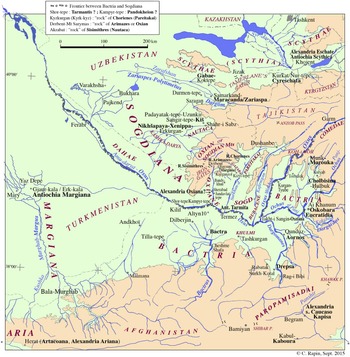
Ai Khanoum was a Greek-style city founded in the late fourth century on the confluence of the Oxos (Amu Darya) and Kokcha rivers in northern Afghanistan (see figure 2).Footnote 35 Excavated from 1964 to 1978, the site has now all but been destroyed as a result of looting during the Soviet invasion, Taliban rule, and the American–British-led war in Afghanistan. The city contained many Greek features, including a theatre capable of seating 5,000 people, a gymnasium, mosaics, and stoas.Footnote 36 However, there are also numerous Iranian architectural features, such as a Mesopotamian-style temple, and the site was possibly an earlier Persian-era settlement. Cultural fusion must have been strong. Ai Khanoum, and Bactria in general, have produced a number of Greek and Aramaic texts on burnt brick, parchment, clay, and stone. The most famous is probably a copy of the Delphic Maxims, with accompanying epigram, brought from Delphi to Ai Khanoum by one Klearchos, probably in the third century.Footnote 37 The stone bearing the text was discovered in 1966 in the pronaos of the heroon of Kineas, presumably the founder of the city.
These wise sayings of men of former times, the words of famous men, are consecrated at holy Pytho; from there Klearchos copied them carefully, to set them up, shining afar, in the precinct of Kineas. When a child show yourself well behaved; when a young man, self controlled; in middle age, just; as an old man, a good counsellor; at the end of your life, free from sorrow.
(IK 65 [Estremo oriente], 382–4)Footnote 38Map of Central Asia from the end of the Achaemenid period to the Hellenistic period, including Sogdiana and Bactria. © Claude Rapin.

On one level this is a literary text and some of the vocabulary echoes Homer, Hesiod, and Pindar.Footnote 39 Adrian Hollis has suggested that it might even refer to Apollonius Rhodius' Argonautica.Footnote 40 It also has connections with eastern thought, particularly the aforementioned Buddhist edicts of Asoka.Footnote 41 Though located in the extreme east, the document presumes and interacts with Greek knowledge and literature. The authors it mentions – Homer and Pindar – are part of the Greek canon and were widely known and studied throughout the ancient Greek world. The epigram's literary context tells us much about Greek culture and education at Ai Khanoum, but, as Rachel Mairs has recently shown, its physical and architectural context tells us more about Greek identity in third-century Bactria.Footnote 42
The inscription is part of a physical monument and seems to have been found in situ. Two mausolea are located within the walls of Ai Khanoum. Both are vaults with multiple burials and a small shrine on top. One is of mid-third-century date, but is not yet fully published. The other is of late fourth-century date, though it shows signs of renovation in the mid- to late third century, c.260–220. It is to this second mausoleum that the inscription with the Delphic Maxims was added. The mausoleum housed a small shrine on a raised platform of non-Greek design surrounded by a walled enclosure. Four burials were located within, two in stone sarcophagi and two in wooden coffins. An aperture was also found linking one sarcophagus to the upper room, with a conduit for liquids poured down into the coffin. This sarcophagus probably belonged to Kineas, the presumed founder of Ai Khanoum.
The renovation of the shrine of Kineas and the inscription of the Delphic Maxims are connected. Both renovation and inscription were part of a wider process of building and renovation undertaken throughout the city in the mid-third century, during the second or third generation of the city, what Rachel Mairs has termed ‘the Bactrian-born generation’.Footnote 43 Scholarship has traditionally focused on the identity of the Klearchos who brought the maxims from Delphi to Ai Khanoum. Louis Robert identified him with the peripatetic philosopher Klearchos of Soli, a pupil of Aristotle with interests in Indian philosophy (Diog. Laert. 1.9; Joseph, Ap. 1.179).Footnote 44 This identification has been almost universally accepted and has made its way into English-language textbooks on Greek history and epigraphy as an example of the connectivity of the Hellenistic period and the Greek identity of Ai Khanoum.Footnote 45
Jeffrey Lerner has correctly stated that there is no evidence that this Klearchos is Klearchos of Soli, in Cyprus.Footnote 46 Klearchos is not a rare name: 180 examples are recorded in the Lexicon of Greek Personal Names, almost 50 from the mid-fourth century to the late third – so it would be foolish to think that just because it appears at Ai Khanoum it must belong to a well-known philosopher with the same name. For this to be Klearchos of Cypriot Soli his journey would have to date from the late fourth or very early third century, when we know that he was active. As Rachel Mairs has pointed out, the inscription itself and its placement within the shrine of Kineas date from at least a generation later, in the mid-third-century, when Klearchos was probably dead, perhaps even later if Jeffrey Lerner's dating of the renovations to c.210–170 is correct.Footnote 47 As Mairs has shown, the addition of the Delphic Maxims to the shrine of Kineas should be understood as part of the city's mid-third century renovation. By focusing on the identity of Klearchos we ignore the inscription's physical and cultural context.
Building on Lerner's suggestion that Klearchos was a resident of Ai Khanoum, Mairs has connected his journey to Delphi with the process of rebuilding and reorganization that Ai Khanoum underwent in the mid-third century. Traditionally, when setting out to found a colony it was customary to receive an oracle from Delphi (Hdt. 5.42.2). This did not happen when Ai Khanoum was founded, so Klearchos' mission to collect the maxims from Delphi and see to their inscription on the tomb of the city's founder would have served as a substitute oracle, one that could have been projected back in time from the mid-third century to the original foundation of the city in the late fourth century. Klearchos' mission was undertaken three generations after the original foundation of the city, but it ascribed to the city's foundation a Greek cultural and religious definition not there for the first generation of citizens in the late fourth century but required now by the third, ‘Bactrian’, generation of citizens in the mid-third century. It was a refinement of Greek identity projected back through time to the city's foundation, lending Delphic patronage and cultural authority to the city's identity.Footnote 48
The relationship between Kineas and Klearchos epitomizes the duality of this civic foundation. Kineas founded the city in the late fourth century, but three generations later Klearchos gave it its founding charter by undertaking his mission to Delphi. The two completed different parts of a traditional Greek foundation story, with Kineas founding the city and receiving cult and Klearchos providing the Delphic pseudo-oracular connection. Klearchos may have been a member of a prominent family, perhaps even a descendent of Kineas.
Mairs's reassessment questions the idea of a city's foundation as a moment, rather than, as it appears to be here, a process stretching from Kineas in the late fourth century to Klearchos in the mid-third century. Ai Khanoum's foundation was an organic process, not a single definable moment. Physically, Ai Khanoum and the shrine of Kineas were renovated in the mid-third century. Spiritually, the foundation of Ai Khanoum was augmented by the addition of a Delphic connection tying the city more closely with the traditions of Greek colonization and embedding the foundation narrative within a quintessentially Greek cultural and religious context. What we have is a new interpretative layer, a new way of reading the city's foundation, one that emphasizes the city's Greek identity in spite, and perhaps because, of its location at the furthest boundaries of the Greek world. The Delphic Maxims and Klearchos' epigram, with its Homeric and Pindaric echoes, enforced Ai Khanoum's Greek identity and gave the city the Greek religious and cultural connection that its original foundation lacked.
The stele of Sophytos, Afghanistan
Like Heliodotos' dedication to Hestia, the funerary epigram of Sophytos son of Naratos came to light on the antiquities market and was published in 2004. Again, it has only been available for study through one published photograph, so we know neither its dimensions nor its archaeological context.Footnote 49 Found in Kandahar (ancient Alexandria-in-Arachosia), it is an early second-century limestone plaque containing a funerary epigram, in ten elegiac couplets of archaizing Greek. It was designed to be set into a wall, presumably of the mausoleum mentioned in the text.
The irresistible force of the trio of Fates destroyed the house of my forefathers, which had flourished greatly for many years. But I, Sophytos son of Naratos, pitiably bereft when quite small of my ancestral livelihood, after I had acquired the virtue of Hekatos [Apollo] and the Muses, mixed with noble prudence, then did consider how I might raise up again my family house. Obtaining interest-bearing money from another source, I left home, keen not to return before I possessed wealth, the supreme good. Thus, by travelling to many cities for commerce, I acquired ample riches without reproach. Becoming celebrated, I returned to my homeland after countless years, and showed myself, bringing pleasure to well-wishers. Straightway I built afresh my paternal home, which was riddled with rot, making it better than before, and also, since the tomb had collapsed to the ground, I constructed another one and, during my lifetime, set upon it by the roadside this loquacious plaque. Thus may the sons and grandsons of myself, who completed this enviable work, possess my house.
(SEG liv.1568)Footnote 50As with the epigram of Klearchos from Ai Khanoum, this is a literary text and evidence of a high-quality Greek education. It too contains Homeric allusions,Footnote 51 and may even show evidence of knowledge of Alexandrian poetry, specifically Kallimachos' Hecale,Footnote 52 all of which operate as markers of a common cultural education. In this instance, however, there is an added layer of significance since we have Sophytos, a Hellenized Indian, who may have even composed the epigram himself, representing himself as an eastern Odysseus safely returned with his fortune to his native Kandahar. He returned not to his Penelope but to his family home and tomb, which he renovated and rebuilt as a result of his success abroad.
The institution of a funerary epigram is Greek, as is the idea of publishing it by the roadside and exhorting passers-by to stop and read it. Sophytos is thus presenting himself within a quintessentially Greek cultural context. The epigram is longer than the traditional funerary epigram because it must accommodate the acrostic ΔΙΑ ΣΩΦΥΤΟΥ ΤΟΥ ΝΑΡΑΤΟΥ. The consequence is a verbosity that the author is aware of and uses humour to apologize for (l.19). However, verbosity may hide insecurity. Sophytos is very consciously trying to convince the audience of his intelligence through his mastery of Greek. By spelling out the acrostic he reveals that his concern is with making his education and intelligence explicit and ensuring that as many as possible recognize it.
The epigram relates how Sophytos' fortunes – and by proxy the fortunes of his family – were restored through his intelligence and hard work. We should perhaps see its verbosity as a representation of the education and intelligence that he used to remake his fortune and restore his family's standing. By writing in Greek, Sophytos is claiming a certain status attained through Greek education. This may not be so much to do with constructing an identity – in the sense of an Indian trying to be Greek – but more to do with emphasizing the role played by Greek education within his life. He is not a ‘new man’; he is from a wealthy family fallen on hard times.Footnote 53 By placing his Greek funerary epigram on his family's roadside tomb, Sophytos displayed to a Greek audience the importance of his Greek education in restoring his family's fortune.
This monument shows no evidence of non-Greek culture.Footnote 54 All discussions of Sophytos son of Naratos' identity arise from his name, which appears to be a Hellenized version of an Indian name (Subhūti son of Nārada).Footnote 55 He himself nowhere claims an ethnic identity as either Indian or Greek. The creation of a Greek cultural monument by a Hellenized Indian forces us to consider the text as an example of the negotiation of cultural boundaries. However, the text is only one moment in the life of Sophytos son of Naratos. Although he appears to have had only one name – we do not see him using a Greek name in Greek contexts or an Indian name in Indian contexts – he was well travelled and must have been adept at engaging with different cultures and contexts. There is no hint of bilingualism within our text, but that does not mean that it did not exist. Since we do not have the funerary monument to which the epigram was attached, we cannot tell whether it was of Greek or mixed architectural styles or whether it contained non-Greek inscriptions. Sophytos says that he had the tomb built himself, so its form would presumably tell us a lot about his cultural self-presentation. We can only push Sophytos' funerary epigram so far, but it forces us to problematize the question of education, identity, and cultural interaction in the Hellenistic east.
The pillar of Heliodora, India
This pillar, from modern Besnagar, is a dedication to the god Vasudeva and preserves the dedicatory inscription of one Heliodora son of Diya of Takhkhasila (Heliodoros son of Dion of Taxila), a ‘Greek’ ambassador from King Amtalikita (Antialkidas). It dates from the late second century.Footnote 56 The script is Brahmi but the language is Prakrit. Excavations from 1963 to 1965 detected the remains of an elliptical temple building around the pillar which dated from the fourth century. Other pillars originally stood on site, and at least three capitals have been found. The Heliodora pillar, like Heliodotos' altar, existed as part of a wider religious complex.Footnote 57
This Garuda-pillar of Vãsudeva, the god of gods, was constructed here by Heliodora, the Bhãgavata, son of Diya, of Takhkhasilã, the Greek ambassador who came from the Great King Amtalikita to King Kãsîputra Bhãgabhadra, the Savior, prospering in (his) fourteenth regnal year. (These?) three steps to immortality, when correctly followed, lead to heaven: control, generosity, and attention.Footnote 58
A man with an Indianized Greek name dedicates an Indian-style pillar, in an Indian language, at an Indian religious site, to an Indian deity. He is clearly presenting himself within an Indian cultural and religious context. This is possibly connected with his mission to the Indian court, but as a resident of Taxila in Pakistan – a site which has produced evidence of Indian deities – it is possible that Heliodora was already a worshipper of Vasudeva.
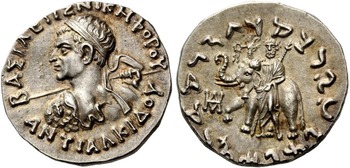
As with the dedication of Heliodotos and the stele of Sophytos, this monument is culturally monolingual, but it does describe Heliodora as a yona-dutena or ‘Greek ambassador’ of King Amtalikita, known from his frequently bilingual coins as Antialkidas Nikephoros, who ruled part of the Punjab in the late second and early first centuries (see figure 3).
Silver tetradrachm of King Antialkidas, c.115–95. Obverse: ΒΑΣΙΛΕΩΣ ΝΙΚΗΦΟΡΟΥ ΑΝΤΑΛΚΙΔΟΥ in Greek. Reverse: Maharajasa jayadharasa amtialikidasa in Karoshti. © Classical Numismatic Group.

We do not know whether this is Heliodora's self-representation as the pillar's dedicator or a description of him by the text's author, but it highlights a strong contrast between the Indian context of the dedication and the Greek definition of the dedicator. With his movement from the royal court of an Indo-Greek king to the religious world of Indian dedications, Heliodora expresses – but does not necessarily prove – a greater degree of cultural fluency than Sophytos. By the use of a specific ethnic title, this monument reveals his cultural bilingualism, moving from a Greek diplomatic context to an Indian religious one. However, this dedication is a single moment in Heliodora's life. We do not know how he would have presented himself in a Greek text or a Greek context, nor do we know how his Indian and Greek identities overlapped in his family, upbringing, daily life, or career.
Administrative texts from Ai Khanoum, Sangcharak, and Takht-i Sangin
A series of administrative texts from throughout Bactria reveal the stratigraphy of the ruling class during the Hellenistic period. From these documents it appears that the upper echelon of the administration consisted primarily of people with Greek names, while the lower echelon consisted by and large of people with Bactrian and Iranian names. While such social stratigraphy might reflect the realities of a bilingual administrative system – Greek at the upper levels, Bactrian at the lower – it might also represent the use of situational identities, whereby a person assumed different cultural identities in different contexts, meaning that a Greek name might reflect an individual's position in the Greco-Macedonian socio-political hierarchy rather than his ethnicity. In short, we should be careful not to ascribe ethnicity from names alone.
The Asangorna parchment, from Sangcharak, but now in the Ashmolean Museum, Oxford, records the collection of tax during the reign of Antimachos Theos in the late third or early second century. In it, Menodotos the tax-gatherer (λογευτής), in the presence of other officials – Demonax and Simos, who had been sent by Diodoros, the controller of revenues (ὁ ἐπὶ τῶν προσόδων) – acknowledges receipt of payments due from Dataes, a man with an Iranian name.Footnote 59 On the basis of onomastics, this could be taken to signify an administrative hierarchy based on ethnicity, but names alone are a difficult criterion for ethnic identity. A series of late second-century ostraca from the ‘treasury’ of Ai Khanoum shows that goods sent by people named Zenon, Timodemos, Philiskos, Straton, and Kosmos were counted, recorded, and sealed by individuals named Oxeboakes, Oxybazos, and Aryandes. Again, it is tempting to posit an ethnically segregated hierarchy, but these same goods were also handled by individuals with the Greek names Hermaios, Straton, Molossos, and Nikeratos.Footnote 60 It would appear that the administration was, to some degree, a mixed Greco-Macedonian and Irano-Bactrian one.Footnote 61 Further evidence of such mixing of cultures comes from a clay mould for a bronze cauldron dedicated to the Oxos, found in Takht-i Sangin in Tajikistan in 2007. Along with an inscription on a limestone bowl from the same site, it preserves evidence for the earliest use of Greek script to write the local Bactrian dialect and testifies to the spread of the Greek language and the interaction of Greek and non-Greek cultural and linguistic forms in late Hellenistic Bactria.Footnote 62
Conclusion
Each of the documents discussed above is a snapshot of a vibrant process of cultural interaction. Each forces us to think about questions of identity, language, education, and culture, but each has its limitations. Heliodotos' dedication is an isolated fragment of Greek language, religion, and culture in Hellenistic Bactria, seemingly existing in isolation of its wider Bactrian context. It tells us a lot about the diffusion of Greek culture in the Hellenistic East, but nothing about the interaction of different cultures. The Delphic Maxims show us how Ai Khanoum sought to express its Greek identity in the mid-third century by commissioning a Greek addition to their founder's shrine. However, the non-Greek element of the city, well attested in the artistic and architectural record, remains invisible here. The Sophytos stele shows us how a Hellenized Indian sought to present himself as an educated Greek, but it nowhere comments on his own ethnic identity. The Heliodora pillar compels us to think about how the dedicatee expressed his Greek identity within an Indian cultural context, but it cannot tell us how Helidora operated outside that context. The administrative texts from Ai Khanoum, Sangcharak, and Takht-i Sangin offer a snapshot of the socio-political life of Hellenistic Bactria, but names alone cannot be taken as evidence of ethnic identity. In each instance, we detect tantalizing elements of Heliodotos', Ai Khanoum's, Sophytos', and Heliodora's self-presentation, but only within very specific and defined cultural contexts. Could Heliodotos or Sophytos have expressed themselves any differently in Greek dedicatory or funerary epigrams, with all the conventions and traditions that come with those literary forms? Could Heliodora have dedicated such a monument in any language other than Prakrit? Each of these caveats prevents us from treating of absolute definitions when discussing language, culture, and identity.
Taken together, however, these documents show how easily certain individuals could move between different modes of cultural expression: Indians in Greek epigram to Greeks in Indian dedications. They also reveal the creation of local cultural identities, whereby both Sophytos and Heliodora express themselves in the verbal and cultural language of a society that is not entirely their own. These documents tell us about the representation of identities, but not about the reception of identities. We do not know how native Bactrians felt about the ‘grove of Zeus’, the presence of Greek dedications and religious rituals there, and the rule of Greco-Macedonian kings. We do not know how the Greek or Greek-educated community of Kandahar felt about Sophytos, a Greek-educated man of Indian descent. Nor do we know how the Indian community of Vidisha responded to Heliodora, the Greek ambassador of a Greco-Indian king, who made an Indian-style dedication to an Indian deity. These documents may not tell us in an absolute way how identity was perceived within what must have been a series of very mixed communities, but they do show us how vibrant such cross-culturalism was and they cause us to think more carefully about a process that scholarship has all too often simply treated as ‘Hellenization’.