Many Jewish communities of the early modern era, especially throughout the Mediterranean basin, in Salonika and Alexandria, as well as in Venice, were multiethnic and hence multicultural, composed of Ashkenazim, Sephardim, and at times, also other groups. In Italy ethnic diversity—including the Italian Jews, or italiani, the Ashkenazic Jews, or tedeschi, and since the sixteenth century also Sephardic Jews—was the rule in communities of all sizes. Rather than meld into a single, if heterogeneous, community, the ethnic groups of Italy's Jewish communities retained their particularity by founding their own synagogues. For their part, political authorities usually dealt with the Italian and Ashkenazic Jewish communities as a single entity, because the terms that constituted the basis of their political-legal and economic status were identical for both groups. But the Sephardic Jews enjoyed a different political-legal and economic status, and hence were administered separately, and in some cases included additional subdivisions as well.
The Jewish community of Padua was multiethnic from the start, with Italian as well as Ashkenazic settlers, and here too heterogeneity was the rule. An Ashkenazic synagogue was established in 1525, an Italian one in 1548, and a Sephardic one in 1617.Footnote 1 Since the Sephardic Jews settled in Padua long after the Jewish community was founded, their impact on the life of the community seems to have been less than that of their Ashkenazic and Italian brethren, and of the Spanish and Portuguese Jews of neighboring Venice and other Italian cities. In Padua the Ashkenazic Jews set the tone, their power and prestige based not only on their position as founders but also on the city's famous yeshiva, led by Rabbis Judah Mintz (d. 1508) and Me'ir Katzenellenbogen (Maharam, d. 1565).
New arrivals inevitably acculturate to their new environment, but this process is both gradual and complex, as immigrants and their descendants adopt some of the norms and features of their surroundings while also striving to preserve core elements of their native tradition and identity. For Jewish settlers in early modern Italy, this process necessarily involved the selective adoption of mores, tastes, and values from both the Jewish and non-Jewish realms of their new home. The Yiddish Cow Book (Verona, 1555), for example, demonstrates both the tendency to import elements of the host culture and to cling to elements associated with home.Footnote 2 It contains a list of foods typical of local Italian fare of the Emilia region, and blends Yiddish and Judeo-Italian terms, with a result that would be intelligible only to a Yiddish speaker living in Italy.
The Jews who left Germany in the late Middle Ages and found themselves in multiethnic communities on the Italian peninsula tended to cling to their religious heritage with remarkable tenacity even as they adopted local ways in areas such as food and language. Their ancestors in German lands had exhibited a conservative tendency with regard to minhag, or custom, since the founding of their communities in the Rhineland in the early tenth century.Footnote 3 In Italy the multiethnic environment presented a new challenge to this Ashkenazic traditionalism, and the Ashkenazim strained to retain their distinctive tradition even as they adapted to local conditions.Footnote 4
This intricate dynamic is evidenced in the Jewish graveyard of sixteenth-century Padua. The city's earliest surviving Jewish tombstones, from the late fifteenth century and early sixteenth century, display literary and architectural characteristics clearly patterned after those of medieval Germany, and also found in tombstones of fifteenth-century Treviso, another Ashkenazic community in the northeast of Italy.Footnote 5 In Padua, evidence of Ashkenazi acculturation to the Italian environment becomes evident in the tombstones displaying characteristic elements of Renaissance Italy, deriving from both the Jewish and non-Jewish realms, found in a graveyard dating back to the middle third of the sixteenth century––long after the Ashkenazic Jews migrated to the Veneto.
The Italian turn of the Paduan gravestone in the sixteenth century was sudden and dramatic, but it was not the result of any abrupt change in the community's political fortunes or ethnic complexion. Rather, this turn makes manifest the well-known cultural efflorescence of Italian Jewry during the Renaissance, which began at least a century earlier and was characterized by the creative interplay of motifs from Jewish tradition and the broader environment. Scholars have identified an identical acculturation pattern among German Jewry in the Middle Ages, and the Padua gravestones testify to the talent their descendants displayed as they operated in the same mode in the Italian context.Footnote 6
While the tombstone is only one case among many in which Padua's predominantly Ashkenazic population assimilated Italian tastes in this period, a comparison of the epitaphs and sepulchral art of Padua's Jews with those of their Catholic neighbors shows that the Jews of Padua were not simply modeling their tombstones after those of non-Jews, but were creatively infusing their designs with elements from Renaissance literature and architecture. Moreover, as tombstones from fifteenth-century Trani in southern Italy indicate, the form of Padua's sixteenth-century tombstones was new to Italian Jews of various ethnic groups, and not only to the Ashkenazic contingent.
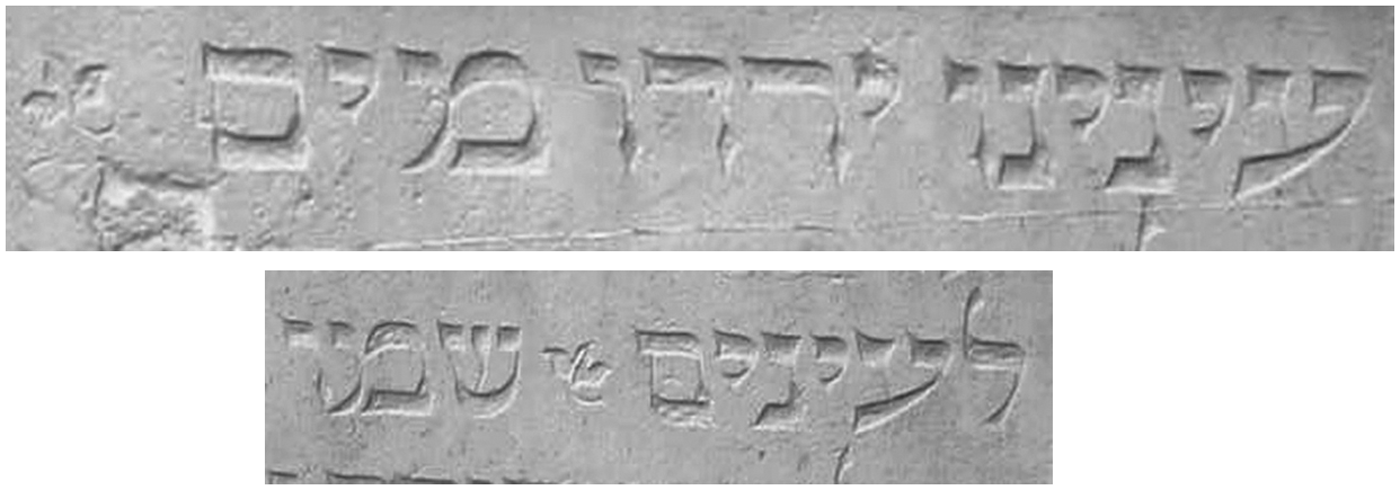
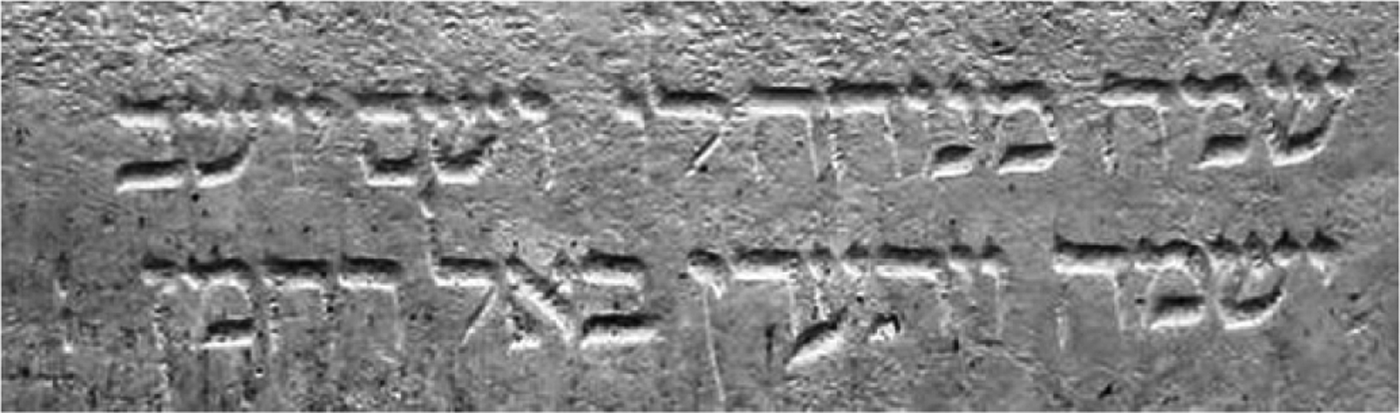
Only two tombstone fragments remain from a Jewish graveyard in Padua's Via Codalunga, which was destroyed during the 1509 war of the League of Cambrai. They provide a glimpse into the early style that, along with the evidence from Treviso, appears to have been common in Jewish cemeteries in northern Italy. The inscriptions translate as follows:

Ogye's Hebrew date is equivalent to March 27, 1483. The final line, typical of medieval Ashkenazic inscriptions, is an abbreviation of the blessing: “May her soul be bundled in the bundle of life (1 Samuel 25:29) with the other righteous men and women in paradise, Amen.”Footnote 7 The epithets on Fiora's inscription are also formulaic.Footnote 8 Because the last line of her inscription is truncated, its terminus ad quem would be the fall of 1539, but Fiora probably died at least thirty years earlier, before the cemetery's destruction in 1509.Footnote 9
Where Padua's Jews buried their dead following the 1509 destruction of the cemetery is uncertain, but in 1529 they opened a new cemetery in Borgo Zodio, today Via Wiel, across the Bacchiglione River.Footnote 10 This cemetery contains ninety-three tombstones from the sixteenth century. They differ markedly from those of Ogye and Fiora, displaying features characteristic of the Italian Renaissance.Footnote 11
Of the ninety-three tombstones, about forty tombstones are from 1530–1560. Their inscriptions divide fairly evenly between simple prose inscriptions and those constructed in more complex rhymed prose or (unmetered) poetry. They are studded with biblical expressions and with snippets of biblical verses, mostly drawn from Lamentations and Job and expressing sorrow. “For these things do I weep” (Lamentations 1:16) and “the crown has fallen from our head… because of this our hearts are sick” (Lamentations 5:16–17) are examples of such usages. The more complex compositions are no surprise, for rhymed prose with a broad range of poetic elements is common in medieval Hebrew literature, and German Jewry created a corpus of poetic lamentations and penitential texts.Footnote 12
The inaugural text of Padua's metered epitaph poetry is that of Naftali ben Yosef Kohen (1.58, d. 1538).Footnote 13 Hebrew meter is based on the division of vowels into short vowels—the sheva and ḥataf—and long ones, namely all the rest. The basic principle is that the stichs must present a single pattern of long and short vowels.Footnote 14 Hebrew poets of early modern Italy often ignored the distinction between long and short vowels. Instead, they measured the number of syllables in a line and required that lines uniformly conclude in either millerʻa or milleʻeil, namely accented on either the ultimate or penultimate syllable. The Italian taste generally preferred stichs of eleven syllables, known as endecasillabo, and preferably those ending in milleʻeil, which were known as endecasillabo piano. Sometimes poets did pay attention to the distribution of long and short vowels. Thus, the favored endecasillabo piano scheme appears in a number of variations, of which the layout with short vowels at syllables three and seven was especially popular, and thus is appropriately known in Hebrew poetics as “standard 11-milleʻeil.”Footnote 15
The epitaph on Naftali ben Yosef Kohen's 1538 tombstone is carefully constructed in six stichs of sixteen syllables, each line divided into four units of four syllables, always ending in millerʻa. A single rhyme threads its way through the poem (-rah), and there is also an internal rhyme scheme: in three of the six lines the fourth and eighth syllables rhyme. This poem is built exclusively with long vowels, and hence is termed “simple” in the language of Hebrew poetics. The structure of four-times-four syllables per line, in millerʻa and monorhyme, is the legacy of medieval Spanish Jewry. Thus the very first clear instance of metered Hebrew epitaph poetry from Padua exhibits Iberian influence. This is surprising not only in view of the Ashkenazic traditionalism in matters of halakhic practice, but also of the marginal nature of the Sephardic component in the mosaic of the city's Jewish life.
The second metered poem in the Paduan corpus comes from the 1544 tombstone of Neḥemiah Saraval (1.76, d. 1544). This inscription presents a metrical scheme of twelve syllables with a millerʻa ending (i.e. 12a), a fuller version of endecasillabo and a popular metrical pattern in Italian Hebrew poetry. The appearance of this scheme completes the transition from Ashkenazic patterns to the Italian tradition.
The trail blazed, nineteen years were to pass before meter came to dominate the Padua graveyard. Between 1544 and 1563 twenty-one gravestones were added, not one of them in meter but ten in rhyme and several with acrostic, indicating a preference for the familiar over the novel.Footnote 16 These inscriptions are highly creative, presenting a wide range of rhyme schemes, from monorhyme to couplets to a sequence as complex as ABABBACCC. The most creative portion of the period of Padua's epitaph poetry tradition would be the century or so from about 1560 to 1650. In the late sixteenth century new forms of Hebrew epitaph poetry were introduced and during the seventeenth century new forms of Baroque complexity were added. But by the eighteenth century the genre had stagnated, all but disappearing after approximately 1830.
It is with the epitaph on the tomb of Eliezer Ḥefeẓ, dated 1563 (1.68), that metered epitaph poetry became a consistent feature of Padua's Hebrew inscriptions. This is a modest effort, just a quatrain in 10a. Unlike the compositions surveyed earlier, Ḥefeẓ's poem has an enclosed rhyme scheme (ABBA). This is very common in the eight-stich poem, the ottava, which was an extremely popular form in Italian Hebrew verse and in the Paduan graveyards as well. In effect, then, Ḥefeẓ's poem is a half-ottava.
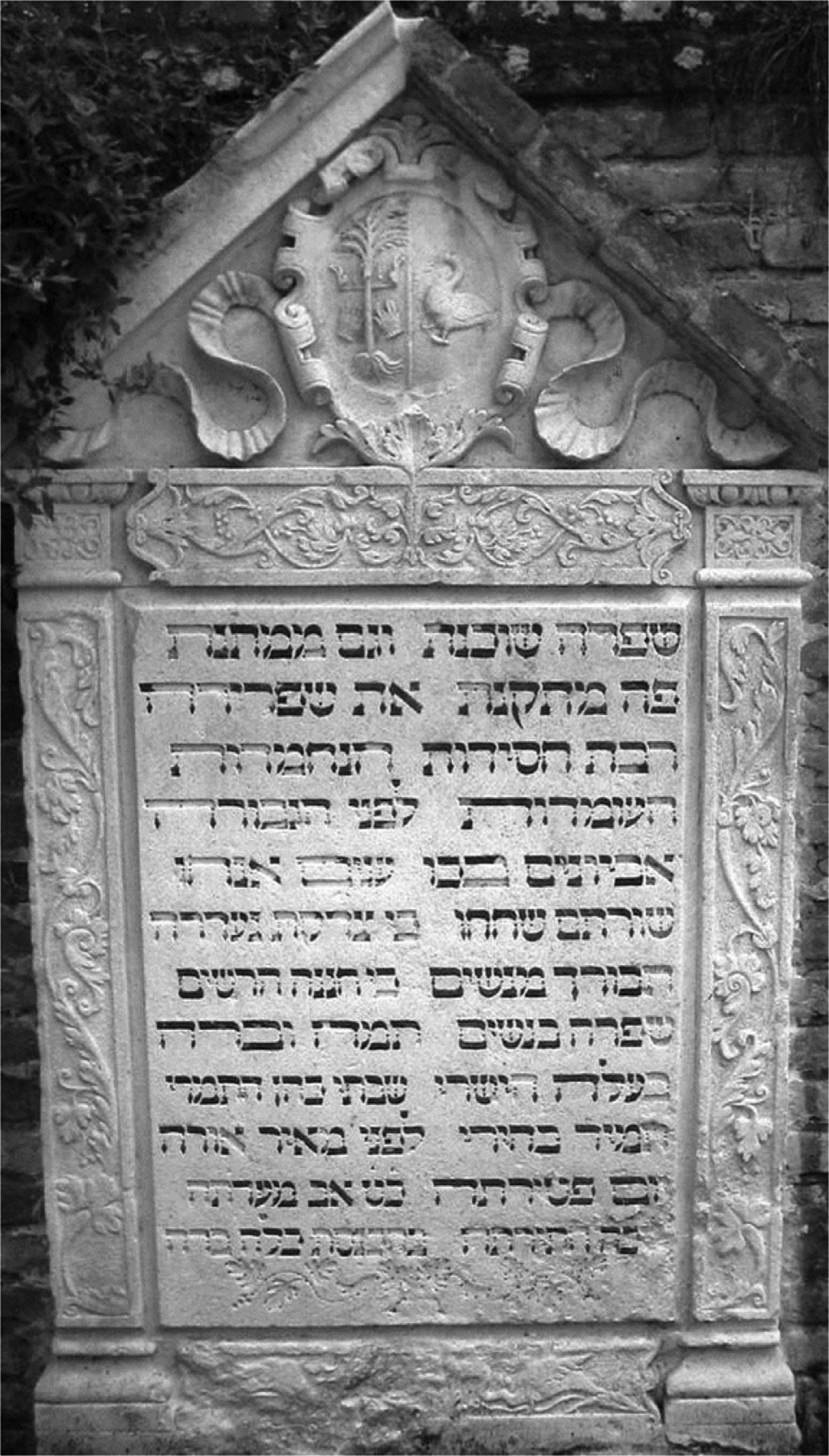
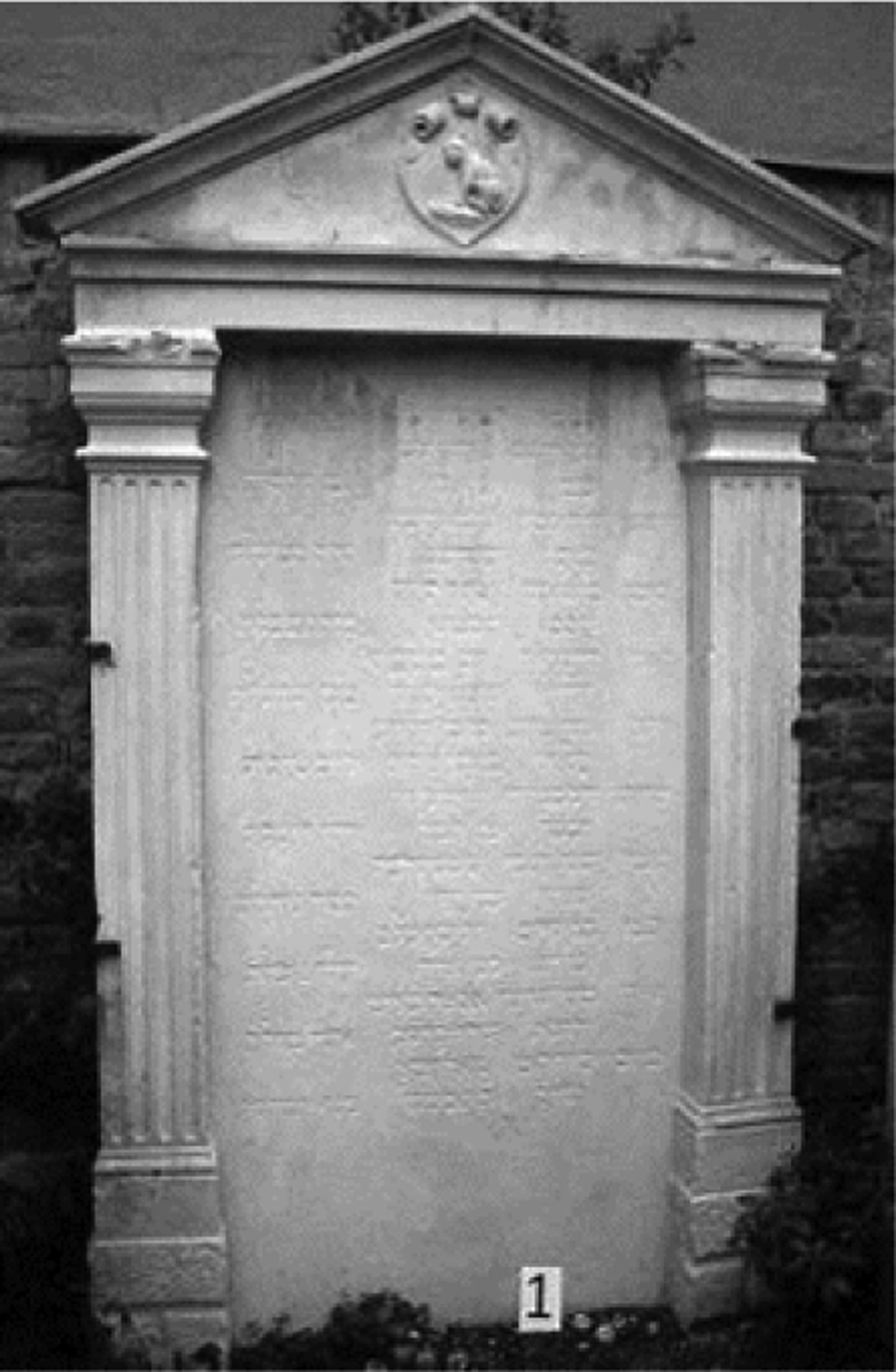
The metered poem from January 1565 on the tombstone of Me'ir Katzenellenbogen (1.2), or Maharam, a famous Ashkenazi rabbi and the most illustrious citizen of Padua's Jewish community in his day,Footnote 17 is in the simple Spanish style, with lines of four-times-four syllables in long vowels. Given Maharam's stature, the composition of his epitaph poem in a classic Spanish form is powerful testimony to the cultural shift we are examining. His son Samuel's epitaph (1.1), from 1597, with its twenty-two lines is unprecedented. The meter is classic endecasillabo piano, and a rhyme scheme stitches together the even lines, while in each of the odd-numbered lines the two hemistichs share a rhyme of their own.Footnote 18
Metered Hebrew poetry was, of course, not new to Italy; a rich and varied corpus of metered verse had accumulated since its introduction and development by Immanuel of Rome in the early fourteenth century. The novelty lay rather in the choice of genre, in the decision to craft epitaphs using these particular poetic tools. Metered epitaph poem became the hallmark of Italian Jewish epigraphy in the early modern era in communities throughout northern and central Italy. This tendency cut across ethnic lines; the primary sources evince no apparent distinction between the ethnic affiliations of communities or individuals. In Padua, the appearance of epitaph poetry coincided with its appearance elsewhere in northern and central Italy in the first half of the sixteenth century. And so, after well over a century of Jewish life in these cities and towns, the tedeschi of Padua were now au courant.Footnote 19 Padua's largely tedeschi constituency embraced epitaph poetry along with Italian Jewry's other ethnic groups, despite the traditionalism expressed by the Ashkenazic Jews in liturgy, ritual slaughter, and other areas of ceremonial law.
The new genre of the epitaph poem reflects the impact of the Italian Renaissance on Jewish culture. During the Renaissance, the epitaph poem was popular among poets intent upon reviving the epigram, which had been popular in Greco-Roman antiquity. Fifteenth- and sixteenth-century Italy was the repository of anthologies of epigrams composed in ancient Greece, of which epitaphs were a major genre. The first edition of the Planudean Anthology was printed at Florence in 1494, apparently in a large number of copies, and further editions followed, as well as selections. The epitaph epigram was thus circulating widely among poets and intellectuals of the day.Footnote 20 In Padua, Marcus Musurus taught the Greek anthology in 1506 and tried his hand at composing original epigrams.Footnote 21 The Latin epigram, famously associated with the Roman satirist Martial, was also popular, although the epitaph poetry of the Renaissance is anything but satirical. A poetics of epigrams by Francesco Robortello printed in 1548,around the time Robortello began teaching in Padua, defined the literary features of the classical epigram, based on Aristotle's Poetics, and placed the genre at the disposal of latter-day humanists.
Poets of the Italian Renaissance also wrote their own epitaph poems to commemorate great men and beloved relatives: Petrarch wrote six couplets for the marble tomb of his grandchild Francescuolo, and Salutati left epitaph poems for illustrious members of Florentine society. Michelangelo composed fifty epitaph poems—sonnets and quatrains—following the untimely death in 1544 of Cecchino Bracci, the nephew of his friend and adviser Luigi del Riccio.Footnote 22 Epitaph poems also had their place in Pietro Bembo's Carminum Libellus, including epitaphs for a brother, a son, a friend, a teacher, and even for his dog Bembino.Footnote 23 There are over a hundred epitaph poems in Giovanni Pontano's Tumuli, published in 1505, the first such epigraphic anthology of the period.Footnote 24
Both the form and content of the Hebrew compositions present elements analogous to those of the Italian Renaissance epigram. Antonio Minturno's work on the Italian epigram, published in 1563, prescribed the use of the endecasillabo, exclusively or alternating with the seven-syllable line.Footnote 25 The endecasillabo was the preferred form of Padua's epitaph poetry, reflecting a close relationship between Hebrew tradition and the Renaissance.
The decline of the acrostic in Hebrew epitaph poetry is another indication of the integration of Italian Renaissance poetic styles into Hebrew poetry. The acrostic was characteristic of the Hebrew liturgical poetry of medieval Germany and hence not unexpected in Padua. In inscriptions from the early sixteenth century, letters of the acrostic denote the first name of the deceased, and occasionally also the patronymic. With the shift to metered poetry, the acrostic faded away. While the earliest such inscriptions, for Naftali Kohen and Neḥemiah Saraval, lack an acrostic, between 1532 and 1573 it was a prominent characteristic of epitaph poetry, with eighteen poems adorned with an acrostic. With the last two examples dating from the end of the sixteenth, the acrostic came to an end in Italy, without ever returning there, except for one instance in 1810.Footnote 26 The acrostic remained a feature of the epitaphs and liturgical compositions of the Jews of central and eastern Europe in the early modern era.
Although meter provides a rigid structure, and thus undercuts the acrostic's formal significance, this does not properly explain the acrostic's disappearance. After all, metered poems continued to rhyme, such that clearly poets continued to feel the need for an aesthetic organizational device apart from meter. Rather, the explanation lies in the preference of Renaissance poets. Robortello advised readers to avoid acrostics, because the Greeks did, and the disappearance of the acrostic from the Hebrew inscriptions shows that Padua's Hebrew poets heeded this instruction.Footnote 27
The epitaph poem's incipit also echoed the conventions of the Italian Renaissance. In the ancient world graves often lined the roads, and thus “Stop, passerby, and read” was a common epigraphic formula, urging the wayfarer to pause and read the inscription, momentarily rescuing the deceased from oblivion.Footnote 28 In Padua, the call to the visitor appeared very early in the corpus. The poem for Rachel Ẓarfati (1.167, d. 1566) commences as follows:
A year later the inscription of Rebecca Lolli (1.165, d. 1567) displays the same feature:
The poem for Abraham Luzzato (1.156, d. 1583) singles out the casual passerby, rather than the visitor:
The individual passerby is addressed directly, in the classical tradition, in the incipit of the epitaph poem for Maharam's son, Samuel Judah Katzenellenbogen (1.1, d. 1597):
The first words focus on the paradox of the grave, which, the poem insists, is no grave at all. The denial of death and decay serve, in Stoic fashion, to celebrate the dignity and glory of its royal rabbinic contents.
The epitaph poem is one among many types of occasional poetry composed in honor of social or communal religious events, such as weddings or the dedication of synagogues. The absence of any such epitaphs in medieval Germany, on the gravestones in Treviso and the two surviving Paduan inscriptions from before 1509, strongly suggests that the new genre represents the adoption of an Italian literary art form. The disappearance of the acrostic and the adoption of the passerby incipit leave no doubt that the Hebrew poets were not merely improvising upon Italy's late medieval tradition of Hebrew poetry, they were consciously exploiting the literary conventions of the Italian Renaissance.
*
The sepulchral art of Padua's Jews in the sixteenth century further testifies to the same cultural transformation. Architecture was one of the most creative of artistic fields in Renaissance Italy. As Italian humanists turned to Greco-Roman antiquity for literary models, so too did they scrutinize the archaeological remains of ancient structures and peruse the textbook of Vitruvius to determine the principles of classical architecture. The Renaissance was a golden age for architecture, with Codussi, Palladio, and others making reputations that resounded far and wide. Their work also resonated with Padua's Jews, including the tedeschi: the Jewish tombstones of sixteenth-century Padua include standard features of Renaissance architecture.
The stele, namely a tablet set within an architectural frame, is the most common design in Hebrew gravestones. Of the two tombstones from the Via Codalunga cemetery, Fiora's is unadorned while Ogye's is a bit more sophisticated, since its inscription is recessed and framed by pilasters. The pilasters are an architectural feature, and indeed the Hebrew tombstone is a genre of applied architecture.
The influence of the Italian Renaissance was also felt powerfully beyond the Apennine peninsula, its revitalization of classical architecture evident in the capitals of sixteenth-century Europe. Hence the Jews of other lands were also found mining the classical tradition for the architectural design of their tombstones. Ashkenazic Jews were no exception, and pilasters and portals adorn the tombstones of central Europe as well as Padua. However, the tombstones from early modern Germany do not exhibit epitaph poetry, and classical architectural elements were implemented only long after these were found in Italy.Footnote 32
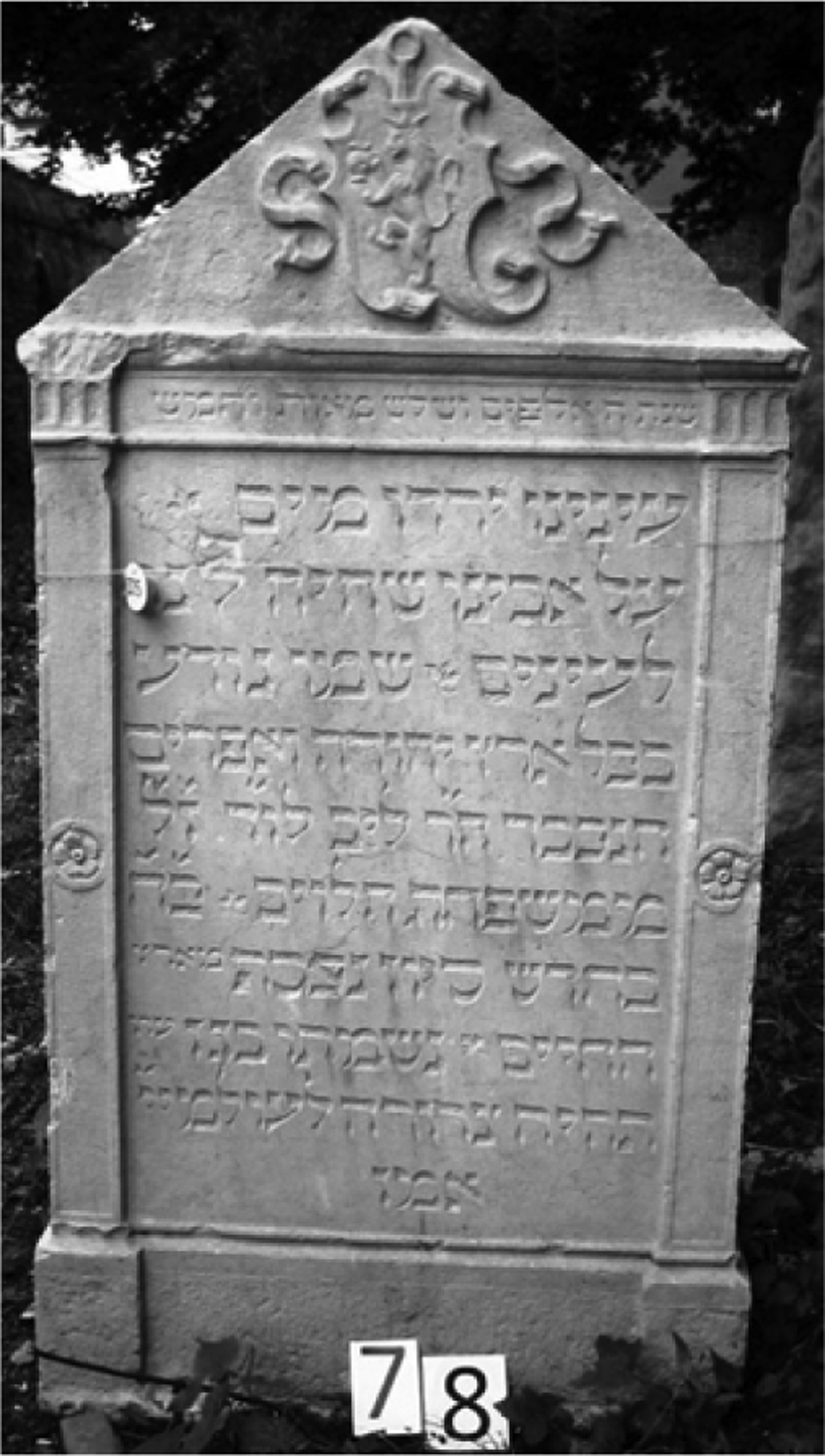
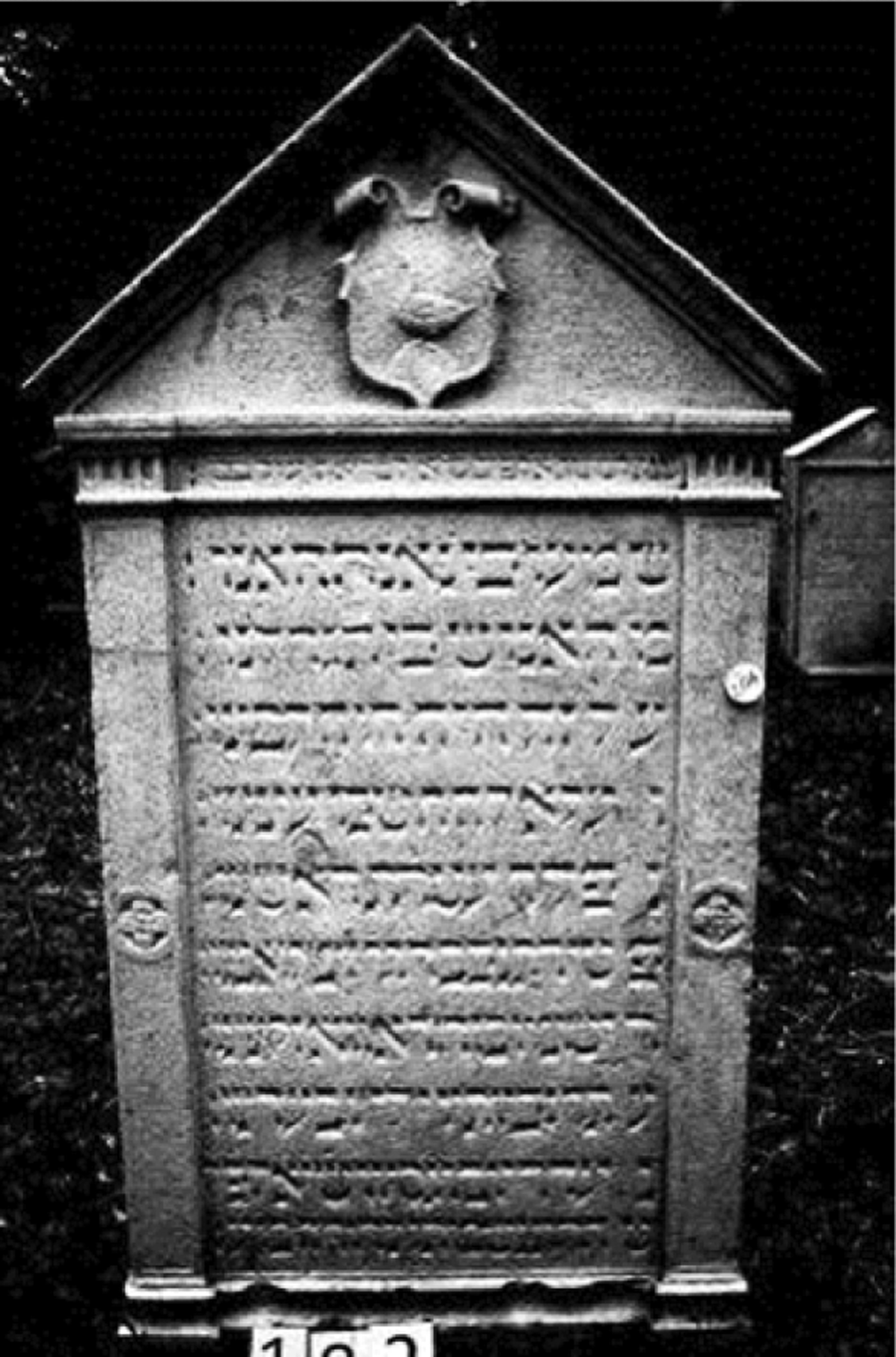
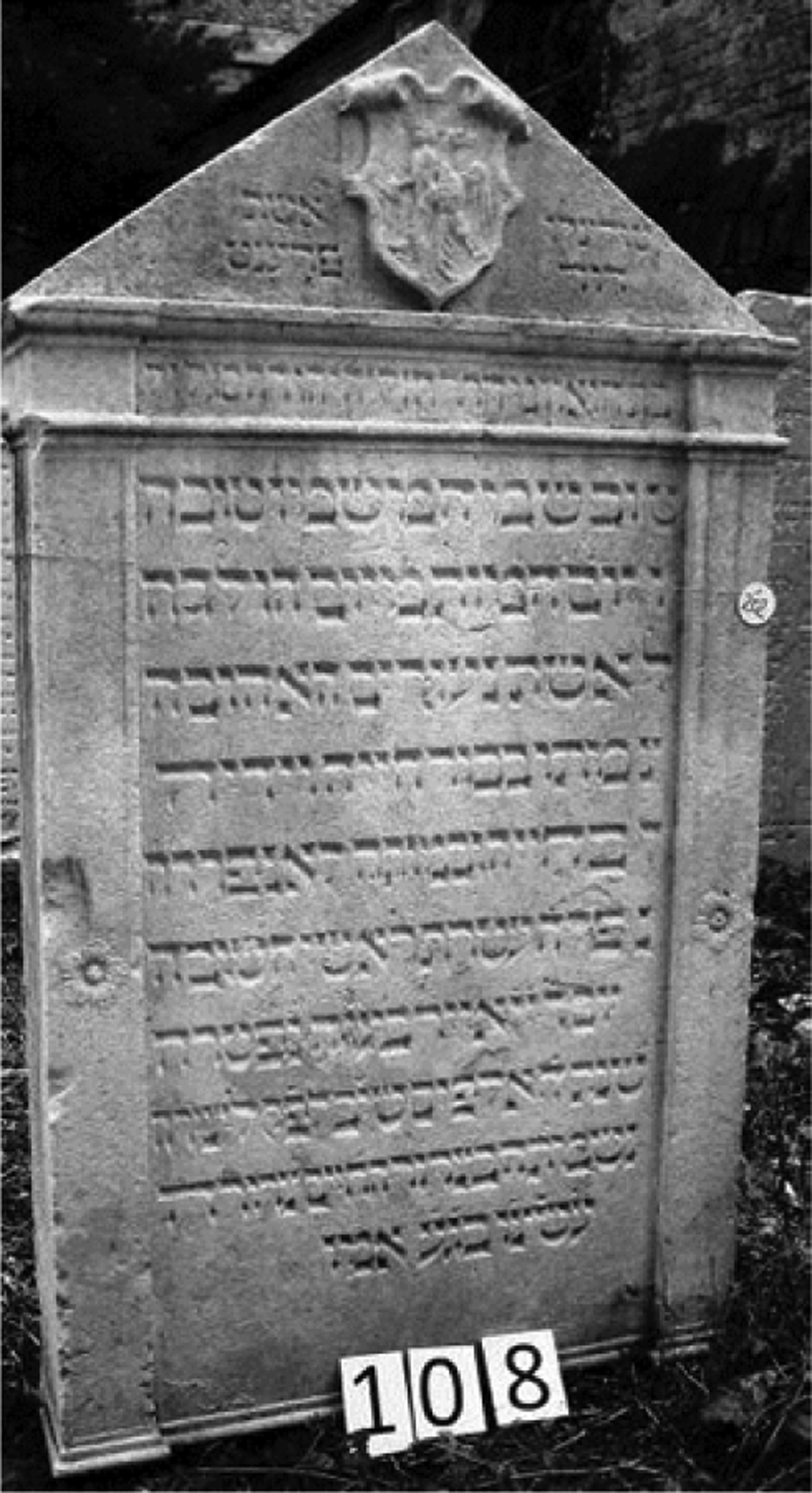
Architectural frames were conventionally used in early modern Europe to structure a broad range of objects, including mantels, moldings, candelabra, and illuminated documents. The classical portico, with pediment, entablature, columns, and portal, began appearing in Italy in the early fifteenth century. The portico became extremely popular, and served to ornament the title pages of books, as well as actual buildings.Footnote 33 Italy's Jews, too, applied the portico to Hebrew title pages, in print and manuscript, and also to the illuminated ketubah, or marriage contract.Footnote 34 In the graveyard, the gable represents the portico, especially when accompanied by entablature and pilasters. A series of portico tombstones from the latter half of the sixteenth century have a distinctly Palladian character:
These three stones, carved in the space of just seven years, closely resemble one another. All have pilasters, with pseudo-capitals ornamented with vertical channels and rosettes in mid-pilaster. Additionally, in all three the lintel frames the first line of the inscription. The tympanum of the tombstone of Simon Parente (fig. 4), is recessed, granting a more formal and sophisticated look. The tombstone of Tolẓeln Parente (fig. 5) more closely resembles that of Leb Lodi (fig. 3) than that of Simon, Tolẓeln's kinsman by marriage. The fluting on the pilasters of her tombstone is a further ornamental development of the genre.
Ogye bat Jacob
Fior[a] [bat] Shabbatai
Leb Lodi (1.78, d. 1545)
Simon Parente (1.102, d. 1551).
Tolẓeln Parente (1.108, d. 1552).
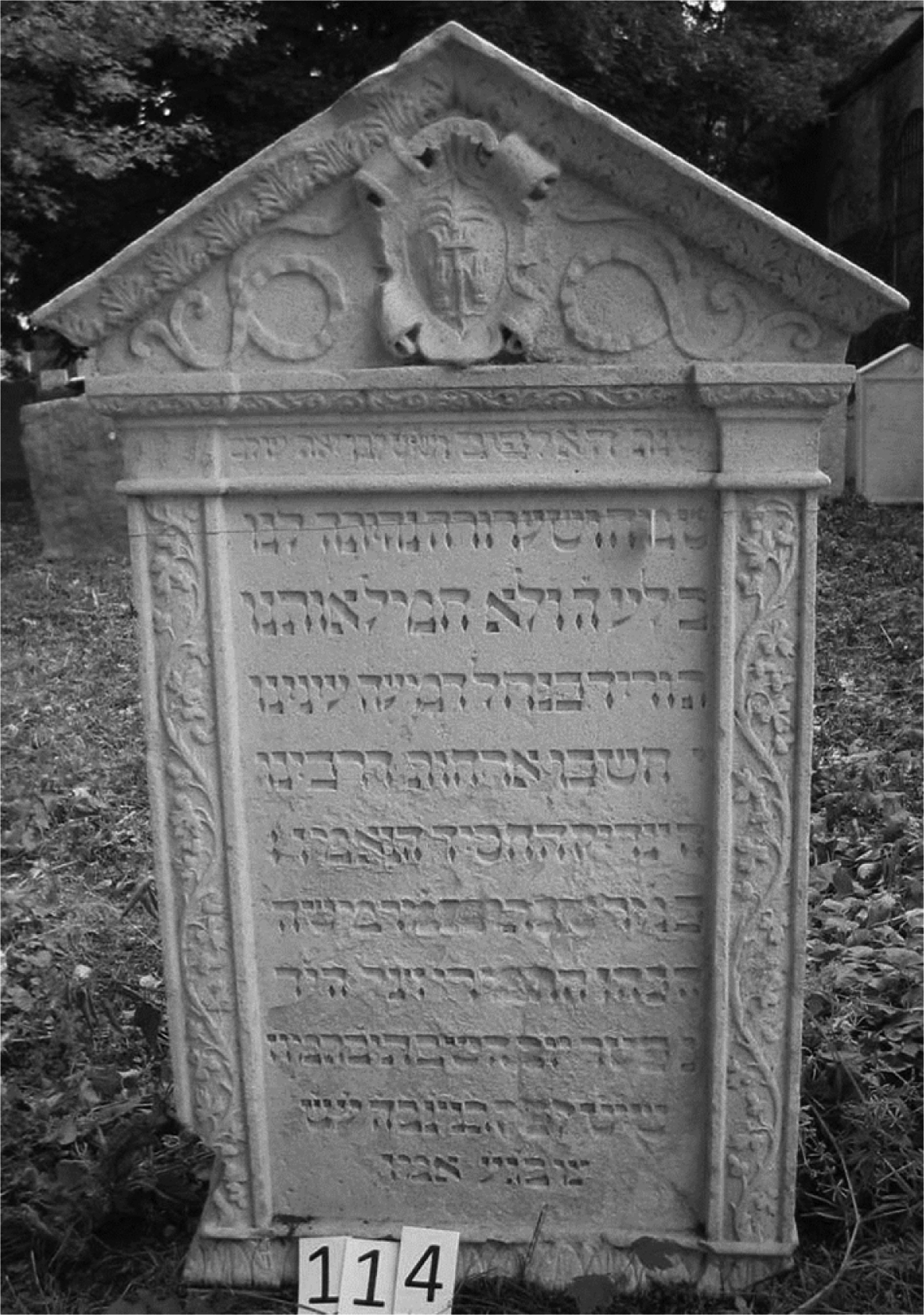
The portico tombstone continued to evolve. Two members of the Tamari family, Shabbatai (1.114, d. 1559) and Shifrah (1.125, d. 1565), were immortalized with elaborately ornamented monuments:
Both of these pediments have the prominent gable and recessed tympanum common to Simon Parente's tombstone. Shabbatai's tombstone (fig. 6) has an acanthus border running beneath the gable, a foliated scroll below the cornice, and a row of beech leaves along the base. An undulating vine runs along the pilasters of both structures, and also across the lintel of Shifrah's tombstone (fig. 7). On Shifrah's monument a cornice with an egg-and-dart pattern surmounts the pseudo-capitals, which are ornamented with an arabesque. Near the bottom, a floral strip extends horizontally beneath the tablet, between the Doric bases of the pilasters. A running branch of acanthus, chiseled very lightly, imparting a rococo look, trails across the bottom of the tablet, just below the inscription, filling in the remaining blank area.
Shabbatai Tamari (1.114, d. 1559).
Shifrah Tamari (1.125, d. 1565).
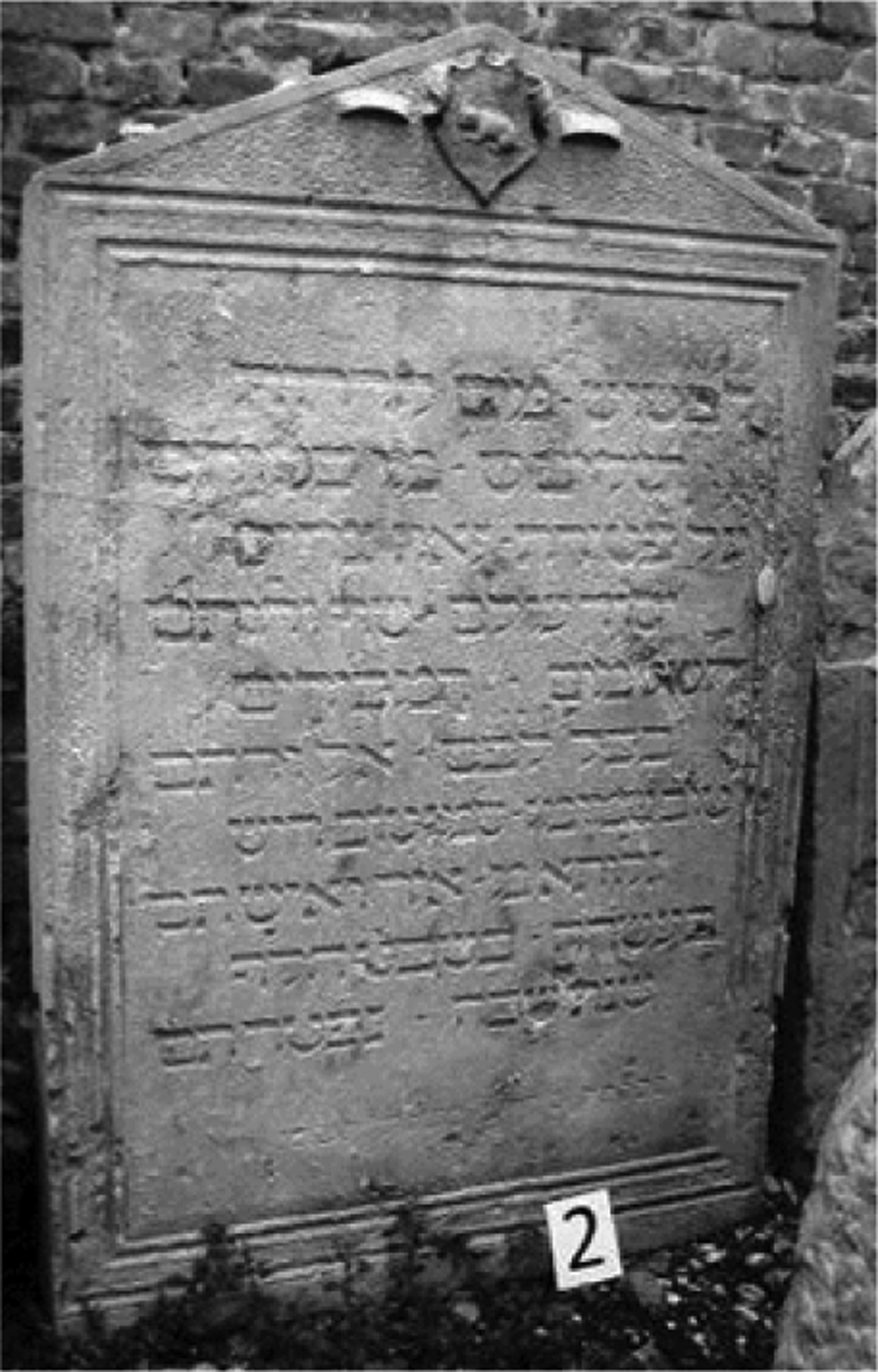
Maharam's tombstone (fig. 8) is more austere. It presents a gable, but no pediment and entablature, no pilasters and capitals. The restrained design does not signify reservations toward the use of classical elements; in fact, it subtly invokes these, and would not be mistaken for that of a tombstone from late-medieval Germany. Rather, Maharam's tombstone is a testimony to scholarly humility, in the spirit of the adage attributed to the rabbinic sage, Simon ben Gamaliel, that scholars are remembered for their words and hence require no monuments.Footnote 35
Me'ir Katzenellenbogen (1.2, d. 1565).
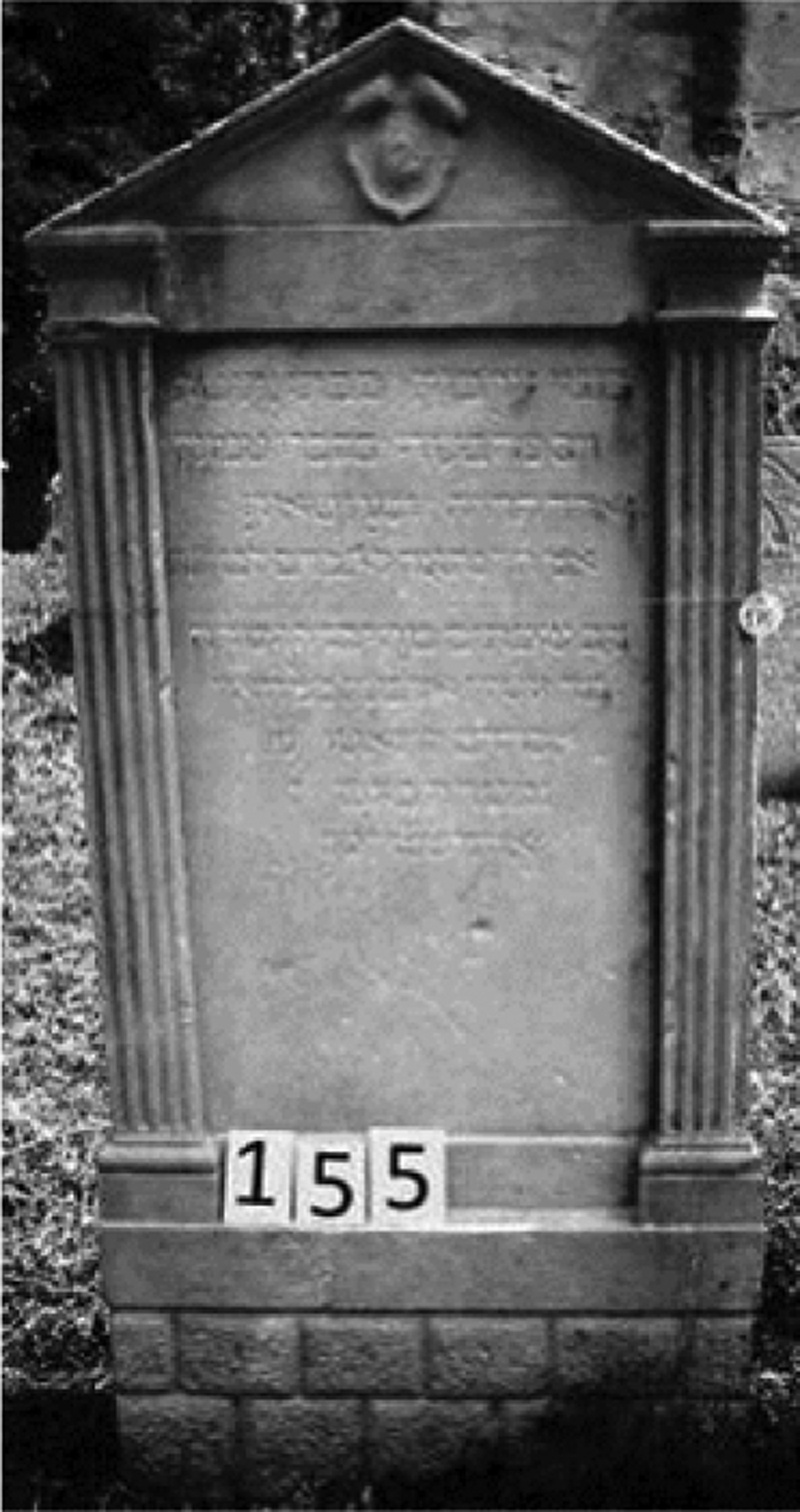
In later decades of the sixteenth century the portico tombstones returned to a more Palladian look, with cleaner lines. The 1586 design commemorating Abraham Luzzatto (fig. 9) has the classical structure of gable, pseudo-capitals, fluted pilasters, base, and plinth, but with no entablature and none of the elaborate ornamentation characteristic of the Tamari monuments.
Abraham Luzzatto (1.155, d. 1586).
The series of sixteenth-century porticos in the Palladian fashion concludes with the tombstone commemorating Samuel Judah Katzenellenbogen (fig. 10), Maharam's son and the leading rabbi of Venice in his day. Though fairly plain, with a cornice, architrave, and frieze above the pilasters, it is more ornate than that of Maharam, and more formal than Luzzatto's. The Doric pseudo-capitals, quite rare in the Padua corpus, also emphasize the classical style.
Samuel Judah Katzenellenbogen (1.1, d. 1597).
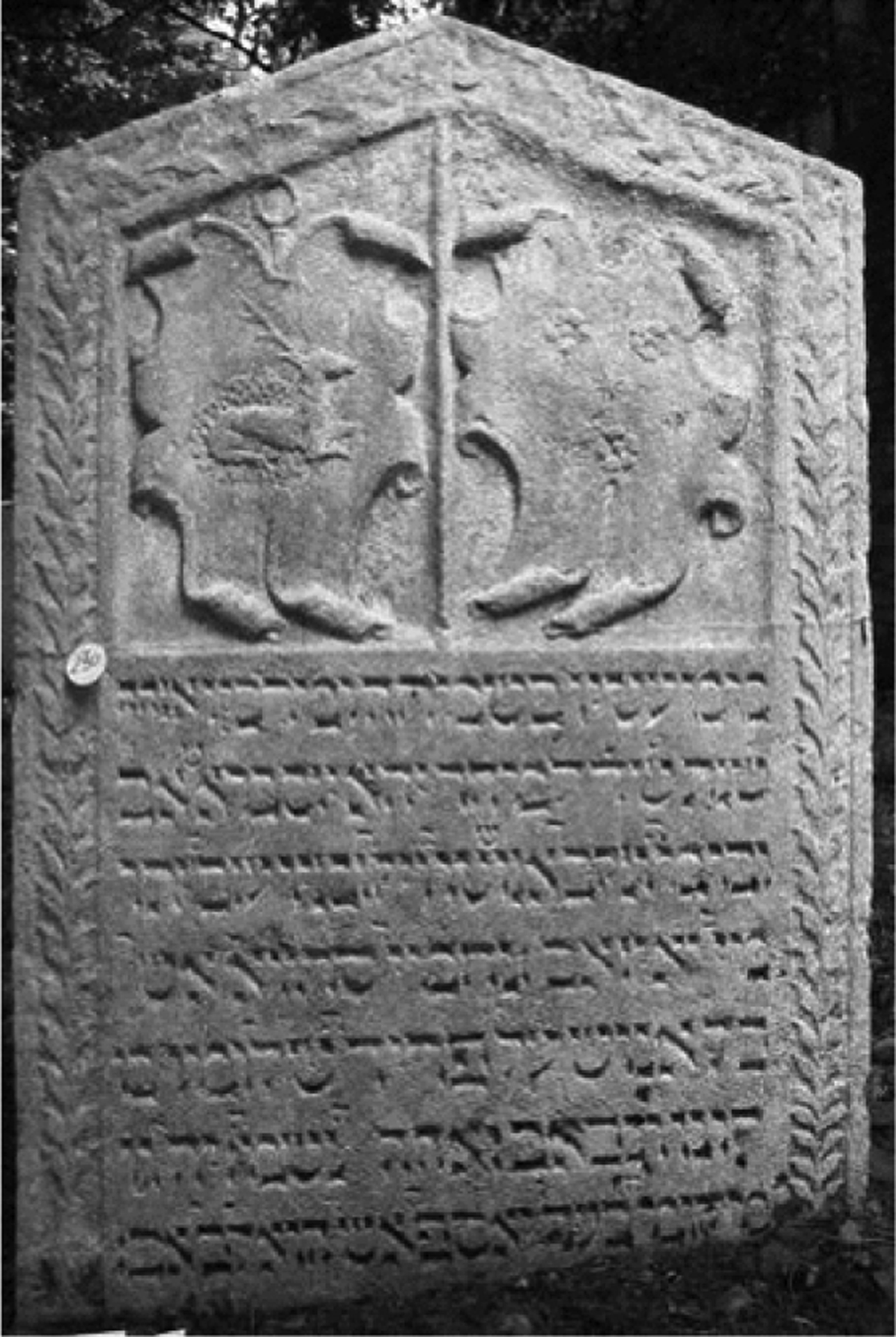
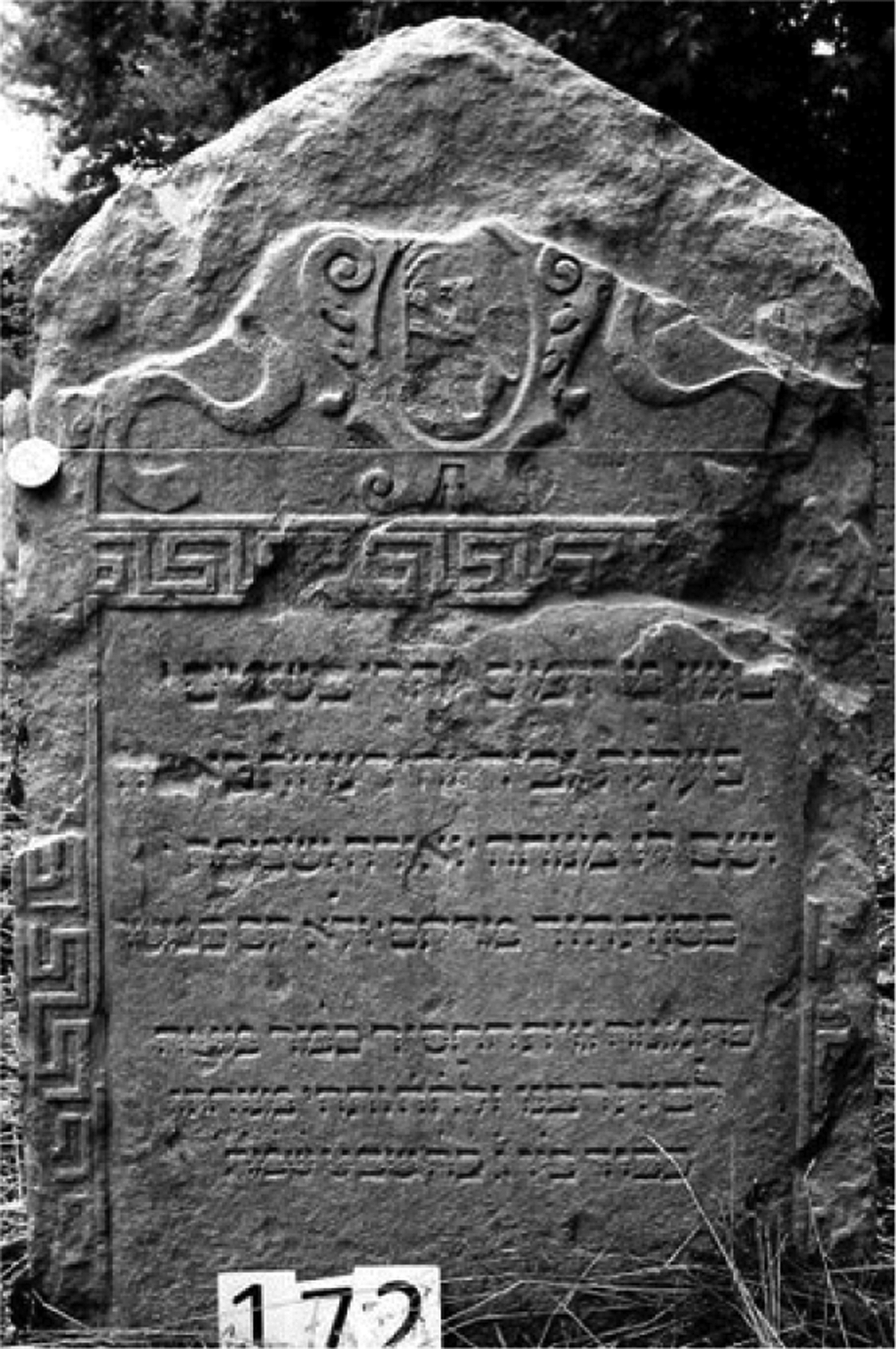
Pentagonal tombstones likewise belong to the portico genre. Dropping the horizontal plane of the triangle, which is usually either a lintel or a decorative frame, creates a rectangular space below the angular planes of the apex, resulting in a pentagon. The pentagon's relationship to the gable defines it as a natural extension of the portico tradition of Renaissance architecture, with a creative twist.
These two pentagons share a penchant for flamboyant ornamentation. The 1544 tombstone of Jacob Saraval (fig. 11), the earliest of the pentagons, has an acanthus border, while on the 1588 tombstone of Moses Rabeno (fig. 12) a meander pattern frames the tablet on three sides. Both the acanthus and the meander are motifs from the classical tradition, underscoring their roots in Renaissance architecture.
Jacob Saraval (1.76, d. 1544).
Moses Rabeno (1.172, d. 1588).
The arch is a fundamental component of the portico and therefore represents the adoption of Renaissance architecture by the Jews of sixteenth-century Padua. In Padua, arches invariably appear as a secondary architectural element within a larger design.
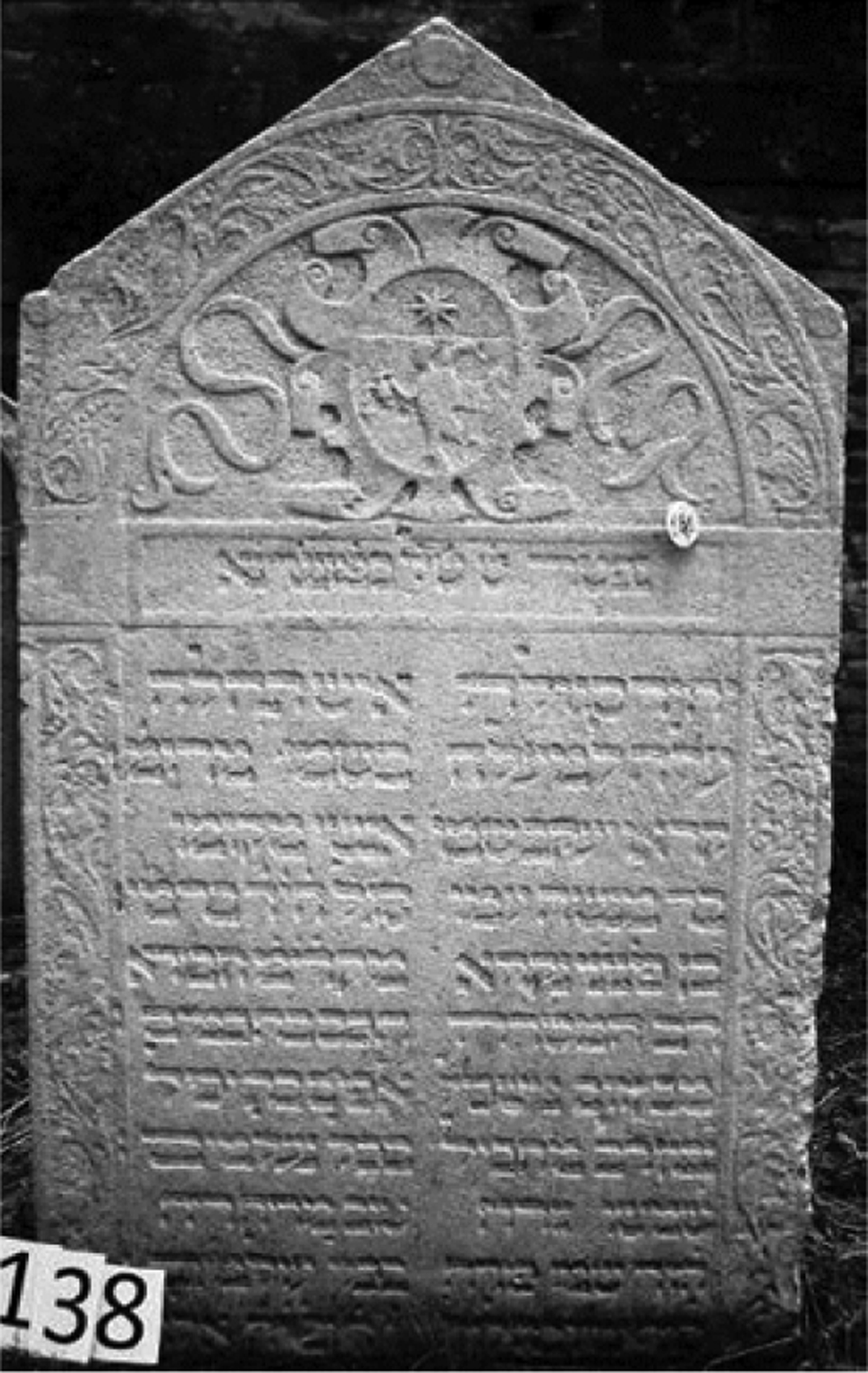
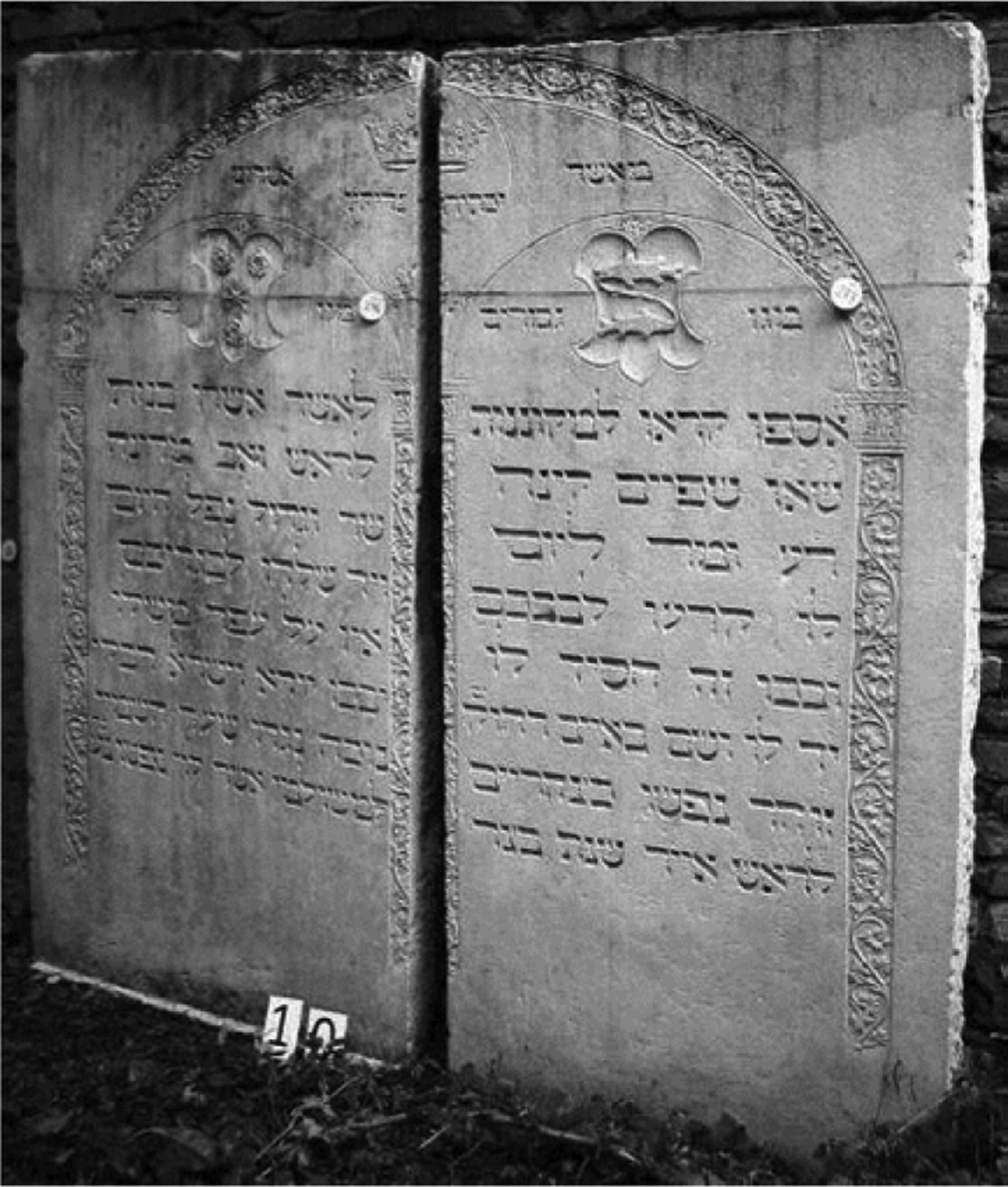
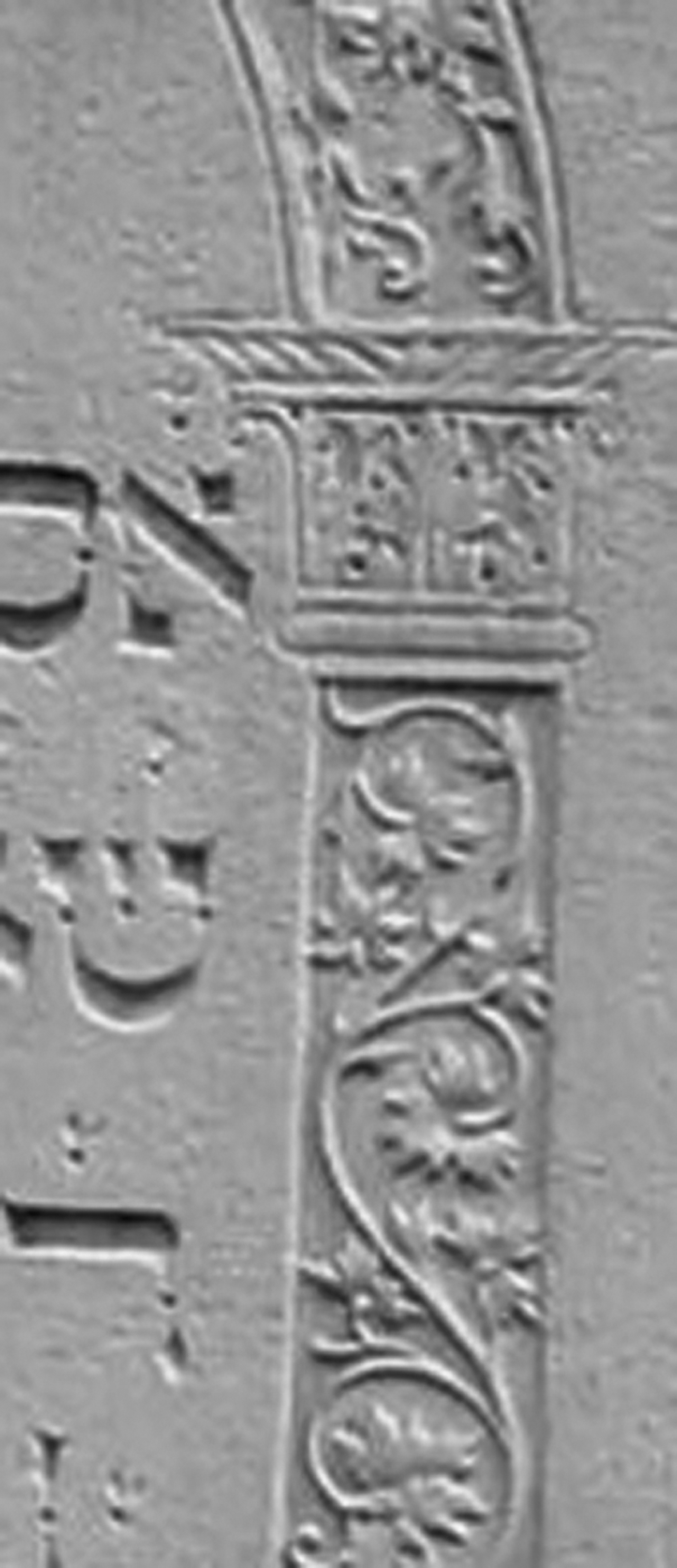
The arch and pentagon tombstone in memory of Jacob Finzi of Crema (fig. 13) has most of the ornamental elements already noted, as well as tiny wheels at the upper three corners. Next to it, the tombstone with arch and pseudo-pilasters commemorates Asher Meshullam (fig. 14), also known as Anselmo del Banco, the preeminent Jewish loan banker of Venice and the mainstay of that city's Jewish community.Footnote 36 The Florentine lilies carved in relief on Asher's tombstone, which provide a platform for his family emblems, are an unusual and impressive feature, especially striking because the other architectural and decorative elements are lightly carved. The pseudo-Corinthian capitals (fig. 15) are remarkable too, for they are practically unique to this period of Padua's sepulchral art for Jews of any ethnic group. One would expect no less from a tombstone of a member of the Meshullam family, given their financial and political power.
Jacob Finzi (1.138, d. 1570).
Asher Meshullam (1.10, d. 1532).
detail of Asher Meshullam tombstone (1.10, d. 1532).
The base of the tombstone, its most humble architectural component, could easily be ignored. But this part, too, incorporates elements of the Italian Renaissance:
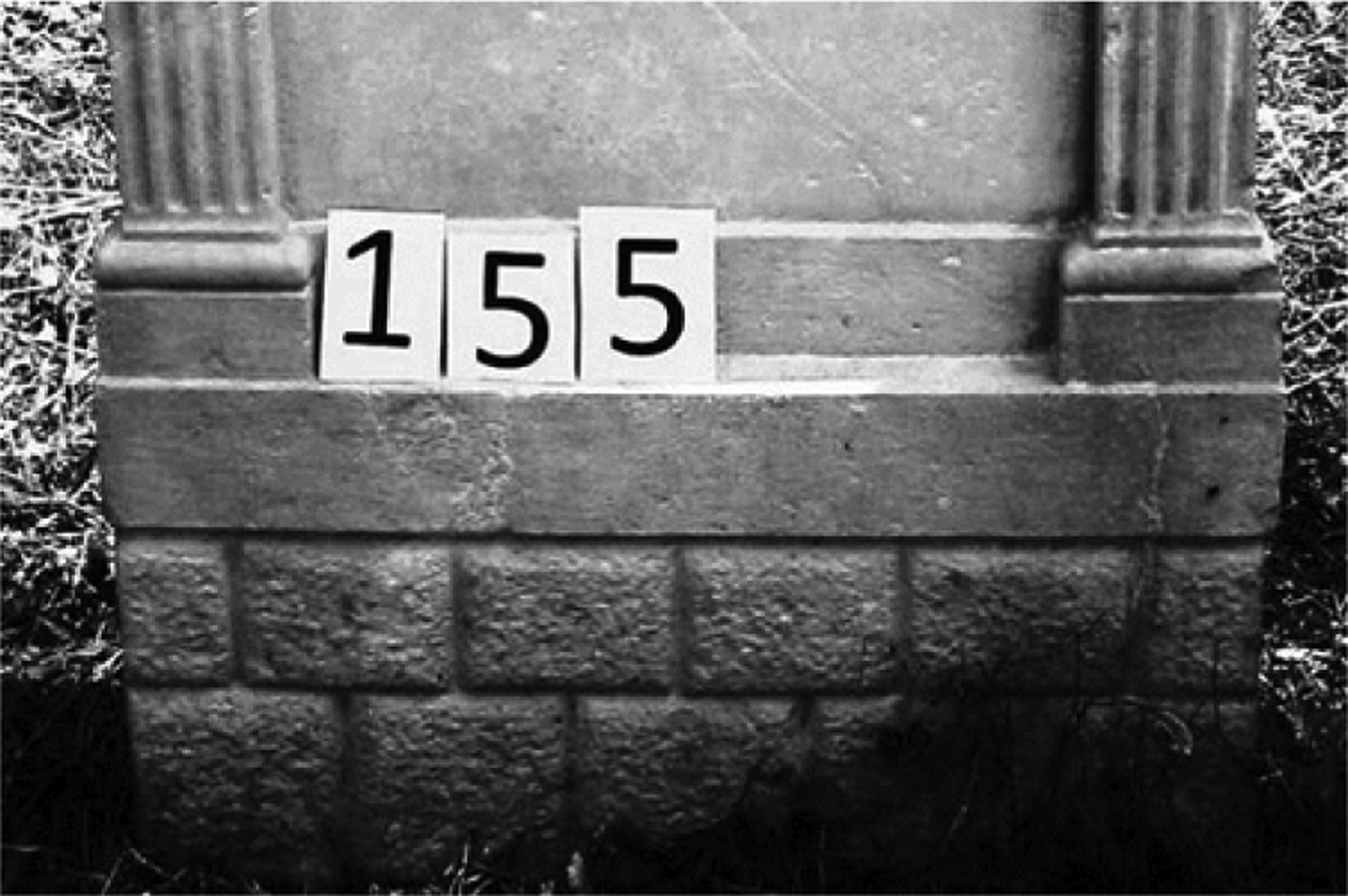
The base of the tombstone of Abraham Luzzatto (fig. 16) depicts the architectural technique known as rustication, in which the façade of a building's lowest story, at street level, is rough and bumpy, while higher up it is flat and smooth.Footnote 37 This common technique in the Italian Renaissance reflects the portico conception of the tombstone characteristic of this portion of the period, and can be found on several Paduan gravestones from the sixteenth and early seventeenth centuries.Footnote 38
Detail of the tombstone of Abraham Luzzatto (1.155, d. 1586).
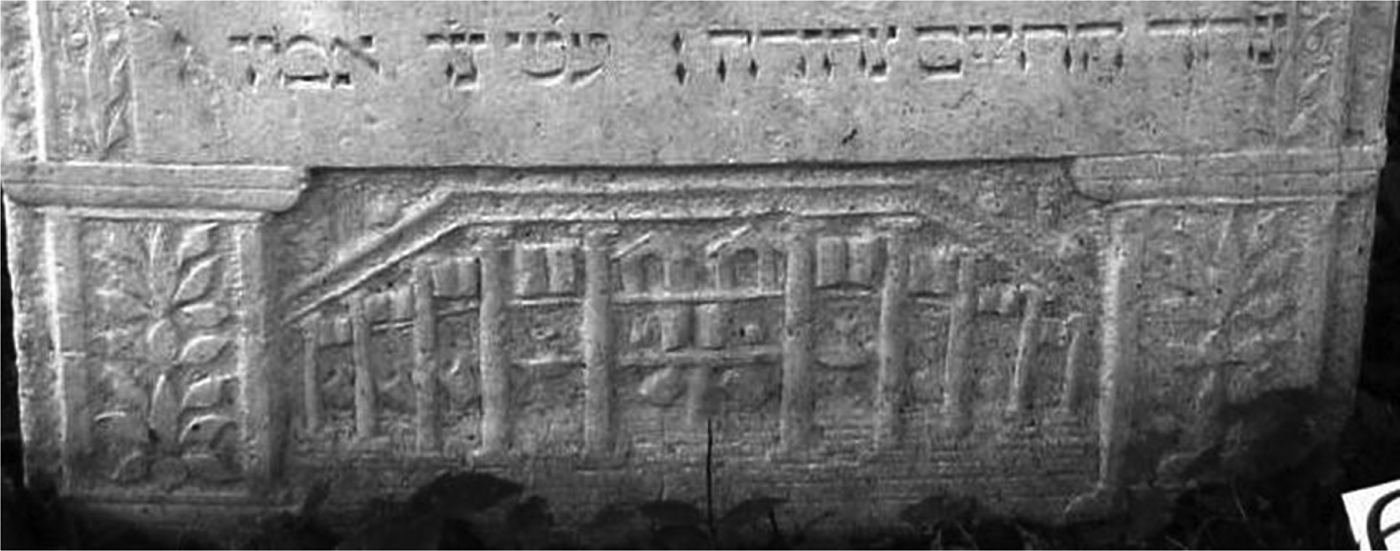
The image carved in 1540 at the base of the tombstone of Michael ben Reuben, a physician from Ferrara (fig. 17) presents a striking amalgam of elements from the classical and Jewish traditions. Between the squat columns beneath the tablet, carved minutely and precisely, stands the open façade of a Parthenon-like edifice, supported by ten columns with Ionic capitals. The rhomboid shape of the roof grants it a three-dimensional appearance, and the stars above provide a natural setting. Between the columns, on the middle and lower levels, are various objects, including jugs, a set of laver and basin, and possibly books. Collectively, the laver and basin and the other implements seem to represent the Temple of Jerusalem, which would certainly explain the majestic architecture. Two tiny houses occupy the center of the uppermost level, and their diminutive size and lofty position may signify distance. It may be, therefore, that the houses embody the rest of the city of Jerusalem, beyond the Temple confines. The classical structure is obviously patterned after the public buildings of ancient Greece and Rome, but the allusion to the Jewish shrine is equally unmistakable.
Michael ben Reuben (1.64, d. 1540).
Carved onto many of the Padua tombstones are personal emblems, an art form of particular significance for the society and culture of premodern Europe. The original purpose of the emblem was to provide a non-verbal mechanism for identifying an individual or family, facilitating identification in an age when the surname had not yet supplanted the patronymic. Originating in the realm of heraldry, by the end of the twelfth century the emblem was widely employed in everyday urban life, on seals, coins, buildings, documents, and other objects. During the thirteenth century, the emblem spread from the nobility to merchants, artisans, clergy, and peasants, as well as religious institutions. The emblem also enjoyed geographic diffusion. From its first appearances in northern Europe, by the middle of the thirteenth century the emblem had spread south to Spain and Italy and north to Scandinavia.Footnote 39
Similarly, the Jews of various European lands, including central Europe, exhibited emblems in a variety of contexts. In the Padua tombstones the emblem was clearly a component of the Renaissance tradition, for the emblem and the shield in which it is set are placed in the tympanum of the gable. Palladio viewed the emblem as an organic feature of the classical portico, and emblems habitually appear in the tympanums of buildings whose designs he published in his treatise on architecture. And, indeed, his villas, including Villa Emo and Villa Badoer, exhibit shields with oval frames in the tympanum.Footnote 40 The architecture of the Renaissance is thus the context for the emblem's appearance on Padua's Hebrew tombstones.
The following table details just how prevalent the emblem was in sixteenth-century Padua:
Emblems on Jewish Tombstones in Sixteenth-Century Padua
These data, however limited, indicate that, in contrast to the adoption of metered poetry, the architectural approach, including the emblem, appears already at the very beginning of our period, with no indication of gradual progression.
The emblem can typically be found on a heraldic shield or escutcheon. Heraldry considers the shield one of the three components of the coat of arms, along with the charges (i.e. symbols), and colors. The shield has a wide variety of shapes, of which the most popular in Padua are the shield, roundel, oval, and cartouche.Footnote 41 The shield was so essential that figures presented without it are not considered heraldic arms.
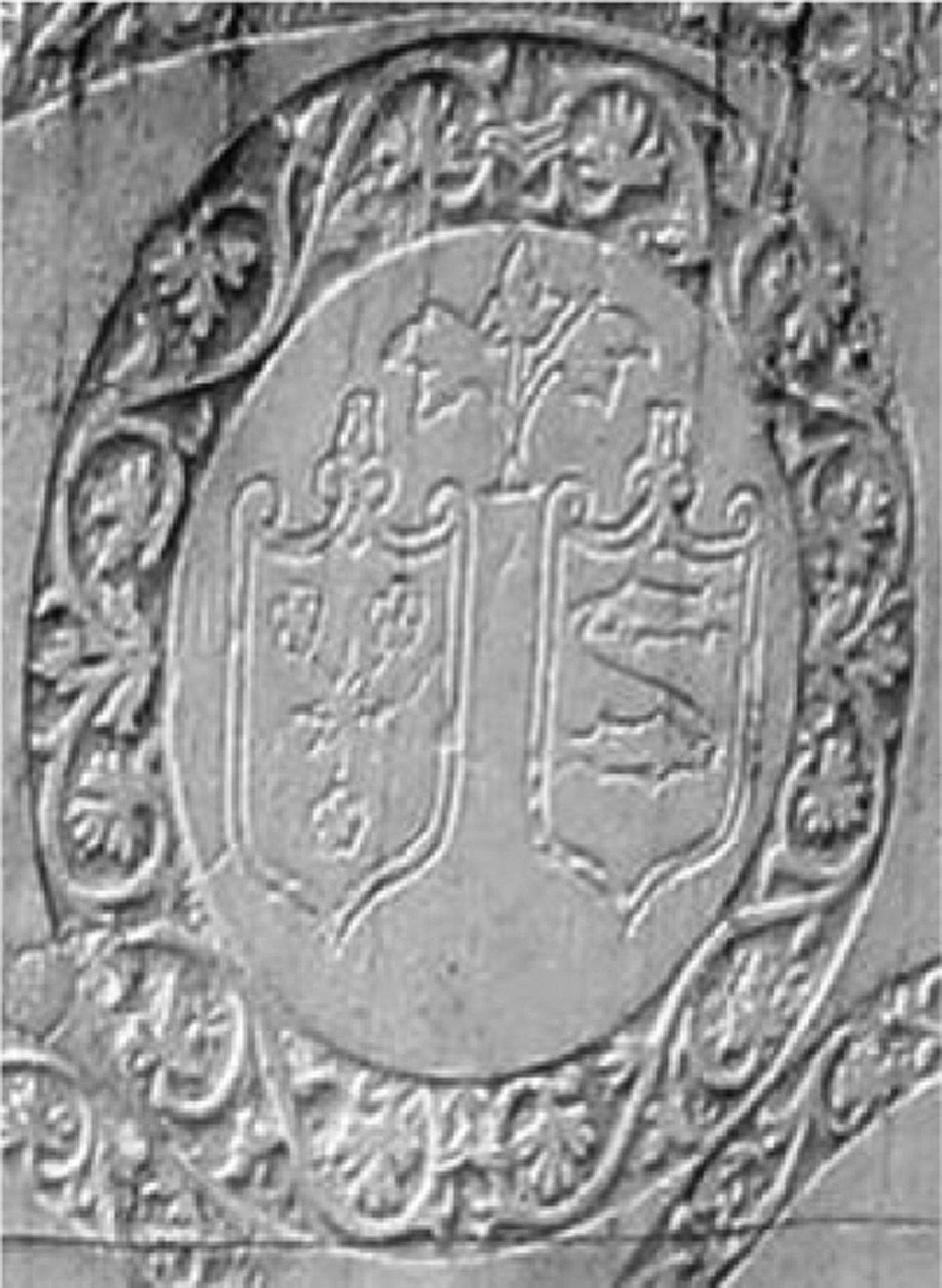
Shields are often partitioned into sections that present the arms of different families or branches of a single family. In Padua, tombstones memorializing husband and wife sometimes present two shields, with the symbols of each family. On rare occasions emblems of two families were represented united. The tombstone of Mordekhai Levi Meshullam (fig. 18) is one such example. A single frame unites two lightly engraved shields, with the emblems of two families, although this is the tombstone of a single individual, Mordekhai Levi Meshullam, of the highly esteemed del Banco family of Venice.
Mordekhai Levi Meshullam (1.7, d. 1552).
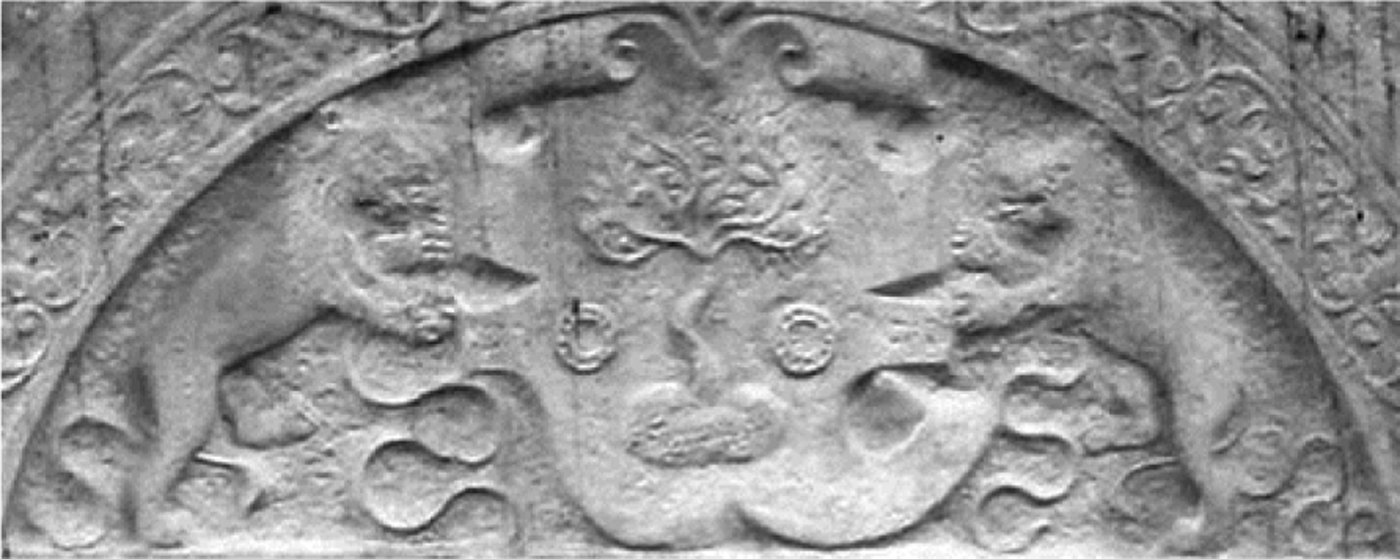
Heraldic shields also have “supporting” figures, usually lions or putti, which flank the shield and appear to hold it erect. In Padua, pairs of rampant lions flank various objects as charges, but the 1540 gravestone of Michael ben Reuben (fig. 19) represents the only example of supporting figures from before the mid-nineteenth century. These rampant lions face one another, paws resting on the shield (although these supporting figures may be leopards, rather than lions).
Michael ben Reuben (1.64, d. 1540).
The main element in the heraldic shield is, of course, the charges, or the icons displayed on the shield. In the traditional taxonomy of heraldry, these are classified in the categories of natural, artificial, and imaginative. Natural figures include animal and plant life; artificial elements include manufactured objects; and imaginative emblems include fantastic creatures, such as dragons and mermaids.Footnote 42 The first two categories are found in Padua's sixteenth-century graveyard, but not the third. Mythological creatures do appear in other genres of Jewish art in early modern Italy, but it seems they were deemed inappropriate in the cemetery.
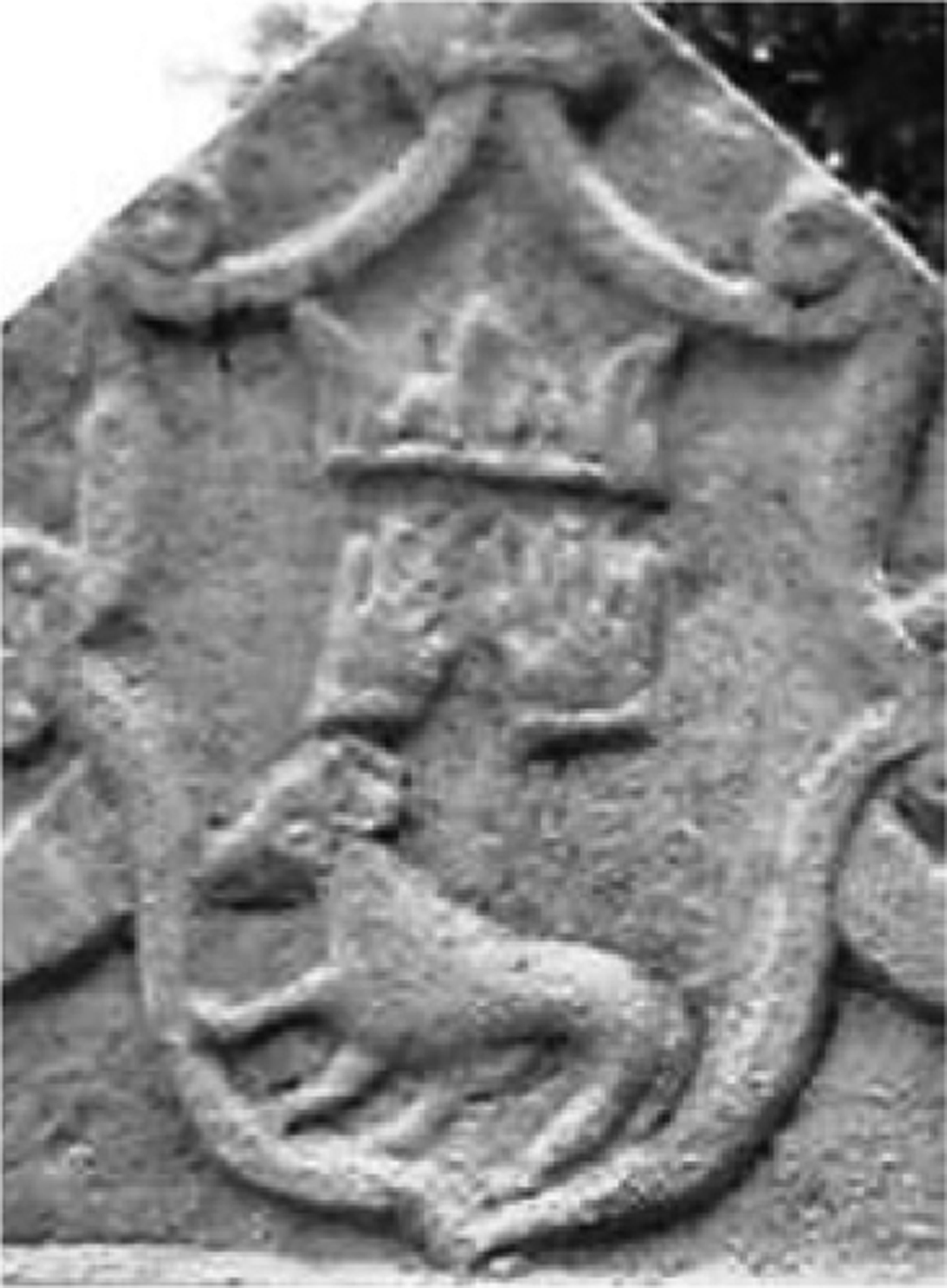
Among the emblems of Jews in various European countries, some were selected because they communicate significant traits pertaining to the individual or head of the household. This is also true for emblems in Italy, and Padua is no exception. Figures also represent vocations, as in the striking example of the tomb of Isaac Kohen from 1565 (fig. 20). The inscription on this tombstone identifies the deceased as “Isaac, butcher and also Kohen [priest],” both identities proudly represented by the charges, the former by the priestly crown and hands, and the latter by the cow in left profile.
Isaac Kohen (1.150, d. 1565).
Among animal figures in heraldry, the most common are a lion, eagle, deer, horse, and fish.Footnote 43 Both the lion and the eagle have been termed kings of beasts, signifying power and leadership, and thus also the qualities of courage, nobility, generosity, and justice.Footnote 44 In Jewish tradition both lion and eagle are identified with the mishnaic dictum of Judah ben Teima: “Be bold as a leopard and swift as an eagle and fleet as a hart and strong as a lion to do the will of thy father who is in heaven.”Footnote 45 As the emblem of the Venetian republic, the lion was an especially potent symbol of power for subjects of La Serenissima, including the residents of Padua, although on the shields of Padua's Jewish tombstones the lion is always rampant, a position not associated with the lion of St. Mark.
The eagle is analogous to the lion for its supreme dignity and power. In funerary art of ancient Rome the eagle was associated with victory and “ascension,” and implied spiritual ascent.Footnote 46 In the thirteenth century, adopted by Frederic Barbarossa as the emblem of the Staufen, the eagle assumed imperial significance. Soon, it began to rival the lion in heraldic popularity among the nobility, even if commoners continued to prefer the lion. So, too, did the Jews of Padua.
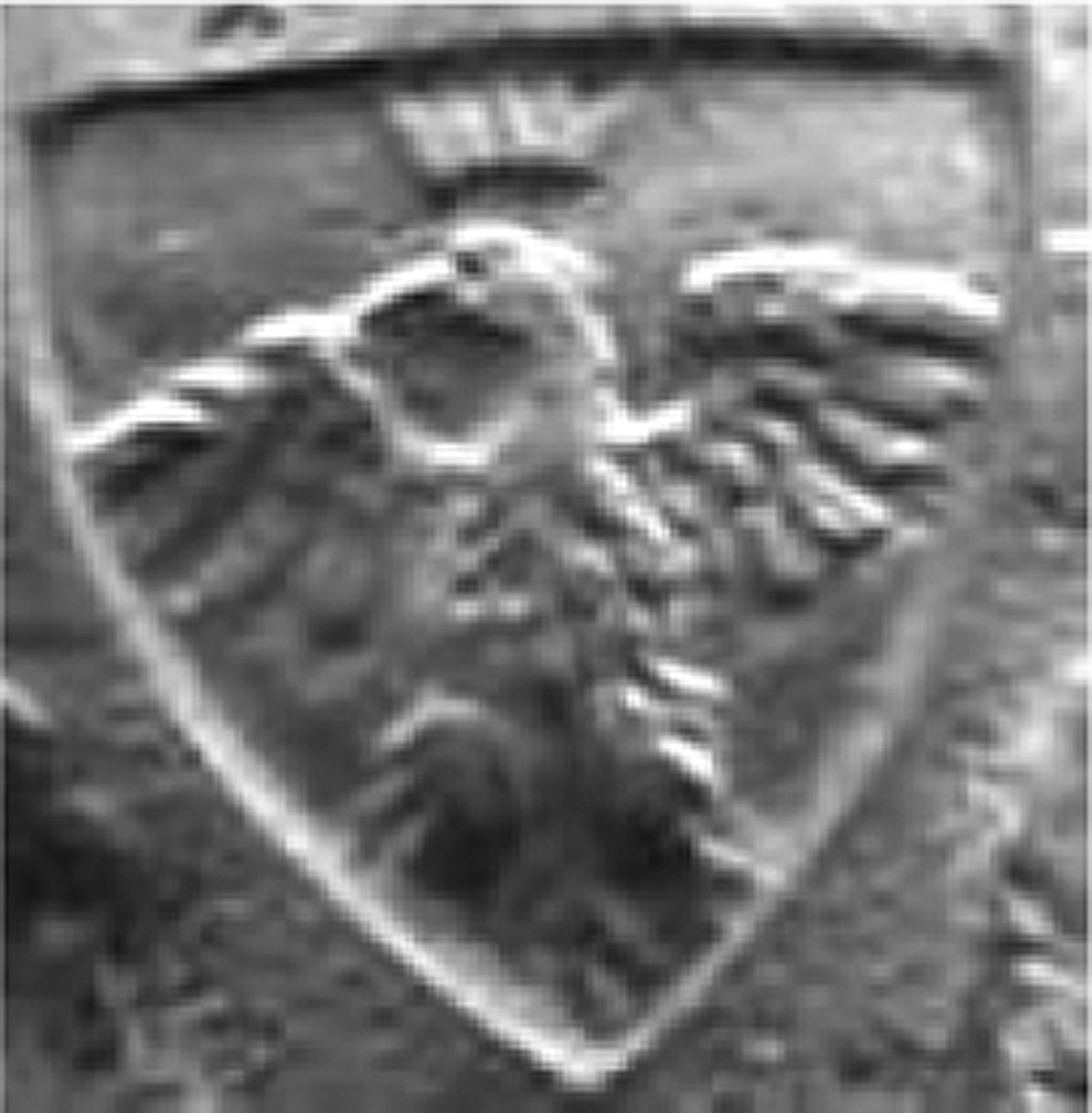
The eagle on Rachel Ẓarfati's tomb (fig. 21) is among the most finely wrought in the Padua corpus. The crown eloquently expresses the eagle's regal nature, just as the spread wings evoke its awesome power. For Jews, the connotations of the eagle are drawn from its biblical appearances. It has divine associations stemming from the description of the Israelites as having been borne by God “on eagle's wings” (Exodus 19:4), and again, when God is described as taking flight while bearing the nation under its wings as an eagle bears its young (Deuteronomy 32:11). The psalmist expresses the vigor of the eagle in the verse that declares that the Lord renews one's youth “like an eagle” (Psalms 103:5).Footnote 47
Rachel Ẓarfati (1.167, d. 1566).
In the category of manufactured objects, the crown is the most prominent member, both for its ubiquity and for its regal nature. In heraldry crowns are of particular importance, because the choice of crown signifies the rank of the house. Thus there are different crowns not only for king and prince, but also for duke, marquis, and so on, as well as discrete styles for Europe's various lands, yielding a total of ninety-one varieties of heraldic crowns. As a rule, crowns for higher ranks have luxurious cloth as well as gold.Footnote 48
Maharam's tombstone is the only one in Padua's cemeteries featuring two crowns. One signifies the crown of the Torah; while the other, since the Katzenellenbogens were not Aaronites, can only be the “crown of the good name.”Footnote 49 The pair of crowns are not charges; since they flank the shield, they are simply ornaments. By contrast, the tombstone of Maharam's own son, Samuel Judah, though containing an epitaph bestowing on him the crown of Torah, features no visual representation of the crown itself.
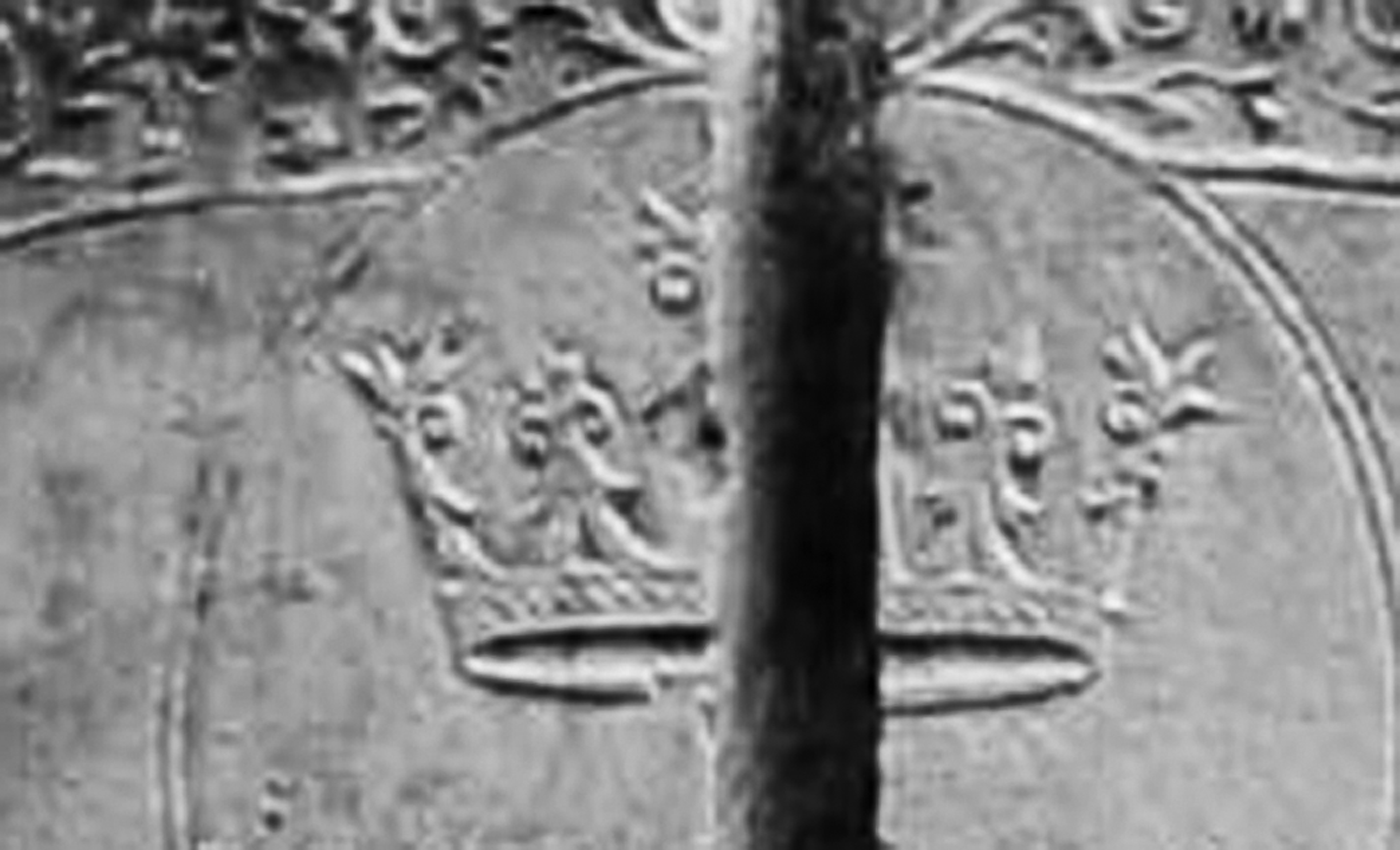
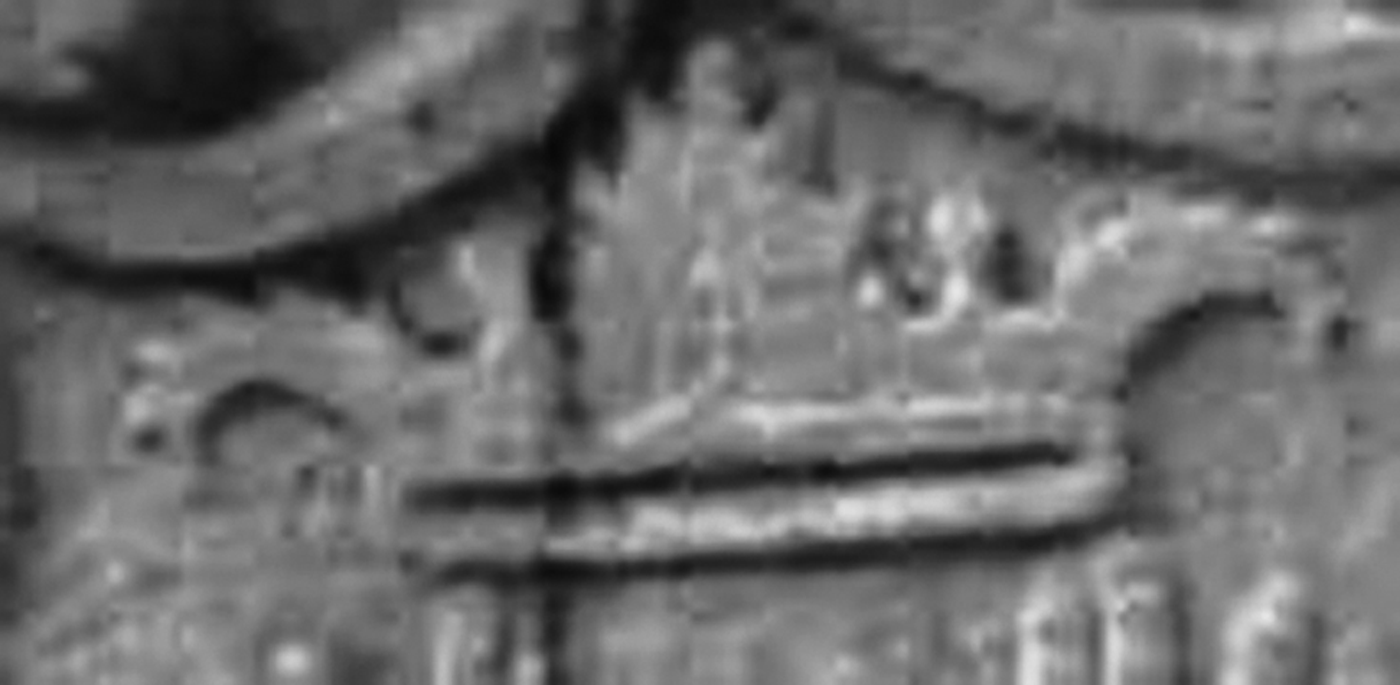
Nonetheless, crowns frequently appeared on Padua tombstones: The most finely carved and exquisitely preserved crown in the corpus is that on the tombstone of Asher Meshullam (fig. 22). It has five tall leaves with flowers. Although it lacks the five alternating small leaves typical of this design, its style strongly resembles the Italian prince's crown found on heraldry charts, which seems to befit this individual's lofty status in the Jewish community. The crown on the tombstone of Naftali Kohen (fig. 23) has a large leaf in the center, curvilinear ones on the left and right, and two smaller leaves in between––a design similar to that marking an Italian marquis, who ranks lower than a prince but higher than a baron. But, in contrast to the crown on Naftali Kohen's tomb, the leaves on a marquis crown are typically equal in height.
Asher Meshullam (1.10, d. 1532).
Naftali Kohen (1.176, d. 1571).
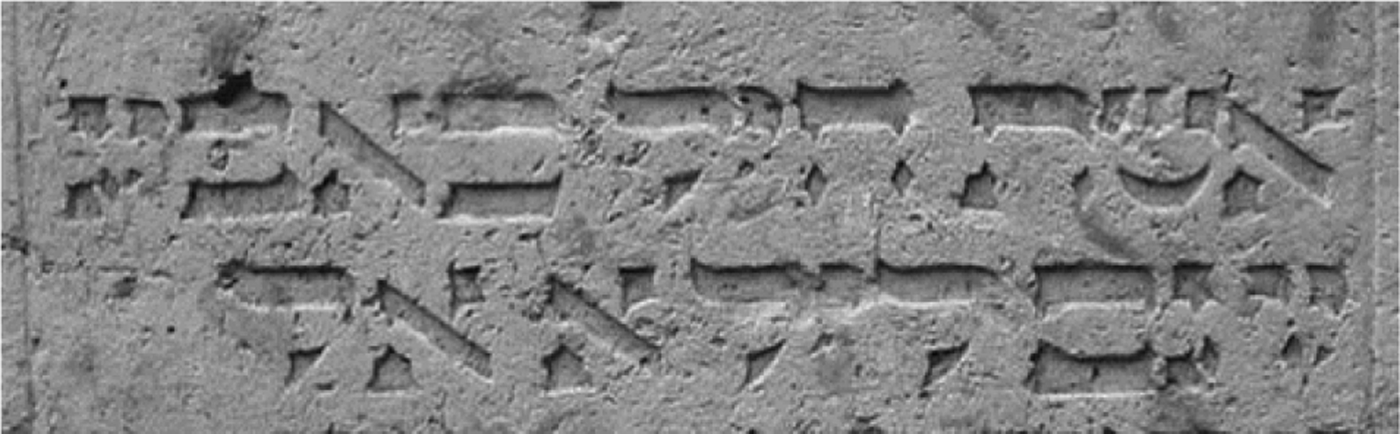
The same pattern of Ashkenazic acculturation evident in inscriptions and art can also be seen in lettering, including the use of graphic symbols. In the sixteenth century the square lettering characteristic of the Ashkenazic hand reigned supreme in the Padua cemetery.Footnote 50 In this hand, the letters frequently inclined to the left and the characters were fairly short and thick, as is the case on the gravestone of 'Avigayil Katzenellenbogen, the wife of Samuel Judah Katzenellenbogen (fig. 24).
'Avigayil Katzenellenbogen (1.11, d. 1594).
The tombstone of 'Avigayil's father-in-law, the Maharam (fig. 25), displays a characteristic common in Ashkenazic manuscripts, including those penned in fifteenth-century northern Italy––a tendency to decorate Ashkenazic characters with a dot carved at the midpoint of the vertical lines. The dot-at-midpoint technique was fairly popular: nearly half of the tombstones with Ashkenazic lettering exhibit this paleographic ornament.
Me'ir Katzenellenbogen (1.2, d. 1565).
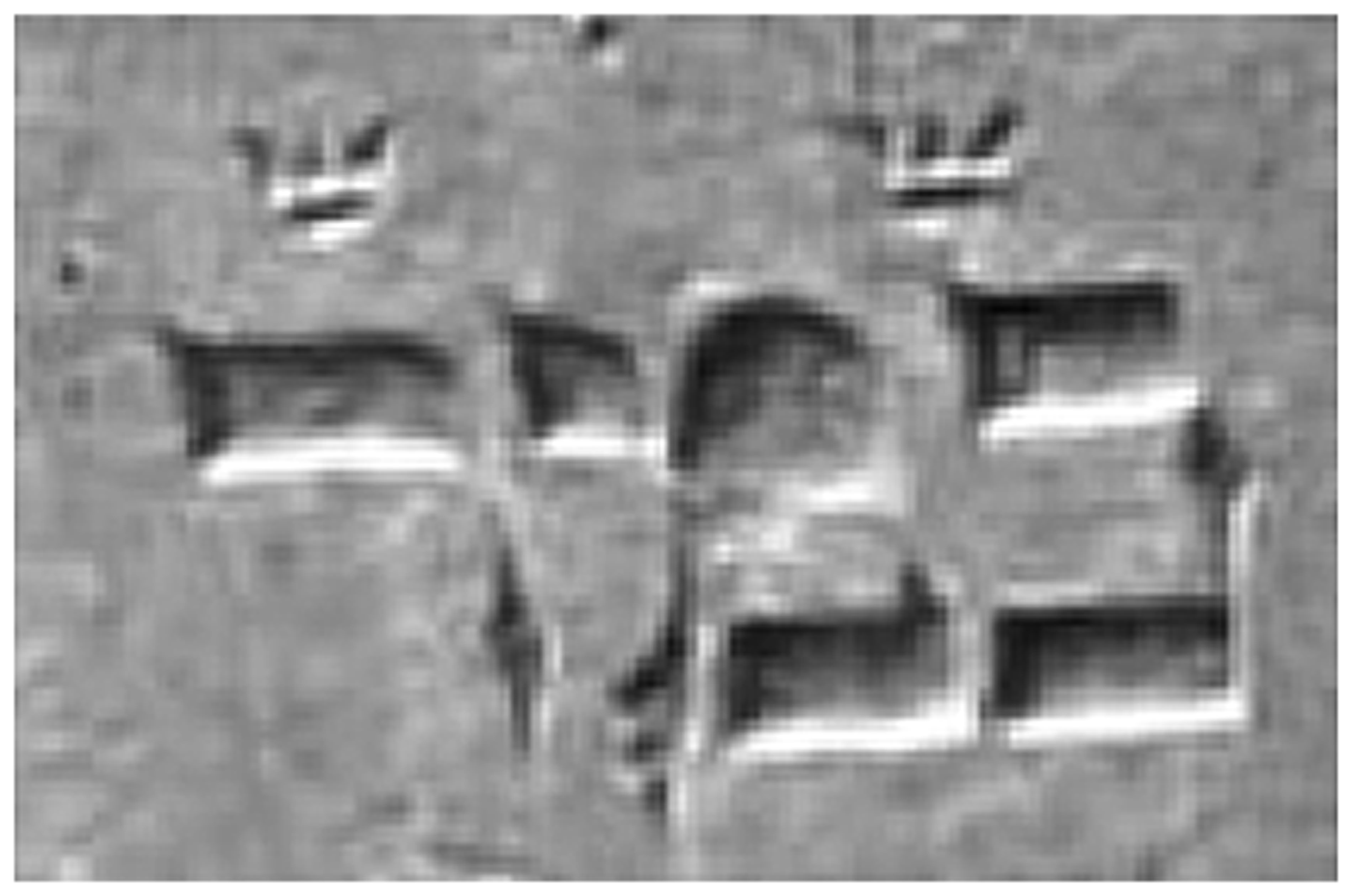
The paleographic creativity of the sixteenth century is also expressed in the use of other decorative symbols. Crowns marked abbreviations the way quotation marks are used today (fig. 26); trefoils served as punctuation marking the end of lines, and separating them from one another (fig. 27).
Aaron Kohen (1.171, d. 1598).
Leb Lodi 1.78, d. 1545.
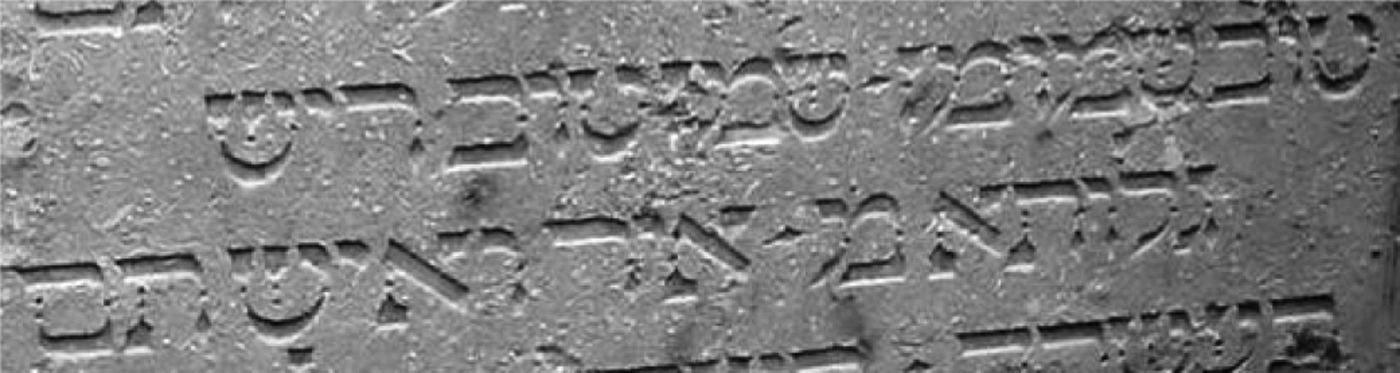
But at the end of the sixteenth century, the handwriting style of the Padua tombstones shifted decisively from Ashkenazic to Sephardic square characters. These lines from the 1585 inscription of Moses Judah Seligman (fig. 28) are the earliest instance of the new handwriting in the Padua corpus, followed by that of Samuel Judah Katzenellenbogen in 1597; in the seventeenth century this style became the norm. As the use of Sephardic characters on Ashkenazi tombstones demonstrates, one cannot make a judgment about the ethnicity of the deceased solely based on the lettering style. In Hebrew paleography, the term “Sephardic” is a holdover from the study of medieval Hebrew manuscripts. The square characters depicted here closely resemble those of Sephardic square characters from the Middle Ages, but the term is not rooted in the historical setting. In lettering, as in inscription and architecture, the Padua tombstones reflect the acculturation of the city's Ashkenazic constituency.
Moses Judah Seligman (1.151, d. 1585).
These transformations in visual style, poetics, and architecture were not quite simultaneous. While both features characteristic of Renaissance architecture and metered poetry appeared from the outset of the period, becoming ubiquitous by mid-century, Ashkenazic lettering continued to dominate the scene throughout the sixteenth century. Reasons for these chronological discrepancies await further research. But, perhaps Christian stone carvers may be credited for the early implementation of new architectural styles that preceded changes in inscription, while the new lettering may be attributable to the growing impact of printing.Footnote 51
*
If the Padua tombstones of the sixteenth century reflect the impact of the Italian environment on the city's mainly Ashkenazic community, they must be seen in the broader context of the firmness and flexibility of Ashkenazic identity in other realms of social and cultural activity. Treviso, northeast of Padua, where twenty-seven inscriptions survive from the fifteenth century, had a tedeschi community as old as that of Padua. Almost all of the Treviso texts are in simple prose, without rhyme, meter, or acrostic. They merely identify the deceased, provide the date of death, and conclude with a prayer for the soul of the departed. Their only embellishments are complimentary epithets immediately preceding the name, such as honest, erudite, venerable, etc. Four Treviso tombstones survive in nearly pristine condition, and their architectural design, too, is distinctly medieval. Like the pre-1509 tombstones from Padua, they are simple rectangles, or at most lunettes, utterly devoid of adornment. The lettering in Ashkenazic block characters betrays no Italian influence.Footnote 52
Gravestones of the Jews of medieval Italy further underscore the innovative nature of the Padua tombstones. Three survive from fifteenth-century Trani, in southern Italy, which was home to a Jewish community in the High Middle Ages. These inscriptions, written entirely in prose, provide only the name of the deceased, the date of death, and the closing acronym of the customary blessing, “May his/her soul be bound in the bond of life” (TNẒBH). The architecture of these tombstones is also simple: two stones are plain rectangles, with no ornamentation, while the third is an equally unadorned cylinder. The lettering in thin block characters appears clumsy and uneven.Footnote 53 These tombstones reflect the era before the Renaissance aesthetics penetrated the Italian Jewish cemetery. The fact that the Jewish population in Trani was comprised of italiani, and its tombstones clearly reflect medieval rather than Renaissance design in both text and art suggest that for both the italiani and the tedeschi, the new type of tombstone that appeared in Padua and elsewhere in northern Italy in the sixteenth century marked a radical departure from tradition toward an inspiring embrace of Renaissance creativity.
A similar transition, if at a different pace, from medieval to Renaissance design is evident in northern Europe. The inscriptions on Hebrew tombstones from fifteenth- and sixteenth-century Germany supply the expected biographical data, and not infrequently also contain short eulogies of the deceased in rhymed prose.Footnote 54 Similar texts were found in Padua in the early decades of the sixteenth century, but were then replaced by the new type of poetic inscription described above.
The architecture of Hebrew tombstones from Frankfurt of the same period parallels that of Padua. Rectangular stones that lack adornment dominated, to be gradually replaced by trapezoids. But design and ornamentation reminiscent of the Italian material only arrived in the middle of the seventeenth century.Footnote 55 Later German monuments displayed other elements analogous to those of Padua: the inscription chiseled on a rectangular tablet set within a portal, often with pilasters, or heraldry in the tympanum. Still, while some of the charges and ornamentation are common to both lands, the German tombstone has a different look and could not be mistaken for Italian.Footnote 56 Some of the new styles and elements in sepulchral architecture in central Europe and northern Italy owed much to the title pages of printed books, with bibliographical information set within a portal frame. But Italian architecture provided models for palaces and public buildings in many European lands, including Prague and Cracow, and thus the appearance of Italian elements in the designs of Jewish tombstones from these regions is not unexpected.
If the transformations of sepulchral Jewish art in northern Europe can perhaps be traced to Italian architecture and printed books, it is certain that Catholic tombstones could not have inspired the Jewish gravestones. The Jewish gravestone had no analogue in Christian Europe in the Middle Ages, including the sixteenth century. Throughout medieval Europe, graves of prominent figures in Christian society, the nobility, royalty, and other important public figures, featured elaborate three-dimensional tombs, many with recumbent effigies. In contrast, the commoners were typically interred anonymously in collective graves, usually in the rear of the churchyard, without individual burial or commemoration. England, in the mid-seventeenth century, was the first European country to bury commoners in individual graves and mark them with gravestones.Footnote 57
*
The Renaissance architecture that inspired the artistic elements of Padua's Hebrew tombstones is evident also in other contexts within the same community. The ark in the small hall (beit midrash) on the ground floor of the tedeschi synagogue, probably from 1525, has double Ionic half-colonettes supporting an entablature, topped by a gabled attic and flanked by S-shaped sloping screens. Ilia Rodov has likened this architectural scheme to the façade of Santa Maria Novella in Florence following Alberti's 1456–1470 renovation.Footnote 58 Likewise, the central element of a Padua Torah curtain (parokhet) dated ca. 1550 is a portico, with arch, fluted pilasters, and capitals, surmounted by the verse: “This is the gate of the Lord, into which the righteous shall enter” (Psalms 118:20).Footnote 59 The portico also appears on title pages, such as the title page of the collected Torah sermons of Shemtov ibn Shemtov, printed in Padua in 1567.
The influences of classical architectural elements, such as personal emblems, were manifest not only in buildings, interior ornamentations, and tombstones. Indeed, personal emblems were displayed by Jews not only on their tombstones but also on marriage contracts (ketubbot), on the frontispieces of illuminated Hebrew manuscripts, and on Hebrew printers' marks.Footnote 60 The emblem spread beyond Italy. In early modern Germany, as well as in Vienna and Prague, emblems could be found on houses in the Judengas depicting figures of various types: animals, plants, minerals, and various objects, such as a moon, mirror, and wheel. In Worms, Jews were required to hang the shield outside their house to identify it as the home of Jews, like the distinguishing badge. And in Frankfurt, following the Fettmilch uprising of 1614, Jews displayed the shield on their houses as a mark of their protection by the king.Footnote 61
The tedeschi of Padua used the personal emblem on ceremonial objects in the late fifteenth or early sixteenth century. Maharam of Padua related to Elia Capsali of Crete, a student in the Padua yeshiva, the story of the conflict between Judah Mintz (d. 1509), his father-in-law and Padua's leading rabbinic authority, and Herz Wertheim, a wealthy layman. Wertheim built an opulent synagogue in his home, and insisted that a Torah curtain embroidered with pearls and featuring his personal emblem, a deer, which signified Wertheim's given name, be hung on the ark during the festivals. But the rabbi objected on the grounds that the form of the animal stood out in relief, in apparent contravention of the prohibition of graven images. Wertheim used his economic might to muster support from other rabbis and ignored Mintz's protests, whereupon the rabbi reportedly stormed out of the room.Footnote 62 Mintz objected not to emblems per se, but rather to the display of animal charges in the synagogue, where they might be perceived as the objects of worship.Footnote 63
The Italianization of Padua's Ashkenazic Jews is apparent not only in the arts, but also in their social mores. In 1507 Mintz and other Ashkenazi rabbis from the Veneto published a series of ordinances. They addressed inter alia forms of acceptable behavior for women with regard to bathing, dancing, and attire, as well as norms of sexual propriety. From these regulations it is apparent that the Ashkenazi Jews in Veneto adapted to the cultural norms of the region, even engaging in the same customs as their gentile neighbors. On the one hand, the ordinance on dancing, for example, set a fairly liberal standard of moral propriety, even if it also referred to norms practiced in northern Europe, Mintz's cultural point of origin. On the other, the regulations concerning apparel were more restrained. They condemned certain types of “immodest” male apparel of the kind worn in Italy and not in Germany, and outlawed wigs, which Italian women customarily wore, a practice approved by italiani and Sephardic rabbis. The condemnation of certain male clothing by the Ashkenazi rabbis of the Veneto mirrored criticisms found in Italian Catholic works of ethical guidance.
Finally, the Veneto ordinances defined eighteen as the minimum age for the practice of ritual slaughter, contradicting the venerable halakhic tradition—observed in Italy—that fixed the minimum age at thirteen. The ordinance prescribes an unprecedented stringency, for which the position of Mordekhai ben Hillel, a thirteenth-century German authority, is the only basis. All the Veneto ordinances were rooted in a firm Ashkenazic identity, and collectively they express the rabbis' concern to shepherd their flock along a path that would preserve it from the pitfalls of the local Italian lifestyle, Jewish or gentile.Footnote 64
While the tedeschi were adapting to local practices and acquiring local tastes, to the chagrin of the rabbis, on the formal plane the ethnic divide separating them from the italiani remained a characteristic feature of Jewish life. In Ferrara, the two groups prayed together until 1520, when the tedeschi received permission to have their own synagogue.Footnote 65 In 1532 the Ferrara Ashkenazic community petitioned the ecclesiastical authorities for permission to erect a new synagogue, emphasizing the difference between their prayer rites and those of the city's other Jewish inhabitants.Footnote 66 In Mantua, where the italiani constituted the majority and the tedeschi a minority, from the mid-sixteenth century and throughout the early modern era the community's constitution stipulated that one of the three deputies would always be Ashkenazi; the same ratio was preserved among the tax assessors.Footnote 67 For all the cooperation between the two ethnic bodies, the different Jewish ethnic groups did not meld into a single unified society.
Ethnic difference found expression in negative stereotyping, providing a means to gauge the permeability of the social boundary. One of the italiani, attempting to dissuade his kinsman from marrying an Ashkenazic girl, warned him that Ashkenazic Jews were “impudent,”Footnote 68 and took a dim view of Ashkenazic women in particular:
They have been trouble for all the Jews and especially for italiani like us, “going with extended necks after adultery, tinkling with their feet” [Isaiah 3:16], the plate of impudence and shame “forever on their foreheads” [Exodus 28:38], pulling transgression with the ropes of temptation and idle chatter, speaking mostly alien languages.Footnote 69 They lower their husbands’ superior eyes, opening their mouths inordinately wide and in loud voice “ridiculing their husbands” [Esther 1:17], even if he is a king or of priestly descent.Footnote 70
A reference to the tedeschi as impudent also appears in an anonymous sixteenth-century letter, in which a man warned his brother, who attended a yeshiva in Bologna, not to pursue his plan of moving to Venice to study with a particular scholar. He argued that the Venetian ghetto contained many people who were “‘a people of impure lips’ [Isaiah 6:5], impudent, who hate their italiani brethren, who are not strangers [as they are].”Footnote 71 These sources criticized Ashkenazic arrogance and snobbish attitude towards the italiani.
The apparent impudence of the tedeschi was already highlighted in a medieval poem copied in the middle of the sixteenth century into the epistolary of Abraham of Sant'Angelo:
The epistolary attributes the poem to Rashi, but this is likely apocryphal, not only on account of Rashi's stature, but also because the poem first appears in a fourteenth-century manuscript. It was probably written in the context of migrations of French Jewry following one of the fourteenth-century expulsions.Footnote 72 Still, Abraham of Sant'Angelo's choice to copy this text into his epistolary suggests that it expressed feelings of resentment harbored in his own milieu. The reference to the tedeschi as cruel and impudent (‘azim) echoes the sentiment of other poems, along with the image of Ashkenazic women as powerful in Jewish society, a common trope in the Middle Ages and the early modern era.Footnote 73
The perceived arrogance of the tedeschi is palpable also in the rabbinic literature surrounding clashes over Jewish law and custom in sixteenth-century Italy. Early in the sixteenth century, during the famous Finzi-Norsa controversy, Rabbi Abraham Mintz, originally of Padua but then living in Mantua, lampooned the italiani for the awe in which they held rabbinic excommunication, “more than the tedeschi,” he said.Footnote 74 In a 1568 dispute, two Ashkenazic rabbis from Venice urged the deputies of Padua's Jewish community to accept a writ of excommunication and ignore an annulment issued by a pair of rabbis from Ferrara. In arguing for their authority, the Ashkenazic rabbis stressed their ethnicity. Isaac de Lattes, a Provençal rabbi, attempting to neutralize the pressure of the Venetian rabbis, accused, in an acrimonious statement, Ashkenazic rabbis of indiscriminately supporting the positions of their tedeschi colleagues at the expense of the italiani.Footnote 75 Similarly, towards the close of the sixteenth century, Judah Saltaro da Fano of Padua protested the policy of the “general academy” (yeshivah kelalit) of Venice of giving the last word to the Ashkenazic rabbis. He decried the assumption that “the Presidency belongs to the tedeschi, and that God has kept glory from the italiani, levantini, and ponentini.”Footnote 76
The powerful, at times heavy-handed, Ashkenazic tradition had a measure of impact on the ritual behavior of the italiani in northern Italy. Rabbi Menaḥem ‘Azariah da Fano (d. 1620), a prominent expert in Jewish law and mysticism, decried the current practice “in most of the world,” according to which Aaronites refrained from reciting the priestly blessing on a daily basis. This custom, which had clearly won the day, was rooted in the medieval tradition of the German pietists, and flew in the face of the italiani's tradition of daily recitation.Footnote 77 This sort of tension also surfaces in an undated letter by one Re'ushev of Foligno, who expressed satisfaction at having learned that the italiani observe the same custom as the tedeschi on a certain halakhic matter, for “if it is true, thank God, the Lord of Israel, the tedeschi will no longer say that since I am an italiano, I seek to discredit their custom.”Footnote 78
The italiani also derided the tedeschi for their language. A poem by the renowned grammarian and litterateur Elia Levita (d. 1549) states: “Do not regard me as belonging to a people steeped in the language of Ḥittim, and dirty.” The latter, obviously a slur, and the former probably also disparaging, perhaps of Yiddish.Footnote 79 Already in the late fifteenth century, Isaac Abarbanel (d. 1508), the Spanish exegete, denigrated the tedeschi as rude and inarticulate. He complimented Saul ha-Kohen Ashkenazi of Candia on his eloquence, “language not found in the land of Ashkenaz, the rock from which you were hewn, not even in the mouths of her rabbis. However perfect and numerous they are, ‘under their tongues are mischief and iniquity’ [Psalms 10:7], and ‘a stammering tongue that cannot be understood’ [Isaiah 33:19].”Footnote 80 And decades later, Joshua Soncino (d. 1569), a rabbi from Constantinople, offered a similar criticism of Judah Mintz:
We have received a tradition from our ancestors and rabbis that his wisdom and acuity are not evident from his rulings, for he was many times greater than his rulings would suggest, for he was an Ashkenazi, and all Ashkenazim are by nature stammerers, heavy of speech, lacking the power to express, orally or in writing, the depths of their hearts, and who can only be understood by one who hears them and resides among them for a long time.Footnote 81
Unlike Abarbanel, Soncino only accused Mintz of being inarticulate, but not of “mischief and iniquity.”
The image of Mintz and the tedeschi as stammerers doubtless refers to their spoken Italian. Elia Capsali related that Mintz had agreed to conduct a halakhic discourse in Hebrew for the benefit of a rabbi of French extraction, “so that he could understand,” suggesting that in the Padua yeshiva Yiddish was normally the language of instruction.Footnote 82 This was still the case later in the sixteenth century, but a shift away from Yiddish is discernible. Yekuti'el Karmi, in a letter from approximately 1572, offered the following counsel to his brother-in-law, a student in the yeshiva of Vercelli:
I believe that the path you have chosen, of seizing the Italian language while not abandoning the language of Ashkenaz [Ecclesiastes 7:18], is very good. For you will gain from both in understanding the material, and incidentally you will derive no small benefit from becoming accustomed to speaking eloquently in both languages; and you will not suffer what has happened to me, when I changed my demeanor [Psalms 34:1] entirely, for I remained bald from both sides.Footnote 83
Karmi went on to question his addressee's decision to study Bible in Yiddish and Talmud in Italian, for “the tedeschi are superior to the italiani only in the excellence of the pilpul and acuity pertaining to the Talmud, while the italiani are stronger than the tedeschi in biblical language and in the ways of correctly reading it grammatically, on general matters and fine points.”Footnote 84 Karmi's comment on the relative strengths of the italiani and tedeschi in Bible and Talmud respectively echoes a cultural dichotomy that was a leitmotif of the Middle Ages; the Ashkenazic migration to Italy had clearly done little to efface.Footnote 85
Karmi's letter testifies that, even as the tedeschi acquired Italian, Yiddish continued to play an important role in their cultural life. Between 1545 and 1609 thirty-five Yiddish titles appeared in Venice, Mantua, Cremona, Sabbionneta, and Verona, and while a portion of this literature was probably distributed in northern and eastern Europe, there was also a local market. It was in Italy that Elia Levita pioneered the field of Yiddish belles lettres, and Yiddish printed editions became an important vehicle for the popularization of traditional religious literature, especially liturgical and ethical texts. Jacob Soresina's book on porging published in Venice in 1595 supplied the necessary terms in Yiddish, Italian, and Judeo-Spanish, while the Passover haggadah printed in Venice in 1599 appeared in Italian, Spanish, and Yiddish.Footnote 86
Robert Bonfil has noted that friction between Jews of German and Italian origin appears in sources from the fifteenth and sixteenth centuries, but thereafter it fades away and ultimately disappears, as the tedeschi achieved total integration.Footnote 87 This progression is indeed attested in the minute books of the Padua Jewish community for the late sixteenth century. In June 1584 the deputies of the Padua Jewish community enacted the following statute:Footnote 88
Whereas we have seen that “the former days were better than these” [Ecclesiastes 7:10], and many would attend synagogue services morning and evening, such that we would pray both morning and evening in the two synagogues of Padua, with no toil or strain to find ten [men]; but nowadays the opposite is true, for one must quickly bow down to his friend to get him to serve as the tenth; and this sometimes happens in the Great Synagogue and sometimes in that of the italiani;
Therefore, a statute is proposed by the deputies that every current member of the Great Synagogue, and similarly every current member of the italiani synagogue, must always be counted among those of his congregation. Whoever shall leave his synagogue and attend another for three consecutive days, or eight separate ones, shall be declared a transgressor in his synagogue and be excommunicated and fined two ducats to be applied to the Vettuarie judge, and two ducats for the [Jewish] charity here in Padua… And all Israel shall remain clean.
It passed with eleven in favor, four opposed.
The new statute required the respective members of the Ashkenazic and Italian synagogues to restrict their participation to the synagogue of their particular ethnic group. The prologue explains that this measure was intended to ameliorate the situation, in which both synagogues occasionally had difficulty achieving a quorum of ten adult males. The statute attributed this problem to weak attendance rather than to a dearth of members. How the measure was to solve the problem is unclear. But even if the deputies felt that the ethnic boundary was losing its integrity, at this point, the ethnic boundary was only crossed to solve the problem of the missing tenth man, and although the communal leaders feared that this was happening too frequently, the tedeschi were not crossing over as a matter of course.
A decade later, in October 1594, the Ashkenazic acculturation process had advanced further, and the Padua community council found it necessary to promulgate a statute on a related matter:Footnote 89
Whereas our ancestral custom is law,Footnote 90 therefore, whereas the custom of the Ashkenazic community is to recite the prophetic portions with the notes in accordance with our custom; and whereas the strap has loosened,Footnote 91 and many community members recite the prophetic portions with the notes customary among the italiani; and one ought not to do so, given that the synagogue has been Ashkenazic from its inception to the present;
Therefore, a statute is proposed that any of our people, living in Padua or elsewhere, may only recite the prophetic portion with the tune of our Ashkenazic custom… With this reservation, that he may say it on the Sabbath when a newly-delivered mother attends the synagogue, and similarly on the Sabbath of a wedding, and in no other way. And no deputy may allow anyone at other times.
That this statute does not treat extraordinary circumstances suggests that by this time the ethnic boundary between Padua's Ashkenazic and italiani Jews had largely collapsed. It was no longer a question of people straying from the tedeschi to the italiani congregation or vice versa, but rather of the widespread introduction of customs of the italiani into the Ashkenazic synagogue. And the crossover seems unidirectional, indicating that the tedeschi were blending into its Italian (Jewish) environment, rather than the other way around.Footnote 92
In art, language, and society, then, the predominantly Ashkenazic community of sixteenth-century Padua underwent an inexorable process of acculturation into their Italian environment. Through a kind of social osmosis, the tedeschi adopted the aesthetics and mores of the Renaissance while also trumpeting their ethnic identity, which they zealously strove to preserve. This dynamic was still in place in sixteenth-century Padua, two centuries after the tedeschi had settled in the city.
But by the seventeenth century the tedeschi and italiani were no longer socially distinct, even in communities, such as Padua, that continued to maintain separate synagogues. No doubt the arrival of the next wave of immigrants, the Iberian Jews and New Christians arriving from east and west, catalyzed this change, for their socioeconomic status and ethnic pride challenged those of the tedeschi. The Padua tombstones mirror the broad social and cultural process of acculturation, even as their poetry and art delight the mind and the eye.