A growing body of literature has identified the ability to effectively regulate and manage emotions as a critical factor that predicts resilience or adaptive functioning as well as mental health across the life span (Aldao, Nolen-Hoeksema, & Schweizer, Reference Aldao, Nolen-Hoeksema and Schweizer2010). Specifically, emotional dysregulation has been implicated in a wide range of psychopathology in children, adolescents, and adults (Bradley et al., in press). Broadly speaking, emotional dysregulation involves a tendency for emotions to spiral out of control, change rapidly, get expressed in intense and unmodified forms, and/or overwhelm both coping capacity and reasoning (Cole, Michel, & Teti, Reference Cole, Michel and Teti1994; Linehan & Heard, Reference Linehan, Heard, Clarkin, Marziali and Munroe-Blum1992; Shedler & Westen, Reference Shedler and Westen2004; Westen, Reference Westen and Curtis1991, Reference Westen, Flack and Laird1998). Recent research has focused on understanding the defining properties, developmental trajectories, neurobiological underpinnings, and behavioral manifestations of emotional dysregulation (Gross, Reference Gross2007).
Developmental research suggests that emotional dysregulation may emerge from the interaction of temperament, other biologic risk factors, and the exposure to adverse circumstances early in life (Calkins & Hill, Reference Calkins, Hill and Gross2007). According to this model, children with high levels of negative affect and emotional reactivity are at increased risk for developing emotional dysregulation, when their development also occurs in the context of environmental adversity (e.g., witnessing parental violence, parental psychopathology, or maltreatment). For example, multiple studies find that, when compared to nonmaltreated children, maltreated children demonstrate a decreased ability to regulate their emotions and that this deficit is associated with impairment in socioemotional and cognitive domains of development (Rogosch, Cicchetti, & Aber, Reference Rogosch, Cicchetti and Aber1995; Shields & Cicchetti, Reference Shields and Cicchetti1997, Reference Shields and Cicchetti1998). Disrupted emotional regulation beginning in childhood may be an important factor contributing to the robust relationship between exposure to childhood adversity and a wide range of psychological problems including depression, suicide, and substance use among others (e.g., Anda et al., Reference Anda, Felitti, Bremner, Walker, Whitfield and Perry2006; De Pauw & Mervielde; Krueger et al., Reference Krueger, Hicks, Patrick, Carlson, Lacono and McGue2002; Krueger & Tackett, Reference Krueger and Tackett2003; Nigg, Reference Nigg2000). Consistent with this hypothesis, a recent study of 7- to 10-year-old children found that emotion regulation mediated the relationship between maltreatment and psychopathology (Alink, Cicchetti, Kim, & Rogosch, Reference Alink, Cicchetti, Kim and Rogosch2009; Rogosch et al., Reference Rogosch, Cicchetti and Aber1995). Likewise, a longitudinal study comparing 6- to 12-year-old maltreated and nonmaltreated children found that both exposure to multiple types of maltreatment as well as earlier onset of maltreatment were related to increased emotional dysregulation (Kim & Cicchetti, Reference Kim and Cicchetti2010). This study also demonstrated that higher emotional dysregulation at initial assessment was associated with increased risk for peer rejection and externalizing behaviors at follow-up assessment (conversely, the ability to regulate emotions at initial assessment was associated with increased levels of peer acceptance and decreased levels of externalizing behavior problems).
Increased emotional dysregulation after child maltreatment might have neurobiological correlates. In fact, early adverse experience in the susceptible child may alter the development of brain circuits that are critically involved in regulation and processing of emotion, such as frontal cortical areas and the amygdala, leading to altered behavioral and physiological responsiveness. Research with maltreated children finds a greater attentional bias toward and reaction to negatively valenced and threatening stimuli (Blau, Maurer, Tottenham, & McCandliss, Reference Blau, Maurer, Tottenham and McCandliss2007; Dalgleish et al., Reference Dalgleish, Taghavi, Neshat-Doost, Moradi, Canterbury and Yule2003; Moulson, Westerlund, Fox, Zeanah, & Nelson, Reference Moulson, Westerlund, Fox, Zeanah and Nelson2009; Pollak, Messner, Kistler, & Cohn, Reference Pollak, Messner, Kistler and Cohn2009). For example, a study comparing maltreated and nonmaltreated children found that maltreated children showed stronger event-related brain potentials in response to angry faces (Pollak, Klorman, Thatcher, & Cicchetti, Reference Pollak, Klorman, Thatcher and Cicchetti2001). Recent research (e.g., Tottenham et al., Reference Tottenham, Hare, Quinn, McCarry, Nurse and Gilhooly2010) in a sample of school age children, found that that prolonged care in orphanages (as measured by later age of adoption) was associated with larger amygdala volume, increased anxiety, and high levels of emotional dysregulation. This research suggests that, when children are raised in abusive/threatening environments, they may develop response patterns marked by differential allocation of attention and sensitized responding to some types of emotional stimuli. This may have the impact of increasing negative environmental responses, thus setting into place a cycle that promotes emotional dysregulation (see, e.g., Yates, Obradovic, & Egeland, Reference Yates, Obradovi and Egeland2010). Thus, the developmental research on child maltreatment and emotional dysregulation highlights the importance of understanding roles of multidirectional and interacting forces of multiple factors (e.g., child, parent, community) that occur across time during child development (Cicchetti & Dawson, Reference Cicchetti and Dawson2002; Masten & Cicchetti, Reference Masten and Cicchetti2010; Yates et al., Reference Yates, Obradovi and Egeland2010).
A developmental cascade model may account for the wide range of negative outcomes often associated with a history of childhood maltreatment (Dodge, Greenberg, & Malone, Reference Dodge, Greenberg and Malone2008; Lewin-Bizan, Bowers, & Lerner, Reference Lewin-Bizan, Bowers and Lerner2010; Masten et al., Reference Masten, Roisman, Long, Burt, Obradovic and Riley2005). This model posits that early maltreatment impacts key developmental, psychological, and biological processes, such as the ability to regulate emotion, which form the scaffolding for future development. Thus, either competence or deficiency “spreads” over time and environments to either promote or discourage adaptive development (Cicchetti & Cannon, Reference Cicchetti and Cannon1999; Masten & Cicchetti, Reference Masten and Cicchetti2010; Masten et al., Reference Masten, Roisman, Long, Burt, Obradovic and Riley2005; Masten & Wright, Reference Masten, Wright, Reich, Zautra and Hall2010). Put another way, early development of emotion regulation likely increases ability to succeed at childhood developmental tasks, such as forming relationships or school successes that then foster risk/resilience with respect to adolescent and adult developmental tasks (Cicchetti & Tucker, Reference Cicchetti and Tucker1994; Masten & Cicchetti, Reference Masten and Cicchetti2010; Masten & Wright, Reference Masten, Wright, Reich, Zautra and Hall2010).
Research on the development of emotional regulation skills in childhood further suggests that a secure attachment with a caregiver increases the ability to regulate emotions in a developmentally appropriate manner (Thompson, Reference Thompson, Cassidy and Shaver2008). Individual attachment style may thus influence the relationship between childhood maltreatment and adult psychopathology. Accordingly, Alink and colleagues (Reference Alink, Cicchetti, Kim and Rogosch2009) found that the relationship between child maltreatment, emotional dysregulation, and behavioral problems is moderated by the quality of mother–child attachment. Specifically, among children with an insecure attachment style in the mother–child relationship, maltreatment was associated with diminished emotional regulation, which in turn predicted increased risk for behavioral problems. Among those children with secure attachment style, maltreatment did not predict the level of emotional regulation. In addition, a secure attachment style in adulthood may be a critical element of the ability to regulate emotional responses. Some theorists suggest that, over the course of development, children with secure attachment relationships are able to incorporate the calming, distress-regulating actions of the caregiver into their own mental and emotional processes, allowing them to develop over time the ability to regulate their own emotions (Mikulincer & Shaver, Reference Mikulincer and Shaver2007). Adult attachment style is also associated with an ability to regulate emotions. Specifically, although adults with a secure attachment style are able to recognize and tolerate distressing/negative emotions and use effective coping strategies including drawing on attachment relationships to manage these emotions, adults without a secure attachment style draw on a variety of less effective coping strategies in the face of experience that evokes distress/negative emotions (Shaver & Mikulincer, Reference Shaver, Mikulincer and Gross2007). For example, an experiment found that thinking about a significant other during a stressful task results in decreased distress among participants with a secure attachment style and increased distress among participants with an insecure attachment style (McGowan, Reference McGowan2002). Cloitre, Stovall McClough, Zorbas, and Charuvastra (Reference Cloitre, Stovall McClough, Zorbas and Charuvastra2008) found that, among a sample of adult women, insecure attachment style predicted impaired emotion regulation capacities.
Research has repeatedly demonstrated a relationship between childhood maltreatment and risk for failure to develop a secure attachment style (see, e.g., Cyr, Euser, Bakermans-Kranenburg, & van IJzendoorn, Reference Cyr, Euser, Bakermans-Kranenburg and van IJzendoorn2010). In particular, under circumstances in which the adults to whom the child turns for security in the face of threat are also the source of the threat or fear, the attachment system is particularly impacted (Cassidy & Mohr, Reference Cassidy and Mohr2001; van IJzendoorn, Schuengel, & Bakermans-Kranenburg, Reference van IJzendoorn, Schuengel and Bakermans-Kranenburg1999). In the face of this “fright without solution” (Main & Hesse, Reference Main, Hesse, Greenberg, Cicchetti and Cummings1990), individuals develop a “disorganized” or “unresolved” attachment style (Cassidy & Mohr, Reference Cassidy and Mohr2001; Lyons-Ruth, Melnick, Bronfman, Sherry, & Llanas, Reference Lyons-Ruth, Melnick, Bronfman, Sherry, Llanas, Atkinson and Zucker2004; Schuengel, Bakermans-Kranenburg, & van IJzendoorn, Reference Schuengel, Bakermans-Kranenburg and van IJzendoorn1999). Similarly, children developing in environments marked by physical and emotional abuse and neglect are much less likely to develop a secure attachment style and much more likely to develop insecure attachment styles (Cicchetti, Rogosch, & Toth, Reference Cicchetti, Rogosch and Toth2006; Cyr et al., Reference Cyr, Euser, Bakermans-Kranenburg and van IJzendoorn2010; Lyons-Ruth & Jacobvitz, Reference Lyons-Ruth, Jacobvitz, Cassidy and Shaver1999). Several studies (Carlson, Cicchetti, Barnett, & Braunwald, Reference Carlson, Cicchetti, Barnett and Braunwald1989; Cicchetti & Barnett, Reference Cicchetti and Barnett1991; Cicchetti et al., Reference Cicchetti, Rogosch and Toth2006) comparing maltreated and nonmaltreated infants demonstrate high rates of disorganized/disoriented attachment in the maltreated groups. Similarly, a study of preschool children assessed with the Strange Situation paradigm at the age of 30, 36, and 48 months found that at each age, maltreated children demonstrated higher rates of insecure attachment (Cicchetti & Barnett, Reference Cicchetti and Barnett1991). This study also found that, over time, the securely attached nonmaltreated children were likely to remain securely attached, whereas maltreated children who demonstrated secure attachment at the initial assessment were not likely to remain securely attached. A recent meta-analytic review of studies of childhood maltreatment and attachment security and disorganization (Cyr et al., Reference Cyr, Euser, Bakermans-Kranenburg and van IJzendoorn2010) found a large effect size for the relationship between child maltreatment and attachment security (d = 2.10, confidence interval = 1.82–2.37) and for the relationship between childhood maltreatment and disorganized/disoriented attachment (d = 2.19, confidence interval = 1.53–2.85). Disorganized/unresolved attachment style reflects failure to establish an organized strategy to regulate emotions in the face of stress or trauma (Cassidy & Mohr, Reference Cassidy and Mohr2001; van IJzendoorn et al., Reference van IJzendoorn, Schuengel and Bakermans-Kranenburg1999). Unresolved/disorganized attachment has been found to be associated with increased risk for emotional dysregulation as well a number of types of psychopathology that involve inability to effectively regulate emotions in the face of threat or trauma (e.g., dissociation, borderline personality, posttraumatic stress disorder [PTSD]; Bradley & Westen, Reference Bradley and Westen2005; Levy, Reference Levy2005; Lyons-Ruth, Dutra, Schuder, & Bianchi, Reference Lyons-Ruth, Dutra, Schuder and Bianchi2006; Stovall-McClough & Cloitre, Reference Stovall-McClough and Cloitre2006).
Although research on neurobiological systems implicated in the consequences of childhood maltreatment has predominantly focused on stress-mediating systems, less attention has been directed toward studying biological mediators that promote attachment and emotional regulation, such as the neuropeptide oxytocin. Oxytocin has been known to modulate social behavior and cognition, including mother–infant bonding, social pair bonding, interpersonal trust, or ability to infer facial emotions, in both animal and human studies (Bakermans-Kranenburg & van IJzendoorn, Reference Bakermans-Kranenburg and van IJzendoorn2008; Costa et al., Reference Costa, Pini, Gabelloni, Abelli, Lari and Cardini2009; Donaldson & Young, Reference Donaldson and Young2008; Lerer et al., Reference Lerer, Levi, Salomon, Darvasi, Yirmiya and Ebstein2007; Lucht et al., Reference Lucht, Barnow, Sonnenfeld, Rosenberger, Grabe and Schroeder2009; Rodrigues, Saslow, Garcia, John, & Keltner, Reference Rodrigues, Saslow, Garcia, John and Keltner2009; Ross & Young, Reference Ross and Young2009; Takayanagi et al., Reference Takayanagi, Yoshida, Bielsky, Ross, Kawamata and Onaka2005; Wu et al., Reference Wu, Jia, Ruan, Liu, Guo and Shuang2005). Oxytocin has further been reported to exert anxiolytic and antidepressant effects during stress exposure in both animal and human studies (Heinrichs, Baumgartner, Kirschbaum, & Ehlert, Reference Heinrichs, Baumgartner, Kirschbaum and Ehlert2003; Kirsch et al., Reference Kirsch, Esslinger, Chen, Mier, Lis and Siddhanti2005; Scantamburlo et al., Reference Scantamburlo, Hansenne, Fuchs, Pitchot, Maréchal and Pequeux2007; Yoshida et al., Reference Yoshida, Takayanagi, Inoue, Kimura, Young and Onaka2009). In a mouse model, oxytocin was found to exert anxiolytic effects via regulating serotonin release by activating the oxytocin receptor (OXTR) in serotonergic neurons (Yoshida et al., Reference Yoshida, Takayanagi, Inoue, Kimura, Young and Onaka2009). In humans, intranasal administration of oxytocin was found to reduce amygdala activation in the presence of fear-inducing visual stimuli (Kirsch et al., Reference Kirsch, Esslinger, Chen, Mier, Lis and Siddhanti2005). In patients with major depression, plasma oxytocin levels were significantly and negatively correlated with depressive and anxiety symptom rating scores (Scantamburlo et al., Reference Scantamburlo, Hansenne, Fuchs, Pitchot, Maréchal and Pequeux2007). Of note, childhood adversity induces deceased oxytocin signaling in rodents and nonhuman primate models of early life stress (Francis, Champagne, & Meaney, Reference Francis, Champagne and Meaney2000; Winslow, Noble, Lyons, Sterk, & Insel, Reference Winslow, Noble, Lyons, Sterk and Insel2003). Measuring oxytocin levels in cerebrospinal fluid of adult women, Heim and colleagues (Reference Heim, Young, Newport, Mletzko, Miller and Nemeroff2008) demonstrated an association between maltreatment and decreased oxytocin activity. Decreased cerebral spinal fluid oxytocin levels were also associated with increased anxiety in women with histories of childhood abuse. Taken together, these findings suggest an involvement of the central nervous system oxytocin system in mediating the link between childhood maltreatment and adult emotional disorders.
More recently, attention has been directed toward studying effects of genetic variations in receptors that mediate the physiological and behavioral effects of oxytocin (Lerer et al., Reference Lerer, Levi, Salomon, Darvasi, Yirmiya and Ebstein2007; Lucht et al., Reference Lucht, Barnow, Sonnenfeld, Rosenberger, Grabe and Schroeder2009; Wu et al., Reference Wu, Jia, Ruan, Liu, Guo and Shuang2005). Note that the OXTR rs53576 polymorphism has been associated with phenotype characteristics associated with emotional regulation difficulties including positive and negative affect (Lucht et al., Reference Lucht, Barnow, Sonnenfeld, Rosenberger, Grabe and Schroeder2009), unipolar depression (Costa et al., Reference Costa, Pini, Gabelloni, Abelli, Lari and Cardini2009), and physiological stress reactivity (Rodrigues et al., Reference Rodrigues, Saslow, Garcia, John and Keltner2009). The same polymorphism has also been associated with parental sensitivity, empathy, and seeking social support under conditions of distress (Bakermans-Kranenburg et al., Reference Bakermans-Kranenburg, van IJzendoorn, Pijlman, Mesman and Juffer2008; Costa et al., Reference Costa, Pini, Gabelloni, Abelli, Lari and Cardini2009; Kim et al., Reference Kim, Sherman, Sasaki, Xu, Chu and Ryu2010). Hence, this polymorphism appears to be associated with several key constructs that are implicated in child maltreatment, attachment, and emotional regulation.
We therefore hypothesized that OXTR rs53576 might be implicated in the relationship of childhood maltreatment with both emotional dysregulation and adult attachment. Specifically, the objective of the present study was to examine the role of OXTR rs53576 and childhood abuse, and their interaction, in predicting adult attachment style and emotional dysregulation.
Method
Procedure
Subjects in this study were recruited as part of the Grady Trauma Project, a 5-year NIH-funded study (MH071537) of risk and resilience factors related to PTSD (Binder et al., Reference Binder, Bradley, Liu, Epstein, Deveau and Mercer2008; Bradley et al., Reference Bradley, Binder, Epstein, Tang, Nair and Liu2008; Gillespie et al., Reference Gillespie, Bradley, Mercer, Smith, Conneely and Gapen2009). Participants were recruited from the General Medical and Obstetric/Gynecological Clinics at a publicly funded, nonprofit healthcare system that serves a low-income population in Atlanta, Georgia. Interviewers approached participants waiting for appointments. Participants were read each question by a trained interviewer who recorded their responses onto a tablet computer. Participants completed a battery of self-report measures assessing trauma history, childhood abuse, and associated symptoms including emotional dysregulation that took 45 to 75 min to complete (dependent in large part on the extent of the participant's trauma history and symptoms). All measures were obtained by verbal interview. Each person was paid $15.00 for participation in this phase of the study. As described in full detail previously (Gillespie et al., Reference Gillespie, Bradley, Mercer, Smith, Conneely and Gapen2009), study participants who completed this initial interview were invited to participate in a secondary phase of the study, which included a more comprehensive, interview-based assessment of current adaptive functioning across multiple domains including interpersonal relationships, childhood and adulthood trauma exposure, and symptoms of mood, anxiety, substance use and psychotic disorders (Bradley et al., Reference Bradley, Binder, Epstein, Tang, Nair and Liu2008; Gillespie et al., Reference Gillespie, Bradley, Mercer, Smith, Conneely and Gapen2009). Eligibility requirements for the study included the ability to give informed consent, and written and verbal informed consent was obtained for all participants. All procedures in this study were approved by the institutional review boards of Emory University School of Medicine and Grady Memorial Hospital. The presented data were collected between 2005 and 2010.
Participants
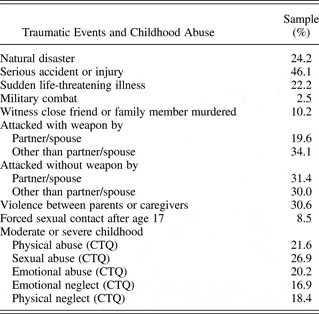
The sample included 1,632 study participants. Because some of the participants did not complete all measures, the number of participants for individual analyses varies. The participants were predominantly female (63.3%) with ages ranging from 18 to 90 years (M = 39.36, SD = 13.64). All participants were African American. The majority of the participants had a low income, with 37.6% reporting a household monthly income less than $500, 26.6% reporting a household monthly income between $500 and $1000, 25.3% reporting a household monthly income between $1000 and $2000; the remaining 10.4% reporting a household monthly income of $2000 or higher. As reported elsewhere (Gillespie et al., Reference Gillespie, Bradley, Mercer, Smith, Conneely and Gapen2009), this sample reports a high level of childhood maltreatment and trauma exposure (see Table 1).
Lifetime rates of traumatic events (n = 1,347)

Note: CTQ, Childhood Trauma Questionnaire.
Measures
Childhood Trauma Questionnaire (CTQ)
The CTQ (Bernstein & Fink, Reference Bernstein and Fink1998; Bernstein et al., Reference Bernstein, Stein, Newcomb, Walker, Pogge and Ahluvalia2003) is a 28-item self-report measure of child maltreatment and neglect assessing five types of maltreatment: sexual, physical, and emotional abuse and emotional and physical neglect. Similar to our previous approach (Bradley et al., Reference Bradley, Binder, Epstein, Tang, Nair and Liu2008) scores were extracted for the categories of emotional, physical, and sexual abuse and physical and emotional neglect. Following Bernstein and Fink's score ranges for none, mild, moderate, and severe levels of abuse, we classified each type of abuse into (a) none/mild range, and (b) moderate/severe range (Bernstein & Fink, Reference Bernstein and Fink1998). We then divided the study participants into groups based on the number of types of abuse and neglect in the moderate to severe range.
Traumatic Events Inventory
Lifetime history of trauma other than childhood maltreatment was assessed using the Traumatic Events Inventory (Bradley et al., Reference Bradley, Binder, Epstein, Tang, Nair and Liu2008; Gillespie et al., Reference Gillespie, Bradley, Mercer, Smith, Conneely and Gapen2009; Schwartz, Bradley, Sexton, Sherry, & Ressler, Reference Schwartz, Bradley, Sexton, Sherry and Ressler2005). This instrument measures lifetime exposure to different categories of trauma, including natural disaster, serious accident or injury, sudden life-threatening illness, military combat, physical assault, and sexual assault. For each category, having had the exposure was scored “1” and no exposure “0.” The childhood abuse items in this inventory were excluded to avoid overlap with the information collected with the CTQ.
Emotional Dysregulation Scale
The Emotional Dysregulation Scale (Bradley et al., in press) is a 24-item self-report scale adapted from the clinician-rated Affect Regulation and Experiences Questionnaire (Westen, Muderrisoglu, Fowler, Shedler, & Koren, Reference Westen, Muderrisoglu, Fowler, Shedler and Koren1997; Westen & Shedler, Reference Westen and Shedler1999a, Reference Westen and Shedler1999b; Zittel Conklin & Westen, Reference Zittel Conklin and Westen2005). Items are scored on a 7-point Likert scale and assess domains of emotional experiencing (e.g., “My emotions sometimes spiral out of control,” “Emotions overwhelm me,” “When I feel angry, I get really angry”), cognition (e.g., “When I'm upset, I have trouble seeing or remembering anything good about myself,” “When I'm feeling bad, I have trouble remembering anything positive; everything just feels bad”), and behavior (e.g., “When my emotions are strong, I often make bad decisions,” “When I'm upset, I sometimes become needy or clingy”). This self-report measure of emotional dysregulation demonstrates high internal consistency (α = 0.97) and relates as expected to a range of psychopathology criterion variables including PTSD, substance abuse problems, depression, suicide history, and subjective sense of adaptive functioning (Bradley et al., in press). A copy of the full measure is available at www.psychsystems.net.
Adult Attachment Prototype Questionnaire
A subset of participants in this study (n = 308), who also participated in the second phase of the study were assessed with respect to current adaptive functioning across multiple domains including interpersonal relationships as well as symptoms of psychiatric disorders. Based on the data gathered in these interviews, participants were rated using the Adult Attachment Prototype Questionnaire (Westen, Nakash, Thomas, & Bradley, Reference Westen, Nakash, Thomas and Bradley2006). This measure provides 5-point Likert ratings of degree of match to secure (“Can rely on the availability and sensitivity of the people they love”), and disorganized/unresolved attachment style prototypes (“Tend to respond to intimate relationships in ways that appear inconsistent, contradictory, or dissociative”). Prior research found predicted relationships between this instrument and adaptive functioning, symptoms of personality disorders and developmental history variables supporting the validity of the measure. Both prior research using the Adult Attachment Prototype Questionnaire (Westen et al., Reference Westen, Nakash, Thomas and Bradley2006) and recent data from our research group indicate strong interrater reliability for this measure (intraclass r = .76).
Genotyping
DNA was extracted from saliva collected into Oragene saliva kits (DNA Genotek Inc., Ontario, Canada) using the Agencourt DNAdvance Kit (Beckman Coulter Inc., Brea, California). Two OTR single nucleotide polymorphisms, rs2254298 and rs53576, were genotyped using Sequenom iPLEX technology (MassARRAY system, Sequenom Inc., San Diego, CA) and Taqman single nucleotide polymorphism genotyping assays (Life Technologies Corp., Carlsbad, CA). rs53576 was genotyped using both Taqman (88.0% call rate) and Sequenom (96.7% call rate) with a 28% across method duplication and a discordance rate of 0.1%. Negative controls and within- and across-plate duplicates were used for quality control. Discordant samples were removed prior to analysis. Genotype frequencies were checked for Hardy–Weinberg equilibrium (χ2 = 1.61, p = .21). The minor allele for rs53576, “A,” occurs with a frequency of 0.21 in African Americans.
Results
Childhood maltreatment and emotional dysregulation
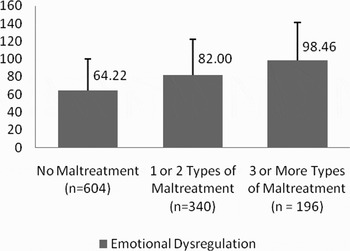
Controlling for gender, age, and household monthly income and total level of nonchildhood abuse trauma exposure, we used univariate analysis of variance to determine if emotional dysregulation levels differed with respect to childhood abuse (coded as a three-level independent variable as described in the Methods Section). Consistent with prior research (Bradley et al., in press) we found a dose–response relationship between childhood maltreatment and emotional dysregulation, F (2, 1133) = 28.84, p < .001 (see Figure 1).
The level of emotional dysregulation by the number of types of child maltreatment. [A color version of this figure can be viewed online at journals.cambridge.org/dpp]

OXTR rs53576 polymorphisms and emotional dysregulation
Controlling for the same variables as above, we evaluated the effect of OXTR rs53576 on level of emotional dysregulation. Data did not support a main effect of OXTR rs53576 on level of emotional regulation, both when OXTR rs53576 was coded as a three-level (AA, AG, GG) genotypic model or as a two-level variable (AA/AG and GG) A carrier model.
Interaction of OXTR rs53576 and childhood maltreatment in predicting emotional dysregulation
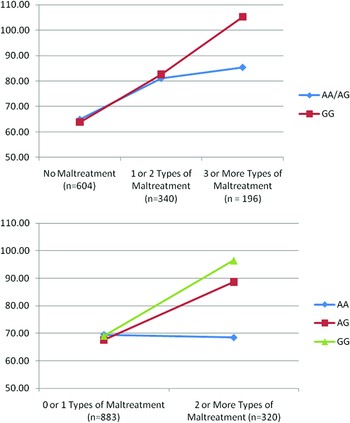
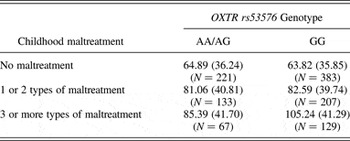
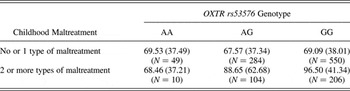
Controlling for gender, age, and household monthly income and total level of nonchildhood abuse trauma exposure, we conducted a univariate analysis of variance with OXTR rs53576, coded as a two-level variable (AA/AG and GG), and childhood maltreatment (0, 1 or 2, and 3 or more types) as independent variables (see Table 2). Results indicated a significant interaction of these two variables in predicting level of emotional dysregulation, F (2, 1130) = 4.85, p = .008 (see Figure 2). Because of the low number of individuals with the AA genotype in our sample, we used nonparametric statistics to examine an interaction between the three-level genetic variable (AA, AG, GG) and emotional dysregulation. We also collapsed the abuse variable into a two-level variable (no or one type of abuse vs. two or more abuse types; see Table 3). Specifically, we divided the sample by genotype and used Mann–Whitney U test to look for an effect of abuse on level of emotional dysregulation at each level of the genotype variable. For the AA genotype, there was no significant difference in level of emotional dysregulation with respect to level of childhood maltreatment (z = 0.05, p = .96). However, for both the AG genotype (z = 4.35, p < .001) and the GG genotype (z = 8.08, p < .001), there were significant differences in the degree of emotional dysregulation with respect to level of childhood maltreatment (see Figure 2) Thus, persons who carried the G allele were at an allele-dose dependent risk to develop emotional dysregulation relative to child maltreatment, whereas AA carriers appear to be protected.
The interaction of the oxytocin receptor gene OXTR rs53576 and childhood maltreatment predicts the level of emotional dysregulation. [A color version of this figure can be viewed online at journals.cambridge.org/dpp]

Mean of emotional dysregulation for AA/AG and GG genotype across level of childhood maltreatment

Mean of emotional dysregulation for AA, AG, and GG genotypes across level of childhood maltreatment

Childhood maltreatment and adult attachment
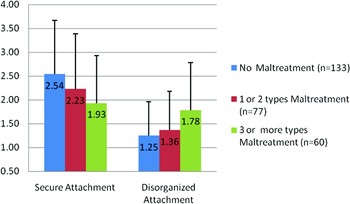
Controlling for gender, age, and household monthly income, we used univariate analysis of variance to determine if rating on level of match to both the secure attachment prototype and the disorganized attachment prototype differed with respect to childhood abuse (coded as a three-level independent variable as described in the Methods section). Consistent with prior research (see, e.g., Cyr et al., Reference Cyr, Euser, Bakermans-Kranenburg and van IJzendoorn2010), we found a dose–response relationship between childhood maltreatment and decreased level of the secure attachment prototype, F (2, 263) = 6.71, p = .001, as well as a positive association with the disorganized attachment prototype, F (2, 264) = 5.39, p < .001 (see Figure 3).
Secure and disorganized attachment ratings across levels of childhood maltreatment. [A color version of this figure can be viewed online at journals.cambridge.org/dpp]

OXTR rs53576 polymorphism and adult attachment
Controlling for gender, age, and household monthly income, we used univariate analysis of variance to determine if ratings that match the secure attachment prototype or the disorganized attachment prototype were associated to genotype. Data did not support differences in level of either secure attachment or disorganized attachment as a function of OXTR rs53576 coded as a two-level variable (AA and AG). Similarly, data did not support differences in level of either secure attachment or disorganized attachment (with OXTR rs53576 coded as a three-level variable (AA, AG and GG).
Interaction of OXTR rs53576 and childhood maltreatment in predicting adult attachment
Because we had attachment data on only a subset of individuals in the sample and because attachment data are not normally distributed, we conducted nonparametric analysis using the two-level genotype variable (AA/AG and GG) and a two-level maltreatment variable (no abuse or one type of abuse vs. two or more abuse types).
Secure attachment
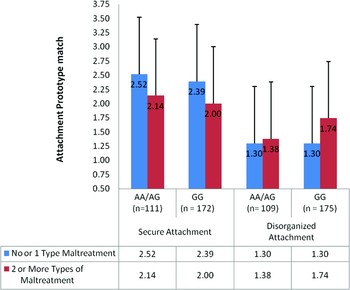
We divided the sample by genotype and used Mann–Whitney U test to look for an effect of abuse on level of secure attachment rating at each level of the genotype variable. For the AA/AG combined genotypes there was no significant difference in level of secure attachment with respect to level of childhood maltreatment (z = 1.50, p = .13). However, for the GG genotype, there was a significant difference in secure attachment with respect to childhood maltreatment (z = 2.27, p = .02). Specifically, GG carriers with two or more types of childhood maltreatment were rated as having lower levels of secure attachment compared to GG carriers with no or mild exposure (see Figure 4).
The relationship of genotype to secure and disorganized attachment ratings across the level of childhood maltreatment. [A color version of this figure can be viewed online at journals.cambridge.org/dpp]

Disorganized attachment
We divided the sample by genotype and used Mann–Whitney U test to look for an effect of abuse on level of disorganized attachment rating at each level of the genotype variable. For the AA/AG genotypes there was no significant difference in level of disorganized attachment with respect to level of childhood maltreatment (z = 0.28, p = .78). However, for the GG genotype, there was a significant difference in disorganized attachment with respect to childhood maltreatment (z = 3.46, p = .001). Specifically, GG carriers with two or more types of childhood maltreatment were at higher risk to show disorganized attachment, compared to GG carriers with no or mild exposure (see Figure 4).
The relationship of childhood maltreatment, attachment, and emotional dysregulation across the OXTR rs53576 genotype
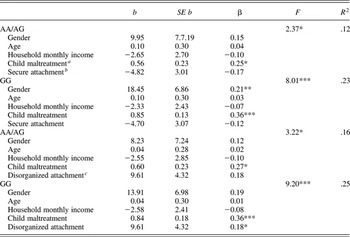
One question raised by the above data as well as the theoretical and research literature is whether or not the relationship of childhood maltreatment with emotional dysregulation is accounted for by attachment. As one way of addressing this question we conducted a series of linear regressions to examine associations of childhood maltreatment and attachment ratings with emotional dysregulation. Given the differences in the relationship of these variables based on the OXTR rs53576 genotype, we divided the sample using the two-level genotype variable (AA/AG and GG) before we conducted these analyses. Although the selected predictor variables were significantly correlated, the relationships were far from large enough in effect to create concerns about multicollinearity or variance inflation within a regression model (O'Brien, Reference O'Brien2007). In each regression, gender, age, and household monthly income were entered in the first step of the model to control for demographic variations. We then entered childhood maltreatment in the second step and attachment prototype rating (either secure or disorganized) in the final step in order to examine its incremental validity to each predictive model. Table 4 presents results from the third-step overall model of each linear regression. Across all models, the first step (demographic variables) did not account for a significant amount of variance in emotional dysregulation.
Association of childhood maltreatment and attachment ratings with emotional dysregulation across the AA/AG genotypes and the GG genotype of OXTR rs53576

aChild Trauma Questionnaire total score.
bSecure attachment prototype rating.
cDisorganized attachment prototype rating.
*p < .05. **p < .01. ***p ≤ .001.
Secure attachment
In the models that included the secure attachment prototype ratings, the second step (child maltreatment) accounted for a significant amount of the variance, over and above the demographic variables, for both the AA/AG and the GG genotypes. Specifically, for the AA/AG genotypes, childhood maltreatment accounted for an additional 5% of the variance, F (1, 85) = 6.58, p = .01; for the GG genotype, childhood maltreatment accounted for an additional 19% of the variance, F (1, 139) = 24.95, p < .001. In these models, the addition of the secure attachment ratings in the third step did not account for a significant increase in variance for either the AA/AG genotypes or the GG genotype.
Disorganized attachment
In the models that included the disorganized attachment prototype ratings, the second step (child maltreatment) accounted for a significant amount of the variance over and above the demographic variables. Specifically, for the AA/AG genotypes, childhood maltreatment accounted for an additional 8% of the variance, F (1, 83) = 7.19, p = .009, and for the GG genotype, the addition of childhood maltreatment accounted for an additional 16% of the variance, F (1, 141) = 28.40, p < .001. However, in the third step, the rating of disorganized attachment style only accounted for a significant increase in variance in the GG genotype, but not the AA/AG genotypes. Specifically, for the GG genotype, the addition of attachment disorganization accounted for an additional 3% of the variance, F (1, 140) = 4.94, p = .03.
The above analyses indicate that the relationship between childhood maltreatment and emotional dysregulation is not accounted for by attachment style for either the AA/AG or the GG genotypes of OXTR rs53576. Consistent with theory and previous research findings reporting a strong inverse relationship between childhood maltreatment and secure attachment, it is not surprising that in our study the secure attachment rating did not account for a significant amount of variance in emotional dysregulation after accounting for total level of child maltreatment. With respect to disorganized attachment we did find that, for the GG genotype of OXTR rs53576, disorganized attachment rating accounted for a small (3%) but statistically significant amount of variance in emotional dysregulation over and above the total level of childhood maltreatment.
Discussion
We found no direct relationship between oxytocin receptor polymorphism rs53576 and emotional dysregulation or ratings of adult attachment style. However, we found that an interaction between rs53576 and childhood maltreatment predicted emotional dysregulation, such that G allele carriers were at risk for increased emotional dysregulation when exposed to three or more categories of childhood abuse. Among participants who reported two or more types of childhood maltreatment, level of disorganized adult attachment was higher and level of secure adult attachment was lower in GG individuals compared to AA/AG individuals. Thus, in contrast to other studies that found that GG individuals were at lowest risk (Bakermans-Kranenburg & van IJzendoorn, Reference Bakermans-Kranenburg and van IJzendoorn2008; Rodrigues et al., Reference Rodrigues, Saslow, Garcia, John and Keltner2009), our findings suggest that, in the context of multiple types of childhood maltreatment, the AA carriers and to some extent the AG carriers were more resilient than the GG carriers.
The data from this sample suggest that genetic variants in OXTR rs53576 that have previously been shown to predict “risk” (AA/AG) appear to confer “resilience.” Likewise, data indicate that the GG variant that has previously conferred “resilience” confers “risk” in our sample. In a study of college students, GG individuals demonstrated higher levels of empathy and lower levels of stress reactivity as compared to AA or AG individuals (Rodrigues et al., Reference Rodrigues, Saslow, Garcia, John and Keltner2009). Bakermans-Kranenburg and van IJzendoorn (Reference Bakermans-Kranenburg and van IJzendoorn2008) found that the AA/AG genotypes were associated with lower levels of sensitive parenting compared to the GG genotype. Data from Wu and colleagues (2005) have indicated increased risk for autism in the individuals with the A allele (AA/AG) compared to those with the GG genotype.
There is some prior research (Kim et al., Reference Kim, Sherman, Sasaki, Xu, Chu and Ryu2010) suggesting that the effect of OXTR rs53576 genotype varies depending on both sociocultural factors and level of stress. Specifically, this research found that in a sample of European American participants, those with either the AG or the GG genotypes of OXTR rs53576 sought social support from others in the face of high distress. However, they did not find this same relationship in distressed Korean participants. They also found that under conditions of low distress, seeking support did not differ across OXTR rs53576 genotype for either the American or the Korean samples. Thus, they concluded that culture in combination with genetic influences impacted the decision to seek social support. Although our sample was relatively homogeneous with respect to both race/ethnicity and socioeconomic status, our data were consistent with this research in that the effect of OXTR rs53576 was present at high levels of stress, that is, childhood maltreatment. Of note, our results are also consistent with other Gene × Environment (G × E) studies (Binder et al., Reference Binder, Bradley, Liu, Epstein, Deveau and Mercer2008; Bradley et al., Reference Bradley, Binder, Epstein, Tang, Nair and Liu2008; Ressler et al., Reference Ressler, Bradley, Mercer, Deveau, Smith and Gillespie2010) that found that the effect of genotype on risk or resilience was strongest in the individuals reporting multiple types of childhood maltreatment. This finding is consistent with the data from adverse child experiences studies (Anda et al., Reference Anda, Felitti, Bremner, Walker, Whitfield and Perry2006) showing a dose–response relationship between number of types of adverse childhood experiences and a wide range of physical and mental health outcomes in adulthood.
Other research on oxytocin has found that its impact on prosocial behavior varied with respect to both individual and environmental characteristics. Specifically, recent research on the role of oxytocin and social behavior has suggested that oxytocin increases the perceived salience of social cues (Bartz et al., Reference Bartz, Zaki, Bolger, Hollander, Ludwig and Kolevzon2010; Shamay-Tsoory et al., Reference Shamay-Tsoory, Fischer, Dvash, Harari, Perach-Bloom and Levkovitz2009). Although this may confer adaptive functioning in supportive developmental environments, in environments marked by childhood maltreatment, particularly multiple types of childhood maltreatment, this sensitivity to social context may be a liability. The assumption underlying “normal” attachment processes is that proximity to the caregiver supports emotional regulation (Mikulincer, Shaver, & Pereg, Reference Mikulincer, Shaver and Pereg2003). However, in interactions with an abusive caregiver, a tendency to seek proximity may lead to further distress and undermine the ability to regulate emotions. Related research using cortisol levels as a marker of stress response finds that early life/childhood insecure and disorganized attachment predicts cortisol elevation in response to stress (Borelli et al., Reference Borelli, Crowley, David, Sbarra, Anderson and Mayes2010; Gunnar, Mangelsdorf, Larson, & Hertsgaard, Reference Gunnar, Mangelsdorf, Larson and Hertsgaard1989; Hertsgaard, Gunnar, Erickson, & Nachmias, Reference Hertsgaard, Gunnar, Erickson and Nachmias1995; Schieche & Spangler, Reference Schieche and Spangler2005). One of the hallmarks of disorganized/unresolved attachment is unstable representations of the self and others. In the case of childhood maltreatment, caregivers are intermittently and inconsistently comforting and threatening, and increased attunement and sensitivity to this type of environment/social context might lead to increased risk for a disorganized/unresolved attachment style. Specifically, data suggest that abuse-related parenting behaviors, including threatening, frightening, frightened and dissociative behaviors, as well as withdrawal and inappropriate emotional responsiveness are associated with increased risk for a disorganized attachment style in children (Abrams, Rifkin, & Hesse, Reference Abrams, Rifkin and Hesse2006; Madigan et al., Reference Madigan, Bakermans-Kranenburg, van IJzendoorn, Moran, Pederson and Benoit2006; Schuengel et al., Reference Schuengel, Bakermans-Kranenburg and van IJzendoorn1999; van IJzendoorn et al., Reference van IJzendoorn, Schuengel and Bakermans-Kranenburg1999).
Initial efforts by psychological researchers to understand the interaction of candidate genes and environment focused on determining which genetic variants were associated with increased vulnerability in the face of negative environmental influences (e.g., stress, trauma, and childhood abuse). More recent work in this area has posited the idea of “differential susceptibility” to environment (Belsky et al., Reference Belsky, Jonassaint, Pluess, Stanton, Brummett and Williams2009; Belsky & Pluess, Reference Belsky and Pluess2009). This theory suggests that the same genetic factors that impact sensitivity and susceptibility to negative/adverse environmental influences also impact sensitivity to positive/enriching environmental influences. Thus, the same individuals who are most susceptible to adverse environmental experiences are also the most likely to respond to enriching/positive environmental influences (Belsky et al., Reference Belsky, Jonassaint, Pluess, Stanton, Brummett and Williams2009; Belsky & Pluess, Reference Belsky and Pluess2009). As an example of this, recent research found differential susceptibility to parenting dependent on the presence of the 7-repeat dopamine receptor D4 (DRD4) allele (Bakermans-Kranenburg & van IJzendoorn, Reference Bakermans-Kranenburg and van IJzendoorn2007). Specifically, children with “insensitive mothers” and the 7-repeat DRD4 allele displayed higher levels of externalizing behaviors, whereas children with the DRD4 7-repeat polymorphism and “sensitive mothers” displayed lowers levels of externalizing behavior problems (Bakermans-Kranenburg, van IJzendoorn, Pijlman, Mesman, & Juffer, Reference Bakermans-Kranenburg, van IJzendoorn, Pijlman, Mesman and Juffer2008). Furthermore, this research group found that externalizing behaviors of children with the DRD4 7-repeat allele were more susceptible to experimentally induced changes in maternal discipline (Bakermans-Kranenburg et al., Reference Bakermans-Kranenburg, van IJzendoorn, Pijlman, Mesman and Juffer2008) and that children with the DRD4 7-repeat allele showed lower levels of daily cortisol in response to a parenting intervention designed to increase positive discipline and sensitive parenting. Similarly, Leve and colleagues (Reference Leve, Harold, Ge, Neiderhiser, Shaw and Scaramella2009) examined genetic differences in response to parenting interventions among high risk children. They found that the effects of structured parenting behavior differed based on child genetic risk such that those children at highest genetic risk also showed a more positive response to parenting interventions as compared to children at low genetic risk.
Following the differential susceptibility model, it is possible that, while in the context of more positive/enriching and even neutral environments, the GG genotype of OXTR rs53576 may confer increased resilience with respect to prosocial or empathic behaviors, whereas in a stressful or threatening context such as that likely to be associated with multiple types of childhood maltreatment, this same sensitivity to environment may confer risk. This might be even more likely if the effect of OXTR rs53576 genotype is particularly associated with sensitivity to social and interpersonal context given that child maltreatment often occurs in the context of primary attachment relationships. Research on the impact of traumatic experiences has focused consistently on their impact on the fight, flight, or freeze “fear response” mechanism associated with exposure to threat. However, parent–child attachment behaviors and associated biological systems are also core threat response mechanisms that promote social affiliation in response to stress. Translational research conducted by Sullivan and colleagues (Moriceau, Roth, & Sullivan, Reference Moriceau, Roth and Sullivan2010; Moriceau, Shionoya, Jakubs, & Sullivan, Reference Moriceau, Shionoya, Jakubs and Sullivan2009) has demonstrated that early life stress simultaneously activates both attachment and fear neural systems and that this combined fear/attachment learning circuit involves a cascade of events beginning with cortisol release in response to stress. For example, one recent study by this group found that rat pups raised in experimentally induced “abusive attachment” compared to normal pups demonstrated increased amygdala activity in response to maternal odor following a corticosterone injection (Raineki, Moriceau, & Sullivan, Reference Raineki, Moriceau and Sullivan2010).
Limitations
The primary limitations for this study are associated with the use of cross-sectional data and retrospective data collection. Longitudinal studies are needed to examine the developmental relationship of genetic risk, early life stressors, emotion dysregulation, and psychopathology. This study relies on self-report of childhood abuse and emotional dysregulation. Although there are limitations to this method of assessment, we used a well-validated self-report instrument that has been used in many other studies including other G × E studies, which allows data from this study to be compared with other research. Research evaluating biomarkers (e.g., genetic data, imaging data) related to variants in the OXTR genotype, levels of oxytocin, response to oxytocin administration, as well emotion dysregulation and attachments are needed to best understand the interaction between these factors and processes. In addition, this research was conducted in a homogeneous sample with respect to both race and income, making it important to consider the possibility that factors specific to this low income, urban, primarily African American sample may relate to the results of the study. Nonetheless, our sample represents a population at very high risk for trauma exposure and associated adverse outcome (e.g., depression, substance use disorders, PTSD). Thus, the data have valuable potential for informing broader public health policies and practices. In addition, this should be considered a preliminary study, and replication in other samples is needed.
Research and policy implications
The data from this study suggest that under adverse childhood circumstances a variant in an OXTR gene that has been previously associated with adaptive social behaviors is associated with increased risk for adult disorganized/unresolved attachment. Although this specific finding is preliminary and in need of replication, it is consistent with research indicating that our understanding of developmental neurobiology and risk/resilience needs to take social context into account. The data collected in this study were the result of a study focused on risk and resilience to trauma exposure in a highly traumatized sample of low-income African American men and women living in an urban environment. Data collected in other samples will need to take into account not only differences in outcomes associated with a given genotype but also the social environment of the participants. Similarly, there is a need to continue to conduct translational research that focuses on understanding the impact of environmental influences on developmental neurobiology. In particular, translational research that focuses on circumstances that lead to the activation of both fear response systems and attachment response systems is indicated. With respect to intervention, these data suggest the importance of interventions that support positive parent–child interactions including ones that are directly focused on improving attachment (Juffer, Bakermans-Kranenburg, & van IJzendoorn, Reference Juffer, Bakermans-Kranenburg and van IJzendoorn2008; MacMillan et al., Reference MacMillan, Wathen, Barlow, Fergusson, Leventhal and Taussig2009; Stolk et al., Reference Stolk, Mesman, van Zeijl, Alink, Bakermans-Kranenburg and van IJzendoorn2008).
To the extent that these data are consistent with differential susceptibility to environment, these types of interventions may be the most effective for the most vulnerable children. Programs identifying children who are “at risk” in early childhood may then be a good way to identify those children and parents who would be most likely to benefit from intervention. In addition, although some preliminary data have suggested that “at-risk” children and their parents may be more responsive to parenting interventions, there is a possibility that children with higher levels of susceptibility/plasticity to environment (who are thus potentially at highest risk in the face of adverse environments) may also be responsive to other environmental interventions (e.g., school or community interventions). In general, research on childhood maltreatment has not taken into account other factors present in the family or community that might serve to mitigate the impact of adverse experiences/maltreatment. For example, recent research (Kinnally et al., Reference Kinnally, Huang, Haverly, Burke, Galfalvy and Brent2009) found that in a sample of adult female participants, higher levels of perceived parental care mitigated the effect of childhood stress on aggression/impulsivity among both low-expressing and heterozygous monoamine oxidase A upstream variable number tandem repeat (MAOA-uVNTR) allele carriers but did not show an effect in the group homozygous for the high-expressing MAOA-uVNTR allele.
The clear data on the broad ranging, lifelong negative impact of early life adverse experiences underscore the importance of developing effective interventions. The most effective interventions will be those that are based on research focused in identifying the psychosocial and neurobiological processes underlying the association between adverse childhood experiences and later risk and resilience (Cicchetti & Gunnar, Reference Cicchetti and Gunnar2008). Such research should include a focus on interactive neurobiological processes associated with both attachment and response to threat. Effective strategies will also work toward determining which environments and interventions mitigate the impact of adverse experiences and for which individuals these environments and interventions might be the most effective.